
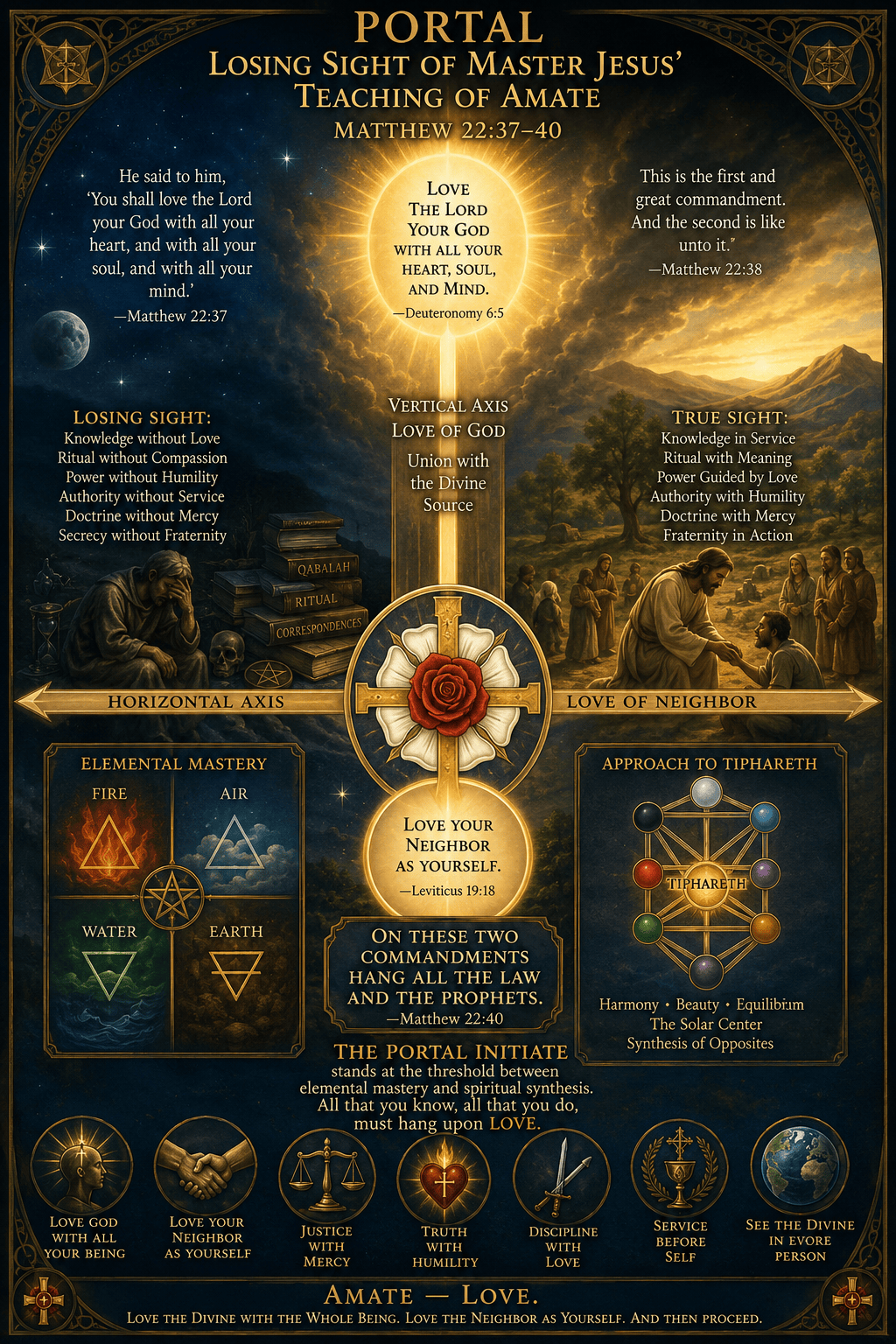
There comes a point upon the initiatory path when the student must confront a disturbing possibility.
It is possible to acquire knowledge and yet become less wise.
It is possible to master ritual and yet become less compassionate.
It is possible to memorize Divine Names, trace pentagrams with precision, understand the Sephiroth, planets, elements, Tarot Keys, Hebrew letters, and occult correspondences—and nevertheless lose sight of the principle for which all of these things were intended.
It is possible, in other words, to become accomplished in the forms of the Mysteries while gradually forgetting their heart.
For the Portal initiate this is an especially serious danger.
The Portal is a threshold. Behind the candidate lies the differentiated elemental curriculum of the Outer Order. Ahead lies the symbolism of Tiphareth, equilibrium, sacrifice, regeneration, and the deeper mysteries of the Adept. The initiate therefore stands at an intermediate place: possessing more knowledge than the beginner, but not yet entitled to confuse knowledge with realization.
And it is precisely at such a threshold that we should return to one of the simplest teachings attributed to Master Jesus:
Love. For the purposes of this lecture I shall call this the teaching of Amate.
We should, however, begin with a philological clarification. Amate is Latin, the plural imperative of amare: “Love!” or “You all, love!” It is an appropriate symbolic title for the teaching, but it is not the actual Latin wording of Matthew 22:37–40. Jerome’s Vulgate reads Diliges Dominum Deum tuum—“You shall love the Lord your God”—and Diliges proximum tuum, sicut teipsum—“You shall love your neighbor as yourself.” The underlying Greek in Matthew employs agapēseis, from agapaō, in both commandments. (Bible Gateway)
Thus Amate is best understood here not as a quotation but as an initiatory summons:
Love.
And the question placed before the Portal initiate is whether, somewhere amid the accumulation of occult knowledge, we have ceased to hear it.
The Question Placed Before Jesus
Matthew situates the teaching during the final Jerusalem controversies.
Jesus has entered the city. His authority is being questioned. Priests, elders, Pharisees, Sadducees, and interpreters of Torah engage him in a succession of disputes. Matthew 22:34–40 describes an expert in the Law approaching Jesus with a question intended to test him:
“Teacher, which commandment in the law is the greatest?”
The question arises entirely within Jewish discourse. Jesus does not respond by rejecting Torah, nor does he replace Judaism with a new Christian ethic. Instead, his answer consists of two passages already contained within Torah itself.
The first comes from Deuteronomy 6:5:
“You shall love the Lord your God with all your heart, and with all your soul, and with all your mind.”
The second comes from Leviticus 19:18:
“You shall love your neighbor as yourself.”
Jesus then adds the extraordinary interpretive declaration:
“On these two commandments hang all the law and the prophets.”
The importance of this statement cannot be overstated.
Jesus has not abolished the Law.
He has identified its center of gravity.
He has not offered two pleasant spiritual recommendations among many others.
He has declared that the entire religious structure must ultimately be suspended from these two principles. Modern Matthean scholarship consistently recognizes that Matthew presents love of God and neighbor as an interpretive center from which the larger scriptural tradition is to be understood. (SciELO)
The Greek verb in Matthew 22:40 is krematai: the Law and the Prophets “hang,” “depend,” or are suspended upon these commandments.
Picture a great temple lamp suspended from two chains.
Remove either chain and the lamp falls.
So also, Jesus implies, a religious system from which either love of God or love of neighbor has been removed can no longer bear the weight of revelation.
That image ought to trouble every initiate.
For exactly the same danger exists within esotericism.
We may preserve the structure while losing that upon which the structure hangs.
“Hear, O Israel”
The first commandment cited by Jesus comes from the Shema, one of the foundational affirmations of Jewish religious life.
Deuteronomy declares:
“Hear, O Israel: the LORD our God, the LORD is one.”
And then:
“You shall love the LORD your God with all your heart, and with all your soul, and with all your might.”
The Septuagint—the ancient Greek translation of the Hebrew Scriptures—already renders this command with agapēseis, the same verbal form that appears in Matthew. (Biblindex)
Matthew’s version names heart, soul, and mind. Deuteronomy’s Hebrew expression and the Septuagint’s Greek wording are not identical to Matthew’s formulation, and the Synoptic Gospels themselves preserve slightly different forms. We should therefore avoid constructing an elaborate occult anatomy in which “heart,” “soul,” “mind,” and “strength” correspond to four neatly separated metaphysical substances.
Biblically, the force of the expression is totality.
Love God with the whole person.
With thought.
With desire.
With intention.
With vitality.
With memory.
With choice.
With everything by which you can truthfully say, “I am.”
This is covenantal love rather than fleeting emotion.
And this distinction matters profoundly to the initiate.
Love, in this teaching, cannot be reduced to sentimentality.
One may experience no pleasant emotion whatsoever and still act in love.
One may feel affection and nevertheless act selfishly.
Biblical love possesses volitional, ethical, relational, and covenantal dimensions. It appears in what one chooses, serves, protects, honors, refuses to betray, and places at the center of life.
This immediately places pressure upon the magician’s conception of Will.
What does it mean to develop Will if the will itself has never learned what it ought to love?
An intensified ego is not the Higher Will.
An amplified desire is not spiritual attainment.
The capacity to concentrate does not tell us what deserves concentration.
Power cannot supply its own ethical destination.
Thus Jesus places love before technique.
“And the Second Is Like Unto It”
The second command comes from Leviticus 19:18.
Its original context is remarkably practical.
The verse does not float in abstraction. It appears amid commandments concerning social relationships, justice, honesty, treatment of the vulnerable, economic conduct, resentment, retaliation, and communal responsibility.
Immediately before “love your neighbor as yourself,” Leviticus prohibits vengeance and the bearing of grudges. The command to love one’s neighbor therefore belongs to a concrete ethic of human relationship. (StudyLight)
This is critical.
Jesus does not say:
“Possess loving thoughts about humanity.”
He cites a command emerging from the difficult terrain of living with actual human beings.
Neighbors irritate us.
Neighbors disagree with us.
Neighbors disappoint us.
Neighbors compete with us.
Neighbors sometimes injure us.
And it is there—not merely in meditation before an altar—that the quality of our spiritual realization becomes visible.
The ritual chamber is controlled.
Human relationship is not.
Anyone can cultivate serenity when incense is burning, candles are aligned, the Temple is silent, and everyone present observes the rubric.
The test occurs when another human being contradicts us.
The test occurs when authority is challenged.
The test occurs when we are criticized unfairly.
The test occurs when our pride is wounded.
The test occurs when forgiveness becomes costly.
The test occurs when we possess power over another person.
That is where initiation becomes real.
“As Yourself”
The phrase “love your neighbor as yourself” has sometimes been transformed into the modern psychological assertion that one must first possess adequate self-esteem before loving others.
That may be a useful psychological insight in particular contexts, but it should not simply be inserted into the ancient text.
The command assumes the ordinary human tendency to seek one’s own welfare and uses that instinct as the measure of responsibility toward another.
Attend to your neighbor’s good with the seriousness with which you instinctively attend to your own.
Protect another’s dignity as you protect yours.
Take another’s suffering seriously.
Do not reduce another human being to a function in your private drama.
And for the esoteric initiate there is an even sharper implication.
Do not treat people as correspondences.
Do not treat students as extensions of your authority.
Do not treat initiates of lower grade as spiritually inferior human beings.
Do not treat those outside the tradition as “profane” in a manner that permits contempt.
Do not mistake possession of specialized vocabulary for possession of superior consciousness.
The person standing before you remains an image-bearing mystery greater than the category into which you have placed them.
Love of God and Love of Neighbor Cannot Be Separated
Jesus calls the second commandment “like” the first.
That word is decisive.
The two commandments are distinguishable, but they cannot finally be divorced.
The vertical relationship and the horizontal relationship test one another.
One may claim extraordinary devotion to God while behaving cruelly toward other people.
Jesus does not permit such devotion to remain unquestioned.
Conversely, one may speak eloquently of universal humanity while refusing all orientation toward transcendence, holiness, truth, or accountability beyond the individual ego.
The Matthean teaching holds the two together.
Love rises toward God.
Love extends toward the neighbor.
And each becomes evidence concerning the authenticity of the other.
Here the Rosicrucian imagination may contemplate the Cross.
This is not an historical interpretation of Matthew; it is an initiatory meditation upon the text.
The vertical axis may be contemplated as the movement of consciousness toward the Divine: the creature remembering its Source.
The horizontal axis may be contemplated as the extension of that realized Divine relationship into human life: mercy, justice, patience, fraternity, and service.
Where the two meet is the center.
And within a Golden Dawn–Rosicrucian symbolic framework, the Portal initiate stands precisely before the mystery of such a center.
The Portal and the Danger of Spiritual Accumulation
The Portal Grade represents synthesis.
The initiate has passed through the elemental Grades and approaches the mystery represented by Spirit and, beyond the threshold, the equilibrating solar symbolism associated with the Adept work.
Golden Dawn source material preserved through Israel Regardie’s compilation presents Portal as the transitional stage between the elemental work of the Outer Order and the Adept mysteries that follow. (Interactive Atlas)
But every synthesis creates a temptation.
Once we have learned many things, knowledge itself can become identity.
“I know the correspondences.”
“I know the ritual.”
“I know the secret pronunciation.”
“I know the hidden doctrine.”
“I possess the grade.”
“I hold the office.”
“I have authority.”
And gradually an initiatory instrument becomes a personality structure.
The candidate begins by seeking illumination and ends by protecting status.
This is one of the most subtle forms of losing sight of Amate.
The occultist may become fascinated with hierarchies while forgetting fraternity.
Fascinated with power while forgetting service.
Fascinated with purity while forgetting mercy.
Fascinated with secret doctrine while forgetting ordinary kindness.
Fascinated with magical Will while forgetting the neighbor.
Fascinated with ascending the Tree while becoming increasingly difficult to live with on Earth.
If this happens, initiation has turned backward.
The Temple has become another architecture of the ego.
When Severity Loses Mercy
The Portal initiate has encountered forces represented symbolically by the elements, planets, Sephiroth, and the balancing principles of the Tree.
One of the temptations accompanying such study is to make metaphysical categories into excuses for personal behavior.
Cruelty becomes “Geburah.”
Emotional coldness becomes “discernment.”
Domination becomes “Will.”
Avoidance becomes “detachment.”
Vanity becomes “solar consciousness.”
Possessiveness becomes “devotion.”
And spiritual pride becomes “recognition of one’s grade.”
The tradition becomes dangerous at precisely the point where symbolic language protects the personality from moral examination.
Jesus’ commandment dismantles this defense.
Whatever name we give our behavior, we must eventually ask:
Does this action express love of God?
Does it express love of neighbor?
Does it protect truth?
Does it preserve dignity?
Does it seek another’s genuine good?
Does it require me to treat someone merely as an instrument of my own desire?
These questions cannot answer every ethical dilemma automatically. Love is not permissiveness. Love does not forbid discipline, boundaries, correction, judgment, or consequences.
The Gospel of Matthew itself contains teachings about reconciliation, accountability, communal discipline, hypocrisy, justice, and judgment.
But discipline stripped of love becomes domination.
Truth stripped of love becomes a weapon.
Authority stripped of love becomes tyranny.
And esoteric knowledge stripped of love becomes spiritual ornamentation.
“On These Two Hang All the Law and the Prophets”
Matthew’s concluding statement is perhaps the most important sentence for our purpose.
Jesus does not merely say that these commandments are important.
He says everything hangs upon them.
This is an interpretive principle.
A commandment may be technically observed and spiritually violated.
A ritual may be performed flawlessly while its purpose is contradicted by the person performing it.
A Temple may preserve every rubric and nevertheless fail to embody what the Temple represents.
This is why “correctness” cannot be the final measure of initiation.
There are necessary forms.
There are standards.
There are obligations.
There is discipline.
There is knowledge that must actually be learned.
But none of these is self-justifying.
The question remains:
Upon what do they hang?
Matthew answers:
Love of God.
Love of neighbor.
This places an uncomfortable responsibility upon every initiate who holds authority.
The higher the grade, the greater the obligation.
The office does not exist to magnify the officer.
Knowledge does not exist to separate the knower from the supposedly ignorant.
Initiation does not grant permission to become less humane.
Quite the opposite.
If initiation is genuine, the initiate should become increasingly capable of seeing.
Seeing complexity.
Seeing suffering.
Seeing consequences.
Seeing one’s own shadow.
Seeing the dignity of the person who cannot advance one’s ambitions.
Seeing the humanity of one’s adversary.
Seeing when a doctrine is being used to excuse selfishness.
And seeing the Divine precisely where the ego would prefer not to find It.
The Forgotten Test of Adeptship
What, then, might constitute one of the hidden tests of the Portal?
Not merely:
Can you invoke?
Can you banish?
Can you trace the symbols?
Can you explain the Tree?
Can you identify the Tarot correspondences?
Can you recite the Knowledge Lectures?
Those questions have their place.
But there is another examination.
What happens when someone beneath your grade makes a better argument than you?
What happens when you must apologize?
What happens when recognition is given to another?
What happens when someone cannot repay your kindness?
What happens when a person leaves your group?
What happens when someone opposes you?
What happens when you acquire information that could humiliate another?
What happens when you have enough authority to punish?
What happens when no one would know whether you chose mercy?
These moments may reveal more about initiation than any written examination.
The knowledge test tells us what the candidate remembers.
The ethical test reveals what the candidate has become.
Agapē Is Not Weakness
Because love is often sentimentalized, some initiates may assume that an emphasis upon love weakens the severity required by authentic spiritual training.
It does not.
Biblical agapē is demanding.
To love God with the whole being is severe.
It requires the reordering of desire.
To love the neighbor as oneself is severe.
It prohibits many cherished forms of selfishness.
To forgive is difficult.
To confront injustice without hatred is difficult.
To speak truth without cruelty is difficult.
To maintain boundaries without vengeance is difficult.
To correct another without secretly enjoying superiority is difficult.
To serve without demanding recognition is difficult.
Love is not the absence of strength.
Love is strength brought under moral government.
This is one reason the teaching belongs profoundly at Portal.
The elemental forces must not merely be awakened.
They must be reconciled.
Fire without love becomes destruction.
Water without love becomes possessiveness or emotional engulfment.
Air without love becomes sterile abstraction or intellectual cruelty.
Earth without love becomes materialism, rigidity, and self-preservation.
Spirit does not simply add a fifth power to four others.
Spirit must order them toward unity.
The Approach Toward Tiphareth
Within the Hermetic Qabalistic map employed by the Golden Dawn tradition, the Portal candidate prepares for the mysteries associated with Tiphareth.
Tiphareth is Beauty, harmony, equilibrium, mediation, the solar center, and within Christianized Hermetic interpretation becomes deeply associated with sacrificial and redemptive symbolism.
Therefore the teaching of Matthew 22:37–40 is exceptionally appropriate at this threshold.
One cannot meaningfully approach the symbolism of the sacrificed and risen center while nurturing contempt.
One cannot speak solemnly of the Higher Genius while refusing ordinary decency.
One cannot invoke the Divine Names of harmony while deliberately generating discord for personal advantage.
One cannot seek union above while producing unnecessary division below.
The Solar Mysteries demand something greater than brilliance.
They demand integration.
And love is integrative.
Love takes what ego continually divides—self and other, sacred and ordinary, Temple and world—and asks whether one spiritual law governs them all.
This may be the deeper meaning of Jesus’ statement that the whole Law and Prophets hang upon the two commandments.
The spiritual life cannot finally be compartmentalized.
The same person who stands before the altar must eventually stand before the neighbor.
Losing Sight of the Master
There is a particular danger within esoteric Christianity.
The initiate may become so fascinated with the cosmic Christ that the historical teachings of Jesus become secondary.
We may discuss Logos theology, solar symbolism, Tiphareth, the Mystical Rose, resurrection consciousness, sacred geometry, Qabalistic correspondences, angelic hierarchies, and the mysteries of the Christos.
All of these may possess value within their proper domains.
But we should occasionally ask a devastatingly simple question:
What did Jesus tell people to do?
Love God.
Love the neighbor.
Reconcile.
Forgive.
Practice mercy.
Seek justice.
Care for the vulnerable.
Do not make public spirituality a theater of vanity.
Do not confuse status with holiness.
Judge yourself before obsessively judging others.
Let the inner condition and the outer act become one.
If our esotericism succeeds in making Jesus more cosmologically impressive but his commandments less binding, something has gone wrong.
We have admired the Master and ignored the teaching.
We have constructed the Christos and forgotten Amate.
The Portal Examination of the Heart
Therefore, candidate of the Portal, examine yourself.
Not with self-condemnation.
With precision.
Where has knowledge made you more patient?
Where has ritual made you more generous?
Where has Qabalah made you more capable of perceiving unity?
Where has meditation made you more responsible in relationship?
Where has magical discipline made your word more trustworthy?
Where has the experience of Divine Presence made another person’s dignity more difficult to violate?
And where has the opposite occurred?
Where has knowledge become superiority?
Where has initiation become identity?
Where has secrecy become exclusion?
Where has discipline become harshness?
Where has authority become possession?
Where has spiritual language allowed you to avoid apologizing?
Those questions belong to Portal because Portal is the place of synthesis.
The scattered parts must become one.
The ritual self and the ordinary self must become one.
The devotional life and the ethical life must become one.
The magician and the neighbor must meet.
The Final Teaching
And so we return to the beginning.
Amate.
Love.
Not because love is simple.
But because everything else becomes dangerous without it.
Love God with the whole of yourself.
Not the ceremonial self only.
Not the intellectual self only.
Not the self that appears before the Temple.
The whole self.
And love the neighbor.
Not humanity in abstraction.
The person.
The difficult person.
The forgotten person.
The person over whom you possess power.
The person from whom you have nothing to gain.
The person whose existence interrupts your preferred image of yourself.
For Master Jesus does not permit the initiate to hide in metaphysics.
“On these two commandments hang all the Law and the Prophets.”
And if the Law and the Prophets hang upon them, then perhaps our rituals must hang upon them also.
Our grades must hang upon them.
Our authority must hang upon them.
Our magical work must hang upon them.
Our Qabalah must hang upon them.
Our Rosicrucianism must hang upon them.
Our claims of attainment must hang upon them.
For if love is removed, the whole edifice—however elaborate, however ancient, however beautifully ornamented—has lost the thing upon which it was suspended.
Thus at the Portal, before seeking further Light, the initiate should hear again the forgotten command:
Amate.
Love.
Love the Divine with the whole being.
Love the neighbor as yourself.
And then proceed.
For perhaps the true qualification for entering more deeply into the Mysteries is not merely that we have learned more secrets—
but that the secrets have taught us how to love.
Annotated Bibliography
- The Holy Bible. Deuteronomy 6:4–5; Leviticus 19:17–18; Matthew 5:43–48; 7:12; 22:34–40; 23:23.
These passages constitute the primary textual foundation of the lecture. Deuteronomy supplies the command to love God; Leviticus supplies the command to love the neighbor; Matthew joins them and makes them the interpretive foundation upon which “the Law and the Prophets” depend. The Greek Septuagint already employs agapēseis in Deuteronomy 6:5 and Leviticus 19:18, illuminating Matthew’s use of the same verb. (Biblindex) - Davies, W. D., and Dale C. Allison Jr. A Critical and Exegetical Commentary on the Gospel According to Saint Matthew. Vol. 3, Matthew 19–28. International Critical Commentary. London: T&T Clark, 1997.
One of the major technical commentaries on Matthew. Davies and Allison are particularly valuable for Matthean dependence upon Jewish Scripture, Jewish interpretive traditions, Synoptic comparison, and the literary construction of Matthew 19–28. This should be consulted when developing the lecture into a more formal exegetical study. (Scribd) - France, R. T. The Gospel of Matthew. New International Commentary on the New Testament. Grand Rapids: Eerdmans, 2007.
France offers detailed yet accessible exegesis of Matthew as a literary and theological whole, with careful attention to the Gospel’s first-century Palestinian context. His treatment is especially useful for understanding Matthew’s presentation of Jesus as an interpreter of Israel’s Scriptures rather than as one simply discarding Torah. (Eerdmans Publishing Co) - Hagner, Donald A. Matthew 14–28. Word Biblical Commentary 33B. Dallas: Word Books, 1995.
Hagner provides close textual, grammatical, historical, and theological analysis of the latter half of Matthew. His commentary is useful for studying the Jerusalem controversy narratives in which Matthew 22:34–40 occurs and for comparing Matthew with Mark and other Synoptic traditions. (Biblia) - Keener, Craig S. The Gospel of Matthew: A Socio-Rhetorical Commentary. Grand Rapids: Eerdmans, 2009.
Particularly valuable for reconstructing the social, Jewish, and Mediterranean environment in which Matthew’s audience would have heard the Gospel. Keener emphasizes both historical context and the Gospel’s demands upon discipleship, making the work especially useful for moving responsibly from historical exegesis toward ethical application. (Eerdmans Publishing Co) - Luz, Ulrich. Matthew 21–28: A Commentary. Hermeneia. Translated by James E. Crouch. Minneapolis: Fortress Press, 2005.
Luz combines rigorous historical-critical exegesis with Wirkungsgeschichte, the history of the text’s interpretation and effects. This makes the volume especially useful for a lecture such as the present one, where historical meaning must first be established before later Christian and esoteric readings are consciously distinguished from it. (JSTOR) - Levine, Amy-Jill, and Marc Zvi Brettler, eds. The Jewish Annotated New Testament. 2nd ed. New York: Oxford University Press, 2017.
An indispensable corrective to interpretations that detach Jesus from Judaism. The annotations and essays situate New Testament texts within Jewish Scripture, history, practice, and debate. For Matthew 22 it helps guard against the historically misleading notion that Jesus replaced an allegedly legalistic Jewish religion with an entirely new religion of love. (Religious Studies) - Milgrom, Jacob. Leviticus 17–22: A New Translation with Introduction and Commentary. Anchor Bible 3A. New York: Doubleday, 2000.
Milgrom’s monumental treatment of Leviticus is particularly important for understanding Leviticus 19:18 in its original holiness and communal context. His analysis prevents the command to “love your neighbor” from being reduced to vague sentiment by locating it amid concrete obligations concerning justice, vengeance, social ethics, and holiness. (Yale University Press) - Regardie, Israel. The Golden Dawn: A Complete Course in Practical Ceremonial Magic. 6th ed. St. Paul, MN: Llewellyn Publications, 1989.
Regardie’s compilation remains a fundamental published source for the ritual and instructional corpus associated with the Golden Dawn and Stella Matutina traditions. It should be treated principally as a documentary source for the Order’s rituals and teachings rather than as independent historical scholarship. It provides the ritual context for the Portal Grade, elemental synthesis, Spirit symbolism, and the transition toward the Adept work employed in this lecture’s esoteric interpretation. (Interactive Atlas) - Septuagint. Deuteronomy 6:5 and Leviticus 19:18.
The Greek Jewish Scriptures are particularly important for this lecture because both commandments use forms of agapaō before their appearance in Matthew. This demonstrates that Matthew’s language of love is deeply rooted in the Greek Jewish scriptural tradition and should not be presented as a Christian invention set against Judaism. (Biblindex) - Biblia Sacra Vulgata. Matthew 22:37–39.
The Vulgate reads Diliges Dominum Deum tuum and Diliges proximum tuum, rather than amate. This source is therefore essential for the terminological clarification made at the beginning of the lecture. Amate remains an effective Latin ceremonial motto—“Love!”—but should be identified as an interpretive title rather than the Vulgate wording of Jesus’ response. (Bible Gateway) - “The Double Love Commandment.” Scholarly study of Matthew 22:34–40.
This study examines the literary framing of Matthew’s “double love commandment,” Matthew’s modifications of the Markan account, and the significance of the declaration that the Law and Prophets depend upon these commands. It provides useful secondary support for treating Matthew 22:34–40 as an interpretive statement concerning Torah rather than merely an isolated moral aphorism. (SciELO)
This version deliberately makes the Portal itself the ethical crisis point: elemental mastery is insufficient unless the personality has begun to submit knowledge, authority, magical Will, and spiritual ambition to the double commandment of love. It also keeps the historical Jewish Jesus, the Greek agapēseis, the Latin diliges, and the later Rosicrucian–Golden Dawn interpretation clearly differentiated rather than collapsing them into one tradition.