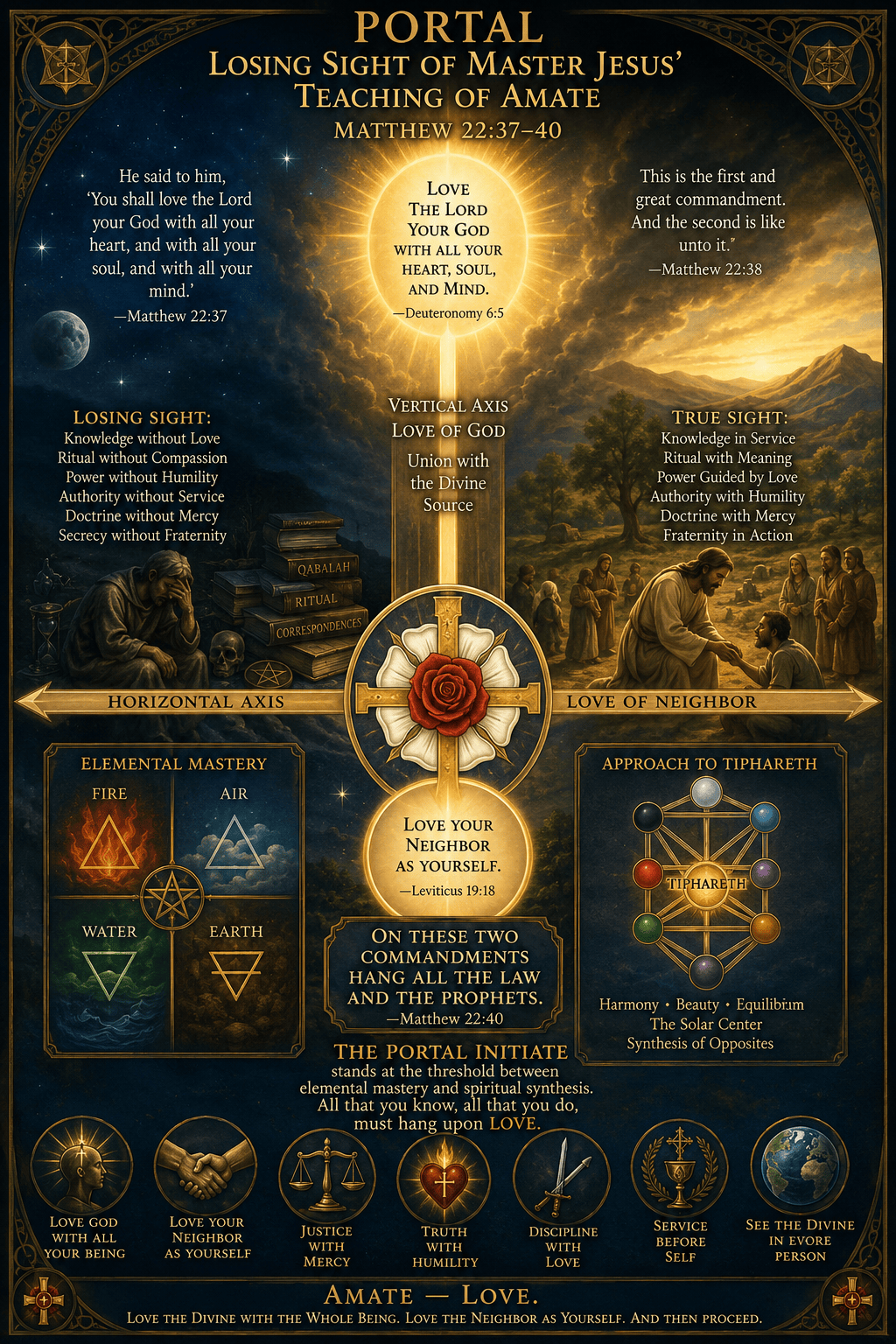
PORTAL LECTURE | Losing Sight of Master Jesus’ Teaching of Amate: Love of God, Love of Neighbor, and the Forgotten Measure of Initiation (Matthew 22:37–40) | Victoria Generao, PhD

There comes a point upon the initiatory path when the student must confront a disturbing possibility.

It is possible to acquire knowledge and yet become less wise.

It is possible to master ritual and yet become less compassionate.

It is possible to memorize Divine Names, trace pentagrams with precision, understand the Sephiroth, planets, elements, Tarot Keys, Hebrew letters, and occult correspondences—and nevertheless lose sight of the principle for which all of these things were intended.

It is possible, in other words, to become accomplished in the forms of the Mysteries while gradually forgetting their heart.

For the Portal initiate this is an especially serious danger.

The Portal is a threshold. Behind the candidate lies the differentiated elemental curriculum of the Outer Order. Ahead lies the symbolism of Tiphareth, equilibrium, sacrifice, regeneration, and the deeper mysteries of the Adept. The initiate therefore stands at an intermediate place: possessing more knowledge than the beginner, but not yet entitled to confuse knowledge with realization.

And it is precisely at such a threshold that we should return to one of the simplest teachings attributed to Master Jesus:

Love. For the purposes of this lecture I shall call this the teaching of Amate.

We should, however, begin with a philological clarification. Amate is Latin, the plural imperative of amare: “Love!” or “You all, love!” It is an appropriate symbolic title for the teaching, but it is not the actual Latin wording of Matthew 22:37–40. Jerome’s Vulgate reads Diliges Dominum Deum tuum—“You shall love the Lord your God”—and Diliges proximum tuum, sicut teipsum—“You shall love your neighbor as yourself.” The underlying Greek in Matthew employs agapēseis, from agapaō, in both commandments. (Bible Gateway)

Thus Amate is best understood here not as a quotation but as an initiatory summons:

Love.

And the question placed before the Portal initiate is whether, somewhere amid the accumulation of occult knowledge, we have ceased to hear it.

The Question Placed Before Jesus

Matthew situates the teaching during the final Jerusalem controversies.

Jesus has entered the city. His authority is being questioned. Priests, elders, Pharisees, Sadducees, and interpreters of Torah engage him in a succession of disputes. Matthew 22:34–40 describes an expert in the Law approaching Jesus with a question intended to test him:

“Teacher, which commandment in the law is the greatest?”

The question arises entirely within Jewish discourse. Jesus does not respond by rejecting Torah, nor does he replace Judaism with a new Christian ethic. Instead, his answer consists of two passages already contained within Torah itself.

The first comes from Deuteronomy 6:5:

“You shall love the Lord your God with all your heart, and with all your soul, and with all your mind.”

The second comes from Leviticus 19:18:

“You shall love your neighbor as yourself.”

Jesus then adds the extraordinary interpretive declaration:

“On these two commandments hang all the law and the prophets.”

The importance of this statement cannot be overstated.

Jesus has not abolished the Law.

He has identified its center of gravity.

He has not offered two pleasant spiritual recommendations among many others.

He has declared that the entire religious structure must ultimately be suspended from these two principles. Modern Matthean scholarship consistently recognizes that Matthew presents love of God and neighbor as an interpretive center from which the larger scriptural tradition is to be understood. (SciELO)

The Greek verb in Matthew 22:40 is krematai: the Law and the Prophets “hang,” “depend,” or are suspended upon these commandments.

Picture a great temple lamp suspended from two chains.

Remove either chain and the lamp falls.

So also, Jesus implies, a religious system from which either love of God or love of neighbor has been removed can no longer bear the weight of revelation.

That image ought to trouble every initiate.

For exactly the same danger exists within esotericism.

We may preserve the structure while losing that upon which the structure hangs.

“Hear, O Israel”

The first commandment cited by Jesus comes from the Shema, one of the foundational affirmations of Jewish religious life.

Deuteronomy declares:

“Hear, O Israel: the LORD our God, the LORD is one.”

And then:

“You shall love the LORD your God with all your heart, and with all your soul, and with all your might.”

The Septuagint—the ancient Greek translation of the Hebrew Scriptures—already renders this command with agapēseis, the same verbal form that appears in Matthew. (Biblindex)

Matthew’s version names heart, soul, and mind. Deuteronomy’s Hebrew expression and the Septuagint’s Greek wording are not identical to Matthew’s formulation, and the Synoptic Gospels themselves preserve slightly different forms. We should therefore avoid constructing an elaborate occult anatomy in which “heart,” “soul,” “mind,” and “strength” correspond to four neatly separated metaphysical substances.

Biblically, the force of the expression is totality.

Love God with the whole person.

With thought.

With desire.

With intention.

With vitality.

With memory.

With choice.

With everything by which you can truthfully say, “I am.”

This is covenantal love rather than fleeting emotion.

And this distinction matters profoundly to the initiate.

Love, in this teaching, cannot be reduced to sentimentality.

One may experience no pleasant emotion whatsoever and still act in love.

One may feel affection and nevertheless act selfishly.

Biblical love possesses volitional, ethical, relational, and covenantal dimensions. It appears in what one chooses, serves, protects, honors, refuses to betray, and places at the center of life.

This immediately places pressure upon the magician’s conception of Will.

What does it mean to develop Will if the will itself has never learned what it ought to love?

An intensified ego is not the Higher Will.

An amplified desire is not spiritual attainment.

The capacity to concentrate does not tell us what deserves concentration.

Power cannot supply its own ethical destination.

Thus Jesus places love before technique.

“And the Second Is Like Unto It”

The second command comes from Leviticus 19:18.

Its original context is remarkably practical.

The verse does not float in abstraction. It appears amid commandments concerning social relationships, justice, honesty, treatment of the vulnerable, economic conduct, resentment, retaliation, and communal responsibility.

Immediately before “love your neighbor as yourself,” Leviticus prohibits vengeance and the bearing of grudges. The command to love one’s neighbor therefore belongs to a concrete ethic of human relationship. (StudyLight)

This is critical.

Jesus does not say:

“Possess loving thoughts about humanity.”

He cites a command emerging from the difficult terrain of living with actual human beings.

Neighbors irritate us.

Neighbors disagree with us.

Neighbors disappoint us.

Neighbors compete with us.

Neighbors sometimes injure us.

And it is there—not merely in meditation before an altar—that the quality of our spiritual realization becomes visible.

The ritual chamber is controlled.

Human relationship is not.

Anyone can cultivate serenity when incense is burning, candles are aligned, the Temple is silent, and everyone present observes the rubric.

The test occurs when another human being contradicts us.

The test occurs when authority is challenged.

The test occurs when we are criticized unfairly.

The test occurs when our pride is wounded.

The test occurs when forgiveness becomes costly.

The test occurs when we possess power over another person.

That is where initiation becomes real.

“As Yourself”

The phrase “love your neighbor as yourself” has sometimes been transformed into the modern psychological assertion that one must first possess adequate self-esteem before loving others.

That may be a useful psychological insight in particular contexts, but it should not simply be inserted into the ancient text.

The command assumes the ordinary human tendency to seek one’s own welfare and uses that instinct as the measure of responsibility toward another.

Attend to your neighbor’s good with the seriousness with which you instinctively attend to your own.

Protect another’s dignity as you protect yours.

Take another’s suffering seriously.

Do not reduce another human being to a function in your private drama.

And for the esoteric initiate there is an even sharper implication.

Do not treat people as correspondences.

Do not treat students as extensions of your authority.

Do not treat initiates of lower grade as spiritually inferior human beings.

Do not treat those outside the tradition as “profane” in a manner that permits contempt.

Do not mistake possession of specialized vocabulary for possession of superior consciousness.

The person standing before you remains an image-bearing mystery greater than the category into which you have placed them.

Love of God and Love of Neighbor Cannot Be Separated

Jesus calls the second commandment “like” the first.

That word is decisive.

The two commandments are distinguishable, but they cannot finally be divorced.

The vertical relationship and the horizontal relationship test one another.

One may claim extraordinary devotion to God while behaving cruelly toward other people.

Jesus does not permit such devotion to remain unquestioned.

Conversely, one may speak eloquently of universal humanity while refusing all orientation toward transcendence, holiness, truth, or accountability beyond the individual ego.

The Matthean teaching holds the two together.

Love rises toward God.

Love extends toward the neighbor.

And each becomes evidence concerning the authenticity of the other.

Here the Rosicrucian imagination may contemplate the Cross.

This is not an historical interpretation of Matthew; it is an initiatory meditation upon the text.

The vertical axis may be contemplated as the movement of consciousness toward the Divine: the creature remembering its Source.

The horizontal axis may be contemplated as the extension of that realized Divine relationship into human life: mercy, justice, patience, fraternity, and service.

Where the two meet is the center.

And within a Golden Dawn–Rosicrucian symbolic framework, the Portal initiate stands precisely before the mystery of such a center.

The Portal and the Danger of Spiritual Accumulation

The Portal Grade represents synthesis.

The initiate has passed through the elemental Grades and approaches the mystery represented by Spirit and, beyond the threshold, the equilibrating solar symbolism associated with the Adept work.

Golden Dawn source material preserved through Israel Regardie’s compilation presents Portal as the transitional stage between the elemental work of the Outer Order and the Adept mysteries that follow. (Interactive Atlas)

But every synthesis creates a temptation.

Once we have learned many things, knowledge itself can become identity.

“I know the correspondences.”

“I know the ritual.”

“I know the secret pronunciation.”

“I know the hidden doctrine.”

“I possess the grade.”

“I hold the office.”

“I have authority.”

And gradually an initiatory instrument becomes a personality structure.

The candidate begins by seeking illumination and ends by protecting status.

This is one of the most subtle forms of losing sight of Amate.

The occultist may become fascinated with hierarchies while forgetting fraternity.

Fascinated with power while forgetting service.

Fascinated with purity while forgetting mercy.

Fascinated with secret doctrine while forgetting ordinary kindness.

Fascinated with magical Will while forgetting the neighbor.

Fascinated with ascending the Tree while becoming increasingly difficult to live with on Earth.

If this happens, initiation has turned backward.

The Temple has become another architecture of the ego.

When Severity Loses Mercy

The Portal initiate has encountered forces represented symbolically by the elements, planets, Sephiroth, and the balancing principles of the Tree.

One of the temptations accompanying such study is to make metaphysical categories into excuses for personal behavior.

Cruelty becomes “Geburah.”

Emotional coldness becomes “discernment.”

Domination becomes “Will.”

Avoidance becomes “detachment.”

Vanity becomes “solar consciousness.”

Possessiveness becomes “devotion.”

And spiritual pride becomes “recognition of one’s grade.”

The tradition becomes dangerous at precisely the point where symbolic language protects the personality from moral examination.

Jesus’ commandment dismantles this defense.

Whatever name we give our behavior, we must eventually ask:

Does this action express love of God?

Does it express love of neighbor?

Does it protect truth?

Does it preserve dignity?

Does it seek another’s genuine good?

Does it require me to treat someone merely as an instrument of my own desire?

These questions cannot answer every ethical dilemma automatically. Love is not permissiveness. Love does not forbid discipline, boundaries, correction, judgment, or consequences.

The Gospel of Matthew itself contains teachings about reconciliation, accountability, communal discipline, hypocrisy, justice, and judgment.

But discipline stripped of love becomes domination.

Truth stripped of love becomes a weapon.

Authority stripped of love becomes tyranny.

And esoteric knowledge stripped of love becomes spiritual ornamentation.

“On These Two Hang All the Law and the Prophets”

Matthew’s concluding statement is perhaps the most important sentence for our purpose.

Jesus does not merely say that these commandments are important.

He says everything hangs upon them.

This is an interpretive principle.

A commandment may be technically observed and spiritually violated.

A ritual may be performed flawlessly while its purpose is contradicted by the person performing it.

A Temple may preserve every rubric and nevertheless fail to embody what the Temple represents.

This is why “correctness” cannot be the final measure of initiation.

There are necessary forms.

There are standards.

There are obligations.

There is discipline.

There is knowledge that must actually be learned.

But none of these is self-justifying.

The question remains:

Upon what do they hang?

Matthew answers:

Love of God.

Love of neighbor.

This places an uncomfortable responsibility upon every initiate who holds authority.

The higher the grade, the greater the obligation.

The office does not exist to magnify the officer.

Knowledge does not exist to separate the knower from the supposedly ignorant.

Initiation does not grant permission to become less humane.

Quite the opposite.

If initiation is genuine, the initiate should become increasingly capable of seeing.

Seeing complexity.

Seeing suffering.

Seeing consequences.

Seeing one’s own shadow.

Seeing the dignity of the person who cannot advance one’s ambitions.

Seeing the humanity of one’s adversary.

Seeing when a doctrine is being used to excuse selfishness.

And seeing the Divine precisely where the ego would prefer not to find It.

The Forgotten Test of Adeptship

What, then, might constitute one of the hidden tests of the Portal?

Not merely:

Can you invoke?

Can you banish?

Can you trace the symbols?

Can you explain the Tree?

Can you identify the Tarot correspondences?

Can you recite the Knowledge Lectures?

Those questions have their place.

But there is another examination.

What happens when someone beneath your grade makes a better argument than you?

What happens when you must apologize?

What happens when recognition is given to another?

What happens when someone cannot repay your kindness?

What happens when a person leaves your group?

What happens when someone opposes you?

What happens when you acquire information that could humiliate another?

What happens when you have enough authority to punish?

What happens when no one would know whether you chose mercy?

These moments may reveal more about initiation than any written examination.

The knowledge test tells us what the candidate remembers.

The ethical test reveals what the candidate has become.

Agapē Is Not Weakness

Because love is often sentimentalized, some initiates may assume that an emphasis upon love weakens the severity required by authentic spiritual training.

It does not.

Biblical agapē is demanding.

To love God with the whole being is severe.

It requires the reordering of desire.

To love the neighbor as oneself is severe.

It prohibits many cherished forms of selfishness.

To forgive is difficult.

To confront injustice without hatred is difficult.

To speak truth without cruelty is difficult.

To maintain boundaries without vengeance is difficult.

To correct another without secretly enjoying superiority is difficult.

To serve without demanding recognition is difficult.

Love is not the absence of strength.

Love is strength brought under moral government.

This is one reason the teaching belongs profoundly at Portal.

The elemental forces must not merely be awakened.

They must be reconciled.

Fire without love becomes destruction.

Water without love becomes possessiveness or emotional engulfment.

Air without love becomes sterile abstraction or intellectual cruelty.

Earth without love becomes materialism, rigidity, and self-preservation.

Spirit does not simply add a fifth power to four others.

Spirit must order them toward unity.

The Approach Toward Tiphareth

Within the Hermetic Qabalistic map employed by the Golden Dawn tradition, the Portal candidate prepares for the mysteries associated with Tiphareth.

Tiphareth is Beauty, harmony, equilibrium, mediation, the solar center, and within Christianized Hermetic interpretation becomes deeply associated with sacrificial and redemptive symbolism.

Therefore the teaching of Matthew 22:37–40 is exceptionally appropriate at this threshold.

One cannot meaningfully approach the symbolism of the sacrificed and risen center while nurturing contempt.

One cannot speak solemnly of the Higher Genius while refusing ordinary decency.

One cannot invoke the Divine Names of harmony while deliberately generating discord for personal advantage.

One cannot seek union above while producing unnecessary division below.

The Solar Mysteries demand something greater than brilliance.

They demand integration.

And love is integrative.

Love takes what ego continually divides—self and other, sacred and ordinary, Temple and world—and asks whether one spiritual law governs them all.

This may be the deeper meaning of Jesus’ statement that the whole Law and Prophets hang upon the two commandments.

The spiritual life cannot finally be compartmentalized.

The same person who stands before the altar must eventually stand before the neighbor.

Losing Sight of the Master

There is a particular danger within esoteric Christianity.

The initiate may become so fascinated with the cosmic Christ that the historical teachings of Jesus become secondary.

We may discuss Logos theology, solar symbolism, Tiphareth, the Mystical Rose, resurrection consciousness, sacred geometry, Qabalistic correspondences, angelic hierarchies, and the mysteries of the Christos.

All of these may possess value within their proper domains.

But we should occasionally ask a devastatingly simple question:

What did Jesus tell people to do?

Love God.

Love the neighbor.

Reconcile.

Forgive.

Practice mercy.

Seek justice.

Care for the vulnerable.

Do not make public spirituality a theater of vanity.

Do not confuse status with holiness.

Judge yourself before obsessively judging others.

Let the inner condition and the outer act become one.

If our esotericism succeeds in making Jesus more cosmologically impressive but his commandments less binding, something has gone wrong.

We have admired the Master and ignored the teaching.

We have constructed the Christos and forgotten Amate.

The Portal Examination of the Heart

Therefore, candidate of the Portal, examine yourself.

Not with self-condemnation.

With precision.

Where has knowledge made you more patient?

Where has ritual made you more generous?

Where has Qabalah made you more capable of perceiving unity?

Where has meditation made you more responsible in relationship?

Where has magical discipline made your word more trustworthy?

Where has the experience of Divine Presence made another person’s dignity more difficult to violate?

And where has the opposite occurred?

Where has knowledge become superiority?

Where has initiation become identity?

Where has secrecy become exclusion?

Where has discipline become harshness?

Where has authority become possession?

Where has spiritual language allowed you to avoid apologizing?

Those questions belong to Portal because Portal is the place of synthesis.

The scattered parts must become one.

The ritual self and the ordinary self must become one.

The devotional life and the ethical life must become one.

The magician and the neighbor must meet.

The Final Teaching

And so we return to the beginning.

Amate.

Love.

Not because love is simple.

But because everything else becomes dangerous without it.

Love God with the whole of yourself.

Not the ceremonial self only.

Not the intellectual self only.

Not the self that appears before the Temple.

The whole self.

And love the neighbor.

Not humanity in abstraction.

The person.

The difficult person.

The forgotten person.

The person over whom you possess power.

The person from whom you have nothing to gain.

The person whose existence interrupts your preferred image of yourself.

For Master Jesus does not permit the initiate to hide in metaphysics.

“On these two commandments hang all the Law and the Prophets.”

And if the Law and the Prophets hang upon them, then perhaps our rituals must hang upon them also.

Our grades must hang upon them.

Our authority must hang upon them.

Our magical work must hang upon them.

Our Qabalah must hang upon them.

Our Rosicrucianism must hang upon them.

Our claims of attainment must hang upon them.

For if love is removed, the whole edifice—however elaborate, however ancient, however beautifully ornamented—has lost the thing upon which it was suspended.

Thus at the Portal, before seeking further Light, the initiate should hear again the forgotten command:

Amate.

Love.

Love the Divine with the whole being.

Love the neighbor as yourself.

And then proceed.

For perhaps the true qualification for entering more deeply into the Mysteries is not merely that we have learned more secrets—

but that the secrets have taught us how to love.


Annotated Bibliography

  1. The Holy Bible. Deuteronomy 6:4–5; Leviticus 19:17–18; Matthew 5:43–48; 7:12; 22:34–40; 23:23.
    These passages constitute the primary textual foundation of the lecture. Deuteronomy supplies the command to love God; Leviticus supplies the command to love the neighbor; Matthew joins them and makes them the interpretive foundation upon which “the Law and the Prophets” depend. The Greek Septuagint already employs agapēseis in Deuteronomy 6:5 and Leviticus 19:18, illuminating Matthew’s use of the same verb. (Biblindex)
  2. Davies, W. D., and Dale C. Allison Jr. A Critical and Exegetical Commentary on the Gospel According to Saint Matthew. Vol. 3, Matthew 19–28. International Critical Commentary. London: T&T Clark, 1997.
    One of the major technical commentaries on Matthew. Davies and Allison are particularly valuable for Matthean dependence upon Jewish Scripture, Jewish interpretive traditions, Synoptic comparison, and the literary construction of Matthew 19–28. This should be consulted when developing the lecture into a more formal exegetical study. (Scribd)
  3. France, R. T. The Gospel of Matthew. New International Commentary on the New Testament. Grand Rapids: Eerdmans, 2007.
    France offers detailed yet accessible exegesis of Matthew as a literary and theological whole, with careful attention to the Gospel’s first-century Palestinian context. His treatment is especially useful for understanding Matthew’s presentation of Jesus as an interpreter of Israel’s Scriptures rather than as one simply discarding Torah. (Eerdmans Publishing Co)
  4. Hagner, Donald A. Matthew 14–28. Word Biblical Commentary 33B. Dallas: Word Books, 1995.
    Hagner provides close textual, grammatical, historical, and theological analysis of the latter half of Matthew. His commentary is useful for studying the Jerusalem controversy narratives in which Matthew 22:34–40 occurs and for comparing Matthew with Mark and other Synoptic traditions. (Biblia)
  5. Keener, Craig S. The Gospel of Matthew: A Socio-Rhetorical Commentary. Grand Rapids: Eerdmans, 2009.
    Particularly valuable for reconstructing the social, Jewish, and Mediterranean environment in which Matthew’s audience would have heard the Gospel. Keener emphasizes both historical context and the Gospel’s demands upon discipleship, making the work especially useful for moving responsibly from historical exegesis toward ethical application. (Eerdmans Publishing Co)
  6. Luz, Ulrich. Matthew 21–28: A Commentary. Hermeneia. Translated by James E. Crouch. Minneapolis: Fortress Press, 2005.
    Luz combines rigorous historical-critical exegesis with Wirkungsgeschichte, the history of the text’s interpretation and effects. This makes the volume especially useful for a lecture such as the present one, where historical meaning must first be established before later Christian and esoteric readings are consciously distinguished from it. (JSTOR)
  7. Levine, Amy-Jill, and Marc Zvi Brettler, eds. The Jewish Annotated New Testament. 2nd ed. New York: Oxford University Press, 2017.
    An indispensable corrective to interpretations that detach Jesus from Judaism. The annotations and essays situate New Testament texts within Jewish Scripture, history, practice, and debate. For Matthew 22 it helps guard against the historically misleading notion that Jesus replaced an allegedly legalistic Jewish religion with an entirely new religion of love. (Religious Studies)
  8. Milgrom, Jacob. Leviticus 17–22: A New Translation with Introduction and Commentary. Anchor Bible 3A. New York: Doubleday, 2000.
    Milgrom’s monumental treatment of Leviticus is particularly important for understanding Leviticus 19:18 in its original holiness and communal context. His analysis prevents the command to “love your neighbor” from being reduced to vague sentiment by locating it amid concrete obligations concerning justice, vengeance, social ethics, and holiness. (Yale University Press)
  9. Regardie, Israel. The Golden Dawn: A Complete Course in Practical Ceremonial Magic. 6th ed. St. Paul, MN: Llewellyn Publications, 1989.
    Regardie’s compilation remains a fundamental published source for the ritual and instructional corpus associated with the Golden Dawn and Stella Matutina traditions. It should be treated principally as a documentary source for the Order’s rituals and teachings rather than as independent historical scholarship. It provides the ritual context for the Portal Grade, elemental synthesis, Spirit symbolism, and the transition toward the Adept work employed in this lecture’s esoteric interpretation. (Interactive Atlas)
  10. Septuagint. Deuteronomy 6:5 and Leviticus 19:18.
    The Greek Jewish Scriptures are particularly important for this lecture because both commandments use forms of agapaō before their appearance in Matthew. This demonstrates that Matthew’s language of love is deeply rooted in the Greek Jewish scriptural tradition and should not be presented as a Christian invention set against Judaism. (Biblindex)
  11. Biblia Sacra Vulgata. Matthew 22:37–39.
    The Vulgate reads Diliges Dominum Deum tuum and Diliges proximum tuum, rather than amate. This source is therefore essential for the terminological clarification made at the beginning of the lecture. Amate remains an effective Latin ceremonial motto—“Love!”—but should be identified as an interpretive title rather than the Vulgate wording of Jesus’ response. (Bible Gateway)
  12. “The Double Love Commandment.” Scholarly study of Matthew 22:34–40.
    This study examines the literary framing of Matthew’s “double love commandment,” Matthew’s modifications of the Markan account, and the significance of the declaration that the Law and Prophets depend upon these commands. It provides useful secondary support for treating Matthew 22:34–40 as an interpretive statement concerning Torah rather than merely an isolated moral aphorism. (SciELO)

This version deliberately makes the Portal itself the ethical crisis point: elemental mastery is insufficient unless the personality has begun to submit knowledge, authority, magical Will, and spiritual ambition to the double commandment of love. It also keeps the historical Jewish Jesus, the Greek agapēseis, the Latin diliges, and the later Rosicrucian–Golden Dawn interpretation clearly differentiated rather than collapsing them into one tradition.

Clearing Up the Confusion: What Differentiates Qabalah, Kabbalah, and Cabala? | Victoria Generao, PhD

Here is the completed scholarly blog, with the spelling issue clarified at the outset and the bibliography divided between Jewish Kabbalah, Renaissance Christian Cabala, and modern Hermetic Qabalah.

Few subjects in Western esotericism produce as much terminological confusion as Kabbalah, Cabala, and Qabalah. A student may open one book and encounter the Kabbalah, another and find the Cabala, and then enter a Hermetic or Golden Dawn curriculum where the same Tree of Life is called the Qabalah. To make matters more confusing, other spellings appear everywhere: Kabala, Qabbalah, Cabbala, Kabalah, and even Kaballah.

Are these simply different English spellings of the same Hebrew word?

Linguistically, yes.

Historically and religiously, however, the answer is considerably more complicated.

In modern scholarly and esoteric usage, three spellings have gradually become useful for distinguishing three related but historically different streams of thought:

Kabbalah usually denotes the Jewish mystical tradition.

Cabala often denotes the Renaissance and early-modern Christian adaptation of Jewish Kabbalah.

Qabalah commonly denotes the later Hermetic and Western occult synthesis, particularly the system that eventually became central to Rosicrucianism, ceremonial magic, and the Hermetic Order of the Golden Dawn.

But this distinction must immediately be qualified: these spellings are conventions, not historical laws. Renaissance authors, nineteenth-century occultists, Jewish scholars, translators, and modern publishers have never used them with complete consistency. Even dictionaries list numerous acceptable transliterations. (American Heritage Dictionary)

Understanding the difference therefore requires us to look not merely at how the word is spelled, but at what happened to the tradition as it moved from one religious and intellectual environment into another.

First, a Note About “Kaballah”

Before separating the three traditions, one common misunderstanding should be cleared away.

“Kaballah” is not a fourth school of mystical thought.

It is simply one of the many English attempts to transliterate the Hebrew word קבלה — Qabbalah/Kabbalah. The standard contemporary academic spelling is generally Kabbalah. The spelling Kaballah, although frequently encountered, does not by itself indicate a separate lineage or doctrine.

The Hebrew word derives from the root Q-B-L, meaning “to receive.” Qabbalah therefore carries the sense of something received, handed down, or transmitted as tradition. The concept of reception is essential: the Kabbalist understands mystical wisdom not merely as private speculation but as participation in an inherited sacred tradition. (Sefaria)

The multiple English spellings arose because Hebrew does not map neatly onto the Latin alphabet. The Hebrew letter ק, Qof, may appear as q, k, or historically even c in European languages. Doubling consonants and retaining the final h likewise vary according to transliteration systems.

Thus, from a purely linguistic standpoint, Kabbalah, Cabala, and Qabalah can all represent the same Hebrew word.

The historical traditions that eventually gathered around those spellings, however, are not identical.


Kabbalah: The Jewish Mystical Tradition

The proper historical starting point is Jewish Kabbalah.

Kabbalah is not an independent religion and was not originally conceived as an occult philosophy detached from Judaism. It developed within the religious world of Judaism and cannot be fully understood apart from Torah, Hebrew language, rabbinic interpretation, prayer, mitzvot, divine names, and Jewish theological speculation.

Scholars debate precisely where “Kabbalah” begins. Earlier Jewish mystical currents include Merkavah and Hekhalot mysticism, speculations concerning the divine throne, angelic worlds, heavenly palaces, sacred names, and visionary ascent. The enigmatic Sefer Yetzirah, or Book of Formation, likewise provided an enormously influential cosmology based upon the Hebrew letters and numbers.

The form generally recognized as medieval Kabbalah emerged more clearly during the twelfth and thirteenth centuries, particularly in southern France and Spain. The Sefer ha-Bahir became important during this period, followed by the tremendous flowering of Spanish Kabbalah and eventually the collection of texts known as the Zohar, which appeared in late thirteenth-century Castile and became the most influential literary corpus of classical Kabbalah. Modern scholarship regards the Zohar as a collection produced within medieval Castilian Kabbalistic circles rather than simply as a verbatim composition of the second-century sage Rabbi Shimon bar Yochai to whom traditional attribution assigns it. (Cambridge University Press)

At the center of much Kabbalistic thought stands the mystery of Ein Sof, the Infinite and ultimately incomprehensible Divine, and the manifestation of divine activity through the ten sefirot.

These sefirot are not simply “ten planets,” nor are they gods. They constitute an extraordinarily complex symbolic theology describing aspects, powers, qualities, relationships, and processes within divine manifestation.

Names such as:

Keter — Crown

Chokhmah — Wisdom

Binah — Understanding

Chesed — Lovingkindness

Gevurah — Strength or Judgment

Tiferet — Beauty

Netzach — Eternity or Victory

Hod — Splendor

Yesod — Foundation

Malkhut — Kingdom

eventually became familiar far beyond Judaism.

Yet within Jewish Kabbalah they exist inside a distinctly Jewish symbolic universe involving Torah, creation, divine names, masculine and feminine dimensions of divinity, the Shekhinah, commandments, exile, restoration, and the relationship between human religious action and the divine world.

Indeed, one important scholarly interpretation describes Kabbalah as a particularly powerful example of theurgic mysticism: human prayer and sacred action can affect or harmonize the relationships among divine powers. (Stanford Encyclopedia of Philosophy)

This point already distinguishes classical Jewish Kabbalah from much later Western occult Qabalah.

The Jewish Kabbalist is not originally asking:

“Which Tarot card belongs on this path?”

The concern is more likely:

How does Torah reveal the hidden structure of divinity?

How do divine names disclose creation?

How do the sefirot interact?

How does human religious action participate in cosmic restoration?

How can the soul cleave to God?

And how does the visible world reflect mysteries concealed within revelation?

There were nevertheless many schools of Jewish Kabbalah. Abraham Abulafia developed an ecstatic and prophetic tradition involving Hebrew letters, divine names, breathing, and meditation. Moses de León and other Castilian Kabbalists developed theosophical systems. Moses Cordovero constructed an extensive synthesis. Isaac Luria and his disciples transformed Kabbalistic cosmology in sixteenth-century Safed through doctrines such as tzimtzum, shevirat ha-kelim, and tikkun—divine contraction, the breaking of the vessels, and cosmic restoration.

Thus even the phrase Jewish Kabbalah encompasses a family of traditions rather than one monolithic doctrine. Moshe Idel’s scholarship in particular helped move modern studies beyond overly simple attempts to reduce the whole history of Kabbalah to one system. (OUP Academic)


Cabala: When Renaissance Christianity Encountered Kabbalah

A dramatic transformation occurred during the Renaissance.

Christian humanists became increasingly fascinated with Hebrew. They studied Jewish scriptures, rabbinic literature, philosophy, and eventually Kabbalistic writings.

Among the most important figures was Giovanni Pico della Mirandola, whose 900 Conclusions of 1486 included numerous propositions drawn from Kabbalistic material.

Pico did not simply convert to Judaism or become a Jewish Kabbalist.

He interpreted Kabbalah through Christianity.

He believed that ancient Hebrew mysteries could reveal or confirm Christian truths. Kabbalistic doctrines were consequently interpreted in relation to Christ, the Trinity, Christian salvation, and a broader Renaissance project that sought a primordial wisdom underlying Plato, Pythagoras, Hermeticism, Christianity, and ancient theology.

Pico’s work marks a watershed in the emergence of what scholars call Christian Kabbalah or Christian Cabala. (Cambridge University Press)

The tradition was developed further by the German Christian Hebraist Johann Reuchlin, particularly in De Verbo Mirifico and his enormously influential De Arte Cabalistica, published in 1517.

Reuchlin interpreted Hebrew divine names and Kabbalistic teachings christologically. For Christian Cabalists, mysteries discovered within Hebrew could therefore become testimonies to Christianity.

This was no minor shift.

Jewish Kabbalah understood itself within Jewish revelation.

Christian Cabala took elements of that revelation and re-read them through an explicitly Christian theological framework.

Cambridge scholarship describes Christian Kabbalah precisely in terms of the Christian interpretation and use of Kabbalistic texts and methods in support of Christian doctrines. (Cambridge University Press)

From Pico and Reuchlin, Christian Cabala spread into the writings of figures such as Francesco Giorgi, Heinrich Cornelius Agrippa, Guillaume Postel, Robert Fludd, Athanasius Kircher, and others.

During this process, Kabbalistic materials increasingly interacted with:

Neoplatonism,

Hermetic philosophy,

astrology,

alchemy,

natural magic,

angelology,

number symbolism,

and Renaissance theories of cosmic correspondence.

The boundaries between Cabala, Hermeticism, natural philosophy, and magic consequently became increasingly porous. Reuchlin’s De Arte Cabalistica was particularly influential in presenting Cabala as a means of discovering connections between God, nature, language, and sacred wisdom. (Cambridge University Press)

By the seventeenth century another major bridge appeared: Christian Knorr von Rosenroth’s Kabbala Denudata, published between 1677 and 1684.

This massive Latin compilation made portions of Jewish Kabbalistic literature, including important Lurianic materials and Zoharic writings, accessible to Christian European intellectuals who could not read the Hebrew or Aramaic originals.

It would later become particularly important to Western occultists.

Christian Cabala was therefore neither merely a misspelling of Kabbalah nor entirely independent of it.

It was a Christian reinterpretation of Jewish mystical materials.

That distinction is essential.


Qabalah: The Western Hermetic and Magical Transformation

The next major transformation occurred within the Western esoteric tradition.

What is now commonly called Hermetic Qabalah emerged through several centuries of accumulated Christian Cabala, Renaissance magic, Rosicrucianism, alchemy, occult philosophy, Freemasonry, French occultism, and nineteenth-century ceremonial magic.

By the late nineteenth century, particularly within the Hermetic Order of the Golden Dawn, the Tree of Life became the organizing structure of an enormous Western esoteric system.

The Golden Dawn was founded in Britain in 1888 and became one of the most influential organizations in the history of modern ritual magic. Modern scholarship emphasizes its combination of Rosicrucian, Masonic, Hermetic, occult, and Kabbalistic interests. (OUP Academic)

Here something remarkable happened to the Tree of Life.

It became not merely a mystical theology but a universal map of correspondences.

The ten sefirot and twenty-two connecting paths could now be correlated with systems drawn from far beyond Judaism.

Among them were:

the Hebrew alphabet,

planets,

zodiacal signs,

the classical elements,

Tarot,

alchemy,

angelic hierarchies,

divine names,

magical weapons,

colors,

incenses,

metals,

plants,

Egyptian deities,

Greek and Roman gods,

grades of initiation,

states of consciousness,

and methods of ceremonial and visionary practice.

This is recognizably Hermetic Qabalah.

The Golden Dawn’s founders and early authorities—including William Wynn Westcott and S. L. MacGregor Mathers—inherited centuries of Christian and occult interpretation of Kabbalah and incorporated it into a ceremonial initiatory structure.

Mathers himself explicitly preferred the spelling Qabalah, explaining his transliteration and using Q in representing Hebrew terminology. (The Hermetic Order of The Golden Dawn®)

Later figures such as Aleister Crowley, Dion Fortune, Paul Foster Case, Israel Regardie, and many twentieth-century ceremonial magicians further developed this system.

Crowley’s Liber 777, for example, represents the Hermetic Qabalistic impulse almost perfectly: spiritual realities are arranged into immense tables of correspondences.

Dion Fortune’s The Mystical Qabalah presents the Tree as a practical philosophical and psychological framework for Western occult training.

Israel Regardie’s publications transmitted the Golden Dawn system to a vastly larger audience.

In this environment the Tree of Life functions as something like a metaphysical master diagram.

The magician can ascend it.

Meditate upon it.

Construct rituals through it.

Place Tarot upon it.

Map astrology onto it.

Use it to analyze mythology.

Interpret consciousness through it.

And correlate apparently unrelated spiritual systems by assigning them positions within its structure.

Such a methodology is characteristic of Hermetic Qabalah.

It is not characteristic of medieval Jewish Kabbalah in precisely the same way.


The Difference Is Therefore More Than Spelling

The most useful distinction can be summarized like this:

TraditionConventional SpellingHistorical SettingPrimary Orientation
Jewish mysticismKabbalahMedieval Judaism onwardTorah, God, sefirot, divine names, mystical exegesis, theurgy
Christian adaptationCabalaRenaissance and early-modern ChristianityChristian interpretation of Hebrew/Kabbalistic mysteries
Western esoteric synthesisQabalahModern Hermeticism and ceremonial magicTree of Life as initiatory and magical system of correspondences

Yet the table should never be mistaken for an absolute linguistic rule.

A Jewish scholar writing in 1900 may use Cabala.

An occultist may write Kabbalah.

A Christian scholar may use Qabbalah.

Older reference works themselves often use Cabala for Jewish mysticism. The spelling cannot establish lineage by itself. (Jewish Encyclopedia)

The distinction becomes meaningful only when we ask:

What sources are being used?

Within what religion or philosophy?

How is the Tree of Life being interpreted?

What is the purpose of the practice?

Those questions tell us far more than whether an author chose C, K, or Q.


Three Trees—or One Tree Seen Through Three Worlds?

For the Western esoteric student, it can be tempting to imagine that Kabbalah, Cabala, and Qabalah represent three completely separate systems.

Historically that would also be misleading.

There is genuine continuity.

Christian Cabalists actually studied Jewish Kabbalistic texts. Hermetic occultists inherited considerable material from Christian Cabala. Golden Dawn Qabalah retained Hebrew divine names, the ten sefirot, twenty-two Hebrew letters, the four worlds, Adam Kadmon, angelic hierarchies, and many concepts derived ultimately from Jewish mystical sources.

The relationship is therefore genealogical.

One grows historically from contact with another.

But genealogy does not mean identity.

Christian thinkers changed Kabbalah by placing it within Christianity.

Hermetic thinkers changed it again by incorporating Tarot, astrology, alchemy, comparative mythology, ceremonial magic, and initiatory symbolism.

A useful analogy would be a language passing through several cultures.

Words survive.

Structures survive.

Symbols survive.

But meanings accumulate, shift, and sometimes change radically.

Joseph Dan observes that precisely this meeting of Jewish Kabbalah with Christian philosophy, science, theology, and magic produced the multiple meanings that continue to surround the word Kabbalah today. (OUP Academic)


Why the Distinction Matters for Golden Dawn Students

For someone working within the Golden Dawn or broader Western Mystery Tradition, this distinction is particularly important.

The Golden Dawn did not simply preserve medieval Jewish Kabbalah unchanged.

It received Kabbalistic ideas after centuries of transmission through Christian Cabala, Renaissance occult philosophy, Rosicrucianism, Éliphas Lévi and nineteenth-century occultism, and then organized those materials into a sophisticated initiatory system.

Thus when a Golden Dawn initiate places:

Saturn at Binah,

Jupiter at Chesed,

Mars at Geburah,

the Sun at Tiferet,

Venus at Netzach,

Mercury at Hod,

and the Moon at Yesod,

the practitioner is operating within a distinctly Hermetic Qabalistic system of correspondences.

When the twenty-two Tarot trumps are placed upon the twenty-two paths of the Tree of Life, we are again firmly within Western esoteric Qabalah rather than classical Jewish Kabbalah.

This does not render the Hermetic system illegitimate.

It simply tells us what it is.

Its genius lies precisely in synthesis.

Hermetic Qabalah takes the Tree of Life and makes it a map upon which enormous portions of Western esoteric symbolism can be coordinated.

But scholarly clarity requires acknowledging the Jewish tradition from which that Tree originated and recognizing that later Western systems represent reinterpretations rather than simple continuations unchanged.


Kabbalah, Cabala, and Qabalah as a Historical Continuum

The clearest way to understand the development is therefore:

Jewish Kabbalah

Renaissance Christian Cabala

Early-modern Christian Hermetic and occult Cabala

Nineteenth-century Western occultism

Golden Dawn Hermetic Qabalah

Modern ceremonial magic, Tarot, Rosicrucian and occult Qabalah

This model is simplified—history is rarely so linear—but it reveals why the three traditions resemble one another while remaining distinguishable.

What began as the language of received Jewish mystical tradition eventually entered Renaissance Christianity, where it became a theological key for interpreting Christianity and creation.

From there it entered Western occult philosophy.

Eventually, in the hands of the nineteenth-century magical revival and particularly the Golden Dawn, it became one of the most elaborate systems of symbolic correspondence ever created within Western esotericism.


Clearing Up the Confusion

We can therefore answer the original question very simply.

Kabbalah is principally the Jewish mystical tradition from which the others ultimately draw.

Cabala is a useful scholarly designation for the Christian Renaissance reception and reinterpretation of Jewish Kabbalah.

Qabalah is a useful modern designation for the Hermetic and occult system that developed from Jewish and Christian Kabbalistic materials and integrated them with ceremonial magic, astrology, Tarot, alchemy, Rosicrucianism, and other Western esoteric traditions.

And Kaballah is primarily a spelling variant—not another independent branch.

The spellings themselves did not create three traditions.

History did.

Behind all three stands the Hebrew idea of קבלה — reception.

Something is received.

But every reception also involves interpretation.

The Jewish mystic received Kabbalah within Torah.

The Renaissance Christian received it through Christian revelation.

The Hermetic magician received it through the doctrine of correspondences and the initiatory mysteries of the Western esoteric tradition.

The same ancient vocabulary thus entered three different intellectual worlds.

And perhaps that is ultimately why the distinction is worth learning: not so that one tradition can be declared “real” and the others “false,” but so that each can be understood in its own historical, theological, and initiatory context.


Annotated Bibliography

I. Jewish Kabbalah: Primary Sources and Scholarship

Dan, Joseph. Kabbalah: A Very Short Introduction. Oxford: Oxford University Press, 2007.

One of the most accessible scholarly introductions to the history of Kabbalah. Dan is particularly helpful for understanding the transformation of Jewish Kabbalah through its encounter with Christianity and the resulting ambiguity surrounding the word itself. His discussion of Christian Kabbalah is especially relevant to distinguishing Kabbalah from Cabala. (OUP Academic)

Idel, Moshe. Kabbalah: New Perspectives. New Haven: Yale University Press, 1988.

A landmark revision of modern Kabbalah scholarship. Idel challenges several assumptions inherited from Gershom Scholem and emphasizes the diversity of Kabbalistic practices, including ecstatic, theosophical, and theurgical currents. Essential for avoiding the mistake of treating Jewish Kabbalah as one uniform theological system.

Idel, Moshe. Kabbalah in Italy, 1280–1510: A Survey. New Haven: Yale University Press, 2011.

Particularly valuable for understanding the intellectual environment in which Jewish Kabbalah encountered Renaissance Christianity. Idel traces the interaction among Jewish mystical schools in Italy and the conditions that eventually made Christian Kabbalah possible. (OUP Academic)

Matt, Daniel C., Nathan Wolski, and Joel Hecker, trans. The Zohar: Pritzker Edition. Stanford: Stanford University Press, 2004–2017.

The major contemporary English scholarly translation of the Zohar. The Pritzker Edition combines translation with extensive historical, textual, linguistic, and Kabbalistic commentary. It is indispensable for students who wish to encounter Jewish Kabbalah through an actual foundational text rather than primarily through later occult interpretations.

Scholem, Gershom. Major Trends in Jewish Mysticism. New York: Schocken Books, 1995. Originally published 1941.

One of the foundational works of modern academic Kabbalah studies. Although subsequent scholarship has revised many of Scholem’s conclusions, his historical framework remains indispensable. Particularly useful for Merkavah mysticism, the Zohar, Abraham Abulafia, Lurianic Kabbalah, and Hasidism.

Scholem, Gershom. Origins of the Kabbalah. Edited by R. J. Zwi Werblowsky. Translated by Allan Arkush. Princeton: Princeton University Press, 1987.

A detailed investigation of the emergence of medieval Kabbalah, especially in Provence and Gerona. This work is useful for separating historically demonstrable medieval Kabbalah from claims that the fully developed system existed unchanged from biblical antiquity.

Hayman, A. Peter. Sefer Yeṣira: Edition, Translation and Text-Critical Commentary. Tübingen: Mohr Siebeck, 2004.

A scholarly critical edition of Sefer Yetzirah. The work is important because later Jewish, Christian, and Hermetic traditions all drew upon its cosmology of Hebrew letters, numbers, directions, and creation. It also demonstrates how much later occult interpretation has been layered upon an originally concise and enigmatic Jewish text.


II. Christian Cabala and the Renaissance Transformation

Blau, Joseph Leon. The Christian Interpretation of the Cabala in the Renaissance. New York: Columbia University Press, 1944.

A classic academic study of Christian Cabala. Although later research has expanded and corrected aspects of Blau’s interpretation, the book remains enormously useful for tracing the transformation of Jewish Kabbalistic ideas within Renaissance Christian intellectual culture. (Brill)

Farmer, Stephen A. Syncretism in the West: Pico’s 900 Theses (1486): The Evolution of Traditional Religious and Philosophical Systems. Tempe: Medieval & Renaissance Texts & Studies, 1998.

Contains the Latin text, English translation, and extensive commentary on Pico della Mirandola’s famous 900 Conclusions. Essential for seeing Christian Cabala at one of its formative moments, when Pico attempted to reconcile Kabbalah with Christianity, Platonism, Aristotelianism, magic, and ancient wisdom traditions. (Folger Catalog)

Forshaw, Peter J. “Christian Kabbalah.” In The Cambridge Handbook of Western Mysticism and Esotericism, edited by Glenn Alexander Magee. Cambridge: Cambridge University Press, 2016.

An excellent modern scholarly overview of the development of Christian Kabbalah from Pico through later Renaissance and early-modern figures. Particularly useful for understanding the Christian theological motives behind the appropriation and reinterpretation of Jewish mystical sources. (Cambridge University Press)

Reuchlin, Johann. On the Art of the Kabbalah: De Arte Cabalistica. Translated by Martin and Sarah Goodman. New York: Abaris Books, 1983. Originally published 1517.

One of the most important primary texts of Christian Cabala. Reuchlin presents Kabbalistic concepts within a Christian philosophical framework and illustrates exactly how Hebrew mystical material was reinterpreted by Christian Hebraists of the Renaissance. (Folger Catalog)

Coudert, Allison P. The Impact of the Kabbalah in the Seventeenth Century: The Life and Thought of Francis Mercury van Helmont. Leiden: Brill, 1999.

An important study of the later European reception of Kabbalah, especially Lurianic material transmitted through Christian intellectual networks. Coudert demonstrates how Kabbalah became integrated with broader early-modern religious, philosophical, and scientific speculation.

Knorr von Rosenroth, Christian. Kabbala Denudata. Sulzbach and Frankfurt, 1677–1684.

A monumental Latin collection and translation of Kabbalistic texts. Although difficult for modern readers and deeply shaped by Christian interpretation, it became one of the major channels through which Kabbalistic material entered later European occultism. S. L. MacGregor Mathers subsequently translated selections into English as The Kabbalah Unveiled.


III. Hermetic Qabalah and the Western Magical Tradition

Fortune, Dion. The Mystical Qabalah. London: Ernest Benn, 1935.

A classic practitioner text of twentieth-century Hermetic Qabalah. Fortune interprets the Tree of Life as a practical map of consciousness, cosmology, magical development, and spiritual initiation. It should not be read as an academic description of Jewish Kabbalah; rather, it is an excellent primary witness to the mature Western esoteric Qabalistic tradition.

Crowley, Aleister. 777 and Other Qabalistic Writings. Edited by Israel Regardie. York Beach, Maine: Samuel Weiser, 1973.

One of the clearest demonstrations of what distinguishes Hermetic Qabalah from classical Jewish Kabbalah. Crowley’s tables correlate the Tree of Life with planets, Tarot, gods, colors, magical weapons, perfumes, stones, plants, and numerous religious systems. It represents the Hermetic doctrine of correspondences carried to extraordinary complexity.

Regardie, Israel. The Golden Dawn. Various editions.

The most influential published presentation of Golden Dawn ritual and instructional material. Regardie’s work demonstrates how completely Qabalah functions as the structural framework of Golden Dawn ceremonial magic, grades, divine names, Tarot correspondences, planetary symbolism, and initiatory cosmology.

Owen, Alex. The Place of Enchantment: British Occultism and the Culture of the Modern. Chicago: University of Chicago Press, 2004.

A major scholarly study of modern British occultism. Owen’s treatment of Golden Dawn practitioners provides valuable historical context for understanding how Cabalistic and magical interests functioned within the late Victorian occult revival rather than treating the Golden Dawn solely through its own internal mythology. (OUP Academic)

Hanegraaff, Wouter J. Esotericism and the Academy: Rejected Knowledge in Western Culture. Cambridge: Cambridge University Press, 2012.

A foundational study of Western esotericism as an academic field. Although not exclusively about Qabalah, Hanegraaff provides the intellectual framework necessary for understanding how Hermeticism, Renaissance magic, Christian Cabala, occult philosophy, and later esotericism became interconnected—and why historians must distinguish these currents from their Jewish sources.


Recommended Reading Sequence

For a student wanting to understand the three traditions without conflating them, a productive sequence would be:

Joseph Dan → Gershom Scholem → Moshe Idel → the Zohar → Pico della Mirandola → Johann Reuchlin → Christian Knorr von Rosenroth → Golden Dawn material → Dion Fortune → Crowley’s 777.

Read in that order, something important becomes visible.

The student watches a Jewish mystical vocabulary emerge within Judaism, enter Renaissance Christianity, become embedded in European esoteric philosophy, and finally transform into the comprehensive Hermetic Qabalistic system encountered within the Golden Dawn and much of modern ceremonial magic.

That historical sequence is the key to finally clearing up the confusion between Kabbalah, Cabala, and Qabalah.

I can also reshape this into a more explicitly Golden Dawn–Rosicrucian version, focusing on exactly what the Golden Dawn inherited from Jewish Kabbalah versus Christian Cabala, and what the Order itself added to create its distinctive Hermetic Qabalah.

The Dark Night of the Soul in the Golden Dawn | Portal Grade | Victoria Generao, PhD

Nigredo, the Veil of Paroketh, and the Rosicrucian Mystery of the Interior Sun

There comes a moment in the Great Work when the initiate discovers that Light does not always reveal itself as illumination.

Sometimes Light first reveals itself by exposing darkness.

There comes a stage when the formulas that once provided certainty cease to satisfy. Ritual may still be performed correctly, yet its former consolation seems absent. The symbols remain upon the altar, the Divine Names are still vibrated, the sacred gestures are still made, and yet something within the initiate has changed.

The former spiritual identity has begun to loosen.

For the Golden Dawn initiate approaching the Portal Grade, this experience may be understood through an alchemical and Rosicrucian lens as something resembling the mystical Dark Night of the Soul.

The expression itself is not an original Golden Dawn technical term. It comes principally from the Christian mystical writings of St. John of the Cross, who described states of purification in which the soul is deprived of its familiar consolations so that it may be drawn toward a more profound union with God.

Yet the concept offers an extraordinarily powerful way of contemplating the mystery of Portal.

For Portal is itself an in-between place.

Behind the initiate lie the elemental Grades of the First Order.

Ahead lies the threshold of Adeptus Minor 5=6, the mysteries of Tiphareth, and entrance into the Rosicrucian Second Order of the Rosae Rubeae et Aureae Crucis — the Red Rose and the Golden Cross.

Portal is therefore neither simply an ending nor simply a beginning.

It is the darkness between them.

It is the place where the initiate who has learned the elements must now become their synthesis.

It is the place where the magician who has learned to command forces must begin learning how to become a vessel for something greater.

And in the language of spiritual alchemy, this mystery is closely related to Nigredo — the Blackening.

The Four Elements Have Been Traversed

The journey through the elemental Grades has already subjected the initiate to a deliberate process of differentiation.

In Zelator 1=10, the mysteries of Earth establish foundation, embodiment, stability, discipline, and the necessity of bringing spiritual aspiration into manifestation.

In Theoricus 2=9, the mysteries of Air awaken thought, perception, language, reason, discrimination, and the mobility of consciousness.

In Practicus 3=8, Water opens the initiate to emotion, imagination, intuition, memory, receptivity, and the deeper currents of the psyche.

In Philosophus 4=7, Fire introduces will, aspiration, intensity, transformation, purification, and the power by which the old may be consumed so that something greater can emerge.

By the time the initiate arrives at Portal, Earth, Air, Water, and Fire have all been encountered.

But Portal asks a very different question.

It no longer asks:

What is Earth?

What is Air?

What is Water?

What is Fire?

It asks:

Who is the one in whom all four must become reconciled?

The candidate has studied the elements externally.

Portal begins their synthesis internally.

This is why Portal is associated not with another isolated elemental condition, but with the reconciling mystery of Spirit.

The four forces must be brought beneath a higher principle.

The elemental personality must become a pentagram.

The four arms must discover their center.

And the initiate begins to understand that Spirit cannot simply be added to Earth, Air, Water, and Fire as though it were a fifth substance sitting beside them.

Spirit must penetrate them.

Spirit must order them.

Spirit must reconcile them.

Spirit must become the hidden unity through which the four become one.

The Magician Becomes the Alchemical Vessel

Until this point, the initiate may have imagined that occult training consisted primarily of acquiring greater knowledge and greater control.

Learn the correspondences.

Learn the invocations.

Learn the Divine Names.

Learn the Tarot.

Learn Qabalah.

Learn ritual.

Learn the movement of magical force.

Learn how to invoke.

Learn how to banish.

Learn how to formulate.

Learn how to direct.

But Portal introduces a more dangerous proposition.

Perhaps the Great Work is not primarily about what the magician can make the universe do.

Perhaps the Great Work is about what the Divine can make of the magician.

At that point the operation reverses.

The practitioner becomes the materia.

The consciousness of the initiate becomes the alchemical substance placed within the vessel.

Every contradiction, every unresolved attachment, every ambition, every fear, every hidden motive, and every cherished spiritual self-image becomes part of the material upon which the Work must act.

Portal therefore announces an important transition:

the magician who has worked upon the elements must now permit the elements to work upon the magician.

And this is where the Dark Night begins.

Nigredo: The Blackening of the Spiritual Personality

In the imagery of Western alchemy, Nigredo is associated with blackening, decomposition, putrefaction, death, dissolution, and the breaking apart of a previously established form.

The material placed into the alchemical vessel does not immediately become gold.

First it may blacken.

It may decay.

It may lose its recognizable structure.

The original form appears to die.

Historically, alchemy encompassed genuine laboratory practices as well as philosophical, religious, and symbolic dimensions; modern scholarship cautions against reducing all historical alchemy to psychology alone. Yet later Western esoteric traditions made extensive use of alchemical imagery as a language for interior transformation. (University of Chicago Press)

In the Portal interpretation, Nigredo can therefore represent the decomposition of the initiate’s previous spiritual identity.

The candidate may have spent years constructing an identity around attainment.

“I know.”

“I understand.”

“I have been initiated.”

“I have received the Grades.”

“I can perform the rituals.”

“I know the correspondences.”

“I know the Divine Names.”

“I understand the Tree of Life.”

Portal quietly asks:

Who is this “I” that claims these attainments?

Suddenly the knowledge itself becomes subject to examination.

The ego can possess occultism just as easily as it can possess money, social status, academic credentials, authority, or reputation.

It can say:

My knowledge.

My initiation.

My lineage.

My magical ability.

My grade.

My spiritual authority.

My enlightenment.

But the Rosicrucian path cannot culminate in the enthronement of the spiritual ego.

Something must die.

The Veil of Paroketh

The Golden Dawn places profound symbolic importance upon the approach toward Tiphareth, the Solar Sephirah of Beauty, harmony, sacrifice, the Higher Genius, and the reconciled center of consciousness.

Before that Solar center lies the symbolic Veil of Paroketh.

The Veil marks a boundary.

Below it, the initiate has worked primarily through the structures of the personality and the elemental world.

Beyond it lies the approach toward the consciousness symbolized by Tiphareth.

The Veil therefore presents a paradox.

The initiate cannot cross it merely by becoming a more sophisticated version of the personality that approached it.

More information is not enough.

More memorization is not enough.

More magical technique is not enough.

Even greater psychic sensitivity is not enough.

The consciousness itself must become capable of another relationship with the Divine.

Portal thus becomes a chamber of transition between what the initiate has constructed and what the initiate must become.

The candidate stands, symbolically, before the Veil and encounters the uncomfortable truth:

the personality that brought me here cannot, by its own sovereignty, take me farther.

This realization is one of the deepest meanings that may be given to the Portal Dark Night.

When the Gods Become Silent

One of the characteristics traditionally associated with mystical purification is the withdrawal of spiritual consolation.

Prayer may cease to provide emotional reassurance.

Meditation may feel barren.

Ritual may feel less dramatic.

Visions may disappear.

Synchronicities may diminish.

The initiate may feel that the invisible world has withdrawn.

It is tempting to interpret such periods as spiritual failure.

But the mystical tradition of St. John of the Cross offers another possibility.

The soul can become attached not only to worldly pleasure but to spiritual pleasure.

The sensation of holiness can become an attachment.

Mystical visions can become an attachment.

Occult power can become an attachment.

Psychic phenomena can become an attachment.

Being recognized as spiritually advanced can become an attachment.

Even the experience of divine presence can become something the ego demands as reassurance.

The Dark Night removes the guarantee of consolation.

St. John of the Cross’s Dark Night is therefore useful comparatively, though it belongs to Christian contemplative theology rather than to the formal Golden Dawn curriculum. (Christian Classics Ethereal Library)

The question then becomes:

Will the initiate continue the Work without being rewarded by spiritual sensation?

Will one perform the rite when there is no exhilaration?

Will one meditate when no vision comes?

Will one pray when Heaven appears silent?

Will one remain faithful when there is no external confirmation of progress?

If so, something profound begins to change.

Practice ceases to be performed solely because it produces experience.

Practice becomes devotion.

The Rosicrucian Tomb

Here the Portal mystery becomes unmistakably Rosicrucian.

For beyond Portal lies the Second Order.

And at the heart of the Rosicrucian current stands one of Western esotericism’s most powerful images:

the Tomb of Christian Rosenkreutz.

The Fama Fraternitatis, first printed in 1614, tells of the discovery of the concealed sepulcher of the legendary founder of the Rosicrucian Brotherhood. The body of Christian Rosenkreutz is found preserved within a mysterious chamber after 120 years, surrounded by signs of hidden wisdom and spiritual science. The image became foundational to later Rosicrucian imagination. (Rosicrucianism)

The Golden Dawn’s Rosicrucian Adept tradition drew deeply upon this symbolism.

The Adeptus Minor mysteries are therefore not simply mysteries of acquiring greater magical authority.

They are mysteries of death, burial, discovery, regeneration, and resurrection.

That transforms the meaning of Portal.

Portal stands before the Tomb.

Before the candidate may fully participate in the mysteries symbolized by the resurrected Adept, something analogous to burial must already have begun within the candidate.

The spiritual ego approaches the sepulcher.

It cannot carry all of itself through the door.

Post CXX Annos Patebo

One of the famous Rosicrucian motifs surrounding the Tomb is the promise:

Post CXX Annos Patebo

“After one hundred and twenty years I shall open.”

The statement possesses extraordinary initiatory power when contemplated in relation to Portal.

The tomb is closed.

The Adept is hidden.

The Light is concealed.

Yet concealment is not absence.

The mystery is gestating.

The apparent grave contains a future revelation.

This is exactly the paradox of Nigredo.

The alchemical matter appears dead.

But something is happening within the vessel.

The seed lies beneath the earth.

The Sun appears absent during midnight.

The initiate cannot yet see the transformation because the operation is taking place beneath the threshold of ordinary awareness.

Portal teaches patience within sacred obscurity.

Not every spiritual transformation announces itself immediately.

Some changes occur in silence.

Some occur beneath consciousness.

Some must ripen inside the sealed vessel.

The Rose and the Cross

The Rosicrucian mystery eventually presents the initiate with the image of the Rose upon the Cross.

This symbol admits many layers of interpretation and should not be reduced to a single formula.

Yet for the Portal initiate it offers a particularly powerful teaching.

The Cross may be contemplated as the structure of manifested existence: the four directions, the four elements, incarnation, limitation, sacrifice, and the intersection of forces within material life.

The Rose unfolds at the center.

It suggests awakening consciousness, beauty, regeneration, multiplicity returning toward unity, and the opening of the interior life.

The mystery is not that the Rose escapes the Cross.

The Rose blossoms upon it.

This is crucial.

Rosicrucian initiation is not fundamentally an escape from embodiment.

Matter is not simply discarded.

The elements are not destroyed.

The human personality is not obliterated.

Instead, something divine must flower through them.

The Rose requires the Cross.

Spirit requires a vessel.

The invisible requires manifestation.

The Higher Genius requires an integrated personality through which to act.

Portal therefore does not teach the initiate how to abandon humanity.

It teaches the initiate how humanity may become transparent to something greater.

Crucifixion Before Resurrection

The Solar mysteries of Tiphareth carry strong sacrificial and redemptive symbolism within the Golden Dawn’s Christian-Hermetic and Rosicrucian framework.

This is why the approach to Adeptus Minor cannot be reduced to gaining occult power.

The candidate approaches a mystery of sacrifice.

The false king must surrender the throne.

The personality must cease claiming absolute sovereignty.

The magician begins moving from the question:

“How can I make spiritual powers serve my will?”

toward another:

“How may my will become reconciled with the Divine Will?”

That is a far more demanding question.

It shifts the orientation of magic itself.

The operator becomes servant.

The commander becomes mediator.

The magician becomes priest.

Will becomes offering.

Power becomes stewardship.

Knowledge becomes responsibility.

This is the Rosicrucian crucifixion of magical ego.

Yet crucifixion is not the final word.

The entire mystery moves toward regeneration.

There can be no resurrection of the higher consciousness without some death of the lower claim to sovereignty.

V.I.T.R.I.O.L. — Descend Into the Interior Earth

The alchemical maxim V.I.T.R.I.O.L. offers another key to the Portal ordeal:

Visita Interiora Terrae Rectificando Invenies Occultum Lapidem.

Traditionally rendered:

Visit the interior of the earth; by rectifying, you shall discover the hidden Stone.

The command is not to flee darkness.

The command is to enter it consciously.

For the Portal initiate, the “interior earth” may be understood as the concealed depth of the psyche.

There the initiate may encounter everything that the spiritual persona would prefer not to acknowledge:

fear,

pride,

envy,

need for recognition,

resentment,

control,

ambition,

unacknowledged desire,

spiritual vanity,

fear of failure,

fear of insignificance,

and perhaps most importantly,

fear of surrender.

These forces become the materia of the Work.

They must neither be worshiped nor denied.

They must be rectified.

The initiate descends not because darkness is the goal, but because something precious has been concealed inside it.

The Stone is hidden in the earth.

The Guardian at the Threshold

Esoteric literature frequently speaks of a Guardian of the Threshold, whether literally, symbolically, psychologically, or initiatically conceived.

Portal gives this motif special relevance.

At a threshold, everything that remains unresolved becomes visible.

The initiate may discover that the greatest obstacle is not an external demon but an unconscious pattern that has repeatedly shaped choices without ever being recognized.

The magician may discover pride masquerading as authority.

Fear masquerading as discernment.

Control masquerading as discipline.

Avoidance masquerading as detachment.

Ambition masquerading as aspiration.

Fantasy masquerading as revelation.

The Guardian asks:

Can you distinguish what is true from what you merely wish to be true?

Can you hold power without needing to dominate?

Can you hold knowledge without needing superiority?

Can you encounter your shadow without identifying yourself with it?

Can you receive correction without collapse?

Can you surrender illusion without surrendering the Work?

These are Portal questions.

The Black Raven and the White Rose

Alchemy frequently represents the early stages of transformation through images of blackness, ravens, graves, darkness, decay, and death.

Later imagery moves toward washing, whitening, purification, dawn, and illumination.

Thus the Black Raven of Nigredo eventually gives way toward Albedo — the Whitening.

The symbolic progression can be expressed:

Nigredo — Blackening

The old configuration decomposes.

Albedo — Whitening

The materia is washed, clarified, and purified.

Citrinitas — Yellowing

Solar consciousness begins to dawn.

Rubedo — Reddening

The transformed principle is embodied and brought toward completion.

These color stages are useful esoteric symbols, although historical alchemical texts vary considerably and do not all employ a single standardized four-stage system. Modern historical scholarship is particularly valuable for keeping contemporary esoteric interpretation distinct from the diversity of actual alchemical practice. (University of Chicago Press)

From a Golden Dawn–Rosicrucian perspective, Portal can be contemplated particularly as the passage from Nigredo toward Albedo.

The candidate is being prepared for Solar consciousness.

The dawn has not yet appeared.

But the darkness has begun to become transparent.

Tiphareth: The Interior Sun

Beyond the Veil lies Tiphareth.

Beauty.

Harmony.

Sacrifice.

Equilibrium.

The Solar center.

The Higher Genius.

The reconciled heart of the Tree.

This does not mean that simply receiving the 5=6 Grade automatically completes such realization.

Initiatory symbolism describes a Work that must be lived.

But Tiphareth establishes the new orientation.

The magician no longer seeks simply to become powerful.

The magician seeks to become aligned.

The personality no longer seeks simply to shine.

It seeks to transmit Light.

The initiate no longer asks only:

“What can I accomplish?”

The question becomes:

“What is the Great Work asking to accomplish through me?”

This is the dawning of the Interior Sun.

From Pentagram to Rose Cross

The Portal mystery can therefore be imagined as a transformation between two great magical symbols.

The Pentagram expresses the human microcosm and the equilibrium of the elements beneath Spirit.

The Rose Cross expresses a deeper Rosicrucian synthesis in which manifested life becomes the field upon which spiritual consciousness unfolds.

Portal stands between them.

The initiate first becomes the balanced pentagram.

Then the initiate approaches the mystery of the Rose upon the Cross.

One symbolism prepares for the other.

The elements must first be equilibrated.

Then the Solar center can become increasingly conscious.

The magician must first become a stable vessel.

Then the Rose may open.

Nothing Is Wasted in the Great Work

Perhaps one of alchemy’s most beautiful spiritual teachings is that apparently worthless matter may conceal extraordinary potential.

Lead contains the dream of gold.

The grave contains the possibility of resurrection.

Winter conceals spring.

Midnight secretly contains dawn.

And the shadow of the initiate contains forces that, once purified and reconciled, may become instruments of the Work.

Fear may become vigilance.

Anger may reveal the need for justice.

Desire may disclose the hidden direction of the will.

Grief may become compassion.

Failure may destroy illusion.

Humiliation may weaken pride.

Uncertainty may create genuine humility.

The Portal initiate therefore learns not to discard the prima materia of the self.

The Work is not accomplished by pretending to possess only Light.

It is accomplished by bringing everything into conscious relationship with Light.

The Rosicrucian Meaning of the Dark Night

The Dark Night of Portal is therefore not primarily punishment.

It is purification.

It is not divine abandonment.

It is the removal of false dependence.

It is not proof that initiation has failed.

It may instead be evidence that the Work has entered deeper material.

The candidate who once sought Light as an experience must begin seeking Light as a principle.

The initiate who once sought magical power must begin seeking alignment.

The student who once collected mysteries must become a mystery consciously lived.

The personality that once claimed the Work must begin surrendering itself to the Work.

This is Nigredo.

This is the sealed Tomb.

This is the Black Raven.

This is the Veil.

This is midnight before the Solar dawn.


Portal as the Chamber Before Resurrection

The Portal Grade may therefore be contemplated as a symbolic chamber immediately before the Rosicrucian mystery of regeneration.

The candidate stands before the Tomb of the Adept.

Behind are the four elemental worlds through which consciousness has traveled.

Above shines the unseen Sun of Tiphareth.

Before the initiate hangs the Veil.

Within the heart waits the Rose.

And beneath all conscious certainty the alchemical operation continues.

What must decay, decays.

What must be surrendered is surrendered.

What must be reconciled is brought together.

What cannot pass the Veil must remain behind.

The initiate enters the darkness carrying many identities.

The magician.

The scholar.

The occultist.

The ritualist.

The visionary.

The officer.

The teacher.

The seeker.

Portal asks:

Who remains when even these names fall silent?

The answer does not come intellectually.

It rises gradually, like dawn.

The Secret of Portal

The final secret of Portal may be expressed simply:

The darkness is not the opposite of initiation.

Sometimes darkness is initiation.

The seed does not germinate beneath the noon Sun.

It germinates beneath the soil.

The alchemical matter does not become perfected by remaining unchanged.

It must enter dissolution.

Christian Rosenkreutz does not reveal himself from a throne.

He is discovered within a Tomb.

The Adept is found where the uninitiated consciousness expects only death.

And so the initiate learns the Rosicrucian paradox:

The Tomb is secretly a Temple.

The Cross secretly bears a Rose.

Nigredo secretly contains the dawn.

The Veil secretly announces what lies beyond it.

And the Dark Night secretly contains the first rays of the Interior Sun.

The Portal candidate therefore does not conquer darkness by refusing to enter it.

The candidate enters consciously, carrying the Lamp of discernment.

One descends into the interior earth.

One rectifies.

One waits.

One listens.

One permits the false structures to fall away.

And eventually, within the chamber that once appeared empty, something begins to shine.

Not the borrowed light of doctrine.

Not the reflected light of reputation.

Not the artificial light of spiritual identity.

But a Light arising from the center.

A Solar Light.

A quiet Light.

A Light that does not belong to the personality yet may increasingly shine through it.

This is the promise concealed within the Portal Grade.

The candidate enters as the magician who has mastered the elements.

The candidate approaches Adeptship as one who has begun learning to surrender them to Spirit.

The Nigredo has prepared the vessel.

The Veil has concealed the mystery.

The Tomb has taught the formula of death and regeneration.

The Cross has received the Rose.

And somewhere beyond the darkness—

the Sun of Tiphareth is rising.


Annotated Bibliography

I. Primary Golden Dawn and Rosicrucian Sources

Regardie, Israel. The Golden Dawn: The Original Account of the Teachings, Rites, and Ceremonies of the Hermetic Order. 7th ed. Edited by John Michael Greer. St. Paul, MN: Llewellyn Publications, 2016.

The indispensable documentary source for studying the published rituals, knowledge lectures, symbolism, and magical instructions of the Golden Dawn tradition. For the present essay, Regardie is particularly important for understanding the progression of the elemental Grades, Portal, Adeptus Minor, Qabalistic grade structure, elemental symbolism, and the ritual framework surrounding the approach to the Second Order. The work was first published beginning in 1937; the Greer edition reorganizes and restores the material for modern study. (Llewellyn)

Regardie, Israel. The Complete Golden Dawn System of Magic. New Falcon Publications, 1991.

A massive compilation of Golden Dawn teachings, ritual material, Qabalah, Tarot, astrology, Enochian work, magical doctrine, and initiation material. It is particularly valuable as a reference collection for advanced students who wish to compare ritual structures with the broader magical curriculum in which they function. Because different editions vary in pagination and arrangement, readers should identify the edition they are using before citing individual sections. (Google Books)

Anonymous. Fama Fraternitatis R.C. Kassel, 1614.

The first printed Rosicrucian manifesto and an essential primary source for understanding the legendary Brotherhood of the Rose Cross. Of particular relevance to Portal and Adeptus Minor symbolism is its narrative of Christian Rosenkreutz, the secret fraternity, the discovery of his concealed tomb, the 120-year period, and the ideal of a hidden brotherhood devoted to spiritual and intellectual reformation. The Fama provides part of the Rosicrucian imaginative foundation from which later occult orders—including the Golden Dawn—drew. (Rosicrucianism)

Anonymous. Confessio Fraternitatis R.C. 1615.

The second major Rosicrucian manifesto expands upon the Fama and presents the Brotherhood’s mission in more overtly religious, reformative, and prophetic terms. It is useful for understanding that early Rosicrucianism was not merely a system of private magical attainment but a vision of spiritual renewal, sacred knowledge, and transformation of both the individual and the world. Read beside the Golden Dawn’s Rosicrucian Adept tradition, it helps prevent the Rose Cross from being reduced merely to a magical emblem.

The Chymical Wedding of Christian Rosenkreutz. Strasbourg, 1616.

The third classic text associated with the early Rosicrucian current. Written as an elaborate allegorical initiation, it places Christian Rosenkreutz within a sequence of trials, purifications, symbolic deaths, transformations, and a mysterious royal wedding. It is especially valuable for a Portal interpretation because it demonstrates how Rosicrucian symbolism, initiation, and alchemical transformation can be woven together through narrative. The work was first published in German in 1616. (Confraternity of the Rose Cross)

John of the Cross, St. Dark Night of the Soul. Translated and edited by E. Allison Peers. New York: Image Books, 1959.

The principal comparative source for the phrase “Dark Night of the Soul.” John of the Cross describes the purification of sense and spirit through the withdrawal of spiritual consolation and attachment. It should not be treated as a Golden Dawn document; rather, it supplies a Christian mystical framework through which the psychological and devotional implications of the Portal threshold may fruitfully be contemplated. (Christian Classics Ethereal Library)

II. Historical Studies of the Golden Dawn and Rosicrucian Tradition

Bogdan, Henrik. Western Esotericism and Rituals of Initiation. Albany: State University of New York Press, 2007.

One of the most useful academic studies for placing the Golden Dawn within the broader history of Western initiatory societies. Bogdan examines the relationship between Freemasonry, later high-degree systems, Western esotericism, and Golden Dawn initiation. His dedicated chapter on the Hermetic Order of the Golden Dawn is particularly valuable for distinguishing historically documented initiatory structures from later occult reinterpretations. (SUNY Press)

Gilbert, R. A. The Golden Dawn Companion: A Guide to the History, Structure, and Workings of the Hermetic Order of the Golden Dawn. Wellingborough: Aquarian Press, 1986.

A compact reference work dealing with Golden Dawn history, membership, grades, temples, officers, and institutional structure. Gilbert’s work is especially useful when studying Portal not only symbolically but organizationally—as the threshold separating the Outer Order curriculum from the Rosicrucian work associated with the Second Order. (Google Books)

Yates, Frances A. The Rosicrucian Enlightenment. London: Routledge, 1972; later editions.

A landmark and highly influential scholarly interpretation of the Rosicrucian movement within the religious, political, Hermetic, and intellectual environment of early seventeenth-century Europe. Some details of Yates’s larger historical thesis have been debated and revised by later scholars, but the book remains foundational for understanding the Rosicrucian manifestos, Christian Rosenkreutz, John Dee, Robert Fludd, Michael Maier, and the cultural environment in which the Rosicrucian phenomenon emerged. (Routledge)

McIntosh, Christopher. The Rosicrucians: The History, Mythology, and Rituals of an Esoteric Order. 3rd ed. York Beach, ME: Samuel Weiser, 1997.

A readable historical survey tracing Rosicrucianism from the original manifestos through later movements and occult revivals. Of particular interest to Golden Dawn students is McIntosh’s treatment of the Golden Dawn’s relationship to earlier Rosicrucian currents. The book also examines the legendary discovery of Christian Rosenkreutz’s seven-sided vault, making it especially relevant to the symbolic connection between the Rosicrucian Tomb and the Adept tradition. (Google Books)

III. Alchemical Sources and Interpretive Studies

Principe, Lawrence M. The Secrets of Alchemy. Chicago: University of Chicago Press, 2012.

An essential modern historical introduction to alchemy. Principe is particularly important because he challenges the common modern tendency to assume that historical alchemists were primarily practicing psychological or spiritual transformation under chemical metaphors. His work demonstrates the serious experimental and material dimensions of alchemy while also recognizing its wider religious and cultural contexts. This makes the book invaluable for keeping a modern esoteric reading of Nigredo intellectually honest. (University of Chicago Press)

Newman, William R., and Lawrence M. Principe. Alchemy Tried in the Fire: Starkey, Boyle, and the Fate of Helmontian Chymistry. Chicago: University of Chicago Press, 2002.

A major scholarly work demonstrating the sophisticated laboratory dimensions of early modern alchemy or “chymistry.” Through the work of George Starkey and Robert Boyle, Newman and Principe show that alchemical practice involved genuine experimental reasoning, measurement, laboratory operations, and theories of matter. The text is valuable as a corrective companion to occult uses of alchemical terminology such as Nigredo, Solve, and Coagula. (University of Chicago Press)

Abraham, Lyndy. A Dictionary of Alchemical Imagery. Cambridge: Cambridge University Press, 1998.

An exceptionally useful reference work for decoding the vocabulary and imagery of Western alchemy. Entries examine both physical and figurative meanings of alchemical symbols and are supported by historical textual examples. Particularly useful to the present subject are images associated with death, blackness, the raven, dissolution, conjunction, purification, the philosophical stone, the king, the sun, and regeneration. (Google Books)

Jung, C. G. Psychology and Alchemy. 2nd ed. Translated by R. F. C. Hull. Collected Works, vol. 12. Princeton: Princeton University Press, 1968.

Jung’s influential psychological interpretation of alchemy established much of the modern vocabulary by which Nigredo, conjunction, transformation, and the Philosopher’s Stone are associated with processes of individuation and psychological integration. His work is particularly fruitful when contemplating Portal as an interior transformation of the magician. It should, however, be read alongside historians such as Principe and Newman so that Jung’s psychological interpretation is not mistaken for a complete historical account of what practicing alchemists themselves believed they were doing. (JSTOR)


Suggested Reading Sequence for the Portal Initiate

For a specifically Golden Dawn–Rosicrucian study of this subject, the most useful sequence is:

First: Regardie, The Golden Dawn — establish the actual Golden Dawn grade structure and ritual symbolism.

Second: Fama Fraternitatis — encounter the original Rosicrucian Tomb and Christian Rosenkreutz mythology.

Third: The Chymical Wedding of Christian Rosenkreutz — study Rosicrucian initiation through an explicitly alchemical narrative.

Fourth: St. John of the Cross, Dark Night of the Soul — explore the mystical purification produced by the withdrawal of consolation.

Fifth: Abraham, A Dictionary of Alchemical Imagery — investigate the symbolism of Nigredo, death, purification, conjunction, and the Stone.

Sixth: Principe, The Secrets of Alchemy — ground the esoteric interpretation in reliable historical scholarship.

Seventh: Bogdan and McIntosh — place the Golden Dawn and its Rosicrucian claims within their larger historical and initiatory context.

Finally: Jung, Psychology and Alchemy — return to the alchemical symbols as images of interior psychological transformation, while maintaining the distinction between modern psychological interpretation and historical alchemical practice.

Taken together, these works reveal the Portal not merely as an administrative interval between Philosophus and Adeptus Minor, but as a profoundly meaningful threshold:

the elemental magician approaches the Veil, enters the Nigredo, stands before the Rosicrucian Tomb, and prepares for the dawning of the Solar Mystery of Tiphareth.

The historical framework behind the bibliography is well supported: the Fama appeared in 1614, the Chymical Wedding in 1616, the Golden Dawn was founded in 1888, and its ritual system became enormously influential in later Western esotericism. (Rosicrucianism)

Alchemy’s Place Within the Western Mystery Tradition | Victoria Generao, PhD

Generated image

Few subjects within the Western Mystery Tradition have been as misunderstood as Alchemy.

To the modern mind, alchemy is often reduced to the image of a medieval experimenter attempting to turn lead into gold. In popular culture, the alchemist appears surrounded by furnaces, strange vessels, mysterious powders, astrological diagrams, and cryptic manuscripts, forever searching for the legendary Philosopher’s Stone.

Yet within the Western esoteric tradition, alchemy came to mean something much greater.

The laboratory was real. The metals were real. The furnaces, crucibles, salts, acids, pigments, medicines, distillation apparatus, and metallurgical experiments were real.

But alongside this material Art developed another dimension: Alchemy became a language of spiritual transformation.

The lead was also the unrefined human being.

The furnace was also the ordeal of initiation.

The vessel was also consciousness.

The purification of matter reflected the purification of the soul.

And the Gold sought by the philosopher represented not merely material wealth, but the realization of a perfected state of being.

Thus, within the Western Mystery Tradition, alchemy occupies a unique place between natural philosophy, sacred symbolism, laboratory experimentation, mysticism, Hermeticism, medicine, astrology, Qabalah, Rosicrucianism, and ceremonial magic.

It is simultaneously an Art of Nature and an Art of the Soul.

What Is Alchemy?

The word alchemy ultimately entered European languages through the Arabic al-kīmiyāʾ, although the historical roots of the tradition extend through Hellenistic Egypt, Greek philosophy, Egyptian religious symbolism, Arabic science and medicine, and later medieval and Renaissance Europe.

At its most practical level, alchemy concerned the transformation and purification of substances.

The alchemist studied processes such as:

  • calcination,
  • dissolution,
  • separation,
  • conjunction,
  • fermentation,
  • distillation,
  • sublimation,
  • coagulation,
  • extraction,
  • metallurgy,
  • and the preparation of medicines and tinctures.

The laboratory therefore became a place where the hidden properties of Nature might be uncovered through disciplined experimentation.

But the alchemical worldview rested upon an important philosophical assumption:

Nature is alive, purposeful, and capable of transformation.

Metals were not regarded merely as inert substances. They were understood as participating within a living cosmos.

Just as a seed might become a tree, the alchemist imagined that metals themselves possessed developmental possibilities.

Gold represented the perfection of the metallic kingdom.

The alchemist therefore sought to understand — and perhaps accelerate — the processes by which Nature brought matter toward greater refinement.

This concept eventually became inseparable from a second idea:

If Nature can be perfected, perhaps human nature can also be perfected.

Here laboratory alchemy begins to become spiritual alchemy.

Alchemy and the Hermetic Worldview

Alchemy became deeply associated with the philosophical current we now call Hermeticism.

Hermetic writings describe a universe in which the visible and invisible worlds correspond with one another.

The Divine, the cosmos, Nature, and humanity are interconnected.

The human being is therefore frequently understood as a microcosm — a small universe reflecting the greater macrocosm.

This principle is commonly summarized in later esoteric tradition by the familiar expression:

“As above, so below.”

Within an alchemical framework, this means that transformations occurring within matter can symbolically mirror transformations occurring within consciousness.

When a substance is heated, dissolved, purified, separated, recombined, and fixed into a new form, the alchemist may contemplate the corresponding operations occurring within the psyche and soul.

Alchemy therefore becomes a kind of sacred mirror.

The laboratory operation reveals the spiritual operation.

Matter teaches consciousness.

Nature becomes scripture.

The Great Work

The central undertaking of alchemy is traditionally called the Magnum Opus — the Great Work.

Externally, the Great Work concerns the production of the Philosopher’s Stone or some perfected alchemical substance.

Internally, the Great Work concerns the transformation of the human being.

The ordinary personality is fragmented.

Desires conflict with reason.

Instinct conflicts with aspiration.

Fear conflicts with courage.

Ignorance obscures wisdom.

The alchemical path seeks not simply to suppress these contradictions but to transform and reconcile them.

The practitioner becomes the alchemical vessel.

Within that vessel, the divided elements of the personality undergo purification, confrontation, dissolution, recombination, and eventual integration.

The ultimate goal is not merely to become “better.”

It is to become whole.

Solve et Coagula

One of the most important alchemical principles is expressed in the Latin phrase:

Solve et Coagula.

Dissolve and coagulate.

Break apart and re-form.

Every profound transformation involves both movements.

Something must first be loosened, questioned, dismantled, or dissolved.

Only then can a stronger and more harmonious form emerge.

This principle operates at many levels.

A false belief may need to dissolve before understanding can arise.

An unhealthy identity may need to collapse before a more authentic self can emerge.

An emotional pattern may need to be examined before its energy can be redirected.

A magical practitioner may need to surrender an illusion of power before learning genuine discipline.

Thus the Great Work repeatedly moves through cycles of:

form → dissolution → purification → integration → new form.

The process rarely occurs only once.

It repeats at progressively deeper levels.

The Three Alchemical Principles

Among the most influential symbolic systems of later alchemy is the triad of:

Sulfur, Mercury, and Salt.

These should not always be interpreted merely as ordinary chemical substances. Within philosophical alchemy they became archetypal principles.

Sulfur

Sulfur represents the active, fiery, individualizing principle.

It may correspond symbolically with will, passion, identity, energy, combustion, and the dynamic force within a thing.

Spiritually considered, Sulfur is that which burns, desires, strives, and expresses.

Mercury

Mercury represents the fluid, mediating, transformative principle.

It is mobile, elusive, volatile, and capable of joining opposites.

Mercury may therefore symbolize consciousness, imagination, communication, subtle energy, or the mediating intelligence between spirit and matter.

Salt

Salt represents fixity, structure, embodiment, and manifestation.

It gives stability.

It crystallizes.

It preserves.

In spiritual alchemy, Salt may represent the body, the established personality, or the concrete vehicle through which higher forces must ultimately operate.

The Great Work seeks not the destruction of these principles but their harmonious reconciliation.

Will, consciousness, and embodiment must learn to function together.

The Four Elements and Alchemy

Alchemy is also intimately connected with the classical elements:

Fire, Water, Air, and Earth.

These elements were not merely material substances. They were philosophical principles describing modes of existence.

Fire transforms.

Water dissolves.

Air circulates.

Earth stabilizes.

The alchemist works with these forces both literally and symbolically.

Fire may represent purification and will.

Water may represent emotion and subconscious transformation.

Air may represent thought and differentiation.

Earth may represent embodiment and manifestation.

Within later ceremonial traditions such as the Hermetic Order of the Golden Dawn, these elemental correspondences become central to initiatory training.

The candidate moves symbolically through the elements, gradually learning to recognize, purify, and equilibrate their corresponding forces within consciousness.

In this sense, the initiatory grades themselves can be interpreted alchemically.

The magician becomes the subject of the experiment.

The Blackening, Whitening, Yellowing, and Reddening

Alchemical texts sometimes describe the Great Work through a sequence of color stages.

The terminology varies between authors and periods, but four stages became particularly influential:

Nigredo — Albedo — Citrinitas — Rubedo.

These should not be treated as a single rigid universal formula, but they provide one of the clearest symbolic maps of spiritual alchemy.

Nigredo — The Blackening

Nigredo represents decomposition, darkness, dissolution, and confrontation.

The old form begins to break apart.

Psychologically, this may correspond to confrontation with one’s shadow, limitations, contradictions, fears, attachments, and illusions.

Spiritually, Nigredo is frequently experienced as a kind of descent.

It is the darkness before illumination.

Alchemy insists that this darkness is not meaningless.

Decay prepares the ground for transformation.

The seed must disappear beneath the soil before new life emerges.

Albedo — The Whitening

After decomposition comes purification.

Albedo is associated with washing, clarification, cleansing, and renewed perception.

What was confused begins to become distinguishable.

The aspirant develops greater discernment.

Emotional and intellectual impurities become easier to recognize.

Symbolically, this is the emergence of reflected light after darkness.

Albedo has often been associated with lunar symbolism, receptivity, purification, and the awakening of the interior spiritual nature.

Citrinitas — The Yellowing

Citrinitas is sometimes associated with the dawning of spiritual consciousness.

The reflected light of the Moon gives way to the rising light of the Sun.

The aspirant no longer merely receives illumination but begins to embody it.

Wisdom becomes increasingly interiorized.

The practitioner begins to understand that the spiritual principle being sought was never entirely external.

Rubedo — The Reddening

Rubedo represents culmination, integration, embodiment, and completion.

Spirit and matter are reconciled.

The divided elements are united.

What was volatile becomes fixed.

The spiritual realization must now become incarnate within life.

This is essential.

The purpose of spiritual alchemy is not permanent escape from the world.

The goal is to bring transformed consciousness back into embodied existence.

The Gold must become visible.

The Philosopher’s Stone

No symbol is more closely associated with alchemy than the Philosopher’s Stone.

Historically, alchemists described the Stone in different ways. It might transform base metals, perfect substances, restore health, or participate in the preparation of the Elixir of Life.

Within spiritual interpretation, however, the Stone becomes a profound symbol of perfected consciousness.

It is the stable center that emerges after the reconciliation of opposing forces.

The Stone is therefore paradoxical.

It represents something eternal produced through transformation.

Something hidden yet omnipresent.

Something simple yet reached only through tremendous complexity.

For the spiritual alchemist, the Stone may signify the discovery of the Divine center within the human being.

In Qabalistic terms, one might compare this awakening with the realization of the central solar consciousness associated with Tiphareth, although alchemical symbolism cannot simply be reduced to Qabalistic symbolism.

The traditions overlap, but they remain distinct languages.

Within the Western Mystery Tradition, however, these symbolic languages were frequently placed into correspondence with one another.

The Philosopher’s Stone, the solar Self, the awakened heart, the redeemed human being, and the consciousness of the Adept may therefore illuminate one another.

Alchemical Gold

Gold possesses unique symbolic importance.

Unlike iron, which rusts, or copper, which tarnishes, gold appears incorruptible.

It resists ordinary decay.

For this reason, it became an obvious symbol of permanence, perfection, solar consciousness, nobility, and spiritual incorruptibility.

The transformation of lead into gold therefore carries a powerful metaphysical message.

Lead is heavy.

Gold is radiant.

Lead belongs symbolically to Saturn.

Gold belongs symbolically to the Sun.

The transformation from lead to gold may therefore be interpreted as the movement from restriction, unconsciousness, heaviness, and mortality toward illumination, integration, and spiritual sovereignty.

Yet the alchemist does not simply discard the lead.

The lead becomes the substance through which Gold is revealed.

This expresses an important principle of the Mystery Tradition:

The lower nature is not merely rejected. It is transformed.

The body is not the enemy.

Emotion is not the enemy.

Desire is not the enemy.

Personality is not the enemy.

They are the raw materials of the Work.

Alchemy and Astrology

Alchemy historically developed in close relationship with astrology.

The seven classical planets were associated with seven metals:

Sun — Gold
Moon — Silver
Mercury — Mercury
Venus — Copper
Mars — Iron
Jupiter — Tin
Saturn — Lead

These correspondences allowed alchemical texts to speak simultaneously in chemical, mythological, astrological, and spiritual language.

Saturn could therefore signify both the planet Saturn and lead.

Mars could indicate iron.

Venus could indicate copper.

The Sun could signify gold, solar vitality, consciousness, or spiritual illumination.

This symbolic layering contributed to the famously cryptic character of alchemical literature.

A text describing the marriage of the Sun and Moon might refer simultaneously to substances in a laboratory, cosmic forces, psychological polarities, and spiritual principles.

Understanding alchemy therefore requires learning to read symbolically rather than merely literally.

The Chemical Wedding

One of the central mysteries of spiritual alchemy is the reconciliation of opposites.

Sun and Moon.

King and Queen.

Sulfur and Mercury.

Fire and Water.

Spirit and Matter.

Masculine and Feminine.

Conscious and Unconscious.

Above and Below.

Rather than allowing these forces to remain divided, alchemy seeks their coniunctio — sacred conjunction.

This is sometimes portrayed as a royal marriage.

The King and Queen enter the alchemical vessel.

They are dissolved.

They die symbolically.

They are purified.

And from their union emerges something greater than either possessed independently.

The mystery expresses an important esoteric principle:

Wholeness emerges not through the victory of one opposite over another, but through their reconciliation at a higher level.

The true Adept does not become all Fire or all Water.

The Adept learns equilibrium.

Alchemy and Rosicrucianism

Alchemy became particularly important within the symbolic world of Rosicrucianism.

The early seventeenth-century Rosicrucian manifestos appeared within a European intellectual environment already saturated with Hermeticism, Paracelsian medicine, alchemical philosophy, Christian mysticism, astrology, and reformist religious thought.

The mysterious Rosicrucian brotherhood described in these writings presented the image of an invisible fraternity dedicated to wisdom, healing, spiritual regeneration, and the reformation of human knowledge.

This environment naturally overlapped with alchemical ideas.

Perhaps nowhere is this connection more vividly expressed than in the enigmatic Chymical Wedding of Christian Rosenkreutz, published in 1616.

The narrative presents a sequence of symbolic ordeals, royal imagery, death and resurrection, purification, testing, and transformation.

It may be read on several levels: religious allegory, initiatory drama, alchemical symbolism, and spiritual transformation.

Within later esoteric Rosicrucianism, the Rose and Cross themselves can be understood alchemically.

The Cross represents manifested existence, embodiment, trial, and the intersection of forces.

The Rose blooms from the Cross.

Beauty emerges from suffering.

Consciousness emerges through incarnation.

Spirit flowers through matter.

Alchemy and Qabalah

Alchemy and Qabalah arose from different historical traditions, yet Renaissance and later occult philosophers increasingly brought them into dialogue.

The Tree of Life offered Western esotericists a map of divine emanation and human consciousness.

Alchemy offered a language of transformation.

When placed together, the Tree could describe where consciousness stands, while alchemy could describe how consciousness changes.

Malkuth may represent the dense material field in which the Work begins.

Yesod corresponds with the formative and imaginal foundation.

Hod and Netzach express intellectual and emotional polarities.

Tiphareth represents solar harmony and a profound reorientation toward the Higher Self.

The Supernal Sephiroth point toward increasingly transcendent states of unity.

Alchemy can therefore be used as a symbolic vocabulary for movement through these states.

Yet one principle remains essential:

The Tree of Life should not be forcibly reduced to a laboratory diagram.

Rather, the two systems function as complementary symbolic languages.

The Qabalist says:

Ascend the Tree.

The alchemist says:

Transform the substance.

The magician eventually realizes that the Tree, the substance, the laboratory, and the operator all meet within consciousness.

Alchemy and the Golden Dawn

Within the Hermetic Order of the Golden Dawn and related magical traditions, alchemical symbolism occupies an important background role.

The Golden Dawn inherited and synthesized numerous esoteric currents:

Hermeticism.

Qabalah.

Astrology.

Tarot.

Geomancy.

Enochian material.

Elemental philosophy.

Christian and Rosicrucian symbolism.

Ceremonial magic.

And alchemical thought.

The system’s emphasis upon equilibration of the elements, purification of the personality, the awakening of higher consciousness, and the progressive initiation of the candidate is deeply compatible with an alchemical interpretation.

The First Order may be understood as preparing the raw material.

The elements are identified.

Separated.

Studied.

Purified.

Balanced.

The Portal becomes a threshold of synthesis.

The Adeptus Minor mysteries shift the emphasis toward the solar center of Tiphareth and the deeper reconciliation of the human personality with the higher spiritual nature.

From an alchemical perspective, this is not merely advancement through grades.

It is the progressive refinement of the Materia Prima — the First Matter — which is the practitioner oneself.

The candidate entering the Temple is the raw substance.

The initiated Adept is the substance undergoing conscious transformation.

The Athanor: The Furnace of the Soul

An important alchemical image is the athanor, a furnace designed to maintain a steady heat over extended periods.

Spiritually, the athanor represents sustained discipline.

Transformation requires heat.

But not every transformation requires violent fire.

Often the most profound changes emerge through steady, controlled, persistent application.

Meditation.

Ritual.

Prayer.

Study.

Self-observation.

Ethical discipline.

Contemplation.

Service.

Silence.

These practices generate the slow interior heat of the Work.

Too little heat and nothing transforms.

Too much heat and the vessel may crack.

Thus the alchemist learns another essential principle:

Transformation requires both intensity and regulation.

Spiritual enthusiasm without discipline can become instability.

Discipline without inspiration can become lifeless routine.

The proper fire must be maintained.

The Alchemical Vessel

The alchemical vessel is equally important.

Processes must occur within a protected container.

In spiritual work, this vessel may be understood as the disciplined consciousness of the practitioner.

It may also be the ritual Temple.

The magical circle.

The initiatory Order.

The meditation chamber.

The relationship between teacher and student.

The body itself.

All true transformation requires containment.

This is one reason traditional Mystery schools emphasize structure, obligation, preparation, ritual boundaries, ethical expectations, and graduated initiation.

The purpose of the container is not merely restriction.

It allows transformation to occur without dispersing its energy.

The vessel holds the Work.

Laboratory and Oratory

A famous theme within later alchemical spirituality is the relationship between laboratory and oratory.

The laboratory is the place of experiment.

The oratory is the place of prayer and contemplation.

One without the other is incomplete.

Experiment without reverence may produce cleverness without wisdom.

Prayer without engagement with reality may produce spirituality without grounding.

The Western Mystery Tradition repeatedly attempts to unite these two orientations.

Study and meditation.

Reason and intuition.

Science and symbolism.

Experiment and revelation.

Alchemy therefore represents one of the clearest historical attempts within Western esotericism to refuse the division between matter and spirit.

The Divine is not discovered only by fleeing Nature.

The Divine may also be encountered through Nature.

The Alchemist as Co-Worker with Nature

One of the deepest alchemical ideas is that the practitioner does not create transformation from nothing.

Instead, the alchemist assists a process already latent within Nature.

The oak already exists potentially within the acorn.

The flower exists potentially within the seed.

Gold, within the alchemical imagination, exists potentially within less perfected metals.

Likewise, higher consciousness exists potentially within the human being.

The Great Work does not manufacture a completely alien identity.

It reveals and develops what was hidden.

This gives spiritual alchemy a remarkably hopeful anthropology.

Human beings are unfinished.

But unfinished does not mean meaningless.

The raw material contains the possibility of the Stone.

Alchemy as Initiation

Initiation itself is fundamentally alchemical.

The candidate enters as one thing and emerges as another.

The initiation chamber becomes the vessel.

The officers provide the forces.

The ritual generates the heat.

The symbols act as catalysts.

The candidate undergoes symbolic death, purification, instruction, testing, and reintegration.

A genuine initiation therefore does more than communicate information.

It rearranges consciousness.

Something is separated from something else.

Something is awakened.

Something is surrendered.

Something is remembered.

Something is reborn.

This is why alchemical symbolism remains so useful for understanding the initiatory process.

Initiation is not simply learning secrets.

It is becoming capable of embodying them.

The Prima Materia

Perhaps the most important question in alchemy concerns the mysterious Prima Materia — the First Matter.

Alchemical writers gave it countless descriptions.

It was said to be everywhere yet overlooked.

Cheap yet priceless.

Despised yet indispensable.

Known to children yet misunderstood by scholars.

These paradoxes encouraged generations of speculation.

Spiritually interpreted, however, the answer becomes remarkably intimate.

The Prima Materia is your present condition.

Not the perfected self you imagine becoming.

Not some distant mystical identity.

The Work begins with what is actually here.

Your strengths.

Your weaknesses.

Your desires.

Your fears.

Your memories.

Your habits.

Your body.

Your intellect.

Your relationships.

Your wounds.

Your talents.

Your contradictions.

Nothing is excluded from the laboratory.

The very material we might prefer to discard often becomes the material from which transformation begins.

Why Alchemy Still Matters

Alchemy remains relevant within the Western Mystery Tradition because it provides something extraordinarily valuable:

a language for understanding transformation.

It reminds the practitioner that spiritual development is a process rather than a single revelation.

There will be dissolution.

There will be purification.

There will be confusion.

There will be illumination.

There will be repeated cycles of death and renewal.

Alchemy also teaches that authentic spiritual realization must eventually become embodied.

Insight must become conduct.

Vision must become character.

Knowledge must become wisdom.

Power must become responsibility.

The Stone must become fixed.

Otherwise the Work remains volatile.

The Great Work Is the Transformation of the Operator

Eventually the student encounters one of the central paradoxes of Western esotericism.

At first, the practitioner believes that the mysteries exist somewhere outside.

In a hidden manuscript.

In a secret ritual.

In an ancient Temple.

In an undiscovered symbol.

In a magical tool.

In a teacher.

In an Order.

In some remote spiritual world.

All of these may assist the Work.

But gradually the center of gravity shifts.

The practitioner realizes that the ultimate laboratory is consciousness itself.

The metals are within.

The furnace is within.

The King and Queen are within.

The Sun and Moon are within.

The dragon is within.

The Mercury is within.

The Stone is hidden within the same mysterious substance.

And so the final question of alchemy is not simply:

Can lead become gold?

It is:

Can the human being become a conscious vessel of the Divine?

Within the Western Mystery Tradition, the answer is the very reason the Great Work exists.

Alchemy teaches that transformation is possible.

But it also teaches that transformation demands participation.

The Stone is not given cheaply.

The vessel must be prepared.

The fire must be maintained.

The opposites must be reconciled.

The impurities must be confronted.

The work must continue until knowledge becomes being.

This is Alchemy’s enduring place within the Western Mystery Tradition.

It is not merely an obsolete predecessor of chemistry.

Nor is it merely a collection of mysterious symbols.

It is one of the West’s great metaphysical languages for describing the mystery by which the unrefined becomes refined, the divided becomes reconciled, the hidden becomes revealed, and the human becomes increasingly capable of expressing the Divine Light concealed within matter itself.

And so the ancient injunction of the alchemist remains relevant to every serious student of the Mysteries:

Enter the vessel.

Tend the fire.

Separate the subtle from the gross.

Unite what has been divided.

And continue the Great Work until the Gold hidden within the First Matter begins to shine.


Annotated Bibliography

Alchemy’s Place Within the Western Mystery Tradition

A Note on Historical and Esoteric Interpretation

Because the accompanying blog approaches alchemy specifically from the perspective of the Western Mystery Tradition, it intentionally emphasizes the spiritual, initiatory, Hermetic, Rosicrucian, Qabalistic, and psychological dimensions that later esotericists discovered or developed within alchemical symbolism.

A scholarly bibliography should nevertheless distinguish this from a purely historical claim that all historical alchemists were secretly describing inner spiritual transformation. Modern historians such as Lawrence M. Principe have strongly cautioned against that interpretation. Historical alchemy included genuine experimental work with metals, minerals, medicines, distillation, furnaces, and chemical transformations, although religious, cosmological, astrological, and spiritual ideas could exist alongside those practices.

The sources below are therefore arranged in three complementary groups:

  1. Historical and Academic Foundations
  2. Hermetic, Rosicrucian, and Early Esoteric Sources
  3. Spiritual Alchemy and the Modern Western Mystery Tradition

Together they support both the historical framework and the explicitly esoteric interpretation developed in the blog.


I. Historical and Academic Foundations

Copenhaver, Brian P., trans. and ed. Hermetica: The Greek Corpus Hermeticum and the Latin Asclepius in a New English Translation, with Notes and Introduction. Cambridge: Cambridge University Press, 1992.

Copenhaver’s translation is one of the most important modern scholarly editions of the philosophical Corpus Hermeticum and Asclepius. These writings are essential for understanding the religious and philosophical environment associated with Hermes Trismegistus: divine Mind, regeneration, humanity as an intermediary between celestial and terrestrial realms, and the possibility of spiritual ascent.

The Hermetica should not simply be treated as an alchemical textbook. Rather, it provides the philosophical worldview that later Western Hermeticists increasingly associated with alchemy: a meaningful cosmos in which humanity, Nature, and the Divine participate in a network of correspondences. It is particularly useful for the blog’s discussions of microcosm and macrocosm, Hermetic cosmology, and humanity’s transformative relationship with Nature.

Recommended for:
Hermetic philosophy; macrocosm and microcosm; Divine Mind; spiritual regeneration; Renaissance Hermetic foundations.


Linden, Stanton J., ed. The Alchemy Reader: From Hermes Trismegistus to Isaac Newton. Cambridge: Cambridge University Press, 2003.

Linden provides an unusually valuable collection of primary texts spanning ancient, medieval, Renaissance, and early-modern alchemy. Rather than presenting alchemy through one modern interpretive theory, the anthology allows students to encounter the diversity of alchemical voices directly.

For the present blog, this is particularly useful because it demonstrates how alchemical language moves among technical operations, cosmology, allegory, medicine, religion, and philosophical speculation. It also helps the reader understand why symbols such as kings, queens, conjunctions, death, resurrection, furnaces, and metals cannot always be reduced to only one meaning.

Recommended for:
Primary sources; historical terminology; Philosopher’s Stone; transmutation; alchemical allegory; development of the tradition.


Newman, William R., and Lawrence M. Principe. Alchemy Tried in the Fire: Starkey, Boyle, and the Fate of Helmontian Chymistry. Chicago: University of Chicago Press, 2002.

Newman and Principe’s study is fundamental to the modern academic reassessment of alchemy. By examining George Starkey, Robert Boyle, and seventeenth-century chymistry, the authors demonstrate that alchemists could be serious investigators of matter whose activities contributed to the development of experimental natural philosophy.

This work is especially valuable as a corrective to the romantic notion that laboratory terminology was merely a disguise for mystical psychology. It strengthens the blog by grounding its spiritual interpretation within the historical reality of actual laboratories, substances, experimental procedures, and technical knowledge.

Recommended for:
Laboratory alchemy; early chemistry; experimental practice; seventeenth-century chymistry; historical methodology.


Principe, Lawrence M. The Secrets of Alchemy. Chicago: University of Chicago Press, 2013.

This is arguably the most important single modern introduction for anyone teaching alchemy seriously. Principe traces alchemy from Hellenistic Egypt through the Arabic and Latin traditions into early-modern Europe while reconstructing actual alchemical procedures in the laboratory.

Principe is particularly important because he challenges the assumption that premodern alchemy was primarily a disguised system of spiritual transformation. At the same time, his work demonstrates that alchemy inhabited a world in which religion, natural philosophy, medicine, cosmology, and experimentation were far less sharply separated than they are today. This makes it an indispensable historical counterbalance to the explicitly initiatory interpretation adopted in the blog.

Recommended for:
Overall history of alchemy; laboratory practice; Philosopher’s Stone; transmutation; Zosimos; misconceptions concerning alchemy.


Principe, Lawrence M. “Alchemy.” In The Cambridge Handbook of Western Mysticism and Esotericism, edited by Glenn Alexander Magee, 359–371. Cambridge: Cambridge University Press, 2016.

This concise scholarly overview is particularly useful for placing alchemy within the larger academic field of Western esotericism. Principe emphasizes that alchemy existed in many forms across nearly two millennia and resists reducing it to a single definition.

The chapter is highly useful for instructors because it explicitly addresses the historiographical problem of reading eighteenth-, nineteenth-, and twentieth-century spiritual interpretations backward into medieval and early-modern texts. It therefore provides an excellent scholarly qualification to the blog’s treatment of alchemy as the transformation of the operator.

Recommended for:
Academic framing; definitions of alchemy; historiography; distinguishing historical alchemy from later occult interpretations.


Faivre, Antoine. Access to Western Esotericism. Albany: State University of New York Press, 1994.

Faivre’s work was foundational in establishing Western esotericism as a modern field of scholarly study. His analysis identifies recurring characteristics within esoteric currents, including correspondences, living Nature, imagination and mediation, and the experience of transmutation.

These categories strongly illuminate the worldview expressed in the blog. Alchemy becomes especially intelligible within Faivre’s concept of a living, interconnected Nature in which transformation of matter can participate in a larger spiritual cosmology. The book also situates alchemy beside Christian Kabbalah, Hermeticism, Rosicrucianism, and theosophical currents rather than studying each in isolation.

Recommended for:
Western esotericism; correspondences; living Nature; transformation; Hermetic and Rosicrucian context.


Hanegraaff, Wouter J. Esotericism and the Academy: Rejected Knowledge in Western Culture. Cambridge: Cambridge University Press, 2012.

Hanegraaff examines how currents now grouped under “Western esotericism” became marginalized within modern intellectual history. His analysis is invaluable for understanding why Hermeticism, magic, astrology, alchemy, and related traditions were frequently treated as irrational remnants rather than as historically important components of European intellectual culture.

For the blog, this provides broader context for alchemy’s migration from natural philosophy into the territory later labeled “occult” or “esoteric.” It is especially useful for explaining why modern readers often encounter a distorted choice between viewing alchemy either as primitive chemistry or purely mystical symbolism.

Recommended for:
History of Western esotericism; Renaissance Hermetism; occultism; academic reception of alchemy.


II. Hermetic, Rosicrucian, and Early Esoteric Sources

Andreae, Johann Valentin, attributed. The Chymical Wedding of Christian Rosenkreutz. 1616.

The Chymical Wedding is among the foundational literary works associated with the early Rosicrucian phenomenon. It relates the strange initiatory adventures of Christian Rosenkreutz through trials, royal imagery, death and regeneration, transformation, astronomical symbolism, and laboratory operations.

For the blog, it is an essential primary source for the section concerning the Chemical Wedding, Rosicrucianism, conjunction of opposites, initiation, and regeneration. Its symbolism later became enormously important to esoteric Rosicrucian interpreters, although scholars continue to debate how literally, allegorically, satirically, or spiritually Andreae intended the narrative to be read. The work appeared in 1616 and is traditionally associated with Johann Valentin Andreae.

Recommended for:
Rosicrucianism; Chemical Wedding; King and Queen; initiation; conjunction; death and rebirth.


Tilton, Hereward. The Quest for the Phoenix: Spiritual Alchemy and Rosicrucianism in the Work of Count Michael Maier (1569–1622). Berlin and New York: Walter de Gruyter, 2003.

Tilton’s work is especially significant for the present blog because it directly investigates the relationship between alchemy, spirituality, and Rosicrucianism in the writings of Michael Maier.

Rather than assuming that spiritual interpretations of alchemy were either universal or entirely modern inventions, Tilton examines an early-modern figure in whom religious and spiritual concerns genuinely intersected with alchemical thought. The study is particularly useful for discussions of solar mysticism, Christian symbolism, Rosicrucian ideology, and the relationship between material and spiritual dimensions of the Great Work.

Recommended for:
Michael Maier; spiritual alchemy; Rosicrucianism; solar symbolism; early-modern esoteric Christianity.


Yates, Frances A. The Rosicrucian Enlightenment. London: Routledge & Kegan Paul, 1972.

Yates’s classic study helped establish the Rosicrucian manifestos as important documents in the intellectual and religious environment of seventeenth-century Europe. She places Rosicrucianism in conversation with Renaissance Hermeticism, reform movements, mathematics, science, magic, and Christian spirituality.

Some aspects of Yates’s broader historical thesis have subsequently been revised or challenged, so the work should not be treated as the final word on Rosicrucian origins. Nevertheless, it remains enormously influential and highly useful for understanding the intellectual environment from which later Western Mystery traditions drew their image of Rosicrucianism as a vehicle of universal spiritual and intellectual reformation.

Recommended for:
Rosicrucian manifestos; Renaissance Hermeticism; seventeenth-century esotericism; intellectual reform.


III. Spiritual Alchemy and the Modern Western Mystery Tradition

Atwood, Mary Anne. A Suggestive Inquiry into the Hermetic Mystery. Originally published 1850.

Atwood represents an important stage in the development of spiritual or interior interpretations of alchemy. Her work presents the Hermetic Art as something much deeper than ordinary metallic transmutation and directs the reader toward an initiatory and transformative reading of alchemical literature.

Atwood is therefore particularly relevant to the blog’s treatment of the laboratory as a metaphor for consciousness and of the Great Work as transformation of the practitioner. Historically, however, she should be read as a nineteenth-century interpreter of earlier alchemy rather than as definitive evidence that all medieval alchemists understood their work in precisely this manner.

Recommended for:
Spiritual alchemy; Hermetic initiation; inner transformation; nineteenth-century occult interpretation.


Waite, Arthur Edward. The Secret Tradition in Alchemy: Its Development and Records. London: Kegan Paul, Trench, Trubner & Co., 1926.

Waite was an important figure in both the Golden Dawn milieu and later Rosicrucian esotericism. In The Secret Tradition in Alchemy, he explores the possibility that beneath the historical literature of metallic transmutation exists another tradition concerned with mystical realization.

Waite is especially useful for tracing how alchemy entered twentieth-century Western occultism as a language of interior transformation. His work provides a bridge between older alchemical literature and later Rosicrucian, Qabalistic, and initiatory interpretations of the Great Work. As with Atwood, his conclusions should be identified as esoteric interpretation rather than neutral historical consensus.

Recommended for:
Mystical alchemy; Rosicrucian interpretation; Hermetic symbolism; Golden Dawn-era esotericism.


Jung, C. G. Psychology and Alchemy. 2nd ed. Collected Works of C. G. Jung, vol. 12. Princeton: Princeton University Press, 1968.

Jung’s interpretation of alchemy profoundly shaped the modern understanding of alchemical symbolism as a map of psychological and spiritual transformation. He interpreted images of conjunction, death, rebirth, Sol and Luna, Mercurius, the vessel, and the Philosopher’s Stone through the process he called individuation.

Jung is especially relevant to the blog’s discussions of Nigredo, confrontation with the shadow, reconciliation of opposites, wholeness, and the Philosopher’s Stone as an image of integrated consciousness. Modern historians rightly caution that Jung’s psychological interpretation should not be projected indiscriminately onto historical alchemists. Nevertheless, his influence on twentieth- and twenty-first-century spiritual alchemy is immense.

Recommended for:
Nigredo and psychological descent; individuation; conjunction of opposites; Self; Philosopher’s Stone; modern symbolic interpretation.


Regardie, Israel. The Complete Golden Dawn System of Magic. Falcon Press, 1984.

Regardie’s monumental compilation preserves a large body of Golden Dawn ritual, magical, Qabalistic, elemental, Rosicrucian, and initiatory teaching. It is indispensable for understanding how nineteenth- and twentieth-century ceremonial magicians synthesized multiple Western esoteric systems into a coherent initiatory structure.

Regardie specifically acknowledges alchemy as part of the Western esoteric current recognized within the Golden Dawn environment, while also noting that it was not necessarily a major practical subject of the original Order’s formal instruction. His text connects alchemical principles with spiritual development and records the broader Golden Dawn tendency to correlate alchemy with Qabalah, astrology, initiation, and the Great Work.

This source is especially important for supporting the blog’s claim that Golden Dawn initiation can be interpreted alchemically, while preserving the historical qualification that alchemy was not simply the organizing curriculum of every Golden Dawn grade.

Recommended for:
Golden Dawn; Hermetic Qabalah; elemental initiation; Rosicrucianism; Great Work; alchemical correspondences.


IV. Particularly Important Sources for Specific Sections of the Blog

For students or readers who wish to follow the blog thematically, the following reading sequence is especially useful:

For “What Is Alchemy?” and the historical laboratory tradition:
Principe, The Secrets of Alchemy; Newman and Principe, Alchemy Tried in the Fire; Linden, The Alchemy Reader.

For Hermeticism and the living cosmos:
Copenhaver, Hermetica; Faivre, Access to Western Esotericism.

For the Great Work and spiritual transformation:
Atwood, A Suggestive Inquiry into the Hermetic Mystery; Waite, The Secret Tradition in Alchemy; Jung, Psychology and Alchemy.

For Rosicrucian alchemy and the Chemical Wedding:
The Chymical Wedding of Christian Rosenkreutz; Tilton, The Quest for the Phoenix; Yates, The Rosicrucian Enlightenment.

For the Golden Dawn and ceremonial-magical interpretation:
Regardie, The Complete Golden Dawn System of Magic.

For modern academic safeguards against overgeneralization:
Principe, “Alchemy,” in The Cambridge Handbook of Western Mysticism and Esotericism; Hanegraaff, Esotericism and the Academy.


Recommended Core Reading List

If the bibliography is to be reduced to a seven-book core curriculum, the strongest sequence would be:

  1. Copenhaver — Hermetica
  2. Linden — The Alchemy Reader
  3. Principe — The Secrets of Alchemy
  4. Faivre — Access to Western Esotericism
  5. Tilton — The Quest for the Phoenix
  6. Jung — Psychology and Alchemy
  7. Regardie — The Complete Golden Dawn System of Magic

Together, these works allow the student to encounter alchemy through several necessary lenses: primary text, historical practice, Hermetic philosophy, Western esotericism, Rosicrucian spirituality, psychological symbolism, and Golden Dawn ceremonial interpretation.

The resulting picture is richer than either of the two common extremes. Alchemy need not be reduced to “failed chemistry,” nor should every furnace, metal, and laboratory operation automatically be transformed into psychological allegory. Historically, alchemy encompassed real material practices embedded within religious, philosophical, medical, astrological, and cosmological worlds. Later Western Mystery traditions then inherited those materials and developed them into one of their most powerful languages for describing initiation, purification, death and rebirth, integration, and the Great Work of human transformation.

Manichaeism – Annotated Bibliography and Recommended Reading | Victoria Generao, PhD

Annotated Bibliography: Manichaeism

Primary and Manichaean Sources

BeDuhn, Jason David. The Manichaean Body: In Discipline and Ritual. Baltimore: Johns Hopkins University Press, 2000.

A major study of Manichaean religious practice, particularly the relationship between cosmology, bodily discipline, food, sexuality, ritual, and the liberation of Light. BeDuhn demonstrates that Manichaeism was not merely a speculative dualistic philosophy but a highly structured religious discipline. This source is especially valuable for the blog’s discussion of the Elect, Hearers, asceticism, and the body as a site within the cosmic drama.

Gardner, Iain. The Founder of Manichaeism: Rethinking the Life of Mani. Cambridge: Cambridge University Press, 2020.

An important modern reconstruction of Mani’s life and religious career. Gardner examines the historical Mani rather than relying exclusively upon later polemical accounts. Particularly useful for understanding Mani’s Persian background, missionary ambitions, encounters with other religions, and his conception of himself as a universal prophet.

Gardner, Iain, and Samuel N. C. Lieu, eds. Manichaean Texts from the Roman Empire. Cambridge: Cambridge University Press, 2004.

A valuable collection of Manichaean and related textual materials from the Roman world. It provides primary-source evidence for Manichaean beliefs, practices, and communities. Particularly useful for moving beyond descriptions of Manichaeism written by its Christian opponents.

Lieu, Samuel N. C. Manichaeism in the Later Roman Empire and Medieval China. 2nd ed. Tübingen: Mohr Siebeck, 1992.

One of the foundational historical studies of Manichaeism’s geographical expansion. Lieu traces the religion from its origins in the Persian world through its development in the Roman Empire and its eventual expansion into Central Asia and China. This is especially useful for supporting the blog’s claim that Manichaeism functioned as a genuine international religion rather than a small Mediterranean sect.


Mani and the Manichaean Cosmology

Lieu, Samuel N. C., ed. Manichaeism in the Chinese Turkestan and China: A Bibliographical Survey.

Useful for studying the eastern transmission of Manichaeism and the surviving evidence from Central Asia and China. It helps establish the extraordinary geographical reach of Mani’s religion along the Silk Road.

Sundermann, Werner. Studies in Manichaean Literature and History. Piscataway, NJ: Gorgias Press, 2009.

A collection of scholarship by one of the major modern authorities on Iranian and Central Asian Manichaeism. Sundermann’s work is particularly valuable for reconstructing Manichaean terminology, mythology, textual traditions, and historical development.

Asmussen, Jes Peter. Manichaean Literature: Representative Texts Chiefly from Middle Persian and Parthian Writings. Delmar, NY: Scholars’ Facsimiles & Reprints, 1975.

A useful collection of translations and studies of Manichaean literary remains. It provides access to the Persian and Parthian dimensions of Mani’s religion and is particularly helpful for investigating the Iranian roots of Manichaean cosmology.


Manichaeism, Gnosticism, and Late Antiquity

Jonas, Hans. The Gnostic Religion: The Message of the Alien God and the Beginnings of Christianity. Boston: Beacon Press, 1958.

A classic study of Gnostic religion and mythology. Although some of Jonas’s interpretations have been revised by subsequent scholarship, his work remains extremely influential in understanding the larger religious environment in which Manichaeism emerged. Particularly useful for the blog’s comparison of divine Light, spiritual alienation, hidden knowledge, and salvation.

King, Karen L. What Is Gnosticism? Cambridge, MA: Harvard University Press, 2003.

An important corrective to overly broad definitions of “Gnosticism.” King demonstrates that the term can obscure substantial differences among ancient religious movements. This source is especially valuable for the blog’s caution that Manichaeism should not simply be classified as another branch of Gnosticism.

Williams, Michael Allen. Rethinking “Gnosticism”: An Argument for Dismantling a Dubious Category. Princeton: Princeton University Press, 1996.

A foundational critique of the category “Gnosticism.” Williams is particularly useful for maintaining historical precision when comparing Manichaeism with Gnostic Christianity. His work supports the blog’s approach of identifying similarities without collapsing distinct traditions into a single system.


Manichaeism and Augustine

Brown, Peter. Augustine of Hippo: A Biography. Berkeley: University of California Press, 2000.

A classic biography of Augustine that provides important context for his association with Manichaeism and his eventual departure from it. Particularly useful for understanding how Manichaean ideas influenced Augustine’s intellectual development and his later reflections on evil, free will, creation, and human nature.

Augustine. Confessions.

Augustine’s autobiographical account is an essential primary source for understanding his own experience of Manichaeism. His description must, however, be read critically because it was written after his conversion to Christianity and therefore reflects his later theological perspective. It is nevertheless indispensable for understanding Manichaeism’s influence in the Roman world.


Zoroastrianism and Persian Religious Context

Boyce, Mary. Zoroastrians: Their Religious Beliefs and Practices. London: Routledge, 1979.

A highly respected introduction to Zoroastrianism. This work provides the background necessary for understanding the Persian religious environment from which Manichaeism emerged. It is particularly useful for comparing concepts of cosmic opposition, Light, Darkness, good, evil, and cosmic restoration without incorrectly equating Zoroastrianism with Manichaeism.

Boyce, Mary. A History of Zoroastrianism. 3 vols. Leiden: Brill, 1975–1991.

A major scholarly history of Zoroastrianism. This is a more advanced resource for readers who want to investigate the Persian religious context of Mani in greater depth.


Manichaeism and Buddhism

Lieu, Samuel N. C. Manichaeism in the Later Roman Empire and Medieval China.

This work is particularly useful for examining the eastward movement of Manichaeism and its encounter with Buddhist cultures. It helps place Mani’s missionary religion within the larger cultural exchange occurring across the Silk Road.

Clark, Anthony E. Manichaean and Buddhist Interactions in Central Asia.

Useful for comparative study of the relationship between Manichaean communities and Buddhist environments in Central Asia. This area is especially important because Mani’s religion was not simply a Persian phenomenon; it became increasingly adapted to the intellectual and religious environments through which it traveled.


Manichaeism and Western Esotericism

Hanegraaff, Wouter J. Western Esotericism: A Guide for the Perplexed. London: Bloomsbury, 2013.

An excellent introduction to the academic study of Western esotericism. Hanegraaff provides a useful framework for discussing Hermeticism, Gnosticism, alchemy, Christian esotericism, and later occult traditions without making simplistic claims of direct historical descent. This is especially appropriate for the blog’s section on Manichaeism’s relevance to Western esoteric thought.

Faivre, Antoine. Access to Western Esotericism. Albany: State University of New York Press, 1994.

A foundational study of the characteristics scholars have traditionally associated with Western esotericism. Particularly useful for identifying recurring themes such as correspondences, living nature, imagination, transmutation, and spiritual experience.

Hanegraaff, Wouter J., ed. Dictionary of Gnosis & Western Esotericism. Leiden: Brill, 2005.

One of the most useful reference works for advanced comparative study. The entries on Manichaeism, Gnosticism, Hermeticism, alchemy, Christian esotericism, and related movements provide a scholarly foundation for placing Manichaeism within the broader history of esoteric ideas.


Hermeticism and the Light–Darkness Problem

Copenhaver, Brian P., ed. and trans. Hermetica: The Greek Corpus Hermeticum and the Latin Asclepius in a New English Translation. Cambridge: Cambridge University Press, 1992.

The standard scholarly English edition of the principal Hermetic texts. This is particularly valuable for comparing Manichaean ideas concerning divine intellect, spiritual awakening, cosmology, and humanity’s relationship to the material world with Hermetic perspectives.

Importantly, the Hermetic texts should not be treated as evidence that Hermeticism derived directly from Manichaeism. Rather, they provide an important comparative framework for examining different late-antique responses to the relationship between spirit and matter.


Alchemy and Transformation

Eliade, Mircea. The Forge and the Crucible: The Origins and Structures of Alchemy. Chicago: University of Chicago Press, 1978.

A classic comparative interpretation of alchemy. Although some of Eliade’s broader historical conclusions require qualification, the work is useful for understanding the symbolic relationship between purification, transformation, matter, and spiritual regeneration.

For the blog, it provides a useful comparative counterpoint to Manichaean dualism: whereas Manichaeism emphasizes the liberation of Light from material entanglement, alchemical traditions frequently envision transformation occurring through engagement with material processes.

Principe, Lawrence M. The Secrets of Alchemy. Chicago: University of Chicago Press, 2013.

A particularly valuable corrective to romanticized accounts of alchemy. Principe demonstrates the importance of understanding historical alchemy as both practical laboratory work and a complex intellectual tradition. This can help prevent the blog’s Manichaean/alchemical comparison from becoming historically anachronistic.


Recommended Core Reading List

If this blog is intended for students of your Golden Dawn/Rosicrucian curriculum, I would reduce the bibliography to a manageable “core shelf”:

  1. Jason David BeDuhn — The Manichaean Body
  2. Iain Gardner — The Founder of Manichaeism
  3. Samuel N. C. Lieu — Manichaeism in the Later Roman Empire and Medieval China
  4. Karen L. King — What Is Gnosticism?
  5. Michael Allen Williams — Rethinking “Gnosticism”
  6. Brian P. Copenhaver — Hermetica
  7. Wouter J. Hanegraaff — Western Esotericism
  8. Antoine Faivre — Access to Western Esotericism
  9. Mary Boyce — Zoroastrians
  10. Augustine — Confessions

Together these give the student three distinct levels of investigation: what the Manichaeans actually taught, how historians reconstruct Manichaeism, and how its themes can be responsibly compared with the Western Mystery Tradition.

A Note on Historical Method

One point I would strongly recommend preserving in the blog is the distinction between historical influence and esoteric correspondence.

It is tempting to construct a chain such as:

Zoroastrianism → Manichaeism → Gnosticism → Hermeticism → Alchemy → Rosicrucianism → Golden Dawn

But that would be historically too simplistic.

A stronger esoteric approach is to say that these traditions repeatedly encounter related Mystery questions—Light and Darkness, Spirit and Matter, the nature of evil, divine immanence, human transformation, revelation, purification, and cosmic regeneration—while answering those questions in substantially different ways.

That distinction actually makes the Manichaean material much more interesting. It allows Manichaeism to stand on its own rather than turning it into a presumed ancestor of every later Western occult tradition.

Tarot Attributes on the Tree of Life, by Rev. Marek Bazgrzacki

TOL-TAROT1

The use of the Tarot fitted in nicely with the poem’s themes of the Fisher King and the Grail myths. A.E. Waite, a Grail obsessive, had worked numerous Arthurian figures and symbols into the highly popular 1910 Waite Smith Tarot deck. Along with the grail iconography Waite added aspects of the Christian Cabala and Hebrew Kabbalah, Gnosticism, Rosicrucianism and ancient Egyptian symbology into the deck [11]. This was done as part of a ambitious synthesis of the various occult traditions, a task undertaken by the grandly self-titled Hermetic Order of the Golden Dawn, a group in which A.E. Waite was a key member. The Waite Smith Tarot was the first deck to have the 22 cards of the major arcana and the 4 suits, each of 14 of the minor arcana cards fully illustrated, a companion guidebook The pictorial key to the Tarot was published alongside the deck with full explanations of the cards.

AE-WaiteFrom the mid-nineteenth century onward the 22 cards of the major arcana had become increasingly associated with the concept of pathways and the 22 letters of the Hebrew alphabet within the Kabbalist ‘tree of life’ and ‘by 1890 Kabbalistic teaching was integral to Tarot design’ [12]. As a body of knowledge the Kabbalah has its origins in Hebrew oral tradition, scriptures and Jewish rabbinical writing. Its early history is unclear, but it developed further between the 7th and 18th centuries. Its formative texts include the Zohar and Sefer Yetzirah.  A key point in its development was the writing of Etz Ha-Chaim, “The Tree of Life” by Chaim Vital in the 1590s, based on the teachings of Rabbi Isaac Luria. The concept of the tree of life entered a variety of Western esoteric traditions, being taken up by the Golden Dawn and their Hermetic Qabalah.

Allusions to the components and structures of the tree of life with its alphabetised pathways and the use of kabbalistic allegory has a long tradition in Jewish and European literature.

Consisting of ten interconnected sefira (plural sefirot), the tree of life is arranged vertically into three columns or pillars: the left hand pillar, the pillar of mercy, representing the principles of benevolence; the right hand pillar, the pillar of severity, power and strict justice; while the central pillar, representing harmony and the ideal balance of mercy and justice, uniting and balancing the two sides. Each of the sefirot has an associated vice and virtue and like a snakes and ladders board, the vices and virtues form gateways and trapdoors between the sefirot.

Though each sefira is as important as the rest, the tree is arranged hierarchically into the four overlapping worlds of the Kabbalah, a ladder from the physical to the metaphysical, a ladder that one may both ascend and descend, a ladder made up of the 22 pathways.

hebrew tarotThe ten sefirot of the tree of life may have had their origins as representations of the metaphysical but they can be used as templates for personality traits, states of mind, or the developmental ages of man and are in some ways similar to Jungian archetypes. These templates are subtler than cartoon stereotypes or the motions of type-cast character actors, coming from a deep tradition influencing literary culture as well folk and pop psychology.

Each of the 22 pathways is associated with a letter of the Hebrew alphabet. The names of the letters have literal meanings e.g. the word aleph, the name of the Hebrew character ? also has the literal meaning of ‘ox’. Each of the 22 pathways is also associated with one of the 22 Tarot cards of the Major Arcana. In the tarot tradition these have a recognized set of attributes and symbolic and mythic associations and cards will often have links and relationships to other cards in the deck. Though the cards often represent characters they should not be seen solely in those terms, rather they present situations or dilemmas within a plot, situations that the protagonists must overcome, being integral rather than part of a parallel narrative structure. The cards, like panels from a graphic novel are dealt, interpreted and stitched into a storyboard.

—-

For a detailed reference on each of the Major and Minor Arcana, access our Resources link here.