
by Moe | In England there still hangs on a courthouse wall, the Round Table of King Arthur. In the very center of the table is a beautiful 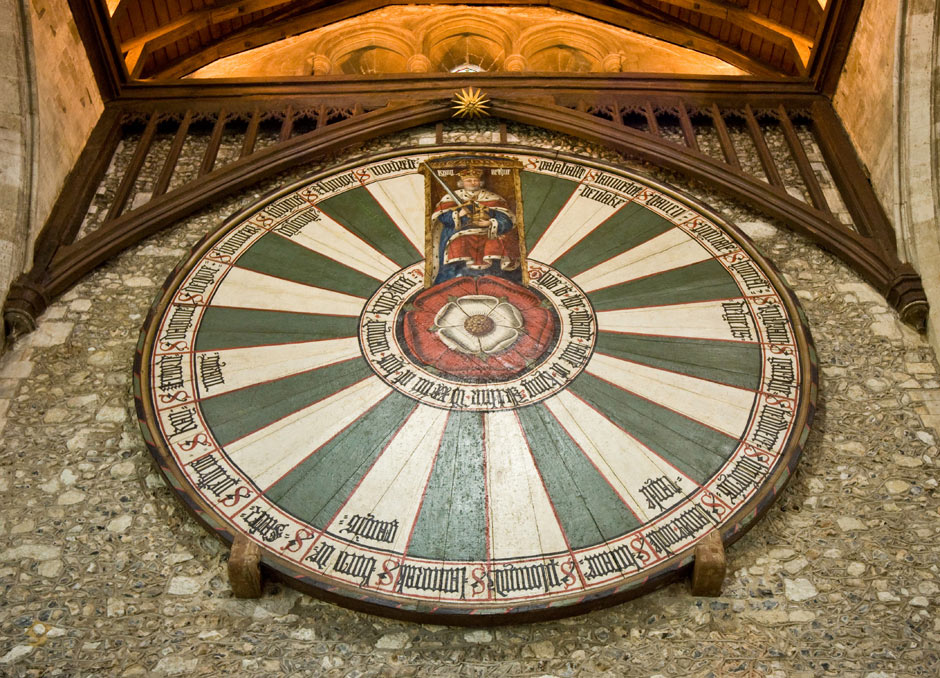 rose painted in natural colors. This symbol is that of the Rosicrucians, the ancient alchemists, and there is a direct connection between the legend of the British King and the ancient philosophers of fire. – Manly P. Hall
The rose (Latin, rosa, in Greek, rhodon) is a sacred symbol of regeneration, purity, virginity, fertility, sexuality, secrets, and most of all, love. In the earliest of times, women were often referred to as a “rosebud,” and a bride a “rose.”
In Greek mythology, the rose with five petals became the five-pointed star (pentagram or pentacle) of the Goddess of Love, Aphrodite, and the red petals of the rose are the blood of Lord Adonis (Jupiter).
The Greek female poet Sappho wrote about the rose in about 600 B. C.;
Would Jove appoint some flower to reign
In matchless beauty on the plain,
The Rose (mankind will all agree),
The Rose, the Queen of Flowers should be.
The pride of plants, the grace of bowers;
The blush of meads, the eyes of flowers;
Its beauties charm the gods above;
Its fragrance is the breath of love;
Its foliage wantons in the air,
Luxuriant, like the flowing hair;
It shines in blooming splendor gay,
While zephyrs on its bosom play.
The first use of the rose as a symbol can be found in the art of the Ancient Sumerians and later by the Hittities (Kheta), who are the sons of Heth or Ham. The royalty of the Ancient Hittite empires of the 15th century B.C. had used roses, often called Rosettes, that can be seen in Hittite inscriptions, seals, adorning jewelry, and headwear. Later roses were worn by Egyptian, Assyrian, English and Norman rulers from approximately the 7th century B.C. forward.
In Ancient Egypt, the rose was an emblem of immortality, and the rose with the true cross (Tau/Ankh) was the symbol of the “secrets of immortality.” The rose is the flower of the virgin Goddess of a thousand names who governs both heaven and hell, Isis. She is the Rose-breasted Lady in Nubia. In Ancient Egypt, in the temples, rites, and in festivals of Isis, roses were always a main decoration, and the Egyptians had also exported these roses around the world. The rosette continued to have a royal symbolism down into later times.
The following images below are from a statue of Meryetamun, daughter of Ramses II, located in the Cairo Museum and showing a rose or rosette on her left breast. Isis was also often shown with Horus on her left breast. Meryetamun, or Queen Mary is also known as the White Queen and whom I believe to be the direct hereditary descendant of almost all Queens in the West down to the current Queen Elizabeth II who is the queen of 16 of the 53 member states in the Commonwealth of Nations.

Here is a close up version of the rose on her breast.

Queen Mary from Egypt is also the mother of almost half of all Europeans who carry this maternal DNA blood line, including me. Queen Elizabeth II is Head of the Commonwealth and Supreme Governor of the Church of England. The Queen also uses the rose as her symbol which marks her ascension to the throne in 1952. It is a pink rose called the Queen Elizabeth rose.
It is known as the first Grandiflora rose of them all. It is a beautiful pink rose that was said to be developed in the very early 1950’s and named for Queen Elizabeth II on June 2nd 1953, her Coronation.

 In Rome with the formation of the Catholic Brotherhood, the red rose of Venus and Isis later became a symbol of the Virgin Mary, whose red petals represent the five wounds of Christ and the blood of the Christian martyrs. The white rose represents purity and Virginity. One of Mary’s many titles is the “Mystical Rose of Heaven” and the “Rosa Mystica.” Paintings of the Virgin Queen had often shown her surrounded by roses, holding a rose, or sitting in a rose.
In the bible, the rose is found in the Song of Solomon, Chapter 2: “I am the rose of Sharon, and the lily of the valleys”, and in Isaiah Chapter 35: “The wilderness and the solitary place shall be glad for them; and the desert shall rejoice, and blossom as the rose.”
Sharon is the name of a fruitful plain or country, where herds and flocks were kept- Chron. xxvii. 29. Isa. xxxv. 2. and lxv. 10. This plain or country lay between Cesarea and Joppa, beginning at Lydda in Crete (Phoenicia, Canaan, Minoa, Atlantis). The Hittites had also lived in Sharon amongst the Amorites at Jerusalem in the days of Abraham. Eventually they would be driven north by the Egyptian Pharaoh Thothmes III.
When Henry VII took the crown of England from Richard III in battle, he brought about the end of the Wars of the Roses between theHouse of Lancaster (whose badge was a red rose) and the House of York (whose badge was a white rose). The White Rose of York (also called the Rose alba or rose argent), a white heraldic rose, is the symbol of the House of York and has since been adopted as a symbol of Yorkshire as a whole.
Henry VII’s father was Edmund Tudor from the House of Richmond, and his mother was Margaret Beaufort from the House of Lancaster; he married Elizabeth of York to bring all factions together. In fact, Richard III fought under the banner of the boar, and Henry under the banner of the dragon of his native Wales. The white rose/red rose idea was said to be a Tudor invention. In the late Seventeenth Century, the Jacobites took up the White Rose of York as their emblem, celebrating “White Rose Day” on 10 June, the anniversary of the birth of James III and VIII in 1688. (Wikipedia)
SYMBOL OF THE ROSE IN SECRET SOCIETIES, RELIGION AND KINGDOMS
In the Ancient Greek legend of Harpocrates, the god of silence; Eros presents a rose to the god of silence. This is where the term “sub rosa,” or “under the rose”- meaning “the keeping of a secret” is derived from, and why it is used in many secret societies such as the Rosicrucian, as their main symbols.
The rose is also found central in occult teachings and secret societies as a symbol of both silence and secrecy. It is also the national flower of England. The rose is one of the most important images used in the Ancient Brotherhood and by Alchemists from the East. Various secret societies use the rose as one of their main symbols such as the Freemasons, Order of the Rosy Cross, or the Rosicrucians.
The Rosicrucians were founded in approximately the late 13th or early 14th centuries by a group of men who were dedicated to the knowledge of the sacred science of the soul, body, and universe. Knowledge, that at one time was a threat to the Catholic Church and that would be deemed heretical and warrant the need for secrecy.
Their name Rosicrucian is derived from the Latin words rosa (rose) and crux (cross), and their symbol is that of the rose crucified in the center of a cross. The rose is symbolic of our soul, and when combined with the cross, it signifies that the soul of man is crucified upon the body, where it is held by three nails (Manly Hall).
This secret society under the rose assists people with their teachings by aiding the soul searcher of wisdom through the process of their spiritual or soul awakening. They have learning courses and books that teach people to not only know themselves, but also the Universe around them, and how their vital energies interplay with the forces of nature in the AS ABOVE, and the SO BELOW.
A Master Rosicrucian is the adept, alchemist, or true philosopher of the ancient arts who has gained the knowledge to know the secrets of the soul, immortality, and the Universe. Many P. Hall had written in The Secret Teaching of All Ages, “In mysticism the eagle is a symbol of initiation (the spinal Spirit Fire), and by this is explained the inability of the unregenerated world to understand the Secret Order of the Rose Cross. Those professing this theory regard the Comte de St.-Germain as their highest adept and assert that he and Christian Rosencreutz were one and the same individual.
They accept fire as their universal symbol because it was the one element by means of which they could control the metals. They declared themselves the descendants of Tubal-cain and Hiram Abiff, and that the purpose of their existence was to preserve the spiritual nature of man through ages of materiality. “The Gnosticsects, the Arabs, Alchemists, Templars, Rosicrucians, and lastly the Freemasons, form the Western chain in the transmission of occult science.” (See The Tarot of the Bohemians translated by A. E. Waite from the French of Papus.)”
Arthur Edward Waite had written about the Rose and cross inBrotherhood of the Rosy Cross:
‘Thus the Rose is a symbol of Mary because of her motherhood, but in relation to her it belongs to divine things, even as she herself stands on the threshold of Deity, being Spouse of the Divine Spirit and bearer of the Divine word made flesh. So also is the Rose of Shekinah, a Divine Rose, as she whom it typifies is Divine Mother of souls.’
From Geheime Figuren der Rosenkreuzer:
“The rose is a yonic symbol associated with generation, fecundity, and purity. The fact that flowers blossom by unfolding has caused them to be chosen as symbolic of spiritual unfoldment. The red color of the rose refers to the blood of Christ, and the golden heart concealed within the midst of the flower corresponds to the spiritual gold concealed within the human nature. The number of its petals being ten is also a subtle reminder of the perfect Pythagorean number.
The rose symbolizes the heart, and the heart has always been accepted by Christians as emblematic of the virtues of love and compassion, as well as of the nature of Christ–the personification of these virtues. The rose as a religious emblem is of great antiquity. It was accepted by the Greeks as the symbol of the sunrise, or of the coming of dawn. In his Metamorphosis, or Golden Ass, Apuleius, turned into a donkey because of his foolishness, regained his human shape by eating a sacred rose given to him by the Egyptian priests.
The presence of a hieroglyphic rose upon the escutcheon of Martin Luther has been the basis of much speculation as to whether any connection existed between his Reformation and the secret activities of the Rose Cross.”
Manly P. Hall further elaborates on the symbol of the Rose:
“The rose is a yonic symbol associated with generation, fecundity, and purity. The fact that flowers blossom by unfolding has caused them to be chosen as symbolic of spiritual unfoldment. The red color of the rose refers to the blood of Christ, and the golden heart concealed within the midst of the flower corresponds to the spiritual gold concealed within the human nature.”
 TheHermetic Order of the Golden Dawn also has rose symbolism in their degree system with “The Ritual of the Rose Cross”, that is said to be performed for spiritual protection and also preparation for meditation.
The rose cross also has a place in the secret order called the Ordo Templi Orientis with their Fifth Degree titled, the “Sovereign Prince Rose-Croix, and Knight of the Pelican and Eagle.” The Pelican since ancient times had always represented Christ, andthe Mohamedans have a tradition that Christ was conceived by the smelling of a rose.
Another secret society that uses the rose and rose cross as a prominent symbol are the Freemasons. In the higher degrees of Masonry, the degrees of the Rose Croix, such as the Sovereign Prince Rose Croix, are some of the most ancient degrees of masonry. It is to be found in nearly all their rites. The Ancient and Accepted Scotch rite, or the Southern Jurisdiction of the Scottish Rite’s 18th degree is called, “Knight Rose Croix.”
In 1871, Albert Pike had written about this degree;
“The Degree of Rose Cross teaches three things;—the unity, immutability and goodness of God; the immortality of the Soul; and the ultimate defeat and extinction of evil and wrong and sorrow, by a Redeemer or Messiah, yet to come, if he has not already appeared.
The ROSE, was anciently sacred to Aurora and the Sun. It is a symbol of Dawn, of the resurrection of Light and the renewal of life, and therefore of the dawn of the first day, and more particularly of the resurrection: and the Cross and Rose together are therefore hieroglyphical to be read, the Dawn of Eternal Life which all Nations have hoped for by the advent of a Redeemer.”
Albert Mckay in his Lexicon of Freemasonry strongly states;
‘The Rose Croix degree was an attempt to ChristianizeFreemasonry; to apply the rites, and symbols, and traditions of Ancient Craft Masonry to the last and greatest dispensation; to add to the first Temple of Solomon and the second of Zerubbabel, a third, that to which Christ alluded when he said, “Destroy this temple, and in three days will I raise it up.” Everything, in short, about the degree is Christian.’
I will leave you with a quote from the Master Rosicrucian, Max Heindel who had written, “the blood-red rose shows the passion filled blood of the human race, and the goal to bring the pure and holy state to which man will attain when he has cleansed and purified his blood from desire, when he has become chaste, pure and Christ-like.
Thus we see that in time the present passionate mode of generation will be again superceded by a pure and more efficient method than the present, and that also is symbolized in the RoseCross where the rose is placed in the center between the four arms. The long limb represents the body, the two horizontals, the two arms and the short upper limb, the head. The the rose is in place of the larynx.
The rose, like any other flower, is the generative organ of the plant. Its green stem carries the colorless, passionless plant-blood. The blood-red rose shows the passion filled blood of the human race, but in the rose the vital fluid is not sensuous, it is chaste and pure. Thus it is an excellent symbol of the generative organ in the pure and holy state to which man will attain when he has cleansed and purified his blood from desire, when he has become chaste, pure and Christ-like.
Therefore the Rosicrucians look ardently forward to the day when the roses shall bloom upon the cross of humanity, therefore the Elder Brothers greet the aspiring soul with the words of the Rosicrucian Greeting: “May the Roses bloom upon your Cross,” and therefore the greeting is given in the meetings of the Fellowship Centers by the leader to the assembled students, probationers and disciples who respond to the greeting by saying “And on yours, also.” (The Rosicrucian Cosmo-conception; Or, Mystic Christianity)
When that day arrives, the blood red rose of the Rosicrucians will turn white and will become the center of the true cross, the Tau.


 Grand Temple of Horus Behdety