This is not yet an alchemical operation. It is the emptying of the vessel.
Concerning the Threshold, the Void, and the Renunciation of Pretension
The Charge
Aspirant, standing upon the Threshold, thou art neither admitted nor excluded, neither instructed nor refused.
The Grade of Neophyte is not a possession, but a condition.
It signifies not knowledge attained, but ignorance acknowledged.
Thou art now placed between the worlds, having voluntarily withdrawn from certainty, from authority assumed, and from the false comfort of unexamined belief.
Know that at this stage:
Thou art not yet a student of the Mysteries
Thou art not yet an operator of the Art
Thou art not yet a bearer of Light
Thou art a candidate for discipline.
The Neophyte is required to unlearn before learning, to become empty before being filled, and to submit before aspiring.
Therefore thou art charged:
To lay aside all titles, ranks, and claims of attainment
To refrain from judgment of the Path before walking it
To accept obscurity, silence, and probation without resentment
This Grade does not promise revelation. It demands honesty.
For many seek the Mysteries to escape themselves. The Mysteries permit no such escape.
Thus thou art warned:
The Work begins not in Light, but in darkness willingly entered.
If thou canst not endure not-knowing, thou art unfit for knowing.
If thou canst not obey in small things, thou shalt not be trusted in greater.
This Charge is laid upon thee not to humble thee before others, but to strip thee of self-deception.
Bear it patiently, and the Gate may open of its own accord.
📜 The Probationary Obligation of the Grade of Neophyte (0=0)
(The Aspirant stands in silence, facing the East.)
The Obligation
I, standing freely at the Threshold of the Sacred Art, in the presence of the Unseen Order and under the Witness of the Living Light, do solemnly affirm and obligate myself upon my honor and my conscience as a Neophyte upon probation,
That I will seek truth rather than comfort, and discipline rather than display.
That I will lay aside claims of prior attainment, and will present myself to the Work as one willing to learn, to be corrected, and to be tested.
That I will maintain silence concerning the practices, symbols, and teachings to which I may be exposed, save where lawful instruction permits speech.
That I will observe carefully and act deliberately, not rushing ahead of instruction nor resisting necessary restraint.
That I will submit to probation without demand for advancement, recognition, or assurance, knowing that readiness is proven by conduct and not declared by desire.
That I will withdraw willingly should I find myself unable to uphold this discipline, rather than compromise the Work through impatience or self-deception.
If I fail in this Obligation through dishonesty, haste, or vanity, may the Gate remain closed to me, and my progress be halted until sincerity is restored.
But if I uphold it with integrity and perseverance, may the Threshold become a Door, the Silence become instruction, and the Darkness yield in due time to Light.
So I affirm and bind myself, freely, consciously, and deliberately.
Closing Formula (By the Hierophant or Instructor)
Let the Aspirant remain in silence and watchfulness. Let the Vessel be emptied. Let no light be claimed before it is given.
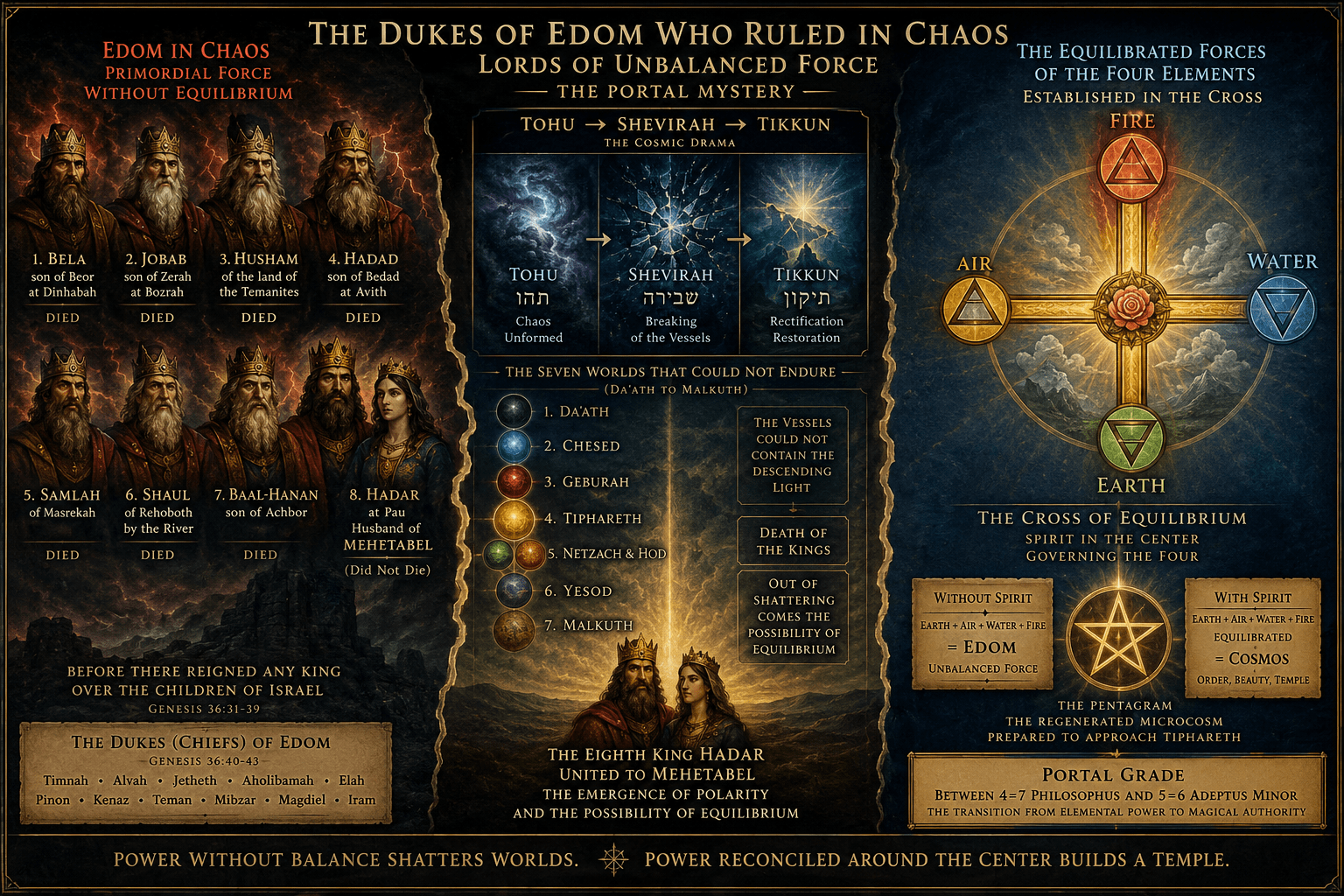
In the Golden Dawn Portal Grade, the phrase “The Dukes of Edom ruled in Chaos, Lords of unbalanced force” refers to a very old Qabalistic doctrine: before the ordered Tree of Life could exist, primordial configurations of force arose that could not maintain equilibrium. They are represented by the Kings of Edom of Genesis 36 and, in later Hermetic terminology, by the “Dukes of Edom.” The Portal ritual explicitly contrasts them with the equated forces of the Four Elements and then establishes the Cross as the symbol of restored equilibrium. (Daniel Tarr)
The Biblical Kings of Edom
Genesis 36:31 makes the enigmatic statement that these were the kings who ruled Edom “before there reigned any king over the children of Israel.” It then gives eight rulers:
Bela ben Beor — king at Dinhabah
Jobab ben Zerah — of Bozrah
Husham — of the land of the Temanites
Hadad ben Bedad — king at Avith
Samlah — of Masrekah
Shaul — of Rehoboth by the River
Baal-Hanan ben Achbor
Hadar/Hadad — king at Pau; husband of Mehetabel
The text repeatedly says that each of the first seven kings dies and is replaced. The eighth, Hadar, is different: Genesis introduces his wife, Mehetabel, and does not conclude his entry by saying that he died. (Bible Gateway)
That small biblical peculiarity becomes enormously important in Qabalah.
Why are they said to have “ruled in Chaos”?
In the Zoharic material translated by S. L. MacGregor Mathers in The Kabbalah Unveiled, the Edomite kings are interpreted cosmologically. Before the Divine configuration had been established “in the equilibrium of balance,” primordial kings or worlds arose, but they could not endure. Mathers explicitly connects Genesis 36 with these earlier worlds of unbalanced force. (Internet Sacred Text Archive)
This is the background of the Portal formula.
Chaos here is not merely disorder in the everyday sense. It corresponds to the Qabalistic idea of Tohu — תהו, the primordial condition in which tremendous Divine forces existed without sufficient relationship, mediation, or equilibrium.
The forces themselves are not intrinsically evil.
The problem is that they are unbalanced.
Severity without Mercy becomes destruction.
Mercy without Severity becomes uncontrolled expansion.
Fire without Water consumes.
Water without Fire stagnates.
Expansion without limitation becomes dissolution.
Limitation without expansion becomes sterility.
Thus the Edomite Kings represent powers that are enormous, even divine in origin, but which cannot sustain a universe because they have not yet learned relationship.
This is why their reign ends in death.
The Breaking of the Vessels
Later Lurianic Qabalah gives this idea its famous formulation as Shevirat ha-Kelim — שבירת הכלים, the Breaking of the Vessels.
The primordial vessels receive an intensity of Divine Light that they cannot contain. They shatter. Their fragments descend, carrying sparks of Divine Light with them.
The Kings of Edom become symbolic representations of these shattered configurations.
In Lurianic teaching, the seven primordial kings are associated with the lower seven configurations extending from Da‘ath downward: Da‘ath, Chesed, Geburah, Tiphareth, Netzach-Hod considered together, Yesod, and Malkuth. They “die” because their vessels cannot maintain the descending Light. (Sefaria)
This gives us an important Qabalistic sequence:
Tohu → Shevirah → Tikkun
Chaos → Breaking → Restoration.
And that sequence is precisely what the Portal ceremony dramatizes.
Why is the eighth king different?
The eighth ruler, Hadar, is particularly significant.
Unlike the preceding kings, Scripture gives him a wife:
Mehetabel, daughter of Matred, daughter of Me-Zahab.
And Scripture does not immediately declare his death. (Bible Gateway)
Qabalistically, this becomes a symbol of an enormous transformation.
The earlier kings exist as isolated forces.
Hadar exists in relationship.
King and Queen.
Masculine and feminine.
Force and form.
Positive and negative.
Chokmah and Binah.
Mercy and Severity.
The presence of the feminine principle indicates the possibility of equilibrium through polarity.
Thus Hadar anticipates the corrected world — Olam ha-Tikkun, the World of Rectification.
The universe can now endure because force is no longer solitary.
It has found its counterpart.
But what about the actual “Dukes of Edom”?
Here we need to make a distinction that is often blurred in Golden Dawn language.
Genesis actually gives two groups.
First come the Kings of Edom in Genesis 36:31–39.
Then Genesis 36:40–43 lists the chiefs whom the King James Version calls the Dukes of Edom:
Modern translations generally render the Hebrew term alluph as “chief” or “clan leader” rather than “duke.” (Bible Gateway)
So strictly speaking, the biblical Kings and Dukes are two different lists.
But in Golden Dawn ritual language, “Dukes of Edom” becomes a more generalized title for the primordial powers of the Edomite condition—the Lords of Unbalanced Force.
The technical Qabalistic doctrine, however, is primarily derived from the Kings of Edom.
Why does the Portal Grade invoke them?
Now we reach the real initiatory significance.
The Portal is not merely another elemental grade.
The initiate has already passed through:
Zelator — Earth Theoricus — Air Practicus — Water Philosophus — Fire.
But possessing the four elements does not mean that they have yet been integrated.
One can possess tremendous Earth, Air, Water and Fire forces and still remain internally divided.
That condition is Edom.
The Portal therefore opens with the warning:
“The Dukes of Edom ruled in Chaos, Lords of unbalanced force.”
And immediately afterward asks what stands upon the Altar.
The response is:
“The Symbol of the equated forces of the Four Elements.”
Then comes the command that the power of Edom be banished and the Cross established. (Wasabi Technologies)
That exchange summarizes almost the entire mystery of Portal.
The candidate has accumulated elemental power.
Now the candidate must become capable of equilibrating it.
The Four Elements must cease behaving like four competing kingdoms.
They must become the four arms of one Cross.
And into the center of that Cross must descend the Fifth Principle:
Spirit.
Thus:
Earth + Air + Water + Fire without Spirit = Edom.
But:
Earth + Air + Water + Fire equilibrated around Spirit = the Pentagram of the regenerated Microcosm.
That is why the Portal lies between 4=7 Philosophus and 5=6 Adeptus Minor.
Edom as an initiatory condition
There is an even deeper way of understanding this.
The Kings of Edom are not primarily entities somewhere “out there.”
They describe a condition that can exist within the magician.
Whenever one faculty attempts to become king over the whole personality, an Edomite kingdom arises.
Intellect without compassion becomes Edom.
Emotion without discrimination becomes Edom.
Will without wisdom becomes Edom.
Imagination without grounding becomes Edom.
Discipline without love becomes Edom.
Love without boundaries becomes Edom.
Spiritual aspiration without embodiment can also become Edom.
Every one of these possesses legitimate power.
What makes it Edomite is not the power itself.
It is power claiming sovereignty without equilibrium.
This is why Portal is such an important threshold.
The aspirant is being taught that the problem is no longer simply ignorance.
The more advanced danger is unbalanced attainment.
A powerful magician who is internally divided can be more dangerous—to themselves and others—than an inexperienced magician.
Portal therefore teaches:
Do not destroy the Elements. Equilibrate them.
Do not eliminate Geburah.
Balance it with Chesed.
Do not extinguish Fire.
Give it Water.
Do not suppress intellect.
Reconcile it with intuition.
Do not annihilate personality.
Place it under the rulership of the Higher Genius.
Edom and the Qliphoth
There is also a relationship between the Edomite Kings and the later doctrine of the Qliphoth, the “shells” or “husks.”
In Mathers’ presentation, when the primordial vessels cannot sustain equilibrium, their broken remains become associated with the shells—the remnants of forces separated from their proper place in the Divine order. (Scribd)
This does not mean that the historical Edomite people should be identified with demons or evil. The mystical interpretation is symbolic and cosmological; it takes the biblical narrative and uses its kings as archetypes of primordial imbalance.
For Golden Dawn purposes, this distinction is important.
Edom is a metaphysical condition, not an ethnicity.
The Portal mystery in one formula
The entire teaching can therefore be condensed into a remarkable progression:
The Kings of Edom ↓ Unbalanced Force ↓ Tohu — Chaos ↓ Breaking of the Vessels ↓ Death of the Kings ↓ Emergence of complementary polarity ↓ Equilibrium ↓ Tikkun — Rectification ↓ The Four Elements balanced beneath Spirit ↓ The Pentagram ↓ Tiphareth ↓ The birth of the Adept.
And this is why the Portal ceremony does not merely say that Chaos existed.
It declares that Edom ruled in Chaos.
The great lesson is that force alone cannot create Cosmos.
Only force placed into right relationship can do so.
The Philosophus has learned Fire and completed the circuit of the four elemental Grades. The Portal initiate must now discover the secret that transforms elemental power into magical authority:
Equilibrium precedes true Adeptship.
The Dukes of Edom therefore stand at the threshold as a warning: Power without balance produces shattered worlds.
If you want, I can develop this next into a full Portal oral temple lecture: “The Dukes of Edom, the Kings Who Died, and the Mystery of Unbalanced Force,” incorporating Tohu, Shevirat ha-Kelim, the Qliphoth, Tikkun, the Four Elements, the Portal Cross, and the transition from 4=7 to 5=6.
Absolutely. For this Portal material, the bibliography should preserve the historical chain from Genesis → Zohar → Lurianic Kabbalah → Hermetic Qabalah → Golden Dawn Portal symbolism, while making clear where later occult interpretation goes beyond the biblical text.
Annotated Bibliography
The Dukes of Edom, the Kings Who Died, and the Mystery of Unbalanced Force
Primary Biblical and Kabbalistic Sources
The Holy Bible. Genesis 36:1–43. King James Version.
Genesis 36 is the indispensable starting point for the doctrine of the Kings and Dukes of Edom. Verses 31–39 enumerate the kings who ruled Edom “before there reigned any king over the children of Israel.” Seven successive rulers are explicitly said to die, while the account of the eighth ruler, Hadar, notably introduces his wife, Mehetabel, without concluding with a statement of his death. Verses 40–43 then give a separate list of the allufim of Edom, rendered “dukes” in the King James Version and more commonly “chiefs” or “clans” in modern translations. This distinction is essential: the mystical doctrine of primordial worlds is principally attached to the Kings of Edom, even though Golden Dawn ritual employs the expression “Dukes of Edom.” (Sefaria)
Recommended for: establishing the scriptural foundation; distinguishing Kings from Dukes; studying the exceptional position of Hadar and Mehetabel.
The Zohar. Especially theSifra de-Tzeniuta(“Book of Concealed Mystery”) and theIdra Rabba(“Greater Holy Assembly”).
The Zoharic corpus provides the crucial transformation of Genesis 36 from genealogy into mystical cosmology. The Edomite kings become symbolic of primordial configurations that existed before the Divine forces had been properly arranged “in the equilibrium of balance.” These configurations could not endure. The Zohar thus supplies one of the major conceptual ancestors of the later doctrines of cosmic imbalance, destruction, and reconstruction. For a Portal student, this material explains why Edom becomes a symbol not merely of disorder but of force existing prior to stable equilibrium.
Recommended for: understanding the transition from biblical Edom to metaphysical Edom and the emergence of the doctrine of primordial, unsustainable worlds.
Mathers, S. L. MacGregor, trans.The Kabbalah Unveiled. London: George Redway, 1887.
Mathers’s translation of portions of the Zohar became one of the most influential conduits by which Zoharic symbolism entered nineteenth-century Hermetic Qabalah and subsequently the Golden Dawn. Particularly important is the section titled “Concerning the Edomite Kings.” Here the kings are explicitly associated with primordial formations existing before the establishment of equilibrium. Mathers’s terminology—especially his repeated emphasis upon the “equilibrium of balance”—strongly anticipates the language and symbolism of the Golden Dawn Portal Grade. (Universal Co-Masonry)
Although modern scholarship and translations should be consulted alongside Mathers, this work is indispensable for understanding what the founders and early Adepts of the Golden Dawn themselves were likely reading.
Recommended for: direct study of the intellectual bridge between Jewish Kabbalistic texts and Golden Dawn Hermetic Qabalah.
Lurianic Kabbalah: Tohu, Shevirah, and Tikkun
Vital, Hayyim.Etz Hayyim [The Tree of Life].Compiled from the teachings of Isaac Luria. Various editions.
Hayyim Vital’s writings are the principal literary repository of the teachings attributed to Rabbi Isaac Luria, the Ari. Within the Lurianic system, the problem suggested by the Edomite Kings becomes part of a vast cosmological drama involving Tzimtzum (divine contraction), the emergence of primordial configurations, Shevirat ha-Kelim (the Breaking of the Vessels), the scattering of divine sparks, and Tikkun (rectification or restoration).
This source is especially valuable for advanced Portal work because it demonstrates that the “death of the kings” is not simply a story of evil being destroyed. Rather, it symbolizes the inability of isolated vessels to contain an overwhelming influx of Divine Light. The corrective process involves restructuring, relationship, polarity, and integration.
Recommended for: advanced study of the metaphysics underlying “unbalanced force,” particularly the relationship between catastrophe and subsequent rectification.
Fine, Lawrence.Physician of the Soul, Healer of the Cosmos: Isaac Luria and His Kabbalistic Fellowship. Stanford, CA: Stanford University Press, 2003.
Fine provides one of the strongest modern scholarly treatments of Isaac Luria and the community through which Lurianic Kabbalah developed. Of particular importance for this subject are his discussions of Lurianic myth, cosmic fracture, the qelippot, human spiritual practice, and the restoration of the cosmos. Fine also emphasizes that Lurianic Kabbalah was not merely speculative metaphysics but a lived religious discipline in which human action participated in cosmic repair. (Google Books)
For the Portal initiate, this provides an important parallel: Tikkun is not merely something that happens to the universe; the practitioner participates in rectification. The Golden Dawn’s balancing of the Elements around Spirit may therefore profitably be compared—while not simply equated—with the broader Kabbalistic principle of restoration.
Recommended for: historically responsible treatment of Isaac Luria, Shevirah, Tikkun, qelippot, and the practical implications of cosmic rectification.
Scholem, Gershom.Major Trends in Jewish Mysticism. New York: Schocken Books, 1995. Originally published 1941.
Scholem’s classic study remains foundational for the modern academic understanding of Jewish mysticism. Especially relevant is the chapter “Isaac Luria and His School,” which places Lurianic doctrines within their historical and theological context and discusses such central concepts as Tzimtzum, cosmic catastrophe, and Tikkun. (Penguin Random House)
Scholem is especially useful for Golden Dawn students because he helps prevent the retroactive assumption that the fully developed Hermetic Tree of Life system was identical to historical Jewish Kabbalah. His work allows the initiate to appreciate both genuine continuity and later occult transformation.
Recommended for: historical background to Lurianic Kabbalah and a scholarly counterbalance to nineteenth-century occult interpretations.
Scholem, Gershom.Kabbalah. New York: Meridian/Penguin, 1978.
This broad reference work provides accessible but substantial treatments of the major historical currents, concepts, symbols, and personalities of Kabbalah. It is particularly useful for tracing the development of the sefirot, the Zohar, Lurianism, the qelippot, Tikkun, and the evolution of Kabbalistic cosmology. (Google Books)
For this Portal study, Scholem supplies the larger intellectual environment necessary to avoid treating the Kings of Edom, the Breaking of the Vessels, and the Qliphoth as interchangeable doctrines. They belong to related but historically developing layers of Kabbalistic speculation.
Recommended for: reference work and broader conceptual orientation.
Zoharic Scholarship
Tishby, Isaiah.The Wisdom of the Zohar: An Anthology of Texts. 3 vols. Translated by David Goldstein. Oxford: Littman Library of Jewish Civilization, 1989.
Tishby’s monumental anthology combines translated Zoharic passages with extensive scholarly introductions and commentary. It remains one of the most valuable English-language aids for understanding the symbolic universe of the Zohar. Its thematic organization makes it particularly useful when studying divine configurations, creation, judgment, the sefirotic world, evil, and the dynamic relationship between masculine and feminine principles. (JSTOR)
This work is especially helpful when exploring why the introduction of Mehetabel, the wife of the final Edomite king, became important to later Kabbalistic interpretation. The transition from isolated force toward relationship and polarity belongs to a much larger Zoharic concern with the proper conjunction and harmony of Divine powers.
Recommended for: serious Zohar study and clarification of the Jewish mystical background behind later Hermetic doctrines of equilibrium.
Giller, Pinchas.Reading the Zohar: The Sacred Text of Kabbalah. Oxford: Oxford University Press, 2000.
Giller examines the Zohar not merely as a repository of isolated mystical statements but as a complex sacred text possessing its own literary, ritual, symbolic, and interpretive world. (OUP Academic)
This perspective is useful for Portal students who encounter individual Zoharic statements through Mathers or other occult compilations. Giller helps restore those passages to their wider Jewish mystical setting and prevents the student from assuming that a Golden Dawn interpretation is necessarily identical to the original Zoharic intention.
Recommended for: learning how to approach Zoharic texts critically and contextually.
Hermetic Qabalah and the Golden Dawn
Regardie, Israel.The Golden Dawn: The Original Account of the Teachings, Rites, and Ceremonies of the Hermetic Order. Edited by John Michael Greer. Woodbury, MN: Llewellyn Publications, 2016.
This is one of the principal published repositories of Golden Dawn teachings and rituals. Regardie’s work preserves the initiatory framework within which the Edomite formula becomes especially important. The Portal ritual explicitly declares:
“The Dukes of Edom ruled in Chaos, Lords of unbalanced force,”
and immediately contrasts them with the symbol upon the Altar representing the equated forces of the Four Elements. The subsequent establishment of the Cross makes clear that the Portal interpretation of Edom concerns the transition from elemental disequilibrium to ordered integration. The current Llewellyn edition is edited by John Michael Greer and presents the influential material Regardie first published beginning in 1937. (Daniel Tarr)
Recommended for: the primary Golden Dawn application of the Edomite doctrine and its direct connection with Portal initiation.
Regardie, Israel.The Complete Golden Dawn System of Magic. Phoenix: Falcon Press, 1984.
This expansive collection preserves Golden Dawn teachings, ritual material, Qabalah, Tarot, astrology, alchemy, magical practice, and additional instructional material. The original edition appeared through Falcon Press in 1984. (Invisible House Society)
For the present subject, it should be used alongside The Golden Dawn to understand how the symbolism of equilibrium operates within the larger magical system: Pentagram, elemental grades, Spirit, the Cross, Tiphareth, and the gradual reconstruction of the magician as a balanced microcosm.
Recommended for: advanced cross-referencing of Portal symbolism with the wider Golden Dawn magical system.
Modern Academic Perspectives on Kabbalah
Idel, Moshe.Kabbalah: New Perspectives. New Haven: Yale University Press, 1988.
Idel’s influential study broadened academic investigation of Kabbalah beyond some of the historical models associated with Scholem. He emphasizes comparative, experiential, theurgical, and phenomenological dimensions of Jewish mysticism. (Yale University Press)
This work is valuable to the Portal student because it warns against reducing Kabbalah to one uniform theological system. Ideas such as divine emanation, mystical union, theurgy, cosmic restoration, and human participation in the Divine order developed through several streams. This nuance becomes particularly important when comparing Jewish Kabbalah to its later Hermetic adaptation.
Recommended for: advanced students wishing to distinguish historical Kabbalistic traditions from later Western esoteric synthesis.
Dan, Joseph.Kabbalah: A Very Short Introduction. Oxford: Oxford University Press, 2007.
Dan offers a concise scholarly introduction to the history and ideas of Kabbalah. His treatment helps situate the Zohar, Lurianic mysticism, the sefirotic system, and later developments within Jewish intellectual history. (OUP Academic)
For students encountering the subject primarily through the Golden Dawn, Dan provides a useful corrective orientation. It reinforces the fact that Hermetic Qabalah is an adaptation and transformation of Jewish Kabbalistic materials rather than a simple continuation of them.
Recommended for: introductory historical grounding before undertaking more difficult primary and scholarly works.
Suggested Portal Reading Sequence
For a Portal initiate studying the doctrine progressively, the following sequence is particularly effective:
First: Genesis 36:31–43 Establish exactly what the biblical text says about the Kings and Dukes.
Second: Mathers, The Kabbalah Unveiled, “Concerning the Edomite Kings” Observe how the biblical material enters nineteenth-century Hermetic Qabalah.
Third: Regardie, The Golden Dawn, Portal Ritual Examine how Edom becomes the ritual formula of “unbalanced force.”
Fourth: Scholem, Major Trends in Jewish Mysticism, “Isaac Luria and His School” Study the historical development of cosmic fracture and restoration.
Fifth: Fine, Physician of the Soul, Healer of the Cosmos Deepen the understanding of Lurianic Tikkun as an active religious and mystical undertaking.
Sixth: Tishby, The Wisdom of the Zohar Return to the deeper Zoharic theological framework from which many of these concepts emerged.
Seventh: Idel and Giller Use modern scholarship to distinguish the historical Jewish traditions from their later Hermetic transformations.
Portal Study Key
The bibliography as a whole supports a four-stage historical and initiatory development:
Genesis The Kings of Edom who reign and die.
↓
Zohar The Kings become primordial powers existing before stable equilibrium.
↓
Lurianic Kabbalah Primordial imbalance develops into the great drama of Tohu → Shevirah → Tikkun: Chaos, Breaking, and Rectification.
↓
Golden Dawn Portal The myth becomes an initiatory formula:
Dukes of Edom = Lords of Unbalanced Force
versus
The Cross = Equilibrated Forces of the Four Elements
and finally:
Spirit governing the Four Elements = the regenerated Microcosm prepared to approach Tiphareth.
The most important interpretive caution is that these are successive layers of interpretation rather than one identical doctrine preserved unchanged through history. Genesis describes Edomite rulers and chiefs; medieval Kabbalah mystically reinterprets the kings; Lurianic Kabbalah develops a far-reaching cosmology of fracture and restoration; and the Golden Dawn adapts these ideas to an initiatory system centered upon elemental equilibrium.
For the Portal initiate, this distinction does not weaken the symbolism. It makes it considerably richer.
The historical doctrine tells us how the symbol developed.
The initiatory doctrine tells us why it was placed at the threshold of Adeptship.
This gives the blog a solid blend of primary sources, Golden Dawn authorities, and academic Kabbalah scholarship, rather than relying only on modern occult interpretations.
As Philosophi, we have reached a significant turning point in our progress through the Outer Order. In the earlier Grades, we devoted ourselves to understanding the elemental constitution of both the universe and ourselves. We learned that Earth provides stability, Air grants understanding, Water teaches receptivity, and Fire awakens aspiration and the directed Will. Now, standing within the Grade of Philosophus, the Grade attributed to Fire, we begin to unite those elemental lessons into something more dynamic. We begin to study the celestial powers that govern the rhythms of nature and the unfolding of the human soul.
Tonight we shall examine one of the oldest and most misunderstood branches of the Hermetic tradition: the creation and use of planetary talismans.
Many people, upon first hearing the word talisman, imagine an enchanted object possessing mysterious powers of its own—a charm that somehow compels fortune, wealth, protection, or influence merely by existing. Such ideas have become popular through folklore and modern fantasy, but they bear little resemblance to the understanding preserved within the Western Mystery Tradition.
The Hermetic initiate approaches talismanic work from an entirely different perspective.
A talisman possesses no inherent magical force independent of the consciousness that creates and consecrates it. It is not a supernatural battery storing invisible energy, nor is it an object capable of overriding Divine Providence. Rather, a talisman is a sacred symbol deliberately fashioned to serve as a bridge between the visible and invisible worlds. It is a point of contact between the aspirant’s disciplined consciousness and the eternal principles represented by the celestial spheres.
In other words, the talisman does not create the relationship—it reminds us of it, focuses it, and strengthens our participation in it.
This distinction is essential.
Throughout your studies in the Golden Dawn, you have repeatedly encountered the Hermetic axiom, “As Above, So Below.” This ancient statement expresses the doctrine of correspondence, the realization that every level of existence reflects every other level according to proportion and analogy. The planets, the Sephiroth, the elements, the colors, the Hebrew letters, the Tarot, sacred geometry, music, and even the architecture of the Temple all participate in this universal harmony.
Nothing exists in isolation.
Every created thing speaks the language of correspondence.
The purpose of ceremonial magic is not to manipulate these correspondences but to consciously cooperate with them.
A talisman, therefore, becomes a carefully constructed microcosm. It reflects within a small and tangible form a much greater spiritual reality. Like the Temple itself, it is built according to sacred relationships rather than arbitrary decoration. Every line, every color, every Divine Name, every perfume, and every geometric figure contributes to a single symbolic harmony.
The Philosophus is especially prepared for this work because this Grade is fundamentally concerned with the intelligent direction of force.
Fire is frequently misunderstood. Many assume it represents only passion or intensity. Yet in our system Fire represents directed purpose. It is aspiration governed by wisdom. Fire illuminates, purifies, transforms, and gives life. Without Fire there is no alchemy, no spiritual growth, and no Great Work.
The construction of a talisman is therefore not an artistic exercise.
It is an act of disciplined intention.
Before a single line is drawn, before any metal is engraved or parchment prepared, the Philosophus must ask one question—a question far more important than what planet to choose or what symbols to employ.
That question is this:
“What Divine virtue am I seeking to cultivate?”
Notice the wording carefully.
Not, “What do I want?”
Not, “What can I obtain?”
Not, “What can magic give me?”
But rather,
“What kind of person must I become?”
This single question separates authentic Hermetic practice from superstition.
Suppose a student desires confidence.
The ordinary person may ask for success.
The initiate instead asks for courage.
Suppose another seeks prosperity.
The initiate first asks for wisdom in stewardship, generosity, justice, and right relationship with abundance.
Whenever we seek the inner virtue before the outer circumstance, we align ourselves with Divine Law rather than personal appetite.
Each of the seven classical planets represents one of these enduring modes of Divine expression.
Saturn teaches discipline, perseverance, maturity, patience, and sacred responsibility. Saturn is often feared because it limits, delays, and tests us. Yet every teacher worthy of respect has possessed something of Saturn. Without limitation there can be no mastery. Without discipline there can be no freedom.
Jupiter expresses expansion, justice, mercy, leadership, generosity, and noble governance. It teaches us how authority may become service rather than domination.
Mars is frequently mistaken for aggression, but the Philosophus learns that Mars is courageous action disciplined by wisdom. It is the strength to defend what is right without becoming consumed by anger.
The Sun represents illumination, vitality, harmony, integration, and the realization of one’s higher purpose. It is the radiant center around which the lesser faculties revolve.
Venus teaches beauty, love, attraction, balance, creativity, and reconciliation. Properly understood, Venus is not indulgence but harmony.
Mercury governs understanding, communication, adaptability, learning, interpretation, and the integration of opposites. Mercury is the sacred messenger who continually moves between worlds.
Finally, the Moon teaches receptivity, memory, imagination, intuition, and the mysterious rhythms through which consciousness reflects higher realities.
Notice that every planetary quality ultimately describes a transformation within ourselves.
This is why authentic planetary magic is always ethical.
If one attempts to invoke Mars in order to dominate another person, one has already departed from the Hermetic path.
If one seeks Venus merely to manipulate affection, one has misunderstood Venus entirely.
If one pursues Jupiter for status alone, Jupiter withdraws its blessing because justice has been abandoned.
The planets cannot be reduced to personal desires.
They represent Divine principles.
Accordingly, the true Philosophus approaches every operation with humility.
Only after selecting the appropriate planetary current does the practical work begin.
Tradition has always advised us to perform these operations in harmony with celestial rhythms. Planetary days, planetary hours, lunar phases, and favorable astrological configurations all provide opportunities to cooperate with nature’s own cycles. We do not imagine that the heavens mechanically force success or failure. Rather, we recognize that every living organism flourishes when it moves with natural rhythms rather than against them.
The sailor cannot command the wind.
The wise sailor learns when to raise the sail.
So too the magician.
Timing is cooperation, not coercion.
Likewise, the materials selected for the talisman participate in this symbolic harmony. Gold naturally reflects the solar current. Silver resonates with the Moon. Copper recalls Venus, iron Mars, tin Jupiter, lead Saturn. Appropriate colors, perfumes, herbs, gemstones, and sacred inscriptions all deepen the symbolic language through which the unconscious and the higher faculties communicate.
Yet we should never mistake expense for effectiveness.
A beautifully engraved golden talisman fashioned in vanity possesses less spiritual value than a simple parchment prepared reverently by an earnest student.
Magic has never been measured by luxury.
It is measured by consciousness.
When the design has been completed, the talisman must be consecrated. Here again, the ritual is not performed to force power into the object, but to dedicate it wholly to Divine service.
The fourfold elemental consecration beautifully illustrates this principle.
Through Earth we establish stability.
Through Air we awaken understanding.
Through Water we purify emotion and intention.
Through Fire we kindle aspiration and living Will.
Each element blesses the work because each element also blesses the practitioner.
The object is being consecrated, certainly—but even more importantly, the soul of the operator is being consecrated alongside it.
Following the ritual comes perhaps the most neglected stage of all.
Meditation.
Many students devote great care to constructing a talisman only to place it in a drawer and expect miraculous results.
The Hermetic tradition teaches otherwise.
Every day the Philosophus returns to contemplation.
One reflects upon the planetary virtue, visualizes its color, vibrates its Divine Name, considers its Sephirah, and quietly asks how that celestial quality may become increasingly active in ordinary life.
Little by little, the symbol ceases to be merely external.
The talisman begins its true work.
Or perhaps it would be more accurate to say that the practitioner finally begins theirs.
Imagine, for example, a Temple officer who desires to become a more balanced leader. Rather than asking Jupiter for authority over others, that officer fashions a simple Jupiter talisman bearing the Divine Name El, the sigil of Jupiter, perhaps a verse from the Psalms celebrating justice and mercy, and a personal vow engraved upon its reverse: “May I first govern myself before seeking to guide another.”
Each Thursday, during the hour of Jupiter, the officer meditates upon patience, generosity, fairness, and wise judgment.
Weeks become months.
Months become years.
Eventually those around the officer begin to notice something remarkable.
Not the talisman.
The character.
The true miracle has occurred where it always does—in the transformation of the soul.
This leads us to what may be the greatest secret concerning talismanic work.
The highest purpose of every external symbol is eventually to make itself unnecessary.
The Temple prepares us to discover the Inner Temple.
The ritual prepares us for continual remembrance.
The wand teaches directed Will.
The Cup teaches purified emotion.
The Sword teaches discrimination.
The Pantacle teaches manifestation.
Likewise, the talisman teaches us that the virtues we seek have always existed as possibilities within our own higher nature.
The external object merely reminds us of what we are slowly becoming.
As advancement continues toward the Portal and beyond, the initiate discovers an astonishing truth.
The true talisman is not made of gold.
It is the disciplined mind.
It is not engraved upon parchment.
It is engraved upon character.
It is not carried in a pocket.
It is carried within the heart.
When Saturn becomes steadfast wisdom, when Jupiter becomes noble justice, when Mars becomes fearless compassion, when Venus becomes selfless love, when Mercury becomes truthful understanding, when the Moon becomes purified imagination, and when the Sun shines as the radiant image of the Higher Self, the initiate has become what every talisman was intended to symbolize.
One then walks through the world as a living image of celestial harmony.
Fratres and Sorores, let this be your aim.
Construct talismans with reverence, but never become dependent upon them. Study correspondences with precision, yet remember that every correspondence ultimately points toward an interior reality. Let every consecration be an act of self-consecration. Let every planetary invocation become an invitation to embody its highest virtue. Let every symbol remind you that the Great Work is not the animation of objects, but the gradual sanctification of the human soul.
For in the end, metals tarnish, parchment fades, incense dissipates, and even the finest engravings yield to time. But the virtues patiently cultivated through disciplined practice become enduring treasures. They accompany the initiate beyond every ritual chamber, beyond every Temple wall, and beyond the changing fortunes of earthly life.
May your hands fashion worthy symbols, your minds perceive the wisdom hidden within them, and your hearts become living temples through which the Light of the Divine may shine unobstructed into the world.
So may it be.
Below is an annotated bibliography designed specifically to support the Philosophus lecture on planetary talismanic work. I’ve separated historical sources from modern Golden Dawn scholarship so students can distinguish Renaissance astrological magic from later Hermetic Order practice.
Annotated Bibliography
Planetary Talismanic Work: Celestial Correspondence, Consecration, and the Great Work
This bibliography supports the Philosophus lecture on planetary talismanic work by tracing the subject from late-antique and medieval astral magic through Renaissance Hermeticism and into the magical system of the Hermetic Order of the Golden Dawn. Particular attention should be given to the historical distinction between astral magic, in which images and materials are deliberately fashioned under particular celestial conditions, and the later Golden Dawn talismanic method, which integrates planetary correspondences with Divine Names, Hebrew Qabalah, ritual consecration, color symbolism, and ceremonial invocation.
Because the surviving literature contains different theological and magical assumptions, these works should not be treated as though they represent a single uninterrupted system. Rather, they document stages in the historical development of what modern practitioners commonly call planetary talismanic magic.
Primary and Historical Sources
Agrippa, Heinrich Cornelius.Three Books of Occult Philosophy. Translated by James Freake. Edited and annotated by Donald Tyson. St. Paul, MN: Llewellyn Publications, 1993.
Agrippa’s De occulta philosophia libri tres is one of the foundational texts for understanding the intellectual ancestry of Golden Dawn correspondence magic. Agrippa systematically organizes the relationships among planets, metals, stones, plants, animals, numbers, Divine Names, angels, images, and other natural and celestial phenomena.
For the Philosophus, Agrippa is particularly important because he presents magic as an art based upon relationships between different levels of creation. The magician constructs operations according to these correspondences so that terrestrial things may be brought into sympathy with celestial influences. His discussions of planetary images, numbers, magical squares, suffumigations, and celestial virtues provide essential historical background for later talismanic practice.
Agrippa should nevertheless be read historically rather than simply treated as a Golden Dawn manual. His Renaissance Christian-Neoplatonic worldview predates the Order by centuries.
Recommended for: planetary correspondences, magical images, planetary numbers, metals, perfumes, celestial virtues, and the philosophical basis of correspondence.
Ficino, Marsilio.Three Books on Life. Translated by Carol V. Kaske and John R. Clark. Binghamton, NY: Medieval & Renaissance Texts & Studies, 1989.
Marsilio Ficino provides one of the most sophisticated Renaissance explanations of celestial influence and sympathetic magic. Particularly important is the third book, De vita coelitus comparanda—”On Obtaining Life from the Heavens.”
Ficino describes a cosmos filled with correspondences linking stars, planets, music, colors, odors, plants, stones, and human temperament. His approach is valuable for understanding why Renaissance practitioners believed physical substances could participate in celestial qualities.
For Philosophus instruction, Ficino also provides an important corrective to simplistic ideas about “charging objects.” The practitioner seeks harmony or sympathy with celestial forces rather than imagining the planet as merely injecting an occult substance into an object.
Recommended for: planetary sympathy, Renaissance astrological philosophy, celestial influence, music, materia magica, and the theoretical foundations of talismanic practice.
Iamblichus.On the Mysteries. Translated by Emma C. Clarke, John M. Dillon, and Jackson P. Hershbell. Atlanta: Society of Biblical Literature, 2003.
Although Iamblichus does not provide a Golden Dawn-style system for constructing planetary talismans, his defense of theurgy is fundamental to understanding the religious philosophy behind later ceremonial magic.
Iamblichus argues that sacred symbols, substances, invocations, and ritual actions can participate in realities greater than the individual human intellect. Theurgical ritual therefore cannot be reduced merely to imagination or psychological suggestion.
This source gives the Philosophus a deeper philosophical foundation for understanding why ritual objects may function as sacred points of correspondence while simultaneously warning against reducing the Divine to personal desire.
Recommended for: theurgy, sacred symbols, ritual participation, divine hierarchy, and the metaphysics underlying ceremonial consecration.
Plotinus.The Enneads. Translated by Lloyd P. Gerson et al. Cambridge: Cambridge University Press, 2018.
Plotinus provides essential philosophical background for the hierarchical universe inherited by later Neoplatonic, Hermetic, and Renaissance magical traditions. His cosmos proceeds from the One through Intellect and Soul toward embodied existence while remaining interconnected at every level.
Although Plotinus is not principally a talismanic magician, his metaphysics helps explain the philosophical environment from which theories of cosmic sympathy emerged.
For the Philosophus, Plotinus is particularly useful when studying the principle that visible things may participate in invisible archetypes without being identical to them.
Recommended for: Neoplatonism, cosmic hierarchy, participation, the World Soul, and philosophical foundations of “As Above, So Below.”
ThePicatrix: A Grimoire of Astrological Magic. Translated by John Michael Greer and Christopher Warnock. Renaissance Astrology, 2009.
The Picatrix, the Latin form of the Arabic Ghāyat al-Ḥakīm, is among the most important historical works on astrological image magic. It describes the creation of images under particular celestial configurations and discusses planetary correspondences, suffumigations, prayers, materials, elections, and ritual procedures.
Its importance to the study of planetary talismans cannot be overstated. It demonstrates that celestial timing was not a decorative addition to talismanic work but historically formed part of the operative theory itself.
The Philosophus should approach the Picatrix as a historical source rather than an instruction book to be followed indiscriminately. Some procedures reflect medieval assumptions and practices that are inappropriate or unsafe in a modern Temple setting.
Regardie, Israel.The Golden Dawn: The Original Account of the Teachings, Rites & Ceremonies of the Hermetic Order. Various editions.
Regardie’s compilation remains indispensable for studying the practical magical curriculum associated with the Golden Dawn tradition. It preserves extensive systems of elemental, planetary, zodiacal, Qabalistic, angelic, color, Tarot, and ritual correspondences.
Of particular importance for talismanic work are the Order’s teachings concerning magical images, Divine and angelic names, planetary forces, ritual consecration, the Rose Cross, pentagram and hexagram formulae, and the use of correspondences as an integrated ceremonial language.
For Philosophus study, Regardie should function as one of the principal bridges between earlier Renaissance magic and the distinctive ceremonial synthesis developed within the Golden Dawn tradition.
Recommended for: Golden Dawn ritual theory, planetary correspondences, Qabalah, Divine Names, color scales, magical implements, consecration, and ceremonial structure.
Regardie, Israel.How to Make and Use Talismans. St. Paul, MN: Llewellyn Publications.
This compact work directly addresses the practical theory and construction of talismans from a modern Hermetic perspective.
Regardie explains how symbols, magical squares, sigils, planetary correspondences, intention, and ritual consecration may be combined into a coherent talismanic operation. Its relative simplicity makes it particularly useful as a practical bridge between theoretical Golden Dawn correspondence tables and actual talisman construction.
Students should read it alongside the larger Golden Dawn corpus so that its practical instructions remain situated within the ethical and initiatory framework of ceremonial magic.
Crowley, Aleister.777 and Other Qabalistic Writings.
Whatever one’s assessment of Crowley’s later magical system, Liber 777 remains an exceptionally useful comparative table of Hermetic and Qabalistic correspondences derived substantially from the intellectual environment of the Golden Dawn.
Its tables connect Sephiroth and Paths with planets, elements, colors, perfumes, plants, stones, magical weapons, Divine Names, angelic orders, and numerous other symbolic categories.
For the Philosophus, the value of 777 lies primarily in research and comparison. It demonstrates how an operative magician can organize correspondences into a coherent symbolic matrix.
It should not, however, be mistaken for an original Golden Dawn Knowledge Lecture or treated as identical with the Order’s own tables.
Cicero, Chic, and Sandra Tabatha Cicero.The Essential Golden Dawn: An Introduction to High Magic. St. Paul, MN: Llewellyn Publications, 2003.
This modern introduction provides accessible explanations of Golden Dawn cosmology, ritual symbolism, Qabalah, magical tools, and ceremonial practice.
For students encountering talismanic work for the first time, the Ciceros help situate individual magical techniques within the larger initiatory objective of the Golden Dawn: transformation of the practitioner.
This makes the work particularly appropriate for the ethical emphasis of the Philosophus lecture. The talisman should not become an isolated technique for acquiring desired things but should remain subordinate to the Great Work.
Recommended for: introductory Golden Dawn theory, ritual structure, Qabalah, magical development, and the relationship between practical magic and initiation.
Scholarly Studies
Yates, Frances A.Giordano Bruno and the Hermetic Tradition. Chicago: University of Chicago Press, 1964.
Yates’s influential study helped establish Renaissance Hermeticism as a serious subject of intellectual history. She explores Ficino, Renaissance magic, Hermetic literature, memory systems, celestial imagery, and Giordano Bruno.
Some aspects of the “Yates thesis” have subsequently been revised or challenged by later scholarship, particularly regarding the dating and historical influence of the Corpus Hermeticum. Nevertheless, this remains an important work for understanding the scholarly rediscovery of Renaissance Hermeticism.
Recommended for: Renaissance Hermeticism, Ficino, Bruno, intellectual history, and the revival of magical philosophy.
Copenhaver, Brian P.Magic in Western Culture: From Antiquity to the Enlightenment. Cambridge: Cambridge University Press, 2015.
Copenhaver provides scholarly examination of philosophical and magical ideas that developed from antiquity through Renaissance Europe. His work is particularly useful for placing Ficino, natural magic, Neoplatonism, and theories of occult qualities within their proper intellectual contexts.
For Philosophus students, this work helps distinguish historical magical philosophy from modern reconstructions of it.
Hanegraaff, Wouter J.Esotericism and the Academy: Rejected Knowledge in Western Culture. Cambridge: Cambridge University Press, 2012.
Hanegraaff examines how currents now categorized under “Western esotericism” became separated from mainstream academic narratives and how modern scholarship has begun reconsidering them.
Although not a talismanic manual, this work is valuable for advanced students because it provides methodological tools for distinguishing historical evidence, practitioner tradition, polemical interpretation, and later esoteric reconstruction.
Recommended for: Western esotericism as an academic field, historiography, Hermeticism, and critical methodology.
Pingree, David. “Some of the Sources of theGhāyat al-Ḥakīm.”Journal of the Warburg and Courtauld Institutes43 (1980): 1–15.
Pingree’s scholarship is important for understanding the complex transmission of astrological and magical ideas behind the Ghāyat al-Ḥakīm, later known in Latin Europe as the Picatrix.
This study is especially useful for instructors who wish to prevent the common misconception that planetary talismanic magic originated within nineteenth-century occultism. Golden Dawn practice belongs to a much longer history involving Greek, Arabic, Jewish, medieval European, Renaissance Christian, and early modern intellectual currents.
Recommended for: historical transmission, Arabic astral magic, Picatrix, and the genealogy of planetary magical traditions.
Recommended Philosophus Reading Sequence
For practical Temple instruction, the student should begin with Regardie’sThe Golden Dawn to understand the Order’s system of correspondences, followed by Regardie’sHow to Make and Use Talismans for practical application.
The student should then read selections from Agrippa’sThree Books of Occult Philosophy to understand the Renaissance theory behind planetary correspondences.
Selections from Ficino’sThree Books on Life should follow, especially those dealing with celestial harmony and sympathetic relationships.
Only after this conceptual foundation has been established should the student approach the Picatrix as a historical study of operative astrological magic.
Iamblichus and Plotinus may then be introduced to deepen the philosophical understanding of theurgy, participation, cosmic hierarchy, and the relationship between visible symbols and invisible realities.
Finally, modern scholarship such as Yates, Copenhaver, Hanegraaff, and Pingree should be consulted so that the practitioner learns to distinguish historical evidence from later esoteric synthesis.
Philosophus Teaching Principle
The central lesson emerging from these sources may be expressed simply:
The planetary talisman is the outer image of an inner alignment.
The medieval astrologer emphasized celestial election. The Renaissance magician emphasized cosmic sympathy. The Neoplatonist emphasized participation in higher realities. The Golden Dawn integrated these currents with Qabalah, Divine Names, angelic hierarchies, ritual invocation, color symbolism, and ceremonial consecration.
For the Philosophus, however, all of these methods should converge upon the Great Work.
A talisman of Jupiter should ultimately make the practitioner more just.
A talisman of Mars should cultivate disciplined courage.
A talisman of Venus should deepen harmony and love.
A talisman of Mercury should sharpen truthful understanding.
A lunar talisman should purify imagination and receptivity.
A Saturnian talisman should strengthen discipline and wisdom.
And a Solar talisman should direct the consciousness toward integration, illumination, and the awakening of the Higher Self.
Thus the highest achievement of planetary talismanic work is not merely the production of a consecrated object.
It is the gradual transformation of the magician into a living talisman of the Divine Light.
There is a moment in the initiatory journey when the greatest obstacle confronting the magician is no longer ignorance.
The student has learned correspondences. Ritual forms have become familiar. Divine Names can be vibrated with confidence. The Tree of Life is no longer an unfamiliar diagram but a living map of consciousness. The elements have been contemplated, invoked, banished, balanced, and experienced.
Yet with increased knowledge comes a more difficult question:
Who within us is seeking all of this attainment?
For the Golden Dawn Philosophus, this question belongs naturally to the mysteries of the 4=7 Grade. The Philosophus is associated with Netzach, the seventh Sephirah of the Qabalistic Tree of Life, and with the Element of Fire. (The Hermetic Order of The Golden Dawn®) Netzach is the sphere of Venus: attraction, desire, beauty, love, imagination, passion, aesthetic consciousness, and the magnetic force by which one thing reaches toward another.
It is therefore fitting that the Philosophus should confront not simply the existence of desire, but the deeper mystery of what desire does to consciousness.
Into this initiatory landscape we may place a brief but striking passage from the First Epistle of John:
“For all that is in the world, the lust of the flesh, and the lust of the eyes, and the pride of life, is not of the Father, but is of the world.” — 1 John 2:16, KJV
Modern translations render the three expressions somewhat differently; for example, the NRSVUE speaks of “the desire of the flesh, the desire of the eyes, [and] the pride in riches.” (Bible Gateway) But beneath the variations in translation remains a threefold warning concerning appetite, attraction, and self-exaltation.
For the Philosophus, these three forces can become more than moral categories.
They can become a mirror.
This essay does not propose that 1 John 2:16 was itself a formal Golden Dawn grade teaching. Rather, it places the Johannine verse beside the established symbolism of the 4=7 Grade and asks what happens when the two are contemplated together.
What emerges is an unexpectedly precise meditation upon the purification of desire.
Netzach and the Mystery of Desire
It would be a serious misunderstanding of Netzach to imagine that its lesson is the destruction of desire.
Netzach is alive with desire.
It is longing, beauty, attraction, art, pleasure, devotion, affection, enthusiasm, imagination, and emotional force. It is that part of consciousness that reaches outward and declares:
I love.
I want.
I am drawn toward this.
Without such a faculty there could scarcely be spiritual aspiration at all.
After all, what is aspiration except desire directed toward something greater than the ordinary personality?
What is devotion except desire concentrated upon the Divine?
What is mystical longing except the soul remembering, however faintly, that it is separated from something it wishes desperately to recover?
Even ceremonial magic depends upon desire. The magician imagines, concentrates, wills, invokes, and directs force toward an intended end.
The question of Netzach is therefore not:
Can you stop wanting?
The question is:
Can you learn what is worthy of wanting?
And even more deeply:
Can you discover what within you is doing the wanting?
Here 1 John 2:16 becomes especially valuable, because its threefold formula describes three different ways desire can capture consciousness.
The lust of the flesh.
The lust of the eyes.
The pride of life.
They may be understood as three progressive movements:
I crave.
I grasp.
I build an identity around what I have craved and grasped.
This is not merely a Christian ethical problem.
It is an initiatory problem.
The Lust of the Flesh: When Appetite Becomes Master
The “lust of the flesh” is often reduced almost entirely to sexual desire, but such a reading is unnecessarily narrow.
The flesh is the realm of embodied appetite.
Food.
Sexuality.
Comfort.
Pleasure.
Security.
Possession.
Physical gratification.
The avoidance of pain.
The desire to remain comfortable when transformation demands discomfort.
None of these things need be regarded as inherently evil.
The Golden Dawn magician does not transcend the body by despising it.
The body is the very instrument through which ritual enters physical manifestation. The magician stands within the circle. The lungs breathe. The voice vibrates Divine Names. The hand traces the pentagram. The feet circumambulate the Temple. The nervous system responds to visualization, sound, color, gesture, and intention.
The body is therefore not the enemy.
Enslavement to appetite is the problem.
The distinction is enormous.
One may enjoy food without becoming governed by hunger.
One may experience sexuality without becoming governed by compulsion.
One may value physical comfort without allowing comfort to determine every important decision.
One may possess material things without allowing those things to become the measure of personal worth.
The Philosophus must gradually discover the difference between:
“I experience this desire”
and
“I must obey this desire.”
Before training, these two experiences often appear identical.
An impulse arises, and the personality assumes that the impulse deserves expression simply because it exists.
Initiatory discipline introduces a space between impulse and action.
Within that space the magician begins to ask:
Where did this desire originate?
What will happen if I obey it?
What will happen if I refuse it?
Does it strengthen me?
Does it diminish me?
Is it consistent with my deeper Will?
Can its energy be redirected?
Can its fire be consecrated?
The Philosophus does not become less alive by asking these questions.
The Philosophus becomes more free.
The desire remains a force, but it ceases to be a ruler.
The Lust of the Eyes: The Magical Danger of Appearance
The second phrase is more subtle.
The lust of the eyes.
The eyes do more than see.
They compare.
They evaluate.
They imagine.
They project.
They encounter an image and whisper:
“I want that.”
“I want to possess that.”
“I want to become that.”
“I want others to see me that way.”
Here the teaching becomes profoundly Netzachian.
Netzach is deeply concerned with beauty, attraction, image, feeling, art, imagination, and the power of forms to move consciousness. Dion Fortune’s influential presentation of the Hermetic Qabalah treats Netzach within precisely this wider symbolic and psychological structure of the Tree. (Red Wheel/Weiser)
The magician knows better than most people that images possess power.
A color can alter consciousness.
A Tarot card can awaken an entire interior landscape.
A sigil can become the focus of sustained magical intention.
A robe can change the psychological state of the wearer.
A temple arrangement can communicate meaning before a single word is spoken.
Incense, lamps, geometric forms, weapons, banners, gestures, and sacred images all work upon the imagination.
But herein lies the danger.
The image can reveal Reality, but the image can also replace Reality.
This is one of the great temptations of occultism.
The student may fall in love with the appearance of attainment.
Beautiful robes.
Impressive titles.
Rare books.
Magical tools.
Grade insignia.
Secret names.
Certificates.
Lineages.
Visions.
Astral experiences.
Extraordinary stories.
These things may have legitimate uses.
But they can also become the occult equivalent of jewelry displayed before a mirror.
One can accumulate the symbols of Adeptship while remaining remarkably unchanged.
One may speak eloquently about Tiphareth while being unable to control anger.
One may explain the Qabalah while remaining incapable of forgiveness.
One may describe the Abyss yet be emotionally devastated by a minor insult.
One may possess exquisite ritual implements while possessing very little mastery over oneself.
This is the lust of the eyes in magical clothing.
The question for the Philosophus therefore becomes:
Am I seeking Reality, or have I become fascinated by its appearance?
Ritual exists to transform consciousness.
Symbols exist to communicate and awaken force.
Initiatory titles exist to identify stages of work.
The Temple is not a theatrical stage upon which the personality demonstrates its importance.
It is an alchemical vessel in which the personality is supposed to change.
The Pride of Life: When the Ego Becomes an Initiate
The third expression may be the most dangerous.
The pride of life.
If the lust of the flesh says:
“I must experience,”
and the lust of the eyes says:
“I must possess,”
the pride of life declares:
“I must become somebody.”
This temptation follows the aspirant directly into the Temple.
Ordinary people may derive their identity from money, education, profession, influence, attractiveness, reputation, or social standing.
The occultist can reproduce precisely the same structure using spiritual language.
Instead of saying:
“I am important because I am wealthy,”
the ego says:
“I am important because I am initiated.”
Instead of:
“I possess social rank,”
it declares:
“I possess magical rank.”
Instead of:
“I know influential people,”
it announces:
“I know secret teachings.”
Instead of:
“I am better because of what I own,”
it whispers:
“I am superior because of what I know.”
The ego has not disappeared.
It has merely learned Qabalah.
It has put on a robe.
It has learned the Signs.
It has acquired a magical motto.
And now it bows very solemnly before itself.
This is one of the most subtle dangers encountered by any advanced student of esotericism.
Initiation can transform the personality.
But the personality can also appropriate initiation.
The Golden Dawn corpus preserved and transmitted through Israel Regardie’s The Golden Dawn remains one of the major documentary sources for the system’s initiatory structure, rituals, teachings, correspondences, and grade work. (Google Books) Within such a structured initiatory environment, distinctions of grade are useful—but psychologically they can also become material from which a spiritual identity is constructed.
The Philosophus must therefore learn the difference between authority and self-importance.
Authority grows from competence, responsibility, experience, and alignment.
Self-importance requires recognition.
Authority can serve quietly.
Self-importance needs witnesses.
Authority accepts responsibility.
Self-importance collects titles.
The spiritually maturing magician begins asking not:
“How advanced do others believe me to be?”
but:
“What has actually changed within me?”
That question is far more demanding.
The Three Temptations Are Really One
Seen together, the three expressions reveal a single mechanism.
The lust of the flesh says:
I am what I experience.
The lust of the eyes says:
I am what I possess, behold, or attract.
The pride of life says:
I am the identity I have constructed from these things.
Experience.
Possession.
Identity.
From these, the personality constructs its kingdom.
And yet initiation continually points toward something deeper than the constructed personality.
The Higher Self.
The Divine Spark.
The inner Genius.
The spiritual center that does not depend for its existence upon applause, possession, gratification, or status.
This leads to an uncomfortable insight.
Even the desire for spiritual attainment may become an attachment.
One person desires money.
Another desires magical power.
One desires social recognition.
Another desires recognition as an Adept.
One collects luxury objects.
Another collects initiations.
One pursues sensual experiences.
Another becomes addicted to visions.
Externally, these may appear radically different.
Psychologically, the mechanism can be almost identical.
I need this experience in order to know that I am significant.
That is the deeper problem.
The Philosophus must learn to recognize it.
“Not of the Father, but of the World”
The Johannine text contrasts these desires with what is “of the Father.”
Biblical scholars have devoted considerable attention to the distinctive ethical and theological dualisms of the Johannine writings—light and darkness, truth and falsehood, God and world, love and hatred, abiding and passing away. Raymond E. Brown and Judith Lieu provide two substantial scholarly treatments of these themes within the Johannine epistles. (AbeBooks)
For the esoteric reader, however, “the world” need not be interpreted simply as physical matter.
Such an interpretation would fit poorly with ceremonial magic, which continually discovers sacred meaning within material forms.
Earth.
Water.
Air.
Fire.
Planets.
Stars.
Metals.
Perfumes.
Colors.
Plants.
Stones.
Sounds.
Bodies.
All can become carriers of correspondence.
The problem is not the manifested world.
The problem is consciousness that encounters manifestation and sees nothing beyond appearance.
Consider a rose.
One person sees a desirable object.
Another sees beauty.
The Qabalist may perceive Venus.
Beyond Venus, Netzach.
Beyond Netzach, the architecture of the Tree of Life.
Beyond the Tree, the Divine Reality toward which the entire symbolic structure points.
The rose has not changed.
The consciousness beholding the rose has changed.
This is initiation.
The world is not necessarily abandoned.
It becomes transparent.
Things begin pointing beyond themselves.
Beauty becomes revelation.
Pleasure becomes gratitude.
Desire becomes aspiration.
Knowledge becomes responsibility.
Power becomes service.
Love becomes devotion.
The Secret Severity of Venus
Venus is frequently imagined as gentle.
Beauty.
Love.
Harmony.
Attraction.
Pleasure.
Yet the initiatory mysteries of Netzach contain a hidden severity.
For love becomes spiritually significant precisely where possession ends.
The question of Netzach is not merely:
Can you love?
Almost everyone loves something.
The deeper questions are:
Can you love without controlling?
Can you admire beauty without needing to own it?
Can you experience pleasure without requiring constant gratification?
Can you serve without demanding recognition?
Can you perform magical work without needing others to know that you perform magical work?
Can you receive praise without becoming intoxicated?
Can you receive correction without becoming shattered?
Can you encounter a powerful mystical experience without immediately constructing a grand identity around having experienced it?
Can you become accomplished without needing to feel superior?
These are severe questions.
They reveal why the purification of Netzach is much more than emotional refinement.
It is the purification of motive.
The immature magician may seek attainment in order to become extraordinary.
The maturing Philosophus seeks attainment in order to become capable.
Capable of service.
Capable of responsibility.
Capable of carrying greater force without distortion.
Capable of approaching the higher mysteries without turning them into ornaments for the personality.
This is the victory concealed within Netzach.
Fire Does Not Merely Destroy—It Transforms
The Element of Fire provides the perfect image for this work.
The traditional Philosophus ritual symbolism explicitly associates the Grade with Fire and Netzach. (Stichting Argus)
Fire consumes.
But fire also illuminates.
Fire warms.
Fire transforms.
Fire rises.
And fire must be governed.
A controlled flame lights the Temple.
An uncontrolled flame destroys it.
So it is with desire.
Passion governed by Will becomes power.
Passion without direction becomes compulsion.
The task of the Philosophus is therefore not to extinguish the fire of desire but to consecrate its fuel.
The threefold formula of 1 John can then be understood alchemically.
The lust of the flesh can become reverence for embodiment.
The lust of the eyes can become contemplation of sacred beauty.
The pride of life can become dignified service to the Higher Will.
Appetite becomes stewardship.
Possession becomes appreciation.
Vanity becomes responsibility.
Desire becomes devotion.
Beauty becomes revelation.
Identity becomes vocation.
The force remains.
Its orientation changes.
That is spiritual alchemy.
The Philosophus Standing Before Tiphareth
The 4=7 Grade is not an end.
The Philosophus stands near the completion of the elemental grades, looking toward the Portal and the mysteries that eventually lead toward the Adeptus Minor work associated with Tiphareth.
This gives the struggle with desire an even greater significance.
Netzach says:
I desire.
The Solar mystery asks:
What does the Higher Self desire through me?
Netzach says:
I love.
The higher work asks:
Can love become sacrifice?
Netzach says:
I seek beauty.
The higher work asks:
Can you perceive Beauty as an expression of Divine harmony rather than an object of possession?
Netzach says:
I wish to attain.
The higher work asks the most dangerous question of all:
Who is the “I” that wishes to attain?
This question can dismantle years of spiritual vanity.
Why do I want initiation?
Why do I want knowledge?
Why do I want power?
Why do I want mystical experience?
Why do I want recognition?
Why do I want others to perceive me as advanced?
The Philosophus need not answer these questions with shame.
The proper attitude is observation.
The magician studies consciousness.
One identifies a force.
One names it.
One traces its origin.
One examines its effect.
One transforms it.
The goal is not self-condemnation.
The goal is freedom.
A Threefold Examination for the Philosophus
The verse can therefore become a practical daily examination.
When powerful appetite arises, ask:
Is this the lust of the flesh?
In other words:
Is an appetite demanding obedience merely because I feel it strongly?
When fascination or comparison arises, ask:
Is this the lust of the eyes?
Am I being captivated by appearance, glamour, possession, fantasy, envy, or image?
When spiritual self-importance arises, ask:
Is this the pride of life?
Am I turning knowledge, office, attainment, experience, lineage, or initiation into proof that I am superior?
Then a fourth question may be added:
What would this same energy become if offered to the Great Work?
That is the Philosophus question.
Not merely:
How do I resist desire?
But:
How do I transform its fire?
The Meaning of Victory
Netzach means Victory.
Yet what kind of victory should the Philosophus seek?
Certainly not victory over everyone else.
Not victory in argument.
Not victory through prestige.
Not victory through displaying occult knowledge.
Not victory through collecting grades.
The greater victory occurs when those forces that once ruled the personality become servants of the Will.
When desire no longer determines destiny.
When beauty no longer deceives.
When praise no longer intoxicates.
When criticism no longer destroys equilibrium.
When pleasure can be enjoyed without becoming necessary.
When power can be exercised without becoming identity.
When knowledge creates humility rather than superiority.
When love expands rather than possesses.
That is Netzach as Victory.
Perhaps then the profound relevance of 1 John 2:16 to the Philosophus can be stated very simply.
The verse is not ultimately asking the Initiate to hate the body, reject beauty, or become insignificant.
It is asking something much harder.
Do not become enslaved to what the body wants.
Do not become hypnotized by what the eyes behold.
Do not mistake the identity constructed by the personality for the deepest Self.
Live in the world.
Experience the world.
Create within the world.
Love within the world.
Serve within the world.
But do not forget what lies behind appearance.
Behind form is force.
Behind force is consciousness.
Behind consciousness is Spirit.
And behind every authentic hunger for Truth burns a deeper Fire—the Fire that ultimately draws the Initiate toward the Divine.
The great prayer of the Philosophus therefore ceases to be:
“Give me what I desire.”
It becomes:
“Teach me what is worthy of desire.”
And with that change something begins to happen within Netzach.
Attraction becomes aspiration.
Passion becomes devotion.
Beauty becomes revelation.
Knowledge becomes service.
Desire becomes consecrated Will.
The scattered fires of the personality begin gathering around a single center.
The many loves begin remembering the One Love from which they came.
And the Philosophus begins to discover that Victory does not consist in possessing everything one desires.
Victory consists in becoming master of the fire by which one desires at all.
Annotated Bibliography
Brown, Raymond E. The Epistles of John: A New Translation with Introduction and Commentary. Anchor Bible 30. Garden City, NY: Doubleday, 1982.
Brown’s extensive commentary remains an important scholarly resource for the Johannine epistles. The original Anchor Bible edition was published by Doubleday in 1982. (AbeBooks) Brown provides detailed historical, linguistic, theological, and literary treatment of 1 John. For the present essay, his work is particularly useful for keeping the interpretation of 1 John 2:16 grounded in its actual Johannine context before applying a later esoteric reading. Readers wishing to distinguish historical biblical exegesis from Golden Dawn-style contemplative interpretation should begin here.
Cicero, Chic, and Sandra Tabatha Cicero. Self-Initiation into the Golden Dawn Tradition: A Complete Curriculum of Study for Both the Solitary Magician and the Working Magical Group. St. Paul, MN: Llewellyn Publications, 2002.
The Ciceros present a large-scale curriculum based upon the Golden Dawn initiatory tradition, including ritual work, Qabalah, Tarot, astrology, elemental study, meditation, and grade progression. The 2002 Llewellyn edition is documented as a substantial self-directed curriculum. (Amazon) It is particularly useful for understanding Golden Dawn work not simply as intellectual study but as progressive transformation through structured practice. In relation to this blog, it provides context for treating the Philosophus Grade as a stage of active spiritual discipline rather than merely a collection of correspondences.
Fortune’s classic work remains one of the most accessible twentieth-century introductions to the psychological and esoteric interpretation of the Tree of Life. The current Weiser Classics edition was issued in 2022. (Red Wheel/Weiser) Her treatment of the Sephiroth is especially useful for understanding Netzach as more than a simple planetary attribution. She approaches the Tree as a map of consciousness, making her work valuable for exploring desire, instinct, emotion, polarity, beauty, and the relationship between the personality and higher spiritual consciousness.
The Holy Bible. 1 John 2:15–17.
This passage forms the primary textual foundation for the essay. Verse 16 presents the threefold formula traditionally translated in the King James Version as “the lust of the flesh, and the lust of the eyes, and the pride of life.” Contemporary translations vary in wording; the NRSVUE, for example, renders the verse in terms of the desire of the flesh, desire of the eyes, and pride in riches. (Bible Gateway) Reading verses 15–17 together is important because verse 17 adds the theme of impermanence—the world and its desire are passing away—while setting the will of God in contrast with transient desire. For Philosophus contemplation, this creates a useful tension between temporary attraction and enduring spiritual orientation.
Lieu, Judith M. I, II & III John: A Commentary. New Testament Library. Louisville, KY: Westminster John Knox Press, 2008.
Lieu’s commentary offers a more recent scholarly study of the Johannine epistles. The volume was published in the New Testament Library series by Westminster John Knox in 2008. (Logos Bible Study Platform) Her work is useful for examining Johannine language, community identity, ethical dualisms, and the relationship between theological claims and lived conduct. For readers of this essay, Lieu provides an important corrective against lifting 1 John 2:16 entirely out of its original Christian setting. The Golden Dawn interpretation presented here should be understood as a later contemplative application rather than the historical meaning of the text itself.
Regardie, Israel. The Golden Dawn: The Original Account of the Teachings, Rites, and Ceremonies of the Hermetic Order. Edited by John Michael Greer, with contributions by Chic Cicero and Sandra Tabatha Cicero. Woodbury, MN: Llewellyn Worldwide, 2016.
Regardie’s publication of Golden Dawn ritual and instructional material became one of the principal means by which the Order’s teachings entered the modern esoteric world. The 2016 Llewellyn edition, edited by John Michael Greer, collects the ritual, magical, Qabalistic, elemental, and initiatory material associated with the system. (Google Books) It is indispensable for grounding discussion of the Philosophus Grade in Golden Dawn sources. Particularly relevant to this essay are the associations of 4=7 with Netzach and Fire and the larger understanding of elemental initiation as internal development rather than merely theoretical learning.
Suggested Comparative Study
For students working specifically at the 4=7 level, the richest study method is to read 1 John 2:15–17 first as scripture, using Brown and Lieu to understand the Johannine context, and only afterward read it Qabalistically, alongside the Philosophus material preserved by Regardie and interpreted through works such as Fortune and the Ciceros.
This preserves an important distinction:
Biblical exegesis asks what the text meant within its own religious and historical world.
Esoteric contemplation asks what the text may reveal when placed within an initiatory symbolic system.
The two approaches need not be confused in order to illuminate one another.
For the Philosophus, that comparative contemplation returns again and again to the central mystery of Netzach:
What do I love?
What do I desire?
What possesses my attention?
What identity am I building from these desires?
And finally:
Can the Fire that once carried me outward toward gratification be turned upward toward the Great Work?
That is where 1 John 2:16 becomes more than a warning.
It becomes a mirror held before the Fire of Netzach.
There is a quiet tragedy in modern adulthood: we are trained to be efficient, optimized, scheduled… but rarely enchanted.
And yet, beneath the spreadsheets and status updates, something ancient hums.
Let’s call it what it is.
Magic.
Not rabbits in hats. Not superstition. Not fantasy.
Magic as the art and science of manifesting one’s will into reality.
That definition alone feels like striking flint against stone. Sparks fly. 🔥
Because suddenly, magic is not escapism. It is agency.
Magic Is Intent Made Tangible
At its core, magic is deliberate creation.
You choose a direction. You focus attention. You align thought, emotion, and action. Reality bends.
Every entrepreneur who builds a company, every artist who shapes an idea into form, every parent who shapes a human soul is practicing magic in its most grounded sense.
When you decide:
“I will build this.” “I will heal this.” “I will become this.”
You are declaring will. And when that will is paired with disciplined action, reflection, and refinement, it becomes science as well as art.
Magic is not wishful thinking. It is structured intention.
The Psychological Power of a Magical Framework
To live magically is to live consciously.
When you frame your life as an act of willful creation, several things happen:
1. You Reclaim Responsibility
Circumstances matter. But so does interpretation. So does response. Magic shifts you from passive recipient to active participant.
You stop asking, “Why is this happening to me?” You begin asking, “What am I building here?”
That subtle pivot changes everything.
2. You Train Attention
Attention is the currency of reality.
What you consistently notice grows in your experience. Gratitude multiplies. Fear multiplies. Opportunity multiplies.
Magic, properly understood, is applied attention. It is choosing where your mental spotlight shines. 🎯
3. You Activate Symbolic Thinking
Humans are meaning-making creatures. Ritual, symbolism, journaling, intentional habits, and reflective practices encode intention deeper into the psyche.
Light a candle before working. Write your goals in ink, not in fleeting thought. Speak your commitments aloud.
These are not theatrics. They are neurological anchors.
The brain loves ritual. It interprets repetition as importance.
Magic becomes behavioral neuroscience in ceremonial clothing.
The Creative Edge of Living Magically
People who consciously practice “manifesting will into reality” often display a few shared traits:
Clarity of vision
Emotional resilience
Comfort with delayed gratification
Creative adaptability
Why?
Because magic demands alignment.
You cannot manifest chaos with disciplined will. You cannot build long-term reality from short-term impulse.
Magic is the long game.
It is strategic imagination paired with consistent action.
It asks: What future are you rehearsing daily?
Ritual as Architecture
Daily ritual does something extraordinary: it builds invisible architecture.
Morning journaling. Evening reflection. A walk taken with a specific intention. A gratitude practice before sleep.
These small acts create internal order.
And internal order produces external coherence.
In this way, magic becomes habit design with poetry.
You are not just living. You are sculpting.
The Spiritual Dimension
Even for the secular mind, there is something profound in this framework.
To view yourself as a being capable of directing will into form is to affirm dignity.
It restores mystery without abandoning reason. It allows reverence without requiring dogma.
You become both architect and apprentice.
Both sculptor and stone.
There is humility in that. There is power in that.
✨
The Real Benefit: Integration
The greatest benefit of incorporating magic into your life is integration.
Mind and action align. Emotion and intention align. Dream and discipline align.
You stop fragmenting yourself.
You begin living as a coherent force.
And coherence is magnetic.
A Simple Practice to Begin
If magic is the art and science of manifesting one’s will into reality, then begin small.
Tonight, write one clear intention for tomorrow.
Not vague. Not aspirational. Concrete.
“I will complete the proposal draft.” “I will speak calmly in the meeting.” “I will train for 30 minutes.”
Then act.
Observe.
Refine.
That is magic in motion.
No smoke. No mirrors. Just will, attention, and embodied action.
In a world that often feels random and overwhelming, incorporating magic into your life is not about escaping reality.
It is about participating in it deliberately.
It is about remembering that you are not merely drifting through circumstances.
You are shaping them.
And when you live that way, life ceases to feel accidental.
Many of you who subscribe to this blog are well beyond your first steps with Isis. If that’s you, I do hope you’ll share your stories in the comments or on social media. But some of you […]
The copper alloy hollow cast statue of Princess Takushit serves a multifaceted role in ancient Egyptian ritual and commemoration. Discovered in 1880 on the hill of Kom-Toruga in Lower Egypt, near Lake Mariut south of Alexandria, this artifact exemplifies the convergence of ceremonial, votive, and funerary practices of its time. During her lifetime, Princess Takushit […]
Neith is one of the oldest known deities of ancient Egypt. As a result, her functions evolved over time. Like many goddesses, she exhibits a dual nature: gentle as a protector and fierce as a warrior. There is abundant evidence that she held significant status during the predynastic and early dynastic periods, and reverence for […]
50 years have passed, Since the invasion of the crescent moon and star, The Grey Wolves and the red flags of death Still reign in the North Cypriot sky. […]
Wisdom — Your Infinite Source Of Lifechanging Wisdom.
We are a small group of individuals passionate about sharing the knowledge of people who have contributed to society. We produce content that breathes fresh life into well-known quotes that have been said throughout history because of our love of learning and creativity.
A genuine authorial voice and meticulous attention to every detail of the text enable us to produce truly excellent content that benefits so many people globally.
Let our channel serve as a never-ending well of knowledge to which you may always turn.
This sound is about healing your mind, soul, body, anxiety disorders, sleep problem, depression, insomnia, focus, migraine, stress, agriculture and many more. If you want to find the secrets of the universe, think in terms of energy, frequency and vibration. Similarly, in this channel we are here to help you with positive energy, frequency healing and vibrates through the help of music. In our music we generally use binural rhythms, isochronic tones, subliminal statements and biokinesis to inspire people when awakening from life, enlightenment and much more. (Lucid Dreaming Music) It also includes sleeping music, relaxation music, meditation music, tibetan music, bowl music, shamanic music, healing music, study music, Reiki music, Zen music, spa music/massage and music and music of yoga
Introduction: The Great Sphinx of Giza, a colossal and enigmatic monument, has always been a subject of fascination for scholars, archaeologists, and conspiracy theorists alike. In this article, the spotlight is on the Sphinx and its alleged connection to the mythical Lost City of Atlantis. Edgar Cayce, a man known for his trance-induced revelations, claimed … Read more
Twinkle, twinkle little star. How I wonder what you are…….
Do you really wonder what stars are made of? Or how come they seem so far away? As we learned in school, stars are made up of hot gasses which is hydrogen and helium. But still, it seems like the stars are alive and watching over us.
On a clear night sky, one can observe with admiration those stars that come in different sizes and colors. And they are really such an amazing thing to watch which is why many started star gazing. I even enjoyed this myself as I spent some time watching the night sky from my room’s rooftop when I was a teen. It has been my way of de-stressing.
Where did the first stars come from? There is an interesting legend about the stars that could also explain why the stars are so high up in the sky. […]
Hello, Isiacs. I’m reposting this because, well, it’s that time of year and this question must be answered. Again. Every year, at about this time, one post on this blog starts to get a […]
The existence of Atlantis has not yet been proven. However, we have the odd testimony described in texts by Plato and in the well-known dialogues of Timaeus and Critias. But, is there concrete evidence about the existence or not of this lost continent?
At the moment we do not yet have conclusive evidence. We are told that Atlantis had a vast territory with a great naval force. That it very possibly rose in front of the Pillars of Hercules (the Strait of Gibraltar) and that it was inhabited by an almost “ideal” society.
They had great natural resources, a varied fauna where, for example, elephants were not lacking. There is also talk of a mountain surrounded by water, of a very distinguished acropolis with a royal palace and of a temple in honor of Poseidon, that god who protected them for a long time.
Until one day, the Atlanteans became too proud and lost the favor of their deity. Timaeus tells us, among other things, that they came to dominate the existing territories from Libya to Egypt, until at the end a violent earthquake made that prosperous country disappear in the absolute silence of the waters.
But do we have feasible evidence to show us the veracity of all this? Today we offer you the latest data available.
The original metal of Atlantis: the Orichalcum
The news appeared in various international media, such as the “Daily Mail”. In these media we are told of a hopeful discovery, made by a group of archaeologists from an Italian university, the “Suor Orsola Benincasa”
And what is this finding about? It was off the coast of Sicily, in a city called Gela. Beneath its calm and blue waters, there was an old sunken ship. Submerged about 300 meters deep.
What was inside it ignited the most subtle anticipation among the experts. In the old ship’s bellies were 39 ingots of something very special.
A material that is known as Orichalcum, Oricalco or Orihalcon. It is a type of legendary metal that appears in detail described in Plato’s work, as the most typical thing that was extracted from the mines of Atlantis. The second most valuable after gold. It is a Greek word that can be translated as “mountain copper.”
One of the lumps of ‘orichalcum’ that was found on the seabed just off the coast of Gela, in southern Sicily.
After various analyzes it has been discovered that the Orichalcum is actually a mixture of copper, zinc, nickel, lead and iron and, in turn, these ingots coincide with the details that Plato himself provided about how they used to be smelted.
But if these ingots are interesting, the ship where they were found is even more interesting. It is a very old ship; According to scientists, it must be just over 2,600 years old, which places it on a route that would go from some point farther in the Mediterranean to Asia Minor , at which point a storm ended up sinking it.
It should also be noted that, until recently, many considered the Orichalcum as something very similar to amber and without any relationship to Atlantis.
Others do relate it to the lost continent, but now, authors such as the British researcher James Allen, tell us that it would be more accurate to place Atlantis in the Andean Altiplano, since orichalcum is very similar to the natural alloy of gold and copper that there are in the mines in Urukilia, near Pampa Aullagas, in Bolivia. In fact, there are beautiful crafts with this material.
But what was recently discovered off the coast of Sicily gives us a new type of metal made up of 75-80% copper, 15-20% zinc and small traces of nickel, lead and iron.
Does it then belong to the mines that Plato said existed in Atlantis? We don’t know yet, but as the investigations progress we will inform you, because the subject undoubtedly deserves it.
What is your opinion? Do you think Atlantis really existed?
Five thousand years ago, the rulers of Upper Egypt cast their gaze upon the kingdoms of the Nile Delta and embarked on a conquest that, according to all indications, was accomplished by Narmer, the ruler of Nekhen, who is considered the first pharaoh of a unified Egypt.
In the 3rd century BC, the Egyptian priest Manetho composed a history of Egypt in Greek for King Ptolemy II Philadelphus. Unfortunately, from this work, known as Aegyptiaca, only a few passages have been preserved, reduced to the enumeration of thirty-one dynasties along with the names of the sovereigns who constituted them and references to some significant events during their reigns.
According to Manetho, the history of dynasties commenced with Menes, acknowledged as the inaugural pharaoh of Egypt and the founder of the First Dynasty. Prior to Menes, also known as Narmer, the land of the Nile was ruled by gods and demigods.
However, modern archaeology has revealed that long before Narmer’s reign, a lengthy process of unification of the entire Egyptian territory was underway. This process was led by monarchs hailing from Upper Egypt, the southern region of the country, who are associated with what we now call “Dynasty 0.”
These monarchs ruled during the Late Predynastic or Protodynastic period, spanning from 3300 to 3100 BC. This period corresponds to the concluding phase of the culture recognized by Egyptologists as Nagada III.
Today, Nagada (known as Nubt in ancient Egyptian and Ombos in Greek) is merely a village. However, it remains a crucial archaeological site for establishing the origins of these rulers of the 0th dynasty who embarked on their campaign to conquer the northern regions of the country.
The Earliest Kingdoms
Prior to the Late Predynastic period, the various “urban” communities in Upper Egypt had clustered along the Nile, where arable land was abundant.
Peasants made use of the river’s annual flooding, combined with early artificial irrigation techniques, to enhance agricultural productivity. This allowed for the cultivation of a wider range of crops, including cereals, fruits, and vegetables, leading to a substantial population increase.
As these communities grew, they began to be governed by leaders who were universally accepted and respected. Undoubtedly, these leaders must have possessed qualities of both military prowess and effective mediation.
Between 3500 and 3300 BC, corresponding to the Nagada II or Gerzense culture, Upper Egypt featured three prominent population centers that outshone the rest: the proto-kingdoms of Hierakonpolis (known as Nekhen in Egyptian), Nagada, and Tinis-Abydos. Their expansion led to fierce competition for dominance over the entire region and control of exotic trade goods.
The rivalries among these three centers eventually culminated in the triumph of Hierakonpolis. It unified Upper Egypt under its rule and established a highly centralized government. The victorious leaders of Hierakonpolis settled in the nearby town of Tinis-Abydos, possibly with plans for future expansion northward.
It’s worth noting that the necropolises of Upper Egypt’s most influential regional centers contained burials of varying social classes during this period. The quantity and quality of funerary objects discovered in certain graves point to the emergence of a powerful elite within an increasingly hierarchical society.
While Upper Egypt achieved military unity (possibly through alliances as well as conflicts), the settlements in Lower Egypt, specifically in the Delta region, did not form a cohesive kingdom. Some prominent elites may have existed in cities like Buto (known as Pe in Egyptian) or Sais. However, in general terms, the various communities remained autonomous from one another.
Furthermore, these Lower Egyptian communities had experienced limited social changes since the Neolithic era. They were societies with minimal social disparities, as evidenced by the simplicity of the tombs unearthed in the region. These tombs typically consisted of small, ground-dug oval graves with basic funerary belongings.
Upper and Lower Egypt
Gradually, the cultures in the northern regions abandoned their traditional practices and material culture in favor of those from Upper Egypt. They adopted features like wheel-turned pottery with a red glaze and the crafting of stone vessels, which were characteristic of Nagada II.
By the onset of the Late Predynastic period, around 3300 BC, the indigenous culture of Lower Egypt had vanished, supplanted by elements from Upper Egypt. Now, the entire country was culturally united, though not politically. The political unification that would ultimately lead to the formation of the pharaonic state commenced in the south during the final phase of the Predynastic era. The expansion of Upper Egypt toward the north must have been gradual and intricate, occurring under the rule of various kings from Dynasty 0.
It is intriguing to note that in later dynastic times, starting in the 3rd millennium BC, the falcon god Horus, symbolizing order, was regarded as the protective deity of Lower Egypt, while the warrior god Set, symbolizing chaos, served as the patron deity of Upper Egypt. According to mythology, Horus and Set clashed when the latter slew Osiris, the father of Horus. Until recently, scholars interpreted this mythical conflict between Horus and Set as a reflection of the struggles between two predynastic kingdoms: one from Upper Egypt and the other from Lower Egypt.
However, contemporary understanding suggests that the unification process did not result from a confrontation between an Upper Egyptian ruler and a unified Delta. In reality, Egypt’s transformation into a territorial state resulted from the successive conquests carried out by the kings of Upper Egypt over several generations.
In this context, the concept of Egypt as a land of the Two Lands (comprising two kingdoms) lacks historical grounding. Instead, it aligns with the Egyptian notion that a whole is constituted by two opposing yet complementary parts. These two halves, Upper and Lower Egypt, had their own patron gods and emblematic symbols. Consequently, Set and the city of Hierakonpolis became the protective deity and symbolic capital of Upper Egypt, while the falcon god Horus and the city of Buto assumed the role of the protective deity and symbolic capital of Lower Egypt.
The Tomb of an Unknown King
Archaeological excavations conducted in Tinis-Abydos have unveiled the history of Egypt’s unifiers—the rulers of the 0th dynasty.
Starting from the Nagada III period, Abydos, serving as the necropolis of the city of Tinis (whose precise location remains unknown), became the final resting place for these rulers.
Their tombs have been identified in what we now recognize as Cemetery U and Cemetery B. Among the tombs, the most extensive and intricate one is the Uj tomb, associated with a leader or sovereign who lived around 3250 BC.
The discovery and excavation of this tomb took place in 1988, led by archaeologists from the German Institute in Cairo under the guidance of Egyptologist Günter Dreyer. Covering an area of 66.4 square meters, the tomb comprises twelve interconnected chambers linked by narrow vertical slots.
Despite being plundered in ancient times, archaeologists uncovered bone and ivory artifacts, including intricately carved knife handles, stone containers, a significant cache of ceramics (including plates, bread molds, and jugs containing scented oil, fats, and beer), as well as up to 400 vessels believed to have been imported from Canaan, possibly used to store wine.
Within the burial chamber, remnants of a wooden chapel and a complete ivory heqa scepter were discovered. The heqa scepter, shaped like a staff, symbolized royal authority during dynastic periods. Its presence in the tomb strongly suggests the royal status of its occupant.
Among the diverse array of funerary objects found in the Uj tomb of Abydos, the most significant for researchers may be the 150 small bone or ivory tablets engraved with the earliest hieroglyphic signs recorded in Egyptian history. These signs also appeared inscribed in black ink on ceramic vessels and represent the oldest known evidence of writing in the Nile region, possibly even the oldest writing in the world. These inscriptions confirm the indigenous origin of Egyptian writing and suggest its connection to the realm of royal funerals.
While the identity of the tomb’s occupant remains a mystery, the frequent appearance of the scorpion symbol on the ceramic vessels found there has led to the suggestion that the sovereign interred here might have been referred to as King Scorpion I. However, this is likely a symbolic name, and the prominently depicted scorpion sign may represent one of the many symbols of his power and strength rather than a literal name.
The Trials of Unification
As previously explained, the political unification of Egypt was the outcome of an extended series of military conquests in the Delta region carried out by the kings of Upper Egypt, predating the First Dynasty.
Our sole evidence of these conquests stems from the relief scenes found in the “unification documents,” which date back to the conclusion of the Predynastic era. These documents include knife handles, votive mace heads, and sizable ceremonial palettes, originally utilized as platforms for cosmetics preparation.
The Palettes of the Lion and the Bull depict the king in the guise of a lion or a bull, engaged in combat against enemies or fortified cities. These themes frequently recur in the iconography of the period and likely offer a representation of actual events.
The rulers credited with accomplishing the unification of the Two Lands are Narmer and Scorpion, though many experts propose that they might be one and the same individual.
In their respective city of origin, Hierakonpolis, a significant cult center linked to the falcon god Horus, numerous votive objects bearing these names have been unearthed. These include the renowned Palette of Narmer and the mace heads featuring Scorpion and Narmer.
It is highly probable that the scenes etched on the Narmer votive palette portray the culmination of this unification process. Narmer, recognized as the first ruler of the First Dynasty and the founder of the city of Memphis, is credited with finalizing the unification of Upper and Lower Egypt around 3100 BC.
Source: Irene Cordón i Solà-Sagalés, National Geographic
Shoulder of the bulls, from Abydos. Louvre Museum, Paris. BridgemanHandle of the Gebel El-Arak knife, made of ivory. Louvre Museum, Paris. Bridgeman
Throughout most of ancient Egyptian history, the god Ra was the supreme deity who governed the passage of hours, days, months, years, and seasons.
He brought order to the universe and made life possible. Ra could manifest in two other forms: Khepri, symbolizing birth or rebirth as the dung beetle, and Atum, representing the complete being.
The ancient Egyptian clergy explained that the sun star could assume different forms during its journey across the sky: Khepri represented the rising sun, Ra symbolized the sun at its zenith, and Atum represented the setting sun.
Ra’s daily emergence from the depths of the Duat (underworld) symbolized the cyclical nature of creation, and he was particularly venerated at Heliopolis.
During the Old Kingdom, the cult of Ra had a significant influence, combining with the two primary deities of creation, Atum and Amun, to give rise to hybrid entities like Atum-Ra and later Amun-Ra.
This is how the sun god became worshipped as a creator god. Ra was also considered the ancestor of the pharaohs, and his role grew even more complex as he merged with other gods.
The Birth of Ra
There are various versions of Ra’s birth. In a classic rendition, as recounted notably by Neil Philip in his work “Myths and Legends,” Ra created himself by naming himself, just as he would create the elements of life by drawing them from the Nun, the primordial ocean.
In a variant, Ra is said to have been brought into the world by the goddess Neith during the darkness that presided over the emergence of life on Earth.
When confronted by this darkness, he began to cry, and humanity was born from his tears. Neith also gave birth to the serpent Apophis (Apep). Apophis and Ra were in constant conflict, clashing night after night.
Ra, whether as Atum-Ra or Amun-Ra, was not only the god of the sun but also the ruler of both gods and humans. Ra, and later his sons, reigned on Earth. The eye of Ra watched and observed everything, sparing nothing from its gaze.
The Papyrus of Ani is one of the best-known versions of the Book of the Dead. It is believed that it was written about the nineteenth dynasty.
Among other things, its importance is because it contemplates the largest number of chapters among all the texts that have been found, explaining in detail the judgment of Osiris, a moment in which the soul of the deceased faces a judgment on the conduct of his past life.
The ancient Egyptians had a lot of respect for death. They cared more about the afterlife than the present one. For this reason, those who could afford it, as it was very expensive, did not hesitate to purchase their own Book of the Dead.
They could be made to order, thus bearing the name of the deceased and having previously chosen the spells for his papyrus. On the other hand, series of the Books of the Dead were also frequent, in which space was left to place the name of the deceased (they would obviously be cheaper).
Taking this into account, we can affirm that Ani was someone of great relevance. In the text, it is already said that he was a scribe, and the truth is that the scribes enjoyed an excellent social position at that time.
The text thus reveals that Ani was a “true royal scribe and administrator of the divine offerings of all the gods”, “Governor of the granary of the lords of Abydos and scribe of the divine offerings of the Lords of Thebes,” and “Beloved of the lord of the north and south”.
All this makes us see that he was of a high rank and that his position allowed him to pay for such a complex and elaborate book.
Egyptologists believe that the book was written by three different scribes. This is because three very different spellings can be identified, although it is true that they are from the same school and that one of them stands out above the other two.
On this occasion, the text was adapted to the images, as can be seen in the changes of signs, repetition of chapters, and omission of others. This was unusual for this type of book.
The book itself is nothing more than a perfect manual of the steps that the ka of the deceased must follow in the Duat. A Guide to the Perils of the Path to Judgment with Osiris. Thus, this book would have been called the book of eternal awakening.
Although approximately twenty-five thousand different copies of the Book of the Dead have been found, this papyrus of Ani is, without a doubt, one of the best-preserved copies. Therefore, the book itself has been a great source of knowledge about the religiosity of the ancient Egyptians.
The “strange” find of the papyrus
Discovered in the tomb of Ani at Thebes (nineteenth dynasty ca. 1250 BC), it recounts the journey to the afterlife of this high official and royal scribe together with his wife, the priestess Tutu.
It was purchased by the controversial Ernest Wallis Budge (1857-1934). Given the “strange” circumstances by which the piece was taken, the authorities of the Antiquities Service surrounded the Egyptologist’s house to seize the pieces. But Budge did not flinch, and he evaded the pieces.
In order to more easily take out the papyrus from the country, he cut its more than twenty-three meters into thirty-seven fragments, which are the ones that can be seen today in the British Museum in London.
Isis and Nephthys before Osiris, in the form of a Djed pillar. Papyrus of Ani.