
The Gnosis of The Eucharist
by Stephan A. Hoeller
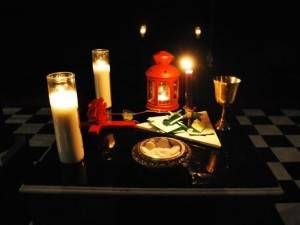
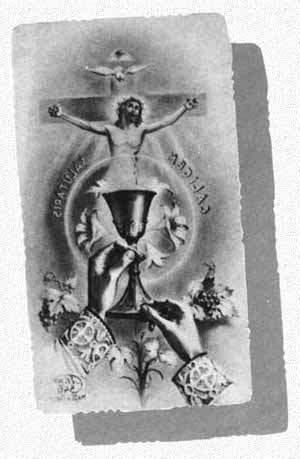
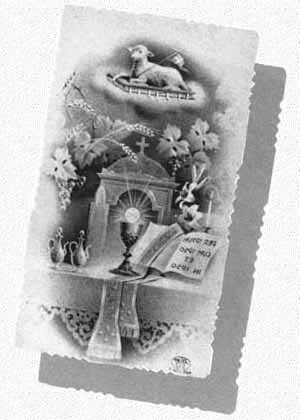
 he Mass, or, as it is sometimes called, the divine liturgy or the Eucharist, is the most solemn of all the Christian sacraments. Through it we are led step by step to the purpose of our earthly lives — union with the divine — for at its climax the faithful are made one with God and each other by receiving the body and blood of Christ under the earthly forms of bread and wine.
Although these mystical aspects of the Mass have been known and proclaimed by all the branches of Christendom that have not abandoned the ancient sacramental system (including the Roman Catholic, Eastern Orthodox, and, with some ambiguities, the Anglican), the rationalistic tendencies that have arisen since the Second Vatican Council in the Roman Catholic Church are robbing the Mass of much of its numinosity and psychospiritual utility.
Similarly, many in the occult, metaphysical, and New Age movements have little appreciation for the magic and mystery of the time-honored sacramental system of Christianity and within it for the supreme sacrament of the Mass. The older of these movements bear the imprint of nineteenth-century thinking, which was hyperintellectual, moralistic, and at times materialistic. The groups that have sprung up since the 1960’s are a bit more favorably disposed toward ritual than their predecessors, but their appreciation of the sacraments is still small. Much of alternative spirituality is thus in danger of losing touch with one of the most valuable aspects of the mystico-magical heritage of the West.
To be sure, there are valid objections to ritual. Its practice has often been accompanied by blind superstition. Still, it must be remembered that a lack of consciousness will regularly turn meaningful and transformative practices into superstitious ones. The fault is not with the ritual, but with the practitioner. Ritual, provided it uses authentic symbols, is no more or less than what H.P. Blavatsky called “concretized truth.” This may be covered up by superstition, but the hidden truth is always discernable beneath the covering. Gnostic studies of the sacraments are intended to free the kernel of truth from the accretions of unconsciousness and misunderstanding that have been permitted to obscure it.
In the following we shall deal with several separate approaches to the greatest of the Christian mysteries. Some of these may contradict each other, while others tend to complement one another, and still others will restate truths present in other approaches.
Source: The Gnosis of The Eucharist
 Grand Temple of Horus Behdety