Fratres and Sorores of the Order, Officers newly entrusted with the governance of this Temple, Initiates assembled beneath the banners of the Mysteries: At this sacred turning of the year, we stand once again upon the threshold of equilibrium. The Sun has come unto the place of balance. Day and night face one another as equals. Neither Light nor Darkness possesses dominion, and for one brief and solemn moment the scales of Nature are held in perfect poise. This is the mystery of the Autumnal Equinox. It is not merely an astronomical event. Nor is it merely a seasonal marker in the procession of the year. To those who walk the Hermetic Path, it is a living symbol of the Great Work itself. For the Initiate must learn to stand where the Sun now stands: between opposing forces, neither fleeing one nor clinging blindly to the other. Between Mercy and Severity. Between expansion and restraint. Between speech and silence. Between action and contemplation. Between the visible and the invisible. Between that which we desire to become and that which, in truth, we presently are. At the Equinox, Nature herself teaches the lesson of the Balance. And therefore it is fitting that at this season the Officers of the Temple should be renewed, the duties of the Mysteries reassigned, and those who have accepted office reminded that no Officer stands here merely to wear a sash, bear an implement, recite a title, or occupy a station. To accept an office within the Temple is to accept a spiritual burden. It is to become, for a season, the living representative of a principle. It is to say before the visible and invisible assembly: Let this principle work through me. Therefore, Officers of the Temple, remember that the authority entrusted to you is not personal authority. The office belongs to the Temple. The power belongs to the Current. The Wisdom belongs to the Divine. You are its stewards. The robes you wear are not ornaments of distinction. They are reminders of obligation. The implements you bear are not possessions. They are symbols of responsibility. The stations at which you stand are not privileges. They are places of service. And when, in due season, another stands where you now stand, the Mysteries will continue. For none among us is greater than the Work we have sworn to serve. Let the Hiereus remember that strength without Wisdom becomes tyranny, but strength disciplined by Wisdom becomes guardianship. Let the Hegemon remember that reconciliation is not weakness, for the Middle Way requires greater mastery than either extreme. Let the Kerux remember that every proclamation should carry truth, every movement should possess purpose, and every opening of a way should be undertaken with vigilance. Let the Stolistes remember that purification begins not with Water alone, but with the cleansing of motive, intention, memory, and heart. Let the Dadouchos remember that consecration requires more than flame. One must first kindle the interior Fire before attempting to awaken it in another. Let the Sentinel remember that every sacred enclosure possesses a boundary and that discernment is itself a form of protection. And let every Officer remember that harmony among the Officers is itself part of the ritual. For a Temple divided against itself cannot become a true vessel of the Light. We may pronounce every sacred name perfectly. We may trace every symbol correctly. We may know the correspondences of the Elements, Planets, Sephiroth, Paths, Hebrew letters, Tarot Keys, and celestial spheres. Yet if we bring pride, resentment, rivalry, vanity, carelessness, or selfish ambition into the sacred precinct, then we introduce disorder into that which was erected to reveal harmony. The true Temple must first be constructed within its Officers. Govern yourselves before attempting to govern another. Correct yourselves before correcting another. Examine your own motives before judging those of your Frater or Soror. Remember that authority exercised without humility obscures the Light it claims to defend. But humility joined with courage allows authority to become sacred service. And to the Initiates I likewise speak. Do not imagine that because you hold no office, you bear no responsibility for the Temple. Every Initiate is a living stone within its walls. Every word contributes either to harmony or discord. Every act of kindness strengthens it. Every act of dishonor weakens it. Every disciplined meditation strengthens it. Every neglected obligation weakens it. Every sincere aspiration brightens its subtle form. Every indulgence in malice, gossip, contempt, or unnecessary conflict introduces shadow into its atmosphere. The Temple is not merely this physical chamber. It is a living body created through shared purpose. It is built through ritual. It is nourished by aspiration. It is strengthened through study. It is defended through ethical conduct. It is illuminated by the sincere spiritual labor of those who enter beneath its portals. Therefore never ask only: What can the Order give me? Ask also: What am I giving to the Order? Never ask merely: How rapidly may I advance? Ask: How deeply have I integrated what has already been entrusted to me? For the Mysteries are not a race toward titles. They are a process of transformation. The grade is not the attainment. The sash is not the attainment. The certificate is not the attainment. Knowledge itself, unless transformed into character, is not the attainment. The true grade is the degree to which consciousness has become capable of embodying the principle represented by that grade. What profit is there in knowing the mystery of Earth if we possess no stability? What profit is there in learning the mysteries of Air if our thoughts remain disordered? What profit is there in studying Water if our emotions govern us without restraint? What profit is there in invoking Fire if our Will is scattered among a thousand desires? And what profit is there in speaking endlessly of Spirit if we cannot recognize the Divine dignity within another human being? The Great Work is not performed upon parchment alone. It is performed upon the personality. The laboratory is the human constitution. The prima materia is the unrefined self. The furnace is life. The Fire is aspiration. The solvent is discipline. And the gold toward which we labor is awakened consciousness capable of reflecting the Light of the Higher Genius. Thus the Autumnal Equinox speaks to us of harvest. Spring carried the promise. Summer brought growth. Autumn asks: What has actually borne fruit? This is a question every Initiate should ask. What has your study produced? What has your ritual practice changed? What habit has been overcome? What virtue has been strengthened? What fear has been confronted? What illusion has been recognized? What responsibility have you finally accepted? Where have you become more truthful? Where have you become more compassionate? Where have you become stronger? Where have you become freer? And where, despite all our learning and aspiration, do we remain unchanged? These questions are not instruments of condemnation. They are instruments of measurement. The Autumnal Equinox belongs to the Scales. And the Scales neither flatter nor accuse. They reveal. To weigh a thing rightly is to see it rightly. And to see ourselves rightly is among the most difficult arts of initiation. Neither self-glorification nor self-contempt. But self-knowledge. Neither inflation nor humiliation. But truth. Know your strength. Know your weakness. Know what you understand. Know what you do not understand. Know where you have conquered. Know where you remain vulnerable. And then— work. This is equilibrium in seed. For balance does not mean immobility. Consider the Scales. Equilibrium is achieved not because nothing acts upon them, but because the forces acting upon them have been rightly adjusted. So too the balanced magician is not one who has escaped passion, sorrow, desire, conflict, responsibility, or change. The balanced magician is one who has increasingly learned to place these forces into right relationship. The Light does not require us to cease being human. It requires us to become fully human: conscious, responsible, integrated, compassionate, strong, discerning, and capable of acting from a center deeper than impulse. This is why the Equinox is both beautiful and severe. From this moment the nights lengthen. The outer Sun declines. The green world prepares to withdraw. Leaves fall. Seeds descend beneath the soil. Life moves inward. And Nature teaches again that darkness is not always destruction. Sometimes darkness is gestation. Sometimes withdrawal is preparation. Sometimes silence is instruction. Sometimes loss is purification. Sometimes the falling away of what once clothed us is necessary before the essential may be revealed. Therefore, fear not every descent into darkness. But neither worship it. The Initiate does not worship darkness. The Initiate enters it carrying a Lamp. There is a profound difference. Our task is not to become enamored of obscurity. Our task is to discover within obscurity the hidden seed of Light. When circumstances become uncertain— carry the Lamp. When the mind becomes confused— carry the Lamp. When grief enters your life— carry the Lamp. When pride has been wounded— carry the Lamp. When the Path becomes difficult— carry the Lamp. When those around you lose sight of their highest nature— carry the Lamp. And when you yourself forget who you are, seek again that interior flame which no external night can wholly extinguish. At the Vernal Equinox we celebrate emergence. At the Autumnal Equinox we contemplate surrender. The magician must know how to begin. The magician must also know how to release. There are ideas whose seasons have passed. Habits whose usefulness has ended. Ambitions belonging to an earlier self. Injuries preserved long after they ceased to protect us. Identities to which we cling because they once gave us security. Autumn therefore asks: What must fall? Look upon the trees. They do not cease to be trees when their leaves descend. Their life withdraws toward the center. So too may the Initiate learn to release without losing the Self. You are not every opinion you have ever held. You are not every role you have ever occupied. You are not every mistake you have ever made. You are not every praise you have ever received. You are not every wound you have ever carried. Behind the changing garments of personality stands something deeper. The Divine Spark. The Hidden Light. That sacred center toward which all true initiation directs us. Our ceremonies point toward it. Our studies train the mind to perceive it. Our meditations train the imagination to receive its symbols. Our ethical obligations prepare the character to bear its force. Our fraternity reminds us that the Work is never accomplished through selfishness alone. Cherish therefore the fraternity of this Temple. There will be disagreements. There will be misunderstandings. Personalities will sometimes clash. A Mystery School does not gather perfected beings. It gathers human beings attempting transformation. Our fraternity therefore cannot depend upon the absence of conflict. It must depend upon our ability to address conflict honorably. Speak truthfully. Listen carefully. Correct gently when gentleness is sufficient. Stand firmly when firmness is required. Forgive where forgiveness is possible. Protect boundaries where boundaries are necessary. Never use occult knowledge as a weapon against another. Never use spiritual rank to silence legitimate concern. Never mistake secrecy for permission to conceal wrongdoing. Never confuse obedience to the Work with unquestioning obedience to personality. Our loyalty must remain first to Truth, to the Divine, to the integrity of the Mysteries, and to those ethical principles without which no genuine spiritual community can endure. The greater the authority, the greater the responsibility. The higher the office, the deeper the accountability. The more knowledge entrusted to us, the more carefully it must be used. And now the solar gate turns toward the darker half of the year. Use the season well. Study more deeply. Meditate more faithfully. Keep your records. Examine your dreams. Observe the movements of your mind. Refine your ritual practice. Strengthen your physical foundation. Order your affairs. Repair what may be repaired. Complete what should be completed. Release what should be released. Cultivate silence. For there comes a point upon the Path when we discover that the loudest voice is rarely the voice of the Higher Genius. The deeper instruction often comes quietly. A symbol. A dream. A sudden insight. A movement of conscience. A recognition during ritual. A truth long resisted but no longer deniable. A simple realization: Something within me must change. Listen. For the season before us favors the interior Work. The outer Sun diminishes that another Sun may be discovered. There is a Solar Light that does not rise in the East nor set in the West. There is a Dawn which no clock measures. There is a Temple not built by human hands. There is a Flame before which every earthly flame is but reflection. And every authentic Mystery ultimately points toward that Light. Therefore we enter Autumn not in sorrow but in solemnity. We enter carrying the fruits of what has been accomplished. We enter acknowledging what remains unfinished. We enter ready to release what has fulfilled its season. We enter prepared to labor in hidden places. And we enter together. May those who have struggled find renewed strength. May those who have succeeded remain humble. May those who have erred learn. May those who have been wounded heal. May those who have wandered remember the Path. May those who possess knowledge gain understanding. May those who possess understanding attain wisdom. And may wisdom ripen into compassion. Let the Balance be established within us. Let the Pillars be made steadfast. Let Mercy temper Severity. Let Severity give strength to Mercy. Let the Elements be harmonized. Let the lower nature become responsive to the Higher. Let knowledge become practice. Let practice become transformation. Let transformation become service. Let service become Light. As the Sun enters the Gate of Equilibrium, may we likewise enter equilibrium within ourselves. As the leaves descend toward Earth, may all that is false within us fall away. As the seed enters darkness, may the hidden seed of the Divine be nourished within the secret ground of the soul. As the nights lengthen, may the Interior Lamp burn brighter. And when the outer world becomes dark, may we remember that those who have truly discovered the Light carry dawn within themselves. Officers of the Temple: Stand faithfully at your stations. Initiates of the Mysteries: Stand faithfully upon your Path. And all of us together, remembering that we are servants rather than possessors of the Mysteries, let us go forward into the descending half of the year with vigilance, courage, humility, discipline, and fraternity. For the Great Work continues. The Temple remains open within us. The Lamp remains kindled. The Path remains before us. Beyond every darkness— Light. Beyond every veil— Light. Within the heart of every sincere seeker— Light. So may the Balance be established. So may the Temple be strengthened. So may the Divine Light descend upon, dwell within, and radiate through all who faithfully undertake the Great Work. So let it be.
In Peace Profound,
VH Soror TF Hierophantria and Imperatrix Grand Temple of Horus Behdety
This is not yet an alchemical operation. It is the emptying of the vessel.
Concerning the Threshold, the Void, and the Renunciation of Pretension
The Charge
Aspirant, standing upon the Threshold, thou art neither admitted nor excluded, neither instructed nor refused.
The Grade of Neophyte is not a possession, but a condition.
It signifies not knowledge attained, but ignorance acknowledged.
Thou art now placed between the worlds, having voluntarily withdrawn from certainty, from authority assumed, and from the false comfort of unexamined belief.
Know that at this stage:
Thou art not yet a student of the Mysteries
Thou art not yet an operator of the Art
Thou art not yet a bearer of Light
Thou art a candidate for discipline.
The Neophyte is required to unlearn before learning, to become empty before being filled, and to submit before aspiring.
Therefore thou art charged:
To lay aside all titles, ranks, and claims of attainment
To refrain from judgment of the Path before walking it
To accept obscurity, silence, and probation without resentment
This Grade does not promise revelation. It demands honesty.
For many seek the Mysteries to escape themselves. The Mysteries permit no such escape.
Thus thou art warned:
The Work begins not in Light, but in darkness willingly entered.
If thou canst not endure not-knowing, thou art unfit for knowing.
If thou canst not obey in small things, thou shalt not be trusted in greater.
This Charge is laid upon thee not to humble thee before others, but to strip thee of self-deception.
Bear it patiently, and the Gate may open of its own accord.
📜 The Probationary Obligation of the Grade of Neophyte (0=0)
(The Aspirant stands in silence, facing the East.)
The Obligation
I, standing freely at the Threshold of the Sacred Art, in the presence of the Unseen Order and under the Witness of the Living Light, do solemnly affirm and obligate myself upon my honor and my conscience as a Neophyte upon probation,
That I will seek truth rather than comfort, and discipline rather than display.
That I will lay aside claims of prior attainment, and will present myself to the Work as one willing to learn, to be corrected, and to be tested.
That I will maintain silence concerning the practices, symbols, and teachings to which I may be exposed, save where lawful instruction permits speech.
That I will observe carefully and act deliberately, not rushing ahead of instruction nor resisting necessary restraint.
That I will submit to probation without demand for advancement, recognition, or assurance, knowing that readiness is proven by conduct and not declared by desire.
That I will withdraw willingly should I find myself unable to uphold this discipline, rather than compromise the Work through impatience or self-deception.
If I fail in this Obligation through dishonesty, haste, or vanity, may the Gate remain closed to me, and my progress be halted until sincerity is restored.
But if I uphold it with integrity and perseverance, may the Threshold become a Door, the Silence become instruction, and the Darkness yield in due time to Light.
So I affirm and bind myself, freely, consciously, and deliberately.
Closing Formula (By the Hierophant or Instructor)
Let the Aspirant remain in silence and watchfulness. Let the Vessel be emptied. Let no light be claimed before it is given.
An esoteric study of shadow, equilibrium, the Higher Self, and preparation for the Adeptus Minor 5=6 Grade
There comes a point in the initiatory journey when advancement can no longer be measured by how much the student has learned.
The candidate may know the correspondences. The Divine Names may be memorized. The elemental attributions may be committed to memory. The Tarot paths may be understood, the Sephiroth placed correctly upon the Tree, the rituals rehearsed, the signs practiced, and the formulae intellectually comprehended.
Yet none of these accomplishments, taken by themselves, answer the question posed by the Portal:
Who is it that seeks to cross the threshold?
That is a different examination entirely.
The Portal Grade occupies a peculiar position within the Hermetic Order of the Golden Dawn. Unlike Zelator, Theoricus, Practicus, and Philosophus, it is not assigned to one Sephirah. Israel Regardie describes it instead as an “outer court” to Tiphareth, situated at the Veil of Paroketh between the elemental grades and Adeptus Minor. Its attribution is Spirit—the Quintessence that crowns Earth, Air, Water, and Fire and brings their powers into equilibrium. (Publicism)
Thus Portal is not merely the next Grade.
It is the place where everything that came before must become integrated.
And integration inevitably produces confrontation.
For before the candidate can stand in the solar consciousness symbolized by Tiphareth, the candidate must encounter that within the personality which cannot yet endure the Sun.
That encounter is the mystery of the Guardian of the Threshold.
The Guardian Is Already Waiting
The expression “Dweller on the Threshold” did not originate as a technical title in the original Golden Dawn Portal ceremony. Its famous literary appearance is in Edward Bulwer-Lytton’s 1842 Rosicrucian novel Zanoni. The term was subsequently developed extensively by Theosophical and other occult writers, while Rudolf Steiner later formulated an elaborate teaching concerning both a lesser and a greater Guardian encountered during spiritual development. (Wikipedia)
That distinction is important.
When we speak of the “Dweller” in a Golden Dawn Portal context, we should not casually invent a lost Golden Dawn doctrine claiming that the candidate was literally introduced to an official being carrying that title.
Rather, the Dweller provides an extraordinarily useful interpretive key for understanding what the Portal formula requires psychologically and initiatically.
The Golden Dawn itself continually places guardians, barriers, swords, veils, examinations, equilibrating officers, elemental forces, and thresholds before the advancing initiate. Regardie even describes earlier elemental ceremonies in which Guardians bar the candidate’s progress until a balanced path is found. More importantly, he states explicitly that the personality must be harmonized and the elements equilibrated lest magical illumination lead not to Adeptship but to fanaticism and pathology. His summary is wonderfully concise:
“Equilibrium is the basis of the soul.” (Avalon Library)
The Guardian, then, need not always be imagined as something standing outside us.
The Guardian is also whatever within us makes equilibrium impossible.
It waits precisely because we have carried it there.
The Dweller as the Unredeemed Personality
One of the great temptations of spiritual work is imagining that advancement makes the personality disappear.
It does not.
Initiation illuminates the personality.
And whatever is illuminated becomes visible.
Qualities that could remain concealed during ordinary life may become magnified when ritual, meditation, invocation, astral practice, and sustained concentration intensify consciousness. Ambition may disguise itself as spiritual vocation. Fear may masquerade as discernment. Anger may proclaim itself righteous severity. Vanity may call itself spiritual authority. Dependency may appear as devotion. Fantasy may be mistaken for vision. Psychological projection may be declared clairvoyance.
The further the aspirant proceeds, the more dangerous self-deception becomes because the aspirant now possesses a sophisticated symbolic vocabulary with which to justify it.
This is why the Portal candidate must learn a particularly difficult lesson:
Esoteric knowledge does not automatically produce self-knowledge.
One can understand the Tree of Life while remaining almost entirely ignorant of the motives moving through one’s own psyche.
One can lecture beautifully on Geburah while being ruled by anger.
One can speak endlessly of Chesed while craving recognition.
One can invoke Netzach while refusing to examine emotional dependency.
One can master Hod intellectually while using knowledge to defend oneself against experience.
One may even speak eloquently of Tiphareth while secretly wanting Adeptship principally because the title confirms one’s importance.
That last possibility is perhaps the most dangerous.
Because Tiphareth cannot safely become the throne of the unexamined ego.
Shadow at the Veil of Paroketh
Modern depth psychology gives us another useful language for approaching this mystery.
C. G. Jung used the term shadow for aspects of the personality that remain unconscious or are rejected by one’s conscious self-image. The shadow need not consist exclusively of immoral qualities; it can also contain capacities, emotions, instincts, creativity, strength, or vulnerability that the conscious personality has refused to acknowledge. Jung’s Aion places the shadow among the most immediate archetypal problems confronting the ego on the path toward a more comprehensive Self. (JSTOR)
Jungian terminology is later than the nineteenth-century Golden Dawn and should not be retroactively presented as original Order doctrine.
But the comparison is illuminating.
The shadow is precisely what the ceremonial magician cannot afford to leave entirely unconscious.
Why?
Because whatever the magician refuses to recognize inwardly will tend to be encountered outwardly.
The authoritarian occultist continually discovers enemies.
The vain occultist continually encounters people who “fail to recognize spiritual rank.”
The jealous practitioner repeatedly detects hostile psychic currents.
The frightened clairvoyant sees threats everywhere.
The initiate unwilling to admit doubt may become fanatically certain.
The individual unable to acknowledge personal desire may attribute that desire to spirits, Masters, deities, astrology, Tarot, or Divine Providence.
Thus the Guardian performs a merciful function.
It asks the aspirant:
How much of what you call revelation is actually yourself?
That question alone could occupy an entire Portal probation.
The Four Elemental Faces of the Dweller
The Portal follows an initiatory progression through Earth, Air, Water, and Fire. These elements are not discarded when Philosophus is completed. They are brought together beneath Spirit.
Regardie characterizes Portal precisely as a synthesis in which the elemental self is coordinated and equilibrated before being offered to the service of the Higher Genius. (Avalon Library)
The Dweller may therefore be contemplated through four elemental faces.
The Dweller of Earth appears wherever stability has hardened into inertia.
Earth gives endurance, embodiment, reliability, practicality, and strength. But unbalanced Earth clings. It fears change. It identifies spiritual security with possessions, titles, institutional position, familiar teachings, or rigid structures.
Its threshold question is:
What are you afraid to lose?
The candidate who cannot relinquish a former identity cannot easily receive a greater one.
The Dweller of Air appears wherever intelligence has become rationalization.
Air analyzes, compares, names, communicates, learns, and distinguishes. But unbalanced Air can live entirely in theories. It can explain everything while experiencing very little.
The intellectual magician may be able to diagram the universe yet remain unable to sit silently with grief, uncertainty, love, shame, or awe.
Its threshold question is:
What truth have you explained so thoroughly that you no longer have to experience it?
The Dweller of Water arises wherever receptivity becomes emotional captivity.
Water gives empathy, imagination, dream, memory, devotion, psychic sensitivity, and depth. But unbalanced Water can confuse feeling with truth.
Not every strong emotion is intuition.
Not every dream is prophecy.
Not every attraction is destiny.
Not every fear is warning.
Its threshold question is:
Can you feel deeply without making every feeling an oracle?
The Dweller of Fire appears wherever will becomes domination.
Fire gives courage, enthusiasm, aspiration, purification, creativity, and magical force. Yet unbalanced Fire easily becomes pride.
This Dweller is particularly dangerous near Tiphareth because spiritual illumination itself may feed inflation.
The candidate experiences genuine insight and concludes:
Therefore I am exceptional.
The candidate performs successful magical work and concludes:
Therefore my judgment cannot be questioned.
The candidate senses spiritual vocation and concludes:
Therefore others should follow me.
The threshold question of Fire is severe:
Do you desire the Light—or do you desire to be seen possessing it?
Portal places Spirit above these four powers not to destroy them but to govern them.
The Quintessence is the Crown precisely because none of the elemental powers can safely crown itself.
Why the Guardian Appears Before the Sun
Tiphareth is the solar heart of the Tree.
In Golden Dawn initiatory architecture, Portal stands outside it while Adeptus Minor enters its mystery. Regardie describes Portal as the outer court of Tiphareth and the 5=6 ceremony as Tiphareth within. Historical scholarship likewise identifies Portal with the Veil of Paroketh preceding the Second Order and Adeptus Minor initiation. (Publicism)
This placement explains why the confrontation with the Dweller belongs naturally here.
The Sun illuminates.
But illumination does not discriminate between what we would like to see and what we would prefer to keep hidden.
When the solar principle rises within consciousness, both gold and refuse become visible.
Therefore the aspirant’s first reaction to increasing Light may paradoxically be an intensified awareness of darkness.
This is not necessarily regression.
It may be revelation.
The shadows were already in the chamber.
Someone has simply lit the lamp.
The Portal candidate must therefore abandon the immature assumption that spiritual advancement means feeling progressively more holy, peaceful, powerful, clairvoyant, or exalted.
Sometimes advancement means becoming painfully aware of one’s impatience.
Sometimes it means discovering the vanity concealed inside devotion.
Sometimes it means recognizing how often supposedly selfless service was driven by a desire to be indispensable.
Sometimes it means realizing that an enemy carried a quality we refused to recognize in ourselves.
Sometimes it means admitting:
I was wrong.
That sentence may open more gates than a hundred secret passwords.
The Dweller and Spiritual Inflation
One of the most dangerous mistakes at the threshold of Adeptship is confusing contact with the Higher Self with identification of the ordinary personality as the Higher Self.
These are opposites.
The Higher Genius does not make the lower personality omniscient.
The Solar Self does not transform personal preference into Divine Law.
Adeptship does not mean that every intuition is correct.
The more powerful the symbolism surrounding initiation becomes, the easier it is for the personality to appropriate it.
The ego hears:
You are approaching the Inner Order.
And translates it:
I am superior.
The ritual says:
Consecrate yourself to the Great Work.
The ego hears:
Others should recognize my status.
The tradition speaks of magical authority.
The shadow whispers:
You should control people.
The Higher Genius calls the candidate toward service.
The Dweller converts service into self-importance.
This is why genuine contact with Tiphareth has traditionally been expressed through imagery of sacrifice as readily as illumination.
The Sun does not merely crown.
The Sun also exposes.
And the Rose grows upon the Cross.
The Rosicrucian Mystery Beyond the Veil
Beyond Portal lies the ceremonial world of the R.R. et A.C., the Rosae Rubeae et Aureae Crucis—the Rose of Ruby and Cross of Gold.
The Adeptus Minor ceremony is built around the symbolic tomb or Vault of Christian Rosenkreutz. Historical studies of the Golden Dawn note that Mathers developed the Vault symbolism from the Rosicrucian Fama Fraternitatis, integrating Qabalistic, alchemical, astrological, and magical symbolism into the 5=6 initiation. (Avalon Library)
Within the ritual symbolism, the center of the Vault is identified as the point of Perfect Equilibrium. (Tarr Daniel)
This is no incidental detail.
The candidate who spent the elemental Grades differentiating forces must now become capable of standing at their center.
Not above them through repression.
Not below them through enslavement.
At their center.
The Rosicrucian mystery therefore deepens the Portal teaching.
Before resurrection comes death.
Before the Rose opens comes the Cross.
Before the candidate may participate consciously in the solar mystery of Christian Rosenkreutz, something in the personality must consent to cease being sovereign.
The Dweller resists exactly this death.
It says:
Keep everything you have become.
Keep your grievances.
Keep your titles.
Keep your certainty.
Keep your superiority.
Keep your carefully constructed identity.
Enter Tiphareth—but bring me with you and place me upon the throne.
The Guardian says otherwise.
Nothing unexamined may be enthroned.
The Higher Self Is Not the Reward of the Ego
The Adeptus Minor formula turns toward the Higher and Divine Genius with extraordinary seriousness. In surviving versions of the 5=6 obligation, the initiate pledges to undertake the Great Work of purifying and exalting the spiritual nature and ultimately uniting with the Higher and Divine Genius. (Tarr Daniel)
Notice the direction of movement.
The Higher Genius is not being invited to glorify the ordinary personality.
The personality is being purified so that it may become capable of transmitting something greater.
Regardie similarly describes the elemental grades as preparation of the lower self so that it may become a worthy vehicle of the Light and an instrument of the Higher Genius. (Avalon Library)
This reverses one of the most common misunderstandings of initiation.
Adeptship is not:
“I have accumulated sufficient occult knowledge; therefore greater power should now be given to me.”
Its true formula is closer to:
“I have worked sufficiently upon myself that perhaps I may now become a more transparent instrument of the Work.”
The difference is enormous.
The first seeks possession.
The second seeks participation.
The first asks what powers will be acquired.
The second asks what burdens can now be carried responsibly.
The first seeks confirmation of identity.
The second accepts transformation of identity.
The first wants the Crown.
The second becomes willing to carry the Cross.
Meeting the Dweller
What, then, does it mean practically for a Portal candidate to “meet the Dweller”?
It does not require manufacturing frightening astral experiences.
It does not require hallucinating an entity.
It certainly does not require cultivating paranoia concerning psychic attack.
The most profound meeting may be quieter.
The candidate begins noticing recurring reactions.
The same conflict appears in different relationships.
The same resentment returns under different circumstances.
The same insecurity seeks new disguises.
The same hunger for recognition repeatedly appears beneath noble projects.
The same fear continually obstructs change.
Instead of blaming circumstances, the candidate asks:
What is the constant factor in all these situations?
And eventually comes the uncomfortable answer:
I am.
That recognition is not self-condemnation.
It is power.
What remains unconscious controls us disproportionately.
What becomes conscious can be brought into relationship with Will.
Thus meeting the Dweller does not mean hating the shadow.
It means ceasing to let the shadow rule anonymously.
The Guardian Is Also a Protector
There is another side to the symbol.
A Guardian does not merely prevent entrance.
A Guardian protects what lies beyond.
The threshold is guarded because what lies beyond it is powerful.
This transforms our understanding of delay.
When initiation is postponed, when advancement feels slow, when the aspirant discovers another layer requiring attention, the immediate reaction may be disappointment:
Why am I still here?
Portal gives another interpretation.
Perhaps the threshold is not punishing you.
Perhaps it is protecting both you and the Work from premature entrance.
Regardie reports that the historical system prescribed a substantial period between Portal and Adeptus Minor, describing it as a gestational interval rather than merely another rapid promotion. (Avalon Library)
That symbolism deserves contemplation.
A gestation cannot be accelerated indefinitely without consequence.
Something must become capable of sustaining life before birth occurs.
Likewise, the Portal initiate is not merely waiting for 5=6.
The Adept is being formed.
The Greater Guardian: What Will You Serve?
If the first face of the Dweller concerns everything unresolved behind us, another Guardian seems to stand ahead.
Steiner’s later esoteric formulation distinguished a lesser and a greater Guardian of the Threshold. Whatever one makes metaphysically of Steiner’s clairvoyant framework, the distinction offers a useful contemplative model. (Universal Co-Masonry)
The lesser Guardian may ask:
Have you confronted what you have been?
The greater asks:
What will you become responsible for if you pass?
That is the more serious question.
For the threshold of Adeptship is not merely a privilege.
It is an ethical enlargement.
More knowledge means greater responsibility for how knowledge is used.
More authority means greater responsibility for restraint.
More magical capacity means greater responsibility for motive.
More visibility means greater responsibility for example.
More students mean greater responsibility for humility.
The candidate who desires power without corresponding responsibility has not defeated the Dweller.
The candidate has merely recruited it.
The Portal Examination That Cannot Be Written
There are examinations that can be graded.
One either knows the Hebrew letters or does not.
One either understands the elemental correspondences or does not.
One either recognizes the Tarot Keys or does not.
But the most important Portal examination is lived.
Can the candidate receive correction without humiliation becoming rage?
Can the candidate possess authority without requiring obedience for emotional reassurance?
Can the candidate disagree without demonizing?
Can the candidate acknowledge uncertainty?
Can the candidate distinguish intuition from desire?
Can the candidate admit projection?
Can the candidate accept that spiritual experiences do not make one morally infallible?
Can the candidate hold power without using it to compensate for insecurity?
Can the candidate remain a student while becoming an Adept?
These questions cannot be answered ceremonially.
Life answers them.
Rending the Veil
Paroketh is therefore more than a curtain standing between two Grades.
It becomes the veil of self-deception.
To rend it is to become increasingly incapable of lying to oneself.
This may be one of the deepest meanings of preparation for Tiphareth.
For the Higher Self cannot be known merely by constructing increasingly elaborate ideas about the Higher Self.
The personality must become sufficiently transparent that something deeper can shine through it.
The Work is subtraction as well as accumulation.
Less projection.
Less pretension.
Less compulsive certainty.
Less attachment to status.
Less need to dominate.
Less fear of being ordinary.
Less separation between professed ideals and lived behavior.
Then something solar becomes possible.
Not the theatrical Sun of the inflated personality.
The quiet Sun.
The center that does not need to announce itself.
The point of equilibrium around which conflicting forces can finally find their proper orbit.
The Guardian’s Final Question
At the threshold of Tiphareth, perhaps the Guardian ultimately asks only one thing:
Are you willing to know yourself sufficiently that the Light no longer has to serve your illusions?
If the answer is no, the Guardian remains.
If the answer is yes, the work begins.
Not ends.
Begins.
Because 5=6 does not certify perfection.
It inaugurates Adeptship.
The Vault opens not because the candidate has become flawless but because the candidate has learned enough equilibrium, humility, discipline, and self-observation to begin working consciously with forces that would be dangerous in the hands of an unexamined personality.
The Guardian therefore becomes not the enemy of initiation but one of its greatest benefactors.
It prevents us from carrying an unconscious tyrant across the threshold and calling that tyrant the Higher Self.
It stands before the Rose and Cross and says:
Know what in you seeks the Light.
Know what in you fears the Light.
Know what in you would misuse the Light.
And then—
when Earth has yielded its rigidity,
when Air has surrendered its evasions,
when Water has relinquished its illusions,
when Fire has laid down its pride,
and Spirit has begun to establish equilibrium among them—
the aspirant may stand before Paroketh with a different understanding.
The Guardian was never merely blocking the road.
The Guardian was preparing the traveler.
And the Dweller at the Threshold was, in the deepest sense, the final portion of the old self demanding to be known before the new Sun could rise.
Annotated Bibliography
Golden Dawn and Rosicrucian Foundations
Regardie, Israel.The Golden Dawn: The Original Account of the Teachings, Rites and Ceremonies of the Hermetic Order of the Golden Dawn. Various editions. The indispensable published corpus of Golden Dawn ritual and instructional material. Its Portal and Adeptus Minor materials provide the primary ritual architecture underlying this study: elemental synthesis, Spirit, Paroketh, Tiphareth, the Vault, equilibrium, and the transition into the Second Order. It should remain the first textual point of reference before later interpretations are imposed upon Golden Dawn doctrine.
Regardie, Israel.What You Should Know About the Golden Dawn. 1936; revised editions, including Falcon Press, 1983. Particularly valuable for interpreting the initiatory psychology of the Grades. Regardie emphasizes that the elemental personality must become harmonized before illumination and specifically warns that magical development without equilibrium may produce fanaticism and pathology rather than Adeptship. He explicitly describes Portal as the outer court of Tiphareth, crowned by Spirit and oriented toward the Higher Genius. (Avalon Library)
The Hermetic Order of the Golden Dawn. “Ritual of the 5=6 Grade of Adeptus Minor.” The central primary ritual for understanding why Portal preparation culminates in a mystery of death, resurrection, equilibrium, Rosicrucian symbolism, and dedication to the Great Work. The surviving ritual includes the aspirant’s undertaking to purify and exalt the spiritual nature and seek union with the Higher and Divine Genius. (Tarr Daniel)
Anonymous.Fama Fraternitatis(1614). The foundational Rosicrucian manifesto behind the Christian Rosenkreutz mythos employed by the Golden Dawn’s Second Order. Its account of the discovery of the hidden tomb of C.R.C. supplied a major literary and symbolic basis for the Vault of the Adepti. The Fama is indispensable for understanding why 5=6 is presented through burial, recovery, transmission, fraternity, and renewal rather than simply promotion to a higher magical rank. (Avalon Library)
Cicero, Chic, and Sandra Tabatha Cicero.The Essential Golden Dawn: An Introduction to High Magic. Llewellyn, 2003. A clear modern exposition of the Golden Dawn system by longtime practitioners and editors of Regardie material. Especially useful for readers needing the relationship among the elemental Grades, Qabalah, ritual psychology, magical equilibrium, and the transition toward Adeptship explained in accessible contemporary language.
The Dweller and Guardian Tradition
Bulwer-Lytton, Edward.Zanoni. 1842. The essential literary source for the modern occult expression “Dweller on the Threshold.” Bulwer-Lytton’s Rosicrucian novel dramatizes the dangers of seeking occult perception before moral and psychological preparation has matured. Later Theosophical and esoteric writers transformed his literary image into a more developed occult doctrine. It is particularly valuable for Portal study precisely because its central warning concerns premature initiation. (Wikipedia)
Blavatsky, H. P.The Theosophical Glossaryand related writings on the “Dweller.” Blavatsky acknowledged Bulwer-Lytton’s terminology while assigning the concept additional occult meanings involving astral residues and the consequences of previous states of personality. These teachings differ from Golden Dawn ritual doctrine but form an important stage in the historical development of the modern Dweller concept. (Theosophy Wiki)
Steiner, Rudolf.Knowledge of the Higher Worlds and Its Attainment. Written 1904–1905. Steiner develops perhaps the most systematic twentieth-century Western esoteric teaching concerning the Guardian of the Threshold, distinguishing lesser and greater Guardians. His treatment is useful comparatively: the threshold becomes an encounter both with accumulated unresolved aspects of oneself and with the ethical demands imposed by higher spiritual consciousness. This is not Golden Dawn doctrine, but it offers a sophisticated comparative model for Portal contemplation. (Rudolf Steiner e.Lib)
Shadow, Self, and Psychological Integration
Jung, C. G.Aion: Researches into the Phenomenology of the Self. Collected Works, vol. 9, part II. Princeton University Press. One of the most useful psychological companions to this Portal study. Jung’s early chapters on ego, shadow, anima/animus, and Self provide a disciplined vocabulary for distinguishing conscious identity from unconscious material and from the larger psychic totality he calls the Self. The parallel with Tiphareth must be treated as comparative rather than historically identical, but Jung is especially helpful in understanding projection, shadow confrontation, and inflation. (JSTOR)
Jung, C. G.Psychology and Alchemy. Collected Works, vol. 12. Princeton University Press. A major work for students wishing to explore the relationship between alchemical transformation and psychological individuation. Jung’s studies of alchemical imagery help illuminate why initiatory traditions repeatedly express transformation through darkness, dissolution, death, conjunction, purification, and the emergence of a more integrated center.
Historical Studies of the Golden Dawn
Goodrick-Clarke, Nicholas.The Western Esoteric Traditions: A Historical Introduction. Oxford University Press, 2008. A scholarly historical overview that situates the Golden Dawn within the larger development of Western esotericism. Particularly relevant here is its description of Portal as connected with Paroketh and of Adeptus Minor as a Rosicrucian ceremony based upon the Christian Rosenkreutz tomb narrative. This work is useful for distinguishing historically documented Golden Dawn structure from later interpretive elaboration. (Avalon Library)
Howe, Ellic.The Magicians of the Golden Dawn: A Documentary History of a Magical Order, 1887–1923. London: Routledge & Kegan Paul, 1972. One of the foundational documentary histories of the Order. Howe is particularly useful as a counterbalance to purely initiatory or devotional accounts because he examines personalities, institutional conflicts, documents, and historical development. Reading Howe alongside Regardie helps the serious student separate the Golden Dawn as an initiatory ideal from the very human organization that attempted to embody that ideal. (Wellcome Collection)
Yates, Frances A.The Rosicrucian Enlightenment. Routledge, 1972. A landmark study of the early modern intellectual and religious environment associated with the Rosicrucian manifestos. Although later scholarship has revised some of Yates’s broader theses, the book remains enormously influential for understanding the historical imagination surrounding Christian Rosenkreutz, reform, Hermeticism, alchemy, and the seventeenth-century Rosicrucian phenomenon that eventually supplied the Golden Dawn with much of its Second Order symbolism.
Taken together, these sources suggest an important conclusion: the “Dweller on the Threshold” is best treated in a Golden Dawn Portal curriculum not as an undocumented literal feature of the original Portal ritual, but as a powerful Rosicrucian-occult and psychological interpretive lens for the work the Grade explicitly demands—elemental equilibrium, purification of the personality, aspiration toward the Higher Genius, and readiness to stand at the Veil before Tiphareth.
That distinction actually strengthens the teaching. It gives the Guardian a precise place: not as invented Golden Dawn history, but as a profound commentary upon the initiatory reality of Portal. (Publicism)
There comes a point upon the initiatory journey when the aspirant discovers that spiritual advancement is no longer primarily a matter of acquiring more information.
There are symbols enough.
There are correspondences enough.
There are rituals enough.
There are names of angels, Divine Names, Tarot Keys, planets, elements, Sephiroth, Paths, colors, weapons, gestures, and formulae enough to occupy the intellect for a lifetime.
Yet at the threshold of the Greater Mysteries, another question begins to make itself heard:
Can you walk the Path?
Not merely describe it.
Not merely diagram it.
Not merely lecture upon it.
Can you walk it?
This is the deeper challenge that confronts the Golden Dawn Portal initiate.
The Portal is appropriately understood as a threshold. The preliminary elemental grades have exposed the initiate successively to the mysteries of Earth, Air, Water, and Fire. Yet the completion of the elemental curriculum does not automatically produce equilibrium. The elements may have been encountered individually while remaining poorly integrated within the personality.
One may possess intellectual brilliance and little compassion.
One may possess great emotional sensitivity and little discipline.
One may possess tremendous will while lacking discernment.
One may possess practicality but remain spiritually asleep.
Thus there arises a further work: the reconciliation of the powers.
The candidate approaching Tiphareth must learn to cease being governed by whichever inner force happens to shout most loudly.
The work becomes one of alignment.
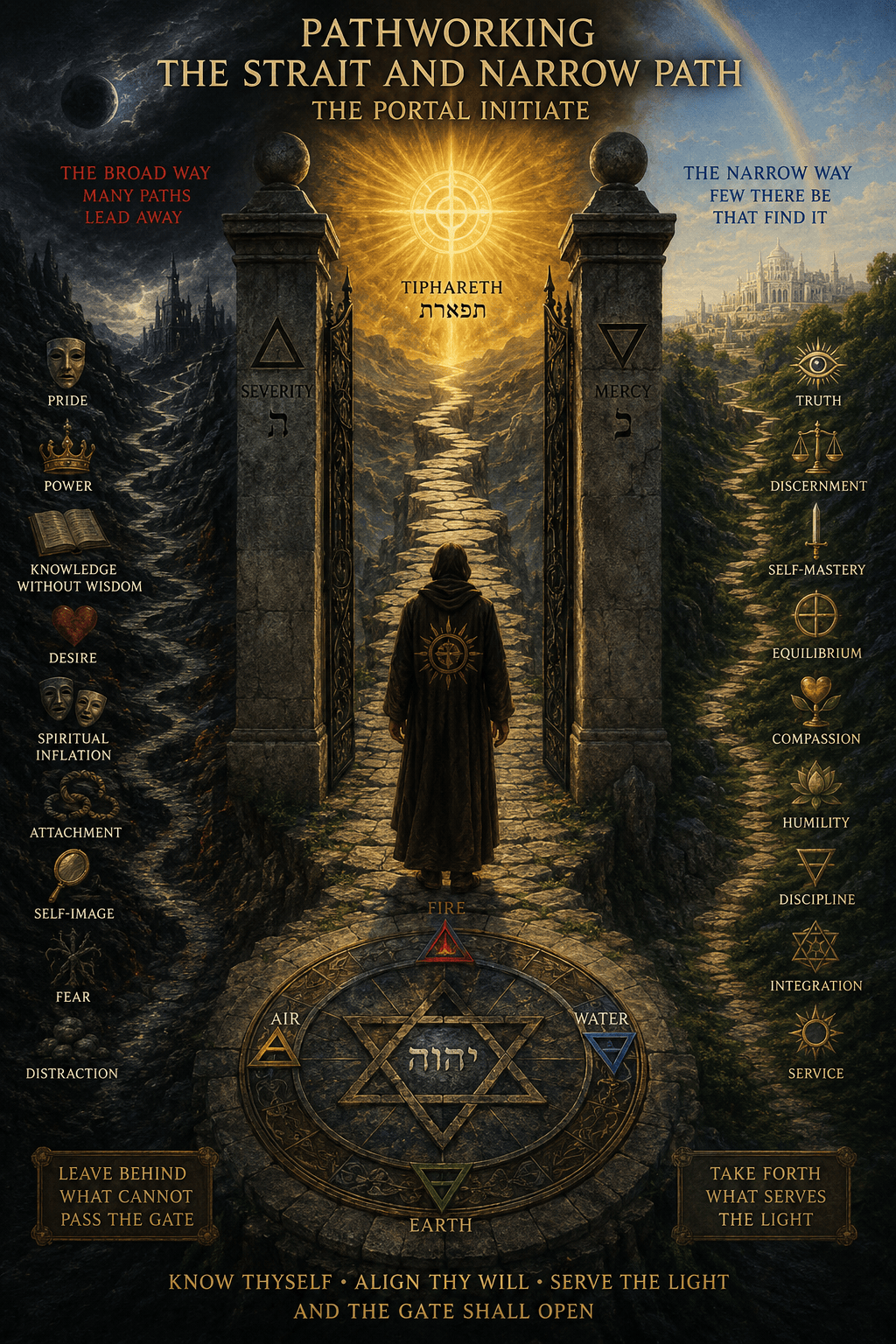
This is where the ancient image of the strait and narrow path becomes particularly illuminating.
The Strait Gate
The expression commonly heard today as “the straight and narrow” derives from the teaching attributed to Jesus in the Sermon on the Mount:
“Enter ye in at the strait gate… because strait is the gate, and narrow is the way, which leadeth unto life.”
The King James wording is significant. The original phrase is not simply “straight,” meaning undeviating. It is strait—an older English term meaning narrow, constricted, rigorous, or difficult. Modern translations accordingly speak of the “narrow gate” and the difficult road leading to life. (Bible Gateway)
Yet the later popular expression “straight and narrow” has unintentionally created an additional piece of symbolism useful to the esotericist.
For the initiatory Path must indeed become both strait and straight.
It is strait because unnecessary possibilities are progressively removed.
It is straight because the aspirant increasingly directs consciousness toward the Center.
The beginner believes spiritual freedom means being able to pursue every possibility.
The initiate gradually discovers another kind of freedom.
It is the freedom that appears when one finally knows where one is going.
The Path narrows because consciousness becomes concentrated.
Distraction diminishes.
Contradiction is exposed.
The personality is asked to become coherent.
The aspirant can no longer indefinitely maintain one set of spiritual ideals in the Temple and an entirely different set of motives in ordinary life.
The Gate becomes narrow because eventually only the authentic self can pass through it.
The Portal as an Inner Threshold
The Portal Grade occupies an unusual position within Golden Dawn symbolism. It stands between the elemental Outer Order grades and the Adeptus Minor mysteries associated with Tiphareth.
Modern Golden Dawn instructional traditions explicitly preserve Portal as the culminating stage of the preliminary grade sequence, preceding entry into the Adept work. Chic and Sandra Tabatha Cicero’s curriculum, for example, carries the student through the grade structure from Neophyte through Portal and explicitly connects the process with the development of the Higher Self. (Llewellyn)
Portal therefore represents more than another collection of correspondences.
It is a condition of transition.
The initiate stands between worlds.
Behind lies the consciousness formed largely through elemental experience.
Ahead lies the solar mystery of Tiphareth.
Between them stands the Gate.
And the Gate is narrow.
The symbolism is profound because the personality would prefer to enter the Greater Mysteries carrying everything with it: every ambition, wound, title, grievance, fantasy, vanity, fear, attachment, and carefully cultivated self-image.
But spiritual initiation continually asks:
What can cross the threshold?
The answer is not everything.
Some things must be integrated.
Some must be transformed.
Some must be surrendered entirely.
Pathworking as Conscious Participation
Within modern Hermetic Qabalistic practice, pathworking provides a method of entering symbolic structures through trained imagination, meditation, ritual consciousness, and contemplation.
Regardie’s A Garden of Pomegranates, particularly in editions expanded by Chic and Sandra Tabatha Cicero, presents the Tree of Life not simply as a philosophical diagram but as a practical system that can be engaged through meditations, exercises, visualizations, and pathworkings associated with its Sephiroth and Paths. (Llewellyn)
This distinction is essential.
A Path upon the Tree of Life is not fully understood merely because one has memorized its number, Hebrew letter, Tarot attribution, planetary or zodiacal correspondence, color scale, and associated symbols.
These are the map.
Pathworking concerns the journey.
The magician deliberately enters the symbolic world represented by the map and allows its archetypal structure to become an interior experience.
In this sense, pathworking the Strait and Narrow Path does not necessarily mean imagining one particular historical Golden Dawn path labeled by that name.
Rather, it means employing the discipline of pathworking to contemplate the central mystery expressed by the phrase:
What within me leads toward the Center, and what leads away from it?
That question belongs profoundly to Portal.
The Tree and the Center
The Qabalistic Tree of Life presents consciousness not as a random collection of experiences but as a patterned relationship of powers.
Severity and Mercy.
Force and Form.
Expansion and Restriction.
Intellect and Emotion.
Desire and Discipline.
Manifestation and Spirit.
The objective of initiation is not simply to choose one side and condemn the other.
The deeper work is equilibrium.
This principle becomes especially visible in the symbolism of the Middle Pillar.
The Middle Pillar represents a central axis upon the Tree, and modern Golden Dawn-derived practice has made this symbolism particularly influential through the ritual commonly called the Middle Pillar Exercise. Regardie’s treatment of the practice emphasizes the balancing relationship between magical development, consciousness, and the interior structure symbolized by the Tree of Life. (Llewellyn)
For the Portal initiate, this provides an especially fruitful meditation.
The Strait and Narrow Path may be contemplated as the path of centering between extremes.
Not weakness between two strengths.
Not indecision between two choices.
Not compromise merely for the sake of avoiding conflict.
True equilibrium is something more demanding.,
It is the ability to contain opposing powers without becoming possessed by either.
This is why the middle way is often more difficult than either extreme.
Anger is easy.
Passive avoidance is easy.
Justice governed by disciplined strength is difficult.
Self-indulgence is easy.
Harsh repression is easy.
Conscious self-mastery is difficult.
Blind belief is easy.
Cynicism is easy.
Discerning faith is difficult.
The broad roads multiply endlessly because imbalance can take innumerable forms.
The narrow Path remains narrow because the Center is precise.
The Temptation of the Side Paths
Every serious spiritual tradition eventually confronts the danger of spiritual inflation.
The aspirant begins seeking wisdom and somewhere along the journey discovers power.
Perhaps there comes unusual intuition.
Perhaps visions become vivid.
Perhaps ritual begins producing strong psychological or spiritual experiences.
Perhaps others begin looking to the practitioner as an authority.
Perhaps titles accumulate.
Perhaps the magician becomes capable of influencing atmosphere, symbol, imagination, or human perception.
At this point, the pathworking becomes dangerous in an entirely different way.
The challenge is no longer whether the aspirant believes in the Path.
The question becomes whether the aspirant will continue walking it when opportunities arise to wander away from it.
The broad road of occultism is filled with fascinating detours.
Power without wisdom.
Knowledge without humility.
Vision without discrimination.
Charisma without ethics.
Authority without accountability.
Mysticism without grounding.
Ritual without transformation.
The Portal initiate must learn that not every open door is a Gate.
Not every vision is revelation.
Not every inner voice is an oracle.
Not every spiritual experience signifies advancement.
Sometimes the most initiatory word available to the magician is simply:
No.
No to distraction.
No to vanity.
No to unnecessary conflict.
No to the appetite for recognition.
No to spiritual theatrics.
No to the desire to appear advanced before one has actually become disciplined.
Every sincere “no” spoken to dispersion becomes a “yes” spoken to the Path.
The Four Elements Must Become One Life
The elemental grades teach powers that are often experienced separately.
Earth teaches stability, manifestation, patience, embodiment, and structure.
Air teaches thought, analysis, language, discrimination, and communication.
Water teaches feeling, intuition, memory, receptivity, and relationship.
Fire teaches will, courage, transformation, purification, and aspiration.
But Portal presents another question:
Can these powers cooperate?
The mature initiate does not merely possess elemental knowledge.
The initiate develops elemental government.
Earth without Air may become stagnation.
Air without Earth may become abstraction.
Water without Fire may become emotional diffusion.
Fire without Water may become cruelty.
Air without Water may become cold intellectualism.
Water without Air may become confusion.
The spiritual personality must therefore become a Temple in which the elemental forces occupy their proper stations.
The Narrow Path is created when each force agrees to serve the Center.
This is inner hierarchy in its sacred sense.
Not domination.
Order.
The personality becomes ordered around a deeper principle of being.
Toward Tiphareth
Within Hermetic Qabalah, Tiphareth occupies the central region of the Tree and carries solar associations of beauty, harmony, mediation, sacrifice, and integrated consciousness.
For the Portal initiate, Tiphareth therefore represents more than a destination on a diagram.
It represents a new organizing principle.
Before the solar center is consciously approached, life tends to revolve around competing desires.
I want this.
I fear that.
I dislike this.
I crave that.
I defend this identity.
I resent that person.
I seek this recognition.
I avoid this discomfort.
The ordinary personality lives among hundreds of small gravitational centers.
Tiphareth symbolizes the emergence of a stronger Sun.
The scattered planets of the personality begin to discover an orbit.
The initiate therefore does not conquer the personality by annihilating it.
The personality is reordered around the Higher Center.
This is why the Narrow Path is simultaneously a path of renunciation and a path of greater life.
Something is lost.
Fragmentation.
Something is gained.
Coherence.
The Pathworking
Imagine, then, that the Portal initiate stands before a road at twilight.
Behind stretch the landscapes already traveled.
The dense earth of Malkuth.
The airy halls of thought.
The waters of memory and dream.
The fiery chambers of desire and transformation.
Before the initiate stands a narrow road ascending toward a distant golden radiance.
There are many other roads.
Some are magnificent.
Some promise immediate illumination.
Some promise hidden knowledge.
Some promise power.
Some promise revenge disguised as justice.
Some promise superiority disguised as initiation.
Some promise escape disguised as transcendence.
The initiate looks upon them.
Then looks again toward the narrow road.
There is nothing spectacular about its beginning.
No crowd applauds.
No herald announces the traveler’s greatness.
There is simply a path.
And a choice.
The initiate steps forward.
Almost immediately the road becomes narrower.
A burden must be abandoned.
The initiate removes resentment.
Further on, another constriction appears.
Pride will not fit.
It too must be left behind.
Further still comes fear.
Then vanity.
Then the desperate need to be correct.
Then the need to be admired.
Then the need to control how others perceive the traveler.
Each abandonment makes the traveler appear to possess less.
Yet the traveler becomes lighter.
The road rises.
The golden radiance grows brighter.
Eventually the initiate realizes that the Narrow Path has not been depriving the traveler.
It has been revealing the traveler.
Layer after layer of accumulated identity has been removed until something quieter remains.
Something that does not need applause.
Something that does not need to dominate.
Something that does not need to pretend.
Something capable of standing before the Light.
The Guardian of the Gate
Every threshold has its guardian.
In psychological language, the guardian may appear as fear, shadow, repression, contradiction, or the disowned portions of the personality.
In initiatory language, the guardian asks whether the candidate possesses the equilibrium required to proceed.
But the Guardian is not necessarily an enemy.
The Guardian protects the Path.
Its question is not:
“Are you perfect?”
Its question is:
“Are you willing to become truthful?”
That is a far more difficult requirement.
Perfection can become fantasy.
Truth demands confrontation.
The candidate who believes there is nothing left to correct is perhaps least prepared to cross the threshold.
The one who can see weakness without collapsing into shame, see strength without inflating into arrogance, recognize ignorance without pretending certainty, and acknowledge progress without mistaking it for completion has begun to acquire something far more valuable than spiritual self-image.
That person is becoming teachable.
And the Greater Mysteries require teachability.
The Narrow Path Is Not Narrow-Mindedness
There is an important distinction to be made.
To walk a narrow spiritual path does not mean cultivating a narrow mind.
Spiritual discipline and intellectual rigidity are not synonymous.
The serious initiate may study widely.
Comparative religion, mysticism, philosophy, psychology, history, science, mythology, Qabalah, Hermeticism, alchemy, Tarot, astrology, theology, and other traditions may all contribute valuable perspectives.
Modern scholarship on Western esotericism itself demonstrates how diverse the currents feeding Western occult traditions have been, including Hermetism, Christian theosophy, Rosicrucianism, alchemy, magic, occultism, and related movements. (Wouter Hanegraaff)
The Path narrows not because the mind becomes smaller.
It narrows because the Will becomes less divided.
One may explore many traditions while remaining centered.
One may know thousands of symbols while serving one essential aspiration:
To know what is True, to become aligned with it, and to embody it.
The Measure of Advancement
At Portal, the initiate may naturally ask:
How do I know whether I am advancing?
The answer is not primarily found in visions.
Nor in titles.
Nor in the number of books read.
Nor in ritual complexity.
A more demanding measure may be applied.
Has the work made the initiate more truthful?
More discerning?
More capable of self-government?
More compassionate without becoming naïve?
Stronger without becoming cruel?
More knowledgeable without becoming arrogant?
More spiritually receptive without becoming credulous?
More capable of holding power without abusing it?
More capable of correcting error without humiliating another?
More capable of remaining centered when praised?
More capable of remaining centered when criticized?
The fruits reveal the Path.
A spiritual system that produces increasingly elaborate metaphysical language while leaving the character untouched has not completed its work.
The real Temple is being erected in consciousness.
Few There Be That Find It
The ancient teaching says that the road leading toward life is difficult and that comparatively few find it. (Bible Gateway)
This need not be interpreted as spiritual elitism.
The difficulty is not that the Divine deliberately hides salvation from humanity.
The difficulty is that human beings are easily distracted.
The broad path is attractive precisely because it demands little integration.
One may remain divided there.
One may proclaim one thing and practice another.
One may blame endlessly.
One may follow appetite wherever it leads.
One may adopt beliefs without transformation.
The Narrow Path demands increasing congruence.
Thought, word, intention, and action must slowly learn to speak the same language.
That work is difficult.
And because it is difficult, it is initiatory.
Portal and the Birth of Responsibility
Earlier stages of spiritual development often revolve around discovery.
The Portal stage increasingly revolves around responsibility.
Once one has learned that thought influences behavior, responsibility increases.
Once one has learned that ritual affects consciousness, responsibility increases.
Once one has learned that words shape others, responsibility increases.
Once one has learned that spiritual authority influences vulnerable people, responsibility increases.
Once one has learned that personal shadows can disguise themselves as mystical conviction, responsibility increases.
Knowledge removes excuses.
The Narrow Path is therefore the path of increasing responsibility.
The initiate can no longer comfortably say:
“I did not know.”
The question becomes:
“Knowing what I know, how shall I live?”
That is Portal consciousness.
The True Magical Will
Eventually the Narrow Path converges upon the mystery of Will.
Not ordinary desire.
Not stubbornness.
Not ambition.
Not the demand that reality obey personality.
True Will, within the deeper currents of Western esoteric spirituality, concerns alignment between the individual life and a more profound spiritual purpose.
When the lesser wills are noisy, the road appears confusing.
A hundred directions compete.
When consciousness becomes quieter, something subtler may be perceived beneath them.
A direction.
A vocation.
A pattern.
A central intention.
The work of the Narrow Path is therefore not to destroy human individuality.
It is to remove enough internal contradiction that individuality may become an instrument of something greater.
The magician ceases asking only:
“What do I want?”
and begins asking:
“What is mine to do?”
The difference marks an initiation.
The Portal Initiate at the Gate
Imagine again the traveler standing before the final Gate.
The road behind has been long.
The traveler has studied the elements.
Learned the correspondences.
Practiced ritual.
Encountered shadow.
Experienced success.
Experienced failure.
Been inspired.
Been disappointed.
Lost certainty.
Recovered aspiration.
And now the Gate stands before the traveler.
It is narrow.
Nothing false can pass easily through it.
The traveler carries no certificate guaranteeing illumination.
No amount of accumulated information can force the Gate.
The traveler has only consciousness, character, aspiration, and Will.
The Guardian asks:
“What do you seek?”
And perhaps the Portal initiate once would have answered:
Knowledge.
Power.
Initiation.
Wisdom.
Vision.
Mastery.
But now the answer has changed.
The traveler says:
The Center.
And the Gate opens.
Conclusion: Walk the Path
The Strait and Narrow Path is not merely a moral prohibition against wrongdoing.
For the Portal initiate it may become a profound image of spiritual concentration.
The Path narrows as unnecessary identities are stripped away.
It becomes straighter as the Will becomes unified.
It becomes brighter as consciousness approaches the solar Center.
It becomes more difficult because self-deception is increasingly denied room in which to hide.
And yet it becomes freer.
The paradox of initiation is that discipline eventually produces liberty.
The musician becomes free through scales.
The scholar becomes free through study.
The athlete becomes free through training.
The magician becomes free through self-mastery.
The narrowness belongs to the training.
The freedom belongs to the attainment.
Thus the Portal candidate does not stand before the threshold merely asking to be admitted into another grade.
The deeper request is:
May I become capable of walking the Path that the grade represents.
For the true Portal is not constructed from curtains, pillars, passwords, or ceremonial furniture.
The true Portal appears wherever a human being chooses the Center instead of distraction, truth instead of self-deception, disciplined Will instead of appetite, equilibrium instead of extremity, and service to the Light instead of glorification of the personality.
There the Gate appears.
There the road narrows.
There the traveler enters.
And there, somewhere beyond the threshold, the first rays of the Sun of Tiphareth begin to rise.
Annotated Bibliography
The Holy Bible. Matthew 7:13–14. Especially the King James Version and New Revised Standard Version Updated Edition. The biblical foundation for the image of the strait gate and narrow way. The King James Version preserves the archaic word strait, meaning narrow or constricted, while contemporary translations generally render the image as the “narrow gate” and the difficult or hard road leading to life. The passage should be understood first within its Christian ethical and spiritual context before applying later Qabalistic or initiatory interpretations. (Bible Gateway)
Regardie, Israel.The Golden Dawn: The Original Account of the Teachings, Rites, and Ceremonies of the Hermetic Order. Various editions; later editions edited and annotated by Chic Cicero and Sandra Tabatha Cicero. One of the principal published repositories of Golden Dawn ritual, grade, Qabalistic, magical, and instructional material. It is indispensable for distinguishing historically transmitted Golden Dawn teachings from later interpretations that developed within modern Hermetic practice. The work remains a fundamental source for studying the relationship between the Outer Order grades, Portal, elemental symbolism, and Adept work. Llewellyn currently describes the volume as an account of the Order’s teachings, rites, and ceremonies. (Llewellyn)
Regardie, Israel.A Garden of Pomegranates: Skrying on the Tree of Life. Expanded and annotated by Chic Cicero and Sandra Tabatha Cicero. Llewellyn Publications. A practical and theoretical introduction to Hermetic Qabalah. The expanded edition is particularly useful for the present subject because it supplements discussion of the Sephiroth and Thirty-two Paths with exercises, meditations, guided visualizations, and pathworkings. It provides a bridge between intellectual study of the Tree and experiential engagement with its symbolism. (Llewellyn)
Regardie, Israel.The Middle Pillar. Expanded and edited by Chic Cicero and Sandra Tabatha Cicero. Llewellyn Publications, 2002 edition. Regardie’s influential exploration of the Middle Pillar exercise combines Hermetic magical practice with psychological interpretation. For Portal study, the work is especially valuable in developing the symbolism of equilibrium, centering, and the conscious organization of the inner life around a vertical spiritual axis. It should not be read as evidence that Matthew’s narrow way historically referred to the Qabalistic Middle Pillar; rather, it supplies a later Hermetic structure through which the biblical image may fruitfully be contemplated. (Llewellyn)
Cicero, Chic, and Sandra Tabatha Cicero.Self-Initiation into the Golden Dawn Tradition. Llewellyn Publications, 2002. A large practical curriculum presenting Golden Dawn-inspired study, meditation, ritual, examinations, and initiatory work from Neophyte through Portal. Especially relevant is its presentation of the grades as a developmental curriculum rather than merely an accumulation of occult data. It offers a modern Golden Dawn perspective on disciplined preparation for the transition from elemental work toward the Higher Self and subsequent Adept work. (Llewellyn)
Fortune, Dion.The Mystical Qabalah. London: Williams & Norgate, 1935; numerous subsequent editions. One of the most influential twentieth-century expositions of the Hermetic Tree of Life. Fortune’s treatment of the Sephiroth, especially the relationship of the central Sephiroth and the equilibrating structure of the Tree, provides an important interpretive background for contemplating Tiphareth as a harmonizing spiritual center. Although Fortune wrote from her own esoteric lineage and should not be treated as a source for original Golden Dawn ritual instructions, her work profoundly shaped later Western Qabalistic interpretation.
Howe, Ellic.The Magicians of the Golden Dawn: A Documentary History of a Magical Order, 1887–1923. London: Routledge & Kegan Paul, 1972; later Weiser edition, 1978. A major documentary history of the original Hermetic Order of the Golden Dawn. Howe is especially useful when separating historical claims about the nineteenth- and early twentieth-century Order from later occult reconstruction and interpretation. His documentary approach provides a valuable counterbalance to purely initiatory or metaphysical accounts of Golden Dawn history. (Google Books)
Gilbert, R. A.The Golden Dawn: Twilight of the Magicians. Wellingborough: Aquarian Press, 1983. A concise historical study of the Golden Dawn, its personalities, development, symbolism, ritual culture, and eventual fragmentation. Gilbert’s historical scholarship is useful for situating Portal and the broader grade system within the actual institutional development of the Order rather than treating all modern Golden Dawn teachings as unchanged survivals from the nineteenth century. (Google Books)
Hanegraaff, Wouter J.Western Esotericism: A Guide for the Perplexed. London: Bloomsbury Academic, 2013. An academic introduction to Western esotericism that places Hermetism, magic, Rosicrucianism, Christian theosophy, occultism, alchemy, and related currents within their broader intellectual and religious history. Hanegraaff is particularly valuable for maintaining scholarly distinctions between historical evidence, later esoteric interpretation, and claims of timeless tradition. This perspective helps contextualize Golden Dawn pathworking as part of the larger development of modern Western esoteric practice. (Wouter Hanegraaff)
Merriam-Webster. “Strait” and “Straight vs. Strait.”Merriam-Webster Dictionary. Useful for clarifying a small but symbolically important linguistic issue. In the traditional phrase “strait gate,” strait signifies something narrow, constricted, rigorous, or difficult. The familiar expression “straight and narrow” developed through the similarity in sound and the natural association of straight with undeviating conduct. For esoteric interpretation, the distinction allows both ideas to become useful: the Path is strait because it demands discipline and straight because it symbolizes increasingly unified direction of Will. (Merriam-Webster)
The Magus of Power, the Intelligence of Transparency, and the Initiatory Passage into Spiritual Adulthood
“Mind is the master power that molds and makes; Man is Mind, and evermore he takes. The tool of Thought, and shaping what he wills; Brings forth a thousand joys, a thousand ills. He thinks in secret and it comes to pass; Environment is but his looking-glass.”
—James Allen, As a Man Thinketh
Opening
Fratres and Sorores of the Portal:
There arrives a moment in every genuine initiatory life when knowledge can no longer remain merely something that one possesses.
It must become something by which one lives.
There comes a threshold at which the accumulated symbols, rituals, correspondences, invocations, meditations, visions, elemental experiences, Qabalistic formulae, and intellectual accomplishments of the preceding grades must cease to be regarded as separate acquisitions. They must be gathered inwardly, equilibrated, tested, and finally brought beneath the sovereignty of a conscious and responsible Will.
Such is the mystery of Portal.
The Portal is not simply another grade added numerically to those which have preceded it. In the classical Golden Dawn structure it is not formally attributed to one Sephirah. Rather, it stands as an antechamber before Tiphareth—the threshold between the elemental Grades of the First Order and the Adept mysteries associated with the Second Order. Israel Regardie aptly describes it as an “outer court” of Tiphareth, a place in which the elemental nature is coordinated and equilibrated before the candidate approaches the deeper mysteries of the Adeptus Minor. (Publicism)
Therefore, Portal must be understood not merely as advancement, but as maturation.
The candidate has accumulated powers.
Now the candidate must learn government.
The candidate has encountered symbols.
Now the candidate must learn discernment.
The candidate has learned how consciousness may be altered.
Now the candidate must learn how consciousness is governed.
The candidate has been shown many worlds.
Now the candidate must discover who it is that beholds them.
And for this reason the words of James Allen provide an unusually fitting point of departure:
Mind is the master power that molds and makes.
Allen’s language emerged from the moral-philosophical tradition of the early twentieth century rather than from Golden Dawn ritual, yet his central proposition—that sustained thought participates in the formation of character—provides a useful ethical analogy for Portal work. Allen himself described mind as the “master-weaver” of inner character and outer circumstance. (PsiTek)
For the Portal initiate, however, we must carry this proposition further.
It is not enough to declare that thoughts create conditions.
We must ask:
What governs thought?
Who selects the image upon which imagination fixes itself?
Who decides whether an inner voice is wisdom, memory, desire, fear, fantasy, intuition, or projection?
Who determines whether an apparition is revelation or glamour?
Who distinguishes genuine spiritual insight from the secret wish of the personality?
And perhaps most importantly:
When power is placed into the hands of the initiate, who assumes responsibility for its consequences?
These are questions of spiritual adulthood.
And Portal is, in a profound sense, the ceremony of approaching one’s initiatory age of majority.
I. Portal as Initiatory Majority
Consider the young person who reaches the civil age of majority.
Yesterday, in the legal imagination, that individual belonged to the category of the minor.
Today, much changes.
The person may enter contracts.
The person may become legally accountable for decisions.
The person may determine where to live.
The person may manage property.
The person may make consequential choices without requiring parental authorization.
Yet something curious has occurred.
At midnight, no great neurological illumination necessarily descended.
No angel whispered the complete wisdom of adulthood into the person’s ear.
No magical transformation guaranteed good judgment.
Legal authority has arrived before complete wisdom.
This is precisely why the analogy is so useful.
Modern developmental psychology recognizes that the transition between adolescence and settled adulthood frequently extends well beyond the eighteenth birthday. Jeffrey Arnett famously proposed the category of “emerging adulthood,” particularly associated with approximately ages eighteen through twenty-five, as a period characterized by identity exploration, changing commitments, increasing independence, and a sense of standing between adolescence and mature adulthood. (PubMed)
The law may say:
You are responsible.
Psychological development answers:
Then you must learn how to become capable of carrying that responsibility.
So also does Portal.
The initiate has passed through Earth, Air, Water, and Fire.
The initiate has encountered the powers attributed symbolically to Malkuth, Yesod, Hod, and Netzach.
The initiate has been given names, signs, symbols, formulae, correspondences, ritual actions, meditations, and systems of interpretation.
But possession of the keys does not yet constitute mastery of the house.
The great question of Portal becomes:
What will you do now that you have the keys?
This is the beginning of initiatory majority.
The student asks:
“What does this symbol mean?”
The maturing initiate asks:
“What responsibility follows from my understanding of it?”
The student asks:
“How do I invoke this force?”
The Portal initiate must ask:
“Should this force be invoked at all?”
The student asks:
“How do I obtain a vision?”
The Portal initiate asks:
“How shall I test the vision once it arrives?”
The student desires experience.
The Adept-in-formation desires truth.
This difference is enormous.
II. The Four Elements Must Now Become One Government
The First Order may be regarded as a systematic education of the elemental personality.
Earth teaches embodiment.
Air teaches mind.
Water teaches the emotional and imaginal nature.
Fire teaches desire, aspiration, energy, courage, and Will.
These powers are necessary.
But none may reign alone.
Earth without Air becomes inertia.
Air without Earth becomes abstraction.
Water without Fire becomes passivity or emotional diffusion.
Fire without Water becomes cruelty, compulsion, or fanaticism.
Air without Water may become sterile intellectualism.
Water without Air may become fantasy mistaken for revelation.
Fire without Earth may attempt what cannot responsibly be sustained.
Earth without Fire may preserve what should have been transformed long ago.
Portal therefore asks for equilibrium.
Regardie describes its symbolism precisely in these terms: the elemental self is recapitulated, coordinated, and equilibrated before being offered toward the higher Genius. The Portal is attributed to Spirit or Aethyr precisely because Spirit crowns and governs the four elemental powers. (Publicism)
The pentagram now becomes psychologically significant.
Four points are not enough.
A human being may possess intelligence, emotion, practical ability, and extraordinary passion and yet remain inwardly disordered.
What must crown them?
Spirit.
And Spirit here should not be understood merely as another “element.”
Spirit is the principle of integration.
It asks:
Who governs the whole?
Portal is therefore the moment in which the initiate must begin converting a collection of powers into a constitution.
III. Mind Is the Instrument, Not the King
James Allen declares that mind is the master power.
At the level of practical character formation, the statement is powerful.
But Qabalistically we must qualify it.
Mind is a master only within its proper domain.
Mind is not the Absolute.
Thought is not Kether.
Intellect is not God.
The Ruach is not the Yechidah.
The danger of magical development is that the practitioner, having discovered the remarkable formative power of imagination and thought, may enthrone the personal mind as supreme.
This is one of the great temptations approaching Tiphareth.
The initiate discovers that concentration works.
Visualization works.
Ritual changes consciousness.
Symbols affect the psyche.
Words alter emotional states.
Intentionality influences behavior.
Disciplined thought can radically reshape character.
And then the personality quietly whispers:
I am therefore the source of the power.
But the Hermetic magician knows better.
The mind is powerful precisely because it can become a vehicle.
The purified mind is not opaque.
It is transparent.
And here we encounter a profound symbolic parallel in the Twelfth Path of Beth.
IV. Beth, Mercury, and the Magus of Power
Historically, one distinction must be maintained carefully.
The Portal Grade itself is not formally the Twelfth Path of Beth.
The classical Golden Dawn places Portal immediately before Tiphareth and attributes it principally to Spirit or Aethyr. Beth, by contrast, is the Twelfth Path connecting Kether and Binah and is attributed to Mercury and to Tarot Key I, the Magician—the Magus of Power. (Llewellyn)
Yet precisely because Portal is concerned with the responsible integration of the initiate’s faculties, the Magus provides a powerful analogical emblem for its inner work.
Before the Magician lie the elemental instruments.
Wand.
Cup.
Sword.
Pentacle.
Fire.
Water.
Air.
Earth.
The Magician does not become one of them.
The Magician governs their relationship.
That is the crucial point.
Power is not demonstrated by identifying with Fire.
Nor by drowning oneself in Water.
Nor by becoming intoxicated with Air.
Nor by becoming imprisoned within Earth.
The Magus stands among the instruments and remains conscious.
The four elemental weapons are available.
But the Magus decides.
This is self-mastery.
Not repression.
Not domination for its own sake.
Not spiritual authoritarianism.
Rather, ordered interior government.
The emotions speak, but do not automatically command.
The intellect analyzes, but does not automatically rule.
Desire arises, but desire does not thereby become destiny.
Sensory appearance presents itself, but appearance is not automatically accepted as truth.
The imagination produces images, but images must be examined.
The magician is therefore not merely one who possesses power.
The Magus is one who has developed sufficient interior authority to determine how power shall be used.
This is why “Magus of Power” must ultimately imply something far subtler than magical force.
The greatest power is the capacity not to be unconsciously ruled by the instrument one believes oneself to be controlling.
V. The Intelligence of Transparency
In William Wynn Westcott’s translation of the text traditionally printed as the Thirty-Two Paths of Wisdom, the Twelfth Path is called the Intelligence of Transparency, associated with the place from which the visions of those who behold apparitions and prophetic sights are said to proceed. (Uri Raz’s Tarot and Kabbalah Site)
A scholarly qualification is important here.
The “Thirty-Two Paths of Wisdom” employed so extensively in Hermetic Qabalah should not simply be equated without qualification with the earliest textual strata of the Sefer Yetzirah. Western esoteric editions frequently printed this later path-text alongside the Sefer Yetzirah, and Golden Dawn Qabalah inherited and systematized these descriptions. Thus, when we speak here of the Twelfth Path as the Intelligence of Transparency, we are speaking within the received Hermetic-Qabalistic tradition associated particularly with Westcott and subsequent occult interpreters.
But consider the extraordinary word:
Transparency.
Transparency is not emptiness.
It is unobstructed transmission.
A clean window does not create the sunlight.
It permits the sunlight to pass.
A distorted window bends the image.
A colored window modifies it.
A cracked mirror fractures it.
A dirty lens obscures it.
So too with consciousness.
The central spiritual problem of vision is not simply whether something has been seen.
The problem is what happened to the perception while it passed through the observer.
Every vision passes through a psyche.
Every intuition encounters memory.
Every revelation encounters expectation.
Every symbol encounters culture.
Every apparition encounters desire.
Every prophecy encounters the human need for significance.
Therefore, the mature magician does not ask merely:
Did I see something?
The mature magician asks:
Through what in me was it seen?
This is the Intelligence of Transparency as a discipline of consciousness.
VI. Mastery Over Apparitions
The inexperienced occultist often desires visions.
The experienced initiate learns to fear indiscriminate belief in them.
Not because visionary consciousness is inherently false.
But because psychic imagery is extraordinarily fertile.
The imagination can produce truthful symbols.
It can also produce compensatory images.
Traumatic residue may appear symbolically.
Unacknowledged desire may present itself wearing sacred clothing.
Fear may masquerade as warning.
Inflation may masquerade as divine election.
Fantasy may masquerade as prophecy.
Cultural memory may masquerade as past-life recollection.
Personal expectation may shape the very thing supposedly perceived objectively.
The Golden Dawn tradition therefore placed extraordinary emphasis upon discrimination, equilibrium, testing, banishing, correspondences, and the avoidance of obsession.
The question for Portal is not:
Can you enter the vision?
It is:
Can you return from it with your judgment intact?
This is a much higher test.
Any dreamer may become fascinated.
The initiate must remain capable of discrimination.
Any person may receive an image.
The magician must interpret without surrendering sovereignty.
The immature seer says:
“I saw it, therefore it is true.”
The mature seer says:
“I saw it. Now let us determine what kind of truth, if any, the vision contains.”
This single distinction separates mysticism from credulity and magical imagination from fantasy.
VII. Prophecy and the Discipline of the Seer
The phrase attached to the Intelligence of Transparency concerning apparitions and the prophecies of seers deserves special attention.
A prophecy is dangerous precisely because it appears to concern the future.
Once believed, it may alter behavior.
A person convinced that failure has been foretold may unconsciously manufacture failure.
A person convinced that greatness has been prophesied may become grandiose.
A person convinced that another human being is cosmically destined for them may override boundaries, evidence, or consent.
A practitioner convinced that catastrophe is coming may turn anxiety into theology.
The Portal initiate therefore learns that prophecy requires greater discipline than ordinary perception.
A seer must ask:
Was the experience symbolic or literal?
Personal or collective?
Psychological or transpersonal?
Conditional or inevitable?
Was there emotional investment in the answer?
Was the question asked repeatedly until a preferred answer appeared?
Does the vision contradict observable reality?
Has fear contaminated interpretation?
Has vanity contaminated interpretation?
Has spiritual ambition contaminated interpretation?
What independent evidence exists?
What happens if the interpretation is wrong?
These are not skeptical questions hostile to spirituality.
They are the ethics of spiritual maturity.
The higher the claim, the greater the obligation to test it.
Portal teaches that discernment is itself sacred.
VIII. Environment as Looking-Glass
Allen’s final line declares:
“Environment is but his looking-glass.”
Taken literally and universally, such an assertion would be philosophically and ethically excessive.
Human beings do not mentally manufacture every circumstance that befalls them.
War, oppression, illness, accident, economic structures, natural disaster, other people’s choices, social inequalities, inherited conditions, and chance contingencies cannot responsibly be reduced to the idea that an individual simply “thought them into existence.”
Such an interpretation can become cruel.
It may blame suffering people for their suffering.
That is neither sound scholarship nor sound initiation.
Yet Allen’s metaphor retains profound psychological value when interpreted carefully.
Environment often becomes a looking-glass in the sense that our reactions to circumstances reveal our interior constitution.
An insult may reveal insecurity.
Authority may reveal rebellion.
Wealth may reveal greed or generosity.
Loss may reveal attachment.
Power may reveal character.
Praise may reveal vanity.
Opposition may reveal courage—or fanaticism.
Uncertainty may reveal whether we possess faith, anxiety, patience, or compulsive control.
The mirror does not necessarily tell us:
You created everything you see.
The mirror asks:
What does your response to what you see reveal about you?
That is a far more mature doctrine.
Portal does not teach omnipotence.
Portal teaches responsibility.
IX. Thought as Magical Material
Thought nevertheless possesses enormous formative power.
Repeated thought becomes inclination.
Inclination reinforces emotion.
Emotion influences choice.
Choice becomes action.
Repeated action establishes habit.
Habit becomes character.
Character shapes destiny—not because consciousness magically controls every external event, but because character profoundly affects what one notices, chooses, tolerates, creates, avoids, pursues, and becomes.
In this sense, thought is magical material.
The magician works upon consciousness because consciousness mediates experience.
One cannot indefinitely cultivate resentment inwardly while expecting peace outwardly.
One cannot repeatedly visualize oneself as powerless while behaving courageously without eventually confronting the contradiction.
One cannot continually feed envy and expect the personality to remain generous.
One cannot cultivate disciplined attention without eventually changing the structure of one’s behavior.
Thought is therefore not merely private.
Thought is formative.
Portal initiates must become guardians of the interior Temple.
Not every thought deserves enthronement.
Not every desire deserves ritual reinforcement.
Not every fantasy deserves visualization.
Not every fear deserves belief.
Not every impulse deserves manifestation.
Self-mastery begins with selection.
X. The Young Adult and the Magical Adult
Return now to the analogy of majority.
The child frequently experiences rules as external.
The parent says:
Do this.
Do not do that.
Come home at this hour.
Spend only this amount.
Avoid this danger.
Fulfill this obligation.
The responsible adult must eventually internalize governance.
One cannot remain morally mature if one behaves responsibly only while being watched.
Likewise, the beginning occult student may require substantial external structure.
Perform this ritual.
Record this meditation.
Memorize this correspondence.
Observe this period.
Do not attempt this practice yet.
Study this grade first.
Such rules are useful.
But Portal introduces a more difficult question:
What happens when the teacher is no longer standing beside you?
Will you still banish properly?
Will you record your failures honestly?
Will you resist exaggerating spiritual experiences?
Will you admit when you do not know?
Will you refrain from manipulating others simply because you have discovered methods of persuasion?
Will you respect another person’s will?
Will you maintain ethical boundaries when secrecy would make misconduct easy?
Will you distinguish authority from domination?
Will you recognize when your own magical ambition has become unhealthy?
Will you stop a working when stopping is wiser than completing it?
These are the examinations of initiatory adulthood.
The minor obeys because authority stands above.
The adult learns to carry authority within.
Portal is therefore not liberation from discipline.
It is the internalization of discipline.
XI. Freedom and Consequence
The immature concept of freedom says:
“I may do what I wish.”
The mature concept of freedom says:
“I may choose, and therefore I am accountable for what follows.”
This is true legally.
It is true psychologically.
And it is profoundly true magically.
Every expansion of freedom increases responsibility.
If one learns methods of concentration, one must become responsible for what is concentrated upon.
If one learns invocation, one becomes responsible for the psychological consequences of invocation.
If one gains influence over others, one becomes responsible for how influence is used.
If one becomes capable of interpreting symbols for another person, one becomes responsible for the fear, hope, dependence, or confusion one’s words might create.
If one becomes a teacher, one becomes responsible for power asymmetries.
If one receives confidential information, one becomes responsible for silence.
If one acquires spiritual authority, one becomes responsible for humility.
The initiate who seeks power without consequence remains a spiritual minor.
The Adept begins where responsibility becomes inseparable from power.
XII. The Greatest Apparition Is the Self
There is, however, one apparition more dangerous than all others.
The apparition of oneself.
The image one has constructed of being spiritual.
The image of being chosen.
The image of being advanced.
The image of being an Adept.
The image of having unusual powers.
The image of being wiser than others.
The image of possessing privileged access to divine truth.
Such images are particularly difficult to detect because the personality is rewarded by believing them.
Thus the Portal candidate approaches Tiphareth carrying a paradox:
To discover the Higher Self, the candidate must become increasingly suspicious of counterfeit selves.
Every identity accumulated below the Veil must be examined.
Scholar.
Magician.
Mystic.
Healer.
Priest.
Priestess.
Initiate.
Teacher.
Seer.
Officer.
Adept-to-be.
All may be meaningful functions.
None is the deepest Self.
Tiphareth does not merely add a more glorious title to the personality.
Tiphareth exposes the personality to a greater center.
The sun does not become another planet.
It reveals the principle around which the planets must be ordered.
XIII. Toward Tiphareth
Tiphareth is Beauty.
Harmony.
Equilibrium.
Solar consciousness.
The center of the Ruach.
The point upon the Tree toward which the lower personality may become ordered.
Portal therefore has something of sunrise about it.
Yet it is sunrise before the Sun itself has fully appeared.
There is illumination behind the horizon.
The candidate senses a greater order.
But sensing is not possessing.
Aspiration is necessary.
Humility is equally necessary.
The First Order has largely taught differentiation.
This is Earth.
This is Air.
This is Water.
This is Fire.
This is Mercury.
This is Venus.
This is Luna.
This is the symbolism of a particular Path.
Portal begins integration.
The question changes from:
What does each power mean?
to:
Around what center shall these powers revolve?
That center cannot safely be the ordinary ego.
If the ego becomes the sun, everything else becomes its servant.
Spirituality then degenerates into self-glorification.
Tiphareth demands a different solar mystery.
The personal will must become increasingly capable of alignment with something greater than personal appetite.
Thus the great formula moves from:
What do I want?
toward:
What is mine rightly to do?
That is a very different question.
XIV. The Magus and the Transparent Mind
Now the analogy of Beth returns with greater force.
The true Magus does not obstruct the Light.
He transmits.
This is the deepest meaning we may derive from the Intelligence of Transparency.
The opaque magician says:
“Behold my power.”
The transparent magician asks:
“What Power moves rightly through me?”
The opaque magician interprets every vision in favor of the ego.
The transparent magician permits correction.
The opaque magician must be right.
The transparent magician desires truth more than vindication.
The opaque magician gathers followers.
The transparent magician cultivates capable souls.
The opaque magician confuses charisma with attainment.
The transparent magician recognizes that personality is an instrument.
The transparent mind does not mean a personality without individuality.
It means a consciousness increasingly free from unconscious distortion.
One becomes capable of seeing without immediately possessing.
Hearing without immediately believing.
Experiencing without immediately declaring.
Receiving without immediately appropriating.
Knowing without immediately boasting.
This is spiritual adulthood.
XV. The Portal Candidate’s Examination of Thought
Therefore, Portal presents a practical discipline.
Before accepting a powerful thought, ask:
Is it true?
Before acting upon it, ask:
Is it necessary?
Before speaking it, ask:
Is it responsible?
Before ritualizing it, ask:
What will this strengthen within me?
Before attempting to manifest it, ask:
Who benefits, who may be harmed, and whose will is involved?
Before calling it guidance, ask:
Have I tested it?
Before calling it prophecy, ask:
What evidence would show me I am mistaken?
Before calling it revelation, ask:
Does it enlarge humility, clarity, compassion, courage, and responsibility—or merely enlarge my importance?
Such questions constitute a magical examen.
They polish the glass.
XVI. Self-Mastery Is Not Self-Violence
We must also reject a common misunderstanding.
Self-mastery does not mean war against oneself.
The magician does not achieve sovereignty by mutilating the psyche.
Emotion is not an enemy.
Desire is not inherently corrupt.
The body is not a prison to be hated.
The intellect is not a demon.
The personality is not evil.
The elements are sacred powers.
The problem is disorder.
The task is right relationship.
Fire must burn where fire is appropriate.
Water must flow where water is needed.
Air must distinguish.
Earth must stabilize.
Spirit must coordinate.
The Portal initiate therefore becomes less interested in suppression and more interested in integration.
Self-mastery means that anger may be experienced without becoming cruelty.
Fear may arise without becoming tyranny.
Desire may arise without becoming enslavement.
Grief may be felt without abandoning the Work.
Power may be possessed without becoming abuse.
Praise may be received without becoming intoxication.
Criticism may be heard without psychological collapse.
Vision may arise without destroying discrimination.
This is equilibrium.
And equilibrium is strength.
XVII. The Ethical Birth of the Adept
The mysteries of Adeptship are sometimes imagined primarily in terms of occult knowledge.
Secret formulae.
Higher rituals.
Consecrations.
Inner Order symbolism.
Advanced evocation.
Skrying.
Enochian work.
Rosicrucian mysteries.
Yet all such things become dangerous if the ethical personality remains immature.
The true threshold of Adeptship is therefore ethical before it is spectacular.
Can greater knowledge be carried without arrogance?
Can secrecy be carried without elitism?
Can authority be carried without exploitation?
Can power be exercised without coercion?
Can spiritual intimacy exist without boundary violation?
Can the initiate distinguish service from the desire to be needed?
Can leadership remain accountable?
Can the magician recognize error?
Can the teacher remain teachable?
These are Solar questions.
For Beauty without ethics becomes glamour.
Power without ethics becomes domination.
Knowledge without ethics becomes cunning.
Vision without ethics becomes manipulation.
Authority without ethics becomes corruption.
Thus the road toward Tiphareth must pass through responsibility.
XVIII. Crossing the Threshold of Majority
Imagine again the young adult standing outside the family home for the first time.
The door closes.
The key is in the hand.
Freedom feels enormous.
There may be exhilaration.
There may also be fear.
There is no longer someone present at every hour to determine what should be done.
The young adult suddenly discovers the hidden burden inside freedom:
I must become the one who decides.
Portal carries this same mystery.
The candidate has been educated by the elemental grades.
Now those teachings must become interior law.
The initiate must begin becoming his or her own guardian of the threshold.
No officer can permanently stand inside the psyche.
No Chief can inspect every thought.
No teacher can accompany every astral journey.
No rubric can anticipate every ethical dilemma.
No book can interpret every vision.
Eventually the initiate must stand within the Temple alone and ask:
What is true?
What is balanced?
What is honorable?
What serves the Great Work?
And then act accordingly.
This is the age of majority of the soul.
XIX. “He Thinks in Secret”
James Allen’s phrase now acquires an initiatory depth:
“He thinks in secret.”
There is indeed a secret chamber.
It is the interior chamber in which thought exists before speech.
Before the ritual gesture.
Before manifestation.
Before action.
Before consequence.
The quality of the magical life is formed there.
One may deceive a Temple.
One may deceive companions.
One may deceive students.
One may deceive teachers.
For a time, one may even deceive oneself.
But the interior Temple records everything in character.
Thought becomes inclination.
Inclination becomes choice.
Choice becomes action.
Action becomes habit.
Habit becomes character.
Character becomes the vessel through which magical power will eventually flow.
Therefore the Portal initiate guards the secret chamber.
Not fearfully.
Consciously.
For what is entertained repeatedly in that chamber will eventually demand embodiment.
XX. The Looking-Glass Becomes Transparent
At the beginning of the Work, the world appears to be the problem.
Other people obstruct us.
Circumstances frustrate us.
Teachers fail us.
Organizations disappoint us.
Rituals seem difficult.
Life interferes with practice.
Later, the initiate learns to use these conditions diagnostically.
The obstacle asks:
What in you requires strengthening?
The conflict asks:
What in you remains unintegrated?
The criticism asks:
Can truth be extracted without resentment?
The temptation asks:
What still governs you?
The vision asks:
Can you see without becoming possessed by seeing?
The possession of power asks:
Can you remain ethical when you could choose otherwise?
The threshold asks:
Are you prepared to become responsible for yourself?
Gradually, the looking-glass becomes transparent.
One ceases merely to stare at oneself in the mirror.
One begins to see through it.
And beyond the reflected personality shines another Light.
The Light of Tiphareth.
XXI. The Portal Admonition
Therefore, Portal Initiate, understand the nature of the threshold upon which you stand.
You have not reached the end of instruction.
You have reached the end of spiritual childhood.
You are not being told that you now know everything.
You are being told that you must become responsible for what you know.
You are not being declared incapable of error.
You are being required to become accountable for error.
You are not being promised freedom from illusion.
You are being trained to recognize illusion.
You are not being promised infallible prophecy.
You are being asked to become transparent enough that vision may be tested without the distorting tyranny of desire.
You are not being crowned sovereign over the universe.
You are being asked to become sovereign within your own sphere of sensation.
This sovereignty begins quietly.
It begins when you choose which thought to cultivate.
Which desire to strengthen.
Which fear to challenge.
Which vision to test.
Which word to speak.
Which silence to maintain.
Which power to invoke.
Which power to refuse.
Which action to perform.
And which consequence to accept.
The ordinary person asks:
“What can I do?”
The magician asks:
“What can I cause?”
The Portal initiate must learn to ask:
“What ought I to cause?”
There begins Adeptship.
Conclusion: The Sun Beyond the Veil
Fratres and Sorores:
The threshold of Tiphareth is not crossed merely by accumulating information.
It is crossed through transformation.
The candidate who approaches the Veil carries all the elemental powers within the microcosm.
Earth has given foundation.
Air has given discrimination.
Water has given depth of consciousness.
Fire has given aspiration.
Spirit now calls these powers into unity.
Like the Magus standing before the four elemental instruments, the Portal initiate must become conscious of the powers arrayed before the inner altar.
Yet mastery does not mean possession.
It means stewardship.
The highest magician is not the personality proclaiming:
“See what I can command.”
The higher magician becomes the transparent vessel capable of saying:
“Let that which is True pass through me without distortion.”
The seer must become transparent to vision.
The thinker transparent to truth.
The magician transparent to Divine Will.
The leader transparent to justice.
The teacher transparent to wisdom.
The healer transparent to compassion.
And the initiate transparent to the Light.
Thus the image of the young adult reaching legal majority becomes a profound symbol of Portal.
The novice was supervised.
The student was instructed.
The elemental initiate was trained.
But the one approaching Adeptship must now begin to govern the self.
The age of majority has arrived.
Not because every lesson has been learned.
But because responsibility can no longer be deferred.
Therefore guard your thoughts.
Test your visions.
Interrogate your motives.
Discipline imagination.
Govern desire.
Honor the freedom of others.
Accept correction.
Remain capable of doubt.
Cultivate aspiration.
Seek equilibrium.
And above all, desire Truth more deeply than you desire to be confirmed in what you already believe.
For the Veil before Tiphareth cannot finally be penetrated by intellectual cleverness alone.
Nor by psychic phenomena.
Nor by titles.
Nor by magical reputation.
Nor even by knowledge.
The veil becomes transparent as the initiate becomes transparent.
And when the looking-glass ceases merely to reflect the lesser personality, the Light that had always stood beyond it begins to appear.
Then the words:
“Mind is the master power”
are transmuted into a higher mystery.
Mind is indeed a great power.
But the purified mind becomes greater still when it learns that its highest office is not to enthrone itself—
but to become a clear and willing instrument of the Light.
And so, standing at the threshold of Tiphareth, the Portal initiate may say:
I have learned to wield the instruments. Now let me become worthy to wield them.
I have learned to seek the vision. Now let me become transparent to Truth.
I have learned that thought shapes character. Now let thought itself be brought beneath the rule of the Higher Will.
I have come of age within the Mysteries. Let me therefore accept the responsibilities of the Light.
And before the Veil of the Sanctuary, let the candidate stand—not as a child demanding entrance, not as a personality demanding power, but as an emerging spiritual adult prepared to assume responsibility for the Great Work.
For beyond that Veil burns the Sun.
And before the Sun can be known as the center of the Temple—
it must first become the center of the Self.
Annotated Bibliography
Allen, James.As a Man Thinketh. 1903.
Allen’s short philosophical work provides the opening aphorism for this lecture and develops the proposition that cultivated thought participates in the formation of character. Although Allen was not presenting Golden Dawn doctrine, his treatment of thought, habit, character, and circumstance provides a useful comparative framework for discussing mental discipline at Portal. His language should not, however, be interpreted as demonstrating that individuals literally create every external circumstance through thought; the present lecture deliberately adopts a more ethically and philosophically qualified reading. The opening poem and Allen’s discussion of mind as a formative power are preserved in surviving editions of the text. (PsiTek)
Arnett, Jeffrey Jensen. “Emerging Adulthood: A Theory of Development from the Late Teens through the Twenties.”American Psychologist55, no. 5 (2000): 469–480.
Arnett’s influential article proposes “emerging adulthood” as a developmental period centered especially upon approximately ages eighteen through twenty-five. He identifies identity exploration, changing social roles, relative independence, and the subjective condition of being neither fully adolescent nor fully established adult. The present lecture uses Arnett cautiously and analogically: Portal resembles emerging adulthood not because occult grades correspond literally to developmental stages, but because both involve the acquisition of increasing autonomy before complete maturity has been achieved. (PubMed)
Cicero, Chic, and Sandra Tabatha Cicero.Self-Initiation into the Golden Dawn Tradition. St. Paul, MN: Llewellyn Publications, 1995.
The Ciceros present a systematic reconstruction of Golden Dawn grade symbolism and practices designed for individual study and self-initiation. Particularly useful for understanding the progressive elemental formation of the First Order and the transitional character of Portal. Their work also demonstrates the modern continuation of Golden Dawn pedagogical structures outside the original nineteenth-century temples.
Cicero, Chic, and Sandra Tabatha Cicero.The Essential Golden Dawn: An Introduction to High Magic. St. Paul, MN: Llewellyn Publications, 2003.
A concise modern overview of Golden Dawn cosmology, ritual, Qabalah, Tarot, elemental magic, and initiatory philosophy. Useful for contextualizing Portal within the larger Golden Dawn system and for readers requiring a more accessible introduction before consulting Regardie’s extensive primary-source compilations.
Fortune, Dion.The Mystical Qabalah. London: Williams & Norgate, 1935.
Fortune’s influential exposition of Hermetic Qabalah is particularly valuable for understanding the psychological and spiritual function of the Sephiroth. Her treatment of Tiphareth as the sphere associated with harmony, sacrifice, solar consciousness, and the higher individuality provides an important interpretive background for the present lecture’s discussion of the transition from personality-centered consciousness toward a more integrated spiritual center. Fortune represents twentieth-century Hermetic interpretation rather than Jewish Kabbalah and should be read within that historical context.
Jung, C. G.Aion: Researches into the Phenomenology of the Self. Collected Works, Vol. 9, Part II. Princeton: Princeton University Press, 1959.
Jung’s analysis of ego, Self, projection, shadow, and symbolic experience offers an important psychological dialogue partner for initiatory traditions. Particularly relevant to the lecture’s argument that visionary experiences require discrimination and that images of spiritual attainment may themselves become projections of the ego. Jung should not be treated as explaining Golden Dawn doctrine, but his psychology provides a sophisticated conceptual vocabulary for examining inflation, projection, integration, and symbolic consciousness.
Kaplan, Aryeh.Sefer Yetzirah: The Book of Creation in Theory and Practice. York Beach, ME: Samuel Weiser, 1990.
Kaplan provides one of the most substantial modern treatments of the Sefer Yetzirah, combining textual scholarship, traditional Jewish commentary, linguistic analysis, and meditative interpretation. His work is especially valuable for distinguishing Jewish textual traditions from later Hermetic adaptations. This distinction matters because the occult “Thirty-Two Paths of Wisdom” descriptions used by the Golden Dawn should not automatically be regarded as belonging to the oldest textual layers of the Sefer Yetzirah itself.
Mathers, S. L. MacGregor, et al. “Book T: The Tarot.” Hermetic Order of the Golden Dawn materials, late nineteenth century.
Book T constitutes one of the principal Golden Dawn sources for the Order’s Tarot correspondences. Within this system, Tarot Key I, the Magician, is attributed to Beth and Mercury and bears the esoteric title The Magus of Power. This attribution provides the historical basis for the present lecture’s use of the Magus as an analogical emblem of conscious direction over elemental powers. The Magus/Beth attribution should nevertheless be kept distinct from Portal’s own formal grade attribution.
Regardie, Israel.The Golden Dawn: A Complete Course in Practical Ceremonial Magic. Various editions. Originally published 1937–1940.
Regardie’s publication remains one of the indispensable repositories of Golden Dawn ritual, instructional documents, knowledge lectures, and grade ceremonies. Of particular relevance is the Portal ritual, which recapitulates and equilibrates the elemental Grades and prepares the candidate for transition toward Adeptus Minor. The ritual materials demonstrate that Portal serves as an initiatory bridge rather than as a Sephirothic Grade in its own right.
Regardie, Israel.The Complete Golden Dawn System of Magic. Phoenix: Falcon Press, 1984.
This expanded compilation preserves extensive ritual and instructional material connected with the Golden Dawn tradition. Its Portal materials are especially valuable for the symbolism of the Veil, the transition from the First to Second Order, the elemental synthesis, and the aspirational movement toward the Vault of the Adepti. The surviving text explicitly portrays the candidate as approaching the concealed Portal and being required to complete the symbolic formula before the Veil may be approached. (Scripta et Veritas)
Regardie, Israel.What You Should Know About the Golden Dawn. Various editions.
Regardie’s historical and explanatory discussion contains an especially concise interpretation of Portal. He describes it as not being attributed to a Sephirah in itself but as an outer court to Tiphareth, intermediate between the elemental Grades and Adeptus Minor. He further emphasizes Spirit or Aethyr, elemental equilibrium, aspiration, and the coordination of the lower nature toward the higher Genius. This formulation supplies one of the central historical foundations for the present lecture. (Publicism)
Wang, Robert.The Qabalistic Tarot: A Textbook of Mystical Philosophy. York Beach, ME: Samuel Weiser, 1983.
Wang presents one of the clearest comparative studies of Tarot as interpreted through the Golden Dawn’s Hermetic-Qabalistic structure. Particularly useful for understanding the relationship among Tarot Key I, Mercury, Beth, the Tree of Life, elemental instruments, and the magician as mediator of spiritual force. Wang also helps distinguish between Tarot symbolism as popularly interpreted and its more technical Golden Dawn correspondences.
Westcott, William Wynn, trans.Sepher Yetzirah: The Book of Formation and the Thirty-Two Paths of Wisdom. Various editions, originally published in the late nineteenth century.
Westcott, one of the principal founders of the Hermetic Order of the Golden Dawn, played a central role in transmitting Qabalistic texts into English occultism. In the Thirty-Two Paths of Wisdom printed with his translation, the Twelfth Path is called the Intelligence of Transparency and is associated with the source of visionary apparitions and prophetic seeing. (Uri Raz’s Tarot and Kabbalah Site)
For scholarly purposes, readers should recognize that the Thirty-Two Paths of Wisdom text as transmitted in Western occult editions has a textual history distinct from the oldest forms of the Sefer Yetzirah. Nevertheless, Westcott’s version became extraordinarily influential in Golden Dawn and subsequent Hermetic Qabalah, making it essential for understanding why Beth, Mercury, the Magus of Power, transparency, vision, and prophecy became linked within the Western Mystery Tradition.
Suggested Scholarly Reading Sequence
For students approaching this lecture as part of Portal preparation, the most useful progression is:
James Allen, As a Man Thinketh — for the ethical discipline of thought.
Israel Regardie, What You Should Know About the Golden Dawn — for the initiatory meaning of Portal.
Regardie, The Golden Dawn — for the ritual and instructional foundation.
Westcott, Sepher Yetzirah and the appended Thirty-Two Paths of Wisdom — for the Hermetic formulation of the Intelligence of Transparency.
Robert Wang, The Qabalistic Tarot — for Beth, Mercury, and the Magus of Power.
Dion Fortune, The Mystical Qabalah — for the Hermetic understanding of Tiphareth.
Aryeh Kaplan, Sefer Yetzirah — to place the Hermetic material alongside serious Jewish textual scholarship.
Jeffrey Arnett, “Emerging Adulthood” — for the developmental analogy of newly acquired autonomy and responsibility.
C. G. Jung, Aion — for psychological considerations concerning projection, ego, Self, and spiritual inflation.
Final Portal Maxim
The child asks to be shown the Light. The student learns the symbols of the Light. The magician learns to direct the forces of the Light. But the Portal initiate must become responsible for the Light that has been entrusted to them.
For mastery is not proven by what one can summon, but by what one can govern; not by what one can see, but by what one can discern; not by the possession of power, but by transparency before Truth.
Here is the completed scholarly blog, with the spelling issue clarified at the outset and the bibliography divided between Jewish Kabbalah, Renaissance Christian Cabala, and modern Hermetic Qabalah.
Few subjects in Western esotericism produce as much terminological confusion as Kabbalah, Cabala, and Qabalah. A student may open one book and encounter the Kabbalah, another and find the Cabala, and then enter a Hermetic or Golden Dawn curriculum where the same Tree of Life is called the Qabalah. To make matters more confusing, other spellings appear everywhere: Kabala, Qabbalah, Cabbala, Kabalah, and even Kaballah.
Are these simply different English spellings of the same Hebrew word?
Linguistically, yes.
Historically and religiously, however, the answer is considerably more complicated.
In modern scholarly and esoteric usage, three spellings have gradually become useful for distinguishing three related but historically different streams of thought:
Kabbalah usually denotes the Jewish mystical tradition.
Cabala often denotes the Renaissance and early-modern Christian adaptation of Jewish Kabbalah.
Qabalah commonly denotes the later Hermetic and Western occult synthesis, particularly the system that eventually became central to Rosicrucianism, ceremonial magic, and the Hermetic Order of the Golden Dawn.
But this distinction must immediately be qualified: these spellings are conventions, not historical laws. Renaissance authors, nineteenth-century occultists, Jewish scholars, translators, and modern publishers have never used them with complete consistency. Even dictionaries list numerous acceptable transliterations. (American Heritage Dictionary)
Understanding the difference therefore requires us to look not merely at how the word is spelled, but at what happened to the tradition as it moved from one religious and intellectual environment into another.
First, a Note About “Kaballah”
Before separating the three traditions, one common misunderstanding should be cleared away.
“Kaballah” is not a fourth school of mystical thought.
It is simply one of the many English attempts to transliterate the Hebrew word קבלה — Qabbalah/Kabbalah. The standard contemporary academic spelling is generally Kabbalah. The spelling Kaballah, although frequently encountered, does not by itself indicate a separate lineage or doctrine.
The Hebrew word derives from the root Q-B-L, meaning “to receive.” Qabbalah therefore carries the sense of something received, handed down, or transmitted as tradition. The concept of reception is essential: the Kabbalist understands mystical wisdom not merely as private speculation but as participation in an inherited sacred tradition. (Sefaria)
The multiple English spellings arose because Hebrew does not map neatly onto the Latin alphabet. The Hebrew letter ק, Qof, may appear as q, k, or historically even c in European languages. Doubling consonants and retaining the final h likewise vary according to transliteration systems.
Thus, from a purely linguistic standpoint, Kabbalah, Cabala, and Qabalah can all represent the same Hebrew word.
The historical traditions that eventually gathered around those spellings, however, are not identical.
Kabbalah: The Jewish Mystical Tradition
The proper historical starting point is Jewish Kabbalah.
Kabbalah is not an independent religion and was not originally conceived as an occult philosophy detached from Judaism. It developed within the religious world of Judaism and cannot be fully understood apart from Torah, Hebrew language, rabbinic interpretation, prayer, mitzvot, divine names, and Jewish theological speculation.
Scholars debate precisely where “Kabbalah” begins. Earlier Jewish mystical currents include Merkavah and Hekhalot mysticism, speculations concerning the divine throne, angelic worlds, heavenly palaces, sacred names, and visionary ascent. The enigmatic Sefer Yetzirah, or Book of Formation, likewise provided an enormously influential cosmology based upon the Hebrew letters and numbers.
The form generally recognized as medieval Kabbalah emerged more clearly during the twelfth and thirteenth centuries, particularly in southern France and Spain. The Sefer ha-Bahir became important during this period, followed by the tremendous flowering of Spanish Kabbalah and eventually the collection of texts known as the Zohar, which appeared in late thirteenth-century Castile and became the most influential literary corpus of classical Kabbalah. Modern scholarship regards the Zohar as a collection produced within medieval Castilian Kabbalistic circles rather than simply as a verbatim composition of the second-century sage Rabbi Shimon bar Yochai to whom traditional attribution assigns it. (Cambridge University Press)
At the center of much Kabbalistic thought stands the mystery of Ein Sof, the Infinite and ultimately incomprehensible Divine, and the manifestation of divine activity through the ten sefirot.
These sefirot are not simply “ten planets,” nor are they gods. They constitute an extraordinarily complex symbolic theology describing aspects, powers, qualities, relationships, and processes within divine manifestation.
Names such as:
Keter — Crown
Chokhmah — Wisdom
Binah — Understanding
Chesed — Lovingkindness
Gevurah — Strength or Judgment
Tiferet — Beauty
Netzach — Eternity or Victory
Hod — Splendor
Yesod — Foundation
Malkhut — Kingdom
eventually became familiar far beyond Judaism.
Yet within Jewish Kabbalah they exist inside a distinctly Jewish symbolic universe involving Torah, creation, divine names, masculine and feminine dimensions of divinity, the Shekhinah, commandments, exile, restoration, and the relationship between human religious action and the divine world.
Indeed, one important scholarly interpretation describes Kabbalah as a particularly powerful example of theurgic mysticism: human prayer and sacred action can affect or harmonize the relationships among divine powers. (Stanford Encyclopedia of Philosophy)
This point already distinguishes classical Jewish Kabbalah from much later Western occult Qabalah.
The Jewish Kabbalist is not originally asking:
“Which Tarot card belongs on this path?”
The concern is more likely:
How does Torah reveal the hidden structure of divinity?
How do divine names disclose creation?
How do the sefirot interact?
How does human religious action participate in cosmic restoration?
How can the soul cleave to God?
And how does the visible world reflect mysteries concealed within revelation?
There were nevertheless many schools of Jewish Kabbalah. Abraham Abulafia developed an ecstatic and prophetic tradition involving Hebrew letters, divine names, breathing, and meditation. Moses de León and other Castilian Kabbalists developed theosophical systems. Moses Cordovero constructed an extensive synthesis. Isaac Luria and his disciples transformed Kabbalistic cosmology in sixteenth-century Safed through doctrines such as tzimtzum, shevirat ha-kelim, and tikkun—divine contraction, the breaking of the vessels, and cosmic restoration.
Thus even the phrase Jewish Kabbalah encompasses a family of traditions rather than one monolithic doctrine. Moshe Idel’s scholarship in particular helped move modern studies beyond overly simple attempts to reduce the whole history of Kabbalah to one system. (OUP Academic)
Cabala: When Renaissance Christianity Encountered Kabbalah
A dramatic transformation occurred during the Renaissance.
Christian humanists became increasingly fascinated with Hebrew. They studied Jewish scriptures, rabbinic literature, philosophy, and eventually Kabbalistic writings.
Among the most important figures was Giovanni Pico della Mirandola, whose 900 Conclusions of 1486 included numerous propositions drawn from Kabbalistic material.
Pico did not simply convert to Judaism or become a Jewish Kabbalist.
He interpreted Kabbalah through Christianity.
He believed that ancient Hebrew mysteries could reveal or confirm Christian truths. Kabbalistic doctrines were consequently interpreted in relation to Christ, the Trinity, Christian salvation, and a broader Renaissance project that sought a primordial wisdom underlying Plato, Pythagoras, Hermeticism, Christianity, and ancient theology.
Pico’s work marks a watershed in the emergence of what scholars call Christian Kabbalah or Christian Cabala. (Cambridge University Press)
The tradition was developed further by the German Christian Hebraist Johann Reuchlin, particularly in De Verbo Mirifico and his enormously influential De Arte Cabalistica, published in 1517.
Reuchlin interpreted Hebrew divine names and Kabbalistic teachings christologically. For Christian Cabalists, mysteries discovered within Hebrew could therefore become testimonies to Christianity.
This was no minor shift.
Jewish Kabbalah understood itself within Jewish revelation.
Christian Cabala took elements of that revelation and re-read them through an explicitly Christian theological framework.
Cambridge scholarship describes Christian Kabbalah precisely in terms of the Christian interpretation and use of Kabbalistic texts and methods in support of Christian doctrines. (Cambridge University Press)
From Pico and Reuchlin, Christian Cabala spread into the writings of figures such as Francesco Giorgi, Heinrich Cornelius Agrippa, Guillaume Postel, Robert Fludd, Athanasius Kircher, and others.
During this process, Kabbalistic materials increasingly interacted with:
Neoplatonism,
Hermetic philosophy,
astrology,
alchemy,
natural magic,
angelology,
number symbolism,
and Renaissance theories of cosmic correspondence.
The boundaries between Cabala, Hermeticism, natural philosophy, and magic consequently became increasingly porous. Reuchlin’s De Arte Cabalistica was particularly influential in presenting Cabala as a means of discovering connections between God, nature, language, and sacred wisdom. (Cambridge University Press)
By the seventeenth century another major bridge appeared: Christian Knorr von Rosenroth’s Kabbala Denudata, published between 1677 and 1684.
This massive Latin compilation made portions of Jewish Kabbalistic literature, including important Lurianic materials and Zoharic writings, accessible to Christian European intellectuals who could not read the Hebrew or Aramaic originals.
It would later become particularly important to Western occultists.
Christian Cabala was therefore neither merely a misspelling of Kabbalah nor entirely independent of it.
It was a Christian reinterpretation of Jewish mystical materials.
That distinction is essential.
Qabalah: The Western Hermetic and Magical Transformation
The next major transformation occurred within the Western esoteric tradition.
What is now commonly called Hermetic Qabalah emerged through several centuries of accumulated Christian Cabala, Renaissance magic, Rosicrucianism, alchemy, occult philosophy, Freemasonry, French occultism, and nineteenth-century ceremonial magic.
By the late nineteenth century, particularly within the Hermetic Order of the Golden Dawn, the Tree of Life became the organizing structure of an enormous Western esoteric system.
The Golden Dawn was founded in Britain in 1888 and became one of the most influential organizations in the history of modern ritual magic. Modern scholarship emphasizes its combination of Rosicrucian, Masonic, Hermetic, occult, and Kabbalistic interests. (OUP Academic)
Here something remarkable happened to the Tree of Life.
It became not merely a mystical theology but a universal map of correspondences.
The ten sefirot and twenty-two connecting paths could now be correlated with systems drawn from far beyond Judaism.
Among them were:
the Hebrew alphabet,
planets,
zodiacal signs,
the classical elements,
Tarot,
alchemy,
angelic hierarchies,
divine names,
magical weapons,
colors,
incenses,
metals,
plants,
Egyptian deities,
Greek and Roman gods,
grades of initiation,
states of consciousness,
and methods of ceremonial and visionary practice.
This is recognizably Hermetic Qabalah.
The Golden Dawn’s founders and early authorities—including William Wynn Westcott and S. L. MacGregor Mathers—inherited centuries of Christian and occult interpretation of Kabbalah and incorporated it into a ceremonial initiatory structure.
Mathers himself explicitly preferred the spelling Qabalah, explaining his transliteration and using Q in representing Hebrew terminology. (The Hermetic Order of The Golden Dawn®)
Later figures such as Aleister Crowley, Dion Fortune, Paul Foster Case, Israel Regardie, and many twentieth-century ceremonial magicians further developed this system.
Crowley’s Liber 777, for example, represents the Hermetic Qabalistic impulse almost perfectly: spiritual realities are arranged into immense tables of correspondences.
Dion Fortune’s The Mystical Qabalah presents the Tree as a practical philosophical and psychological framework for Western occult training.
Israel Regardie’s publications transmitted the Golden Dawn system to a vastly larger audience.
In this environment the Tree of Life functions as something like a metaphysical master diagram.
The magician can ascend it.
Meditate upon it.
Construct rituals through it.
Place Tarot upon it.
Map astrology onto it.
Use it to analyze mythology.
Interpret consciousness through it.
And correlate apparently unrelated spiritual systems by assigning them positions within its structure.
Such a methodology is characteristic of Hermetic Qabalah.
It is not characteristic of medieval Jewish Kabbalah in precisely the same way.
The Difference Is Therefore More Than Spelling
The most useful distinction can be summarized like this:
Christian interpretation of Hebrew/Kabbalistic mysteries
Western esoteric synthesis
Qabalah
Modern Hermeticism and ceremonial magic
Tree of Life as initiatory and magical system of correspondences
Yet the table should never be mistaken for an absolute linguistic rule.
A Jewish scholar writing in 1900 may use Cabala.
An occultist may write Kabbalah.
A Christian scholar may use Qabbalah.
Older reference works themselves often use Cabala for Jewish mysticism. The spelling cannot establish lineage by itself. (Jewish Encyclopedia)
The distinction becomes meaningful only when we ask:
What sources are being used?
Within what religion or philosophy?
How is the Tree of Life being interpreted?
What is the purpose of the practice?
Those questions tell us far more than whether an author chose C, K, or Q.
Three Trees—or One Tree Seen Through Three Worlds?
For the Western esoteric student, it can be tempting to imagine that Kabbalah, Cabala, and Qabalah represent three completely separate systems.
Historically that would also be misleading.
There is genuine continuity.
Christian Cabalists actually studied Jewish Kabbalistic texts. Hermetic occultists inherited considerable material from Christian Cabala. Golden Dawn Qabalah retained Hebrew divine names, the ten sefirot, twenty-two Hebrew letters, the four worlds, Adam Kadmon, angelic hierarchies, and many concepts derived ultimately from Jewish mystical sources.
The relationship is therefore genealogical.
One grows historically from contact with another.
But genealogy does not mean identity.
Christian thinkers changed Kabbalah by placing it within Christianity.
Hermetic thinkers changed it again by incorporating Tarot, astrology, alchemy, comparative mythology, ceremonial magic, and initiatory symbolism.
A useful analogy would be a language passing through several cultures.
Words survive.
Structures survive.
Symbols survive.
But meanings accumulate, shift, and sometimes change radically.
Joseph Dan observes that precisely this meeting of Jewish Kabbalah with Christian philosophy, science, theology, and magic produced the multiple meanings that continue to surround the word Kabbalah today. (OUP Academic)
Why the Distinction Matters for Golden Dawn Students
For someone working within the Golden Dawn or broader Western Mystery Tradition, this distinction is particularly important.
The Golden Dawn did not simply preserve medieval Jewish Kabbalah unchanged.
It received Kabbalistic ideas after centuries of transmission through Christian Cabala, Renaissance occult philosophy, Rosicrucianism, Éliphas Lévi and nineteenth-century occultism, and then organized those materials into a sophisticated initiatory system.
Thus when a Golden Dawn initiate places:
Saturn at Binah,
Jupiter at Chesed,
Mars at Geburah,
the Sun at Tiferet,
Venus at Netzach,
Mercury at Hod,
and the Moon at Yesod,
the practitioner is operating within a distinctly Hermetic Qabalistic system of correspondences.
When the twenty-two Tarot trumps are placed upon the twenty-two paths of the Tree of Life, we are again firmly within Western esoteric Qabalah rather than classical Jewish Kabbalah.
This does not render the Hermetic system illegitimate.
It simply tells us what it is.
Its genius lies precisely in synthesis.
Hermetic Qabalah takes the Tree of Life and makes it a map upon which enormous portions of Western esoteric symbolism can be coordinated.
But scholarly clarity requires acknowledging the Jewish tradition from which that Tree originated and recognizing that later Western systems represent reinterpretations rather than simple continuations unchanged.
Kabbalah, Cabala, and Qabalah as a Historical Continuum
The clearest way to understand the development is therefore:
Jewish Kabbalah
↓
Renaissance Christian Cabala
↓
Early-modern Christian Hermetic and occult Cabala
↓
Nineteenth-century Western occultism
↓
Golden Dawn Hermetic Qabalah
↓
Modern ceremonial magic, Tarot, Rosicrucian and occult Qabalah
This model is simplified—history is rarely so linear—but it reveals why the three traditions resemble one another while remaining distinguishable.
What began as the language of received Jewish mystical tradition eventually entered Renaissance Christianity, where it became a theological key for interpreting Christianity and creation.
From there it entered Western occult philosophy.
Eventually, in the hands of the nineteenth-century magical revival and particularly the Golden Dawn, it became one of the most elaborate systems of symbolic correspondence ever created within Western esotericism.
Clearing Up the Confusion
We can therefore answer the original question very simply.
Kabbalah is principally the Jewish mystical tradition from which the others ultimately draw.
Cabala is a useful scholarly designation for the Christian Renaissance reception and reinterpretation of Jewish Kabbalah.
Qabalah is a useful modern designation for the Hermetic and occult system that developed from Jewish and Christian Kabbalistic materials and integrated them with ceremonial magic, astrology, Tarot, alchemy, Rosicrucianism, and other Western esoteric traditions.
And Kaballah is primarily a spelling variant—not another independent branch.
The spellings themselves did not create three traditions.
History did.
Behind all three stands the Hebrew idea of קבלה — reception.
Something is received.
But every reception also involves interpretation.
The Jewish mystic received Kabbalah within Torah.
The Renaissance Christian received it through Christian revelation.
The Hermetic magician received it through the doctrine of correspondences and the initiatory mysteries of the Western esoteric tradition.
The same ancient vocabulary thus entered three different intellectual worlds.
And perhaps that is ultimately why the distinction is worth learning: not so that one tradition can be declared “real” and the others “false,” but so that each can be understood in its own historical, theological, and initiatory context.
Annotated Bibliography
I. Jewish Kabbalah: Primary Sources and Scholarship
Dan, Joseph. Kabbalah: A Very Short Introduction. Oxford: Oxford University Press, 2007.
One of the most accessible scholarly introductions to the history of Kabbalah. Dan is particularly helpful for understanding the transformation of Jewish Kabbalah through its encounter with Christianity and the resulting ambiguity surrounding the word itself. His discussion of Christian Kabbalah is especially relevant to distinguishing Kabbalah from Cabala. (OUP Academic)
Idel, Moshe. Kabbalah: New Perspectives. New Haven: Yale University Press, 1988.
A landmark revision of modern Kabbalah scholarship. Idel challenges several assumptions inherited from Gershom Scholem and emphasizes the diversity of Kabbalistic practices, including ecstatic, theosophical, and theurgical currents. Essential for avoiding the mistake of treating Jewish Kabbalah as one uniform theological system.
Idel, Moshe. Kabbalah in Italy, 1280–1510: A Survey. New Haven: Yale University Press, 2011.
Particularly valuable for understanding the intellectual environment in which Jewish Kabbalah encountered Renaissance Christianity. Idel traces the interaction among Jewish mystical schools in Italy and the conditions that eventually made Christian Kabbalah possible. (OUP Academic)
Matt, Daniel C., Nathan Wolski, and Joel Hecker, trans. The Zohar: Pritzker Edition. Stanford: Stanford University Press, 2004–2017.
The major contemporary English scholarly translation of the Zohar. The Pritzker Edition combines translation with extensive historical, textual, linguistic, and Kabbalistic commentary. It is indispensable for students who wish to encounter Jewish Kabbalah through an actual foundational text rather than primarily through later occult interpretations.
Scholem, Gershom. Major Trends in Jewish Mysticism. New York: Schocken Books, 1995. Originally published 1941.
One of the foundational works of modern academic Kabbalah studies. Although subsequent scholarship has revised many of Scholem’s conclusions, his historical framework remains indispensable. Particularly useful for Merkavah mysticism, the Zohar, Abraham Abulafia, Lurianic Kabbalah, and Hasidism.
Scholem, Gershom. Origins of the Kabbalah. Edited by R. J. Zwi Werblowsky. Translated by Allan Arkush. Princeton: Princeton University Press, 1987.
A detailed investigation of the emergence of medieval Kabbalah, especially in Provence and Gerona. This work is useful for separating historically demonstrable medieval Kabbalah from claims that the fully developed system existed unchanged from biblical antiquity.
Hayman, A. Peter. Sefer Yeṣira: Edition, Translation and Text-Critical Commentary. Tübingen: Mohr Siebeck, 2004.
A scholarly critical edition of Sefer Yetzirah. The work is important because later Jewish, Christian, and Hermetic traditions all drew upon its cosmology of Hebrew letters, numbers, directions, and creation. It also demonstrates how much later occult interpretation has been layered upon an originally concise and enigmatic Jewish text.
II. Christian Cabala and the Renaissance Transformation
Blau, Joseph Leon. The Christian Interpretation of the Cabala in the Renaissance. New York: Columbia University Press, 1944.
A classic academic study of Christian Cabala. Although later research has expanded and corrected aspects of Blau’s interpretation, the book remains enormously useful for tracing the transformation of Jewish Kabbalistic ideas within Renaissance Christian intellectual culture. (Brill)
Farmer, Stephen A. Syncretism in the West: Pico’s 900 Theses (1486): The Evolution of Traditional Religious and Philosophical Systems. Tempe: Medieval & Renaissance Texts & Studies, 1998.
Contains the Latin text, English translation, and extensive commentary on Pico della Mirandola’s famous 900 Conclusions. Essential for seeing Christian Cabala at one of its formative moments, when Pico attempted to reconcile Kabbalah with Christianity, Platonism, Aristotelianism, magic, and ancient wisdom traditions. (Folger Catalog)
Forshaw, Peter J. “Christian Kabbalah.” In The Cambridge Handbook of Western Mysticism and Esotericism, edited by Glenn Alexander Magee. Cambridge: Cambridge University Press, 2016.
An excellent modern scholarly overview of the development of Christian Kabbalah from Pico through later Renaissance and early-modern figures. Particularly useful for understanding the Christian theological motives behind the appropriation and reinterpretation of Jewish mystical sources. (Cambridge University Press)
Reuchlin, Johann. On the Art of the Kabbalah: De Arte Cabalistica. Translated by Martin and Sarah Goodman. New York: Abaris Books, 1983. Originally published 1517.
One of the most important primary texts of Christian Cabala. Reuchlin presents Kabbalistic concepts within a Christian philosophical framework and illustrates exactly how Hebrew mystical material was reinterpreted by Christian Hebraists of the Renaissance. (Folger Catalog)
Coudert, Allison P. The Impact of the Kabbalah in the Seventeenth Century: The Life and Thought of Francis Mercury van Helmont. Leiden: Brill, 1999.
An important study of the later European reception of Kabbalah, especially Lurianic material transmitted through Christian intellectual networks. Coudert demonstrates how Kabbalah became integrated with broader early-modern religious, philosophical, and scientific speculation.
Knorr von Rosenroth, Christian. Kabbala Denudata. Sulzbach and Frankfurt, 1677–1684.
A monumental Latin collection and translation of Kabbalistic texts. Although difficult for modern readers and deeply shaped by Christian interpretation, it became one of the major channels through which Kabbalistic material entered later European occultism. S. L. MacGregor Mathers subsequently translated selections into English as The Kabbalah Unveiled.
III. Hermetic Qabalah and the Western Magical Tradition
Fortune, Dion. The Mystical Qabalah. London: Ernest Benn, 1935.
A classic practitioner text of twentieth-century Hermetic Qabalah. Fortune interprets the Tree of Life as a practical map of consciousness, cosmology, magical development, and spiritual initiation. It should not be read as an academic description of Jewish Kabbalah; rather, it is an excellent primary witness to the mature Western esoteric Qabalistic tradition.
Crowley, Aleister. 777 and Other Qabalistic Writings. Edited by Israel Regardie. York Beach, Maine: Samuel Weiser, 1973.
One of the clearest demonstrations of what distinguishes Hermetic Qabalah from classical Jewish Kabbalah. Crowley’s tables correlate the Tree of Life with planets, Tarot, gods, colors, magical weapons, perfumes, stones, plants, and numerous religious systems. It represents the Hermetic doctrine of correspondences carried to extraordinary complexity.
Regardie, Israel. The Golden Dawn. Various editions.
The most influential published presentation of Golden Dawn ritual and instructional material. Regardie’s work demonstrates how completely Qabalah functions as the structural framework of Golden Dawn ceremonial magic, grades, divine names, Tarot correspondences, planetary symbolism, and initiatory cosmology.
Owen, Alex. The Place of Enchantment: British Occultism and the Culture of the Modern. Chicago: University of Chicago Press, 2004.
A major scholarly study of modern British occultism. Owen’s treatment of Golden Dawn practitioners provides valuable historical context for understanding how Cabalistic and magical interests functioned within the late Victorian occult revival rather than treating the Golden Dawn solely through its own internal mythology. (OUP Academic)
Hanegraaff, Wouter J. Esotericism and the Academy: Rejected Knowledge in Western Culture. Cambridge: Cambridge University Press, 2012.
A foundational study of Western esotericism as an academic field. Although not exclusively about Qabalah, Hanegraaff provides the intellectual framework necessary for understanding how Hermeticism, Renaissance magic, Christian Cabala, occult philosophy, and later esotericism became interconnected—and why historians must distinguish these currents from their Jewish sources.
Recommended Reading Sequence
For a student wanting to understand the three traditions without conflating them, a productive sequence would be:
Joseph Dan → Gershom Scholem → Moshe Idel → the Zohar → Pico della Mirandola → Johann Reuchlin → Christian Knorr von Rosenroth → Golden Dawn material → Dion Fortune → Crowley’s 777.
Read in that order, something important becomes visible.
The student watches a Jewish mystical vocabulary emerge within Judaism, enter Renaissance Christianity, become embedded in European esoteric philosophy, and finally transform into the comprehensive Hermetic Qabalistic system encountered within the Golden Dawn and much of modern ceremonial magic.
That historical sequence is the key to finally clearing up the confusion between Kabbalah, Cabala, and Qabalah.
I can also reshape this into a more explicitly Golden Dawn–Rosicrucian version, focusing on exactly what the Golden Dawn inherited from Jewish Kabbalah versus Christian Cabala, and what the Order itself added to create its distinctive Hermetic Qabalah.
Primary Objective : To transform astrological knowledge into direct spiritual experience through disciplined contemplative practice.
Before we begin tonight’s work, I would like each of you to set aside, for just a little while, the charts, the tables of correspondences, and the lists of planetary rulerships that have occupied so much of your studies. They have served you well, and they remain indispensable. But they are only the beginning.
Throughout the earlier grades, you have learned to identify the symbols of astrology. You have memorized the qualities of the planets, the elements, the signs, the decans, and the many correspondences that bind astrology to the Tree of Life. That knowledge forms a necessary foundation. Yet no amount of intellectual study can replace direct spiritual experience.
The work of the Magician is to transform knowledge into wisdom.
Tonight, we will explore one of the most beautiful and transformative practices of the Western Mystery Tradition: astrological pathworking.
The heavens are more than a collection of distant celestial bodies. To the ancient philosophers, the Hermetic sages, the Rosicrucians, and the initiates of the Golden Dawn, the cosmos was alive. Every planet expressed a divine principle. Every zodiacal sign revealed a unique mode through which the One Life manifested itself. The stars were not merely objects to be observed—they were symbols of living realities, mirrors reflecting eternal truths within the soul of humanity.
When we practice astrological pathworking, we are not attempting to travel physically into the heavens. Rather, we enter the symbolic landscape of consciousness. We seek to encounter the archetypal intelligence represented by a planet or sign. We allow the imagination—not as fantasy, but as the sacred faculty of vision—to become a bridge between the conscious mind and the deeper levels of the psyche and spirit.
This distinction is important.
Fantasy is something we invent.
Pathworking is something we receive.
The initiate approaches these inner experiences with humility rather than expectation. We do not force visions to appear. We do not attempt to manufacture profound experiences. Instead, we create the proper conditions and allow the symbols to reveal themselves naturally. We become attentive observers of the inner world.
By the time one reaches the Grade of Philosophus, this manner of work becomes especially appropriate.
Philosophus is the Grade of Fire.
Fire is the element of transformation. It consumes what is crude and reveals what is essential. Fire gives warmth, illumination, and life, but only when governed wisely. So too must our knowledge be refined through experience. The facts we have accumulated must become living realities within consciousness.
There are, generally speaking, three stages through which astrological understanding develops.
The first is intellectual.
This is where every student begins. We memorize that Aries is cardinal fire, ruled by Mars. We learn that Taurus belongs to Venus, that Saturn governs Capricorn, that Mercury rules Gemini and Virgo. We study aspects, dignities, exaltations, and correspondences.
This level is necessary.
But it is not enough.
The second level is psychological.
Here the symbols begin to awaken within our own lives.
We notice Mars whenever we are called upon to defend someone or confront a difficult situation. We recognize Saturn whenever discipline, patience, or responsibility become necessary. Venus appears not merely as romance, but as our capacity for beauty, harmony, and appreciation.
The symbols cease being external descriptions.
They become mirrors.
Eventually, the initiate enters the third level.
This is the mystical level.
Here, the symbols are experienced as living archetypes. The initiate no longer contemplates merely the idea of courage but encounters the essence represented by Mars. No longer simply studies beauty but experiences the living current symbolized by Venus. Jupiter ceases to be only expansion or fortune and becomes the felt presence of generosity, wisdom, and noble authority.
Whether we understand these encounters psychologically, spiritually, or both is less important than the transformation they produce.
This is the purpose of pathworking.
Naturally, preparation is essential.
One should never rush into this practice.
The Temple—or whatever sacred space you have prepared—should be quiet, orderly, and free from distraction. A simple altar is sufficient. A white candle may be lit to symbolize the Divine Light. If desired, a planetary candle corresponding to the work may also be used, together with appropriate incense.
Begin, as always, by centering yourself.
Perform the Lesser Banishing Ritual of the Pentagram to establish equilibrium within the sphere of sensation. Offer an Adoration to the Lord of the Universe. Sit quietly until the ordinary chatter of the mind begins to settle.
Only then should the pathworking begin.
Most astrological pathworkings follow a remarkably similar structure.
First comes relaxation.
Allow the breath to become slow and steady. Let tension dissolve from the body. Withdraw awareness from external concerns and gather it inward.
Then comes visualization.
Imagine yourself standing before a doorway.
Upon that doorway appears the glyph of the sign or planet with which you intend to work. Do not rush forward. Pause. Recognize that you stand at the threshold of a sacred mystery. Inwardly ask permission to enter.
This simple act cultivates humility. We do not storm the Temple of Wisdom; we are invited into it.
When the time feels right, step through the doorway.
Now the true work begins.
Do not force the scenery. Do not struggle to invent details. Allow the environment to unfold gradually. Perhaps you find yourself upon a mountain. Perhaps within a forest, a temple, a desert, or beside a river. Whatever appears, observe it with quiet curiosity.
Sooner or later, most sincere pathworkings introduce some form of guide.
It may be a wise elder.
An angelic presence.
A symbolic animal.
A priest or priestess.
A king.
A child.
Occasionally no guide appears at all, and the landscape itself becomes the teacher.
Receive whatever comes without judgment.
If an opportunity arises, respectfully ask a question.
“What quality must I cultivate?”
“What obstacle hinders my growth?”
“What lesson belongs to this sign?”
Ask only one question at a time.
Then wait.
Silence often teaches more than words.
Eventually, the experience reaches its natural conclusion.
Offer gratitude to whatever intelligence or symbol has appeared. Retrace your steps through the doorway. Return your awareness gently to the room. Open your eyes without haste.
Then write.
Write immediately.
Memory fades far more quickly than we imagine.
Record the date, the planetary hour if known, the Moon’s phase, the symbols encountered, the dialogue, the emotions, the unexpected details, and any practical insights that emerged. Over months and years these journals become invaluable records of spiritual development.
Let us consider an example.
Imagine we are entering the current of Aries.
You find yourself standing before dawn. The eastern horizon glows with deep crimson light. A narrow mountain path rises before you toward a solitary temple perched upon the summit. As you climb, the landscape grows increasingly austere. There is nothing unnecessary here. Every stone, every gust of wind, every step demands purpose.
At the summit waits a great ram.
Its presence is calm rather than aggressive. Its eyes shine with unwavering certainty.
It asks a single question.
“What have you delayed because of fear?”
There is no accusation in its voice.
Only invitation.
Nearby burns a clear, unwavering flame. Within the fire stands a sword. It is not offered for violence. It is offered to cut away hesitation.
You receive it.
When you descend the mountain, the dawn has become full daylight.
Nothing in your external life has changed.
Yet inwardly something has shifted.
That is the work.
Now consider Taurus.
Instead of a mountain, you enter a broad green valley. The air is rich with the fragrance of spring. At the center stands an ancient oak whose roots disappear into immeasurable depths. Beneath its branches rests a magnificent white bull.
The bull does not challenge you.
It simply asks,
“What truly nourishes your soul?”
Notice that this question is not about possessions.
Nor comfort.
Nor pleasure.
It asks about nourishment.
Remain there as long as necessary.
Listen.
The lesson of Taurus often arrives in silence.
Or imagine entering the temple of Libra.
You walk into a vast marble hall filled with perfect stillness. At its center stands a golden balance. No one attends it. One scale bears your strengths; the other, your limitations. Neither outweighs the other. Both belong to the whole person.
A veiled figure appears—not to judge you, but to invite you into greater balance. She silently gestures for you to place one attachment upon the scales.
Observe what changes.
Such experiences often reveal truths that no textbook can adequately convey.
Planetary pathworkings proceed in much the same manner.
In a Venus meditation, you may find yourself walking through an exquisite rose garden where beauty surrounds you from every direction. Yet among hundreds of blossoms, one rose remains unopened. A luminous feminine presence asks gently,
“What beauty within yourself remains unopened?”
A Saturn pathworking may lead you instead to a mountain monastery where an elderly teacher offers no speeches, no praise, and no criticism. There is only unfinished work waiting patiently upon a stone bench. The lesson is discovered not through conversation but through disciplined labor.
A Jupiter meditation may open into a magnificent library whose shelves stretch beyond sight. Upon a throne sits a benevolent king who asks,
“What blessing have you overlooked?”
Notice that the questions are always simple.
The answers, however, may occupy a lifetime.
Now, a word of caution.
Not every image carries profound meaning.
Sometimes the imagination simply wanders.
Sometimes the subconscious rearranges memories into symbolic form.
This is perfectly natural.
The Magician therefore cultivates discernment.
Ask yourself after every experience three simple questions.
Did this meditation make me more humble?
Did it encourage greater virtue?
Did it awaken a deeper desire to serve?
If the answer is yes, then the work has likely borne good fruit.
If the experience merely inflates pride, feeds spiritual vanity, or encourages a sense of superiority, then it should be regarded with great caution.
The purpose of pathworking is transformation, not entertainment.
Its fruits should appear not only in meditation but in ordinary life.
After a Mars pathworking, practice courage.
After Venus, cultivate kindness.
After Saturn, complete a neglected responsibility.
After Mercury, communicate with greater honesty and precision.
After Jupiter, share wisdom generously.
After Moon work, spend time in reflection.
After Sun work, strive to embody integrity and noble leadership.
Without action, vision gradually fades.
Experience becomes memory rather than transformation.
For your work during the coming weeks, each of you will undertake a complete cycle through the zodiac. Dedicate one week to each sign. Enter its symbolic landscape, receive whatever instruction it offers, and faithfully record your experiences in your magical journal. At our Temple meetings, we shall compare observations—not to determine who is “correct,” but to discover how universal archetypes reveal themselves uniquely to each individual soul. You will likely find recurring themes alongside strikingly personal symbolism, and both are worthy of careful contemplation.
As you complete the cycle, you will notice a remarkable change. The zodiac will no longer appear as twelve abstract divisions upon an astrological chart. Aries will become a remembered ascent toward courage. Taurus will become a valley of quiet strength. Gemini a place of living dialogue. Cancer a sanctuary of memory. Leo a throne of radiant purpose. Virgo a sacred workshop of refinement. Libra a hall of equilibrium. Scorpio a chamber of transformation. Sagittarius a road toward distant horizons. Capricorn a mountain of disciplined ascent. Aquarius a temple of inspired vision. Pisces an ocean of compassionate surrender.
The signs will cease to be merely studied.
They will become inhabited.
This is the true aim of astrological pathworking. It is not the pursuit of extraordinary visions or psychic experiences, but the gradual refinement of consciousness. Through repeated encounters with these celestial archetypes, we begin to recognize that the zodiac is not only written across the heavens—it is inscribed within the soul itself.
The ancient Hermetic axiom reminds us, “As above, so below; as within, so without.” Through this sacred work, the macrocosm and the microcosm gradually come into harmony. We discover that the celestial temple we have sought among the stars has always existed within the sanctuary of our own being.
May your journeys through the living Zodiac deepen your wisdom, strengthen your character, and kindle ever more brightly the sacred Fire entrusted to the Magician, until every step upon the path reflects the Light of the One Divine Source.
For this lecture, I distinguish between sources that directly document Golden Dawn astral/astrological practice and sources that provide the older Hermetic, Qabalistic, astrological, and modern interpretive foundations behind the lecture.
Annotated Bibliography: Astrological Pathworking
Primary Golden Dawn and Hermetic Sources
Regardie, Israel.The Golden Dawn: The Original Account of the Teachings, Rites, and Ceremonies of the Hermetic Order. 6th ed. St. Paul, MN: Llewellyn Publications, 1989.
This is the principal modern compendium for Golden Dawn ritual, symbolism, grade material, elemental work, Tarot, Qabalah, astrology, and astral techniques. It is particularly important for understanding why astrological pathworking cannot be isolated from the Order’s larger system of correspondences. For the Magician, Regardie provides the ritual and symbolic architecture through which zodiacal and planetary forces can be approached as components of an integrated magical universe.
King, Francis, ed.Astral Projection, Ritual Magic, and Alchemy: Golden Dawn Material by S. L. MacGregor Mathers and Others. Rochester, VT: Destiny Books, 1987.
Especially relevant to the practical dimension of the lecture. The collection preserves Golden Dawn-related material concerning astral consciousness, magical imagination, visionary work, and related occult techniques. It helps place “pathworking” within the broader historical practice of skrying and astral vision rather than treating it merely as guided visualization.
Mathers, S. L. MacGregor.The Kabbalah Unveiled. London: George Redway, 1887.
Mathers’s translation of portions of Knorr von Rosenroth’s Latin Kabbala Denudata was profoundly influential upon the Golden Dawn’s understanding of Qabalah. Although it is not a pathworking manual, it provides important historical background for the cosmological structure through which Golden Dawn practitioners understood spiritual worlds, emanation, divine names, and the relationship between higher and lower realities.
Westcott, William Wynn.An Introduction to the Study of the Kabalah. London: J. M. Watkins, 1910.
Westcott, one of the Golden Dawn’s founders, offers a compact introduction to the Qabalistic worldview underlying much of the Order’s magical system. It is useful for Magician students because astrological pathworking within the Golden Dawn is not simply “astrology plus visualization”: planets, signs, Hebrew letters, Sephiroth, Tarot, and divine hierarchies exist within a deliberately interconnected symbolic structure.
Golden Dawn Correspondences and Practical Magic
Crowley, Aleister.777 and Other Qabalistic Writings of Aleister Crowley. York Beach, ME: Samuel Weiser, 1973.
Despite Crowley’s later development of a distinctly Thelemic system, the correspondence tables of 777 preserve and expand material substantially indebted to the Golden Dawn tradition. The tables are extremely useful when constructing pathworkings because they correlate planets and zodiacal signs with colors, divine names, Tarot, Hebrew letters, perfumes, magical images, and other symbolic categories. For students, however, it is important to distinguish Golden Dawn-derived material from Crowley’s subsequent Thelemic interpretations.
Cicero, Chic, and Sandra Tabatha Cicero.Self-Initiation into the Golden Dawn Tradition. St. Paul, MN: Llewellyn Publications, 1995.
A modern systematic presentation of Golden Dawn practice particularly useful for understanding how ritual, visualization, meditation, symbolism, and grade work can function as an integrated curriculum. It provides practical context for preparing sacred space and cultivating the disciplined imaginative faculties required for pathworking.
Cicero, Chic, and Sandra Tabatha Cicero.The Essential Golden Dawn: An Introduction to High Magic. St. Paul, MN: Llewellyn Publications, 2003.
A useful secondary introduction to Golden Dawn magical philosophy and practice. For the present lecture, its value lies in explaining how ritual, Qabalah, astrology, Tarot, and magical symbolism operate as interconnected components rather than independent subjects. It is particularly accessible for students transitioning from theoretical correspondence work toward practical magical application.
Astrology and the Western Esoteric Tradition
Agrippa, Heinrich Cornelius.Three Books of Occult Philosophy. Translated by James Freake. Edited and annotated by Donald Tyson. St. Paul, MN: Llewellyn Publications, 1993.
Agrippa is indispensable for understanding the Renaissance magical worldview inherited by later ceremonial traditions. His treatment of planetary qualities, celestial correspondences, number, elemental philosophy, images, spirits, and the relationship between terrestrial and celestial realities provides an important historical foundation for the concept that planetary forces may be approached through carefully constructed networks of symbolism.
Ficino, Marsilio.Three Books on Life. Edited and translated by Carol V. Kaske and John R. Clark. Binghamton, NY: Medieval & Renaissance Texts & Studies, 1989.
Ficino provides one of the most sophisticated Renaissance treatments of humanity’s relationship with celestial influences. Particularly valuable is De vita coelitus comparanda (“On Obtaining Life from the Heavens”), in which Ficino discusses music, imagery, plants, perfumes, colors, and contemplative practices in relation to planetary qualities. His work offers a major intellectual ancestor to later planetary magical practices.
Cornford, Francis Macdonald, trans.Plato’s Cosmology: The Timaeus of Plato. Indianapolis: Hackett Publishing, 1997.
Plato’s Timaeus provides an important philosophical background for the Western conception of the cosmos as an ordered, ensouled whole rather than a collection of unrelated material objects. It supports the lecture’s broader metaphysical premise that human consciousness and celestial order can be contemplated as corresponding expressions within a unified cosmos.
Hermetic Foundations
Copenhaver, Brian P., trans.Hermetica: The Greek Corpus Hermeticum and the Latin Asclepius in a New English Translation, with Notes and Introduction. Cambridge: Cambridge University Press, 1992.
One of the strongest scholarly translations of the philosophical Hermetica. The texts explore divine Mind, cosmic order, humanity as microcosm, spiritual rebirth, and the relationship between the human and celestial realms. This is an important corrective to overly simplified modern uses of “as above, so below”: the actual Hermetic worldview is considerably richer than the popular maxim suggests.
Fowden, Garth.The Egyptian Hermes: A Historical Approach to the Late Pagan Mind. Princeton, NJ: Princeton University Press, 1986.
Fowden provides the historical context necessary for understanding Hermeticism as a late-antique religious-philosophical phenomenon. This scholarly source helps distinguish historical Hermetic thought from nineteenth- and twentieth-century occult interpretations of it, making it particularly valuable for an advanced Temple curriculum.
Tarot, Astrology, and the Paths
Case, Paul Foster.The Tarot: A Key to the Wisdom of the Ages. Richmond, VA: Macoy Publishing, 1947.
Case, who was strongly influenced by Golden Dawn teachings before developing Builders of the Adytum, presents Tarot as a system of spiritual and psychological transformation. His discussions of Hebrew letters, astrological correspondences, meditation, and Tarot imagery are particularly relevant to zodiacal pathworking because the Golden Dawn’s zodiacal signs can also be approached through their corresponding Major Arcana Keys.
Wang, Robert.The Qabalistic Tarot: A Textbook of Mystical Philosophy. York Beach, ME: Samuel Weiser, 1983.
An especially useful bridge between Golden Dawn Tarot, astrology, Qabalah, and the Tree of Life. Wang demonstrates how Tarot symbolism functions within the Golden Dawn’s Qabalistic framework. For pathworking students, it assists in understanding why a zodiacal journey may simultaneously involve a Hebrew letter, Tarot trump, elemental quality, planetary influence, and Tree-of-Life path.
Although centered upon Crowley’s Thoth Tarot rather than strictly Golden Dawn Tarot, DuQuette clearly explains many of the astrological, Qabalistic, elemental, and zodiacal correspondences inherited from the Golden Dawn system. It is useful as a comparative secondary source, especially when students begin exploring how Golden Dawn correspondences evolved within later Western magical traditions.
Active Imagination and the Psychology of Pathworking
Jung, C. G.The Archetypes and the Collective Unconscious. 2nd ed. Translated by R. F. C. Hull. Princeton, NJ: Princeton University Press, 1969.
Jung supplies an important psychological framework for understanding why symbolic encounters can possess tremendous subjective power without requiring the practitioner to decide immediately whether an encountered figure is an objectively independent spiritual intelligence. His concept of archetypes is particularly helpful when interpreting recurring kings, queens, animals, temples, mountains, oceans, guides, and celestial figures within pathworking.
Jung, C. G.The Red Book: Liber Novus. Edited by Sonu Shamdasani. Translated by Mark Kyburz, John Peck, and Sonu Shamdasani. New York: W. W. Norton, 2009.
Jung’s extraordinary record of visionary encounters demonstrates sustained engagement with deliberately entered imaginal experience. It should not be treated as a Golden Dawn manual, but it provides a valuable comparative example of disciplined dialogue with interior figures and symbolic environments. It is particularly relevant to the lecture’s distinction between consciously manufacturing imagery and allowing an imaginal encounter to develop with a degree of autonomy.
Modern Studies of Western Esotericism
Hanegraaff, Wouter J.Western Esotericism: A Guide for the Perplexed. London: Bloomsbury Academic, 2013.
A valuable scholarly orientation to the field of Western esotericism. Hanegraaff helps situate Hermeticism, Renaissance magic, occultism, and related currents within their proper historical contexts. For a Magician curriculum, this provides useful academic balance alongside practitioner literature.
Goodrick-Clarke, Nicholas.The Western Esoteric Traditions: A Historical Introduction. Oxford: Oxford University Press, 2008.
A concise historical overview of Hermeticism, Renaissance magic, Rosicrucianism, occultism, and modern esoteric movements. This work helps students understand that Golden Dawn astrological practice emerged from centuries of intellectual and magical development rather than appearing as an isolated nineteenth-century system.
Asprem, Egil.Arguing with Angels: Enochian Magic and Modern Occulture. Albany: State University of New York Press, 2012.
Although primarily concerned with Enochian magic, Asprem’s scholarly treatment of visionary magical practice and modern ceremonial occultism is useful for placing Golden Dawn approaches to spiritual perception within a larger historical framework. It also encourages critical reflection on how practitioners understand and interpret visionary experiences.
Recommended Core Reading for the 4=7 Student
For this particular Temple lecture, I would make Regardie, King, Cicero & Cicero, Agrippa, Ficino, Copenhaver, Wang, and Jung the principal reading cluster.
Together they establish four layers necessary for mature Magician work: the Golden Dawn ritual framework, the astrological and Hermetic cosmology, the Qabalistic/Tarot correspondence system, and a psychological framework for evaluating visionary experience.
One important refinement should also be made to the spoken lecture. The familiar formulation “As above, so below; as within, so without” should not be presented as a verbatim ancient Hermetic quotation. The first concept derives ultimately from the Emerald Tablet, while the expanded modern formulation is considerably later. For a formal 4=7 curriculum, I would present it as a Hermetic principle rather than quote it as though those exact words appeared in the ancient Corpus Hermeticum. That distinction makes the lecture historically stronger without diminishing its esoteric meaning.
As Philosophi, we have reached a significant turning point in our progress through the Outer Order. In the earlier Grades, we devoted ourselves to understanding the elemental constitution of both the universe and ourselves. We learned that Earth provides stability, Air grants understanding, Water teaches receptivity, and Fire awakens aspiration and the directed Will. Now, standing within the Grade of Philosophus, the Grade attributed to Fire, we begin to unite those elemental lessons into something more dynamic. We begin to study the celestial powers that govern the rhythms of nature and the unfolding of the human soul.
Tonight we shall examine one of the oldest and most misunderstood branches of the Hermetic tradition: the creation and use of planetary talismans.
Many people, upon first hearing the word talisman, imagine an enchanted object possessing mysterious powers of its own—a charm that somehow compels fortune, wealth, protection, or influence merely by existing. Such ideas have become popular through folklore and modern fantasy, but they bear little resemblance to the understanding preserved within the Western Mystery Tradition.
The Hermetic initiate approaches talismanic work from an entirely different perspective.
A talisman possesses no inherent magical force independent of the consciousness that creates and consecrates it. It is not a supernatural battery storing invisible energy, nor is it an object capable of overriding Divine Providence. Rather, a talisman is a sacred symbol deliberately fashioned to serve as a bridge between the visible and invisible worlds. It is a point of contact between the aspirant’s disciplined consciousness and the eternal principles represented by the celestial spheres.
In other words, the talisman does not create the relationship—it reminds us of it, focuses it, and strengthens our participation in it.
This distinction is essential.
Throughout your studies in the Golden Dawn, you have repeatedly encountered the Hermetic axiom, “As Above, So Below.” This ancient statement expresses the doctrine of correspondence, the realization that every level of existence reflects every other level according to proportion and analogy. The planets, the Sephiroth, the elements, the colors, the Hebrew letters, the Tarot, sacred geometry, music, and even the architecture of the Temple all participate in this universal harmony.
Nothing exists in isolation.
Every created thing speaks the language of correspondence.
The purpose of ceremonial magic is not to manipulate these correspondences but to consciously cooperate with them.
A talisman, therefore, becomes a carefully constructed microcosm. It reflects within a small and tangible form a much greater spiritual reality. Like the Temple itself, it is built according to sacred relationships rather than arbitrary decoration. Every line, every color, every Divine Name, every perfume, and every geometric figure contributes to a single symbolic harmony.
The Philosophus is especially prepared for this work because this Grade is fundamentally concerned with the intelligent direction of force.
Fire is frequently misunderstood. Many assume it represents only passion or intensity. Yet in our system Fire represents directed purpose. It is aspiration governed by wisdom. Fire illuminates, purifies, transforms, and gives life. Without Fire there is no alchemy, no spiritual growth, and no Great Work.
The construction of a talisman is therefore not an artistic exercise.
It is an act of disciplined intention.
Before a single line is drawn, before any metal is engraved or parchment prepared, the Philosophus must ask one question—a question far more important than what planet to choose or what symbols to employ.
That question is this:
“What Divine virtue am I seeking to cultivate?”
Notice the wording carefully.
Not, “What do I want?”
Not, “What can I obtain?”
Not, “What can magic give me?”
But rather,
“What kind of person must I become?”
This single question separates authentic Hermetic practice from superstition.
Suppose a student desires confidence.
The ordinary person may ask for success.
The initiate instead asks for courage.
Suppose another seeks prosperity.
The initiate first asks for wisdom in stewardship, generosity, justice, and right relationship with abundance.
Whenever we seek the inner virtue before the outer circumstance, we align ourselves with Divine Law rather than personal appetite.
Each of the seven classical planets represents one of these enduring modes of Divine expression.
Saturn teaches discipline, perseverance, maturity, patience, and sacred responsibility. Saturn is often feared because it limits, delays, and tests us. Yet every teacher worthy of respect has possessed something of Saturn. Without limitation there can be no mastery. Without discipline there can be no freedom.
Jupiter expresses expansion, justice, mercy, leadership, generosity, and noble governance. It teaches us how authority may become service rather than domination.
Mars is frequently mistaken for aggression, but the Philosophus learns that Mars is courageous action disciplined by wisdom. It is the strength to defend what is right without becoming consumed by anger.
The Sun represents illumination, vitality, harmony, integration, and the realization of one’s higher purpose. It is the radiant center around which the lesser faculties revolve.
Venus teaches beauty, love, attraction, balance, creativity, and reconciliation. Properly understood, Venus is not indulgence but harmony.
Mercury governs understanding, communication, adaptability, learning, interpretation, and the integration of opposites. Mercury is the sacred messenger who continually moves between worlds.
Finally, the Moon teaches receptivity, memory, imagination, intuition, and the mysterious rhythms through which consciousness reflects higher realities.
Notice that every planetary quality ultimately describes a transformation within ourselves.
This is why authentic planetary magic is always ethical.
If one attempts to invoke Mars in order to dominate another person, one has already departed from the Hermetic path.
If one seeks Venus merely to manipulate affection, one has misunderstood Venus entirely.
If one pursues Jupiter for status alone, Jupiter withdraws its blessing because justice has been abandoned.
The planets cannot be reduced to personal desires.
They represent Divine principles.
Accordingly, the true Philosophus approaches every operation with humility.
Only after selecting the appropriate planetary current does the practical work begin.
Tradition has always advised us to perform these operations in harmony with celestial rhythms. Planetary days, planetary hours, lunar phases, and favorable astrological configurations all provide opportunities to cooperate with nature’s own cycles. We do not imagine that the heavens mechanically force success or failure. Rather, we recognize that every living organism flourishes when it moves with natural rhythms rather than against them.
The sailor cannot command the wind.
The wise sailor learns when to raise the sail.
So too the magician.
Timing is cooperation, not coercion.
Likewise, the materials selected for the talisman participate in this symbolic harmony. Gold naturally reflects the solar current. Silver resonates with the Moon. Copper recalls Venus, iron Mars, tin Jupiter, lead Saturn. Appropriate colors, perfumes, herbs, gemstones, and sacred inscriptions all deepen the symbolic language through which the unconscious and the higher faculties communicate.
Yet we should never mistake expense for effectiveness.
A beautifully engraved golden talisman fashioned in vanity possesses less spiritual value than a simple parchment prepared reverently by an earnest student.
Magic has never been measured by luxury.
It is measured by consciousness.
When the design has been completed, the talisman must be consecrated. Here again, the ritual is not performed to force power into the object, but to dedicate it wholly to Divine service.
The fourfold elemental consecration beautifully illustrates this principle.
Through Earth we establish stability.
Through Air we awaken understanding.
Through Water we purify emotion and intention.
Through Fire we kindle aspiration and living Will.
Each element blesses the work because each element also blesses the practitioner.
The object is being consecrated, certainly—but even more importantly, the soul of the operator is being consecrated alongside it.
Following the ritual comes perhaps the most neglected stage of all.
Meditation.
Many students devote great care to constructing a talisman only to place it in a drawer and expect miraculous results.
The Hermetic tradition teaches otherwise.
Every day the Philosophus returns to contemplation.
One reflects upon the planetary virtue, visualizes its color, vibrates its Divine Name, considers its Sephirah, and quietly asks how that celestial quality may become increasingly active in ordinary life.
Little by little, the symbol ceases to be merely external.
The talisman begins its true work.
Or perhaps it would be more accurate to say that the practitioner finally begins theirs.
Imagine, for example, a Temple officer who desires to become a more balanced leader. Rather than asking Jupiter for authority over others, that officer fashions a simple Jupiter talisman bearing the Divine Name El, the sigil of Jupiter, perhaps a verse from the Psalms celebrating justice and mercy, and a personal vow engraved upon its reverse: “May I first govern myself before seeking to guide another.”
Each Thursday, during the hour of Jupiter, the officer meditates upon patience, generosity, fairness, and wise judgment.
Weeks become months.
Months become years.
Eventually those around the officer begin to notice something remarkable.
Not the talisman.
The character.
The true miracle has occurred where it always does—in the transformation of the soul.
This leads us to what may be the greatest secret concerning talismanic work.
The highest purpose of every external symbol is eventually to make itself unnecessary.
The Temple prepares us to discover the Inner Temple.
The ritual prepares us for continual remembrance.
The wand teaches directed Will.
The Cup teaches purified emotion.
The Sword teaches discrimination.
The Pantacle teaches manifestation.
Likewise, the talisman teaches us that the virtues we seek have always existed as possibilities within our own higher nature.
The external object merely reminds us of what we are slowly becoming.
As advancement continues toward the Portal and beyond, the initiate discovers an astonishing truth.
The true talisman is not made of gold.
It is the disciplined mind.
It is not engraved upon parchment.
It is engraved upon character.
It is not carried in a pocket.
It is carried within the heart.
When Saturn becomes steadfast wisdom, when Jupiter becomes noble justice, when Mars becomes fearless compassion, when Venus becomes selfless love, when Mercury becomes truthful understanding, when the Moon becomes purified imagination, and when the Sun shines as the radiant image of the Higher Self, the initiate has become what every talisman was intended to symbolize.
One then walks through the world as a living image of celestial harmony.
Fratres and Sorores, let this be your aim.
Construct talismans with reverence, but never become dependent upon them. Study correspondences with precision, yet remember that every correspondence ultimately points toward an interior reality. Let every consecration be an act of self-consecration. Let every planetary invocation become an invitation to embody its highest virtue. Let every symbol remind you that the Great Work is not the animation of objects, but the gradual sanctification of the human soul.
For in the end, metals tarnish, parchment fades, incense dissipates, and even the finest engravings yield to time. But the virtues patiently cultivated through disciplined practice become enduring treasures. They accompany the initiate beyond every ritual chamber, beyond every Temple wall, and beyond the changing fortunes of earthly life.
May your hands fashion worthy symbols, your minds perceive the wisdom hidden within them, and your hearts become living temples through which the Light of the Divine may shine unobstructed into the world.
So may it be.
Below is an annotated bibliography designed specifically to support the Philosophus lecture on planetary talismanic work. I’ve separated historical sources from modern Golden Dawn scholarship so students can distinguish Renaissance astrological magic from later Hermetic Order practice.
Annotated Bibliography
Planetary Talismanic Work: Celestial Correspondence, Consecration, and the Great Work
This bibliography supports the Philosophus lecture on planetary talismanic work by tracing the subject from late-antique and medieval astral magic through Renaissance Hermeticism and into the magical system of the Hermetic Order of the Golden Dawn. Particular attention should be given to the historical distinction between astral magic, in which images and materials are deliberately fashioned under particular celestial conditions, and the later Golden Dawn talismanic method, which integrates planetary correspondences with Divine Names, Hebrew Qabalah, ritual consecration, color symbolism, and ceremonial invocation.
Because the surviving literature contains different theological and magical assumptions, these works should not be treated as though they represent a single uninterrupted system. Rather, they document stages in the historical development of what modern practitioners commonly call planetary talismanic magic.
Primary and Historical Sources
Agrippa, Heinrich Cornelius.Three Books of Occult Philosophy. Translated by James Freake. Edited and annotated by Donald Tyson. St. Paul, MN: Llewellyn Publications, 1993.
Agrippa’s De occulta philosophia libri tres is one of the foundational texts for understanding the intellectual ancestry of Golden Dawn correspondence magic. Agrippa systematically organizes the relationships among planets, metals, stones, plants, animals, numbers, Divine Names, angels, images, and other natural and celestial phenomena.
For the Philosophus, Agrippa is particularly important because he presents magic as an art based upon relationships between different levels of creation. The magician constructs operations according to these correspondences so that terrestrial things may be brought into sympathy with celestial influences. His discussions of planetary images, numbers, magical squares, suffumigations, and celestial virtues provide essential historical background for later talismanic practice.
Agrippa should nevertheless be read historically rather than simply treated as a Golden Dawn manual. His Renaissance Christian-Neoplatonic worldview predates the Order by centuries.
Recommended for: planetary correspondences, magical images, planetary numbers, metals, perfumes, celestial virtues, and the philosophical basis of correspondence.
Ficino, Marsilio.Three Books on Life. Translated by Carol V. Kaske and John R. Clark. Binghamton, NY: Medieval & Renaissance Texts & Studies, 1989.
Marsilio Ficino provides one of the most sophisticated Renaissance explanations of celestial influence and sympathetic magic. Particularly important is the third book, De vita coelitus comparanda—”On Obtaining Life from the Heavens.”
Ficino describes a cosmos filled with correspondences linking stars, planets, music, colors, odors, plants, stones, and human temperament. His approach is valuable for understanding why Renaissance practitioners believed physical substances could participate in celestial qualities.
For Philosophus instruction, Ficino also provides an important corrective to simplistic ideas about “charging objects.” The practitioner seeks harmony or sympathy with celestial forces rather than imagining the planet as merely injecting an occult substance into an object.
Recommended for: planetary sympathy, Renaissance astrological philosophy, celestial influence, music, materia magica, and the theoretical foundations of talismanic practice.
Iamblichus.On the Mysteries. Translated by Emma C. Clarke, John M. Dillon, and Jackson P. Hershbell. Atlanta: Society of Biblical Literature, 2003.
Although Iamblichus does not provide a Golden Dawn-style system for constructing planetary talismans, his defense of theurgy is fundamental to understanding the religious philosophy behind later ceremonial magic.
Iamblichus argues that sacred symbols, substances, invocations, and ritual actions can participate in realities greater than the individual human intellect. Theurgical ritual therefore cannot be reduced merely to imagination or psychological suggestion.
This source gives the Philosophus a deeper philosophical foundation for understanding why ritual objects may function as sacred points of correspondence while simultaneously warning against reducing the Divine to personal desire.
Recommended for: theurgy, sacred symbols, ritual participation, divine hierarchy, and the metaphysics underlying ceremonial consecration.
Plotinus.The Enneads. Translated by Lloyd P. Gerson et al. Cambridge: Cambridge University Press, 2018.
Plotinus provides essential philosophical background for the hierarchical universe inherited by later Neoplatonic, Hermetic, and Renaissance magical traditions. His cosmos proceeds from the One through Intellect and Soul toward embodied existence while remaining interconnected at every level.
Although Plotinus is not principally a talismanic magician, his metaphysics helps explain the philosophical environment from which theories of cosmic sympathy emerged.
For the Philosophus, Plotinus is particularly useful when studying the principle that visible things may participate in invisible archetypes without being identical to them.
Recommended for: Neoplatonism, cosmic hierarchy, participation, the World Soul, and philosophical foundations of “As Above, So Below.”
ThePicatrix: A Grimoire of Astrological Magic. Translated by John Michael Greer and Christopher Warnock. Renaissance Astrology, 2009.
The Picatrix, the Latin form of the Arabic Ghāyat al-Ḥakīm, is among the most important historical works on astrological image magic. It describes the creation of images under particular celestial configurations and discusses planetary correspondences, suffumigations, prayers, materials, elections, and ritual procedures.
Its importance to the study of planetary talismans cannot be overstated. It demonstrates that celestial timing was not a decorative addition to talismanic work but historically formed part of the operative theory itself.
The Philosophus should approach the Picatrix as a historical source rather than an instruction book to be followed indiscriminately. Some procedures reflect medieval assumptions and practices that are inappropriate or unsafe in a modern Temple setting.
Regardie, Israel.The Golden Dawn: The Original Account of the Teachings, Rites & Ceremonies of the Hermetic Order. Various editions.
Regardie’s compilation remains indispensable for studying the practical magical curriculum associated with the Golden Dawn tradition. It preserves extensive systems of elemental, planetary, zodiacal, Qabalistic, angelic, color, Tarot, and ritual correspondences.
Of particular importance for talismanic work are the Order’s teachings concerning magical images, Divine and angelic names, planetary forces, ritual consecration, the Rose Cross, pentagram and hexagram formulae, and the use of correspondences as an integrated ceremonial language.
For Philosophus study, Regardie should function as one of the principal bridges between earlier Renaissance magic and the distinctive ceremonial synthesis developed within the Golden Dawn tradition.
Recommended for: Golden Dawn ritual theory, planetary correspondences, Qabalah, Divine Names, color scales, magical implements, consecration, and ceremonial structure.
Regardie, Israel.How to Make and Use Talismans. St. Paul, MN: Llewellyn Publications.
This compact work directly addresses the practical theory and construction of talismans from a modern Hermetic perspective.
Regardie explains how symbols, magical squares, sigils, planetary correspondences, intention, and ritual consecration may be combined into a coherent talismanic operation. Its relative simplicity makes it particularly useful as a practical bridge between theoretical Golden Dawn correspondence tables and actual talisman construction.
Students should read it alongside the larger Golden Dawn corpus so that its practical instructions remain situated within the ethical and initiatory framework of ceremonial magic.
Crowley, Aleister.777 and Other Qabalistic Writings.
Whatever one’s assessment of Crowley’s later magical system, Liber 777 remains an exceptionally useful comparative table of Hermetic and Qabalistic correspondences derived substantially from the intellectual environment of the Golden Dawn.
Its tables connect Sephiroth and Paths with planets, elements, colors, perfumes, plants, stones, magical weapons, Divine Names, angelic orders, and numerous other symbolic categories.
For the Philosophus, the value of 777 lies primarily in research and comparison. It demonstrates how an operative magician can organize correspondences into a coherent symbolic matrix.
It should not, however, be mistaken for an original Golden Dawn Knowledge Lecture or treated as identical with the Order’s own tables.
Cicero, Chic, and Sandra Tabatha Cicero.The Essential Golden Dawn: An Introduction to High Magic. St. Paul, MN: Llewellyn Publications, 2003.
This modern introduction provides accessible explanations of Golden Dawn cosmology, ritual symbolism, Qabalah, magical tools, and ceremonial practice.
For students encountering talismanic work for the first time, the Ciceros help situate individual magical techniques within the larger initiatory objective of the Golden Dawn: transformation of the practitioner.
This makes the work particularly appropriate for the ethical emphasis of the Philosophus lecture. The talisman should not become an isolated technique for acquiring desired things but should remain subordinate to the Great Work.
Recommended for: introductory Golden Dawn theory, ritual structure, Qabalah, magical development, and the relationship between practical magic and initiation.
Scholarly Studies
Yates, Frances A.Giordano Bruno and the Hermetic Tradition. Chicago: University of Chicago Press, 1964.
Yates’s influential study helped establish Renaissance Hermeticism as a serious subject of intellectual history. She explores Ficino, Renaissance magic, Hermetic literature, memory systems, celestial imagery, and Giordano Bruno.
Some aspects of the “Yates thesis” have subsequently been revised or challenged by later scholarship, particularly regarding the dating and historical influence of the Corpus Hermeticum. Nevertheless, this remains an important work for understanding the scholarly rediscovery of Renaissance Hermeticism.
Recommended for: Renaissance Hermeticism, Ficino, Bruno, intellectual history, and the revival of magical philosophy.
Copenhaver, Brian P.Magic in Western Culture: From Antiquity to the Enlightenment. Cambridge: Cambridge University Press, 2015.
Copenhaver provides scholarly examination of philosophical and magical ideas that developed from antiquity through Renaissance Europe. His work is particularly useful for placing Ficino, natural magic, Neoplatonism, and theories of occult qualities within their proper intellectual contexts.
For Philosophus students, this work helps distinguish historical magical philosophy from modern reconstructions of it.
Hanegraaff, Wouter J.Esotericism and the Academy: Rejected Knowledge in Western Culture. Cambridge: Cambridge University Press, 2012.
Hanegraaff examines how currents now categorized under “Western esotericism” became separated from mainstream academic narratives and how modern scholarship has begun reconsidering them.
Although not a talismanic manual, this work is valuable for advanced students because it provides methodological tools for distinguishing historical evidence, practitioner tradition, polemical interpretation, and later esoteric reconstruction.
Recommended for: Western esotericism as an academic field, historiography, Hermeticism, and critical methodology.
Pingree, David. “Some of the Sources of theGhāyat al-Ḥakīm.”Journal of the Warburg and Courtauld Institutes43 (1980): 1–15.
Pingree’s scholarship is important for understanding the complex transmission of astrological and magical ideas behind the Ghāyat al-Ḥakīm, later known in Latin Europe as the Picatrix.
This study is especially useful for instructors who wish to prevent the common misconception that planetary talismanic magic originated within nineteenth-century occultism. Golden Dawn practice belongs to a much longer history involving Greek, Arabic, Jewish, medieval European, Renaissance Christian, and early modern intellectual currents.
Recommended for: historical transmission, Arabic astral magic, Picatrix, and the genealogy of planetary magical traditions.
Recommended Philosophus Reading Sequence
For practical Temple instruction, the student should begin with Regardie’sThe Golden Dawn to understand the Order’s system of correspondences, followed by Regardie’sHow to Make and Use Talismans for practical application.
The student should then read selections from Agrippa’sThree Books of Occult Philosophy to understand the Renaissance theory behind planetary correspondences.
Selections from Ficino’sThree Books on Life should follow, especially those dealing with celestial harmony and sympathetic relationships.
Only after this conceptual foundation has been established should the student approach the Picatrix as a historical study of operative astrological magic.
Iamblichus and Plotinus may then be introduced to deepen the philosophical understanding of theurgy, participation, cosmic hierarchy, and the relationship between visible symbols and invisible realities.
Finally, modern scholarship such as Yates, Copenhaver, Hanegraaff, and Pingree should be consulted so that the practitioner learns to distinguish historical evidence from later esoteric synthesis.
Philosophus Teaching Principle
The central lesson emerging from these sources may be expressed simply:
The planetary talisman is the outer image of an inner alignment.
The medieval astrologer emphasized celestial election. The Renaissance magician emphasized cosmic sympathy. The Neoplatonist emphasized participation in higher realities. The Golden Dawn integrated these currents with Qabalah, Divine Names, angelic hierarchies, ritual invocation, color symbolism, and ceremonial consecration.
For the Philosophus, however, all of these methods should converge upon the Great Work.
A talisman of Jupiter should ultimately make the practitioner more just.
A talisman of Mars should cultivate disciplined courage.
A talisman of Venus should deepen harmony and love.
A talisman of Mercury should sharpen truthful understanding.
A lunar talisman should purify imagination and receptivity.
A Saturnian talisman should strengthen discipline and wisdom.
And a Solar talisman should direct the consciousness toward integration, illumination, and the awakening of the Higher Self.
Thus the highest achievement of planetary talismanic work is not merely the production of a consecrated object.
It is the gradual transformation of the magician into a living talisman of the Divine Light.
Fire, Earth, and the Victory of the Alchemical Will
Fratres and Sorores of the Grade of Philosophus,
We have arrived at a point in our studies where the Element of Fire must no longer be understood merely as flame.
Fire is not simply that which burns.
It is that which causes transformation.
It is the secret impulse by which one state of being becomes another; by which the fixed is made volatile, the impure is separated from the pure, the dormant is awakened, and the concealed virtue buried within Matter is brought into manifestation.
For this reason, the ancient alchemists placed before us one of the most magnificent and misunderstood mysteries of the Western Tradition:
Chrysopoeia — the making of gold.
The word derives from the Greek chrysos, meaning gold, and poiein, meaning to make or produce. On its surface, therefore, Chrysopoeia is precisely what legend declares it to be: the fabled art by which the alchemist seeks to transmute base metals—most famously lead—into gold.
Yet for the Philosophus, this definition is only the outer gate.
The deeper question is:
Why gold?
And deeper still:
What must Fire accomplish within Earth before gold can appear?
These questions lead us into the mystery of the Regnum Minerale, the Mineral Kingdom, that most silent and seemingly inert of the kingdoms of Nature.
For beneath our feet, within stone, ore, crystal, salt, sulfur, metal, and mineral, another form of life is concealed.
It does not breathe as the animal breathes.
It does not grow visibly toward the Sun as the plant grows.
Its consciousness, if we may speak symbolically, is contracted almost entirely into form.
Its forces sleep deeply.
And because they sleep deeply, the Mineral Kingdom becomes one of the great occult symbols of Spirit imprisoned within Matter.
The alchemist therefore enters the Regnum Mineralia not merely as a miner searching for treasure, but as an Initiate searching for the Divine Fire concealed within the densest manifestations of Earth.
And herein lies the first mystery of Chrysopoeia:
Gold is not created from nothing.
The alchemist seeks to awaken that which is already potentially present.
The Regnum Mineralia
The old Hermetic philosophers frequently regarded Nature as manifesting through great kingdoms.
There is the Mineral Kingdom.
The Vegetable Kingdom.
The Animal Kingdom.
And ultimately the kingdom of humanity, in whom Nature becomes increasingly conscious of herself.
Of these, the Mineral Kingdom appears lowest because it possesses the greatest density and the least visible freedom.
Yet what appears lowest often conceals the deepest mystery.
For consider the stone.
The stone appears silent.
Yet within it are crystalline geometries.
Within metals are electrical properties.
Within ores sleep colors that emerge only beneath the action of heat.
Within minerals are structures formed under immense pressures and temperatures within the body of the Earth.
Thus the apparent stillness of mineral existence conceals tremendous forces.
The alchemist understood this intuitively.
Matter was never truly dead.
It was Spirit under conditions of extreme limitation.
And therefore the mineral laboratory became a theater of initiation.
The furnace was an altar.
The crucible was a womb.
The metals were participants in a cosmic drama.
The fire beneath the vessel represented the hidden Fire of transformation.
And the alchemist stood between Heaven and Earth, attempting to accelerate processes that Nature herself performs slowly within the depths of the world.
To undertake Chrysopoeia was therefore to declare:
What Nature accomplishes through ages, Art shall attempt through conscious cooperation with Nature.
This is the meaning of the traditional union of Art and Nature.
The true alchemist does not conquer Nature by violating her.
The alchemist conquers by understanding her.
And this distinction will become increasingly important to you as Philosophus.
The Victory Over Earth
You have traversed the elemental Grades.
Earth has taught you stability.
Air has taught you discrimination.
Water has taught you receptivity.
Now Fire demands something different.
Fire demands mastery through transformation.
Within the symbolic sequence of the First Order, the Philosophus approaches the culmination of elemental training. The work is therefore not the rejection of Earth but its transfiguration.
This is what may be called the victory over Earth.
But beware the word victory.
It does not mean annihilation.
The alchemist does not destroy Earth.
Fire without Earth possesses nothing upon which to operate.
Instead, Fire penetrates Earth.
Fire awakens Earth.
Fire separates what Earth has bound together.
Fire reveals what Earth has concealed.
And finally Fire causes Earth to surrender its imprisoned Light.
Thus the victory of Fire over Earth is not destruction.
It is liberation.
Imagine a piece of dark ore removed from the mountain.
To the untrained eye, it is merely stone.
But the metallurgist places that ore into the furnace.
Heat enters it.
Its form changes.
Impurities separate.
Slag rises.
Metal becomes molten.
What had seemed to be one substance is revealed as many.
Fire has compelled Matter to confess its composition.
That image is profoundly important.
Fire makes Matter reveal its secrets.
And so does initiation.
Lead and Gold
Why did the alchemists so frequently speak of lead and gold?
Because among the seven traditional planetary metals, these two stand at opposite poles of a magnificent symbolism.
Lead belongs to Saturn.
Gold belongs to the Sun.
Lead is heavy.
Gold is radiant.
Lead is dull.
Gold shines.
Lead readily suggests age, limitation, gravity, mortality, and compression.
Gold suggests incorruptibility, brilliance, perfection, solar consciousness, and completion.
Thus the transformation of lead into gold becomes an alchemical proclamation:
That which is bound may become liberated.
That which is dark may become luminous.
That which is imperfect may reveal its hidden perfection.
Saturn becomes Sun.
Not because Saturn is evil.
Saturn is necessary.
Saturn gives form.
Saturn gives boundaries.
Saturn crystallizes.
Without Saturn nothing could remain long enough to become anything.
But the very power that gives form can eventually become imprisonment.
Lead therefore represents consciousness that has forgotten the Fire concealed within itself.
Gold represents that same consciousness after illumination.
And so the great metallurgical dream of Chrysopoeia contains another teaching:
The lead is not discarded.
The lead is transformed.
The prima materia of the Great Work is often precisely that substance which ordinary consciousness considers worthless.
This principle has enormous importance in magical development.
Your weaknesses may contain your strength in an unrefined condition.
Your passions may contain Will in an undisciplined condition.
Your fears may contain awareness imprisoned within contraction.
Your doubts may contain discrimination awaiting purification.
The alchemist therefore asks not merely:
“What must I eliminate?”
The wiser question is:
“What is this trying to become?”
That is an alchemical question.
The Primordial Fire
Now we approach a still deeper mystery.
If Earth appears to stand opposite Fire, how can the alchemist say that the substances of Earth are themselves born from Fire?
Because elemental philosophy operates on more than one level.
Physical earth is not identical with the philosophical Element of Earth.
Physical flame is not identical with philosophical Fire.
The Four Elements are modes through which manifestation is understood.
Fire is the principle of activity, expansion, transformation, radiation, and originating impulse.
Earth is the principle of fixation, embodiment, stability, crystallization, and completion.
Therefore something remarkable becomes apparent.
Earth is Fire brought to rest.
What appears fixed may be understood as the final condensation of forces that were once dynamic.
The ancient volcano teaches this beautifully.
From beneath the Earth comes molten stone.
Fire and Earth are already united.
The glowing lava emerges as something almost fluid with heat.
It moves.
It radiates.
It burns.
Then gradually it cools.
It darkens.
It solidifies.
It becomes stone.
Where has the Fire gone?
To the senses, it has vanished.
To the occult philosopher, it has become latent.
The active principle has entered fixation.
Fire has become hidden within Earth.
Thus Chrysopoeia may be understood as the reversal of that process.
Fire enters Earth again in order to awaken what Earth has imprisoned.
The furnace repeats the mystery of creation.
The Tetragrammaton
This mystery may be contemplated through the sacred formula of the Tetragrammaton:
Yod — Heh — Vav — Heh Final.
Within the classical Golden Dawn elemental attribution:
Yod corresponds to Fire.
The first Heh corresponds to Water.
Vav corresponds to Air.
The Final Heh corresponds to Earth.
This distinction should remain clear.
Yet there exists a subtler relationship between Yod and Vav that becomes significant to our alchemical meditation.
Yod is the primordial fiery seed.
It is the point of force.
The initiating spark.
The archetypal impulse.
It is Fire before extension.
Vav, while elementally attributed to Air within this formula, means the nail, hook, or connector.
It joins.
It transmits.
It mediates between above and below.
Thus we should not simply call Vav Fire. Rather, we may understand Vav as the vehicle through which the initiating fiery impulse is transmitted toward manifestation.
Yod is the spark.
Vav extends the influence of that spark into structure.
And finally the Second Heh receives the completed force as Earth.
In this sense, one may contemplate a secret descent:
Fire originates.
Water receives.
Air mediates.
Earth embodies.
And once embodiment has occurred, another process becomes possible.
The alchemist applies Fire to Earth.
The end of the formula is returned toward its beginning.
The Fourth is awakened by the First.
The final Heh encounters Yod.
Matter encounters Spirit.
The crucible becomes the place of their marriage.
Fire Hidden Within Earth
Here we come to one of the most beautiful paradoxes of alchemy.
Fire and Earth appear opposed.
Fire rises.
Earth descends.
Fire expands.
Earth contracts.
Fire moves.
Earth rests.
Fire volatilizes.
Earth fixes.
Yet each requires the other.
Fire without Earth cannot build.
Earth without Fire cannot evolve.
This is why genuine alchemy continually operates through relationships between the volatile and the fixed.
The alchemist must learn to fix the volatile and volatilize the fixed.
The fixed must be made capable of movement.
The volatile must be given a body.
Spirit must descend.
Matter must ascend.
This reciprocal movement lies close to the heart of the Hermetic Work.
And here the Emerald Tablet whispers its perennial formula:
That which is above corresponds to that which is below, and that which is below corresponds to that which is above, for the accomplishment of the miracle of the One Thing.
Chrysopoeia is one expression of that miracle.
The gold above must awaken the gold below.
The Solar principle must be discovered within the Saturnian prison.
The Fire concealed inside Earth must recognize the Fire descending from Heaven.
The Philosophical Sulfur
When alchemists speak of Fire within Matter, we inevitably encounter the mystery of Sulfur.
Do not mistake Philosophical Sulfur merely for ordinary chemical sulfur.
In alchemical symbolism, Sulfur represents the fiery, active, individualized principle.
It burns.
It desires.
It colors.
It gives character.
It is closely associated with the principle of combustible Fire.
Mercury, by contrast, represents volatility, mediation, fluidity, and spirit.
Salt represents fixation, body, and crystallization.
Within mineral alchemy these principles become especially significant because the alchemist seeks to understand how the fiery Sulfur has become imprisoned within the Salt of material existence.
In symbolic Chrysopoeia, the work consists partly in freeing, purifying, recombining, and perfecting these principles.
One cannot simply pour Fire upon matter and expect perfection.
The fire must be governed.
This is crucial.
Too little Fire accomplishes nothing.
Too much Fire destroys the vessel.
The proper Fire transforms.
Here lies an exact lesson for the Philosophus.
The Fire of Philosophus
The Grade of Philosophus is fiery.
But the Philosophus is not merely encouraged to become passionate.
Passion is easy.
Anger is easy.
Excitement is easy.
Impulsive action is easy.
None of these constitutes mastery of Fire.
The untrained person is often possessed by Fire.
The trained magician learns to possess Fire.
There is an enormous difference.
The alchemical furnace provides the symbol.
The fire must be sustained.
It must be measured.
It must be watched.
At certain stages it must increase.
At others it must diminish.
Sometimes the matter must be heated gently for long periods.
Sometimes intense heat is required.
The operator who knows only maximum intensity ruins the Work.
So too with the magical Will.
The strong Will is not the Will that is forever shouting.
It is the Will capable of maintaining the exact degree of force required by the operation.
This is the disciplined Fire of Philosophus.
The Athanor and the Human Being
The traditional alchemical furnace is sometimes called the athanor.
For our purposes, contemplate the human personality itself as an athanor.
Your body is the vessel.
Your emotional nature provides combustible material.
Your mind regulates the process.
Your Will tends the Fire.
And consciousness itself observes the transformation.
Within this athanor lies your personal Regnum Minerale.
What in you has become hardened?
What has crystallized?
What assumptions have become stone?
What habits have become lead?
What fears have become Saturnian walls?
What inherited patterns have become so fixed that you mistake them for your essential nature?
These are your metals.
These are your ores.
These are the substances placed upon the Philosophical Fire.
The alchemist does not curse them.
The alchemist works them.
Again and again.
Solve et coagula.
Dissolve and coagulate.
Separate and reunite.
Break apart and reconstruct.
Volatilize and fix.
Purify and embody.
This rhythm continues until a more perfect form appears.
The Victory of the Philosophus
Now perhaps we can understand what the victory over Earth truly signifies.
The victory is not achieved when the Philosophus escapes Matter.
Anyone can dream of escape.
The greater achievement is to discover Spirit within Matter.
To find Fire within Earth.
To discover Gold within Lead.
To perceive Light inside limitation.
To recognize that the physical world itself is not the enemy of spiritual attainment but the laboratory in which spiritual attainment becomes real.
The magician who experiences lofty visions but cannot incarnate them has not completed the Work.
The magician who receives inspiration but cannot give it form has not completed the Work.
The magician who speaks beautifully of spiritual ideals but cannot embody them in behavior has not completed the Work.
Fire must become Earth.
Yod must ultimately reach the final Heh.
And then the Earth must reveal the Fire hidden inside itself.
This is a circulation.
A descent and ascent.
An involution and evolution.
A coagulation and dissolution.
A cosmic respiration.
Gold as Solar Consciousness
Gold is the metal of the Sun.
And the Sun occupies a unique place within the symbolism of the Great Work.
The Sun illuminates without asking whether the object deserves illumination.
It gives.
It radiates.
It stands at the center.
Thus Solar consciousness signifies a state in which the fragmented parts of the personality begin to organize themselves around a true center.
This is why Chrysopoeia possesses profound importance for anyone approaching the mysteries beyond the First Order.
For the Philosophus stands near a threshold.
The elemental personality has been examined through Earth, Air, Water, and Fire.
But elemental development cannot be the final destination.
The elements must eventually be harmonized.
Their quarrels must cease.
Their forces must be reconciled around a central principle.
That principle is represented in the Golden Dawn system by the mystery of Spirit and, beyond the elemental Grades, by the Solar consciousness associated with Tiphareth.
Thus the dream of making gold quietly anticipates the greater initiatory work to come.
The Philosophus learns Fire.
But the Adept must become Solar.
The distinction is vital.
Fire transforms.
The Sun integrates.
Fire purifies.
The Sun illuminates.
Fire conquers resistance.
The Sun establishes harmony.
Therefore the Chrysopoeia contemplated by the Philosophus is preparation for a deeper Chrysopoeia of consciousness.
The personality itself must someday become philosophical gold.
The Secret Fire in the Earth
Return once more to the Earth.
Imagine descending beneath its surface.
Past soil.
Past roots.
Past water.
Past layers of stone.
Deeper.
Deeper still.
Pressure increases.
Heat increases.
The apparently cold Earth reveals another face.
Within the planetary body exists Fire.
This image would have delighted the Hermetic philosopher.
For the very element that appears most opposite to Fire contains Fire within itself.
And so it is with you.
Beneath the most resistant part of your nature there is energy.
Beneath the most stubborn fixation there was once movement.
Beneath every crystallized psychological structure there lies some original force that caused it to form.
Find that force.
That is the work.
Do not merely strike the stone.
Discover the Fire that created the stone.
Then the stone can be transformed.
The Philosophers’ Stone
At last we approach the legendary agent of Chrysopoeia:
The Philosophers’ Stone.
Legends declare that this mysterious substance possesses the power to perfect imperfect metals and transform them into gold.
Whether interpreted materially, spiritually, symbolically, or through some union of these approaches, its initiatory significance is unmistakable.
The Stone represents perfected Nature.
And here again appears the great paradox.
The agent capable of transforming metals is called a Stone.
Something apparently belonging to Earth.
Yet this Stone contains the perfected Fire capable of transforming Earth.
The Stone is therefore Fire and Earth reconciled.
Spirit embodied without losing its luminosity.
Matter made transparent to Spirit.
Fixity containing perfect potency.
The volatile has been fixed.
The fixed has been spiritualized.
The opposites have been married.
This is why the Stone itself becomes an image of the completed Work.
A Meditation for the Philosophus
Imagine before you a lump of dark lead.
Heavy.
Cold.
Dull.
Place it within a crucible.
See beneath that crucible a small flame.
Do not increase it suddenly.
Watch.
Tend it.
The flame grows.
The vessel warms.
The lead begins to respond.
What appeared fixed becomes fluid.
What appeared permanent reveals itself capable of transformation.
Now contemplate within that molten metal a tiny point of brilliant red-gold light.
A Yod of Fire.
A seed.
A secret Sun.
The Fire was not absent.
It was concealed.
Allow the point of light to grow.
See it penetrate the molten substance.
See darkness become luminosity.
See heaviness become radiance.
Slowly the metal changes.
Before you now rests gold.
Not because Matter was rejected.
Because Matter remembered what it could become.
And inwardly say:
The Fire is hidden within the Earth.
The Gold is hidden within the Lead.
The Light is hidden within the darkness.
The Work reveals what has always been concealed.
Closing Admonition
Philosophus, remember this.
You have not been given Fire merely that you may burn obstacles from your path.
You have been given Fire that you may discover the secret virtues hidden within them.
The immature magician sees resistance and says:
Destroy it.
The alchemist sees resistance and asks:
What is imprisoned here?
That difference marks an enormous development of consciousness.
For the entire world is a Regnum Minerale awaiting interpretation.
Within every stone sleeps geometry.
Within every metal sleeps a planetary virtue.
Within every limitation sleeps possibility.
Within Earth sleeps Fire.
Within Saturn sleeps the possibility of the Sun.
Within Lead sleeps Gold.
And within the elemental personality of the Initiate sleeps a consciousness greater than the personality itself.
Therefore Chrysopoeia is not merely the ancient dream of wealth.
It is the proclamation of Hermetic optimism:
Nothing in Nature need remain forever in its present condition.
Transformation is possible.
Purification is possible.
Perfection may be approached.
The coarse may become subtle.
The dark may become luminous.
The fragmented may become whole.
The base may become noble.
And so the true Philosophus stands before the furnace not as a conqueror imposing violence upon Nature, but as a conscious collaborator with the secret Fire already working within her.
Tend that Fire.
Guard it.
Regulate it.
Feed it with knowledge.
Direct it with Will.
Temper it with understanding.
Give it a vessel strong enough to contain it.
And when Fire and Earth have finally learned to recognize one another, the Work approaches its consummation.
For then the mystery of Chrysopoeia reveals its deepest teaching:
Gold is not merely made.
Gold is unveiled.
And that which the alchemist unveils within the Regnum Mineralia, the Initiate must eventually unveil within the secret kingdom of the Self.
Solve et Coagula.
Dissolve and reform.
Purify and embody.
Descend and ascend.
Kindle the Fire.
Perfect the Stone.
And seek the Gold hidden within all things.
LVX.
Annotated Bibliography
Chrysopoeia, the Regnum Mineralia, Fire and Earth, and the Transmutation of Lead into Gold
This bibliography is designed specifically to accompany the Philosophus lecture on Chrysopoeia. It deliberately draws from several streams: primary and early alchemical literature; modern scholarship on laboratory alchemy and metallic transmutation; works addressing the symbolism of Sulfur, Mercury, Salt, Fire, Earth, and the Philosophers’ Stone; and Golden Dawn sources that place these ideas within the initiatory structure of the 4=7 Grade.
For instructional purposes, a distinction should be maintained between historical chrysopoeia, in which practitioners genuinely investigated metallic substances and processes, and spiritual or initiatory alchemy, in which the transformation of metals becomes an analogue for the transformation of consciousness. Modern historical scholarship has demonstrated that reducing premodern alchemy to either primitive chemistry or purely psychological allegory seriously distorts the historical tradition.
Annotated Sources
Regardie, Israel.The Golden Dawn: The Original Account of the Teachings, Rites, and Ceremonies of the Hermetic Order. Edited by John Michael Greer. Forewords by Chic Cicero and Sandra Tabatha Cicero. Woodbury, MN: Llewellyn Publications, 2016. This is the foundational source for situating Chrysopoeia within the Golden Dawn initiatory framework. The work preserves the Grade structure, elemental correspondences, Qabalistic symbolism, ritual material, and traditional attribution of the Tetragrammaton in which Yod corresponds to Fire, the first Heh to Water, Vav to Air, and the final Heh to Earth. This distinction is especially important for the present lecture: Vav should not simply be identified elementally with Fire; rather, in the alchemical interpretation developed here, it may be contemplated as a mediating and transmitting principle through which the originating impulse symbolized by Yod proceeds toward manifestation. The book is therefore essential for distinguishing formal Golden Dawn correspondence from later interpretive expansion.
Regardie, Israel, with Chic Cicero and Sandra Tabatha Cicero.The Philosopher’s Stone: Spiritual Alchemy, Psychology, and Ritual Magic. Woodbury, MN: Llewellyn Publications, 2013. Of all the modern Golden Dawn-related texts, this is one of the most directly relevant to the Philosophus study of Chrysopoeia. Regardie interprets seventeenth-century alchemical texts through psychological, magical, and spiritual lenses, while the Ciceros’ expanded edition adds material specifically addressing Golden Dawn alchemy, solve et coagula, Sol and Luna, the elixir, and ritual applications of alchemical symbolism. It provides an excellent bridge between the literal image of metallic transmutation and the initiatory interpretation of transforming the elemental personality into a more integrated and Solar condition.
Regardie, Israel, Chic Cicero, and Sandra Tabatha Cicero.Gold: Israel Regardie’s Lost Book of Alchemy. Woodbury, MN: Llewellyn Publications, 2015. Gold continues Regardie’s exploration of spiritual alchemy and is particularly useful for the symbolism of gold as a state of perfected consciousness rather than merely a valuable metal. Regardie examines early modern alchemical texts while correlating their imagery with psychological transformation, healing, magical energy, and mystical realization. For the Philosophus, this source supports the movement from elemental Fire toward Solar consciousness—from the power that transforms to the principle that integrates and illuminates. It should, however, be read as a twentieth-century esoteric interpretation rather than as a neutral account of what every historical alchemist intended.
Principe, Lawrence M.The Secrets of Alchemy. Chicago: University of Chicago Press, 2013. Principe’s study is indispensable for grounding an esoteric lecture in the actual history of alchemy. He examines Greek, Arabic, medieval Latin, and early modern traditions and demonstrates that many alchemists genuinely performed laboratory operations rather than merely concealing psychological doctrines beneath chemical terminology. Especially valuable are his discussions of furnaces, antimony, metallic preparations, color changes, experimental reconstruction, and the historical development of chrysopoeian thought. For the Philosophus, Principe prevents the common mistake of reducing the furnace, crucible, mineral, and metal to nothing more than symbols: they were symbols, but they were also often actual substances and technologies.
Newman, William R.Promethean Ambitions: Alchemy and the Quest to Perfect Nature. Chicago: University of Chicago Press, 2004. Newman explores one of the central concepts underlying Chrysopoeia: the belief that human Art can cooperate with, imitate, accelerate, and even perfect the processes of Nature. This is extremely important for understanding the statement that the alchemist does not simply “conquer” Nature but seeks to participate consciously in her formative powers. Medieval and early modern debates over whether human art could genuinely produce gold illuminate the philosophical foundation of the alleged “victory over Earth.” The alchemical victory is therefore better understood as the perfection of natural potential than as the violent overthrow of the material world.
Pseudo-Geber.The Summa Perfectionis of Pseudo-Geber: A Critical Edition, Translation, and Study. Edited and translated by William R. Newman. Leiden: E. J. Brill, 1991. The Summa perfectionis, composed in the late thirteenth century, became one of the most influential texts of medieval Latin alchemy. Its theory of metallic composition, purification, perfection, and transmutation is directly relevant to Chrysopoeia and the idea that imperfect metals possess the potential to receive a more perfect metallic form. The accompanying scholarly study is especially valuable for understanding sulfur-mercury theories of metals without importing modern occult meanings into them prematurely. For advanced 4=7 study, this source demonstrates that the doctrine of perfecting metals was once a sophisticated natural-philosophical theory rather than merely a mystical metaphor.
Linden, Stanton J., ed.The Alchemy Reader: From Hermes Trismegistus to Isaac Newton. Cambridge: Cambridge University Press, 2003. Linden’s anthology provides a particularly useful gateway into actual alchemical voices. It contains primary-source selections extending from Hermetic material through medieval, Renaissance, and seventeenth-century authors, enabling the student to encounter the symbolic language of alchemy rather than relying exclusively upon modern interpretations. Its value for the Philosophus lies in tracing recurring themes—prima materia, purification, conjunction, Fire, metals, the Philosophers’ Stone, generation, death, resurrection, and perfection—across many periods of the tradition. It is one of the best single-volume companions for further reading alongside the present lecture.
Abraham, Lyndy.A Dictionary of Alchemical Imagery. Cambridge: Cambridge University Press, 1998. Abraham’s dictionary is an invaluable reference work for decoding the symbolic vocabulary encountered in alchemical texts. Entries dealing with Fire, Earth, Sulfur, Mercury, Salt, gold, lead, Sun, Saturn, king, furnace, vessel, fixation, sublimation, conjunction, nigredo, albedo, rubedo, and the Stone allow students to recognize how one symbol may simultaneously carry laboratory, cosmological, spiritual, and literary meanings. Particularly important to this lecture is the traditional movement in which the matter is dissolved, purified, conjoined, and eventually fixed into a transformed “Earth.” The work is ideal for developing a disciplined symbolic vocabulary rather than assigning arbitrary modern meanings to alchemical images.
Paracelsus.Selected Writings. Edited by Jolande Jacobi. Translated by Norbert Guterman. Princeton, NJ: Princeton University Press, 1988. Paracelsus is essential for the transition from medieval alchemical speculation into a Renaissance worldview in which Nature is understood as living, ensouled, internally related, and filled with hidden virtues. His thought is especially valuable for contemplating the Regnum Minerale as more than inert matter. Mineral, plant, animal, star, body, and spirit participate in an interconnected cosmos whose concealed powers may be extracted, separated, purified, and applied through Art. For the Philosophus, Paracelsus helps establish the deeper Hermetic principle that the material world contains hidden signatures and powers awaiting revelation through disciplined knowledge.
Agricola, Georgius.De Re Metallica. Translated by Herbert Clark Hoover and Lou Henry Hoover. New York: Dover Publications, 1950. Originally translated and published in 1912 from the Latin edition of 1556.
Agricola is not primarily an esoteric alchemist, and precisely for that reason this text is extremely useful. De Re Metallica provides a detailed early modern account of mining, ores, furnaces, smelting, assaying, separation, fire, lead, gold, silver, sulfurous materials, and metallurgical technologies. It shows what actual engagement with the Regnum Minerale looked like in the period surrounding the flowering of Renaissance alchemy. Students reading descriptions of the alchemical furnace as an initiatory symbol should encounter Agricola alongside occult texts so they understand the material reality from which such symbolism developed.
Holmyard, E. J.Alchemy. New York: Dover Publications, 1990. Originally published 1957.
Holmyard offers a classic historical overview of alchemy encompassing Greek, Islamic, medieval European, and early modern traditions. His treatment includes alchemical apparatus, the Four Elements, minerals, sulfur, mercury, lead, furnaces, transmutation, the Philosophers’ Stone, Paracelsus, and the language of secrecy. Although later scholarship has refined several aspects of the historical picture, this remains a useful intermediate text because it connects technical alchemical practice with its philosophical and religious environment without treating the entire tradition as fantasy. For the 4=7 student it provides a broad orientation before moving into highly specialized scholarship.
Evola, Julius.The Hermetic Tradition: Symbols and Teachings of the Royal Art. Translated by E. E. Rehmus. Rochester, VT: Inner Traditions, 1995.
This work should be approached as an esoteric interpretation of alchemy rather than modern academic historiography. Within that limitation, it is particularly relevant to the present Philosophus lecture because Evola treats alchemy as an initiatory Royal Art concerned with transformation, the Four Elements, Sulfur, Salt, Mercury, planetary hierarchies, metallic transmutation, and the awakening of powers concealed within Nature and the practitioner. His treatment of the relationship between active and passive principles, fixation and volatilization, and material and spiritual transformation offers fruitful material for contemplation of the union of Fire and Earth. Students should separate the value of these Hermetic interpretations from Evola’s unrelated political and social writings and should not treat his universalizing claims about alchemy as settled historical fact.
Concluding Bibliographic Note
Taken together, these sources reveal that Chrysopoeia occupies several overlapping worlds simultaneously.
Historically, it concerned the possibility that metals might be purified, matured, or transformed through human Art. Medieval theories could understand metals as imperfect or incomplete manifestations capable of further perfection, while the alchemist sought an agent—the medicine, tincture, elixir, or Philosophers’ Stone—capable of accelerating that perfection.
Metallurgically, the image is grounded in a real encounter with the Mineral Kingdom: ores are removed from Earth, crushed, washed, roasted, heated, smelted, separated, refined, alloyed, and assayed. Fire genuinely makes the apparently fixed mineral world disclose properties that cannot otherwise be seen.
Hermetically, these processes become powerful metaphors for the relationship between the volatile and the fixed, Spirit and Matter, Fire and Earth, Sulfur and Salt, Sun and Saturn, gold and lead.
Within the Golden Dawn, this symbolism becomes especially appropriate to the 4=7 Philosophus, whose encounter with Fire represents not merely enthusiasm or passion but the disciplined capacity to transform. Yet the traditional Tetragrammaton formula should remain exact: Yod is Fire and Vav is Air. The deeper connection developed in the lecture is therefore not an elemental identification of Yod and Vav as two Fires, but a dynamic relationship: Yod represents the originating fiery impulse, while Vav functions as the connector and mediator through which force proceeds toward embodiment in the final Heh of Earth.
Chrysopoeia can therefore serve the Philosophus as a profound initiatory emblem:
Saturn is not simply rejected; its Lead is perfected. Earth is not destroyed; its hidden Fire is released. Matter is not abandoned; its concealed virtue is revealed. The base is not discarded; it becomes the substance of the Work.
And in that sense the ancient quest for metallic gold becomes an anticipatory mystery of the Greater Work awaiting beyond the elemental Grades: the movement from the differentiated elemental personality toward the Solar integration of Tiphareth.
The Chrysopoeian maxim for the Philosophus may therefore be expressed:
The Fire descends into Earth. The Earth conceals the Fire. Art awakens what Nature has hidden. And from the darkness of Saturn emerges the Gold of the Sun.
Tonight we turn our attention to an art that may at first seem deceptively simple.
Sixteen figures.
Rows of single and double points.
Marks traditionally made in earth, sand, dust, wax, paper, or upon a tablet.
From these apparently elementary combinations emerges one of the oldest and most elegant systems of Western divination:
Geomancy.
Yet the Theoricus should understand from the beginning that within the Golden Dawn, the study of Geomancy is not merely the learning of another method for predicting events.
It is training.
It is symbolic training.
It is mental training.
It is astral training.
And, perhaps most importantly, it is training in the disciplined interpretation of forces.
The question before us, therefore, is not simply:
“What is Geomancy?”
The deeper question is:
Why should the Theoricus learn it?
And to understand the answer, we must first understand something about the Grade through which you are presently passing.
THE THEORICUS AND THE AWAKENING OF THE SYMBOLIC MIND
The Grade of Theoricus is attributed to Yesod, the Ninth Sephirah upon the Tree of Life.
Yesod means Foundation.
It is the great formative sphere through which subtle forces are gathered, patterned, reflected, and transmitted toward manifestation.
It is traditionally associated with the Moon.
And just as the Moon receives the light of the Sun and reflects it toward the Earth, so does Yesod receive impressions from higher levels of consciousness and translate them into images, symbols, dreams, emotions, instincts, and astral forms.
This is why the Theoricus must begin learning to distinguish between a symbol and the force represented by that symbol.
A symbol is not merely a picture.
A symbol is a vessel.
It is a structure through which consciousness encounters an invisible principle.
The sixteen figures of Geomancy therefore provide the Theoricus with an ideal symbolic alphabet.
You must learn to look at a figure such as Fortuna Major and perceive more than a pattern of dots.
You must eventually recognize solar strength, enduring success, stability, elevation, protection, and the strengthening of circumstances.
You must look upon Rubeus and perceive more than an arrangement of marks.
You must begin to recognize passion, volatility, force, danger, excess, and the uncontrolled eruption of energy.
You must see Carcer and recognize restriction, limitation, boundary, enclosure, discipline, and Saturnian containment.
You must see Via and recognize movement, transition, fluidity, travel, change, and the passage from one condition into another.
Thus the figures cease to be arbitrary designs.
They become living signatures of force.
And this is one of the central tasks of the Theoricus:
to learn to perceive the invisible through the visible.
GEOMANCY AS AN ART OF EARTH AND AIR
There is a beautiful apparent contradiction within Geomancy.
Its name derives from words meaning, essentially,
divination by the Earth.
Historically, geomantic figures were often created by making spontaneous marks in sand or soil and reducing those marks into numerical patterns.
Geomancy is therefore profoundly terrestrial.
And yet the Theoricus is particularly concerned with the development of the intellectual and analytical faculties traditionally associated with Air.
Here we encounter one of the first important lessons.
The Earth produces the marks.
But the mind must interpret them.
Earth receives.
Air discriminates.
Earth records.
Air analyzes.
Earth presents the form.
Air asks:
What does this form mean?
Thus Geomancy becomes an extraordinary exercise in balancing two faculties that the magician must eventually unite:
receptivity and discrimination.
You must first allow a pattern to arise.
Then you must interpret that pattern without distorting it according to your personal desires.
This distinction is crucial.
For the immature diviner asks:
“What do I want the oracle to say?”
The trained diviner asks:
“What does the oracle actually say?”
That difference is enormous.
Indeed, it is one of the foundations of magical integrity.
THE ANCIENT CURRENT OF GEOMANCY
Geomancy possesses a long and complex history.
Forms of earth divination appear in a number of cultures, but the system that entered medieval and Renaissance Western occultism was greatly developed through the Arabic tradition of ‘ilm al-raml, the “science of the sand.”
Through transmission into medieval Europe, Geomancy became one of the respected divinatory sciences.
It was studied alongside astrology.
Medieval and Renaissance geomancers developed systems connecting the figures with planets, zodiacal signs, elements, directions, houses, qualities of motion, colors, and conditions of fortune.
By the Renaissance, Geomancy had entered the larger corpus of ceremonial and occult philosophy.
It appears within the intellectual environment associated with figures such as Cornelius Agrippa, and later became incorporated into the magical synthesis inherited and reorganized by the Hermetic Order of the Golden Dawn.
The Golden Dawn therefore did not encounter Geomancy as an isolated curiosity.
It inherited a symbolic technology.
And this technology fit remarkably well with the Order’s method.
For the Golden Dawn teaches by correspondence.
Color corresponds to planet.
Planet corresponds to Sephirah.
Sephirah corresponds to Divine Name.
Planet corresponds to metal.
Zodiacal sign corresponds to Hebrew letter.
Tarot corresponds to Path.
Element corresponds to direction.
Direction corresponds to weapon.
And so forth.
Geomancy belongs naturally within this universe because its sixteen figures are themselves embedded in an elaborate network of correspondences.
Learning Geomancy therefore helps train the student to think in precisely the way the Golden Dawn system requires.
THE SIXTEEN FIGURES AS AN OCCULT ALPHABET
The sixteen traditional geomantic figures are:
Via — the Way.
Populus — the People.
Fortuna Major — the Greater Fortune.
Fortuna Minor — the Lesser Fortune.
Acquisitio — Gain.
Amissio — Loss.
Laetitia — Joy.
Tristitia — Sorrow.
Puella — the Girl.
Puer — the Boy.
Conjunctio — Conjunction.
Carcer — Prison.
Caput Draconis — Head of the Dragon.
Cauda Draconis — Tail of the Dragon.
Albus — White.
And Rubeus — Red.
At first the student will naturally attempt to memorize definitions.
That is necessary.
But it is not sufficient.
Eventually each figure should become a kind of occult personality.
When you encounter Puella, you should feel something Venusian within it.
Receptivity.
Beauty.
Harmony.
Social connection.
Reconciliation.
When you encounter Puer, you should recognize the Martial quality.
Initiative.
Impulsiveness.
Conflict.
Courage.
Heat.
When you encounter Acquisitio, you should perceive expansion and accumulation.
When you encounter Amissio, you should perceive release, expenditure, reduction, or separation.
The Theoricus therefore begins developing an internal vocabulary of forces.
This becomes invaluable later.
Because ceremonial magic demands precisely this ability.
When a planetary force is invoked, you must eventually recognize whether the atmosphere feels Jupiterian, Saturnian, Martial, Venusian, Mercurial, Solar, or Lunar.
Geomancy begins sharpening that faculty in a controlled symbolic environment.
FOUR LINES — FOUR ELEMENTAL CONDITIONS
Every geomantic figure consists of four horizontal levels.
Each level contains either:
one point
or
two points.
Traditionally these lines may be associated with the four Elements:
Fire,
Air,
Water,
and Earth.
Thus every figure contains within itself a complete elemental formula.
Consider what this means.
A figure is not merely a name.
It is an arrangement of elemental states.
The magician therefore learns to ask:
Where is the activity?
Where is the stability?
Which portion of the figure is open?
Which portion is closed?
Where does motion occur?
Where does accumulation occur?
The sixteen figures are consequently combinations arising from a very simple binary structure.
One point.
Two points.
Active.
Passive.
Odd.
Even.
Expansion.
Contraction.
From an extraordinarily simple numerical principle arises an entire language of divination.
This should remind the Theoricus of a principle encountered again and again throughout occult science:
Complexity emerges from simplicity.
The four Elements produce innumerable worlds.
The ten Sephiroth produce countless combinations.
The Hebrew alphabet generates innumerable words.
The few basic components of astrology generate millions of possible horoscopes.
Likewise, sixteen geomantic figures may describe an astonishing variety of human circumstances.
GEOMANCY AND THE SCIENCE OF COMBINATION
There is another reason Geomancy is particularly valuable to the Theoricus.
Geomancy teaches you how occult forces combine.
A complete geomantic chart traditionally develops through a sequence of figures beginning with the four Mothers.
From the Mothers arise the four Daughters.
From these arise the Nieces.
Then appear the two Witnesses.
And finally the Judge.
In some methods additional figures may be derived for further interpretation.
Notice the philosophical principle.
One figure generates another.
Forces combine.
Consequences emerge.
Conditions produce outcomes.
The oracle is therefore not merely presenting disconnected symbols.
It presents a chain of causation.
The Mothers may be understood as the original conditions.
The Daughters reveal another dimension of those conditions.
The Nieces demonstrate combinations and developments.
The Witnesses summarize opposing or complementary currents.
And the Judge represents the resulting condition.
The student is therefore learning something much deeper than fortune-telling.
You are learning to trace the evolution of force.
That skill will later become indispensable in ceremonial magic.
For whenever you perform a magical operation, you must eventually learn to ask:
What forces have I introduced?
How will they combine with forces already present?
What secondary effects may arise?
What is the likely final equilibrium?
Geomancy trains precisely this form of occult reasoning.
THE JUDGE AND THE DISCIPLINE OF JUDGMENT
The final figure of the traditional Shield Chart is called the Judge.
That name deserves contemplation.
The Judge does not merely “predict the future.”
The Judge represents the resolution of preceding conditions.
The Judge is therefore the product of everything that came before it.
This teaches the Theoricus a profound principle:
Outcomes arise from combinations of causes.
This principle is equally magical, psychological, and ethical.
The magician who repeatedly cultivates anger eventually produces an atmosphere shaped by anger.
The magician who repeatedly cultivates clarity produces conditions favorable to clarity.
The magician who repeatedly acts without discipline eventually produces disorder.
And the magician who repeatedly brings forces into equilibrium gradually creates a more ordered inner world.
The geomantic Judge therefore teaches not fatalism—
but consequence.
GEOMANCY AND YESOD
Now let us return to Yesod.
Why is divination particularly significant at this stage?
Because Yesod is the sphere of images.
Dreams arise through Yesod.
Memory is colored through Yesod.
Imagination operates through Yesod.
Psychic impressions often enter consciousness through Yesod.
The astral body is traditionally related to Yesodic processes.
And therefore the Theoricus must learn an extremely important lesson:
Not every image is revelation.
Not every intuition is prophecy.
Not every dream is divine communication.
Not every emotional reaction is spiritual guidance.
Not every psychic impression is accurate.
The sphere of Yesod is reflective.
And reflections may be clear or distorted.
Just as the Moon may be reflected perfectly upon still water but shattered upon turbulent water, so may subtle impressions be distorted by emotional agitation, expectation, fear, desire, or fantasy.
Geomancy gives the Theoricus a discipline through which intuition is constrained by structure.
You may have an intuitive impression—
but the chart still has rules.
You may dislike a figure—
but its established correspondence still remains.
You may desperately desire a particular outcome—
but the Judge may disagree.
Thus the system disciplines the astral imagination.
This is one of its greatest values.
DIVINATION AND SELF-DECEPTION
Every magician must confront the danger of self-deception.
The more imaginative the practitioner becomes, the greater this danger may become.
One may begin seeing omens everywhere.
Every coincidence becomes cosmic confirmation.
Every dream becomes prophecy.
Every emotional surge becomes the voice of a spiritual intelligence.
Geomancy provides a corrective.
It says:
Generate the figures.
Construct the chart.
Observe the houses.
Examine the witnesses.
Consider the Judge.
Compare testimonies.
Determine whether the figures agree.
Interpret according to established principles.
In this manner intuition is not abolished.
It is disciplined.
And disciplined intuition is one of the foundations of genuine occult practice.
GEOMANCY AS A BRIDGE TO ASTROLOGY
The Theoricus should also notice the strong relationship between Geomancy and Astrology.
Traditional geomantic practice developed extensive planetary and zodiacal correspondences.
Figures were associated with planetary forces.
Geomantic charts came to be interpreted through twelve houses analogous to the houses of astrology.
The First House concerns the querent.
The Second concerns resources.
The Third concerns communication and local affairs.
The Fourth concerns home and foundations.
The Fifth concerns creativity and pleasure.
The Sixth concerns work, service, and difficulties of daily life.
The Seventh concerns relationships and opponents.
The Eighth concerns shared resources, transformation, inheritance, and mortality.
The Ninth concerns religion, philosophy, journeys, and higher study.
The Tenth concerns profession, authority, reputation, and public standing.
The Eleventh concerns friends, allies, hopes, and associations.
The Twelfth concerns hidden conditions, confinement, enemies, and concealed matters.
Thus by learning Geomancy, the student begins becoming familiar with the concept of houses as fields of manifestation.
A symbol never exists only in abstraction.
Its meaning changes according to where it operates.
Mars in one environment is not identical to Mars in another.
Venus in one house does not behave exactly like Venus in another.
Likewise a geomantic figure must be interpreted according to the house in which it appears.
The student therefore begins learning one of the foundational principles of all advanced occult interpretation:
A force must always be understood in context.
THERE ARE NO SIMPLY “GOOD” OR “BAD” FIGURES
This is another major lesson.
Beginners often want to divide every oracle into two categories.
Good.
Bad.
Fortunate.
Unfortunate.
But the occultist must become subtler.
Consider Carcer, the Prison.
Restriction sounds unpleasant.
But suppose the question concerns:
“Will this boundary remain secure?”
Carcer may be highly favorable.
Suppose the question concerns:
“Can this unstable situation be contained?”
Again, Carcer may indicate precisely what is required.
Or consider Amissio, Loss.
If the question is:
“Will I retain this possession?”
Amissio may be unfavorable.
But if the question is:
“Can I rid myself of this harmful attachment?”
Amissio may describe liberation.
Likewise Puer, the fiery Martial figure, might signify conflict in a question of reconciliation—
but courage and decisive action in a question requiring bold intervention.
This teaches the Theoricus to move beyond simplistic moral categories.
Occult forces are contextual.
Fire may warm a home.
Fire may destroy a home.
Water may preserve life.
Water may drown.
Saturn may imprison.
Saturn may stabilize.
Mars may injure.
Mars may defend.
Venus may harmonize.
Venus may seduce.
The mature magician learns not merely to label forces but to understand their function.
Geomancy begins teaching exactly that.
GEOMANCY AND THE DEVELOPMENT OF MAGICAL MEMORY
There is also the practical matter of memory.
Golden Dawn study demands an enormous network of correspondences.
Planets.
Elements.
Signs.
Hebrew letters.
Sephiroth.
Divine Names.
Archangels.
Angelic Orders.
Tarot Keys.
Colors.
Magical weapons.
Incenses.
Metals.
Geomantic figures.
At first these may seem like isolated lists.
Eventually they must become interconnected.
Suppose you encounter a figure associated with Mars.
Immediately your mind should begin forming associations.
Mars.
Geburah.
Red.
Iron.
Force.
Severity.
Conflict.
Courage.
The Sword.
Heat.
Action.
When these correspondences begin arising naturally, something important has changed.
You are no longer memorizing occultism.
You are beginning to think occultly.
Geomancy helps develop this associative consciousness.
GEOMANCY AS TRAINING FOR SKRYING
There is another connection of particular importance to the Theoricus.
Geomancy trains symbolic contemplation.
A student may begin by looking at a geomantic figure intellectually.
Eventually, however, the figure may become a doorway for meditation.
One may contemplate its elemental composition.
Its planetary correspondence.
Its color.
Its emotional quality.
Its motion.
Its landscape.
Its symbolic inhabitants.
In advanced practice, such contemplation may contribute toward the development of skrying and astral perception.
But the order of training is important.
First:
learn the correspondence.
Then:
understand the correspondence.
Then:
meditate upon the correspondence.
Only afterward should one place great confidence in subjective impressions arising from it.
Knowledge precedes interpretation.
Structure precedes vision.
Discipline precedes freedom.
This principle protects the student.
GEOMANCY AND THE FOUR ELEMENTS
Geomancy also reinforces elemental understanding.
Every occult situation may be considered through elemental balance.
Is there too much Fire?
Too little Water?
Is Air dominating Earth?
Is Earth preventing necessary motion?
Is emotional Water overwhelming rational Air?
Geomantic figures provide another symbolic means through which these relationships may be observed.
The Theoricus begins seeing that events themselves possess elemental qualities.
A heated argument may be Martial and Fiery.
A prolonged legal restriction may be Saturnian and Earthy.
A romantic reconciliation may be Venusian and Watery.
A sudden exchange of information may be Mercurial and Airy.
Thus ordinary human situations become readable as combinations of force.
This is preparation for ceremonial magic because ritual itself works through carefully selected combinations of force.
THE DIFFERENCE BETWEEN DIVINATION AND FORTUNE-TELLING
The Golden Dawn student should be careful with language.
Divination, at its highest level, is not merely the attempt to discover:
“What will happen to me?”
That question may be legitimate.
But it is incomplete.
A more mature divinatory question asks:
What forces are operating?
What tendency is developing?
What am I failing to perceive?
What will likely result if present conditions continue?
Where is resistance?
Where is opportunity?
What action restores equilibrium?
Now divination becomes useful to the magician.
It becomes diagnostic.
Geomancy becomes not merely a device for predicting events, but a method of examining the architecture of circumstances.
FATE, TENDENCY, AND WILL
Here we encounter an important philosophical issue.
If Geomancy reveals the future, is the future fixed?
The Golden Dawn magician should resist simplistic fatalism.
The oracle often reveals tendency.
It describes forces presently operating.
Strong currents produce probable outcomes.
But human choices may alter circumstances.
New information may enter.
Different decisions may be made.
A magical operation may change conditions.
Another person’s will may intervene.
Therefore the wise diviner does not say carelessly:
“This must happen.”
Rather:
“Under the present arrangement of forces, this is the direction toward which events appear to be moving.”
Such language is both more responsible and more philosophically accurate.
THE ETHICS OF DIVINATION
The Theoricus must also begin learning responsibility.
Divination creates influence.
When someone asks you a serious question, your words may affect decisions.
Relationships may change because of what you say.
Financial choices may change.
Emotional states may change.
Therefore the magician must never use an oracle to create unnecessary fear.
Nor should one present interpretation as infallible.
Nor should one manipulate another person by claiming occult authority.
The diviner must distinguish between:
the figure,
the interpretation,
and personal opinion.
These are not always identical.
Humility is essential.
Even an experienced geomancer may misunderstand a chart.
Thus the deeper magical virtue cultivated through Geomancy is not certainty.
It is discernment.
ASKING THE RIGHT QUESTION
Geomancy also teaches the importance of formulation.
A poorly formed question often produces a poorly understood answer.
Suppose someone asks:
“Will everything turn out well?”
What does “everything” mean?
What does “well” mean?
For whom?
During what period?
Compare that with:
“What is the likely outcome of accepting this position during the next six months?”
Now the oracle has focus.
This teaches another law of magic:
Intention must be clearly formulated.
An unclear intention produces scattered results.
A clear intention gives direction to force.
Thus even the act of constructing a geomantic question becomes magical training.
THE THEORICUS AS OBSERVER
The word Theoricus itself suggests contemplation and observation.
At this stage the student must learn to observe before attempting mastery.
Geomancy is an ideal teacher because the chart exists independently of your emotional reaction.
You may examine it.
Return to it.
Record it.
Compare your interpretation with later events.
Discover where you were correct.
Discover where you projected.
Discover which correspondences you misunderstood.
Discover which intuitions proved accurate.
Thus Geomancy can become a laboratory of consciousness.
Keep records.
Date your readings.
Write the exact question.
Record the figures.
Record the interpretation before the outcome is known.
Then return later.
This practice is invaluable.
Without records, memory conveniently rewrites the past.
You remember successful predictions and forget the unsuccessful ones.
The magician must resist this tendency.
The magical diary therefore becomes the companion of Geomancy.
Together they create accountability.
THE SHIELD CHART AS A MAP OF CONSCIOUSNESS
Consider the traditional Shield Chart itself.
At first it appears to be merely a diagram.
But contemplate its structure.
Four Mothers.
Four Daughters.
Four Nieces.
Two Witnesses.
One Judge.
Many conditions gradually reduce toward synthesis.
Multiplicity moves toward unity.
This is itself profoundly Hermetic.
From many manifestations—
one judgment.
From many causes—
one result.
From complexity—
a pattern.
The magician is constantly performing this operation.
You receive impressions from the senses.
Memories.
Feelings.
Thoughts.
Intuitions.
Symbolic correspondences.
Then consciousness attempts to synthesize them.
Geomancy externalizes this process.
It gives you a visible diagram of occult reasoning.
THE TWO WITNESSES
Before the Judge appear the two Witnesses.
These may be contemplated as two great testimonies.
Two currents.
Two perspectives upon the question.
They stand before the Judge.
This structure contains an important lesson for the Theoricus:
Do not judge from one testimony alone.
Examine multiple indications.
Compare figures.
Look for repetition.
Look for contradiction.
Look for reinforcement.
Look for imbalance.
The experienced occultist rarely bases a major conclusion upon one isolated symbol.
Instead, patterns are examined.
This is equally true in Tarot, astrology, ritual observation, dream work, and skrying.
Geomancy teaches synthesis.
GEOMANCY AND MAGICAL EQUILIBRIUM
Perhaps one of the greatest contributions Geomancy can make to your training is the cultivation of equilibrium.
The diviner must remain receptive without becoming passive.
Analytical without becoming rigid.
Intuitive without becoming fanciful.
Confident without becoming arrogant.
Skeptical without becoming closed.
This is difficult.
But it is precisely the balance demanded of the magician.
To practice Geomancy properly is therefore to practice a miniature form of magical equilibrium.
PREPARATION FOR THE HIGHER GRADES
The Theoricus should understand that nothing learned at this stage exists in isolation.
Geomancy prepares you for increasingly sophisticated symbolic systems.
As you advance, the ability to combine correspondences becomes more important.
The ability to distinguish objective symbolism from subjective fantasy becomes more important.
The ability to understand planetary forces becomes more important.
The ability to interpret complex symbolic patterns becomes more important.
The ability to record magical experiments becomes more important.
The ability to recognize cause and consequence becomes more important.
Thus Geomancy is not a detour from ceremonial magic.
It is training for ceremonial magic.
The student who learns Geomancy carefully is learning how to read forces.
And the magician who cannot read forces will eventually have difficulty directing them.
FROM DIVINER TO MAGICIAN
There is a progression hidden within this study.
At first you ask:
“What does this figure mean?”
Later you ask:
“What force does this figure represent?”
Later still:
“How is this force operating within the chart?”
Then:
“How does this force interact with the other forces present?”
And eventually:
“How might equilibrium be restored?”
Notice what has happened.
You have moved from prediction toward diagnosis.
From diagnosis toward understanding.
From understanding toward intelligent action.
This is the transition from the passive fortune-teller to the active magician.
The purpose of magical knowledge is not merely to observe destiny.
It is to participate consciously in the formation of one’s life.
A FINAL CONTEMPLATION
Fratres and Sorores, imagine the ancient geomancer seated before a field of sand.
The hand moves.
Marks appear.
At first there is disorder.
Then the marks are counted.
Odd.
Even.
Single.
Double.
Four lines emerge.
A figure appears.
More figures follow.
Mothers.
Daughters.
Nieces.
Witnesses.
Judge.
What began as apparent randomness slowly reveals structure.
What appeared chaotic begins to speak.
This image contains a profound teaching.
Human life often appears exactly the same way.
Events seem disconnected.
Emotions seem contradictory.
Relationships change.
Opportunities appear.
Doors close.
Patterns arise and vanish.
To ordinary awareness it may seem chaotic.
But the occultist learns to ask:
What pattern lies beneath appearance?
That question stands near the heart of all esoteric study.
The Tree of Life asks it.
Astrology asks it.
Tarot asks it.
Alchemy asks it.
Qabalah asks it.
Geomancy asks it.
And eventually the magician asks it of the Self.
What forces move within me?
What patterns have I inherited?
What conditions am I creating?
Which forces strengthen me?
Which imprison me?
What must be gained?
What must be lost?
Where must I remain still?
Where must I travel?
Where is Fortuna?
Where is Carcer?
Where is Acquisitio?
Where is Amissio?
Where does the Dragon begin—
and where must the Dragon’s Tail release that which is finished?
Now the sixteen figures become something more than instruments of divination.
They become mirrors of consciousness.
CLOSING CHARGE TO THE THEORICUS
Therefore, Theoricus, do not learn the sixteen figures merely to pass an examination.
Learn them until they become familiar companions.
Do not memorize only their names.
Learn their movements.
Learn their planets.
Learn their elemental qualities.
Learn their strengths.
Learn their dangers.
Learn how they behave within houses.
Learn how they combine.
Learn how they testify.
Learn how they judge.
Most importantly—
learn what occurs within your own consciousness while you interpret them.
Observe when desire interferes.
Observe when fear interferes.
Observe when intuition clarifies.
Observe when imagination exaggerates.
Observe when the symbolism speaks clearly.
For this is part of the true work of the 2=9 Grade.
The Foundation must become stable.
The lunar mirror must become clear.
The imagination must become disciplined.
The intellect must become discerning.
And the student must gradually learn to recognize order within apparent chaos.
So when you next cast the points of Geomancy, do not think that you are merely making marks upon paper.
Imagine instead that you are standing upon the boundary between the visible and invisible worlds.
The Earth receives the points.
The Air distinguishes them.
The Moon reflects their images.
The mind interprets their pattern.
And consciousness seeks the hidden law beneath manifestation.
This is why the Theoricus learns Geomancy.
Not merely to predict.
Not merely to divine.
But to see.
To see pattern.
To see correspondence.
To see consequence.
To see force.
And ultimately—
to begin seeing the invisible architecture that stands behind the visible world.
Thus is Geomancy properly approached as a discipline of the Theoricus: an Art of Earth, interpreted through Air, reflected through Yesod, and brought into consciousness through the trained faculty of symbolic judgment.
May your vision become clear.
May your judgment become balanced.
And may the Foundation upon which you build become firm.
Few subjects within the Western Mystery Tradition have been as misunderstood as Alchemy.
To the modern mind, alchemy is often reduced to the image of a medieval experimenter attempting to turn lead into gold. In popular culture, the alchemist appears surrounded by furnaces, strange vessels, mysterious powders, astrological diagrams, and cryptic manuscripts, forever searching for the legendary Philosopher’s Stone.
Yet within the Western esoteric tradition, alchemy came to mean something much greater.
The laboratory was real. The metals were real. The furnaces, crucibles, salts, acids, pigments, medicines, distillation apparatus, and metallurgical experiments were real.
But alongside this material Art developed another dimension: Alchemy became a language of spiritual transformation.
The lead was also the unrefined human being.
The furnace was also the ordeal of initiation.
The vessel was also consciousness.
The purification of matter reflected the purification of the soul.
And the Gold sought by the philosopher represented not merely material wealth, but the realization of a perfected state of being.
Thus, within the Western Mystery Tradition, alchemy occupies a unique place between natural philosophy, sacred symbolism, laboratory experimentation, mysticism, Hermeticism, medicine, astrology, Qabalah, Rosicrucianism, and ceremonial magic.
It is simultaneously an Art of Nature and an Art of the Soul.
What Is Alchemy?
The word alchemy ultimately entered European languages through the Arabic al-kīmiyāʾ, although the historical roots of the tradition extend through Hellenistic Egypt, Greek philosophy, Egyptian religious symbolism, Arabic science and medicine, and later medieval and Renaissance Europe.
At its most practical level, alchemy concerned the transformation and purification of substances.
The alchemist studied processes such as:
calcination,
dissolution,
separation,
conjunction,
fermentation,
distillation,
sublimation,
coagulation,
extraction,
metallurgy,
and the preparation of medicines and tinctures.
The laboratory therefore became a place where the hidden properties of Nature might be uncovered through disciplined experimentation.
But the alchemical worldview rested upon an important philosophical assumption:
Nature is alive, purposeful, and capable of transformation.
Metals were not regarded merely as inert substances. They were understood as participating within a living cosmos.
Just as a seed might become a tree, the alchemist imagined that metals themselves possessed developmental possibilities.
Gold represented the perfection of the metallic kingdom.
The alchemist therefore sought to understand — and perhaps accelerate — the processes by which Nature brought matter toward greater refinement.
This concept eventually became inseparable from a second idea:
If Nature can be perfected, perhaps human nature can also be perfected.
Here laboratory alchemy begins to become spiritual alchemy.
Alchemy and the Hermetic Worldview
Alchemy became deeply associated with the philosophical current we now call Hermeticism.
Hermetic writings describe a universe in which the visible and invisible worlds correspond with one another.
The Divine, the cosmos, Nature, and humanity are interconnected.
The human being is therefore frequently understood as a microcosm — a small universe reflecting the greater macrocosm.
This principle is commonly summarized in later esoteric tradition by the familiar expression:
“As above, so below.”
Within an alchemical framework, this means that transformations occurring within matter can symbolically mirror transformations occurring within consciousness.
When a substance is heated, dissolved, purified, separated, recombined, and fixed into a new form, the alchemist may contemplate the corresponding operations occurring within the psyche and soul.
Alchemy therefore becomes a kind of sacred mirror.
The laboratory operation reveals the spiritual operation.
Matter teaches consciousness.
Nature becomes scripture.
The Great Work
The central undertaking of alchemy is traditionally called the Magnum Opus — the Great Work.
Externally, the Great Work concerns the production of the Philosopher’s Stone or some perfected alchemical substance.
Internally, the Great Work concerns the transformation of the human being.
The ordinary personality is fragmented.
Desires conflict with reason.
Instinct conflicts with aspiration.
Fear conflicts with courage.
Ignorance obscures wisdom.
The alchemical path seeks not simply to suppress these contradictions but to transform and reconcile them.
The practitioner becomes the alchemical vessel.
Within that vessel, the divided elements of the personality undergo purification, confrontation, dissolution, recombination, and eventual integration.
The ultimate goal is not merely to become “better.”
It is to become whole.
Solve et Coagula
One of the most important alchemical principles is expressed in the Latin phrase:
Solve et Coagula.
Dissolve and coagulate.
Break apart and re-form.
Every profound transformation involves both movements.
Something must first be loosened, questioned, dismantled, or dissolved.
Only then can a stronger and more harmonious form emerge.
This principle operates at many levels.
A false belief may need to dissolve before understanding can arise.
An unhealthy identity may need to collapse before a more authentic self can emerge.
An emotional pattern may need to be examined before its energy can be redirected.
A magical practitioner may need to surrender an illusion of power before learning genuine discipline.
Thus the Great Work repeatedly moves through cycles of:
form → dissolution → purification → integration → new form.
The process rarely occurs only once.
It repeats at progressively deeper levels.
The Three Alchemical Principles
Among the most influential symbolic systems of later alchemy is the triad of:
Sulfur, Mercury, and Salt.
These should not always be interpreted merely as ordinary chemical substances. Within philosophical alchemy they became archetypal principles.
Sulfur
Sulfur represents the active, fiery, individualizing principle.
It may correspond symbolically with will, passion, identity, energy, combustion, and the dynamic force within a thing.
Spiritually considered, Sulfur is that which burns, desires, strives, and expresses.
Mercury
Mercury represents the fluid, mediating, transformative principle.
It is mobile, elusive, volatile, and capable of joining opposites.
Mercury may therefore symbolize consciousness, imagination, communication, subtle energy, or the mediating intelligence between spirit and matter.
Salt
Salt represents fixity, structure, embodiment, and manifestation.
It gives stability.
It crystallizes.
It preserves.
In spiritual alchemy, Salt may represent the body, the established personality, or the concrete vehicle through which higher forces must ultimately operate.
The Great Work seeks not the destruction of these principles but their harmonious reconciliation.
Will, consciousness, and embodiment must learn to function together.
The Four Elements and Alchemy
Alchemy is also intimately connected with the classical elements:
Fire, Water, Air, and Earth.
These elements were not merely material substances. They were philosophical principles describing modes of existence.
Fire transforms.
Water dissolves.
Air circulates.
Earth stabilizes.
The alchemist works with these forces both literally and symbolically.
Fire may represent purification and will.
Water may represent emotion and subconscious transformation.
Air may represent thought and differentiation.
Earth may represent embodiment and manifestation.
Within later ceremonial traditions such as the Hermetic Order of the Golden Dawn, these elemental correspondences become central to initiatory training.
The candidate moves symbolically through the elements, gradually learning to recognize, purify, and equilibrate their corresponding forces within consciousness.
In this sense, the initiatory grades themselves can be interpreted alchemically.
The magician becomes the subject of the experiment.
The Blackening, Whitening, Yellowing, and Reddening
Alchemical texts sometimes describe the Great Work through a sequence of color stages.
The terminology varies between authors and periods, but four stages became particularly influential:
Nigredo — Albedo — Citrinitas — Rubedo.
These should not be treated as a single rigid universal formula, but they provide one of the clearest symbolic maps of spiritual alchemy.
Nigredo — The Blackening
Nigredo represents decomposition, darkness, dissolution, and confrontation.
The old form begins to break apart.
Psychologically, this may correspond to confrontation with one’s shadow, limitations, contradictions, fears, attachments, and illusions.
Spiritually, Nigredo is frequently experienced as a kind of descent.
It is the darkness before illumination.
Alchemy insists that this darkness is not meaningless.
Decay prepares the ground for transformation.
The seed must disappear beneath the soil before new life emerges.
Albedo — The Whitening
After decomposition comes purification.
Albedo is associated with washing, clarification, cleansing, and renewed perception.
What was confused begins to become distinguishable.
The aspirant develops greater discernment.
Emotional and intellectual impurities become easier to recognize.
Symbolically, this is the emergence of reflected light after darkness.
Albedo has often been associated with lunar symbolism, receptivity, purification, and the awakening of the interior spiritual nature.
Citrinitas — The Yellowing
Citrinitas is sometimes associated with the dawning of spiritual consciousness.
The reflected light of the Moon gives way to the rising light of the Sun.
The aspirant no longer merely receives illumination but begins to embody it.
Wisdom becomes increasingly interiorized.
The practitioner begins to understand that the spiritual principle being sought was never entirely external.
Rubedo — The Reddening
Rubedo represents culmination, integration, embodiment, and completion.
Spirit and matter are reconciled.
The divided elements are united.
What was volatile becomes fixed.
The spiritual realization must now become incarnate within life.
This is essential.
The purpose of spiritual alchemy is not permanent escape from the world.
The goal is to bring transformed consciousness back into embodied existence.
The Gold must become visible.
The Philosopher’s Stone
No symbol is more closely associated with alchemy than the Philosopher’s Stone.
Historically, alchemists described the Stone in different ways. It might transform base metals, perfect substances, restore health, or participate in the preparation of the Elixir of Life.
Within spiritual interpretation, however, the Stone becomes a profound symbol of perfected consciousness.
It is the stable center that emerges after the reconciliation of opposing forces.
The Stone is therefore paradoxical.
It represents something eternal produced through transformation.
Something hidden yet omnipresent.
Something simple yet reached only through tremendous complexity.
For the spiritual alchemist, the Stone may signify the discovery of the Divine center within the human being.
In Qabalistic terms, one might compare this awakening with the realization of the central solar consciousness associated with Tiphareth, although alchemical symbolism cannot simply be reduced to Qabalistic symbolism.
The traditions overlap, but they remain distinct languages.
Within the Western Mystery Tradition, however, these symbolic languages were frequently placed into correspondence with one another.
The Philosopher’s Stone, the solar Self, the awakened heart, the redeemed human being, and the consciousness of the Adept may therefore illuminate one another.
Alchemical Gold
Gold possesses unique symbolic importance.
Unlike iron, which rusts, or copper, which tarnishes, gold appears incorruptible.
It resists ordinary decay.
For this reason, it became an obvious symbol of permanence, perfection, solar consciousness, nobility, and spiritual incorruptibility.
The transformation of lead into gold therefore carries a powerful metaphysical message.
Lead is heavy.
Gold is radiant.
Lead belongs symbolically to Saturn.
Gold belongs symbolically to the Sun.
The transformation from lead to gold may therefore be interpreted as the movement from restriction, unconsciousness, heaviness, and mortality toward illumination, integration, and spiritual sovereignty.
Yet the alchemist does not simply discard the lead.
The lead becomes the substance through which Gold is revealed.
This expresses an important principle of the Mystery Tradition:
The lower nature is not merely rejected. It is transformed.
The body is not the enemy.
Emotion is not the enemy.
Desire is not the enemy.
Personality is not the enemy.
They are the raw materials of the Work.
Alchemy and Astrology
Alchemy historically developed in close relationship with astrology.
The seven classical planets were associated with seven metals:
Sun — Gold Moon — Silver Mercury — Mercury Venus — Copper Mars — Iron Jupiter — Tin Saturn — Lead
These correspondences allowed alchemical texts to speak simultaneously in chemical, mythological, astrological, and spiritual language.
Saturn could therefore signify both the planet Saturn and lead.
Mars could indicate iron.
Venus could indicate copper.
The Sun could signify gold, solar vitality, consciousness, or spiritual illumination.
This symbolic layering contributed to the famously cryptic character of alchemical literature.
A text describing the marriage of the Sun and Moon might refer simultaneously to substances in a laboratory, cosmic forces, psychological polarities, and spiritual principles.
Understanding alchemy therefore requires learning to read symbolically rather than merely literally.
The Chemical Wedding
One of the central mysteries of spiritual alchemy is the reconciliation of opposites.
Sun and Moon.
King and Queen.
Sulfur and Mercury.
Fire and Water.
Spirit and Matter.
Masculine and Feminine.
Conscious and Unconscious.
Above and Below.
Rather than allowing these forces to remain divided, alchemy seeks their coniunctio — sacred conjunction.
This is sometimes portrayed as a royal marriage.
The King and Queen enter the alchemical vessel.
They are dissolved.
They die symbolically.
They are purified.
And from their union emerges something greater than either possessed independently.
The mystery expresses an important esoteric principle:
Wholeness emerges not through the victory of one opposite over another, but through their reconciliation at a higher level.
The true Adept does not become all Fire or all Water.
The Adept learns equilibrium.
Alchemy and Rosicrucianism
Alchemy became particularly important within the symbolic world of Rosicrucianism.
The early seventeenth-century Rosicrucian manifestos appeared within a European intellectual environment already saturated with Hermeticism, Paracelsian medicine, alchemical philosophy, Christian mysticism, astrology, and reformist religious thought.
The mysterious Rosicrucian brotherhood described in these writings presented the image of an invisible fraternity dedicated to wisdom, healing, spiritual regeneration, and the reformation of human knowledge.
This environment naturally overlapped with alchemical ideas.
Perhaps nowhere is this connection more vividly expressed than in the enigmatic Chymical Wedding of Christian Rosenkreutz, published in 1616.
The narrative presents a sequence of symbolic ordeals, royal imagery, death and resurrection, purification, testing, and transformation.
It may be read on several levels: religious allegory, initiatory drama, alchemical symbolism, and spiritual transformation.
Within later esoteric Rosicrucianism, the Rose and Cross themselves can be understood alchemically.
The Cross represents manifested existence, embodiment, trial, and the intersection of forces.
The Rose blooms from the Cross.
Beauty emerges from suffering.
Consciousness emerges through incarnation.
Spirit flowers through matter.
Alchemy and Qabalah
Alchemy and Qabalah arose from different historical traditions, yet Renaissance and later occult philosophers increasingly brought them into dialogue.
The Tree of Life offered Western esotericists a map of divine emanation and human consciousness.
Alchemy offered a language of transformation.
When placed together, the Tree could describe where consciousness stands, while alchemy could describe how consciousness changes.
Malkuth may represent the dense material field in which the Work begins.
Yesod corresponds with the formative and imaginal foundation.
Hod and Netzach express intellectual and emotional polarities.
Tiphareth represents solar harmony and a profound reorientation toward the Higher Self.
The Supernal Sephiroth point toward increasingly transcendent states of unity.
Alchemy can therefore be used as a symbolic vocabulary for movement through these states.
Yet one principle remains essential:
The Tree of Life should not be forcibly reduced to a laboratory diagram.
Rather, the two systems function as complementary symbolic languages.
The Qabalist says:
Ascend the Tree.
The alchemist says:
Transform the substance.
The magician eventually realizes that the Tree, the substance, the laboratory, and the operator all meet within consciousness.
Alchemy and the Golden Dawn
Within the Hermetic Order of the Golden Dawn and related magical traditions, alchemical symbolism occupies an important background role.
The Golden Dawn inherited and synthesized numerous esoteric currents:
Hermeticism.
Qabalah.
Astrology.
Tarot.
Geomancy.
Enochian material.
Elemental philosophy.
Christian and Rosicrucian symbolism.
Ceremonial magic.
And alchemical thought.
The system’s emphasis upon equilibration of the elements, purification of the personality, the awakening of higher consciousness, and the progressive initiation of the candidate is deeply compatible with an alchemical interpretation.
The First Order may be understood as preparing the raw material.
The elements are identified.
Separated.
Studied.
Purified.
Balanced.
The Portal becomes a threshold of synthesis.
The Adeptus Minor mysteries shift the emphasis toward the solar center of Tiphareth and the deeper reconciliation of the human personality with the higher spiritual nature.
From an alchemical perspective, this is not merely advancement through grades.
It is the progressive refinement of the Materia Prima — the First Matter — which is the practitioner oneself.
The candidate entering the Temple is the raw substance.
The initiated Adept is the substance undergoing conscious transformation.
The Athanor: The Furnace of the Soul
An important alchemical image is the athanor, a furnace designed to maintain a steady heat over extended periods.
Spiritually, the athanor represents sustained discipline.
Transformation requires heat.
But not every transformation requires violent fire.
Often the most profound changes emerge through steady, controlled, persistent application.
Meditation.
Ritual.
Prayer.
Study.
Self-observation.
Ethical discipline.
Contemplation.
Service.
Silence.
These practices generate the slow interior heat of the Work.
Too little heat and nothing transforms.
Too much heat and the vessel may crack.
Thus the alchemist learns another essential principle:
Transformation requires both intensity and regulation.
Spiritual enthusiasm without discipline can become instability.
Discipline without inspiration can become lifeless routine.
The proper fire must be maintained.
The Alchemical Vessel
The alchemical vessel is equally important.
Processes must occur within a protected container.
In spiritual work, this vessel may be understood as the disciplined consciousness of the practitioner.
It may also be the ritual Temple.
The magical circle.
The initiatory Order.
The meditation chamber.
The relationship between teacher and student.
The body itself.
All true transformation requires containment.
This is one reason traditional Mystery schools emphasize structure, obligation, preparation, ritual boundaries, ethical expectations, and graduated initiation.
The purpose of the container is not merely restriction.
It allows transformation to occur without dispersing its energy.
The vessel holds the Work.
Laboratory and Oratory
A famous theme within later alchemical spirituality is the relationship between laboratory and oratory.
The laboratory is the place of experiment.
The oratory is the place of prayer and contemplation.
One without the other is incomplete.
Experiment without reverence may produce cleverness without wisdom.
Prayer without engagement with reality may produce spirituality without grounding.
The Western Mystery Tradition repeatedly attempts to unite these two orientations.
Study and meditation.
Reason and intuition.
Science and symbolism.
Experiment and revelation.
Alchemy therefore represents one of the clearest historical attempts within Western esotericism to refuse the division between matter and spirit.
The Divine is not discovered only by fleeing Nature.
The Divine may also be encountered through Nature.
The Alchemist as Co-Worker with Nature
One of the deepest alchemical ideas is that the practitioner does not create transformation from nothing.
Instead, the alchemist assists a process already latent within Nature.
The oak already exists potentially within the acorn.
The flower exists potentially within the seed.
Gold, within the alchemical imagination, exists potentially within less perfected metals.
Likewise, higher consciousness exists potentially within the human being.
The Great Work does not manufacture a completely alien identity.
It reveals and develops what was hidden.
This gives spiritual alchemy a remarkably hopeful anthropology.
Human beings are unfinished.
But unfinished does not mean meaningless.
The raw material contains the possibility of the Stone.
Alchemy as Initiation
Initiation itself is fundamentally alchemical.
The candidate enters as one thing and emerges as another.
The initiation chamber becomes the vessel.
The officers provide the forces.
The ritual generates the heat.
The symbols act as catalysts.
The candidate undergoes symbolic death, purification, instruction, testing, and reintegration.
A genuine initiation therefore does more than communicate information.
It rearranges consciousness.
Something is separated from something else.
Something is awakened.
Something is surrendered.
Something is remembered.
Something is reborn.
This is why alchemical symbolism remains so useful for understanding the initiatory process.
Initiation is not simply learning secrets.
It is becoming capable of embodying them.
The Prima Materia
Perhaps the most important question in alchemy concerns the mysterious Prima Materia — the First Matter.
Alchemical writers gave it countless descriptions.
It was said to be everywhere yet overlooked.
Cheap yet priceless.
Despised yet indispensable.
Known to children yet misunderstood by scholars.
These paradoxes encouraged generations of speculation.
Spiritually interpreted, however, the answer becomes remarkably intimate.
The Prima Materia is your present condition.
Not the perfected self you imagine becoming.
Not some distant mystical identity.
The Work begins with what is actually here.
Your strengths.
Your weaknesses.
Your desires.
Your fears.
Your memories.
Your habits.
Your body.
Your intellect.
Your relationships.
Your wounds.
Your talents.
Your contradictions.
Nothing is excluded from the laboratory.
The very material we might prefer to discard often becomes the material from which transformation begins.
Why Alchemy Still Matters
Alchemy remains relevant within the Western Mystery Tradition because it provides something extraordinarily valuable:
a language for understanding transformation.
It reminds the practitioner that spiritual development is a process rather than a single revelation.
There will be dissolution.
There will be purification.
There will be confusion.
There will be illumination.
There will be repeated cycles of death and renewal.
Alchemy also teaches that authentic spiritual realization must eventually become embodied.
Insight must become conduct.
Vision must become character.
Knowledge must become wisdom.
Power must become responsibility.
The Stone must become fixed.
Otherwise the Work remains volatile.
The Great Work Is the Transformation of the Operator
Eventually the student encounters one of the central paradoxes of Western esotericism.
At first, the practitioner believes that the mysteries exist somewhere outside.
In a hidden manuscript.
In a secret ritual.
In an ancient Temple.
In an undiscovered symbol.
In a magical tool.
In a teacher.
In an Order.
In some remote spiritual world.
All of these may assist the Work.
But gradually the center of gravity shifts.
The practitioner realizes that the ultimate laboratory is consciousness itself.
The metals are within.
The furnace is within.
The King and Queen are within.
The Sun and Moon are within.
The dragon is within.
The Mercury is within.
The Stone is hidden within the same mysterious substance.
And so the final question of alchemy is not simply:
Can lead become gold?
It is:
Can the human being become a conscious vessel of the Divine?
Within the Western Mystery Tradition, the answer is the very reason the Great Work exists.
Alchemy teaches that transformation is possible.
But it also teaches that transformation demands participation.
The Stone is not given cheaply.
The vessel must be prepared.
The fire must be maintained.
The opposites must be reconciled.
The impurities must be confronted.
The work must continue until knowledge becomes being.
This is Alchemy’s enduring place within the Western Mystery Tradition.
It is not merely an obsolete predecessor of chemistry.
Nor is it merely a collection of mysterious symbols.
It is one of the West’s great metaphysical languages for describing the mystery by which the unrefined becomes refined, the divided becomes reconciled, the hidden becomes revealed, and the human becomes increasingly capable of expressing the Divine Light concealed within matter itself.
And so the ancient injunction of the alchemist remains relevant to every serious student of the Mysteries:
Enter the vessel.
Tend the fire.
Separate the subtle from the gross.
Unite what has been divided.
And continue the Great Work until the Gold hidden within the First Matter begins to shine.
Annotated Bibliography
Alchemy’s Place Within the Western Mystery Tradition
A Note on Historical and Esoteric Interpretation
Because the accompanying blog approaches alchemy specifically from the perspective of the Western Mystery Tradition, it intentionally emphasizes the spiritual, initiatory, Hermetic, Rosicrucian, Qabalistic, and psychological dimensions that later esotericists discovered or developed within alchemical symbolism.
A scholarly bibliography should nevertheless distinguish this from a purely historical claim that all historical alchemists were secretly describing inner spiritual transformation. Modern historians such as Lawrence M. Principe have strongly cautioned against that interpretation. Historical alchemy included genuine experimental work with metals, minerals, medicines, distillation, furnaces, and chemical transformations, although religious, cosmological, astrological, and spiritual ideas could exist alongside those practices.
The sources below are therefore arranged in three complementary groups:
Historical and Academic Foundations
Hermetic, Rosicrucian, and Early Esoteric Sources
Spiritual Alchemy and the Modern Western Mystery Tradition
Together they support both the historical framework and the explicitly esoteric interpretation developed in the blog.
I. Historical and Academic Foundations
Copenhaver, Brian P., trans. and ed. Hermetica: The Greek Corpus Hermeticum and the Latin Asclepius in a New English Translation, with Notes and Introduction. Cambridge: Cambridge University Press, 1992.
Copenhaver’s translation is one of the most important modern scholarly editions of the philosophical Corpus Hermeticum and Asclepius. These writings are essential for understanding the religious and philosophical environment associated with Hermes Trismegistus: divine Mind, regeneration, humanity as an intermediary between celestial and terrestrial realms, and the possibility of spiritual ascent.
The Hermetica should not simply be treated as an alchemical textbook. Rather, it provides the philosophical worldview that later Western Hermeticists increasingly associated with alchemy: a meaningful cosmos in which humanity, Nature, and the Divine participate in a network of correspondences. It is particularly useful for the blog’s discussions of microcosm and macrocosm, Hermetic cosmology, and humanity’s transformative relationship with Nature.
Linden, Stanton J., ed. The Alchemy Reader: From Hermes Trismegistus to Isaac Newton. Cambridge: Cambridge University Press, 2003.
Linden provides an unusually valuable collection of primary texts spanning ancient, medieval, Renaissance, and early-modern alchemy. Rather than presenting alchemy through one modern interpretive theory, the anthology allows students to encounter the diversity of alchemical voices directly.
For the present blog, this is particularly useful because it demonstrates how alchemical language moves among technical operations, cosmology, allegory, medicine, religion, and philosophical speculation. It also helps the reader understand why symbols such as kings, queens, conjunctions, death, resurrection, furnaces, and metals cannot always be reduced to only one meaning.
Recommended for: Primary sources; historical terminology; Philosopher’s Stone; transmutation; alchemical allegory; development of the tradition.
Newman, William R., and Lawrence M. Principe. Alchemy Tried in the Fire: Starkey, Boyle, and the Fate of Helmontian Chymistry. Chicago: University of Chicago Press, 2002.
Newman and Principe’s study is fundamental to the modern academic reassessment of alchemy. By examining George Starkey, Robert Boyle, and seventeenth-century chymistry, the authors demonstrate that alchemists could be serious investigators of matter whose activities contributed to the development of experimental natural philosophy.
This work is especially valuable as a corrective to the romantic notion that laboratory terminology was merely a disguise for mystical psychology. It strengthens the blog by grounding its spiritual interpretation within the historical reality of actual laboratories, substances, experimental procedures, and technical knowledge.
Principe, Lawrence M. The Secrets of Alchemy. Chicago: University of Chicago Press, 2013.
This is arguably the most important single modern introduction for anyone teaching alchemy seriously. Principe traces alchemy from Hellenistic Egypt through the Arabic and Latin traditions into early-modern Europe while reconstructing actual alchemical procedures in the laboratory.
Principe is particularly important because he challenges the assumption that premodern alchemy was primarily a disguised system of spiritual transformation. At the same time, his work demonstrates that alchemy inhabited a world in which religion, natural philosophy, medicine, cosmology, and experimentation were far less sharply separated than they are today. This makes it an indispensable historical counterbalance to the explicitly initiatory interpretation adopted in the blog.
Recommended for: Overall history of alchemy; laboratory practice; Philosopher’s Stone; transmutation; Zosimos; misconceptions concerning alchemy.
Principe, Lawrence M. “Alchemy.” In The Cambridge Handbook of Western Mysticism and Esotericism, edited by Glenn Alexander Magee, 359–371. Cambridge: Cambridge University Press, 2016.
This concise scholarly overview is particularly useful for placing alchemy within the larger academic field of Western esotericism. Principe emphasizes that alchemy existed in many forms across nearly two millennia and resists reducing it to a single definition.
The chapter is highly useful for instructors because it explicitly addresses the historiographical problem of reading eighteenth-, nineteenth-, and twentieth-century spiritual interpretations backward into medieval and early-modern texts. It therefore provides an excellent scholarly qualification to the blog’s treatment of alchemy as the transformation of the operator.
Recommended for: Academic framing; definitions of alchemy; historiography; distinguishing historical alchemy from later occult interpretations.
Faivre, Antoine. Access to Western Esotericism. Albany: State University of New York Press, 1994.
Faivre’s work was foundational in establishing Western esotericism as a modern field of scholarly study. His analysis identifies recurring characteristics within esoteric currents, including correspondences, living Nature, imagination and mediation, and the experience of transmutation.
These categories strongly illuminate the worldview expressed in the blog. Alchemy becomes especially intelligible within Faivre’s concept of a living, interconnected Nature in which transformation of matter can participate in a larger spiritual cosmology. The book also situates alchemy beside Christian Kabbalah, Hermeticism, Rosicrucianism, and theosophical currents rather than studying each in isolation.
Recommended for: Western esotericism; correspondences; living Nature; transformation; Hermetic and Rosicrucian context.
Hanegraaff, Wouter J. Esotericism and the Academy: Rejected Knowledge in Western Culture. Cambridge: Cambridge University Press, 2012.
Hanegraaff examines how currents now grouped under “Western esotericism” became marginalized within modern intellectual history. His analysis is invaluable for understanding why Hermeticism, magic, astrology, alchemy, and related traditions were frequently treated as irrational remnants rather than as historically important components of European intellectual culture.
For the blog, this provides broader context for alchemy’s migration from natural philosophy into the territory later labeled “occult” or “esoteric.” It is especially useful for explaining why modern readers often encounter a distorted choice between viewing alchemy either as primitive chemistry or purely mystical symbolism.
Recommended for: History of Western esotericism; Renaissance Hermetism; occultism; academic reception of alchemy.
II. Hermetic, Rosicrucian, and Early Esoteric Sources
Andreae, Johann Valentin, attributed. The Chymical Wedding of Christian Rosenkreutz. 1616.
The Chymical Wedding is among the foundational literary works associated with the early Rosicrucian phenomenon. It relates the strange initiatory adventures of Christian Rosenkreutz through trials, royal imagery, death and regeneration, transformation, astronomical symbolism, and laboratory operations.
For the blog, it is an essential primary source for the section concerning the Chemical Wedding, Rosicrucianism, conjunction of opposites, initiation, and regeneration. Its symbolism later became enormously important to esoteric Rosicrucian interpreters, although scholars continue to debate how literally, allegorically, satirically, or spiritually Andreae intended the narrative to be read. The work appeared in 1616 and is traditionally associated with Johann Valentin Andreae.
Recommended for: Rosicrucianism; Chemical Wedding; King and Queen; initiation; conjunction; death and rebirth.
Tilton, Hereward. The Quest for the Phoenix: Spiritual Alchemy and Rosicrucianism in the Work of Count Michael Maier (1569–1622). Berlin and New York: Walter de Gruyter, 2003.
Tilton’s work is especially significant for the present blog because it directly investigates the relationship between alchemy, spirituality, and Rosicrucianism in the writings of Michael Maier.
Rather than assuming that spiritual interpretations of alchemy were either universal or entirely modern inventions, Tilton examines an early-modern figure in whom religious and spiritual concerns genuinely intersected with alchemical thought. The study is particularly useful for discussions of solar mysticism, Christian symbolism, Rosicrucian ideology, and the relationship between material and spiritual dimensions of the Great Work.
Recommended for: Michael Maier; spiritual alchemy; Rosicrucianism; solar symbolism; early-modern esoteric Christianity.
Yates, Frances A. The Rosicrucian Enlightenment. London: Routledge & Kegan Paul, 1972.
Yates’s classic study helped establish the Rosicrucian manifestos as important documents in the intellectual and religious environment of seventeenth-century Europe. She places Rosicrucianism in conversation with Renaissance Hermeticism, reform movements, mathematics, science, magic, and Christian spirituality.
Some aspects of Yates’s broader historical thesis have subsequently been revised or challenged, so the work should not be treated as the final word on Rosicrucian origins. Nevertheless, it remains enormously influential and highly useful for understanding the intellectual environment from which later Western Mystery traditions drew their image of Rosicrucianism as a vehicle of universal spiritual and intellectual reformation.
III. Spiritual Alchemy and the Modern Western Mystery Tradition
Atwood, Mary Anne. A Suggestive Inquiry into the Hermetic Mystery. Originally published 1850.
Atwood represents an important stage in the development of spiritual or interior interpretations of alchemy. Her work presents the Hermetic Art as something much deeper than ordinary metallic transmutation and directs the reader toward an initiatory and transformative reading of alchemical literature.
Atwood is therefore particularly relevant to the blog’s treatment of the laboratory as a metaphor for consciousness and of the Great Work as transformation of the practitioner. Historically, however, she should be read as a nineteenth-century interpreter of earlier alchemy rather than as definitive evidence that all medieval alchemists understood their work in precisely this manner.
Waite, Arthur Edward. The Secret Tradition in Alchemy: Its Development and Records. London: Kegan Paul, Trench, Trubner & Co., 1926.
Waite was an important figure in both the Golden Dawn milieu and later Rosicrucian esotericism. In The Secret Tradition in Alchemy, he explores the possibility that beneath the historical literature of metallic transmutation exists another tradition concerned with mystical realization.
Waite is especially useful for tracing how alchemy entered twentieth-century Western occultism as a language of interior transformation. His work provides a bridge between older alchemical literature and later Rosicrucian, Qabalistic, and initiatory interpretations of the Great Work. As with Atwood, his conclusions should be identified as esoteric interpretation rather than neutral historical consensus.
Jung, C. G. Psychology and Alchemy. 2nd ed. Collected Works of C. G. Jung, vol. 12. Princeton: Princeton University Press, 1968.
Jung’s interpretation of alchemy profoundly shaped the modern understanding of alchemical symbolism as a map of psychological and spiritual transformation. He interpreted images of conjunction, death, rebirth, Sol and Luna, Mercurius, the vessel, and the Philosopher’s Stone through the process he called individuation.
Jung is especially relevant to the blog’s discussions of Nigredo, confrontation with the shadow, reconciliation of opposites, wholeness, and the Philosopher’s Stone as an image of integrated consciousness. Modern historians rightly caution that Jung’s psychological interpretation should not be projected indiscriminately onto historical alchemists. Nevertheless, his influence on twentieth- and twenty-first-century spiritual alchemy is immense.
Recommended for: Nigredo and psychological descent; individuation; conjunction of opposites; Self; Philosopher’s Stone; modern symbolic interpretation.
Regardie, Israel. The Complete Golden Dawn System of Magic. Falcon Press, 1984.
Regardie’s monumental compilation preserves a large body of Golden Dawn ritual, magical, Qabalistic, elemental, Rosicrucian, and initiatory teaching. It is indispensable for understanding how nineteenth- and twentieth-century ceremonial magicians synthesized multiple Western esoteric systems into a coherent initiatory structure.
Regardie specifically acknowledges alchemy as part of the Western esoteric current recognized within the Golden Dawn environment, while also noting that it was not necessarily a major practical subject of the original Order’s formal instruction. His text connects alchemical principles with spiritual development and records the broader Golden Dawn tendency to correlate alchemy with Qabalah, astrology, initiation, and the Great Work.
This source is especially important for supporting the blog’s claim that Golden Dawn initiation can be interpreted alchemically, while preserving the historical qualification that alchemy was not simply the organizing curriculum of every Golden Dawn grade.
Recommended for: Golden Dawn; Hermetic Qabalah; elemental initiation; Rosicrucianism; Great Work; alchemical correspondences.
IV. Particularly Important Sources for Specific Sections of the Blog
For students or readers who wish to follow the blog thematically, the following reading sequence is especially useful:
For “What Is Alchemy?” and the historical laboratory tradition: Principe, The Secrets of Alchemy; Newman and Principe, Alchemy Tried in the Fire; Linden, The Alchemy Reader.
For Hermeticism and the living cosmos: Copenhaver, Hermetica; Faivre, Access to Western Esotericism.
For the Great Work and spiritual transformation: Atwood, A Suggestive Inquiry into the Hermetic Mystery; Waite, The Secret Tradition in Alchemy; Jung, Psychology and Alchemy.
For Rosicrucian alchemy and the Chemical Wedding: The Chymical Wedding of Christian Rosenkreutz; Tilton, The Quest for the Phoenix; Yates, The Rosicrucian Enlightenment.
For the Golden Dawn and ceremonial-magical interpretation: Regardie, The Complete Golden Dawn System of Magic.
For modern academic safeguards against overgeneralization: Principe, “Alchemy,” in The Cambridge Handbook of Western Mysticism and Esotericism; Hanegraaff, Esotericism and the Academy.
Recommended Core Reading List
If the bibliography is to be reduced to a seven-book core curriculum, the strongest sequence would be:
Copenhaver — Hermetica
Linden — The Alchemy Reader
Principe — The Secrets of Alchemy
Faivre — Access to Western Esotericism
Tilton — The Quest for the Phoenix
Jung — Psychology and Alchemy
Regardie — The Complete Golden Dawn System of Magic
Together, these works allow the student to encounter alchemy through several necessary lenses: primary text, historical practice, Hermetic philosophy, Western esotericism, Rosicrucian spirituality, psychological symbolism, and Golden Dawn ceremonial interpretation.
The resulting picture is richer than either of the two common extremes. Alchemy need not be reduced to “failed chemistry,” nor should every furnace, metal, and laboratory operation automatically be transformed into psychological allegory. Historically, alchemy encompassed real material practices embedded within religious, philosophical, medical, astrological, and cosmological worlds. Later Western Mystery traditions then inherited those materials and developed them into one of their most powerful languages for describing initiation, purification, death and rebirth, integration, and the Great Work of human transformation.
Hermeticism is one of the central philosophical streams underlying the teachings and practices of the Hermetic Order of the Golden Dawn.
There are certain words that appear again and again in Western esoteric tradition: Alchemy. Kabbalah. Astrology. Theurgy. Rosicrucianism. Magic.
And standing among them is Hermeticism.
For anyone beginning serious study of the Hermetic Order of the Golden Dawn, Hermeticism is not simply another subject to memorize. It is one of the philosophical frameworks that helps explain why the Golden Dawn teaches what it teaches.
The Golden Dawn did not emerge from a single religious or philosophical tradition. Rather, it brought together several streams of Western esotericism into an integrated initiatory system. Hermeticism provided one of the great intellectual and spiritual foundations upon which that synthesis could be constructed.
To understand the Golden Dawn, therefore, it is helpful to understand Hermes.
Who—or What—is Hermes?
Hermeticism takes its name from Hermes Trismegistus, the legendary figure known as “Hermes Thrice-Great.”
Hermes Trismegistus is traditionally associated with the Egyptian god Thoth and the Greek god Hermes. Historically, however, Hermetic literature emerged from the religious and philosophical environment of the Greco-Egyptian world, particularly in the first several centuries of the Common Era.
Hermes Trismegistus became the traditional author or revealer of a body of writings concerned with profound questions:
What is God?
What is the nature of the Cosmos?
What is the human being?
How are humanity and the Divine related?
What is the origin of consciousness?
How can human beings awaken to spiritual knowledge?
And perhaps most importantly:
Can humanity know the Divine directly?
This last question is fundamental to Hermetic spirituality.
Hermeticism is not merely concerned with believing certain propositions about God. It is concerned with knowing—with awakening the intellect and consciousness to perceive spiritual reality.
This is why the Hermetic tradition is closely associated with the concept of gnosis, or direct spiritual knowledge.
Hermeticism Is a Philosophy of Correspondence
One of the most recognizable principles associated with Hermeticism is the idea of correspondence.
The famous maxim traditionally associated with the Emerald Tablet is:
“As above, so below.”
Although the phrase has been interpreted in many ways over the centuries, its essential idea is that the different levels of reality are interconnected.
The macrocosm and microcosm reflect one another.
The heavens and the Earth are not regarded as completely isolated realms.
The human being is understood as a microcosm, a little universe containing within itself correspondences to the greater universe—the macrocosm.
This idea becomes enormously important in Golden Dawn training.
Why?
Because the Golden Dawn’s magical system is built upon correspondence.
Planets correspond to metals, colors, days, angels, divine names, Tarot cards, Sephiroth, geomantic figures, incense, numbers and magical weapons.
The zodiac corresponds to particular qualities of consciousness.
The elements correspond to modes of manifestation.
The Tree of Life provides a map through which these correspondences can be organized.
To the modern mind, these relationships can initially appear like an enormous collection of unrelated symbols.
Hermeticism provides the underlying principle:
The symbols are related because reality itself is interconnected.
The Microcosm and the Macrocosm
This principle becomes particularly important in Golden Dawn magical practice.
The human being is not viewed merely as a physical organism standing outside the universe and observing it.
The magician is understood as a microcosm of the greater universe.
The elements within nature correspond to elemental forces within the human being.
The planets correspond to psychological, spiritual and cosmic principles.
The seven traditional planets can therefore be contemplated not merely as objects in the sky, but as principles operating within consciousness.
The Sun may represent illumination, vitality and the center of individual identity.
The Moon may represent reflection, memory, imagination and the subconscious.
Mercury may represent intellect, communication and mediation.
Venus may represent attraction, harmony and relationship.
Mars may represent force, courage and assertion.
Jupiter may represent expansion, generosity and sovereignty.
Saturn may represent limitation, discipline, time and structure.
The Golden Dawn takes these traditional correspondences and places them into a systematic initiatory framework.
The magician learns to recognize these forces within the cosmos and within oneself.
That is quintessentially Hermetic.
Hermeticism and the Great Work
Another major reason Hermeticism became important to the Golden Dawn is its relationship with Alchemy.
Alchemy is often misunderstood as merely an ancient attempt to manufacture gold from base metals.
Historically, alchemy certainly included experimentation with physical substances, laboratory processes and the transformation of matter.
But within the Western esoteric tradition, alchemy acquired a profound spiritual interpretation.
The transformation of lead into gold became a powerful image for the transformation of the human being.
The prima materia could be understood as the unrefined condition of existence.
The alchemical work becomes a process of purification, dissolution, separation, conjunction and regeneration.
The goal is transformation.
The Golden Dawn inherited this symbolism and connected it to initiation.
The candidate enters the temple as one condition of being and proceeds through a series of symbolic transformations.
The language changes, but the fundamental question remains:
How does the imperfect become perfected?
This is the language of the Great Work.
And the Great Work is central to both Hermetic and Golden Dawn thought.
Hermeticism and Magic
Hermeticism also provides a philosophical foundation for the Golden Dawn’s understanding of magic.
Magic, in this context, is not simply the attempt to obtain material desires through supernatural means.
It is a disciplined method for bringing the human will and consciousness into alignment with higher spiritual principles.
The magician studies the universe so that the magician may understand the forces operating within it.
Then the magician studies the self so that those same forces can be recognized internally.
Eventually, the distinction between “outer universe” and “inner universe” begins to dissolve.
This is why Golden Dawn magical training involves so much symbolism.
The ritual implements are not merely props.
The colors are not merely decorative.
The divine names are not merely foreign words.
The Tarot images are not merely fortune-telling cards.
The planetary symbols are not merely astronomical glyphs.
Each becomes a vehicle of contemplation and consciousness.
The magician learns to move from symbol to principle, and from principle toward direct realization.
The Hermetic Principle of Transformation
Hermeticism is fundamentally transformative.
It asks the student not simply:
“What do you know?”
but:
“What are you becoming?”
This distinction is extremely important in Golden Dawn training.
A person can memorize the Hebrew letters, the Tarot attributions, the planetary correspondences, the Sephiroth, the zodiacal signs and the elemental weapons without necessarily undergoing any meaningful transformation.
Knowledge is necessary.
But knowledge alone is not the destination.
The Golden Dawn’s initiatory structure is designed to transform intellectual knowledge into lived consciousness.
The student learns the symbols.
The student performs the rituals.
The student meditates upon the correspondences.
The student performs elemental and planetary workings.
The student confronts the limitations of the personality.
And gradually, ideally, the student becomes capable of perceiving the symbolic language of the universe from within.
This is why Hermeticism is better understood as a way of seeing than merely a collection of doctrines.
Hermeticism and the Tree of Life
The Golden Dawn’s use of the Qabalistic Tree of Life demonstrates the Hermetic tendency toward synthesis particularly well.
Strictly speaking, Jewish Kabbalah and Hermeticism are historically distinct traditions.
The Golden Dawn did not simply reproduce traditional Jewish Kabbalah.
Instead, it developed a distinctly Western esoteric or Hermetic Qabalah, integrating Qabalistic symbolism with Tarot, astrology, alchemy, ceremonial magic and other traditions.
The Tree of Life became a universal symbolic map.
The ten Sephiroth could be contemplated as divine emanations, levels of consciousness, stages of manifestation and dimensions of the cosmic order.
The twenty-two paths could be associated with the Hebrew alphabet and Tarot Major Arcana.
The planets, elements and zodiac could be incorporated into the structure.
This creates an enormous symbolic network.
And again, Hermeticism supplies the underlying logic:
Everything participates in a greater pattern of correspondence.
Hermeticism and the Tarot
This is also why Tarot became so important within the Golden Dawn system.
The Tarot was transformed from a card game and divinatory instrument into an initiatory symbolic language.
The Major Arcana were associated with the paths of the Tree of Life.
The cards were connected with Hebrew letters, zodiacal signs and planets.
The four suits were associated with the four elements.
The court cards were organized through elemental and zodiacal correspondences.
The Tarot therefore became something much more than a method for predicting events.
It became a map of consciousness.
The Fool can be understood as the beginning of the spiritual journey.
The Magician represents directed consciousness and the capacity to bring potential into manifestation.
The High Priestess evokes hidden knowledge and the mystery of the unconscious and Divine Feminine.
The Hermit represents interior illumination and the search for wisdom.
Death represents transformation.
The Tower represents the destruction of false structures.
The Sun represents illumination and integration.
The World represents completion and the realization of the cosmic pattern.
In a Hermetic framework, these are not merely pictures.
They are archetypal stations of consciousness.
Hermeticism and Initiation
The Golden Dawn’s grade system also reflects Hermetic ideas of transformation.
The initiate does not merely receive information.
The initiate symbolically enters a new relationship with the universe.
The elemental grades—Zelator, Theoricus, Practicus and Philosophus—can be understood as stages in the development and integration of elemental consciousness.
The higher grades then introduce increasingly sophisticated planetary, solar and spiritual symbolism.
The Adeptus Minor work, especially, centers upon the transformation of the personality through the symbolism of Tiphareth and the Solar consciousness.
Here we encounter another fundamental Hermetic idea:
The human being can become consciously aligned with the Divine order.
The purpose of initiation is therefore not merely to make someone “more knowledgeable about magic.”
It is to awaken the individual to a different mode of being.
Hermeticism and “Know Thyself”
One of the oldest philosophical imperatives associated with Western esotericism is:
Know thyself.
Within Hermetic thought, self-knowledge becomes inseparable from knowledge of the cosmos.
If humanity is a microcosm, then understanding oneself provides a doorway into understanding the greater universe.
The Hermetic magician therefore studies both:
the universe without
and
the universe within.
This is one reason Golden Dawn training involves such extensive symbolic correspondences.
When the student studies Mars, for example, the question is not merely:
“What does Mars mean?”
The deeper question becomes:
Where does Mars operate within me?
Where do I experience courage?
Where do I experience anger?
Where do I assert myself?
Where do I fight unnecessarily?
Where must I develop strength?
Where must force become disciplined?
The symbol becomes a mirror.
And this is where Hermeticism becomes profoundly psychological without ceasing to be spiritual.
Hermeticism Is Not the Same Thing as “Occultism”
It is worth making an important distinction.
Hermeticism and occultism are not interchangeable terms.
“Occultism” is a much broader category describing traditions and practices concerned with hidden or esoteric dimensions of reality.
Hermeticism is one particular philosophical and religious stream within the larger Western esoteric landscape.
The Golden Dawn itself is therefore better understood as a synthetic esoteric tradition.
It draws upon:
Hermeticism.
Qabalah.
Christian mysticism.
Rosicrucianism.
Alchemy.
Astrology.
Ceremonial magic.
Tarot.
Theurgy.
Neoplatonic ideas.
Egyptian symbolism.
And other streams of Western esotericism.
Hermeticism provides one of the great philosophical threads that allows these diverse traditions to be woven together.
Why Did the Golden Dawn Need Hermeticism?
Because the Golden Dawn was attempting something extraordinarily ambitious.
It was not simply creating a system for divination.
It was attempting to construct a complete curriculum of Western magical and mystical development.
A student needed to understand the elements.
Then astrology.
Then the planets.
Then the zodiac.
Then the Tree of Life.
Then Tarot.
Then alchemy.
Then ceremonial magic.
Then the deeper structures of consciousness.
The system required a principle that could explain why all of these subjects belonged together.
Hermeticism supplied that principle through correspondence, analogy, polarity, transformation and the relationship between microcosm and macrocosm.
The many became one system.
The symbols became interconnected.
And the student was encouraged to see the universe as an intelligible spiritual organism rather than a collection of unrelated phenomena.
The Hermetic Golden Dawn
Perhaps the simplest way to understand the relationship is this:
Hermeticism provides the worldview.
The Golden Dawn provides an initiatory curriculum through which that worldview can be studied, experienced and practiced.
Hermeticism says that the universe is interconnected.
The Golden Dawn teaches the student how to map those connections.
Hermeticism says that humanity is a microcosm.
The Golden Dawn teaches the student how to explore the corresponding forces within consciousness.
Hermeticism teaches transformation.
The Golden Dawn gives the student ritual, meditation, symbolism and graded instruction through which transformation may be pursued.
Hermeticism points toward spiritual knowledge.
The Golden Dawn constructs practices intended to cultivate that knowledge.
The Deeper Purpose
Ultimately, Hermeticism is not about collecting correspondences.
It is not about knowing that one planet corresponds to a particular metal, one Tarot card to a particular Hebrew letter, or one Sephirah to a particular divine quality.
Those correspondences are the vocabulary.
They are not the conversation itself.
The deeper purpose is to learn how to think symbolically, perceive relationships, discipline consciousness and recognize the sacred pattern underlying existence.
The Golden Dawn student gradually learns to look at a symbol and ask:
What does this represent?
Where does this principle operate in nature?
Where does it operate in humanity?
Where does it operate within me?
How can I consciously harmonize myself with it?
And ultimately:
What does this reveal about the Divine?
That progression—from symbol, to correspondence, to contemplation, to experience, to realization—is deeply Hermetic.
The Hermetic Path
The Golden Dawn therefore stands within a long Western current of spiritual aspiration.
Its central question is not merely:
“How can I perform magic?”
The deeper question is:
“How can I transform myself so that I become a conscious participant in the Divine order?”
That is the Hermetic question.
The magician studies the heavens and discovers patterns.
The magician studies the Earth and discovers correspondences.
The magician studies the human being and discovers the microcosm.
The magician studies the symbols and discovers a language.
The magician enters ritual and discovers participation.
And eventually, the magician discovers that the greatest mystery being studied is not somewhere outside.
It is within.
This is why Hermeticism belongs so naturally within the Golden Dawn teachings.
It gives the student more than a collection of occult techniques.
It gives the student a philosophy of interconnectedness, a discipline of self-knowledge, and a vision of spiritual transformation.
The ultimate Hermetic lesson might therefore be expressed simply:
Know the Cosmos. Know Yourself. Recognize the correspondence. Transform the self. And through that transformation, awaken to the Divine.
That is the heart of the Hermetic current running through the Golden Dawn.
And that is why, for the serious student of the Golden Dawn, Hermeticism is not merely another subject in the curriculum.
It is one of the ideas that makes the entire curriculum intelligible.
Ritual can be presented not merely as ceremonial form, but as the technology by which magical intention is given structure, symbolism, embodiment, and direction.
Ritual is one of the oldest technologies of the human spirit.
Long before modern humanity possessed laboratories, universities, psychological theories, or sophisticated systems of technology, human beings gathered together to mark the great thresholds of existence. Birth, initiation, marriage, death, planting, harvest, the changing of seasons, the movements of the heavens, and encounters with the sacred were given form through ritual.
Ritual transformed an ordinary moment into a meaningful one.
But what exactly is ritual?
And what place does ritual occupy within the practice of magic?
To the magician, ritual is far more than ceremony. It is a deliberate arrangement of words, gestures, symbols, movements, objects, sounds, images, and states of consciousness designed to produce a particular transformation within the practitioner and, according to the magical worldview, within the subtle environment surrounding the practitioner.
In this sense, ritual may be understood as the structured language of magical action.
Ritual Is Not Simply Ceremony
The word ritual is sometimes used to describe any repeated activity. Someone may say, for example, “I have a morning ritual,” meaning that they drink coffee, meditate, exercise, or read before beginning the day.
There is nothing wrong with this usage, but magical ritual means something more precise.
A magical ritual is an intentional symbolic action.
Its movements and components are not arbitrary. The practitioner performs particular actions because those actions have been assigned a meaning, correspondence, intention, or magical function.
A ritual may therefore contain:
sacred words
prayers
invocations
divine names
gestures
signs
sacred objects
incense
candles or lamps
elemental symbols
planetary or zodiacal correspondences
sacred geometry
visualization
music or vibration
consecration
purification
banishing
invocation
meditation
offering
contemplation
closing and grounding
The important point is not the number of components.
The important point is intentionality.
A candle sitting on an altar is an object.
Lighting that candle as an intentional representation of Divine Light transforms the same object into a ritual symbol.
The difference lies in consciousness and purpose.
Ritual Gives Form to Intention
Magic begins with intention.
The magician must first know what is being attempted.
Without intention, magical activity can become little more than theatrical movement.
But intention alone may remain vague.
“I want transformation.”
“I want protection.”
“I want healing.”
“I want wisdom.”
“I want to communicate with the Divine.”
These intentions may be sincere, but ritual gives them structure.
It takes an interior intention and translates it into an exterior sequence of symbolic actions.
The magician might therefore think of ritual as a bridge:
Will → Symbol → Action → Consciousness → Transformation
The ritual provides the pathway through which the Will is deliberately expressed.
This is one reason ritual has remained central to ceremonial magic.
The magician does not merely think about transformation.
The magician performs transformation.
Ritual as a Language
Every culture has developed symbolic languages.
We communicate through spoken language, written language, mathematics, music, architecture, gesture, and visual imagery.
Ritual is another symbolic language.
Consider the simple act of raising a lamp.
In ordinary circumstances, raising a lamp simply provides illumination.
Within a magical context, the same action may signify:
Light arising from Darkness.
Or:
Consciousness illuminating the unconscious.
Or:
Divine Wisdom entering the Temple.
Or:
The Light of the Higher Self descending into manifestation.
The physical gesture has become a symbolic statement.
This is why ritual can communicate with levels of consciousness that ordinary intellectual language sometimes cannot reach.
The intellect understands definitions.
The imagination understands images.
The body understands movement.
The emotions understand atmosphere.
The deeper psyche understands symbol.
A well-constructed ritual speaks to all of these simultaneously.
Ritual and the Human Psyche
Modern psychology provides another useful way of understanding ritual.
Human consciousness is not exclusively rational.
We respond powerfully to symbols, repetition, rhythm, music, posture, sensory associations, spatial arrangements, and emotionally charged experiences.
Ritual gathers these elements together.
A practitioner who enters a temple, puts on ceremonial clothing, lights incense, sounds a bell, performs a purification, assumes a particular posture, vibrates a sacred Name, and visualizes a column of Light is not merely “going through motions.”
The practitioner is deliberately changing the conditions of consciousness.
The ordinary environment is interrupted.
Attention becomes concentrated.
The senses become engaged.
The imagination becomes activated.
The body participates.
The conscious mind receives a coherent symbolic narrative.
The result can be a profound shift in awareness.
From this perspective, ritual is partly a technology of attention.
It teaches the mind where to look.
It teaches the imagination what to perceive.
It teaches the body how to participate.
And it teaches the Will how to remain directed.
Ritual and the Magical Worldview
The ceremonial magician, however, may go further than psychological interpretation.
Within traditional Western magic, the universe is frequently understood as a web of correspondences.
The macrocosm and microcosm reflect one another.
The human being is regarded as a small universe existing within the greater Universe.
The planets, elements, zodiacal signs, directions, divine Names, colors, numbers, metals, stones, plants, letters, and geometric forms can therefore be understood as participating in a network of symbolic relationships.
Ritual brings these correspondences together.
A planetary ritual, for example, does not simply “talk about Jupiter.”
It may incorporate:
Jupiter’s day and hour.
Jupiter’s color.
Jupiter’s metal.
Jupiter’s number.
Jupiter’s planetary symbol.
Appropriate incense.
Appropriate divine Names.
Appropriate angelic and spiritual correspondences.
Appropriate psalms, prayers, or invocations.
Appropriate geometric forms.
Appropriate visualization.
The magician creates a symbolic environment in which the consciousness of the practitioner becomes attuned to the qualities associated with Jupiter.
Within the magical worldview, this is not merely metaphor.
The correspondence itself becomes operative.
Ritual as Alignment
This gives us one of the most useful definitions of magical ritual:
Ritual is the deliberate alignment of the magician with a desired spiritual, psychological, elemental, planetary, or divine force.
The magician does not simply ask:
“How can I get something?”
The deeper question becomes:
“What must I become aligned with in order for this transformation to occur?”
This distinction is crucial.
Suppose a magician performs a ritual for wisdom.
The purpose is not necessarily to command wisdom to appear magically out of nowhere.
The ritual may instead place the magician into relationship with the symbols of Wisdom.
The practitioner becomes still.
The mind becomes receptive.
The appropriate Divine Name is invoked.
The appropriate symbols are contemplated.
The imagination enters the symbolic world.
The practitioner listens.
The ritual becomes an act of alignment.
Ritual, Will, and the Art of Magic
Aleister Crowley famously defined magic as “the Science and Art of causing Change to occur in conformity with Will.”
Although Crowley’s formulation belongs to his particular magical system, it expresses an important principle shared by many magical traditions:
Magic requires directed Will.
Ritual provides the architecture through which Will can operate.
Imagine the Will as an arrow.
Intention determines the target.
Concentration draws the bow.
Ritual establishes the direction.
Symbolism provides the language.
Imagination provides the field of operation.
Action releases the arrow.
This is why disciplined ritual practice can be so important to the magician.
It trains the Will.
The practitioner learns to begin when the ritual begins.
To concentrate when concentration is required.
To visualize deliberately.
To pronounce words intentionally.
To maintain posture.
To control attention.
To complete what has been begun.
These may appear to be simple disciplines, but they cultivate one of the central qualities required for magical development:
the ability to direct consciousness deliberately rather than allowing consciousness to direct us unconsciously.
The Temple as a Magical Laboratory
The ritual space itself has significance.
A temple is not simply a room in which ritual happens.
It is a deliberately constructed symbolic universe.
The altar establishes a center.
The cardinal directions establish orientation.
The elemental stations establish a cosmological structure.
The lamps establish Light.
The incense establishes atmosphere.
The sacred images establish archetypal presence.
The ritual implements establish specific magical functions.
In the Golden Dawn tradition, the Temple becomes a representation of the Universe and, simultaneously, of the human being.
The magician enters the Temple as the Microcosm entering into conscious relationship with the Macrocosm.
The Temple therefore becomes a laboratory of consciousness.
The magician enters ordinary reality.
The Temple is established.
The sacred space is opened.
The magical operation is performed.
The desired transformation is invoked.
The ritual is closed.
The magician returns to ordinary consciousness.
This sequence is itself important.
The practitioner learns how to enter sacred consciousness deliberately—and how to return from it deliberately.
Opening and Closing
One of the most frequently overlooked aspects of ritual is the beginning and ending.
A magical ritual is not simply an experience that happens in the middle.
It has boundaries.
The opening establishes the sacred field.
The closing releases it.
This is why ceremonial traditions place such emphasis upon purification, consecration, banishing, invocation, and closing.
The magician is learning that consciousness can have thresholds.
There is a time to enter.
There is a time to remain.
There is a time to depart.
This principle becomes increasingly important as magical work becomes more advanced.
The practitioner must not merely learn how to open a door.
The practitioner must learn how to close it.
Banishing and Invocation
Two fundamental movements appear repeatedly throughout Western ceremonial magic:
banishing and invocation.
Banishing establishes boundaries.
Invocation establishes presence.
Banishing may be understood as the clearing, ordering, or purification of the ritual field.
Invocation may be understood as the drawing-in or establishment of a particular divine, elemental, planetary, or spiritual quality.
The two movements should not be confused.
A practitioner who constantly invokes without learning to establish boundaries may become energetically and psychologically undisciplined.
A practitioner who constantly banishes without learning to invoke may become very good at clearing space without ever filling that space with a consciously chosen quality.
A person can become fascinated with ritual while losing sight of its purpose.
The altar becomes elaborate.
The robes become beautiful.
The incense becomes exotic.
The implements become expensive.
The words become increasingly complicated.
But the magician’s consciousness remains unchanged.
At that point ritual has become theater.
This is one of the great tests of magical practice.
The question is not:
“Did I perform every gesture correctly?”
The deeper question is:
“What happened to consciousness?”
Did concentration increase?
Did awareness deepen?
Did the symbolic meaning become clearer?
Did the practitioner encounter something within themselves that required transformation?
Did the ritual strengthen the Will?
Did it cultivate reverence?
Did it create greater alignment between thought, emotion, speech, and action?
If not, the ritual may need to be reconsidered.
Ritual and Repetition
Repetition is one of ritual’s great powers.
The first time a practitioner performs a ritual, the sequence may feel artificial.
The words must be remembered.
The gestures must be learned.
The correspondences must be recalled.
The imagination may wander.
With repetition, something changes.
The ritual becomes familiar.
The body learns the movements.
The mind recognizes the sequence.
The imagination begins responding automatically to symbols.
Eventually, the ritual can become a doorway.
A particular gesture begins to evoke a particular state of consciousness.
A Divine Name begins to produce a particular inner orientation.
A particular incense becomes associated with a planetary or elemental current.
A particular symbol immediately activates an entire network of meaning.
This is ritual conditioning in the deepest sense.
The practitioner has created a bridge between symbol and consciousness.
Ritual and Initiation
Ritual also plays a central role in initiation.
Initiation is not simply receiving information.
A person can read hundreds of books about transformation without actually undergoing transformation.
Initiatory ritual creates an experience.
The candidate crosses a threshold.
The candidate enters darkness.
The candidate encounters symbols.
The candidate receives Light.
The candidate is given new signs, words, tools, or responsibilities.
The candidate emerges changed—or is at least given the opportunity to become changed.
This is why the great mystery traditions have historically relied upon ritual.
The mystery is not merely explained.
It is experienced.
Ritual as Alchemy
The alchemist provides another beautiful analogy.
In alchemy, transformation occurs through carefully ordered operations.
Matter is separated, purified, dissolved, recombined, fixed, and elevated.
The magician performs a similar process upon consciousness.
The ritual separates the practitioner from ordinary consciousness.
Purification removes what is unnecessary.
Invocation introduces the desired quality.
Contemplation allows the quality to be absorbed.
Integration brings the experience back into ordinary life.
The ritual therefore becomes an alchemical vessel.
The Temple becomes the laboratory.
The practitioner becomes the materia.
The Will becomes the fire.
And transformation becomes the Great Work.
The True Purpose of Ritual
Ultimately, ritual is not about making reality look mystical.
It is about making consciousness intentional.
A ritual teaches us that our actions matter.
Our words matter.
Our attention matters.
Our symbols matter.
Our imagination matters.
Our Will matters.
And perhaps most importantly, ritual teaches us that transformation requires participation.
We cannot remain spectators to our own spiritual development.
We must enter the Temple.
We must light the lamp.
We must speak the Word.
We must make the gesture.
We must confront the darkness.
We must invoke the Light.
We must perform the Work.
And then we must carry what we have learned back into ordinary life.
The ultimate measure of magical ritual is therefore not how impressive the ceremony appears.
It is what the practitioner becomes afterward.
If ritual makes us more conscious, more disciplined, more compassionate, more courageous, more discerning, more aligned with our highest Will, and more capable of bringing spiritual insight into practical life, then ritual has accomplished its purpose.
The Temple has done its work.
The ritual has done its work.
And the magician has become, even if only for a moment, an active participant in the Great Work of transformation.
Ritual is the art of making the invisible visible through deliberate action.
It takes intention and gives it form.
It takes symbol and gives it movement.
It takes aspiration and gives it discipline.
It takes consciousness and teaches it how to become Will.
And through repeated, conscious practice, ritual becomes something greater than ceremony.
It becomes a path.
A language.
A laboratory.
A threshold.
And ultimately, a means by which the human being learns to participate consciously in the sacred architecture of the Universe.
The Religion of Light, Darkness, and the Cosmic Redemption of the Divine
Among the great religious movements of late antiquity, few are as ambitious—and as misunderstood—as Manichaeism.
Born in the third century through the teachings of the Persian prophet Mani (c. 216–274 CE), Manichaeism developed into a universal religion that attempted to synthesize elements of Zoroastrianism, Christianity, Buddhism, and other religious traditions into a single cosmological system.
At its heart was a dramatic proposition:
The universe is the theater of a cosmic conflict between Light and Darkness, and humanity participates in the process by which divine Light is liberated from its entanglement with matter.
Manichaeism therefore was not simply a philosophy of good versus evil. It presented an elaborate sacred cosmology in which the human being became a microcosm of a much larger cosmic drama.
For the student of Western esotericism, this makes Manichaeism particularly intriguing.
Its mythology raises questions that would repeatedly appear, in different forms, throughout Gnostic, Hermetic, Christian mystical, Rosicrucian, and later occult traditions:
What is the origin of consciousness?
Why does spirit appear imprisoned within matter?
What is the relationship between Light and Darkness?
Why is humanity simultaneously fallen and divine?
And perhaps most importantly:
Is salvation a matter of escaping the material world—or participating consciously in the restoration of the Light within it?
Mani: The Prophet of a Universal Religion
Mani was born in the Persian Empire around 216 CE, probably in southern Mesopotamia.
He grew up in a religious environment influenced by Jewish-Christian traditions, and according to Manichaean tradition, he experienced revelations from a heavenly companion or divine Twin who instructed him in his mission.
Mani eventually proclaimed himself the final messenger in a succession of prophets.
His religious vision included figures such as:
Adam
Seth
Noah
Abraham
Zoroaster
Buddha
Jesus
and ultimately Mani himself.
Mani did not necessarily understand these figures as founders of unrelated religions. Instead, he presented himself as the revealer of a universal wisdom that had appeared previously through different messengers but had become obscured, fragmented, or misunderstood.
This is one of the most significant characteristics of Manichaeism.
It was deliberately universalist.
Mani wanted his teaching to travel.
Unlike religions tied primarily to a particular ethnic community or geographic homeland, Manichaeism was constructed as a missionary religion.
Its communities eventually appeared across Persia, Central Asia, India, China, North Africa, and the Roman world.
For several centuries, Manichaeism was genuinely a world religion.
The Two Principles
The foundation of Manichaean cosmology is the doctrine of two primordial principles:
Light
and
Darkness.
These are not merely moral metaphors.
They are cosmic realities.
The Kingdom of Light is associated with spiritual intelligence, order, peace, beauty, consciousness, and divine being.
The Kingdom of Darkness represents chaos, materiality, violence, ignorance, desire, and unconsciousness.
In their original condition, the two realms are distinct.
The problem begins when Darkness encounters the realm of Light.
The encounter produces the great cosmic drama.
Unlike many later Christian interpretations of evil, Manichaean Darkness is not simply a privation of good. It possesses its own reality and activity.
This is one of the places where Manichaeism differs radically from orthodox Christianity.
In classical Christian theology, God is ultimately sovereign over creation and evil cannot possess an equal metaphysical status with God.
Manichaeism instead presents something much closer to cosmic dualism.
Light and Darkness are primordial realities.
The universe exists as the result of their interaction.
The Cosmic Drama
The Manichaean creation myth is extraordinarily elaborate.
When the forces of Darkness perceive the realm of Light, they desire what they do not possess.
The divine realm responds by sending forth manifestations of Light to confront Darkness.
Among the central figures is the Primal Man, sometimes called First Man.
Primal Man descends with his divine emanations to confront the forces of Darkness.
But the encounter does not immediately result in the destruction of Darkness.
Instead, something extraordinary happens.
Elements of Light become trapped within the forces of Darkness.
Thus begins the great cosmic problem.
Divine Light has become imprisoned within the material cosmos.
And humanity is part of this imprisonment.
Humanity as a Mixture of Light and Darkness
This is perhaps the most important idea for understanding Manichaean spirituality.
The human being is a mixture.
Within us exists something belonging to the divine realm of Light.
Yet that Light has become entangled with the material and psychic forces associated with Darkness.
The human being therefore possesses a paradoxical nature.
We are simultaneously:
cosmic prisoners
and
bearers of divine Light.
This provides a radically different interpretation of human existence.
The spiritual problem is not simply that humanity has “sinned.”
The deeper problem is entanglement.
Something divine has become concealed within something material.
The task of religion is therefore the liberation of Light.
Salvation as Liberation
Manichaean salvation is consequently very different from the idea of salvation as merely forgiveness.
The central spiritual process is the release and purification of Light.
The human being must learn to recognize the divine element within consciousness and cease feeding the forces that maintain its imprisonment.
This produced a rigorous religious discipline.
The Manichaean community was divided broadly into two groups:
The Elect
and
the Hearers.
The Elect practiced an extremely disciplined ascetic life.
The Hearers supported the Elect and participated in Manichaean religious practice while living within ordinary society.
This distinction allowed Manichaeism to develop a structured religious community without requiring every member to abandon ordinary life.
The Elect and the Path of Purification
The Elect were expected to follow strict disciplines involving food, sexuality, possessions, and violence.
The reason was cosmological.
If divine Light exists throughout creation, then ordinary physical processes can potentially participate in its imprisonment or liberation.
Eating, sexuality, agriculture, violence, and other ordinary activities could therefore have cosmic implications.
The Elect attempted to minimize actions believed to interfere with the liberation of Light.
The religious life became a kind of cosmic purification discipline.
This is important because Manichaeism was not merely speculative mythology.
Its cosmology demanded a corresponding way of life.
The initiate was expected to become an active participant in the restoration of the cosmos.
The Human Being as Microcosm
Here we encounter an idea that resonates strongly with later esoteric traditions:
the human being is a microcosm of the universe.
The conflict between Light and Darkness is not merely happening “out there.”
It is happening within us.
The cosmic drama is reflected psychologically and spiritually in the human condition.
Our consciousness contains both the longing for transcendence and the gravitational pull of material existence.
We experience desire, fear, ignorance, attachment, compassion, wisdom, illumination, and spiritual aspiration.
Manichaeism interprets this condition cosmologically.
The human being becomes a miniature theater in which the cosmic conflict is enacted.
This is one reason Manichaean thought can be fruitfully compared with later esoteric systems even though they should not simply be treated as identical.
The Body and the Problem of Matter
One of the most controversial aspects of Manichaeism is its negative evaluation of material existence.
Matter is deeply associated with Darkness.
The body therefore becomes a vehicle through which divine Light is constrained.
This led Manichaeism toward an extremely strong ascetic orientation.
But it is important to understand the distinction between saying:
“the physical world is evil”
and saying:
“the physical world contains something divine that has become imprisoned within it.”
The second formulation better captures the distinctive Manichaean drama.
The world is simultaneously a prison and a place of liberation.
The material cosmos contains divine Light.
Therefore the cosmos cannot simply be dismissed as meaningless.
It is the location in which the great work of liberation takes place.
The Divine Light
Manichaean cosmology contains numerous divine beings, emanations, and cosmic agents.
Among them are figures associated with:
the Father of Greatness,
the Mother of Life,
Primal Man,
the Living Spirit,
the Third Messenger,
the Virgin of Light,
and the Jesus of Light.
These figures should not necessarily be interpreted according to later Christian assumptions.
Manichaeism uses a richly symbolic cosmology in which divine beings perform specific functions within the cosmic process.
The divine realm becomes almost an immense hierarchy of Light.
This immediately invites comparison with other mystical systems that describe reality through emanation, hierarchy, celestial intelligence, and progressive revelation.
Jesus in Manichaeism
Manichaeism’s treatment of Jesus is particularly interesting.
Mani considered Jesus one of the great messengers of divine wisdom.
But Manichaean Christianity differed substantially from orthodox Christianity.
The Manichaean Jesus is closely associated with the revelation of the divine Light and the awakening of humanity to its true condition.
The crucifixion is not understood in precisely the same manner as the orthodox Christian doctrine of atonement.
Instead, Manichaean interpretation emphasizes revelation, liberation, and the cosmic mystery of Light.
Jesus becomes a revealer of the hidden condition of humanity.
In this respect, Manichaeism participates in the broader late-antique tendency to interpret religious figures as revealing cosmic mysteries.
Manichaeism and Gnosticism
Manichaeism is frequently called “Gnostic.”
That classification requires some care.
There are unmistakable similarities between Manichaeism and various Gnostic traditions.
Both can emphasize:
hidden spiritual knowledge,
the divine element within humanity,
the alienation of spirit,
the inadequacy of ordinary worldly consciousness,
and salvation through awakening.
But Manichaeism developed its own independent cosmological system.
It should therefore not simply be treated as another branch of ancient Gnosticism.
A better approach is to see Manichaeism as one member of the broader religious and philosophical environment of late antiquity, where questions about spirit, matter, revelation, salvation, and cosmic hierarchy were being explored in many different ways.
Manichaeism and Zoroastrianism
The relationship with Persian religion is equally important.
The obvious comparison is the opposition between Light and Darkness, good and evil, and cosmic conflict.
Manichaeism emerged within a Persian cultural environment deeply influenced by Zoroastrian traditions.
Yet Manichaeism transformed these themes into a distinctive cosmological system.
Rather than simply reproducing Zoroastrianism, Mani incorporated Persian dualistic concepts into a broader universal religion.
The result was something remarkable:
a Persian religious framework communicating through a universal mystical vocabulary.
Manichaeism and Buddhism
Mani also encountered Buddhist traditions.
This influence appears particularly in Manichaean ideas concerning:
discipline,
asceticism,
detachment,
rebirth,
ethical purification,
and liberation.
Manichaeism consequently became something of a religious synthesis.
Its mythology was Persian.
Its missionary strategy was universal.
Its Christian vocabulary was extensive.
Its ethical disciplines could resemble Buddhist asceticism.
Its doctrine of hidden Light had affinities with various Gnostic currents.
This extraordinary synthesis helps explain both its power and its eventual conflicts with established religions.
Manichaeism’s Spread Across the Ancient World
Manichaeism spread remarkably quickly.
Communities existed throughout the Persian Empire and eventually reached the Roman Empire.
Manichaean missionaries traveled eastward along the Silk Road.
The religion eventually established communities in Central Asia and China.
It also became significant in North Africa.
This is particularly important because Manichaeism was not a small, isolated mystery cult.
At its height, it represented a serious alternative religious system.
It possessed:
scriptures,
rituals,
missionaries,
clerical structures,
religious art,
cosmology,
ethical rules,
and a sophisticated theological system.
Augustine and Manichaeism
One of the most famous people to encounter Manichaeism was Augustine of Hippo.
Before becoming one of Christianity’s most influential theologians, Augustine spent approximately nine years associated with Manichaeism.
His eventual rejection of it became enormously important for Christian intellectual history.
Augustine’s criticisms of Manichaean cosmology contributed to the development of his own thinking concerning evil, free will, creation, and the nature of God.
There is therefore an intriguing historical irony:
Manichaeism helped shape Christian theology even as Christianity ultimately became one of its strongest opponents.
The movement was eventually suppressed throughout much of the Roman world and Persian territories.
Yet it did not disappear immediately.
Manichaean communities survived for centuries, particularly in Central Asia and China.
Why Manichaeism Matters to Western Esotericism
This is where the subject becomes especially interesting for students of Hermeticism, Gnosticism, Rosicrucianism, and the Western Mystery Tradition.
We must be historically careful.
It would be incorrect to claim that modern Western occultism is simply descended from Manichaeism.
The historical transmission is far more complicated.
Nevertheless, Manichaean ideas belong to a larger stream of Western and Near Eastern religious thought concerning:
Light and Darkness
spirit and matter
cosmic polarity
divine emanation
the hidden divine spark
purification
initiation
cosmic regeneration
and
the transformation of consciousness.
These themes repeatedly reappear in later mystical traditions.
Light as an Esoteric Symbol
The Manichaean concept of Light can be approached symbolically as well as cosmologically.
Light represents consciousness.
It represents divine intelligence.
It represents spiritual identity.
Darkness represents unconsciousness, fragmentation, ignorance, and attachment.
From this perspective, the Manichaean myth becomes an interior map.
The question becomes:
Where is the Light imprisoned within me?
What portions of consciousness have become obscured?
What desires keep consciousness bound to unconscious patterns?
What practices restore clarity?
What actions liberate rather than imprison consciousness?
These questions remain recognizable within many forms of mystical practice.
A traditional Temple Blend incense is not a single historical formula, but rather a class of resin-based incenses intended to evoke the atmosphere of sacred temples, churches, and mystery schools. Across the Western Mystery Tradition—including Rosicrucian, Hermetic, Golden Dawn, and ceremonial magical practice—the most common foundation consists of frankincense, myrrh, and benzoin, with additional resins added to deepen, brighten, or sweeten the fragrance.
A Classic Temple Blend
This recipe burns well on charcoal and produces a rich, lingering aroma.
Ingredients (by weight)
4 parts Frankincense (Olibanum)
2 parts Myrrh
2 parts Benzoin (Siam or Sumatra)
1 part Copal (gold or white)
½ part Dragon’s Blood
¼ part Mastic (optional, for brightness)
Optional additions
A few dried rose petals (Rosicrucian symbolism)
A pinch of powdered sandalwood
Small amount of powdered cedar
One or two crushed cloves (very sparingly)
Tiny amount of cinnamon chips
Avoid adding too many herbs. Temple incense is traditionally resin-dominant.
Equipment
Mortar and pestle
Small glass bowl
Kitchen scale (preferred)
Fine mesh sieve (optional)
Airtight glass jar
Charcoal tablets and censer for burning
Step 1 – Freeze the Resins
Place the resins in the freezer for 30–60 minutes.
Cold resin shatters instead of becoming gummy, making it much easier to grind.
Step 2 – Grind Separately
Each resin has a different hardness.
Grind:
Frankincense first
Myrrh second
Benzoin separately
Copal separately
Dragon’s Blood last
Do not worry if some pieces remain coarse.
Step 3 – Blend
Combine all powders in a glass bowl.
Mix thoroughly with a wooden spoon or gloved hands.
If using powdered sandalwood or cedar, add them now.
Step 4 – Cure
Seal in a glass jar.
Allow the incense to rest:
minimum: 2 weeks
ideal: 1 month
exceptional: 3 months
As with wine, the fragrance becomes smoother as the volatile oils mingle.
Step 5 – Burn
Light a charcoal tablet until fully ignited.
Wait until it develops a gray ash coating.
Place only a pinch of incense on the charcoal.
Too much resin at once will melt and produce excessive smoke.
A Rosicrucian Temple Blend
For meditation in a Rosicrucian setting:
5 parts Frankincense
2 parts Benzoin
2 parts Myrrh
1 part Mastic
½ part Rose petals
¼ part Orris Root
This blend is bright, uplifting, and well suited for contemplative work centered on the symbolism of the Rose Cross.
A Golden Dawn Blend
Designed for ceremonial operations.
4 parts Frankincense
2 parts Myrrh
2 parts Benzoin
1 part Dragon’s Blood
1 part Copal
Pinch of Storax
This produces a heavier, more dramatic fragrance appropriate for ritual work.
Planetary Temple Blend
Excellent for general planetary invocations.
Frankincense — Solar
Myrrh — Lunar
Benzoin — Mercury
Copal — Jupiter
Dragon’s Blood — Mars
Mastic — Air and purification
The resulting aroma is balanced without strongly emphasizing one planetary current.
Consecrating the Blend
Many ceremonial traditions prepare incense with mindful intention rather than as an ordinary craft project.
A simple approach is to:
Work in a clean, quiet space.
Grind each resin with deliberate attention.
As each ingredient is added, reflect on its symbolic qualities—for example, frankincense for aspiration, myrrh for sacrifice and transformation, benzoin for harmony, copal for purification, and dragon’s blood for vitality and protection.
Once blended, allow the incense to mature undisturbed before its first ceremonial use.
Some practitioners reserve a dedicated jar for temple incense and prepare fresh batches seasonally or before major observances.
Storage
Keep resin incense:
in amber glass jars
away from sunlight
cool and dry
tightly sealed
Properly stored, resin incense can retain its fragrance for many years, and many practitioners find that a well-aged blend develops a smoother, more integrated aroma over time.
For a Rosicrucian Temple working, this classic formula is an excellent starting point:
5 parts Frankincense
2 parts Benzoin
2 parts Myrrh
1 part Mastic
½ part Copal
½ part dried red rose petals
¼ part Orris root powder
The result is bright enough for meditation, warm enough for ritual, and sufficiently balanced for regular temple use throughout the liturgical year.
Officers, initiates, companions, and honored guests:
Tonight we turn our attention toward Lammas, the festival of the First Harvest.
In the agricultural calendar, Lammas marks the season in which the first grain is gathered and the first bread of the new harvest is prepared. Within modern Pagan observance, it stands at the beginning of the harvest cycle and is commonly celebrated around the first day of August.
For the esoteric student, however, Lammas is more than a seasonal festival.
It is a natural revelation of the Hermetic process.
It illustrates the descent of spiritual force into matter, the maturation of potential through elemental operation, the necessity of sacrifice, and the transmutation of individual attainment into service.
Lammas may therefore be studied as a seasonal emblem of the Great Work.
I. The Seasonal Threshold
Lammas occurs after the summer solstice.
At the solstice, the solar power has reached its greatest visible extension. The days are longest, vegetation flourishes, and the outward current of life appears triumphant.
Yet the solstice also marks the beginning of the Sun’s decline.
After the longest day, the hours of light gradually diminish.
By Lammas, the solar force is still strong, but its direction has changed. The power that once drove expansion is now becoming concentrated within the harvest.
The light that filled the sky has entered the grain.
This is the first key to understanding Lammas esoterically:
Energy that has completed its outward expansion begins to consolidate into form.
The spiritual life follows a similar rhythm.
There are seasons of aspiration, study, invocation, growth, and expansion. There must also be seasons of consolidation, embodiment, evaluation, and harvest.
Without consolidation, inspiration remains diffuse.
Without embodiment, knowledge remains theoretical.
Without harvest, growth never becomes nourishment.
Lammas therefore announces a turning from expansion toward integration.
II. The Grain as an Initiatory Symbol
Consider the life of the grain.
The seed begins as a compact vessel containing hidden potential.
Nothing in its outward appearance reveals the full pattern that it carries. Yet within it exists the power to become root, stalk, leaf, and ripened grain.
The seed enters the Earth.
There, in darkness, it breaks open.
Its original form is destroyed, but its essential life is liberated.
The root descends while the shoot rises.
The seed therefore moves in two directions simultaneously: downward into matter and upward toward light.
This is a fitting image of initiation.
The aspirant cannot ascend authentically without also descending into the unexamined depths of the personality.
One must confront the concealed roots of desire, fear, memory, and conditioning while also reaching toward the higher consciousness.
The spiritual path is not a flight upward alone.
It is the establishment of a living axis between the heights and the depths.
The grain expresses this axis perfectly.
Its roots enter the darkness of Malkuth.
Its stalk rises toward the Sun.
Its golden crown receives and concentrates the solar fire.
III. The Elemental Operation
The life of the grain also reveals the cooperation of the four classical Elements.
Earth provides the field, the mineral substance, the body, and the conditions of stability.
Water awakens the seed, dissolves its rigidity, and carries nourishment through the plant.
Air enables respiration, movement, exchange, and growth.
Fire, present through the Sun, provides warmth, vitality, maturation, and ripening.
Yet the four Elements do not operate as a random collection of forces.
They are coordinated by a fifth principle.
This principle may be called Spirit, Quintessence, the hidden life, or the directing intelligence within nature.
In Golden Dawn symbolism, Spirit equilibrates and governs the Elements.
Without balance, Fire would consume.
Water would dissolve.
Air would disperse.
Earth would become inert.
Through the operation of Spirit, the Elements become a temple rather than a conflict.
The grain is therefore a living pentagram.
The loaf of Lammas makes this symbolism even more explicit.
Flour represents Earth.
Water binds the flour into one body.
Air enters the dough and raises it.
Fire fixes and transforms the mixture.
Spirit is the unseen principle that gives meaning to the entire operation.
Bread becomes the Pentagram made visible in substance.
IV. Solve et Coagula
The alchemical formula most clearly revealed through Lammas is Solve et Coagula: dissolve and coagulate.
The seed must dissolve its former condition before the plant can emerge.
The grain must be separated from the stalk.
The husk must be broken.
The grain must be ground into flour.
Its fixed structure must be reduced.
Yet dissolution is not the final purpose.
The flour is joined with water.
Air is introduced.
The mixture is kneaded into a new body.
Fire fixes the new form.
The result is bread.
The work therefore proceeds through a cycle:
The old form is dissolved.
The hidden essence is released.
The components are purified and joined.
A new form is established.
This is the formula of psychological and spiritual transformation.
The unrefined personality cannot simply be decorated with spiritual symbols.
Its patterns must be examined and, where necessary, dissolved.
Unconscious motives must be revealed.
Contradictions must be separated.
The faculties must be purified and reordered.
Only then can a more integrated spiritual identity be established.
The grain does not become bread by remaining grain.
The aspirant does not become an initiate by clinging unchanged to every habit of the former life.
V. The Alchemical Stages of the Harvest
The cycle of grain may also be contemplated through the major stages of alchemical transformation.
The seed enters the dark soil. This corresponds symbolically to Nigredo, the black stage of dissolution, obscurity, and putrefaction.
The seed’s former structure breaks down.
The aspirant experiences a similar darkness whenever old assumptions, identities, or certainties begin to fail.
From this darkness, the shoot emerges.
The washing rains and the first green growth may be associated with purification, renewal, and the gradual emergence of clarity.
The plant rises into the sunlight.
Its structure becomes ordered.
Its life is directed toward a definite purpose.
At harvest, the grain becomes golden.
This golden state evokes the solar completion of the Work.
Yet the lesson of Lammas is that even gold must become useful.
The ripened grain cannot remain forever in the field.
Attainment must pass into service.
Illumination must become embodiment.
The spiritual gold must tincture the world.
VI. Tiphareth and the Solar Grain
Within the Qabalistic Tree of Life, Lammas resonates strongly with Tiphareth.
Tiphareth is the sphere of Beauty, harmony, balance, sacrifice, healing, and solar consciousness.
It stands at the center of the Tree and mediates between the higher and lower worlds.
The Sun is its principal planetary correspondence.
The grain is solar because it has received the Sun’s power and fixed it within matter.
Wheat may therefore be contemplated as condensed sunlight.
Bread is solar vitality made receivable through the body.
This relationship suggests a movement from Tiphareth to Malkuth.
The force of the solar center descends into the Kingdom.
Spirit enters matter.
Light enters the field.
The field produces grain.
The grain becomes bread.
The bread strengthens embodied life.
This descent is not a degradation of spirit.
It is the fulfillment of spirit.
The purpose of the higher is not merely to remain above.
Its light seeks expression below.
The purpose of mystical realization is not escape from the world, but the illumination of the world.
Lammas teaches the sanctity of descent.
VII. The Sacrificed Solar Principle
Lammas also contains the mystery of the sacrificed solar power.
In many agricultural mythologies, the spirit of the grain is symbolically cut down at harvest. Modern Pagan traditions may represent this through the Grain God or Corn King.
From an esoteric perspective, this image corresponds to the solar principle that gives itself so that life may continue.
The grain reaches perfection by becoming capable of offering itself.
Its cutting is not a failure.
It is the consequence of fulfillment.
This distinction is important.
Sacrifice in the higher sense is not meaningless destruction.
It is the surrender of a completed form so that a greater purpose may be served.
The grain gives its body as bread.
The initiate gives knowledge as guidance.
The healer gives training as service.
The teacher gives understanding as instruction.
The adept gives presence, stability, and illumination to the world.
The true solar consciousness does not hoard its radiance.
Like the Sun, it gives.
VIII. The Rose and the Cross
The Rosicrucian formula of the Rose and Cross offers another interpretation of the harvest.
The Cross represents incarnation, limitation, the four Elements, labor, and the conditions of manifestation.
The Rose represents awakened consciousness, beauty, harmony, hidden wisdom, and spiritual unfolding.
At Lammas, the field is the Cross.
It is the place of work, time, weather, limitation, and effort.
The golden grain is the Rose.
It is the flowering result of spirit operating through material conditions.
The Rosicrucian does not reject the Cross in order to discover the Rose.
The Rose blooms upon the Cross.
Matter is not the enemy of spirit.
Matter is the field in which spiritual meaning becomes visible.
Therefore the Rosicrucian approach to Lammas is not world-denying.
It affirms that ordinary actions may become sacramental when performed with awareness.
Labor may become ritual.
Craftsmanship may become devotion.
A meal may become communion.
A household may become a temple.
The body may become an instrument of the Light.
IX. The Sickle and the Sword
The sickle is one of the principal symbols of the harvest.
Its function is separation.
It cuts the grain from the field.
It ends one phase of growth and begins the process of transformation.
In ceremonial symbolism, the sword performs a related function.
The sword represents reason, discrimination, division, clarity, and authority.
The Lammas sickle may therefore be interpreted as the Sword of Discernment applied to the field of life.
The practitioner must ask:
What has genuinely ripened?
What only appears impressive?
What bears grain?
What is empty husk?
What should be preserved as seed?
What should be transformed into nourishment?
What should be returned to the Earth?
The harvest is a judgment, but not necessarily a punishment.
It is a revelation.
The field reveals the consequences of previous conditions and actions.
For the magician, this is essential.
The magical record must distinguish between intention and result.
Emotional excitement is not attainment.
Complexity is not depth.
A dramatic vision is not always wisdom.
A title is not transformation.
A ritual is judged by its fruit.
Has the work produced balance?
Has it produced courage?
Has it produced self-knowledge?
Has it produced ethical discipline?
Has it increased the capacity to serve?
These are the questions of the harvest.
X. Lammas and the Test of Adeptship
The beginner naturally gathers knowledge.
The student collects symbols, correspondences, rituals, names, teachings, and techniques.
This stage is necessary.
Yet the test of adeptship is not accumulation.
It is integration.
The true adept becomes fruitful.
Knowledge becomes wisdom.
Wisdom becomes balance.
Balance becomes healing influence.
Understanding becomes guidance.
Power becomes responsibility.
Lammas therefore provides an important standard for esoteric attainment.
The robes, grades, implements, signs, and passwords of initiation are not the harvest.
They are instruments of cultivation.
The harvest is the transformation of the human being.
The initiate must ask:
Am I more truthful than I was?
Am I more disciplined?
Am I less ruled by impulse?
Am I more compassionate without becoming weak?
Am I more discerning without becoming cruel?
Am I able to carry responsibility without seeking domination?
Am I able to receive correction?
Am I becoming a stable presence within the lives of others?
The adept must become bread.
XI. Lugh and the Integration of Skill
Lammas is frequently celebrated alongside Lughnasadh, the Gaelic festival associated with Lugh.
Lugh is remembered as a master of many arts.
Esoterically, he represents the integration of faculties.
The magician likewise must coordinate multiple powers.
Intellect must not war against intuition.
Will must not overwhelm compassion.
Devotion must not reject discrimination.
Imagination must not abandon reason.
Power must not escape ethics.
The wand, cup, sword, and pentacle must be balanced around the center.
Lugh’s mastery is therefore not mere talent.
It is disciplined integration.
The festival of Lammas may be used to honor the development of skill, craft, artistry, scholarship, and practical excellence.
The esoteric path is not opposed to competence.
To perform a task well is to bring order into matter.
To refine a craft is to cooperate with the formative intelligence of the Logos.
To create something useful, beautiful, and true is a form of magical work.
XII. The Law of Exchange
Every harvest is made possible by expenditure.
The soil gives nutrients.
The clouds give rain.
The Sun gives light.
The seed gives its original form.
The laborer gives time and strength.
Transformation requires exchange.
The spiritual life is governed by the same law.
One does not attain discipline without surrendering certain comforts.
One does not attain wisdom without surrendering certain illusions.
One does not attain mastery without surrendering distraction.
One does not attain service without surrendering some degree of self-importance.
The question of sacrifice must therefore be understood carefully.
Sacrifice is not suffering pursued for its own sake.
It is the conscious consecration of energy, time, habit, or identity to a purpose of greater value.
At Lammas, the practitioner may ask:
What has the Work required from me?
What have I resisted giving?
What am I now prepared to offer?
XIII. The Spiritual Inventory
Lammas is an appropriate time for a formal spiritual inventory.
The initiate may review the cycle of the year.
At the winter solstice, the Light was born in darkness.
At Imbolc, the hidden life began to stir.
At the spring equinox, balance enabled growth.
At Beltane, vitality and desire entered union.
At the summer solstice, solar power reached its greatest extension.
At Lammas, the first results become visible.
The practitioner should examine these results without either vanity or self-condemnation.
The alchemist does not curse the vessel when an experiment fails.
The conditions are studied.
Was the heat sufficient?
Was the matter properly prepared?
Was the operation interrupted?
Was the vessel impure?
Was the timing wrong?
Was patience lacking?
This analytical spirit should be applied inwardly.
What practice produced genuine transformation?
What effort was inconsistent?
What intention was unrealistic?
What obstacle was ignored?
What unexpected blessing appeared?
What should be continued?
What should be revised?
What should be abandoned?
The harvest is information.
XIV. The Final Formula
The deepest teaching of Lammas may be summarized in a single movement:
The Light descends into matter so that matter may become a vehicle of Light.
The Sun enters the grain.
The grain enters the bread.
The bread enters the body.
The body becomes the instrument of action.
Action becomes service.
Service returns the Light to the world.
Therefore the First Harvest is not only the gathering of personal achievement.
It is the beginning of distribution.
What has been gained must now be shared.
What has been understood must now be embodied.
What has been received must now become useful.
The true harvest of the Rosicrucian path is not hidden knowledge.
It is the flowering of the inner Rose within the conditions of ordinary life.
The true harvest of the alchemical path is not private gold.
It is the tincture that transforms what it touches.
The true harvest of the ceremonial path is not power over invisible forces.
It is the ordered, ethical, and illuminated human being.
At Lammas, let us gather the grain.
Let us preserve the seed.
Let us separate substance from husk.
Let us submit what is unrefined to the millstone of discipline.
Let us join the Elements in right proportion.
Let us pass through the fire of transformation.
And let the bread of our labor become nourishment for the world.
Litha is one of the most widely celebrated festivals in modern Pagan traditions, marking the Summer Solstice—the longest day and shortest night of the year. While ancient cultures observed the solstice in diverse ways, contemporary Paganism honors Litha as a sacred celebration of the Sun at the height of its power, abundance in the natural world, and the fullness of life before the gradual return of darkness.
Every year, as the Sun reaches its highest point in the sky, something extraordinary happens.
For one glorious day, daylight lingers longer than at any other time of the year. The Earth seems alive with warmth, flowers bloom in vibrant colors, gardens overflow with life, and the natural world stands in its fullest expression.
This is Litha, the Summer Solstice—a sacred celebration of light, vitality, abundance, and the ever-turning Wheel of the Year.
Although often associated with modern Paganism and Wicca, the Summer Solstice has been honored by cultures across the world for thousands of years. Whether through bonfires, dances, feasts, or watching the sunrise over ancient stone circles, humanity has long recognized this day as one of profound spiritual significance.
What Is Litha?
Litha is one of the eight seasonal festivals known as the Wheel of the Year. It falls on or around June 20–22 in the Northern Hemisphere (and around December 20–22 in the Southern Hemisphere).
It marks the moment when the Sun reaches its greatest strength.
Yet hidden within this triumph of light is an important reminder.
From this day forward, the daylight slowly begins to diminish.
Litha therefore teaches a profound spiritual lesson:
Everything that rises must eventually descend.
Every season contains the seed of the next.
Life exists not in permanence, but in sacred cycles.
The Power of the Sun
Across many Pagan traditions, the Sun represents far more than a celestial body.
It symbolizes:
Life
Wisdom
Consciousness
Courage
Creativity
Divine illumination
Spiritual awakening
At Litha, the Sun is honored not simply because it shines, but because it makes all earthly life possible.
Its warmth ripens crops.
Its light nourishes forests.
Its energy sustains every living thing.
For many practitioners, spending time beneath the Sun during Litha becomes an act of gratitude—a reminder of humanity’s intimate relationship with the natural world.
Ancient Roots
Long before the word “Litha” entered modern Pagan vocabulary, civilizations celebrated the Summer Solstice.
Ancient peoples aligned monuments with the rising Sun.
Farmers prayed for healthy harvests.
Communities gathered around enormous bonfires.
Kings demonstrated their power.
Priests welcomed the season of abundance.
Even today, thousands gather each year at ancient monuments such as:
Stonehenge
Newgrange
Chichén Itzá
These sacred places remind us that humanity has always looked toward the heavens to understand our place within the cosmos.
The Oak King and the Holly King
Many modern Pagan traditions tell a symbolic story of two archetypal rulers:
The Oak King, who governs the waxing light from Yule to Litha.
The Holly King, who rules the waning light from Litha until Yule.
At the Summer Solstice, the Oak King reaches the height of his reign before yielding to the Holly King.
This is not a story of defeat.
Rather, it illustrates one of nature’s deepest truths:
Growth and decline are partners, not enemies.
Without rest there can be no renewal.
Without winter there can be no spring.
Without endings there can be no beginnings.
Symbols of Litha
Many symbols associated with Litha reflect the season’s abundance.
Among them are:
Bonfires
The Sun
Oaks
Wildflowers
Honey
Herbs
Bees
Butterflies
Wheels
Solar wheels
Fresh fruits
Wheat
St. John’s Wort
Mugwort
Lavender
Sunflowers
Fire plays an especially important role.
Across Europe, enormous hilltop fires once blazed through the night, symbolizing the strength of the Sun and offering blessings for protection, fertility, and prosperity.
Spiritual Themes
Litha invites reflection on questions such as:
Where has my life reached its fullest expression?
What seeds have now borne fruit?
What blessings have I overlooked?
What must I preserve before the seasons begin to change?
How can I use my gifts to bring light into the lives of others?
Rather than focusing on what is lacking, Litha encourages appreciation for what is already flourishing.
Gratitude itself becomes a spiritual practice.
Simple Ways to Celebrate
You do not need an elaborate ritual to honor Litha.
Many meaningful observances are beautifully simple.
You might:
Rise early to watch the sunrise.
Spend time hiking through forests or meadows.
Gather flowers for your home altar.
Prepare a meal using seasonal fruits and vegetables.
Light a candle in gratitude for the Sun.
Journal about the blessings that have come into your life.
Meditate outdoors beneath a tree.
Host a gathering with family or friends.
Offer thanks for the abundance of the Earth.
Above all, Litha is a celebration of presence.
It asks us to notice beauty while it is here.
A Festival of Gratitude
Perhaps the greatest lesson of Litha is this:
Light is most precious because it does not last forever.
The Summer Solstice reminds us to celebrate while the flowers bloom, to laugh while the days are warm, and to cherish the people who walk beside us.
Nature teaches that nothing remains fixed
The Wheel continues to turn.
Yet each return of Litha offers another opportunity to stand beneath the radiant Sun, breathe deeply, and remember that we, too, are part of this living rhythm.
As the ancient cycle continues, may the light that shines above also awaken the light within.
There is a quiet tragedy in modern adulthood: we are trained to be efficient, optimized, scheduled… but rarely enchanted.
And yet, beneath the spreadsheets and status updates, something ancient hums.
Let’s call it what it is.
Magic.
Not rabbits in hats. Not superstition. Not fantasy.
Magic as the art and science of manifesting one’s will into reality.
That definition alone feels like striking flint against stone. Sparks fly. 🔥
Because suddenly, magic is not escapism. It is agency.
Magic Is Intent Made Tangible
At its core, magic is deliberate creation.
You choose a direction. You focus attention. You align thought, emotion, and action. Reality bends.
Every entrepreneur who builds a company, every artist who shapes an idea into form, every parent who shapes a human soul is practicing magic in its most grounded sense.
When you decide:
“I will build this.” “I will heal this.” “I will become this.”
You are declaring will. And when that will is paired with disciplined action, reflection, and refinement, it becomes science as well as art.
Magic is not wishful thinking. It is structured intention.
The Psychological Power of a Magical Framework
To live magically is to live consciously.
When you frame your life as an act of willful creation, several things happen:
1. You Reclaim Responsibility
Circumstances matter. But so does interpretation. So does response. Magic shifts you from passive recipient to active participant.
You stop asking, “Why is this happening to me?” You begin asking, “What am I building here?”
That subtle pivot changes everything.
2. You Train Attention
Attention is the currency of reality.
What you consistently notice grows in your experience. Gratitude multiplies. Fear multiplies. Opportunity multiplies.
Magic, properly understood, is applied attention. It is choosing where your mental spotlight shines. 🎯
3. You Activate Symbolic Thinking
Humans are meaning-making creatures. Ritual, symbolism, journaling, intentional habits, and reflective practices encode intention deeper into the psyche.
Light a candle before working. Write your goals in ink, not in fleeting thought. Speak your commitments aloud.
These are not theatrics. They are neurological anchors.
The brain loves ritual. It interprets repetition as importance.
Magic becomes behavioral neuroscience in ceremonial clothing.
The Creative Edge of Living Magically
People who consciously practice “manifesting will into reality” often display a few shared traits:
Clarity of vision
Emotional resilience
Comfort with delayed gratification
Creative adaptability
Why?
Because magic demands alignment.
You cannot manifest chaos with disciplined will. You cannot build long-term reality from short-term impulse.
Magic is the long game.
It is strategic imagination paired with consistent action.
It asks: What future are you rehearsing daily?
Ritual as Architecture
Daily ritual does something extraordinary: it builds invisible architecture.
Morning journaling. Evening reflection. A walk taken with a specific intention. A gratitude practice before sleep.
These small acts create internal order.
And internal order produces external coherence.
In this way, magic becomes habit design with poetry.
You are not just living. You are sculpting.
The Spiritual Dimension
Even for the secular mind, there is something profound in this framework.
To view yourself as a being capable of directing will into form is to affirm dignity.
It restores mystery without abandoning reason. It allows reverence without requiring dogma.
You become both architect and apprentice.
Both sculptor and stone.
There is humility in that. There is power in that.
✨
The Real Benefit: Integration
The greatest benefit of incorporating magic into your life is integration.
Mind and action align. Emotion and intention align. Dream and discipline align.
You stop fragmenting yourself.
You begin living as a coherent force.
And coherence is magnetic.
A Simple Practice to Begin
If magic is the art and science of manifesting one’s will into reality, then begin small.
Tonight, write one clear intention for tomorrow.
Not vague. Not aspirational. Concrete.
“I will complete the proposal draft.” “I will speak calmly in the meeting.” “I will train for 30 minutes.”
Then act.
Observe.
Refine.
That is magic in motion.
No smoke. No mirrors. Just will, attention, and embodied action.
In a world that often feels random and overwhelming, incorporating magic into your life is not about escaping reality.
It is about participating in it deliberately.
It is about remembering that you are not merely drifting through circumstances.
You are shaping them.
And when you live that way, life ceases to feel accidental.
A ritual is a container for meaning. Not just something you do, but something you enter.
It is behavior lifted slightly above the ordinary and polished until it reflects something larger than the moment. If daily actions are loose pages, ritual is a book bound in intention. 📖
At its core, a ritual has three ingredients:
Intention – Why you are doing it.
Structure – Repeated gestures, words, symbols, or timing.
Meaning – A story or worldview that gives the action weight.
Without intention, it’s a habit. Without structure, it’s a feeling. Without meaning, it’s choreography.
Everyday Rituals (Yes, You Already Have Them)
Brushing your teeth is a routine. Lighting a candle before journaling becomes a ritual.
The difference is not complexity. It is consciousness.
You might notice ritual in:
Saying grace before a meal
Toasting at a wedding
Standing during a national anthem
Morning coffee made the same way every day ☕
These actions create psychological thresholds. They whisper to the nervous system: “Now we are entering something.”
Ritual in Religion & Culture
Christianity
The Eucharist, baptism, feast days. Ritual makes theology tangible. Bread becomes memory. Water becomes initiation.
Hinduism
Offerings, lamps, mantra recitation. The cosmos is invited into the room through rhythm and flame.
Judaism
Sabbath candles, Passover meals, blessings over wine. Time itself becomes sacred architecture.
Across cultures, ritual does three quiet things:
Marks transitions
Reinforces identity
Synchronizes communities
Psychological View
From a psychological perspective, ritual:
Reduces anxiety
Strengthens focus
Creates a sense of control
Deepens memory encoding
Athletes have pre-game rituals. Writers have desk rituals. Even children invent bedtime rituals. The mind loves patterned gateways.
Esoteric or Magical Definition
In ceremonial traditions, ritual is sometimes defined as:
“The art and science of manifesting will through symbolic action.”
Here, ritual becomes a laboratory of consciousness. Symbols are tools. Gesture is language. Space becomes a stage for the invisible.
But the principle is the same as lighting a birthday candle and making a wish. 🎂
A Compact Definition
A ritual is structured, intentional action that transforms ordinary time into meaningful time.
It is how humans tell reality: “This moment matters.”
Ritual is one of the oldest and most universal technologies of human consciousness. Every culture, religion, mystery school, and spiritual tradition has developed ritual because it addresses something fundamental in human beings: our need to create meaning, navigate change, and connect with realities larger than ourselves.
Let’s examine ritual from four complementary perspectives.
The Psychological Lens
Psychologically, ritual functions as a mechanism for organizing consciousness.
The psychologist Carl Jung observed that human beings naturally think in symbols. The unconscious mind does not communicate primarily through logic but through images, myths, archetypes, and symbolic actions. Ritual speaks this language.
When a person performs a ritual:
Attention is focused.
Ordinary distractions are reduced.
Emotions are given symbolic expression.
The unconscious is engaged through image and gesture.
A wedding ceremony does not merely announce a marriage. It psychologically transforms two individuals into a new identity: husband and wife.
A funeral does not merely dispose of a body. It assists the psyche in processing grief and accepting transition.
From a psychological perspective, ritual creates what Jung might call a bridge between conscious and unconscious realms.
Ritual also produces what psychologists call “state change.”
Consider the sequence:
Preparation
Entry
Symbolic action
Culmination
Return
This mirrors the structure of many altered states of consciousness. Even secular rituals—graduations, military ceremonies, court proceedings—create measurable shifts in identity and perception.
Thus psychologically, ritual is a tool for:
Identity formation
Emotional integration
Anxiety reduction
Meaning-making
Transformation of consciousness
The Anthropological Lens
Anthropologists often regard ritual as one of the defining characteristics of human culture.
The anthropologist Arnold van Gennep proposed that many rituals follow a pattern called the “Rite of Passage.”
He identified three stages:
Separation
The individual leaves their previous state.
Examples:
Leaving home for initiation
Entering a temple
Donning ritual vestments
Liminality
The individual exists “between worlds.”
This concept was expanded by Victor Turner.
The liminal state is neither the old identity nor the new identity.
Examples:
The initiate before initiation
The bride before marriage
The candidate before ordination
Liminality is sacred because transformation occurs there.
Incorporation
The individual returns with a new status.
Examples:
Initiate
Priest
Adept
Married person
Elder
Anthropologically, ritual serves several functions:
Preserves social order
Transmits cultural values
Establishes communal identity
Creates solidarity
Connects present generations with ancestral traditions
Turner further described the experience of communitas, a temporary state of unity experienced during ritual where normal social distinctions dissolve and participants feel profoundly connected.
Many initiates describe this feeling after powerful ceremonies.
The Liturgical-Theological Lens
In liturgical theology, ritual is not merely symbolic.
It is sacramental.
A sacrament is an outward sign that conveys inward grace.
In traditional Christian theology, ritual does not simply represent divine realities—it participates in them.
For example, within many branches of Christianity:
Baptism is not merely a symbol of rebirth.
Eucharist is not merely a memorial meal.
Ordination is not merely recognition of office.
The ritual itself mediates divine action.
Liturgical theology understands ritual as:
Anamnesis
Sacred remembrance.
Not merely remembering the past, but making it present.
Participation
The congregation participates in heavenly realities.
Many liturgies describe worship as joining the worship of angels and saints.
Sanctification of Time
The liturgical year transforms ordinary time into sacred time.
Examples include:
Advent
Christmas
Lent
Easter
Pentecost
Sanctification of Space
An altar is not merely furniture.
It becomes a symbolic meeting point between heaven and earth.
In this perspective, ritual is a vehicle through which divine grace enters human experience.
The Ceremonial Magical Lens
This is where ritual reaches perhaps its most elaborate symbolic development.
In ceremonial magic, ritual is often understood as a method of intentionally altering consciousness and aligning the microcosm (the human being) with the macrocosm (the universe).
A foundational Hermetic principle states:
“As above, so below.”
The magician does not merely perform symbolic acts.
The magician seeks to participate consciously in cosmic processes.
Why Ceremonial Magic Uses Ritual
Ceremonial magic assumes that:
Consciousness can be transformed.
Symbols possess power because they engage deep structures of psyche and spirit.
The universe is ordered according to intelligible principles.
Human beings can harmonize themselves with those principles.
Thus ritual becomes a technology of alignment.
The Magical Temple
In traditions such as the Order of the Golden Dawn, the temple represents the universe in miniature.
Every object has symbolic meaning:
East = Light and Spirit
West = Completion and Descent
South = Fire and Force
North = Earth and Stability
The temple becomes a living diagram of the cosmos.
The initiate stands at its center as the meeting point of all forces.
Ritual as Drama of the Soul
Initiatory rituals are rarely instructional lectures.
They are enacted myths.
The candidate experiences:
Darkness
Seeking
Testing
Revelation
Rebirth
This follows the universal hero pattern identified by Joseph Campbell.
The initiate does not merely learn a teaching.
The initiate undergoes it.
Ritual and the Subtle Body
Many ceremonial traditions teach that ritual affects subtle levels of consciousness.
Examples include:
Visualization
Vibratory formulas
Sacred names
Symbolic gestures
Invocation
Meditation
Whether interpreted psychologically, spiritually, or metaphysically, these practices alter awareness and produce profound experiences of transformation.
The Golden Dawn View
Within the Golden Dawn system, ritual has several purposes:
Purification
Consecration
Initiation
Invocation
Equilibration
Spiritual realization
The Lesser Ritual of the Pentagram, for example, is not simply a protective exercise.
It trains:
Imagination
Attention
Symbolic thinking
Sacred orientation
Awareness of elemental balance
Over time, ritual becomes less about “doing a ceremony” and more about transforming the practitioner into a living temple.
The Deeper Mystery
Across psychology, anthropology, theology, and ceremonial magic, a common theme emerges.
Ritual creates a bridge.
Between conscious and unconscious.
Between individual and community.
Between ordinary time and sacred time.
Between the human and the divine.
Between who we are and who we are becoming.
For the ceremonial magician and Rosicrucian initiate, the highest purpose of ritual is not the manipulation of external forces. It is the gradual awakening of the soul to its own divine nature.
At its deepest level, ritual is the deliberate creation of a sacred encounter—an encounter through which transformation becomes possible. The outer ceremony is the visible form; the real ritual occurs within consciousness itself.
A Golden Dawn Reflection for the Thoughtful Reader
By Victoria Generao, PhD
Each year, on the feast of Corpus Christi, streets in many parts of the world are briefly transformed. Flowers are scattered. Bells are rung. A radiant sun of gold is lifted above the heads of the faithful.
To some, this is devotional pageantry. To others, theological affirmation.
To the student of Western esotericism, it is something more subtle: a public enactment of a solar mystery.
The Sun at the Heart
In the symbolic language of the Hermetic Order of the Golden Dawn, the Sun occupies a central and mediating role. It stands between the heights and the depths, between abstraction and embodiment. It is the harmonizing center.
Corpus Christi celebrates the presence of the Divine within consecrated matter. Esoterically considered, this is the same principle: light entering substance without destroying it.
The image of the host placed within a radiant sunburst monstrance is not accidental ornament. It is a visual formula:
Center: luminous presence
Circle: perfected vessel
Rays: life extending outward
The symbolism speaks quietly of something universal. Spirit is not opposed to matter. It seeks expression through it.
The Mystery of Transformation
The theological language of the feast describes transformation at the level of essence. What appears unchanged outwardly is inwardly transfigured.
Western esoteric tradition recognizes this as a key principle of spiritual development. Transformation does not always announce itself with spectacle. The outer life may remain recognizable, yet the interior orientation is altered.
The bread of daily existence becomes transparent to meaning. The ordinary reveals its hidden architecture.
Corpus Christi, viewed symbolically, affirms that matter can become a bearer of light. The human being, too, may undergo such refinement.
The Solar Pattern in the Individual
Many spiritual systems describe an inner center, a point of balance or illumination. In Golden Dawn symbolism, this is often associated with the solar sphere on the Tree of Life, the harmonizing heart of the structure.
The annual celebration of Corpus Christi can be understood as a reminder of this center. The Divine Presence is not merely distant or transcendent. It may be encountered in lived reality, in embodied life.
The ritual procession through streets and neighborhoods subtly mirrors a deeper procession: light carried into the visible world.
The question posed is simple yet searching:
Can illumination walk within the structures of daily life?
The Mystical Body and Invisible Continuity
Corpus Christi also celebrates communion, not only with the Divine but with one another. It speaks of a living body composed of many members.
Esoteric tradition similarly speaks of a chain of transmission, a fellowship of those who have sought to refine perception and character across generations. Whether described as a mystical body or an initiatory lineage, the idea is the same: awakening is not solitary.
The feast becomes, in this light, an affirmation of belonging to a living stream of light-bearing consciousness.
Why It Endures
In a world inclined toward abstraction or fragmentation, Corpus Christi offers a different message. It insists that the sacred is not merely conceptual. It can be touched, tasted, embodied.
For the esoteric student, the significance is quiet but profound. The celebration is not only about veneration. It is about realization.
Each year, the solar emblem is lifted. Each year, light is proclaimed within form.
The inner work asks:
Has that light found expression in thought, word, and deed? Has the center held? Has the ordinary become radiant?
Corpus Christi, read symbolically, is less a memory of an event and more an invitation. It suggests that illumination is not meant to remain in heaven, nor in theory, nor in private meditation alone.
It is meant to take flesh in the world.
And that work, like the rising of the Sun, is renewed each year. ☉🌹