Fratres and Sorores of the Order, Officers newly entrusted with the governance of this Temple, Initiates assembled beneath the banners of the Mysteries: At this sacred turning of the year, we stand once again upon the threshold of equilibrium. The Sun has come unto the place of balance. Day and night face one another as equals. Neither Light nor Darkness possesses dominion, and for one brief and solemn moment the scales of Nature are held in perfect poise. This is the mystery of the Autumnal Equinox. It is not merely an astronomical event. Nor is it merely a seasonal marker in the procession of the year. To those who walk the Hermetic Path, it is a living symbol of the Great Work itself. For the Initiate must learn to stand where the Sun now stands: between opposing forces, neither fleeing one nor clinging blindly to the other. Between Mercy and Severity. Between expansion and restraint. Between speech and silence. Between action and contemplation. Between the visible and the invisible. Between that which we desire to become and that which, in truth, we presently are. At the Equinox, Nature herself teaches the lesson of the Balance. And therefore it is fitting that at this season the Officers of the Temple should be renewed, the duties of the Mysteries reassigned, and those who have accepted office reminded that no Officer stands here merely to wear a sash, bear an implement, recite a title, or occupy a station. To accept an office within the Temple is to accept a spiritual burden. It is to become, for a season, the living representative of a principle. It is to say before the visible and invisible assembly: Let this principle work through me. Therefore, Officers of the Temple, remember that the authority entrusted to you is not personal authority. The office belongs to the Temple. The power belongs to the Current. The Wisdom belongs to the Divine. You are its stewards. The robes you wear are not ornaments of distinction. They are reminders of obligation. The implements you bear are not possessions. They are symbols of responsibility. The stations at which you stand are not privileges. They are places of service. And when, in due season, another stands where you now stand, the Mysteries will continue. For none among us is greater than the Work we have sworn to serve. Let the Hiereus remember that strength without Wisdom becomes tyranny, but strength disciplined by Wisdom becomes guardianship. Let the Hegemon remember that reconciliation is not weakness, for the Middle Way requires greater mastery than either extreme. Let the Kerux remember that every proclamation should carry truth, every movement should possess purpose, and every opening of a way should be undertaken with vigilance. Let the Stolistes remember that purification begins not with Water alone, but with the cleansing of motive, intention, memory, and heart. Let the Dadouchos remember that consecration requires more than flame. One must first kindle the interior Fire before attempting to awaken it in another. Let the Sentinel remember that every sacred enclosure possesses a boundary and that discernment is itself a form of protection. And let every Officer remember that harmony among the Officers is itself part of the ritual. For a Temple divided against itself cannot become a true vessel of the Light. We may pronounce every sacred name perfectly. We may trace every symbol correctly. We may know the correspondences of the Elements, Planets, Sephiroth, Paths, Hebrew letters, Tarot Keys, and celestial spheres. Yet if we bring pride, resentment, rivalry, vanity, carelessness, or selfish ambition into the sacred precinct, then we introduce disorder into that which was erected to reveal harmony. The true Temple must first be constructed within its Officers. Govern yourselves before attempting to govern another. Correct yourselves before correcting another. Examine your own motives before judging those of your Frater or Soror. Remember that authority exercised without humility obscures the Light it claims to defend. But humility joined with courage allows authority to become sacred service. And to the Initiates I likewise speak. Do not imagine that because you hold no office, you bear no responsibility for the Temple. Every Initiate is a living stone within its walls. Every word contributes either to harmony or discord. Every act of kindness strengthens it. Every act of dishonor weakens it. Every disciplined meditation strengthens it. Every neglected obligation weakens it. Every sincere aspiration brightens its subtle form. Every indulgence in malice, gossip, contempt, or unnecessary conflict introduces shadow into its atmosphere. The Temple is not merely this physical chamber. It is a living body created through shared purpose. It is built through ritual. It is nourished by aspiration. It is strengthened through study. It is defended through ethical conduct. It is illuminated by the sincere spiritual labor of those who enter beneath its portals. Therefore never ask only: What can the Order give me? Ask also: What am I giving to the Order? Never ask merely: How rapidly may I advance? Ask: How deeply have I integrated what has already been entrusted to me? For the Mysteries are not a race toward titles. They are a process of transformation. The grade is not the attainment. The sash is not the attainment. The certificate is not the attainment. Knowledge itself, unless transformed into character, is not the attainment. The true grade is the degree to which consciousness has become capable of embodying the principle represented by that grade. What profit is there in knowing the mystery of Earth if we possess no stability? What profit is there in learning the mysteries of Air if our thoughts remain disordered? What profit is there in studying Water if our emotions govern us without restraint? What profit is there in invoking Fire if our Will is scattered among a thousand desires? And what profit is there in speaking endlessly of Spirit if we cannot recognize the Divine dignity within another human being? The Great Work is not performed upon parchment alone. It is performed upon the personality. The laboratory is the human constitution. The prima materia is the unrefined self. The furnace is life. The Fire is aspiration. The solvent is discipline. And the gold toward which we labor is awakened consciousness capable of reflecting the Light of the Higher Genius. Thus the Autumnal Equinox speaks to us of harvest. Spring carried the promise. Summer brought growth. Autumn asks: What has actually borne fruit? This is a question every Initiate should ask. What has your study produced? What has your ritual practice changed? What habit has been overcome? What virtue has been strengthened? What fear has been confronted? What illusion has been recognized? What responsibility have you finally accepted? Where have you become more truthful? Where have you become more compassionate? Where have you become stronger? Where have you become freer? And where, despite all our learning and aspiration, do we remain unchanged? These questions are not instruments of condemnation. They are instruments of measurement. The Autumnal Equinox belongs to the Scales. And the Scales neither flatter nor accuse. They reveal. To weigh a thing rightly is to see it rightly. And to see ourselves rightly is among the most difficult arts of initiation. Neither self-glorification nor self-contempt. But self-knowledge. Neither inflation nor humiliation. But truth. Know your strength. Know your weakness. Know what you understand. Know what you do not understand. Know where you have conquered. Know where you remain vulnerable. And then— work. This is equilibrium in seed. For balance does not mean immobility. Consider the Scales. Equilibrium is achieved not because nothing acts upon them, but because the forces acting upon them have been rightly adjusted. So too the balanced magician is not one who has escaped passion, sorrow, desire, conflict, responsibility, or change. The balanced magician is one who has increasingly learned to place these forces into right relationship. The Light does not require us to cease being human. It requires us to become fully human: conscious, responsible, integrated, compassionate, strong, discerning, and capable of acting from a center deeper than impulse. This is why the Equinox is both beautiful and severe. From this moment the nights lengthen. The outer Sun declines. The green world prepares to withdraw. Leaves fall. Seeds descend beneath the soil. Life moves inward. And Nature teaches again that darkness is not always destruction. Sometimes darkness is gestation. Sometimes withdrawal is preparation. Sometimes silence is instruction. Sometimes loss is purification. Sometimes the falling away of what once clothed us is necessary before the essential may be revealed. Therefore, fear not every descent into darkness. But neither worship it. The Initiate does not worship darkness. The Initiate enters it carrying a Lamp. There is a profound difference. Our task is not to become enamored of obscurity. Our task is to discover within obscurity the hidden seed of Light. When circumstances become uncertain— carry the Lamp. When the mind becomes confused— carry the Lamp. When grief enters your life— carry the Lamp. When pride has been wounded— carry the Lamp. When the Path becomes difficult— carry the Lamp. When those around you lose sight of their highest nature— carry the Lamp. And when you yourself forget who you are, seek again that interior flame which no external night can wholly extinguish. At the Vernal Equinox we celebrate emergence. At the Autumnal Equinox we contemplate surrender. The magician must know how to begin. The magician must also know how to release. There are ideas whose seasons have passed. Habits whose usefulness has ended. Ambitions belonging to an earlier self. Injuries preserved long after they ceased to protect us. Identities to which we cling because they once gave us security. Autumn therefore asks: What must fall? Look upon the trees. They do not cease to be trees when their leaves descend. Their life withdraws toward the center. So too may the Initiate learn to release without losing the Self. You are not every opinion you have ever held. You are not every role you have ever occupied. You are not every mistake you have ever made. You are not every praise you have ever received. You are not every wound you have ever carried. Behind the changing garments of personality stands something deeper. The Divine Spark. The Hidden Light. That sacred center toward which all true initiation directs us. Our ceremonies point toward it. Our studies train the mind to perceive it. Our meditations train the imagination to receive its symbols. Our ethical obligations prepare the character to bear its force. Our fraternity reminds us that the Work is never accomplished through selfishness alone. Cherish therefore the fraternity of this Temple. There will be disagreements. There will be misunderstandings. Personalities will sometimes clash. A Mystery School does not gather perfected beings. It gathers human beings attempting transformation. Our fraternity therefore cannot depend upon the absence of conflict. It must depend upon our ability to address conflict honorably. Speak truthfully. Listen carefully. Correct gently when gentleness is sufficient. Stand firmly when firmness is required. Forgive where forgiveness is possible. Protect boundaries where boundaries are necessary. Never use occult knowledge as a weapon against another. Never use spiritual rank to silence legitimate concern. Never mistake secrecy for permission to conceal wrongdoing. Never confuse obedience to the Work with unquestioning obedience to personality. Our loyalty must remain first to Truth, to the Divine, to the integrity of the Mysteries, and to those ethical principles without which no genuine spiritual community can endure. The greater the authority, the greater the responsibility. The higher the office, the deeper the accountability. The more knowledge entrusted to us, the more carefully it must be used. And now the solar gate turns toward the darker half of the year. Use the season well. Study more deeply. Meditate more faithfully. Keep your records. Examine your dreams. Observe the movements of your mind. Refine your ritual practice. Strengthen your physical foundation. Order your affairs. Repair what may be repaired. Complete what should be completed. Release what should be released. Cultivate silence. For there comes a point upon the Path when we discover that the loudest voice is rarely the voice of the Higher Genius. The deeper instruction often comes quietly. A symbol. A dream. A sudden insight. A movement of conscience. A recognition during ritual. A truth long resisted but no longer deniable. A simple realization: Something within me must change. Listen. For the season before us favors the interior Work. The outer Sun diminishes that another Sun may be discovered. There is a Solar Light that does not rise in the East nor set in the West. There is a Dawn which no clock measures. There is a Temple not built by human hands. There is a Flame before which every earthly flame is but reflection. And every authentic Mystery ultimately points toward that Light. Therefore we enter Autumn not in sorrow but in solemnity. We enter carrying the fruits of what has been accomplished. We enter acknowledging what remains unfinished. We enter ready to release what has fulfilled its season. We enter prepared to labor in hidden places. And we enter together. May those who have struggled find renewed strength. May those who have succeeded remain humble. May those who have erred learn. May those who have been wounded heal. May those who have wandered remember the Path. May those who possess knowledge gain understanding. May those who possess understanding attain wisdom. And may wisdom ripen into compassion. Let the Balance be established within us. Let the Pillars be made steadfast. Let Mercy temper Severity. Let Severity give strength to Mercy. Let the Elements be harmonized. Let the lower nature become responsive to the Higher. Let knowledge become practice. Let practice become transformation. Let transformation become service. Let service become Light. As the Sun enters the Gate of Equilibrium, may we likewise enter equilibrium within ourselves. As the leaves descend toward Earth, may all that is false within us fall away. As the seed enters darkness, may the hidden seed of the Divine be nourished within the secret ground of the soul. As the nights lengthen, may the Interior Lamp burn brighter. And when the outer world becomes dark, may we remember that those who have truly discovered the Light carry dawn within themselves. Officers of the Temple: Stand faithfully at your stations. Initiates of the Mysteries: Stand faithfully upon your Path. And all of us together, remembering that we are servants rather than possessors of the Mysteries, let us go forward into the descending half of the year with vigilance, courage, humility, discipline, and fraternity. For the Great Work continues. The Temple remains open within us. The Lamp remains kindled. The Path remains before us. Beyond every darkness— Light. Beyond every veil— Light. Within the heart of every sincere seeker— Light. So may the Balance be established. So may the Temple be strengthened. So may the Divine Light descend upon, dwell within, and radiate through all who faithfully undertake the Great Work. So let it be.
In Peace Profound,
VH Soror TF Hierophantria and Imperatrix Grand Temple of Horus Behdety
The Magus of Power, the Intelligence of Transparency, and the Initiatory Passage into Spiritual Adulthood
“Mind is the master power that molds and makes; Man is Mind, and evermore he takes. The tool of Thought, and shaping what he wills; Brings forth a thousand joys, a thousand ills. He thinks in secret and it comes to pass; Environment is but his looking-glass.”
—James Allen, As a Man Thinketh
Opening
Fratres and Sorores of the Portal:
There arrives a moment in every genuine initiatory life when knowledge can no longer remain merely something that one possesses.
It must become something by which one lives.
There comes a threshold at which the accumulated symbols, rituals, correspondences, invocations, meditations, visions, elemental experiences, Qabalistic formulae, and intellectual accomplishments of the preceding grades must cease to be regarded as separate acquisitions. They must be gathered inwardly, equilibrated, tested, and finally brought beneath the sovereignty of a conscious and responsible Will.
Such is the mystery of Portal.
The Portal is not simply another grade added numerically to those which have preceded it. In the classical Golden Dawn structure it is not formally attributed to one Sephirah. Rather, it stands as an antechamber before Tiphareth—the threshold between the elemental Grades of the First Order and the Adept mysteries associated with the Second Order. Israel Regardie aptly describes it as an “outer court” of Tiphareth, a place in which the elemental nature is coordinated and equilibrated before the candidate approaches the deeper mysteries of the Adeptus Minor. (Publicism)
Therefore, Portal must be understood not merely as advancement, but as maturation.
The candidate has accumulated powers.
Now the candidate must learn government.
The candidate has encountered symbols.
Now the candidate must learn discernment.
The candidate has learned how consciousness may be altered.
Now the candidate must learn how consciousness is governed.
The candidate has been shown many worlds.
Now the candidate must discover who it is that beholds them.
And for this reason the words of James Allen provide an unusually fitting point of departure:
Mind is the master power that molds and makes.
Allen’s language emerged from the moral-philosophical tradition of the early twentieth century rather than from Golden Dawn ritual, yet his central proposition—that sustained thought participates in the formation of character—provides a useful ethical analogy for Portal work. Allen himself described mind as the “master-weaver” of inner character and outer circumstance. (PsiTek)
For the Portal initiate, however, we must carry this proposition further.
It is not enough to declare that thoughts create conditions.
We must ask:
What governs thought?
Who selects the image upon which imagination fixes itself?
Who decides whether an inner voice is wisdom, memory, desire, fear, fantasy, intuition, or projection?
Who determines whether an apparition is revelation or glamour?
Who distinguishes genuine spiritual insight from the secret wish of the personality?
And perhaps most importantly:
When power is placed into the hands of the initiate, who assumes responsibility for its consequences?
These are questions of spiritual adulthood.
And Portal is, in a profound sense, the ceremony of approaching one’s initiatory age of majority.
I. Portal as Initiatory Majority
Consider the young person who reaches the civil age of majority.
Yesterday, in the legal imagination, that individual belonged to the category of the minor.
Today, much changes.
The person may enter contracts.
The person may become legally accountable for decisions.
The person may determine where to live.
The person may manage property.
The person may make consequential choices without requiring parental authorization.
Yet something curious has occurred.
At midnight, no great neurological illumination necessarily descended.
No angel whispered the complete wisdom of adulthood into the person’s ear.
No magical transformation guaranteed good judgment.
Legal authority has arrived before complete wisdom.
This is precisely why the analogy is so useful.
Modern developmental psychology recognizes that the transition between adolescence and settled adulthood frequently extends well beyond the eighteenth birthday. Jeffrey Arnett famously proposed the category of “emerging adulthood,” particularly associated with approximately ages eighteen through twenty-five, as a period characterized by identity exploration, changing commitments, increasing independence, and a sense of standing between adolescence and mature adulthood. (PubMed)
The law may say:
You are responsible.
Psychological development answers:
Then you must learn how to become capable of carrying that responsibility.
So also does Portal.
The initiate has passed through Earth, Air, Water, and Fire.
The initiate has encountered the powers attributed symbolically to Malkuth, Yesod, Hod, and Netzach.
The initiate has been given names, signs, symbols, formulae, correspondences, ritual actions, meditations, and systems of interpretation.
But possession of the keys does not yet constitute mastery of the house.
The great question of Portal becomes:
What will you do now that you have the keys?
This is the beginning of initiatory majority.
The student asks:
“What does this symbol mean?”
The maturing initiate asks:
“What responsibility follows from my understanding of it?”
The student asks:
“How do I invoke this force?”
The Portal initiate must ask:
“Should this force be invoked at all?”
The student asks:
“How do I obtain a vision?”
The Portal initiate asks:
“How shall I test the vision once it arrives?”
The student desires experience.
The Adept-in-formation desires truth.
This difference is enormous.
II. The Four Elements Must Now Become One Government
The First Order may be regarded as a systematic education of the elemental personality.
Earth teaches embodiment.
Air teaches mind.
Water teaches the emotional and imaginal nature.
Fire teaches desire, aspiration, energy, courage, and Will.
These powers are necessary.
But none may reign alone.
Earth without Air becomes inertia.
Air without Earth becomes abstraction.
Water without Fire becomes passivity or emotional diffusion.
Fire without Water becomes cruelty, compulsion, or fanaticism.
Air without Water may become sterile intellectualism.
Water without Air may become fantasy mistaken for revelation.
Fire without Earth may attempt what cannot responsibly be sustained.
Earth without Fire may preserve what should have been transformed long ago.
Portal therefore asks for equilibrium.
Regardie describes its symbolism precisely in these terms: the elemental self is recapitulated, coordinated, and equilibrated before being offered toward the higher Genius. The Portal is attributed to Spirit or Aethyr precisely because Spirit crowns and governs the four elemental powers. (Publicism)
The pentagram now becomes psychologically significant.
Four points are not enough.
A human being may possess intelligence, emotion, practical ability, and extraordinary passion and yet remain inwardly disordered.
What must crown them?
Spirit.
And Spirit here should not be understood merely as another “element.”
Spirit is the principle of integration.
It asks:
Who governs the whole?
Portal is therefore the moment in which the initiate must begin converting a collection of powers into a constitution.
III. Mind Is the Instrument, Not the King
James Allen declares that mind is the master power.
At the level of practical character formation, the statement is powerful.
But Qabalistically we must qualify it.
Mind is a master only within its proper domain.
Mind is not the Absolute.
Thought is not Kether.
Intellect is not God.
The Ruach is not the Yechidah.
The danger of magical development is that the practitioner, having discovered the remarkable formative power of imagination and thought, may enthrone the personal mind as supreme.
This is one of the great temptations approaching Tiphareth.
The initiate discovers that concentration works.
Visualization works.
Ritual changes consciousness.
Symbols affect the psyche.
Words alter emotional states.
Intentionality influences behavior.
Disciplined thought can radically reshape character.
And then the personality quietly whispers:
I am therefore the source of the power.
But the Hermetic magician knows better.
The mind is powerful precisely because it can become a vehicle.
The purified mind is not opaque.
It is transparent.
And here we encounter a profound symbolic parallel in the Twelfth Path of Beth.
IV. Beth, Mercury, and the Magus of Power
Historically, one distinction must be maintained carefully.
The Portal Grade itself is not formally the Twelfth Path of Beth.
The classical Golden Dawn places Portal immediately before Tiphareth and attributes it principally to Spirit or Aethyr. Beth, by contrast, is the Twelfth Path connecting Kether and Binah and is attributed to Mercury and to Tarot Key I, the Magician—the Magus of Power. (Llewellyn)
Yet precisely because Portal is concerned with the responsible integration of the initiate’s faculties, the Magus provides a powerful analogical emblem for its inner work.
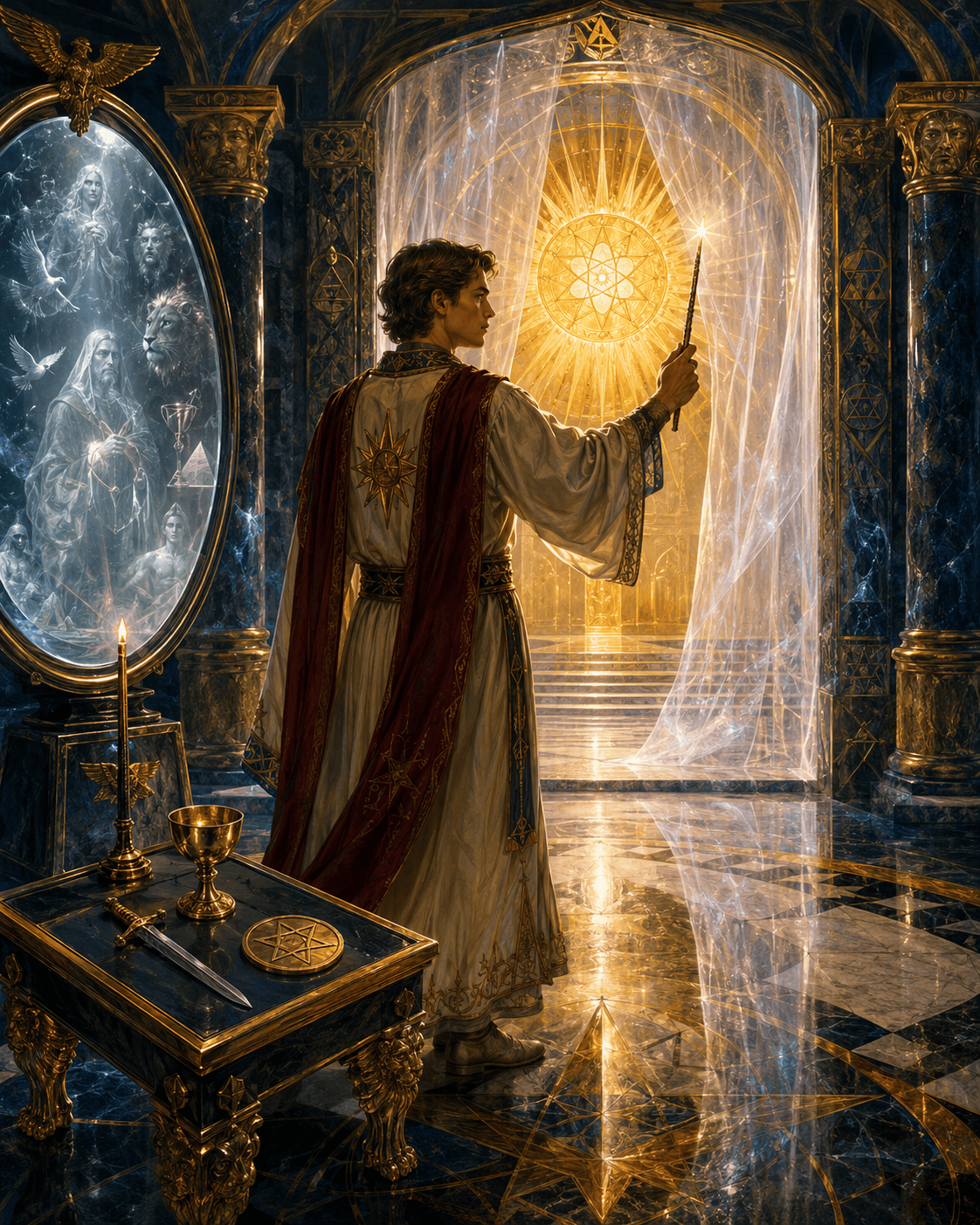
Before the Magician lie the elemental instruments.
Wand.
Cup.
Sword.
Pentacle.
Fire.
Water.
Air.
Earth.
The Magician does not become one of them.
The Magician governs their relationship.
That is the crucial point.
Power is not demonstrated by identifying with Fire.
Nor by drowning oneself in Water.
Nor by becoming intoxicated with Air.
Nor by becoming imprisoned within Earth.
The Magus stands among the instruments and remains conscious.
The four elemental weapons are available.
But the Magus decides.
This is self-mastery.
Not repression.
Not domination for its own sake.
Not spiritual authoritarianism.
Rather, ordered interior government.
The emotions speak, but do not automatically command.
The intellect analyzes, but does not automatically rule.
Desire arises, but desire does not thereby become destiny.
Sensory appearance presents itself, but appearance is not automatically accepted as truth.
The imagination produces images, but images must be examined.
The magician is therefore not merely one who possesses power.
The Magus is one who has developed sufficient interior authority to determine how power shall be used.
This is why “Magus of Power” must ultimately imply something far subtler than magical force.
The greatest power is the capacity not to be unconsciously ruled by the instrument one believes oneself to be controlling.
V. The Intelligence of Transparency
In William Wynn Westcott’s translation of the text traditionally printed as the Thirty-Two Paths of Wisdom, the Twelfth Path is called the Intelligence of Transparency, associated with the place from which the visions of those who behold apparitions and prophetic sights are said to proceed. (Uri Raz’s Tarot and Kabbalah Site)
A scholarly qualification is important here.
The “Thirty-Two Paths of Wisdom” employed so extensively in Hermetic Qabalah should not simply be equated without qualification with the earliest textual strata of the Sefer Yetzirah. Western esoteric editions frequently printed this later path-text alongside the Sefer Yetzirah, and Golden Dawn Qabalah inherited and systematized these descriptions. Thus, when we speak here of the Twelfth Path as the Intelligence of Transparency, we are speaking within the received Hermetic-Qabalistic tradition associated particularly with Westcott and subsequent occult interpreters.
But consider the extraordinary word:
Transparency.
Transparency is not emptiness.
It is unobstructed transmission.
A clean window does not create the sunlight.
It permits the sunlight to pass.
A distorted window bends the image.
A colored window modifies it.
A cracked mirror fractures it.
A dirty lens obscures it.
So too with consciousness.
The central spiritual problem of vision is not simply whether something has been seen.
The problem is what happened to the perception while it passed through the observer.
Every vision passes through a psyche.
Every intuition encounters memory.
Every revelation encounters expectation.
Every symbol encounters culture.
Every apparition encounters desire.
Every prophecy encounters the human need for significance.
Therefore, the mature magician does not ask merely:
Did I see something?
The mature magician asks:
Through what in me was it seen?
This is the Intelligence of Transparency as a discipline of consciousness.
VI. Mastery Over Apparitions
The inexperienced occultist often desires visions.
The experienced initiate learns to fear indiscriminate belief in them.
Not because visionary consciousness is inherently false.
But because psychic imagery is extraordinarily fertile.
The imagination can produce truthful symbols.
It can also produce compensatory images.
Traumatic residue may appear symbolically.
Unacknowledged desire may present itself wearing sacred clothing.
Fear may masquerade as warning.
Inflation may masquerade as divine election.
Fantasy may masquerade as prophecy.
Cultural memory may masquerade as past-life recollection.
Personal expectation may shape the very thing supposedly perceived objectively.
The Golden Dawn tradition therefore placed extraordinary emphasis upon discrimination, equilibrium, testing, banishing, correspondences, and the avoidance of obsession.
The question for Portal is not:
Can you enter the vision?
It is:
Can you return from it with your judgment intact?
This is a much higher test.
Any dreamer may become fascinated.
The initiate must remain capable of discrimination.
Any person may receive an image.
The magician must interpret without surrendering sovereignty.
The immature seer says:
“I saw it, therefore it is true.”
The mature seer says:
“I saw it. Now let us determine what kind of truth, if any, the vision contains.”
This single distinction separates mysticism from credulity and magical imagination from fantasy.
VII. Prophecy and the Discipline of the Seer
The phrase attached to the Intelligence of Transparency concerning apparitions and the prophecies of seers deserves special attention.
A prophecy is dangerous precisely because it appears to concern the future.
Once believed, it may alter behavior.
A person convinced that failure has been foretold may unconsciously manufacture failure.
A person convinced that greatness has been prophesied may become grandiose.
A person convinced that another human being is cosmically destined for them may override boundaries, evidence, or consent.
A practitioner convinced that catastrophe is coming may turn anxiety into theology.
The Portal initiate therefore learns that prophecy requires greater discipline than ordinary perception.
A seer must ask:
Was the experience symbolic or literal?
Personal or collective?
Psychological or transpersonal?
Conditional or inevitable?
Was there emotional investment in the answer?
Was the question asked repeatedly until a preferred answer appeared?
Does the vision contradict observable reality?
Has fear contaminated interpretation?
Has vanity contaminated interpretation?
Has spiritual ambition contaminated interpretation?
What independent evidence exists?
What happens if the interpretation is wrong?
These are not skeptical questions hostile to spirituality.
They are the ethics of spiritual maturity.
The higher the claim, the greater the obligation to test it.
Portal teaches that discernment is itself sacred.
VIII. Environment as Looking-Glass
Allen’s final line declares:
“Environment is but his looking-glass.”
Taken literally and universally, such an assertion would be philosophically and ethically excessive.
Human beings do not mentally manufacture every circumstance that befalls them.
War, oppression, illness, accident, economic structures, natural disaster, other people’s choices, social inequalities, inherited conditions, and chance contingencies cannot responsibly be reduced to the idea that an individual simply “thought them into existence.”
Such an interpretation can become cruel.
It may blame suffering people for their suffering.
That is neither sound scholarship nor sound initiation.
Yet Allen’s metaphor retains profound psychological value when interpreted carefully.
Environment often becomes a looking-glass in the sense that our reactions to circumstances reveal our interior constitution.
An insult may reveal insecurity.
Authority may reveal rebellion.
Wealth may reveal greed or generosity.
Loss may reveal attachment.
Power may reveal character.
Praise may reveal vanity.
Opposition may reveal courage—or fanaticism.
Uncertainty may reveal whether we possess faith, anxiety, patience, or compulsive control.
The mirror does not necessarily tell us:
You created everything you see.
The mirror asks:
What does your response to what you see reveal about you?
That is a far more mature doctrine.
Portal does not teach omnipotence.
Portal teaches responsibility.
IX. Thought as Magical Material
Thought nevertheless possesses enormous formative power.
Repeated thought becomes inclination.
Inclination reinforces emotion.
Emotion influences choice.
Choice becomes action.
Repeated action establishes habit.
Habit becomes character.
Character shapes destiny—not because consciousness magically controls every external event, but because character profoundly affects what one notices, chooses, tolerates, creates, avoids, pursues, and becomes.
In this sense, thought is magical material.
The magician works upon consciousness because consciousness mediates experience.
One cannot indefinitely cultivate resentment inwardly while expecting peace outwardly.
One cannot repeatedly visualize oneself as powerless while behaving courageously without eventually confronting the contradiction.
One cannot continually feed envy and expect the personality to remain generous.
One cannot cultivate disciplined attention without eventually changing the structure of one’s behavior.
Thought is therefore not merely private.
Thought is formative.
Portal initiates must become guardians of the interior Temple.
Not every thought deserves enthronement.
Not every desire deserves ritual reinforcement.
Not every fantasy deserves visualization.
Not every fear deserves belief.
Not every impulse deserves manifestation.
Self-mastery begins with selection.
X. The Young Adult and the Magical Adult
Return now to the analogy of majority.
The child frequently experiences rules as external.
The parent says:
Do this.
Do not do that.
Come home at this hour.
Spend only this amount.
Avoid this danger.
Fulfill this obligation.
The responsible adult must eventually internalize governance.
One cannot remain morally mature if one behaves responsibly only while being watched.
Likewise, the beginning occult student may require substantial external structure.
Perform this ritual.
Record this meditation.
Memorize this correspondence.
Observe this period.
Do not attempt this practice yet.
Study this grade first.
Such rules are useful.
But Portal introduces a more difficult question:
What happens when the teacher is no longer standing beside you?
Will you still banish properly?
Will you record your failures honestly?
Will you resist exaggerating spiritual experiences?
Will you admit when you do not know?
Will you refrain from manipulating others simply because you have discovered methods of persuasion?
Will you respect another person’s will?
Will you maintain ethical boundaries when secrecy would make misconduct easy?
Will you distinguish authority from domination?
Will you recognize when your own magical ambition has become unhealthy?
Will you stop a working when stopping is wiser than completing it?
These are the examinations of initiatory adulthood.
The minor obeys because authority stands above.
The adult learns to carry authority within.
Portal is therefore not liberation from discipline.
It is the internalization of discipline.
XI. Freedom and Consequence
The immature concept of freedom says:
“I may do what I wish.”
The mature concept of freedom says:
“I may choose, and therefore I am accountable for what follows.”
This is true legally.
It is true psychologically.
And it is profoundly true magically.
Every expansion of freedom increases responsibility.
If one learns methods of concentration, one must become responsible for what is concentrated upon.
If one learns invocation, one becomes responsible for the psychological consequences of invocation.
If one gains influence over others, one becomes responsible for how influence is used.
If one becomes capable of interpreting symbols for another person, one becomes responsible for the fear, hope, dependence, or confusion one’s words might create.
If one becomes a teacher, one becomes responsible for power asymmetries.
If one receives confidential information, one becomes responsible for silence.
If one acquires spiritual authority, one becomes responsible for humility.
The initiate who seeks power without consequence remains a spiritual minor.
The Adept begins where responsibility becomes inseparable from power.
XII. The Greatest Apparition Is the Self
There is, however, one apparition more dangerous than all others.
The apparition of oneself.
The image one has constructed of being spiritual.
The image of being chosen.
The image of being advanced.
The image of being an Adept.
The image of having unusual powers.
The image of being wiser than others.
The image of possessing privileged access to divine truth.
Such images are particularly difficult to detect because the personality is rewarded by believing them.
Thus the Portal candidate approaches Tiphareth carrying a paradox:
To discover the Higher Self, the candidate must become increasingly suspicious of counterfeit selves.
Every identity accumulated below the Veil must be examined.
Scholar.
Magician.
Mystic.
Healer.
Priest.
Priestess.
Initiate.
Teacher.
Seer.
Officer.
Adept-to-be.
All may be meaningful functions.
None is the deepest Self.
Tiphareth does not merely add a more glorious title to the personality.
Tiphareth exposes the personality to a greater center.
The sun does not become another planet.
It reveals the principle around which the planets must be ordered.
XIII. Toward Tiphareth
Tiphareth is Beauty.
Harmony.
Equilibrium.
Solar consciousness.
The center of the Ruach.
The point upon the Tree toward which the lower personality may become ordered.
Portal therefore has something of sunrise about it.
Yet it is sunrise before the Sun itself has fully appeared.
There is illumination behind the horizon.
The candidate senses a greater order.
But sensing is not possessing.
Aspiration is necessary.
Humility is equally necessary.
The First Order has largely taught differentiation.
This is Earth.
This is Air.
This is Water.
This is Fire.
This is Mercury.
This is Venus.
This is Luna.
This is the symbolism of a particular Path.
Portal begins integration.
The question changes from:
What does each power mean?
to:
Around what center shall these powers revolve?
That center cannot safely be the ordinary ego.
If the ego becomes the sun, everything else becomes its servant.
Spirituality then degenerates into self-glorification.
Tiphareth demands a different solar mystery.
The personal will must become increasingly capable of alignment with something greater than personal appetite.
Thus the great formula moves from:
What do I want?
toward:
What is mine rightly to do?
That is a very different question.
XIV. The Magus and the Transparent Mind
Now the analogy of Beth returns with greater force.
The true Magus does not obstruct the Light.
He transmits.
This is the deepest meaning we may derive from the Intelligence of Transparency.
The opaque magician says:
“Behold my power.”
The transparent magician asks:
“What Power moves rightly through me?”
The opaque magician interprets every vision in favor of the ego.
The transparent magician permits correction.
The opaque magician must be right.
The transparent magician desires truth more than vindication.
The opaque magician gathers followers.
The transparent magician cultivates capable souls.
The opaque magician confuses charisma with attainment.
The transparent magician recognizes that personality is an instrument.
The transparent mind does not mean a personality without individuality.
It means a consciousness increasingly free from unconscious distortion.
One becomes capable of seeing without immediately possessing.
Hearing without immediately believing.
Experiencing without immediately declaring.
Receiving without immediately appropriating.
Knowing without immediately boasting.
This is spiritual adulthood.
XV. The Portal Candidate’s Examination of Thought
Therefore, Portal presents a practical discipline.
Before accepting a powerful thought, ask:
Is it true?
Before acting upon it, ask:
Is it necessary?
Before speaking it, ask:
Is it responsible?
Before ritualizing it, ask:
What will this strengthen within me?
Before attempting to manifest it, ask:
Who benefits, who may be harmed, and whose will is involved?
Before calling it guidance, ask:
Have I tested it?
Before calling it prophecy, ask:
What evidence would show me I am mistaken?
Before calling it revelation, ask:
Does it enlarge humility, clarity, compassion, courage, and responsibility—or merely enlarge my importance?
Such questions constitute a magical examen.
They polish the glass.
XVI. Self-Mastery Is Not Self-Violence
We must also reject a common misunderstanding.
Self-mastery does not mean war against oneself.
The magician does not achieve sovereignty by mutilating the psyche.
Emotion is not an enemy.
Desire is not inherently corrupt.
The body is not a prison to be hated.
The intellect is not a demon.
The personality is not evil.
The elements are sacred powers.
The problem is disorder.
The task is right relationship.
Fire must burn where fire is appropriate.
Water must flow where water is needed.
Air must distinguish.
Earth must stabilize.
Spirit must coordinate.
The Portal initiate therefore becomes less interested in suppression and more interested in integration.
Self-mastery means that anger may be experienced without becoming cruelty.
Fear may arise without becoming tyranny.
Desire may arise without becoming enslavement.
Grief may be felt without abandoning the Work.
Power may be possessed without becoming abuse.
Praise may be received without becoming intoxication.
Criticism may be heard without psychological collapse.
Vision may arise without destroying discrimination.
This is equilibrium.
And equilibrium is strength.
XVII. The Ethical Birth of the Adept
The mysteries of Adeptship are sometimes imagined primarily in terms of occult knowledge.
Secret formulae.
Higher rituals.
Consecrations.
Inner Order symbolism.
Advanced evocation.
Skrying.
Enochian work.
Rosicrucian mysteries.
Yet all such things become dangerous if the ethical personality remains immature.
The true threshold of Adeptship is therefore ethical before it is spectacular.
Can greater knowledge be carried without arrogance?
Can secrecy be carried without elitism?
Can authority be carried without exploitation?
Can power be exercised without coercion?
Can spiritual intimacy exist without boundary violation?
Can the initiate distinguish service from the desire to be needed?
Can leadership remain accountable?
Can the magician recognize error?
Can the teacher remain teachable?
These are Solar questions.
For Beauty without ethics becomes glamour.
Power without ethics becomes domination.
Knowledge without ethics becomes cunning.
Vision without ethics becomes manipulation.
Authority without ethics becomes corruption.
Thus the road toward Tiphareth must pass through responsibility.
XVIII. Crossing the Threshold of Majority
Imagine again the young adult standing outside the family home for the first time.
The door closes.
The key is in the hand.
Freedom feels enormous.
There may be exhilaration.
There may also be fear.
There is no longer someone present at every hour to determine what should be done.
The young adult suddenly discovers the hidden burden inside freedom:
I must become the one who decides.
Portal carries this same mystery.
The candidate has been educated by the elemental grades.
Now those teachings must become interior law.
The initiate must begin becoming his or her own guardian of the threshold.
No officer can permanently stand inside the psyche.
No Chief can inspect every thought.
No teacher can accompany every astral journey.
No rubric can anticipate every ethical dilemma.
No book can interpret every vision.
Eventually the initiate must stand within the Temple alone and ask:
What is true?
What is balanced?
What is honorable?
What serves the Great Work?
And then act accordingly.
This is the age of majority of the soul.
XIX. “He Thinks in Secret”
James Allen’s phrase now acquires an initiatory depth:
“He thinks in secret.”
There is indeed a secret chamber.
It is the interior chamber in which thought exists before speech.
Before the ritual gesture.
Before manifestation.
Before action.
Before consequence.
The quality of the magical life is formed there.
One may deceive a Temple.
One may deceive companions.
One may deceive students.
One may deceive teachers.
For a time, one may even deceive oneself.
But the interior Temple records everything in character.
Thought becomes inclination.
Inclination becomes choice.
Choice becomes action.
Action becomes habit.
Habit becomes character.
Character becomes the vessel through which magical power will eventually flow.
Therefore the Portal initiate guards the secret chamber.
Not fearfully.
Consciously.
For what is entertained repeatedly in that chamber will eventually demand embodiment.
XX. The Looking-Glass Becomes Transparent
At the beginning of the Work, the world appears to be the problem.
Other people obstruct us.
Circumstances frustrate us.
Teachers fail us.
Organizations disappoint us.
Rituals seem difficult.
Life interferes with practice.
Later, the initiate learns to use these conditions diagnostically.
The obstacle asks:
What in you requires strengthening?
The conflict asks:
What in you remains unintegrated?
The criticism asks:
Can truth be extracted without resentment?
The temptation asks:
What still governs you?
The vision asks:
Can you see without becoming possessed by seeing?
The possession of power asks:
Can you remain ethical when you could choose otherwise?
The threshold asks:
Are you prepared to become responsible for yourself?
Gradually, the looking-glass becomes transparent.
One ceases merely to stare at oneself in the mirror.
One begins to see through it.
And beyond the reflected personality shines another Light.
The Light of Tiphareth.
XXI. The Portal Admonition
Therefore, Portal Initiate, understand the nature of the threshold upon which you stand.
You have not reached the end of instruction.
You have reached the end of spiritual childhood.
You are not being told that you now know everything.
You are being told that you must become responsible for what you know.
You are not being declared incapable of error.
You are being required to become accountable for error.
You are not being promised freedom from illusion.
You are being trained to recognize illusion.
You are not being promised infallible prophecy.
You are being asked to become transparent enough that vision may be tested without the distorting tyranny of desire.
You are not being crowned sovereign over the universe.
You are being asked to become sovereign within your own sphere of sensation.
This sovereignty begins quietly.
It begins when you choose which thought to cultivate.
Which desire to strengthen.
Which fear to challenge.
Which vision to test.
Which word to speak.
Which silence to maintain.
Which power to invoke.
Which power to refuse.
Which action to perform.
And which consequence to accept.
The ordinary person asks:
“What can I do?”
The magician asks:
“What can I cause?”
The Portal initiate must learn to ask:
“What ought I to cause?”
There begins Adeptship.
Conclusion: The Sun Beyond the Veil
Fratres and Sorores:
The threshold of Tiphareth is not crossed merely by accumulating information.
It is crossed through transformation.
The candidate who approaches the Veil carries all the elemental powers within the microcosm.
Earth has given foundation.
Air has given discrimination.
Water has given depth of consciousness.
Fire has given aspiration.
Spirit now calls these powers into unity.
Like the Magus standing before the four elemental instruments, the Portal initiate must become conscious of the powers arrayed before the inner altar.
Yet mastery does not mean possession.
It means stewardship.
The highest magician is not the personality proclaiming:
“See what I can command.”
The higher magician becomes the transparent vessel capable of saying:
“Let that which is True pass through me without distortion.”
The seer must become transparent to vision.
The thinker transparent to truth.
The magician transparent to Divine Will.
The leader transparent to justice.
The teacher transparent to wisdom.
The healer transparent to compassion.
And the initiate transparent to the Light.
Thus the image of the young adult reaching legal majority becomes a profound symbol of Portal.
The novice was supervised.
The student was instructed.
The elemental initiate was trained.
But the one approaching Adeptship must now begin to govern the self.
The age of majority has arrived.
Not because every lesson has been learned.
But because responsibility can no longer be deferred.
Therefore guard your thoughts.
Test your visions.
Interrogate your motives.
Discipline imagination.
Govern desire.
Honor the freedom of others.
Accept correction.
Remain capable of doubt.
Cultivate aspiration.
Seek equilibrium.
And above all, desire Truth more deeply than you desire to be confirmed in what you already believe.
For the Veil before Tiphareth cannot finally be penetrated by intellectual cleverness alone.
Nor by psychic phenomena.
Nor by titles.
Nor by magical reputation.
Nor even by knowledge.
The veil becomes transparent as the initiate becomes transparent.
And when the looking-glass ceases merely to reflect the lesser personality, the Light that had always stood beyond it begins to appear.
Then the words:
“Mind is the master power”
are transmuted into a higher mystery.
Mind is indeed a great power.
But the purified mind becomes greater still when it learns that its highest office is not to enthrone itself—
but to become a clear and willing instrument of the Light.
And so, standing at the threshold of Tiphareth, the Portal initiate may say:
I have learned to wield the instruments. Now let me become worthy to wield them.
I have learned to seek the vision. Now let me become transparent to Truth.
I have learned that thought shapes character. Now let thought itself be brought beneath the rule of the Higher Will.
I have come of age within the Mysteries. Let me therefore accept the responsibilities of the Light.
And before the Veil of the Sanctuary, let the candidate stand—not as a child demanding entrance, not as a personality demanding power, but as an emerging spiritual adult prepared to assume responsibility for the Great Work.
For beyond that Veil burns the Sun.
And before the Sun can be known as the center of the Temple—
it must first become the center of the Self.
Annotated Bibliography
Allen, James.As a Man Thinketh. 1903.
Allen’s short philosophical work provides the opening aphorism for this lecture and develops the proposition that cultivated thought participates in the formation of character. Although Allen was not presenting Golden Dawn doctrine, his treatment of thought, habit, character, and circumstance provides a useful comparative framework for discussing mental discipline at Portal. His language should not, however, be interpreted as demonstrating that individuals literally create every external circumstance through thought; the present lecture deliberately adopts a more ethically and philosophically qualified reading. The opening poem and Allen’s discussion of mind as a formative power are preserved in surviving editions of the text. (PsiTek)
Arnett, Jeffrey Jensen. “Emerging Adulthood: A Theory of Development from the Late Teens through the Twenties.”American Psychologist55, no. 5 (2000): 469–480.
Arnett’s influential article proposes “emerging adulthood” as a developmental period centered especially upon approximately ages eighteen through twenty-five. He identifies identity exploration, changing social roles, relative independence, and the subjective condition of being neither fully adolescent nor fully established adult. The present lecture uses Arnett cautiously and analogically: Portal resembles emerging adulthood not because occult grades correspond literally to developmental stages, but because both involve the acquisition of increasing autonomy before complete maturity has been achieved. (PubMed)
Cicero, Chic, and Sandra Tabatha Cicero.Self-Initiation into the Golden Dawn Tradition. St. Paul, MN: Llewellyn Publications, 1995.
The Ciceros present a systematic reconstruction of Golden Dawn grade symbolism and practices designed for individual study and self-initiation. Particularly useful for understanding the progressive elemental formation of the First Order and the transitional character of Portal. Their work also demonstrates the modern continuation of Golden Dawn pedagogical structures outside the original nineteenth-century temples.
Cicero, Chic, and Sandra Tabatha Cicero.The Essential Golden Dawn: An Introduction to High Magic. St. Paul, MN: Llewellyn Publications, 2003.
A concise modern overview of Golden Dawn cosmology, ritual, Qabalah, Tarot, elemental magic, and initiatory philosophy. Useful for contextualizing Portal within the larger Golden Dawn system and for readers requiring a more accessible introduction before consulting Regardie’s extensive primary-source compilations.
Fortune, Dion.The Mystical Qabalah. London: Williams & Norgate, 1935.
Fortune’s influential exposition of Hermetic Qabalah is particularly valuable for understanding the psychological and spiritual function of the Sephiroth. Her treatment of Tiphareth as the sphere associated with harmony, sacrifice, solar consciousness, and the higher individuality provides an important interpretive background for the present lecture’s discussion of the transition from personality-centered consciousness toward a more integrated spiritual center. Fortune represents twentieth-century Hermetic interpretation rather than Jewish Kabbalah and should be read within that historical context.
Jung, C. G.Aion: Researches into the Phenomenology of the Self. Collected Works, Vol. 9, Part II. Princeton: Princeton University Press, 1959.
Jung’s analysis of ego, Self, projection, shadow, and symbolic experience offers an important psychological dialogue partner for initiatory traditions. Particularly relevant to the lecture’s argument that visionary experiences require discrimination and that images of spiritual attainment may themselves become projections of the ego. Jung should not be treated as explaining Golden Dawn doctrine, but his psychology provides a sophisticated conceptual vocabulary for examining inflation, projection, integration, and symbolic consciousness.
Kaplan, Aryeh.Sefer Yetzirah: The Book of Creation in Theory and Practice. York Beach, ME: Samuel Weiser, 1990.
Kaplan provides one of the most substantial modern treatments of the Sefer Yetzirah, combining textual scholarship, traditional Jewish commentary, linguistic analysis, and meditative interpretation. His work is especially valuable for distinguishing Jewish textual traditions from later Hermetic adaptations. This distinction matters because the occult “Thirty-Two Paths of Wisdom” descriptions used by the Golden Dawn should not automatically be regarded as belonging to the oldest textual layers of the Sefer Yetzirah itself.
Mathers, S. L. MacGregor, et al. “Book T: The Tarot.” Hermetic Order of the Golden Dawn materials, late nineteenth century.
Book T constitutes one of the principal Golden Dawn sources for the Order’s Tarot correspondences. Within this system, Tarot Key I, the Magician, is attributed to Beth and Mercury and bears the esoteric title The Magus of Power. This attribution provides the historical basis for the present lecture’s use of the Magus as an analogical emblem of conscious direction over elemental powers. The Magus/Beth attribution should nevertheless be kept distinct from Portal’s own formal grade attribution.
Regardie, Israel.The Golden Dawn: A Complete Course in Practical Ceremonial Magic. Various editions. Originally published 1937–1940.
Regardie’s publication remains one of the indispensable repositories of Golden Dawn ritual, instructional documents, knowledge lectures, and grade ceremonies. Of particular relevance is the Portal ritual, which recapitulates and equilibrates the elemental Grades and prepares the candidate for transition toward Adeptus Minor. The ritual materials demonstrate that Portal serves as an initiatory bridge rather than as a Sephirothic Grade in its own right.
Regardie, Israel.The Complete Golden Dawn System of Magic. Phoenix: Falcon Press, 1984.
This expanded compilation preserves extensive ritual and instructional material connected with the Golden Dawn tradition. Its Portal materials are especially valuable for the symbolism of the Veil, the transition from the First to Second Order, the elemental synthesis, and the aspirational movement toward the Vault of the Adepti. The surviving text explicitly portrays the candidate as approaching the concealed Portal and being required to complete the symbolic formula before the Veil may be approached. (Scripta et Veritas)
Regardie, Israel.What You Should Know About the Golden Dawn. Various editions.
Regardie’s historical and explanatory discussion contains an especially concise interpretation of Portal. He describes it as not being attributed to a Sephirah in itself but as an outer court to Tiphareth, intermediate between the elemental Grades and Adeptus Minor. He further emphasizes Spirit or Aethyr, elemental equilibrium, aspiration, and the coordination of the lower nature toward the higher Genius. This formulation supplies one of the central historical foundations for the present lecture. (Publicism)
Wang, Robert.The Qabalistic Tarot: A Textbook of Mystical Philosophy. York Beach, ME: Samuel Weiser, 1983.
Wang presents one of the clearest comparative studies of Tarot as interpreted through the Golden Dawn’s Hermetic-Qabalistic structure. Particularly useful for understanding the relationship among Tarot Key I, Mercury, Beth, the Tree of Life, elemental instruments, and the magician as mediator of spiritual force. Wang also helps distinguish between Tarot symbolism as popularly interpreted and its more technical Golden Dawn correspondences.
Westcott, William Wynn, trans.Sepher Yetzirah: The Book of Formation and the Thirty-Two Paths of Wisdom. Various editions, originally published in the late nineteenth century.
Westcott, one of the principal founders of the Hermetic Order of the Golden Dawn, played a central role in transmitting Qabalistic texts into English occultism. In the Thirty-Two Paths of Wisdom printed with his translation, the Twelfth Path is called the Intelligence of Transparency and is associated with the source of visionary apparitions and prophetic seeing. (Uri Raz’s Tarot and Kabbalah Site)
For scholarly purposes, readers should recognize that the Thirty-Two Paths of Wisdom text as transmitted in Western occult editions has a textual history distinct from the oldest forms of the Sefer Yetzirah. Nevertheless, Westcott’s version became extraordinarily influential in Golden Dawn and subsequent Hermetic Qabalah, making it essential for understanding why Beth, Mercury, the Magus of Power, transparency, vision, and prophecy became linked within the Western Mystery Tradition.
Suggested Scholarly Reading Sequence
For students approaching this lecture as part of Portal preparation, the most useful progression is:
James Allen, As a Man Thinketh — for the ethical discipline of thought.
Israel Regardie, What You Should Know About the Golden Dawn — for the initiatory meaning of Portal.
Regardie, The Golden Dawn — for the ritual and instructional foundation.
Westcott, Sepher Yetzirah and the appended Thirty-Two Paths of Wisdom — for the Hermetic formulation of the Intelligence of Transparency.
Robert Wang, The Qabalistic Tarot — for Beth, Mercury, and the Magus of Power.
Dion Fortune, The Mystical Qabalah — for the Hermetic understanding of Tiphareth.
Aryeh Kaplan, Sefer Yetzirah — to place the Hermetic material alongside serious Jewish textual scholarship.
Jeffrey Arnett, “Emerging Adulthood” — for the developmental analogy of newly acquired autonomy and responsibility.
C. G. Jung, Aion — for psychological considerations concerning projection, ego, Self, and spiritual inflation.
Final Portal Maxim
The child asks to be shown the Light. The student learns the symbols of the Light. The magician learns to direct the forces of the Light. But the Portal initiate must become responsible for the Light that has been entrusted to them.
For mastery is not proven by what one can summon, but by what one can govern; not by what one can see, but by what one can discern; not by the possession of power, but by transparency before Truth.
Nigredo, the Veil of Paroketh, and the Rosicrucian Mystery of the Interior Sun
There comes a moment in the Great Work when the initiate discovers that Light does not always reveal itself as illumination.
Sometimes Light first reveals itself by exposing darkness.
There comes a stage when the formulas that once provided certainty cease to satisfy. Ritual may still be performed correctly, yet its former consolation seems absent. The symbols remain upon the altar, the Divine Names are still vibrated, the sacred gestures are still made, and yet something within the initiate has changed.
The former spiritual identity has begun to loosen.
For the Golden Dawn initiate approaching the Portal Grade, this experience may be understood through an alchemical and Rosicrucian lens as something resembling the mystical Dark Night of the Soul.
The expression itself is not an original Golden Dawn technical term. It comes principally from the Christian mystical writings of St. John of the Cross, who described states of purification in which the soul is deprived of its familiar consolations so that it may be drawn toward a more profound union with God.
Yet the concept offers an extraordinarily powerful way of contemplating the mystery of Portal.
For Portal is itself an in-between place.
Behind the initiate lie the elemental Grades of the First Order.
Ahead lies the threshold of Adeptus Minor 5=6, the mysteries of Tiphareth, and entrance into the Rosicrucian Second Order of the Rosae Rubeae et Aureae Crucis — the Red Rose and the Golden Cross.
Portal is therefore neither simply an ending nor simply a beginning.
It is the darkness between them.
It is the place where the initiate who has learned the elements must now become their synthesis.
It is the place where the magician who has learned to command forces must begin learning how to become a vessel for something greater.
And in the language of spiritual alchemy, this mystery is closely related to Nigredo — the Blackening.
The Four Elements Have Been Traversed
The journey through the elemental Grades has already subjected the initiate to a deliberate process of differentiation.
In Zelator 1=10, the mysteries of Earth establish foundation, embodiment, stability, discipline, and the necessity of bringing spiritual aspiration into manifestation.
In Theoricus 2=9, the mysteries of Air awaken thought, perception, language, reason, discrimination, and the mobility of consciousness.
In Practicus 3=8, Water opens the initiate to emotion, imagination, intuition, memory, receptivity, and the deeper currents of the psyche.
In Philosophus 4=7, Fire introduces will, aspiration, intensity, transformation, purification, and the power by which the old may be consumed so that something greater can emerge.
By the time the initiate arrives at Portal, Earth, Air, Water, and Fire have all been encountered.
But Portal asks a very different question.
It no longer asks:
What is Earth?
What is Air?
What is Water?
What is Fire?
It asks:
Who is the one in whom all four must become reconciled?
The candidate has studied the elements externally.
Portal begins their synthesis internally.
This is why Portal is associated not with another isolated elemental condition, but with the reconciling mystery of Spirit.
The four forces must be brought beneath a higher principle.
The elemental personality must become a pentagram.
The four arms must discover their center.
And the initiate begins to understand that Spirit cannot simply be added to Earth, Air, Water, and Fire as though it were a fifth substance sitting beside them.
Spirit must penetrate them.
Spirit must order them.
Spirit must reconcile them.
Spirit must become the hidden unity through which the four become one.
The Magician Becomes the Alchemical Vessel
Until this point, the initiate may have imagined that occult training consisted primarily of acquiring greater knowledge and greater control.
Learn the correspondences.
Learn the invocations.
Learn the Divine Names.
Learn the Tarot.
Learn Qabalah.
Learn ritual.
Learn the movement of magical force.
Learn how to invoke.
Learn how to banish.
Learn how to formulate.
Learn how to direct.
But Portal introduces a more dangerous proposition.
Perhaps the Great Work is not primarily about what the magician can make the universe do.
Perhaps the Great Work is about what the Divine can make of the magician.
At that point the operation reverses.
The practitioner becomes the materia.
The consciousness of the initiate becomes the alchemical substance placed within the vessel.
Every contradiction, every unresolved attachment, every ambition, every fear, every hidden motive, and every cherished spiritual self-image becomes part of the material upon which the Work must act.
Portal therefore announces an important transition:
the magician who has worked upon the elements must now permit the elements to work upon the magician.
And this is where the Dark Night begins.
Nigredo: The Blackening of the Spiritual Personality
In the imagery of Western alchemy, Nigredo is associated with blackening, decomposition, putrefaction, death, dissolution, and the breaking apart of a previously established form.
The material placed into the alchemical vessel does not immediately become gold.
First it may blacken.
It may decay.
It may lose its recognizable structure.
The original form appears to die.
Historically, alchemy encompassed genuine laboratory practices as well as philosophical, religious, and symbolic dimensions; modern scholarship cautions against reducing all historical alchemy to psychology alone. Yet later Western esoteric traditions made extensive use of alchemical imagery as a language for interior transformation. (University of Chicago Press)
In the Portal interpretation, Nigredo can therefore represent the decomposition of the initiate’s previous spiritual identity.
The candidate may have spent years constructing an identity around attainment.
“I know.”
“I understand.”
“I have been initiated.”
“I have received the Grades.”
“I can perform the rituals.”
“I know the correspondences.”
“I know the Divine Names.”
“I understand the Tree of Life.”
Portal quietly asks:
Who is this “I” that claims these attainments?
Suddenly the knowledge itself becomes subject to examination.
The ego can possess occultism just as easily as it can possess money, social status, academic credentials, authority, or reputation.
It can say:
My knowledge.
My initiation.
My lineage.
My magical ability.
My grade.
My spiritual authority.
My enlightenment.
But the Rosicrucian path cannot culminate in the enthronement of the spiritual ego.
Something must die.
The Veil of Paroketh
The Golden Dawn places profound symbolic importance upon the approach toward Tiphareth, the Solar Sephirah of Beauty, harmony, sacrifice, the Higher Genius, and the reconciled center of consciousness.
Before that Solar center lies the symbolic Veil of Paroketh.
The Veil marks a boundary.
Below it, the initiate has worked primarily through the structures of the personality and the elemental world.
Beyond it lies the approach toward the consciousness symbolized by Tiphareth.
The Veil therefore presents a paradox.
The initiate cannot cross it merely by becoming a more sophisticated version of the personality that approached it.
More information is not enough.
More memorization is not enough.
More magical technique is not enough.
Even greater psychic sensitivity is not enough.
The consciousness itself must become capable of another relationship with the Divine.
Portal thus becomes a chamber of transition between what the initiate has constructed and what the initiate must become.
The candidate stands, symbolically, before the Veil and encounters the uncomfortable truth:
the personality that brought me here cannot, by its own sovereignty, take me farther.
This realization is one of the deepest meanings that may be given to the Portal Dark Night.
When the Gods Become Silent
One of the characteristics traditionally associated with mystical purification is the withdrawal of spiritual consolation.
Prayer may cease to provide emotional reassurance.
Meditation may feel barren.
Ritual may feel less dramatic.
Visions may disappear.
Synchronicities may diminish.
The initiate may feel that the invisible world has withdrawn.
It is tempting to interpret such periods as spiritual failure.
But the mystical tradition of St. John of the Cross offers another possibility.
The soul can become attached not only to worldly pleasure but to spiritual pleasure.
The sensation of holiness can become an attachment.
Mystical visions can become an attachment.
Occult power can become an attachment.
Psychic phenomena can become an attachment.
Being recognized as spiritually advanced can become an attachment.
Even the experience of divine presence can become something the ego demands as reassurance.
The Dark Night removes the guarantee of consolation.
St. John of the Cross’s Dark Night is therefore useful comparatively, though it belongs to Christian contemplative theology rather than to the formal Golden Dawn curriculum. (Christian Classics Ethereal Library)
The question then becomes:
Will the initiate continue the Work without being rewarded by spiritual sensation?
Will one perform the rite when there is no exhilaration?
Will one meditate when no vision comes?
Will one pray when Heaven appears silent?
Will one remain faithful when there is no external confirmation of progress?
If so, something profound begins to change.
Practice ceases to be performed solely because it produces experience.
Practice becomes devotion.
The Rosicrucian Tomb
Here the Portal mystery becomes unmistakably Rosicrucian.
For beyond Portal lies the Second Order.
And at the heart of the Rosicrucian current stands one of Western esotericism’s most powerful images:
the Tomb of Christian Rosenkreutz.
The Fama Fraternitatis, first printed in 1614, tells of the discovery of the concealed sepulcher of the legendary founder of the Rosicrucian Brotherhood. The body of Christian Rosenkreutz is found preserved within a mysterious chamber after 120 years, surrounded by signs of hidden wisdom and spiritual science. The image became foundational to later Rosicrucian imagination. (Rosicrucianism)
The Golden Dawn’s Rosicrucian Adept tradition drew deeply upon this symbolism.
The Adeptus Minor mysteries are therefore not simply mysteries of acquiring greater magical authority.
They are mysteries of death, burial, discovery, regeneration, and resurrection.
That transforms the meaning of Portal.
Portal stands before the Tomb.
Before the candidate may fully participate in the mysteries symbolized by the resurrected Adept, something analogous to burial must already have begun within the candidate.
The spiritual ego approaches the sepulcher.
It cannot carry all of itself through the door.
Post CXX Annos Patebo
One of the famous Rosicrucian motifs surrounding the Tomb is the promise:
Post CXX Annos Patebo
“After one hundred and twenty years I shall open.”
The statement possesses extraordinary initiatory power when contemplated in relation to Portal.
The tomb is closed.
The Adept is hidden.
The Light is concealed.
Yet concealment is not absence.
The mystery is gestating.
The apparent grave contains a future revelation.
This is exactly the paradox of Nigredo.
The alchemical matter appears dead.
But something is happening within the vessel.
The seed lies beneath the earth.
The Sun appears absent during midnight.
The initiate cannot yet see the transformation because the operation is taking place beneath the threshold of ordinary awareness.
Portal teaches patience within sacred obscurity.
Not every spiritual transformation announces itself immediately.
Some changes occur in silence.
Some occur beneath consciousness.
Some must ripen inside the sealed vessel.
The Rose and the Cross
The Rosicrucian mystery eventually presents the initiate with the image of the Rose upon the Cross.
This symbol admits many layers of interpretation and should not be reduced to a single formula.
Yet for the Portal initiate it offers a particularly powerful teaching.
The Cross may be contemplated as the structure of manifested existence: the four directions, the four elements, incarnation, limitation, sacrifice, and the intersection of forces within material life.
The Rose unfolds at the center.
It suggests awakening consciousness, beauty, regeneration, multiplicity returning toward unity, and the opening of the interior life.
The mystery is not that the Rose escapes the Cross.
The Rose blossoms upon it.
This is crucial.
Rosicrucian initiation is not fundamentally an escape from embodiment.
Matter is not simply discarded.
The elements are not destroyed.
The human personality is not obliterated.
Instead, something divine must flower through them.
The Rose requires the Cross.
Spirit requires a vessel.
The invisible requires manifestation.
The Higher Genius requires an integrated personality through which to act.
Portal therefore does not teach the initiate how to abandon humanity.
It teaches the initiate how humanity may become transparent to something greater.
Crucifixion Before Resurrection
The Solar mysteries of Tiphareth carry strong sacrificial and redemptive symbolism within the Golden Dawn’s Christian-Hermetic and Rosicrucian framework.
This is why the approach to Adeptus Minor cannot be reduced to gaining occult power.
The candidate approaches a mystery of sacrifice.
The false king must surrender the throne.
The personality must cease claiming absolute sovereignty.
The magician begins moving from the question:
“How can I make spiritual powers serve my will?”
toward another:
“How may my will become reconciled with the Divine Will?”
That is a far more demanding question.
It shifts the orientation of magic itself.
The operator becomes servant.
The commander becomes mediator.
The magician becomes priest.
Will becomes offering.
Power becomes stewardship.
Knowledge becomes responsibility.
This is the Rosicrucian crucifixion of magical ego.
Yet crucifixion is not the final word.
The entire mystery moves toward regeneration.
There can be no resurrection of the higher consciousness without some death of the lower claim to sovereignty.
V.I.T.R.I.O.L. — Descend Into the Interior Earth
The alchemical maxim V.I.T.R.I.O.L. offers another key to the Portal ordeal:
Visita Interiora Terrae Rectificando Invenies Occultum Lapidem.
Traditionally rendered:
Visit the interior of the earth; by rectifying, you shall discover the hidden Stone.
The command is not to flee darkness.
The command is to enter it consciously.
For the Portal initiate, the “interior earth” may be understood as the concealed depth of the psyche.
There the initiate may encounter everything that the spiritual persona would prefer not to acknowledge:
fear,
pride,
envy,
need for recognition,
resentment,
control,
ambition,
unacknowledged desire,
spiritual vanity,
fear of failure,
fear of insignificance,
and perhaps most importantly,
fear of surrender.
These forces become the materia of the Work.
They must neither be worshiped nor denied.
They must be rectified.
The initiate descends not because darkness is the goal, but because something precious has been concealed inside it.
The Stone is hidden in the earth.
The Guardian at the Threshold
Esoteric literature frequently speaks of a Guardian of the Threshold, whether literally, symbolically, psychologically, or initiatically conceived.
Portal gives this motif special relevance.
At a threshold, everything that remains unresolved becomes visible.
The initiate may discover that the greatest obstacle is not an external demon but an unconscious pattern that has repeatedly shaped choices without ever being recognized.
The magician may discover pride masquerading as authority.
Fear masquerading as discernment.
Control masquerading as discipline.
Avoidance masquerading as detachment.
Ambition masquerading as aspiration.
Fantasy masquerading as revelation.
The Guardian asks:
Can you distinguish what is true from what you merely wish to be true?
Can you hold power without needing to dominate?
Can you hold knowledge without needing superiority?
Can you encounter your shadow without identifying yourself with it?
Can you receive correction without collapse?
Can you surrender illusion without surrendering the Work?
These are Portal questions.
The Black Raven and the White Rose
Alchemy frequently represents the early stages of transformation through images of blackness, ravens, graves, darkness, decay, and death.
Later imagery moves toward washing, whitening, purification, dawn, and illumination.
Thus the Black Raven of Nigredo eventually gives way toward Albedo — the Whitening.
The symbolic progression can be expressed:
Nigredo — Blackening
The old configuration decomposes.
Albedo — Whitening
The materia is washed, clarified, and purified.
Citrinitas — Yellowing
Solar consciousness begins to dawn.
Rubedo — Reddening
The transformed principle is embodied and brought toward completion.
These color stages are useful esoteric symbols, although historical alchemical texts vary considerably and do not all employ a single standardized four-stage system. Modern historical scholarship is particularly valuable for keeping contemporary esoteric interpretation distinct from the diversity of actual alchemical practice. (University of Chicago Press)
From a Golden Dawn–Rosicrucian perspective, Portal can be contemplated particularly as the passage from Nigredo toward Albedo.
The candidate is being prepared for Solar consciousness.
The dawn has not yet appeared.
But the darkness has begun to become transparent.
Tiphareth: The Interior Sun
Beyond the Veil lies Tiphareth.
Beauty.
Harmony.
Sacrifice.
Equilibrium.
The Solar center.
The Higher Genius.
The reconciled heart of the Tree.
This does not mean that simply receiving the 5=6 Grade automatically completes such realization.
Initiatory symbolism describes a Work that must be lived.
But Tiphareth establishes the new orientation.
The magician no longer seeks simply to become powerful.
The magician seeks to become aligned.
The personality no longer seeks simply to shine.
It seeks to transmit Light.
The initiate no longer asks only:
“What can I accomplish?”
The question becomes:
“What is the Great Work asking to accomplish through me?”
This is the dawning of the Interior Sun.
From Pentagram to Rose Cross
The Portal mystery can therefore be imagined as a transformation between two great magical symbols.
The Pentagram expresses the human microcosm and the equilibrium of the elements beneath Spirit.
The Rose Cross expresses a deeper Rosicrucian synthesis in which manifested life becomes the field upon which spiritual consciousness unfolds.
Portal stands between them.
The initiate first becomes the balanced pentagram.
Then the initiate approaches the mystery of the Rose upon the Cross.
One symbolism prepares for the other.
The elements must first be equilibrated.
Then the Solar center can become increasingly conscious.
The magician must first become a stable vessel.
Then the Rose may open.
Nothing Is Wasted in the Great Work
Perhaps one of alchemy’s most beautiful spiritual teachings is that apparently worthless matter may conceal extraordinary potential.
Lead contains the dream of gold.
The grave contains the possibility of resurrection.
Winter conceals spring.
Midnight secretly contains dawn.
And the shadow of the initiate contains forces that, once purified and reconciled, may become instruments of the Work.
Fear may become vigilance.
Anger may reveal the need for justice.
Desire may disclose the hidden direction of the will.
Grief may become compassion.
Failure may destroy illusion.
Humiliation may weaken pride.
Uncertainty may create genuine humility.
The Portal initiate therefore learns not to discard the prima materia of the self.
The Work is not accomplished by pretending to possess only Light.
It is accomplished by bringing everything into conscious relationship with Light.
The Rosicrucian Meaning of the Dark Night
The Dark Night of Portal is therefore not primarily punishment.
It is purification.
It is not divine abandonment.
It is the removal of false dependence.
It is not proof that initiation has failed.
It may instead be evidence that the Work has entered deeper material.
The candidate who once sought Light as an experience must begin seeking Light as a principle.
The initiate who once sought magical power must begin seeking alignment.
The student who once collected mysteries must become a mystery consciously lived.
The personality that once claimed the Work must begin surrendering itself to the Work.
This is Nigredo.
This is the sealed Tomb.
This is the Black Raven.
This is the Veil.
This is midnight before the Solar dawn.
Portal as the Chamber Before Resurrection
The Portal Grade may therefore be contemplated as a symbolic chamber immediately before the Rosicrucian mystery of regeneration.
The candidate stands before the Tomb of the Adept.
Behind are the four elemental worlds through which consciousness has traveled.
Above shines the unseen Sun of Tiphareth.
Before the initiate hangs the Veil.
Within the heart waits the Rose.
And beneath all conscious certainty the alchemical operation continues.
What must decay, decays.
What must be surrendered is surrendered.
What must be reconciled is brought together.
What cannot pass the Veil must remain behind.
The initiate enters the darkness carrying many identities.
The magician.
The scholar.
The occultist.
The ritualist.
The visionary.
The officer.
The teacher.
The seeker.
Portal asks:
Who remains when even these names fall silent?
The answer does not come intellectually.
It rises gradually, like dawn.
The Secret of Portal
The final secret of Portal may be expressed simply:
The darkness is not the opposite of initiation.
Sometimes darkness is initiation.
The seed does not germinate beneath the noon Sun.
It germinates beneath the soil.
The alchemical matter does not become perfected by remaining unchanged.
It must enter dissolution.
Christian Rosenkreutz does not reveal himself from a throne.
He is discovered within a Tomb.
The Adept is found where the uninitiated consciousness expects only death.
And so the initiate learns the Rosicrucian paradox:
The Tomb is secretly a Temple.
The Cross secretly bears a Rose.
Nigredo secretly contains the dawn.
The Veil secretly announces what lies beyond it.
And the Dark Night secretly contains the first rays of the Interior Sun.
The Portal candidate therefore does not conquer darkness by refusing to enter it.
The candidate enters consciously, carrying the Lamp of discernment.
One descends into the interior earth.
One rectifies.
One waits.
One listens.
One permits the false structures to fall away.
And eventually, within the chamber that once appeared empty, something begins to shine.
Not the borrowed light of doctrine.
Not the reflected light of reputation.
Not the artificial light of spiritual identity.
But a Light arising from the center.
A Solar Light.
A quiet Light.
A Light that does not belong to the personality yet may increasingly shine through it.
This is the promise concealed within the Portal Grade.
The candidate enters as the magician who has mastered the elements.
The candidate approaches Adeptship as one who has begun learning to surrender them to Spirit.
The Nigredo has prepared the vessel.
The Veil has concealed the mystery.
The Tomb has taught the formula of death and regeneration.
The Cross has received the Rose.
And somewhere beyond the darkness—
the Sun of Tiphareth is rising.
Annotated Bibliography
I. Primary Golden Dawn and Rosicrucian Sources
Regardie, Israel.The Golden Dawn: The Original Account of the Teachings, Rites, and Ceremonies of the Hermetic Order. 7th ed. Edited by John Michael Greer. St. Paul, MN: Llewellyn Publications, 2016.
The indispensable documentary source for studying the published rituals, knowledge lectures, symbolism, and magical instructions of the Golden Dawn tradition. For the present essay, Regardie is particularly important for understanding the progression of the elemental Grades, Portal, Adeptus Minor, Qabalistic grade structure, elemental symbolism, and the ritual framework surrounding the approach to the Second Order. The work was first published beginning in 1937; the Greer edition reorganizes and restores the material for modern study. (Llewellyn)
Regardie, Israel.The Complete Golden Dawn System of Magic. New Falcon Publications, 1991.
A massive compilation of Golden Dawn teachings, ritual material, Qabalah, Tarot, astrology, Enochian work, magical doctrine, and initiation material. It is particularly valuable as a reference collection for advanced students who wish to compare ritual structures with the broader magical curriculum in which they function. Because different editions vary in pagination and arrangement, readers should identify the edition they are using before citing individual sections. (Google Books)
Anonymous.Fama Fraternitatis R.C.Kassel, 1614.
The first printed Rosicrucian manifesto and an essential primary source for understanding the legendary Brotherhood of the Rose Cross. Of particular relevance to Portal and Adeptus Minor symbolism is its narrative of Christian Rosenkreutz, the secret fraternity, the discovery of his concealed tomb, the 120-year period, and the ideal of a hidden brotherhood devoted to spiritual and intellectual reformation. The Fama provides part of the Rosicrucian imaginative foundation from which later occult orders—including the Golden Dawn—drew. (Rosicrucianism)
Anonymous.Confessio Fraternitatis R.C.1615.
The second major Rosicrucian manifesto expands upon the Fama and presents the Brotherhood’s mission in more overtly religious, reformative, and prophetic terms. It is useful for understanding that early Rosicrucianism was not merely a system of private magical attainment but a vision of spiritual renewal, sacred knowledge, and transformation of both the individual and the world. Read beside the Golden Dawn’s Rosicrucian Adept tradition, it helps prevent the Rose Cross from being reduced merely to a magical emblem.
The Chymical Wedding of Christian Rosenkreutz. Strasbourg, 1616.
The third classic text associated with the early Rosicrucian current. Written as an elaborate allegorical initiation, it places Christian Rosenkreutz within a sequence of trials, purifications, symbolic deaths, transformations, and a mysterious royal wedding. It is especially valuable for a Portal interpretation because it demonstrates how Rosicrucian symbolism, initiation, and alchemical transformation can be woven together through narrative. The work was first published in German in 1616. (Confraternity of the Rose Cross)
John of the Cross, St.Dark Night of the Soul. Translated and edited by E. Allison Peers. New York: Image Books, 1959.
The principal comparative source for the phrase “Dark Night of the Soul.” John of the Cross describes the purification of sense and spirit through the withdrawal of spiritual consolation and attachment. It should not be treated as a Golden Dawn document; rather, it supplies a Christian mystical framework through which the psychological and devotional implications of the Portal threshold may fruitfully be contemplated. (Christian Classics Ethereal Library)
II. Historical Studies of the Golden Dawn and Rosicrucian Tradition
Bogdan, Henrik.Western Esotericism and Rituals of Initiation. Albany: State University of New York Press, 2007.
One of the most useful academic studies for placing the Golden Dawn within the broader history of Western initiatory societies. Bogdan examines the relationship between Freemasonry, later high-degree systems, Western esotericism, and Golden Dawn initiation. His dedicated chapter on the Hermetic Order of the Golden Dawn is particularly valuable for distinguishing historically documented initiatory structures from later occult reinterpretations. (SUNY Press)
Gilbert, R. A.The Golden Dawn Companion: A Guide to the History, Structure, and Workings of the Hermetic Order of the Golden Dawn. Wellingborough: Aquarian Press, 1986.
A compact reference work dealing with Golden Dawn history, membership, grades, temples, officers, and institutional structure. Gilbert’s work is especially useful when studying Portal not only symbolically but organizationally—as the threshold separating the Outer Order curriculum from the Rosicrucian work associated with the Second Order. (Google Books)
Yates, Frances A.The Rosicrucian Enlightenment. London: Routledge, 1972; later editions.
A landmark and highly influential scholarly interpretation of the Rosicrucian movement within the religious, political, Hermetic, and intellectual environment of early seventeenth-century Europe. Some details of Yates’s larger historical thesis have been debated and revised by later scholars, but the book remains foundational for understanding the Rosicrucian manifestos, Christian Rosenkreutz, John Dee, Robert Fludd, Michael Maier, and the cultural environment in which the Rosicrucian phenomenon emerged. (Routledge)
McIntosh, Christopher.The Rosicrucians: The History, Mythology, and Rituals of an Esoteric Order. 3rd ed. York Beach, ME: Samuel Weiser, 1997.
A readable historical survey tracing Rosicrucianism from the original manifestos through later movements and occult revivals. Of particular interest to Golden Dawn students is McIntosh’s treatment of the Golden Dawn’s relationship to earlier Rosicrucian currents. The book also examines the legendary discovery of Christian Rosenkreutz’s seven-sided vault, making it especially relevant to the symbolic connection between the Rosicrucian Tomb and the Adept tradition. (Google Books)
III. Alchemical Sources and Interpretive Studies
Principe, Lawrence M.The Secrets of Alchemy. Chicago: University of Chicago Press, 2012.
An essential modern historical introduction to alchemy. Principe is particularly important because he challenges the common modern tendency to assume that historical alchemists were primarily practicing psychological or spiritual transformation under chemical metaphors. His work demonstrates the serious experimental and material dimensions of alchemy while also recognizing its wider religious and cultural contexts. This makes the book invaluable for keeping a modern esoteric reading of Nigredo intellectually honest. (University of Chicago Press)
Newman, William R., and Lawrence M. Principe.Alchemy Tried in the Fire: Starkey, Boyle, and the Fate of Helmontian Chymistry. Chicago: University of Chicago Press, 2002.
A major scholarly work demonstrating the sophisticated laboratory dimensions of early modern alchemy or “chymistry.” Through the work of George Starkey and Robert Boyle, Newman and Principe show that alchemical practice involved genuine experimental reasoning, measurement, laboratory operations, and theories of matter. The text is valuable as a corrective companion to occult uses of alchemical terminology such as Nigredo, Solve, and Coagula. (University of Chicago Press)
Abraham, Lyndy.A Dictionary of Alchemical Imagery. Cambridge: Cambridge University Press, 1998.
An exceptionally useful reference work for decoding the vocabulary and imagery of Western alchemy. Entries examine both physical and figurative meanings of alchemical symbols and are supported by historical textual examples. Particularly useful to the present subject are images associated with death, blackness, the raven, dissolution, conjunction, purification, the philosophical stone, the king, the sun, and regeneration. (Google Books)
Jung, C. G.Psychology and Alchemy. 2nd ed. Translated by R. F. C. Hull. Collected Works, vol. 12. Princeton: Princeton University Press, 1968.
Jung’s influential psychological interpretation of alchemy established much of the modern vocabulary by which Nigredo, conjunction, transformation, and the Philosopher’s Stone are associated with processes of individuation and psychological integration. His work is particularly fruitful when contemplating Portal as an interior transformation of the magician. It should, however, be read alongside historians such as Principe and Newman so that Jung’s psychological interpretation is not mistaken for a complete historical account of what practicing alchemists themselves believed they were doing. (JSTOR)
Suggested Reading Sequence for the Portal Initiate
For a specifically Golden Dawn–Rosicrucian study of this subject, the most useful sequence is:
First: Regardie, The Golden Dawn — establish the actual Golden Dawn grade structure and ritual symbolism.
Second:Fama Fraternitatis — encounter the original Rosicrucian Tomb and Christian Rosenkreutz mythology.
Third:The Chymical Wedding of Christian Rosenkreutz — study Rosicrucian initiation through an explicitly alchemical narrative.
Fourth: St. John of the Cross, Dark Night of the Soul — explore the mystical purification produced by the withdrawal of consolation.
Fifth: Abraham, A Dictionary of Alchemical Imagery — investigate the symbolism of Nigredo, death, purification, conjunction, and the Stone.
Sixth: Principe, The Secrets of Alchemy — ground the esoteric interpretation in reliable historical scholarship.
Seventh: Bogdan and McIntosh — place the Golden Dawn and its Rosicrucian claims within their larger historical and initiatory context.
Finally: Jung, Psychology and Alchemy — return to the alchemical symbols as images of interior psychological transformation, while maintaining the distinction between modern psychological interpretation and historical alchemical practice.
Taken together, these works reveal the Portal not merely as an administrative interval between Philosophus and Adeptus Minor, but as a profoundly meaningful threshold:
the elemental magician approaches the Veil, enters the Nigredo, stands before the Rosicrucian Tomb, and prepares for the dawning of the Solar Mystery of Tiphareth.
The historical framework behind the bibliography is well supported: the Fama appeared in 1614, the Chymical Wedding in 1616, the Golden Dawn was founded in 1888, and its ritual system became enormously influential in later Western esotericism. (Rosicrucianism)
Primary Objective : To transform astrological knowledge into direct spiritual experience through disciplined contemplative practice.
Before we begin tonight’s work, I would like each of you to set aside, for just a little while, the charts, the tables of correspondences, and the lists of planetary rulerships that have occupied so much of your studies. They have served you well, and they remain indispensable. But they are only the beginning.
Throughout the earlier grades, you have learned to identify the symbols of astrology. You have memorized the qualities of the planets, the elements, the signs, the decans, and the many correspondences that bind astrology to the Tree of Life. That knowledge forms a necessary foundation. Yet no amount of intellectual study can replace direct spiritual experience.
The work of the Magician is to transform knowledge into wisdom.
Tonight, we will explore one of the most beautiful and transformative practices of the Western Mystery Tradition: astrological pathworking.
The heavens are more than a collection of distant celestial bodies. To the ancient philosophers, the Hermetic sages, the Rosicrucians, and the initiates of the Golden Dawn, the cosmos was alive. Every planet expressed a divine principle. Every zodiacal sign revealed a unique mode through which the One Life manifested itself. The stars were not merely objects to be observed—they were symbols of living realities, mirrors reflecting eternal truths within the soul of humanity.
When we practice astrological pathworking, we are not attempting to travel physically into the heavens. Rather, we enter the symbolic landscape of consciousness. We seek to encounter the archetypal intelligence represented by a planet or sign. We allow the imagination—not as fantasy, but as the sacred faculty of vision—to become a bridge between the conscious mind and the deeper levels of the psyche and spirit.
This distinction is important.
Fantasy is something we invent.
Pathworking is something we receive.
The initiate approaches these inner experiences with humility rather than expectation. We do not force visions to appear. We do not attempt to manufacture profound experiences. Instead, we create the proper conditions and allow the symbols to reveal themselves naturally. We become attentive observers of the inner world.
By the time one reaches the Grade of Philosophus, this manner of work becomes especially appropriate.
Philosophus is the Grade of Fire.
Fire is the element of transformation. It consumes what is crude and reveals what is essential. Fire gives warmth, illumination, and life, but only when governed wisely. So too must our knowledge be refined through experience. The facts we have accumulated must become living realities within consciousness.
There are, generally speaking, three stages through which astrological understanding develops.
The first is intellectual.
This is where every student begins. We memorize that Aries is cardinal fire, ruled by Mars. We learn that Taurus belongs to Venus, that Saturn governs Capricorn, that Mercury rules Gemini and Virgo. We study aspects, dignities, exaltations, and correspondences.
This level is necessary.
But it is not enough.
The second level is psychological.
Here the symbols begin to awaken within our own lives.
We notice Mars whenever we are called upon to defend someone or confront a difficult situation. We recognize Saturn whenever discipline, patience, or responsibility become necessary. Venus appears not merely as romance, but as our capacity for beauty, harmony, and appreciation.
The symbols cease being external descriptions.
They become mirrors.
Eventually, the initiate enters the third level.
This is the mystical level.
Here, the symbols are experienced as living archetypes. The initiate no longer contemplates merely the idea of courage but encounters the essence represented by Mars. No longer simply studies beauty but experiences the living current symbolized by Venus. Jupiter ceases to be only expansion or fortune and becomes the felt presence of generosity, wisdom, and noble authority.
Whether we understand these encounters psychologically, spiritually, or both is less important than the transformation they produce.
This is the purpose of pathworking.
Naturally, preparation is essential.
One should never rush into this practice.
The Temple—or whatever sacred space you have prepared—should be quiet, orderly, and free from distraction. A simple altar is sufficient. A white candle may be lit to symbolize the Divine Light. If desired, a planetary candle corresponding to the work may also be used, together with appropriate incense.
Begin, as always, by centering yourself.
Perform the Lesser Banishing Ritual of the Pentagram to establish equilibrium within the sphere of sensation. Offer an Adoration to the Lord of the Universe. Sit quietly until the ordinary chatter of the mind begins to settle.
Only then should the pathworking begin.
Most astrological pathworkings follow a remarkably similar structure.
First comes relaxation.
Allow the breath to become slow and steady. Let tension dissolve from the body. Withdraw awareness from external concerns and gather it inward.
Then comes visualization.
Imagine yourself standing before a doorway.
Upon that doorway appears the glyph of the sign or planet with which you intend to work. Do not rush forward. Pause. Recognize that you stand at the threshold of a sacred mystery. Inwardly ask permission to enter.
This simple act cultivates humility. We do not storm the Temple of Wisdom; we are invited into it.
When the time feels right, step through the doorway.
Now the true work begins.
Do not force the scenery. Do not struggle to invent details. Allow the environment to unfold gradually. Perhaps you find yourself upon a mountain. Perhaps within a forest, a temple, a desert, or beside a river. Whatever appears, observe it with quiet curiosity.
Sooner or later, most sincere pathworkings introduce some form of guide.
It may be a wise elder.
An angelic presence.
A symbolic animal.
A priest or priestess.
A king.
A child.
Occasionally no guide appears at all, and the landscape itself becomes the teacher.
Receive whatever comes without judgment.
If an opportunity arises, respectfully ask a question.
“What quality must I cultivate?”
“What obstacle hinders my growth?”
“What lesson belongs to this sign?”
Ask only one question at a time.
Then wait.
Silence often teaches more than words.
Eventually, the experience reaches its natural conclusion.
Offer gratitude to whatever intelligence or symbol has appeared. Retrace your steps through the doorway. Return your awareness gently to the room. Open your eyes without haste.
Then write.
Write immediately.
Memory fades far more quickly than we imagine.
Record the date, the planetary hour if known, the Moon’s phase, the symbols encountered, the dialogue, the emotions, the unexpected details, and any practical insights that emerged. Over months and years these journals become invaluable records of spiritual development.
Let us consider an example.
Imagine we are entering the current of Aries.
You find yourself standing before dawn. The eastern horizon glows with deep crimson light. A narrow mountain path rises before you toward a solitary temple perched upon the summit. As you climb, the landscape grows increasingly austere. There is nothing unnecessary here. Every stone, every gust of wind, every step demands purpose.
At the summit waits a great ram.
Its presence is calm rather than aggressive. Its eyes shine with unwavering certainty.
It asks a single question.
“What have you delayed because of fear?”
There is no accusation in its voice.
Only invitation.
Nearby burns a clear, unwavering flame. Within the fire stands a sword. It is not offered for violence. It is offered to cut away hesitation.
You receive it.
When you descend the mountain, the dawn has become full daylight.
Nothing in your external life has changed.
Yet inwardly something has shifted.
That is the work.
Now consider Taurus.
Instead of a mountain, you enter a broad green valley. The air is rich with the fragrance of spring. At the center stands an ancient oak whose roots disappear into immeasurable depths. Beneath its branches rests a magnificent white bull.
The bull does not challenge you.
It simply asks,
“What truly nourishes your soul?”
Notice that this question is not about possessions.
Nor comfort.
Nor pleasure.
It asks about nourishment.
Remain there as long as necessary.
Listen.
The lesson of Taurus often arrives in silence.
Or imagine entering the temple of Libra.
You walk into a vast marble hall filled with perfect stillness. At its center stands a golden balance. No one attends it. One scale bears your strengths; the other, your limitations. Neither outweighs the other. Both belong to the whole person.
A veiled figure appears—not to judge you, but to invite you into greater balance. She silently gestures for you to place one attachment upon the scales.
Observe what changes.
Such experiences often reveal truths that no textbook can adequately convey.
Planetary pathworkings proceed in much the same manner.
In a Venus meditation, you may find yourself walking through an exquisite rose garden where beauty surrounds you from every direction. Yet among hundreds of blossoms, one rose remains unopened. A luminous feminine presence asks gently,
“What beauty within yourself remains unopened?”
A Saturn pathworking may lead you instead to a mountain monastery where an elderly teacher offers no speeches, no praise, and no criticism. There is only unfinished work waiting patiently upon a stone bench. The lesson is discovered not through conversation but through disciplined labor.
A Jupiter meditation may open into a magnificent library whose shelves stretch beyond sight. Upon a throne sits a benevolent king who asks,
“What blessing have you overlooked?”
Notice that the questions are always simple.
The answers, however, may occupy a lifetime.
Now, a word of caution.
Not every image carries profound meaning.
Sometimes the imagination simply wanders.
Sometimes the subconscious rearranges memories into symbolic form.
This is perfectly natural.
The Magician therefore cultivates discernment.
Ask yourself after every experience three simple questions.
Did this meditation make me more humble?
Did it encourage greater virtue?
Did it awaken a deeper desire to serve?
If the answer is yes, then the work has likely borne good fruit.
If the experience merely inflates pride, feeds spiritual vanity, or encourages a sense of superiority, then it should be regarded with great caution.
The purpose of pathworking is transformation, not entertainment.
Its fruits should appear not only in meditation but in ordinary life.
After a Mars pathworking, practice courage.
After Venus, cultivate kindness.
After Saturn, complete a neglected responsibility.
After Mercury, communicate with greater honesty and precision.
After Jupiter, share wisdom generously.
After Moon work, spend time in reflection.
After Sun work, strive to embody integrity and noble leadership.
Without action, vision gradually fades.
Experience becomes memory rather than transformation.
For your work during the coming weeks, each of you will undertake a complete cycle through the zodiac. Dedicate one week to each sign. Enter its symbolic landscape, receive whatever instruction it offers, and faithfully record your experiences in your magical journal. At our Temple meetings, we shall compare observations—not to determine who is “correct,” but to discover how universal archetypes reveal themselves uniquely to each individual soul. You will likely find recurring themes alongside strikingly personal symbolism, and both are worthy of careful contemplation.
As you complete the cycle, you will notice a remarkable change. The zodiac will no longer appear as twelve abstract divisions upon an astrological chart. Aries will become a remembered ascent toward courage. Taurus will become a valley of quiet strength. Gemini a place of living dialogue. Cancer a sanctuary of memory. Leo a throne of radiant purpose. Virgo a sacred workshop of refinement. Libra a hall of equilibrium. Scorpio a chamber of transformation. Sagittarius a road toward distant horizons. Capricorn a mountain of disciplined ascent. Aquarius a temple of inspired vision. Pisces an ocean of compassionate surrender.
The signs will cease to be merely studied.
They will become inhabited.
This is the true aim of astrological pathworking. It is not the pursuit of extraordinary visions or psychic experiences, but the gradual refinement of consciousness. Through repeated encounters with these celestial archetypes, we begin to recognize that the zodiac is not only written across the heavens—it is inscribed within the soul itself.
The ancient Hermetic axiom reminds us, “As above, so below; as within, so without.” Through this sacred work, the macrocosm and the microcosm gradually come into harmony. We discover that the celestial temple we have sought among the stars has always existed within the sanctuary of our own being.
May your journeys through the living Zodiac deepen your wisdom, strengthen your character, and kindle ever more brightly the sacred Fire entrusted to the Magician, until every step upon the path reflects the Light of the One Divine Source.
For this lecture, I distinguish between sources that directly document Golden Dawn astral/astrological practice and sources that provide the older Hermetic, Qabalistic, astrological, and modern interpretive foundations behind the lecture.
Annotated Bibliography: Astrological Pathworking
Primary Golden Dawn and Hermetic Sources
Regardie, Israel.The Golden Dawn: The Original Account of the Teachings, Rites, and Ceremonies of the Hermetic Order. 6th ed. St. Paul, MN: Llewellyn Publications, 1989.
This is the principal modern compendium for Golden Dawn ritual, symbolism, grade material, elemental work, Tarot, Qabalah, astrology, and astral techniques. It is particularly important for understanding why astrological pathworking cannot be isolated from the Order’s larger system of correspondences. For the Magician, Regardie provides the ritual and symbolic architecture through which zodiacal and planetary forces can be approached as components of an integrated magical universe.
King, Francis, ed.Astral Projection, Ritual Magic, and Alchemy: Golden Dawn Material by S. L. MacGregor Mathers and Others. Rochester, VT: Destiny Books, 1987.
Especially relevant to the practical dimension of the lecture. The collection preserves Golden Dawn-related material concerning astral consciousness, magical imagination, visionary work, and related occult techniques. It helps place “pathworking” within the broader historical practice of skrying and astral vision rather than treating it merely as guided visualization.
Mathers, S. L. MacGregor.The Kabbalah Unveiled. London: George Redway, 1887.
Mathers’s translation of portions of Knorr von Rosenroth’s Latin Kabbala Denudata was profoundly influential upon the Golden Dawn’s understanding of Qabalah. Although it is not a pathworking manual, it provides important historical background for the cosmological structure through which Golden Dawn practitioners understood spiritual worlds, emanation, divine names, and the relationship between higher and lower realities.
Westcott, William Wynn.An Introduction to the Study of the Kabalah. London: J. M. Watkins, 1910.
Westcott, one of the Golden Dawn’s founders, offers a compact introduction to the Qabalistic worldview underlying much of the Order’s magical system. It is useful for Magician students because astrological pathworking within the Golden Dawn is not simply “astrology plus visualization”: planets, signs, Hebrew letters, Sephiroth, Tarot, and divine hierarchies exist within a deliberately interconnected symbolic structure.
Golden Dawn Correspondences and Practical Magic
Crowley, Aleister.777 and Other Qabalistic Writings of Aleister Crowley. York Beach, ME: Samuel Weiser, 1973.
Despite Crowley’s later development of a distinctly Thelemic system, the correspondence tables of 777 preserve and expand material substantially indebted to the Golden Dawn tradition. The tables are extremely useful when constructing pathworkings because they correlate planets and zodiacal signs with colors, divine names, Tarot, Hebrew letters, perfumes, magical images, and other symbolic categories. For students, however, it is important to distinguish Golden Dawn-derived material from Crowley’s subsequent Thelemic interpretations.
Cicero, Chic, and Sandra Tabatha Cicero.Self-Initiation into the Golden Dawn Tradition. St. Paul, MN: Llewellyn Publications, 1995.
A modern systematic presentation of Golden Dawn practice particularly useful for understanding how ritual, visualization, meditation, symbolism, and grade work can function as an integrated curriculum. It provides practical context for preparing sacred space and cultivating the disciplined imaginative faculties required for pathworking.
Cicero, Chic, and Sandra Tabatha Cicero.The Essential Golden Dawn: An Introduction to High Magic. St. Paul, MN: Llewellyn Publications, 2003.
A useful secondary introduction to Golden Dawn magical philosophy and practice. For the present lecture, its value lies in explaining how ritual, Qabalah, astrology, Tarot, and magical symbolism operate as interconnected components rather than independent subjects. It is particularly accessible for students transitioning from theoretical correspondence work toward practical magical application.
Astrology and the Western Esoteric Tradition
Agrippa, Heinrich Cornelius.Three Books of Occult Philosophy. Translated by James Freake. Edited and annotated by Donald Tyson. St. Paul, MN: Llewellyn Publications, 1993.
Agrippa is indispensable for understanding the Renaissance magical worldview inherited by later ceremonial traditions. His treatment of planetary qualities, celestial correspondences, number, elemental philosophy, images, spirits, and the relationship between terrestrial and celestial realities provides an important historical foundation for the concept that planetary forces may be approached through carefully constructed networks of symbolism.
Ficino, Marsilio.Three Books on Life. Edited and translated by Carol V. Kaske and John R. Clark. Binghamton, NY: Medieval & Renaissance Texts & Studies, 1989.
Ficino provides one of the most sophisticated Renaissance treatments of humanity’s relationship with celestial influences. Particularly valuable is De vita coelitus comparanda (“On Obtaining Life from the Heavens”), in which Ficino discusses music, imagery, plants, perfumes, colors, and contemplative practices in relation to planetary qualities. His work offers a major intellectual ancestor to later planetary magical practices.
Cornford, Francis Macdonald, trans.Plato’s Cosmology: The Timaeus of Plato. Indianapolis: Hackett Publishing, 1997.
Plato’s Timaeus provides an important philosophical background for the Western conception of the cosmos as an ordered, ensouled whole rather than a collection of unrelated material objects. It supports the lecture’s broader metaphysical premise that human consciousness and celestial order can be contemplated as corresponding expressions within a unified cosmos.
Hermetic Foundations
Copenhaver, Brian P., trans.Hermetica: The Greek Corpus Hermeticum and the Latin Asclepius in a New English Translation, with Notes and Introduction. Cambridge: Cambridge University Press, 1992.
One of the strongest scholarly translations of the philosophical Hermetica. The texts explore divine Mind, cosmic order, humanity as microcosm, spiritual rebirth, and the relationship between the human and celestial realms. This is an important corrective to overly simplified modern uses of “as above, so below”: the actual Hermetic worldview is considerably richer than the popular maxim suggests.
Fowden, Garth.The Egyptian Hermes: A Historical Approach to the Late Pagan Mind. Princeton, NJ: Princeton University Press, 1986.
Fowden provides the historical context necessary for understanding Hermeticism as a late-antique religious-philosophical phenomenon. This scholarly source helps distinguish historical Hermetic thought from nineteenth- and twentieth-century occult interpretations of it, making it particularly valuable for an advanced Temple curriculum.
Tarot, Astrology, and the Paths
Case, Paul Foster.The Tarot: A Key to the Wisdom of the Ages. Richmond, VA: Macoy Publishing, 1947.
Case, who was strongly influenced by Golden Dawn teachings before developing Builders of the Adytum, presents Tarot as a system of spiritual and psychological transformation. His discussions of Hebrew letters, astrological correspondences, meditation, and Tarot imagery are particularly relevant to zodiacal pathworking because the Golden Dawn’s zodiacal signs can also be approached through their corresponding Major Arcana Keys.
Wang, Robert.The Qabalistic Tarot: A Textbook of Mystical Philosophy. York Beach, ME: Samuel Weiser, 1983.
An especially useful bridge between Golden Dawn Tarot, astrology, Qabalah, and the Tree of Life. Wang demonstrates how Tarot symbolism functions within the Golden Dawn’s Qabalistic framework. For pathworking students, it assists in understanding why a zodiacal journey may simultaneously involve a Hebrew letter, Tarot trump, elemental quality, planetary influence, and Tree-of-Life path.
Although centered upon Crowley’s Thoth Tarot rather than strictly Golden Dawn Tarot, DuQuette clearly explains many of the astrological, Qabalistic, elemental, and zodiacal correspondences inherited from the Golden Dawn system. It is useful as a comparative secondary source, especially when students begin exploring how Golden Dawn correspondences evolved within later Western magical traditions.
Active Imagination and the Psychology of Pathworking
Jung, C. G.The Archetypes and the Collective Unconscious. 2nd ed. Translated by R. F. C. Hull. Princeton, NJ: Princeton University Press, 1969.
Jung supplies an important psychological framework for understanding why symbolic encounters can possess tremendous subjective power without requiring the practitioner to decide immediately whether an encountered figure is an objectively independent spiritual intelligence. His concept of archetypes is particularly helpful when interpreting recurring kings, queens, animals, temples, mountains, oceans, guides, and celestial figures within pathworking.
Jung, C. G.The Red Book: Liber Novus. Edited by Sonu Shamdasani. Translated by Mark Kyburz, John Peck, and Sonu Shamdasani. New York: W. W. Norton, 2009.
Jung’s extraordinary record of visionary encounters demonstrates sustained engagement with deliberately entered imaginal experience. It should not be treated as a Golden Dawn manual, but it provides a valuable comparative example of disciplined dialogue with interior figures and symbolic environments. It is particularly relevant to the lecture’s distinction between consciously manufacturing imagery and allowing an imaginal encounter to develop with a degree of autonomy.
Modern Studies of Western Esotericism
Hanegraaff, Wouter J.Western Esotericism: A Guide for the Perplexed. London: Bloomsbury Academic, 2013.
A valuable scholarly orientation to the field of Western esotericism. Hanegraaff helps situate Hermeticism, Renaissance magic, occultism, and related currents within their proper historical contexts. For a Magician curriculum, this provides useful academic balance alongside practitioner literature.
Goodrick-Clarke, Nicholas.The Western Esoteric Traditions: A Historical Introduction. Oxford: Oxford University Press, 2008.
A concise historical overview of Hermeticism, Renaissance magic, Rosicrucianism, occultism, and modern esoteric movements. This work helps students understand that Golden Dawn astrological practice emerged from centuries of intellectual and magical development rather than appearing as an isolated nineteenth-century system.
Asprem, Egil.Arguing with Angels: Enochian Magic and Modern Occulture. Albany: State University of New York Press, 2012.
Although primarily concerned with Enochian magic, Asprem’s scholarly treatment of visionary magical practice and modern ceremonial occultism is useful for placing Golden Dawn approaches to spiritual perception within a larger historical framework. It also encourages critical reflection on how practitioners understand and interpret visionary experiences.
Recommended Core Reading for the 4=7 Student
For this particular Temple lecture, I would make Regardie, King, Cicero & Cicero, Agrippa, Ficino, Copenhaver, Wang, and Jung the principal reading cluster.
Together they establish four layers necessary for mature Magician work: the Golden Dawn ritual framework, the astrological and Hermetic cosmology, the Qabalistic/Tarot correspondence system, and a psychological framework for evaluating visionary experience.
One important refinement should also be made to the spoken lecture. The familiar formulation “As above, so below; as within, so without” should not be presented as a verbatim ancient Hermetic quotation. The first concept derives ultimately from the Emerald Tablet, while the expanded modern formulation is considerably later. For a formal 4=7 curriculum, I would present it as a Hermetic principle rather than quote it as though those exact words appeared in the ancient Corpus Hermeticum. That distinction makes the lecture historically stronger without diminishing its esoteric meaning.
For the Golden Dawn initiate who has entered the 4=7 Grade of Philosophus, the spiritual journey begins to take on a distinctly different character.
Earlier grades teach stability, intellectual development, symbolic literacy, and the disciplined organization of consciousness. But Philosophus brings the initiate into the sphere of Netzach, the Sephirah of Venus: beauty, attraction, passion, devotion, imagination, desire, art, relationship, and emotional power.
It is here, perhaps more than in any earlier grade, that the initiate begins to confront an important question:
What is it that the soul truly desires?
At first, the answer seems obvious. We desire people, experiences, achievement, knowledge, beauty, pleasure, belonging, recognition, power, spiritual attainment, and many other things.
Yet behind these countless desires may lie something much deeper.
The ancient philosophical tradition we now call Neoplatonism offers one of the most profound answers ever given to this mystery. It proposes that beneath the multiplicity of human longing lies an ancient spiritual hunger: the desire of the soul to return to its Divine Source.
For the Philosophus, this is not merely an interesting philosophical idea.
It is an initiatory teaching.
It is a metaphysics of the path.
And in many respects, it provides one of the philosophical foundations upon which later Western mysticism, Hermeticism, theurgy, Renaissance magic, and ultimately much of the worldview inherited by the Golden Dawn would develop.
The Mystery Behind Multiplicity
The world appears to us as multiplicity.
We see countless separate things: people, animals, plants, planets, ideas, emotions, places, and events. Reality seems divided into an almost unimaginable number of individual forms.
Neoplatonism begins by asking what lies behind all this diversity.
Is there some principle beneath existence itself?
Is there a source from which being, intelligence, life, and consciousness emerge?
The philosopher Plotinus, writing in the third century, described this ultimate source as the One.
The One is not simply a god among other gods, nor merely the largest or most powerful being in existence.
It is beyond ordinary categories altogether.
It lies beyond division, beyond limitation, and even beyond the usual distinction between subject and object.
The One cannot truly be contained within definition because all definitions establish boundaries, and the One is beyond boundaries.
It is the source from which existence proceeds.
For a student of Qabalah, the resemblance to certain Qabalistic ideas is immediately suggestive.
The Golden Dawn initiate becomes familiar with the veils of negative existence:
Ain — No-Thing.
Ain Soph — the Limitless.
Ain Soph Aur — the Limitless Light.
Neoplatonism and Qabalah are not identical systems, and they should never be casually collapsed into one another. They emerged from different historical, cultural, and religious worlds.
Yet both traditions recognize a fundamental mystery: the ultimate Divine Reality lies beyond the capacity of ordinary conceptual thought.
We may point toward it.
We may symbolize it.
We may participate in it.
But we cannot contain it intellectually.
And this recognition becomes increasingly important as the initiate approaches deeper mystical work.
The Descent from the One
If the One transcends manifestation, how does the universe arise?
Neoplatonism answers this through the doctrine of emanation.
The One does not create reality in the simple sense of manufacturing something separate from itself. Rather, existence flows outward from the Source in a series of increasingly differentiated levels.
A traditional analogy is the Sun.
The Sun radiates light without losing its own brilliance.
Or consider a flame that gives forth illumination while remaining itself.
So too, according to Neoplatonic philosophy, reality proceeds from the One because fullness naturally overflows.
From the One emerges Nous, often translated as Divine Intellect.
Within Nous reside the intelligible patterns or archetypal principles of reality.
From Nous proceeds Soul, including what later writers describe as the World Soul.
From Soul emerges the living cosmos, individual souls, nature, and eventually the material world.
We might visualize this procession as:
The One → Divine Intellect → World Soul → Individual Souls → Nature → Material Manifestation
For the Golden Dawn initiate, this structure may evoke another familiar symbol: the Tree of Life.
Qabalistic cosmology similarly presents reality as unfolding from the highest spiritual principles into increasingly differentiated levels until manifestation reaches Malkuth.
In one direction there is descent.
In the other direction there is ascent.
And it is this second movement that makes Neoplatonism so relevant to initiation.
For everything that proceeds from the Divine also contains within itself an impulse toward return.
The Neoplatonists described a great rhythm within existence:
Remaining. Procession. Return.
The Divine remains what it eternally is.
Creation proceeds from it.
And creation seeks reunion with its source.
The universe, in this sense, breathes.
It moves outward into multiplicity and inward toward Unity.
The initiatory path is the conscious participation in this return.
The Soul That Has Forgotten
If the soul comes from a higher reality, why do we experience ourselves as separate, fragmented, uncertain beings?
Neoplatonism proposes that the soul becomes absorbed in multiplicity.
It becomes fascinated by outward appearances.
It identifies itself with temporary conditions.
It forgets its origin.
The problem is therefore not necessarily that physical existence is evil.
Rather, the problem arises when consciousness assumes that physical existence is all there is.
The soul gradually says:
“I am my body.”
“I am my possessions.”
“I am my reputation.”
“I am my fear.”
“I am what other people think of me.”
“I am my desires.”
“I am my wounds.”
“I am my accomplishments.”
These identifications gradually conceal the deeper nature of the soul.
Spiritual philosophy therefore becomes a form of remembering.
The Platonic tradition often speaks of anamnesis, recollection. Truth is not merely accumulated from outside. Something within the soul recognizes what is true because it possesses an innate relationship with higher reality.
This has a powerful parallel within initiation.
The Golden Dawn ceremony does not simply give the initiate new information.
It attempts to awaken something.
Ritual dramatizes darkness and light, death and rebirth, wandering and orientation, imbalance and equilibrium.
The initiate is being taught to remember an interior order that ordinary consciousness has forgotten.
Initiation, from this perspective, is a form of sacred recollection.
Why Neoplatonism Belongs in the Philosophus Grade
The connection between Neoplatonism and the 4=7 Grade becomes especially clear when we consider Netzach.
Netzach is the sphere of Venus.
It governs attraction, desire, affection, relationship, beauty, art, pleasure, imagination, instinct, emotion, and devotion.
These forces can either bind consciousness to fragmentation or help elevate it toward the Divine.
That distinction is one of the central spiritual problems of the Philosophus.
Consider beauty.
A person encounters something beautiful: a face, a sunset, a temple, a painting, a ritual, a melody, a poem.
Something awakens.
There is longing.
The ordinary reaction is to attempt to possess the beautiful object.
The Platonic and Neoplatonic reaction asks a different question:
What is the Beauty that shines through this beautiful thing?
At that moment, the beautiful object becomes a doorway rather than an endpoint.
Its beauty points beyond itself.
The visible form awakens an intuition of invisible Beauty.
This is the secret by which the power of Netzach can become transformative.
Desire may become aspiration.
Attraction may become reverence.
Emotion may become devotion.
Passion may become consecration.
Love may become the ladder by which consciousness ascends.
The Philosophus is therefore not asked merely to suppress desire.
The deeper task is to purify desire.
Eros as the Longing for the Divine
The ancient concept of Eros is much broader than the modern tendency to associate it almost exclusively with romantic or sexual love.
In Platonic thought, eros is the force of longing.
It is the attraction of the soul toward what it perceives as beautiful, good, or complete.
In an initiatory context, eros becomes the magnetic principle of ascent.
This suggests an important meditation for the Philosophus:
What do I actually desire?
Beneath every immediate answer another question may be found.
Why do I desire recognition?
Why do I desire knowledge?
Why do I desire love?
Why do I desire power?
Why do I desire spiritual experience?
If the inquiry continues deeply enough, temporary desires begin to reveal larger archetypal longings.
The desire for knowledge may conceal the desire for Truth.
The desire for relationship may conceal the desire for Union.
The desire for beauty may conceal the longing for Beauty itself.
The desire for influence may conceal a distorted longing to participate in Divine Will.
The desire for permanence may conceal the soul’s intuition that its deepest nature transcends the temporary personality.
Unconscious desire can enslave.
Conscious desire can teach.
Purified desire can initiate.
Consecrated desire becomes aspiration.
This is one of the great alchemical operations of Netzach.
Plotinus and the Inner Ascent
Plotinus taught that ascent required purification and inward turning.
The human soul is distracted by the noise of outward life. It becomes dispersed among countless impressions, attractions, fears, and concerns.
The spiritual path therefore involves recollecting consciousness.
The seeker gradually becomes less identified with the outer and begins to discover the higher dimensions of the soul within.
This teaching has tremendous significance for ceremonial magic.
At first, the Temple is external.
There are Pillars.
An altar.
Officers.
Weapons.
Lights.
Colors.
Symbols.
But eventually all of these must become interior realities.
The external Temple must become the internal Temple.
The Pillars must be discovered within consciousness.
The altar must be established within the heart and mind.
The magical weapons must become faculties of the magician.
The Light must cease to be only ceremonial and become experiential.
This is why ritual repetition by itself does not guarantee spiritual development.
One may perform the gestures perfectly and still remain inwardly unchanged.
The purpose of ritual is not merely performance.
It is interiorization.
The magician is meant eventually to become the Temple.
Iamblichus and the Rise of Theurgy
Later Neoplatonism developed another idea of immense importance to Western ceremonial magic: theurgy.
The philosopher Iamblichus argued that intellectual contemplation alone could not complete the ascent of the human being.
We are not merely intellects.
We are embodied.
We are emotional.
We are imaginative.
We live within symbols.
We respond to sound, gesture, color, fragrance, number, image, place, and sacred action.
The entire person must therefore participate in spiritual transformation.
This is where theurgy enters.
The word may be translated as Divine work or God-working.
Theurgy involves sacred rites, invocations, symbols, divine names, offerings, images, correspondences, and ritual actions intended to align human consciousness with higher realities.
This concept is crucial.
True theurgy is not primarily about commanding Divine Powers.
It is about becoming properly aligned with them.
The human microcosm is brought into relationship with the greater cosmic order.
And here the connection with Golden Dawn ritual becomes unmistakable.
Colors.
Planetary symbols.
Hebrew letters.
Divine Names.
Archangels.
Incenses.
Tarot Keys.
Directions.
Numbers.
Magical weapons.
Geometrical forms.
All of these function within networks of correspondence.
The ritual magician works through these networks in order to move consciousness from visible symbol toward invisible principle.
Symbols as Living Bridges
Modern culture often treats symbols as intellectual representations.
A symbol “stands for” something.
Esoteric traditions frequently understand symbols in a much more dynamic way.
A sacred symbol can function as a bridge.
It may participate in the reality it reveals.
Fire, for example, may symbolize Will, Spirit, purification, destruction, illumination, or transformation.
But ritual fire is not merely an idea.
Its heat is real.
Its light is real.
Its movement is real.
Its effect on consciousness is real.
When placed within a carefully constructed ritual pattern, the physical fire becomes the meeting point between sensation, imagination, emotion, intellect, and spiritual meaning.
The same is true of sacred sound.
Color.
Incense.
Gesture.
Divine Names.
The Golden Dawn initiate therefore learns not only what symbols mean, but how to enter into symbolic consciousness.
For the Philosophus, this becomes especially important because Netzach communicates so strongly through image, beauty, music, emotion, and aesthetic experience.
The task is not simply to feel these things.
The task is to feel them consciously without being ruled by them.
The Great Chain of Correspondence
Later Neoplatonists, especially Proclus, developed elaborate systems describing the relationship between higher divine principles and their manifestations throughout the cosmos.
A divine principle could express itself through an entire chain or series of correspondences.
This concept should be very familiar to the Golden Dawn student.
Consider Venus.
Venus may be approached through the planet itself, through Netzach, through particular colors, symbols, Divine Names, angelic orders, perfumes, metals, mythological images, numbers, Tarot correspondences, psychological qualities, and ritual forms.
These associations are not intended to be arbitrary catalogues.
They form a symbolic chain.
The senses encounter the perfume.
The eyes encounter the color.
The imagination forms the image.
The voice vibrates the sacred name.
The mind recognizes the correspondence.
The consciousness begins to move toward the underlying principle.
In this way, the visible becomes a ladder toward the invisible.
This is the deeper purpose of correspondence.
Ascending Through Worlds
The Golden Dawn initiate is already familiar with the Qabalistic doctrine of the Four Worlds:
Assiah — Action.
Yetzirah — Formation.
Briah — Creation.
Atziluth — Emanation.
Neoplatonism uses a different metaphysical vocabulary, but it likewise presents reality as layered.
Physical manifestation is only one mode of existence.
The ritual magician therefore learns to move consciousness through increasingly subtle levels of perception.
At the beginning of a ceremony, the practitioner may simply see candles, robes, furniture, and people.
As consciousness deepens, the ritual environment becomes symbolic.
The officers become embodiments of forces.
The Temple becomes an image of cosmic architecture.
The words become currents.
The gestures become movements within an invisible order.
The initiate moves progressively from:
object → symbol → power → principle.
This is the logic of magical ascent.
Purification Before Power
Neoplatonism also teaches that spiritual ascent requires purification.
This teaching should be taken very seriously by the Philosophus.
The condition of consciousness determines how experience is interpreted.
A fearful person may perceive spiritual realities through fear.
A narcissistic person may interpret spiritual experience as proof of personal greatness.
An undisciplined imagination may confuse fantasy with revelation.
An emotionally unstable practitioner may mistake intensity for truth.
For this reason, ethics and self-discipline are not merely moral decorations added to magical training.
They are essential components of the Work.
This is particularly important in Netzach.
Netzach intensifies desire.
It intensifies emotion.
It intensifies charisma.
It intensifies imagination.
It intensifies attraction and enthusiasm.
And so the Philosophus must learn a difficult lesson:
Feeling something intensely does not necessarily make it true.
Ecstasy is not automatically attainment.
A vision is not automatically revelation.
Devotion is not automatically wisdom.
Attraction is not automatically love.
Emotion may reveal truth, but it must eventually be balanced by the discriminating intelligence of Hod and oriented toward the harmonizing center of Tiphareth.
This is why the Tree of Life is a system of balance rather than isolated powers.
Beauty as Sacred Memory
Among the most beautiful teachings inherited from Platonism and Neoplatonism is the idea that beauty awakens memory.
The soul encounters beauty and recognizes something.
Harmony.
Proportion.
Radiance.
Order.
Wholeness.
The experience touches something deeper than ordinary preference.
This is one reason sacred art has played such a powerful role in spiritual traditions.
Architecture.
Music.
Color.
Symbol.
Ceremonial movement.
Vestments.
Sacred geometry.
All may become vehicles through which consciousness remembers a higher order.
Yet Netzach contains a subtle danger.
The initiate may become fascinated with the beautiful container and forget what the container is meant to reveal.
A magnificent robe does not make an Adept.
An ornate wand does not create magical authority.
An impressive title does not prove attainment.
A beautiful ritual is not necessarily a transformative ritual.
Beauty serves its highest purpose when it opens consciousness beyond itself.
When beauty becomes an end in itself, it becomes another attachment.
When beauty reveals the Divine, it becomes initiation.
The Philosophus as a Lover of Wisdom
The very title Philosophus contains the heart of the teaching.
Philo means love.
Sophia means wisdom.
A philosopher is literally a lover of wisdom.
The Philosophus is therefore not meant simply to accumulate occult information.
One may memorize Qabalistic tables without loving wisdom.
One may memorize Tarot correspondences without loving wisdom.
One may know dozens of Divine Names without loving wisdom.
One may pass examinations without loving wisdom.
To become a Philosophus is to allow knowledge to become desire.
Wisdom must become beloved.
The pursuit of truth must cease to be merely academic and become devotional.
At this point, philosophy becomes an aspect of eros.
The soul begins to love Truth itself.
The Trap of Spiritual Self-Importance
There is, however, a danger on every initiatory path.
Knowledge can become identity.
Titles can become identity.
Grades can become identity.
Mystical experiences can become identity.
The practitioner begins to think:
“I know what others do not.”
“I am advanced.”
“I possess secret wisdom.”
“I have spiritual authority.”
From a Neoplatonic perspective, this is movement in the wrong direction.
The path toward the One is a movement from fragmentation toward unity.
Spiritual narcissism intensifies separation.
If supposed attainment produces arrogance, contempt, or constant concern with superiority, something has become distorted.
Authentic development should gradually produce greater clarity, proportion, self-command, humility, compassion, and awareness of the common Divine Source of existence.
The closer the soul approaches Unity, the less interested it becomes in proving that it is separate and special.
From Netzach Toward Tiphareth
The 4=7 Grade is not a destination.
Netzach is a necessary stage of the journey, but the powers awakened there must eventually be carried toward a higher center.
That center is Tiphareth.
Netzach teaches attraction to beauty.
Tiphareth represents a deeper Beauty arising from harmony and integration.
Netzach says:
“I desire.”
Tiphareth asks:
“What is the true object of your desire?”
Netzach says:
“I love.”
Tiphareth asks:
“Can you love without possession?”
Netzach says:
“I am inspired.”
Tiphareth asks:
“Can inspiration become discipline, sacrifice, balance, and service?”
This transition mirrors the Neoplatonic path of return.
The many desires must eventually reveal the one desire beneath them.
The scattered forces of the personality must converge upon a center.
The initiate must gradually discover that beneath every lesser longing lies the greater longing of the soul for its Source.
The Microcosm and the Macrocosm
Neoplatonic and Hermetic thought contributed enormously to the Western esoteric idea that the human being is a microcosm, a reflection of the greater universe or macrocosm.
The planetary forces therefore exist not only in the heavens but symbolically within human consciousness.
Mars may appear as courage, aggression, heat, separation, conflict, or determination.
Venus may appear as attraction, affection, beauty, relationship, pleasure, or cohesion.
Mercury manifests through language, thought, exchange, and analysis.
Saturn through limitation, discipline, structure, and time.
Jupiter through expansion, authority, benevolence, and growth.
The Sun through identity, illumination, vitality, and centrality.
Planetary magic therefore becomes far more than an attempt to invoke external celestial influences.
It can become a method of harmonizing the inner cosmos.
The magician gradually learns to bring the microcosm into conscious relationship with the macrocosm.
Ritual as Sacred Remembering
From a Neoplatonic perspective, ritual may be understood as a form of recollection.
Every ritual says:
Remember that the Temple is more than a room.
Remember that Light is more than physical illumination.
Remember that the elements are more than substances.
Remember that sacred names point beyond ordinary language.
Remember that Tarot is more than divination.
Remember that the Tree of Life is more than a diagram.
Remember that the magical weapons are more than ceremonial objects.
Remember that you are more than the personality you presently imagine yourself to be.
Repeated ritual gradually places a sacred architecture within consciousness.
Eventually, the magician begins to carry the Temple inwardly.
The Pillars become internal principles.
The altar becomes an inner center.
The elemental forces become recognizable within the psyche.
The magician no longer merely performs the ritual.
The ritual has begun to form the magician.
Theurgy and the Limits of Technique
The Neoplatonic understanding of theurgy also provides an important corrective for ceremonial magic.
The Divine cannot be reduced to technique.
There is always a danger in occult practice that ritual can become mechanical.
The practitioner begins to assume that correct pronunciation, correct gestures, correct colors, and correct instruments automatically compel spiritual results.
But sacred operation is not a machine.
Technique creates a vessel.
It does not imprison the Infinite.
Theurgy ultimately requires reverence, discipline, humility, purity of intention, and alignment.
The mature magician therefore moves from asking:
How can I make reality obey my will?
toward the deeper question:
How can my will become aligned with the greater order of reality?
This is a profound transition.
It marks the movement from manipulation toward participation.
From egoic power toward sacred service.
From personal will toward Divine Will.
The Fire of Philosophus
The element traditionally associated with the Philosophus Grade is Fire.
Fire rises.
Fire transforms.
Fire illuminates.
Fire consumes one form and releases another.
It is therefore an extraordinary symbol of the Neoplatonic return.
Yet not every fire leads upward.
There is the fire of anger.
The fire of envy.
The fire of obsession.
The fire of ambition.
The fire of fanaticism.
The fire of uncontrolled passion.
And there is another Fire.
The fire of aspiration.
The fire of devotion.
The fire of courage.
The fire of sacrifice.
The fire of illumination.
The Philosophus is not asked to extinguish Fire.
The Philosophus is asked to consecrate it.
The uncontrolled flame must become the lamp of the sanctuary.
The Return of the Soul
Neoplatonism presents existence as a vast spiritual arc.
Unity gives rise to multiplicity.
Within multiplicity, consciousness awakens.
Within consciousness, longing arises.
Through longing, the soul seeks.
Through seeking comes purification.
Through purification comes recollection.
Through recollection comes ascent.
And through ascent comes participation in the Divine.
The soul does not necessarily return by rejecting the world.
Rather, it learns to see through the world.
Beauty reveals Beauty.
Love reveals Love.
Intelligence reveals Intelligence.
Life reveals Life.
The many gradually reveal the One.
And the One illuminates the many.
For the Golden Dawn Philosophus, this teaching is profoundly practical.
Neoplatonism asks the initiate to examine desire, beauty, ritual, symbolism, purification, and spiritual aspiration as parts of a single movement.
The goal is not simply to know more.
It is to become different.
To allow desire to become aspiration.
To allow beauty to become revelation.
To allow ritual to become transformation.
To allow symbols to become living bridges.
To allow the scattered personality to begin seeking its center.
And ultimately, to recognize that beneath the countless desires of the human heart lies one ancient longing:
the longing of the many for the One.
All proceeds from Unity.
All exists within Unity.
And the path of initiation is, in its deepest sense, the conscious journey of return.
Khabs Am Pekht.
Konx Om Pax.
Light in Extension.
Annotated Bibliography
Neoplatonism and the Golden Dawn Philosophus: The Soul’s Return to the One
Editorial Note
The following bibliography supports the historical, philosophical, and esoteric themes explored in the blog, particularly the doctrines of the One, emanation, procession and return, the ascent of the soul, eros and beauty, theurgy, sacred symbolism, cosmic correspondence, and the relationship between the microcosm and macrocosm.
The sources have been divided into four categories: foundational Platonic and Neoplatonic texts; modern scholarship on Neoplatonism and theurgy; works tracing the transmission of Platonic, Hermetic, and magical ideas into Western esotericism; and Golden Dawn sources relevant to the 4=7 Philosophus Grade.
An important distinction should be maintained throughout: the parallels drawn in the blog between Neoplatonic metaphysics and Qabalistic/Golden Dawn cosmology are comparative and interpretive, not assertions that the systems are historically identical. Neoplatonic ideas entered Western esotericism through many centuries of philosophical, Christian, Jewish, Hermetic, Renaissance, and occult reception. Hanegraaff’s scholarship is particularly useful for maintaining this historical distinction.
I. FOUNDATIONAL PLATONIC AND NEOPLATONIC SOURCES
1. Plato. Symposium. Translated by Robin Waterfield. Oxford World’s Classics. Oxford University Press, 2008.
The Symposium provides an indispensable philosophical background for the blog’s treatment of Eros as a power of ascent. Through the teaching attributed to Diotima, love develops from attraction to particular beautiful things toward contemplation of Beauty at progressively higher levels. This provides the conceptual ancestor of the blog’s assertion that the Philosophus need not destroy desire but must learn to refine it until attraction becomes aspiration. For a 4=7 initiate working within Netzach, the Platonic transformation of eros from possession toward contemplation offers an especially valuable framework for understanding Venusian consciousness.
Most relevant themes: Eros, Beauty, desire, spiritual ascent, love as an initiatory force.
2. Plotinus. Plotinus: The Enneads. 2nd ed. Edited and translated by Lloyd P. Gerson. Translated by George Boys-Stones, John M. Dillon, R. A. H. King, Andrew Smith, and James Wilberding. Cambridge University Press, 2025.
This is the central primary source for the Neoplatonic worldview discussed throughout the blog. Plotinus develops the hierarchy of the One, Intellect or Nous, and Soul, together with the soul’s movement away from multiplicity and its return toward higher unity. Particularly valuable for the Philosophus are the treatises on Beauty, the virtues, the Good, the primary hypostases, and the nature of the human being. The 2025 second edition is the revised form of the major modern collaborative English translation and provides an excellent basis for serious temple or academic study.
For the 4=7 initiate, Plotinus supplies the philosophical foundation for one of the blog’s principal teachings: initiation may be understood as recollection and return rather than the acquisition of an entirely new spiritual nature.
Most relevant themes: the One, Nous, Soul, emanation, Beauty, purification, inward ascent, return to Unity.
3. Iamblichus. Iamblichus: On the Mysteries. Translated by Emma C. Clarke, John M. Dillon, and Jackson P. Hershbell. Society of Biblical Literature, 2003.
Iamblichus is essential for understanding the transition from Neoplatonism as primarily philosophical contemplation toward theurgy as sacred ritual participation. On the Mysteries discusses ritual, sacrifice, divine possession, divination, spiritual beings, sacred symbols, and the means by which the soul may be brought into union with the gods. The modern SBL edition explicitly identifies divine union and theurgy as central to Iamblichus’s project.
This source is therefore among the most important for the blog’s comparison between later Neoplatonic theurgy and Golden Dawn ceremonial practice. The parallel does not mean that Golden Dawn rituals are simply Iamblichean rites; rather, Iamblichus provides an ancient philosophical precedent for understanding why names, symbols, gestures, materials, images, and ritual actions might serve as bridges between levels of reality.
4. Proclus. The Elements of Theology: A Revised Text with Translation, Introduction, and Commentary. 2nd ed. Edited and translated by E. R. Dodds. Clarendon Press, 1963.
Proclus represents one of the most systematic expressions of mature Neoplatonic metaphysics. The Elements of Theology develops an intricate philosophical account of causation, participation, unity, multiplicity, procession, and return. Oxford describes the work as a concise synthesis of the developed Neoplatonic system.
For the Golden Dawn initiate, Proclus is particularly helpful in understanding the philosophical logic behind chains of correspondence. Higher principles communicate themselves through subordinate levels of reality, while lower beings participate in the principles above them. This provides an illuminating philosophical analogy for the Golden Dawn practice of linking Sephiroth, planets, Divine Names, archangels, colors, metals, perfumes, Tarot images, and other correspondences into coherent symbolic structures.
Most relevant themes: procession and return, participation, divine hierarchy, symbolic chains, correspondence, unity and multiplicity.
II. MODERN SCHOLARSHIP ON NEOPLATONISM AND THEURGY
Remes provides one of the clearest modern introductions to Neoplatonic philosophy. Her study treats first principles and metaphysical hierarchy, the sensible cosmos, human nature, the self, psychology, ethics, and the later Neoplatonic legacy. Cambridge’s presentation of the book specifically highlights the Neoplatonic problem of the One and the many, as well as humanity’s simultaneous participation in nature and higher intellectual reality.
This is an excellent corrective to overly simplified occult presentations of Neoplatonism. It helps the 4=7 student recognize that Neoplatonism was not merely a mystical cosmology but a sophisticated philosophical tradition concerned with consciousness, ethics, identity, knowledge, and the structure of reality.
Most relevant themes: metaphysical hierarchy, the self, the One and the many, psychology, ethics, philosophical ascent.
6. Chlup, Radek. Proclus: An Introduction. Cambridge University Press, 2012.
Chlup offers a comprehensive introduction to Proclus and the highly developed form of late Neoplatonism that emerged around him. The work examines Proclus’s metaphysics, theology, cosmology, soul, ritual worldview, and understanding of divine order. Cambridge identifies the volume as a comprehensive introduction to the major areas of Proclean thought.
For the Philosophus, this work is especially useful in clarifying the idea that the cosmos is an ordered structure of interrelated divine manifestations rather than a collection of isolated objects. It therefore gives philosophical depth to the blog’s discussion of symbolic correspondences and the concept of an interconnected universe.
7. Shaw, Gregory. Theurgy and the Soul: The Neoplatonism of Iamblichus. Pennsylvania State University Press, 1995.
Shaw’s study is one of the most important modern works for understanding Iamblichean theurgy. Rather than treating ritual as an embarrassing or irrational addition to philosophy, Shaw explores it as an integral part of Iamblichus’s understanding of the soul’s transformation and relationship with the Divine. Contemporary scholarly references identify the work as a major study of the theory and practice of Iamblichean theurgy.
This book directly supports one of the major arguments of the blog: spiritual transformation cannot always be reduced to intellectual comprehension. Ritual involves the body, senses, imagination, symbols, sacred materials, and the entire embodied human being.
For the Golden Dawn Philosophus, Shaw provides an invaluable philosophical context for asking why ritual can transform consciousness rather than merely communicate ideas about transformation.
III. NEOPLATONISM, RENAISSANCE MAGIC, AND WESTERN ESOTERICISM
8. Ficino, Marsilio. Three Books on Life: A Critical Edition and Translation. Edited and translated by Carol V. Kaske and John R. Clark. ACMRS Press, 2019.
Marsilio Ficino is one of the most important figures in the Renaissance revival of Platonism and Neoplatonism. Three Books on Life is especially significant because it demonstrates how Platonic cosmology could be combined with medicine, astrology, music, planetary influence, spiritus, and practices intended to harmonize the individual with celestial powers. The modern critical edition is published by ACMRS Press.
Ficino provides an important historical bridge between ancient Neoplatonic philosophy and later forms of Western esoteric cosmology. His understanding of cosmic sympathy helps illuminate the worldview behind the blog’s discussion of planetary correspondences and the human being as a mediator between visible and invisible worlds.
His treatment of love is equally significant: scholarship on Ficino emphasizes his adaptation of Platonic and Neoplatonic love into a force binding different levels of reality together.
9. Walker, D. P. Spiritual and Demonic Magic: From Ficino to Campanella. Introduction by Brian Copenhaver. Pennsylvania State University Press, 2000. Originally published 1958.
Walker traces the intellectual and religious context of Renaissance magical theory from Ficino onward. The work helped establish serious scholarly study of Renaissance magic by demonstrating its connection with religion, medicine, music, philosophy, and concepts of spirit rather than treating magic as merely a marginal superstition. Penn State describes the work as a landmark in Renaissance studies and notes its original publication by the Warburg Institute in 1958.
This volume is valuable for tracing the historical middle ground between late-antique Neoplatonism and the much later ceremonial systems encountered in modern Western occultism.
10. Copenhaver, Brian P., ed. and trans. Hermetica: The Greek Corpus Hermeticum and the Latin Asclepius in a New English Translation, with Notes and Introduction. Cambridge University Press, 1992.
Although the Hermetic writings are not themselves simply Neoplatonic texts, they belong to the late-antique spiritual and philosophical environment that later became crucial to Western esotericism. Copenhaver’s translation provides a scholarly English edition of the Corpus Hermeticum and Latin Asclepius.
This collection is particularly useful for exploring themes that resonate with both Neoplatonism and Golden Dawn thought: spiritual rebirth, divine mind, the living cosmos, human beings as intermediaries between worlds, and ascent toward knowledge of the Divine. Ficino’s translation and reception of Hermetic literature also helped make Hermeticism an important component of Renaissance esoteric philosophy.
Most relevant themes: Hermeticism, Divine Mind, spiritual rebirth, macrocosm and microcosm, Renaissance transmission.
11. Hanegraaff, Wouter J. Esotericism and the Academy: Rejected Knowledge in Western Culture. Cambridge University Press, 2012.
Hanegraaff provides an essential modern scholarly framework for understanding how currents derived from Platonism, Hermeticism, magic, astrology, and other forms of what later became called Western esotericism were received, reinterpreted, contested, and sometimes marginalized throughout European intellectual history. Cambridge describes the work as an examination of how intellectuals since the Renaissance responded to a cluster of late-antique ideas that became associated with esoteric traditions.
This source is especially important for maintaining historical discipline. It discourages the simplistic idea of a single, unchanged “secret tradition” passing intact from Plotinus to the Golden Dawn. Instead, it reveals a much more interesting history of adaptation, reinterpretation, synthesis, and revival.
Most relevant themes: Western esotericism, historiography, Renaissance reception, Hermeticism, transmission and transformation.
12. Yates, Frances A. Giordano Bruno and the Hermetic Tradition. University of Chicago Press, 1991. Originally published 1964.
Yates’s famous study helped transform modern scholarship on Renaissance Hermeticism and magical philosophy. It places figures such as Ficino and Bruno within a Renaissance intellectual environment in which Hermetic, magical, philosophical, and cosmological ideas interacted powerfully. The University of Chicago Press describes the work as an examination of the relationship among Renaissance humanism, Hermetic thought, magic, and occult practice.
The work remains historically important, although later scholarship has revised and challenged aspects of what is sometimes called the “Yates thesis.” It should therefore be read alongside Hanegraaff, Copenhaver, and more recent historical research rather than treated as the final account of Western esoteric transmission.
Most relevant themes: Renaissance Hermeticism, magic, intellectual transmission, Western esoteric history.
IV. GOLDEN DAWN AND QABALISTIC SOURCES
13. Regardie, Israel. The Golden Dawn: The Original Account of the Teachings, Rites, and Ceremonies of the Hermetic Order. 7th ed. Revised and expanded. Llewellyn Publications, 2016.
Regardie’s monumental compilation remains the principal published source for the ritual, symbolic, Qabalistic, and magical curriculum historically associated with the Hermetic Order of the Golden Dawn. The current seventh edition contains the Order’s occult symbolism, Qabalistic philosophy, magical training, rituals, diagrams, tables, and related instructional material.
For the present blog, this is the most important source for the Golden Dawn side of the comparison. It provides the ritual and symbolic context for understanding the Philosophus Grade, the Tree of Life, Sephirotic correspondences, elemental and planetary symbolism, magical implements, Divine Names, ritual architecture, and the broader system of correspondences that the blog places into conversation with Neoplatonic metaphysics.
This work should therefore be distinguished from the ancient sources: Plotinus, Iamblichus, and Proclus establish the Neoplatonic philosophical background, while Regardie provides the much later Golden Dawn structure through which those ideas are being esoterically interpreted.
Most relevant themes: Golden Dawn grades, Qabalah, ritual, correspondences, ceremonial magic, magical symbolism.
14. Cicero, Chic, and Sandra Tabatha Cicero. The Essential Golden Dawn: An Introduction to High Magic. Llewellyn Publications, 2003.
The Ciceros provide a more accessible introduction to Golden Dawn history, symbolism, ritual theory, magical technique, and the overall structure of the tradition. Llewellyn describes the work as an introduction to Golden Dawn practice and its ritual symbolism and techniques.
This text is particularly useful as a companion to Regardie because it helps students move from the enormous body of source material contained in The Golden Dawn toward a conceptual understanding of how its different components function together.
For a 4=7 Philosophus, it offers context for viewing ritual not simply as ceremonial choreography but as a structured process involving symbol, correspondence, imagination, invocation, consciousness, and spiritual development.
Most relevant themes: Golden Dawn ritual theory, symbolism, magical technique, initiation, correspondences.
Suggested Reading Sequence for the 4=7 Philosophus
For a student approaching these materials specifically from the standpoint of the Philosophus Grade, the most productive sequence would be:
Plato — Symposium Begin with desire, eros, and the ascent through Beauty.
Plotinus — The Enneads Study the One, Nous, Soul, Beauty, purification, and return.
Remes — Neoplatonism Establish a modern scholarly framework for understanding the system.
Iamblichus — On the Mysteries Encounter the transition from contemplation to theurgy.
Shaw — Theurgy and the Soul Explore why ritual itself becomes a mode of spiritual transformation.
Proclus — The Elements of Theology Examine participation, procession, return, and hierarchical correspondence.
Chlup — Proclus: An Introduction Place Proclean cosmology into a more accessible philosophical framework.
Ficino — Three Books on Life Observe Neoplatonism entering Renaissance planetary and magical thought.
Walker — Spiritual and Demonic Magic Study the historical development of Renaissance magical philosophy.
Copenhaver — Hermetica Explore the related Hermetic worldview that profoundly influenced Renaissance esotericism.
Hanegraaff — Esotericism and the Academy Understand how these currents were historically transmitted, transformed, rejected, and rediscovered.
Regardie — The Golden Dawn Return to the Golden Dawn corpus and recognize the correspondential, Qabalistic, and ritual architecture through a more developed philosophical lens.
Cicero and Cicero — The Essential Golden Dawn Integrate these ideas with a modern explanation of Golden Dawn magical practice.
Core Sources Most Directly Supporting the Blog
If this bibliography is to accompany the public-facing blog and a shorter “Recommended Reading” section is desired, the seven strongest sources would be:
Plotinus — The Enneads For the One, Nous, Soul, Beauty, purification, and return.
Iamblichus — On the Mysteries For theurgy and ritual participation in Divine Reality.
Proclus — The Elements of Theology For procession, return, participation, hierarchy, and correspondence.
Gregory Shaw — Theurgy and the Soul For the philosophical meaning of embodied ritual and theurgic transformation.
Marsilio Ficino — Three Books on Life For the Renaissance transformation of Neoplatonism into planetary and magical cosmology.
Israel Regardie — The Golden Dawn For the actual Golden Dawn ritual and Qabalistic framework of the 4=7 Philosophus.
Wouter J. Hanegraaff — Esotericism and the Academy For the historical bridge connecting ancient philosophy, Renaissance esotericism, and later occult traditions without falsely collapsing them into a single unchanged lineage.
Together, these works illuminate the central mystery explored by the blog: that the Philosophus, standing within the fiery and Venusian consciousness of Netzach, may come to understand desire not merely as something to master, but as something capable of transmutation. Through philosophical discrimination, ritual purification, beauty, devotion, and theurgy, the scattered desires of the personality may gradually reveal the deeper aspiration of the soul—the movement from multiplicity toward Unity, and from the manifested many toward the ineffable One.
The Tree of Life as a Map of Initiation, Consciousness, and Magical Practice
Within the Western Mystery Tradition, few systems have exercised as profound an influence upon modern ceremonial magic as Qabalah. For the Hermetic Order of the Golden Dawn, Qabalah was not merely one subject among many. It became the great organizing framework through which astrology, Tarot, alchemy, elemental magic, planetary magic, sacred names, angelology, ritual initiation, and mystical psychology could be brought into relationship with one another.
To study Golden Dawn magic without Qabalah is therefore much like attempting to understand a cathedral by examining individual stones while ignoring the architecture that holds them together.
The Qabalistic Tree of Life provides that architecture.
Through its ten Sephiroth, twenty-two connecting Paths, multiple Worlds, Divine Names, angelic hierarchies, planetary correspondences, elemental forces, Hebrew letters, and numerical symbolism, the Tree becomes both a diagram of the cosmos and a symbolic anatomy of the human being.
For the Golden Dawn magician, it is simultaneously:
a map of creation,
a map of consciousness,
a map of initiation,
a system of magical correspondences,
and a contemplative model of the soul’s return toward the Divine.
Understanding this relationship reveals why Qabalah stands at the very heart of Golden Dawn magical practice.
What Is Qabalah?
The word Qabalah, from the Hebrew Qabbalah, is generally associated with the idea of “reception” or “that which has been received.” Historically, Jewish Kabbalah developed as a complex body of mystical speculation concerning God, creation, Scripture, the Divine Names, the nature of the soul, and humanity’s relationship with the Infinite.
Western ceremonial magicians inherited portions of this tradition through several historical channels and gradually developed what is now commonly called Hermetic Qabalah.
It is important to distinguish these streams.
Jewish Kabbalah possesses its own theological, textual, devotional, and historical foundations. Hermetic Qabalah emerged later within Christian, Rosicrucian, occult, and magical environments and adapted Kabbalistic concepts into a broader esoteric synthesis.
The Golden Dawn inherited this Western or Hermetic form.
Within it, the Qabalistic Tree of Life became a universal symbolic matrix upon which almost every major body of occult symbolism could be placed.
Thus the planets could be correlated to the Sephiroth.
The Hebrew alphabet could be associated with the twenty-two Paths.
The Tarot could be placed upon those same Paths.
The classical elements could be situated within the Tree.
Astrological signs, planets, Divine Names, Archangels, angelic choirs, magical weapons, colors, numbers, and states of consciousness could likewise be organized through Qabalistic correspondence.
The result was one of the most sophisticated symbolic systems ever constructed within Western esotericism.
The Tree of Life
At the center of Golden Dawn Qabalah stands the diagram known as the Tree of Life.
The Tree consists of ten primary spheres called Sephiroth, singular Sephirah, connected by twenty-two Paths.
The ten Sephiroth are:
Kether — Crown
Chokmah — Wisdom
Binah — Understanding
Chesed — Mercy
Geburah — Severity or Strength
Tiphareth — Beauty
Netzach — Victory
Hod — Splendor
Yesod — Foundation
Malkuth — Kingdom
These Sephiroth can be understood on many levels simultaneously.
They represent stages within the unfolding of Divine manifestation.
They represent dimensions of consciousness.
They correspond to planetary and elemental powers.
They represent psychological and spiritual conditions encountered upon the initiatory journey.
And, within Golden Dawn magic, they serve as actual ritual and contemplative territories through which the initiate progressively travels.
The Tree therefore should not be viewed merely as a chart.
It is better understood as a living symbolic universe.
From Kether to Malkuth: The Descent of Manifestation
The Tree of Life describes creation as a movement from unity into multiplicity.
At the summit is Kether, the Crown, representing the first point of manifest consciousness emerging from the incomprehensible Divine mystery beyond the Tree.
From Kether arises Chokmah, the primordial force of expansion and dynamic energy.
Across from Chokmah stands Binah, the principle of form, limitation, understanding, and containment.
From these Supernal principles arise progressively denser levels of manifestation until the process culminates in Malkuth, the Kingdom—the world of physical existence.
The magical student therefore encounters a profound principle:
Matter is not separate from Spirit.
Matter is the furthest condensation of Spirit.
Malkuth is therefore not something to be despised or escaped. It is the manifested end of a Divine process.
This idea deeply influences Golden Dawn magic.
The magician does not simply seek to flee the material world in pursuit of some distant spiritual reality. Instead, the magician seeks to recognize the spiritual forces operating through manifestation and consciously bring the lower dimensions of life into greater harmony with the higher.
The ancient Hermetic maxim expresses the principle:
“As above, so below.”
The Tree of Life gives that principle a structure.
The Tree as the Human Being
The Golden Dawn also teaches the Tree of Life as a map of human consciousness.
Malkuth corresponds to embodied life and sensory consciousness.
Yesod relates strongly to the subconscious, imagination, dream, astral perception, and the formative powers behind manifestation.
Hod corresponds to intellect, language, analysis, symbolism, and conceptual thought.
Tiphareth represents the harmonizing spiritual center of the personality and becomes particularly important within Golden Dawn initiation.
Geburah relates to discipline, strength, judgment, destruction, and corrective force.
Chesed represents expansion, authority, mercy, order, and beneficent rulership.
Binah, Chokmah, and Kether belong increasingly to states of consciousness traditionally described as Supernal.
Thus the magician may read the Tree outwardly as a diagram of the cosmos and inwardly as a diagram of the self.
This relationship is fundamental.
The universe and the human being are understood as reflections of one another.
The magician is a microcosm of the macrocosm.
The Three Pillars
The Sephiroth are arranged upon three vertical columns traditionally called the Pillars.
The right-hand Pillar is associated with expansion, force, mercy, and activity.
The left-hand Pillar represents restriction, form, severity, and receptivity.
Between them stands the Middle Pillar, the principle of equilibrium.
This structure becomes one of the great practical teachings of Golden Dawn magic.
Magical development requires balance.
Unrestrained expansion becomes chaos.
Unrestrained restriction becomes sterility.
Emotion without intellect becomes unstable.
Intellect without imagination becomes lifeless.
Power without compassion becomes tyranny.
Compassion without discernment becomes weakness.
The Middle Pillar therefore represents the harmonization of apparent opposites.
The successful magician learns not simply to choose one polarity over another, but to stand consciously between them.
This principle appears repeatedly throughout Golden Dawn ritual.
The Four Worlds
Golden Dawn Qabalah also works extensively with the doctrine of the Four Worlds.
These are traditionally described as:
Atziluth — the Archetypal World The level of Divine emanation and pure spiritual principle.
Briah — the Creative World The realm of archetypal creation and great spiritual intelligences.
Yetzirah — the Formative World The world of angels, astral formation, symbolic imagery, and subtle forces.
Assiah — the Material World The physical universe and the domain of concrete manifestation.
These Worlds provide an important key to understanding ceremonial magic.
A magical operation may begin with intention or Divine principle, move through spiritual intelligence, acquire symbolic or astral form, and ultimately seek expression within physical circumstances.
The magician therefore attempts to align several levels of reality rather than simply “wishing” something into existence.
Golden Dawn ritual is designed to establish correspondence between these levels.
Divine Names and Magical Authority
One of the most immediately recognizable Qabalistic features of Golden Dawn ritual is the use of Divine Names.
Certain Names are associated with particular Sephiroth, elements, planets, directions, and magical forces.
These names are frequently vibrated during ritual.
Within the Golden Dawn worldview, magical authority does not properly originate in the ordinary personality of the practitioner.
The magician does not ideally proclaim:
“I personally command the universe.”
Instead, the magician seeks alignment with a higher principle.
The Divine Name establishes the highest spiritual authority associated with the force being invoked or directed.
Below the Divine Name may appear an Archangel.
Below the Archangel, an angelic choir.
Below the angelic order, planetary, elemental, or astral intelligences.
This creates a hierarchical chain of manifestation.
The magician attempts to work from the highest available spiritual level downward.
The practical implication is important.
Golden Dawn ceremonial magic is not merely the exertion of personal will.
It is ideally the alignment of personal will with a higher order of reality.
The Qabalistic Cross
One of the clearest examples of Qabalah entering Golden Dawn ritual is the Qabalistic Cross.
The practitioner touches various points upon the body while vibrating sacred words traditionally rendered:
Ateh — Thou art Malkuth — the Kingdom Ve-Geburah — and the Power Ve-Gedulah — and the Glory Le-Olam, Amen — forever, Amen
The body becomes symbolically mapped onto the Tree of Life.
Above the head is the Divine source.
The feet correspond toward Malkuth.
The shoulders establish the polarities of Geburah and Gedulah—Severity and Mercy.
The practitioner stands at the center.
The ritual therefore transforms the human body into a living Qabalistic glyph.
Before pentagrams are traced or angels invoked, the magician establishes the self as a balanced microcosm within the Divine order.
This is Qabalah translated from diagram into ritual movement.
Qabalah and the Pentagram Rituals
The Lesser Ritual of the Pentagram provides another example of Qabalistic theory expressed through ceremonial action.
The magician establishes the center through the Qabalistic Cross.
Pentagrams are traced at the quarters.
Divine Names are vibrated.
Archangels are visualized surrounding the magician.
The practitioner stands within a sacred geometric field.
What appears externally to be a simple banishing or invoking ceremony therefore contains multiple layers.
It establishes:
orientation within sacred space,
elemental equilibrium,
relationship between microcosm and macrocosm,
Divine authority,
angelic guardianship,
and centered consciousness.
The ritual is therefore both magical and psychological.
Repeated practice trains the practitioner to inhabit a symbolic universe in which body, direction, element, Divine Name, image, sound, and intention operate together.
The Middle Pillar
Perhaps no Golden Dawn-derived exercise demonstrates the practical application of the Tree of Life more clearly than the Middle Pillar Exercise.
In this practice, centers corresponding to Sephiroth upon the Middle Pillar are visualized within or around the body.
Divine Names are vibrated while the practitioner imagines light descending through the Qabalistic structure.
The Tree ceases to be an external diagram and becomes an internal experience.
The magician does not merely contemplate Kether, Tiphareth, Yesod, and Malkuth.
The magician imagines these principles awakening within the subtle body.
This reflects a larger characteristic of Golden Dawn training:
Symbols are not intended only to be memorized.
They are intended to be entered, embodied, visualized, vibrated, contemplated, and eventually experienced.
Qabalah and Golden Dawn Initiation
The grades of the Golden Dawn are closely connected with the Sephiroth of the Tree of Life.
The Outer Order curriculum progressively moves the initiate symbolically upward through the lower Sephiroth.
The traditional sequence includes:
Neophyte 0=0 — threshold or preliminary grade
Zelator 1=10 — Malkuth
Theoricus 2=9 — Yesod
Practicus 3=8 — Hod
Philosophus 4=7 — Netzach
Beyond these lies the Portal grade, followed by the Adeptus Minor grade associated with Tiphareth.
The numbering itself expresses Qabalistic symbolism.
In the grade 2=9, for example, the number nine identifies Yesod as the ninth Sephirah, while the first number signifies an additional initiatory formula within the traditional grade structure.
Initiation therefore becomes a ritualized journey through the Tree.
The student is not simply learning subjects.
The curriculum symbolically reconstructs consciousness through a progressive ascent.
Tiphareth and the Adept
Within Golden Dawn spirituality, Tiphareth occupies a particularly important position.
Located near the center of the Tree, Tiphareth signifies Beauty, harmony, solar consciousness, sacrifice, redemption, and the reconciliation of opposites.
It is associated with the Sun.
In many Western esoteric systems influenced by the Golden Dawn, Tiphareth becomes associated with the awakening of a deeper spiritual identity beyond the ordinary personality.
The Adeptus Minor grade therefore represents much more than advancement in magical technique.
Symbolically, it marks the transition from primarily personal magical development toward alignment with a more profound spiritual center.
The initiate begins to ask not merely:
“What do I desire?”
but:
“What is the purpose of my incarnation?”
“What is the deeper Will beneath my changing desires?”
“How may the lower personality become an instrument of the higher consciousness?”
Here Qabalah becomes a psychology of initiation.
Qabalah and Tarot
One of the Golden Dawn’s most influential contributions to modern occultism was its systematic integration of the Tarot with the Tree of Life.
The twenty-two Major Arcana were attributed to the twenty-two Hebrew letters and therefore to the twenty-two Paths connecting the Sephiroth.
This transformed Tarot from a collection of symbolic cards into a map of initiatory consciousness.
For example, a Tarot Key may be studied simultaneously as:
a pictorial symbol,
an astrological force,
a Hebrew letter,
a numerical principle,
a Path upon the Tree,
a psychological process,
and an initiatory gateway.
A pathworking involving a Major Arcana card therefore becomes much more than guided imagery.
The practitioner is symbolically entering a specific relationship between two Sephiroth.
This is why Golden Dawn Tarot symbolism can become extraordinarily layered.
Every image exists within a network of correspondences.
Qabalah and Astrology
The seven traditional planets correspond to seven major Sephiroth:
Malkuth receives the elemental and terrestrial forces.
Through this correspondence, astrology becomes integrated into the Tree of Life.
Planetary magic can therefore be understood Qabalistically.
To work with Mercury is not simply to invoke an astrological planet.
The magician also encounters Hod: intellect, language, calculation, analysis, classification, communication, and magical formulation.
To work with Venus involves not merely the planet Venus but also Netzach: attraction, desire, feeling, beauty, imagination, pleasure, relationship, and artistic expression.
Thus the Sephiroth deepen the psychological and spiritual interpretation of planetary forces.
Qabalah and Alchemy
The Golden Dawn also connects Qabalistic symbolism with alchemy.
Both traditions describe transformation.
Alchemy speaks of refining the prima materia through stages of purification, dissolution, separation, conjunction, fermentation, distillation, and coagulation.
Qabalah describes the ascent and integration of consciousness through the Tree.
Both can therefore be read as descriptions of an inner work.
The unrefined personality becomes the alchemical substance.
The Tree becomes the laboratory.
Ritual becomes one of the fires.
Meditation becomes another.
Initiation applies pressure.
Study provides structure.
Life itself supplies the raw material.
The philosophical gold sought by the alchemist becomes analogous to the awakened and integrated consciousness sought by the magician.
The Paths of the Tree
The twenty-two Paths joining the Sephiroth describe relationships between different states of consciousness.
This distinction is important.
A Sephirah represents a condition or sphere.
A Path represents movement between conditions.
The spiritual journey is therefore not merely about reaching one symbolic location after another.
Transformation occurs in the passage between them.
For this reason Golden Dawn pathworking often involves movement.
The practitioner may symbolically travel from one Sephirah to another through a Tarot image, Hebrew letter, astrological correspondence, color field, magical weapon, or visionary landscape.
Such work trains consciousness to recognize transitions:
from instinct to intellect,
from intellect to imagination,
from personality to spiritual identity,
from multiplicity toward unity.
The Tree becomes a map not merely of where consciousness can be, but of how consciousness changes.
Correspondence as a Magical Science
One of the most distinctive features of Golden Dawn Qabalah is its extraordinary system of correspondences.
A single Sephirah may possess associations with:
number,
Divine Name,
Archangel,
angelic choir,
planet,
color,
perfume,
gemstone,
magical image,
spiritual virtue,
vice,
bodily correspondence,
mythological figure,
and ritual symbolism.
At first this can appear overwhelming.
Yet the purpose is not arbitrary memorization.
Correspondence trains the magician to perceive patterns.
If two symbols belong to the same underlying archetypal force, they can illuminate one another.
Gold, the Sun, Tiphareth, illumination, kingship, sacrifice, radiance, and solar deities may all become symbolic expressions of a related principle.
The magician gradually learns to think analogically rather than only literally.
This analogical consciousness is one of the foundations of ceremonial magic.
The Tree as a Magical Filing System
Golden Dawn writers sometimes treated the Tree as a kind of universal filing system.
This description is useful, but incomplete.
The Tree certainly allows the magician to organize enormous amounts of symbolic information.
Yet something more profound happens with long study.
The practitioner begins to see connections that were previously invisible.
Tarot illuminates astrology.
Astrology illuminates mythology.
Mythology illuminates ritual.
Ritual illuminates psychology.
Psychology illuminates mystical experience.
Qabalah provides the symbolic grammar through which these systems communicate.
The student gradually stops seeing separate occult subjects and begins seeing a network of relationships.
This is one of the deeper educational purposes of Golden Dawn training.
The Danger of Mere Correspondence
There is, however, a danger.
A magician may become so fascinated with correspondences that the living spiritual purpose of the system is forgotten.
It is possible to memorize every color scale, angelic name, planetary attribution, Tarot correspondence, and Hebrew letter yet remain inwardly unchanged.
Qabalah then becomes an intellectual cabinet of curiosities.
Golden Dawn magic ultimately demands something more.
Knowledge must become practice.
Practice must become experience.
Experience must become transformation.
Transformation must produce greater clarity, equilibrium, self-knowledge, ethical responsibility, and spiritual awareness.
Otherwise the Tree remains a diagram upon paper.
The true work is to discover the Tree within oneself.
Balance Before Power
One of the wisest principles implicit within Golden Dawn Qabalah is that magical power should emerge from equilibrium.
The Tree repeatedly teaches balance.
Mercy balances Severity.
Force balances Form.
Intellect balances Emotion.
Expansion balances Restriction.
The Pillars must be reconciled within the Middle.
This has direct consequences for magical practice.
Someone capable of producing extraordinary visionary experiences but unable to govern anger has not achieved equilibrium.
Someone who memorizes magical formulae but lacks discernment remains incomplete.
Someone who seeks occult power without developing ethical responsibility risks magnifying the very imbalances that initiation is meant to correct.
The Tree therefore serves as an instrument of diagnosis.
The magician asks:
Where am I excessive?
Where am I deficient?
What force requires balancing?
What Sephirah represents a quality I must cultivate?
Which apparent opposite have I rejected?
These questions transform Qabalah into a practical discipline of self-knowledge.
Ascent and Descent
Students sometimes imagine spiritual progress only as an ascent from Malkuth toward Kether.
Yet the mature magical model includes both ascent and descent.
The magician rises toward greater consciousness.
But illumination must then descend into life.
Insight must become conduct.
Vision must become service.
Spiritual realization must transform relationships, speech, work, ethics, creativity, and ordinary choices.
The lightning flash descends the Tree.
The serpent of initiation ascends it.
These two movements belong together.
One describes manifestation.
The other describes return.
The accomplished magician learns to participate consciously in both.
Qabalah as a Language of Initiation
Ultimately, Qabalah gave the Golden Dawn something far greater than an assortment of correspondences.
It gave the Order a language of initiation.
Through that language, the initiate could understand ritual events as stages within a coherent spiritual journey.
Malkuth became more than Earth.
Yesod became more than the Moon.
Hod became more than Mercury.
Netzach became more than Venus.
Tiphareth became more than the Sun.
Each became a dimension of human and cosmic consciousness.
The Tree transformed ceremonial magic from disconnected ritual techniques into a symbolic path of spiritual development.
The Living Tree
For the beginning student, the Tree of Life may first appear to be an intimidating diagram filled with unfamiliar Hebrew names and lines.
Over time, however, something changes.
The spheres acquire personality.
The Paths acquire atmosphere.
The Divine Names become recognizable.
Tarot images begin speaking the language of the Tree.
Planetary forces reveal their relationships.
Ritual gestures acquire deeper meaning.
One eventually realizes that the Tree is not asking merely to be memorized.
It is asking to be lived.
Every conflict between mercy and severity becomes Qabalistic.
Every tension between reason and feeling becomes Qabalistic.
Every descent of an idea into manifestation echoes the Tree.
Every attempt to raise consciousness from instinct toward spiritual awareness becomes a journey upon its Paths.
The Tree thus becomes less a diagram of somewhere else and more a symbolic revelation of the world already around us—and the world within us.
Qabalah at the Heart of Golden Dawn Magic
Golden Dawn magic can be understood as an enormous synthesis of Western esoteric traditions.
It incorporates Egyptian imagery, Rosicrucian symbolism, astrology, alchemy, Tarot, Enochian material, elemental philosophy, ceremonial ritual, angelology, Hermeticism, and mystical Christianity.
Yet Qabalah provides much of the structure that allows these systems to coexist.
It is the framework upon which the correspondences are arranged.
It is the ladder upon which the initiate ascends.
It is the mirror through which the magician studies the self.
And it is the symbolic bridge connecting humanity, cosmos, and Divine Reality.
The goal, however, is not merely to know where every symbol belongs upon the Tree.
The deeper goal is transformation.
The magician begins in Malkuth, within the complexity of embodied existence, and gradually learns to recognize the forces operating within consciousness and the cosmos.
Through discipline, ritual, study, contemplation, ethical refinement, and initiation, those forces are brought increasingly into equilibrium.
The Tree that was first encountered in a book becomes internalized.
The temple becomes internalized.
The symbols become internalized.
Eventually the Great Work itself is understood not merely as something the magician performs.
The magician becomes the field upon which the Work is performed.
And therein lies one of the deepest secrets of Qabalah within Golden Dawn magic:
The Tree of Life is not simply a map of the universe.
It is a map of what the human being may become.
Annotated Bibliography
Qabalah and Golden Dawn Magic
The following bibliography is designed to accompany the blog “Qabalah and Golden Dawn Magic: The Tree of Life as a Map of Initiation, Consciousness, and Magical Practice.” It intentionally includes both academic studies of Jewish Kabbalah and primary or influential works of Hermetic Qabalah and Golden Dawn ceremonial magic.
A useful distinction should be maintained throughout: Kabbalah generally refers here to the historical Jewish mystical traditions, while Qabalah refers to the later Hermetic and Western esoteric adaptation employed by the Golden Dawn. The spelling convention is helpful but is not universally followed by every author.
I. Historical and Academic Foundations of Kabbalah
Dan, Joseph.Kabbalah: A Very Short Introduction. Oxford University Press, 2006.
Joseph Dan provides a compact yet scholarly introduction to the history and major concepts of Jewish Kabbalah. He discusses the development of Kabbalistic thought, important texts, mystical interpretations of Scripture, the nature of the Divine, and the historical transmission of Kabbalistic ideas.
This book is especially valuable for Golden Dawn students because it establishes what Kabbalah was before its incorporation into Western ceremonial magic. It therefore provides an important historical corrective to the tendency to assume that the Tree of Life, Sephiroth, and Hebrew-letter correspondences have always been understood in the form later presented by occult orders.
Best used for: historical orientation; distinguishing Jewish Kabbalah from Hermetic Qabalah.
Idel, Moshe.Kabbalah: New Perspectives. Yale University Press, 1988.
Moshe Idel’s influential study broadened modern scholarship on Kabbalah by emphasizing the diversity of Kabbalistic schools and the experiential, ecstatic, magical, and theurgical dimensions of Jewish mysticism.
For the Golden Dawn student, Idel is useful because he demonstrates that Kabbalah cannot be reduced merely to a diagram of ten Sephiroth. Historical Kabbalah included contemplative techniques, linguistic mysticism, sacred names, ritual action, and theories concerning human participation in Divine processes.
These themes provide an illuminating historical background for understanding why later ceremonial magicians found Kabbalistic ideas so adaptable to ritual practice.
Best used for: advanced study of mystical experience, theurgy, and Kabbalistic practice.
Scholem, Gershom.Major Trends in Jewish Mysticism. Schocken Books.
Gershom Scholem’s classic study remains one of the foundational works in the academic investigation of Jewish mysticism. He traces major currents including early Jewish mysticism, medieval German Hasidism, the Zohar, Isaac Luria, Sabbateanism, and Hasidic developments.
Although subsequent scholars have revised some of Scholem’s conclusions, his work remains essential for understanding the historical development of Kabbalah.
For a Golden Dawn curriculum, Scholem provides valuable context by demonstrating that the occult Tree of Life employed by nineteenth-century magicians emerged from a much longer and considerably more complicated religious history.
Best used for: historical depth and advanced contextual study.
Matt, Daniel C.The Essential Kabbalah: The Heart of Jewish Mysticism. HarperSanFrancisco, 1995.
Daniel Matt presents carefully selected passages from the Jewish mystical tradition together with accessible explanatory commentary. Major concepts such as Ein Sof, the Sephiroth, creation, Divine immanence, the soul, and the Shekhinah are introduced through actual Kabbalistic writings.
This text is particularly valuable because it allows students accustomed to Golden Dawn terminology to encounter Kabbalah in a distinctly Jewish mystical voice.
It can help reveal how concepts subsequently incorporated into Hermetic Qabalah originally functioned within a religious and theological context very different from nineteenth-century ceremonial magic.
Best used for: contemplative study and exposure to primary Kabbalistic themes.
Kaplan, Aryeh, trans. and comm.Sefer Yetzirah: The Book of Creation in Theory and Practice. Weiser Books.
Aryeh Kaplan’s translation and commentary on the Sefer Yetzirah provides an extensive treatment of one of the oldest and most influential texts associated with Jewish mystical cosmology.
The work explores the Hebrew letters, numbers, the ten sefirot, cosmology, elemental principles, astrological associations, and meditative interpretations.
Golden Dawn students will find this work particularly useful because the Sefer Yetzirah became enormously influential within Western occult speculation. Comparing Kaplan’s treatment with nineteenth-century occult translations reveals both continuities and significant differences between Jewish mystical interpretation and Hermetic Qabalah.
Best used for: Hebrew letters, creation symbolism, number mysticism, and comparative Qabalistic study.
II. Sources in the Formation of Hermetic Qabalah
Westcott, William Wynn, trans.Sepher Yetzirah: The Book of Formation. 1887.
William Wynn Westcott, one of the principal founders of the Hermetic Order of the Golden Dawn, produced an influential English translation of the Sefer Yetzirah during the same period in which the Golden Dawn system was emerging.
The work is historically important because it demonstrates one of the channels through which Jewish mystical ideas entered Victorian occultism.
Westcott’s translation should not necessarily be treated as the preferred modern scholarly edition. Its importance lies instead in understanding how Golden Dawn-era occultists themselves encountered and interpreted the text.
Best used for: historical Golden Dawn reception of Kabbalistic literature.
Mathers, S. L. MacGregor, trans.The Kabbalah Unveiled. George Redway, 1887.
S. L. MacGregor Mathers, another principal figure in the formation of the Golden Dawn, translated portions of Christian Knorr von Rosenroth’s seventeenth-century Latin Kabbala Denudata into English.
The book contains translations of portions of the Zoharic tradition, including texts concerned with the concealed Divine, the primordial human, and complex configurations within the Divine realm.
Its importance to Golden Dawn studies cannot be overstated. It illustrates how Kabbalistic material entered Western ceremonial magic through several interpretive layers: Hebrew and Aramaic sources, Christian Kabbalistic interpretation, Latin translation, and finally Victorian occultism.
Best used for: understanding the intellectual environment from which Golden Dawn Qabalah developed.
III. Primary Golden Dawn Sources
Regardie, Israel.The Golden Dawn. Llewellyn Publications.
Israel Regardie’s monumental publication of Golden Dawn rituals and teachings is the most important readily available source for studying the Order’s practical application of Qabalah.
Throughout its teachings, the Tree of Life serves as a framework connecting:
initiation,
Tarot,
astrology,
geomancy,
alchemy,
elemental magic,
planetary symbolism,
Hebrew letters,
Divine Names,
angelic hierarchies,
color correspondences,
and ritual magic.
Regardie’s collection demonstrates that Qabalah was not merely an auxiliary philosophical subject within Golden Dawn training. It functioned as a central organizing structure for the entire magical curriculum.
The relationship between grades and Sephiroth is especially important. Malkuth, Yesod, Hod, Netzach, and Tiphareth become not merely abstract spheres but stages within the initiatory journey.
Best used for: Golden Dawn ritual, grade structure, correspondences, and practical ceremonial Qabalah.
Regardie, Israel.A Garden of Pomegranates: Skrying on the Tree of Life. Various editions.
A Garden of Pomegranates is Regardie’s more focused exposition of the Hermetic Tree of Life.
The book discusses the Sephiroth and Paths and presents the Tree as both a philosophical structure and a practical framework for mystical and magical development.
For students beginning to move from memorization toward direct contemplative engagement with the Tree, Regardie’s approach provides an important bridge between theoretical Qabalah and experiential pathworking.
Best used for: introductory Hermetic Qabalah, Sephiroth, Paths, and contemplative practice.
IV. The Tree of Life in Western Esotericism
Fortune, Dion.The Mystical Qabalah. 1935.
Dion Fortune’s The Mystical Qabalah remains one of the most influential twentieth-century explanations of Hermetic Qabalah.
Fortune presents the Tree of Life as a system capable of integrating psychology, mythology, astrology, magic, philosophy, and mystical development.
Her treatment was influenced by the Golden Dawn stream, although her work belongs to a later esoteric lineage.
Of particular importance is her understanding of the Tree as a method of training consciousness rather than simply an occult classification chart. The Sephiroth become living states of awareness and archetypal forces that can be encountered psychologically and magically.
This closely supports the central premise of the blog: the Tree is both a map of the cosmos and a map of the developing human being.
Best used for: psychological and mystical interpretation of the Tree of Life.
Zalewski, Pat.Kabbalah of the Golden Dawn. Llewellyn Publications.
Pat Zalewski’s work concentrates specifically upon the Qabalistic system employed by the Golden Dawn.
It explores the Sephiroth, Paths, symbolism, magical correspondences, and the relationship between Qabalah and Golden Dawn ritual practice.
Zalewski is particularly useful once students already possess a basic understanding of the Tree and wish to investigate how it functions inside the actual magical structure of the Order.
The book emphasizes that Golden Dawn Qabalah is fundamentally practical: its symbols are meant to be invoked, visualized, contemplated, and experienced.
Best used for: intermediate and advanced Golden Dawn Qabalistic study.
Cicero, Chic, and Sandra Tabatha Cicero.The Essential Golden Dawn: An Introduction to High Magic. Llewellyn Publications.
The Ciceros provide an accessible introduction to the philosophy, history, symbolism, and magical practices associated with the Golden Dawn tradition.
Their treatment is useful for newcomers because Qabalah is presented within the larger ceremonial framework rather than as an isolated subject.
The Tree of Life, elemental work, ritual magic, initiation, Tarot, and magical symbolism are shown as interrelated components of one larger system of spiritual development.
Best used for: beginners seeking an approachable introduction to Golden Dawn ceremonial philosophy.
V. Tarot and the Qabalistic Paths
Case, Paul Foster.The Tarot: A Key to the Wisdom of the Ages.
Paul Foster Case was deeply influenced by the Golden Dawn tradition and later developed his own extensive synthesis of Tarot and Hermetic Qabalah.
The book examines the Major Arcana through symbolism, number, Hebrew letters, astrology, and spiritual psychology.
For the subject of the blog, Case is particularly helpful in understanding the idea that the twenty-two Tarot Trumps can function as symbolic gateways corresponding to the twenty-two Paths of the Tree of Life.
His work illustrates how Tarot became, within the Golden Dawn-influenced tradition, far more than a system of divination. It became a visual language of initiation.
Best used for: Tarot-Qabalah correspondences and meditative interpretation of the Major Arcana.
Crowley, Aleister.777 and Other Qabalistic Writings.
Although Aleister Crowley later developed his own Thelemic system, his early magical training occurred within the Golden Dawn tradition.
777 presents extensive tables of correspondences linking the Sephiroth and Paths with planets, zodiacal signs, elements, Divine Names, angels, Tarot cards, colors, perfumes, plants, stones, mythological figures, and many other symbolic categories.
The work demonstrates one of the defining characteristics of Hermetic Qabalah: the use of the Tree of Life as a universal correspondence system.
It is particularly useful for advanced students who want to understand the logic underlying ceremonial correspondences and ritual construction.
Best used for: advanced correspondence study and comparative ceremonial symbolism.
VI. Historical Study of the Golden Dawn
Howe, Ellic.The Magicians of the Golden Dawn: A Documentary History of a Magical Order, 1887–1923. Routledge & Kegan Paul, 1972.
Ellic Howe provides a historical rather than devotional or practitioner-oriented account of the Hermetic Order of the Golden Dawn.
The work examines the founding figures, organizational history, internal disputes, rituals, manuscripts, and personalities of the Order.
Its importance lies in separating historical Golden Dawn development from later legend.
For the study of Qabalah, Howe helps establish the cultural environment in which Westcott, Mathers, Florence Farr, W. B. Yeats, and other members participated in the creation and transmission of the Golden Dawn’s complex occult synthesis.
Best used for: documentary history and institutional context.
VII. Recommended Reading Sequence
For a student approaching Qabalah and Golden Dawn Magic, the following progression is particularly effective:
Foundation
Joseph Dan — Kabbalah: A Very Short Introduction
Daniel C. Matt — The Essential Kabbalah
Aryeh Kaplan — Sefer Yetzirah
These establish the Jewish mystical background.
Historical Transition
William Wynn Westcott — Sepher Yetzirah
S. L. MacGregor Mathers — The Kabbalah Unveiled
These demonstrate how Kabbalistic ideas entered nineteenth-century Western occultism.
Golden Dawn Practice
Israel Regardie — The Golden Dawn
Israel Regardie — A Garden of Pomegranates
Dion Fortune — The Mystical Qabalah
These establish the practical Hermetic Tree of Life.
Advanced Integration
Pat Zalewski — Kabbalah of the Golden Dawn
Paul Foster Case — The Tarot: A Key to the Wisdom of the Ages
Aleister Crowley — 777 and Other Qabalistic Writings
These deepen the integration of the Tree with Tarot, astrology, magical correspondences, and ceremonial practice.
Historical Context
Ellic Howe — The Magicians of the Golden Dawn
This places the entire magical system within its nineteenth- and early twentieth-century historical setting.
A Note for Students of the Golden Dawn
The most fruitful approach is to resist treating these texts as though they all describe precisely the same tradition.
A useful threefold distinction is:
Jewish Kabbalah A family of Jewish mystical and theological traditions concerned with God, Torah, creation, the Sephiroth, the soul, sacred language, and humanity’s relationship with the Divine.
Christian Cabala Renaissance and early modern Christian adaptations of Kabbalistic concepts, often interpreted through Christian theology.
Hermetic Qabalah The Western esoteric synthesis developed through occultism, Rosicrucianism, ceremonial magic, Tarot, astrology, alchemy, and related traditions, reaching an especially elaborate form within the Hermetic Order of the Golden Dawn.
Understanding these distinctions does not weaken the Golden Dawn system.
It strengthens its study.
The Golden Dawn’s achievement was not the invention of Kabbalah, but the construction of an extraordinary esoteric synthesis in which the Tree of Life became a framework capable of organizing nearly the entire symbolic universe of Western ceremonial magic.
For the serious practitioner, the bibliography therefore serves two purposes: to recover the historical roots of the tradition and to understand how those roots were transformed into the living magical language of the Golden Dawn.
A traditional Temple Blend incense is not a single historical formula, but rather a class of resin-based incenses intended to evoke the atmosphere of sacred temples, churches, and mystery schools. Across the Western Mystery Tradition—including Rosicrucian, Hermetic, Golden Dawn, and ceremonial magical practice—the most common foundation consists of frankincense, myrrh, and benzoin, with additional resins added to deepen, brighten, or sweeten the fragrance.
A Classic Temple Blend
This recipe burns well on charcoal and produces a rich, lingering aroma.
Ingredients (by weight)
4 parts Frankincense (Olibanum)
2 parts Myrrh
2 parts Benzoin (Siam or Sumatra)
1 part Copal (gold or white)
½ part Dragon’s Blood
¼ part Mastic (optional, for brightness)
Optional additions
A few dried rose petals (Rosicrucian symbolism)
A pinch of powdered sandalwood
Small amount of powdered cedar
One or two crushed cloves (very sparingly)
Tiny amount of cinnamon chips
Avoid adding too many herbs. Temple incense is traditionally resin-dominant.
Equipment
Mortar and pestle
Small glass bowl
Kitchen scale (preferred)
Fine mesh sieve (optional)
Airtight glass jar
Charcoal tablets and censer for burning
Step 1 – Freeze the Resins
Place the resins in the freezer for 30–60 minutes.
Cold resin shatters instead of becoming gummy, making it much easier to grind.
Step 2 – Grind Separately
Each resin has a different hardness.
Grind:
Frankincense first
Myrrh second
Benzoin separately
Copal separately
Dragon’s Blood last
Do not worry if some pieces remain coarse.
Step 3 – Blend
Combine all powders in a glass bowl.
Mix thoroughly with a wooden spoon or gloved hands.
If using powdered sandalwood or cedar, add them now.
Step 4 – Cure
Seal in a glass jar.
Allow the incense to rest:
minimum: 2 weeks
ideal: 1 month
exceptional: 3 months
As with wine, the fragrance becomes smoother as the volatile oils mingle.
Step 5 – Burn
Light a charcoal tablet until fully ignited.
Wait until it develops a gray ash coating.
Place only a pinch of incense on the charcoal.
Too much resin at once will melt and produce excessive smoke.
A Rosicrucian Temple Blend
For meditation in a Rosicrucian setting:
5 parts Frankincense
2 parts Benzoin
2 parts Myrrh
1 part Mastic
½ part Rose petals
¼ part Orris Root
This blend is bright, uplifting, and well suited for contemplative work centered on the symbolism of the Rose Cross.
A Golden Dawn Blend
Designed for ceremonial operations.
4 parts Frankincense
2 parts Myrrh
2 parts Benzoin
1 part Dragon’s Blood
1 part Copal
Pinch of Storax
This produces a heavier, more dramatic fragrance appropriate for ritual work.
Planetary Temple Blend
Excellent for general planetary invocations.
Frankincense — Solar
Myrrh — Lunar
Benzoin — Mercury
Copal — Jupiter
Dragon’s Blood — Mars
Mastic — Air and purification
The resulting aroma is balanced without strongly emphasizing one planetary current.
Consecrating the Blend
Many ceremonial traditions prepare incense with mindful intention rather than as an ordinary craft project.
A simple approach is to:
Work in a clean, quiet space.
Grind each resin with deliberate attention.
As each ingredient is added, reflect on its symbolic qualities—for example, frankincense for aspiration, myrrh for sacrifice and transformation, benzoin for harmony, copal for purification, and dragon’s blood for vitality and protection.
Once blended, allow the incense to mature undisturbed before its first ceremonial use.
Some practitioners reserve a dedicated jar for temple incense and prepare fresh batches seasonally or before major observances.
Storage
Keep resin incense:
in amber glass jars
away from sunlight
cool and dry
tightly sealed
Properly stored, resin incense can retain its fragrance for many years, and many practitioners find that a well-aged blend develops a smoother, more integrated aroma over time.
For a Rosicrucian Temple working, this classic formula is an excellent starting point:
5 parts Frankincense
2 parts Benzoin
2 parts Myrrh
1 part Mastic
½ part Copal
½ part dried red rose petals
¼ part Orris root powder
The result is bright enough for meditation, warm enough for ritual, and sufficiently balanced for regular temple use throughout the liturgical year.
There is a quiet tragedy in modern adulthood: we are trained to be efficient, optimized, scheduled… but rarely enchanted.
And yet, beneath the spreadsheets and status updates, something ancient hums.
Let’s call it what it is.
Magic.
Not rabbits in hats. Not superstition. Not fantasy.
Magic as the art and science of manifesting one’s will into reality.
That definition alone feels like striking flint against stone. Sparks fly. 🔥
Because suddenly, magic is not escapism. It is agency.
Magic Is Intent Made Tangible
At its core, magic is deliberate creation.
You choose a direction. You focus attention. You align thought, emotion, and action. Reality bends.
Every entrepreneur who builds a company, every artist who shapes an idea into form, every parent who shapes a human soul is practicing magic in its most grounded sense.
When you decide:
“I will build this.” “I will heal this.” “I will become this.”
You are declaring will. And when that will is paired with disciplined action, reflection, and refinement, it becomes science as well as art.
Magic is not wishful thinking. It is structured intention.
The Psychological Power of a Magical Framework
To live magically is to live consciously.
When you frame your life as an act of willful creation, several things happen:
1. You Reclaim Responsibility
Circumstances matter. But so does interpretation. So does response. Magic shifts you from passive recipient to active participant.
You stop asking, “Why is this happening to me?” You begin asking, “What am I building here?”
That subtle pivot changes everything.
2. You Train Attention
Attention is the currency of reality.
What you consistently notice grows in your experience. Gratitude multiplies. Fear multiplies. Opportunity multiplies.
Magic, properly understood, is applied attention. It is choosing where your mental spotlight shines. 🎯
3. You Activate Symbolic Thinking
Humans are meaning-making creatures. Ritual, symbolism, journaling, intentional habits, and reflective practices encode intention deeper into the psyche.
Light a candle before working. Write your goals in ink, not in fleeting thought. Speak your commitments aloud.
These are not theatrics. They are neurological anchors.
The brain loves ritual. It interprets repetition as importance.
Magic becomes behavioral neuroscience in ceremonial clothing.
The Creative Edge of Living Magically
People who consciously practice “manifesting will into reality” often display a few shared traits:
Clarity of vision
Emotional resilience
Comfort with delayed gratification
Creative adaptability
Why?
Because magic demands alignment.
You cannot manifest chaos with disciplined will. You cannot build long-term reality from short-term impulse.
Magic is the long game.
It is strategic imagination paired with consistent action.
It asks: What future are you rehearsing daily?
Ritual as Architecture
Daily ritual does something extraordinary: it builds invisible architecture.
Morning journaling. Evening reflection. A walk taken with a specific intention. A gratitude practice before sleep.
These small acts create internal order.
And internal order produces external coherence.
In this way, magic becomes habit design with poetry.
You are not just living. You are sculpting.
The Spiritual Dimension
Even for the secular mind, there is something profound in this framework.
To view yourself as a being capable of directing will into form is to affirm dignity.
It restores mystery without abandoning reason. It allows reverence without requiring dogma.
You become both architect and apprentice.
Both sculptor and stone.
There is humility in that. There is power in that.
✨
The Real Benefit: Integration
The greatest benefit of incorporating magic into your life is integration.
Mind and action align. Emotion and intention align. Dream and discipline align.
You stop fragmenting yourself.
You begin living as a coherent force.
And coherence is magnetic.
A Simple Practice to Begin
If magic is the art and science of manifesting one’s will into reality, then begin small.
Tonight, write one clear intention for tomorrow.
Not vague. Not aspirational. Concrete.
“I will complete the proposal draft.” “I will speak calmly in the meeting.” “I will train for 30 minutes.”
Then act.
Observe.
Refine.
That is magic in motion.
No smoke. No mirrors. Just will, attention, and embodied action.
In a world that often feels random and overwhelming, incorporating magic into your life is not about escaping reality.
It is about participating in it deliberately.
It is about remembering that you are not merely drifting through circumstances.
You are shaping them.
And when you live that way, life ceases to feel accidental.
We usually connect the ancient Egyptian “Wandering Goddess” motif with fiery Lionesses like Tefnut and Sakhmet. And although Isis is indeed among our Wandering Goddesses,* right now, I&…
Many of you who subscribe to this blog are well beyond your first steps with Isis. If that’s you, I do hope you’ll share your stories in the comments or on social media. But some of you […]
Hello, all! Yes, this is a repost. But it’s with good cause. I just received files of the NEW 25th Anniversary Edition of Isis Magic, which I must review and proof on a deadline. So I’m […]
Part 1 If you’ve been flipping through the new edition of Offering to Isis, you may have noticed that two of Her sacred symbols—which can also serve as offerings to Her—are a mooring post and […]
In honor of the Summer Solstice-tide (locally, our festival was delayed until this weekend, so I’m still in solstice-mode), I bring you the rite of Capturing Sunlight, and a chant for Isis as […]
I’m taking the day off today, so please enjoy these images of Isis’ temple at Philae from our Egyptian journey. It truly is the most beautiful of the surviving temples because of the st […]
In the Oxyrhynchus Invocation of Isis, it is stated quite plainly: “Thou [Isis] didst make the power of women equal to that of men.” I know of no other ancient texts that lay out the me […]
Saturn moves into Aries on 25 May and will stay in this sign for the next three years. The only exception will be between 1 September 2025 and 14 February 2026, when he will move back into Pisces. […]
If the Higher Mind-Entity – the permanent and the immortal – is of the divine homogeneous essence of ‘Alaya-Akasa,’ or Mahat, – its reflection, the Personal Mind, is, as a temporary ‘Principle,’ of the Substance of the Astral Light. As a pure ray of the ‘Son of the Universal Mind,’ it could perform no functions in the body, and would remain powerless over the turbulent organs of Matter. Thus, while its inner constitution is Manasic, its ‘body,’ or rather functioning essence, is heterogeneous, and leavened with the Astral Light, the lowest element of Ether. It is a part of the mission of the Manasic Ray, to get gradually rid of the blind, deceptive element which, though it makes of it an active spiritual entity on this plane, still brings it into so close contact with matter as to entirely becloud its divine nature and stultify its intuitions.
H.P. Blavatsky
The poet Tennyson proclaimed: “Ring out the old, ring in the new.” There is, at this point in the history of human evolution, a tremendous and unprecedented golden opportunity. Its origin is not in outward forms and institutions, but in consciousness itself; its promise is rooted in a radical restructuring of the ratios in human consciousness between the unmanifest and manifest. Since this revolution arises within the very principle of Manasic self-consciousness, it can be neither understood nor entered through tellurian conceptions of human history or egoity below the fourth plane. Yet, everywhere, men and women of moral courage can glimpse this subtle transformation through the intimations of awakened intuition, and can authentically respond to the noumenal initiatives of our time. Each may uncover within himself the spiritual resources to contribute to the humanity of the future and the strength of mind to take those decisions at the moment of death which will assure participation in that future.
Before the dawning of the new order of the ages, in which the relations of nations will be changed significantly, humanity will witness the dismantling of the old structures. The clarion call has been sounded and it will be maintained continuously until all the obsolete megaliths that wallow in the debris of the past and the humbug of history, and until all the appalling vicissitudes of the Karma of Israel over two thousand years, will come to an end, and end not with a bang but a whimper. It is the solemn duty of those who have had the sacred privilege of entering the orbit of the 1975 Cycle to draw apart, in the words of St. Paul, from the multitudes of fatalists and to insert themselves into the whole human family. This is not easy, for everyone is a victim of his own karma over millions of years. All this karma may be strangely brought together in a concentrated form in a single lifetime, through a process which defies analysis and baffles imitation, and which can only be glimpsed intermittently, in hints and whispers, until the moment of death, when the immortal soul lays down its garment and gains, at last, some inkling of the hidden meaning of human life.
One of the long-standing problems with the western world, especially over the past two hundred and fifty years, has been its baseless assumption that the entire world owes it an explanation. The many owe no explanation to the few, and above all, there is no explanation owed to the ignorant and uninitiated by the Society of Sages. Krishna owes no one any explanation. If this is understood, it will become clear that human beings have assumed needless burdens of false knowledge. Through a mistaken conception of knowledge they assume that what they repeat below the fourth plane they truly know, because they have failed to grasp the crucial distinction between ‘knowing how’ and ‘knowing that’. Reading a textbook on carpentry does not ensure that one can become a carpenter. A cookbook does not make a chef. If this is true of carpentry and cooking, of music and mathematics, it is even more true of spiritual wisdom. The mere fact of repeating words below the fourth plane does not admit the soul of man to the stream of search. No one becomes a mountain climber by dreaming about it, or by exchanging images and fantasies with others. The truth can only be known by testing and training one’s psyche, and this cannot be done without first asking who is really testing and training the psyche. If a human being were merely one of the six specialized principles of human nature, it would be impossible to engage in self-redemption.
All the principles of man are derivatives and reflections, on different planes of substance, of One Life, One Light and One Energy. When a human being ascends above the fourth plane and becomes immortal, living in the instrument but in the name of the music, inhabiting the vessel but in the name of the Light, remaining in the mask but in the name of the Nameless, he has become attuned to humanity at large. Anyone at any time can become more attentive to the vast milling crowds of human souls, who, though they may wander in the dark and sometimes tumble in the dust, come together in the dusk. As souls, all withdraw into deep sleep and come closer to the Divine within, finding in “nature’s second course” the nourishment and strength which enables them to arise the next day and continue with courage their pilgrimage. To become attentive to the cry of the human race, to become responsive to the immemorial march of all human souls on this vast and uncharted pilgrimage, is also to come closer to Krishna within, and to comprehend the affirmation: “I am seated in the hearts of all beings and from me comes knowledge and memory and loss of both.”
There is that facet of the Logos which is karma, the complex interaction of all life-atoms below the fourth plane in the great wheel of life, as Buddha called it. All of these participate at different rates and with different degrees of semi-unconsciousness – partial, imperfect self-consciousness –in the long pilgrimage. Therefore, human beings generally do not know who they are, where they are or what goal they seek. This threefold ignorance is an integral part of the human enterprise. In the modern world, those who failed spiritually, being unable to maintain even minimal standards of what it is to be human, developed theories based upon the corruption of consciousness to apply to most human beings, who, however imperfect, are not warped in the essential intuitions of the heart. It is the tragedy of man and of human history that the monstrous necromancy and extreme sickness of so few should have imposed so great and so intolerable a burden upon large masses of human beings. This is the fault of modern miseducation, rooted in false ideas of human life, which asserts the quaint dogma – for which there is no evidence and never will be – that the human being is the body, that there is only one life, that this is a universe without moral law, that everything is chaos and without meaning, and that by counting the heads of the mindless, by collating the opinions of cerebrating machines, there is an accredited basis for either Truth or Equality or Freedom. There is none, and therefore the ritual of democracy has failed. All the deceptive tokenism that resulted from the eighteenth century revolution has evaporated.
Each human being is a Monad or individual, a ray of the Divine, immortal in essence, yet only potentially so as an incarnated ray working in vestures that are evidently mortal. These vestures, ever changing and evanescent, compel every human being to interact with all the seven kingdoms of nature. There is not an animal, not a plant or mineral, not a star or galaxy or planet, which does not feel every subterranean influence in nature. Therefore, all human beings are brought together in a vast solidarity of being in which breathe millions upon millions of centers of light in all the variegated kingdoms of nature. In finding itself, humanity must rediscover its ontological basis in the entire cosmic scheme. Five million years ago in Atlantis, human beings sought the mystery fires but then, alas, degraded them. They sought thaumaturgic powers at the expense of the majority of mankind. They exploited the theurgic traditions of their wiser ancestors. They generated the intoxicating idea of individual perfection, for which exclusiveness there is no cosmic provision in the grand scheme of evolution. There is not a human being on earth who could truly ascend above the planes without coming into a compassionate relationship with all life. The true Teaching, which has always existed in the world, guarded in sanctuaries around the globe, reminds us that no one can ever make any real spiritual progress except on behalf of all humanity.
June 27-29, 2025 Portland Oregon area The ritualists for this festival are meeting today at my house for rehearsal. It’s getting REAL and I’m getting excited! If you’re in or near…
On April 27, the New Moon in Taurus invites us, as it does each year, to plant intentions in fertile ground. But this time, the earth is not still. Something stirs in the deep dark of Gaia. Beneath […]
“The external world is not God, and will not be God in all eternity. The world is merely a state of existence wherein God is manifesting Himself.” (Stief., ii. 316.)
“If you consider the depth of heaven, the stars, the elements, and the earth, you will, of course, not grasp with your eyes the pure and clear Godhead, although God is there and within it; but if you rise up in your thoughts and direct your mind to God, who in His holiness rules within the All, you are then penetrating through heaven and grasping the very sacred heart of God Himself.” (Aurora, xxiii. 11.)
“Before the time of the creation of heaven, the stars, the elements, and also before the creation of the angels, there was nothing but Deity, reproducing itself for ever sweetly and lovely, and conceiving of its own image.” (Aurora, xxiii. 15.)
“God did not create for the purpose of perfecting Himself, but to reveal Himself to Himself in great joy and magnificence. This joy did not begin with the beginning of creation, but it has been from all eternity a subjective state in God.” (Signature, xvi. 2.)
“We cannot reasonably suppose any formation or differentiation to have existed in the eternal One from which, or according to which (formation) something could have been made; for if such a form, or predisposition to making a form, had existed, there would have been another cause, besides God, from which the form would have resulted, and then there would have been something else (another god), and not the one only and eternal God.” (Baptism, i. 1.)
“Creation is nothing else but a revelation of the all-essential, unfathomable God, and whatever exists in His own eternal evolution, which is without a beginning, is also in that creation. But the latter is in regard to God what an apple that grows upon a tree is to the tree. The apple is not the tree, but grows out of the power of the tree. Likewise all things have their origin in divine desire, and that desire caused them to enter into being. In the beginning there was nothing to produce them, except the mystery of eternal generation (evolution).” (Signature, xvi. 1.)
“No creature can issue from the purely divine state of being, because this state has neither cause nor beginning, nor can it be brought into a beginning.” (Grace, viii. 45.)
“Within the light and the heart of God, as such, there can be nothing created; because the light is the end of nature and has no quality. Therefore it cannot change or be made into anything, but remains for ever the same in eternity.” (Three Principles, x. 41.)
APRIL 7 VENUS RETROGRADE IN PISCES CONJUNCT SATURN, 25 PISCES 4:01 AM PDT, 7:01 am EDT, 11:01 am GMT’. This is serious karmic stuff, Venus rules money, values, relationships and SATURN puts a […]