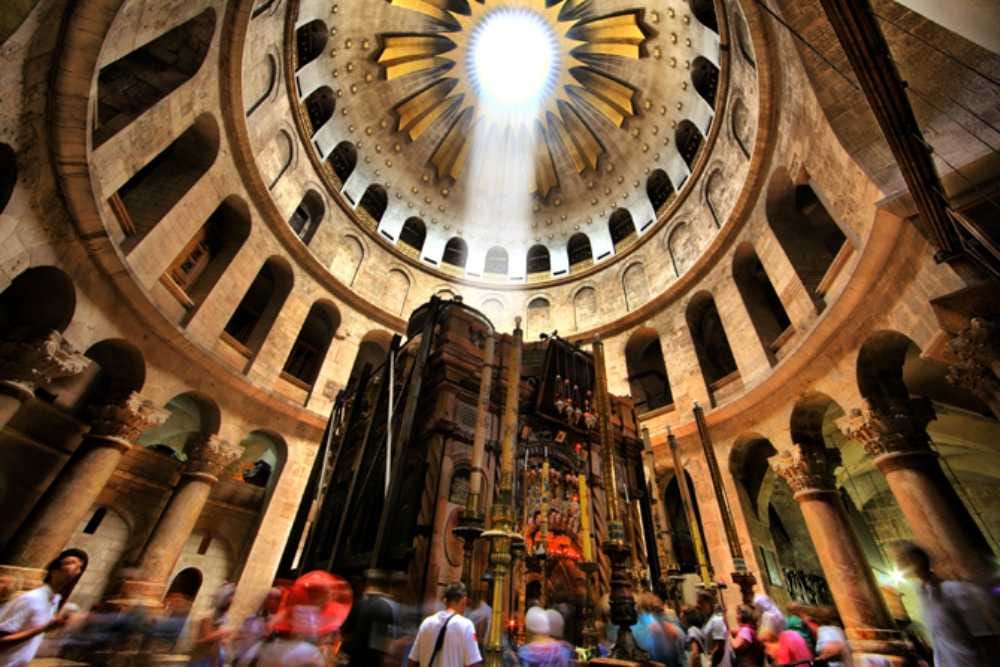
“According to Eusebius, Hadrian built a temple dedicated to the Roman goddess Venus to bury the cave in which Jesus had been buried. The Orthodox Church celebrates the Dedication of the Church of the Holy Sepulchre on September 26 (Gregorian), the same date as the ancient Roman festival of Venus.”
Melchizedek was the king of Shalem also known as Shalim. Shalim is a god in the Canaanite religion pantheon, mentioned in inscriptions found in Ugarit (Ras Shamra) in Syria. William F. Albright identified Shalim as the god of dusk, and Shahar as Goddess and sometimes known as god of the dawn. Shalim is also identified as the deity representing Venus or the “Evening Star”, and Shahar, the “Morning Star”.His name derives from the triconsonantal Semitic root S-L-M. Many scholars believe that the name of Shalim is preserved in the name of the city Jerusalem and both Shalim and Shahar were the patrons of Shalim.
This tells us that Melchizedek was the high priest of the most high God Shalim which is Venus yet when we look further back we see that Shalim and Shahar were indeed deities of Venus because they had been birthed from Venus herself whom we know to be Inanna, Ishtar, Aphrodite, Astarte, Asherah, Mary Magdalene, Mother Mary etc So in truth, Jerusalem is the city of Venus.
We call the planet Venus the morning star when it appears in the east at sunrise, and the evening star when it appears in the west at sunset, although the ancients called it Hesperus in the evening and Phosphorus, or Lucifer, in the morning. Because of the distances of the respective orbits of Venus and the Earth from the Sun, Venus is never visible more than three hours before sunrise nor three hours after sunset, and it may also surprise you that Venus can be seen in broad daylight, provided you know where, and when, to look after reference to an almanac.-Masonic Library. . . . .After Jesus was born in Bethlehem in Judea, during the time of King Herod, Magi from the east arrived in Jerusalem, asking, “Where is the One who has been born King of the Jews? We saw His star in the east and have come to worship Him.”-Matthew 2:2
The study of Phoenician gods revealed three goddesses to be different aspects of the planet Venus. A similar trilogy exists in the Norse pantheon, but with different names. It is believed that the Phoenicians, or Canaanites carried their beliefs with them when working on the Temple for Solomon and may have affected its ultimate design.
It is said that the first known name for the city of Jerusalem was Urushalim, “Uru’ founded by “Shalem”, the name of the Canaanite god of Venus in its evening setting, but Solomon’s Temple was facing in the opposite direction, towards Venus rising in its role as morning star. We can be certain that King Solomon’s Temple was built by Canaanites who were known to worship Venus, also we can understand that Solomon had no tradition of his own to give him the knowledge of how to build a temple that was properly constructed to interface with the heavens. However it is perplexing that these Venus worshipping Phoenicians were allowed to build the house of God.
Biblical scholars have noted from passages such as I Kings 11.5 that Venus was worshipped by Solomon in her special form as the deity of the Phoenicians and he fell out of favour with God. The official worship of Venus as Astarte, the Queen of Heaven continued in the Kingdom of Judah until circa 600 BCE.
Moses created Princes of the Tabernacle and the initiations took place when the Pentagram, or blazing star was to be seen in the east. A blazing star that is referred to as a Pentagram can only be a reference to Venus which had long been associated with the pentagram because of the planet’s apparent movement around the sun when observed from Earth. It is suggested that when the Romans destroyed Jerusalem and the Temple in year 70 of the Christian Era, a number of the Princes of the Tabernacle managed to escape to locations across Europe. It was from these families that the men came, who went on to found the Knights Templar.-Masonic Library
Venus is represented by the pentagram, hexagram, heptagram and octagram. For a time, a pentagram was the official seal of the city of Jerusalem and it was also the symbol of the Pythagoreans.
In later times, it was used by medieval Christians to symbolize the five wounds of Christ, and figured in the heavily symbolic Arthurian romances. In medieval times, the pentagram represented the proportions of the human body.
In alchemical texts, the four elements (in Latin)- flatus, ignus, aqua, terra, superseded by light, or divine energy- illustrated the process of creation, and the biblical motto Fiat Lux, or, “let there be light.” Venus and the pentagram is the symbol of the Light Bringer, the Morning Star who is also known as Lucifer in Latin and Phosphorus in Greek.
This Venus, this Morning Star, is the same star the Jesus called himself and it is through Venus that all of the elements of Jerusalem, David and Melchizedek are connected. The star that rose out of the House of Jacob is both David and Jesus and that star is Venus and that scepter was passed on as the divine seed from the bloodlines of Jacob, through to David, through to Joseph and then to Jesus himself.
In many icons you will see Mother Mary associated with the star which symbolizes Venus. The church fathers were well aware that Mary manifested from her previous known names of Venus which grew out from ancient mesopotamia. Venus has always been the Queen of Heaven, Earth and the underworld and she has always been known as the mother of the sun, who is the dying and resurrected fertility god which is again, another connection with the original name of Bethlehem.
She is Venus herself who produces the messenger of light who comes to Earth to bring the Christ Logos which is the divine Word. As the Mother of the Mysteries, it is through her son that the world becomes enlightened should they choose to follow his Way which leads straight back to her, which is the soul.
By Helen Demetriou, taken from
 Grand Temple of Horus Behdety