
The Timeless Kabiri (1)
FROM the very day when the first mystic found the means of communication between this world and the worlds of the invisible host, between the sphere of matter and that of pure spirit, he concluded that to abandon this mysterious science to the profanation of the rabble was to lose it.
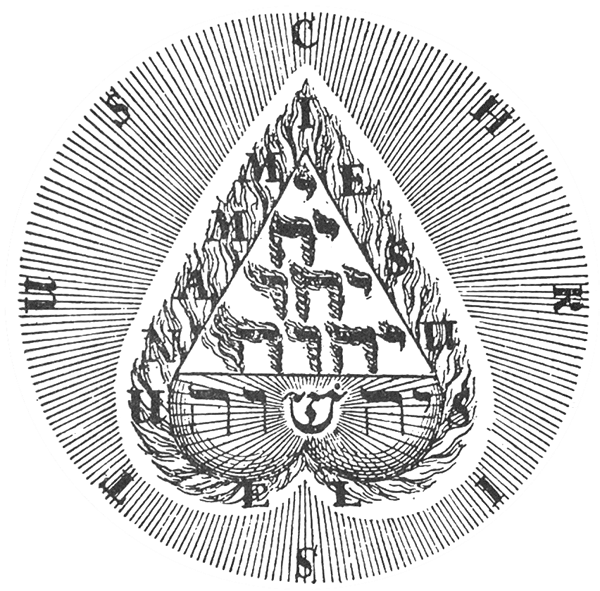
The Kabiri or the Kabirim [the name is Phoenician] were Deities and very mysterious gods with the ancient nations, including the Israelites, and were held in the highest veneration at Thebes, in Lemnos, Phrygia, Macedonia, and especially at Samothrace. They were mystery gods, no profane having the right to name or speak of them. Herodotus makes of them Fire-gods and points to Vulcan as their father. The Kabiri presided over the Mysteries, and their real number has never been revealed, their occult meaning being very sacred.
The Kabiri were also Assyrian gods. In Hebrew the name means “the mighty ones,” Gibborim. In Samothrace, an island famous and renowned for its Mysteries all over the world — perhaps the oldest ever established in our present race — they were the Samothraces. The latter are considered identical with the Kabiri, Dioscuri and Corybantes. The names of the Samothraces were mystical, denoting Pluto, Ceres or Proserpine, Bacchus and Æsculapius, or Hermes. At one time all the deities connected with fire, whether they were divine, infernal or volcanic, were called Kabirian. With the Christians, however, they are now devils, although the modern Archangels are the direct transformation of these same Kabiri.
Those who know anything of the Samothracian mysteries will remember that the generic name of the Kabiri was the “Holy Fires,” which created on seven localities of the island of Electria (or Samothrace) the “Kabir born of the Holy Lemnos” (the island sacred to Vulcan). According to Pindar, this Kabir, whose name was Adamas, was, in the traditions of Lemnos, the type of the primitive man born from the bosom of the Earth. He was the archetype of the first males in the order of generation, and was one of the seven autochthonous ancestors or progenitors of mankind.
A Mystery, imparted to but very few initiates, was enacted once every seven years during the Mysteries, and the records of it are found self-imprinted on the leaves of the Thibetan sacred tree, the mysterious Kounboum, in the Lamasery of the holy adepts. In the shoreless ocean of space radiates the central, spiritual, and invisible sun. The universe is his body, spirit, and soul; and after this ideal model are framed all “things.” These three emanations are the three lives, the three degrees of the gnostic Pleroma, the three “Kabalistic Faces,” for theANCIENT of the ancient, the holy of the aged, the great En-Soph, “has a form and then he has no form.” The invisible “assumed a form when he called the universe into existence,” says the Sohar, the Book of Splendor. The first light is His Soul, the Infinite, Boundless, and Immortal breath; under the efflux of which the universe heaves its mighty bosom, infusing intelligent life throughout creation. The second emanation condenses cometary matter and produces form within the cosmic circle; sets the countless worlds floating in the electric space, and infuses the unintelligent, blind life-principle into every form. The third produces the whole universe of physical matter; and as it keeps gradually receding from the Central Divine Light its brightness wanes and it becomes DARKNESS and the BAD — pure matter, the “gross purgations of the celestial fire” of the Hermetists.
When the Central Invisible, the “highest and greatest Creative POWER,” saw the efforts of the divine Scintilla[Over-Soul], unwilling to be dragged lower down into the degradation of matter, to liberate itself, he permitted it to shoot out from itself a monad, over which, attached to it as by the finest thread, the Divine Scintilla had to watch during its ceaseless peregrinations from one form to another. Thus the monad was shot down into the first form of matter and became encased in a stone; then, in course of time, through the combined efforts ofliving fire and living water, both of which shone their reflection upon the stone, the monad crept out of its prison to sunlight as a lichen. From change to change it went higher and higher; the monad, with every new transformation borrowing more of the radiance of its parent, Scintilla (Soul), which approached it nearer at every transmigration. For “the First Cause had willed it to proceed in this order”; and destined it to creep on higher until the physical form became once more the Adam of dust, shaped in the image of the Adam Kadmon (Pitris).
Before undergoing its last earthly transformation, the external covering of the monad, from the moment of its conception as an embryo, passes in turn, once more, through the phases of the several kingdoms. In its fluidic prison it assumes a vague resemblance at various periods of the gestation to plant, reptile, bird, and animal, until it becomes a human embryo. At the birth of the future man, the monad, radiating with all the glory of its immortal parent [Dhyani-Buddha] which watches it from the seventh sphere, becomes senseless. It loses all recollection of the past, and returns to consciousness but gradually, when the instinct of childhood gives way to reason and intelligence. After the separation between the life-principle (astral spirit) and the body takes place, the liberated soul — Monad, exultingly rejoins the mother and father spirit [i.e., the Fire-Kabiri], the radiant Augoeides, and the two, merged into one, forever form, with a glory proportioned to the spiritual purity of the past earth-life, the Adam who has completed the circle of necessity, and is freed from the last vestige of his physical encasement. Henceforth, growing more and more radiant at each step of his upward progress, he mounts the shining path that ends at the point from which he started around the Grand Cycle.
If one studies comparative Theogony, it is easy to find that the secret of these “Fires” was taught in the Mysteries of every ancient people, pre-eminently in Samothrace. There is not the smallest doubt that the Kabiri, the most arcane of all the ancient deities, gods and men, great deities and Titans, are identical with the Kumaras and Rudras headed by Kartikeya [Mars, personifying the powers of the LOGOS] — a Kumara also. This is quite evident even exoterically; and these Hindu deities were, like the Kabiri, the personified sacred Fires of the most occult powers of Nature. The several branches of the Aryan Race, the Asiatic and the European, the Hindu and the Greek, did their best to conceal their true nature, if not their importance. As in the case of the Kumaras, the number of the Kabiri is uncertain. Some say that they were three or four only; others say seven. Thus, while in Samothrace and the oldest Egyptian temples they were the great Cosmic Gods (the seven and the forty-nineSacred Fires), in the Grecian fanes their rites became mostly phallic, therefore to the profane, obscene. In the latter case they were three and four, or seven — the male and female principles — (the crux ansata), this division showing why some classical writers held that they were only 3, while others named 4. And these were, the Kabiri Axieros (in his female aspect, Demeter); Axio-Kersa (Persephone); Axiokersos (Pluto or Hades); and Kadmos or Kadmilos (Hermes — not the ithyphallic Hermes mentioned by Herodotus … but “he of the sacred legend,” explained only during the Samothracian mysteries). They may very well stand for the alter-egos of the four Kumaras, Sanat-Kumara, Sananda, Sanaka, and Sanatana. The former deities, whose reputed father was Vulcan, were often confounded with the Dioscuri, Corybantes, Anaces, etc., just as the Kumara, whose reputed father is Brahmâ (or rather, the “Flame of his Wrath”) … were confounded with the Asuras, the Rudras, and the Pitris, for the simple reason that they are all one — i.e., correlative Forces and Fires.
The Kabirim, the “mighty ones,” are identical with our primeval Dhyan-Chohans, with the incorporeal and corporeal Pitris, and with all the rulers and instructors of the primeval races, which are referred to as the Gods and Kings of the divine Dynasties. It matters little whether it is Isis, or Ceres — the “Kabiria” — or again the Kabiri. Every nation has either the seven and ten Rishi-Manus and Prajapatis; the seven and ten Ki-y; or ten and seven Amshaspends (six exoterically, if Ormazd, their chief and Logos, is excluded); ten and seven Chaldean Anedots, ten and seven Sephiroth, etc., etc. One and all have been derived from the primitive Dhyan-Chohans of the Esoteric doctrine, or the “Builders” of the Stanzas. From Manu, Thot-Hermes, Oannes Dagon, and Edris-Enoch, down to Plato and Panadores, all tell us of seven divine Dynasties, of seven Lemurian and seven Atlantean divisions of the earth; of the seven primitive and dual gods who descend from their celestial abode and reign on Earth, teaching mankind Astronomy, Architecture, and all the other sciences that have come down to us.
These Beings appear first as “gods” and Creators; then they merge in nascent man, to finally emerge as “divine-Kings and Rulers.” But this fact has been gradually forgotten. As Bosuage shows, the Egyptians themselves confessed that science flourished in their country only since Isis-Osiris, whom they continue to adore as gods, “though they had become Princes in human form.” And he adds of Osiris-Isis (the divine androgyne): “It is said that this Prince (Isis-Osiris) built cities in Egypt, stopped the overflowing of the Nile; invented agriculture, the use of the vine, music, astronomy, and geometry.”
It is the Kabiri who are credited with having revealed, by producing corn or wheat, the great boon of agriculture. What Isis-Osiris, the once living Kabiria, has done in Egypt, that Ceres is said to have done in Sicily; they all belong to one class. To them, the Kabiri or Titans, is ascribed the invention of letters (theDevanagari, or the alphabet and language of the gods), of laws and legislature, of architecture, as of the various modes of magic, so-called; and of the medical use of plants. Hermes, Orpheus, Cadmus, Asclepius, all those demi-gods and heroes, to whom is ascribed the revelation of sciences to men, and in whom Bryant, Faber, Bishop Cumberland, and so many other Christian writers, too zealous for the plain truth, would force posterity to see only pagan copies of one and sole prototype, named Noah — are all generic names.
As to the Jewish Noah, no Occultist would ever think of dispossessing him of his prerogatives, if he is claimed to be an Atlantean; for this would simply show that the Israelites repeated the story of Vaivasvata-Manu, Xisuthrus, and so many others, and that they only changed the name, to do which they had the same right as any other nation or tribe. What we object to is the literal acceptation of Biblical chronology, as it is absurd, and in accord with neither geological data nor reason. Moreover, if Noah was an Atlantean, then he was a Titan, a giant, as Faber shows; and if a giant, then why is he not shown as such in Genesis? The Titans and Kabirs have been invariably made out by the theologians and some pious symbologists as indissolubly connected with the grotesque personage called devil, and every proof to the contrary has been hitherto as invariably rejected and ignored; therefore, the Occultist must neglect nothing which may tend to defeat this conspiracy of slander.
Neither the Chaldean nor the Biblical deluge (the stories of the Babylonian Xisuthrus and Noah) is based on the universal or even on the Atlantean deluges, recorded in the Indian allegory of Vaivasvata-Manu. They are all the exoteric allegories based on the esoteric mysteries of Samothrace. If the older Chaldees knew the esoteric truth of Samothrace in the Puranic legends, the other nations were aware only of the Samothracian mystery, and allegorized it. They adapted it to their astronomical and anthropological, or rather phallic, notions. Samothrace is known historically to have been famous in antiquity for a deluge, which submerged the country and reached the top of the highest mountains; an event which happened before the age of the Argonauts. It was overflowed very suddenly by the waters of the Euxine, regarded up to that time as a lake. If, while coupling with this the fact that Samothrace was colonized by the Phoenicians, and before them by the mysterious Pelasgians who came from the East, one remembers also the identity of the mystery gods of the Phoenicians, Chaldeans, and Israelites, it will be easy to discover whence came also the confused account of the Noachian deluge.
Thus it is very important to prevent fanatics from monopolising all the facts in history and legend, and from fathering their distortions of truth, history, and legend upon one man. Noah, is either a myth along with the others or one whose legend was built upon the Kabirian or Titanic tradition, as taught in Samothrace. He has, therefore, no claim to be monopolised by either Jew or Christian. If, as Faber tried to demonstrate at such cost of learning and research, Noah is an Atlantean, and a Titan, and his family are Kabiri or pious Titans, etc., then biblical chronology falls by its own weight, and along with it all the patriarchs — the antediluvian and pre-Atlantean Titans. As now discovered and proven, Cain is Mars, the god of power and generation. Tubal-Cain is a Kabir, “an instructor of every artificer in brass and iron”; or, if this will please better, he is one with Hephaestos or Vulcan — Vul-cain, the greatest god also with the later Egyptians, and the greatest Kabir. The god of time was Chium in Egypt, or Saturn, or Seth, and Chium is the same as Cain. Jabal is taken from the Kabiri — instructors in agriculture, “such as have cattle,” and Jubal is “the father of those who handle the harp,” he, or they who fabricated the harp for Kronos and the trident for Poseidon.
The history or “fables” about the mysterious Telchines, fables echoing each and all the archaic events of our esoteric teachings, furnish us with a key to the origin of Cain’s genealogy; they give the reason why the Roman Catholic Church identifies “the accursed blood” of Cain and Ham with Sorcery, and makes it responsible for the Deluge. Were not the Telchines, it is argued, the mysterious iron-workers of Rhodes; they who were the first to raise statues to the gods, furnish them with weapons, and men with magic arts? And is it not they who were destroyed by a deluge at the command of Zeus, as the Cainites were by that of Jehovah? The Telchines are simply the Kabiri and the Titans, in another form. They are the Atlanteans also. “Like Lemnos and Samothrace,” says Decharme, “Rhodes, the birthplace of the Telchines, is an island of volcanic formation.” The island of Rhodes emerged suddenly out of the seas, after having been previously engulfed by the Ocean, say the traditions. Like Samothrace it is connected in the memory of men with the Flood legends.
The Kabiri are in truth “the great, beneficent and powerful Gods,” as Cassius Hermone calls them. At Thebes, the Kabirim Kore and Demeter had a sanctuary, and at Memphis, the Kabiri had a temple so sacred that none, excepting the priests, were suffered to enter their holy precincts. During the Samothracian Mysteries, “after the distribution of pure Fire a new life began.” This was the “new birth” that is alluded to by Jesus in his nocturnal conversation with Nicodemus. “Initiated into the most blessed of all the Mysteries, being ourselves pure … we become just and holy with wisdom.” “He breathed on them and saith unto them, ‘Take of Holy Pneuma’.” And this simple act of will-power was sufficient to impart vaticination in its nobler and more perfect form if both the initiator and the initiated were worthy of it. To deride this gift, even in its present aspect, “as the corrupt offspring and lingering remains of an ignorant age of superstition, would be as unphilosophical as it is wrong,” as remarked by a 19th century minister. “To remove the veil which hides our vision from the future, has been attempted in all ages of the world.”
The fact that, astronomically, the Titans-Kabirim were also the generators and regulators of the seasons, and cosmically the great Volcanic Energies, the gods presiding over all the metals and terrestrial works, does not prevent them from being, in their original divine characters, the beneficent Entities who, symbolized in Prometheus, brought light to the world, and endowed humanity with intellect and reason. They are pre-eminently in every theogony, especially in the Hindu, the sacred Divine FIRES, 3, 7, or 49, according as the allegory demands it. They were universally worshipped, and their origin is lost in the night of time. Yet whether propitiated in Phrygia, Phoenicia, the Troad, Thrace, Egypt, Lemnos or Sicily, their cult was always connected with fire; their temples ever built in the most volcanic localities, and in exoteric worship they belonged to Chthonian Divinities. Therefore Christianity has made of them infernal gods. Nor must it be lost sight of that the Kabiri were of both sexes, as also terrestrial, celestial and kosmic. While in their later capacity of the Rulers of sidereal and terrestrial powers, a purely geological phenomenon was symbolized in the persons of those rulers, they were also, in the beginning of times, the rulers of mankind. When incarnated as Kings of the “divine Dynasties,” they gave the first impulse to civilizations, and directed the mind with which they had endued men to the invention and perfection of all the arts and sciences. Thus the Kabiri are said to have appeared as the benefactors of men, and as such they lived for ages in the memory of nations.
They had other names in the “sacred language,” known but to the hierophants and priests; and “it was not lawful to mention them.” We find them pronounced, albeit slightly disfigured, as known in that same sacred language — by the populations of Siam, Thibet, and India. And on the walls of the Cambodian Nagkon-Wat are to be found at this day several repetitions of the Kabirian gods of Samothrace. This may have escaped the notice of archaeologists, but upon stricter inspection they will be found there, as well as the reputed father of the Kabiri — Vulcan, with his bolts and implements, having near him a king with a sceptre in his hand, which is the counterpart of that of Cheronaea, or the “scepter of Agamemnon,” so-called, said to have been presented to him by the lame god of Lemnos. In another place we find Vulcan, recognizable by his hammer and pincers, but under the shape of a monkey, as usually represented by the Egyptians. It is easy to see that the excavators of Ellora, the builders of the old Pagodas, the architects of Copan and of the ruins of Central America, those of Nagkon-Wat, and those of the Egyptian remains were, if not of the same race, at least of the same religion — the one taught in the oldest Mysteries. And if, as sometimes thought, Nagkon-Wat is essentially a Buddhist temple, how comes it to have on its walls basso relievos of completely an Assyrian character and Kabirian gods which, though universally worshipped as the most ancient of the Asiatic mystery-gods, had already been abandoned 200 years B.C., and the Samothracian mysteries themselves completely altered?
Source: THEOSOPHY, Vol. 52, No. 2, Dec., 1963 (pp. 43-50)









 Grand Temple of Horus Behdety