
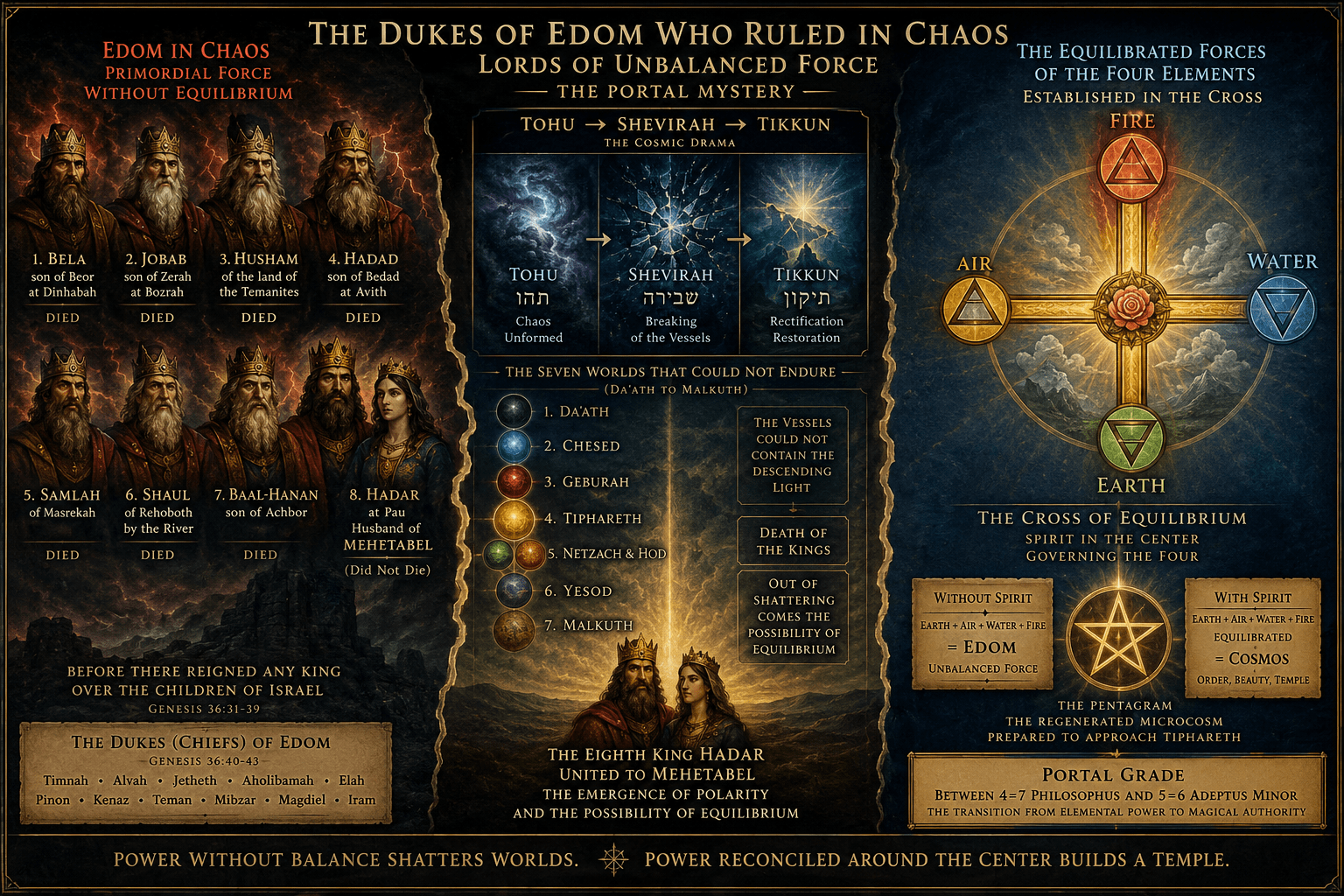
In the Golden Dawn Portal Grade, the phrase “The Dukes of Edom ruled in Chaos, Lords of unbalanced force” refers to a very old Qabalistic doctrine: before the ordered Tree of Life could exist, primordial configurations of force arose that could not maintain equilibrium. They are represented by the Kings of Edom of Genesis 36 and, in later Hermetic terminology, by the “Dukes of Edom.” The Portal ritual explicitly contrasts them with the equated forces of the Four Elements and then establishes the Cross as the symbol of restored equilibrium. (Daniel Tarr)
The Biblical Kings of Edom
Genesis 36:31 makes the enigmatic statement that these were the kings who ruled Edom “before there reigned any king over the children of Israel.” It then gives eight rulers:
- Bela ben Beor — king at Dinhabah
- Jobab ben Zerah — of Bozrah
- Husham — of the land of the Temanites
- Hadad ben Bedad — king at Avith
- Samlah — of Masrekah
- Shaul — of Rehoboth by the River
- Baal-Hanan ben Achbor
- Hadar/Hadad — king at Pau; husband of Mehetabel
The text repeatedly says that each of the first seven kings dies and is replaced. The eighth, Hadar, is different: Genesis introduces his wife, Mehetabel, and does not conclude his entry by saying that he died. (Bible Gateway)
That small biblical peculiarity becomes enormously important in Qabalah.
Why are they said to have “ruled in Chaos”?
In the Zoharic material translated by S. L. MacGregor Mathers in The Kabbalah Unveiled, the Edomite kings are interpreted cosmologically. Before the Divine configuration had been established “in the equilibrium of balance,” primordial kings or worlds arose, but they could not endure. Mathers explicitly connects Genesis 36 with these earlier worlds of unbalanced force. (Internet Sacred Text Archive)
This is the background of the Portal formula.
Chaos here is not merely disorder in the everyday sense. It corresponds to the Qabalistic idea of Tohu — תהו, the primordial condition in which tremendous Divine forces existed without sufficient relationship, mediation, or equilibrium.
The forces themselves are not intrinsically evil.
The problem is that they are unbalanced.
Severity without Mercy becomes destruction.
Mercy without Severity becomes uncontrolled expansion.
Fire without Water consumes.
Water without Fire stagnates.
Expansion without limitation becomes dissolution.
Limitation without expansion becomes sterility.
Thus the Edomite Kings represent powers that are enormous, even divine in origin, but which cannot sustain a universe because they have not yet learned relationship.
This is why their reign ends in death.
The Breaking of the Vessels
Later Lurianic Qabalah gives this idea its famous formulation as Shevirat ha-Kelim — שבירת הכלים, the Breaking of the Vessels.
The primordial vessels receive an intensity of Divine Light that they cannot contain. They shatter. Their fragments descend, carrying sparks of Divine Light with them.
The Kings of Edom become symbolic representations of these shattered configurations.
In Lurianic teaching, the seven primordial kings are associated with the lower seven configurations extending from Da‘ath downward: Da‘ath, Chesed, Geburah, Tiphareth, Netzach-Hod considered together, Yesod, and Malkuth. They “die” because their vessels cannot maintain the descending Light. (Sefaria)
This gives us an important Qabalistic sequence:
Tohu → Shevirah → Tikkun
Chaos → Breaking → Restoration.
And that sequence is precisely what the Portal ceremony dramatizes.
Why is the eighth king different?
The eighth ruler, Hadar, is particularly significant.
Unlike the preceding kings, Scripture gives him a wife:
Mehetabel, daughter of Matred, daughter of Me-Zahab.
And Scripture does not immediately declare his death. (Bible Gateway)
Qabalistically, this becomes a symbol of an enormous transformation.
The earlier kings exist as isolated forces.
Hadar exists in relationship.
King and Queen.
Masculine and feminine.
Force and form.
Positive and negative.
Chokmah and Binah.
Mercy and Severity.
The presence of the feminine principle indicates the possibility of equilibrium through polarity.
Thus Hadar anticipates the corrected world — Olam ha-Tikkun, the World of Rectification.
The universe can now endure because force is no longer solitary.
It has found its counterpart.
But what about the actual “Dukes of Edom”?
Here we need to make a distinction that is often blurred in Golden Dawn language.
Genesis actually gives two groups.
First come the Kings of Edom in Genesis 36:31–39.
Then Genesis 36:40–43 lists the chiefs whom the King James Version calls the Dukes of Edom:
Timnah
Alvah
Jetheth
Aholibamah
Elah
Pinon
Kenaz
Teman
Mibzar
Magdiel
Iram
Modern translations generally render the Hebrew term alluph as “chief” or “clan leader” rather than “duke.” (Bible Gateway)
So strictly speaking, the biblical Kings and Dukes are two different lists.
But in Golden Dawn ritual language, “Dukes of Edom” becomes a more generalized title for the primordial powers of the Edomite condition—the Lords of Unbalanced Force.
The technical Qabalistic doctrine, however, is primarily derived from the Kings of Edom.
Why does the Portal Grade invoke them?
Now we reach the real initiatory significance.
The Portal is not merely another elemental grade.
The initiate has already passed through:
Zelator — Earth
Theoricus — Air
Practicus — Water
Philosophus — Fire.
But possessing the four elements does not mean that they have yet been integrated.
One can possess tremendous Earth, Air, Water and Fire forces and still remain internally divided.
That condition is Edom.
The Portal therefore opens with the warning:
“The Dukes of Edom ruled in Chaos, Lords of unbalanced force.”
And immediately afterward asks what stands upon the Altar.
The response is:
“The Symbol of the equated forces of the Four Elements.”
Then comes the command that the power of Edom be banished and the Cross established. (Wasabi Technologies)
That exchange summarizes almost the entire mystery of Portal.
The candidate has accumulated elemental power.
Now the candidate must become capable of equilibrating it.
The Four Elements must cease behaving like four competing kingdoms.
They must become the four arms of one Cross.
And into the center of that Cross must descend the Fifth Principle:
Spirit.
Thus:
Earth + Air + Water + Fire without Spirit = Edom.
But:
Earth + Air + Water + Fire equilibrated around Spirit = the Pentagram of the regenerated Microcosm.
That is why the Portal lies between 4=7 Philosophus and 5=6 Adeptus Minor.
Edom as an initiatory condition
There is an even deeper way of understanding this.
The Kings of Edom are not primarily entities somewhere “out there.”
They describe a condition that can exist within the magician.
Whenever one faculty attempts to become king over the whole personality, an Edomite kingdom arises.
Intellect without compassion becomes Edom.
Emotion without discrimination becomes Edom.
Will without wisdom becomes Edom.
Imagination without grounding becomes Edom.
Discipline without love becomes Edom.
Love without boundaries becomes Edom.
Spiritual aspiration without embodiment can also become Edom.
Every one of these possesses legitimate power.
What makes it Edomite is not the power itself.
It is power claiming sovereignty without equilibrium.
This is why Portal is such an important threshold.
The aspirant is being taught that the problem is no longer simply ignorance.
The more advanced danger is unbalanced attainment.
A powerful magician who is internally divided can be more dangerous—to themselves and others—than an inexperienced magician.
Portal therefore teaches:
Do not destroy the Elements.
Equilibrate them.
Do not eliminate Geburah.
Balance it with Chesed.
Do not extinguish Fire.
Give it Water.
Do not suppress intellect.
Reconcile it with intuition.
Do not annihilate personality.
Place it under the rulership of the Higher Genius.
Edom and the Qliphoth
There is also a relationship between the Edomite Kings and the later doctrine of the Qliphoth, the “shells” or “husks.”
In Mathers’ presentation, when the primordial vessels cannot sustain equilibrium, their broken remains become associated with the shells—the remnants of forces separated from their proper place in the Divine order. (Scribd)
This does not mean that the historical Edomite people should be identified with demons or evil. The mystical interpretation is symbolic and cosmological; it takes the biblical narrative and uses its kings as archetypes of primordial imbalance.
For Golden Dawn purposes, this distinction is important.
Edom is a metaphysical condition, not an ethnicity.
The Portal mystery in one formula
The entire teaching can therefore be condensed into a remarkable progression:
The Kings of Edom
↓
Unbalanced Force
↓
Tohu — Chaos
↓
Breaking of the Vessels
↓
Death of the Kings
↓
Emergence of complementary polarity
↓
Equilibrium
↓
Tikkun — Rectification
↓
The Four Elements balanced beneath Spirit
↓
The Pentagram
↓
Tiphareth
↓
The birth of the Adept.
And this is why the Portal ceremony does not merely say that Chaos existed.
It declares that Edom ruled in Chaos.
The great lesson is that force alone cannot create Cosmos.
Only force placed into right relationship can do so.
The Philosophus has learned Fire and completed the circuit of the four elemental Grades. The Portal initiate must now discover the secret that transforms elemental power into magical authority:
Equilibrium precedes true Adeptship.
The Dukes of Edom therefore stand at the threshold as a warning: Power without balance produces shattered worlds.
The Cross answers them:
Power reconciled around the Center produces a Temple. (Wasabi Technologies)
If you want, I can develop this next into a full Portal oral temple lecture: “The Dukes of Edom, the Kings Who Died, and the Mystery of Unbalanced Force,” incorporating Tohu, Shevirat ha-Kelim, the Qliphoth, Tikkun, the Four Elements, the Portal Cross, and the transition from 4=7 to 5=6.
Absolutely. For this Portal material, the bibliography should preserve the historical chain from Genesis → Zohar → Lurianic Kabbalah → Hermetic Qabalah → Golden Dawn Portal symbolism, while making clear where later occult interpretation goes beyond the biblical text.
Annotated Bibliography
The Dukes of Edom, the Kings Who Died, and the Mystery of Unbalanced Force
Primary Biblical and Kabbalistic Sources
The Holy Bible. Genesis 36:1–43. King James Version.
Genesis 36 is the indispensable starting point for the doctrine of the Kings and Dukes of Edom. Verses 31–39 enumerate the kings who ruled Edom “before there reigned any king over the children of Israel.” Seven successive rulers are explicitly said to die, while the account of the eighth ruler, Hadar, notably introduces his wife, Mehetabel, without concluding with a statement of his death. Verses 40–43 then give a separate list of the allufim of Edom, rendered “dukes” in the King James Version and more commonly “chiefs” or “clans” in modern translations. This distinction is essential: the mystical doctrine of primordial worlds is principally attached to the Kings of Edom, even though Golden Dawn ritual employs the expression “Dukes of Edom.” (Sefaria)
Recommended for: establishing the scriptural foundation; distinguishing Kings from Dukes; studying the exceptional position of Hadar and Mehetabel.
The Zohar. Especially the Sifra de-Tzeniuta (“Book of Concealed Mystery”) and the Idra Rabba (“Greater Holy Assembly”).
The Zoharic corpus provides the crucial transformation of Genesis 36 from genealogy into mystical cosmology. The Edomite kings become symbolic of primordial configurations that existed before the Divine forces had been properly arranged “in the equilibrium of balance.” These configurations could not endure. The Zohar thus supplies one of the major conceptual ancestors of the later doctrines of cosmic imbalance, destruction, and reconstruction. For a Portal student, this material explains why Edom becomes a symbol not merely of disorder but of force existing prior to stable equilibrium.
Recommended for: understanding the transition from biblical Edom to metaphysical Edom and the emergence of the doctrine of primordial, unsustainable worlds.
Mathers, S. L. MacGregor, trans. The Kabbalah Unveiled. London: George Redway, 1887.
Mathers’s translation of portions of the Zohar became one of the most influential conduits by which Zoharic symbolism entered nineteenth-century Hermetic Qabalah and subsequently the Golden Dawn. Particularly important is the section titled “Concerning the Edomite Kings.” Here the kings are explicitly associated with primordial formations existing before the establishment of equilibrium. Mathers’s terminology—especially his repeated emphasis upon the “equilibrium of balance”—strongly anticipates the language and symbolism of the Golden Dawn Portal Grade. (Universal Co-Masonry)
Although modern scholarship and translations should be consulted alongside Mathers, this work is indispensable for understanding what the founders and early Adepts of the Golden Dawn themselves were likely reading.
Recommended for: direct study of the intellectual bridge between Jewish Kabbalistic texts and Golden Dawn Hermetic Qabalah.
Lurianic Kabbalah: Tohu, Shevirah, and Tikkun
Vital, Hayyim. Etz Hayyim [The Tree of Life]. Compiled from the teachings of Isaac Luria. Various editions.
Hayyim Vital’s writings are the principal literary repository of the teachings attributed to Rabbi Isaac Luria, the Ari. Within the Lurianic system, the problem suggested by the Edomite Kings becomes part of a vast cosmological drama involving Tzimtzum (divine contraction), the emergence of primordial configurations, Shevirat ha-Kelim (the Breaking of the Vessels), the scattering of divine sparks, and Tikkun (rectification or restoration).
This source is especially valuable for advanced Portal work because it demonstrates that the “death of the kings” is not simply a story of evil being destroyed. Rather, it symbolizes the inability of isolated vessels to contain an overwhelming influx of Divine Light. The corrective process involves restructuring, relationship, polarity, and integration.
Recommended for: advanced study of the metaphysics underlying “unbalanced force,” particularly the relationship between catastrophe and subsequent rectification.
Fine, Lawrence. Physician of the Soul, Healer of the Cosmos: Isaac Luria and His Kabbalistic Fellowship. Stanford, CA: Stanford University Press, 2003.
Fine provides one of the strongest modern scholarly treatments of Isaac Luria and the community through which Lurianic Kabbalah developed. Of particular importance for this subject are his discussions of Lurianic myth, cosmic fracture, the qelippot, human spiritual practice, and the restoration of the cosmos. Fine also emphasizes that Lurianic Kabbalah was not merely speculative metaphysics but a lived religious discipline in which human action participated in cosmic repair. (Google Books)
For the Portal initiate, this provides an important parallel: Tikkun is not merely something that happens to the universe; the practitioner participates in rectification. The Golden Dawn’s balancing of the Elements around Spirit may therefore profitably be compared—while not simply equated—with the broader Kabbalistic principle of restoration.
Recommended for: historically responsible treatment of Isaac Luria, Shevirah, Tikkun, qelippot, and the practical implications of cosmic rectification.
Scholem, Gershom. Major Trends in Jewish Mysticism. New York: Schocken Books, 1995. Originally published 1941.
Scholem’s classic study remains foundational for the modern academic understanding of Jewish mysticism. Especially relevant is the chapter “Isaac Luria and His School,” which places Lurianic doctrines within their historical and theological context and discusses such central concepts as Tzimtzum, cosmic catastrophe, and Tikkun. (Penguin Random House)
Scholem is especially useful for Golden Dawn students because he helps prevent the retroactive assumption that the fully developed Hermetic Tree of Life system was identical to historical Jewish Kabbalah. His work allows the initiate to appreciate both genuine continuity and later occult transformation.
Recommended for: historical background to Lurianic Kabbalah and a scholarly counterbalance to nineteenth-century occult interpretations.
Scholem, Gershom. Kabbalah. New York: Meridian/Penguin, 1978.
This broad reference work provides accessible but substantial treatments of the major historical currents, concepts, symbols, and personalities of Kabbalah. It is particularly useful for tracing the development of the sefirot, the Zohar, Lurianism, the qelippot, Tikkun, and the evolution of Kabbalistic cosmology. (Google Books)
For this Portal study, Scholem supplies the larger intellectual environment necessary to avoid treating the Kings of Edom, the Breaking of the Vessels, and the Qliphoth as interchangeable doctrines. They belong to related but historically developing layers of Kabbalistic speculation.
Recommended for: reference work and broader conceptual orientation.
Zoharic Scholarship
Tishby, Isaiah. The Wisdom of the Zohar: An Anthology of Texts. 3 vols. Translated by David Goldstein. Oxford: Littman Library of Jewish Civilization, 1989.
Tishby’s monumental anthology combines translated Zoharic passages with extensive scholarly introductions and commentary. It remains one of the most valuable English-language aids for understanding the symbolic universe of the Zohar. Its thematic organization makes it particularly useful when studying divine configurations, creation, judgment, the sefirotic world, evil, and the dynamic relationship between masculine and feminine principles. (JSTOR)
This work is especially helpful when exploring why the introduction of Mehetabel, the wife of the final Edomite king, became important to later Kabbalistic interpretation. The transition from isolated force toward relationship and polarity belongs to a much larger Zoharic concern with the proper conjunction and harmony of Divine powers.
Recommended for: serious Zohar study and clarification of the Jewish mystical background behind later Hermetic doctrines of equilibrium.
Giller, Pinchas. Reading the Zohar: The Sacred Text of Kabbalah. Oxford: Oxford University Press, 2000.
Giller examines the Zohar not merely as a repository of isolated mystical statements but as a complex sacred text possessing its own literary, ritual, symbolic, and interpretive world. (OUP Academic)
This perspective is useful for Portal students who encounter individual Zoharic statements through Mathers or other occult compilations. Giller helps restore those passages to their wider Jewish mystical setting and prevents the student from assuming that a Golden Dawn interpretation is necessarily identical to the original Zoharic intention.
Recommended for: learning how to approach Zoharic texts critically and contextually.
Hermetic Qabalah and the Golden Dawn
Regardie, Israel. The Golden Dawn: The Original Account of the Teachings, Rites, and Ceremonies of the Hermetic Order. Edited by John Michael Greer. Woodbury, MN: Llewellyn Publications, 2016.
This is one of the principal published repositories of Golden Dawn teachings and rituals. Regardie’s work preserves the initiatory framework within which the Edomite formula becomes especially important. The Portal ritual explicitly declares:
“The Dukes of Edom ruled in Chaos, Lords of unbalanced force,”
and immediately contrasts them with the symbol upon the Altar representing the equated forces of the Four Elements. The subsequent establishment of the Cross makes clear that the Portal interpretation of Edom concerns the transition from elemental disequilibrium to ordered integration. The current Llewellyn edition is edited by John Michael Greer and presents the influential material Regardie first published beginning in 1937. (Daniel Tarr)
Recommended for: the primary Golden Dawn application of the Edomite doctrine and its direct connection with Portal initiation.
Regardie, Israel. The Complete Golden Dawn System of Magic. Phoenix: Falcon Press, 1984.
This expansive collection preserves Golden Dawn teachings, ritual material, Qabalah, Tarot, astrology, alchemy, magical practice, and additional instructional material. The original edition appeared through Falcon Press in 1984. (Invisible House Society)
For the present subject, it should be used alongside The Golden Dawn to understand how the symbolism of equilibrium operates within the larger magical system: Pentagram, elemental grades, Spirit, the Cross, Tiphareth, and the gradual reconstruction of the magician as a balanced microcosm.
Recommended for: advanced cross-referencing of Portal symbolism with the wider Golden Dawn magical system.
Modern Academic Perspectives on Kabbalah
Idel, Moshe. Kabbalah: New Perspectives. New Haven: Yale University Press, 1988.
Idel’s influential study broadened academic investigation of Kabbalah beyond some of the historical models associated with Scholem. He emphasizes comparative, experiential, theurgical, and phenomenological dimensions of Jewish mysticism. (Yale University Press)
This work is valuable to the Portal student because it warns against reducing Kabbalah to one uniform theological system. Ideas such as divine emanation, mystical union, theurgy, cosmic restoration, and human participation in the Divine order developed through several streams. This nuance becomes particularly important when comparing Jewish Kabbalah to its later Hermetic adaptation.
Recommended for: advanced students wishing to distinguish historical Kabbalistic traditions from later Western esoteric synthesis.
Dan, Joseph. Kabbalah: A Very Short Introduction. Oxford: Oxford University Press, 2007.
Dan offers a concise scholarly introduction to the history and ideas of Kabbalah. His treatment helps situate the Zohar, Lurianic mysticism, the sefirotic system, and later developments within Jewish intellectual history. (OUP Academic)
For students encountering the subject primarily through the Golden Dawn, Dan provides a useful corrective orientation. It reinforces the fact that Hermetic Qabalah is an adaptation and transformation of Jewish Kabbalistic materials rather than a simple continuation of them.
Recommended for: introductory historical grounding before undertaking more difficult primary and scholarly works.
Suggested Portal Reading Sequence
For a Portal initiate studying the doctrine progressively, the following sequence is particularly effective:
First: Genesis 36:31–43
Establish exactly what the biblical text says about the Kings and Dukes.
Second: Mathers, The Kabbalah Unveiled, “Concerning the Edomite Kings”
Observe how the biblical material enters nineteenth-century Hermetic Qabalah.
Third: Regardie, The Golden Dawn, Portal Ritual
Examine how Edom becomes the ritual formula of “unbalanced force.”
Fourth: Scholem, Major Trends in Jewish Mysticism, “Isaac Luria and His School”
Study the historical development of cosmic fracture and restoration.
Fifth: Fine, Physician of the Soul, Healer of the Cosmos
Deepen the understanding of Lurianic Tikkun as an active religious and mystical undertaking.
Sixth: Tishby, The Wisdom of the Zohar
Return to the deeper Zoharic theological framework from which many of these concepts emerged.
Seventh: Idel and Giller
Use modern scholarship to distinguish the historical Jewish traditions from their later Hermetic transformations.
Portal Study Key
The bibliography as a whole supports a four-stage historical and initiatory development:
Genesis
The Kings of Edom who reign and die.
↓
Zohar
The Kings become primordial powers existing before stable equilibrium.
↓
Lurianic Kabbalah
Primordial imbalance develops into the great drama of Tohu → Shevirah → Tikkun: Chaos, Breaking, and Rectification.
↓
Golden Dawn Portal
The myth becomes an initiatory formula:
Dukes of Edom
= Lords of Unbalanced Force
versus
The Cross
= Equilibrated Forces of the Four Elements
and finally:
Spirit governing the Four Elements
= the regenerated Microcosm prepared to approach Tiphareth.
The most important interpretive caution is that these are successive layers of interpretation rather than one identical doctrine preserved unchanged through history. Genesis describes Edomite rulers and chiefs; medieval Kabbalah mystically reinterprets the kings; Lurianic Kabbalah develops a far-reaching cosmology of fracture and restoration; and the Golden Dawn adapts these ideas to an initiatory system centered upon elemental equilibrium.
For the Portal initiate, this distinction does not weaken the symbolism. It makes it considerably richer.
The historical doctrine tells us how the symbol developed.
The initiatory doctrine tells us why it was placed at the threshold of Adeptship.
This gives the blog a solid blend of primary sources, Golden Dawn authorities, and academic Kabbalah scholarship, rather than relying only on modern occult interpretations.