
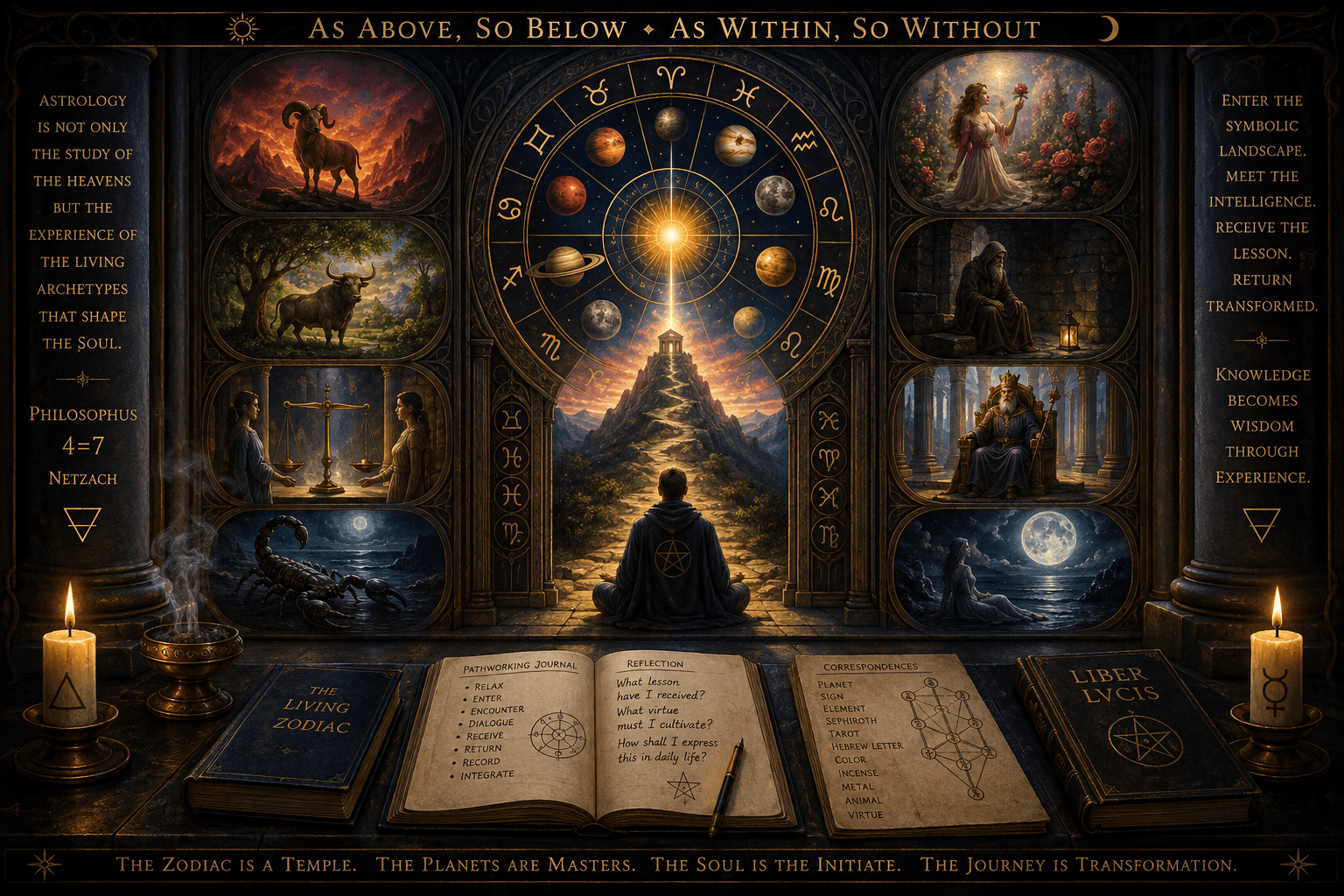
Primary Objective : To transform astrological knowledge into direct spiritual experience through disciplined contemplative practice.
Before we begin tonight’s work, I would like each of you to set aside, for just a little while, the charts, the tables of correspondences, and the lists of planetary rulerships that have occupied so much of your studies. They have served you well, and they remain indispensable. But they are only the beginning.
Throughout the earlier grades, you have learned to identify the symbols of astrology. You have memorized the qualities of the planets, the elements, the signs, the decans, and the many correspondences that bind astrology to the Tree of Life. That knowledge forms a necessary foundation. Yet no amount of intellectual study can replace direct spiritual experience.
The work of the Magician is to transform knowledge into wisdom.
Tonight, we will explore one of the most beautiful and transformative practices of the Western Mystery Tradition: astrological pathworking.
The heavens are more than a collection of distant celestial bodies. To the ancient philosophers, the Hermetic sages, the Rosicrucians, and the initiates of the Golden Dawn, the cosmos was alive. Every planet expressed a divine principle. Every zodiacal sign revealed a unique mode through which the One Life manifested itself. The stars were not merely objects to be observed—they were symbols of living realities, mirrors reflecting eternal truths within the soul of humanity.
When we practice astrological pathworking, we are not attempting to travel physically into the heavens. Rather, we enter the symbolic landscape of consciousness. We seek to encounter the archetypal intelligence represented by a planet or sign. We allow the imagination—not as fantasy, but as the sacred faculty of vision—to become a bridge between the conscious mind and the deeper levels of the psyche and spirit.
This distinction is important.
Fantasy is something we invent.
Pathworking is something we receive.
The initiate approaches these inner experiences with humility rather than expectation. We do not force visions to appear. We do not attempt to manufacture profound experiences. Instead, we create the proper conditions and allow the symbols to reveal themselves naturally. We become attentive observers of the inner world.
By the time one reaches the Grade of Philosophus, this manner of work becomes especially appropriate.
Philosophus is the Grade of Fire.
Fire is the element of transformation. It consumes what is crude and reveals what is essential. Fire gives warmth, illumination, and life, but only when governed wisely. So too must our knowledge be refined through experience. The facts we have accumulated must become living realities within consciousness.
There are, generally speaking, three stages through which astrological understanding develops.
The first is intellectual.
This is where every student begins. We memorize that Aries is cardinal fire, ruled by Mars. We learn that Taurus belongs to Venus, that Saturn governs Capricorn, that Mercury rules Gemini and Virgo. We study aspects, dignities, exaltations, and correspondences.
This level is necessary.
But it is not enough.
The second level is psychological.
Here the symbols begin to awaken within our own lives.
We notice Mars whenever we are called upon to defend someone or confront a difficult situation. We recognize Saturn whenever discipline, patience, or responsibility become necessary. Venus appears not merely as romance, but as our capacity for beauty, harmony, and appreciation.
The symbols cease being external descriptions.
They become mirrors.
Eventually, the initiate enters the third level.
This is the mystical level.
Here, the symbols are experienced as living archetypes. The initiate no longer contemplates merely the idea of courage but encounters the essence represented by Mars. No longer simply studies beauty but experiences the living current symbolized by Venus. Jupiter ceases to be only expansion or fortune and becomes the felt presence of generosity, wisdom, and noble authority.
Whether we understand these encounters psychologically, spiritually, or both is less important than the transformation they produce.
This is the purpose of pathworking.
Naturally, preparation is essential.
One should never rush into this practice.
The Temple—or whatever sacred space you have prepared—should be quiet, orderly, and free from distraction. A simple altar is sufficient. A white candle may be lit to symbolize the Divine Light. If desired, a planetary candle corresponding to the work may also be used, together with appropriate incense.
Begin, as always, by centering yourself.
Perform the Lesser Banishing Ritual of the Pentagram to establish equilibrium within the sphere of sensation. Offer an Adoration to the Lord of the Universe. Sit quietly until the ordinary chatter of the mind begins to settle.
Only then should the pathworking begin.
Most astrological pathworkings follow a remarkably similar structure.
First comes relaxation.
Allow the breath to become slow and steady. Let tension dissolve from the body. Withdraw awareness from external concerns and gather it inward.
Then comes visualization.
Imagine yourself standing before a doorway.
Upon that doorway appears the glyph of the sign or planet with which you intend to work. Do not rush forward. Pause. Recognize that you stand at the threshold of a sacred mystery. Inwardly ask permission to enter.
This simple act cultivates humility. We do not storm the Temple of Wisdom; we are invited into it.
When the time feels right, step through the doorway.
Now the true work begins.
Do not force the scenery. Do not struggle to invent details. Allow the environment to unfold gradually. Perhaps you find yourself upon a mountain. Perhaps within a forest, a temple, a desert, or beside a river. Whatever appears, observe it with quiet curiosity.
Sooner or later, most sincere pathworkings introduce some form of guide.
It may be a wise elder.
An angelic presence.
A symbolic animal.
A priest or priestess.
A king.
A child.
Occasionally no guide appears at all, and the landscape itself becomes the teacher.
Receive whatever comes without judgment.
If an opportunity arises, respectfully ask a question.
“What quality must I cultivate?”
“What obstacle hinders my growth?”
“What lesson belongs to this sign?”
Ask only one question at a time.
Then wait.
Silence often teaches more than words.
Eventually, the experience reaches its natural conclusion.
Offer gratitude to whatever intelligence or symbol has appeared. Retrace your steps through the doorway. Return your awareness gently to the room. Open your eyes without haste.
Then write.
Write immediately.
Memory fades far more quickly than we imagine.
Record the date, the planetary hour if known, the Moon’s phase, the symbols encountered, the dialogue, the emotions, the unexpected details, and any practical insights that emerged. Over months and years these journals become invaluable records of spiritual development.
Let us consider an example.
Imagine we are entering the current of Aries.
You find yourself standing before dawn. The eastern horizon glows with deep crimson light. A narrow mountain path rises before you toward a solitary temple perched upon the summit. As you climb, the landscape grows increasingly austere. There is nothing unnecessary here. Every stone, every gust of wind, every step demands purpose.
At the summit waits a great ram.
Its presence is calm rather than aggressive. Its eyes shine with unwavering certainty.
It asks a single question.
“What have you delayed because of fear?”
There is no accusation in its voice.
Only invitation.
Nearby burns a clear, unwavering flame. Within the fire stands a sword. It is not offered for violence. It is offered to cut away hesitation.
You receive it.
When you descend the mountain, the dawn has become full daylight.
Nothing in your external life has changed.
Yet inwardly something has shifted.
That is the work.
Now consider Taurus.
Instead of a mountain, you enter a broad green valley. The air is rich with the fragrance of spring. At the center stands an ancient oak whose roots disappear into immeasurable depths. Beneath its branches rests a magnificent white bull.
The bull does not challenge you.
It simply asks,
“What truly nourishes your soul?”
Notice that this question is not about possessions.
Nor comfort.
Nor pleasure.
It asks about nourishment.
Remain there as long as necessary.
Listen.
The lesson of Taurus often arrives in silence.
Or imagine entering the temple of Libra.
You walk into a vast marble hall filled with perfect stillness. At its center stands a golden balance. No one attends it. One scale bears your strengths; the other, your limitations. Neither outweighs the other. Both belong to the whole person.
A veiled figure appears—not to judge you, but to invite you into greater balance. She silently gestures for you to place one attachment upon the scales.
Observe what changes.
Such experiences often reveal truths that no textbook can adequately convey.
Planetary pathworkings proceed in much the same manner.
In a Venus meditation, you may find yourself walking through an exquisite rose garden where beauty surrounds you from every direction. Yet among hundreds of blossoms, one rose remains unopened. A luminous feminine presence asks gently,
“What beauty within yourself remains unopened?”
A Saturn pathworking may lead you instead to a mountain monastery where an elderly teacher offers no speeches, no praise, and no criticism. There is only unfinished work waiting patiently upon a stone bench. The lesson is discovered not through conversation but through disciplined labor.
A Jupiter meditation may open into a magnificent library whose shelves stretch beyond sight. Upon a throne sits a benevolent king who asks,
“What blessing have you overlooked?”
Notice that the questions are always simple.
The answers, however, may occupy a lifetime.
Now, a word of caution.
Not every image carries profound meaning.
Sometimes the imagination simply wanders.
Sometimes the subconscious rearranges memories into symbolic form.
This is perfectly natural.
The Magician therefore cultivates discernment.
Ask yourself after every experience three simple questions.
Did this meditation make me more humble?
Did it encourage greater virtue?
Did it awaken a deeper desire to serve?
If the answer is yes, then the work has likely borne good fruit.
If the experience merely inflates pride, feeds spiritual vanity, or encourages a sense of superiority, then it should be regarded with great caution.
The purpose of pathworking is transformation, not entertainment.
Its fruits should appear not only in meditation but in ordinary life.
After a Mars pathworking, practice courage.
After Venus, cultivate kindness.
After Saturn, complete a neglected responsibility.
After Mercury, communicate with greater honesty and precision.
After Jupiter, share wisdom generously.
After Moon work, spend time in reflection.
After Sun work, strive to embody integrity and noble leadership.
Without action, vision gradually fades.
Experience becomes memory rather than transformation.
For your work during the coming weeks, each of you will undertake a complete cycle through the zodiac. Dedicate one week to each sign. Enter its symbolic landscape, receive whatever instruction it offers, and faithfully record your experiences in your magical journal. At our Temple meetings, we shall compare observations—not to determine who is “correct,” but to discover how universal archetypes reveal themselves uniquely to each individual soul. You will likely find recurring themes alongside strikingly personal symbolism, and both are worthy of careful contemplation.
As you complete the cycle, you will notice a remarkable change. The zodiac will no longer appear as twelve abstract divisions upon an astrological chart. Aries will become a remembered ascent toward courage. Taurus will become a valley of quiet strength. Gemini a place of living dialogue. Cancer a sanctuary of memory. Leo a throne of radiant purpose. Virgo a sacred workshop of refinement. Libra a hall of equilibrium. Scorpio a chamber of transformation. Sagittarius a road toward distant horizons. Capricorn a mountain of disciplined ascent. Aquarius a temple of inspired vision. Pisces an ocean of compassionate surrender.
The signs will cease to be merely studied.
They will become inhabited.
This is the true aim of astrological pathworking. It is not the pursuit of extraordinary visions or psychic experiences, but the gradual refinement of consciousness. Through repeated encounters with these celestial archetypes, we begin to recognize that the zodiac is not only written across the heavens—it is inscribed within the soul itself.
The ancient Hermetic axiom reminds us, “As above, so below; as within, so without.” Through this sacred work, the macrocosm and the microcosm gradually come into harmony. We discover that the celestial temple we have sought among the stars has always existed within the sanctuary of our own being.
May your journeys through the living Zodiac deepen your wisdom, strengthen your character, and kindle ever more brightly the sacred Fire entrusted to the Magician, until every step upon the path reflects the Light of the One Divine Source.
For this lecture, I distinguish between sources that directly document Golden Dawn astral/astrological practice and sources that provide the older Hermetic, Qabalistic, astrological, and modern interpretive foundations behind the lecture.
Annotated Bibliography: Astrological Pathworking
Primary Golden Dawn and Hermetic Sources
- Regardie, Israel. The Golden Dawn: The Original Account of the Teachings, Rites, and Ceremonies of the Hermetic Order. 6th ed. St. Paul, MN: Llewellyn Publications, 1989.
This is the principal modern compendium for Golden Dawn ritual, symbolism, grade material, elemental work, Tarot, Qabalah, astrology, and astral techniques. It is particularly important for understanding why astrological pathworking cannot be isolated from the Order’s larger system of correspondences. For the Magician, Regardie provides the ritual and symbolic architecture through which zodiacal and planetary forces can be approached as components of an integrated magical universe.
- King, Francis, ed. Astral Projection, Ritual Magic, and Alchemy: Golden Dawn Material by S. L. MacGregor Mathers and Others. Rochester, VT: Destiny Books, 1987.
Especially relevant to the practical dimension of the lecture. The collection preserves Golden Dawn-related material concerning astral consciousness, magical imagination, visionary work, and related occult techniques. It helps place “pathworking” within the broader historical practice of skrying and astral vision rather than treating it merely as guided visualization.
- Mathers, S. L. MacGregor. The Kabbalah Unveiled. London: George Redway, 1887.
Mathers’s translation of portions of Knorr von Rosenroth’s Latin Kabbala Denudata was profoundly influential upon the Golden Dawn’s understanding of Qabalah. Although it is not a pathworking manual, it provides important historical background for the cosmological structure through which Golden Dawn practitioners understood spiritual worlds, emanation, divine names, and the relationship between higher and lower realities.
- Westcott, William Wynn. An Introduction to the Study of the Kabalah. London: J. M. Watkins, 1910.
Westcott, one of the Golden Dawn’s founders, offers a compact introduction to the Qabalistic worldview underlying much of the Order’s magical system. It is useful for Magician students because astrological pathworking within the Golden Dawn is not simply “astrology plus visualization”: planets, signs, Hebrew letters, Sephiroth, Tarot, and divine hierarchies exist within a deliberately interconnected symbolic structure.
Golden Dawn Correspondences and Practical Magic
- Crowley, Aleister. 777 and Other Qabalistic Writings of Aleister Crowley. York Beach, ME: Samuel Weiser, 1973.
Despite Crowley’s later development of a distinctly Thelemic system, the correspondence tables of 777 preserve and expand material substantially indebted to the Golden Dawn tradition. The tables are extremely useful when constructing pathworkings because they correlate planets and zodiacal signs with colors, divine names, Tarot, Hebrew letters, perfumes, magical images, and other symbolic categories. For students, however, it is important to distinguish Golden Dawn-derived material from Crowley’s subsequent Thelemic interpretations.
- Cicero, Chic, and Sandra Tabatha Cicero. Self-Initiation into the Golden Dawn Tradition. St. Paul, MN: Llewellyn Publications, 1995.
A modern systematic presentation of Golden Dawn practice particularly useful for understanding how ritual, visualization, meditation, symbolism, and grade work can function as an integrated curriculum. It provides practical context for preparing sacred space and cultivating the disciplined imaginative faculties required for pathworking.
- Cicero, Chic, and Sandra Tabatha Cicero. The Essential Golden Dawn: An Introduction to High Magic. St. Paul, MN: Llewellyn Publications, 2003.
A useful secondary introduction to Golden Dawn magical philosophy and practice. For the present lecture, its value lies in explaining how ritual, Qabalah, astrology, Tarot, and magical symbolism operate as interconnected components rather than independent subjects. It is particularly accessible for students transitioning from theoretical correspondence work toward practical magical application.
Astrology and the Western Esoteric Tradition
- Agrippa, Heinrich Cornelius. Three Books of Occult Philosophy. Translated by James Freake. Edited and annotated by Donald Tyson. St. Paul, MN: Llewellyn Publications, 1993.
Agrippa is indispensable for understanding the Renaissance magical worldview inherited by later ceremonial traditions. His treatment of planetary qualities, celestial correspondences, number, elemental philosophy, images, spirits, and the relationship between terrestrial and celestial realities provides an important historical foundation for the concept that planetary forces may be approached through carefully constructed networks of symbolism.
- Ficino, Marsilio. Three Books on Life. Edited and translated by Carol V. Kaske and John R. Clark. Binghamton, NY: Medieval & Renaissance Texts & Studies, 1989.
Ficino provides one of the most sophisticated Renaissance treatments of humanity’s relationship with celestial influences. Particularly valuable is De vita coelitus comparanda (“On Obtaining Life from the Heavens”), in which Ficino discusses music, imagery, plants, perfumes, colors, and contemplative practices in relation to planetary qualities. His work offers a major intellectual ancestor to later planetary magical practices.
- Cornford, Francis Macdonald, trans. Plato’s Cosmology: The Timaeus of Plato. Indianapolis: Hackett Publishing, 1997.
Plato’s Timaeus provides an important philosophical background for the Western conception of the cosmos as an ordered, ensouled whole rather than a collection of unrelated material objects. It supports the lecture’s broader metaphysical premise that human consciousness and celestial order can be contemplated as corresponding expressions within a unified cosmos.
Hermetic Foundations
- Copenhaver, Brian P., trans. Hermetica: The Greek Corpus Hermeticum and the Latin Asclepius in a New English Translation, with Notes and Introduction. Cambridge: Cambridge University Press, 1992.
One of the strongest scholarly translations of the philosophical Hermetica. The texts explore divine Mind, cosmic order, humanity as microcosm, spiritual rebirth, and the relationship between the human and celestial realms. This is an important corrective to overly simplified modern uses of “as above, so below”: the actual Hermetic worldview is considerably richer than the popular maxim suggests.
- Fowden, Garth. The Egyptian Hermes: A Historical Approach to the Late Pagan Mind. Princeton, NJ: Princeton University Press, 1986.
Fowden provides the historical context necessary for understanding Hermeticism as a late-antique religious-philosophical phenomenon. This scholarly source helps distinguish historical Hermetic thought from nineteenth- and twentieth-century occult interpretations of it, making it particularly valuable for an advanced Temple curriculum.
Tarot, Astrology, and the Paths
- Case, Paul Foster. The Tarot: A Key to the Wisdom of the Ages. Richmond, VA: Macoy Publishing, 1947.
Case, who was strongly influenced by Golden Dawn teachings before developing Builders of the Adytum, presents Tarot as a system of spiritual and psychological transformation. His discussions of Hebrew letters, astrological correspondences, meditation, and Tarot imagery are particularly relevant to zodiacal pathworking because the Golden Dawn’s zodiacal signs can also be approached through their corresponding Major Arcana Keys.
- Wang, Robert. The Qabalistic Tarot: A Textbook of Mystical Philosophy. York Beach, ME: Samuel Weiser, 1983.
An especially useful bridge between Golden Dawn Tarot, astrology, Qabalah, and the Tree of Life. Wang demonstrates how Tarot symbolism functions within the Golden Dawn’s Qabalistic framework. For pathworking students, it assists in understanding why a zodiacal journey may simultaneously involve a Hebrew letter, Tarot trump, elemental quality, planetary influence, and Tree-of-Life path.
- DuQuette, Lon Milo. Understanding Aleister Crowley’s Thoth Tarot. San Francisco: Weiser Books, 2003.
Although centered upon Crowley’s Thoth Tarot rather than strictly Golden Dawn Tarot, DuQuette clearly explains many of the astrological, Qabalistic, elemental, and zodiacal correspondences inherited from the Golden Dawn system. It is useful as a comparative secondary source, especially when students begin exploring how Golden Dawn correspondences evolved within later Western magical traditions.
Active Imagination and the Psychology of Pathworking
- Jung, C. G. The Archetypes and the Collective Unconscious. 2nd ed. Translated by R. F. C. Hull. Princeton, NJ: Princeton University Press, 1969.
Jung supplies an important psychological framework for understanding why symbolic encounters can possess tremendous subjective power without requiring the practitioner to decide immediately whether an encountered figure is an objectively independent spiritual intelligence. His concept of archetypes is particularly helpful when interpreting recurring kings, queens, animals, temples, mountains, oceans, guides, and celestial figures within pathworking.
- Jung, C. G. The Red Book: Liber Novus. Edited by Sonu Shamdasani. Translated by Mark Kyburz, John Peck, and Sonu Shamdasani. New York: W. W. Norton, 2009.
Jung’s extraordinary record of visionary encounters demonstrates sustained engagement with deliberately entered imaginal experience. It should not be treated as a Golden Dawn manual, but it provides a valuable comparative example of disciplined dialogue with interior figures and symbolic environments. It is particularly relevant to the lecture’s distinction between consciously manufacturing imagery and allowing an imaginal encounter to develop with a degree of autonomy.
Modern Studies of Western Esotericism
- Hanegraaff, Wouter J. Western Esotericism: A Guide for the Perplexed. London: Bloomsbury Academic, 2013.
A valuable scholarly orientation to the field of Western esotericism. Hanegraaff helps situate Hermeticism, Renaissance magic, occultism, and related currents within their proper historical contexts. For a Magician curriculum, this provides useful academic balance alongside practitioner literature.
- Goodrick-Clarke, Nicholas. The Western Esoteric Traditions: A Historical Introduction. Oxford: Oxford University Press, 2008.
A concise historical overview of Hermeticism, Renaissance magic, Rosicrucianism, occultism, and modern esoteric movements. This work helps students understand that Golden Dawn astrological practice emerged from centuries of intellectual and magical development rather than appearing as an isolated nineteenth-century system.
- Asprem, Egil. Arguing with Angels: Enochian Magic and Modern Occulture. Albany: State University of New York Press, 2012.
Although primarily concerned with Enochian magic, Asprem’s scholarly treatment of visionary magical practice and modern ceremonial occultism is useful for placing Golden Dawn approaches to spiritual perception within a larger historical framework. It also encourages critical reflection on how practitioners understand and interpret visionary experiences.
Recommended Core Reading for the 4=7 Student
For this particular Temple lecture, I would make Regardie, King, Cicero & Cicero, Agrippa, Ficino, Copenhaver, Wang, and Jung the principal reading cluster.
Together they establish four layers necessary for mature Magician work: the Golden Dawn ritual framework, the astrological and Hermetic cosmology, the Qabalistic/Tarot correspondence system, and a psychological framework for evaluating visionary experience.
One important refinement should also be made to the spoken lecture. The familiar formulation “As above, so below; as within, so without” should not be presented as a verbatim ancient Hermetic quotation. The first concept derives ultimately from the Emerald Tablet, while the expanded modern formulation is considerably later. For a formal 4=7 curriculum, I would present it as a Hermetic principle rather than quote it as though those exact words appeared in the ancient Corpus Hermeticum. That distinction makes the lecture historically stronger without diminishing its esoteric meaning.