
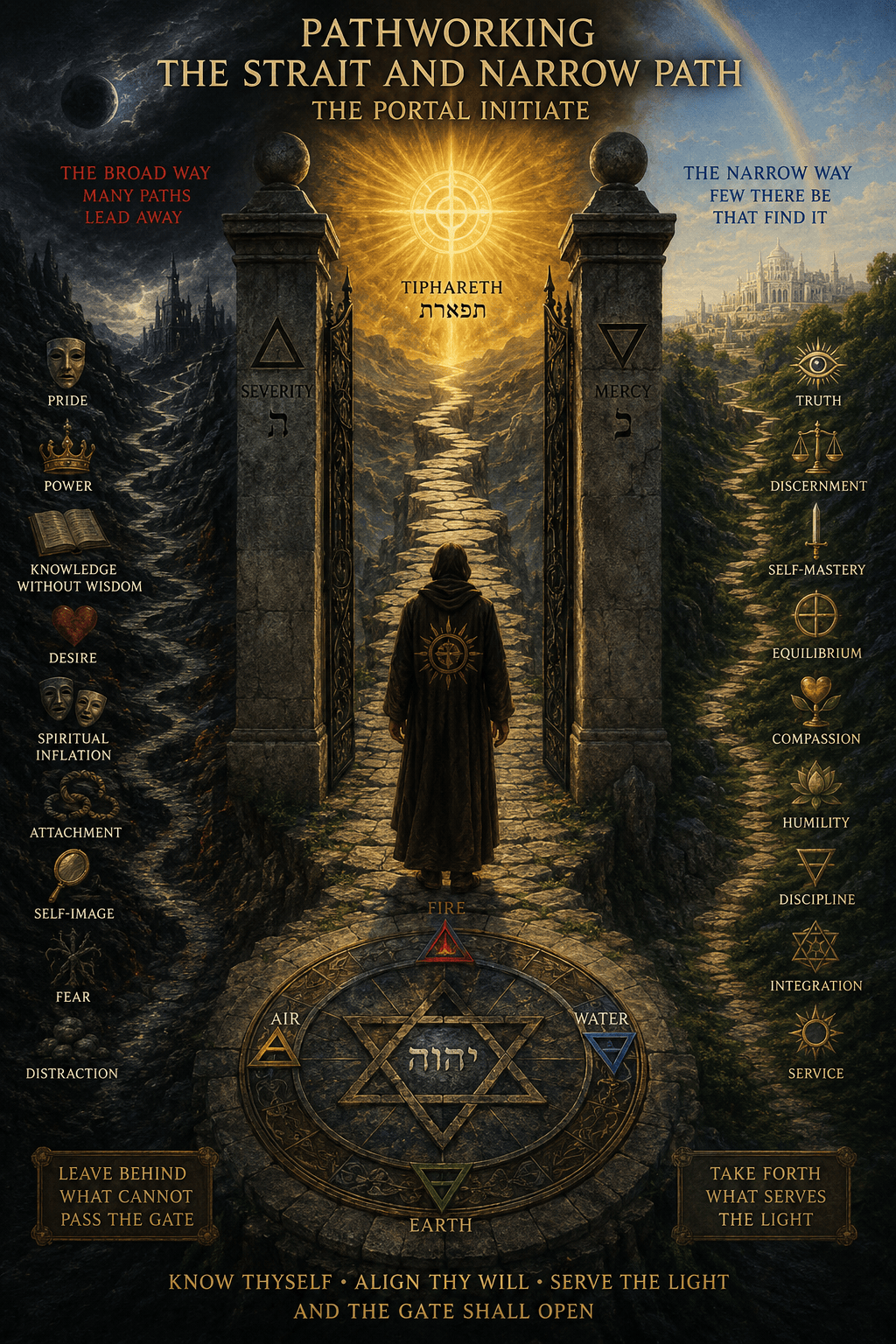
The Portal Initiate and the Way of Equilibrium
There comes a point upon the initiatory journey when the aspirant discovers that spiritual advancement is no longer primarily a matter of acquiring more information.
There are symbols enough.
There are correspondences enough.
There are rituals enough.
There are names of angels, Divine Names, Tarot Keys, planets, elements, Sephiroth, Paths, colors, weapons, gestures, and formulae enough to occupy the intellect for a lifetime.
Yet at the threshold of the Greater Mysteries, another question begins to make itself heard:
Can you walk the Path?
Not merely describe it.
Not merely diagram it.
Not merely lecture upon it.
Can you walk it?
This is the deeper challenge that confronts the Golden Dawn Portal initiate.
The Portal is appropriately understood as a threshold. The preliminary elemental grades have exposed the initiate successively to the mysteries of Earth, Air, Water, and Fire. Yet the completion of the elemental curriculum does not automatically produce equilibrium. The elements may have been encountered individually while remaining poorly integrated within the personality.
One may possess intellectual brilliance and little compassion.
One may possess great emotional sensitivity and little discipline.
One may possess tremendous will while lacking discernment.
One may possess practicality but remain spiritually asleep.
Thus there arises a further work: the reconciliation of the powers.
The candidate approaching Tiphareth must learn to cease being governed by whichever inner force happens to shout most loudly.
The work becomes one of alignment.
This is where the ancient image of the strait and narrow path becomes particularly illuminating.
The Strait Gate
The expression commonly heard today as “the straight and narrow” derives from the teaching attributed to Jesus in the Sermon on the Mount:
“Enter ye in at the strait gate… because strait is the gate, and narrow is the way, which leadeth unto life.”
The King James wording is significant. The original phrase is not simply “straight,” meaning undeviating. It is strait—an older English term meaning narrow, constricted, rigorous, or difficult. Modern translations accordingly speak of the “narrow gate” and the difficult road leading to life. (Bible Gateway)
Yet the later popular expression “straight and narrow” has unintentionally created an additional piece of symbolism useful to the esotericist.
For the initiatory Path must indeed become both strait and straight.
It is strait because unnecessary possibilities are progressively removed.
It is straight because the aspirant increasingly directs consciousness toward the Center.
The beginner believes spiritual freedom means being able to pursue every possibility.
The initiate gradually discovers another kind of freedom.
It is the freedom that appears when one finally knows where one is going.
The Path narrows because consciousness becomes concentrated.
Distraction diminishes.
Contradiction is exposed.
The personality is asked to become coherent.
The aspirant can no longer indefinitely maintain one set of spiritual ideals in the Temple and an entirely different set of motives in ordinary life.
The Gate becomes narrow because eventually only the authentic self can pass through it.
The Portal as an Inner Threshold
The Portal Grade occupies an unusual position within Golden Dawn symbolism. It stands between the elemental Outer Order grades and the Adeptus Minor mysteries associated with Tiphareth.
Modern Golden Dawn instructional traditions explicitly preserve Portal as the culminating stage of the preliminary grade sequence, preceding entry into the Adept work. Chic and Sandra Tabatha Cicero’s curriculum, for example, carries the student through the grade structure from Neophyte through Portal and explicitly connects the process with the development of the Higher Self. (Llewellyn)
Portal therefore represents more than another collection of correspondences.
It is a condition of transition.
The initiate stands between worlds.
Behind lies the consciousness formed largely through elemental experience.
Ahead lies the solar mystery of Tiphareth.
Between them stands the Gate.
And the Gate is narrow.
The symbolism is profound because the personality would prefer to enter the Greater Mysteries carrying everything with it: every ambition, wound, title, grievance, fantasy, vanity, fear, attachment, and carefully cultivated self-image.
But spiritual initiation continually asks:
What can cross the threshold?
The answer is not everything.
Some things must be integrated.
Some must be transformed.
Some must be surrendered entirely.
Pathworking as Conscious Participation
Within modern Hermetic Qabalistic practice, pathworking provides a method of entering symbolic structures through trained imagination, meditation, ritual consciousness, and contemplation.
Regardie’s A Garden of Pomegranates, particularly in editions expanded by Chic and Sandra Tabatha Cicero, presents the Tree of Life not simply as a philosophical diagram but as a practical system that can be engaged through meditations, exercises, visualizations, and pathworkings associated with its Sephiroth and Paths. (Llewellyn)
This distinction is essential.
A Path upon the Tree of Life is not fully understood merely because one has memorized its number, Hebrew letter, Tarot attribution, planetary or zodiacal correspondence, color scale, and associated symbols.
These are the map.
Pathworking concerns the journey.
The magician deliberately enters the symbolic world represented by the map and allows its archetypal structure to become an interior experience.
In this sense, pathworking the Strait and Narrow Path does not necessarily mean imagining one particular historical Golden Dawn path labeled by that name.
Rather, it means employing the discipline of pathworking to contemplate the central mystery expressed by the phrase:
What within me leads toward the Center, and what leads away from it?
That question belongs profoundly to Portal.
The Tree and the Center
The Qabalistic Tree of Life presents consciousness not as a random collection of experiences but as a patterned relationship of powers.
Severity and Mercy.
Force and Form.
Expansion and Restriction.
Intellect and Emotion.
Desire and Discipline.
Manifestation and Spirit.
The objective of initiation is not simply to choose one side and condemn the other.
The deeper work is equilibrium.
This principle becomes especially visible in the symbolism of the Middle Pillar.
The Middle Pillar represents a central axis upon the Tree, and modern Golden Dawn-derived practice has made this symbolism particularly influential through the ritual commonly called the Middle Pillar Exercise. Regardie’s treatment of the practice emphasizes the balancing relationship between magical development, consciousness, and the interior structure symbolized by the Tree of Life. (Llewellyn)
For the Portal initiate, this provides an especially fruitful meditation.
The Strait and Narrow Path may be contemplated as the path of centering between extremes.
Not weakness between two strengths.
Not indecision between two choices.
Not compromise merely for the sake of avoiding conflict.
True equilibrium is something more demanding.,
It is the ability to contain opposing powers without becoming possessed by either.
This is why the middle way is often more difficult than either extreme.
Anger is easy.
Passive avoidance is easy.
Justice governed by disciplined strength is difficult.
Self-indulgence is easy.
Harsh repression is easy.
Conscious self-mastery is difficult.
Blind belief is easy.
Cynicism is easy.
Discerning faith is difficult.
The broad roads multiply endlessly because imbalance can take innumerable forms.
The narrow Path remains narrow because the Center is precise.
The Temptation of the Side Paths
Every serious spiritual tradition eventually confronts the danger of spiritual inflation.
The aspirant begins seeking wisdom and somewhere along the journey discovers power.
Perhaps there comes unusual intuition.
Perhaps visions become vivid.
Perhaps ritual begins producing strong psychological or spiritual experiences.
Perhaps others begin looking to the practitioner as an authority.
Perhaps titles accumulate.
Perhaps the magician becomes capable of influencing atmosphere, symbol, imagination, or human perception.
At this point, the pathworking becomes dangerous in an entirely different way.
The challenge is no longer whether the aspirant believes in the Path.
The question becomes whether the aspirant will continue walking it when opportunities arise to wander away from it.
The broad road of occultism is filled with fascinating detours.
Power without wisdom.
Knowledge without humility.
Vision without discrimination.
Charisma without ethics.
Authority without accountability.
Mysticism without grounding.
Ritual without transformation.
The Portal initiate must learn that not every open door is a Gate.
Not every vision is revelation.
Not every inner voice is an oracle.
Not every spiritual experience signifies advancement.
Sometimes the most initiatory word available to the magician is simply:
No.
No to distraction.
No to vanity.
No to unnecessary conflict.
No to the appetite for recognition.
No to spiritual theatrics.
No to the desire to appear advanced before one has actually become disciplined.
Every sincere “no” spoken to dispersion becomes a “yes” spoken to the Path.
The Four Elements Must Become One Life
The elemental grades teach powers that are often experienced separately.
Earth teaches stability, manifestation, patience, embodiment, and structure.
Air teaches thought, analysis, language, discrimination, and communication.
Water teaches feeling, intuition, memory, receptivity, and relationship.
Fire teaches will, courage, transformation, purification, and aspiration.
But Portal presents another question:
Can these powers cooperate?
The mature initiate does not merely possess elemental knowledge.
The initiate develops elemental government.
Earth without Air may become stagnation.
Air without Earth may become abstraction.
Water without Fire may become emotional diffusion.
Fire without Water may become cruelty.
Air without Water may become cold intellectualism.
Water without Air may become confusion.
The spiritual personality must therefore become a Temple in which the elemental forces occupy their proper stations.
The Narrow Path is created when each force agrees to serve the Center.
This is inner hierarchy in its sacred sense.
Not domination.
Order.
The personality becomes ordered around a deeper principle of being.
Toward Tiphareth
Within Hermetic Qabalah, Tiphareth occupies the central region of the Tree and carries solar associations of beauty, harmony, mediation, sacrifice, and integrated consciousness.
For the Portal initiate, Tiphareth therefore represents more than a destination on a diagram.
It represents a new organizing principle.
Before the solar center is consciously approached, life tends to revolve around competing desires.
I want this.
I fear that.
I dislike this.
I crave that.
I defend this identity.
I resent that person.
I seek this recognition.
I avoid this discomfort.
The ordinary personality lives among hundreds of small gravitational centers.
Tiphareth symbolizes the emergence of a stronger Sun.
The scattered planets of the personality begin to discover an orbit.
The initiate therefore does not conquer the personality by annihilating it.
The personality is reordered around the Higher Center.
This is why the Narrow Path is simultaneously a path of renunciation and a path of greater life.
Something is lost.
Fragmentation.
Something is gained.
Coherence.
The Pathworking
Imagine, then, that the Portal initiate stands before a road at twilight.
Behind stretch the landscapes already traveled.
The dense earth of Malkuth.
The airy halls of thought.
The waters of memory and dream.
The fiery chambers of desire and transformation.
Before the initiate stands a narrow road ascending toward a distant golden radiance.
There are many other roads.
Some are magnificent.
Some promise immediate illumination.
Some promise hidden knowledge.
Some promise power.
Some promise revenge disguised as justice.
Some promise superiority disguised as initiation.
Some promise escape disguised as transcendence.
The initiate looks upon them.
Then looks again toward the narrow road.
There is nothing spectacular about its beginning.
No crowd applauds.
No herald announces the traveler’s greatness.
There is simply a path.
And a choice.
The initiate steps forward.
Almost immediately the road becomes narrower.
A burden must be abandoned.
The initiate removes resentment.
Further on, another constriction appears.
Pride will not fit.
It too must be left behind.
Further still comes fear.
Then vanity.
Then the desperate need to be correct.
Then the need to be admired.
Then the need to control how others perceive the traveler.
Each abandonment makes the traveler appear to possess less.
Yet the traveler becomes lighter.
The road rises.
The golden radiance grows brighter.
Eventually the initiate realizes that the Narrow Path has not been depriving the traveler.
It has been revealing the traveler.
Layer after layer of accumulated identity has been removed until something quieter remains.
Something that does not need applause.
Something that does not need to dominate.
Something that does not need to pretend.
Something capable of standing before the Light.
The Guardian of the Gate
Every threshold has its guardian.
In psychological language, the guardian may appear as fear, shadow, repression, contradiction, or the disowned portions of the personality.
In initiatory language, the guardian asks whether the candidate possesses the equilibrium required to proceed.
But the Guardian is not necessarily an enemy.
The Guardian protects the Path.
Its question is not:
“Are you perfect?”
Its question is:
“Are you willing to become truthful?”
That is a far more difficult requirement.
Perfection can become fantasy.
Truth demands confrontation.
The candidate who believes there is nothing left to correct is perhaps least prepared to cross the threshold.
The one who can see weakness without collapsing into shame, see strength without inflating into arrogance, recognize ignorance without pretending certainty, and acknowledge progress without mistaking it for completion has begun to acquire something far more valuable than spiritual self-image.
That person is becoming teachable.
And the Greater Mysteries require teachability.
The Narrow Path Is Not Narrow-Mindedness
There is an important distinction to be made.
To walk a narrow spiritual path does not mean cultivating a narrow mind.
Spiritual discipline and intellectual rigidity are not synonymous.
The serious initiate may study widely.
Comparative religion, mysticism, philosophy, psychology, history, science, mythology, Qabalah, Hermeticism, alchemy, Tarot, astrology, theology, and other traditions may all contribute valuable perspectives.
Modern scholarship on Western esotericism itself demonstrates how diverse the currents feeding Western occult traditions have been, including Hermetism, Christian theosophy, Rosicrucianism, alchemy, magic, occultism, and related movements. (Wouter Hanegraaff)
The Path narrows not because the mind becomes smaller.
It narrows because the Will becomes less divided.
One may explore many traditions while remaining centered.
One may know thousands of symbols while serving one essential aspiration:
To know what is True, to become aligned with it, and to embody it.
The Measure of Advancement
At Portal, the initiate may naturally ask:
How do I know whether I am advancing?
The answer is not primarily found in visions.
Nor in titles.
Nor in the number of books read.
Nor in ritual complexity.
A more demanding measure may be applied.
Has the work made the initiate more truthful?
More discerning?
More capable of self-government?
More compassionate without becoming naïve?
Stronger without becoming cruel?
More knowledgeable without becoming arrogant?
More spiritually receptive without becoming credulous?
More capable of holding power without abusing it?
More capable of correcting error without humiliating another?
More capable of remaining centered when praised?
More capable of remaining centered when criticized?
The fruits reveal the Path.
A spiritual system that produces increasingly elaborate metaphysical language while leaving the character untouched has not completed its work.
The real Temple is being erected in consciousness.
Few There Be That Find It
The ancient teaching says that the road leading toward life is difficult and that comparatively few find it. (Bible Gateway)
This need not be interpreted as spiritual elitism.
The difficulty is not that the Divine deliberately hides salvation from humanity.
The difficulty is that human beings are easily distracted.
The broad path is attractive precisely because it demands little integration.
One may remain divided there.
One may proclaim one thing and practice another.
One may blame endlessly.
One may follow appetite wherever it leads.
One may adopt beliefs without transformation.
The Narrow Path demands increasing congruence.
Thought, word, intention, and action must slowly learn to speak the same language.
That work is difficult.
And because it is difficult, it is initiatory.
Portal and the Birth of Responsibility
Earlier stages of spiritual development often revolve around discovery.
The Portal stage increasingly revolves around responsibility.
Once one has learned that thought influences behavior, responsibility increases.
Once one has learned that ritual affects consciousness, responsibility increases.
Once one has learned that words shape others, responsibility increases.
Once one has learned that spiritual authority influences vulnerable people, responsibility increases.
Once one has learned that personal shadows can disguise themselves as mystical conviction, responsibility increases.
Knowledge removes excuses.
The Narrow Path is therefore the path of increasing responsibility.
The initiate can no longer comfortably say:
“I did not know.”
The question becomes:
“Knowing what I know, how shall I live?”
That is Portal consciousness.
The True Magical Will
Eventually the Narrow Path converges upon the mystery of Will.
Not ordinary desire.
Not stubbornness.
Not ambition.
Not the demand that reality obey personality.
True Will, within the deeper currents of Western esoteric spirituality, concerns alignment between the individual life and a more profound spiritual purpose.
When the lesser wills are noisy, the road appears confusing.
A hundred directions compete.
When consciousness becomes quieter, something subtler may be perceived beneath them.
A direction.
A vocation.
A pattern.
A central intention.
The work of the Narrow Path is therefore not to destroy human individuality.
It is to remove enough internal contradiction that individuality may become an instrument of something greater.
The magician ceases asking only:
“What do I want?”
and begins asking:
“What is mine to do?”
The difference marks an initiation.
The Portal Initiate at the Gate
Imagine again the traveler standing before the final Gate.
The road behind has been long.
The traveler has studied the elements.
Learned the correspondences.
Practiced ritual.
Encountered shadow.
Experienced success.
Experienced failure.
Been inspired.
Been disappointed.
Lost certainty.
Recovered aspiration.
And now the Gate stands before the traveler.
It is narrow.
Nothing false can pass easily through it.
The traveler carries no certificate guaranteeing illumination.
No amount of accumulated information can force the Gate.
The traveler has only consciousness, character, aspiration, and Will.
The Guardian asks:
“What do you seek?”
And perhaps the Portal initiate once would have answered:
Knowledge.
Power.
Initiation.
Wisdom.
Vision.
Mastery.
But now the answer has changed.
The traveler says:
The Center.
And the Gate opens.
Conclusion: Walk the Path
The Strait and Narrow Path is not merely a moral prohibition against wrongdoing.
For the Portal initiate it may become a profound image of spiritual concentration.
The Path narrows as unnecessary identities are stripped away.
It becomes straighter as the Will becomes unified.
It becomes brighter as consciousness approaches the solar Center.
It becomes more difficult because self-deception is increasingly denied room in which to hide.
And yet it becomes freer.
The paradox of initiation is that discipline eventually produces liberty.
The musician becomes free through scales.
The scholar becomes free through study.
The athlete becomes free through training.
The magician becomes free through self-mastery.
The narrowness belongs to the training.
The freedom belongs to the attainment.
Thus the Portal candidate does not stand before the threshold merely asking to be admitted into another grade.
The deeper request is:
May I become capable of walking the Path that the grade represents.
For the true Portal is not constructed from curtains, pillars, passwords, or ceremonial furniture.
The true Portal appears wherever a human being chooses the Center instead of distraction, truth instead of self-deception, disciplined Will instead of appetite, equilibrium instead of extremity, and service to the Light instead of glorification of the personality.
There the Gate appears.
There the road narrows.
There the traveler enters.
And there, somewhere beyond the threshold, the first rays of the Sun of Tiphareth begin to rise.
Annotated Bibliography
- The Holy Bible. Matthew 7:13–14. Especially the King James Version and New Revised Standard Version Updated Edition.
The biblical foundation for the image of the strait gate and narrow way. The King James Version preserves the archaic word strait, meaning narrow or constricted, while contemporary translations generally render the image as the “narrow gate” and the difficult or hard road leading to life. The passage should be understood first within its Christian ethical and spiritual context before applying later Qabalistic or initiatory interpretations. (Bible Gateway) - Regardie, Israel. The Golden Dawn: The Original Account of the Teachings, Rites, and Ceremonies of the Hermetic Order. Various editions; later editions edited and annotated by Chic Cicero and Sandra Tabatha Cicero.
One of the principal published repositories of Golden Dawn ritual, grade, Qabalistic, magical, and instructional material. It is indispensable for distinguishing historically transmitted Golden Dawn teachings from later interpretations that developed within modern Hermetic practice. The work remains a fundamental source for studying the relationship between the Outer Order grades, Portal, elemental symbolism, and Adept work. Llewellyn currently describes the volume as an account of the Order’s teachings, rites, and ceremonies. (Llewellyn) - Regardie, Israel. A Garden of Pomegranates: Skrying on the Tree of Life. Expanded and annotated by Chic Cicero and Sandra Tabatha Cicero. Llewellyn Publications.
A practical and theoretical introduction to Hermetic Qabalah. The expanded edition is particularly useful for the present subject because it supplements discussion of the Sephiroth and Thirty-two Paths with exercises, meditations, guided visualizations, and pathworkings. It provides a bridge between intellectual study of the Tree and experiential engagement with its symbolism. (Llewellyn) - Regardie, Israel. The Middle Pillar. Expanded and edited by Chic Cicero and Sandra Tabatha Cicero. Llewellyn Publications, 2002 edition.
Regardie’s influential exploration of the Middle Pillar exercise combines Hermetic magical practice with psychological interpretation. For Portal study, the work is especially valuable in developing the symbolism of equilibrium, centering, and the conscious organization of the inner life around a vertical spiritual axis. It should not be read as evidence that Matthew’s narrow way historically referred to the Qabalistic Middle Pillar; rather, it supplies a later Hermetic structure through which the biblical image may fruitfully be contemplated. (Llewellyn) - Cicero, Chic, and Sandra Tabatha Cicero. Self-Initiation into the Golden Dawn Tradition. Llewellyn Publications, 2002.
A large practical curriculum presenting Golden Dawn-inspired study, meditation, ritual, examinations, and initiatory work from Neophyte through Portal. Especially relevant is its presentation of the grades as a developmental curriculum rather than merely an accumulation of occult data. It offers a modern Golden Dawn perspective on disciplined preparation for the transition from elemental work toward the Higher Self and subsequent Adept work. (Llewellyn) - Fortune, Dion. The Mystical Qabalah. London: Williams & Norgate, 1935; numerous subsequent editions.
One of the most influential twentieth-century expositions of the Hermetic Tree of Life. Fortune’s treatment of the Sephiroth, especially the relationship of the central Sephiroth and the equilibrating structure of the Tree, provides an important interpretive background for contemplating Tiphareth as a harmonizing spiritual center. Although Fortune wrote from her own esoteric lineage and should not be treated as a source for original Golden Dawn ritual instructions, her work profoundly shaped later Western Qabalistic interpretation. - Howe, Ellic. The Magicians of the Golden Dawn: A Documentary History of a Magical Order, 1887–1923. London: Routledge & Kegan Paul, 1972; later Weiser edition, 1978.
A major documentary history of the original Hermetic Order of the Golden Dawn. Howe is especially useful when separating historical claims about the nineteenth- and early twentieth-century Order from later occult reconstruction and interpretation. His documentary approach provides a valuable counterbalance to purely initiatory or metaphysical accounts of Golden Dawn history. (Google Books) - Gilbert, R. A. The Golden Dawn: Twilight of the Magicians. Wellingborough: Aquarian Press, 1983.
A concise historical study of the Golden Dawn, its personalities, development, symbolism, ritual culture, and eventual fragmentation. Gilbert’s historical scholarship is useful for situating Portal and the broader grade system within the actual institutional development of the Order rather than treating all modern Golden Dawn teachings as unchanged survivals from the nineteenth century. (Google Books) - Hanegraaff, Wouter J. Western Esotericism: A Guide for the Perplexed. London: Bloomsbury Academic, 2013.
An academic introduction to Western esotericism that places Hermetism, magic, Rosicrucianism, Christian theosophy, occultism, alchemy, and related currents within their broader intellectual and religious history. Hanegraaff is particularly valuable for maintaining scholarly distinctions between historical evidence, later esoteric interpretation, and claims of timeless tradition. This perspective helps contextualize Golden Dawn pathworking as part of the larger development of modern Western esoteric practice. (Wouter Hanegraaff) - Merriam-Webster. “Strait” and “Straight vs. Strait.” Merriam-Webster Dictionary.
Useful for clarifying a small but symbolically important linguistic issue. In the traditional phrase “strait gate,” strait signifies something narrow, constricted, rigorous, or difficult. The familiar expression “straight and narrow” developed through the similarity in sound and the natural association of straight with undeviating conduct. For esoteric interpretation, the distinction allows both ideas to become useful: the Path is strait because it demands discipline and straight because it symbolizes increasingly unified direction of Will. (Merriam-Webster)