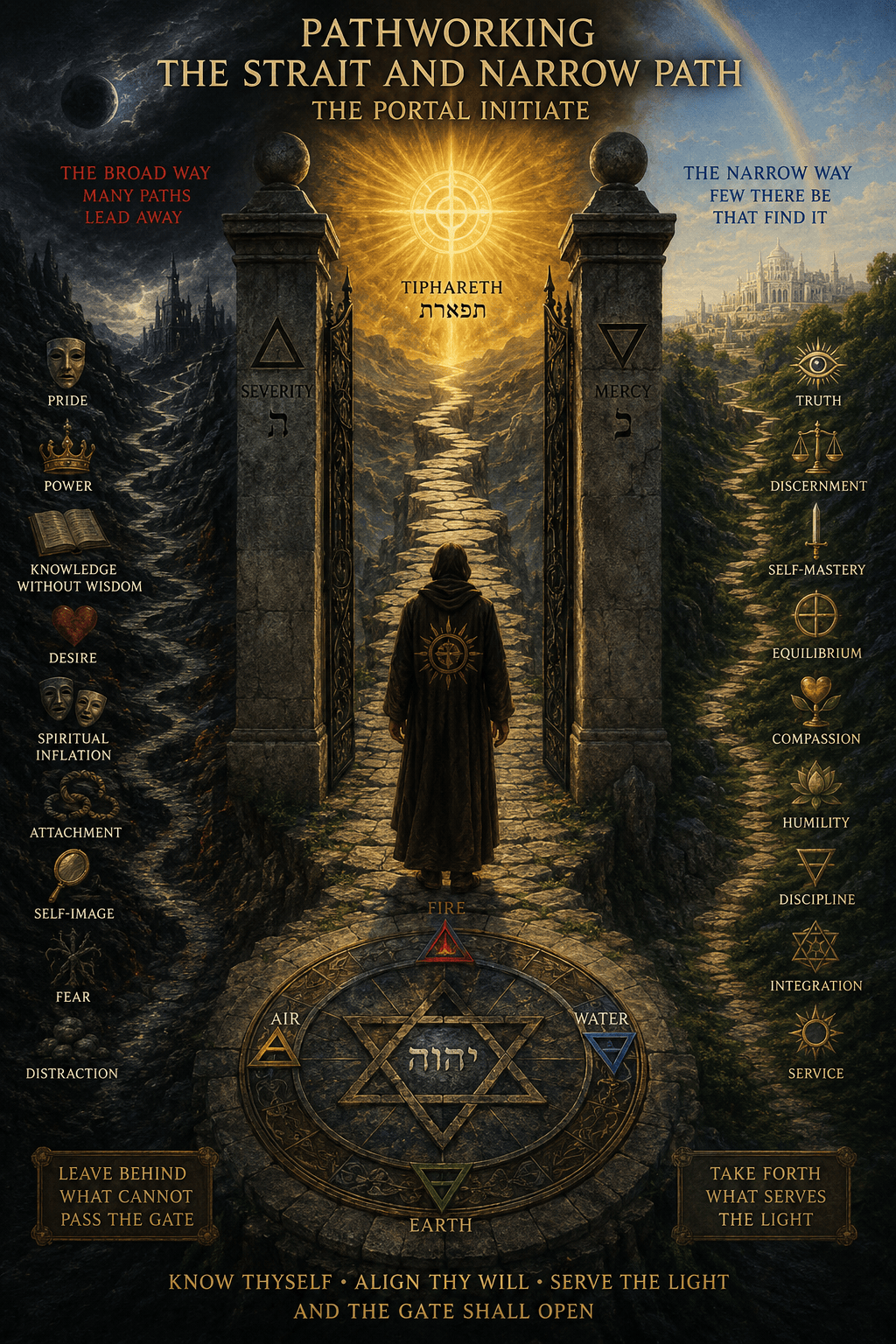
PORTAL OF THE GREATER MYSTERIES | The Sovereignty of Mind at the Threshold of Tiphareth | Victoria Generao, PhD

The Magus of Power, the Intelligence of Transparency, and the Initiatory Passage into Spiritual Adulthood

“Mind is the master power that molds and makes;
Man is Mind, and evermore he takes.
The tool of Thought, and shaping what he wills;
Brings forth a thousand joys, a thousand ills.
He thinks in secret and it comes to pass;
Environment is but his looking-glass.”

—James Allen, As a Man Thinketh


Opening

Fratres and Sorores of the Portal:

There arrives a moment in every genuine initiatory life when knowledge can no longer remain merely something that one possesses.

It must become something by which one lives.

There comes a threshold at which the accumulated symbols, rituals, correspondences, invocations, meditations, visions, elemental experiences, Qabalistic formulae, and intellectual accomplishments of the preceding grades must cease to be regarded as separate acquisitions. They must be gathered inwardly, equilibrated, tested, and finally brought beneath the sovereignty of a conscious and responsible Will.

Such is the mystery of Portal.

The Portal is not simply another grade added numerically to those which have preceded it. In the classical Golden Dawn structure it is not formally attributed to one Sephirah. Rather, it stands as an antechamber before Tiphareth—the threshold between the elemental Grades of the First Order and the Adept mysteries associated with the Second Order. Israel Regardie aptly describes it as an “outer court” of Tiphareth, a place in which the elemental nature is coordinated and equilibrated before the candidate approaches the deeper mysteries of the Adeptus Minor. (Publicism)

Therefore, Portal must be understood not merely as advancement, but as maturation.

The candidate has accumulated powers.

Now the candidate must learn government.

The candidate has encountered symbols.

Now the candidate must learn discernment.

The candidate has learned how consciousness may be altered.

Now the candidate must learn how consciousness is governed.

The candidate has been shown many worlds.

Now the candidate must discover who it is that beholds them.

And for this reason the words of James Allen provide an unusually fitting point of departure:

Mind is the master power that molds and makes.

Allen’s language emerged from the moral-philosophical tradition of the early twentieth century rather than from Golden Dawn ritual, yet his central proposition—that sustained thought participates in the formation of character—provides a useful ethical analogy for Portal work. Allen himself described mind as the “master-weaver” of inner character and outer circumstance. (PsiTek)

For the Portal initiate, however, we must carry this proposition further.

It is not enough to declare that thoughts create conditions.

We must ask:

What governs thought?

Who selects the image upon which imagination fixes itself?

Who decides whether an inner voice is wisdom, memory, desire, fear, fantasy, intuition, or projection?

Who determines whether an apparition is revelation or glamour?

Who distinguishes genuine spiritual insight from the secret wish of the personality?

And perhaps most importantly:

When power is placed into the hands of the initiate, who assumes responsibility for its consequences?

These are questions of spiritual adulthood.

And Portal is, in a profound sense, the ceremony of approaching one’s initiatory age of majority.


I. Portal as Initiatory Majority

Consider the young person who reaches the civil age of majority.

Yesterday, in the legal imagination, that individual belonged to the category of the minor.

Today, much changes.

The person may enter contracts.

The person may become legally accountable for decisions.

The person may determine where to live.

The person may manage property.

The person may make consequential choices without requiring parental authorization.

Yet something curious has occurred.

At midnight, no great neurological illumination necessarily descended.

No angel whispered the complete wisdom of adulthood into the person’s ear.

No magical transformation guaranteed good judgment.

Legal authority has arrived before complete wisdom.

This is precisely why the analogy is so useful.

Modern developmental psychology recognizes that the transition between adolescence and settled adulthood frequently extends well beyond the eighteenth birthday. Jeffrey Arnett famously proposed the category of “emerging adulthood,” particularly associated with approximately ages eighteen through twenty-five, as a period characterized by identity exploration, changing commitments, increasing independence, and a sense of standing between adolescence and mature adulthood. (PubMed)

The law may say:

You are responsible.

Psychological development answers:

Then you must learn how to become capable of carrying that responsibility.

So also does Portal.

The initiate has passed through Earth, Air, Water, and Fire.

The initiate has encountered the powers attributed symbolically to Malkuth, Yesod, Hod, and Netzach.

The initiate has been given names, signs, symbols, formulae, correspondences, ritual actions, meditations, and systems of interpretation.

But possession of the keys does not yet constitute mastery of the house.

The great question of Portal becomes:

What will you do now that you have the keys?

This is the beginning of initiatory majority.

The student asks:

“What does this symbol mean?”

The maturing initiate asks:

“What responsibility follows from my understanding of it?”

The student asks:

“How do I invoke this force?”

The Portal initiate must ask:

“Should this force be invoked at all?”

The student asks:

“How do I obtain a vision?”

The Portal initiate asks:

“How shall I test the vision once it arrives?”

The student desires experience.

The Adept-in-formation desires truth.

This difference is enormous.


II. The Four Elements Must Now Become One Government

The First Order may be regarded as a systematic education of the elemental personality.

Earth teaches embodiment.

Air teaches mind.

Water teaches the emotional and imaginal nature.

Fire teaches desire, aspiration, energy, courage, and Will.

These powers are necessary.

But none may reign alone.

Earth without Air becomes inertia.

Air without Earth becomes abstraction.

Water without Fire becomes passivity or emotional diffusion.

Fire without Water becomes cruelty, compulsion, or fanaticism.

Air without Water may become sterile intellectualism.

Water without Air may become fantasy mistaken for revelation.

Fire without Earth may attempt what cannot responsibly be sustained.

Earth without Fire may preserve what should have been transformed long ago.

Portal therefore asks for equilibrium.

Regardie describes its symbolism precisely in these terms: the elemental self is recapitulated, coordinated, and equilibrated before being offered toward the higher Genius. The Portal is attributed to Spirit or Aethyr precisely because Spirit crowns and governs the four elemental powers. (Publicism)

The pentagram now becomes psychologically significant.

Four points are not enough.

A human being may possess intelligence, emotion, practical ability, and extraordinary passion and yet remain inwardly disordered.

What must crown them?

Spirit.

And Spirit here should not be understood merely as another “element.”

Spirit is the principle of integration.

It asks:

Who governs the whole?

Portal is therefore the moment in which the initiate must begin converting a collection of powers into a constitution.


III. Mind Is the Instrument, Not the King

James Allen declares that mind is the master power.

At the level of practical character formation, the statement is powerful.

But Qabalistically we must qualify it.

Mind is a master only within its proper domain.

Mind is not the Absolute.

Thought is not Kether.

Intellect is not God.

The Ruach is not the Yechidah.

The danger of magical development is that the practitioner, having discovered the remarkable formative power of imagination and thought, may enthrone the personal mind as supreme.

This is one of the great temptations approaching Tiphareth.

The initiate discovers that concentration works.

Visualization works.

Ritual changes consciousness.

Symbols affect the psyche.

Words alter emotional states.

Intentionality influences behavior.

Disciplined thought can radically reshape character.

And then the personality quietly whispers:

I am therefore the source of the power.

But the Hermetic magician knows better.

The mind is powerful precisely because it can become a vehicle.

The purified mind is not opaque.

It is transparent.

And here we encounter a profound symbolic parallel in the Twelfth Path of Beth.


IV. Beth, Mercury, and the Magus of Power

Historically, one distinction must be maintained carefully.

The Portal Grade itself is not formally the Twelfth Path of Beth.

The classical Golden Dawn places Portal immediately before Tiphareth and attributes it principally to Spirit or Aethyr. Beth, by contrast, is the Twelfth Path connecting Kether and Binah and is attributed to Mercury and to Tarot Key I, the Magician—the Magus of Power. (Llewellyn)

Yet precisely because Portal is concerned with the responsible integration of the initiate’s faculties, the Magus provides a powerful analogical emblem for its inner work.

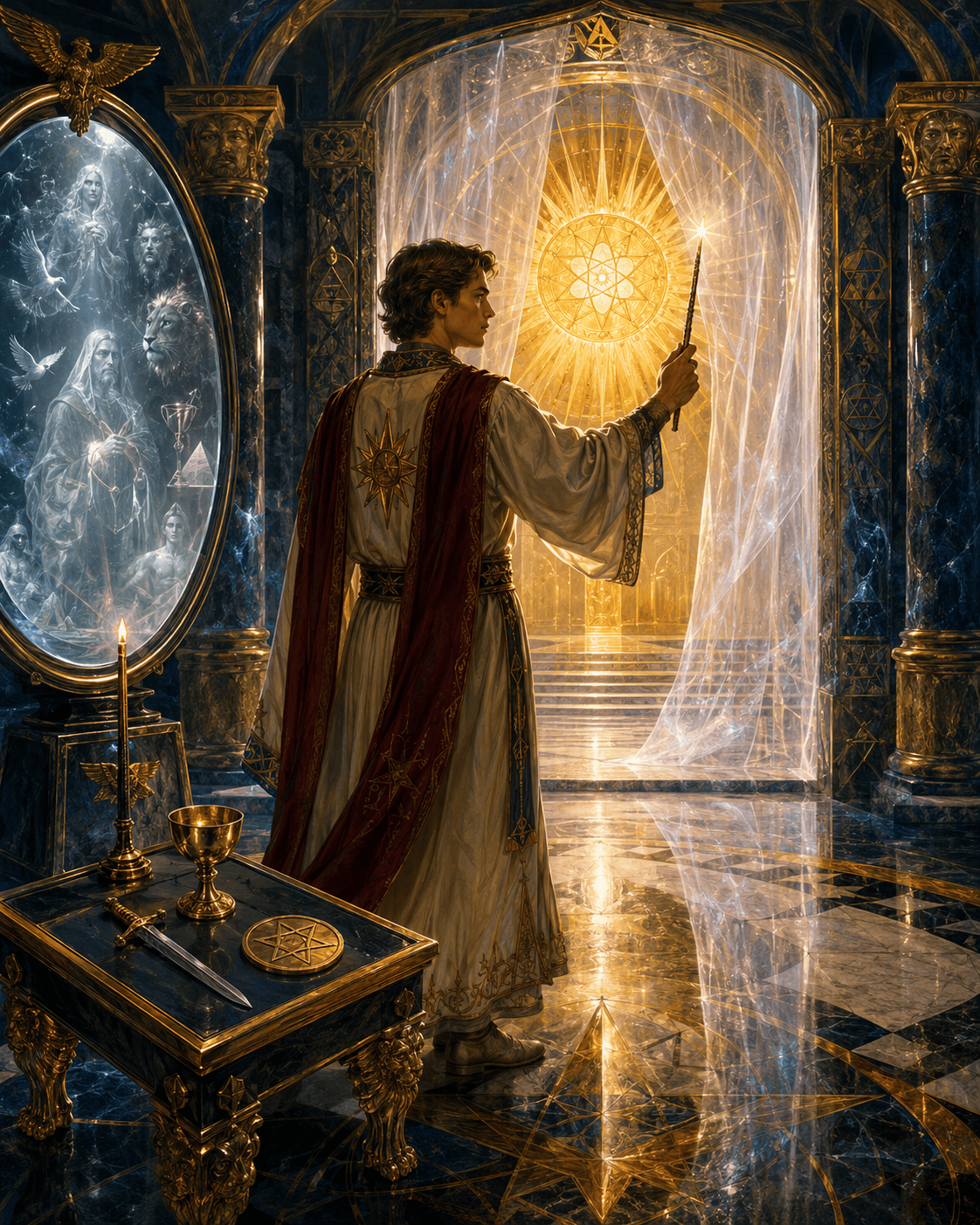
Before the Magician lie the elemental instruments.

Wand.

Cup.

Sword.

Pentacle.

Fire.

Water.

Air.

Earth.

The Magician does not become one of them.

The Magician governs their relationship.

That is the crucial point.

Power is not demonstrated by identifying with Fire.

Nor by drowning oneself in Water.

Nor by becoming intoxicated with Air.

Nor by becoming imprisoned within Earth.

The Magus stands among the instruments and remains conscious.

The four elemental weapons are available.

But the Magus decides.

This is self-mastery.

Not repression.

Not domination for its own sake.

Not spiritual authoritarianism.

Rather, ordered interior government.

The emotions speak, but do not automatically command.

The intellect analyzes, but does not automatically rule.

Desire arises, but desire does not thereby become destiny.

Sensory appearance presents itself, but appearance is not automatically accepted as truth.

The imagination produces images, but images must be examined.

The magician is therefore not merely one who possesses power.

The Magus is one who has developed sufficient interior authority to determine how power shall be used.

This is why “Magus of Power” must ultimately imply something far subtler than magical force.

The greatest power is the capacity not to be unconsciously ruled by the instrument one believes oneself to be controlling.


V. The Intelligence of Transparency

In William Wynn Westcott’s translation of the text traditionally printed as the Thirty-Two Paths of Wisdom, the Twelfth Path is called the Intelligence of Transparency, associated with the place from which the visions of those who behold apparitions and prophetic sights are said to proceed. (Uri Raz’s Tarot and Kabbalah Site)

A scholarly qualification is important here.

The “Thirty-Two Paths of Wisdom” employed so extensively in Hermetic Qabalah should not simply be equated without qualification with the earliest textual strata of the Sefer Yetzirah. Western esoteric editions frequently printed this later path-text alongside the Sefer Yetzirah, and Golden Dawn Qabalah inherited and systematized these descriptions. Thus, when we speak here of the Twelfth Path as the Intelligence of Transparency, we are speaking within the received Hermetic-Qabalistic tradition associated particularly with Westcott and subsequent occult interpreters.

But consider the extraordinary word:

Transparency.

Transparency is not emptiness.

It is unobstructed transmission.

A clean window does not create the sunlight.

It permits the sunlight to pass.

A distorted window bends the image.

A colored window modifies it.

A cracked mirror fractures it.

A dirty lens obscures it.

So too with consciousness.

The central spiritual problem of vision is not simply whether something has been seen.

The problem is what happened to the perception while it passed through the observer.

Every vision passes through a psyche.

Every intuition encounters memory.

Every revelation encounters expectation.

Every symbol encounters culture.

Every apparition encounters desire.

Every prophecy encounters the human need for significance.

Therefore, the mature magician does not ask merely:

Did I see something?

The mature magician asks:

Through what in me was it seen?

This is the Intelligence of Transparency as a discipline of consciousness.


VI. Mastery Over Apparitions

The inexperienced occultist often desires visions.

The experienced initiate learns to fear indiscriminate belief in them.

Not because visionary consciousness is inherently false.

But because psychic imagery is extraordinarily fertile.

The imagination can produce truthful symbols.

It can also produce compensatory images.

Traumatic residue may appear symbolically.

Unacknowledged desire may present itself wearing sacred clothing.

Fear may masquerade as warning.

Inflation may masquerade as divine election.

Fantasy may masquerade as prophecy.

Cultural memory may masquerade as past-life recollection.

Personal expectation may shape the very thing supposedly perceived objectively.

The Golden Dawn tradition therefore placed extraordinary emphasis upon discrimination, equilibrium, testing, banishing, correspondences, and the avoidance of obsession.

The question for Portal is not:

Can you enter the vision?

It is:

Can you return from it with your judgment intact?

This is a much higher test.

Any dreamer may become fascinated.

The initiate must remain capable of discrimination.

Any person may receive an image.

The magician must interpret without surrendering sovereignty.

The immature seer says:

“I saw it, therefore it is true.”

The mature seer says:

“I saw it. Now let us determine what kind of truth, if any, the vision contains.”

This single distinction separates mysticism from credulity and magical imagination from fantasy.


VII. Prophecy and the Discipline of the Seer

The phrase attached to the Intelligence of Transparency concerning apparitions and the prophecies of seers deserves special attention.

A prophecy is dangerous precisely because it appears to concern the future.

Once believed, it may alter behavior.

A person convinced that failure has been foretold may unconsciously manufacture failure.

A person convinced that greatness has been prophesied may become grandiose.

A person convinced that another human being is cosmically destined for them may override boundaries, evidence, or consent.

A practitioner convinced that catastrophe is coming may turn anxiety into theology.

The Portal initiate therefore learns that prophecy requires greater discipline than ordinary perception.

A seer must ask:

Was the experience symbolic or literal?

Personal or collective?

Psychological or transpersonal?

Conditional or inevitable?

Was there emotional investment in the answer?

Was the question asked repeatedly until a preferred answer appeared?

Does the vision contradict observable reality?

Has fear contaminated interpretation?

Has vanity contaminated interpretation?

Has spiritual ambition contaminated interpretation?

What independent evidence exists?

What happens if the interpretation is wrong?

These are not skeptical questions hostile to spirituality.

They are the ethics of spiritual maturity.

The higher the claim, the greater the obligation to test it.

Portal teaches that discernment is itself sacred.


VIII. Environment as Looking-Glass

Allen’s final line declares:

“Environment is but his looking-glass.”

Taken literally and universally, such an assertion would be philosophically and ethically excessive.

Human beings do not mentally manufacture every circumstance that befalls them.

War, oppression, illness, accident, economic structures, natural disaster, other people’s choices, social inequalities, inherited conditions, and chance contingencies cannot responsibly be reduced to the idea that an individual simply “thought them into existence.”

Such an interpretation can become cruel.

It may blame suffering people for their suffering.

That is neither sound scholarship nor sound initiation.

Yet Allen’s metaphor retains profound psychological value when interpreted carefully.

Environment often becomes a looking-glass in the sense that our reactions to circumstances reveal our interior constitution.

An insult may reveal insecurity.

Authority may reveal rebellion.

Wealth may reveal greed or generosity.

Loss may reveal attachment.

Power may reveal character.

Praise may reveal vanity.

Opposition may reveal courage—or fanaticism.

Uncertainty may reveal whether we possess faith, anxiety, patience, or compulsive control.

The mirror does not necessarily tell us:

You created everything you see.

The mirror asks:

What does your response to what you see reveal about you?

That is a far more mature doctrine.

Portal does not teach omnipotence.

Portal teaches responsibility.


IX. Thought as Magical Material

Thought nevertheless possesses enormous formative power.

Repeated thought becomes inclination.

Inclination reinforces emotion.

Emotion influences choice.

Choice becomes action.

Repeated action establishes habit.

Habit becomes character.

Character shapes destiny—not because consciousness magically controls every external event, but because character profoundly affects what one notices, chooses, tolerates, creates, avoids, pursues, and becomes.

In this sense, thought is magical material.

The magician works upon consciousness because consciousness mediates experience.

One cannot indefinitely cultivate resentment inwardly while expecting peace outwardly.

One cannot repeatedly visualize oneself as powerless while behaving courageously without eventually confronting the contradiction.

One cannot continually feed envy and expect the personality to remain generous.

One cannot cultivate disciplined attention without eventually changing the structure of one’s behavior.

Thought is therefore not merely private.

Thought is formative.

Portal initiates must become guardians of the interior Temple.

Not every thought deserves enthronement.

Not every desire deserves ritual reinforcement.

Not every fantasy deserves visualization.

Not every fear deserves belief.

Not every impulse deserves manifestation.

Self-mastery begins with selection.


X. The Young Adult and the Magical Adult

Return now to the analogy of majority.

The child frequently experiences rules as external.

The parent says:

Do this.

Do not do that.

Come home at this hour.

Spend only this amount.

Avoid this danger.

Fulfill this obligation.

The responsible adult must eventually internalize governance.

One cannot remain morally mature if one behaves responsibly only while being watched.

Likewise, the beginning occult student may require substantial external structure.

Perform this ritual.

Record this meditation.

Memorize this correspondence.

Observe this period.

Do not attempt this practice yet.

Study this grade first.

Such rules are useful.

But Portal introduces a more difficult question:

What happens when the teacher is no longer standing beside you?

Will you still banish properly?

Will you record your failures honestly?

Will you resist exaggerating spiritual experiences?

Will you admit when you do not know?

Will you refrain from manipulating others simply because you have discovered methods of persuasion?

Will you respect another person’s will?

Will you maintain ethical boundaries when secrecy would make misconduct easy?

Will you distinguish authority from domination?

Will you recognize when your own magical ambition has become unhealthy?

Will you stop a working when stopping is wiser than completing it?

These are the examinations of initiatory adulthood.

The minor obeys because authority stands above.

The adult learns to carry authority within.

Portal is therefore not liberation from discipline.

It is the internalization of discipline.


XI. Freedom and Consequence

The immature concept of freedom says:

“I may do what I wish.”

The mature concept of freedom says:

“I may choose, and therefore I am accountable for what follows.”

This is true legally.

It is true psychologically.

And it is profoundly true magically.

Every expansion of freedom increases responsibility.

If one learns methods of concentration, one must become responsible for what is concentrated upon.

If one learns invocation, one becomes responsible for the psychological consequences of invocation.

If one gains influence over others, one becomes responsible for how influence is used.

If one becomes capable of interpreting symbols for another person, one becomes responsible for the fear, hope, dependence, or confusion one’s words might create.

If one becomes a teacher, one becomes responsible for power asymmetries.

If one receives confidential information, one becomes responsible for silence.

If one acquires spiritual authority, one becomes responsible for humility.

The initiate who seeks power without consequence remains a spiritual minor.

The Adept begins where responsibility becomes inseparable from power.


XII. The Greatest Apparition Is the Self

There is, however, one apparition more dangerous than all others.

The apparition of oneself.

The image one has constructed of being spiritual.

The image of being chosen.

The image of being advanced.

The image of being an Adept.

The image of having unusual powers.

The image of being wiser than others.

The image of possessing privileged access to divine truth.

Such images are particularly difficult to detect because the personality is rewarded by believing them.

Thus the Portal candidate approaches Tiphareth carrying a paradox:

To discover the Higher Self, the candidate must become increasingly suspicious of counterfeit selves.

Every identity accumulated below the Veil must be examined.

Scholar.

Magician.

Mystic.

Healer.

Priest.

Priestess.

Initiate.

Teacher.

Seer.

Officer.

Adept-to-be.

All may be meaningful functions.

None is the deepest Self.

Tiphareth does not merely add a more glorious title to the personality.

Tiphareth exposes the personality to a greater center.

The sun does not become another planet.

It reveals the principle around which the planets must be ordered.


XIII. Toward Tiphareth

Tiphareth is Beauty.

Harmony.

Equilibrium.

Solar consciousness.

The center of the Ruach.

The point upon the Tree toward which the lower personality may become ordered.

Portal therefore has something of sunrise about it.

Yet it is sunrise before the Sun itself has fully appeared.

There is illumination behind the horizon.

The candidate senses a greater order.

But sensing is not possessing.

Aspiration is necessary.

Humility is equally necessary.

The First Order has largely taught differentiation.

This is Earth.

This is Air.

This is Water.

This is Fire.

This is Mercury.

This is Venus.

This is Luna.

This is the symbolism of a particular Path.

Portal begins integration.

The question changes from:

What does each power mean?

to:

Around what center shall these powers revolve?

That center cannot safely be the ordinary ego.

If the ego becomes the sun, everything else becomes its servant.

Spirituality then degenerates into self-glorification.

Tiphareth demands a different solar mystery.

The personal will must become increasingly capable of alignment with something greater than personal appetite.

Thus the great formula moves from:

What do I want?

toward:

What is mine rightly to do?

That is a very different question.


XIV. The Magus and the Transparent Mind

Now the analogy of Beth returns with greater force.

The true Magus does not obstruct the Light.

He transmits.

This is the deepest meaning we may derive from the Intelligence of Transparency.

The opaque magician says:

“Behold my power.”

The transparent magician asks:

“What Power moves rightly through me?”

The opaque magician interprets every vision in favor of the ego.

The transparent magician permits correction.

The opaque magician must be right.

The transparent magician desires truth more than vindication.

The opaque magician gathers followers.

The transparent magician cultivates capable souls.

The opaque magician confuses charisma with attainment.

The transparent magician recognizes that personality is an instrument.

The transparent mind does not mean a personality without individuality.

It means a consciousness increasingly free from unconscious distortion.

One becomes capable of seeing without immediately possessing.

Hearing without immediately believing.

Experiencing without immediately declaring.

Receiving without immediately appropriating.

Knowing without immediately boasting.

This is spiritual adulthood.


XV. The Portal Candidate’s Examination of Thought

Therefore, Portal presents a practical discipline.

Before accepting a powerful thought, ask:

Is it true?

Before acting upon it, ask:

Is it necessary?

Before speaking it, ask:

Is it responsible?

Before ritualizing it, ask:

What will this strengthen within me?

Before attempting to manifest it, ask:

Who benefits, who may be harmed, and whose will is involved?

Before calling it guidance, ask:

Have I tested it?

Before calling it prophecy, ask:

What evidence would show me I am mistaken?

Before calling it revelation, ask:

Does it enlarge humility, clarity, compassion, courage, and responsibility—or merely enlarge my importance?

Such questions constitute a magical examen.

They polish the glass.


XVI. Self-Mastery Is Not Self-Violence

We must also reject a common misunderstanding.

Self-mastery does not mean war against oneself.

The magician does not achieve sovereignty by mutilating the psyche.

Emotion is not an enemy.

Desire is not inherently corrupt.

The body is not a prison to be hated.

The intellect is not a demon.

The personality is not evil.

The elements are sacred powers.

The problem is disorder.

The task is right relationship.

Fire must burn where fire is appropriate.

Water must flow where water is needed.

Air must distinguish.

Earth must stabilize.

Spirit must coordinate.

The Portal initiate therefore becomes less interested in suppression and more interested in integration.

Self-mastery means that anger may be experienced without becoming cruelty.

Fear may arise without becoming tyranny.

Desire may arise without becoming enslavement.

Grief may be felt without abandoning the Work.

Power may be possessed without becoming abuse.

Praise may be received without becoming intoxication.

Criticism may be heard without psychological collapse.

Vision may arise without destroying discrimination.

This is equilibrium.

And equilibrium is strength.


XVII. The Ethical Birth of the Adept

The mysteries of Adeptship are sometimes imagined primarily in terms of occult knowledge.

Secret formulae.

Higher rituals.

Consecrations.

Inner Order symbolism.

Advanced evocation.

Skrying.

Enochian work.

Rosicrucian mysteries.

Yet all such things become dangerous if the ethical personality remains immature.

The true threshold of Adeptship is therefore ethical before it is spectacular.

Can greater knowledge be carried without arrogance?

Can secrecy be carried without elitism?

Can authority be carried without exploitation?

Can power be exercised without coercion?

Can spiritual intimacy exist without boundary violation?

Can the initiate distinguish service from the desire to be needed?

Can leadership remain accountable?

Can the magician recognize error?

Can the teacher remain teachable?

These are Solar questions.

For Beauty without ethics becomes glamour.

Power without ethics becomes domination.

Knowledge without ethics becomes cunning.

Vision without ethics becomes manipulation.

Authority without ethics becomes corruption.

Thus the road toward Tiphareth must pass through responsibility.


XVIII. Crossing the Threshold of Majority

Imagine again the young adult standing outside the family home for the first time.

The door closes.

The key is in the hand.

Freedom feels enormous.

There may be exhilaration.

There may also be fear.

There is no longer someone present at every hour to determine what should be done.

The young adult suddenly discovers the hidden burden inside freedom:

I must become the one who decides.

Portal carries this same mystery.

The candidate has been educated by the elemental grades.

Now those teachings must become interior law.

The initiate must begin becoming his or her own guardian of the threshold.

No officer can permanently stand inside the psyche.

No Chief can inspect every thought.

No teacher can accompany every astral journey.

No rubric can anticipate every ethical dilemma.

No book can interpret every vision.

Eventually the initiate must stand within the Temple alone and ask:

What is true?

What is balanced?

What is honorable?

What serves the Great Work?

And then act accordingly.

This is the age of majority of the soul.


XIX. “He Thinks in Secret”

James Allen’s phrase now acquires an initiatory depth:

“He thinks in secret.”

There is indeed a secret chamber.

It is the interior chamber in which thought exists before speech.

Before the ritual gesture.

Before manifestation.

Before action.

Before consequence.

The quality of the magical life is formed there.

One may deceive a Temple.

One may deceive companions.

One may deceive students.

One may deceive teachers.

For a time, one may even deceive oneself.

But the interior Temple records everything in character.

Thought becomes inclination.

Inclination becomes choice.

Choice becomes action.

Action becomes habit.

Habit becomes character.

Character becomes the vessel through which magical power will eventually flow.

Therefore the Portal initiate guards the secret chamber.

Not fearfully.

Consciously.

For what is entertained repeatedly in that chamber will eventually demand embodiment.


XX. The Looking-Glass Becomes Transparent

At the beginning of the Work, the world appears to be the problem.

Other people obstruct us.

Circumstances frustrate us.

Teachers fail us.

Organizations disappoint us.

Rituals seem difficult.

Life interferes with practice.

Later, the initiate learns to use these conditions diagnostically.

The obstacle asks:

What in you requires strengthening?

The conflict asks:

What in you remains unintegrated?

The criticism asks:

Can truth be extracted without resentment?

The temptation asks:

What still governs you?

The vision asks:

Can you see without becoming possessed by seeing?

The possession of power asks:

Can you remain ethical when you could choose otherwise?

The threshold asks:

Are you prepared to become responsible for yourself?

Gradually, the looking-glass becomes transparent.

One ceases merely to stare at oneself in the mirror.

One begins to see through it.

And beyond the reflected personality shines another Light.

The Light of Tiphareth.


XXI. The Portal Admonition

Therefore, Portal Initiate, understand the nature of the threshold upon which you stand.

You have not reached the end of instruction.

You have reached the end of spiritual childhood.

You are not being told that you now know everything.

You are being told that you must become responsible for what you know.

You are not being declared incapable of error.

You are being required to become accountable for error.

You are not being promised freedom from illusion.

You are being trained to recognize illusion.

You are not being promised infallible prophecy.

You are being asked to become transparent enough that vision may be tested without the distorting tyranny of desire.

You are not being crowned sovereign over the universe.

You are being asked to become sovereign within your own sphere of sensation.

This sovereignty begins quietly.

It begins when you choose which thought to cultivate.

Which desire to strengthen.

Which fear to challenge.

Which vision to test.

Which word to speak.

Which silence to maintain.

Which power to invoke.

Which power to refuse.

Which action to perform.

And which consequence to accept.

The ordinary person asks:

“What can I do?”

The magician asks:

“What can I cause?”

The Portal initiate must learn to ask:

“What ought I to cause?”

There begins Adeptship.


Conclusion: The Sun Beyond the Veil

Fratres and Sorores:

The threshold of Tiphareth is not crossed merely by accumulating information.

It is crossed through transformation.

The candidate who approaches the Veil carries all the elemental powers within the microcosm.

Earth has given foundation.

Air has given discrimination.

Water has given depth of consciousness.

Fire has given aspiration.

Spirit now calls these powers into unity.

Like the Magus standing before the four elemental instruments, the Portal initiate must become conscious of the powers arrayed before the inner altar.

Yet mastery does not mean possession.

It means stewardship.

The highest magician is not the personality proclaiming:

“See what I can command.”

The higher magician becomes the transparent vessel capable of saying:

“Let that which is True pass through me without distortion.”

The seer must become transparent to vision.

The thinker transparent to truth.

The magician transparent to Divine Will.

The leader transparent to justice.

The teacher transparent to wisdom.

The healer transparent to compassion.

And the initiate transparent to the Light.

Thus the image of the young adult reaching legal majority becomes a profound symbol of Portal.

The novice was supervised.

The student was instructed.

The elemental initiate was trained.

But the one approaching Adeptship must now begin to govern the self.

The age of majority has arrived.

Not because every lesson has been learned.

But because responsibility can no longer be deferred.

Therefore guard your thoughts.

Test your visions.

Interrogate your motives.

Discipline imagination.

Govern desire.

Honor the freedom of others.

Accept correction.

Remain capable of doubt.

Cultivate aspiration.

Seek equilibrium.

And above all, desire Truth more deeply than you desire to be confirmed in what you already believe.

For the Veil before Tiphareth cannot finally be penetrated by intellectual cleverness alone.

Nor by psychic phenomena.

Nor by titles.

Nor by magical reputation.

Nor even by knowledge.

The veil becomes transparent as the initiate becomes transparent.

And when the looking-glass ceases merely to reflect the lesser personality, the Light that had always stood beyond it begins to appear.

Then the words:

“Mind is the master power”

are transmuted into a higher mystery.

Mind is indeed a great power.

But the purified mind becomes greater still when it learns that its highest office is not to enthrone itself—

but to become a clear and willing instrument of the Light.

And so, standing at the threshold of Tiphareth, the Portal initiate may say:

I have learned to wield the instruments.
Now let me become worthy to wield them.

I have learned to seek the vision.
Now let me become transparent to Truth.

I have learned that thought shapes character.
Now let thought itself be brought beneath the rule of the Higher Will.

I have come of age within the Mysteries.
Let me therefore accept the responsibilities of the Light.

And before the Veil of the Sanctuary, let the candidate stand—not as a child demanding entrance, not as a personality demanding power, but as an emerging spiritual adult prepared to assume responsibility for the Great Work.

For beyond that Veil burns the Sun.

And before the Sun can be known as the center of the Temple—

it must first become the center of the Self.


Annotated Bibliography

Allen, James. As a Man Thinketh. 1903.

Allen’s short philosophical work provides the opening aphorism for this lecture and develops the proposition that cultivated thought participates in the formation of character. Although Allen was not presenting Golden Dawn doctrine, his treatment of thought, habit, character, and circumstance provides a useful comparative framework for discussing mental discipline at Portal. His language should not, however, be interpreted as demonstrating that individuals literally create every external circumstance through thought; the present lecture deliberately adopts a more ethically and philosophically qualified reading. The opening poem and Allen’s discussion of mind as a formative power are preserved in surviving editions of the text. (PsiTek)

Arnett, Jeffrey Jensen. “Emerging Adulthood: A Theory of Development from the Late Teens through the Twenties.” American Psychologist 55, no. 5 (2000): 469–480.

Arnett’s influential article proposes “emerging adulthood” as a developmental period centered especially upon approximately ages eighteen through twenty-five. He identifies identity exploration, changing social roles, relative independence, and the subjective condition of being neither fully adolescent nor fully established adult. The present lecture uses Arnett cautiously and analogically: Portal resembles emerging adulthood not because occult grades correspond literally to developmental stages, but because both involve the acquisition of increasing autonomy before complete maturity has been achieved. (PubMed)

Cicero, Chic, and Sandra Tabatha Cicero. Self-Initiation into the Golden Dawn Tradition. St. Paul, MN: Llewellyn Publications, 1995.

The Ciceros present a systematic reconstruction of Golden Dawn grade symbolism and practices designed for individual study and self-initiation. Particularly useful for understanding the progressive elemental formation of the First Order and the transitional character of Portal. Their work also demonstrates the modern continuation of Golden Dawn pedagogical structures outside the original nineteenth-century temples.

Cicero, Chic, and Sandra Tabatha Cicero. The Essential Golden Dawn: An Introduction to High Magic. St. Paul, MN: Llewellyn Publications, 2003.

A concise modern overview of Golden Dawn cosmology, ritual, Qabalah, Tarot, elemental magic, and initiatory philosophy. Useful for contextualizing Portal within the larger Golden Dawn system and for readers requiring a more accessible introduction before consulting Regardie’s extensive primary-source compilations.

Fortune, Dion. The Mystical Qabalah. London: Williams & Norgate, 1935.

Fortune’s influential exposition of Hermetic Qabalah is particularly valuable for understanding the psychological and spiritual function of the Sephiroth. Her treatment of Tiphareth as the sphere associated with harmony, sacrifice, solar consciousness, and the higher individuality provides an important interpretive background for the present lecture’s discussion of the transition from personality-centered consciousness toward a more integrated spiritual center. Fortune represents twentieth-century Hermetic interpretation rather than Jewish Kabbalah and should be read within that historical context.

Jung, C. G. Aion: Researches into the Phenomenology of the Self. Collected Works, Vol. 9, Part II. Princeton: Princeton University Press, 1959.

Jung’s analysis of ego, Self, projection, shadow, and symbolic experience offers an important psychological dialogue partner for initiatory traditions. Particularly relevant to the lecture’s argument that visionary experiences require discrimination and that images of spiritual attainment may themselves become projections of the ego. Jung should not be treated as explaining Golden Dawn doctrine, but his psychology provides a sophisticated conceptual vocabulary for examining inflation, projection, integration, and symbolic consciousness.

Kaplan, Aryeh. Sefer Yetzirah: The Book of Creation in Theory and Practice. York Beach, ME: Samuel Weiser, 1990.

Kaplan provides one of the most substantial modern treatments of the Sefer Yetzirah, combining textual scholarship, traditional Jewish commentary, linguistic analysis, and meditative interpretation. His work is especially valuable for distinguishing Jewish textual traditions from later Hermetic adaptations. This distinction matters because the occult “Thirty-Two Paths of Wisdom” descriptions used by the Golden Dawn should not automatically be regarded as belonging to the oldest textual layers of the Sefer Yetzirah itself.

Mathers, S. L. MacGregor, et al. “Book T: The Tarot.” Hermetic Order of the Golden Dawn materials, late nineteenth century.

Book T constitutes one of the principal Golden Dawn sources for the Order’s Tarot correspondences. Within this system, Tarot Key I, the Magician, is attributed to Beth and Mercury and bears the esoteric title The Magus of Power. This attribution provides the historical basis for the present lecture’s use of the Magus as an analogical emblem of conscious direction over elemental powers. The Magus/Beth attribution should nevertheless be kept distinct from Portal’s own formal grade attribution.

Regardie, Israel. The Golden Dawn: A Complete Course in Practical Ceremonial Magic. Various editions. Originally published 1937–1940.

Regardie’s publication remains one of the indispensable repositories of Golden Dawn ritual, instructional documents, knowledge lectures, and grade ceremonies. Of particular relevance is the Portal ritual, which recapitulates and equilibrates the elemental Grades and prepares the candidate for transition toward Adeptus Minor. The ritual materials demonstrate that Portal serves as an initiatory bridge rather than as a Sephirothic Grade in its own right.

Regardie, Israel. The Complete Golden Dawn System of Magic. Phoenix: Falcon Press, 1984.

This expanded compilation preserves extensive ritual and instructional material connected with the Golden Dawn tradition. Its Portal materials are especially valuable for the symbolism of the Veil, the transition from the First to Second Order, the elemental synthesis, and the aspirational movement toward the Vault of the Adepti. The surviving text explicitly portrays the candidate as approaching the concealed Portal and being required to complete the symbolic formula before the Veil may be approached. (Scripta et Veritas)

Regardie, Israel. What You Should Know About the Golden Dawn. Various editions.

Regardie’s historical and explanatory discussion contains an especially concise interpretation of Portal. He describes it as not being attributed to a Sephirah in itself but as an outer court to Tiphareth, intermediate between the elemental Grades and Adeptus Minor. He further emphasizes Spirit or Aethyr, elemental equilibrium, aspiration, and the coordination of the lower nature toward the higher Genius. This formulation supplies one of the central historical foundations for the present lecture. (Publicism)

Wang, Robert. The Qabalistic Tarot: A Textbook of Mystical Philosophy. York Beach, ME: Samuel Weiser, 1983.

Wang presents one of the clearest comparative studies of Tarot as interpreted through the Golden Dawn’s Hermetic-Qabalistic structure. Particularly useful for understanding the relationship among Tarot Key I, Mercury, Beth, the Tree of Life, elemental instruments, and the magician as mediator of spiritual force. Wang also helps distinguish between Tarot symbolism as popularly interpreted and its more technical Golden Dawn correspondences.

Westcott, William Wynn, trans. Sepher Yetzirah: The Book of Formation and the Thirty-Two Paths of Wisdom. Various editions, originally published in the late nineteenth century.

Westcott, one of the principal founders of the Hermetic Order of the Golden Dawn, played a central role in transmitting Qabalistic texts into English occultism. In the Thirty-Two Paths of Wisdom printed with his translation, the Twelfth Path is called the Intelligence of Transparency and is associated with the source of visionary apparitions and prophetic seeing. (Uri Raz’s Tarot and Kabbalah Site)

For scholarly purposes, readers should recognize that the Thirty-Two Paths of Wisdom text as transmitted in Western occult editions has a textual history distinct from the oldest forms of the Sefer Yetzirah. Nevertheless, Westcott’s version became extraordinarily influential in Golden Dawn and subsequent Hermetic Qabalah, making it essential for understanding why Beth, Mercury, the Magus of Power, transparency, vision, and prophecy became linked within the Western Mystery Tradition.


Suggested Scholarly Reading Sequence

For students approaching this lecture as part of Portal preparation, the most useful progression is:

  1. James Allen, As a Man Thinketh — for the ethical discipline of thought.
  2. Israel Regardie, What You Should Know About the Golden Dawn — for the initiatory meaning of Portal.
  3. Regardie, The Golden Dawn — for the ritual and instructional foundation.
  4. Westcott, Sepher Yetzirah and the appended Thirty-Two Paths of Wisdom — for the Hermetic formulation of the Intelligence of Transparency.
  5. Robert Wang, The Qabalistic Tarot — for Beth, Mercury, and the Magus of Power.
  6. Dion Fortune, The Mystical Qabalah — for the Hermetic understanding of Tiphareth.
  7. Aryeh Kaplan, Sefer Yetzirah — to place the Hermetic material alongside serious Jewish textual scholarship.
  8. Jeffrey Arnett, “Emerging Adulthood” — for the developmental analogy of newly acquired autonomy and responsibility.
  9. C. G. Jung, Aion — for psychological considerations concerning projection, ego, Self, and spiritual inflation.

Final Portal Maxim

The child asks to be shown the Light.
The student learns the symbols of the Light.
The magician learns to direct the forces of the Light.
But the Portal initiate must become responsible for the Light that has been entrusted to them.

For mastery is not proven by what one can summon,
but by what one can govern;
not by what one can see,
but by what one can discern;
not by the possession of power,
but by transparency before Truth.

The Dark Night of the Soul in the Golden Dawn | Portal Grade | Victoria Generao, PhD

Nigredo, the Veil of Paroketh, and the Rosicrucian Mystery of the Interior Sun

There comes a moment in the Great Work when the initiate discovers that Light does not always reveal itself as illumination.

Sometimes Light first reveals itself by exposing darkness.

There comes a stage when the formulas that once provided certainty cease to satisfy. Ritual may still be performed correctly, yet its former consolation seems absent. The symbols remain upon the altar, the Divine Names are still vibrated, the sacred gestures are still made, and yet something within the initiate has changed.

The former spiritual identity has begun to loosen.

For the Golden Dawn initiate approaching the Portal Grade, this experience may be understood through an alchemical and Rosicrucian lens as something resembling the mystical Dark Night of the Soul.

The expression itself is not an original Golden Dawn technical term. It comes principally from the Christian mystical writings of St. John of the Cross, who described states of purification in which the soul is deprived of its familiar consolations so that it may be drawn toward a more profound union with God.

Yet the concept offers an extraordinarily powerful way of contemplating the mystery of Portal.

For Portal is itself an in-between place.

Behind the initiate lie the elemental Grades of the First Order.

Ahead lies the threshold of Adeptus Minor 5=6, the mysteries of Tiphareth, and entrance into the Rosicrucian Second Order of the Rosae Rubeae et Aureae Crucis — the Red Rose and the Golden Cross.

Portal is therefore neither simply an ending nor simply a beginning.

It is the darkness between them.

It is the place where the initiate who has learned the elements must now become their synthesis.

It is the place where the magician who has learned to command forces must begin learning how to become a vessel for something greater.

And in the language of spiritual alchemy, this mystery is closely related to Nigredo — the Blackening.

The Four Elements Have Been Traversed

The journey through the elemental Grades has already subjected the initiate to a deliberate process of differentiation.

In Zelator 1=10, the mysteries of Earth establish foundation, embodiment, stability, discipline, and the necessity of bringing spiritual aspiration into manifestation.

In Theoricus 2=9, the mysteries of Air awaken thought, perception, language, reason, discrimination, and the mobility of consciousness.

In Practicus 3=8, Water opens the initiate to emotion, imagination, intuition, memory, receptivity, and the deeper currents of the psyche.

In Philosophus 4=7, Fire introduces will, aspiration, intensity, transformation, purification, and the power by which the old may be consumed so that something greater can emerge.

By the time the initiate arrives at Portal, Earth, Air, Water, and Fire have all been encountered.

But Portal asks a very different question.

It no longer asks:

What is Earth?

What is Air?

What is Water?

What is Fire?

It asks:

Who is the one in whom all four must become reconciled?

The candidate has studied the elements externally.

Portal begins their synthesis internally.

This is why Portal is associated not with another isolated elemental condition, but with the reconciling mystery of Spirit.

The four forces must be brought beneath a higher principle.

The elemental personality must become a pentagram.

The four arms must discover their center.

And the initiate begins to understand that Spirit cannot simply be added to Earth, Air, Water, and Fire as though it were a fifth substance sitting beside them.

Spirit must penetrate them.

Spirit must order them.

Spirit must reconcile them.

Spirit must become the hidden unity through which the four become one.

The Magician Becomes the Alchemical Vessel

Until this point, the initiate may have imagined that occult training consisted primarily of acquiring greater knowledge and greater control.

Learn the correspondences.

Learn the invocations.

Learn the Divine Names.

Learn the Tarot.

Learn Qabalah.

Learn ritual.

Learn the movement of magical force.

Learn how to invoke.

Learn how to banish.

Learn how to formulate.

Learn how to direct.

But Portal introduces a more dangerous proposition.

Perhaps the Great Work is not primarily about what the magician can make the universe do.

Perhaps the Great Work is about what the Divine can make of the magician.

At that point the operation reverses.

The practitioner becomes the materia.

The consciousness of the initiate becomes the alchemical substance placed within the vessel.

Every contradiction, every unresolved attachment, every ambition, every fear, every hidden motive, and every cherished spiritual self-image becomes part of the material upon which the Work must act.

Portal therefore announces an important transition:

the magician who has worked upon the elements must now permit the elements to work upon the magician.

And this is where the Dark Night begins.

Nigredo: The Blackening of the Spiritual Personality

In the imagery of Western alchemy, Nigredo is associated with blackening, decomposition, putrefaction, death, dissolution, and the breaking apart of a previously established form.

The material placed into the alchemical vessel does not immediately become gold.

First it may blacken.

It may decay.

It may lose its recognizable structure.

The original form appears to die.

Historically, alchemy encompassed genuine laboratory practices as well as philosophical, religious, and symbolic dimensions; modern scholarship cautions against reducing all historical alchemy to psychology alone. Yet later Western esoteric traditions made extensive use of alchemical imagery as a language for interior transformation. (University of Chicago Press)

In the Portal interpretation, Nigredo can therefore represent the decomposition of the initiate’s previous spiritual identity.

The candidate may have spent years constructing an identity around attainment.

“I know.”

“I understand.”

“I have been initiated.”

“I have received the Grades.”

“I can perform the rituals.”

“I know the correspondences.”

“I know the Divine Names.”

“I understand the Tree of Life.”

Portal quietly asks:

Who is this “I” that claims these attainments?

Suddenly the knowledge itself becomes subject to examination.

The ego can possess occultism just as easily as it can possess money, social status, academic credentials, authority, or reputation.

It can say:

My knowledge.

My initiation.

My lineage.

My magical ability.

My grade.

My spiritual authority.

My enlightenment.

But the Rosicrucian path cannot culminate in the enthronement of the spiritual ego.

Something must die.

The Veil of Paroketh

The Golden Dawn places profound symbolic importance upon the approach toward Tiphareth, the Solar Sephirah of Beauty, harmony, sacrifice, the Higher Genius, and the reconciled center of consciousness.

Before that Solar center lies the symbolic Veil of Paroketh.

The Veil marks a boundary.

Below it, the initiate has worked primarily through the structures of the personality and the elemental world.

Beyond it lies the approach toward the consciousness symbolized by Tiphareth.

The Veil therefore presents a paradox.

The initiate cannot cross it merely by becoming a more sophisticated version of the personality that approached it.

More information is not enough.

More memorization is not enough.

More magical technique is not enough.

Even greater psychic sensitivity is not enough.

The consciousness itself must become capable of another relationship with the Divine.

Portal thus becomes a chamber of transition between what the initiate has constructed and what the initiate must become.

The candidate stands, symbolically, before the Veil and encounters the uncomfortable truth:

the personality that brought me here cannot, by its own sovereignty, take me farther.

This realization is one of the deepest meanings that may be given to the Portal Dark Night.

When the Gods Become Silent

One of the characteristics traditionally associated with mystical purification is the withdrawal of spiritual consolation.

Prayer may cease to provide emotional reassurance.

Meditation may feel barren.

Ritual may feel less dramatic.

Visions may disappear.

Synchronicities may diminish.

The initiate may feel that the invisible world has withdrawn.

It is tempting to interpret such periods as spiritual failure.

But the mystical tradition of St. John of the Cross offers another possibility.

The soul can become attached not only to worldly pleasure but to spiritual pleasure.

The sensation of holiness can become an attachment.

Mystical visions can become an attachment.

Occult power can become an attachment.

Psychic phenomena can become an attachment.

Being recognized as spiritually advanced can become an attachment.

Even the experience of divine presence can become something the ego demands as reassurance.

The Dark Night removes the guarantee of consolation.

St. John of the Cross’s Dark Night is therefore useful comparatively, though it belongs to Christian contemplative theology rather than to the formal Golden Dawn curriculum. (Christian Classics Ethereal Library)

The question then becomes:

Will the initiate continue the Work without being rewarded by spiritual sensation?

Will one perform the rite when there is no exhilaration?

Will one meditate when no vision comes?

Will one pray when Heaven appears silent?

Will one remain faithful when there is no external confirmation of progress?

If so, something profound begins to change.

Practice ceases to be performed solely because it produces experience.

Practice becomes devotion.

The Rosicrucian Tomb

Here the Portal mystery becomes unmistakably Rosicrucian.

For beyond Portal lies the Second Order.

And at the heart of the Rosicrucian current stands one of Western esotericism’s most powerful images:

the Tomb of Christian Rosenkreutz.

The Fama Fraternitatis, first printed in 1614, tells of the discovery of the concealed sepulcher of the legendary founder of the Rosicrucian Brotherhood. The body of Christian Rosenkreutz is found preserved within a mysterious chamber after 120 years, surrounded by signs of hidden wisdom and spiritual science. The image became foundational to later Rosicrucian imagination. (Rosicrucianism)

The Golden Dawn’s Rosicrucian Adept tradition drew deeply upon this symbolism.

The Adeptus Minor mysteries are therefore not simply mysteries of acquiring greater magical authority.

They are mysteries of death, burial, discovery, regeneration, and resurrection.

That transforms the meaning of Portal.

Portal stands before the Tomb.

Before the candidate may fully participate in the mysteries symbolized by the resurrected Adept, something analogous to burial must already have begun within the candidate.

The spiritual ego approaches the sepulcher.

It cannot carry all of itself through the door.

Post CXX Annos Patebo

One of the famous Rosicrucian motifs surrounding the Tomb is the promise:

Post CXX Annos Patebo

“After one hundred and twenty years I shall open.”

The statement possesses extraordinary initiatory power when contemplated in relation to Portal.

The tomb is closed.

The Adept is hidden.

The Light is concealed.

Yet concealment is not absence.

The mystery is gestating.

The apparent grave contains a future revelation.

This is exactly the paradox of Nigredo.

The alchemical matter appears dead.

But something is happening within the vessel.

The seed lies beneath the earth.

The Sun appears absent during midnight.

The initiate cannot yet see the transformation because the operation is taking place beneath the threshold of ordinary awareness.

Portal teaches patience within sacred obscurity.

Not every spiritual transformation announces itself immediately.

Some changes occur in silence.

Some occur beneath consciousness.

Some must ripen inside the sealed vessel.

The Rose and the Cross

The Rosicrucian mystery eventually presents the initiate with the image of the Rose upon the Cross.

This symbol admits many layers of interpretation and should not be reduced to a single formula.

Yet for the Portal initiate it offers a particularly powerful teaching.

The Cross may be contemplated as the structure of manifested existence: the four directions, the four elements, incarnation, limitation, sacrifice, and the intersection of forces within material life.

The Rose unfolds at the center.

It suggests awakening consciousness, beauty, regeneration, multiplicity returning toward unity, and the opening of the interior life.

The mystery is not that the Rose escapes the Cross.

The Rose blossoms upon it.

This is crucial.

Rosicrucian initiation is not fundamentally an escape from embodiment.

Matter is not simply discarded.

The elements are not destroyed.

The human personality is not obliterated.

Instead, something divine must flower through them.

The Rose requires the Cross.

Spirit requires a vessel.

The invisible requires manifestation.

The Higher Genius requires an integrated personality through which to act.

Portal therefore does not teach the initiate how to abandon humanity.

It teaches the initiate how humanity may become transparent to something greater.

Crucifixion Before Resurrection

The Solar mysteries of Tiphareth carry strong sacrificial and redemptive symbolism within the Golden Dawn’s Christian-Hermetic and Rosicrucian framework.

This is why the approach to Adeptus Minor cannot be reduced to gaining occult power.

The candidate approaches a mystery of sacrifice.

The false king must surrender the throne.

The personality must cease claiming absolute sovereignty.

The magician begins moving from the question:

“How can I make spiritual powers serve my will?”

toward another:

“How may my will become reconciled with the Divine Will?”

That is a far more demanding question.

It shifts the orientation of magic itself.

The operator becomes servant.

The commander becomes mediator.

The magician becomes priest.

Will becomes offering.

Power becomes stewardship.

Knowledge becomes responsibility.

This is the Rosicrucian crucifixion of magical ego.

Yet crucifixion is not the final word.

The entire mystery moves toward regeneration.

There can be no resurrection of the higher consciousness without some death of the lower claim to sovereignty.

V.I.T.R.I.O.L. — Descend Into the Interior Earth

The alchemical maxim V.I.T.R.I.O.L. offers another key to the Portal ordeal:

Visita Interiora Terrae Rectificando Invenies Occultum Lapidem.

Traditionally rendered:

Visit the interior of the earth; by rectifying, you shall discover the hidden Stone.

The command is not to flee darkness.

The command is to enter it consciously.

For the Portal initiate, the “interior earth” may be understood as the concealed depth of the psyche.

There the initiate may encounter everything that the spiritual persona would prefer not to acknowledge:

fear,

pride,

envy,

need for recognition,

resentment,

control,

ambition,

unacknowledged desire,

spiritual vanity,

fear of failure,

fear of insignificance,

and perhaps most importantly,

fear of surrender.

These forces become the materia of the Work.

They must neither be worshiped nor denied.

They must be rectified.

The initiate descends not because darkness is the goal, but because something precious has been concealed inside it.

The Stone is hidden in the earth.

The Guardian at the Threshold

Esoteric literature frequently speaks of a Guardian of the Threshold, whether literally, symbolically, psychologically, or initiatically conceived.

Portal gives this motif special relevance.

At a threshold, everything that remains unresolved becomes visible.

The initiate may discover that the greatest obstacle is not an external demon but an unconscious pattern that has repeatedly shaped choices without ever being recognized.

The magician may discover pride masquerading as authority.

Fear masquerading as discernment.

Control masquerading as discipline.

Avoidance masquerading as detachment.

Ambition masquerading as aspiration.

Fantasy masquerading as revelation.

The Guardian asks:

Can you distinguish what is true from what you merely wish to be true?

Can you hold power without needing to dominate?

Can you hold knowledge without needing superiority?

Can you encounter your shadow without identifying yourself with it?

Can you receive correction without collapse?

Can you surrender illusion without surrendering the Work?

These are Portal questions.

The Black Raven and the White Rose

Alchemy frequently represents the early stages of transformation through images of blackness, ravens, graves, darkness, decay, and death.

Later imagery moves toward washing, whitening, purification, dawn, and illumination.

Thus the Black Raven of Nigredo eventually gives way toward Albedo — the Whitening.

The symbolic progression can be expressed:

Nigredo — Blackening

The old configuration decomposes.

Albedo — Whitening

The materia is washed, clarified, and purified.

Citrinitas — Yellowing

Solar consciousness begins to dawn.

Rubedo — Reddening

The transformed principle is embodied and brought toward completion.

These color stages are useful esoteric symbols, although historical alchemical texts vary considerably and do not all employ a single standardized four-stage system. Modern historical scholarship is particularly valuable for keeping contemporary esoteric interpretation distinct from the diversity of actual alchemical practice. (University of Chicago Press)

From a Golden Dawn–Rosicrucian perspective, Portal can be contemplated particularly as the passage from Nigredo toward Albedo.

The candidate is being prepared for Solar consciousness.

The dawn has not yet appeared.

But the darkness has begun to become transparent.

Tiphareth: The Interior Sun

Beyond the Veil lies Tiphareth.

Beauty.

Harmony.

Sacrifice.

Equilibrium.

The Solar center.

The Higher Genius.

The reconciled heart of the Tree.

This does not mean that simply receiving the 5=6 Grade automatically completes such realization.

Initiatory symbolism describes a Work that must be lived.

But Tiphareth establishes the new orientation.

The magician no longer seeks simply to become powerful.

The magician seeks to become aligned.

The personality no longer seeks simply to shine.

It seeks to transmit Light.

The initiate no longer asks only:

“What can I accomplish?”

The question becomes:

“What is the Great Work asking to accomplish through me?”

This is the dawning of the Interior Sun.

From Pentagram to Rose Cross

The Portal mystery can therefore be imagined as a transformation between two great magical symbols.

The Pentagram expresses the human microcosm and the equilibrium of the elements beneath Spirit.

The Rose Cross expresses a deeper Rosicrucian synthesis in which manifested life becomes the field upon which spiritual consciousness unfolds.

Portal stands between them.

The initiate first becomes the balanced pentagram.

Then the initiate approaches the mystery of the Rose upon the Cross.

One symbolism prepares for the other.

The elements must first be equilibrated.

Then the Solar center can become increasingly conscious.

The magician must first become a stable vessel.

Then the Rose may open.

Nothing Is Wasted in the Great Work

Perhaps one of alchemy’s most beautiful spiritual teachings is that apparently worthless matter may conceal extraordinary potential.

Lead contains the dream of gold.

The grave contains the possibility of resurrection.

Winter conceals spring.

Midnight secretly contains dawn.

And the shadow of the initiate contains forces that, once purified and reconciled, may become instruments of the Work.

Fear may become vigilance.

Anger may reveal the need for justice.

Desire may disclose the hidden direction of the will.

Grief may become compassion.

Failure may destroy illusion.

Humiliation may weaken pride.

Uncertainty may create genuine humility.

The Portal initiate therefore learns not to discard the prima materia of the self.

The Work is not accomplished by pretending to possess only Light.

It is accomplished by bringing everything into conscious relationship with Light.

The Rosicrucian Meaning of the Dark Night

The Dark Night of Portal is therefore not primarily punishment.

It is purification.

It is not divine abandonment.

It is the removal of false dependence.

It is not proof that initiation has failed.

It may instead be evidence that the Work has entered deeper material.

The candidate who once sought Light as an experience must begin seeking Light as a principle.

The initiate who once sought magical power must begin seeking alignment.

The student who once collected mysteries must become a mystery consciously lived.

The personality that once claimed the Work must begin surrendering itself to the Work.

This is Nigredo.

This is the sealed Tomb.

This is the Black Raven.

This is the Veil.

This is midnight before the Solar dawn.


Portal as the Chamber Before Resurrection

The Portal Grade may therefore be contemplated as a symbolic chamber immediately before the Rosicrucian mystery of regeneration.

The candidate stands before the Tomb of the Adept.

Behind are the four elemental worlds through which consciousness has traveled.

Above shines the unseen Sun of Tiphareth.

Before the initiate hangs the Veil.

Within the heart waits the Rose.

And beneath all conscious certainty the alchemical operation continues.

What must decay, decays.

What must be surrendered is surrendered.

What must be reconciled is brought together.

What cannot pass the Veil must remain behind.

The initiate enters the darkness carrying many identities.

The magician.

The scholar.

The occultist.

The ritualist.

The visionary.

The officer.

The teacher.

The seeker.

Portal asks:

Who remains when even these names fall silent?

The answer does not come intellectually.

It rises gradually, like dawn.

The Secret of Portal

The final secret of Portal may be expressed simply:

The darkness is not the opposite of initiation.

Sometimes darkness is initiation.

The seed does not germinate beneath the noon Sun.

It germinates beneath the soil.

The alchemical matter does not become perfected by remaining unchanged.

It must enter dissolution.

Christian Rosenkreutz does not reveal himself from a throne.

He is discovered within a Tomb.

The Adept is found where the uninitiated consciousness expects only death.

And so the initiate learns the Rosicrucian paradox:

The Tomb is secretly a Temple.

The Cross secretly bears a Rose.

Nigredo secretly contains the dawn.

The Veil secretly announces what lies beyond it.

And the Dark Night secretly contains the first rays of the Interior Sun.

The Portal candidate therefore does not conquer darkness by refusing to enter it.

The candidate enters consciously, carrying the Lamp of discernment.

One descends into the interior earth.

One rectifies.

One waits.

One listens.

One permits the false structures to fall away.

And eventually, within the chamber that once appeared empty, something begins to shine.

Not the borrowed light of doctrine.

Not the reflected light of reputation.

Not the artificial light of spiritual identity.

But a Light arising from the center.

A Solar Light.

A quiet Light.

A Light that does not belong to the personality yet may increasingly shine through it.

This is the promise concealed within the Portal Grade.

The candidate enters as the magician who has mastered the elements.

The candidate approaches Adeptship as one who has begun learning to surrender them to Spirit.

The Nigredo has prepared the vessel.

The Veil has concealed the mystery.

The Tomb has taught the formula of death and regeneration.

The Cross has received the Rose.

And somewhere beyond the darkness—

the Sun of Tiphareth is rising.


Annotated Bibliography

I. Primary Golden Dawn and Rosicrucian Sources

Regardie, Israel. The Golden Dawn: The Original Account of the Teachings, Rites, and Ceremonies of the Hermetic Order. 7th ed. Edited by John Michael Greer. St. Paul, MN: Llewellyn Publications, 2016.

The indispensable documentary source for studying the published rituals, knowledge lectures, symbolism, and magical instructions of the Golden Dawn tradition. For the present essay, Regardie is particularly important for understanding the progression of the elemental Grades, Portal, Adeptus Minor, Qabalistic grade structure, elemental symbolism, and the ritual framework surrounding the approach to the Second Order. The work was first published beginning in 1937; the Greer edition reorganizes and restores the material for modern study. (Llewellyn)

Regardie, Israel. The Complete Golden Dawn System of Magic. New Falcon Publications, 1991.

A massive compilation of Golden Dawn teachings, ritual material, Qabalah, Tarot, astrology, Enochian work, magical doctrine, and initiation material. It is particularly valuable as a reference collection for advanced students who wish to compare ritual structures with the broader magical curriculum in which they function. Because different editions vary in pagination and arrangement, readers should identify the edition they are using before citing individual sections. (Google Books)

Anonymous. Fama Fraternitatis R.C. Kassel, 1614.

The first printed Rosicrucian manifesto and an essential primary source for understanding the legendary Brotherhood of the Rose Cross. Of particular relevance to Portal and Adeptus Minor symbolism is its narrative of Christian Rosenkreutz, the secret fraternity, the discovery of his concealed tomb, the 120-year period, and the ideal of a hidden brotherhood devoted to spiritual and intellectual reformation. The Fama provides part of the Rosicrucian imaginative foundation from which later occult orders—including the Golden Dawn—drew. (Rosicrucianism)

Anonymous. Confessio Fraternitatis R.C. 1615.

The second major Rosicrucian manifesto expands upon the Fama and presents the Brotherhood’s mission in more overtly religious, reformative, and prophetic terms. It is useful for understanding that early Rosicrucianism was not merely a system of private magical attainment but a vision of spiritual renewal, sacred knowledge, and transformation of both the individual and the world. Read beside the Golden Dawn’s Rosicrucian Adept tradition, it helps prevent the Rose Cross from being reduced merely to a magical emblem.

The Chymical Wedding of Christian Rosenkreutz. Strasbourg, 1616.

The third classic text associated with the early Rosicrucian current. Written as an elaborate allegorical initiation, it places Christian Rosenkreutz within a sequence of trials, purifications, symbolic deaths, transformations, and a mysterious royal wedding. It is especially valuable for a Portal interpretation because it demonstrates how Rosicrucian symbolism, initiation, and alchemical transformation can be woven together through narrative. The work was first published in German in 1616. (Confraternity of the Rose Cross)

John of the Cross, St. Dark Night of the Soul. Translated and edited by E. Allison Peers. New York: Image Books, 1959.

The principal comparative source for the phrase “Dark Night of the Soul.” John of the Cross describes the purification of sense and spirit through the withdrawal of spiritual consolation and attachment. It should not be treated as a Golden Dawn document; rather, it supplies a Christian mystical framework through which the psychological and devotional implications of the Portal threshold may fruitfully be contemplated. (Christian Classics Ethereal Library)

II. Historical Studies of the Golden Dawn and Rosicrucian Tradition

Bogdan, Henrik. Western Esotericism and Rituals of Initiation. Albany: State University of New York Press, 2007.

One of the most useful academic studies for placing the Golden Dawn within the broader history of Western initiatory societies. Bogdan examines the relationship between Freemasonry, later high-degree systems, Western esotericism, and Golden Dawn initiation. His dedicated chapter on the Hermetic Order of the Golden Dawn is particularly valuable for distinguishing historically documented initiatory structures from later occult reinterpretations. (SUNY Press)

Gilbert, R. A. The Golden Dawn Companion: A Guide to the History, Structure, and Workings of the Hermetic Order of the Golden Dawn. Wellingborough: Aquarian Press, 1986.

A compact reference work dealing with Golden Dawn history, membership, grades, temples, officers, and institutional structure. Gilbert’s work is especially useful when studying Portal not only symbolically but organizationally—as the threshold separating the Outer Order curriculum from the Rosicrucian work associated with the Second Order. (Google Books)

Yates, Frances A. The Rosicrucian Enlightenment. London: Routledge, 1972; later editions.

A landmark and highly influential scholarly interpretation of the Rosicrucian movement within the religious, political, Hermetic, and intellectual environment of early seventeenth-century Europe. Some details of Yates’s larger historical thesis have been debated and revised by later scholars, but the book remains foundational for understanding the Rosicrucian manifestos, Christian Rosenkreutz, John Dee, Robert Fludd, Michael Maier, and the cultural environment in which the Rosicrucian phenomenon emerged. (Routledge)

McIntosh, Christopher. The Rosicrucians: The History, Mythology, and Rituals of an Esoteric Order. 3rd ed. York Beach, ME: Samuel Weiser, 1997.

A readable historical survey tracing Rosicrucianism from the original manifestos through later movements and occult revivals. Of particular interest to Golden Dawn students is McIntosh’s treatment of the Golden Dawn’s relationship to earlier Rosicrucian currents. The book also examines the legendary discovery of Christian Rosenkreutz’s seven-sided vault, making it especially relevant to the symbolic connection between the Rosicrucian Tomb and the Adept tradition. (Google Books)

III. Alchemical Sources and Interpretive Studies

Principe, Lawrence M. The Secrets of Alchemy. Chicago: University of Chicago Press, 2012.

An essential modern historical introduction to alchemy. Principe is particularly important because he challenges the common modern tendency to assume that historical alchemists were primarily practicing psychological or spiritual transformation under chemical metaphors. His work demonstrates the serious experimental and material dimensions of alchemy while also recognizing its wider religious and cultural contexts. This makes the book invaluable for keeping a modern esoteric reading of Nigredo intellectually honest. (University of Chicago Press)

Newman, William R., and Lawrence M. Principe. Alchemy Tried in the Fire: Starkey, Boyle, and the Fate of Helmontian Chymistry. Chicago: University of Chicago Press, 2002.

A major scholarly work demonstrating the sophisticated laboratory dimensions of early modern alchemy or “chymistry.” Through the work of George Starkey and Robert Boyle, Newman and Principe show that alchemical practice involved genuine experimental reasoning, measurement, laboratory operations, and theories of matter. The text is valuable as a corrective companion to occult uses of alchemical terminology such as Nigredo, Solve, and Coagula. (University of Chicago Press)

Abraham, Lyndy. A Dictionary of Alchemical Imagery. Cambridge: Cambridge University Press, 1998.

An exceptionally useful reference work for decoding the vocabulary and imagery of Western alchemy. Entries examine both physical and figurative meanings of alchemical symbols and are supported by historical textual examples. Particularly useful to the present subject are images associated with death, blackness, the raven, dissolution, conjunction, purification, the philosophical stone, the king, the sun, and regeneration. (Google Books)

Jung, C. G. Psychology and Alchemy. 2nd ed. Translated by R. F. C. Hull. Collected Works, vol. 12. Princeton: Princeton University Press, 1968.

Jung’s influential psychological interpretation of alchemy established much of the modern vocabulary by which Nigredo, conjunction, transformation, and the Philosopher’s Stone are associated with processes of individuation and psychological integration. His work is particularly fruitful when contemplating Portal as an interior transformation of the magician. It should, however, be read alongside historians such as Principe and Newman so that Jung’s psychological interpretation is not mistaken for a complete historical account of what practicing alchemists themselves believed they were doing. (JSTOR)


Suggested Reading Sequence for the Portal Initiate

For a specifically Golden Dawn–Rosicrucian study of this subject, the most useful sequence is:

First: Regardie, The Golden Dawn — establish the actual Golden Dawn grade structure and ritual symbolism.

Second: Fama Fraternitatis — encounter the original Rosicrucian Tomb and Christian Rosenkreutz mythology.

Third: The Chymical Wedding of Christian Rosenkreutz — study Rosicrucian initiation through an explicitly alchemical narrative.

Fourth: St. John of the Cross, Dark Night of the Soul — explore the mystical purification produced by the withdrawal of consolation.

Fifth: Abraham, A Dictionary of Alchemical Imagery — investigate the symbolism of Nigredo, death, purification, conjunction, and the Stone.

Sixth: Principe, The Secrets of Alchemy — ground the esoteric interpretation in reliable historical scholarship.

Seventh: Bogdan and McIntosh — place the Golden Dawn and its Rosicrucian claims within their larger historical and initiatory context.

Finally: Jung, Psychology and Alchemy — return to the alchemical symbols as images of interior psychological transformation, while maintaining the distinction between modern psychological interpretation and historical alchemical practice.

Taken together, these works reveal the Portal not merely as an administrative interval between Philosophus and Adeptus Minor, but as a profoundly meaningful threshold:

the elemental magician approaches the Veil, enters the Nigredo, stands before the Rosicrucian Tomb, and prepares for the dawning of the Solar Mystery of Tiphareth.

The historical framework behind the bibliography is well supported: the Fama appeared in 1614, the Chymical Wedding in 1616, the Golden Dawn was founded in 1888, and its ritual system became enormously influential in later Western esotericism. (Rosicrucianism)