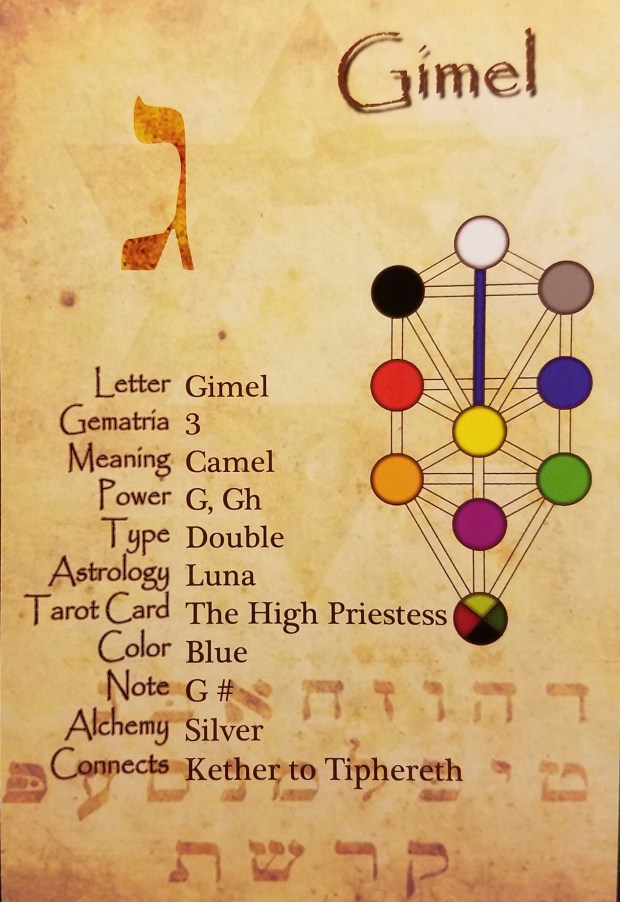
Contemplating Hebrew Letters || Gimmel

3

gimmel

rg

Ger

(The Stranger)

    When a stranger dwells among you in your land, do not taunt him. The stranger who dwells with you shall be like a native among you, and you shall love him like yourself, for you were strangers in the land of Egypt.

Leviticus 19:33–34

    The Old Testament repeats the theme of “love thy neighbor” many times, reminding us of our own times as “strangers in a strange land” so that we’ll be more sensitive to others in repressed or minority status. Because of your own history of enslavement, whether literal or figurative, you should know how it feels to be out of your element, and make an effort to include and accept those peoples who are different from you but who dwell in your midst.

    Although the time the Jews spent in Egypt was one of oppression, slavery, and humiliation, there was also a sense of having settled there, for better or worse. In fact, when Moses led the Jews out of Egypt and began the journey toward the Promised Land and liberation, half of the former slaves chose to stay behind, because to them, a familiar reality, even a horrible one, seemed better than the unknown. Even those who left with Moses at one point panicked in the face of the difficult journey and wondered if maybe they would have been better off back in Egypt, where at least they knew their routines.

    In a way, this desire to return to slavery makes sense—after so many years of living in one harsh reality, it’s an enormous task to change one’s mind-set to that of a free people. This is why we must be kind to the stranger, to encourage him to adapt to his new environment rather than returning to a damaging past. And even if the stranger is just “passing through” and not necessarily joining our specific community, we should encourage him to get the most out of his journey while he’s on it.

    The word Ger is usually translated as “convert,” and the verb form, Lagor, means “to dwell.” In this passage, we see that a Ger is not only someone who has officially converted into a new society or religion, but also a stranger, a foreigner who lives among a new set of people and customs. We’ve all been Gers at one point or another: We’ve moved to a new city, left home to go off to college, been transferred for work, traveled in faraway countries, or simply changed the way we look at the world, so we’ve all become converts of sorts along the way.

    To some extent, this “strangeness,” the definition of a “stranger in a strange land” is essential to Kabala. It may seem odd that this phrase is used in a positive way in traditional texts. But when you look at it from a kabalistic angle, it makes perfect sense: Sometimes you need to lose yourself in order to find yourself, sometimes you need chaos in order to show you the path to order and enlightenment, and sometimes you need to take the road less traveled in order to find the right path for you.

===

    The Gimmel comes to you when you’re suffering from improper judgment. You’re either feeling judged or are judging others unfairly, whether you realize it or not. You may feel like an outsider at work, in social gatherings, or spiritually. Conversely, you may feel too much like an insider, so much so that you don’t accept anyone outside of your immediate circle.

    The challenge is one of identity: We all have to strike a fine balance between knowing who we are and where we’ve come from, and accepting the Other in our lives as equally valid. This is certainly not an easy task. Knowing oneself is hard enough; accepting the Other is sometimes nearly impossible.

    Open yourself to new and different experiences: Hear the stories of the people you encounter on your life’s journey and appreciate where they’ve been, and share your own stories of exile and redemption. Only by opening to others and accepting them will you enlarge your worldview and be totally at peace with your own life.

Contemplating Hebrew Letters || Beth (“Bet”)

2

bet

lbb ldgm

Migdal Bavel

(Tower of Babel)

    The whole earth was of one language and of common purpose. And it came to pass, when they migrated from the east they found a plain in the land of Shinar and settled there. They said to one another, “Come, let us make bricks and burn them in fire.” And the brick served them as stone, and the lime served them as mortar. And they said, “Come, let us build a city, and a tower with its top in the heavens, and let us make a name for ourselves, lest we be dispersed across the whole earth.”

Genesis 11:1–9

    As children, we’re taught that the “Tower of Babel” story is a fable used to explain why we humans speak so many different languages and why we live in so many different corners of the world. We’re not often told the more sophisticated truth, which is that after the people built their famous tower (imagining that they could reach the heavens and from there rage against God), they were punished with the very thing they sought to avoid: dispersion throughout the world, as well as different languages.

    This dispersion is considered a punishment, for now the people who once were of “common purpose” are many different peoples, filled with differences and conflicts—a state of affairs that will lead to unrest beyond anything they’d imagined.

    The people of this early generation (the one following the first destruction of the world through the great flood, which we read about in the story of Noah) sought to use their unity of purpose against God instead of finding ways to use that gift for the good. They didn’t appreciate the gift of Oneness they’d been given, so they were punished with the very opposite state of affairs: They’d now face the challenge of having to learn to understand one another linguistically, culturally, and even geographically before they could accomplish anything as a group. They were reduced to a tower of babble—no one could understand a word anyone else said— and confusion (the Hebrew word mebubal means “confused”).

    Today, we know no other reality than one of diversity and cultural dissonance. But at the beginning of time, we were One. This Oneness, which is also a sign of closeness to God, was not able to withstand even a relatively short period of human history. The rest of time would be a gradual coming together again, a journey of Tikkun Olam (Healing the World) that would take thousands of years to achieve.

    In our 21st-century world, we’re just beginning to experience the spiritual repair, the Tikkun, for the Tower of Babel. Today we’re a global society; we understand each other’s languages; and we deal with one another on political, economic, and social levels all the time. The world is still in disrepair, but it’s getting a little better every day.

    The letter Bet, which corresponds to the number two, is also the first letter of the Torah. This is to teach us that nothing is ever as apparent as we’d like it to be. Starting the Torah with Bet instead of Aleph suggests that it’s important to always look at two sides of every picture—and never take anything for granted. We must see things from both the spiritual and material angles, from the black and white perspectives, and from as many points of view as possible.

    This is the lesson of Babel: To think that we as a human population can band together to change the forces of nature or to rebel against higher forces over which we have no control is the ultimate hubris. For this mistake, we needed to be separated and given different languages and spaces, to be spread about in such an extreme way that we long for the way things used to be, and to try to repair that damage so that we can one day become united for good.

===

    The Bet card comes to you in times of conflict. You’re seeing things in one way when you need to be looking at the situation from any number of alternate angles. Consider the question at hand from different perspectives, putting yourself in the opposite position and thinking about the various ways in which you can be proactive instead of merely reactive.

    Meditate on the story of the Tower of Babel. Imagine the heat of anger that prompted those people to build a mammoth tower.

Now breathe . . . and imagine how the world might have been had we not assumed that our strength and power could literally climb into the heavens and change the force of nature.

Nothing is as simple as we first assume; instead, life is a complicated web of perspectives and priorities. You can only find peace when you see things from many angles and then come to understand your own heart more truly.

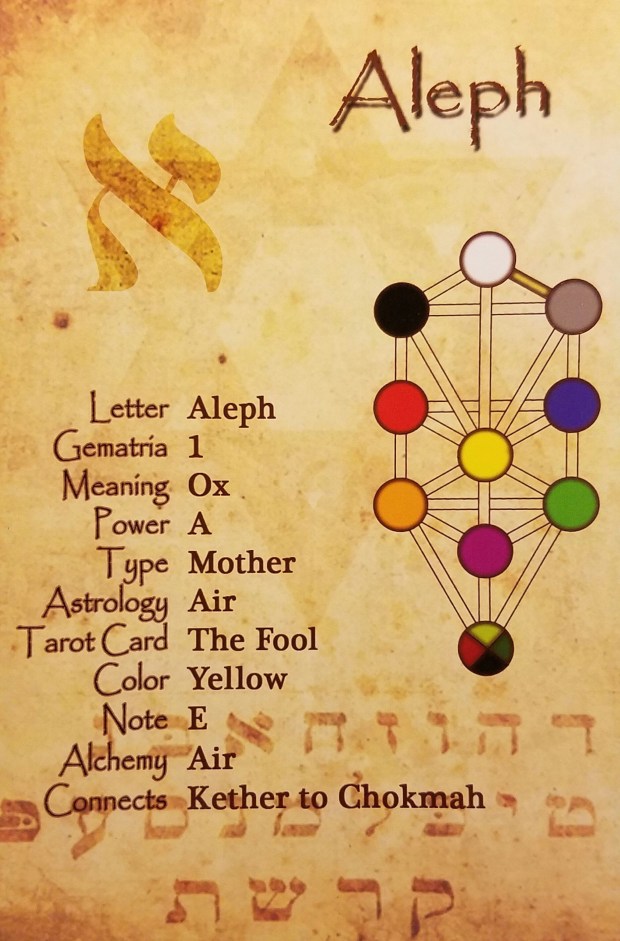
Contemplating Hebrew Letters || Aleph

1

aleph

Mrba

Avram

(Abraham)

    And God said to Abram, “Go for yourself from your land, from your relatives, and from your father’s house to the land that I will show you. And I will make of you a great nation; I will bless you, and make your name great, and you shall be a blessing.”

Genesis 12:1–2

    With these words begins the long journey of Abraham, the father of monotheism and the first Jew, through arduous deserts and foreign lands toward the discovery of a new faith and a new way of relating to God.

    Much has been said about why Abraham, of all people, was chosen for this task. The answer lies here: Beyond everything he later experiences, Abraham is first and foremost willing to take on this initial adventure, to leave behind all that is familiar to him—his country, his family, and his home—and begin again.

    You’ll notice that in this passage, Abraham’s name is spelled “Abram.” That’s because this story takes place before he’s truly proven himself, when he’s still in his original state of mind. Abram must go through a series of trials and tribulations before God endows him with the holy letter Heh, signifying his close connection to the Divine. Abram’s wife, Sarai, will also be renamed along the way, becoming Sarah, the first of the four matriarchs.

    The Hebrew term Lech Lecha, which are the opening words of the passage, literally means “you go.” In this instance, however, it’s used in the figurative sense—Abram is instructed not just to get up and go, but to “go for yourself” or “go toward yourself.”

    In other words, this passage reflects something much deeper than a physical movement into the unknown. The real journey is an inner one: Abram must leave behind his comfortable way of life, which is full of assumptions, and look deeper into his heart to discover what lies beneath. He must disrupt his routine in order to find something much greater—that is, the deeper truths of life.

    In kabalistic terms, this is the real greatness of the patriarch. He is the first to illuminate the path of self-discovery and “find himself.” It’s an active journey, one filled with many life-threatening risks and tests along the way, but it’s perhaps the most rewarding of all. It’s the journey that results in a new name, and a whole new life.


===


    The appearance of the Aleph card may be a sign that you’re unsure as to where your life is headed and that you want to know which direction to take. The Aleph, the first letter of the alphabet, comes at the start of a new adventure or at the end of an old cycle.

    Focus on the energy of Abraham in order to begin again, as if from scratch. Envision leaving everything behind and walking day by day into new spiritual and emotional territory. You know not what lies ahead, nor which direction is correct, but the journey is yours for the taking.

    Know that changing your life, and the lives of generations to come, begins with the very first step you take with faith in yourself and inner resolve.

The Laughing Gnostic — David Bowie and the Occult


What is art? What is rock music? It’s difficult to describe its codes, gestures, aestethics and its perception for the most part it is something that must be experienced, and only as an expression of culture — it being in a constant movement of restlessness and mirroring all graspable parts of society. How can the feverish emptiness of endlessly repeated ecstasy be transformed into something that can be felt and understood, something heard and seen and be purchased? After all, music is not only qualified through the consciousness of its creator but also through the states of mind created by its perceptors.  […]

Read more here:   http://www.parareligion.ch/bowie.htm

Contemplating Hebrew Letters || Tav (or Tau)

22
tav

vhbv vht
Tohu U’Vohu
(Vast Nothingness)*


    In the beginning God created the heavens and the earth. Now the earth was a vast nothingness, with darkness upon the surface of the deep, and the Divine Presence hovered upon the surface of the waters. And God said, “Let there be light,” and there was light.


Genesis 1:1-3


    *The words Tohu U’Vohu have no clear literal English translation. The phrase has been rendered as “astonishingly empty,” “unformed and void,” “formless and empty,” and “horrendous emptiness,” among others. “Vast nothingness” is our original translation.


    Have you ever wondered what the world was like before there was a world? How did the trees get here, or the mountains, or the sea? In every religion, there are myths and stories to explain the creation of the world, and in science there is the theory of evolution as well, but no one can ever know for sure how we came into existence.


    In this passage, the explanation is as follows: In the beginning of time there was simply nothing at all. There was a void, a black hole, stillness . . . and then God decided to start something new—to create a world and populate it, and to see what we might do with it.


    In Kabala, this nothingness is called Ein Sof(“Without End”) and is considered to be another name for God. According to the Zohar, in the beginning there was only God—and still today there is only God because we’re all made up of tiny fragments of His being, even though we have our own form. Kabalists believe that the state of nothingness, of primordial chaos, is a state that lasts throughout eternity. When we die our bodies become, in a sense, the same nothingness—we disintegrate and become formless and empty, just like the Tohu U’Vohuthat existed before there was a world in which our souls could be clothed in bodies. And so we go through an endless cycle of “nothingness” and “being” from life to life, throughout eternity.


    If there is one thing we learn from the Torah, it is that there are no clear beginnings or endings to any story. Historical accounts reverberate in the present day, and single letters can change the way a whole book is read. Even in the first lines of Genesis we see that the mystery is profound and eternal. Notice that in Verse 2, there is a mention of water, but water was only created on the second day. Or was it? We don’t know. This is to teach us to question assumptions and take nothing for granted.


    Chaos will become order because that is the natural tendency of the world, just as the vast nothingness turned into an enormous universe filled with amazing creations. But in order to make sense of the senseless, to make order out of chaos, we have to put our energy into understanding it all, questioning and rethinking all of our assumption.


    The Tav is the last letter of the aleph-bet and the first letter of the word Torah. Torah is the beginning of knowledge, the first explanation for life and human action, the first family and national saga. The end, therefore, is nothing but a beginning. We know by now that this is true: The end of nothingness is existence, and the end of existence is nothingness—and the completion of every stage in life leads us to the next stage. Global creation and the creation of ourselves are both eternal processes.


    The Tav comes to balance the Aleph. Although it also comes at the beginning of a new stage or the end of an old one, the Tav asks us to consider the uncertainty at hand rather than the solution or action to be taken. Chaos and order are part of the same process, and each are necessary to the other.


    This card encourages you to meditate on the vast nothingness, the emptiness of a world before there is night and day, light and darkness, earth and sea. Remember, we’re all part of this mystical state of mind, so let go of your assumptions and your earthly perspective. Allow yourself to experience the chaos of transition before you turn your energy toward the next stage of your life. The end is only the beginning.

Contemplating Hebrew Letters || Zayin

7
zayin

tbsh Mvy ta rvcz
Zachor et Yom HaShabbat
(Remember the Sabbath Day)


    Remember the Sabbath day to sanctify it. Six days shall you work and accomplish all your work, but the seventh day is a Sabbath to the Lord, your God; you shall not do any work—you, your son, your daughter, your slave, your maidservant, your animal, and your stranger who dwells within your gates—for in six days God made the heavens and the earth, the sea and all that is in them, and He rested on the seventh day. Therefore, God blessed the Sabbath day and sanctified it.


Exodus 20:8–11


    Zayin is the seventh letter of the alphabet, so it makes sense that the commandment to observe the day of rest, the Sabbath (which is the seventh day of the week in Judaism) begins with the word Zachor (“remember”). Why is the commandment to “remember” and “sanctify” rather than to “do” something active? And why does the passage say that not only should the heads of household cease from working, but the whole extended family should, too—down to the animals?


    Abraham Joshua Heschel, one of the great Jewish philosophers of the 20th century, wrote that the Sabbath brings us into the realm of time and away from that of space. Because we spend our whole lives envisioning the world in terms of physical things—objects we want to own, places we want to see, and so on—it’s important to take a day to focus on the invisible objects like “sacred moments” in time. You can’t see, touch, or hear a spiritual experience, but you feel it on a higher level, and you may remember it every day for the rest of your life.


    If you were to climb to the top of a mountain and take in the view, the sensation you’d feel—that awareness of the beauty of nature—is an experience of time, not space. You appreciate the physical view, yes, but your feeling of being at one with that physical world is entirely spiritual. This is what happens on the seventh day of creation: God has created the heavens and the earth, the seas, the animals and plants and humankind; and finally, on the seventh day, He takes a look at everything He’s done, decides to take a break, and makes that break a regular part of the rhythm of life on earth—a holy part.


    The Sabbath is the first thing in all of creation that’s described as “holy.” But how can you sanctify something that isn’t physical? How can a day, which is nothing more than a mental concept we use to mark time and keep track of history, become a holy object? Heschel answered that celebrating the Sabbath is a way of celebrating the “holiness of time,” a way to take control of our lives and focus on ourselves. And to do this properly, we not only have to cease from physical labor, but we need to place ourselves in an environment where everything around us, and everyone in our lives, also makes this break.


    For six days of the week we use our powers to dominate the world around us—working, building, creating new objects, and the like. It’s important, then, to use the seventh day to build up  ourselves, to cease working and just appreciate the beauty of the world around us. It’s as if the entire week is the hike to the top of the mountain, and the Sabbath is the rest we take when we get to the top—where we can finally see everything from a new perspective.


    In every religion there is a Sabbath day, though which day of the week it is varies from tradition to tradition. What unites them all is the concept of a day sanctified and set apart from the rest of the week. The concept of a day of rest is integral to Kabala as well—it’s the very heart of the act of restriction, the structure in our lives that allows us to gain so much by simply doing less.


    The Zayin card is a reminder that you need to stop and allow yourself to experience stillness.


    Weeks go by in endless repeating cycles of actions and experiences—work, eat, sleep; work, eat, sleep. We often think of periods of rest as a waste of time, but the truth is that stillness, meditation, and experiences of spirituality are the most rewarding moments of our life.


    Knowing and appreciating the value of the Sabbath day is one thing—remembering it, Zachor, is something different altogether. Knowing is theoretical; remembering is practical.


    Find a way to make the Sabbath a reality for you, a holy time apart from the rest of your week where you can just be and need not do anything.

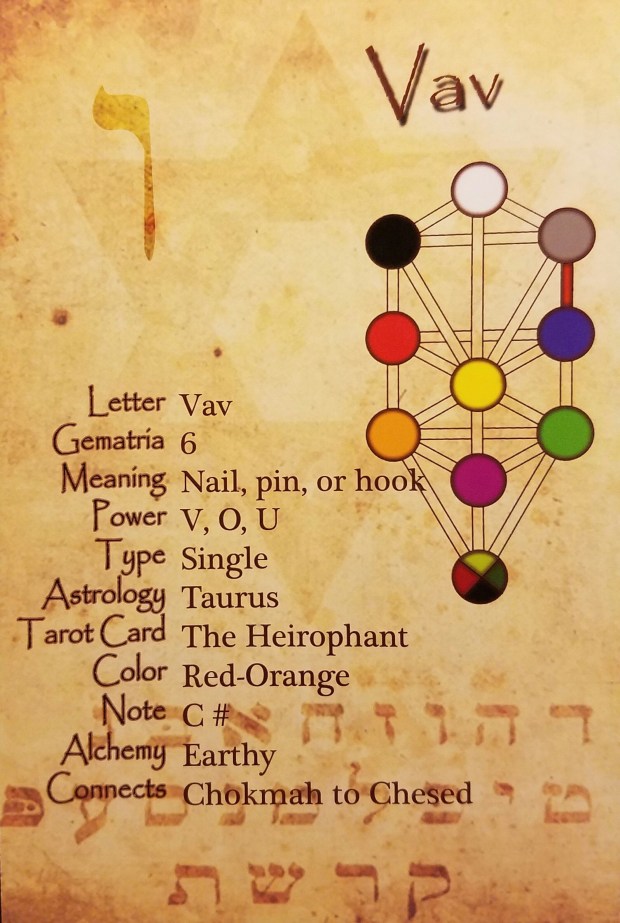
Contemplating Hebrew Letters || Vav (or Vau)

6
vav

yvdyv
Vidui
(Confession)


    When a man or woman who commits any of man’s sins, by committing treachery toward God, and that person shall become guilty—they shall confess the sin that they committed; he shall make restitution for his guilt in its principle amount and add unto it a fifth, and give it to the one to whom he is indebted.


Numbers 5:6–7


    The Jewish concept of confession and atonement for sins is based on this verse from the Bible, in which a person is dishonest regarding financial issues (theft, withholding salary, cheating a person on a loan, and so forth). Because these sins are considered not just an affront to the victim but also to God, God requires the sinner to repent, confess, and pay back the money he’s stolen with interest before he can be forgiven.


    The main prayer service of Yom Kippur, the Day of Atonement, is called the Vidui, which means “confession,” not “atonement.” It may seem odd that the main service of the heart on this holiest day of the year is filled with confessions that the penitent is meant to say aloud, sometimes together with the rest of congregation. After all, isn’t repentance an inner process, a personal discussion one has with God? The answer is yes and no. Although we repent in our hearts, without confession— that is, the act of saying “I have sinned” and admitting our guilt—we’ll never truly repent, gain atonement, or be able to move on, repairing the damage we have done.


    The letter Vav is most commonly known as the prefix used to denote the word “and,” and is seen hundreds of times thought the Bible as such, connecting words and concepts. Vidui serves a similar purpose: Because your past informs your present and future, being honest with yourself—that is, admitting your faults and expressing remorse for the things you’ve done wrong—will help to connect that past to the future in a more productive way. Expressing your guilt out loud and facing the consequences allows you to move on with your life and will help you truly reach a state of self-knowledge.


    It’s especially interesting to note that in Judaism the Vidui is said not only on Yom Kippur, but on one’s wedding day and on one’s deathbed. At traditional Jewish weddings, the bride and groom immerse in the mikveh (ritual bath), fast for the day leading up to their wedding, and recite Yom Kippur prayers just before they go to their ceremony. The bride also traditionally wears a white dress and the groom a white robe, called a kittl, which will in the future be worn to synagogue on Yom Kippur every year and eventually serve as his clothing for burial. The wedding day is known as a personal Yom Kippur for the couple, a day to reflect on their lives up until this point, realize what was lacking in those lives, and purify themselves both physically and spiritually for the future.


    The connections—the Vavs—between these three moments in life (the Day of Atonement, marriage, and death) are more than symbolic. The Vidui brings us to a place of purification and self-awareness that is crucial in every major life-changing event. Recognizing your shortcomings once a year, working toward a clean slate with which to start your married life, and making peace with God before you die are all essential elements of a truly fulfilled existence.


    The Vav card comes to you in times when it’s important to make a confession of some kind. This need not be a “sin” and isn’t a sign of any shortcomings. It’s just that from time to time we all need to admit certain truths to ourselves, to face up to our actions out loud, and accept responsibility for what we’ve done.


    The past will haunt you until it’s been properly dealt with, so don’t wait to take control of your life. Allow yourself to say what needs to be said. The rest will follow.

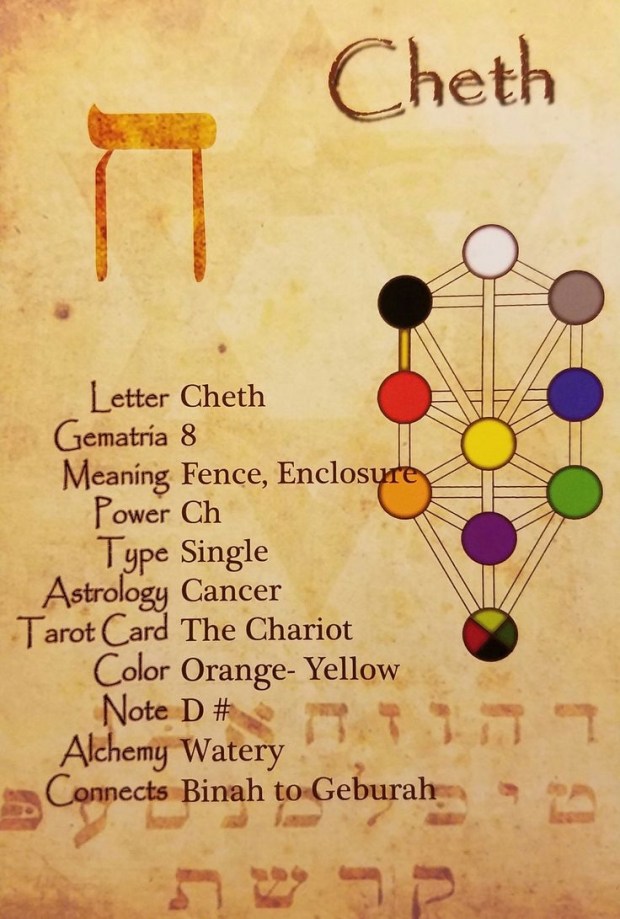
Contemplating Hebrew Letters || Chet

8
chet

hlj
Challah


    . . . when you will eat of the bread of the Land, you shall set aside a portion for God. As the first of your kneading you shall set aside a loaf [Challah] as a portion, like the portion of the threshing-floor, so shall you set it aside.


Numbers 15:19–20


    The Bible mentions the concept of “setting aside” many times: Corners of the field are to be set aside for the poor; the first fruits of every season are to be brought as offerings during harvest festivals; animals are brought as sacrifices in the Temple period; and ten percent of one’s earnings is to be set aside for charity. In this case, Jews are instructed to set aside a portion of the first loaf of every batch of bread they bake for the High Priest.


    Today, when there’s no longer a Holy Temple at the center of Jewish ritual life, and Priests don’t serve the same function, the commandment shifts: A piece of dough is taken from the first batch and thrown into the back of the oven to burn, symbolizing the destruction of the Temple and the exile that exists because of that destruction. There are many customs to reflect the loss of the Temple, such as replacing sacrifices with prayer services, using salt on bread to symbolize the bitterness of living in an imperfect world, and leaving a small part of a newly built home unfinished to commemorate the physical destruction of the Temple structure.


    But “Taking Challah,” as the custom is called, is more than merely preserving an ancient and now practically irrelevant commandment. By physically removing a small piece of dough and making it inedible, eventually discarding it altogether, we remind ourselves that everything we own is temporary. You may think that all of the dough is yours—after all, you paid for the ingredients, mixed them together, and watched them rise— but really, nothing belongs to you alone. You’re given the wheat and the eggs and the water from a higher source, and by letting some of it go, you’re acknowledging that source.


    The root of Challah actually has nothing to do with bread (which is called, in Hebrew, lechem). Instead, the root is chol, which means “ordinary.” The days of the week are separated into Shabbatand chol, Sabbath and weekday. Challah, a food made holy despite its ordinary origins, is made especially to be eaten on the Sabbath. Something as plain as wheat is elevated to a level at which it can be blessed and sanctified as an integral part of the Sabbath meal.


    The concept of Challah extends into our daily lives: We all need to learn the kabalistic lesson of sharing in order to balance the energy of the universe. What we own is never entirely ours, and we could never truly need every single object in our possession. It’s crucial to make giving a part of our consciousness, whether it is to acknowledge the higher force that guards us all, to remember the harsher realities of life, or to give thanks for what we already have.


    The Chet card comes to teach us how we can let go of what we do not need. We can survive on bread and water alone, yet we rely on incredible luxuries as if they were necessary.


    It’s time to let go. Donate clothes you no longer wear to a homeless shelter; take food supplies to a soup kitchen; make a list of your dependencies, and then set the list aflame. You will feel an increased freedom as a result.

Contemplating Hebrew Letters || Samech

15
samech

ynyo rh
Har Sinai
(Mount Sinai)


    On the third day when it was morning, there was thunder and lightning and a heavy cloud on the mountain, and the sound of the shofar [ram’s horn] was very powerful, and the entire people that were in the camp shuddered. Moses brought the people forth from the camp toward God, and they stood at the bottom of a mountain. All of Mount Sinai was smoking because God had descended upon it in the fire; its smoke ascended like the smoke of a furnace, and the entire mountain shuddered exceedingly. The sound of the shofar grew continually much stronger; Moses would speak, and God would respond to him with a voice.


Exodus 19:16–19


    Imagine being there at Sinai: Hundreds of thousands of people, slaves until just a few months before, are gathered together at the foot of a mountain in the desert—and smoke, fire, thunder, lightning, and the sound of the shofarblasting all lead up to the overwhelmingly awesome sound of the voice of God. How do you think this experience would make you feel?


    Legend has it that only the first two of the Ten Commandments were given directly by God, and the last eight had to come through Moses. The people were too overwhelmed by their first direct access to God to handle the situation—so, since they were familiar with his voice and it intimidated them less, they begged Moses to speak instead. (Although, as Bible scholars point out, every individual heard God’s voice differently, according to his or her own capacity and individual understanding, the direct experience of communication with the Divine proved to be more than they could handle.)


    There’s a tradition in Judaism that every single person in the world was at Sinai, and that those same souls have been reincarnated over and over again throughout the generations, even until today. That’s why this scene of the first mass Revelation in history is so compelling to us even now. There’s something in our souls that connects us to this event, remembers the fear that accompanied the excitement, and recognizes that in our most original state of being, we experienced it firsthand.


    The Samech is shaped like a circle, and it represents protection and safety. Although on some level they’re terrified, the people at Mt. Sinai also sense (though perhaps only subconsciously), that they’re going to be fine. When Moses hears their cries and takes over the enunciation of God’s words, the people are able to shield themselves from the frightening and foreign experience and take comfort in the familiar voice of their leader.


    Only once the sound shifts from the mighty, ethereal voice of God to the human one of Moses are the people truly able to comprehend the deeper meaning of the Revelation. Like a perfectly round wedding ring, the experience of Sinai is binding and limitless at the same time, extending to every generation through endless reincarnations. Although the people now have concrete rules and regulations, and have accepted upon themselves the responsibility to live accordingly—which might seem like a burden—they’ve also been guaranteed the ultimate protection and guidance of their God. As if they’re inside a metaphoric Samech, the people are now safely bound within the guidelines of their society, comforted by the permanence of it all.


    The Samech is your key symbol of safety and protection. Whether you’re in a place of transition or going about your daily routines without interruption, you may now and then feel like a lost lamb, unsure of your place in the world.


    Even when good things happen, we tend to question them and their place in the “bigger picture” of our lives. But the Samech reminds us that we’re always enclosed within the protective embrace of a higher force.


    Conjure up the experience of Sinai: Hear the foreign voice from above changing your reality day by day. You can conquer your fears and anxieties and quell your pride by focusing on the energy of the Samech.


    Remember that everything is part of the universal circle of life. The experience you have today leads to the one you’ll have tomorrow and so forth throughout lifetimes, and everything is just as it should be.

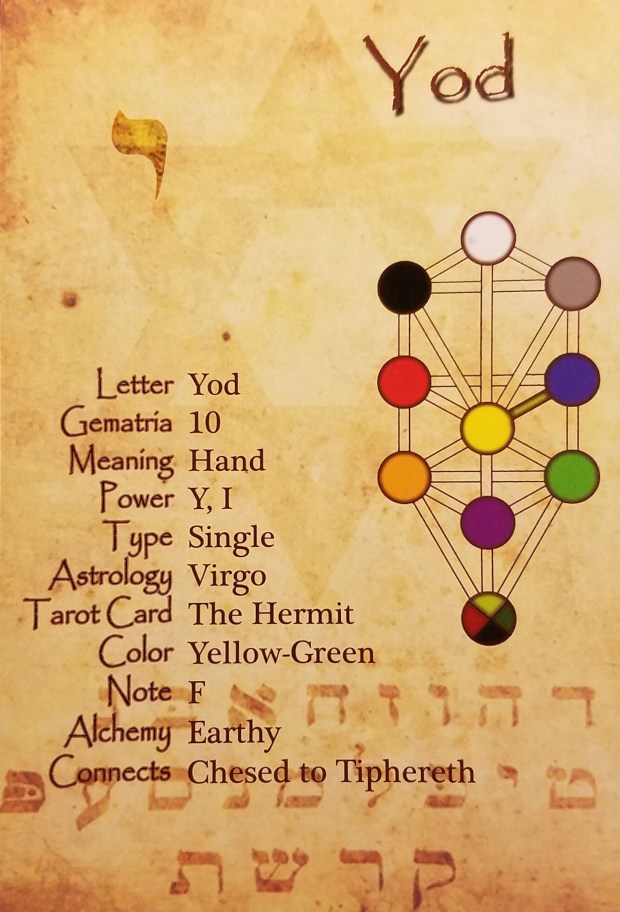
Contemplating Hebrew Letters || Yod

10
yod

PMvy
Yosef
(Joseph)


    Then Joseph said to his brothers, “Come close to me, if you please,” and they came close. And he said, “I am Joseph your brother—it is me, whom you sold into Egypt. And now, be not distressed, nor reproach yourselves for having sold me here, for it was to be a provider that God sent me ahead of you. For this has been two of the hunger years in the midst of the land, and there are yet five years in which there shall be neither plowing nor harvest. Thus God has sent me ahead of you to ensure your survival in the land and to sustain you for a momentous deliverance.”


Genesis 45: 4–8


    The story of Joseph is one of the most dramatic in all of history. Born to Jacob as the first child of his beloved wife, Rachel, Joseph is one of the 12 sons who will comprise the 12 tribes of Israel. But Joseph is unlike his brothers who are the sons of Leah and two maidservants— he’s clearly the favorite and the spiritual inheritor of the family. He and his younger brother, Benjamin, who was born to Rachel just before her death, have always been treated differently than the other ten boys.


    When, as a teenager, Joseph begins to have dreams of superiority—dreams in which he foresees that his brothers will one day bow down to him—his siblings decide that they’ve had enough of this “dreamer.” They throw him into a dark pit and sell him into slavery. Afterward, they take his special multicolored tunic and soak it in blood as “proof” that he’s been killed. They then return to Jacob and report their brother’s “death.”


    However, rather than fading into obscurity and a life of slavery, once in Egypt Joseph is able to use his talents to rise to the top, interpreting dreams and gaining a reputation that will lead him to the Pharoah’s palace to interpret the ruler’s inexplicable visions. When Joseph is able to see the hidden message in the Pharaoh’s dreams of seven skinny cows eating seven fat ones as the sign of seven years of plenty followed by seven years of famine, he’s promoted to be the Pharaoh’s second in command and makes his way into the Egyptian leadership at a crucial time in history.


    When the famine begins, Jacob sends his remaining sons to Egypt to gather provisions—and they come into contact with the brother they’d betrayed so many years ago. Not recognizing Joseph as an adult, his brothers bow down to the man they see as an Egyptian leader.


    After many months of testing the men and sending them back and forth from Egypt to Canaan, Joseph finally reveals himself as their long-lost brother and sends for his father. After all this time, his original dream has finally come true: He’s established himself in such a position of power that his brothers bow down to him, and they fear his revenge. But rather than express his anger and pain, Joseph tells them that he’s come to realize that everything leading up to this point— their jealousy and their plot against him, his time served as a slave, and so forth—was all meant to be, because as a result, he was able to provide food for the family in a time of overwhelming famine.


    Most of us cannot imagine being as “big” as Joseph was under the circumstances. Our anger over past wrongs becomes the dominant force in our actions. But Joseph, perhaps because of the amount of time that had passed, or because of his innate sense of the predestined nature of the world, looks at his reunion differently: He does want to make sure his brothers are sorry for their actions, but once he senses their remorse he seems to let go of his own anger and need for revenge. In this way, Joseph is able to focus on the present instead of the past, willing to move forward with his now reunited family.


    Joseph’s whole life has been one of dreams and their fulfillment. Having been born a dreamer, he’s known all along that the images he saw in his mind weren’t just figments of his imagination but signs of things that would actually come about in real life. As a young man, this awareness was looked at as snobbery, but as a mature adult, sobered by his difficult experiences, his gift was appreciated and led to the ultimate reunion of his family.


    The Yud, as the smallest letter in the alphabet, is often thought about as a “point.” This tiny point lies at the center of our hearts—it’s the driving force that takes us from one stage of life to another, the motivation that follows us through every action we perform. Joseph suffered for his essential point (his talent), but with time it became clear to everyone that he was not just a dreamer but a prophet, and that all of his dreams would one day become reality.


    The Yud appears in moments of spiritual or physical darkness. Like Joseph, you’ve been cast into a metaphorical pit and must redefine your life. You may feel misunderstood, underappreciated, or simply confused—the only way out of this darkness is by recognizing the small point in your soul that leads you forward in life.


    Joseph teaches the power of believing in yourself. You must always know that your life is full of purpose, and that everything that happens to you occurs for a reason. The key to personal fulfillment lies in recognizing your uniqueness and then learning how to apply your special talents in order to change your world and come to an enlightened understanding of your past, present, and future.


    Meditate on the power of forgiveness. Strive to be more like Joseph, who, as a result of forgiving his brothers for their actions, pulls his family together again.

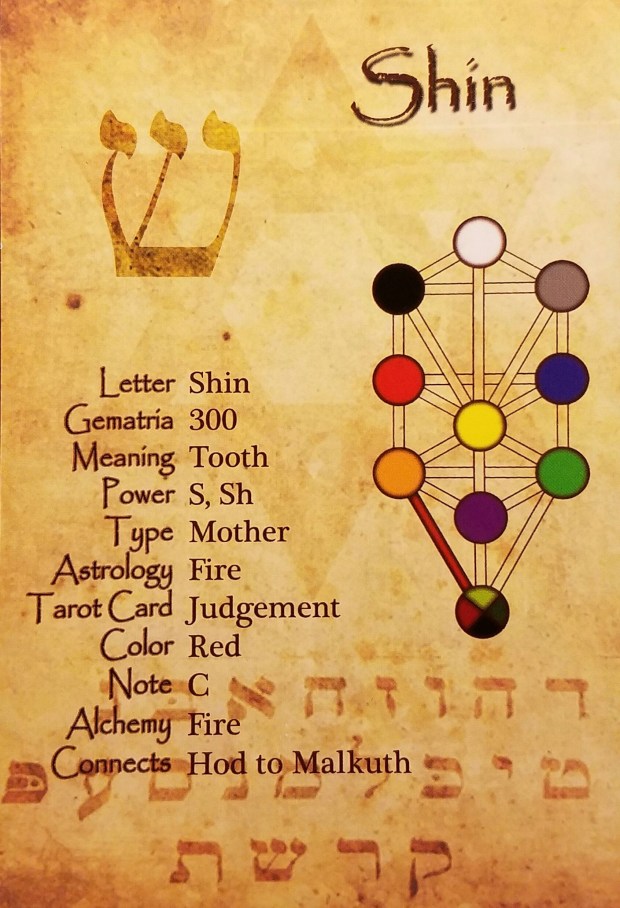
Contemplating Hebrew Letters || Shin

21
shin

Shema Yisrael
(Hear, O Israel)

    Hear, O Israel: The Lord is our God, The Lord is One.

Deuteronomy 6:4

    This single line, Shema Yisrael, Adonai Eloheinu, Adonai Echad, is considered the cornerstone of Jewish faith. The first prayer taught to young children and the last prayer recited on one’s deathbed, in its simplicity and brevity this line captures the ultimate lessons of life: God is One, we are One, everything is Oneness. Described throughout the ages as the ultimate meditation tool and declaration of faith, the Shema, as it is known, is one of the most important sentences in the world.


    Before the Jews finally enter the Land of Israel after 40 years of wandering in the desert, Moses recaps their experiences since the Exodus. He recounts the revelation at Mount Sinai and the giving of the Ten Commandments, and then proceeds to explain those commandments in preparation for living in a world where they will be relevant. In the midst of this he utters the Shema, followed by the instructions: “You shall love the Lord, your God, with all your heart, with all your soul, and with all your resources” (Deut. 6:5).


    What we learn from this is that faith is not just a matter of belief but of totality. To believe is to feel it on every level—emotional, spiritual, practical, and even physical (the Shema is inscribed in the scrolls kept inside mezuzahs, traditional ornaments affixed to the doorposts of homes).


    In order to really say the Shema, you have to be convinced of it on every level. In fact, if you look at the Hebrew text as it is written on a Torah scroll, you’ll see that the last letters of both the first word and the last word of the sentence—Ayin and Dalet—are written twice as big as the other letters in the line. When you put the Ayin of Shema and the Dalet of Echad together, you get the word Ayd, which means “Witness.” Only if you are truly a witness to something can you fully comprehend it. And to truly hear what this prayer is about, you must witness its power for yourself.


    The Shin is the first letter of the words Shalom(“peace”) and Shalem (“complete” or “whole”), so to feel like a complete person is to be at peace with oneself. To feel the wholeness of the universe—the single life force that propels all of us and the world around us—is to also find peace, to hear the lessons of the universe explained.


    Traditionally, this prayer is said sitting down, with one’s eyes closed and the right hand covering them. Each word should be said slowly and focused on, one at a time. Doing this blind meditation teaches us to slow down, to minimize, to block out all outside interference, and to recognize that everything comes down to the single, original source of energy and light. In other words, despite our diverse backgrounds, we all come from the same place. When we truly recognize that unity is the goal of all life, that reconnecting with our origins is essential, we will have achieved wholeness.


    The Shin is the beacon of peace and wholeness. By focusing on the Shemameditation, you can truly connect with the Oneness that is central to Kabala. Hear the lesson and make the statement true for yourself.


    Realize that in the end, we all come from the same source. Close your eyes and focus on the light of creation . . . know that you are part of that light—we all are. You can find peace when you truly accept this principle and witness it for yourself.

Esoteric Art || The Most Comprehensive Exhibition of Leonardo da Vinci’s Work is Coming to Denver

Leonardo de Vinci’s work has lived through generations. He was many things — inventor, artist, scientist, anatomist and architect, to name a few — and his extraordinary legacy has been  […]

Source: The Most Comprehensive Exhibition of Leonardo da Vinci’s Work is Coming to Denver

Frater S.C.F.V on the Glitch Bottle Podcast

Frater S.C.F.V's avatarLight in Extension: A Magical Journal

Glitch Bottle#033 – Solomonic Bells, Wands & Consecrations (Oh My!) with Frater S.C.F.V.

By Frater S.C.F.V

I recently had the great pleasure and honour of appearing on Alexander Eth’s fantastic Glitch Bottlepodcast. We discussed my own multitraditional spiritual background, Solomonic grimoires, Dr. Stephen Skinner’s interesting typology of magic, Mystery, and religion, Wand traditions, Bells and Trumpets of Art, Circles, binding, Consecration by Mass, scrying, cryptoconsecratio, Angelic invocation, and a host of other fascinating topics of magical theory and practice. Please feel free to share any comments or questions you may have. Thank you!

In LVX,
Frater S.C.F.V.

View original post

Musings …

“The moment we turn from a bad habit that is destroying us, and by our own character resolve and determine to live better, the moment we conquer some weakness in ourselves or overcome a prejudice or overcome hatred, or overcome some form of inadequacy in our own nature, at such moments we experience the beginning of our maturity. That is the time we come of age.”

– Manly P. Hall, The Moment of Self-Consciousness, 1971, p.16

Divination with St. Cyprian – Insights on the Shadow and First Pentacle of the Sun

Frater S.C.F.V's avatarLight in Extension: A Magical Journal

By Frater SC.F.V.

Date: November 24, 2018
Sun Phase:Set
Moon Phase:Waning Gibbous (206 degrees) in 28 degrees Gemini
Mansion of the Moon:Dhira
Planetary Day:Day of Saturn
Planetary Hour:Hours of Mars and the Sun
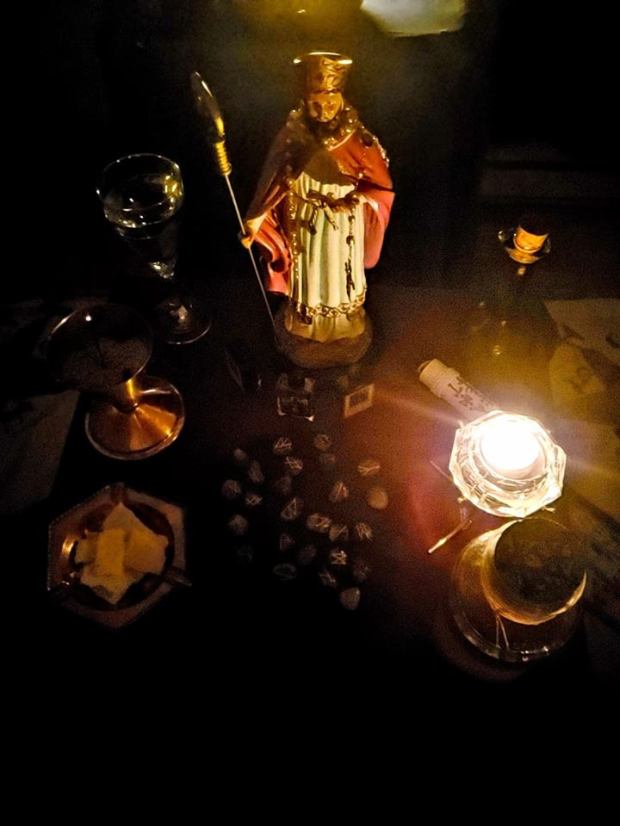
Activities: SolomonicRitual Purification by Water; Solomonic Bell Sounding to the Spirits of the Quarters; Offerings to the Most High and Saint Cyprian; Prayers; Rune Divination with St. Cyprian; Temple Closing

Today, the Moon is in the 7th Mansion of Al-Dhira, a time when it is auspicious to seek and strengthen friendships and give and receive assistance. About this Mansion, the Picatrix (11th century) says:

“The seventh Mansion is Aldira, and it for the acquisition of all good [things]. When the Moon has come around to this Mansion, fashion a seal of silver, and sculpt the image of a man clothed in robes and with his hands extended to heaven after manner…

View original post 1,879 more words

On Initiation Into The Path Of Light …


“Heed these words, you who wish to probe the depths of Nature:

If you do not find within your Self that which you seek, neither will you find it outside.

If you ignore the wonders of your own House, how do you expect to find other wonders?

In you is hidden the Treasure of Treasures.

Know Thyself and you will know the Universe and the Gods.”


— Temple of Apollo at Delphi, by Proxy of Luxor, Ancient Egypt

Why is Yesod in Air and Hod in Water?

A common query among those working the Golden Dawn system is why the Sephirah Yesod (and Theoricus) is attributed to Air instead of Water (after all, it is linked with the Moon, which affects the tides), and why the Sephirah Hod (and Practicus) is attributed to Water (when it is also assigned to the more intellectual, or airy, planet of Mercury). It almost seems like it’s reversed, an apparent elemental inconsistency.  […]

Source:  Yesod In Air, Hod In Water