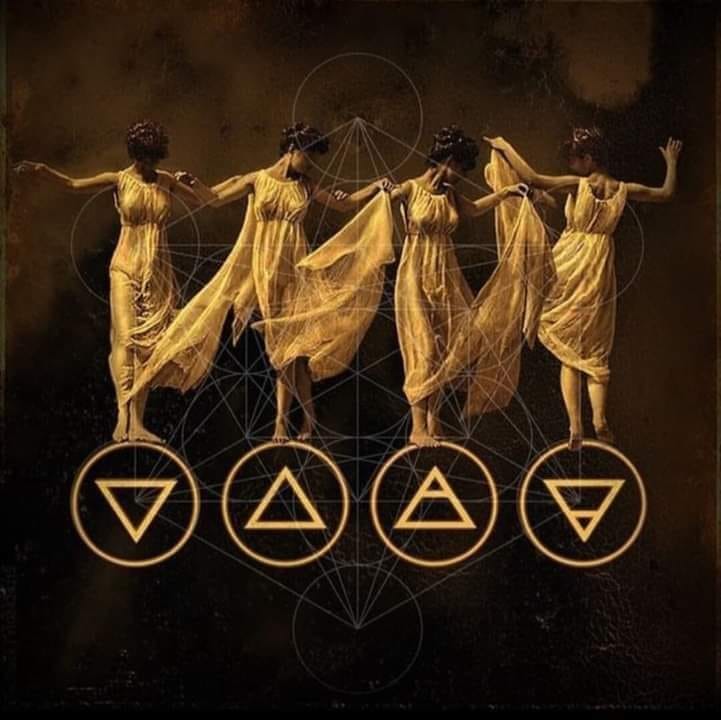
Theosophy | SELF-EMANCIPATION – III

 In order progressively to dissipate and dissolve the elements by which, through the desire for consolidation, people limit and bind themselves, the persisting root of illusion must be sought in the mind. The mental image of oneself as separate from other human beings, feverishly moving places but periodically depressed if not ascending all the time, is entirely false. Each human being is merely one of myriads of centres of sensation and observation, but while such centres in the lower kingdoms have a certain precision, humans are all too often lazily and inefficiently trying to observe and record on the basis of mayavic conceptions amidst a kind of day-dreamy existence. It is an important and difficult task to cut through this veil of illusion, and this can only be done by coming down from the cosmic to the mundane. First, one must rise upwards to a cosmic perspective and perceive the whole universe from a unitary standpoint. Then one can come down to oneself and one’s daily orbit of duties and obligations. Human beings are assuming an impossible task when they attempt the opposite, starting with the lower self and then trying to dispel their root illusions. Only by ascending to the universal and then descending to the particular can one find greater meaning in every atom and every aspect of oneself, as well as every event upon life’s journey and the soul’s pilgrimage.

 Hermetic wisdom holds that everything in the universe follows analogy, that as it is above, so it is below, and that man is a microcosm of the universe. H.P. Blavatsky expresses this axiom in exact terms which clearly show the critical relevance of the evolution of human mentality to corresponding transformations in the subhuman kingdoms: “That which takes place on the spiritual plane repeats itself on the Cosmic plane. Concretion follows the lines of abstraction; corresponding to the highest must be the lowest; the material to the spiritual.” Pointing to the dangers of the anti-intuitive, or below-above approach to the task of liberating consciousness from the bonds of form, she warns: “It would be very misleading to imagine a Monad as a separate Entity trailing its slow way in a distinct path through the lower Kingdoms, and after an incalculable series of transformations flowering into a human being.” To think in such a limiting and linear way is to repeat the error of nineteenth century Darwinian speculation, effectually cutting oneself off both from the prospects of emancipation and the possibilities of service to the entire life-stream of evolution – monadic, mental and astral. To think of oneself and a tiny pebble, and to suppose that the pebble or stone is a separate entity which will eventually become an equally separate human being, is essentially false.

 The Monadic Host is a collective force below the human level, working conjointly, by descent of Spirit into Matter, to raise all that which has become differentiated to a higher power of porosity or luminous reflection of intelligence. Until the human stage the indestructible monadic spark of the One Central Fire is only collectively involved in evolution as part of the great Monadic Host. At the human stage it becomes creatively capable by the potent power of self-reflection, Svasamvedana, of being able to consider itself as an object of its own thought and imagination. This is an extraordinary power, denied to the animal, which the human being has, the sacred gift of visualization. Thought is an essentially divine power belonging to human beings, and when exercised properly it can become an irresistibly potent agent of transformation in human nature and Nature in general. The collective Monadic Host in its descent is only a vast collection of creative centres because the atom “is not a particle of something, animated by a psychic something, destined after aeons to blossom as a man. But it is a concrete manifestation of the Universal Energy which itself has not yet become individualized.” The human Monad is that same universal energy, not separate in any way, but individuated.

 Many of the problems that arise in trying to understand this process are due to thinking in terms of terrene rather than aquatic analogies. When one thinks of the ocean, it is clear that there is no less differentiation there than on the earth. But the untutored and ungoverned senses are practised liars. Hence there is a profound need for true science. Occultism begins in the recognition that raw sense-perceptions not only tell nothing, but are actually poor reporters of inaccurate information. They falsely convey an impression that there are myriad separate things ‘out there’. This is why people who close their eyes and begin to meditate work hard from early on to destroy this delusion. It is sometimes held that this misconception is strong in human life because of the deception of language and the actual activities of naming and particularization, but these themselves arise merely from a priori consolidation in consciousness of one’s image as a separate being. These psychological differentiations exist only as incomplete reflections.

 In essence, there is no differentiation. All drops in the ocean are within one great collective being, and the moment one speaks of ‘drops,’ this is only in relation to some water taken out of the ocean and put in a jar. These are ephemeral ‘drops.’ What applies to the ocean also applies to the earth and everything else, contrary to what the casual eye reports. To understand this truly at its root requires the return, through the power of abstract meditation, to the noumenal source of consciousness, and then smoothly descending in concentrated thought. One thus takes hold of a single torch in the darkness, lighting it up, and through it one may light up other receptive beings. In a sense this is mayavic because all Monads are exactly the same, whether manifest or not, whether illuminated or in darkness. Yet, to recover a sense of true being independently of what has happened in the external fields of sensory contrast, material disaggregation, seeming cohesion and dispersion, and mayavic manifestation, is to recover a noetic sense of the entire ocean and its invisible, unfathomable depths. Then, as Manasa, one may readily appreciate the depth of responsibility implied by the statement that “The ocean (of matter) does not divide into its potential and constituent drops until the sweep of the life-impulse reaches the evolutionary stage of man-birth.”

Raghavan Iyer
The Gupta Vidya III

Theosophy | SELF-EMANCIPATION – II

 The spiritual will alone is constantly able to alchemize, renovate and refine the life-atoms of the vestures, increasing their lightness and porosity to Divine Light. When the vestures are suffused by that Light, it becomes possible to think, feel, act, breathe, smell, taste, touch, see and hear benevolently. One is enabled to employ Divine Wisdom as a science governing every relationship to the atoms that one touches and blesses. The process of refinement involves the full and vast range of Monads that have passed collectively through the various kingdoms at different levels, coming down from the most ethereal in the early Rounds to the existing fourth stage with its kaleidoscopic variety of alternative opportunities for apperceptive and perceptive consciousness. Passing this mid-point, the cycle of monadic evolution moves upwards again to that plane which was in the beginning a state of spiritual and intellectual unconsciousness for the Monads, but which must become the plane of universal self-consciousness for perfected Monads by the end of the Seventh Round.

 Behind and beyond all these changes of state and form there remains, unchanging and intact, one and the same Monad. It is an inward centre of light which does not participate in all the many alterations that affect the vestures. To put it differently, there must be beyond all the material vestures the perpetual motion of the Atmanwhich is the indwelling noumenal and invisible core of every Monad. Those who regularly meditate derive much benefit from the instruction of the Catechism of Gupta Vidya, which teaches one to draw inwards in consciousness to an inmost noumenal centre or point, which then immediately becomes a point in a line, a point in a cross, and finally the central point in relation to all possible forms. By entering into the Divine Darkness of pure abstraction, by becoming a Point without extension and receding behind all the planes of differentiation, one removes all awareness of forms and all evidence that there are many Monads. In the absence of manifest light, one experiences a deeper sense of the unity of all Monads and fundamentally destroys the all-pervasive illusion that there are many different beings separate from each other, sitting or moving in their separate bodies. Krishna teaches that the Eye of Wisdom has the intrinsic capacity to distinguish Spirit itself from a world of diverse objects and ultimately destroys the persisting illusion of manifold objects. When noetic consciousness has majestically risen above separations of objects and forms, it now experiences the world differently, omni-dimensionally and in depth, entering the noumenal realm of what is unmanifest on the illusory plane of contrasts, beyond which there is the homogeneous plane of radiant matter, which lends luminosity to the subtlest vestures of the immortal Soul. This elevation of consciousness to a laya point is an experiment through which one can visualize at a preliminary level the plenitude of the field of noetic ideation, but it may be taken even further and simultaneously applied to all classes of human beings throughout the earth. This requires the progressive deepening of one’s perception through intense meditation, so that over a period of time one may gain a greater sense of the noumenal depths of life-energy, and the magical properties of the Alkahest, the universal solvent.

 The Monad, which is essentially ever the same, participates through the various vestures in succeeding cycles of partial or total obscuration of Spirit or of Matter. Everything occurring in daily life could be seen entirely in terms of the continuous ascent or descent from the One, or in terms of obscuration and illumination, but these could pertain either to Matter or to Spirit. Once one has grasped this philosophical and metaphysical basis for comprehending the complex scheme of monadic life and transformation, one can reckon with the fact that there are seven kingdoms of Monads:

 The first group comprises three degrees of elementals, or nascent centres of forces – from the first stage of differentiation of (from) Mulaprakriti (or rather Pradhana, primordial homogeneous matter) to its third degree – i.e., from full unconsciousness to semi-perception; the second or higher group embraces the kingdoms from vegetable to man; the mineral kingdom thus forming the central or turning point in the degrees of the ‘Monadic Essence,’ considered as an evoluting energy. Three stages (sub-physical) on the elemental side; the mineral kingdom; three stages on the objective physical side – these are the (first or preliminary) seven links of the evolutionary chain.

The Secret Doctrine, i 176

 Between the three elemental kingdoms on the subjective side and the vegetable, animal and human kingdoms on the objective side, lies the mineral kingdom. Poised in the fourth, or balance position, the Mineral Monad becomes crucially important. Indeed, one cannot understand either Evolution or Magic without apprehending the process of immetalization through which the abstract Monas reaches a maximum of condensation in the mineral kingdom. After this stage there comes a rapid dispersion, a continuous loosening up, which then produces the three kingdoms on the ascending arc. Viewed in one way, there is “a descent of spirit into matter equivalent to an ascent in physical evolution.”

 The more Spirit descends into Matter, the more there is conscious evolution on the physical plane. This is part of the cosmic sacrifice, because the bringing down of Spirit into Matter enables the latter at a greater level of density to evolve further and thus be quickened by noetic intelligence. If, for example, one handles with natural reverence and spiritual wakefulness any so-called object, which may seem to be a book, a piece of jade or a wristwatch, but which is actually an aggregate of elementals and life-atoms, then one can wisely instruct and initiate. Those who are truly awake spiritually can take anything, and with selfless love they can quicken latent intelligence, vivifying active awareness and higher self-consciousness. It is not as if there is not much to do in this visible universe. At any given moment one can touch and elevate every sentient point of energy. Looked at in this way, all life becomes extraordinarily meaningful, holding innumerable opportunities to aid monadic life in “a re-ascent from the deepest depths of materiality (the mineral) towards its status quo ante.”

 Since reascent implies a corresponding dissipation of the concrete organism, it is frightening to most people as it means the renunciation of identification with the sense of being in a body. Hence it is a disadvantage for them to have clocks and calendars. By thinking in terms of the distance or closeness in years to birth or death, and the waste of time since the birth of the body, little indeed is done for the care or tendance of the immortal soul. Seeing this makes many people nervous, but this is to lose the proper perspective. One must see all life in the context of the invisible whole. One cannot reascend consciously without a progressive series of dissipations and a continual breaking up of skandhas accumulated throughout a lifetime. For instance, an emotional person needs to reduce the liabilities of the lower vestures to certain basic patterns of consolidation and break up these unhelpful clusters at their very core. Whence the need to belong? What is this concern to appropriate? Whence the desire for material or psychological security? One must burst the consolidating sources of emotion in order to keep pace with forward Manasic evolution. Humanity is in the Fifth Race of the Fourth Round, the long epoch of Manas, and to be emotional is only to go racially backwards. To catch up with the forward impulse of humanity in the Fifth Race means becoming a self-sufficient being of creative thought and deep meditation, freed from the evanescent impulses of mere emotional reaction.

Raghavan Iyer
The Gupta Vidya III

Theosophy | Self-Emancipation – 1

BUDDHI YOGA

Every form on earth, and every speck (atom) in Space strives in its efforts towards self-formulation to follow the model placed for it in the ‘HEAVENLY MAN.’

The Secret Doctrine, i 183

 Monadic evolution aims initially at establishing individuated centres of human self-consciousness. Once millions upon millions of these have emerged under natural law, the distinctive purpose of human evolution thereafter is to arouse and activate universal self-consciousness through a series of progressive awakenings. The monad “in its absolute totality and awakened condition” as “the culmination of the divine incarnations on earth” represents a critical state which will be fully perfected at the end of the Seventh Round by the whole of humanity, under the common cosmic laws of growth and retardation. In this long process there are many casualties and tragedies, but there are also shining examples of truly heroic, Promethean self-emancipation by moral geniuses. Having sunk into the depths of matter, such exemplars have pulled themselves up by self-effort and emerged through creative suffering into exalted states of enlightened consciousness, through which they could keep pace with the Avataric Saviours and Teachers of the entire human race. At all times the spiritual vanguard at the forefront of human evolution points towards the noetic possibilities of human life and architectonic perfection in spiritual consciousness. Every creative advance in monadic evolution depends upon the critical range and potent fullness of self-consciousness. Through its depth of perception in reference to the world, it impels a natural movement towards the Heavenly Man, the Divine Prototype, the Daimon of the immortal Self in every human being. By withdrawal from the selfish clutches of the grosser vestures and the demoniac tendencies, the human Monad reascends through Buddhi Yoga to the state of transcendental union with its parent Self, the universal Ishwara, the Logos in the cosmos and the God in man.

 The degrees of differentiation in the Monadic Host below the human kingdom, as well as the distinctive marks of the human Monad, are conveyed by H.P. Blavatsky in a critical series of propositions which commences with a reference to the earliest period in the ethereal formation of the earth chain:

 The Monadic Host may be roughly divided into three great classes:

 1. The most developed Monads (the Lunar Gods or ‘Spirits,’ called, in India, the Pitris), whose function it is to pass in the first Round through the whole triple cycle of the mineral, vegetable, and animal kingdoms in their most ethereal, filmy, and rudimentary forms, in order to clothe themselves in, and assimilate, the nature of the newly formed chain.

The Secret Doctrine, i 174

  These Monads come over progressively from the previous lunar chain in a series of stages in order to animate all the nascent forms in the coalescing matrix of the earth chain. These lunar forms, extremely subtle and refined in the First Round, incipiently belong from the first to the seven different kingdoms. Then come “those monads that are the first to reach the human stage during the three and a half Rounds.” This great descent of the Monadic Host does not take place all at once, but over immense cycles of manvantaric time, and according to the innate characteristics of these Monads, reflecting an inherent sevenfold division. Owing to the degrees of development that have already taken place, all human Monads roughly fall into seven classes connected with the seven cosmic hierarchies, the seven planets and other sets of seven in Nature. They come therefore in a certain order, and those Monads that are the first to reach the human stage during the three and a half Rounds become Men, or attain to self-consciousness, by the middle of the Fourth Round. These constitute most of Humanity.

 The key to the internal continuity of this entire process, linking together these various stages and phases on diverse planes and globes, is given in the ideational power of the Monad, manifesting as self-conscious intelligence:

  The MONAD emerges from its state of spiritual and intellectual unconsciousness; and, skipping the first two planes – too near the ABSOLUTE to permit of any correlation with anything on a lower plane – it gets direct into the plane of Mentality. But there is no plane in the whole universe with a wider margin, or a wider field of action in its almost endless gradations of perceptive and apperceptive qualities, than this plane.

The Secret Doctrine, i 175

 The term ‘mentality’ is used here to indicate Manas or self-consciousness, and has little or nothing to do with what is normally called mind or brain-power. Manasic beings function on a plane of consciousness saturated with inexhaustible possibilities for mental creation acting through ideal projections, pictures and images. Through this power, or rather through its truncated specialization on the plane of incarnation, all human beings, most of the time unconsciously and ignorantly, are constantly creating affinities with different classes of living centres of energy. Since there is no intrinsic difference between Spirit and Matter, but only an extrinsic difference of degree, the two are inseparable, and one can neither find ideation without substance nor energy without form. This continual coalescence or interaction of energy and form, of ideation and substance, is a pervasive principle in this dynamic universe of ceaseless change and has an intimate bearing upon the whole course of human evolution. Not only do human beings experience alterations of state in the brain-mind and modifications of the vestures at every moment, but correlative changes are also experienced at the level of cohesion in the mineral kingdom, and at the level of instinct in the animal kingdom. In the human kingdom these interrelated changes encompass emotion and feeling in the realm of ‘affect’, the sense of comparison and contrast, identification and differentiation, in the realm of intellectual awareness, as well as the power of noetic discrimination in recognizing subtle nuances of meaning and in the continual interplay of light and darkness.

 These evolutionary processes on the plane of mentality produce the human sense-organs, which are perfected through imaginative precision. Indeed, they must be contemplated calmly and carefully, as without proper mental attention they will remain under-utilized. Most persons are barely able to tap all that is possible even within the entire range of the seven sense-powers. Most people barely hear, barely see, barely touch, barely taste and barely smell, much less activate higher sense-powers. As an obvious example, anyone who develops a refined ability to differentiate the most subtle fragrances will regard the ordinary sense of smell as extremely crude. This would be true not only in regard to herbs or perfumes, but especially in regard to the familiar experience of cooking. It is quite possible to develop and refine the capacity to recognize the invisible essences underlying what seems to be physical food, and to be directly aware of the myriad effects of different combinations of spiritual essences upon the sevenfold human constitution, with its latent forty-nine fires. Such sensory refinement has to do with wise magnetic attunement, and vitally affects the vestures in both their constitution and composition. The alchemical process of distilling the combinations and correlations of essences in each of the invisible vestures proceeds through etherealization which must necessarily work through the spiritual will.

Raghavan Iyer
The Gupta Vidya III

Theosophy | INTEGRATION AND RECURRENCE – I

If, on the one hand, a great portion of the educated public is running into atheism and skepticism, on the other hand, we find an evident current of mysticism forcing its way into science. It is the sign of an irrepressible need in humanity to assure itself that there is a Power Paramount over matter; an occult and mysterious law which governs the world, and which we should rather study and closely watch, trying to adapt ourselves to it, than blindly deny, and break our heads against the rock of destiny. More than one thoughtful mind, while studying the fortunes and reverses of nations and great empires, has been deeply struck by one identical feature in their history, namely, the inevitable recurrence of similar historical events reaching in turn every one of them, and after the same lapse of time. This analogy is found between the events to be substantially the same on the whole, though there may be more or less difference as to the outward form of details.

H.P. Blavatsky
The Theosophist, July 1880

 Cyclic causation or the eternal law of periodicity stands midway between the affirmation of the Absolute and the postulate of progressive enlightenment in the set of fundamental axioms of Gupta Vidya. Pointing to the inexorable alternation of day and night, of birth and death, of manvantara and pralaya, cyclic law ensures that all events along with their participants, great or small, are comprehended within the archetypal logic of the Logos in the cosmos. Gupta Vidya indicates the mayavic nature of all manifestation in relation to the Absolute, whilst at the same time stressing that karmic responsibility is the pivot of all spiritual growth. The essential significance of the complex doctrine of cycles sometimes seems difficult to grasp in theory or to apply in practice. If the mind misconceives the metaphysical distinction between TAT and maya, then the dignity of spiritual striving through cycles under karma will be minimized. Self-examination and self-correction may be neglected owing to a false and merely intellectualist theory of transcendence. Conversely, the mind which embraces a too literalized conception of the immanence of the Absolute will find itself mired in experience with no accessible power of transcendence. It will tend to acquiesce in a sanguine or despairing doctrine of mechanical destiny which is psychological fatalism resulting from a mistaken conflation of causality with the ephemeral forms of outward events.

 The true teaching of cyclic causation implies neither a trivialization nor a mechanization of life in a vesture in terrestrial time. Instead, it intimates the mysterious power of harmony, the irresistible force of necessity, which resides in the eternal balance of the manifest and the unmanifest in every living form and phase of the One Life. The ceaseless vibratory motion of the unmanifest Logos is the stimulus of the complex sets and subsets of hierarchies of being constituting the universe; and of the intricate and interlocking cycles and subcycles of events that measure out its existence. The intimate relationship between temporal identity and cyclic existence is symbolized in the identification of the lifetime of Brahmā with the existence of the universe, a teaching which also conveys the true meaning of immortality in Hiranyagarbha.

 From the standpoint of universal unity and causation, the universe is a virtual image of the eternal motion or vibration of the unmanifest Word, scintillating around a set of points of nodal resonance within that Word itself. From the standpoint of individual beings involved in action, the universe is an aggregation of interlocking periodic processes susceptible to reasoned explanation in terms of laws. Understanding the nature of cycles and what initiates them, together with apprehending the mystery of cyclic causation itself, requires a progressive fusion of these two standpoints. The exalted paradigm of the union of Eternity and Time is Adhiyajna, seated near the circle of infinite eternal light and radiating compassionate guidance to all beings who toil in the coils of Time. Established in Boundless Duration, all times past, present and future lie before his eye like an open book. He is Shiva, the Mahayogin, the leader of the hosts of Kumaras, and also Kronos-Saturn, the lord of sidereal time and the ruler of Aquarius. If humanity is the child of cyclic destiny, Shiva is the spur to the spiritual regeneration of humanity. And, if the Mahatmas and Bodhisattvas, the supreme devotees of Shiva, live to regenerate the world, then it is the sacred privilege and responsibility of those who receive their Teachings to learn to live and breathe for the sake of service to all beings.

 It is in this spirit that H.P. Blavatsky, in her essay entitled “The Theory of Cycles”, suggested several keys to the interpretation of cyclical phenomena. We can readily discern the vast variety of periodic phenomena which has already been noticed in history, in geology, in meteorology and in virtually every other arena of human experience. We can also recognize the statistical recurrence of certain elements in reference to economics, to wars and peace, to the rise and fall of empires, to epidemics and revolutions, and also to natural cataclysms, periods of extraordinary cold and heat. H.P. Blavatsky’s intent was not merely to persuade the reader of the pervasiveness of periodic phenomena through the multiplication of examples, but rather to convey the immanent influence of the power of number and of mathematics within all cyclic phenomena. She reviewed the original analysis of certain historical cycles made by Dr. E. Zasse and published in the Prussian Journal of Statistics. Dr. Zasse presented an account of a series of historical waves, each consisting of five segments of two hundred and fifty years, which have swept over the Eurasian land mass from east to west.

 According to Dr. Zasse’s chronology, which began at approximately 2000 B.C., the year 2000 of the present era should mark the conclusion of the fourth such wave, and the inception of yet another wave from the east. Commenting briefly upon the importance of one-hundred-year cycles within the longer cycles indicated by Dr. Zasse, H.P. Blavatsky cited his analysis of ten-year and fifty-year cycles of war and revolution affecting European nations. In order to draw attention away from external events and to direct it towards deeper psychological causes, she pointed out:

 The periods of the strengthening and weakening of the warlike excitement of the European nations represent a wave strikingly regular in its periodicity, flowing incessantly, as if propelled onward by some invisible fixed law. This same mysterious law seems at the same time to make these events coincide with astronomical wave or cycle, which, at every new revolution, is accompanied by the very marked appearance of spots in the sun.

 Elsewhere, both in Isis Unveiled and The Secret Doctrine, she made reference to the eleven-year sunspot cycle, suggesting something of its occult significance in the respiration and heartbeat of the solar system.

 During the nineteenth century a number of scientists speculated about the relationship of sidereal and terrestrial events. Dr. Stanley Jevons, one of the founders of econometrics, saw a correlation between sunspot cycles and the rises and falls of economic output and productivity. Jevons went so far as to speculate that “the commercial world might be a body so mentally constituted . . . as to be capable of vibrating in a period of ten years”. In The Secret Doctrine, H.P. Blavatsky observed:

 Drs. Jevons and Babbage believe that every thought, displacing the particles of the brain and setting them in motion, scatters them throughout the Universe, and they think that ‘each particle of the existing matter must be a register of all that has happened’.

The Secret Doctrine, i 104


 Correlating this idea to the occult conception of the enduring impress of thought upon the subtle matter of the invisible human vestures, H.P. Blavatsky intimated the vital relationship between the impress of sidereal influences upon the psyche and the cyclic destiny of human souls.

 The Hindu Chitra-Gupta who reads out the account of every Soul’s life from his register, called Agra-Sandhani; the ‘Assessors’ who read theirs from the heart of the defunct, which becomes an open book before (whether) Yama, Minos, Osiris, or Karma – are all so many copies of, and variants from the Lipika, and their Astral Records. Nevertheless, the Lipika are not deities connected with Death, but with Life Eternal.

 Connected as the Lipika are with the destiny of every man and the birth of every child, whose life is already traced in the Astral Light – not fatalistically, but only because the future, like the PAST, is ever alive in the PRESENT – they may also be said to exercise an influence on the Science of Horoscopy.

The Secret Doctrine, i 105


 From such considerations a complex picture emerges of a myriad overlapping cycles and subcycles on several planes of existence. Whilst the enormous breadth and depth of cyclic phenomena would render elusive and exacting analysis of cycles for the neophyte in Gupta Vidya, one should attempt to nurture a cool apprehension of the regular periodicity in the excitement of mental and physical forces affecting both collective and distributive karma. It may help to begin with a relatively simple example. Consider the case of a single family living within a larger household and a local community. Each member of the family is born at a different moment. Each, therefore, has a different constellation in the ascendant at the moment of birth, and each has different cycles determined by the positions of the moon, the planets and the stars in the heavens at the moment of birth. For each, the angular relationships between these sidereal bodies – and their placement relative to the zenith and horizon in the place of the individual’s birth – will vary. Already, even at the simplest level, one can see an inherent complexity to the cyclic destiny of every individual.

Raghavan Iyer
The Gupta Vidya III

Theosophy | SPIRITUAL WILL – I

 The vital interrelationship of Nature and of humanity, as well as the complex process of evolution and of history, is essentially the manifestation of unity in diversity. Every human being is a compact kingdom with manifold centres of energy that are microcosmic foci connected with macrocosmic influences. There is a fundamental logic to the vast unfolding from One Source through rays of light in myriad directions into numerous centres that are all held together by a single Fohatic force, an ordering principle of energy. The logic of emanation is the same for the cosmos and for the individual. The arcane teaching of the divine Hierarchies, of Dhyani Buddhas, of the three sets of Builders and of the mysterious Lipika conveys intimations of invisible, ever-present, noumenal patterns that underlie this immense cosmos of which every human being is an integral part. The ordered movement of the vast whole is also mirrored in the small, in all the atoms, and is paradigmatically present in the symmetries and asymmetries of the human form with its differentiated and specialized organs of perception and of action.

 Modern man, burdened by irrelevant and chaotic cerebration, often fails to ask the critical, central questions: What does it mean to have a human form? Why does the face have seven orifices? What does it mean to have a hand with five fingers? Why is one finger called the index finger and what is the purpose of pointing in human life? What is the significance of the thumb and what is its connection with will and determination, which must be both strong and flexible? Can flexibility and fluidity be combined in human life in ways analogous to what is exemplified in the physical world by all the lunar hierarchies impressed with the intelligence that comes from higher planes? What is the function of the little finger, which is associated with Mercury? What is the connection between speech and this seemingly unimportant digit which is important for those who have skill in the use of hands, whether in instrumental music or in craftsmanship? When one is ready to ask questions of this kind, taking nothing for granted, then one can look at statues of the Buddha and of various gods in many traditions, where the placement of the hand is extraordinarily significant: whether it is pointing above, pointing below, whether it is extended outwards, whether it is in the form of an oblation or receiving an offering, or in the familiar mudra of the hand that blesses. What is the meaning of joining the thumb and the central finger, which is given great importance in mystical texts like the Hymn to Dakshinamurti?

 The moment one begins to raise such innocent questions about the most evident aspects of human existence, it immediately becomes clear that pseudo-sophisticated people are prisoners of the false idea that they already know. And yet self-reliance and spontaneous trust are so scarce in the world of the half-educated. Many people are so lacking in elementary self-knowledge that when a person meets another, instead of a natural response of receptivity and trust, there is an entrenched bias engendered by fear and suspicion. This has been consolidated through the establishment of a Nietzschean conceptual framework in which all human relationships are viewed simply in terms of domination and being dominated. This obsessive standpoint drains human relationships of deeper content, of spiritual meaning and moral consciousness. All moral categories and considerations become irrelevant when one entirely focuses upon an ethically neutral and colourless conception of the will. To assume and act as if everything turns upon the master-slave relation is a major block to the development of self-consciousness, as Hegel recognized. Humanity has left behind its feverish preoccupation with false dominance in formal structures. The seventeenth and eighteenth centuries witnessed the emergence of a higher plateau of individual and collective self-consciousness. All men and women are the inheritors of the Enlightenment, with its unequivocal affirmation of the inalienable dignity of the individual, who can creatively relate to other human beings in meaningful dialogue and constructive cooperation.

 Rooted in a simplistic but assertive mentality, dissolving all moral issues, the language of confrontation and of submission is irrelevant to the universal human condition and to the hierarchical complexity of Nature. Any person with a modicum of thought who begins to ask questions about the marvelous intricacy and dynamic interrelationships of Nature – questions about the sun and the stars, the trees and forests, the rivers and oceans, and above all about human growth – will readily recognize that no real understanding of the organic processes of Nature can be properly expressed in terms of such jejune categories as dominance and submission. Nor can any meaningful truths about the archetypal relations between teachers and disciples, parents and children, friends and companions, be apprehended through the truncated notion of an amoral will. Human life is poetic, musical and poignant. It has an open texture, with recurrent rhythms, and it continuously participates in concurrent cycles. To know this is to recognize, when viewing the frail fabric of modern societies, that human evolution has not abrogated the primordial principles of mutuality and interdependence, but indeed abnormal human beings and societies have become alienated from their inner resources of true strength and warmth, trust and reciprocity. The Golden Rule remains universal in scope and significance. There is not a culture or portion of the human race, not an epoch in history, in which the Golden Rule was not understood. Without this awareness there would be no social survival, let alone its translation into the language of roles and obligations and into the logic of markets. Reciprocity is intrinsic to the human condition.

 By rethinking fundamentally what it means to confer the potency of ideation upon primal facts such as the conscious use of the human hand, one can discard much muddIed thinking which is the prolific parent of a vast progeny of distrustful, fearful, weak and wayward thoughts that are constantly tending in a downward direction. Spiritual will can be strengthened when a person meditates upon the cosmic activity which is partly conveyed through creation myths, and may be grasped metaphysically in terms of the abstract becoming more and more, yet only incompletely, concrete. There must be a firm recognition of the necessary gap – inherently unbridgeable – between the unconditioned and the conditioned, between noumenal light and its phenomenal reflections. For those who begin to sense this in the ever-changing world, it can help to initiate a revolution in their everyday relationships. The true occultist starts at the simple level of constant thoughtfulness and moves to a mode of awareness whereby he can effortlessly put himself into the position of another human being.

 It is the hallmark of spiritual maturity that one has no sense of psychological distance from another, that one cannot only salute but also share the unspoken subjectivity of another human being. When a thoughtful person begins to look at others in this way, the need for involuntary karma and mere extensions to superficial human contact will be replaced by the inward capacity, through every opportunity that comes naturally, to discover the universal meaning of human evolution, the potential richness and actual limitations of human nature, and the shared pathos of the spiritual pilgrimage of humanity. As depth of awareness is gained, it is possible to educate one’s perceptions and one’s responses to the world, cleansing the mind and the heart, and releasing the spiritual will. One can cultivate a real taste for the rarefied altitudes of Himalayan heights whereupon sublime truths are experienced as noumenal realities.

 The awakening of intuitive insight is an essential prerequisite to authentic participation in human life. Noetic awakening presupposes that one learns to take nothing for granted, and repeatedly re-creates a sense of wonder and openness. It is necessary to increase silence in relation to speech, contemplation in relation to action, and deliberation in relation to impetuous response. Living from within, each day becomes charged with rich significance and is a vital link in a continuous thread of creative ideation. So immense are the potentials of human consciousness that for a true yogin a single day is like an entire incarnation. When individuals truly kindle the spark of Buddhi-Manas, they can rapidly move away from the nether region of dark distrust and abject dependence, and actively think in terms of the high prerogatives and vast possibilities of human life. Through calm contemplation they can come closer to the highest energies in the cosmos. Through proper alignment with what is above and within, they readily perceive the world as a shadowy reflection of reality, and also see beyond fleeting images to the hidden core of what gives vitality and continuity to the stream of consciousness. The restoration of Buddhic perception gives a preliminary understanding of what it is like to become constitutionally incapable of distrust, delusion, cowardice and craving. The mental portrait of the self-governed Sage, whoever remains in effortless attunement to the parentless Source, becomes a transforming reality in daily life. One no longer inhabits the terrestrial region of time and space in which linger many deluded souls for whom one feels true compassion, but one ascends to the empyrean of divine ideation.

Raghavan Iyer
The Gupta Vidya III

Theosophy | THE PILGRIMAGE OF HUMANITY – I

Paranirvana is that supreme state of unconditioned consciousness which connotes freedom from the entire process of becoming, the ‘chain of dependent origination’ and involuntary incarnations. The soul’s pilgrimage over eighteen million years of self-conscious existence, and for a much longer period in the future, is truly an awesome and arduous journey through the great Circle of Necessity. Each immortal soul has been repeatedly embodied in the seven kingdoms of Nature, and participated in every possible form through a collective monadic host. Each individual monad has at some remote time experienced the myriad modes of mineral, vegetable and animal life, as well as the variegated centres of consciousness of the three elemental kingdoms. In more recent manvantaric time every human being has traversed the tremendous gamut of contrasting states of mind that are induced by the polarities of self-conscious existence. All this is possible and necessary, according to arcane metaphysics, because “every atom in the Universe has the potentiality of self-consciousness in it, and is, like the Monads of Leibnitz, a Universe in itself, and for itself. It is an atom and an angel.” The Paranirvanic consummation of the soul’s pilgrimage presupposes the existential realization that the individual self-consciousness of human beings is the dim reflection of the universal self-consciousness of the Dhyanis. These are the Buddhas of Contemplation, such as Amitabha overbrooding Gautama Sakyamuni, “manifesting through him whenever this great Soul incarnates on earth as He did in Tzon-kha-pa”.

 Since the enormous potential for divine regeneration is present in every atom, the conventional distinction between animate and inanimate matter is extremely misleading. Everything is alive through awareness; all is consciousness. A few people know intuitively, and many sense psychically, what the ancient schools of wisdom openly taught – that spiritual growth involves the interaction of incipiently self-conscious invisible centres of energy with already perfected human monads. The Hindu teachings about the thirty-three crores of devas and devatas, echoed in mythic allusions to sylphs, salamanders, undines and gnomes, are all references to elementals. In every single elemental life and in every point of invisible space there is potential self-consciousness and some degree of active intelligence. Owing to this ubiquitous presence throughout the course of evolution, the deeper the self-consciousness of human beings, the more effectively they can quicken the intellectual unfoldment of what is potentially present in the whole of life. In Gupta Vidya there are strict rules about magnetic specialization, an essential prerequisite to the creation through meditation of beneficent channels for consciousness. Nourished by meditation and protected by magnetic purity, consciousness becomes so charged with universal light that it can exercise complete control over the entire sphere of perception and activity.

 There is a sum-total of potentials in consciousness, perception and energy that pertains to each self-conscious human monad over eighteen million years. This sum-total has a necessary connection with the spectrum of possibilities in any given lifetime for any human being. Owing to the immersion of consciousness in illusory time, the real person does not consist solely of what is seen at any particular moment, but is constituted by the sum of all the varied and changing conditions from the initial appearance in material form to eventual disappearance from the earth. From birth till death each human incarnation is a series of transformations that is seemingly endless, but which may be partly understood by considering the permutations and combinations of the seven sacred planets and twelve zodiacal signs acting through a variety of aspects and angles. Yet the myriads of transformations a human being undergoes on earth from birth to death are all encompassed by the small circle of time within which a single life is lived. Therefore there is a sum-total, which in turn is included within a much vaster sum-total, unknown to human beings in general, but which exists from eternity in the future and passes by degrees through matter to exist for eternity in the past. To intuit this existence is to awaken to the immense potential of self-consciousness as the guiding force of evolution; to sense its presence in each event is to embark on the path of Paranirvana. To witness its universal dimensions, so that the past and future lie before one like an open book, is to become a Mahatma for whom the grand sum-total is archetypally reflected in the earthly existence of every human soul.

 It is possible in principle for the immortal soul to draw into the realm of self-conscious awareness any portion of the experience and knowledge that is already summed up in its immemorial pilgrimage. This would have been very difficult to conceive in the nineteenth century, but is more comprehensible in the age of DNA and the microprocessor. One needs little familiarity with electronics to recognize that millions of items of information can be registered in minute devices, and little awareness of contemporary biology to apprehend that every possible transformation of a human body over a lifetime is potentially present in the embryonic germ cell. Ancient wisdom teaches that by the end of the seventh month of development much more than can be grasped by modern biology is already inscribed in the foetal vesture as a set of possibilities. Crucial among these is the noetic capacity to make a decisive difference in the extent to which one draws upon and experiences the sum-total of possible configurations. By deep thought and study, by the daily use of true knowledge, by meditation and calm contemplation, by creative interaction with Nature and with other minds, human beings can affect the degree to which they self-consciously experience what is actually going on in all the vestures from the moment of birth to the moment of death.

Maya or illusion is inextricably involved in the idea of separate existence as a monad. From the philosophical perspective of universal self-consciousness, the immense pilgrimage of the human soul is somewhat unreal. Even from the standpoint of the monad enduring over eighteen million years, a hundred lives in succession is mayavic, rather like glancing through a few slides. A single life on earth is barely an instant, if entire solar systems which emerge and disappear over millions upon millions of years are mere winks in the Eye of Self-existence. What then is the meaning and value of a single human life? While there is an extraordinary range in potential human awareness, most beings are “living and partly living”, in the phrase of T.S. Eliot. They are hardly aware of the dynamic processes behind incarnate existence, and from the perspective of the immortal soul they are not awake and scarcely alive. One has to come out of the psychic sleep of a lifetime for there to be a moment of true spiritual awakening to universal causation, human solidarity and the reality of a law-governed universe working ceaselessly through thought, will and feeling, on a cosmic plane but also in and through every single human being on earth. Spiritual awakening is not merely a shift in one’s plane of consciousness, but a fundamental alteration of perspective regarding consciousness itself beyond all its planes of embodiment and manifestation.

Maya or illusion is an element which enters into all finite things, for everything that exists has only a relative, not an absolute, reality, since the appearance which the hidden noumenon assumes for any observer depends upon his power of cognition. To the untrained eye of the savage, a painting is at first an unmeaning confusion of streaks and daubs of colour, while an educated eye sees instantly a face or a landscape. Nothing is permanent except the one hidden absolute existence which contains in itself the noumena of all realities. The existences belonging to every plane of being, up to the highest Dhyan-Chohans, are, in degree, of the nature of shadows cast by a magic lantern on a colourless screen; but all things are relatively real, for the cogniser is also a reflection, and the things cognised are therefore as real to him as himself.

The Secret Doctrine, i 39

Raghavan Iyer
The Gupta Vidya III

Theosophy | THE VIGIL NIGHT OF HUMANITY – II

 No one can separate himself from the meanest and most wretched of the earth. As soon as human beings utter the sacred sound of the AUM, yet harbour selfish thoughts and intentions, consolidating them and presuming to judge harshly a single being (let alone those who have played such sacrificial roles throughout eighteen million years), they are warped and self-condemned. They cannot hope to benefit at the moment of death from the regenerative compassion of the Bodhisattvas. It is in blind ignorance that human beings perform these extraordinary antics, becoming mere mediumistic entities, collections of diseased and distorted life-atoms, brought together by a pathetic preoccupation with personal failure. The very idea is false. It is false at the very root. There can be no solace for the individual except in the context of universal enlightenment, universal progress and universal welfare. Any human being not threatened by the fact that other human souls exist, not disturbed by the fact that humanity is on the march, can receive help, but only in proportion under law and provided that he does not ask for any more than he deserves and not at the expense of any other being.

 Thus, when the Avataric affirmation of Krishna is made and humanity is given its warning, this is done with a calm indifference to the opinions of individuals but with an unqualified insistence upon the simple proposition that the whole is greater than the part, that the tree is greater than the branch, that the mighty forest is greater than any individual tree. That eternal principle is the enduring basis of the custodianship of the sacred Mysteries amongst the Brotherhood of Bodhisattvas, who serve Krishna faithfully in ceaseless and effortless devotion, without let or hindrance, “without variableness or shadow of turning”. This principle has been assiduously upheld without exception in every ancient nation and civilization of the earth, and it will not be forgotten in the future. The doors of the Mystery Temples must remain forever sealed, except to those whose Buddhic intuition resonates to the larger vision, the deeper purpose of all humanity.

 All ancient nations knew this. But though all had their Mysteries and their Hierophants, not all could be equally taught the great metaphysical doctrine; and while a few elect received such truths at their initiation, the masses were allowed to approach them with the greatest caution and only within the farthest limits of fact. ‘From the DIVINE ALL proceeded Amun, the Divine Wisdom . . . give it not to the unworthy,’ says a Book of Hermes. Paul, the ‘wise Master-Builder,’ but echoes Thoth-Hermes when telling the Corinthians ‘We speak Wisdom among them that are perfect (the initiated) . . . divine Wisdom in a MYSTERY, even the hidden Wisdom.’

H.P. Blavatsky

 The golden tones of the humanity of the future have already begun to ring out around the globe, and have been greeted with gladness in the hearts of myriads of unknown human beings in every land. For those who have not yet felt it fully, or only intermittently within themselves, the problem is tunnel vision, an inability to see beyond and outside the narrow horizon of one’s own myopic perception. This tunnel vision is a great obstacle to each and every one who wishes to come out of the multitude, especially in this extremely visual culture, descended from the peasants of the earth. In narrowness and instantaneity there is no basis for growth and enlightenment. The eyes and ears are proverbial liars. Rather, one must learn to use the eye of mind, to awaken the eye of the soul. Above all, in mystic meditation one must draw within one’s own sanctuary in one’s inmost heart, because only there can one come closer to the Logos in the Cosmos, closer to the living god in every man, woman and child on this earth. Many people are ready for this, now more than ever. But there are also, alas, some who are part of the sickness of the past.

 Each human being, as a self-determining agent, is responsible for the opportunities and obstacles of his own making. Therefore, each must learn that to wish all human beings well means to hope that everyone may become a friend of the best in himself, may draw apart from the snake of separateness and the slime of selfishness, and emerge from the pit of ignorance, learning instead to use the senses and organs, and especially the sacred organ of the Logos called the tongue, on behalf of universal good. Yet, one cannot learn to affirm the authentic accents of human brotherhood all at once. Those who have made resolves to do so should not expect that they are abruptly going to become new people. At the same time, new beginnings are indeed possible.

 All human beings know that they have had many opportunities to make some small difference to the quality of their life and consciousness. It is possible to make a much greater difference in the presence of the Guru and the Divine Wisdom, especially if one makes use of every opportunity, in the dawn and at twilight, at midday and perhaps even at midnight. Everyone can find some few moments during the day to devote himself to the sacred purpose of self-regeneration. That is the critical message of metapsychology. And that is why the opportunity is given to various individuals, though they may be ignorant of the ABCs of the Sanatana Dharma, to do that which over a hundred years very few could do effectively, to study Gupta Vidya, the Secret Doctrine, in a way that provides the basis for meditation. When the teachings are meditated upon daily, in conjunction with the use of bija sutras (mantrams given for the sake of creating a current that may be carried throughout the day), together with self-correction, hope is awakened. Regardless of the gravity effect from the past, individuals may make a new beginning; the more that beginning is made on behalf of all that lives, the more that beginning will become a holy resolve. It will be blessed by all the gods and guardians of the globe, and by the Avatar of the age.

 This has nothing to do with nineteenth century rituals and Victorian habits, with slavish adherence to calendars and clocks. No one need labour under false burdens of expectation and regret bolstered by pseudo-psychological theories of human nature. These are but the rationalizations and residues of the failure of individuals to sort out their own lives, to see and acknowledge the nature of their obligations, needs and wants. Today, all over the globe, more courageous men and women than ever before are preparing themselves to become true learners and have already sensed and saluted in their hearts a new current of global awakening. Seeing beyond roles and discerning the principles of metapsychology within their own experience, by honest and voluntary work they are making their own modest but genuine contributions to the whole, thus inserting themselves into the humanity of the future and quietly unravelling the spiritual promise glimpsed in the vigil night of meditation.

 The quintessential meaning of the contemporary revolution in human self-awareness is contained in the metapsychological teachings that are the basis of Buddhi Yoga. The moral diversity human beings exhibit, ranging from pure compassion to abject selfishness, is to be understood in terms of the distinction between human individuality and its transitory mask, the personality. The tendency of the outward character is determined by the inward polarity of Manas. As H.P. Blavatsky explains:

 The mind is dual in its potentiality: it is physical and metaphysical. The higher part of the mind is connected with the spiritual soul or Buddhi, the lower with the animal soul, the Kama principle. There are persons who never think with the higher faculties of their mind at all; those who do so are the minority and are thus, in a way, beyond, if not above, the average of human kind. These will think even upon ordinary matters on that higher plane.

H.P. Blavatsky

Raghavan Iyer
The Gupta Vidya III

Theosophy | THE VIGIL NIGHT OF HUMANITY – I

If the Higher Mind-Entity – the permanent and the immortal – is of the divine homogeneous essence of ‘Alaya-Akasa,’ or Mahat, – its reflection, the Personal Mind, is, as a temporary ‘Principle,’ of the Substance of the Astral Light. As a pure ray of the ‘Son of the Universal Mind,’ it could perform no functions in the body, and would remain powerless over the turbulent organs of Matter. Thus, while its inner constitution is Manasic, its ‘body,’ or rather functioning essence, is heterogeneous, and leavened with the Astral Light, the lowest element of Ether. It is a part of the mission of the Manasic Ray, to get gradually rid of the blind, deceptive element which, though it makes of it an active spiritual entity on this plane, still brings it into so close contact with matter as to entirely becloud its divine nature and stultify its intuitions.

H.P. Blavatsky

 The poet Tennyson proclaimed: “Ring out the old, ring in the new.” There is, at this point in the history of human evolution, a tremendous and unprecedented golden opportunity. Its origin is not in outward forms and institutions, but in consciousness itself; its promise is rooted in a radical restructuring of the ratios in human consciousness between the unmanifest and manifest. Since this revolution arises within the very principle of Manasic self-consciousness, it can be neither understood nor entered through tellurian conceptions of human history or egoity below the fourth plane. Yet, everywhere, men and women of moral courage can glimpse this subtle transformation through the intimations of awakened intuition, and can authentically respond to the noumenal initiatives of our time. Each may uncover within himself the spiritual resources to contribute to the humanity of the future and the strength of mind to take those decisions at the moment of death which will assure participation in that future.

 Before the dawning of the new order of the ages, in which the relations of nations will be changed significantly, humanity will witness the dismantling of the old structures. The clarion call has been sounded and it will be maintained continuously until all the obsolete megaliths that wallow in the debris of the past and the humbug of history, and until all the appalling vicissitudes of the Karma of Israel over two thousand years, will come to an end, and end not with a bang but a whimper. It is the solemn duty of those who have had the sacred privilege of entering the orbit of the 1975 Cycle to draw apart, in the words of St. Paul, from the multitudes of fatalists and to insert themselves into the whole human family. This is not easy, for everyone is a victim of his own karma over millions of years. All this karma may be strangely brought together in a concentrated form in a single lifetime, through a process which defies analysis and baffles imitation, and which can only be glimpsed intermittently, in hints and whispers, until the moment of death, when the immortal soul lays down its garment and gains, at last, some inkling of the hidden meaning of human life.

 One of the long-standing problems with the western world, especially over the past two hundred and fifty years, has been its baseless assumption that the entire world owes it an explanation. The many owe no explanation to the few, and above all, there is no explanation owed to the ignorant and uninitiated by the Society of Sages. Krishna owes no one any explanation. If this is understood, it will become clear that human beings have assumed needless burdens of false knowledge. Through a mistaken conception of knowledge they assume that what they repeat below the fourth plane they truly know, because they have failed to grasp the crucial distinction between ‘knowing how’ and ‘knowing that’. Reading a textbook on carpentry does not ensure that one can become a carpenter. A cookbook does not make a chef. If this is true of carpentry and cooking, of music and mathematics, it is even more true of spiritual wisdom. The mere fact of repeating words below the fourth plane does not admit the soul of man to the stream of search. No one becomes a mountain climber by dreaming about it, or by exchanging images and fantasies with others. The truth can only be known by testing and training one’s psyche, and this cannot be done without first asking who is really testing and training the psyche. If a human being were merely one of the six specialized principles of human nature, it would be impossible to engage in self-redemption.

 All the principles of man are derivatives and reflections, on different planes of substance, of One Life, One Light and One Energy. When a human being ascends above the fourth plane and becomes immortal, living in the instrument but in the name of the music, inhabiting the vessel but in the name of the Light, remaining in the mask but in the name of the Nameless, he has become attuned to humanity at large. Anyone at any time can become more attentive to the vast milling crowds of human souls, who, though they may wander in the dark and sometimes tumble in the dust, come together in the dusk. As souls, all withdraw into deep sleep and come closer to the Divine within, finding in “nature’s second course” the nourishment and strength which enables them to arise the next day and continue with courage their pilgrimage. To become attentive to the cry of the human race, to become responsive to the immemorial march of all human souls on this vast and uncharted pilgrimage, is also to come closer to Krishna within, and to comprehend the affirmation: “I am seated in the hearts of all beings and from me comes knowledge and memory and loss of both.”

 There is that facet of the Logos which is karma, the complex interaction of all life-atoms below the fourth plane in the great wheel of life, as Buddha called it. All of these participate at different rates and with different degrees of semi-unconsciousness – partial, imperfect self-consciousness –in the long pilgrimage. Therefore, human beings generally do not know who they are, where they are or what goal they seek. This threefold ignorance is an integral part of the human enterprise. In the modern world, those who failed spiritually, being unable to maintain even minimal standards of what it is to be human, developed theories based upon the corruption of consciousness to apply to most human beings, who, however imperfect, are not warped in the essential intuitions of the heart. It is the tragedy of man and of human history that the monstrous necromancy and extreme sickness of so few should have imposed so great and so intolerable a burden upon large masses of human beings. This is the fault of modern miseducation, rooted in false ideas of human life, which asserts the quaint dogma – for which there is no evidence and never will be – that the human being is the body, that there is only one life, that this is a universe without moral law, that everything is chaos and without meaning, and that by counting the heads of the mindless, by collating the opinions of cerebrating machines, there is an accredited basis for either Truth or Equality or Freedom. There is none, and therefore the ritual of democracy has failed. All the deceptive tokenism that resulted from the eighteenth century revolution has evaporated.

 Each human being is a Monad or individual, a ray of the Divine, immortal in essence, yet only potentially so as an incarnated ray working in vestures that are evidently mortal. These vestures, ever changing and evanescent, compel every human being to interact with all the seven kingdoms of nature. There is not an animal, not a plant or mineral, not a star or galaxy or planet, which does not feel every subterranean influence in nature. Therefore, all human beings are brought together in a vast solidarity of being in which breathe millions upon millions of centers of light in all the variegated kingdoms of nature. In finding itself, humanity must rediscover its ontological basis in the entire cosmic scheme. Five million years ago in Atlantis, human beings sought the mystery fires but then, alas, degraded them. They sought thaumaturgic powers at the expense of the majority of mankind. They exploited the theurgic traditions of their wiser ancestors. They generated the intoxicating idea of individual perfection, for which exclusiveness there is no cosmic provision in the grand scheme of evolution. There is not a human being on earth who could truly ascend above the planes without coming into a compassionate relationship with all life. The true Teaching, which has always existed in the world, guarded in sanctuaries around the globe, reminds us that no one can ever make any real spiritual progress except on behalf of all humanity.

Raghavan Iyer
The Gupta Vidya III

Theosophy | THE MAHAMUDRA OF VOIDNESS – II

 This is, no doubt, a difficult practice and must be repeated again and again. Whichever purificatory chants one selects — whether it be from The Voice of the Silence, the Bhagavad Gita or The Jewel in the Lotus — these must all be taken as means that are helpful in confronting what is called the papapurusha, the assemblage of sins. It is this hideous aggregate of negative tendencies that forms the basis, at the moment of death, of the kamarupa. On average, it will take some one hundred and fifty years for this form to disintegrate. But if it is more tenacious, owing to a life of self-deception, dishonesty and spiritual pretension, it can last much longer, emitting a foul odour and precipitating crimes and even murders, recognized and unrecognized, on this earth. After-death consequences involving the kamarupa pertain to a plane of effects, but what one does in life pertains to the causal plane of human consciousness. If one is not vigilant, one may be gestating the energies that become powerfully coagulated into a tenacious kamarupa. All such entities are based, in Buddhist theory, upon the force of self-grasping, bound up with the false imputation of inherent existence to the personal ego. Naturally, the presence of such entities putrefying and disintegrating over many centuries throws an oppressive pall over humanity that puts a tremendous brake upon the aspirations of every single human being. Yet this should not be allowed to become a subject of fascination or speculation. Rather, one should recognize one’s own liability to contribute to astral pollution and so one should resolve to purify oneself and one’s emanations.

Instead of becoming preoccupied with the melodramatic history of this aggregate of tendencies, one should merely note them as they arise and mark them for elimination. They will inevitably appear when one starts to engage in meditation, and one should note them only with a view to removing them through the setting up of counter-tendencies drawn from positive efforts to visualize spiritual strengths. Hence the connection, in the Tibetan practice, between the visualization of vajrasattva and the elimination of negative tendencies. Each individual must learn to select the appropriate counter-forces necessary to negate the particular strong negative tendencies that arise. In drawing upon these counter-forces from within, one will discover that one can bring to one’s aid many an element in one’s own being that can serve to one’s spiritual advantage. Every human being has a number of elements which represent a certain ease, naturalness, decency and honesty as a human being. Sometimes there is a debilitating tendency to overlook these or take them for granted.

If this practice is going to prosper, one must bring to it a moral insight rooted in an understanding of metaphysics. The mind must be focused upon general ideas. One must reflect upon the relationship of insight and compassion. Insight is not merely intellectual, but rather arises through the recognition of what skill in action means in specific contexts. Insight involves a perception of how wisdom is reflected within action, and which can come about only through a deep reflection upon the process of how such insight is released. On the other side, before one can truly generate a conscious current of compassion, one must create a state of calm abiding. One must find out one’s resources and potentials for calmness and for generating the maximum field of patience, peacefulness, gentleness and steadfastness. Then one must combine in practice one’s capacity for calmness with one’s capacity for discerning what is essential. Inevitably, this will involve a protracted study lasting over lifetimes, and include enquiry into the fundamental propositions of Gupta Vidya, the study of karma and the study of what Buddhist thought refers to as the chain of dependent origination.

Raghavan Iyer
The Gupta Vidya II

Theosophy | THE MAHAMUDRA OF VOIDNESS – I

If thou dost not — then art thou lost.

For know, that the ETERNAL knows no change.

True meditation upon emptiness depends upon a fullness of preparation through a series of stages of moral practice. Without proper preparation, authentic insight into the nature of voidness (shunyata) is impossible. It matters not how long this preparation takes; it must be honest and genuine, devised by each human being according to his or her own individual karmic agenda. Otherwise it is impossible to launch seriously into meditation, to enter into it with an inward assurance that one will never abandon it. Even after one has entered the Path leading to dhyana one will, inevitably, experience difficulties. Yet one’s very presence upon that Path must be based upon an immutable resolve. One’s preparation for deep meditation upon emptiness must be rooted in a commitment that is irreversible, inalienable and irrevocable.

According to a contemporary commentary upon this teaching delivered by Geshe Rabten, a religious counsellor to the present Dalai Lama, a mahamudra may be understood as a great seal symbolizing an immutable realization of voidness. When one enters into a formal agreement, as in signing a contract, one puts down one’s name or seals a document. Everyone knows what this means in statutory law. It is sacred and irrevocable. It is firm and binding. So, too, in a deeper and spiritual sense, one may seal one’s entire consciousness irreversibly upon the Path of dhyana — meditation. Ultimately, this is a direct subjective experience of voidness. Yet as Geshe Rabten’s commentary points out, this fundamental transformation of consciousness cannot come about except as the sequel to a long and difficult period of preparation through moral practice, mental development and preliminary exercises in meditation. Even these, as set forth in the Sutra Yana teachings of Tibetan Buddhism, require resolves, vows and the development of an unshakeable determination that once one has begun upon this Path, no matter what the difficulties, one will seek to become increasingly honest with oneself and strive ever harder to overcome them.

The primary means of preparation for the mahamudra meditation is taking refuge in the Buddha, the Dhamma and the Sangha. As soon as one directs one’s mind towards the supreme compassion and enormous sacrifice of Gautama Buddha and the entire Host of Bodhisattvas, one is filled with a tremendous purifying strength. By thinking of these beings, who have attained to the state of supreme enlightenment solely for the sake of humanity, one can gain the energy and strength to form an irreversible resolve. Thus all efforts at meditation should begin with an adoration of predecessors, a rejoicing in their very existence and in the reality of their deeds and their living presence. To this joyous practice each individual may bring devotion and an undivided seriousness entirely of his or her own choice. Thinking of the meaning of one’s own life in relationship to the meaning of the lives of all, and in relation to the world’s pain and need, one may contemplate the great work of the Bodhisattvas, inserting one’s own resolve into the broader mission of building a rainbow bridge between the Host of Dhyanis and the world of Myalba. Taking refuge in the triple gem, one can find the courage in oneself to try to aid the earth with all its plight and pain, caused ultimately by a fundamental alienation from the true Self, an ignorance of the true destiny of humanity.

The Tibetan texts lay down for monks a series of mantrams to be chanted. As Geshe Rabten explains, the set of recitations and visualizations revolving around vajrasattva is intended to assist in the elimination of negative tendencies. This aspect of the mahamudra preparation is of particular significance to individuals who have yet to master the discipline and momentum of a mendicant. Vajrasattva represents the embodiment of the power of purification of all the Buddhas. Whilst Tibetan tradition lays down for monks specific modes for visualizing vajrasattva and specific mantrams to be chanted, these details are inappropriate and unnecessary for lay individuals outside the tradition. What is of crucial importance is to bring to bear from within oneself the purifying power of the Buddha-nature upon the whole assemblage of one’s unholy modes of thought, feeling and will. There are, in every human being, a myriad such elements in a state of interconnection. These negative tendencies no doubt arose in former lives, and if they are not extinguished in this life, they will have their fruition in future lives of pain and suffering. The entire assemblage should be acknowledged so as to create a mental posture of total honesty.

Raghavan Iyer
The Gupta Vidya II

Theosophy | THEURGY AND TRANSMUTATION – III

The eternal and transcendental geography of Mount Meru is partially mirrored in divisions of the earth connected with the polar regions. Hence, northern Asia is termed the eternal or perpetual land and the Antarctic is called the ever-living and the concealed. The freedom of the polar regions from the vicissitudes of racial evolution and geological change is a reflection of the permanence of the axis mundi of Mount Meru. The association of the North Pole with Sveta Dwipa, however, should not be thought of merely in terms of a terrestrial region. It would be more helpful to think of a Fohatic magnetic field associated with ice and snow. It is to be found both in snow-capped mountains and in desert oases, such as the Gobi Desert of Central Asia. The poles of the earth are likened in Gupta Vidya to valves regulating the ingress and egress of the solar-selenic radiance affecting the earth. They are intimately connected, through Fohatic arteries girdling the globe, with the circulations of daimons in the atmosphere. By correspondence, within the human form they are analogous to the circulation of the blood and other fluids with their invisible elemental constituents.

 To connect this meta-geography with the inward life of the soul, one must connect the idea of pilgrimage to the idea of the restoration of the obscured flows of spiritual energies within the human temple. As Shankara and others taught, the sacred places of pilgrimage in the world mirror centres within the human body. Thus, there is a deep meaning behind the saying of the Puranas that even the incarnated gods themselves rejoiced to be born in the condition of men in Bharata Varsha in the Third Root Race. In one sense, Bharata Varsha is India, the original chosen land and the best division of Jambhu Dwipa. More essentially, Bharata Varsha is the land of active spiritual works par excellence, the land of initiation and divine knowledge. Hence H.P. Blavatsky’s remark that one who visits India in a proper state of mind can find more blessings and more lessons than anywhere else on this earth.

 Evidently, this must not be understood in an external mechanistic or physical sense, since there are millions upon millions of souls on the Indian subcontinent who have nothing to do with this eternal current. Just as thousands of people might never show Buddhic perception, even though they saw Sir Richard Attenborough’s powerful film on Gandhi, so too, numerous individuals could either visit or be born in India without developing Buddhic insight. Rather, H.P. Blavatsky’s comment must be understood in the light of Christ’s statement that whenever two or three are gathered in his name, he was present amongst them. Again, one could think of the meaning of Dharmakshetra in Kurukshetra, the invisible and omnipresent field of dharma wherein all human beings ceaselessly live and move. Hence the teaching of the eighteenth chapter of the Gita: “Wherever Krishna, the supreme Master of devotion, and wherever the son of Pritha, the mighty archer, may be, there with certainty are fortune, victory, wealth, and wise action.”

 The awakening of Buddhi depends upon soul refinement and soul sensitivity, which can only emerge from a noetic understanding of the noumenal language of the soul. That language is experienced by every human being during deep sleep, but it can only be developed when significant connections are made between what transpires in deep sleep and in waking life. One must learn to understand arcane symbols at many levels. One must, for example, become receptive to the idea that the Sveta Dwipa of the Puranas is one with the Shamballa of Buddhist tradition, and that both are identical with the abode of the Builders, the luminous Sons of Manvantaric Dawn. All such mystical names pertain to a plane of consciousness accessible to human beings within. Mount Meru and the mystical descent of the Ganges can be correlated with critical points within the spiritual spinal cord and the invisible brain. Yogic meditation transports one to inner centres, wherein dwell the gods of light. In this Sveta Dwipa, the luminous Sons of Manvantaric Dawn are eternally present during the mahamanvantara. Though they came out of the Unknown Darkness, according to mythic chronology, they are still ever present on that plane as the root of the world, as timeless spectators in the bliss of non-being. Man links heaven and earth so fully that no mode of incarnation can entirely erase the alchemical signature of one’s origin.

 The lessons of mythic chronology and mystical geography must be applied by each individual to his or her own incarnation. All human beings are always involved with the cycles of the gods and daimons, the devas, devata and elementals. Every child is basically an Atma-Buddhic spark with a ray of lower Manas which becomes active in the seventh month in the mother’s womb. Typically, the ray of Manas does not become active until the age of seven, around which time it brings with it the power to choose and to take responsibility. In some it may be retarded, in others it may come too soon, before there is adequate moral preparation. But the parent who would follow the wise practices of the oldest cultures will only do the minimum that is needed for the baby. That parent will leave the baby alone to bathe in its own state of consciousness. At the same time, adults should listen to a baby’s sounds and address it as an immortal soul, as a human being capable of controlling and commanding the elementals. In so doing, an adult can arouse in the elementals that gather round a child those which are benevolent as well as those which are strong but not possessive. That everything essential to human life is capable of universalization and capable of becoming an object of responsibility may be imparted to a child before it learns to walk, or certainly when it learns to talk. Then it is crucial to draw out a baby’s innate intuition in Atma-Buddhi by explaining and guiding it through the incarnation of Manas.

 By the age of seven, the child should have learnt to sit still and to receive wisdom, and be prepared to inhabit Bharata Varsha. This is nothing but a recapitulation of human evolution up until the midpoint of the Third Root Race, when the Manasa Dhyanis descended into the waiting human forms. Between the ages of seven and fourteen, a child must be very still, calm and deliberate. It can be taught deliberation by deliberate parents; anxious parents find, to their shock, their own neuroses reflected in their children. A child who is given enough basis for self-respect and self-consciousness without verbalization, before the age of seven, can, after Manas awakens it, engage in proper dialogue with a respect for alternatives and a freedom of thought. This combination of discernment and discipline is crucial if the child is to resist the chaos of companions in junior high and high school. Here both parents and children alike should closely observe and follow the best examples they can find. They should withdraw attention from negative examples, abstaining from needless analysis. In this way, the parent may help a child overcome the tendency, prevalent since Atlantis, of fascination with evil.

 All this preparation encourages a balance between the centrifugal and centripetal forces which engage the incarnated ray more fully by the age of fourteen. The centrifugal power of spirit or Buddhi is capable of diffusing from a single point in every direction within a sphere. This omnidirectional diffusion mirrors the ceaseless motion of the Atman. In Manas, the capacity to hold, to focus and to concentrate these energies is associated with the centripetal energies. A helpful example in the balancing of these energies may be gleaned from those older cultures which never allowed people to speak when they were confused or excited until they had sat down. Adolescents must learn to collect themselves, to draw their energies together in calmness, if they are to avoid the rush, the tension and the anxiety endemic to the cycle between fourteen and twenty-one. Once they have developed some mature calmness, depth and strength, they can release the potential of the higher energies of Atma-Buddhi-Manas. In a sense, all humanity is presently engaged in this adolescent phase.

 In the Aquarian Age a dynamic principle of balance is needed. Whilst this has its analogues on the physical plane, and even in the astral vesture, it must not be approached on this level, lest there be a degradation of the idea into Hatha Yoga. Instead, one must begin with the Buddhi-Manasic, with the emotional and mental nature, and find on the physical plane appropriate means of expressing that creative balance. Thus one can produce a rhythmic flow and a light ease in one’s sphere of influence which reflects a life of deep meditation. The ultimate aim is a fusion of love and wisdom, which then becomes Wisdom-Compassion, the fusion of Buddhi and Manas. The fusion of Buddhi and Manas at the highest level is inseparable from the path of adeptship.

 Because of the inherent pacing and cycle of soul-evolution, and because of the karmic encrustations human beings have produced in themselves through associations with secondary and tertiary hosts of daimons, no one can be expected to accomplish all of this in a single lifetime, or indeed in any immediate future series of lives. But each being can make a beginning, and, at some level, fuse Buddhi and Manas. Although overactive in kama manas, most human beings are mediumistic, yet in the antaskarana there are authentic longings for the higher. Such longings must first be purified and made manasic through universalization. This requires sifting finer thoughts and higher impulses from the dross of kama manas, then releasing them for the welfare of humanity as a whole. This means ignoring statistical portraits of humanity given by mass media and developing an inward sense of one’s intimate relationship on the plane of ideation and aspiration with millions upon millions of immortal souls.

 The more one can change the ratios of one’s thought about oneself, one’s thought about Bodhisattvas, and one’s thought about humanity, the better. As these ratios change, the patterns of one’s associations of daimons and elementals will shift, progressively transmuting one’s vestures and refining one’s capacity for benevolence. Gradually, as one thinks more and more in the direction of Bodhisattvas and of humanity, one will come to see oneself as someone who has the confidence and capacity to control elementals at home, at work and in the world. Thus, one can help oneself and so help others to recover the lost link with the Manasa Dhyanis. One may learn to become a being of true meditation and compassion, capable of serving as a self-conscious living link between heaven and earth.

Raghavan Iyer
The Gupta Vidya II

Theosophy | Theurgy and Transformation – 2

THEURGY AND TRANSMUTATION – II

 Unless, however, one draws a basic distinction between the spirit and the soul of man, any effort to practice theurgy will be inverted and turn into psychism or even sorcery. Despite the Pauline classification of spirit, soul and body, Christian theology obscured the distinction between spirit and soul. Even the philosophic doctrines of the medieval Kabbalists, though they paralleled the teachings of the neo-Platonists, were not fully in accord with ancient wisdom. The neo-Platonists were, however, well aware of the dangers and seductions of all theurgy; they knew that would-be neophytes could be caught in the clutches of treacherous daimons. Those who cannot clearly distinguish between spirit and soul, cannot firmly distinguish between higher and lower daimons and theurgy will drift into thaumaturgy. As a result, they are likely to form alliances with lower hosts, worship secondary or even tertiary emanations.

 The most substantial difference consisted in the location of the immortal or divine spirit of man. While the ancient Neoplatonists held that the Augoeides never descends hypostatically into the living man, but only more or less sheds its radiance on the inner man — the astral soul — the Kabalists of the middle ages maintained that the spirit, detaching itself from the ocean of light and spirit, entered into man’s soul, where it remained through life imprisoned in the astral capsule. This difference was the result of the belief of Christian Kabalists, more or less, in the dead letter of the allegory of the fall of man.

H.P. Blavatsky

 The sad consequence of this concretized view of the Fall of man was twofold. First, by ontologically drawing spirit down to the level of soul, it made possible a dependence of spirit upon a third-degree anthropomorphic deity, Jehovah. Secondly, by repudiating the body as representing the Fall through intrinsic sinfulness, one was left with a passive conception of the soul, concerned only with salvation and damnation. The neo-Platonists, however, who viewed the soul as quite distinct from the transcendental spirit, saw no grounds for such an ontological or devotional subordination to lower daimons. They took an active view of the process whereby the soul seeks to link itself to the transcendent spirit. With regard to the spirit,

they allowed its presence in the astral capsule only so far as the spiritual emanations or rays of the ‘shining one’ were concerned. Man and his spiritual soul or the monad — i.e., spirit and its vehicle — had to conquer their immortality by ascending toward the unity with which, if successful, they were finally linked, and into which they were absorbed, so to say. The individualization of man after death depended on the spirit, not on his astral or human soul — Manas and its vehicle Kama Rupa — and body.

H.P. Blavatsky

 From this one may see the central importance of the connection between Atma-Buddhi and Manas. One may also grasp the fundamental importance of devotion to the Brotherhood of Bodhisattvas, for without devotion it is impossible to tap the energies of Atma-Buddhi. Manas is only as luminous as its capacity to focus consciously and radiate the Atma-Buddhic light. If it can do that, then Manas can displace and control kama manasdisengaging the lower Manas from kama, which means freeing the mind from excesses, excuses and evasions. All such errors arise out of the lower manas through its fearful attachment to the body and identification with class, status and property. All of these taints erode the confidence of the soul through the inherent capriciousness of the daimons and elementals within the lower vestures. They are based upon a misguided belief in some entity which holds together all these elementals; in truth, there is only a derived or borrowed sense of entitativeness which is appropriated by the quaternary. This temporary coherence is due to its link with Manas. The lower quaternary is like an image or reflection of the light occurring through an appropriate medium. If the reflective principle of the mind confuses its own image with the authentic source of its illumination, then the polarity of self-consciousness is inverted and the powers of the soul subverted. Fragmentation precludes integration.

 All efforts towards spiritual self-regeneration depend upon strengthening awareness of the shining thread which connects Atma-Buddhi to Manas, and by reflection, Atma-Buddhi-Manas to the quaternary. If this thread is not nurtured in meditation, one will not be able to alter the quality of sleep and so gain continuity of consciousness between day and night and through different states of consciousness. If one cannot do that, one will not be able to generate a strong sense of individuality and ‘I-am-I’ consciousness. One will not realize one’s Self-Being as a reflected ray of the overbrooding Dhyani, linked to the Spiritual Sun. If one cannot do this, one will always identify with one’s name and form, and spiraling downwards, fall into the midst of hosts of secondary and tertiary daimons. When the vision of the soul is deflected downward, it will look only upon that which is dark relative to the invisible radiance of spirit. Fixed by the immortal soul’s energy, this false identification with namarupa will be accompanied by a continuous exaggeration and intensification. As this misuse of divine energy is indefinitely prolonged, the immortal soul will, in time, be estranged from its ray. By assigning an exaggerated sense of reality to that which belongs to physical life, to eating, drinking, working at a job — one is generating a false sense of life, limiting both time and consciousness. This remains essentially true even if one generates a strong attachment to the concept of moral probity in connection with this incarnation. Owing to the diversion of divine energies, all identification with name and form ultimately produces dark emanations which accumulate in kamaloka, where they must be confronted soon after death.

 It is possible, however, to cooperate with the processes of individualization after death. It is possible to live in a manner that dispenses altogether with kamaloka and dispels the karmic accumulations of past attachments. But such a life requires a recognition of total responsibility. It means learning to live with no attachment to name or form. One must ask oneself who is responsible for one’s personality and body, who is responsible for one’s every thought and feeling? Who is responsible for the condition of every life-atom that enters into and emanates from one’s visible and invisible vestures? In asking these questions, one begins to withdraw identification from the instruments, to see oneself as a Monad, and to approach the state of total responsibility from above below. This responsibility extends to the entire field of one’s manifest and unmanifest interactions with all life-atoms. It extends far beyond face and form, to one’s ultimate status as a true Pythagorean spectator. Only by generating a profound sense of critical distance from all names and forms may one learn to exemplify the entirety of one’s dharma in this world.

 Forswearing all anxiety and attachment, all immodesty and false pride, one must learn to put to work in the best possible manner all the instruments and all the energies affecting all the hosts of daimons and devas involved in the human sphere. This can only be done if one develops, retains and strengthens a sense of being changeless and immortal, as Krishna taught Arjuna in the second chapter of the Bhagavad Gita. One must withdraw from all false ideas of vicarious atonement and salvation which are, as Plato taught in Laws, extremely harmful to the vigilant life of the spirit. Every temptation to cut corners through selfish propitiations and degrading rituals is indeed expensive karmically. The very attempt blinds the eye of wisdom, cuts the soul off from its source of light and leaves the wandering pilgrim a wretched and ridiculed victim of its false gods.

 This, in epitome, is the odyssey of the fall of the human soul since its pristine golden age in the Third Root Race. Just as the divine spiritual instruction of that period retains its impress upon the imperishable centres of the soul to this day, so too does this long karmic history lie like a series of encrustations around humanity and the earth. Because man is linked with hosts of elementals within his vestures and with hosts of daimons without, this karmic inheritance is inscribed in the spatial arena of collective human evolution. It may be discerned in the mystical and sacred geography of the globe itself. Gupta Vidya suggests that when the sevenfold host of divine preceptors descended upon earth to initiate and instruct infant humanity, they descended from Sveta Dwipa, a division of Mount Meru. They established seven divine dynasties reigning over seven divisions of the earth or globe. During the Lemurian and Atlantean ages, some of these divisions changed; others have not.

Raghavan Iyer
The Gupta Vidya II

Theosophy | Theurgy and Transformation – 1

To those who knew that there was more than one key to theogonic symbolism, it was a mistake to have expressed it in a language so crude and misleading. For if the educated and learned philosopher could discern the kernel of wisdom under the coarse rind of the fruit, and knew that the latter concealed the greatest laws and truths of psychic and physical nature, as well as the origin of all things — not so with the uninitiated profane. For him the dead letter was religion; the interpretation — sacrilege. And this dead letter could neither edify nor make him more perfect, seeing that such an example was given him by his gods. . . . Now all the gods of Olympus, as well as those of the Hindu Pantheon and the Rishis, were the septiform personations (1) of the noumena of the intelligent Powers of nature; (2) of Cosmic Forces; (3) of celestial bodies; (4) of gods or Dhyan Chohans; (5) of psychic and spiritual powers; (6) of divine kings on earth (or the incarnations of the gods); and (7) of terrestrial heroes or men. The knowledge how to discern among these seven forms the one that is meant, belonged at all times to the Initiates, whose earliest predecessors had created this symbolical and allegorical system.

The Secret Doctrine, ii 764-765

 It is, according to Gautama Buddha, a greater feat to govern oneself than to command all the elements in Nature. All Nature and its powers bend heavenwards before the gentle, irresistible theurgy of the perfected Bodhisattva, the pilgrim-soul who has reached the summit of the Path and become the son of the Dhyanis, compassionator of the triple worlds, greater than all gods. The potential of pure swaraj or self-rule is latent in every Monad, and is quickened by the fiery ray of the Manasa Dhyanis. When first the dark fire of their formless intelligence ignited self-consciousness in the evolved forms of terrestrial humanity over eighteen million years ago, man became a living link between heaven and earth. Conscious of the divine presence within his preceptors, his companions and himself, he was governed by a natural impulse towards gratitude, devotion and benevolence. He lived in effortless sympathy with the hosts of bright devas and devatas that he found in and around himself and throughout the entire realm of Nature. Reflecting the Akashic ideation infused into him by the Manasa, his actions radiated a benign and spontaneous magic.

 Although the impress of that primordial time is ineradicable, human beings have descended so low in consciousness that they can scarcely believe, much less recall, their original estate. Emerson’s charitable characterization of man as God playing the fool cannot account for the awful process by which man has become spiritually self-orphaned and blinded, becoming a burden to himself and a parasite on Nature. What, one might ask, are the strange gods and alien altars towards which human beings have directed their pristine powers in degrading themselves? Since there is no power greater than that which made Monads self-conscious, one need not look beyond oneself to find the cause of one’s own impoverishment. Nor need one look anywhere but within to find the means whereby one may embody the divine impulsion towards its transcendent end. The regeneration and restoration of humanity requires individuals to heed the wisdom of Krishna’s teaching that all beings go to the gods they worship, and thereby awaken to self-conscious immortality in unison with the unmanifest godhead.

 Such an awakening can be neither metaphysically cheap nor psychologically simple; one must skillfully navigate between the Scylla of desperate salvationism and the Charybdis of cynical materialism. If man is potentially a self-conscious link between heaven and earth, one might ask how man is specifically connected with the earth and with heaven. The elements constituting the human vestures are indeed consubstantial with the fabric of Nature outside the human form. Thus, man is linked to the earth through the five sense-organs, each of which has its astral analogue, and also through a variety of classes of elementals. Through each of the astro-physical senses, and especially the sense of inner touch, man is continuously involved in complex processes of interaction with the elemental kingdoms. On the other side, he is connected with the Dhyanis and the devas through daimons, which are the invisible essences of the elements, elastic, ethereal and semi-corporeal, in Nature. These daimons are made up of a much more subtle matter than that which composes the astral form of the average human being. By consciously drawing upon them, one can bring about the progressive etherealization of one’s vestures. Just as the crucifixion of Jesus symbolizes the bondage of spirit on the cross of matter, so too the Eucharist signifies the spiritualization of material vestures and the liberation of the spirit. This process must be initiated through meditation, intensified through refinement in consciousness, through reverence, renunciation and compassion. If one can suffuse one’s whole being with benevolent and elevated thoughts and feelings, it is possible, over a period of seven years, to reform the life-atoms that constitute the astro-physical form. Such a radical renewal will be apparent in one’s hands, face, toes and tongue — indeed at every point in the body.

 This in itself is only one small application of the vast body of arcane and exact knowledge regarding the hosts and hierarchies of beings involved in human evolution. In neo-Platonic thought these beings were divided into three broad classes:

 According to the doctrine of Proclus, the uppermost regions from the Zenith of the Universe to the Moon belonged to the Gods or Planetary Spirits, according to their hierarchies and classes. The highest among them were the twelve Huperouranioi, or Supercelestial Gods, with whole legions of subordinate Daimons at their command. They are followed next in rank and power by the Egkosmioi, the Inter-cosmic Gods, each of these presiding over a great number of Daimons, to whom they impart their power and change it from one to another at will. These are evidently the personified forces of nature in their mutual correlation, the latter being represented by the third class, or the Elementals.

H.P. Blavatsky

In every aspect of life, human beings are intimately and immediately engaged with these ordered ranks and legions of daimons or elementals. The elementals are neither immortal spirits nor tangible bodies; they are merely astral forms of the celestial and super-celestial ideas that move them. They are a combination of sublimated matter and rudimentary mind, centres of force with instinctive desires but no consciousness in the human sense. Acting collectively, they are the nature-spirits — the gnomes and sylphs, salamanders and undines of alchemical tradition.

 All these daimons, together with the higher gods, are connected with the seven sacred elements. At the highest metaphysical level, these elements have nothing to do with what we call fire, air, earth and water. For, in essence, these elements are not material, nor may they be understood in terms of visible functions on the physical plane. Just as the hosts of celestial and super-celestial gods are guided from within by the power of formless spiritual essences, and act outwardly in their dominion over the daimons of the elements, so these daimons themselves preside directly over the elements of the four kingdoms of organic life, ensouling them and giving them their outward capacities of action. Thus, when human beings arouse Buddhi in kama, the reflection of the sixth principle in the fourth,Buddhi will transmute the lower Manas. In the antaskarana, in the channel of aspiration, the force of Buddhi in Manas will actually become manifest in the fingers, nostrils and lungs.Buddhi will be aroused in all the centres of the brain and the heart. It will then be possible to invite or invoke the chief controllers of the many classes of daimons. When this takes place, the teaching that man is a living link between heaven and earth takes on a concrete meaning in benevolent magic based upon arcane science.

Raghavan Iyer
The Gupta Vidya II

“Three Initiates” Unveiled: A Critical-Historical Analysis of 12 Proposed Candidates for Authorship of The Kybalion (1908)

By Adam J. Pearson (2024) The Kybalion: Hermetic Philosophy by “Three Initiates.” First Edition. 1908. A.1. Introduction: Unveiling The Mind(s) Behind the Doctrine of Mind Published in […]

Source: “Three Initiates” Unveiled: A Critical-Historical Analysis of 12 Proposed Candidates for Authorship of The Kybalion (1908)

Theosophy | METAPHYSICS AND SELF-STUDY – II

 There is in every single human being the embryo of this ideal man of meditation, and we can at least imagine what it would be like for such a being to be present somewhere in our midst, if not in ourselves. We also can recognize that we have our own share in the desperate demand for psychological survival. In this way we restore an integrity to our own quest and are somewhat deserving of that illumination which will take hold in our consciousness in relation to the great and priceless teaching. We might begin to wonder whether perhaps there is a golden chord that connects the golden sphere of a man of meditation and the complex intermediary realms in which he must, by pain and anguish and awakening, by knitting together minute golden moments rescued from a great deal of froth and self-deception, come to know himself. If there were not a fundamental connection between meditation and self-study, something of the uniquely precious wisdom in this great text would be lost to us. When we begin to realize this in our lives, we come to appreciate that, while we may not be in a position to make judgments about teachers and schools in a vast and largely unrecorded history or in our own time, nonetheless we do know that there is something profoundly important in stressing both meditation and self-study, in bringing the two together. We must reconcile what looked like a pair of opposites and get beyond despair to something else which allows an existential and dynamic balance between meditation and self-study. This is the quality of compassion. It is in the heart of every human being in his response to human pain, and brings him truly into the fellowship of those Beings of Boundless Compassion.

 A man is a Buddha before he seeks to become a Buddha. He is a Buddha potentially. The Buddha at one time must have had a desire to become a Buddha, to understand human pain. The Buddha vow is holy because it is a vow taken on behalf of all. There is in everyone the capacity to want something for the sake of all, and also honestly to want it for oneself. In this there is an authentic mirroring, in every human heart, of the highest, the holiest and the most pregnant of beginnings of the quest. There are many beginnings, many failures, and many seeming endings. The quest itself, since it applies to all beings and not only to any one man, is beginningless and endless. It is universal, since any individual quest in this direction becomes at some point merged into the collective quest. Put in poetical form, or recognized in the simplest feelings, there is something metaphysically important and philosophically fundamental to the connection between meditation or self-transcendence, and the kind of self-study which makes true self-actualization possible. There is a way in which a man can both be out of this world and in this world, can forget himself and yet be more truly himself. These paradoxes of language are difficult to explain at one level and yet we all know them to be the paradoxes of our very lives. In our moments of greatest loneliness we suddenly find a surprising capacity to come closer to beings far removed from us, men of different races and alienated groups in pain. Then we come to feel a brotherhood that is so profound that it could never be secured in any other way. These are part of the everyday experience of mankind.

 Here we touch on a crucial emphasis, maintained sedulously by the Gelukpa tradition of Tibet, which affirms that unless you spend sufficient time in refining, studying and purifying your motive, in using compassion as fuel to generate the energy needed to take off and land, you should not begin to rush into meditation. It is a slow school, but it greets the aspirant in the name of all. It scorns powers and the notion of one man becoming a superman in isolation from the quest of other men. Making no promises or claims, it does not insult our intelligence by promising us something to be attained without effort.

 Are we not old enough in history to be somewhat apprehensive of schools that promise too much and too soon, when we know that this does not work in any sphere of life? Would we go to some local, loud-talking musician who tells us that he could make us as good as Casals in a week? Would we even take him seriously? We might go to him out of fun or sympathy or curiosity. Why in the most sacred of all realms should we be misled? Is it because of our impatience, our feeling of unworthiness, an advance fear of failure? These questions throw us back upon ourselves. In raising them, in probing our own standpoint at the original moment of the beginning of the quest, we make discoveries about ourselves. They are very profound and important, as they may sum up for us a great deal of the past. They would also be crucial in the future where we may come to sense the supreme relevance all along the way, when it is hard and rough, of what Merlin said to Arthur: “Go back to the original moment.” If one could understand the fullness of what is anticipated in that original moment of our quest, one could trace the whole curve of our growth that is likely to emerge, with its ups and downs. Yet it cannot tell all as long as there are unknown depths of potentiality and free will in a human being.

 A statement in The Morning of the Magicians suggests that so long as men want something for nothing, money without work, knowledge without study, power without knowledge, virtue without some form of asceticism, so long will a thousand pseudo-initiatory societies flourish, imitating the truly secret language of the ‘technicians of the sacred.’ There must be some reason why the integrity of the quest requires that no false flattery be made to the weaker side in every man. The Voice of the Silence tells us early on: “Give up thy life, if thou would’st live.” That side of you which is afraid, which wants to be cajoled and flattered and promised, which would like an insurance policy, must go, must die. It is only in that dying that you will discover yourself. We all limit ourselves. We engage in a collective act of daily self-denigration of mankind. We impose, in addition to our tangible problems, imaginary and insurmountable difficulties owing to our dogmatic insistence on the finality of our limitations.

 The Wisdom-Religion is transmitted so as to restore in the human being, and collectively in the world, the reality of the perfectibility of man, the assurance that men are gods, that any man is capable of reaching the apex, and that the difference between a Buddha or a Christ and any one of us is a difference of degree and not of kind. At the same time it shows that the slaying of the dragon, the putting of the demon under the foot, the command of the sovereign will of the Adept, “Get thee behind me, Satan,” are heroic deeds every one of us could accomplish. Potential gods could also become kings. Every man could be a king in his own republic, but he can only become a king and eventually a god if he first experiences the thrill of affirming what it is to be a man — man qua man, one who partakes of the glory, the potentiality, the promise and the excellence of human nature, one who shares points of contact with the mightiest man of meditation. He must understand what the power of his thought can do, and discern a connection between the imagination of children and the disciplined imagination of perfected teachers.

 With this exalted view of the individual embodiment of the collective potentialities of man, a person can say, “I’m proud to be a man and man enough to give myself a minimum of dignity. I’m willing to be tried, to be tough, to go through a discipline. I’m willing to become a disciple, and dissipate that portion of myself which is pretentious, but which is also my problem and my burden — like the donkey the man carries on his back in the Japanese fable — instead of making it an ever-lengthening shadow by walking away from the sun. I can make that shadow shrink by walking towards the sun, the Logos reflected in the great teachers, which is real and in me and every single living being.” This is a great affirmation. To make it is profoundly important. It is to affirm in this day and age that it is meaningful for a man to give up lesser pretensions and engage in what may look like presumption, but is really an assertion in his life that he can appreciate the prerogative of what it is to be a manushya, a man, a self-conscious being. That is a great step on the path of progressive steps in meditation and self-study.

 So far all that has been said is about beginnings, but this really is an arena where the first step seems to be the most difficult. Also, it is a matter of how you define the first step. An analogy may be made here with our experience in the engineering of flying machines. The designs were there; the diagrams were there; the equations were there; the knowledge of what is involved in maintaining a jet engine at high altitudes was there. The tough part was the take-off and landing problem. We now know more widely, in an age when people turn in desperation to a variety of drugs, that it is very difficult to have control over entry into the higher states of consciousness in a manner that will assure a smooth re-entry into ordinary life. It is because of the take-off and landing problem that we need both to be very clear about our beginnings and also to see the whole quest as a re-sharpening of the integrity of the beginning, in relation to meditation and self-study.

 In the Gelukpa schools one would be told to spend a lot of time expanding compassion but also meditating on meditation. What is one going to meditate on? Meditate on meditation itself. Meditate on men of meditation. In other words, the more you try to meditate, the more you realize that meditation is elusive. But this is an insight that protects you from self-deception. Ultimately, the entire universe is an embodiment of collective mind. Meditation in its fullness is that creative power of the Platonic Demiurge, of the Hindu Visvakarman, of the Logos of the Gnostics, which could initiate a whole world. That initiation or inauguration of a world is a representation of the mighty power of meditation. You can become, says The Voice of the Silence, one with the power of All-Thought, but you cannot do so until you have expelled every particular thought from your mind-soul. Here is the philosophical and cosmic basis of meditation in its fullness. All meditations can only be stepping stones towards a larger meditation. What will give us a gauge of the quality, strength and meaningfulness of our power to meditate, and of our particular meditations, is our ability to harvest in the realm of self-knowledge that which can be tested in our knowledge and understanding of all other selves. To put this in another way, if to love one person unconditionally is so difficult for us, how extraordinarily remote from us seems to be the conception of those beings who can unconditionally love all living beings. We cannot do it even with one. Now someone might say, “No, but I can do it with one or a few sufficiently to understand in principle what it would be like to do it for all.” Someone else might say, “Oh, when I look at my life I find that I don’t know what it is fully to love any one, but I do know that somewhere in my loneliness and pain I feel the closeness of anonymous faces, a silent bond of brotherhood between myself and many others.”

 There are different ways by which we could see in ourselves the embryo of that boundless love and compassion which is the fruit of self-knowledge at its height, where a man becomes self-consciously a universal embodiment of the Logos, having no sense of identity except in the very act of mirroring universal light.

 There must be a tremendous integrity to a teaching and discipline which says that every step counts, that every failure can be used, and that the ashes of your failures will be useful in regrafting and rejuvenating what is like a frail tree that has to be replanted again and again. But the tree one is planting is the tree of immortality. One is trying to bring down into the lesser vehicles of the more differentiated planes of matter the glorious vesture of immortality, which showed more clearly when one was a baby, which one saluted in the first cry of birth, and of which one becomes somewhat aware at the moment of death.

 There is a hint at the moments of birth and death, something like an intimation of the hidden glory of man, but during life one is not so awake. This becomes a problem of memory and forgetfulness. The chain of decline is started. It was classically stated in the second chapter of the Gita: “He who attendeth to the inclinations of the senses, in them hath a concern; from this concern is created passion, from passion anger, from anger is produced delusion, from delusion a loss of the memory, from the loss of memory loss of discrimination, and from loss of discrimination loss of all!” Every man is fragmenting himself, spending himself, limiting himself, finitizing himself, localizing himself, to such a degree, with such an intensity and irregularity, and such a frenetic, feverish restlessness, that he is consuming himself. Physiologically, we know that we cannot beat the clocktime processes of the changes in the physical body. Therefore we cannot expect to find the elixir of immortality on the physical plane. But we all know that by attending to the very process of growth and change, and by awareness of what happens to us in sickness, that we do have some control and can make a difference by our very attitude and acceptance of the process. If you are very ill, by worrying about it you are going to make yourself worse, but there are people who are really quite ill, who by acceptance have gained something of the aroma of well-being.

 These are everyday facts having analogues and roots in a causal realm of ideation and creative imagination which gives shape and form to the subtle vehicle, through which a transmission could take place of the immortal, indestructible and inexhaustible light of the Logos which is in every man and came into the world with every child. It is the radiance of Shekinah, the nur of Allah, the light of St. John. It is a light that looks like darkness and is not to be mistaken for those things that have a glamour on the sensory plane. To bring it down or make it transmit through the causal realm and become a living tejas or light-energy issuing forth from the fingers and all the windows and apertures of the human body is, of course, asking for a great deal. But what one is asking is meaningful, and we have got to try to understand.

Raghavan Iyer
The Gupta Vidya II

Theosophy |  NOETIC SELF-DETERMINATION – II

   The actual fact of man’s psychic (we say manasic or noeticindividuality is a sufficient warrant against the assumption; for in the case of this conclusion being correct, or being indeed . . . the collective hallucination of the whole mankind throughout the ages, there would be an end also to psychic individuality. Now by ‘psychic’ individuality we mean that self-determining power which enables man to override circumstances.

  H.P. Blavatsky, Psychic and Noetic Action”

  All human beings have some experience not only of a persisting sense of individuality, but also of an ineradicable sense of being able to separate themselves from an observable objective field. They have a deep sense of being able to affect it consciously, and indeed even to control it. To dismiss so vital and universal an experience would be to betray a narrow, pseudo-philosophical prejudice towards mechanistic determinism. Not even all animals have precisely the same stimuli or reactions. Certainly, human beings in very similar environments respond quite differently to external stimuli. One cannot deny, then, that a human being can make a vital difference to his environment through his calm appraisal of it, or even through simply comparing or sharply contrasting it with something else. Either through the fugitive sense of memory or through the fervent thrill of anticipation, based upon a relaxed sense of identity projected into the past and the future, or even through heightened perceptions of the unsuspected relations between one’s own circumstances and those of other beings, individuals make decisive choices among newly discovered alternatives. So long as they can ask probing questions about the degree to which they can possibly alter their mental outlook, they can truly determine for themselves, through these subtle changes of attitudes, their untapped ability to alter these circumstances.

 In general, such attitudes may be rather passive or defiantly resistant to circumstances. But they may also include an intelligent acceptance of circumstances rooted in a capacity for conscious cooperation with necessity. One may completely transform one’s environment through rearranging elements in it, through constructive dialogue with other agents and, above all, through an inner life of daily meditation and effortless self-transcendence. Thus free will can function, and so unfold a unitary consciousness coolly capable of deft self-determination. Having understood all this, the main challenge is to come to a clear comprehension of the self-determining power in man and, more specifically, to understand the delicate operation of the diverse faculties of the mind in the compelling context of universal causality. In this regard, the shrewd argument of George T. Ladd concerning mental faculties is crucial. Having contended that the phenomena of human consciousness must require a subject in the form of a real being, manifested immediately to itself in the phenomena of consciousness, he proceeded to consider how that real being perceives its relationship to the activity of consciousness.

   To it the mental phenomena are to be attributed as showing what it is by what it does. The so-called mental ‘faculties’ are only the modes of the behaviour in consciousness of this real being. We actually find, by the only method available, that this real being called Mind believes in certain perpetually recurring modes: therefore, we attribute to it certain faculties. . . . Mental faculties are not entities that have an existence of themselves. . . . They are the modes of the behaviour in consciousness of the mind.

  Ibid.

In other words, Ladd denied that one can comprehend the real being, or unit consciousness, exclusively through those recurring modes that are associated with certain ‘faculties’. Just as one would find the idea of a unit being, in this metaphysical monadology, incompatible with crude physical behaviourism, it is also incompatible with psycho-physical and psychological behaviourism. Put another way, the inherent power of Manasic ‘I-am-I’ consciousness transcends all patterns such as those which inhere in the volatile skandhas. The human being can consciously transcend all behaviour patterns. He can readily transform anything through tapping his inherent powers of volition and ideation. Ladd then concluded:

   The subject of all the states of consciousness is a real unit-being, called Mind; which is of non-material nature, and acts and develops according to laws of its own, but is specially correlated with certain material molecules and masses forming the substance of the Brain.

  Ibid.

Full understanding of these laws, mastery over action and the capacity to coordinate the mind and brain can come only from a strong intention to attain these ends, together with a purgation of one’s entire field. One cannot work with incompatible mixtures, which are inevitably explosive. One cannot infuse the potency of the noetic mind into the polluted psyche. One must purge and purify the psyche before it can absorb the higher current of transformation which is alchemical and fundamentally noetic.

 The question then becomes how, in practice, one can readily recognize the subtle difference between an illusory sense of freedom and a real and valid sense of self-determination. Insofar as people are misled by everyday language and by fleeting sense-perceptions, and insofar as they have an associationist picture of mixed memories and indelible images, rendering them essentially passive in relation to mental and emotional states, they may totally fail to see that all these familiar states fall under laws of causality. They may also be unable to make significant noetic connections. Based upon luminous perceptions of noetic connections, one must learn to see their causal chains and calmly project possible consequences of persisting patterns tomorrow, next year and in the future. One must then take full responsibility for the future consequences of participation in connected patterns. The moment one recognizes and perceives significant connections, one will see that at different times one could have made a distinct difference by the way in which one reacted, by the degree of sensitivity one showed, and by the degree of self-criticism one applied to these states. The moment a human being begins to ask ‘why’, he demands meaning from experience and rejects uncritical acceptance or mere passivity towards anything in life, including the recognizable sequence in which mental phenomena manifest.

 Through this noetic capacity to question the association and the succession of events, one can decisively alter patterns. One can thus move from an initial level of passivity to a degree of free will whilst, in the act of seeing connections and making correlations, raising questions and altering patterns. Given the Buddhist doctrine of skandhas, or the Hindu doctrine of samskaras, each personality collects, over a lifetime, persisting associated tendencies. These persisting tendencies of thought and character are reinforced by appropriate emotions, desires and habits. Hence, the mere making of sporadic alterations in the inherited pattern of tendencies will be a poor example of free will, since over a longer period of time the pattern itself is conditioned by certain basic assumptions.

 To take a simple example, as long as the will to live is strong and persistent, there is a sense in which free will is illusory. One lacks the fundamental capacity to make significant changes in one’s skandhas or personality. This is an expression of prarabdha karma, the karma with which one has begun life. It is already reflected in one’s particular body, one’s mind, one’s emotions, character and personality — and, indeed, in one’s established relationship to a specific heredity and environment. This is part of the karma one cannot alter easily from within. Though these ideas go far beyond anything that is conceived in ordinary behaviouristic psychology, it is vital that the complex notion of free will be raised to a higher level, making greater demands and requiring more fundamental changes in one’s way of life and outlook. It is precisely at this point that the distinction between psychic and noetic action becomes crucial. One must understand the locus in consciousness of the incipient power of free will, and then distinguish this from the fundamental source of will which lies entirely outside the sphere of the personality and the field of prarabdha karma, skandhas and samskaras. Speaking of Ladd’s conception of mind as the real unit being that is the subject of all states of consciousness, H.P. Blavatsky commented:

   This ‘Mind’ is manas, or rather its lower reflection, which whenever it disconnects itself, for the time being, with kamabecomes the guide of the highest mental faculties, and is the organ of the free will in physical man.

  Ibid.

 Whereas Manas itself is noetic, and signifies what could be called the spiritual individuality, there is also that which may be called the psychic individuality — this same Manas in association with kamaor desire. This projected ray of Manas itself has a capacity, though intermittent, for a kind of free will. Consider a human being who is completely caught up in chaotic desires and who is extremely uncritical in relation to his experiences, his tastes, his likes — in short, to his self-image. Even that kind of person will have moments of disengagement from emotion and a relative freedom from desire. In such moments of limited objectivity the person may see what is otherwise invisible. He may see alternatives, recognize degrees, glimpse similarities and differences from other human beings in similar situations; gradually, he may sense the potential for self-determination. Even lower Manas, when it is disconnected from kamacan exercise free will, giving guidance to the mental faculties that make up the personality. This limited application of free will, however, is obviously quite different from full self-determination. The projected ray of Manas is the basis of the psychic nature and potentially the organ of free will in physical man. Manas itself is the basis of the higher self-conscious will, which has no special organ, but is capable, independent of the brain and personality, of functioning on its own. This noetic individuality is distinct from the projected ray of lower Manas, which is its organ, and distinct too from the physical brain and body, which are the organs of the psychic lower Manas. This source of spiritual will is characterized in the Bhagavad Gita as the kshetrajna, higher Manas, the silent Spectator, which is the voluntary sacrificial victim of all the mistakes and misperceptions of its projected ray.

 The contrast between the silent Spectator and the despotic lower Manas explains the difference between the psychic and the noetic. Wherever there is an assertion of the egotistic will, there is an exaggeration of the astral shadow and an intensification of kama manasWhen the projected ray of Manas becomes hard and cold, it tends to become parasitic upon others, taking without returning, claiming without thanking, continuously scheming without scruples. Ultimately, this not only produces a powerful kamarupa, but also puts one on the path towards becoming an apprentice dugpa or black magician. The dugpa or sorcerer works through coercive imposition of combative will. It accommodates nothing compassionate or sacrificial, no hint or suggestion of the supreme state of calm. This suggests a practical test in one’s self-study. If one is becoming more wilful, one is becoming more and more caught up in lower psychic action. One’s astral body is becoming inflamed, fattened and polluted, and one is losing one’s flickering connection with the divine and silent Spectator. This is a poor way of living and ageing, a pathetic condition. If, on the other hand, one is becoming humbler and more responsive to others, more non-violent, less assertive and more open to entering into the relative reality of other beings, loosening and letting go the sense of separateness, one is becoming a true apprentice upon the path of renunciation, the path of benevolent magic. The altruistic use of noetic wisdom, true theurgy, is the teaching of Gupta Vidya.

Raghavan Iyer
The Gupta Vidya II

Theosophy | NOETIC SELF-DETERMINATION – I

   If the general law of the conservation of energy leads modern science to the conclusion that psychic activity only represents a special form of motion, this same law, guiding the Occultists, leads them also to the same conviction — and to something else besides, which psycho-physiology leaves entirely out of all consideration. If the latter has discovered only in this century that psychic (we say even spiritual) action is subject to the same general and immutable laws of motion as any other phenomenon manifested in the objective realm of Kosmos, and that in both the organic and the inorganic (?) worlds every manifestation, whether conscious or unconscious, represents but the result of a collectivity of causes, then in Occult philosophy this represents merely the ABC of its science. . . .
But Occultism says more than this. While making of motion on the material plane and of the conservation of energy two fundamental laws, or rather two aspects of the same omnipresent law — Swara — it denies point blank that these have anything to do with the free will of man which belongs to quite a different plane.

“Psychic and Noetic Action”, H.P. Blavatsky

   Gupta Vidya, the philosophy of perfectibility, is based upon the divine dialectic, which proceeds through progressive universalization, profound synthesis and playful integration. These primary principles are inseparably rooted in the cosmogonic archetypes and patterns of universal unity and causation. They are in sharp contrast to the expedient and evasive methodology of much contemporary thought which all too often proceeds on the basis of Aristotelian classification, statistical analysis and a sterile suspicion of intuitive insight. Whatever the karmic factors in the ancient feud between these divergent streams of thought, it is poignantly evident that their polar contrast becomes insuperable when it comes to understanding human nature. Gupta Vidya views the human situation in the light of the central conception of an immortal individuality capable of infinite perfectibility in its use of opaque and transitory vestures. The greater the degree of understanding attained of Man and Nature, the greater the effective realization of spiritual freedom and self-mastery. In the methodology of modern thought, the more sharply its conceptions are formulated, the more inexorably it is driven to a harsh dilemma: it must either secure the comprehension of Nature at the cost of a deterministic conception of Man, or it must surrender the notions of order and causality in favour of statistical indeterminacy and randomness in Nature, thereby voiding all human action of meaning. Gupta Vidya not only dispels this dilemma, but it also explains the propensity to fall prey to it, through the arcane conception of two fundamental modes of mental activity. These were set forth by H.P. Blavatsky as “psychic” and “noetic” action. They refer to much more than ‘action’ in any ordinary sense, and really represent two distinct, though related, modes of self-conscious existence. They provide the prism through which the perceptive philosopher can view the complex and enigmatic relationship between human freedom and universal causality. All creative change and all dynamic activity in the universe are understood, in the perennial philosophy of Gupta Vidya, as spontaneous expressions of one abstract, pre-cosmic source symbolized as the Great Breath. In its highest ranges this is Spirit, and beneath that, it encompasses every mode of motion down to and including action on the physical plane.

 Motion as the GREAT BREATH (vide “Secret Doctrine”, vol. i, sub voce) — ergo ‘sound’ at the same time — is the substratum of Kosmic-Motion. It is beginningless and endless, the one eternal life, the basis and genesis of the subjective and the objective universe; for LIFE (or Be-ness) is the fons et origo of existence or being. But molecular motion is the lowest and most material of its finite manifestations.

“Psychic and Noetic Action”, H.P. Blavatsky


   Several important consequences follow from this single origin of both subjective and objective reality. For example, the strict unity and universal causality implied by the conception of absolute abstract Motion entail the basic principle transmitted from ancient knowledge into modern science as the law of the conservation of energy. In a world of finite manifestations, such as that of molecular motion, this law has immense importance. The conception of entropy is an allied principle equally crucial in understanding the particularized motions and relationships between objects having specific kinds of energy in the world as we know it. Yet this does not really reveal much about the deeper sense in which there is collection and concentration of energy, from the highest laya state down through the physical plane of manifestation. There is a sense in which enormous energy is held waiting to be released from higher to lower planes. Potential energy, related to the higher aspects of the ceaseless motion of the One Life, transcends all empirical conceptions based upon observable phenomena. This is crucial when considering the seemingly abrupt transition from medieval to modern thought accompanying the movement away from a vastly inflated, but exceedingly particularized, conception of the subjective realm towards an almost obsessive concern with physical objectivity. As the capricious happenings and hearsay of the ‘age of miracles’ were gradually replaced by a rigid conception of external and mechanical order, it increasingly came to be understood that the inner life of man must also conform to universal laws. In what was a marked advance upon earlier notions of both physics and psychology, there emerged, in the nineteenth century, the explosive recognition that everything in the psychological realm is also subject to causality. This was powerfully put forward as part of a grandiose ethical scheme by George Godwin, the philosophical anarchist. Late in the nineteenth century several social scientists argued that if causality is to be applied to all phenomenal events and processes, it must also apply in some way to the world of what may be called psychic action. It must, in short, be applicable to all the states of mind experienced by human beings in bodies with brains.

Raghavan Iyer
The Gupta Vidya II

Mythos | The Four Horsemen

THE FOUR HORSES

Here is pure mythology, in this case using horses to represent 

aspects of our human condition.

The red horse represents our emotional nature, the black horse 

represents our intellectual nature, the pale horse represents 

our physical nature, and the white horse 

represents our spiritual nature.

This is a real horse race, and it is one that goes on within us every day.

THE RED HORSE is the one that takes peace from the earth.

This horse is responsible for the pride that compels people to go to war 

and do terrible things.

You must put a saddle on the red horse. 

When our emotions get the best of us that really do take peace from the earth. 

Our earth. Our minds.

 Are not all of the wars the results of someone’s emotions run amuck?

So, the red or emotional horse getting in the lead can be difficult as we all know.

THE BLACK HORSE

The scripture says that the rider on the Black Horse held a  pair 

of balances in his hands. The balances are for weighing decisions and 

this is what the intellect or black horse does.

The scripture says to the Black Horse, do not hurt the oil and the wine.

The intellect functions in buying and selling. Making decisions.

Where it says do not hurt the Oil and Wine it is saying do not hurt 

the spirit with intellectualism. 

In the spirit realm you must think with your heart in meditation.  

Not with your head.

 Thus when the black horse gets in front we will find ourselves thinking 

and trying to figure spiritual things out instead of allowing spirit 

to flow within us as it will.


THE PALE HORSE

Revelation 6:7

And I saw a pale horse: and his name that sat on him was death, 

and hell followed with him.

And power was given to them over the fourth part of the earth to kill 

with the sword, with hunger and with fear.


The Pale Horse is the physical nature. 

As we all know death and hell follows the physical.

Notice how it is the physical that hungers and dies and must tangle 

with the beasts of the earth.

The physical has power over the fourth. It controls the four parts of 

our nature, if we allow it.

As the Bible says, the spirit is willing but the flesh is weak.

And what are those four parts

The Physical, Spiritual, Intellectual and Emotional.

It is the physical that must interact with the beasts of the earth which 

are the human carnal minds which work against nature for profit and 

lead charges of war and death against the innocent.


THE FOUR HORSES

THE FOUR PARTS OF THE HUMAN PSYCHE MUST GIVE WAY

TO THE LIGHT OF THE RIGHT SIDE WHEN 

THE SEALS ARE OPENED.


These symbolic horses which represent our human nature must 

be rounded up and controlled by the higher nature within us we call God.


AND NOW WE SEE COMING TO US      

THE WHITE HORSE

The White Horse is our spiritual nature.

It must race to the front and lead us to that inner nature of God. 

The higher power that is within us and within all human beings.

We extend the right hand of love to all.

The White Horse has taken the lead.

The Red Horse of Emotions no longer overwhelms us.

The Black Horse of the Intellect is no longer trying to figure out 

how to beat the other guy. Instead, it is absorbed with learning God’s truth.

The Pale Horse, our physical nature. In spite of the four seals 

being opened, our physical nature still struggles against the reins. 

It is difficult for us to bring it under control.

Meditation is what brings it under control. 

It is brought into the corral and no longer pulls us to the lower life battles.

We must keep the white horse up front. 

It is so important for the white horse to win life’s race.

The four horses of our mind that have been used in battles within us 

will come under the rule of light and carry you to a communion 

with the higher light force.

1.  Revelation 19:11

And I saw heaven opened, and behold a white horse; and he that sat upon him was called Faithful and True, and in righteousness he doth judge and make war.

2.  Revelation 19:14

And the armies which were in heaven followed him upon white horses, 

clothed in fine linen, white and clean.

Sit upon your White Horse and ride to the sky. 

They’re waiting for you.

WHY WAS JESUS BORN IN A MANGER

Because the Sun in its course through the Zodiac

is born between Sagittarius and Capricorn,

between the horse and the goat.

Thus the child is born in a stable or manger.