“You will never do anything in this world without courage … the greatest quality of the mind next to honor.” — Aristotle

“You will never do anything in this world without courage … the greatest quality of the mind next to honor.” — Aristotle

We can easily forgive a child who is afraid of the dark; the real tragedy of life is when men are afraid of the light.
— Plato

 “The brain can only assume its proper behavior when consciousness is doing what it is designed for: not writhing and whirling to get out of present experience, but being effortlessly aware of…

THE REBIRTH OF HUMANITY – I
We are only in the Fourth Round, and it is in the Fifth that the full development of Manas, as a direct ray from the Universal MAHAT – a ray unimpeded by matter – will be finally reached. Nevertheless, as every sub-race and nation have their cycles and stages of developmental evolution repeated on a smaller scale, it must be the more so in the case of a Root-Race. Our race then has, as a Root-race, crossed the equatorial line and is cycling onward on the Spiritual side; but some of our sub-races still find themselves on the shadowy descending arc of their respective national cycles; while others again – the oldest – having crossed their crucial point, which alone decides whether a race, a nation, or a tribe will live or perish, are at the apex of spiritual development as sub-races.
The Secret Doctrine, ii 301
H. P. Blavatsky
Ranging from the minutest circles of daily life to the massive arcs of cosmic evolution, the spiralling progress of spiritual humanity has successive phases and synchronous aspects, marked by critical turns and decisive epochs. There are fateful times of birth and death, of transfiguration and rebirth, for individuals as well as civilizations. The majestic beating of the karmic heart of the cosmos resonates within the breast of every intrepid pilgrim-soul so that none is exempt from the challenge of the hour nor impervious to the clarion call of the Mahabharatan “war between the living and the dead”. Days and hours are marked by moments of going forth (pravritti) and going within (nivritti), whilst decades and centuries have their own coded rhythms of activity and rest. In a universe of inexorable law and ceaseless transformation, no two moments in the life of any being are exactly alike. Similarly, in the lifetimes of races the accumulated karma of the past converges with the archetypal logic of cycles to precipitate climacteric moments.
At the present historical moment there is a rapid descent of Dharmakshetra into Kurukshetraand an awesome re-enactment, before the soul’s eye, of the titanic struggle between Kronos and Zeus. To serve the Mahatmas and their Avatar, and through them all of humanity, is the most meaningful and precious privilege open to any person. The readiness to serve is helped by the fusion of an altruistic motive with skill in timely action. These may be gestated through deep meditation on behalf of the good of all beings and an authentic renunciation of earthly concerns for the sake of the many who are lost. One must lay one’s heart open to the present plight of millions of souls who are wandering adrift and are much afflicted by the psychological terror prophesied in Tibet. Not even affording the visible reference of an external cataclysm, this psychological convulsion is needed for the transformation of the humanity of the past into the humanity of the future.
The ramifications of this crucial transition were anticipated and provided for by the Brotherhood of Bodhisattvas. The Avataric descent of the Seventh Impulsion into the moral chaos consequent upon two World Wars and the world weariness of the present epoch marks the culmination of a seven hundred-year cycle extending back to Tsong-Kha-Pa. Whilst this may be more than can be encompassed in the cribbed and cabined conceptions of mortals, it is scarcely an instant in the eyes of those who ever reside on the plane of Shamballa. Sages are fully aware that the voluntary descent of a spiritual Teacher into Myalba merely provides the outward illusion of passage through various phases of earthly life, using but a small portion of an essentially unmanifest Self. Impervious to containment by form, the true being of the Avatar abides in timeless duration, always honouring the One without a second, Tad ekam,that which as the central Spiritual Sun is the single source of all that lives and breathes throughout the seven kingdoms of nature, and of all that is lit up at any level of reflected intelligence from the tiniest atom to the mightiest star in this vast cosmos which extends far beyond the solar system and this earth. One with the unmanifest Logos, Dakshinamurti remains poised at the threshold of the realm of boundless Light, the mathematical circle dividing infinity from finitude, and reposes as achutya – unfallen. As H.P. Blavatsky declared:
The first lesson taught in Esoteric philosophy is that the incognizable Cause does not put forth evolution, whether consciously or unconsciously, but only exhibits periodically different aspects of itself to the perception of finite Minds.
The Secret Doctrine, ii 487
In the Bhagavad Gita, Krishna disclosed that he incarnates on earth periodically for the preservation of the just, the destruction of the wicked and the establishment of righteousness. In Hindu iconography Narayana holds the conch shell, symbolizing his ability to rock the earth through sound, the potency of the Logos as Shabdabrahman, the Soundless Sound of the indestructible Akshara behind and beyond and within all the spaces of “the AUM throughout eternal ages”. This clarion call has gone out to heroic souls incarnated in the last half century for the solemn purpose of gathering together those spread out across the globe who readily recognize the immense danger to humanity from itself, the spiritual danger of self-destruction. It is a summons to halt the desecration of the sacred soil of the good earth upon which all human beings must find their common ground, regardless of race, sex, religion, creed, atheistic philosophy, indifferentism, or any set of beliefs and values. Regardless of whatsoever labels and idiosyncracies of form, all human beings are sharers of the Nur of Allah, the Light that lighteth up every soul that cometh into the world, that Light which is beyond Darkness itself. It is the One Light which has been known by diverse names amongst the many forgotten peoples of our globe over millions and millions of years, in civilizations long buried under deserts and mountains or slipped beneath the sea before existing continents emerged. Infinitely resplendent in eternal duration, it is the Light which was transmitted over eighteen million years ago when the Manas of humanity was lit up by divine beings of one lip, one race, one mind, one heart, seers of whom the Vedas speak.
The mysteries of Heaven and Earth, revealed to the Third Race by their celestial teachers in the days of their purity, became a great focus of light, the rays from which became necessarily weakened as they were diffused and shed upon an uncongenial, because too material soil.
The Secret Doctrine, ii 281
Truly God is one, but manifold are its names. As the Koran teaches, there are as many ways to God as there are children of the breaths of men. Tragically, as mankind became progressively enwrapped in the illusion of material existence, its eyes and ears dimmed, though the light within remained inviolate. Outside the circle of ever vigilant custodians of the Mysteries, the arcane teaching of the universal sound and light of the Logos was obscured, distorted and lost. Today those who call themselves Muslims, Christians, Jews, Hindus, Jains, Sikhs, Buddhists or Zoroastrians, men and women of every sect and nation throughout every continent of the globe, are bereft of the lost Word, Shabdabrahman. Although lost, it has yet been fervently sought by many more millions in our time than ever before in recorded history or even in earlier epochs of antiquity shrouded in myth and mist. The unseen tablets of nature, which are a vast reservoir of enigmatic glyphs and symbols and eternal verities, record the unknown strivings of innumerable human beings, groping in their gloom, sometimes with shame but often with nothing else to support them than the pathos of their search. It is a search to find one’s way back home, out of exile from the kingdom of God, the land of the midnight sun.
In order to gather together the afflicted, the Divine Cowherd summons all awakened souls, wherever and however disguised, through the sounding of the mighty conch. Independent of all modes of external communication, and relying upon the oldest mode of communication known to the Ancient of Days – controlled transference of benevolent thought and ineffable sound – the call is heard by scattered volunteers “in the fierce strife between the living and the dead”. As with Jacob’s ladder in his dream, heaven and earth are reunited, even if momentarily. In this manner, over the next eighteen years the world will move through the darkness, yet mysteriously, step by step, faltering and failing yet persisting, it will move towards that moment when Anno Domini has ceased to be, and a new era will dawn with a new name. There will then be no U.S.A. but a new Republic of Conscience which will take its place in the community of mankind which would have come of age and declared itself as one family.
This is a grand prospect for which there can be inherently no empirical or merely rational proof. Yet it may be tested by any intuitive individual who is courageous enough to pour his or her deepest unspoken feelings, unarticulated dreams and unexpressed inner agony into the alchemical crucible of spiritual striving on behalf of others. It is a tryst that such souls make with destiny, but also with the grandchildren of persons yet unborn. It is a tryst with the humanity of the future, and with the full promise of the Aquarian Age which dawned on the nineteenth of June, 1902, seventy-nine years ago, with mathematical precision. This has an exact relationship to that moment five thousand and eighty-three years ago, in 3102 B.C., when Krishna, having witnessed the outcome of the Mahabharatan war between the greedy Kauravas and the foolish Pandavas, was able to end his seeming life on earth and withdraw from the terrestrial scene. Thus standing apart from this universe, into which he never really enters, he creates therein his mayavi rupas through the mighty magic of prakriti, the seminal potency of mystic thought in the eternal life of self-ideation. Again and again, under different names, it is the same being behind every divine incarnation, whether past or future.
As Dakshinamurti, the Initiator of Initiates, he is seated immovable above Mount Kailas, in mystic meditation since over eighteen million years ago from the time when there was no Mount Kailas and no Himalayas as presently understood. Coming down through all the subsequent recorded and unrecorded eras, he carries forth in unbroken continuity the onward spiritual current which is the irresistible, unconquerable, ineluctable forward march of humanity. He is Shiva-Mahadeva, reborn as the four Kumaras in the successive races of humanity, and that still more mysterious and solitary Being alluded to in the secret Teachings.
The inner man of the first * * * only changes his body from time to time; he is ever the same, knowing neither rest nor Nirvana, spurning Devachan and remaining constantly on Earth for the salvation of mankind.
The Secret Doctrine, ii 281
Attuned to the rhythms of the cosmic ocean of Divine Thought, he is the still motionless centre in its depths around which revolve, like myriad mathematical points in spinning circles, the scattered hosts of humanity. Amidst the larger and larger circles of ripples upon ripples, waves upon waves, all souls are citizens of that universe which is much vaster than the disordered kingdom which, as earthlings, they may seem to inherit but to which they have no claim except as members of a single family.
Hermes, December 1981
Raghavan Iyer
 Source: The True Lucifer is Sophia
There are those Orientalists and historians — and they form the majority — who, while feeling quite unmoved at the rather crude language of the Bible, and some of the events narrated in it, show great disgust at the immorality in the pantheons of India and Greece. 1We may be told that before them Euripides, Pindar, and even Plato, express the same; that they too felt irritated with the tales invented —”those miserable stories of the poets,” as Euripides expresses it (ᾀοιδὣν ὄιδε δυστήυοι λόλοι, Hercules furens, 1346, Dindorf’s Edition).
But there may have been another reason for this, perhaps. To those who knew that there was more than one key to theogonic symbolism, it was a mistake to have expressed it in a language so crude and misleading. For if the educated and learned philosopher could discern the kernel of wisdom under the coarse rind of the fruit, and knew that the latter concealed the greatest laws and truths of psychic and physical nature, as well as the origin of all things — not so with the uninitiated profane. For him the dead letter was religion; the interpretation — sacrilege. And this dead letter could neither edify nor make him more perfect, seeing that such an example was given him by his gods. But to the philosopher — especially the Initiate — Hesiod’s theogony is as historical as any history can be. Plato accepts it as such, and gives out as much of its truths as his pledges permitted him.
The fact that the Atlantes claimed Uranos for their first king, and that Plato commences his story of Atlantis by the division of the great continent by Neptune, the grandson of Uranos, shows that there were continents and kings before Atlantis. For Neptune, to whose lot that continent fell, finds on a small island only one human couple made of clay (i.e., the first physical human man, whose origin began with the last sub-races of the Third Root-Race). It is their daughter Clito that the god marries, and it is his eldest son Atlas who receives for his part the mountain and the continent which was called by his name.
Now all the gods of Olympus, as well as those of the Hindu Pantheon and the Rishis, were the septiform personations (1) of the noumena of the intelligent Powers of nature; (2) of Cosmic Forces; (3) of celestial bodies; (4) of gods or Dhyan Chohans; (5) of psychic and spiritual powers; (6) of divine kings on earth (or the incarnations of the gods); and (7) of terrestrial heroes or men. The knowledge how to discern among these seven forms the one that is meant, belonged at all times to the Initiates, whose earliest predecessors had created this symbolical and allegorical system.
Thus while Uranos (or the host representing this celestial group) reigned and ruled over the Second Race and their (then) Continent; Kronos or Saturn governed the Lemurians; and Jupiter, Neptune 2 and others fought in the allegory for Atlantis, which was the whole earth in the day of the Fourth Race. Poseidonis, or the (last) island of Atlantis “the third step of Idaspati” (or Vishnu) in the mystic language of the secret books — lasted till about 12,000 years ago. 3 The Atlantes of Diodorus were right in claiming that it was their country, the region surrounding Mount Atlas, where “the gods were born” — i.e., “incarnated.” But it was after their fourth incarnation that they became, for the first time, human Kings and rulers.
Diodorus speaks of Uranos as the first king of Atlantis, confusing, either consciously or otherwise, the continents; but, as shown, Plato indirectly corrects the statement. The first astronomical teacher of men was Uranos, because he is one of the seven Dhyan Chohans of that second period or Race. Thus also in the second Manvantara (that of Swarochisha), among the seven sons of the Manu, the presiding gods or Rishis of that race, we find Jyotis, 4 the teacher of astronomy (Jyotisha), one of the names of Brahmâ. And thus also the Chinese revere Tien (or the sky, Ouranos), and name him as their first teacher of astronomy. Uranos gave birth to the Titans of the Third Race, and it is they who (personified by Saturn-Kronos) mutilated him. For as it is the Titans who fell into generation, when “creation by will was superseded by physical procreation,” they needed Uranos no more.
And here a short digression must be permitted and pardoned. In consequence of the last scholarly production of Mr. Gladstone in the Nineteenth Century, “The Greater Gods of Olympos,” the ideas of the general public about Greek Mythology have been still further perverted and biassed. Homer is credited with an inner thought, which is regarded by Mr. Gladstone as “the true key to the Homeric conception,” whereas this “key” was merely ablind. Poseidon “is indeed essentially of the earth earthy . . . . strong and self-asserting, sensual and intensely jealous and vindictive,” — but this is because he symbolises the Spirit of the Fourth Root-Race, the ruler of the Seas, that race which lives above the surface of the seas (λίμνη, Iliad, xxiv., 79), which is composed of the giants, the children of Eurymedon, the race which is the father of Polyphemus, the Titan and one-eyed Cyclops. Though Zeus reigns over the Fourth Race, it is Poseidon who rules, and who is the true key to the triad of the Kronid Brothers and to our human races. Poseidon and Nereus are one: the former the ruler or spirit of Atlantis before the beginning of its submersion, the latter, after. Neptune is the titanic strength of the living race; Nereus, its spirit reincarnated in the subsequent Fifth or Aryan Race: and this is what the great Greek scholar of England has not yet discovered, or even dimly perceived. And yet he makes many observations upon the “artfulness” of Homer, who never names Nereus, at whose designation we arrive . . . . only through the patronymic of the Nereids!
Thus the tendency of even the most erudite Hellenists is to confine their speculations to the exoteric images of mythology and to lose sight of their inner meaning: and it is remarkably illustrated in the case of the Right Hon. W. E. Gladstone, as we have shown. While almost the most conspicuous figure of our age as a statesman, he is at the same time one of the most cultured scholars England has given birth to. Grecian literature has been the loving study of his life, and he has found time amid the bustle of public affairs to enrich contemporary literature with contributions to Greek scholarship which will make his name famous through coming generations. At the same time, as his sincere admirer, the present writer cannot but feel a deep regret that posterity, while acknowledging his profound erudition and splendid culture, will yet, in the greater light which must then shine upon the whole question of symbolism and mythology, judge that he has failed to grasp the spirit of the religious system which he has often criticised from the dogmatic Christian standpoint. In that future day it will be perceived that the esoteric key to the mysteries of the Christian as well as of the Grecian theogonies and Sciences, is the Secret Doctrine of the pre-historic nations, which, along with others, he has denied. It is that Doctrine alone which can trace the kinship of all human religious speculations or even so-called Revelations, and it is this teaching which infuses the Spirit of life into the lay figures on the Mounts of Meru, Olympus, Walhalla, or Sinai. If Mr. Gladstone were a younger man, his admirers might hope that his scholastic studies would be crowned by the discovery of this underlying truth. As it is, he but wastes the golden hours of his declining years in futile disputations with that giant free-thinker, Col. Ingersoll, each fighting with the weapons of exoteric temper, drawn from the arsenals of ignorantLITERALISM. These two great controversialists are equally blind to the true esoteric meaning of the texts which they hurl at each other’s head like iron bullets, while the world alone suffers by such controversies: since the one helps to strengthen the ranks of materialism, and the other those of blind Sectarianism and of the dead letter. And now we may return once more to our immediate subject.
====
1 Professor Max Müller’s Lectures — “on the Philosophy of Mythology” — are before us. We read his citations of Herakleitos (460 B.C.), declaring that Homer deserved “to be ejected from public assemblies and flogged”; and of Xenophanes “holding Homer and Hesiod responsible for the popular superstitions of Greece. . . . ” and for ascribing “to the gods whatever is disgraceful and scandalous among men . . . unlawful acts, such as theft, adultery, and fraud.” Finally the Oxford Professor quotes from Professor Jowett’s translation of Plato, where the latter tells Adaimantos (Republic) that “the young man (in the State) should not be told that in committing the worst of crimes, he is far from doing anything outrageous, and that he may chastise his father (as Zeus did with Kronos) . . in any manner that he likes, and in this will only be following the example of the first and greatest of the gods. . . In my opinion, these stories are not fit to be repeated.” To this Dr. Max Müller observes that “the Greek religion was clearly a national and traditionalreligion, and, as such, it shared both the advantages and disadvantages of this form of religious belief“; while the Christian religion is “an historical and, to a great extent, an individual religion, and it possesses the advantage of an authorised codex and of a settled system of faith” (p. 349). So much the worse if it is “historical,” for surely Lot’s incident with his daughters would only gain, were it “allegorical.”
2 Neptune or Poseidon is the Hindu Idaspati, identical with Narâyana (the mover on the waters) or Vishnu, and like this Hindu god he is shown crossing the whole horizon in three steps. Idaspati means also “the master of the waters.”
3 Bailly’s assertion that the 9,000 years mentioned by the Egyptian priests do not represent “solar years” is groundless. Bailly knew nothing of geology and its calculations; otherwise he would have spoken differently.
4 See Matsya Purâna, which places him among the seven Prajâpatis of the period.
The Secret Doctrine, ii 764–767
H. P. Blavatsky
The image below depicts the occult anatomy of the human body, as projected on the Vitruvian Man (originally done, obviously, by Leonardo da Vinci). It unifies the Tree of Life, the Yogic Chakras, and information from Kundalini Yoga, Tantra, Astrology, Tarot and Alchemy.


Many a time Atlantis is spoken of under another name, one unknown to our commentators. The power of names is great, and was known since the first men were instructed by the divine masters. And as Solon had studied it, he translated the “Atlantean” names into names devised by himself. In connection with the continent of Atlantis, it is desirable to bear in mind that the accounts which have come down to us from the old Greek writers contain a confusion of statements, some referring to the Great Continent and others to the last small island of Poseidonis. It has become customary to take them all as referring to the latter only, but that this is incorrect is evident from the incompatibility of the various statements as to the size, etc., of “Atlantis.”
Thus, in the Timæus and Critias, Plato says, that the plain surrounding the city was itself surrounded by mountain chains. . . . . And the plain was smooth and level, and of an oblong shape, lying north and south, three thousand stadia in one direction and two thousand in the other. . . . . They surrounded the plain by an enormous canal or dike, 101 feet deep, 606 feet broad, and 1,250 miles in length.
Now in other places the entire size of the island of Poseidonis is given as about the same as that assigned here to the “plain around the city” alone. Obviously, one set of statements refers to the great continent, and the other to its last remnant — Plato’s island.
And, again, the standing army of Atlantis is given as upwards of a million men; its navy as 1,200 ships and 240,000 men. Such statements are quite inapplicable to a small island state, of about the size of Ireland!
The Greek allegories give to Atlas, or Atlantis, seven daughters (seven sub-races), whose respective names are Maia, Electra, Taygeta, Asterope, Merope, Alcyone, and Celæno. This ethnologically, as they are credited with having married gods and with having become the mothers of famous heroes, the founders of many nations and cities. Astronomically, the Atlantides have become the seven Pleiades (?). In occult science the two are connected with the destinies of nations, those destinies being shaped by the past events of their early lives according to Karmic law.
Three great nations claimed in antiquity a direct descent from the kingdom of Saturn or Lemuria (confused already several thousands of years before our era with Atlantis): and these were the Egyptians, the Phœnicians (Vide Sanchoniathon), and the old Greeks (Vide Diodorus, after Plato). But the oldest civilized country of Asia — India — can be shown to claim the same descent likewise. Sub-races guided by Karmic law or destiny repeat unconsciously the first steps of their respective mother-races. As the comparatively fair Brahmins have come — when invading India with its dark-coloured Dravidians — from the North, so the Aryan Fifth Race must claim its origin from northern regions. The occult sciences show that the founders (the respective groups of the seven Prajâpatis) of the Root Races have all been connected with the Pole Star. In the Commentary we find:
“He who understands the age of Dhruva 1 who measures 9090 mortal years, will understand the times of the pralayas, the final destiny of nations, O Lanoo.”
Moreover there must have been a good reason why an Asiatic nation should locate its great progenitors and saints in the Ursa Major, a northern constellation. It is 70,000 YEARS, HOWEVER, SINCE THE POLE OF THE EARTH POINTED TO THE FURTHER END OF URSA MINOR’S TAIL; and many more thousand years since the seven Rishis could have been identified with the constellation of Ursa Major.
The Aryan race was born and developed in the far north, though after the sinking of the continent of Atlantis its tribes emigrated further south into Asia. Hence Prometheus is son of Asia, and Deukalion, his son, the Greek Noah — he who created men out of the stones of mother earth — is called a northern Scythe, by Lucian, and Prometheus is made the brother of Atlas and is tied down to Mount Caucasus amid the Snows. 2
Greece had her Hyperborean as well as her Southern Apollo. Thus nearly all the gods of Egypt, Greece, and Phœnicia, as well as those of other Pantheons, are of a northern origin and originated in Lemuria, towards the close of the Third Race, after its full physical and physiological evolution had been completed. 3 All the “fables” of Greece were built on historical facts, if that history had only passed unadulterated by myths to posterity. The “one-eyed” Cyclopes, the giants fabled as the sons of Cœus and Terra —three in number, according to Hesiod — were the last three sub-races of the Lemurians, the “one-eye” referring to the Wisdom eye 4; for the two front eyes were fully developed as physical organs only in the beginning of the Fourth Race. The allegory of Ulysses, whose companions were devoured while the king of Ithaca was saved by putting out with a fire-brand the eye of Polyphemus, is based upon the psycho-physiological atrophy of the “third” eye. Ulysses belongs to the cycle of the heroes of the Fourth Race, and, though a “sage” in the sight of the latter, must have been a profligate in the opinion of the pastoral Cyclopes. 5 His adventure with the latter — a savage gigantic race, the antithesis of cultured civilization in the Odyssey — is an allegorical record of the gradual passage from the Cyclopean civilization of stone and colossal buildings to the more sensual and physical culture of the Atlanteans, which finally caused the last of the Third Race to lose their all-penetrating spiritual eye. That other allegory, which makes Apollo kill the Cyclops to avenge the death of his son Asclepios, does not refer to the three races represented by the three sons of Heaven and Earth, but to the Hyperborean Arimaspian Cyclopes, the last of the race endowed with the “Wisdom-eye.” The former have left relics of their buildings everywhere, in the south as much as in the north; the latter, were confined to the north solely. Thus Apollo — pre-eminently the god of the Seers, whose duty it is to punish desecration — killed them — his shafts representing human passions, fiery and lethal — and hid his shaft behind a mountain in the Hyperborean regions. (Hygin. “Astron. Poétique,” Book ii. c. 15). Cosmically and astronomically this Hyperborean god is the Sun personified, which during the course of the sidereal year (25,868 years) changes the climates on the earth’s surface, making of tropical, frigid regions, and vice versa. Psychically and spiritually his significance is far more important. As Mr. Gladstone pertinently remarks in his “Greater Gods of Olympos,” “the qualities of Apollo (jointly with Athene) are impossible to be accounted for without repairing to sources, which lie beyond the limit of the traditions most commonly explored for the elucidation of the Greek mythology” (Nineteenth Century,July, 1887.)
The history of Latona (Leto), Apollo’s mother, is most pregnant in various meanings. Astronomically, Latona is the polar region and the night, giving birth to the Sun, Apollo, Phœbus, etc. She is born in the Hyperborean countries wherein all the inhabitants were priests of her son, celebrating his resurrection and descent to their country every nineteen years at the renewal of the lunar cycle (Diod. Sic. II. 307). Latona is the Hyperborean Continent, and its race — geologically. 6
1 The equivalent of this name is given in the original.
2 Deukalion is said to have brought the worship of Adonis and Osiris into Phœnicia. Now the worship is that of the Sun, lost and found again in its astronomical significance. It is only at the Pole where the Sun dies out for such a length of time as six months, for in latitude 68º it remains dead only for forty days, as in the festival of Osiris. The two worships were born in the north of Lemuria, or on that continent of which Asia was a kind of broken prolongation, and which stretched up to the Polar regions. This is well shown by de Gebelin’s “Allegories d‘Orient,” p. 246, and by Bailly, though neither Hercules nor Osiris are solar myths, save in one of their seven aspects.
3 The Hyperboreans, now regarded as mythical, were described (Herod, IV., 33-35; Pausanias, 1, 31, 2; V., 7, 8;ad X., 5, 7, 8) as the beloved priests and servants of the gods, and of Apollo chiefly.
4 The Cyclopes are not the only “one-eyed” representatives in tradition. The Arimaspes were a Scythian people, and were also credited with but one eye. (Geographie ancienne, Vol. II, p. 321.) It is they whom Apollo destroyed with his shafts. (See supra.)
5 Ulysses was wrecked on the isle of Ææa, where Circe changed all his companions into pigs for their voluptuousness;and after that he was thrown into Ogygia, the island of Calypso, where for some seven years he lived with the nymph in illicit connection (Odyssey and elsewhere). Now Calypso was a daughter of Atlas(Odys. Book XII.), and all the traditional ancient versions, when speaking of the Isle of Ogygia, say that it was very distant from Greece, and right in the middle of the ocean: thus identifying it with Atlantis.
6 To make a difference between Lemuria and Atlantis, the ancient writers referred to the latter as the northern or Hyperborean Atlantis, and to the former as the southern. Thus Apollodorus says (Mythology, Book II.): “The golden apples carried away by Hercules are not, as some think, in Lybia; they are in the Hyperborean Atlantis.” The Greeks naturalised all the gods they borrowed and made Hellenes of them, and the moderns helped them. Thus also the mythologists have tried to make of Eridan the river Po, in Italy. In the myth of Phaeton it is said that at his death his sisters dropped hot tears which fell into Eridan and were changed into amber! Now amber is found only in the northern seas, in the Baltic. Phaeton, meeting with his death while carrying heat to the frozen stars of the boreal regions, awakening at the Pole the Dragon made rigid by cold, and being hurled down into the Eridan, is an allegory referring directly to the changes of climate in those distant times when, from a frigid zone, the polar lands had become a country with a moderate and warm climate. The usurper of the functions of the sun, Phaeton, being hurled into the Eridan by Jupiter’s thunderbolt, is an allusion to the second change that took place in those regions when, once more, the land where “the magnolia blossomed” became the desolate forbidding land of the farthest north and eternal ices. This allegory covers then the events of two pralayas; and if well understood ought to be a demonstration of the enormous antiquity of the human races.
The Secret Doctrine, ii 767–770
H. P. Blavatsky
http://www.youtube.com/watch?v=d3x02dQTBjE

Let the impartial critic compare the two accounts – the Vishnu Purâna and the Bible – and he will find that the “seven creations” of Brahmâ are at the foundation of the “week” of creation in Genesis i. The two allegories are different, but the systems are all built on the same foundation-stone. The Bible can be understood only by the light of the Kabala. Take the Zohar, the “Book of Concealed Mystery,” however now disfigured, and compare. The seven Rishis and the fourteen Manus of the seven Manvantaras – issue from Brahmâ’s head; they are his “mind-born sons,” and it is with them that begins the division of mankind and its races from the Heavenly man, “the Logos” (the manifested), who is Brahmâ Prajâpati. Says (V. 70 in) the “Ha Idra Rabba Qadisha” (the Greater Holy Assembly) of the skull (head) of Macroprosopus, the ancient One 1 (Sanat, an appellation of Brahmâ), that in every one of his hairs is a “hidden fountain issuing from the concealed brain.” “And it shineth and goeth forth through that hair unto the hair of Microprosopus, and from it (which is the manifest QUATERNARY, the Tetragrammaton) his brain is formed; and thence that brain goeth into THIRTY and TWO paths” (or the triad and the duad, or again 432). And again: (V. 80) “Thirteen curls of hair exist on the one side and on the other of the skull” – i.e., six on one and six on the other, the thirteenth being also the fourteenth, as it is male-female, “and through them commenceth the division of the hair” (the division of things, Mankind and Races).
“We six are lights which shine forth from a seventh (light),” saith Rabbi Abba; “thou art the seventh light”(the synthesis of us all, he adds, speaking of Tetragrammaton and his seven “companions,” whom he calls “the eyes of Tetragrammaton.”)
TETRAGRAMMATON is Brahmâ Prajâpati, who assumed four forms, in order to create four kinds of supernal creatures, i.e., made himself fourfold, or the manifest Quaternary (see Vishnu Purâna, Book I. ch. V.); and who, after that, is re-born in the seven Rishis, his Manasaputras, “mind-born sons,” who became later, 9, 21 and so on, who are all said to be born from various parts of Brahmâ. 2
There are two Tetragrammatons: the Macro- and the Microprosopus. The first is the absolute perfect Square, or the TETRACTIS within the Circle, both abstract conceptions, and is therefore called AIN – the Non-being, i.e., illimitable or absolute Be-ness. But when viewed as Microprosopus, or the “Heavenly man,” the manifested Logos, he is the triangle in the square – the sevenfold cube not the fourfold, or the plane Square. For it is written in the same “Greater Holy Assembly” (83): “And concerning this, the children of Israel wished to know in their minds, like as it is written (Exod. xvii. 7.): ‘Is the Tetragrammaton in the midst of us, or the Negatively Existent One?’ 3 (Where did they distinguish between Microprosopus, who is called Tetragrammaton, and between Macroprosopus, who is called AIN, Ain the negatively existent?) ” 4
Therefore, Tetragrammaton is the THREE made four and the FOUR made three, and is represented on this Earth by his seven “companions,” or “Eyes” – the “Seven eyes of the Lord.” Microprosopus is, at best, only a secondary manifested Deity. For, verse 1,152 of the “Greater Holy Assembly” (Kabala) says –
“We have learned that there were ten (companions) who entered into the Sod, (‘mysterious assembly or mystery’), and that seven only came forth” 5 (i.e., 10 for the unmanifested, 7 for the manifested Universe.)
1,158. “And when Rabbi Shimeon revealed the Arcana there were found none present there save those (seven companions) . . . . 1,159. And Rabbi Shimeon called them the seven eyes of Tetragrammaton, like as it is written, Zach. iii., 9, ‘These are the seven eyes (or principles) of Tetragrammaton,” ‘ – i.e., the four-fold Heavenly man, or pure spirit, is resolved into Septenary man, pure matter and Spirit.
Thus the Tetrad is Microprosopus, and the latter is the male-female Chochmah-Binah, the 2d and 3d Sephiroth. The Tetragrammaton is the very essence of number Seven, in its terrestrial significance. Seven stands between four and nine – the basis and foundation (astrally) of our physical world and man, in the kingdom of Malkuth.
For Christians and believers, this reference to Zaccharias and especially to the Epistle of Peter (I P. ii. 2-5) ought to be conclusive. In the old symbolism, man, chiefly the inner Spiritual man is called “a stone.” Christ is the corner-stone, and Peter refers to all men as “lively” (living) stones. Therefore a “stone with seven eyes” on it can only mean what we say, i.e., a man whose constitution (or “principles”) is septenary.
1 Brahmâ creates in the first Kalpa (day one) various “sacrificial animals” pasu –or the celestial bodies and the Zodiacal signs, and plants which he uses in sacrifices at the opening of Treta Yuga. The esoteric meaning of it shows him proceeding cyclically and creating astral prototypes on the descending spiritual arc and then on the ascending physical arc. The latter is the sub-division of a two-fold creation, subdivided again into seven descending and seven ascending degrees of spirit falling, and of matter ascending – the inverse of what takes place (as in a mirror which reflects the right on the left side) in this manvantara of ours. It is the same, esoterically, in the Elohistic Genesis (chap. i.), and in the Jehovistic copy, as in Hindu cosmogony.
2 It is very surprising to see theologians and Oriental scholars express indignation at the “depraved taste of the Hindu mystics” who, not content with having invented the “Mind-born” Sons of Brahmâ, make the Rishis, Manus, and Prajâpatis of every kind spring from various parts of the body of their primal Progenitor – Brahmâ (see Wilson’s footnote in his Vishnu Purâna, Vol. I., p. 102). Because the average public is unacquainted with the Kabala, the key to, and glossary of, the much veiled Mosaic Books, therefore, the clergy imagines the truth will never out. Let anyone turn to the English, Hebrew, or Latin texts of the Kabala, now so ably translated by several scholars, and he will find that the Tetragrammaton, which is the Hebrew IHVH, is also both the “Sephirothal Tree”– i.e., it contains all the Sephiroth except Kether, the crown – and the united body of the “Heavenly man” (Adam Kadmon) from whose limbs emanate the Universe and everything in it. Furthermore, he will find that the idea in the Kabalistic Books (the chief of which in the Zohar are the “Books of Concealed Mystery,” of the “Greater,” and the “Lesser Holy Assembly”) is entirely phallic and far more crudely expressed than is the four-fold Brahmâ in any of the Purânas. (See “Kabala Unveiled,”by Mr. S. L. Mathers, Chap. xxii., concerning the remaining members of Microprosopus).
For, this “Tree of Life” is also the “tree of knowledge of good and evil,” whose chief mystery is that of human procreation. It is a mistake to regard the Kabala as explaining the mysteries of Kosmos or Nature; it explains and unveils only a few allegories in the Bible, and is more esoteric than is the latter.
3 Simplified in the English Bible to: “Is the Lord (! !) among us, or not?” (See Exodus xvii. 7.)
4 See Kabala Denudata, by S. Liddell MacGregor Mathers, F.T.S., p. 121.
5 Translators often render the word “companion” (angel, also adept) by “Rabbi,”as the Rishis are called gurus. The “Zohar” is, if possible, more occult than the Books of Moses; to read the “Book of Concealed Mystery” one requires the keys furnished by the genuine “Chaldean Book of Numbers,” which is not extant.
The Secret Doctrine, ii 624–627
H. P. Blavatsky

We are reminded in King’s “Gnostics” that the Greek language has but one word for vowel and voice, and this has led the uninitiated to many erroneous interpretations. On the simple knowledge, however, of that well-known fact a comparison may be attempted, and a flood of light thrown upon several mystic meanings. Thus the words, so often used in the Upanishads and thePurânas, “Sound” and “Speech,” may be collated with the Gnostic “Vowels” and the “Voices” of the Thunders and Angels in “Revelation.” The same will be found in Pistis Sophia and other ancient Fragments and MSS. This was remarked even by the matter-of-fact author of “The Gnostics and their Remains.”
 ), making the perfect number ten.Also, these numbers applied equally to divisions of time, to cosmography – metaphysical and physical – as well as to man and everything else in visible nature. Thus these Seven vowels with their forty-nine powers are identical with the three and the Seven Fires of the Hindus and their forty-nine fires; identical with the numerical mysteries of the Persian Simorgh; identical with those of the Jewish Kabalists. The latter, dwarfing the numbers (their mode of blinds), made the duration of each successive renewal (what we call in esoteric parlance Round) of the seven renewals of the globe only of 7,000 years, instead of, as is more likely, 7,000,000,000, and assigned to the total duration of the universe 49,000 years only. (Compare § “Chronology of the Brahmins.”)
The Secret Doctrine, ii 563–565
H. P. Blavatsky
The Theosophist is, in a sense, a Berkeleian phenomenalist and holds to the axiom, esse est percipi (to exist is to be perceived), in regard to all relative truths. Everything that exists has only a relative reality since the appearance which the hidden noumenon assumes for any observer depends upon his power of cognition. Maya or illusion is an element which, therefore, enters into all finite things. The cognizer is also a reflection and the things cognized are therefore as real to him as he himself is. Nothing is permanent except the one hidden absolute existence which contains in itself the noumena of all realities. Everything is illusion outside of eternal Truth, which has neither form, colour, nor limitation. He who has placed himself beyond the veil of maya, the Adept and Initiate, can have no Devachan.Whatever plane our consciousness may be acting in, both we and the things belonging to that plane are, for the time being, our only realities. Relative truths are relative to our plane of perception at any given time in any particular situation.
As we rise in the scale of development we perceive that during the stages through which we have passed we mistook shadows for realities, and the upward progress of the Ego is a series of progressive awakenings, each advance bringing with it the idea that now, at last, we have reached “reality”; but only when we shall have reached the absolute Consciousness, and blended our own with it, shall we be free from the delusions produced by Maya.
The Secret Doctrine, I, 40
Ideologies or systems which claim to be the absolute Truth are clearly tamasic, static and doomed to atrophy and decay and final extinction. Dogmas and claims to uniqueness arerajasic, partial and ephemeral, ever changing and destined to disappear. In ideologies and dogmas are to be contained the seeds of violence because they violate the absolute truth of unity and endow relative truths with the evil aura of the dire heresy of separateness, the greatest of all sins and their common source. When one party or another, when one sect or the other, thinks itself to be the sole possessor of absolute Truth, it becomes only natural that it should think its neighbour absolutely in the clutches of error or of the “devil,” requiring to be redeemed by force or threats or intimidation, i.e., to be shocked into acquiescence by verbal or physical violence. Alternatively, it may attempt to seduce the unwary by subtle propaganda and theological or political bribes.
But once get a man to see that none of them has the whole truth, but that they are mutually complementary, that the complete truth can be found only in the combined views of all, after that which is false in each of them has been sifted out – then true brotherhood in religion will be established.
The Key to Theosophy
Further,
unless every man is brought to understand, and accept as an axiomatic truth that by wronging one man we wrong not only ourselves but the whole of humanity in the long run, no brotherly feelings such as preached by all the great Reformers, pre-eminently by Buddha and Jesus, are possible on earth.
That which is true on the metaphysical plane must also be true on the physical plane.Satya entails ahimsa, and the degree of ahimsa that a man possesses is the measure of thesatya that he embodies.
THEOSOPHIA is identical with SAT or Absolute Truth, and Theosophy is only a partial emanation from it, the shoreless ocean of universal Truth reflecting the rays of the sun of SAT. In The Secret Doctrine, H.P. Blavatsky declared that only the outline of a few fundamental truths from the Secret Doctrine of the archaic ages was now permitted to see the light after long millenniums of the most profound silence and secrecy. “That which must remain unsaid could not be contained in a hundred such volumes, nor could it be imparted to the present generation of Sadducees.” The great truths, which are the inheritance of the future races, cannot be given out at present, as the fate of every such unfamiliar truth is that, if it falls into the hands of the unready, they will only deceive themselves and deceive others, as the Masters have warned. As esoteric truth is made exoteric, absolute Truth is not only reduced to the illusive plane of the relative, but casts a shadow on the delusive plane of error. Occult Wisdom, dealing with eternal truths and primal causes, becomes almost omnipotent when applied in the right direction; its antithesis is that which deals with illusions and false appearances only, as in our exoteric modern sciences, with their immense power of destruction.
The ancients managed to throw a thick veil over the nucleus of truth concealed by archetypal symbols, but they also tried to preserve the latter as a record for future generations, sufficiently transparent to allow their wisest men to discern that truth behind the fabulous form of the glyph or allegory. The whole essence of truth cannot be transmitted from mouth to ear, nor can any pen describe it, unless man finds the answer in the innermost depths of his divine intuitions. No religious founder invented or revealed a new truth as they were all transmitters.
Selecting one or more of those grand verities – actualities visible only to the eye of the real Sage and Seer – out of the many orally revealed to man in the beginning, preserved and perpetuated in the adyta of the temples through initiation, during the MYSTERIES and by personal transmission – they revealed these truths to the masses. Thus every nation received in its turn some of the said truths, under the veil of its own local and special symbolism.
The Secret Doctrine, I, xxxvi
Those who do not relish the distinction between esoteric and exoteric truth, the elect and the multitudes, do not really appreciate the tremendous practical potency of pure truths, and the danger of their misuse. In the Milindapanha we are told about the magical power of an act of truth, the power of a pure soul who has embodied a truth and enacted it in his daily life and who can work magic by the simple act of calling that fact to witness. In Theosophical literature, we are clearly told that a man must set and model his daily life upon the truth that the end of life is action and not thought; only such a man becomes worthy of the name of a Theosophist. “The profession of a truth is not yet the enactment of it.” But truth, however distasteful to the generally blind multitudes, has always had her champions and martyrs. Endless is the search for truth, but we secure it only if we are willing to incarnate it in our own lives. “Let us love it and aspire to it for its own sake, and not for the glory or benefit a minute portion of its revelation may confer on us.”
Theosophy thus teaches the transforming power of truth and affirms the teaching of the Gospel, “Ye shall know the Truth and the Truth shall make you free.” The early Gnostics claimed that their Science, the GNOSIS, rested on a square, the angles of which representedSige (Silence), Bythos (depth), Nous (Spiritual Soul or Mind), and Aletheia (Truth). The cultists are fighting against divine Truth, when repudiating and slandering the Dragon of esoteric Wisdom. But –
no great truth was ever accepted a priori, and generally a century or two passed before it began to glimmer in the human consciousness as a possible verity, except in such eases as the positive discovery of the thing claimed as a fact. The truths of today are the falsehoods and errors of yesterday, and vice versa.
The Secret Doctrine, II, 442
It is only in the Seventh Race that all error will be made away with, and the advent of Truth will be heralded by the holy “Sons of Light.” Meanwhile the Golden Age of the past will not be realized in the future till humanity, as a whole, feels the need of it. In The Key to Theosophy we are told: –
A maxim in the Persian “Javidan Khirad” says: “Truth is of two kinds – one manifest and self-evident; the other demanding incessantly new demonstrations and proofs.” It is only when this latter kind of truth becomes as universally obvious as it is now dim, and therefore liable to be distorted by sophistry and casuistry; it is only when the two kinds will have become once more one, that all people will be brought to see alike.
Truth, in the former sense, is identical with reality and cuts across the distinction between knowledge and being. Truth, in the latter sense, presupposes this distinction, but also requires us to transcend it, for we cannot effectively demonstrate truth until we embody and become the truth, until we carry out the injunction: “Become what thou art.”
O Teacher, what shall I do to reach to Wisdom?
O Wise one, what, to gain perfection?
Search for the Paths. But, O Lanoo, be of clean heart before thou startest on thy journey. Before thou takest thy first step, learn to discern the real from the false, the ever-fleeting from the everlasting. Learn above all to separate Head-learning from Soul-wisdom, the “Eye” from the “Heart” doctrine.
Yea, ignorance is like unto a closed and airless vessel; the soul a bird shut up within. It warbles not, nor can it stir a feather; but the songster mute and torpid sits, and of exhaustion dies.
But even ignorance is better than Head-learning with no Soul-wisdom to illuminate and guide it.
The seeds of Wisdom cannot sprout and grow in airless space. To live and reap experience, the mind needs breadth and depth and points to draw it towards the Diamond Soul. Seek not those points in Maya’s realm; but soar beyond illusions, search the eternal and the changeless SAT, mistrusting fancy’s false suggestions.
For mind is like a mirror; it gathers dust while it reflects. It needs the gentle breezes of Soul-wisdom to brush away the dust of our illusions. Seek, O Beginner, to blend thy Mind and Soul.
The Voice of the Silence
Hermes, September 1975
Raghavan Iyer
It is common to make a sharp separation between knowledge and being, truth and reality, between what we affirm to be true or false and what exists or is non-existent. This distinction, which we have inherited from the Greeks, is valuable in itself and is fundamental to modern thought. On the other hand, in classical Indian tradition as in pre-Socratic thought echoed in Plato, truth and reality are often used as interchangeable terms and we are taught that there is a higher level of awareness and apprehension beyond the sensory field in which our knowing and what is known are united and even transcended in a sense of immediate vision and absorption in what is seen. This identification of truth and reality was reaffirmed by Gandhi in his insistence that truth is that which is and error that which is not. Most of what we normally call knowledge has clearly nothing to do with truth as Gandhi understood it, and we are right to distinguish it from being. The modern man is neither willing nor able to grasp reality; he has been trained to develop and use his reason and his feeling in a manner that can give partial formulations of the truth or passing sensations of particular sense-objects. Once we accept the notion that man can be separated and detached from nature, human knowledge and sensation cannot attain to an intuitive insight into the Tattwas, the essences of things. If, however, we start with the ancient axiom that man is the microcosm of the macrocosm, then we can see that the extent of truth that is available to any man is connected with the plane of reality on which he functions. Hence the importance of H.P. Blavatsky’s advocacy of the Platonic standpoint which was abandoned by Aristotle, who was no Initiate, and who has had such a dominant influence upon subsequent thinking in the West.
In theosophical thought we start with a clear conception of the notion of absolute abstract Truth or Reality, SAT, from which is derived satya or truth. The First Fundamental Proposition of The Secret Doctrine urges us to set out with the postulate that there is one absolute Reality which antecedes all manifested, conditioned being, which is attributeless, which is “Be-ness” rather than Being and is beyond the range and reach of all thought and speculation. Paranishpanna, the summum bonum, is that final state of subjectivity which has no relation to anything but the one absolute Truth (Paramarthasatya) on its plane. Sooner or later, all that now seemingly exists will be in reality in the state of Paranishpanna, the state which leads one to appreciate correctly the full meaning of Non-Being or of absolute Being. But there is a great difference between conscious and unconscious “being.” “The condition ofParanishpanna, without Paramartha, the Self-analyzing consciousness (Svasamvedana), is no bliss, but simply extinction.”
The Greeks were then right to distinguish between reality as it presents itself to finite human minds and reality as it is or would be to the Divine Mind. “Divine Thought” does not necessitate the idea of a single Divine thinker. The Universe is in its totality the SAT, with the past and the future crystallized in an eternal Present, the Divine Thought reflected in a secondary or manifest cause. However, as man is indissolubly linked with the universe, and his Manas is connected with MAHAT, it is possible for man to bridge the gap between truth and reality, between knowledge and being, by conscious effort. As man becomes more and more self-conscious, and less and less passive, in his awareness of the universe, he must abandon the distinction between truth and knowledge and redefine his notion of truth so as to make it identical with reality. The real distinction is between head-learning and soul-wisdom. What the pundit or the ignoramus regards as truth is error to the sage and the Adept. The Adept has realized the non-separateness of all that lives and his own unity with the “Rootless Root” of all, which is pure knowledge (Sattwa, which Shankara took to meanBuddhi), eternal, unconditioned reality or SAT.
The world in which we live is itself the shadow of a shadowy reflection, twice removed, of the “World of Truth” or SAT, through which the direct energy that radiates from the ONE REALITY reaches us. That which is manifested cannot be SAT, but is something phenomenal, not everlasting or even sempiternal. This “World of Truth” is described as “a bright star dropped from the heart of Eternity; the beacon of hope on whose Seven Rays hang the Seven Worlds of Being.” The visible sun is itself only the material shadow of the Central Sun of Truth, which illuminates the invisible, intellectual world of Spirit. The ideal conception of the universe is a Golden Egg, with a positive pole that acts in the manifested world of matter, while the negative pole is lost in the unknowable absoluteness of SAT or Be-ness. The first cosmic aspect of the esoteric SAT is the Universal Mind, MAHAT, “the manifested Omniscience,” the root of SELF-Consciousness. The spirit of archaic philosophy cannot be comprehended unless we thoroughly assimilate the concepts of SAT and Asat.
Asat is not merely the negation of Sat, nor is it the “not yet existing”; for Sat is in itself neither the “existent,” nor “being.” SAT is the immutable, the ever present, changeless and eternal root, from and through which all proceeds. But it is far more than the potential force in the seed, which propels onward the process of development, or what is now called evolution. It is the ever becoming, though the never manifesting. Sat is born from Asat, and ASAT is begotten by Sat: the perpetual motion in a circle, truly; yet a circle that can be squared only at the supreme Initiation, at the threshold of Paranirvana.
The Secret Doctrine, II, 449-50
The Theosophical Trinity is composed of the Sun (the Father), Mercury or Hermes or Budha (the Son), and Venus or Lucifer, the morning Star (the Holy Ghost, Sophia, the Spirit of Wisdom, Love and Truth). To these three correspond Atma, Buddhi and Manas in man.
It is useful to distinguish between absolute and relative truth, between truth and error, between reality and illusion, between Paramarthasatya and Samvritisatya. Paramartha is self-consciousness and the word is made up of parama (above everything) and artha(comprehension); and Satya means absolute true being, or esse. The opposite of this absolute reality, or actuality, is Samvritisatya, the relative truth only, Samvriti meaning “false conception” and being the origin of illusion, Maya; it is illusion-creating appearance. The two obstacles to the attainment of Paramarthasatya are Parikalpita, the error of believing something to exist or to be real which does not exist and is unreal, and Paratantra, that which exists only through a dependent or causal connection. As a result of Parikalpita, we get tamasic knowledge or “truth,” which is based upon an obsession with the sole reality of a single object or thought, which is, in essence, unreal and non-existent. As a result ofParatantra, we get rajasic knowledge or “truth,” based upon a concern with the differences between seemingly separate, but interdependent and ephemeral, things.
When we have developed the faculties necessary to go beyond Parikalpita and Paratantra,we begin to get sattvic knowledge or truth, based upon the recognition of the unity of all things, their common identity on a single plane of universal, ultimate reality. This is itself only an approximation, imperfect and inadequate, to absolute Truth. Whereas relative truth is ephemeral and can be the subject of controversy and is eventually extinguished, absolute Truth is enduring, beyond dispute and can never be destroyed. Whereas relative truth will triumph over error, absolute Truth ever shines, regardless of whether there are martyrs and witnesses ready to vindicate it and die for it. Hence “the failure to sweep away entirely from the face of the earth every vestige of that ancient Wisdom, and to shackle and gag every witness who testified to it.” And yet, in the world of manifestation, every error proliferates other errors rapidly, while each truth has to be painfully discovered. “Error runs down an inclined plane, while Truth has to laboriously climb its way uphill,” says an old proverb.
Hermes, September 1975
Raghavan Iyer

If the Bible combines with archæology and geology to show that human civilization has passed through three more or less distinct stages, in Europe at least; and if man, both in America and Europe, as much as in Asia, dates from geological epochs — why should not the statements of the Secret Doctrine be taken into consideration? Is it more philosophical or logical and scientific too, to disbelieve, with Mr. Albert Gaudry, in Miocene man, while believing that the famous Thenay flints 1“were carved by the Dryopithecus monkey“;or, with the Occultist, that the anthropomorphous monkey came ages after man? For if it is once conceded, and even scientifically demonstrated, that “there was not in the middle of the Miocene epoch a single species of mammal identical with species now extant” (Albert Gaudry “Les Enchainements du monde animal dans les temps géologiques” p. 240), and that man was then just as he is now, only taller, and more athletic than we are 2 — then where is the difficulty? That they could hardly be the descendants of monkeys, which are themselves not traced before the Miocene epoch, 3 is, on the other hand, testified to by several eminent naturalists.
“Thus, in the savage of quaternary ages who had to fight against the mammoth with stone weapons, we find all those craniological characters generally considered as the sign of great intellectual development” (de Quatrefages, “The Human Species, p. 312.)
Unless man emerged spontaneously, endowed with all his intellect and wisdom, from his brainless catarrhine ancestor, he could not have acquired such brain within the limits of the Miocene period, if we are to believe the learned Abbé Bourgeois (Vide infra, footnote 3).
As to the matter of giants, though the tallest man hitherto found in Europe among fossils is the “Mentone man” (6 ft. 8 in.), others may yet be excavated. Nilsson, quoted by Lubbock, states that “in a tomb of the neolithic age . . . . a skeleton of extraordinary size was found in 1807,” and that it was attributed to a king of Scotland, Albus McGaldus.
And if in our own day we occasionally find men and women from 7 ft. to even 9 ft. and 11 ft. high, this only proves — on the law of atavism, or the reappearance of ancestral features of character — that there was a time when 9 ft. and 10 ft. was the average height of humanity, even in our latest Indo-European race.
But as the subject was sufficiently treated elsewhere, we may pass on to the Lemurians and the Atlanteans, and see what the old Greeks knew of these early races and what the moderns know now.
The great nation mentioned by the Egyptian priests, from which descended the forefathers of the Greeks of the age of Troy, and which, as averred, had been destroyed by the Atlantic race, was then, as we see, assuredly no race of Palæolithic savages. Nevertheless, already in the days of Plato, with the exception of priests and Initiates, no one seems to have preserved any distinct recollection of the preceding races. The earliest Egyptians had been separated from the latest Atlanteans for ages upon ages; they were themselves descended from an alien race, and had settled in Egypt some 400,000 years before, 4 but their Initiates had preserved all the records. Even so late as the time of Herodotus, they had still in their possession the statues of 341 kings who had reigned over their little Atlanto-Aryan Sub-race (Vide about the latter “Esoteric Buddhism,” p. 66, Fifth Edition.) If one allows only twenty years as an average figure for the reign of each King, the duration of the Egyptian Empire has to be pushed back, from the day of Herodotus, about 17,000 years.
Bunsen allowed the great Pyramid an antiquity of 20,000 years. More modern archæologists will not give it more than 5,000, or at the utmost 6,000 years, and generously concede to Thebes with its hundred gates, 7,000 years from the date of its foundation. And yet there are records which show Egyptian priests — Initiates — journeying in a North-Westerly direction, by land, via what became later the Straits of Gibraltar; turning North and travelling through the future Phœnician settlements of Southern Gaul; then still further North, until reaching Carnac (Morbihan) they turned to the West again and arrived, still travelling by land, on the North-Western promontory of the New Continent. 5
What was the object of their long journey? And how far back must we place the date of such visits? The archaic records show the Initiates of the Second Sub-race of the Aryan family moving from one land to the other for the purpose of supervising the building of menhirs and dolmens, of colossal Zodiacs in stone, and places of sepulchre to serve as receptacles for the ashes of generations to come. When was it? The fact of their crossing from France to Great Britain by land may give an idea of the date when such a journey could have been performed on terra firma.
It was —
“When the level of the Baltic and of the North Sea was 400 feet higher than it is now; when the valley of the Somme was not hollowed to the depth it has now attained; when Sicily was joined to Africa, Barbary to Spain,” when “Carthage, the Pyramids of Egypt, the palaces of Uxmal and Palenque were not in existence, and the bold navigators of Tyre and Sidon, who at a later date were to undertake their perilous voyages along the coasts of Africa, were yet unborn. What we know withcertainty is that European man was contemporaneous with the extinct species of the quaternary epoch . . . . that he witnessed the upheaval of the Alps 6 and the extension of the glaciers, in a word that he lived for thousands of years before the dawn of the remotest historical traditions . . . . It is even possible that man was the contemporary of extinct mammalia of species yet more ancient . . . . of the Elephas meridionalis of the sands of St. Prest . . . and the Elephas antiquus, assumed to be prior to the elephas primigenius, since their bones are found in company with carved flints in several English caves, associated with those of the Rhinoceros hemitæchus and even of the Machairodus latidens, which is of still earlier date . . . . M. E. Lartet is of opinion that there is nothing really impossible in the existence of man as early as the Tertiary period.” 7
If “there is nothing impossible” scientifically in the idea, and it may be admitted that man lived already as early as the Tertiary period, then it is just as well to remind the reader that Mr. Croll places the beginning of that period 2,500,000 years back (See Croll’s “Climate and Time“); but there was a time when he assigned to it 15,000,000 years.
And if all this may be said of European man, how great is the antiquity of the Lemuro-Atlantean and of the Atlanto-Aryan man? Every educated person who follows the progress of Science, knows how all vestiges of man during the Tertiary period are received. The calumnies that were poured on Desnoyers in 1863, when he made known to the Institute of France that he had made a discovery “in the undisturbed pliocene sands of St. Prest near Chartres, proving the co-existence of man and the Elephas meridionalis“ — were equal to the occasion. The later discovery (in 1867) by the Abbé Bourgeois, that man lived in the Miocene epoch, and the reception it was given at the Pre-historic Congress held at Brussels in 1872, proves that the average man of Science will never see but that which he wants to see. 8
1 “The flints of Thenay bear unmistakable trace of the work of human hands.” (G. de Mortillet, “Promenades au Musee de St. Germain,” p. 76.)
2 Speaking of the reindeer hunters of Perigord, Joly says of them that “they were of great height, athletic, with a strongly built skeleton . . .” etc. (“Man before Metals,” p.353).
3 “On the shores of the lake of Beauce,” says the Abbé Bourgeois, “man lived in the midst of a fauna which completely disappeared (Aceratherium, Tapir, Mastodon). With the fluviatile sands of Orleanais came the anthropomorphous monkey (pliopithecus antiquus); therefore, later than man.” (See Comptes Rendus of the “Prehistoric Congress” of 1867 at Paris.)
4 “In making soundings in the stony soil of the Nile Valley two baked bricks were discovered, one at the depth of 20, the other at 25 yards. If we estimate the thickness of the annual deposit formed by the river at 8 inches per century (more careful calculations have shown no more than from three to five per century), we must assign to the first of these bricks 12,000 years, and to the second 14,000 years. By means of analogous calculations, Burmeister supposes 72,000 years to have elapsed since the first appearance of man on the soil of Egypt, and Draper attributes to the European man, who witnessed the last glacial epoch, an antiquity of more than 250,000 years.” (“Man before Metals,“p. 183.) Egyptian Zodiacs show more than 75,000 years of observation! (See further.) Note well also that Burmeister speaks only of the Delta population.
5 Or on what are now the British Islands, which were not yet detached from the main continent in those days. “The ancient inhabitant of Picardy could pass into Great Britain without crossing the Channel. The British Isles were united to Gaul by an isthmus which has since been submerged.” (“Man before Metals,“p. 184.)
6 He witnessed and remembered it too, as “the final disappearance of the largest continent of Atlantis was an event coincident with the elevation of the Alps,” a master writes (See Esoteric Buddhism p. 70). Pari passu, as one portion of the dry land of our hemisphere disappeared, some land of the new continent emerged from the seas. It is on this colossal cataclysm, which lasted during a period of 150,000 years, that traditions of all the “Deluges” are built, the Jews building their version on an event which took place later in “Poseidonis.”
7 The Antiquity of the Human Race in “Men before Metals,” by M. Joly, Professor at the Science Faculty of Toulouse, p. 184.
8 The scientific “jury” disagreed, as usual; while de Quatrefages, de Mortillet, Worsaæ, Engelhardt, Waldemar, Schmidt, Capellini, Hamy, and Cartailhac, saw upon the flints the traces of human handiwork, Steenstrup, Virchow and Desor refused to do so. Still the majority, if we except some English Scientists, are for Bourgeois.
The Secret Doctrine, ii 748–752
H. P. Blavatsky
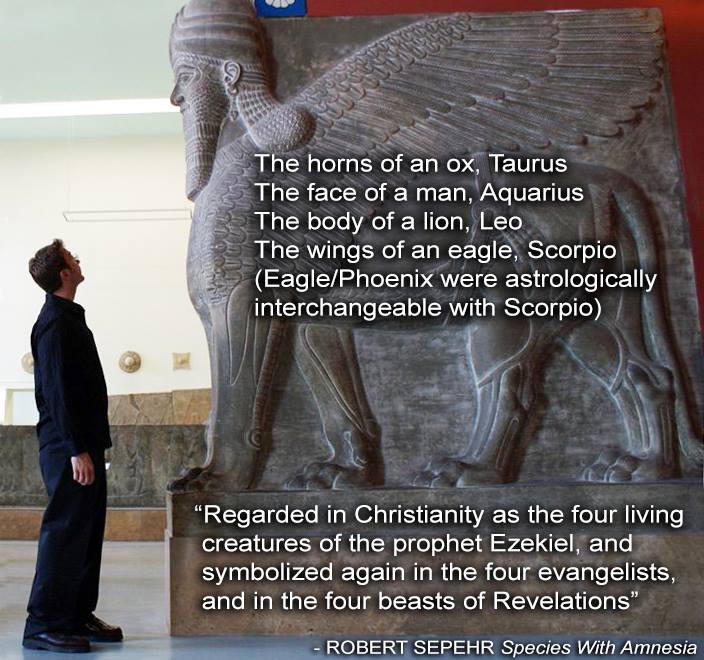
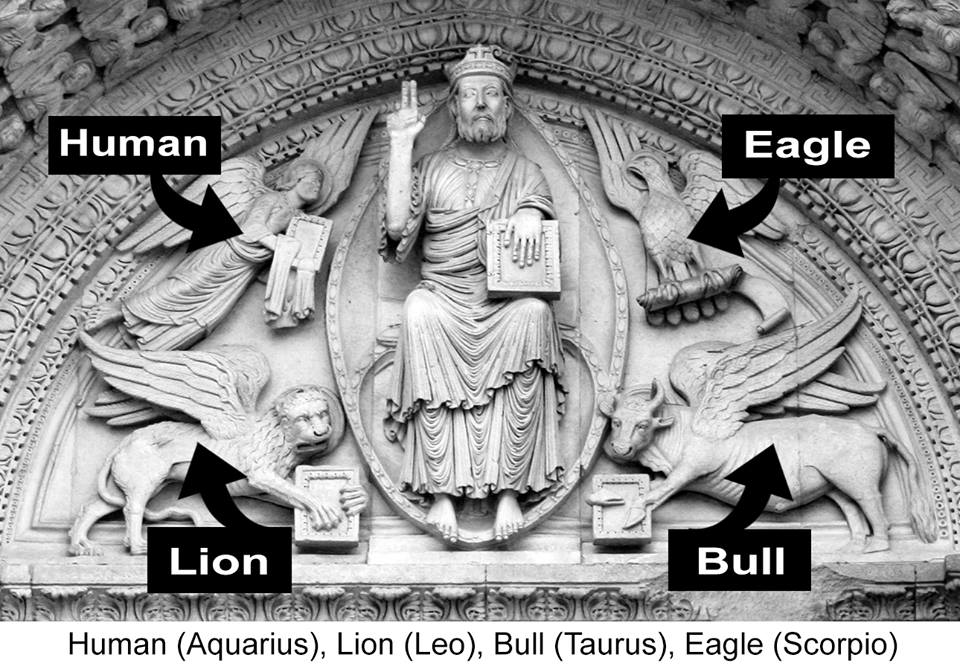
“The Fixed Cross, consisting of four constellations, are the signs regarded in Christianity as the four living creatures of the prophet Ezekiel. They are symbolized again in the four evangelists, and in the four beasts of Revelations.” — ROBERT SEPEHR, Species With Amnesia: Our Forgotten History
Species with Amnesia: Our Forgotten History
https://www.createspace.com/5528598
ROBERT SEPEHR
http://www.amazon.com/Robert-Sepehr/e/B00XTAB1YC/
The moment one consecrates with the OM, one says TAT – That – without past, without limits, the boundless and nameless. To name anything is to limit it. It is not this, it is not that – neti, neti. It can never be made an object or a subject. It is prior, and yet also posterior, to the rise of all possible objects and subjects, all possible constellations of entities and atoms, all possible worlds and minds of beings. Thus having in the moment consecrated through the OM, one goes into TAT, totally negating oneself. Having heightened the significance of what one is going to do, one negates it, relinquishing every wish for any fruit of a sacrifice. Through the power of tapas one makes the sacrificial act disappear into the totality of TAT. This is a dialectical activity requiring the highest practice and exercise in self-consciousness, self-reference and the interplay of the individuality of the sacrificer and the universality of the cosmic sacrifice. As human beings will naturally experience a sense of satisfaction in an authentic act of creative sacrifice, Krishna pointed to this experience of inner fulfilment, inner freedom and inner recognition of truth:
The word SAT is used for qualities that are true and holy, and likewise is applied to laudable actions, O son of Pritha. The state of mental sacrifice when actions are at rest is also called SAT. Whatever is done without faith, whether it be sacrifice, alms-giving, or austerities, is called ASAT, that which is devoid of truth and goodness, O son of Pritha, and is not of any benefit either in this life or after death.
SAT is not a truth, but rather ALL-TRUTH. It may be experienced as truth, goodness, purity, love or a number of other modes familiar to those who are experienced in tapas. Thus, having begun by consecrating with the OM, and then emptied all into TAT, which is beyond all possible concepts, worlds, definitions and beings, one reaffirms Being at the level of invisible unity, the level of the One Light of the One Spirit. Through the trinitarian mantram of OM TAT SAT, one may consecrate activity, negate the personal self, and at the same time realize a state of self-consciousness which will give contentment, substance and continuity to a life of service. When this mode of yajna becomes as natural as breathing, it infuses creativity, sustenance and regeneration into every action.
Metaphysically, the entire cosmos of manifestation is sacrificial. All existence is sacrifice. All descent from homogeneous planes into planes of greater differentiation is a sacrifice, a kind of grace, an avataric descent of the Logos. The primordial compassion in the One initiates and inaugurates the many. The one white light breaks up into the spectrum and then into the myriads upon myriads of hues that are implicit in the hebdomadic worlds. The entire universe may be understood as a great act of compassion. If this is true of the whole, then by identifying oneself totally, in one’s deepest identity, with the Logos, one may find that everything is sacrifice. Once one is attuned to the Logos in this way, then all the tiredness of calculation vanishes, to be replaced by fearlessness with facts and freedom from illusion. One can learn to live in the world, and yet live outside it; one can learn to live only for the sake of sacrifice and benefit to others. By accepting this and cooperating with the cosmic Logoic sacrifice, one frees oneself from virtually all the tension, anxiety and fear that arise out of pseudo-agnosticism, false pride and the inability to recognize that one does not know the karmic mathematics of the universe. One learns to admire the good in others and to adore the wisdom of those who are greater than oneself. As presumption falls away, so too do envy, craving and irritation.
At some point, one can come directly to grips with the twin demons of craving and contempt, like and dislike, attraction and repulsion. Every time one falls prey to the demon of craving, one is equally in the grip of the demon of contempt. So too in the reverse. Once one begins to understand the operation of these shadowy forces in the realm of shadowy selves, one may cut through the pall of murk and gloom that they induce and establish one’s mind in the realm of pure light. The shadow world of interaction and action of shadowy fears and hopes is a lie obscuring the dynamic light of true action. That light moves through a dynamic field of endless sacrifice and perpetual motion. It is difficult to root oneself in a consciousness of that realm, but it can be done through training oneself to hold fast to a sense of the heart and a sense of that which is between the eyes. It is possible to create an alignment between the eye of time and the eye of eternity, between the microcosmic and the macrocosmic, between the field of specific sacrificial karma and the boundless fields of universal sacrifice – Adhiyajna. To do this is to discover wisdom in action, Karma Yoga. If one sets out in dead earnest, one may be confident that things will get worse before they get better. It simply means that each individual has a measure of karma to be worked out. The intense discomfort that one feels in this process is a sign that one is being tested by karma. In fact, one should be grateful that forces are rushing in. It is better to have them precipitate together than to be spread out over a protracted period. And as this happens, one should not advertise it, because it is something that everyone has to do.
Each human being must seize his or her birth, just as, in the Japanese fable, each human being must recognize the donkey of stupidity that he or she is carrying and quietly put it down. These are all elements of past egotism, thoughtlessness, envy, contempt and insensitivity. In the past, one saw people who were blind, deaf and dumb, and instead of saying, “May that be my burden and may I help”, one said, “There but for the grace of God go I.”
Having separated oneself from those who have mysterious karma to bear, these failures will come back to one, and one will have to live out future lives in blindness, deafness and muteness. Whatever the karmic consequences of one’s actions, one must accept them as that which is best for the soul, that alone from which one may learn. It requires extraordinary fearlessness, but when one measures up to the test of accepting the truth, one will discover authentic freedom and true humility. Letting go of pride, one will see that everything is a lesson and that one is glad to learn. As one learns this true patience, one will become grateful when one can pause to look through the eyes of other human beings. One will start to feel something about the total saga of the human enterprise, encompassing all the souls living and learning and somewhere in their hearts unconsciously loving.
Inserting one’s life into the vast human enterprise, one can become a serene instrument of the cosmic sacrifice, consciously throwing all sense of self and separateness into the fire to be burnt. In the end, this is far wiser than being burnt out because of frenetic action, perversity and allegiance to the tired machinations of the false persona. Instead of being an incessant and repetitive victim to excess and deficiency, one may become like the quiet tender of a fire. Discerning the illusive elements in actions, one may gently cast them into the flames of sacrifice, receiving the warmth and joy and light of the fire and freeing oneself from the burden of ignorance. If one can make this a natural way of thinking and breathing, then one will burn out all the dross that would otherwise have formed, at the moment of death, a grotesque kama rupa.
Through the initial mastery of sacrificial skill in action, one may purify one’s will and desire, minimally assuring oneself that one’s actions in life will not be a source of pollution to the human race. When this healthy tropism of the soul has been restored, one is in a position to learn about the positive applications of the Fohatic power of desire. Instead of making an unconscious form or rupa out of kama, one may enter into the current of joy that accompanies sacrificial participation through meditation and action in the pilgrimage of humanity. One learns to engage in self-study solely for the sake of helping others. One learns to sleep and remain awake, to eat and bathe, to sit and walk, to breathe and think and feel for the sake of others. As this grows natural, one becomes like a station beaming vibrations to vast numbers of human beings in need. Serving as an instrument of the Logos far more than one will ever know, one remains free of the distraction of thinking about how much one may have done. Instead, one is concerned only with maintaining the mental stance and spiritual posture of sacrificial action. This is the central teaching of Karma Yoga, which brings about whatever joy, meaning and hope in life is supportable by the universe and is compatible with the joy and hopes of all other beings. Karma Yoga is action in accord with the great wheel of the Law, and it is the rightful inheritance of those who have the courage to make experiments with truth on behalf of humanity.
Instead of wasting time in daydreams about others, or about one’s regrets and mistakes, one should quicken one’s sense of what is necessary to do now. One must learn to stay still and do it. If one can become a one-pointed, whole-hearted person in two or three things done each day, one has embarked on the path of Karma Yoga, and the instances will increase with time. The higher cosmic energies guided by the true Karma Yogin are the energies of the highest Self – the Atman – and they are released only by the power of constructive vows. The mysteries of action and inaction are revealed only to those who bind themselves by sacred vows and commit themselves to the judgement and impartiality of Nature. The selflessness and integrity of Nature is the inward and invisible strength of the Karma Yogin. The secret is to work with the Silence residing in the unmanifest, courageously holding to the sacrificial current and welcoming the adjustment whereby distractions are dissolved and one’s heart and mind are drawn back to the invisible centre. The more one can learn to shackle the unruly vestures, making them instruments of Atma-Buddhi-Manas, the more one can create a stronger karmic matrix for a more glorious future.
Hermes, June 1985
Raghavan Iyer
Promethean foresight must be earned through a thorough study of the mistakes, as well as the wise moves, of all who have gone before. Every great military commander has the utmost respect and fascination both for the successful moves but also the avoidable mistakes made by his precursors in the field of battle. This true learning from the past means putting Epimethean wisdom in the service of Promethean forces with reference to the future. What it comes to in practice is that one must study the lives of others well enough to learn how easy it is to be mistake-prone oneself. At the same time, however, one must not let the fear of mistakes come in the way of doing the best that one knows. One’s motivation can and should be to lay down as a sacrifice all that one has in the best way one can for the sake of the whole, without drawing attention to oneself. When one can do this, one can become an instrument of a higher law or collective force. In a karmic field, wherein high ideals may be intact but threatened by pollution, such as the peace that follows a horrendous war, it is possible for many people to be touched by such motivations. But to become one with an ideal and so free oneself from all pettiness and residues of personal egotism is to prepare oneself to be used by the wisdom operating through karma. Such detached ardour towards ideals was epitomized by Louis Claude de Saint-Martin at the time of the French Revolution:
The society of the world in general appeared to me as a theatre where one is continually passing one’s time playing one’s role and where there is never a moment to learn. The society of wisdom, on the contrary, is a school where one is continually passing one’s time learning one’s role and where one waits for the curtain to rise before playing, that is to say, for the veil which covers the universe to disappear…. We are only here in order to choose.
Mon portrait historique et philosophique.
Foresight at that level requires the courage to negate time, the judgements of the present and also the judgements of posterity. Too many politicians dance with an eye to posterity. This is foolish. The greatest men, like Lincoln, were not obsessed with posterity but with rightness; they understood something of the timeless nature of the enactment of right in the name of an ideal. At the same time, one must make full allowance for all the imperfections in oneself, in the moment and in the act of embodying an ideal. Therefore, Karma Yoga requires a balance between a capacity to be strong in a timeless and universal field and a simultaneous ability to be courageous in that sphere wherein, as Krishna says, no act is without blame. Put in another way, one must combine a macro-perspective with a micro-application, see events both in the large and in the small. The more one is able, through detachment, to infinitize and so negate the finitizing tendencies of the human mind, the more one empties oneself into the boundless, unknown, uncertain and indeterminate ocean of space. At the same time, to gain efficiency and precision, skill in the performance of action, one must master concentration, the ability to bring things to a centre, to an intense, sharp focus. If one can fuse together this sense of infinitude and a sense of laser-like precision, one will gain much more than a sense of what is immediately relevant and essential. One will begin to see the equilibrizing forces of karma as centered upon an invisible point. It is like saying that to be able to master attention in reference to three things, for example, one must focus on some invisible fourth thing that one may think of as either inside or outside the triad, but which is, in reality, entirely beyond it.
Karma Yoga depends upon a sense of depth, a sense of that which is infinitesimal and hidden. This is known by the greatest dancers, archetypally represented by Shiva Nataraj, who are concerned not with position but motion, and who at the same time know that there is something mayavic about motion in relation to a field that is homogeneous and immobile. Its pure existence is in the realm of the mind. It is the etheric empyrean of the poets. It is like the sky in which the bird takes wing and floats in a refulgent majesty, remaining in motion, but when seen from a great distance, seemingly motionless. It is difficult indeed to understand or experience this fusion of motion and motionlessness, action and inaction, the micro-perception and the macro-perspective. When one looks at the night sky, one recognizes that boundless space itself is vastly greater than all the possible galaxies and systems. Even the immense voids in intergalactic space that have recently been discovered only give a relative sense of the metaphysical void of absolute space. And when astronomers speculate along the vague lines of the so-called Big Bang theory, this is nothing but a materialized shadow of the teaching of Gupta Vidya regarding the emanation from within without, a version of the Central Point – the one Cosmic atom – of all the myriad centres of activity in the incipient cosmos.
Without becoming caught up in the unresolved disputes of contemporary cosmology concerning questions of the expanding universe, continuous creation and other mysteries, the ordinary person may learn to look at the sky using the mind’s eye. Directing the vision of the hidden eye of the soul through continuous concentration, one will find that what one sees above in the heavens is mirrored within the heart. In particular, one may develop a sense of space in reference to the Akashawithin the heart. Just as there are chambers in the heart and empty cavities in the brain, so too there is voidness throughout the human body. That voidness, however, cannot be understood in a two-dimensional or three-dimensional sense. Instead, one needs a sense of another level of matter which is consubstantial with the great universal matrix,Mulaprakriti, the Divine Darkness or primordial ground and substratum of all manifested matter. On that plane the distinction between matter and mind has no meaning; Mulaprakriti is mirrored as the Akasha within the heart. It may be symbolized as radiant matter or as a dark luminosity, and mystics have noted the striking analogies between the solar system within which the earth revolves and the miniature solar system within man. As Kropotkin said, every human being is a cosmos of organs, and each organ is itself a cosmos of cells. To be able to experience the cosmos within the empty space in the heart is to discover the seed point or bindhu within the lotus of the heart. But to experience it, one must experience the depth of introverted vision. Those who do so are actually much farther from the ordinary terrestrial realm than could ever be reached by traversing what is called outer space.
To reach the heart of action one must rethink one’s view of space and time and motion. In the seventeenth chapter of the Bhagavad Gita, Krishna gives the mystical key to this meditation upon the heart of action. Having explained to Arjuna the application of the complex doctrine of the gunas,or qualities affecting all action, Krishna gives to Arjuna the talismanicmantram vitalizing all true faith and sacrifice:
OM TAT SAT, these are said to be the threefold designation of the Supreme Being. By these in the beginning were sanctified the knowers of Brahma, the Vedas, and sacrifices.
This is the ancient and sacred mode of consecration of karma or action. The more disinterested one’s practice of Karma Yoga, the more that action is itself a disinterested flow of benevolence, the more one begins to gain clues into the magical connections of the workings of karma in the large. Freed from a concern with one’s own karma, one may begin to discern the karma of nations, continents, races and human beings whom one wishes to serve and help. As one makes inevitable discoveries regarding the cyclic working of karma, one will begin to recognize that the more complex the karmic mathematics, the more one’s practice of benevolence depends upon strength of mind and clarity of perception in taking hold of a set of karmic curves and releasing potent seeds of action.
Therefore the sacrifices, the giving of alms, and the practising of austerities are always, among those who expound Holy Writ, preceded by the word OM.
OM is the Soundless Sound in boundless space – space beyond all subjects and objects, beyond all qualities, space which is no-thing and the fullness of the void. But OM is also in every atom, stirring within the minutest centres imaginable and in all the interstices of empty space. It is also a reverberation of one’s own being, omnipresent in all the vestures, the great keynote of Nature. To be able to bring it before consciousness and to consecrate oneself to it as the Atman or eternal spirit is to reduce oneself to a zero, a sphere of light filled with the oceanic pulsation of theOM at the cosmic level. It encompasses all beginnings, middles and endings. It includes all creative, supportive and regenerative action. Most human action is not creative, but mechanical and routinized, half-hearted and preoccupied, based upon indirect calculations of consequences in the future or guilt over the past. Such action is neither free nor one-pointed. Therefore, it is significant for beings who do not normally experience creative action to set aside certain times of the day to engage in action in a deliberate spirit of sacrifice and charity – yajna and dana – for the good of all.
Since all beings must act out of internal necessity or dharma, it makes sense to set aside certain actions – kriya – as creative contributions to the universal good. Far from being grudging or mechanical, such performance of duty through action flows with a serene and steady rhythm, rooted in an ability to abstract from the outward particulars of acts and a freedom from illusion that is gained through meditation upon the OM. There is an element of illusion in all action, and hence there are always retrospective painful lessons to be learnt from it. OM is the destroyer of illusions. Through it one may learn from the flow of action, from past mistakes and illusions. By making oneself a zero, one can regenerate oneself through the OM. The OM is all this and much more. Through it one may get away from particulars, apprehending the whole, entering into the ocean of space and absolute darkness pregnant with the luminosity that contains universes. Reaching beyond the mind, it touches the deepest core of one’s being connected with the immortal Self in eternity. Thus Krishna taught:
Among those who long for immortality and who do not consider the reward for their actions, the word TAT precedes their rites of sacrifice, their austerities, and giving of alms.
Hermes, June 1985
Raghavan Iyer
One must use with care those living messengers called words, and this reference to messengers has to do with different classes of elementals, all the myriad invisible centres of energy that permeate the diverse departments of Nature. To be full of the fire of devotion and to do the best work one can, one must have the right basis in thinking. The immortal soul is capable of immortal love, of immortal longings that may summon the life-essence that permeates this globe, the omnipresent spirit that is dateless and deathless. Everyone is inherently capable of an unending, unconditional love and courage and endurance, ready “to suffer woes hope thinks infinite”. The depth of devotion depends upon the level of being. Those who are unafraid of death, who see themselves neither in terms of the body nor in terms of the mind, but as immortal monads, can generate and sustain devotion to the greater hearts and minds of the Bodhisattvas. This constant devotion is in the context of universal mind or Mahat, and the hebdomadal heart of the cosmos. They come under the protection of supreme compassion, the universal umbrella of Dharma. When devotion thus becomes a sovereign talisman, it is continually enriched by yajna and tapas, sacrificial meditation. The wise are those who, starting from small drops of genuine devotion, humility and wisdom, make them grow. They are wise because they grow the way Nature grows. They will, of course, make mistakes, but as long as they maintain their original recognition of the utter simplicity, the transparency and truth of devotion, they can strengthen the current of resolve and regeneration. Magic is possible where there is authenticity, continuity and a sense of proportion, where there is sacrifice, care and a willingness to learn, as well as a capacity to merge the little self in the greater Self.
The path of spiritual attention is not easy, although anyone can make a beginning by trying to understand. Those who still have desires should pursue the path of sublimation through sacrificial works. To those who are neither completely indifferent nor too much attached, the devotional path bears fruit. One is not expected to be perfectly indifferent to everything nor suddenly to show effortless mastery in the practice of devotion. Devotees have their many limitations, but they are expected to moderate their attachment to the fruits of results. Then the path of devotion will bear fruit at the moment of death or in other lives. The mathematics of the universe is exact; one merely does the best one can and leaves the rest to the Law. It is necessary to elevate what is mortal and unreal with the help of a mental posture which involves true obeisance. To remember properly the original moment is to gain glimpses into the future. The divisions of time into night and day, clock time and calendars, engender an illusory sense of past and present and future. It may be that in a certain year upon a certain day one had a spiritual awakening because one came into the presence of spiritual wisdom. If so, to be true to that means to keep going back again and again to the original moment, because the more one can do that, the more one will come closer to the Teachers of Wisdom. If on any issue one understood the original moment, then one would see that the whole story is compressed in that original moment. In that is already determined and defined the future outcome of everything that is connected with that original moment.
One cannot awaken the powers of spiritual attention if one is preoccupied with externals. One cannot be spiritually awake and attentive if one has forgotten that one is an immortal soul. Even if at some level one knew it and then forgot it, that is going to have an effect upon the power of attention. Understanding means making connections. When one truly enjoys thinking about what one is trying to recall, then one can summon other ideas connected with the same line of thinking. Correlations begin to emerge and connections can be made. With calm and detachment and true love of something larger than oneself, there can be access to a vaster perspective. The reason why people forget and why they fantasize is that they do not really know in the present. The reason they do not know in the present is that they are not fully attentive as immortal souls. They are misled by the sensorium, by the shadowy screen of prejudice, by the film of false anticipation and by the burden of failure, shame and regret. Therefore, they have neither lightness nor freedom nor joy, neither do they have any fullness of receptivity and devotion. The path of spiritual reminiscence has to be summoned, and the future is obscure to those who desperately want clues or cues from the outside.
Human beings define themselves during the day by how they relate to deep sleep, and during their lifetime by how they relate to their golden moments. They could know their karma if only they would have the courage to look at their vows, at their highest moments and the extent of their fidelity to them. If they can say that they have at some level made an effort to be true but failed, then they should go on and say that they are willing for Karma to work. They must be honest with themselves if they would gain the strength they need through rekindling a golden moment. This could again become real for them in the present. Then they do not have to see their future only in terms of failures, betrayals, forgetfulness and loss of vision. They could see it in terms of a renewal of vision and a rekindling of strength.
To work with Karma is to learn why one is what one is at any given time on any plane, to look at one’s strengths and with the help of this awareness to recognize the seeds of former resolve. One always has the opportunity to be grateful to those who made it possible, to have the courage to look at one’s weaknesses and understand calmly how they arose, and be determined to counteract them. Then one has a sense of actually shaping the future on the basis of true knowledge, not on the basis of mere chance or the whim of a capricious god. This is true spiritual knowledge based upon a courageous correction of one’s own relationship to the divine spirit within, the indwellingIshwara. Great teachers work under a law where every genuine striving is noticed, but all human beings throughout the world come under the same law. Those who can see the past, the present and the future simultaneously will only let their gaze fall where it is merited, because where it falls there is a tremendous quickening of opportunities for growth, but also an enormous increase of the hazards of neglect. In a dynamic universe of thought and of consciousness, a great difference can be made in one’s understanding of causality and of energy through one’s concept of time which is determined by one’s concept of self-hood and being. This is truly a function of how one thinks at this moment today, how one sleeps tonight and how one wakes up tomorrow, in a cycle of progressive awakenings through meditation and ethical practice, not for the sake of oneself but for the sake of all living beings in the visible and invisible cosmos.
Hermes, May 1979
Raghavan Iyer
Sit evenly, erect, at ease, with palms folded on the lap, with eyes fixed on the nose: cleanse your lungs by taking a deep breath, holding it in and then discharging it, raise in your heart the OM sounding like the tolling of a bell, and in the lotus of your heart, contemplate My form as encircled by light.
The path of knowledge is for those who are weary of life; those who still have desires should pursue the path of sublimation through works: and to those who are not completely indifferent nor too much attached the devotional path bears fruit.
Perform your actions for Me and with thoughts fixed on Me: untainted like the sky, see yourself within your self; consider all beings as Myself and adore them; bow to everybody, high or low, great or small, kind or cruel; by seeing Me constantly in all, rid yourself of jealousy, intolerance, violence and egoism. Casting aside your pride, prestige, and sense of shame, fall prostrate in humility before all, down to the dog and ass. This is the knowledge of the learned, the wisdom of the wise – that man attains the Real with the unreal and the Immortal with the mortal.~ Krishna to Uddhava
The universe is mostly unmanifest, and every human being is a microcosmic reflection of the entire egg-like cosmos. Each individual is a vast but largely hidden force-field, but all are manifesting with varying degrees of knowledge, deliberation and discrimination. These diversities are the product of a long history of use, overuse and misuse of the sheaths and vestures in which immortal monads have been embodied in myriad environments over eighteen million years. Given this far-reaching perspective, how can any person use this potent teaching in order to become a better human being? How can an individual become more attentive and discriminating in using the sacred gift of creative imagination, training the mind as an instrument for concentrated thought, directed with a benevolent feeling towards goals compatible with the purposes of all living beings, towards universal good? Strange as it may seem, everyone can discover indispensable clues for answering this question in the simple fact that he or she is a certain kind of human being. The whole story is recorded from head to toe: the way a person walks and talks; the way a person holds himself or herself; the way a person thinks, feels and acts; the way a person relates to other beings; but, above all, the way a person lives through waking and sleeping from day to day, passing through the three halls of consciousness – jagrat, swapna and sushupti – connecting moments in childhood through the seasons of human life, growing, maturing and mellowing with intermittent glimpses of wisdom.
Every person can test motives and methods in the daily attempts to translate thought and intention into outer modes of expression. If someone gets a chance to work upon certain details of some part of a larger work in which the levels of motivation markedly vary, that person can learn through what karma brings to him or her. If, by mistake, one became involved in more than one can manage, this would be known within a short time because one would get burnt. To be unready is to have a shrunken sense of self and therefore a force-field that is very congested with blurred, contradictory and weak currents liable to short circuits and shocks. As long as there is the opportunity to learn and to correct, it is always possible to make a difference, because all human beings are capable in their finest moments of the highest possible motivation. There is hardly a person who has not had moments of pure love of the human race. There are few who have gone through the whole of life without even once having looked at the stars and sky and wondered at the magnitude of the universe. Nature cannot support a human being who cannot ever negate the suffocation of confinement within shallow perspectives of mind and heart. As long as there is the beneficence of sleep, every human being has abundant opportunities to renew the larger Self, the greater motive, the fuller perspective. The problem then is not that a human being is without spiritual resources, but rather how to make those resources tapped during deep dreamless sleep relevant when one is out in the field of duty, Kurukshetra. Wakeful deployment of resources will require sufficient noetic detachment to avert captivity to compulsive activity, and thereby avoid being cut off from the greater Self. When the only correction available is sleep, it is too inefficient to rely upon automatically because the daily passage through confused dream states vitiates the healing effects of deeper dreamless states.
Meditation is the source of noetic understanding, but this depends upon an initial humbling of the false self that otherwise undermines every effort. Learning without unlearning is not only useless, but, like eating without elimination, it can be fatal. Bad habits must be unlearnt while learning new ways of doing things that come from new ways of thinking, and in this continuous process one has to be courageous in assessing one’s spiritual strivings. By seeing where one is going wrong and why, it is possible to make significant connections between causes and consequences and then see where a real difference can be made. It is always possible to make a difference, but only on the basis of self-examination that leaves one more determined and relaxed – more relaxed because of seeing oneself in relation to the whole of humanity. Without running away from the facts, it is possible to take an honest inventory, and if this is done, one will soon begin to discover that it is not that one’s motive is entirely bad or that one is altogether no good. It is rather that one is not very good at learning because of having created blockages in the self through pride, blockages in the mind through prejudice, blockages in the heart through partiality, blockages in the will through perversity. These blockages precipitate very quickly in the presence of great resolves, and if they are not faced, it is difficult to avoid walking backwards. But if this realization brings a sense of defeat, that means one never really understood the teaching of Karma. The Self that has to make the effort of understanding is that ray of the immortal soul which is put in charge of the kingdom in which the different parts of one’s being must be dynamically balanced. When there is a greater harmony within, it is possible to contribute more to harmony without. This is what each is meant to do. The general accounting can be left to Karma. By altering radically one’s attitude to work, to motive and method, and one’s way of balancing them, there is the opportunity for growth on the basis of a larger and a firmer recognition of the invisible forces, realities and laws constantly at work in Nature and in oneself.
Hermes, May 1979
Raghavan Iyer
 Grand Temple of Horus Behdety