An ‘impressive’ heat difference between the blocks has been found at four of Egypt’s pyramids, including the famous Great Pyramid of Giza, researchers say. The finding has been uncovered by a project aiming to penetrate the secrets of the pyramids.
Hieroglyphics play an important role in understanding ancient Egyptian culture. One of the most commonly found and mysterious hieroglyphic symbols is known as the djed symbol.
A monumental discovery with four years of comprehensive Geo-archaeological research has failed to reach mainstream audiences for some reason. The most active pyramid site in the world dating the pyramid complex back 25,000 years has also released scientific evidence supporting the theory that the
GNOSTICISM was at the Foundation of the ancient alchemical mysteries propaged by the Secret College.
This presenter then invites us to refer to this old movie as illustrative of his point … Enjoy!
THE ALCHEMICAL MEME AND SECRET SOCIETIES
(Excerpted from the book, The Mysteries of the Great Cross of Hendaye Alchemy and the End of Time, ch. 2, by Jay Wiedner [Destiny Books, 2003].)
At the heart of the alchemical mystery lies a secret. This is no ordinary secret, however, for it is that which cannot be told. the experience of gnosis. Ultimately, this inexplicable knowing cannot be conferred or taught in any ordinary manner, only incubated and gestated through a mysterious process known as initiation. This initiation can come in a number of different ways, usually through someone who already knows, but occasionally it occurs by means of sacred texts and direct insight.
The alchemical gnosis has been transmitted from generation to generation, through thousands of years. We find the same content experiences of gnosis from the modern samyana experiments at Maharishi University to the Ancient Egyptians. (1) We find the same content in spontaneous experiences from mystics of all eras. The secret at the core of alchemy is an ineffable experience of real workings of our local cosmological neighborhood.
So how can one incubate and gestate such an experience? The answer may lie in the word transmitted. Modern sociologists have begun to discuss the concept of memes, or complex idea groups — such as monotheism and democracy — that appear to have the ability to replicate themselves. Memes seem to have other properties as well, such as an unusual psychic component. The spread of Spiritualism in the nineteenth century is a superb example of a viral-like meme outbreak, and traces of Spiritualism’s meme can be found surviving into the New Age nineties, with its dolphin channeling and near-death experiences. Hollywood films such as The Sixth Sense are deeply influenced by Spiritualism’s perspective on the afterlife, conveying the meme directly and powerfully to millions of moviegoers.
It helps to think of the secret at the core of alchemy as a very special and sophisticated variety of meme. Like a spore or a seed, the meme has a protective shell that is also attractive to appropriate hosts. In the case of the alchemy meme, that shell is the seductive allure of the transmutation of base metal into gold. Even if one absorbs the outer shell of the alchemy meme, however, there is no guarantee that the inner core will blossom and the meme become active. For that to happen, a series of shocks or initiations is required.
The sophistication of the alchemy meme is such that the experience of gnosis at its core can be stimulated only by these shocks. Therefore, to transmit the idea of complex of the gnosis meme through time requires a series of encounters between those in whom the meme is active and those who have merely been exposed to it. From this need evolved the idea of priesthoods and then, as religious structures degenerated, mystery schools and secret societies. We can think of these as incubation devices for spiritual memes.
Through the millennia, the undigested seed of the alchemy meme was jumbled together with other spiritual memes, creating a seemingly endless series of hybrid spiritual expressions masquerading as alchemy. From its appearance in first-century Alexandria to its modern expressions, however, the secret at the core of the alchemy meme can be traced by its gnostic ineffableness. The secret protects itself, but in doing so leaves an unmistakable fingerprint. By following these gnostic fingerprints, we can track the progress of the alchemy meme through history.
EGYPT: ISIS AND HORUS
The word alchemy, as a name for the substance of the mystery, is both revealing and concealing of the true, initiatory nature of the work. Al-khem, Arabic for “the black”, refers to the darkness of the unconsciousness, the most prima of all materia, and to the “Black Land” of Egypt. Thus, the name reveals the starting point of the process and the place where this science attained its fullest expression. This revelation, however, important as it is, effectively conceals the nature of the transmutation at the heart of the great work.
For three thousand years or more Egypt was the heart of the world. Much of the knowledge that is the underpinning of Western civilization had its origins in Egypt. The lenses of Greek and Judeo-Christian “history” distort our modern, essentially European, view of the ancient world. The Bible gives us an Egypt of powerful pharoahs and pagan magicians, mighty armies, slaves and invasions of chariots out of the south. Herodotus gives us a travelogue, complete with inventive stories from his guides. To the Hebrews of the Old Testament, Egypt was the evil of the world from which God had saved them. To the Greeks, it was an ancient culture to be pillaged for ideas and information. To understand the origin of alchemy, we must let go of the Hebraic and Greek bias and look clearly at what the remains of the ancient Egyptian culture can tell us.
When we do this, two things immediately jump out at us. First, the ancient Egyptians were the most scientifically advanced culture on the planet up to the present day, if we have indeed caught up with them; and second — their science, in fact, their entire culture — seems to have been revealed rather than developed. The Egyptians claimed that their knowledge was derived from the actions of divine forces in what they called the First Time, or Zep Tepi. A group known as the Heru Shemsu, or Company of Horus — also called the Company of the Wise, the Companions of Horus, and the Followers of the Widow’s Son — passed down the a body of knowledge through the ages. Each pharoah, down to Roman times, was an Initiate of the Company of Horus and thus privy to this secret knowledge.
In 1945 an Egyptian peasant discovered a collection of early Christian scriptures – the Nag Hammadi Codices, which revealed the existence of a Gnostic version of Christianity. Gnostics (derived from the Greek word gnosis – meaning `knowledge’) felt that they could get to know God, and their own soul, going a step beyond faith. Their message, and the words of the `Gnostic Gospels’ were buried in the sand of the Egyptian desert. Some scholars now believe these scriptures to be just as authentic, if not more so, than the books we collectively know as the New Testament.
In the late 12th century `Cathars’ started preaching an alternative form of Christianity to that of Roman Catholicism, in the French region of Languedoc. Empowering abstinence and poverty, they called themselves Good Men, and believed that the world was an alien environment for man’s soul. The Roman Catholic Church tried unsuccessfully to persuade them they were wrong. Then came the Inquisition, followed by the Albigensian Crusade which crushed the rebels with a military campaign. The `heretics’ were burned at the stake by the hundreds, and again Gnosticism was supressed. Brian Blessed plays a Cathar Bishop, and Ian Brooker plays a Spanish Monk, in an attempt to recreate a theological dispute in France, 1206.
Egyptian Gnostics texts came to Florence in 1492. The Gnostic idea, that man has the capacity to rise above his worldly fate to become a spiritual being, even to be `as God’ was the heretical centrepiece of Renaissance philiosophy. This spiritual notion was forced underground by by the Catholic Church’s opposition, and into the world of magic and alchemy. However a modern millionaire, Joost Ritman, is an example of how Gnoticism continues to defy the passage of time, to re-emerge in every spiritual era.
The Gnostic Gospels said that the world was no place for the divine soul of man, that the world was tragic and that it wasn’t created by God, but by a lower life divinity. To the question “Did a good God create a world of pain” they replied that there was a crack in the universe. The first 20th century scholar to read the Gnostics was C.G.Jung – their `Gnosis’, or knowledge, was to him spiritual self-knowledge. In this programme, scholars debate the relevence of the Gnostic `pulse’ for modern man.
Everyone has heard of the famous boy king, Tutankhamun, but the name of his beloved sister and wife Ankhesenamun is rarely uttered. The tragic life of Ankhesenamun was well documented in the ancient reliefs and paintings of the reign of her parents, the pharaoh Akhenaten and his great royal wife Nefertiti, until the death of Tutankhamun when the young queen seems to have disappeared from the historical records.
Ankhesenamun (“Her Life is of Amun”) was a queen of the Eighteenth Dynasty of Egypt. She was the third of six known daughters, and became the great royal wife of her half-brother Tutankhamun when he was just 8 to 10 years old and she was 13. It is possible that she was briefly married to Tutankhamun’s successor, Ay, believed by some to be her maternal grandfather. It has also been posited that she may have first been the wife of her father, Akhenaten.
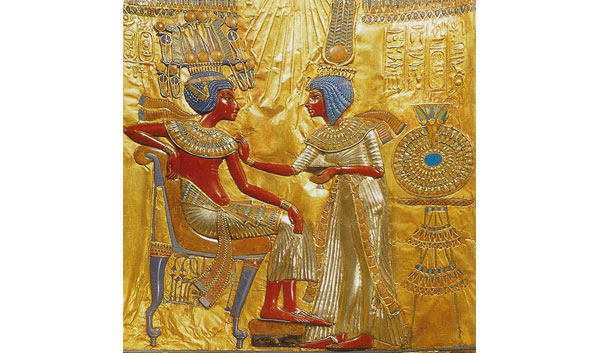
Tutankhamun receives flowers from Ankhesenamun. This image is on the lid of a box found in Tut’s tomb. Photo source: Wikipedia
Marriage within family was not uncommon in ancient Egypt and was practiced among royalty as a means of perpetuating the royal lineage. In fact, Tutankhamun’s parents had also been brother and sister, resulting in some of the genetic conditions that the boy king suffered, including a cleft palate and club foot. The pharaohs believed they were descended from the gods and incest was seen as acceptable so as to retain the sacred bloodline.
Ankhesenamun was born in a time when Egypt was in the midst of an unprecedented religious revolution (c. 1348 BC). Her father had abandoned the old deities of Egypt in favour of the one ‘true’ god of Aten (the Sun disc), thereby creating the first monotheistic religion. His revolutionary actions weren’t taken easily by the priesthood and the Egyptians followers of Ra. It was difficult for such a traditional culture to reject their old gods, and the priesthood—which held a great deal of power—put up a fierce resistance.
Ankhesenamun had two older sisters – Meritaten, Meketaten – and together, the three of them became the “Senior Princesses” and participated in many functions of the government and religion. Various reliefs found in Egypt appear to suggest that Akhenaten may have attempted to father children with all three of his eldest daughters, the second of whom seems to have died during child birth (this scene is depicted inside a royal tomb).
After the death of her father, Akhenaten, and following the short reigns of his successors, Smenkhkare and Neferneferuaten, Ankhesenamun became the wife of Tutankhamun. Following their marriage, the couple were quick to restore the old religion, disregarding Akhenaten’s actions.
Although both Tutankhamun and Ankhesenamun were still children, together they ruled Egypt for the next ten years. During their reign, history shows that Tutankhamun had an official adviser named Ay who most likely was the grandfather of Ankhesenamun, and who probably played an influential role in the lives and decisions of the young couple.
During their reign, it is believed that Tutankhamun and Ankhesenamun conceived two children (both girls) who were born prematurely and died. Evidence comes from the mummified remains of two babies found in Tutankhamun’s tomb and DNA analysis confirmed that they were daughters of Tutankhamun. One of the children is known to have had a condition called Spengel’s deformity in conjunction with spina bifida and scoliosis.
At about the age of eighteen or nineteen, Tutankhamun died suddenly, leaving Ankhesenamun alone without an heir in her early twenties. The grieving queen would have to continue in her official capacity as queen of Egypt and play a major role in finding a successor.
An inscribed ring and gold foil fragments found in the Valley of the Kings depict Ankhesenamen together with her husband’s successor, Ay, but there is no clear indication that they were married. Her name never appeared within his tomb and it is believed that she may have died during or shortly after Ay’s reign, as she disappears from history shortly after his period.
It is not known where she was buried, and no funerary objects with her name are known to exist. This leaves the possibility that her tomb is still somewhere out there, waiting to be discovered. This may help to unravel the final fate of Ankhesenamun.
Featured image: A gold plate found in Tutankhamun’s tomb depicting Tutankhamun and Ankhesenamen together.

 An ‘impressive’ heat difference between the blocks has been found at four of Egypt’s pyramids, including the famous Great Pyramid of Giza, researchers say. The finding has been uncovered by a project aiming to penetrate the secrets of the pyramids.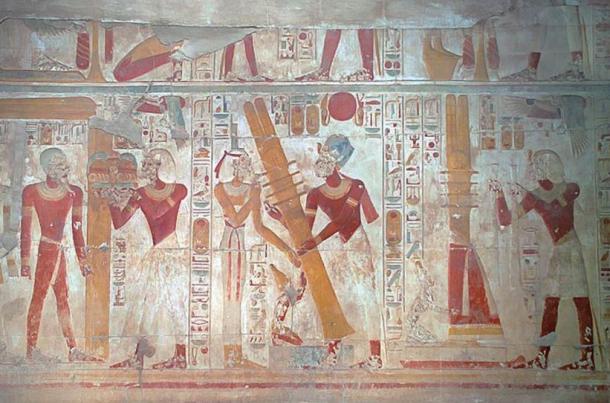


 Grand Temple of Horus Behdety