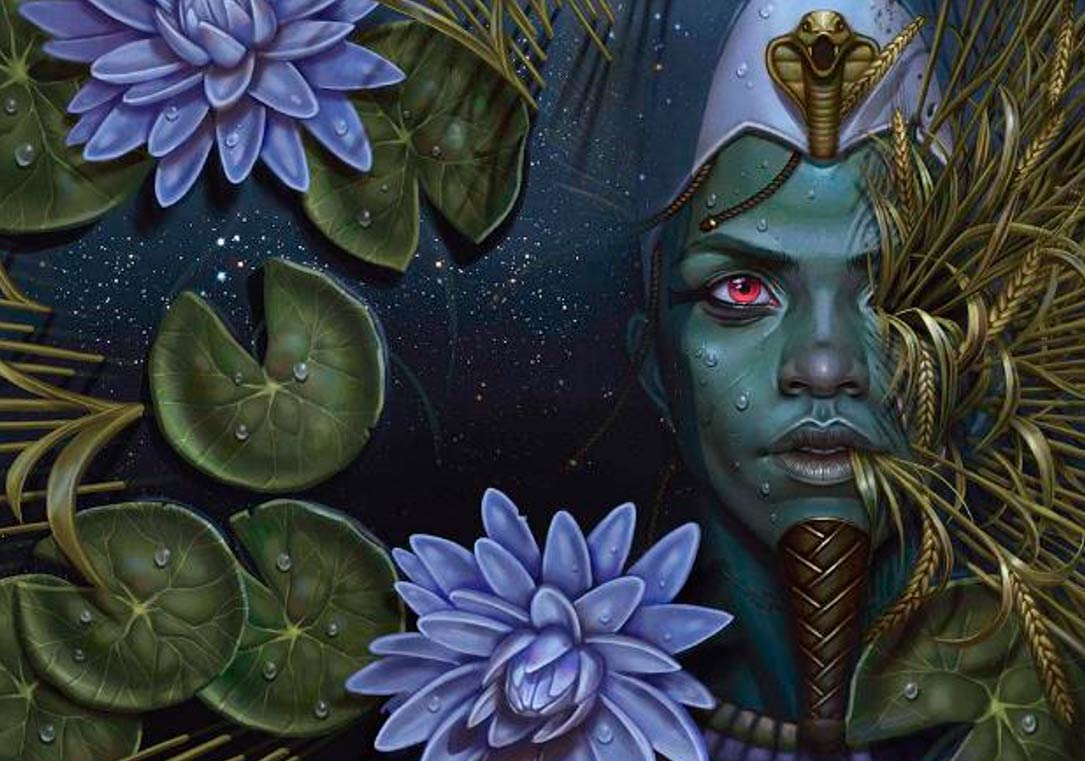
The Dark Night of the Soul in the Golden Dawn | Portal Grade | Victoria Generao, PhD

Nigredo, the Veil of Paroketh, and the Rosicrucian Mystery of the Interior Sun

There comes a moment in the Great Work when the initiate discovers that Light does not always reveal itself as illumination.

Sometimes Light first reveals itself by exposing darkness.

There comes a stage when the formulas that once provided certainty cease to satisfy. Ritual may still be performed correctly, yet its former consolation seems absent. The symbols remain upon the altar, the Divine Names are still vibrated, the sacred gestures are still made, and yet something within the initiate has changed.

The former spiritual identity has begun to loosen.

For the Golden Dawn initiate approaching the Portal Grade, this experience may be understood through an alchemical and Rosicrucian lens as something resembling the mystical Dark Night of the Soul.

The expression itself is not an original Golden Dawn technical term. It comes principally from the Christian mystical writings of St. John of the Cross, who described states of purification in which the soul is deprived of its familiar consolations so that it may be drawn toward a more profound union with God.

Yet the concept offers an extraordinarily powerful way of contemplating the mystery of Portal.

For Portal is itself an in-between place.

Behind the initiate lie the elemental Grades of the First Order.

Ahead lies the threshold of Adeptus Minor 5=6, the mysteries of Tiphareth, and entrance into the Rosicrucian Second Order of the Rosae Rubeae et Aureae Crucis — the Red Rose and the Golden Cross.

Portal is therefore neither simply an ending nor simply a beginning.

It is the darkness between them.

It is the place where the initiate who has learned the elements must now become their synthesis.

It is the place where the magician who has learned to command forces must begin learning how to become a vessel for something greater.

And in the language of spiritual alchemy, this mystery is closely related to Nigredo — the Blackening.

The Four Elements Have Been Traversed

The journey through the elemental Grades has already subjected the initiate to a deliberate process of differentiation.

In Zelator 1=10, the mysteries of Earth establish foundation, embodiment, stability, discipline, and the necessity of bringing spiritual aspiration into manifestation.

In Theoricus 2=9, the mysteries of Air awaken thought, perception, language, reason, discrimination, and the mobility of consciousness.

In Practicus 3=8, Water opens the initiate to emotion, imagination, intuition, memory, receptivity, and the deeper currents of the psyche.

In Philosophus 4=7, Fire introduces will, aspiration, intensity, transformation, purification, and the power by which the old may be consumed so that something greater can emerge.

By the time the initiate arrives at Portal, Earth, Air, Water, and Fire have all been encountered.

But Portal asks a very different question.

It no longer asks:

What is Earth?

What is Air?

What is Water?

What is Fire?

It asks:

Who is the one in whom all four must become reconciled?

The candidate has studied the elements externally.

Portal begins their synthesis internally.

This is why Portal is associated not with another isolated elemental condition, but with the reconciling mystery of Spirit.

The four forces must be brought beneath a higher principle.

The elemental personality must become a pentagram.

The four arms must discover their center.

And the initiate begins to understand that Spirit cannot simply be added to Earth, Air, Water, and Fire as though it were a fifth substance sitting beside them.

Spirit must penetrate them.

Spirit must order them.

Spirit must reconcile them.

Spirit must become the hidden unity through which the four become one.

The Magician Becomes the Alchemical Vessel

Until this point, the initiate may have imagined that occult training consisted primarily of acquiring greater knowledge and greater control.

Learn the correspondences.

Learn the invocations.

Learn the Divine Names.

Learn the Tarot.

Learn Qabalah.

Learn ritual.

Learn the movement of magical force.

Learn how to invoke.

Learn how to banish.

Learn how to formulate.

Learn how to direct.

But Portal introduces a more dangerous proposition.

Perhaps the Great Work is not primarily about what the magician can make the universe do.

Perhaps the Great Work is about what the Divine can make of the magician.

At that point the operation reverses.

The practitioner becomes the materia.

The consciousness of the initiate becomes the alchemical substance placed within the vessel.

Every contradiction, every unresolved attachment, every ambition, every fear, every hidden motive, and every cherished spiritual self-image becomes part of the material upon which the Work must act.

Portal therefore announces an important transition:

the magician who has worked upon the elements must now permit the elements to work upon the magician.

And this is where the Dark Night begins.

Nigredo: The Blackening of the Spiritual Personality

In the imagery of Western alchemy, Nigredo is associated with blackening, decomposition, putrefaction, death, dissolution, and the breaking apart of a previously established form.

The material placed into the alchemical vessel does not immediately become gold.

First it may blacken.

It may decay.

It may lose its recognizable structure.

The original form appears to die.

Historically, alchemy encompassed genuine laboratory practices as well as philosophical, religious, and symbolic dimensions; modern scholarship cautions against reducing all historical alchemy to psychology alone. Yet later Western esoteric traditions made extensive use of alchemical imagery as a language for interior transformation. (University of Chicago Press)

In the Portal interpretation, Nigredo can therefore represent the decomposition of the initiate’s previous spiritual identity.

The candidate may have spent years constructing an identity around attainment.

“I know.”

“I understand.”

“I have been initiated.”

“I have received the Grades.”

“I can perform the rituals.”

“I know the correspondences.”

“I know the Divine Names.”

“I understand the Tree of Life.”

Portal quietly asks:

Who is this “I” that claims these attainments?

Suddenly the knowledge itself becomes subject to examination.

The ego can possess occultism just as easily as it can possess money, social status, academic credentials, authority, or reputation.

It can say:

My knowledge.

My initiation.

My lineage.

My magical ability.

My grade.

My spiritual authority.

My enlightenment.

But the Rosicrucian path cannot culminate in the enthronement of the spiritual ego.

Something must die.

The Veil of Paroketh

The Golden Dawn places profound symbolic importance upon the approach toward Tiphareth, the Solar Sephirah of Beauty, harmony, sacrifice, the Higher Genius, and the reconciled center of consciousness.

Before that Solar center lies the symbolic Veil of Paroketh.

The Veil marks a boundary.

Below it, the initiate has worked primarily through the structures of the personality and the elemental world.

Beyond it lies the approach toward the consciousness symbolized by Tiphareth.

The Veil therefore presents a paradox.

The initiate cannot cross it merely by becoming a more sophisticated version of the personality that approached it.

More information is not enough.

More memorization is not enough.

More magical technique is not enough.

Even greater psychic sensitivity is not enough.

The consciousness itself must become capable of another relationship with the Divine.

Portal thus becomes a chamber of transition between what the initiate has constructed and what the initiate must become.

The candidate stands, symbolically, before the Veil and encounters the uncomfortable truth:

the personality that brought me here cannot, by its own sovereignty, take me farther.

This realization is one of the deepest meanings that may be given to the Portal Dark Night.

When the Gods Become Silent

One of the characteristics traditionally associated with mystical purification is the withdrawal of spiritual consolation.

Prayer may cease to provide emotional reassurance.

Meditation may feel barren.

Ritual may feel less dramatic.

Visions may disappear.

Synchronicities may diminish.

The initiate may feel that the invisible world has withdrawn.

It is tempting to interpret such periods as spiritual failure.

But the mystical tradition of St. John of the Cross offers another possibility.

The soul can become attached not only to worldly pleasure but to spiritual pleasure.

The sensation of holiness can become an attachment.

Mystical visions can become an attachment.

Occult power can become an attachment.

Psychic phenomena can become an attachment.

Being recognized as spiritually advanced can become an attachment.

Even the experience of divine presence can become something the ego demands as reassurance.

The Dark Night removes the guarantee of consolation.

St. John of the Cross’s Dark Night is therefore useful comparatively, though it belongs to Christian contemplative theology rather than to the formal Golden Dawn curriculum. (Christian Classics Ethereal Library)

The question then becomes:

Will the initiate continue the Work without being rewarded by spiritual sensation?

Will one perform the rite when there is no exhilaration?

Will one meditate when no vision comes?

Will one pray when Heaven appears silent?

Will one remain faithful when there is no external confirmation of progress?

If so, something profound begins to change.

Practice ceases to be performed solely because it produces experience.

Practice becomes devotion.

The Rosicrucian Tomb

Here the Portal mystery becomes unmistakably Rosicrucian.

For beyond Portal lies the Second Order.

And at the heart of the Rosicrucian current stands one of Western esotericism’s most powerful images:

the Tomb of Christian Rosenkreutz.

The Fama Fraternitatis, first printed in 1614, tells of the discovery of the concealed sepulcher of the legendary founder of the Rosicrucian Brotherhood. The body of Christian Rosenkreutz is found preserved within a mysterious chamber after 120 years, surrounded by signs of hidden wisdom and spiritual science. The image became foundational to later Rosicrucian imagination. (Rosicrucianism)

The Golden Dawn’s Rosicrucian Adept tradition drew deeply upon this symbolism.

The Adeptus Minor mysteries are therefore not simply mysteries of acquiring greater magical authority.

They are mysteries of death, burial, discovery, regeneration, and resurrection.

That transforms the meaning of Portal.

Portal stands before the Tomb.

Before the candidate may fully participate in the mysteries symbolized by the resurrected Adept, something analogous to burial must already have begun within the candidate.

The spiritual ego approaches the sepulcher.

It cannot carry all of itself through the door.

Post CXX Annos Patebo

One of the famous Rosicrucian motifs surrounding the Tomb is the promise:

Post CXX Annos Patebo

“After one hundred and twenty years I shall open.”

The statement possesses extraordinary initiatory power when contemplated in relation to Portal.

The tomb is closed.

The Adept is hidden.

The Light is concealed.

Yet concealment is not absence.

The mystery is gestating.

The apparent grave contains a future revelation.

This is exactly the paradox of Nigredo.

The alchemical matter appears dead.

But something is happening within the vessel.

The seed lies beneath the earth.

The Sun appears absent during midnight.

The initiate cannot yet see the transformation because the operation is taking place beneath the threshold of ordinary awareness.

Portal teaches patience within sacred obscurity.

Not every spiritual transformation announces itself immediately.

Some changes occur in silence.

Some occur beneath consciousness.

Some must ripen inside the sealed vessel.

The Rose and the Cross

The Rosicrucian mystery eventually presents the initiate with the image of the Rose upon the Cross.

This symbol admits many layers of interpretation and should not be reduced to a single formula.

Yet for the Portal initiate it offers a particularly powerful teaching.

The Cross may be contemplated as the structure of manifested existence: the four directions, the four elements, incarnation, limitation, sacrifice, and the intersection of forces within material life.

The Rose unfolds at the center.

It suggests awakening consciousness, beauty, regeneration, multiplicity returning toward unity, and the opening of the interior life.

The mystery is not that the Rose escapes the Cross.

The Rose blossoms upon it.

This is crucial.

Rosicrucian initiation is not fundamentally an escape from embodiment.

Matter is not simply discarded.

The elements are not destroyed.

The human personality is not obliterated.

Instead, something divine must flower through them.

The Rose requires the Cross.

Spirit requires a vessel.

The invisible requires manifestation.

The Higher Genius requires an integrated personality through which to act.

Portal therefore does not teach the initiate how to abandon humanity.

It teaches the initiate how humanity may become transparent to something greater.

Crucifixion Before Resurrection

The Solar mysteries of Tiphareth carry strong sacrificial and redemptive symbolism within the Golden Dawn’s Christian-Hermetic and Rosicrucian framework.

This is why the approach to Adeptus Minor cannot be reduced to gaining occult power.

The candidate approaches a mystery of sacrifice.

The false king must surrender the throne.

The personality must cease claiming absolute sovereignty.

The magician begins moving from the question:

“How can I make spiritual powers serve my will?”

toward another:

“How may my will become reconciled with the Divine Will?”

That is a far more demanding question.

It shifts the orientation of magic itself.

The operator becomes servant.

The commander becomes mediator.

The magician becomes priest.

Will becomes offering.

Power becomes stewardship.

Knowledge becomes responsibility.

This is the Rosicrucian crucifixion of magical ego.

Yet crucifixion is not the final word.

The entire mystery moves toward regeneration.

There can be no resurrection of the higher consciousness without some death of the lower claim to sovereignty.

V.I.T.R.I.O.L. — Descend Into the Interior Earth

The alchemical maxim V.I.T.R.I.O.L. offers another key to the Portal ordeal:

Visita Interiora Terrae Rectificando Invenies Occultum Lapidem.

Traditionally rendered:

Visit the interior of the earth; by rectifying, you shall discover the hidden Stone.

The command is not to flee darkness.

The command is to enter it consciously.

For the Portal initiate, the “interior earth” may be understood as the concealed depth of the psyche.

There the initiate may encounter everything that the spiritual persona would prefer not to acknowledge:

fear,

pride,

envy,

need for recognition,

resentment,

control,

ambition,

unacknowledged desire,

spiritual vanity,

fear of failure,

fear of insignificance,

and perhaps most importantly,

fear of surrender.

These forces become the materia of the Work.

They must neither be worshiped nor denied.

They must be rectified.

The initiate descends not because darkness is the goal, but because something precious has been concealed inside it.

The Stone is hidden in the earth.

The Guardian at the Threshold

Esoteric literature frequently speaks of a Guardian of the Threshold, whether literally, symbolically, psychologically, or initiatically conceived.

Portal gives this motif special relevance.

At a threshold, everything that remains unresolved becomes visible.

The initiate may discover that the greatest obstacle is not an external demon but an unconscious pattern that has repeatedly shaped choices without ever being recognized.

The magician may discover pride masquerading as authority.

Fear masquerading as discernment.

Control masquerading as discipline.

Avoidance masquerading as detachment.

Ambition masquerading as aspiration.

Fantasy masquerading as revelation.

The Guardian asks:

Can you distinguish what is true from what you merely wish to be true?

Can you hold power without needing to dominate?

Can you hold knowledge without needing superiority?

Can you encounter your shadow without identifying yourself with it?

Can you receive correction without collapse?

Can you surrender illusion without surrendering the Work?

These are Portal questions.

The Black Raven and the White Rose

Alchemy frequently represents the early stages of transformation through images of blackness, ravens, graves, darkness, decay, and death.

Later imagery moves toward washing, whitening, purification, dawn, and illumination.

Thus the Black Raven of Nigredo eventually gives way toward Albedo — the Whitening.

The symbolic progression can be expressed:

Nigredo — Blackening

The old configuration decomposes.

Albedo — Whitening

The materia is washed, clarified, and purified.

Citrinitas — Yellowing

Solar consciousness begins to dawn.

Rubedo — Reddening

The transformed principle is embodied and brought toward completion.

These color stages are useful esoteric symbols, although historical alchemical texts vary considerably and do not all employ a single standardized four-stage system. Modern historical scholarship is particularly valuable for keeping contemporary esoteric interpretation distinct from the diversity of actual alchemical practice. (University of Chicago Press)

From a Golden Dawn–Rosicrucian perspective, Portal can be contemplated particularly as the passage from Nigredo toward Albedo.

The candidate is being prepared for Solar consciousness.

The dawn has not yet appeared.

But the darkness has begun to become transparent.

Tiphareth: The Interior Sun

Beyond the Veil lies Tiphareth.

Beauty.

Harmony.

Sacrifice.

Equilibrium.

The Solar center.

The Higher Genius.

The reconciled heart of the Tree.

This does not mean that simply receiving the 5=6 Grade automatically completes such realization.

Initiatory symbolism describes a Work that must be lived.

But Tiphareth establishes the new orientation.

The magician no longer seeks simply to become powerful.

The magician seeks to become aligned.

The personality no longer seeks simply to shine.

It seeks to transmit Light.

The initiate no longer asks only:

“What can I accomplish?”

The question becomes:

“What is the Great Work asking to accomplish through me?”

This is the dawning of the Interior Sun.

From Pentagram to Rose Cross

The Portal mystery can therefore be imagined as a transformation between two great magical symbols.

The Pentagram expresses the human microcosm and the equilibrium of the elements beneath Spirit.

The Rose Cross expresses a deeper Rosicrucian synthesis in which manifested life becomes the field upon which spiritual consciousness unfolds.

Portal stands between them.

The initiate first becomes the balanced pentagram.

Then the initiate approaches the mystery of the Rose upon the Cross.

One symbolism prepares for the other.

The elements must first be equilibrated.

Then the Solar center can become increasingly conscious.

The magician must first become a stable vessel.

Then the Rose may open.

Nothing Is Wasted in the Great Work

Perhaps one of alchemy’s most beautiful spiritual teachings is that apparently worthless matter may conceal extraordinary potential.

Lead contains the dream of gold.

The grave contains the possibility of resurrection.

Winter conceals spring.

Midnight secretly contains dawn.

And the shadow of the initiate contains forces that, once purified and reconciled, may become instruments of the Work.

Fear may become vigilance.

Anger may reveal the need for justice.

Desire may disclose the hidden direction of the will.

Grief may become compassion.

Failure may destroy illusion.

Humiliation may weaken pride.

Uncertainty may create genuine humility.

The Portal initiate therefore learns not to discard the prima materia of the self.

The Work is not accomplished by pretending to possess only Light.

It is accomplished by bringing everything into conscious relationship with Light.

The Rosicrucian Meaning of the Dark Night

The Dark Night of Portal is therefore not primarily punishment.

It is purification.

It is not divine abandonment.

It is the removal of false dependence.

It is not proof that initiation has failed.

It may instead be evidence that the Work has entered deeper material.

The candidate who once sought Light as an experience must begin seeking Light as a principle.

The initiate who once sought magical power must begin seeking alignment.

The student who once collected mysteries must become a mystery consciously lived.

The personality that once claimed the Work must begin surrendering itself to the Work.

This is Nigredo.

This is the sealed Tomb.

This is the Black Raven.

This is the Veil.

This is midnight before the Solar dawn.


Portal as the Chamber Before Resurrection

The Portal Grade may therefore be contemplated as a symbolic chamber immediately before the Rosicrucian mystery of regeneration.

The candidate stands before the Tomb of the Adept.

Behind are the four elemental worlds through which consciousness has traveled.

Above shines the unseen Sun of Tiphareth.

Before the initiate hangs the Veil.

Within the heart waits the Rose.

And beneath all conscious certainty the alchemical operation continues.

What must decay, decays.

What must be surrendered is surrendered.

What must be reconciled is brought together.

What cannot pass the Veil must remain behind.

The initiate enters the darkness carrying many identities.

The magician.

The scholar.

The occultist.

The ritualist.

The visionary.

The officer.

The teacher.

The seeker.

Portal asks:

Who remains when even these names fall silent?

The answer does not come intellectually.

It rises gradually, like dawn.

The Secret of Portal

The final secret of Portal may be expressed simply:

The darkness is not the opposite of initiation.

Sometimes darkness is initiation.

The seed does not germinate beneath the noon Sun.

It germinates beneath the soil.

The alchemical matter does not become perfected by remaining unchanged.

It must enter dissolution.

Christian Rosenkreutz does not reveal himself from a throne.

He is discovered within a Tomb.

The Adept is found where the uninitiated consciousness expects only death.

And so the initiate learns the Rosicrucian paradox:

The Tomb is secretly a Temple.

The Cross secretly bears a Rose.

Nigredo secretly contains the dawn.

The Veil secretly announces what lies beyond it.

And the Dark Night secretly contains the first rays of the Interior Sun.

The Portal candidate therefore does not conquer darkness by refusing to enter it.

The candidate enters consciously, carrying the Lamp of discernment.

One descends into the interior earth.

One rectifies.

One waits.

One listens.

One permits the false structures to fall away.

And eventually, within the chamber that once appeared empty, something begins to shine.

Not the borrowed light of doctrine.

Not the reflected light of reputation.

Not the artificial light of spiritual identity.

But a Light arising from the center.

A Solar Light.

A quiet Light.

A Light that does not belong to the personality yet may increasingly shine through it.

This is the promise concealed within the Portal Grade.

The candidate enters as the magician who has mastered the elements.

The candidate approaches Adeptship as one who has begun learning to surrender them to Spirit.

The Nigredo has prepared the vessel.

The Veil has concealed the mystery.

The Tomb has taught the formula of death and regeneration.

The Cross has received the Rose.

And somewhere beyond the darkness—

the Sun of Tiphareth is rising.


Annotated Bibliography

I. Primary Golden Dawn and Rosicrucian Sources

Regardie, Israel. The Golden Dawn: The Original Account of the Teachings, Rites, and Ceremonies of the Hermetic Order. 7th ed. Edited by John Michael Greer. St. Paul, MN: Llewellyn Publications, 2016.

The indispensable documentary source for studying the published rituals, knowledge lectures, symbolism, and magical instructions of the Golden Dawn tradition. For the present essay, Regardie is particularly important for understanding the progression of the elemental Grades, Portal, Adeptus Minor, Qabalistic grade structure, elemental symbolism, and the ritual framework surrounding the approach to the Second Order. The work was first published beginning in 1937; the Greer edition reorganizes and restores the material for modern study. (Llewellyn)

Regardie, Israel. The Complete Golden Dawn System of Magic. New Falcon Publications, 1991.

A massive compilation of Golden Dawn teachings, ritual material, Qabalah, Tarot, astrology, Enochian work, magical doctrine, and initiation material. It is particularly valuable as a reference collection for advanced students who wish to compare ritual structures with the broader magical curriculum in which they function. Because different editions vary in pagination and arrangement, readers should identify the edition they are using before citing individual sections. (Google Books)

Anonymous. Fama Fraternitatis R.C. Kassel, 1614.

The first printed Rosicrucian manifesto and an essential primary source for understanding the legendary Brotherhood of the Rose Cross. Of particular relevance to Portal and Adeptus Minor symbolism is its narrative of Christian Rosenkreutz, the secret fraternity, the discovery of his concealed tomb, the 120-year period, and the ideal of a hidden brotherhood devoted to spiritual and intellectual reformation. The Fama provides part of the Rosicrucian imaginative foundation from which later occult orders—including the Golden Dawn—drew. (Rosicrucianism)

Anonymous. Confessio Fraternitatis R.C. 1615.

The second major Rosicrucian manifesto expands upon the Fama and presents the Brotherhood’s mission in more overtly religious, reformative, and prophetic terms. It is useful for understanding that early Rosicrucianism was not merely a system of private magical attainment but a vision of spiritual renewal, sacred knowledge, and transformation of both the individual and the world. Read beside the Golden Dawn’s Rosicrucian Adept tradition, it helps prevent the Rose Cross from being reduced merely to a magical emblem.

The Chymical Wedding of Christian Rosenkreutz. Strasbourg, 1616.

The third classic text associated with the early Rosicrucian current. Written as an elaborate allegorical initiation, it places Christian Rosenkreutz within a sequence of trials, purifications, symbolic deaths, transformations, and a mysterious royal wedding. It is especially valuable for a Portal interpretation because it demonstrates how Rosicrucian symbolism, initiation, and alchemical transformation can be woven together through narrative. The work was first published in German in 1616. (Confraternity of the Rose Cross)

John of the Cross, St. Dark Night of the Soul. Translated and edited by E. Allison Peers. New York: Image Books, 1959.

The principal comparative source for the phrase “Dark Night of the Soul.” John of the Cross describes the purification of sense and spirit through the withdrawal of spiritual consolation and attachment. It should not be treated as a Golden Dawn document; rather, it supplies a Christian mystical framework through which the psychological and devotional implications of the Portal threshold may fruitfully be contemplated. (Christian Classics Ethereal Library)

II. Historical Studies of the Golden Dawn and Rosicrucian Tradition

Bogdan, Henrik. Western Esotericism and Rituals of Initiation. Albany: State University of New York Press, 2007.

One of the most useful academic studies for placing the Golden Dawn within the broader history of Western initiatory societies. Bogdan examines the relationship between Freemasonry, later high-degree systems, Western esotericism, and Golden Dawn initiation. His dedicated chapter on the Hermetic Order of the Golden Dawn is particularly valuable for distinguishing historically documented initiatory structures from later occult reinterpretations. (SUNY Press)

Gilbert, R. A. The Golden Dawn Companion: A Guide to the History, Structure, and Workings of the Hermetic Order of the Golden Dawn. Wellingborough: Aquarian Press, 1986.

A compact reference work dealing with Golden Dawn history, membership, grades, temples, officers, and institutional structure. Gilbert’s work is especially useful when studying Portal not only symbolically but organizationally—as the threshold separating the Outer Order curriculum from the Rosicrucian work associated with the Second Order. (Google Books)

Yates, Frances A. The Rosicrucian Enlightenment. London: Routledge, 1972; later editions.

A landmark and highly influential scholarly interpretation of the Rosicrucian movement within the religious, political, Hermetic, and intellectual environment of early seventeenth-century Europe. Some details of Yates’s larger historical thesis have been debated and revised by later scholars, but the book remains foundational for understanding the Rosicrucian manifestos, Christian Rosenkreutz, John Dee, Robert Fludd, Michael Maier, and the cultural environment in which the Rosicrucian phenomenon emerged. (Routledge)

McIntosh, Christopher. The Rosicrucians: The History, Mythology, and Rituals of an Esoteric Order. 3rd ed. York Beach, ME: Samuel Weiser, 1997.

A readable historical survey tracing Rosicrucianism from the original manifestos through later movements and occult revivals. Of particular interest to Golden Dawn students is McIntosh’s treatment of the Golden Dawn’s relationship to earlier Rosicrucian currents. The book also examines the legendary discovery of Christian Rosenkreutz’s seven-sided vault, making it especially relevant to the symbolic connection between the Rosicrucian Tomb and the Adept tradition. (Google Books)

III. Alchemical Sources and Interpretive Studies

Principe, Lawrence M. The Secrets of Alchemy. Chicago: University of Chicago Press, 2012.

An essential modern historical introduction to alchemy. Principe is particularly important because he challenges the common modern tendency to assume that historical alchemists were primarily practicing psychological or spiritual transformation under chemical metaphors. His work demonstrates the serious experimental and material dimensions of alchemy while also recognizing its wider religious and cultural contexts. This makes the book invaluable for keeping a modern esoteric reading of Nigredo intellectually honest. (University of Chicago Press)

Newman, William R., and Lawrence M. Principe. Alchemy Tried in the Fire: Starkey, Boyle, and the Fate of Helmontian Chymistry. Chicago: University of Chicago Press, 2002.

A major scholarly work demonstrating the sophisticated laboratory dimensions of early modern alchemy or “chymistry.” Through the work of George Starkey and Robert Boyle, Newman and Principe show that alchemical practice involved genuine experimental reasoning, measurement, laboratory operations, and theories of matter. The text is valuable as a corrective companion to occult uses of alchemical terminology such as Nigredo, Solve, and Coagula. (University of Chicago Press)

Abraham, Lyndy. A Dictionary of Alchemical Imagery. Cambridge: Cambridge University Press, 1998.

An exceptionally useful reference work for decoding the vocabulary and imagery of Western alchemy. Entries examine both physical and figurative meanings of alchemical symbols and are supported by historical textual examples. Particularly useful to the present subject are images associated with death, blackness, the raven, dissolution, conjunction, purification, the philosophical stone, the king, the sun, and regeneration. (Google Books)

Jung, C. G. Psychology and Alchemy. 2nd ed. Translated by R. F. C. Hull. Collected Works, vol. 12. Princeton: Princeton University Press, 1968.

Jung’s influential psychological interpretation of alchemy established much of the modern vocabulary by which Nigredo, conjunction, transformation, and the Philosopher’s Stone are associated with processes of individuation and psychological integration. His work is particularly fruitful when contemplating Portal as an interior transformation of the magician. It should, however, be read alongside historians such as Principe and Newman so that Jung’s psychological interpretation is not mistaken for a complete historical account of what practicing alchemists themselves believed they were doing. (JSTOR)


Suggested Reading Sequence for the Portal Initiate

For a specifically Golden Dawn–Rosicrucian study of this subject, the most useful sequence is:

First: Regardie, The Golden Dawn — establish the actual Golden Dawn grade structure and ritual symbolism.

Second: Fama Fraternitatis — encounter the original Rosicrucian Tomb and Christian Rosenkreutz mythology.

Third: The Chymical Wedding of Christian Rosenkreutz — study Rosicrucian initiation through an explicitly alchemical narrative.

Fourth: St. John of the Cross, Dark Night of the Soul — explore the mystical purification produced by the withdrawal of consolation.

Fifth: Abraham, A Dictionary of Alchemical Imagery — investigate the symbolism of Nigredo, death, purification, conjunction, and the Stone.

Sixth: Principe, The Secrets of Alchemy — ground the esoteric interpretation in reliable historical scholarship.

Seventh: Bogdan and McIntosh — place the Golden Dawn and its Rosicrucian claims within their larger historical and initiatory context.

Finally: Jung, Psychology and Alchemy — return to the alchemical symbols as images of interior psychological transformation, while maintaining the distinction between modern psychological interpretation and historical alchemical practice.

Taken together, these works reveal the Portal not merely as an administrative interval between Philosophus and Adeptus Minor, but as a profoundly meaningful threshold:

the elemental magician approaches the Veil, enters the Nigredo, stands before the Rosicrucian Tomb, and prepares for the dawning of the Solar Mystery of Tiphareth.

The historical framework behind the bibliography is well supported: the Fama appeared in 1614, the Chymical Wedding in 1616, the Golden Dawn was founded in 1888, and its ritual system became enormously influential in later Western esotericism. (Rosicrucianism)

4=7 Philosophus Lecture | Chrysopoeia: The Royal Art of the Regnum Mineralia | Victoria Generao, PhD

Fire, Earth, and the Victory of the Alchemical Will

Fratres and Sorores of the Grade of Philosophus,

We have arrived at a point in our studies where the Element of Fire must no longer be understood merely as flame.

Fire is not simply that which burns.

It is that which causes transformation.

It is the secret impulse by which one state of being becomes another; by which the fixed is made volatile, the impure is separated from the pure, the dormant is awakened, and the concealed virtue buried within Matter is brought into manifestation.

For this reason, the ancient alchemists placed before us one of the most magnificent and misunderstood mysteries of the Western Tradition:

Chrysopoeia — the making of gold.

The word derives from the Greek chrysos, meaning gold, and poiein, meaning to make or produce. On its surface, therefore, Chrysopoeia is precisely what legend declares it to be: the fabled art by which the alchemist seeks to transmute base metals—most famously lead—into gold.

Yet for the Philosophus, this definition is only the outer gate.

The deeper question is:

Why gold?

And deeper still:

What must Fire accomplish within Earth before gold can appear?

These questions lead us into the mystery of the Regnum Minerale, the Mineral Kingdom, that most silent and seemingly inert of the kingdoms of Nature.

For beneath our feet, within stone, ore, crystal, salt, sulfur, metal, and mineral, another form of life is concealed.

It does not breathe as the animal breathes.

It does not grow visibly toward the Sun as the plant grows.

Its consciousness, if we may speak symbolically, is contracted almost entirely into form.

Its forces sleep deeply.

And because they sleep deeply, the Mineral Kingdom becomes one of the great occult symbols of Spirit imprisoned within Matter.

The alchemist therefore enters the Regnum Mineralia not merely as a miner searching for treasure, but as an Initiate searching for the Divine Fire concealed within the densest manifestations of Earth.

And herein lies the first mystery of Chrysopoeia:

Gold is not created from nothing.

The alchemist seeks to awaken that which is already potentially present.

The Regnum Mineralia

The old Hermetic philosophers frequently regarded Nature as manifesting through great kingdoms.

There is the Mineral Kingdom.

The Vegetable Kingdom.

The Animal Kingdom.

And ultimately the kingdom of humanity, in whom Nature becomes increasingly conscious of herself.

Of these, the Mineral Kingdom appears lowest because it possesses the greatest density and the least visible freedom.

Yet what appears lowest often conceals the deepest mystery.

For consider the stone.

The stone appears silent.

Yet within it are crystalline geometries.

Within metals are electrical properties.

Within ores sleep colors that emerge only beneath the action of heat.

Within minerals are structures formed under immense pressures and temperatures within the body of the Earth.

Thus the apparent stillness of mineral existence conceals tremendous forces.

The alchemist understood this intuitively.

Matter was never truly dead.

It was Spirit under conditions of extreme limitation.

And therefore the mineral laboratory became a theater of initiation.

The furnace was an altar.

The crucible was a womb.

The metals were participants in a cosmic drama.

The fire beneath the vessel represented the hidden Fire of transformation.

And the alchemist stood between Heaven and Earth, attempting to accelerate processes that Nature herself performs slowly within the depths of the world.

To undertake Chrysopoeia was therefore to declare:

What Nature accomplishes through ages, Art shall attempt through conscious cooperation with Nature.

This is the meaning of the traditional union of Art and Nature.

The true alchemist does not conquer Nature by violating her.

The alchemist conquers by understanding her.

And this distinction will become increasingly important to you as Philosophus.

The Victory Over Earth

You have traversed the elemental Grades.

Earth has taught you stability.

Air has taught you discrimination.

Water has taught you receptivity.

Now Fire demands something different.

Fire demands mastery through transformation.

Within the symbolic sequence of the First Order, the Philosophus approaches the culmination of elemental training. The work is therefore not the rejection of Earth but its transfiguration.

This is what may be called the victory over Earth.

But beware the word victory.

It does not mean annihilation.

The alchemist does not destroy Earth.

Fire without Earth possesses nothing upon which to operate.

Instead, Fire penetrates Earth.

Fire awakens Earth.

Fire separates what Earth has bound together.

Fire reveals what Earth has concealed.

And finally Fire causes Earth to surrender its imprisoned Light.

Thus the victory of Fire over Earth is not destruction.

It is liberation.

Imagine a piece of dark ore removed from the mountain.

To the untrained eye, it is merely stone.

But the metallurgist places that ore into the furnace.

Heat enters it.

Its form changes.

Impurities separate.

Slag rises.

Metal becomes molten.

What had seemed to be one substance is revealed as many.

Fire has compelled Matter to confess its composition.

That image is profoundly important.

Fire makes Matter reveal its secrets.

And so does initiation.

Lead and Gold

Why did the alchemists so frequently speak of lead and gold?

Because among the seven traditional planetary metals, these two stand at opposite poles of a magnificent symbolism.

Lead belongs to Saturn.

Gold belongs to the Sun.

Lead is heavy.

Gold is radiant.

Lead is dull.

Gold shines.

Lead readily suggests age, limitation, gravity, mortality, and compression.

Gold suggests incorruptibility, brilliance, perfection, solar consciousness, and completion.

Thus the transformation of lead into gold becomes an alchemical proclamation:

That which is bound may become liberated.

That which is dark may become luminous.

That which is imperfect may reveal its hidden perfection.

Saturn becomes Sun.

Not because Saturn is evil.

Saturn is necessary.

Saturn gives form.

Saturn gives boundaries.

Saturn crystallizes.

Without Saturn nothing could remain long enough to become anything.

But the very power that gives form can eventually become imprisonment.

Lead therefore represents consciousness that has forgotten the Fire concealed within itself.

Gold represents that same consciousness after illumination.

And so the great metallurgical dream of Chrysopoeia contains another teaching:

The lead is not discarded.

The lead is transformed.

The prima materia of the Great Work is often precisely that substance which ordinary consciousness considers worthless.

This principle has enormous importance in magical development.

Your weaknesses may contain your strength in an unrefined condition.

Your passions may contain Will in an undisciplined condition.

Your fears may contain awareness imprisoned within contraction.

Your doubts may contain discrimination awaiting purification.

The alchemist therefore asks not merely:

“What must I eliminate?”

The wiser question is:

“What is this trying to become?”

That is an alchemical question.

The Primordial Fire

Now we approach a still deeper mystery.

If Earth appears to stand opposite Fire, how can the alchemist say that the substances of Earth are themselves born from Fire?

Because elemental philosophy operates on more than one level.

Physical earth is not identical with the philosophical Element of Earth.

Physical flame is not identical with philosophical Fire.

The Four Elements are modes through which manifestation is understood.

Fire is the principle of activity, expansion, transformation, radiation, and originating impulse.

Earth is the principle of fixation, embodiment, stability, crystallization, and completion.

Therefore something remarkable becomes apparent.

Earth is Fire brought to rest.

What appears fixed may be understood as the final condensation of forces that were once dynamic.

The ancient volcano teaches this beautifully.

From beneath the Earth comes molten stone.

Fire and Earth are already united.

The glowing lava emerges as something almost fluid with heat.

It moves.

It radiates.

It burns.

Then gradually it cools.

It darkens.

It solidifies.

It becomes stone.

Where has the Fire gone?

To the senses, it has vanished.

To the occult philosopher, it has become latent.

The active principle has entered fixation.

Fire has become hidden within Earth.

Thus Chrysopoeia may be understood as the reversal of that process.

Fire enters Earth again in order to awaken what Earth has imprisoned.

The furnace repeats the mystery of creation.

The Tetragrammaton

This mystery may be contemplated through the sacred formula of the Tetragrammaton:

Yod — Heh — Vav — Heh Final.

Within the classical Golden Dawn elemental attribution:

Yod corresponds to Fire.

The first Heh corresponds to Water.

Vav corresponds to Air.

The Final Heh corresponds to Earth.

This distinction should remain clear.

Yet there exists a subtler relationship between Yod and Vav that becomes significant to our alchemical meditation.

Yod is the primordial fiery seed.

It is the point of force.

The initiating spark.

The archetypal impulse.

It is Fire before extension.

Vav, while elementally attributed to Air within this formula, means the nail, hook, or connector.

It joins.

It transmits.

It mediates between above and below.

Thus we should not simply call Vav Fire. Rather, we may understand Vav as the vehicle through which the initiating fiery impulse is transmitted toward manifestation.

Yod is the spark.

Vav extends the influence of that spark into structure.

And finally the Second Heh receives the completed force as Earth.

In this sense, one may contemplate a secret descent:

Fire originates.

Water receives.

Air mediates.

Earth embodies.

And once embodiment has occurred, another process becomes possible.

The alchemist applies Fire to Earth.

The end of the formula is returned toward its beginning.

The Fourth is awakened by the First.

The final Heh encounters Yod.

Matter encounters Spirit.

The crucible becomes the place of their marriage.


Fire Hidden Within Earth

Here we come to one of the most beautiful paradoxes of alchemy.

Fire and Earth appear opposed.

Fire rises.

Earth descends.

Fire expands.

Earth contracts.

Fire moves.

Earth rests.

Fire volatilizes.

Earth fixes.

Yet each requires the other.

Fire without Earth cannot build.

Earth without Fire cannot evolve.

This is why genuine alchemy continually operates through relationships between the volatile and the fixed.

The alchemist must learn to fix the volatile and volatilize the fixed.

The fixed must be made capable of movement.

The volatile must be given a body.

Spirit must descend.

Matter must ascend.

This reciprocal movement lies close to the heart of the Hermetic Work.

And here the Emerald Tablet whispers its perennial formula:

That which is above corresponds to that which is below, and that which is below corresponds to that which is above, for the accomplishment of the miracle of the One Thing.

Chrysopoeia is one expression of that miracle.

The gold above must awaken the gold below.

The Solar principle must be discovered within the Saturnian prison.

The Fire concealed inside Earth must recognize the Fire descending from Heaven.

The Philosophical Sulfur

When alchemists speak of Fire within Matter, we inevitably encounter the mystery of Sulfur.

Do not mistake Philosophical Sulfur merely for ordinary chemical sulfur.

In alchemical symbolism, Sulfur represents the fiery, active, individualized principle.

It burns.

It desires.

It colors.

It gives character.

It is closely associated with the principle of combustible Fire.

Mercury, by contrast, represents volatility, mediation, fluidity, and spirit.

Salt represents fixation, body, and crystallization.

Thus the familiar triad:

Sulfur — Mercury — Salt

may be contemplated as:

Soul — Spirit — Body

or:

Fiery individuality — mediating spirit — fixed manifestation.

Within mineral alchemy these principles become especially significant because the alchemist seeks to understand how the fiery Sulfur has become imprisoned within the Salt of material existence.

In symbolic Chrysopoeia, the work consists partly in freeing, purifying, recombining, and perfecting these principles.

One cannot simply pour Fire upon matter and expect perfection.

The fire must be governed.

This is crucial.

Too little Fire accomplishes nothing.

Too much Fire destroys the vessel.

The proper Fire transforms.

Here lies an exact lesson for the Philosophus.

The Fire of Philosophus

The Grade of Philosophus is fiery.

But the Philosophus is not merely encouraged to become passionate.

Passion is easy.

Anger is easy.

Excitement is easy.

Impulsive action is easy.

None of these constitutes mastery of Fire.

The untrained person is often possessed by Fire.

The trained magician learns to possess Fire.

There is an enormous difference.

The alchemical furnace provides the symbol.

The fire must be sustained.

It must be measured.

It must be watched.

At certain stages it must increase.

At others it must diminish.

Sometimes the matter must be heated gently for long periods.

Sometimes intense heat is required.

The operator who knows only maximum intensity ruins the Work.

So too with the magical Will.

The strong Will is not the Will that is forever shouting.

It is the Will capable of maintaining the exact degree of force required by the operation.

This is the disciplined Fire of Philosophus.

The Athanor and the Human Being

The traditional alchemical furnace is sometimes called the athanor.

For our purposes, contemplate the human personality itself as an athanor.

Your body is the vessel.

Your emotional nature provides combustible material.

Your mind regulates the process.

Your Will tends the Fire.

And consciousness itself observes the transformation.

Within this athanor lies your personal Regnum Minerale.

What in you has become hardened?

What has crystallized?

What assumptions have become stone?

What habits have become lead?

What fears have become Saturnian walls?

What inherited patterns have become so fixed that you mistake them for your essential nature?

These are your metals.

These are your ores.

These are the substances placed upon the Philosophical Fire.

The alchemist does not curse them.

The alchemist works them.

Again and again.

Solve et coagula.

Dissolve and coagulate.

Separate and reunite.

Break apart and reconstruct.

Volatilize and fix.

Purify and embody.

This rhythm continues until a more perfect form appears.

The Victory of the Philosophus

Now perhaps we can understand what the victory over Earth truly signifies.

The victory is not achieved when the Philosophus escapes Matter.

Anyone can dream of escape.

The greater achievement is to discover Spirit within Matter.

To find Fire within Earth.

To discover Gold within Lead.

To perceive Light inside limitation.

To recognize that the physical world itself is not the enemy of spiritual attainment but the laboratory in which spiritual attainment becomes real.

The magician who experiences lofty visions but cannot incarnate them has not completed the Work.

The magician who receives inspiration but cannot give it form has not completed the Work.

The magician who speaks beautifully of spiritual ideals but cannot embody them in behavior has not completed the Work.

Fire must become Earth.

Yod must ultimately reach the final Heh.

And then the Earth must reveal the Fire hidden inside itself.

This is a circulation.

A descent and ascent.

An involution and evolution.

A coagulation and dissolution.

A cosmic respiration.

Gold as Solar Consciousness

Gold is the metal of the Sun.

And the Sun occupies a unique place within the symbolism of the Great Work.

The Sun illuminates without asking whether the object deserves illumination.

It gives.

It radiates.

It stands at the center.

Thus Solar consciousness signifies a state in which the fragmented parts of the personality begin to organize themselves around a true center.

This is why Chrysopoeia possesses profound importance for anyone approaching the mysteries beyond the First Order.

For the Philosophus stands near a threshold.

The elemental personality has been examined through Earth, Air, Water, and Fire.

But elemental development cannot be the final destination.

The elements must eventually be harmonized.

Their quarrels must cease.

Their forces must be reconciled around a central principle.

That principle is represented in the Golden Dawn system by the mystery of Spirit and, beyond the elemental Grades, by the Solar consciousness associated with Tiphareth.

Thus the dream of making gold quietly anticipates the greater initiatory work to come.

The Philosophus learns Fire.

But the Adept must become Solar.

The distinction is vital.

Fire transforms.

The Sun integrates.

Fire purifies.

The Sun illuminates.

Fire conquers resistance.

The Sun establishes harmony.

Therefore the Chrysopoeia contemplated by the Philosophus is preparation for a deeper Chrysopoeia of consciousness.

The personality itself must someday become philosophical gold.

The Secret Fire in the Earth

Return once more to the Earth.

Imagine descending beneath its surface.

Past soil.

Past roots.

Past water.

Past layers of stone.

Deeper.

Deeper still.

Pressure increases.

Heat increases.

The apparently cold Earth reveals another face.

Within the planetary body exists Fire.

This image would have delighted the Hermetic philosopher.

For the very element that appears most opposite to Fire contains Fire within itself.

And so it is with you.

Beneath the most resistant part of your nature there is energy.

Beneath the most stubborn fixation there was once movement.

Beneath every crystallized psychological structure there lies some original force that caused it to form.

Find that force.

That is the work.

Do not merely strike the stone.

Discover the Fire that created the stone.

Then the stone can be transformed.

The Philosophers’ Stone

At last we approach the legendary agent of Chrysopoeia:

The Philosophers’ Stone.

Legends declare that this mysterious substance possesses the power to perfect imperfect metals and transform them into gold.

Whether interpreted materially, spiritually, symbolically, or through some union of these approaches, its initiatory significance is unmistakable.

The Stone represents perfected Nature.

And here again appears the great paradox.

The agent capable of transforming metals is called a Stone.

Something apparently belonging to Earth.

Yet this Stone contains the perfected Fire capable of transforming Earth.

The Stone is therefore Fire and Earth reconciled.

Spirit embodied without losing its luminosity.

Matter made transparent to Spirit.

Fixity containing perfect potency.

The volatile has been fixed.

The fixed has been spiritualized.

The opposites have been married.

This is why the Stone itself becomes an image of the completed Work.

A Meditation for the Philosophus

Imagine before you a lump of dark lead.

Heavy.

Cold.

Dull.

Place it within a crucible.

See beneath that crucible a small flame.

Do not increase it suddenly.

Watch.

Tend it.

The flame grows.

The vessel warms.

The lead begins to respond.

What appeared fixed becomes fluid.

What appeared permanent reveals itself capable of transformation.

Now contemplate within that molten metal a tiny point of brilliant red-gold light.

A Yod of Fire.

A seed.

A secret Sun.

The Fire was not absent.

It was concealed.

Allow the point of light to grow.

See it penetrate the molten substance.

See darkness become luminosity.

See heaviness become radiance.

Slowly the metal changes.

Before you now rests gold.

Not because Matter was rejected.

Because Matter remembered what it could become.

And inwardly say:

The Fire is hidden within the Earth.

The Gold is hidden within the Lead.

The Light is hidden within the darkness.

The Work reveals what has always been concealed.

Closing Admonition

Philosophus, remember this.

You have not been given Fire merely that you may burn obstacles from your path.

You have been given Fire that you may discover the secret virtues hidden within them.

The immature magician sees resistance and says:

Destroy it.

The alchemist sees resistance and asks:

What is imprisoned here?

That difference marks an enormous development of consciousness.

For the entire world is a Regnum Minerale awaiting interpretation.

Within every stone sleeps geometry.

Within every metal sleeps a planetary virtue.

Within every limitation sleeps possibility.

Within Earth sleeps Fire.

Within Saturn sleeps the possibility of the Sun.

Within Lead sleeps Gold.

And within the elemental personality of the Initiate sleeps a consciousness greater than the personality itself.

Therefore Chrysopoeia is not merely the ancient dream of wealth.

It is the proclamation of Hermetic optimism:

Nothing in Nature need remain forever in its present condition.

Transformation is possible.

Purification is possible.

Perfection may be approached.

The coarse may become subtle.

The dark may become luminous.

The fragmented may become whole.

The base may become noble.

And so the true Philosophus stands before the furnace not as a conqueror imposing violence upon Nature, but as a conscious collaborator with the secret Fire already working within her.

Tend that Fire.

Guard it.

Regulate it.

Feed it with knowledge.

Direct it with Will.

Temper it with understanding.

Give it a vessel strong enough to contain it.

And when Fire and Earth have finally learned to recognize one another, the Work approaches its consummation.

For then the mystery of Chrysopoeia reveals its deepest teaching:

Gold is not merely made.

Gold is unveiled.

And that which the alchemist unveils within the Regnum Mineralia, the Initiate must eventually unveil within the secret kingdom of the Self.

Solve et Coagula.

Dissolve and reform.

Purify and embody.

Descend and ascend.

Kindle the Fire.

Perfect the Stone.

And seek the Gold hidden within all things.

LVX.


Annotated Bibliography

Chrysopoeia, the Regnum Mineralia, Fire and Earth, and the Transmutation of Lead into Gold

This bibliography is designed specifically to accompany the Philosophus lecture on Chrysopoeia. It deliberately draws from several streams: primary and early alchemical literature; modern scholarship on laboratory alchemy and metallic transmutation; works addressing the symbolism of Sulfur, Mercury, Salt, Fire, Earth, and the Philosophers’ Stone; and Golden Dawn sources that place these ideas within the initiatory structure of the 4=7 Grade.

For instructional purposes, a distinction should be maintained between historical chrysopoeia, in which practitioners genuinely investigated metallic substances and processes, and spiritual or initiatory alchemy, in which the transformation of metals becomes an analogue for the transformation of consciousness. Modern historical scholarship has demonstrated that reducing premodern alchemy to either primitive chemistry or purely psychological allegory seriously distorts the historical tradition.

Annotated Sources

  1. Regardie, Israel. The Golden Dawn: The Original Account of the Teachings, Rites, and Ceremonies of the Hermetic Order. Edited by John Michael Greer. Forewords by Chic Cicero and Sandra Tabatha Cicero. Woodbury, MN: Llewellyn Publications, 2016.
    This is the foundational source for situating Chrysopoeia within the Golden Dawn initiatory framework. The work preserves the Grade structure, elemental correspondences, Qabalistic symbolism, ritual material, and traditional attribution of the Tetragrammaton in which Yod corresponds to Fire, the first Heh to Water, Vav to Air, and the final Heh to Earth. This distinction is especially important for the present lecture: Vav should not simply be identified elementally with Fire; rather, in the alchemical interpretation developed here, it may be contemplated as a mediating and transmitting principle through which the originating impulse symbolized by Yod proceeds toward manifestation. The book is therefore essential for distinguishing formal Golden Dawn correspondence from later interpretive expansion.
  2. Regardie, Israel, with Chic Cicero and Sandra Tabatha Cicero. The Philosopher’s Stone: Spiritual Alchemy, Psychology, and Ritual Magic. Woodbury, MN: Llewellyn Publications, 2013.
    Of all the modern Golden Dawn-related texts, this is one of the most directly relevant to the Philosophus study of Chrysopoeia. Regardie interprets seventeenth-century alchemical texts through psychological, magical, and spiritual lenses, while the Ciceros’ expanded edition adds material specifically addressing Golden Dawn alchemy, solve et coagula, Sol and Luna, the elixir, and ritual applications of alchemical symbolism. It provides an excellent bridge between the literal image of metallic transmutation and the initiatory interpretation of transforming the elemental personality into a more integrated and Solar condition.
  3. Regardie, Israel, Chic Cicero, and Sandra Tabatha Cicero. Gold: Israel Regardie’s Lost Book of Alchemy. Woodbury, MN: Llewellyn Publications, 2015.
    Gold continues Regardie’s exploration of spiritual alchemy and is particularly useful for the symbolism of gold as a state of perfected consciousness rather than merely a valuable metal. Regardie examines early modern alchemical texts while correlating their imagery with psychological transformation, healing, magical energy, and mystical realization. For the Philosophus, this source supports the movement from elemental Fire toward Solar consciousness—from the power that transforms to the principle that integrates and illuminates. It should, however, be read as a twentieth-century esoteric interpretation rather than as a neutral account of what every historical alchemist intended.
  4. Principe, Lawrence M. The Secrets of Alchemy. Chicago: University of Chicago Press, 2013.
    Principe’s study is indispensable for grounding an esoteric lecture in the actual history of alchemy. He examines Greek, Arabic, medieval Latin, and early modern traditions and demonstrates that many alchemists genuinely performed laboratory operations rather than merely concealing psychological doctrines beneath chemical terminology. Especially valuable are his discussions of furnaces, antimony, metallic preparations, color changes, experimental reconstruction, and the historical development of chrysopoeian thought. For the Philosophus, Principe prevents the common mistake of reducing the furnace, crucible, mineral, and metal to nothing more than symbols: they were symbols, but they were also often actual substances and technologies.
  5. Newman, William R. Promethean Ambitions: Alchemy and the Quest to Perfect Nature. Chicago: University of Chicago Press, 2004.
    Newman explores one of the central concepts underlying Chrysopoeia: the belief that human Art can cooperate with, imitate, accelerate, and even perfect the processes of Nature. This is extremely important for understanding the statement that the alchemist does not simply “conquer” Nature but seeks to participate consciously in her formative powers. Medieval and early modern debates over whether human art could genuinely produce gold illuminate the philosophical foundation of the alleged “victory over Earth.” The alchemical victory is therefore better understood as the perfection of natural potential than as the violent overthrow of the material world.
  6. Pseudo-Geber. The Summa Perfectionis of Pseudo-Geber: A Critical Edition, Translation, and Study. Edited and translated by William R. Newman. Leiden: E. J. Brill, 1991.
    The Summa perfectionis, composed in the late thirteenth century, became one of the most influential texts of medieval Latin alchemy. Its theory of metallic composition, purification, perfection, and transmutation is directly relevant to Chrysopoeia and the idea that imperfect metals possess the potential to receive a more perfect metallic form. The accompanying scholarly study is especially valuable for understanding sulfur-mercury theories of metals without importing modern occult meanings into them prematurely. For advanced 4=7 study, this source demonstrates that the doctrine of perfecting metals was once a sophisticated natural-philosophical theory rather than merely a mystical metaphor.
  7. Linden, Stanton J., ed. The Alchemy Reader: From Hermes Trismegistus to Isaac Newton. Cambridge: Cambridge University Press, 2003.
    Linden’s anthology provides a particularly useful gateway into actual alchemical voices. It contains primary-source selections extending from Hermetic material through medieval, Renaissance, and seventeenth-century authors, enabling the student to encounter the symbolic language of alchemy rather than relying exclusively upon modern interpretations. Its value for the Philosophus lies in tracing recurring themes—prima materia, purification, conjunction, Fire, metals, the Philosophers’ Stone, generation, death, resurrection, and perfection—across many periods of the tradition. It is one of the best single-volume companions for further reading alongside the present lecture.
  8. Abraham, Lyndy. A Dictionary of Alchemical Imagery. Cambridge: Cambridge University Press, 1998.
    Abraham’s dictionary is an invaluable reference work for decoding the symbolic vocabulary encountered in alchemical texts. Entries dealing with Fire, Earth, Sulfur, Mercury, Salt, gold, lead, Sun, Saturn, king, furnace, vessel, fixation, sublimation, conjunction, nigredo, albedo, rubedo, and the Stone allow students to recognize how one symbol may simultaneously carry laboratory, cosmological, spiritual, and literary meanings. Particularly important to this lecture is the traditional movement in which the matter is dissolved, purified, conjoined, and eventually fixed into a transformed “Earth.” The work is ideal for developing a disciplined symbolic vocabulary rather than assigning arbitrary modern meanings to alchemical images.
  9. Paracelsus. Selected Writings. Edited by Jolande Jacobi. Translated by Norbert Guterman. Princeton, NJ: Princeton University Press, 1988.
    Paracelsus is essential for the transition from medieval alchemical speculation into a Renaissance worldview in which Nature is understood as living, ensouled, internally related, and filled with hidden virtues. His thought is especially valuable for contemplating the Regnum Minerale as more than inert matter. Mineral, plant, animal, star, body, and spirit participate in an interconnected cosmos whose concealed powers may be extracted, separated, purified, and applied through Art. For the Philosophus, Paracelsus helps establish the deeper Hermetic principle that the material world contains hidden signatures and powers awaiting revelation through disciplined knowledge.
  10. Agricola, Georgius. De Re Metallica. Translated by Herbert Clark Hoover and Lou Henry Hoover. New York: Dover Publications, 1950. Originally translated and published in 1912 from the Latin edition of 1556.

Agricola is not primarily an esoteric alchemist, and precisely for that reason this text is extremely useful. De Re Metallica provides a detailed early modern account of mining, ores, furnaces, smelting, assaying, separation, fire, lead, gold, silver, sulfurous materials, and metallurgical technologies. It shows what actual engagement with the Regnum Minerale looked like in the period surrounding the flowering of Renaissance alchemy. Students reading descriptions of the alchemical furnace as an initiatory symbol should encounter Agricola alongside occult texts so they understand the material reality from which such symbolism developed.

  1. Holmyard, E. J. Alchemy. New York: Dover Publications, 1990. Originally published 1957.

Holmyard offers a classic historical overview of alchemy encompassing Greek, Islamic, medieval European, and early modern traditions. His treatment includes alchemical apparatus, the Four Elements, minerals, sulfur, mercury, lead, furnaces, transmutation, the Philosophers’ Stone, Paracelsus, and the language of secrecy. Although later scholarship has refined several aspects of the historical picture, this remains a useful intermediate text because it connects technical alchemical practice with its philosophical and religious environment without treating the entire tradition as fantasy. For the 4=7 student it provides a broad orientation before moving into highly specialized scholarship.

  1. Evola, Julius. The Hermetic Tradition: Symbols and Teachings of the Royal Art. Translated by E. E. Rehmus. Rochester, VT: Inner Traditions, 1995.

This work should be approached as an esoteric interpretation of alchemy rather than modern academic historiography. Within that limitation, it is particularly relevant to the present Philosophus lecture because Evola treats alchemy as an initiatory Royal Art concerned with transformation, the Four Elements, Sulfur, Salt, Mercury, planetary hierarchies, metallic transmutation, and the awakening of powers concealed within Nature and the practitioner. His treatment of the relationship between active and passive principles, fixation and volatilization, and material and spiritual transformation offers fruitful material for contemplation of the union of Fire and Earth. Students should separate the value of these Hermetic interpretations from Evola’s unrelated political and social writings and should not treat his universalizing claims about alchemy as settled historical fact.

Concluding Bibliographic Note

Taken together, these sources reveal that Chrysopoeia occupies several overlapping worlds simultaneously.

Historically, it concerned the possibility that metals might be purified, matured, or transformed through human Art. Medieval theories could understand metals as imperfect or incomplete manifestations capable of further perfection, while the alchemist sought an agent—the medicine, tincture, elixir, or Philosophers’ Stone—capable of accelerating that perfection.

Metallurgically, the image is grounded in a real encounter with the Mineral Kingdom: ores are removed from Earth, crushed, washed, roasted, heated, smelted, separated, refined, alloyed, and assayed. Fire genuinely makes the apparently fixed mineral world disclose properties that cannot otherwise be seen.

Hermetically, these processes become powerful metaphors for the relationship between the volatile and the fixed, Spirit and Matter, Fire and Earth, Sulfur and Salt, Sun and Saturn, gold and lead.

Within the Golden Dawn, this symbolism becomes especially appropriate to the 4=7 Philosophus, whose encounter with Fire represents not merely enthusiasm or passion but the disciplined capacity to transform. Yet the traditional Tetragrammaton formula should remain exact: Yod is Fire and Vav is Air. The deeper connection developed in the lecture is therefore not an elemental identification of Yod and Vav as two Fires, but a dynamic relationship: Yod represents the originating fiery impulse, while Vav functions as the connector and mediator through which force proceeds toward embodiment in the final Heh of Earth.

Chrysopoeia can therefore serve the Philosophus as a profound initiatory emblem:

Saturn is not simply rejected; its Lead is perfected.
Earth is not destroyed; its hidden Fire is released.
Matter is not abandoned; its concealed virtue is revealed.
The base is not discarded; it becomes the substance of the Work.

And in that sense the ancient quest for metallic gold becomes an anticipatory mystery of the Greater Work awaiting beyond the elemental Grades: the movement from the differentiated elemental personality toward the Solar integration of Tiphareth.

The Chrysopoeian maxim for the Philosophus may therefore be expressed:

The Fire descends into Earth.
The Earth conceals the Fire.
Art awakens what Nature has hidden.
And from the darkness of Saturn emerges the Gold of the Sun.

Solve et Coagula.

Alchemy’s Place Within the Western Mystery Tradition | Victoria Generao, PhD

Generated image

Few subjects within the Western Mystery Tradition have been as misunderstood as Alchemy.

To the modern mind, alchemy is often reduced to the image of a medieval experimenter attempting to turn lead into gold. In popular culture, the alchemist appears surrounded by furnaces, strange vessels, mysterious powders, astrological diagrams, and cryptic manuscripts, forever searching for the legendary Philosopher’s Stone.

Yet within the Western esoteric tradition, alchemy came to mean something much greater.

The laboratory was real. The metals were real. The furnaces, crucibles, salts, acids, pigments, medicines, distillation apparatus, and metallurgical experiments were real.

But alongside this material Art developed another dimension: Alchemy became a language of spiritual transformation.

The lead was also the unrefined human being.

The furnace was also the ordeal of initiation.

The vessel was also consciousness.

The purification of matter reflected the purification of the soul.

And the Gold sought by the philosopher represented not merely material wealth, but the realization of a perfected state of being.

Thus, within the Western Mystery Tradition, alchemy occupies a unique place between natural philosophy, sacred symbolism, laboratory experimentation, mysticism, Hermeticism, medicine, astrology, Qabalah, Rosicrucianism, and ceremonial magic.

It is simultaneously an Art of Nature and an Art of the Soul.

What Is Alchemy?

The word alchemy ultimately entered European languages through the Arabic al-kīmiyāʾ, although the historical roots of the tradition extend through Hellenistic Egypt, Greek philosophy, Egyptian religious symbolism, Arabic science and medicine, and later medieval and Renaissance Europe.

At its most practical level, alchemy concerned the transformation and purification of substances.

The alchemist studied processes such as:

  • calcination,
  • dissolution,
  • separation,
  • conjunction,
  • fermentation,
  • distillation,
  • sublimation,
  • coagulation,
  • extraction,
  • metallurgy,
  • and the preparation of medicines and tinctures.

The laboratory therefore became a place where the hidden properties of Nature might be uncovered through disciplined experimentation.

But the alchemical worldview rested upon an important philosophical assumption:

Nature is alive, purposeful, and capable of transformation.

Metals were not regarded merely as inert substances. They were understood as participating within a living cosmos.

Just as a seed might become a tree, the alchemist imagined that metals themselves possessed developmental possibilities.

Gold represented the perfection of the metallic kingdom.

The alchemist therefore sought to understand — and perhaps accelerate — the processes by which Nature brought matter toward greater refinement.

This concept eventually became inseparable from a second idea:

If Nature can be perfected, perhaps human nature can also be perfected.

Here laboratory alchemy begins to become spiritual alchemy.

Alchemy and the Hermetic Worldview

Alchemy became deeply associated with the philosophical current we now call Hermeticism.

Hermetic writings describe a universe in which the visible and invisible worlds correspond with one another.

The Divine, the cosmos, Nature, and humanity are interconnected.

The human being is therefore frequently understood as a microcosm — a small universe reflecting the greater macrocosm.

This principle is commonly summarized in later esoteric tradition by the familiar expression:

“As above, so below.”

Within an alchemical framework, this means that transformations occurring within matter can symbolically mirror transformations occurring within consciousness.

When a substance is heated, dissolved, purified, separated, recombined, and fixed into a new form, the alchemist may contemplate the corresponding operations occurring within the psyche and soul.

Alchemy therefore becomes a kind of sacred mirror.

The laboratory operation reveals the spiritual operation.

Matter teaches consciousness.

Nature becomes scripture.

The Great Work

The central undertaking of alchemy is traditionally called the Magnum Opus — the Great Work.

Externally, the Great Work concerns the production of the Philosopher’s Stone or some perfected alchemical substance.

Internally, the Great Work concerns the transformation of the human being.

The ordinary personality is fragmented.

Desires conflict with reason.

Instinct conflicts with aspiration.

Fear conflicts with courage.

Ignorance obscures wisdom.

The alchemical path seeks not simply to suppress these contradictions but to transform and reconcile them.

The practitioner becomes the alchemical vessel.

Within that vessel, the divided elements of the personality undergo purification, confrontation, dissolution, recombination, and eventual integration.

The ultimate goal is not merely to become “better.”

It is to become whole.

Solve et Coagula

One of the most important alchemical principles is expressed in the Latin phrase:

Solve et Coagula.

Dissolve and coagulate.

Break apart and re-form.

Every profound transformation involves both movements.

Something must first be loosened, questioned, dismantled, or dissolved.

Only then can a stronger and more harmonious form emerge.

This principle operates at many levels.

A false belief may need to dissolve before understanding can arise.

An unhealthy identity may need to collapse before a more authentic self can emerge.

An emotional pattern may need to be examined before its energy can be redirected.

A magical practitioner may need to surrender an illusion of power before learning genuine discipline.

Thus the Great Work repeatedly moves through cycles of:

form → dissolution → purification → integration → new form.

The process rarely occurs only once.

It repeats at progressively deeper levels.

The Three Alchemical Principles

Among the most influential symbolic systems of later alchemy is the triad of:

Sulfur, Mercury, and Salt.

These should not always be interpreted merely as ordinary chemical substances. Within philosophical alchemy they became archetypal principles.

Sulfur

Sulfur represents the active, fiery, individualizing principle.

It may correspond symbolically with will, passion, identity, energy, combustion, and the dynamic force within a thing.

Spiritually considered, Sulfur is that which burns, desires, strives, and expresses.

Mercury

Mercury represents the fluid, mediating, transformative principle.

It is mobile, elusive, volatile, and capable of joining opposites.

Mercury may therefore symbolize consciousness, imagination, communication, subtle energy, or the mediating intelligence between spirit and matter.

Salt

Salt represents fixity, structure, embodiment, and manifestation.

It gives stability.

It crystallizes.

It preserves.

In spiritual alchemy, Salt may represent the body, the established personality, or the concrete vehicle through which higher forces must ultimately operate.

The Great Work seeks not the destruction of these principles but their harmonious reconciliation.

Will, consciousness, and embodiment must learn to function together.

The Four Elements and Alchemy

Alchemy is also intimately connected with the classical elements:

Fire, Water, Air, and Earth.

These elements were not merely material substances. They were philosophical principles describing modes of existence.

Fire transforms.

Water dissolves.

Air circulates.

Earth stabilizes.

The alchemist works with these forces both literally and symbolically.

Fire may represent purification and will.

Water may represent emotion and subconscious transformation.

Air may represent thought and differentiation.

Earth may represent embodiment and manifestation.

Within later ceremonial traditions such as the Hermetic Order of the Golden Dawn, these elemental correspondences become central to initiatory training.

The candidate moves symbolically through the elements, gradually learning to recognize, purify, and equilibrate their corresponding forces within consciousness.

In this sense, the initiatory grades themselves can be interpreted alchemically.

The magician becomes the subject of the experiment.

The Blackening, Whitening, Yellowing, and Reddening

Alchemical texts sometimes describe the Great Work through a sequence of color stages.

The terminology varies between authors and periods, but four stages became particularly influential:

Nigredo — Albedo — Citrinitas — Rubedo.

These should not be treated as a single rigid universal formula, but they provide one of the clearest symbolic maps of spiritual alchemy.

Nigredo — The Blackening

Nigredo represents decomposition, darkness, dissolution, and confrontation.

The old form begins to break apart.

Psychologically, this may correspond to confrontation with one’s shadow, limitations, contradictions, fears, attachments, and illusions.

Spiritually, Nigredo is frequently experienced as a kind of descent.

It is the darkness before illumination.

Alchemy insists that this darkness is not meaningless.

Decay prepares the ground for transformation.

The seed must disappear beneath the soil before new life emerges.

Albedo — The Whitening

After decomposition comes purification.

Albedo is associated with washing, clarification, cleansing, and renewed perception.

What was confused begins to become distinguishable.

The aspirant develops greater discernment.

Emotional and intellectual impurities become easier to recognize.

Symbolically, this is the emergence of reflected light after darkness.

Albedo has often been associated with lunar symbolism, receptivity, purification, and the awakening of the interior spiritual nature.

Citrinitas — The Yellowing

Citrinitas is sometimes associated with the dawning of spiritual consciousness.

The reflected light of the Moon gives way to the rising light of the Sun.

The aspirant no longer merely receives illumination but begins to embody it.

Wisdom becomes increasingly interiorized.

The practitioner begins to understand that the spiritual principle being sought was never entirely external.

Rubedo — The Reddening

Rubedo represents culmination, integration, embodiment, and completion.

Spirit and matter are reconciled.

The divided elements are united.

What was volatile becomes fixed.

The spiritual realization must now become incarnate within life.

This is essential.

The purpose of spiritual alchemy is not permanent escape from the world.

The goal is to bring transformed consciousness back into embodied existence.

The Gold must become visible.

The Philosopher’s Stone

No symbol is more closely associated with alchemy than the Philosopher’s Stone.

Historically, alchemists described the Stone in different ways. It might transform base metals, perfect substances, restore health, or participate in the preparation of the Elixir of Life.

Within spiritual interpretation, however, the Stone becomes a profound symbol of perfected consciousness.

It is the stable center that emerges after the reconciliation of opposing forces.

The Stone is therefore paradoxical.

It represents something eternal produced through transformation.

Something hidden yet omnipresent.

Something simple yet reached only through tremendous complexity.

For the spiritual alchemist, the Stone may signify the discovery of the Divine center within the human being.

In Qabalistic terms, one might compare this awakening with the realization of the central solar consciousness associated with Tiphareth, although alchemical symbolism cannot simply be reduced to Qabalistic symbolism.

The traditions overlap, but they remain distinct languages.

Within the Western Mystery Tradition, however, these symbolic languages were frequently placed into correspondence with one another.

The Philosopher’s Stone, the solar Self, the awakened heart, the redeemed human being, and the consciousness of the Adept may therefore illuminate one another.

Alchemical Gold

Gold possesses unique symbolic importance.

Unlike iron, which rusts, or copper, which tarnishes, gold appears incorruptible.

It resists ordinary decay.

For this reason, it became an obvious symbol of permanence, perfection, solar consciousness, nobility, and spiritual incorruptibility.

The transformation of lead into gold therefore carries a powerful metaphysical message.

Lead is heavy.

Gold is radiant.

Lead belongs symbolically to Saturn.

Gold belongs symbolically to the Sun.

The transformation from lead to gold may therefore be interpreted as the movement from restriction, unconsciousness, heaviness, and mortality toward illumination, integration, and spiritual sovereignty.

Yet the alchemist does not simply discard the lead.

The lead becomes the substance through which Gold is revealed.

This expresses an important principle of the Mystery Tradition:

The lower nature is not merely rejected. It is transformed.

The body is not the enemy.

Emotion is not the enemy.

Desire is not the enemy.

Personality is not the enemy.

They are the raw materials of the Work.

Alchemy and Astrology

Alchemy historically developed in close relationship with astrology.

The seven classical planets were associated with seven metals:

Sun — Gold
Moon — Silver
Mercury — Mercury
Venus — Copper
Mars — Iron
Jupiter — Tin
Saturn — Lead

These correspondences allowed alchemical texts to speak simultaneously in chemical, mythological, astrological, and spiritual language.

Saturn could therefore signify both the planet Saturn and lead.

Mars could indicate iron.

Venus could indicate copper.

The Sun could signify gold, solar vitality, consciousness, or spiritual illumination.

This symbolic layering contributed to the famously cryptic character of alchemical literature.

A text describing the marriage of the Sun and Moon might refer simultaneously to substances in a laboratory, cosmic forces, psychological polarities, and spiritual principles.

Understanding alchemy therefore requires learning to read symbolically rather than merely literally.

The Chemical Wedding

One of the central mysteries of spiritual alchemy is the reconciliation of opposites.

Sun and Moon.

King and Queen.

Sulfur and Mercury.

Fire and Water.

Spirit and Matter.

Masculine and Feminine.

Conscious and Unconscious.

Above and Below.

Rather than allowing these forces to remain divided, alchemy seeks their coniunctio — sacred conjunction.

This is sometimes portrayed as a royal marriage.

The King and Queen enter the alchemical vessel.

They are dissolved.

They die symbolically.

They are purified.

And from their union emerges something greater than either possessed independently.

The mystery expresses an important esoteric principle:

Wholeness emerges not through the victory of one opposite over another, but through their reconciliation at a higher level.

The true Adept does not become all Fire or all Water.

The Adept learns equilibrium.

Alchemy and Rosicrucianism

Alchemy became particularly important within the symbolic world of Rosicrucianism.

The early seventeenth-century Rosicrucian manifestos appeared within a European intellectual environment already saturated with Hermeticism, Paracelsian medicine, alchemical philosophy, Christian mysticism, astrology, and reformist religious thought.

The mysterious Rosicrucian brotherhood described in these writings presented the image of an invisible fraternity dedicated to wisdom, healing, spiritual regeneration, and the reformation of human knowledge.

This environment naturally overlapped with alchemical ideas.

Perhaps nowhere is this connection more vividly expressed than in the enigmatic Chymical Wedding of Christian Rosenkreutz, published in 1616.

The narrative presents a sequence of symbolic ordeals, royal imagery, death and resurrection, purification, testing, and transformation.

It may be read on several levels: religious allegory, initiatory drama, alchemical symbolism, and spiritual transformation.

Within later esoteric Rosicrucianism, the Rose and Cross themselves can be understood alchemically.

The Cross represents manifested existence, embodiment, trial, and the intersection of forces.

The Rose blooms from the Cross.

Beauty emerges from suffering.

Consciousness emerges through incarnation.

Spirit flowers through matter.

Alchemy and Qabalah

Alchemy and Qabalah arose from different historical traditions, yet Renaissance and later occult philosophers increasingly brought them into dialogue.

The Tree of Life offered Western esotericists a map of divine emanation and human consciousness.

Alchemy offered a language of transformation.

When placed together, the Tree could describe where consciousness stands, while alchemy could describe how consciousness changes.

Malkuth may represent the dense material field in which the Work begins.

Yesod corresponds with the formative and imaginal foundation.

Hod and Netzach express intellectual and emotional polarities.

Tiphareth represents solar harmony and a profound reorientation toward the Higher Self.

The Supernal Sephiroth point toward increasingly transcendent states of unity.

Alchemy can therefore be used as a symbolic vocabulary for movement through these states.

Yet one principle remains essential:

The Tree of Life should not be forcibly reduced to a laboratory diagram.

Rather, the two systems function as complementary symbolic languages.

The Qabalist says:

Ascend the Tree.

The alchemist says:

Transform the substance.

The magician eventually realizes that the Tree, the substance, the laboratory, and the operator all meet within consciousness.

Alchemy and the Golden Dawn

Within the Hermetic Order of the Golden Dawn and related magical traditions, alchemical symbolism occupies an important background role.

The Golden Dawn inherited and synthesized numerous esoteric currents:

Hermeticism.

Qabalah.

Astrology.

Tarot.

Geomancy.

Enochian material.

Elemental philosophy.

Christian and Rosicrucian symbolism.

Ceremonial magic.

And alchemical thought.

The system’s emphasis upon equilibration of the elements, purification of the personality, the awakening of higher consciousness, and the progressive initiation of the candidate is deeply compatible with an alchemical interpretation.

The First Order may be understood as preparing the raw material.

The elements are identified.

Separated.

Studied.

Purified.

Balanced.

The Portal becomes a threshold of synthesis.

The Adeptus Minor mysteries shift the emphasis toward the solar center of Tiphareth and the deeper reconciliation of the human personality with the higher spiritual nature.

From an alchemical perspective, this is not merely advancement through grades.

It is the progressive refinement of the Materia Prima — the First Matter — which is the practitioner oneself.

The candidate entering the Temple is the raw substance.

The initiated Adept is the substance undergoing conscious transformation.

The Athanor: The Furnace of the Soul

An important alchemical image is the athanor, a furnace designed to maintain a steady heat over extended periods.

Spiritually, the athanor represents sustained discipline.

Transformation requires heat.

But not every transformation requires violent fire.

Often the most profound changes emerge through steady, controlled, persistent application.

Meditation.

Ritual.

Prayer.

Study.

Self-observation.

Ethical discipline.

Contemplation.

Service.

Silence.

These practices generate the slow interior heat of the Work.

Too little heat and nothing transforms.

Too much heat and the vessel may crack.

Thus the alchemist learns another essential principle:

Transformation requires both intensity and regulation.

Spiritual enthusiasm without discipline can become instability.

Discipline without inspiration can become lifeless routine.

The proper fire must be maintained.

The Alchemical Vessel

The alchemical vessel is equally important.

Processes must occur within a protected container.

In spiritual work, this vessel may be understood as the disciplined consciousness of the practitioner.

It may also be the ritual Temple.

The magical circle.

The initiatory Order.

The meditation chamber.

The relationship between teacher and student.

The body itself.

All true transformation requires containment.

This is one reason traditional Mystery schools emphasize structure, obligation, preparation, ritual boundaries, ethical expectations, and graduated initiation.

The purpose of the container is not merely restriction.

It allows transformation to occur without dispersing its energy.

The vessel holds the Work.

Laboratory and Oratory

A famous theme within later alchemical spirituality is the relationship between laboratory and oratory.

The laboratory is the place of experiment.

The oratory is the place of prayer and contemplation.

One without the other is incomplete.

Experiment without reverence may produce cleverness without wisdom.

Prayer without engagement with reality may produce spirituality without grounding.

The Western Mystery Tradition repeatedly attempts to unite these two orientations.

Study and meditation.

Reason and intuition.

Science and symbolism.

Experiment and revelation.

Alchemy therefore represents one of the clearest historical attempts within Western esotericism to refuse the division between matter and spirit.

The Divine is not discovered only by fleeing Nature.

The Divine may also be encountered through Nature.

The Alchemist as Co-Worker with Nature

One of the deepest alchemical ideas is that the practitioner does not create transformation from nothing.

Instead, the alchemist assists a process already latent within Nature.

The oak already exists potentially within the acorn.

The flower exists potentially within the seed.

Gold, within the alchemical imagination, exists potentially within less perfected metals.

Likewise, higher consciousness exists potentially within the human being.

The Great Work does not manufacture a completely alien identity.

It reveals and develops what was hidden.

This gives spiritual alchemy a remarkably hopeful anthropology.

Human beings are unfinished.

But unfinished does not mean meaningless.

The raw material contains the possibility of the Stone.

Alchemy as Initiation

Initiation itself is fundamentally alchemical.

The candidate enters as one thing and emerges as another.

The initiation chamber becomes the vessel.

The officers provide the forces.

The ritual generates the heat.

The symbols act as catalysts.

The candidate undergoes symbolic death, purification, instruction, testing, and reintegration.

A genuine initiation therefore does more than communicate information.

It rearranges consciousness.

Something is separated from something else.

Something is awakened.

Something is surrendered.

Something is remembered.

Something is reborn.

This is why alchemical symbolism remains so useful for understanding the initiatory process.

Initiation is not simply learning secrets.

It is becoming capable of embodying them.

The Prima Materia

Perhaps the most important question in alchemy concerns the mysterious Prima Materia — the First Matter.

Alchemical writers gave it countless descriptions.

It was said to be everywhere yet overlooked.

Cheap yet priceless.

Despised yet indispensable.

Known to children yet misunderstood by scholars.

These paradoxes encouraged generations of speculation.

Spiritually interpreted, however, the answer becomes remarkably intimate.

The Prima Materia is your present condition.

Not the perfected self you imagine becoming.

Not some distant mystical identity.

The Work begins with what is actually here.

Your strengths.

Your weaknesses.

Your desires.

Your fears.

Your memories.

Your habits.

Your body.

Your intellect.

Your relationships.

Your wounds.

Your talents.

Your contradictions.

Nothing is excluded from the laboratory.

The very material we might prefer to discard often becomes the material from which transformation begins.

Why Alchemy Still Matters

Alchemy remains relevant within the Western Mystery Tradition because it provides something extraordinarily valuable:

a language for understanding transformation.

It reminds the practitioner that spiritual development is a process rather than a single revelation.

There will be dissolution.

There will be purification.

There will be confusion.

There will be illumination.

There will be repeated cycles of death and renewal.

Alchemy also teaches that authentic spiritual realization must eventually become embodied.

Insight must become conduct.

Vision must become character.

Knowledge must become wisdom.

Power must become responsibility.

The Stone must become fixed.

Otherwise the Work remains volatile.

The Great Work Is the Transformation of the Operator

Eventually the student encounters one of the central paradoxes of Western esotericism.

At first, the practitioner believes that the mysteries exist somewhere outside.

In a hidden manuscript.

In a secret ritual.

In an ancient Temple.

In an undiscovered symbol.

In a magical tool.

In a teacher.

In an Order.

In some remote spiritual world.

All of these may assist the Work.

But gradually the center of gravity shifts.

The practitioner realizes that the ultimate laboratory is consciousness itself.

The metals are within.

The furnace is within.

The King and Queen are within.

The Sun and Moon are within.

The dragon is within.

The Mercury is within.

The Stone is hidden within the same mysterious substance.

And so the final question of alchemy is not simply:

Can lead become gold?

It is:

Can the human being become a conscious vessel of the Divine?

Within the Western Mystery Tradition, the answer is the very reason the Great Work exists.

Alchemy teaches that transformation is possible.

But it also teaches that transformation demands participation.

The Stone is not given cheaply.

The vessel must be prepared.

The fire must be maintained.

The opposites must be reconciled.

The impurities must be confronted.

The work must continue until knowledge becomes being.

This is Alchemy’s enduring place within the Western Mystery Tradition.

It is not merely an obsolete predecessor of chemistry.

Nor is it merely a collection of mysterious symbols.

It is one of the West’s great metaphysical languages for describing the mystery by which the unrefined becomes refined, the divided becomes reconciled, the hidden becomes revealed, and the human becomes increasingly capable of expressing the Divine Light concealed within matter itself.

And so the ancient injunction of the alchemist remains relevant to every serious student of the Mysteries:

Enter the vessel.

Tend the fire.

Separate the subtle from the gross.

Unite what has been divided.

And continue the Great Work until the Gold hidden within the First Matter begins to shine.


Annotated Bibliography

Alchemy’s Place Within the Western Mystery Tradition

A Note on Historical and Esoteric Interpretation

Because the accompanying blog approaches alchemy specifically from the perspective of the Western Mystery Tradition, it intentionally emphasizes the spiritual, initiatory, Hermetic, Rosicrucian, Qabalistic, and psychological dimensions that later esotericists discovered or developed within alchemical symbolism.

A scholarly bibliography should nevertheless distinguish this from a purely historical claim that all historical alchemists were secretly describing inner spiritual transformation. Modern historians such as Lawrence M. Principe have strongly cautioned against that interpretation. Historical alchemy included genuine experimental work with metals, minerals, medicines, distillation, furnaces, and chemical transformations, although religious, cosmological, astrological, and spiritual ideas could exist alongside those practices.

The sources below are therefore arranged in three complementary groups:

  1. Historical and Academic Foundations
  2. Hermetic, Rosicrucian, and Early Esoteric Sources
  3. Spiritual Alchemy and the Modern Western Mystery Tradition

Together they support both the historical framework and the explicitly esoteric interpretation developed in the blog.


I. Historical and Academic Foundations

Copenhaver, Brian P., trans. and ed. Hermetica: The Greek Corpus Hermeticum and the Latin Asclepius in a New English Translation, with Notes and Introduction. Cambridge: Cambridge University Press, 1992.

Copenhaver’s translation is one of the most important modern scholarly editions of the philosophical Corpus Hermeticum and Asclepius. These writings are essential for understanding the religious and philosophical environment associated with Hermes Trismegistus: divine Mind, regeneration, humanity as an intermediary between celestial and terrestrial realms, and the possibility of spiritual ascent.

The Hermetica should not simply be treated as an alchemical textbook. Rather, it provides the philosophical worldview that later Western Hermeticists increasingly associated with alchemy: a meaningful cosmos in which humanity, Nature, and the Divine participate in a network of correspondences. It is particularly useful for the blog’s discussions of microcosm and macrocosm, Hermetic cosmology, and humanity’s transformative relationship with Nature.

Recommended for:
Hermetic philosophy; macrocosm and microcosm; Divine Mind; spiritual regeneration; Renaissance Hermetic foundations.


Linden, Stanton J., ed. The Alchemy Reader: From Hermes Trismegistus to Isaac Newton. Cambridge: Cambridge University Press, 2003.

Linden provides an unusually valuable collection of primary texts spanning ancient, medieval, Renaissance, and early-modern alchemy. Rather than presenting alchemy through one modern interpretive theory, the anthology allows students to encounter the diversity of alchemical voices directly.

For the present blog, this is particularly useful because it demonstrates how alchemical language moves among technical operations, cosmology, allegory, medicine, religion, and philosophical speculation. It also helps the reader understand why symbols such as kings, queens, conjunctions, death, resurrection, furnaces, and metals cannot always be reduced to only one meaning.

Recommended for:
Primary sources; historical terminology; Philosopher’s Stone; transmutation; alchemical allegory; development of the tradition.


Newman, William R., and Lawrence M. Principe. Alchemy Tried in the Fire: Starkey, Boyle, and the Fate of Helmontian Chymistry. Chicago: University of Chicago Press, 2002.

Newman and Principe’s study is fundamental to the modern academic reassessment of alchemy. By examining George Starkey, Robert Boyle, and seventeenth-century chymistry, the authors demonstrate that alchemists could be serious investigators of matter whose activities contributed to the development of experimental natural philosophy.

This work is especially valuable as a corrective to the romantic notion that laboratory terminology was merely a disguise for mystical psychology. It strengthens the blog by grounding its spiritual interpretation within the historical reality of actual laboratories, substances, experimental procedures, and technical knowledge.

Recommended for:
Laboratory alchemy; early chemistry; experimental practice; seventeenth-century chymistry; historical methodology.


Principe, Lawrence M. The Secrets of Alchemy. Chicago: University of Chicago Press, 2013.

This is arguably the most important single modern introduction for anyone teaching alchemy seriously. Principe traces alchemy from Hellenistic Egypt through the Arabic and Latin traditions into early-modern Europe while reconstructing actual alchemical procedures in the laboratory.

Principe is particularly important because he challenges the assumption that premodern alchemy was primarily a disguised system of spiritual transformation. At the same time, his work demonstrates that alchemy inhabited a world in which religion, natural philosophy, medicine, cosmology, and experimentation were far less sharply separated than they are today. This makes it an indispensable historical counterbalance to the explicitly initiatory interpretation adopted in the blog.

Recommended for:
Overall history of alchemy; laboratory practice; Philosopher’s Stone; transmutation; Zosimos; misconceptions concerning alchemy.


Principe, Lawrence M. “Alchemy.” In The Cambridge Handbook of Western Mysticism and Esotericism, edited by Glenn Alexander Magee, 359–371. Cambridge: Cambridge University Press, 2016.

This concise scholarly overview is particularly useful for placing alchemy within the larger academic field of Western esotericism. Principe emphasizes that alchemy existed in many forms across nearly two millennia and resists reducing it to a single definition.

The chapter is highly useful for instructors because it explicitly addresses the historiographical problem of reading eighteenth-, nineteenth-, and twentieth-century spiritual interpretations backward into medieval and early-modern texts. It therefore provides an excellent scholarly qualification to the blog’s treatment of alchemy as the transformation of the operator.

Recommended for:
Academic framing; definitions of alchemy; historiography; distinguishing historical alchemy from later occult interpretations.


Faivre, Antoine. Access to Western Esotericism. Albany: State University of New York Press, 1994.

Faivre’s work was foundational in establishing Western esotericism as a modern field of scholarly study. His analysis identifies recurring characteristics within esoteric currents, including correspondences, living Nature, imagination and mediation, and the experience of transmutation.

These categories strongly illuminate the worldview expressed in the blog. Alchemy becomes especially intelligible within Faivre’s concept of a living, interconnected Nature in which transformation of matter can participate in a larger spiritual cosmology. The book also situates alchemy beside Christian Kabbalah, Hermeticism, Rosicrucianism, and theosophical currents rather than studying each in isolation.

Recommended for:
Western esotericism; correspondences; living Nature; transformation; Hermetic and Rosicrucian context.


Hanegraaff, Wouter J. Esotericism and the Academy: Rejected Knowledge in Western Culture. Cambridge: Cambridge University Press, 2012.

Hanegraaff examines how currents now grouped under “Western esotericism” became marginalized within modern intellectual history. His analysis is invaluable for understanding why Hermeticism, magic, astrology, alchemy, and related traditions were frequently treated as irrational remnants rather than as historically important components of European intellectual culture.

For the blog, this provides broader context for alchemy’s migration from natural philosophy into the territory later labeled “occult” or “esoteric.” It is especially useful for explaining why modern readers often encounter a distorted choice between viewing alchemy either as primitive chemistry or purely mystical symbolism.

Recommended for:
History of Western esotericism; Renaissance Hermetism; occultism; academic reception of alchemy.


II. Hermetic, Rosicrucian, and Early Esoteric Sources

Andreae, Johann Valentin, attributed. The Chymical Wedding of Christian Rosenkreutz. 1616.

The Chymical Wedding is among the foundational literary works associated with the early Rosicrucian phenomenon. It relates the strange initiatory adventures of Christian Rosenkreutz through trials, royal imagery, death and regeneration, transformation, astronomical symbolism, and laboratory operations.

For the blog, it is an essential primary source for the section concerning the Chemical Wedding, Rosicrucianism, conjunction of opposites, initiation, and regeneration. Its symbolism later became enormously important to esoteric Rosicrucian interpreters, although scholars continue to debate how literally, allegorically, satirically, or spiritually Andreae intended the narrative to be read. The work appeared in 1616 and is traditionally associated with Johann Valentin Andreae.

Recommended for:
Rosicrucianism; Chemical Wedding; King and Queen; initiation; conjunction; death and rebirth.


Tilton, Hereward. The Quest for the Phoenix: Spiritual Alchemy and Rosicrucianism in the Work of Count Michael Maier (1569–1622). Berlin and New York: Walter de Gruyter, 2003.

Tilton’s work is especially significant for the present blog because it directly investigates the relationship between alchemy, spirituality, and Rosicrucianism in the writings of Michael Maier.

Rather than assuming that spiritual interpretations of alchemy were either universal or entirely modern inventions, Tilton examines an early-modern figure in whom religious and spiritual concerns genuinely intersected with alchemical thought. The study is particularly useful for discussions of solar mysticism, Christian symbolism, Rosicrucian ideology, and the relationship between material and spiritual dimensions of the Great Work.

Recommended for:
Michael Maier; spiritual alchemy; Rosicrucianism; solar symbolism; early-modern esoteric Christianity.


Yates, Frances A. The Rosicrucian Enlightenment. London: Routledge & Kegan Paul, 1972.

Yates’s classic study helped establish the Rosicrucian manifestos as important documents in the intellectual and religious environment of seventeenth-century Europe. She places Rosicrucianism in conversation with Renaissance Hermeticism, reform movements, mathematics, science, magic, and Christian spirituality.

Some aspects of Yates’s broader historical thesis have subsequently been revised or challenged, so the work should not be treated as the final word on Rosicrucian origins. Nevertheless, it remains enormously influential and highly useful for understanding the intellectual environment from which later Western Mystery traditions drew their image of Rosicrucianism as a vehicle of universal spiritual and intellectual reformation.

Recommended for:
Rosicrucian manifestos; Renaissance Hermeticism; seventeenth-century esotericism; intellectual reform.


III. Spiritual Alchemy and the Modern Western Mystery Tradition

Atwood, Mary Anne. A Suggestive Inquiry into the Hermetic Mystery. Originally published 1850.

Atwood represents an important stage in the development of spiritual or interior interpretations of alchemy. Her work presents the Hermetic Art as something much deeper than ordinary metallic transmutation and directs the reader toward an initiatory and transformative reading of alchemical literature.

Atwood is therefore particularly relevant to the blog’s treatment of the laboratory as a metaphor for consciousness and of the Great Work as transformation of the practitioner. Historically, however, she should be read as a nineteenth-century interpreter of earlier alchemy rather than as definitive evidence that all medieval alchemists understood their work in precisely this manner.

Recommended for:
Spiritual alchemy; Hermetic initiation; inner transformation; nineteenth-century occult interpretation.


Waite, Arthur Edward. The Secret Tradition in Alchemy: Its Development and Records. London: Kegan Paul, Trench, Trubner & Co., 1926.

Waite was an important figure in both the Golden Dawn milieu and later Rosicrucian esotericism. In The Secret Tradition in Alchemy, he explores the possibility that beneath the historical literature of metallic transmutation exists another tradition concerned with mystical realization.

Waite is especially useful for tracing how alchemy entered twentieth-century Western occultism as a language of interior transformation. His work provides a bridge between older alchemical literature and later Rosicrucian, Qabalistic, and initiatory interpretations of the Great Work. As with Atwood, his conclusions should be identified as esoteric interpretation rather than neutral historical consensus.

Recommended for:
Mystical alchemy; Rosicrucian interpretation; Hermetic symbolism; Golden Dawn-era esotericism.


Jung, C. G. Psychology and Alchemy. 2nd ed. Collected Works of C. G. Jung, vol. 12. Princeton: Princeton University Press, 1968.

Jung’s interpretation of alchemy profoundly shaped the modern understanding of alchemical symbolism as a map of psychological and spiritual transformation. He interpreted images of conjunction, death, rebirth, Sol and Luna, Mercurius, the vessel, and the Philosopher’s Stone through the process he called individuation.

Jung is especially relevant to the blog’s discussions of Nigredo, confrontation with the shadow, reconciliation of opposites, wholeness, and the Philosopher’s Stone as an image of integrated consciousness. Modern historians rightly caution that Jung’s psychological interpretation should not be projected indiscriminately onto historical alchemists. Nevertheless, his influence on twentieth- and twenty-first-century spiritual alchemy is immense.

Recommended for:
Nigredo and psychological descent; individuation; conjunction of opposites; Self; Philosopher’s Stone; modern symbolic interpretation.


Regardie, Israel. The Complete Golden Dawn System of Magic. Falcon Press, 1984.

Regardie’s monumental compilation preserves a large body of Golden Dawn ritual, magical, Qabalistic, elemental, Rosicrucian, and initiatory teaching. It is indispensable for understanding how nineteenth- and twentieth-century ceremonial magicians synthesized multiple Western esoteric systems into a coherent initiatory structure.

Regardie specifically acknowledges alchemy as part of the Western esoteric current recognized within the Golden Dawn environment, while also noting that it was not necessarily a major practical subject of the original Order’s formal instruction. His text connects alchemical principles with spiritual development and records the broader Golden Dawn tendency to correlate alchemy with Qabalah, astrology, initiation, and the Great Work.

This source is especially important for supporting the blog’s claim that Golden Dawn initiation can be interpreted alchemically, while preserving the historical qualification that alchemy was not simply the organizing curriculum of every Golden Dawn grade.

Recommended for:
Golden Dawn; Hermetic Qabalah; elemental initiation; Rosicrucianism; Great Work; alchemical correspondences.


IV. Particularly Important Sources for Specific Sections of the Blog

For students or readers who wish to follow the blog thematically, the following reading sequence is especially useful:

For “What Is Alchemy?” and the historical laboratory tradition:
Principe, The Secrets of Alchemy; Newman and Principe, Alchemy Tried in the Fire; Linden, The Alchemy Reader.

For Hermeticism and the living cosmos:
Copenhaver, Hermetica; Faivre, Access to Western Esotericism.

For the Great Work and spiritual transformation:
Atwood, A Suggestive Inquiry into the Hermetic Mystery; Waite, The Secret Tradition in Alchemy; Jung, Psychology and Alchemy.

For Rosicrucian alchemy and the Chemical Wedding:
The Chymical Wedding of Christian Rosenkreutz; Tilton, The Quest for the Phoenix; Yates, The Rosicrucian Enlightenment.

For the Golden Dawn and ceremonial-magical interpretation:
Regardie, The Complete Golden Dawn System of Magic.

For modern academic safeguards against overgeneralization:
Principe, “Alchemy,” in The Cambridge Handbook of Western Mysticism and Esotericism; Hanegraaff, Esotericism and the Academy.


Recommended Core Reading List

If the bibliography is to be reduced to a seven-book core curriculum, the strongest sequence would be:

  1. Copenhaver — Hermetica
  2. Linden — The Alchemy Reader
  3. Principe — The Secrets of Alchemy
  4. Faivre — Access to Western Esotericism
  5. Tilton — The Quest for the Phoenix
  6. Jung — Psychology and Alchemy
  7. Regardie — The Complete Golden Dawn System of Magic

Together, these works allow the student to encounter alchemy through several necessary lenses: primary text, historical practice, Hermetic philosophy, Western esotericism, Rosicrucian spirituality, psychological symbolism, and Golden Dawn ceremonial interpretation.

The resulting picture is richer than either of the two common extremes. Alchemy need not be reduced to “failed chemistry,” nor should every furnace, metal, and laboratory operation automatically be transformed into psychological allegory. Historically, alchemy encompassed real material practices embedded within religious, philosophical, medical, astrological, and cosmological worlds. Later Western Mystery traditions then inherited those materials and developed them into one of their most powerful languages for describing initiation, purification, death and rebirth, integration, and the Great Work of human transformation.

What Is Hermeticism, and Why Is It Part of the Golden Dawn Teachings? | Victoria Fenerao, PhD

Hermeticism is one of the central philosophical streams underlying the teachings and practices of the Hermetic Order of the Golden Dawn.

There are certain words that appear again and again in Western esoteric tradition: Alchemy. Kabbalah. Astrology. Theurgy. Rosicrucianism. Magic.

And standing among them is Hermeticism.

For anyone beginning serious study of the Hermetic Order of the Golden Dawn, Hermeticism is not simply another subject to memorize. It is one of the philosophical frameworks that helps explain why the Golden Dawn teaches what it teaches.

The Golden Dawn did not emerge from a single religious or philosophical tradition. Rather, it brought together several streams of Western esotericism into an integrated initiatory system. Hermeticism provided one of the great intellectual and spiritual foundations upon which that synthesis could be constructed.

To understand the Golden Dawn, therefore, it is helpful to understand Hermes.

Who—or What—is Hermes?

Hermeticism takes its name from Hermes Trismegistus, the legendary figure known as “Hermes Thrice-Great.”

Hermes Trismegistus is traditionally associated with the Egyptian god Thoth and the Greek god Hermes. Historically, however, Hermetic literature emerged from the religious and philosophical environment of the Greco-Egyptian world, particularly in the first several centuries of the Common Era.

Hermes Trismegistus became the traditional author or revealer of a body of writings concerned with profound questions:

What is God?

What is the nature of the Cosmos?

What is the human being?

How are humanity and the Divine related?

What is the origin of consciousness?

How can human beings awaken to spiritual knowledge?

And perhaps most importantly:

Can humanity know the Divine directly?

This last question is fundamental to Hermetic spirituality.

Hermeticism is not merely concerned with believing certain propositions about God. It is concerned with knowing—with awakening the intellect and consciousness to perceive spiritual reality.

This is why the Hermetic tradition is closely associated with the concept of gnosis, or direct spiritual knowledge.

Hermeticism Is a Philosophy of Correspondence

One of the most recognizable principles associated with Hermeticism is the idea of correspondence.

The famous maxim traditionally associated with the Emerald Tablet is:

“As above, so below.”

Although the phrase has been interpreted in many ways over the centuries, its essential idea is that the different levels of reality are interconnected.

The macrocosm and microcosm reflect one another.

The heavens and the Earth are not regarded as completely isolated realms.

The human being is understood as a microcosm, a little universe containing within itself correspondences to the greater universe—the macrocosm.

This idea becomes enormously important in Golden Dawn training.

Why?

Because the Golden Dawn’s magical system is built upon correspondence.

Planets correspond to metals, colors, days, angels, divine names, Tarot cards, Sephiroth, geomantic figures, incense, numbers and magical weapons.

The zodiac corresponds to particular qualities of consciousness.

The elements correspond to modes of manifestation.

The Tree of Life provides a map through which these correspondences can be organized.

To the modern mind, these relationships can initially appear like an enormous collection of unrelated symbols.

Hermeticism provides the underlying principle:

The symbols are related because reality itself is interconnected.

The Microcosm and the Macrocosm

This principle becomes particularly important in Golden Dawn magical practice.

The human being is not viewed merely as a physical organism standing outside the universe and observing it.

The magician is understood as a microcosm of the greater universe.

The elements within nature correspond to elemental forces within the human being.

The planets correspond to psychological, spiritual and cosmic principles.

The seven traditional planets can therefore be contemplated not merely as objects in the sky, but as principles operating within consciousness.

The Sun may represent illumination, vitality and the center of individual identity.

The Moon may represent reflection, memory, imagination and the subconscious.

Mercury may represent intellect, communication and mediation.

Venus may represent attraction, harmony and relationship.

Mars may represent force, courage and assertion.

Jupiter may represent expansion, generosity and sovereignty.

Saturn may represent limitation, discipline, time and structure.

The Golden Dawn takes these traditional correspondences and places them into a systematic initiatory framework.

The magician learns to recognize these forces within the cosmos and within oneself.

That is quintessentially Hermetic.

Hermeticism and the Great Work

Another major reason Hermeticism became important to the Golden Dawn is its relationship with Alchemy.

Alchemy is often misunderstood as merely an ancient attempt to manufacture gold from base metals.

Historically, alchemy certainly included experimentation with physical substances, laboratory processes and the transformation of matter.

But within the Western esoteric tradition, alchemy acquired a profound spiritual interpretation.

The transformation of lead into gold became a powerful image for the transformation of the human being.

The prima materia could be understood as the unrefined condition of existence.

The alchemical work becomes a process of purification, dissolution, separation, conjunction and regeneration.

The goal is transformation.

The Golden Dawn inherited this symbolism and connected it to initiation.

The candidate enters the temple as one condition of being and proceeds through a series of symbolic transformations.

The language changes, but the fundamental question remains:

How does the imperfect become perfected?

This is the language of the Great Work.

And the Great Work is central to both Hermetic and Golden Dawn thought.

Hermeticism and Magic

Hermeticism also provides a philosophical foundation for the Golden Dawn’s understanding of magic.

Magic, in this context, is not simply the attempt to obtain material desires through supernatural means.

It is a disciplined method for bringing the human will and consciousness into alignment with higher spiritual principles.

The magician studies the universe so that the magician may understand the forces operating within it.

Then the magician studies the self so that those same forces can be recognized internally.

Eventually, the distinction between “outer universe” and “inner universe” begins to dissolve.

This is why Golden Dawn magical training involves so much symbolism.

The ritual implements are not merely props.

The colors are not merely decorative.

The divine names are not merely foreign words.

The Tarot images are not merely fortune-telling cards.

The planetary symbols are not merely astronomical glyphs.

Each becomes a vehicle of contemplation and consciousness.

The magician learns to move from symbol to principle, and from principle toward direct realization.

The Hermetic Principle of Transformation

Hermeticism is fundamentally transformative.

It asks the student not simply:

“What do you know?”

but:

“What are you becoming?”

This distinction is extremely important in Golden Dawn training.

A person can memorize the Hebrew letters, the Tarot attributions, the planetary correspondences, the Sephiroth, the zodiacal signs and the elemental weapons without necessarily undergoing any meaningful transformation.

Knowledge is necessary.

But knowledge alone is not the destination.

The Golden Dawn’s initiatory structure is designed to transform intellectual knowledge into lived consciousness.

The student learns the symbols.

The student performs the rituals.

The student meditates upon the correspondences.

The student performs elemental and planetary workings.

The student confronts the limitations of the personality.

And gradually, ideally, the student becomes capable of perceiving the symbolic language of the universe from within.

This is why Hermeticism is better understood as a way of seeing than merely a collection of doctrines.

Hermeticism and the Tree of Life

The Golden Dawn’s use of the Qabalistic Tree of Life demonstrates the Hermetic tendency toward synthesis particularly well.

Strictly speaking, Jewish Kabbalah and Hermeticism are historically distinct traditions.

The Golden Dawn did not simply reproduce traditional Jewish Kabbalah.

Instead, it developed a distinctly Western esoteric or Hermetic Qabalah, integrating Qabalistic symbolism with Tarot, astrology, alchemy, ceremonial magic and other traditions.

The Tree of Life became a universal symbolic map.

The ten Sephiroth could be contemplated as divine emanations, levels of consciousness, stages of manifestation and dimensions of the cosmic order.

The twenty-two paths could be associated with the Hebrew alphabet and Tarot Major Arcana.

The planets, elements and zodiac could be incorporated into the structure.

This creates an enormous symbolic network.

And again, Hermeticism supplies the underlying logic:

Everything participates in a greater pattern of correspondence.

Hermeticism and the Tarot

This is also why Tarot became so important within the Golden Dawn system.

The Tarot was transformed from a card game and divinatory instrument into an initiatory symbolic language.

The Major Arcana were associated with the paths of the Tree of Life.

The cards were connected with Hebrew letters, zodiacal signs and planets.

The four suits were associated with the four elements.

The court cards were organized through elemental and zodiacal correspondences.

The Tarot therefore became something much more than a method for predicting events.

It became a map of consciousness.

The Fool can be understood as the beginning of the spiritual journey.

The Magician represents directed consciousness and the capacity to bring potential into manifestation.

The High Priestess evokes hidden knowledge and the mystery of the unconscious and Divine Feminine.

The Hermit represents interior illumination and the search for wisdom.

Death represents transformation.

The Tower represents the destruction of false structures.

The Sun represents illumination and integration.

The World represents completion and the realization of the cosmic pattern.

In a Hermetic framework, these are not merely pictures.

They are archetypal stations of consciousness.

Hermeticism and Initiation

The Golden Dawn’s grade system also reflects Hermetic ideas of transformation.

The initiate does not merely receive information.

The initiate symbolically enters a new relationship with the universe.

The elemental grades—Zelator, Theoricus, Practicus and Philosophus—can be understood as stages in the development and integration of elemental consciousness.

The higher grades then introduce increasingly sophisticated planetary, solar and spiritual symbolism.

The Adeptus Minor work, especially, centers upon the transformation of the personality through the symbolism of Tiphareth and the Solar consciousness.

Here we encounter another fundamental Hermetic idea:

The human being can become consciously aligned with the Divine order.

The purpose of initiation is therefore not merely to make someone “more knowledgeable about magic.”

It is to awaken the individual to a different mode of being.

Hermeticism and “Know Thyself”

One of the oldest philosophical imperatives associated with Western esotericism is:

Know thyself.

Within Hermetic thought, self-knowledge becomes inseparable from knowledge of the cosmos.

If humanity is a microcosm, then understanding oneself provides a doorway into understanding the greater universe.

The Hermetic magician therefore studies both:

the universe without

and

the universe within.

This is one reason Golden Dawn training involves such extensive symbolic correspondences.

When the student studies Mars, for example, the question is not merely:

“What does Mars mean?”

The deeper question becomes:

Where does Mars operate within me?

Where do I experience courage?

Where do I experience anger?

Where do I assert myself?

Where do I fight unnecessarily?

Where must I develop strength?

Where must force become disciplined?

The symbol becomes a mirror.

And this is where Hermeticism becomes profoundly psychological without ceasing to be spiritual.

Hermeticism Is Not the Same Thing as “Occultism”

It is worth making an important distinction.

Hermeticism and occultism are not interchangeable terms.

“Occultism” is a much broader category describing traditions and practices concerned with hidden or esoteric dimensions of reality.

Hermeticism is one particular philosophical and religious stream within the larger Western esoteric landscape.

The Golden Dawn itself is therefore better understood as a synthetic esoteric tradition.

It draws upon:

Hermeticism.

Qabalah.

Christian mysticism.

Rosicrucianism.

Alchemy.

Astrology.

Ceremonial magic.

Tarot.

Theurgy.

Neoplatonic ideas.

Egyptian symbolism.

And other streams of Western esotericism.

Hermeticism provides one of the great philosophical threads that allows these diverse traditions to be woven together.

Why Did the Golden Dawn Need Hermeticism?

Because the Golden Dawn was attempting something extraordinarily ambitious.

It was not simply creating a system for divination.

It was attempting to construct a complete curriculum of Western magical and mystical development.

A student needed to understand the elements.

Then astrology.

Then the planets.

Then the zodiac.

Then the Tree of Life.

Then Tarot.

Then alchemy.

Then ceremonial magic.

Then the deeper structures of consciousness.

The system required a principle that could explain why all of these subjects belonged together.

Hermeticism supplied that principle through correspondence, analogy, polarity, transformation and the relationship between microcosm and macrocosm.

The many became one system.

The symbols became interconnected.

And the student was encouraged to see the universe as an intelligible spiritual organism rather than a collection of unrelated phenomena.

The Hermetic Golden Dawn

Perhaps the simplest way to understand the relationship is this:

Hermeticism provides the worldview.

The Golden Dawn provides an initiatory curriculum through which that worldview can be studied, experienced and practiced.

Hermeticism says that the universe is interconnected.

The Golden Dawn teaches the student how to map those connections.

Hermeticism says that humanity is a microcosm.

The Golden Dawn teaches the student how to explore the corresponding forces within consciousness.

Hermeticism teaches transformation.

The Golden Dawn gives the student ritual, meditation, symbolism and graded instruction through which transformation may be pursued.

Hermeticism points toward spiritual knowledge.

The Golden Dawn constructs practices intended to cultivate that knowledge.

The Deeper Purpose

Ultimately, Hermeticism is not about collecting correspondences.

It is not about knowing that one planet corresponds to a particular metal, one Tarot card to a particular Hebrew letter, or one Sephirah to a particular divine quality.

Those correspondences are the vocabulary.

They are not the conversation itself.

The deeper purpose is to learn how to think symbolically, perceive relationships, discipline consciousness and recognize the sacred pattern underlying existence.

The Golden Dawn student gradually learns to look at a symbol and ask:

What does this represent?

Where does this principle operate in nature?

Where does it operate in humanity?

Where does it operate within me?

How can I consciously harmonize myself with it?

And ultimately:

What does this reveal about the Divine?

That progression—from symbol, to correspondence, to contemplation, to experience, to realization—is deeply Hermetic.

The Hermetic Path

The Golden Dawn therefore stands within a long Western current of spiritual aspiration.

Its central question is not merely:

“How can I perform magic?”

The deeper question is:

“How can I transform myself so that I become a conscious participant in the Divine order?”

That is the Hermetic question.

The magician studies the heavens and discovers patterns.

The magician studies the Earth and discovers correspondences.

The magician studies the human being and discovers the microcosm.

The magician studies the symbols and discovers a language.

The magician enters ritual and discovers participation.

And eventually, the magician discovers that the greatest mystery being studied is not somewhere outside.

It is within.

This is why Hermeticism belongs so naturally within the Golden Dawn teachings.

It gives the student more than a collection of occult techniques.

It gives the student a philosophy of interconnectedness, a discipline of self-knowledge, and a vision of spiritual transformation.

The ultimate Hermetic lesson might therefore be expressed simply:

Know the Cosmos.
Know Yourself.
Recognize the correspondence.
Transform the self.
And through that transformation, awaken to the Divine.

That is the heart of the Hermetic current running through the Golden Dawn.

And that is why, for the serious student of the Golden Dawn, Hermeticism is not merely another subject in the curriculum.

It is one of the ideas that makes the entire curriculum intelligible.

What Is Ritual, and What Is Its Place in Magical Workings? | Victoria Generao, PhD

Alchemist is working by his magic table.

Ritual can be presented not merely as ceremonial form, but as the technology by which magical intention is given structure, symbolism, embodiment, and direction.

Ritual is one of the oldest technologies of the human spirit.

Long before modern humanity possessed laboratories, universities, psychological theories, or sophisticated systems of technology, human beings gathered together to mark the great thresholds of existence. Birth, initiation, marriage, death, planting, harvest, the changing of seasons, the movements of the heavens, and encounters with the sacred were given form through ritual.

Ritual transformed an ordinary moment into a meaningful one.

But what exactly is ritual?

And what place does ritual occupy within the practice of magic?

To the magician, ritual is far more than ceremony. It is a deliberate arrangement of words, gestures, symbols, movements, objects, sounds, images, and states of consciousness designed to produce a particular transformation within the practitioner and, according to the magical worldview, within the subtle environment surrounding the practitioner.

In this sense, ritual may be understood as the structured language of magical action.

Ritual Is Not Simply Ceremony

The word ritual is sometimes used to describe any repeated activity. Someone may say, for example, “I have a morning ritual,” meaning that they drink coffee, meditate, exercise, or read before beginning the day.

There is nothing wrong with this usage, but magical ritual means something more precise.

A magical ritual is an intentional symbolic action.

Its movements and components are not arbitrary. The practitioner performs particular actions because those actions have been assigned a meaning, correspondence, intention, or magical function.

A ritual may therefore contain:

  • sacred words
  • prayers
  • invocations
  • divine names
  • gestures
  • signs
  • sacred objects
  • incense
  • candles or lamps
  • elemental symbols
  • planetary or zodiacal correspondences
  • sacred geometry
  • visualization
  • music or vibration
  • consecration
  • purification
  • banishing
  • invocation
  • meditation
  • offering
  • contemplation
  • closing and grounding

The important point is not the number of components.

The important point is intentionality.

A candle sitting on an altar is an object.

Lighting that candle as an intentional representation of Divine Light transforms the same object into a ritual symbol.

The difference lies in consciousness and purpose.

Ritual Gives Form to Intention

Magic begins with intention.

The magician must first know what is being attempted.

Without intention, magical activity can become little more than theatrical movement.

But intention alone may remain vague.

“I want transformation.”

“I want protection.”

“I want healing.”

“I want wisdom.”

“I want to communicate with the Divine.”

These intentions may be sincere, but ritual gives them structure.

It takes an interior intention and translates it into an exterior sequence of symbolic actions.

The magician might therefore think of ritual as a bridge:

Will → Symbol → Action → Consciousness → Transformation

The ritual provides the pathway through which the Will is deliberately expressed.

This is one reason ritual has remained central to ceremonial magic.

The magician does not merely think about transformation.

The magician performs transformation.

Ritual as a Language

Every culture has developed symbolic languages.

We communicate through spoken language, written language, mathematics, music, architecture, gesture, and visual imagery.

Ritual is another symbolic language.

Consider the simple act of raising a lamp.

In ordinary circumstances, raising a lamp simply provides illumination.

Within a magical context, the same action may signify:

Light arising from Darkness.

Or:

Consciousness illuminating the unconscious.

Or:

Divine Wisdom entering the Temple.

Or:

The Light of the Higher Self descending into manifestation.

The physical gesture has become a symbolic statement.

This is why ritual can communicate with levels of consciousness that ordinary intellectual language sometimes cannot reach.

The intellect understands definitions.

The imagination understands images.

The body understands movement.

The emotions understand atmosphere.

The deeper psyche understands symbol.

A well-constructed ritual speaks to all of these simultaneously.

Ritual and the Human Psyche

Modern psychology provides another useful way of understanding ritual.

Human consciousness is not exclusively rational.

We respond powerfully to symbols, repetition, rhythm, music, posture, sensory associations, spatial arrangements, and emotionally charged experiences.

Ritual gathers these elements together.

A practitioner who enters a temple, puts on ceremonial clothing, lights incense, sounds a bell, performs a purification, assumes a particular posture, vibrates a sacred Name, and visualizes a column of Light is not merely “going through motions.”

The practitioner is deliberately changing the conditions of consciousness.

The ordinary environment is interrupted.

Attention becomes concentrated.

The senses become engaged.

The imagination becomes activated.

The body participates.

The conscious mind receives a coherent symbolic narrative.

The result can be a profound shift in awareness.

From this perspective, ritual is partly a technology of attention.

It teaches the mind where to look.

It teaches the imagination what to perceive.

It teaches the body how to participate.

And it teaches the Will how to remain directed.

Ritual and the Magical Worldview

The ceremonial magician, however, may go further than psychological interpretation.

Within traditional Western magic, the universe is frequently understood as a web of correspondences.

The macrocosm and microcosm reflect one another.

The human being is regarded as a small universe existing within the greater Universe.

The planets, elements, zodiacal signs, directions, divine Names, colors, numbers, metals, stones, plants, letters, and geometric forms can therefore be understood as participating in a network of symbolic relationships.

Ritual brings these correspondences together.

A planetary ritual, for example, does not simply “talk about Jupiter.”

It may incorporate:

Jupiter’s day and hour.

Jupiter’s color.

Jupiter’s metal.

Jupiter’s number.

Jupiter’s planetary symbol.

Appropriate incense.

Appropriate divine Names.

Appropriate angelic and spiritual correspondences.

Appropriate psalms, prayers, or invocations.

Appropriate geometric forms.

Appropriate visualization.

The magician creates a symbolic environment in which the consciousness of the practitioner becomes attuned to the qualities associated with Jupiter.

Within the magical worldview, this is not merely metaphor.

The correspondence itself becomes operative.

Ritual as Alignment

This gives us one of the most useful definitions of magical ritual:

Ritual is the deliberate alignment of the magician with a desired spiritual, psychological, elemental, planetary, or divine force.

The magician does not simply ask:

“How can I get something?”

The deeper question becomes:

“What must I become aligned with in order for this transformation to occur?”

This distinction is crucial.

Suppose a magician performs a ritual for wisdom.

The purpose is not necessarily to command wisdom to appear magically out of nowhere.

The ritual may instead place the magician into relationship with the symbols of Wisdom.

The practitioner becomes still.

The mind becomes receptive.

The appropriate Divine Name is invoked.

The appropriate symbols are contemplated.

The imagination enters the symbolic world.

The practitioner listens.

The ritual becomes an act of alignment.

Ritual, Will, and the Art of Magic

Aleister Crowley famously defined magic as “the Science and Art of causing Change to occur in conformity with Will.”

Although Crowley’s formulation belongs to his particular magical system, it expresses an important principle shared by many magical traditions:

Magic requires directed Will.

Ritual provides the architecture through which Will can operate.

Imagine the Will as an arrow.

Intention determines the target.

Concentration draws the bow.

Ritual establishes the direction.

Symbolism provides the language.

Imagination provides the field of operation.

Action releases the arrow.

This is why disciplined ritual practice can be so important to the magician.

It trains the Will.

The practitioner learns to begin when the ritual begins.

To concentrate when concentration is required.

To visualize deliberately.

To pronounce words intentionally.

To maintain posture.

To control attention.

To complete what has been begun.

These may appear to be simple disciplines, but they cultivate one of the central qualities required for magical development:

the ability to direct consciousness deliberately rather than allowing consciousness to direct us unconsciously.

The Temple as a Magical Laboratory

The ritual space itself has significance.

A temple is not simply a room in which ritual happens.

It is a deliberately constructed symbolic universe.

The altar establishes a center.

The cardinal directions establish orientation.

The elemental stations establish a cosmological structure.

The lamps establish Light.

The incense establishes atmosphere.

The sacred images establish archetypal presence.

The ritual implements establish specific magical functions.

In the Golden Dawn tradition, the Temple becomes a representation of the Universe and, simultaneously, of the human being.

The magician enters the Temple as the Microcosm entering into conscious relationship with the Macrocosm.

The Temple therefore becomes a laboratory of consciousness.

The magician enters ordinary reality.

The Temple is established.

The sacred space is opened.

The magical operation is performed.

The desired transformation is invoked.

The ritual is closed.

The magician returns to ordinary consciousness.

This sequence is itself important.

The practitioner learns how to enter sacred consciousness deliberately—and how to return from it deliberately.

Opening and Closing

One of the most frequently overlooked aspects of ritual is the beginning and ending.

A magical ritual is not simply an experience that happens in the middle.

It has boundaries.

The opening establishes the sacred field.

The closing releases it.

This is why ceremonial traditions place such emphasis upon purification, consecration, banishing, invocation, and closing.

The magician is learning that consciousness can have thresholds.

There is a time to enter.

There is a time to remain.

There is a time to depart.

This principle becomes increasingly important as magical work becomes more advanced.

The practitioner must not merely learn how to open a door.

The practitioner must learn how to close it.

Banishing and Invocation

Two fundamental movements appear repeatedly throughout Western ceremonial magic:

banishing and invocation.

Banishing establishes boundaries.

Invocation establishes presence.

Banishing may be understood as the clearing, ordering, or purification of the ritual field.

Invocation may be understood as the drawing-in or establishment of a particular divine, elemental, planetary, or spiritual quality.

The two movements should not be confused.

A practitioner who constantly invokes without learning to establish boundaries may become energetically and psychologically undisciplined.

A practitioner who constantly banishes without learning to invoke may become very good at clearing space without ever filling that space with a consciously chosen quality.

The mature magician learns both.

Clear.
Establish.
Invoke.
Experience.
Integrate.
Close.

Ritual Does Not Replace Understanding

There is a danger in magical practice.

A person can become fascinated with ritual while losing sight of its purpose.

The altar becomes elaborate.

The robes become beautiful.

The incense becomes exotic.

The implements become expensive.

The words become increasingly complicated.

But the magician’s consciousness remains unchanged.

At that point ritual has become theater.

This is one of the great tests of magical practice.

The question is not:

“Did I perform every gesture correctly?”

The deeper question is:

“What happened to consciousness?”

Did concentration increase?

Did awareness deepen?

Did the symbolic meaning become clearer?

Did the practitioner encounter something within themselves that required transformation?

Did the ritual strengthen the Will?

Did it cultivate reverence?

Did it create greater alignment between thought, emotion, speech, and action?

If not, the ritual may need to be reconsidered.

Ritual and Repetition

Repetition is one of ritual’s great powers.

The first time a practitioner performs a ritual, the sequence may feel artificial.

The words must be remembered.

The gestures must be learned.

The correspondences must be recalled.

The imagination may wander.

With repetition, something changes.

The ritual becomes familiar.

The body learns the movements.

The mind recognizes the sequence.

The imagination begins responding automatically to symbols.

Eventually, the ritual can become a doorway.

A particular gesture begins to evoke a particular state of consciousness.

A Divine Name begins to produce a particular inner orientation.

A particular incense becomes associated with a planetary or elemental current.

A particular symbol immediately activates an entire network of meaning.

This is ritual conditioning in the deepest sense.

The practitioner has created a bridge between symbol and consciousness.

Ritual and Initiation

Ritual also plays a central role in initiation.

Initiation is not simply receiving information.

A person can read hundreds of books about transformation without actually undergoing transformation.

Initiatory ritual creates an experience.

The candidate crosses a threshold.

The candidate enters darkness.

The candidate encounters symbols.

The candidate receives Light.

The candidate is given new signs, words, tools, or responsibilities.

The candidate emerges changed—or is at least given the opportunity to become changed.

This is why the great mystery traditions have historically relied upon ritual.

The mystery is not merely explained.

It is experienced.

Ritual as Alchemy

The alchemist provides another beautiful analogy.

In alchemy, transformation occurs through carefully ordered operations.

Matter is separated, purified, dissolved, recombined, fixed, and elevated.

The magician performs a similar process upon consciousness.

The ritual separates the practitioner from ordinary consciousness.

Purification removes what is unnecessary.

Invocation introduces the desired quality.

Contemplation allows the quality to be absorbed.

Integration brings the experience back into ordinary life.

The ritual therefore becomes an alchemical vessel.

The Temple becomes the laboratory.

The practitioner becomes the materia.

The Will becomes the fire.

And transformation becomes the Great Work.

The True Purpose of Ritual

Ultimately, ritual is not about making reality look mystical.

It is about making consciousness intentional.

A ritual teaches us that our actions matter.

Our words matter.

Our attention matters.

Our symbols matter.

Our imagination matters.

Our Will matters.

And perhaps most importantly, ritual teaches us that transformation requires participation.

We cannot remain spectators to our own spiritual development.

We must enter the Temple.

We must light the lamp.

We must speak the Word.

We must make the gesture.

We must confront the darkness.

We must invoke the Light.

We must perform the Work.

And then we must carry what we have learned back into ordinary life.

The ultimate measure of magical ritual is therefore not how impressive the ceremony appears.

It is what the practitioner becomes afterward.

If ritual makes us more conscious, more disciplined, more compassionate, more courageous, more discerning, more aligned with our highest Will, and more capable of bringing spiritual insight into practical life, then ritual has accomplished its purpose.

The Temple has done its work.

The ritual has done its work.

And the magician has become, even if only for a moment, an active participant in the Great Work of transformation.

Ritual is the art of making the invisible visible through deliberate action.

It takes intention and gives it form.

It takes symbol and gives it movement.

It takes aspiration and gives it discipline.

It takes consciousness and teaches it how to become Will.

And through repeated, conscious practice, ritual becomes something greater than ceremony.

It becomes a path.

A language.

A laboratory.

A threshold.

And ultimately, a means by which the human being learns to participate consciously in the sacred architecture of the Universe.

Manichaeism – Annotated Bibliography and Recommended Reading | Victoria Generao, PhD

Annotated Bibliography: Manichaeism

Primary and Manichaean Sources

BeDuhn, Jason David. The Manichaean Body: In Discipline and Ritual. Baltimore: Johns Hopkins University Press, 2000.

A major study of Manichaean religious practice, particularly the relationship between cosmology, bodily discipline, food, sexuality, ritual, and the liberation of Light. BeDuhn demonstrates that Manichaeism was not merely a speculative dualistic philosophy but a highly structured religious discipline. This source is especially valuable for the blog’s discussion of the Elect, Hearers, asceticism, and the body as a site within the cosmic drama.

Gardner, Iain. The Founder of Manichaeism: Rethinking the Life of Mani. Cambridge: Cambridge University Press, 2020.

An important modern reconstruction of Mani’s life and religious career. Gardner examines the historical Mani rather than relying exclusively upon later polemical accounts. Particularly useful for understanding Mani’s Persian background, missionary ambitions, encounters with other religions, and his conception of himself as a universal prophet.

Gardner, Iain, and Samuel N. C. Lieu, eds. Manichaean Texts from the Roman Empire. Cambridge: Cambridge University Press, 2004.

A valuable collection of Manichaean and related textual materials from the Roman world. It provides primary-source evidence for Manichaean beliefs, practices, and communities. Particularly useful for moving beyond descriptions of Manichaeism written by its Christian opponents.

Lieu, Samuel N. C. Manichaeism in the Later Roman Empire and Medieval China. 2nd ed. Tübingen: Mohr Siebeck, 1992.

One of the foundational historical studies of Manichaeism’s geographical expansion. Lieu traces the religion from its origins in the Persian world through its development in the Roman Empire and its eventual expansion into Central Asia and China. This is especially useful for supporting the blog’s claim that Manichaeism functioned as a genuine international religion rather than a small Mediterranean sect.


Mani and the Manichaean Cosmology

Lieu, Samuel N. C., ed. Manichaeism in the Chinese Turkestan and China: A Bibliographical Survey.

Useful for studying the eastern transmission of Manichaeism and the surviving evidence from Central Asia and China. It helps establish the extraordinary geographical reach of Mani’s religion along the Silk Road.

Sundermann, Werner. Studies in Manichaean Literature and History. Piscataway, NJ: Gorgias Press, 2009.

A collection of scholarship by one of the major modern authorities on Iranian and Central Asian Manichaeism. Sundermann’s work is particularly valuable for reconstructing Manichaean terminology, mythology, textual traditions, and historical development.

Asmussen, Jes Peter. Manichaean Literature: Representative Texts Chiefly from Middle Persian and Parthian Writings. Delmar, NY: Scholars’ Facsimiles & Reprints, 1975.

A useful collection of translations and studies of Manichaean literary remains. It provides access to the Persian and Parthian dimensions of Mani’s religion and is particularly helpful for investigating the Iranian roots of Manichaean cosmology.


Manichaeism, Gnosticism, and Late Antiquity

Jonas, Hans. The Gnostic Religion: The Message of the Alien God and the Beginnings of Christianity. Boston: Beacon Press, 1958.

A classic study of Gnostic religion and mythology. Although some of Jonas’s interpretations have been revised by subsequent scholarship, his work remains extremely influential in understanding the larger religious environment in which Manichaeism emerged. Particularly useful for the blog’s comparison of divine Light, spiritual alienation, hidden knowledge, and salvation.

King, Karen L. What Is Gnosticism? Cambridge, MA: Harvard University Press, 2003.

An important corrective to overly broad definitions of “Gnosticism.” King demonstrates that the term can obscure substantial differences among ancient religious movements. This source is especially valuable for the blog’s caution that Manichaeism should not simply be classified as another branch of Gnosticism.

Williams, Michael Allen. Rethinking “Gnosticism”: An Argument for Dismantling a Dubious Category. Princeton: Princeton University Press, 1996.

A foundational critique of the category “Gnosticism.” Williams is particularly useful for maintaining historical precision when comparing Manichaeism with Gnostic Christianity. His work supports the blog’s approach of identifying similarities without collapsing distinct traditions into a single system.


Manichaeism and Augustine

Brown, Peter. Augustine of Hippo: A Biography. Berkeley: University of California Press, 2000.

A classic biography of Augustine that provides important context for his association with Manichaeism and his eventual departure from it. Particularly useful for understanding how Manichaean ideas influenced Augustine’s intellectual development and his later reflections on evil, free will, creation, and human nature.

Augustine. Confessions.

Augustine’s autobiographical account is an essential primary source for understanding his own experience of Manichaeism. His description must, however, be read critically because it was written after his conversion to Christianity and therefore reflects his later theological perspective. It is nevertheless indispensable for understanding Manichaeism’s influence in the Roman world.


Zoroastrianism and Persian Religious Context

Boyce, Mary. Zoroastrians: Their Religious Beliefs and Practices. London: Routledge, 1979.

A highly respected introduction to Zoroastrianism. This work provides the background necessary for understanding the Persian religious environment from which Manichaeism emerged. It is particularly useful for comparing concepts of cosmic opposition, Light, Darkness, good, evil, and cosmic restoration without incorrectly equating Zoroastrianism with Manichaeism.

Boyce, Mary. A History of Zoroastrianism. 3 vols. Leiden: Brill, 1975–1991.

A major scholarly history of Zoroastrianism. This is a more advanced resource for readers who want to investigate the Persian religious context of Mani in greater depth.


Manichaeism and Buddhism

Lieu, Samuel N. C. Manichaeism in the Later Roman Empire and Medieval China.

This work is particularly useful for examining the eastward movement of Manichaeism and its encounter with Buddhist cultures. It helps place Mani’s missionary religion within the larger cultural exchange occurring across the Silk Road.

Clark, Anthony E. Manichaean and Buddhist Interactions in Central Asia.

Useful for comparative study of the relationship between Manichaean communities and Buddhist environments in Central Asia. This area is especially important because Mani’s religion was not simply a Persian phenomenon; it became increasingly adapted to the intellectual and religious environments through which it traveled.


Manichaeism and Western Esotericism

Hanegraaff, Wouter J. Western Esotericism: A Guide for the Perplexed. London: Bloomsbury, 2013.

An excellent introduction to the academic study of Western esotericism. Hanegraaff provides a useful framework for discussing Hermeticism, Gnosticism, alchemy, Christian esotericism, and later occult traditions without making simplistic claims of direct historical descent. This is especially appropriate for the blog’s section on Manichaeism’s relevance to Western esoteric thought.

Faivre, Antoine. Access to Western Esotericism. Albany: State University of New York Press, 1994.

A foundational study of the characteristics scholars have traditionally associated with Western esotericism. Particularly useful for identifying recurring themes such as correspondences, living nature, imagination, transmutation, and spiritual experience.

Hanegraaff, Wouter J., ed. Dictionary of Gnosis & Western Esotericism. Leiden: Brill, 2005.

One of the most useful reference works for advanced comparative study. The entries on Manichaeism, Gnosticism, Hermeticism, alchemy, Christian esotericism, and related movements provide a scholarly foundation for placing Manichaeism within the broader history of esoteric ideas.


Hermeticism and the Light–Darkness Problem

Copenhaver, Brian P., ed. and trans. Hermetica: The Greek Corpus Hermeticum and the Latin Asclepius in a New English Translation. Cambridge: Cambridge University Press, 1992.

The standard scholarly English edition of the principal Hermetic texts. This is particularly valuable for comparing Manichaean ideas concerning divine intellect, spiritual awakening, cosmology, and humanity’s relationship to the material world with Hermetic perspectives.

Importantly, the Hermetic texts should not be treated as evidence that Hermeticism derived directly from Manichaeism. Rather, they provide an important comparative framework for examining different late-antique responses to the relationship between spirit and matter.


Alchemy and Transformation

Eliade, Mircea. The Forge and the Crucible: The Origins and Structures of Alchemy. Chicago: University of Chicago Press, 1978.

A classic comparative interpretation of alchemy. Although some of Eliade’s broader historical conclusions require qualification, the work is useful for understanding the symbolic relationship between purification, transformation, matter, and spiritual regeneration.

For the blog, it provides a useful comparative counterpoint to Manichaean dualism: whereas Manichaeism emphasizes the liberation of Light from material entanglement, alchemical traditions frequently envision transformation occurring through engagement with material processes.

Principe, Lawrence M. The Secrets of Alchemy. Chicago: University of Chicago Press, 2013.

A particularly valuable corrective to romanticized accounts of alchemy. Principe demonstrates the importance of understanding historical alchemy as both practical laboratory work and a complex intellectual tradition. This can help prevent the blog’s Manichaean/alchemical comparison from becoming historically anachronistic.


Recommended Core Reading List

If this blog is intended for students of your Golden Dawn/Rosicrucian curriculum, I would reduce the bibliography to a manageable “core shelf”:

  1. Jason David BeDuhn — The Manichaean Body
  2. Iain Gardner — The Founder of Manichaeism
  3. Samuel N. C. Lieu — Manichaeism in the Later Roman Empire and Medieval China
  4. Karen L. King — What Is Gnosticism?
  5. Michael Allen Williams — Rethinking “Gnosticism”
  6. Brian P. Copenhaver — Hermetica
  7. Wouter J. Hanegraaff — Western Esotericism
  8. Antoine Faivre — Access to Western Esotericism
  9. Mary Boyce — Zoroastrians
  10. Augustine — Confessions

Together these give the student three distinct levels of investigation: what the Manichaeans actually taught, how historians reconstruct Manichaeism, and how its themes can be responsibly compared with the Western Mystery Tradition.

A Note on Historical Method

One point I would strongly recommend preserving in the blog is the distinction between historical influence and esoteric correspondence.

It is tempting to construct a chain such as:

Zoroastrianism → Manichaeism → Gnosticism → Hermeticism → Alchemy → Rosicrucianism → Golden Dawn

But that would be historically too simplistic.

A stronger esoteric approach is to say that these traditions repeatedly encounter related Mystery questions—Light and Darkness, Spirit and Matter, the nature of evil, divine immanence, human transformation, revelation, purification, and cosmic regeneration—while answering those questions in substantially different ways.

That distinction actually makes the Manichaean material much more interesting. It allows Manichaeism to stand on its own rather than turning it into a presumed ancestor of every later Western occult tradition.

Lammas and the Alchemy of the First Harvest | Victoria Generao, PhD

There comes a sacred moment in the turning of the year when the power of the Sun, having reached its greatest outward expression, begins to reveal the hidden purpose of its radiance.

The fields stand golden beneath the summer light. The grain bends under the weight of fulfillment. What began as an invisible potency concealed within the seed has passed through darkness, germination, growth, flowering, and maturation.

Now it must be gathered.

This is the mystery of Lammas, the festival of the First Harvest, traditionally observed around the first day of August. Our Seasonal Meditation may be enjoyed here.

To the agricultural community, Lammas marks the gathering of grain and the blessing of the first bread. To the ceremonial magician, the Rosicrucian, and the spiritual alchemist, it reveals something deeper:

the transmutation of divine force into embodied substance.

Lammas is the festival of spiritual manifestation.

It is the point at which invisible intention becomes visible result, when the concealed fire within the seed has clothed itself in form and stands ready to become nourishment.

The grain is not merely grain.

It is solar force made tangible.

The loaf is not merely food.

It is the completed work of the Elements.

The harvest is not merely an agricultural event.

It is the judgment of the Great Work.

The Loaf and the Hidden Word

The name Lammas is commonly connected with the Old English expression meaning “loaf mass.”

The first grain of the harvest was gathered, milled, baked into bread, and brought forward for blessing. This simple act contains an entire initiatory teaching.

The grain descends into the darkness of the Earth.

It dies to its former condition.

It receives water.

It awakens through solar fire.

It rises into the air.

It matures beneath the heavens.

It is cut down.

It is crushed.

It is combined with other substances.

It passes through fire once again.

At last, it emerges as bread.

This is an alchemical process.

The seed undergoes dissolution, generation, fixation, separation, conjunction, fermentation, and coagulation. Its identity is repeatedly broken so that its hidden purpose may be revealed.

The grain cannot become bread while clinging to the form of the stalk.

The initiate cannot become transformed while clinging entirely to the unrefined personality.

Lammas therefore teaches:

Every true consecration requires surrender to a higher form.

In the grain, the alchemist beholds the mystery of Solve et Coagula—dissolve and coagulate.

The form is broken.

The essence is released.

The essence is recombined.

A new body appears.

The Solar Mystery of the Harvest

Lammas occurs after the height of the summer Sun.

At the summer solstice, solar power appears triumphant. The days are long, the heavens radiant, and the life-force of nature expansive.

Yet from that moment onward, the light begins its gradual descent.

The Sun remains strong, but its decline has begun.

This creates the central paradox of Lammas:

The Sun is still powerful, yet the darkness is returning.

The fields are full, yet they are about to be emptied.

The grain is alive, yet it must be cut down.

The harvest is therefore both victory and sacrifice.

In Hermetic symbolism, the Sun is not merely the physical orb in the heavens. It represents the central spiritual intelligence, the radiant Self, the divine image concealed within humanity.

Within the Qabalistic Tree of Life, this mystery is most clearly reflected in Tiphareth, the sphere of Beauty, harmony, sacrifice, illumination, and the solar consciousness.

Tiphareth is the heart of the Tree.

It mediates between the higher and lower worlds.

It receives the supernal influence and distributes it into the personality and the manifested universe.

At Lammas, the grain becomes a solar symbol because it has absorbed the light of the Sun and transformed that light into living substance.

The wheat is sunlight made visible.

The bread is solar force made receivable.

To consume the sacred loaf is therefore, symbolically, to receive the outward body of an inward light.

Tiphareth and the Sacrificed God

Within the Western Mystery Tradition, the solar center is frequently associated with the figure of the sacrificed and resurrected god.

This image appears in many forms across the ancient world.

The divine king flourishes.

He embodies the vitality of the land.

He reaches fullness.

He gives his life.

Through that offering, the people are sustained and the cycle continues.

In modern Pagan symbolism, Lammas is sometimes associated with the Grain God or Corn King, whose life is present in the ripening fields and whose symbolic death occurs in the harvest.

From a Golden Dawn and Rosicrucian perspective, this figure may be contemplated as an expression of the Tiphareth mystery.

The solar god does not sacrifice himself through defeat.

He gives himself through abundance.

He has become full enough to be offered.

This is not the death of failure.

It is the death of completion.

The grain is cut because it has fulfilled its purpose in the field.

The Sun descends because it has poured forth its strength.

The initiate surrenders the lesser self because a greater life seeks expression.

The sacrificed solar figure teaches that divine power reaches its perfection not in possession, but in distribution.

The Sun shines by giving.

The grain fulfills itself by becoming bread.

The adept completes the work by becoming of service.

The Rosicrucian Mystery of the Rose and the Grain

The Rosicrucian path often expresses spiritual transformation through the union of the Cross and the Rose.

The Cross represents manifestation, embodiment, ordeal, the four Elements, and the condition of incarnation.

The Rose represents the unfolding of consciousness, divine beauty, hidden wisdom, and the awakening of the spiritual center.

At Lammas, the grain may be contemplated through the same symbolic pattern.

The stalk grows upright like a vertical axis between Earth and Heaven.

Its arms and leaves extend through the world of the Elements.

At its summit appears the ripened head of grain, a crown formed through the marriage of terrestrial substance and solar power.

The grain is therefore a kind of vegetable cross crowned by solar gold.

When it is cut, crushed, and passed through fire, its hidden virtue is not destroyed.

It is released.

The mystery of the Rose and Cross is not merely that beauty emerges from suffering. It is that spirit gradually reveals itself through matter when matter is purified, ordered, and consecrated.

Lammas is a festival of this revelation.

The rose blooms through the cross of labor.

The gold appears through the darkness of the soil.

The spiritual essence becomes perceptible through the disciplined transformation of form.

The true Rosicrucian does not reject the material world.

The material world is the laboratory.

The body is the vessel.

The seasons are the ritual.

The harvest is the result of invisible laws operating through visible nature.

The Grain as the Philosophical Child

In alchemical imagery, the completion of the Work is sometimes represented by the birth of the Philosophical Child, the Red King, the solar tincture, or the Stone of the Wise.

These images describe the emergence of a new and integrated state of being.

Lammas may be approached as a seasonal image of this birth.

The seed begins as a hidden potential.

It enters the blackness of the Earth, corresponding symbolically to Nigredo, the black stage of dissolution and putrefaction.

In darkness, its former identity breaks apart.

It receives moisture and begins to awaken.

The green shoot rises, suggesting the renewal and purification associated with the emergence of life from decomposition.

Under the increasing power of the Sun, the plant matures. Its substance becomes ordered. Its form becomes stable. Its purpose becomes visible.

At harvest, the grain turns golden.

This golden state evokes the solar completion of the Work, the awakening of the inner Sun and the production of the spiritual tincture.

Yet even this is not the final stage.

The grain must still be harvested, crushed, blended, and baked.

The apparent completion in the field becomes the beginning of a higher transformation.

So it is with spiritual attainment.

Every initiation that appears to be an ending reveals itself as preparation for a more demanding form of service.

Every realization must be integrated.

Every illumination must become conduct.

Every inward gold must become bread for the world.

Otherwise, the gold remains sterile.

The Elemental Formula of Bread

Bread is one of the most complete ritual symbols of the four classical Elements.

The grain emerges from Earth.

Water awakens the seed and later binds the flour.

Air enters the dough and causes it to rise.

Fire transforms it into bread.

These four are brought into harmony within a single vessel.

Yet the Elements alone do not explain the mystery.

There is also a fifth principle.

This may be understood as Spirit, Quintessence, the hidden life, or the divine intelligence that unites and directs the Elemental powers.

Within Golden Dawn symbolism, Spirit equilibrates the Elements.

It prevents them from existing as disconnected forces and brings them into a meaningful pattern.

The loaf is therefore a symbol of the Pentagram completed.

Earth provides substance.

Water provides cohesion.

Air provides expansion.

Fire provides transformation.

Spirit provides purpose.

The bread becomes a ritual image of the microcosm, a body formed through the balanced operation of the Elements under the guidance of the invisible Fifth.

In this sense, baking bread may become a practical act of ceremonial philosophy.

The kitchen becomes the laboratory.

The bowl becomes the alchemical vessel.

The kneading becomes the discipline of formation.

The rising becomes the expansion of consciousness.

The oven becomes the furnace of transmutation.

The finished loaf becomes the fixed result of the Work.

The Sickle as the Sword of Discernment

Lammas is not only a festival of abundance.

It is also a festival of separation.

The grain must be cut.

The useful must be distinguished from the useless.

The harvest must be separated from the field.

The grain must be separated from the husk.

This is the work of the sword.

In ceremonial magic, the sword is associated with intellect, discrimination, separation, authority, and the power to divide truth from falsehood.

The sickle performs a similar function in the harvest field.

It cuts what has reached maturity.

It ends one cycle so that another may begin.

Spiritually, the Lammas sickle asks us to examine the field of the personality.

What has genuinely ripened?

What is merely overgrown?

What is living grain?

What is empty husk?

What should be gathered?

What should be burned?

The aspirant may possess many thoughts, ambitions, attachments, and spiritual identities, but not all of them bear fruit.

Lammas is therefore a season of testing.

Not every seed becomes a harvest.

Not every ritual produces transformation.

Not every vision becomes wisdom.

Not every study becomes understanding.

Not every claim of attainment contains substance.

The harvest reveals the difference between appearance and result.

Lammas and the Grade of Adeptship

There is a profound relationship between Lammas and the idea of adeptship.

The novice is concerned with beginning.

The student is concerned with accumulation.

The aspirant gathers symbols, techniques, names, correspondences, meditations, rituals, and teachings.

But the adept must become fruitful.

Knowledge must become wisdom.

Wisdom must become equilibrium.

Equilibrium must become healing presence.

The true test of attainment is not how much one has received, but what one has become capable of giving.

Lammas asks the practitioner:

Has your spiritual work made you more disciplined?

Has it made you more compassionate?

Has it made you more truthful?

Has it made you more stable under pressure?

Has it made you more useful to others?

Has it brought the lower nature into greater harmony with the higher?

These are harvest questions.

The robes, implements, titles, grades, signs, and passwords of initiation are containers.

The harvest is the transformation they were meant to produce.

The initiate who bears no fruit remains a field of unrealized possibility.

The adept is spiritual bread.

The Mystery of Malkuth Receiving the Light

Lammas may also be contemplated through the relationship between Tiphareth and Malkuth.

Tiphareth represents the radiant solar center.

Malkuth represents the Kingdom, the material world, the body, the field, the Earth, and the final condensation of divine force into form.

The harvest is the descent of solar power into Malkuth.

The light of the Sun has entered the plant.

The plant has become grain.

The grain becomes bread.

The bread nourishes the body.

This is the doctrine of correspondence enacted in nature.

That which is above descends into that which is below.

The spiritual becomes material without ceasing to be spiritual.

The divine force enters limitation and becomes available through form.

Lammas therefore corrects the mistaken belief that spirit is holy while matter is corrupt.

In Hermetic and Rosicrucian philosophy, matter is not inherently profane.

Matter is spirit under conditions of density.

The task is not to flee embodiment, but to redeem and consecrate it.

A meal prepared with awareness may be sacramental.

Labor performed with right intention may be magical.

A field may become a temple.

Bread may become doctrine.

The body may become an instrument of the Light.

Malkuth is not abandoned.

It is illuminated.

The First Harvest as Spiritual Judgment

Lammas is the first of the great harvest festivals in many modern Pagan forms of the Wheel of the Year.

It begins a period of reckoning.

The light is declining.

The year has entered its mature phase.

The time of unlimited possibility is passing.

The time of result has arrived.

This does not mean that all work is finished.

It means that the consequences of earlier choices are becoming visible.

Lammas therefore embodies a form of spiritual judgment.

Not punishment.

Revelation.

The field reveals the quality of the seed.

The harvest reveals the quality of the tending.

The result reveals the relationship between will, action, circumstance, patience, and grace.

For the magician, this is especially important.

It is easy to confuse desire with will.

It is easy to confuse fantasy with vision.

It is easy to confuse emotional intensity with magical power.

The harvest provides correction.

What actually manifested?

What was transformed?

What remained unchanged?

What produced nourishment?

What produced only exhaustion?

The wise practitioner does not fear this evaluation.

The alchemist studies the failed experiment.

The magician records the result.

The initiate accepts instruction from reality.

The field does not flatter us.

That is why it is a trustworthy teacher.

Lughnasadh and the Mastery of the Many Arts

Lammas is often celebrated in proximity to, or in combination with, the Gaelic festival of Lughnasadh, associated with the god Lugh.

Lugh is remembered as a master of many arts—a figure of skill, sovereignty, intelligence, craftsmanship, and disciplined excellence.

From an esoteric perspective, Lugh represents integrated capability.

He is not merely inspired.

He is trained.

He does not possess one undeveloped gift.

He brings many powers into coordinated expression.

This makes Lughnasadh especially meaningful for the magician, whose work likewise requires integration.

Study without practice is incomplete.

Intuition without discrimination is unstable.

Power without ethics is dangerous.

Devotion without knowledge may become superstition.

Knowledge without devotion may become sterile.

The many faculties must be brought into balance.

The wand, cup, sword, and pentacle must serve one central purpose.

The personality must become an ordered temple.

The powers of the magician must not compete like undisciplined forces.

They must be governed from the center.

Lammas therefore honors not only the harvest of the field, but the harvest of skill.

To practice an art well is to honor the divine intelligence within form.

To refine a craft is to cooperate with the Logos.

To make something beautiful, useful, and true is a form of ritual.

Sacrifice and the Law of Exchange

The harvest exists because something has been spent.

The soil has given nutrients.

The Sun has given light.

The clouds have given rain.

The seed has surrendered its original form.

The laborer has given strength and time.

The field has been cut.

Every manifestation carries a cost.

This is one of the central laws revealed at Lammas.

In magical work, nothing of substance is created through vague desire alone.

Attention is spent.

Time is spent.

Discipline is spent.

Comfort is often spent.

Old identities are spent.

Illusions are spent.

The Great Work demands energy because transformation is an exchange.

The lesser condition is surrendered so that the greater condition may emerge.

This is the meaning of sacrifice in its highest form.

Sacrifice is not arbitrary suffering.

It is the consecration of something valuable toward a greater purpose.

The grain is sacrificed into bread.

Time is sacrificed into skill.

Pride is sacrificed into wisdom.

Impulse is sacrificed into discipline.

Self-importance is sacrificed into service.

Confusion is sacrificed into understanding.

At Lammas, we are invited to ask:

What am I willing to offer so that the Work may continue?

The Alchemical Inventory of the Soul

Lammas is an ideal time for spiritual inventory.

The practitioner may look back to the beginning of the cycle.

At the winter solstice, the Light was born in darkness.

At Imbolc, the first inner stirring became perceptible.

At the spring equinox, balance made growth possible.

At Beltane, desire and life-force entered union.

At the summer solstice, solar power reached fullness.

Now the first harvest appears.

What has been produced?

The question must be approached with honesty rather than self-condemnation.

The alchemist does not curse the vessel because the experiment is incomplete.

The alchemist observes conditions.

Was the fire too weak?

Was it too strong?

Was the matter impure?

Was the vessel unstable?

Was the process interrupted?

Was patience lacking?

Was the operation attempted before the proper time?

This same method may be applied inwardly.

What intention was planted?

What discipline supported it?

What obstacle distorted it?

What unexpected form did it take?

What part of the personality resisted transformation?

What did grace provide that effort alone could not accomplish?

Lammas teaches that the harvest is not merely reward.

It is revelation.

A Golden Dawn–Inspired Lammas Contemplation

Prepare a simple altar facing east or south.

Place upon it a candle representing the Sun, a small loaf of bread, a bowl of grain, and, where appropriate, a rose or a Rosicrucian emblem.

The candle may be gold, yellow, or white.

Stand quietly before the altar.

Take several slow breaths.

Bring your attention first to the Earth beneath you.

Imagine the dark soil of Malkuth, containing innumerable seeds and concealed possibilities.

Then visualize a golden ray descending from the spiritual Sun.

See this light entering the seed.

See the seed break open in darkness.

See the green shoot rising.

See the stalk growing beneath the heavens.

See the head of grain becoming gold.

Now contemplate the bread before you.

Recognize within it the union of Earth, Water, Air, Fire, and Spirit.

Recognize the Sun concealed within matter.

Recognize labor made visible.

Recognize sacrifice made nourishing.

You may then speak:

From darkness into germination,
from germination into growth,
from growth into ripeness,
from ripeness into sacrifice,
from sacrifice into nourishment,
and from nourishment into renewed life.
Thus does the One Life pass through many forms.

Pause.

Consider the principal work of your present spiritual season.

Ask inwardly:

What has ripened within me?

Then ask:

What remains unrefined?

Then:

What must be cut away?

And finally:

How may my harvest become nourishment for others?

Remain in silence.

When ready, break the bread.

Offer the first portion symbolically to the Divine, to the land, or to the invisible powers that sustain life.

Then eat a portion slowly and with awareness.

Receive it not merely as food, but as a sign of the Light embodied.

The Rosicrucian Harvest

The deepest harvest of the Rosicrucian path is not secret knowledge.

It is not the accumulation of symbols.

It is not the possession of hidden names or exalted titles.

The true harvest is the gradual flowering of the spiritual center within ordinary life.

The rose must bloom in the world.

The Light must enter conduct.

The Word must become flesh.

The ideal must become action.

The inward temple must become visible through compassion, truthfulness, restraint, courage, service, and beauty.

This is why the symbolism of bread is so fitting.

Bread is not ornamental.

It nourishes.

The authentic mystic must likewise become nourishing.

The authentic magician must become stabilizing.

The authentic initiate must become a bearer of light rather than merely a collector of mysteries.

The test of spiritual gold is whether it can tincture the world around it.

The test of the harvest is whether it can feed anyone.

The Wisdom of the Descending Sun

Lammas teaches that decline is not always loss.

The descending Sun does not become powerless.

Its force is being transferred.

The radiance of summer becomes the substance of the harvest.

The outward light becomes inward nourishment.

The energy that once filled the sky is gathered into seed, fruit, grain, memory, wisdom, and reserve.

So too in the spiritual life.

There are seasons of outward expansion and seasons of inward consolidation.

There are times to seek new experience and times to digest what has already been received.

There are times to invoke and times to integrate.

There are times to ascend the Tree and times to bring the Light downward into Malkuth.

Lammas marks this turning.

The Great Work cannot remain forever in vision.

It must descend into the body.

It must enter the home.

It must shape speech.

It must order relationships.

It must refine work.

It must become bread.

The First Harvest of the Great Work

At Lammas, the practitioner stands in the golden field between fulfillment and surrender.

The Sun still shines.

The darkness approaches.

The grain is ripe.

The sickle waits.

This is the moment of conscious offering.

Gather what has matured.

Separate grain from husk.

Give thanks for what has been accomplished.

Acknowledge what remains unfinished.

Release what has completed its cycle.

Preserve the seed of future work.

Share the bread.

The harvest does not belong to the individual alone.

Every genuine attainment participates in the restoration of the whole.

Every act of self-mastery lessens disorder.

Every act of wisdom strengthens the temple of humanity.

Every act of compassion brings the hidden Rose closer to flowering.

Every consecrated life becomes part of the Great Work.

This is the esoteric mystery of Lammas:

The Sun enters the grain.
The grain enters the bread.
The bread enters the body.
The Light enters the world through us.

The Wheel turns.

The solar power descends.

The harvest is gathered.

And within the golden seed, concealed beneath the form of completion, the next beginning is already waiting.

Practical Gnosis – Hermeticism

alchemy1
We realize from our study of and, more importantly, our encounter with the figure of Hermes Trismegistus that the most difficult task we have as moderns who wish to pursue a spiritual path is that we cannot simply learn new information and fit it into our pre-existing World View, but we must learn a new World View, a new framework in which to fit the Hermetic knowledge. We are handicapped at every turn by the preconceptions we share of Reality, which are part of the Modern World View. The emphasis on the historical truth of Hermeticism, rather than its spiritual truth is but one trap. The attraction to endlessly “study” the area without actually engaging with the material or practicing the Hermetic arts is another. We do not follow this path because we wish to write a thesis or out of idle or abstract interest. Hermeticism is a means to an end and that end is union with the Divine.

So what is the method? Our first step is to learn and actually practice one or more of the Hermetic arts of astrology, magic and alchemy. At the same time we should study and meditate on the Hermetic philosophy that underlies these arts. We must constantly oscillate between theory and practice.

Practice without theory leaves us blindly following our sources and our limited experience. Practice alone also tempts us to focus on the results of our work, often material, leading us astray with the prospect of wealth, influence and power from our ultimate goal.

Theory without practice is essentially an endless series of mental games. By actually working with the Hermetic arts and obtaining results we can assure ourselves of the efficacy and correspondence to Reality of these arts and the philosophy that underlies them.


alchemy-zorarstorism

In choosing to follow the traditional methods of practicing astrology, magic and alchemy, that is those methods used before 1700, we can do our best to avoid the simplifications typical of “New Age” spirituality and the distortions induced by the Modern World View. We do not accept the traditional Hermetic teachings merely because they are ancient, but because they are true.

As interesting and useful as it is to predict the future with astrology, to summon spirits with magic and to create the philosopher’s stone with alchemy, we find the true value in these arts is the transmutation that their successful mastery causes in our World View. This is not to say that these are purely psychological changes. No, astrology, magic and alchemy most assuredly do work and do causes changes of both a material and spiritual nature. Rather, by observing these changes and recognizing our ability to cause these results, we can know, by experience and for ourselves, that materialism and atheism are false and that the title of agnostic, literally one without knowledge, i.e. the ignorant, is properly bestowed on most moderns.

After having learned this knowledge intellectually, a slow process of assimilation takes place and we begin to internalize and to embody this knowledge. If astrology, magic and alchemy work, it can only be because the Cosmos is indeed one great unified Being bound together by myriad chains of spiritual sympathy and interconnection. Once we truly know this, once we have actually experienced the reality of this, then we have truly begun the process of Hermetic gnosis.

Source:  Sacred Texts

Alchemical Transformation in the Golden Dawn ~ by Lyam Thomas Christopher

GD-TOL-OUTER-ORDER


The Great Work is not an easy task for the human animal. It is the alchemical change from human to more-than-human, and it brings the student of the occult into a direct relationship with the predicament of mortality and with the compromises that he has made in order to survive in the material world. Plunging into these issues when most people would turn back, the student finds himself on a journey through disillusionment, self-doubt, and a dreadful loss of purpose—and possibly a journey that arrives at a new vista of life going far beyond what ordinary consciousness can fathom. In the process of this magical work, life usually gets worse before it gets better. The immortal Self awakened by the Golden Dawn’s Kabbalistic techniques, by its very definition, brings with it a permanent joy and realization, yes, but these rewards are obtained by a journey through darkness. For the true thrust of the Golden Dawn comes as an assault from within. The Great Work brings forth an inner truth that destroys what we hold most dear. It dissolves from the inside the stranglehold that our biology has upon our spirit, subduing the animal and calling forth the god.

This is not good news to the ego, the “assumed identity” that you and I have adopted in order to survive in the world. We have spent at least eighteen years creating a fully functional personality capable of finding food and shelter, forming profitable relationships, and rearing offspring. To discover other possibilities beyond this baseline of existence poses a threat. The human animal fears the power of magic because, in its essence, magic seeks to supplant the animal motives with deeper ones. It seeks to penetrate beyond the boundaries of our daily survival drama. The fact that the body, which you and I work so hard to care for, is mortal—and obviously expendable in the hands of some deeper purpose—is the last reality we want to face!

For those of us morbid enough to value this kind of self-discovery there are available the hidden traditions that still maintain magical practices of self-transformation. The grade system of the Golden Dawn spells out one such program of practice for us. Granted, there are many modern-day offshoots of the Golden Dawn that have become too “respectable” and mainstream to explore the darkness of the human soul. They teach the rudiments of Kabbalah and Egyptology, revealing to us secret handshakes and granting us prestigious certificates, all while oozing an aura of empty mystery with every email. But for those of us who are looking for more than diplomas and historical trivia, there are the less impressive curricula that still teach the distasteful, hands-on work of killing and resurrecting the human animal.

To begin this not-so-glamorous process of transformation, the Golden Dawn student enters the first grade of the Outer Order: Neophyte. In most temples, the student’s primary responsibility in this grade is to perform two exercises every day: the Lesser Banishing Ritual of the Pentagram (LBRP)and the Middle Pillar. He must also complete a small amount of reading, study, and group ritual, but these formalities, as important as they can be, are secondary to the actual daily practice of self-initiation.

The LBRP and Middle Pillar exercises restructure the psyche of the student and set the stage for the transformation process to begin. To do this, the LBRP creates a cleared “space” within the student’s imagination. He draws a magic circle of protection, he intones Hebrew names of God, and he draws sigils with the intention of warding off the influences of the material world from his inner landscape. Following this, the Middle Pillar exercise invokes the highest, purest spiritual light from the student’s divine aspect, drawing it downward into the cleared space and into his body, all the way to the feet. The student thereby identifies himself with a continuum of pure, unconditioned consciousness. He becomes the Middle Pillar of the Tree of Life. This is not so much pictured as an actual tree, but as a framework of interconnected spheres, which symbolizes the creation of the universe from spirit into matter.

Neophyte is a probationary grade. By creating this cleared space, the student introduces himself to future possibilities. If he isn’t yet ripe for spiritual change, his ego has a chance to wage its war of resistance and win. And it often does win. The student who isn’t ready for transformation either stops the process honestly and quits the Golden Dawn (usually for very “rational” reasons) or he joins the social club of New Age charlatans, accumulating grades, certificates, and a storehouse of impressive and useless information. Invisible to him are the students who proceed onward into the inner roller-coaster ride of the grades that follow. No one can fully understand the changes that come next, except those who have gone before.

The next step then is to jump-start the process of dissolving the personality. The student proceeds into the realm of the four Elemental grades:

  1. Zelator = Earth
  2. Theoricus = Air
  3. Practicus = Water
  4. Philosophus = Fire

In each of these grades, he uses Kabbalistic ritual to call forth one of the Four Elements, experiencing intimately its inner psychic correspondences. His personality becomes temporarily unbalanced, preoccupied with anything that corresponds to that Element. In Zelator (the Earth grade), for example, he feels the heaviness and the grit of life in the world. The physicality of everything around him comes into sharp focus. Even the supposedly exalted phenomenon of light can appear as darkness, as just one kind of brick in the tomb of matter. In Theoricus (the Air grade), thoughts and daydreams become overly pronounced. Elation, wonder, and the temptation to chase after glamorous images become commonplace. This gives the student a chance to reach a better understanding of his powers of imagination and his habits of thought, and to organize them and eliminate obsessions. In Practicus (the Water grade), the student gains gradual perspective over emotion and intuition, seeing these as a playing field that reveals the influence of higher forces, similar to the way that the surface of water that displays the influence of wind. And lastly, in the Fire grade, his ritual invocations fan the flames of his animal powers. Passions and instincts rise from below, and the old personality begins to burn away and disappear.

These four grades call forth, purify, and consolidate the each of the Elements, showing how these four come together to produce the illusion of the personality. The student discovers that his ego isn’t inherently real or composed of any singular essence, but rather that it is an arbitrary patchwork, woven together from separate Elemental threads. The false image of the ego shows itself for what it is, and the question of whether anything lies beyond its ingredients becomes serious.

A new perspective begins to dawn, and the student realizes that the real work hasn’t even begun yet. The Elemental grades actually comprise the preliminary work, and a new landscape awaits him as he readies himself to embark on the Great Work itself.

The next task then is to balance the Elements—the facets of the personality—until their unity-in-diversity yields forth something more than the sum of its parts. The Portal Grade is therefore the last grade of the Outer Order, and it reverses the process of disintegration brought on via the Elemental-Grade exercises. All four Elements, which now stand in the four quarters (North, South, East, and West) symbolically untangled from one another, are brought back together meaningfully. This reintegration creates a healthy, sturdy base on which (or within which) to ignite the “oven” of the Great Work.

In Portal and the grades that follow, the language of alchemy, which has remained unreliable and even impenetrable till now, begins to make sense. The sturdy foundation (or vessel) that the student has built via the Elemental grades becomes tangible to the inner senses as a sort of inner, ethereal body, neither energy nor matter. In the midst of the four Elements the newborn adeptcan discern, for the first time perhaps, a sort of stasis field within which he can manipulate the three hidden alchemical principles: Mercury, Sulfur, and Salt. As he proceeds into adeptship, he graduates from working with the four visible Elements (the outer facets of the quintessence) to the threeinvisible principles of the Trinity (the inner aspects of the quintessence). These three supernal principles, expressed in their raw form, are the Salt, Sulfur, and Mercury of alchemy, and they comprise the intangible “guts” of the Four Elements, beneath the “skin” of tangible sensation. They must not be confused with the salt, sulfur, and mercury of common experience.

Into the stasis field—alchemical Salt—the magician begins to concentrate Mercury, the volatile, meandering aspect of mind, and Sulfur, discipline and concentration. His visualization ability now acts from a higher dimension, and it becomes nearly impossible to relay these deeper activities in words. But this kind of magical work has many symbols that attempt to explain it. The alchemists have sometimes represented the process as a crucified serpent, such as the serpent that Moses affixed to a cross in the desert. The cross represents the framework established by the preliminary work (Salt), the Serpent represents the volatile mind (Mercury), and the nails represent the fixation, the restraint and focus (Sulfur) applied to the volatile mind. The adept, in other words, is now capable of working with the quintessence. He can use visualization, breath, and ritual actions to contain his mind’s volatile tendency (Mercury) within a localized area (Salt) and concentrate it to crystallize into manifestation (via the principle of Sulfur). The end product of this effort is the legendary philosopher’s stone, none other than manifested spirit. His body begins to transform and take on the quality of invisible radiance.

Another image that represents this idea is that of the squared circle, common to Renaissance magicians. Renaissance humanists symbolized the unexpressed, divine self of an individual as a circle (Mercury). It’s expression in matter, in the outer world, they visualized as a square (Salt). So, for the magician of antiquity, the squared circle—or circle with a square drawn around it—represented manifested spirit. Sulfur he represented as a point in the center of the circle. The point is the constant, balanced pressure (or meditation) that gradually pushes spiritual potential into matter, forcing it to crystallize and come forth.

To summarize then, the Work in the Golden Dawn’s Outer Order is to dissolve the false personality and make it disappear. The Work in the Inner Order is to call forth the true “personality,” to make it appear or express itself tangibly in the physical world. Though at first glance, the mysticism of the Golden Dawn seems to focus on dissolving the self into spirit, become more subtle and airy, it may come as a surprise to many that the further work of the inner order actually reverses this process such that the adept actively comes out into the world as a direct expression of his Higher Self. In the open air of awakening, his outer world of appearances is consumed by the Worlds within and by the very process of transformation itself. His very presence, without effort, begins to act as a catalyst for magical change wherever he goes.

Lyam Thomas Christopher
Lyam Thomas Christopher (Florida) has been a student of Hermeticism and the Golden Dawn for over fifteen years. After receiving his BA in Liberal Studies he went on to receive his Adeptus Minor from Ra Horkhty Temple. A former bookseller, the author is currently a learning specialist at a regional community college.

Recognizing Real vs. Artificial Synchronicities | Wake Up World

Real synchronicities and artificial synchronicities both have meaning to the perceiver. Both manifest via highly improbable “coincidences.” Artificial synchronicity is engineered by hyperdimensional negative beings in an attempt to suppress, sabotage, drain, distract, or mislead targets on the verge of awakening. This can happen in a variety of ways… By Guest Writer Montalk

Source: Recognizing Real vs. Artificial Synchronicities | Wake Up World

Gnostic Truths Behind Secret Societies and the Alchemical Mysteries, by William Cooper

GNOSTICISM was at the Foundation of the ancient alchemical mysteries propaged by the Secret College.

This presenter then invites us to refer to this old movie as illustrative of his point … Enjoy!


THE ALCHEMICAL MEME AND SECRET SOCIETIES

(Excerpted from the book, The Mysteries of the Great Cross of Hendaye Alchemy and the End of Time, ch. 2, by Jay Wiedner [Destiny Books, 2003].)

At the heart of the alchemical mystery lies a secret.  This is no ordinary secret, however, for it is that which cannot be told.  the experience of gnosis.  Ultimately, this inexplicable knowing cannot be conferred or taught in any ordinary manner, only incubated and gestated through a mysterious process known as initiation.  This initiation can come in a number of different ways, usually through someone who already knows, but occasionally it occurs by means of sacred texts and direct insight.

The alchemical gnosis has been transmitted from generation to generation, through thousands of years.  We find the same content experiences of gnosis from the modern samyana experiments at Maharishi University to the Ancient Egyptians. (1)  We find the same content in spontaneous experiences from mystics of all eras.  The secret at the core of alchemy is an ineffable experience of real workings of our local cosmological neighborhood.

So how can one incubate and gestate such an experience?  The answer may lie in the word transmitted.  Modern sociologists have begun to discuss the concept of memes, or complex idea groups — such as monotheism and democracy — that appear to have the ability to replicate themselves.  Memes seem to have other properties as well, such as an unusual psychic component.  The spread of Spiritualism in the nineteenth century is a superb example of a viral-like meme outbreak, and traces of Spiritualism’s meme can be found surviving into the New Age nineties, with its dolphin channeling and near-death experiences.  Hollywood films such as The Sixth Sense are deeply influenced by Spiritualism’s perspective on the afterlife, conveying the meme directly and powerfully to millions of moviegoers.

It helps to think of the secret at the core of alchemy as a very special and sophisticated variety of meme. Like a spore or a seed, the meme has a protective shell that is also attractive to appropriate hosts. In the case of the alchemy meme, that shell is the seductive allure of the transmutation of base metal into gold.  Even if one absorbs the outer shell of the alchemy meme, however, there is no guarantee that the inner core will blossom and the meme become active.  For that to happen, a series of shocks or initiations is required.

The sophistication of the alchemy meme is such that the experience of gnosis at its core can be stimulated only by these shocks.  Therefore, to transmit the idea of complex of the gnosis meme through time requires a series of encounters between those in whom the meme is active and those who have merely been exposed to it.  From this need evolved the idea of priesthoods and then, as religious structures degenerated, mystery schools and secret societies.  We can think of these as incubation devices for spiritual memes.

Through the millennia, the undigested seed of the alchemy meme was jumbled together with other spiritual memes, creating a seemingly endless series of hybrid spiritual expressions masquerading as alchemy.  From its appearance in first-century Alexandria to its modern expressions, however, the secret at the core of the alchemy meme can be traced by its gnostic ineffableness.  The secret protects itself, but in doing so leaves an unmistakable fingerprint.  By following these gnostic fingerprints, we can track the progress of the alchemy meme through history.

EGYPT:   ISIS AND HORUS

The word alchemy, as a name for the substance of the mystery, is both revealing and concealing of the true, initiatory nature of the work.  Al-khem, Arabic for “the black”, refers to the darkness of the unconsciousness, the most prima of all materia, and to the “Black Land” of Egypt.  Thus, the name reveals the starting point of the process and the place where this science attained its fullest expression.  This revelation, however, important as it is, effectively conceals the nature of the transmutation at the heart of the great work.

For three thousand years or more Egypt was the heart of the world.  Much of the knowledge that is the underpinning of Western civilization had its origins in Egypt.  The lenses of Greek and Judeo-Christian “history” distort our modern, essentially European, view of the ancient world.  The Bible gives us an Egypt of powerful pharoahs and pagan magicians, mighty armies, slaves and invasions of chariots out of the south.  Herodotus gives us a travelogue, complete with inventive stories from his guides.  To the Hebrews of the Old Testament, Egypt was the evil of the world from which God had saved them.  To the Greeks, it was an ancient culture to be pillaged for ideas and information.  To understand the origin of alchemy, we must let go of the Hebraic and Greek bias and look clearly at what the remains of the ancient Egyptian culture can tell us.

When we do this, two things immediately jump out at us.  First, the ancient Egyptians were the most scientifically advanced culture on the planet up to the present day, if we have indeed caught up with them; and second — their science, in fact, their entire culture — seems to have been revealed rather than developed.  The Egyptians claimed that their knowledge was derived from the actions of divine forces in what they called the First Time, or Zep Tepi.  A group known as the Heru Shemsu, or Company of Horus — also called the Company of the Wise, the Companions of Horus, and the Followers of the Widow’s Son — passed down the a body of knowledge through the ages.  Each pharoah, down to Roman times, was an Initiate of the Company of Horus and thus privy to this secret knowledge.

To Know Thyself Is The Prize

Know Thyself Horus

Know Thyself-

The effort of the esoteric student is not so much to know as to become, and herein lies the tremendous import of the Delphic inscription, “Know Thyself”, which is the keynote of esoterism.
The esotericist understands that true knowledge can be attained only through self development in the highest possible sense of the term, a development which begins with introspection and the awakening of creative and regenerative forces which now slumber in man’s inner protoplasmic nature, like the vivicic potency in the ovum, and which when aroused into activity transforms him ultimately into a divine being bodied in a deathless etherial form of ineffable beauty.


This process of transcendental self-conquest, the giving birth to oneself as a spiritual being, evolving from the concealed essence of ones own embryonic nature of self-luminous body, is the principal subject matter of the story which is endeavored to present to the readers in as interesting and understandable form as possible, commensurate with the great theme expounded.


The world of true Being is that of Nous, the real or divine ideas, or archetypes, which are the eternal patterns, so to say, of all things in the manifested universe.


By a paradox which defies the reasoning faculty, but which is readily resolved intuitively, the God is said to be apart from and independent Universe, and yet to permeate every atom of it.


One of the greatest powers possessed by man, when properly developed and used, is the Power of Constructive Imagination, it being the faculty by which we can form a mental image of anything, and bring absent objects and perceptions to the mind, this being the greatest of the mind forces, according to the Natural Laws or Universal Consciousness.


Rightly conceived imagination is the power of the mental representation, and is measured by the vividness and truth of this representation.


If we desire success, happiness, strength and power, the only way is a wise, enlightened use of the power of this representation.
“As a man thinketh, so is he”-as we use our power of mental representation, so will our condition be.

What is Mind?

Hermetics and The Kybalion

gold_vortex


Let’s take a simple and brief philosophical approach to the following terms, ideas and concepts …

“Substance” means: “that which underlies all outward manifestations; the essence; the essential reality; the thing in itself,”

“Reality” means: “the state of being real; true, enduring; valid; fixed; permanent; actual,”

“Substantial” means: “actually existing; being the essential element; being real,”

“Under, and back of, the Universe of Time, Space and Change, is ever to be found The Substantial Reality — the Fundamental Truth.” — The Kybalion.

“While All is in THE ALL, it is equally true that THE ALL is in All. To him who truly understands this truth hath come great knowledge.” — The Kybalion

“Under and behind all outward appearances or manifestations, there must always be a Substantial Reality. This is the Law. Man considering the Universe, of which he is a unit, sees nothing but change in matter, forces, and mental states. He sees that nothing really IS, but that everything is BECOMING and CHANGING. Nothing stands still-everything is being born, growing, dying-the very instant a thing reaches its height, it begins to decline-the law of rhythm is in constant operation-there is no reality, enduring quality, fixity, or substantiality in anything – nothing is permanent but Change. He sees all things evolving from other things, and resolving into other things-a constant action and reaction; inflow and outflow; building up and tearing down; creation and destruction; birth, growth and death. Nothing endures but Change. And if he be a thinking man, he realizes that all of these changing things must be but outward appearances or manifestations of some Underlying Power-some Substantial Reality.” — The Kybalion

BALANCING THE TWO HEMISPHERES MALE & FEMALE CREATED HE THEM LET US GO DOWN (PLURAL) ~ by Lisa Renee Rising

hermetic traditions

The Rebis figure symbolizes the end of the Great Work (alchemical magnus opus) that we have to do on ourselves. The symbology itself is ancient and represents the end result of the search to “know ourselves” and seek the light at the center. Purification of matter and thought, and the reconciliation of spirit and matter.

Within it one can see the reconciliation of the duality into a whole; male and female, sun and moon, square and compass, the right hand and the left hand. The symbols of the united being are contained within an ancient symbol of the universal, world or cosmic egg.

The understanding that we were divine and eternal right now, was the universal “religion” of antiquity. This was long before the time when portions of the ancient mysteries were seeded to what we know today as the various “religions” or mysteries.

“In this way you will reach the fullness, the unity… How is that done? By union with each other and union within oneself…let perfect unity take the place of primitive dissociation and “division”…

in other words, let the “outside” become as the “inside”, the “upper” like the “lower”, the male like the female; let the first become last and the last first: in short, let there be reunion of opposites…”

―Jesus Christ, Gnostic Texts