Daily Chabad

chabad_failure

On Failure …

Adam trudged past the gates of Eden, his head low, his feet heavy with remorse and pain.

Then he stopped, spun around and exclaimed, “Wait a minute! You had this all planned! You put that fruit there knowing I would eat from it! This is all a plot!”

There was no reply.

Without failure, we can never truly reach into the depths of our souls. Only once we have failed can we return and reach higher and higher without end.

Beyond Eden.

The Symbol of the Rose

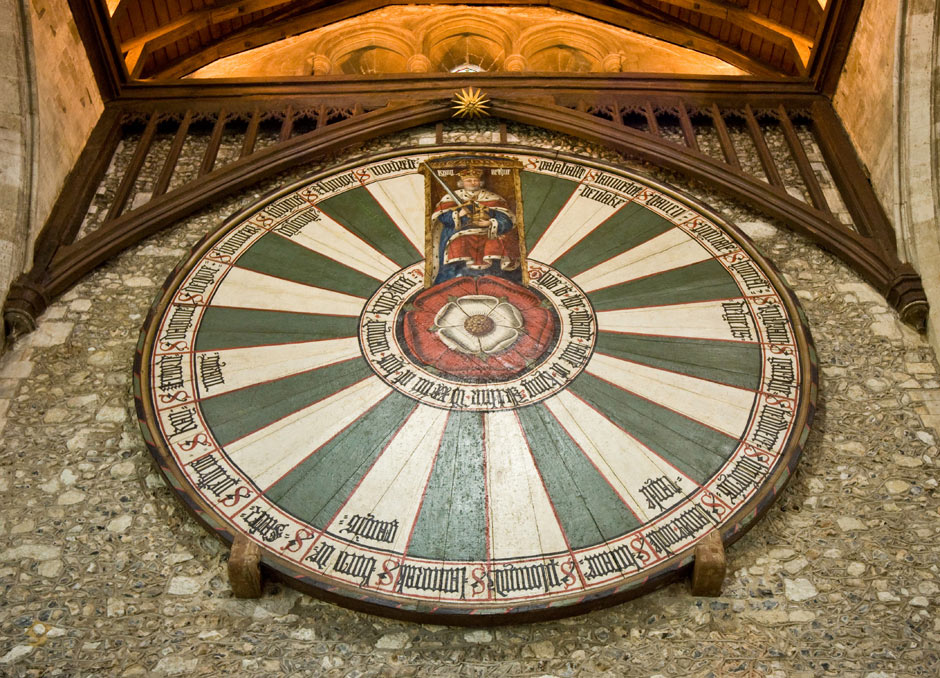
by Moe  |  In England there still hangs on a courthouse wall, the Round Table of King Arthur. In the very center of the table is a beautiful The Round Table, Winchester, UKrose painted in natural colors. This symbol is that of the Rosicrucians, the ancient alchemists, and there is a direct connection between the legend of the British King and the ancient philosophers of fire. – Manly P. Hall

The rose (Latin, rosa, in Greek, rhodon) is a sacred symbol of regeneration, purity, virginity, fertility, sexuality, secrets, and most of all, love. In the earliest of times, women were often referred to as a “rosebud,” and a bride a “rose.”

In Greek mythology, the rose with five petals became the five-pointed star (pentagram or pentacle) of the Goddess of Love, Aphrodite, and the red petals of the rose are the blood of Lord Adonis (Jupiter). 

The Greek female poet Sappho wrote about the rose in about 600 B. C.;

Would Jove appoint some flower to reign
In matchless beauty on the plain,
The Rose (mankind will all agree),
The Rose, the Queen of Flowers should be.
The pride of plants, the grace of bowers;
The blush of meads, the eyes of flowers;
Its beauties charm the gods above;
Its fragrance is the breath of love;
Its foliage wantons in the air,
Luxuriant, like the flowing hair;
It shines in blooming splendor gay,
While zephyrs on its bosom play.

The first use of the rose as a symbol can be found in the art of the Ancient Sumerians and later by the Hittities (Kheta), who are the sons of Heth or Ham. The royalty of the Ancient Hittite empires of the 15th century B.C. had used roses, often called Rosettes, that can be seen in Hittite inscriptions, seals, adorning jewelry, and headwear.  Later roses were worn by Egyptian, Assyrian, English and Norman rulers from approximately the 7th century B.C. forward.

In Ancient Egypt, the rose was an emblem of immortality, and the rose with the true cross (Tau/Ankh) was the symbol of the “secrets of immortality.” The rose is the flower of the virgin Goddess of a thousand names who governs both heaven and hell, Isis. She is the Rose-breasted Lady in Nubia. In Ancient Egypt, in the temples, rites, and in festivals of Isis, roses were always a main decoration, and the Egyptians had also exported these roses around the world. The rosette continued to have a royal symbolism down into later times.

The following images below are from a statue of Meryetamun, daughter of Ramses II, located in the Cairo Museum and showing a rose or rosette on her left breast. Isis was also often shown with Horus on her left breast. Meryetamun, or Queen Mary is also known as the White Queen and whom I believe to be the direct hereditary descendant of almost all Queens in the West down to the current Queen Elizabeth II who is the queen of 16 of the 53 member states in the Commonwealth of Nations.

Symbols rose Meryetamun

Here is a close up version of the rose on her breast.

Symbols rose Meryetamun 2

Queen Mary from Egypt is also the mother of almost half of all Europeans who carry this maternal DNA blood line, including me. Queen Elizabeth II is Head of the Commonwealth and Supreme Governor of the Church of England. The Queen also uses the rose as her symbol which marks her ascension to the throne in 1952. It is a pink rose called the Queen Elizabeth rose.

It is known as the first Grandiflora rose of them all. It is a beautiful pink rose that was said to be developed in the very early 1950’s and named for Queen Elizabeth II on June 2nd 1953, her Coronation.

queenelizabeth rose

Symbols rose maryIn Rome with the formation of the Catholic Brotherhood, the red rose of Venus and Isis later became a symbol of the Virgin Mary, whose red petals represent the five wounds of Christ and the blood of the Christian martyrs. The white rose represents purity and Virginity. One of Mary’s many titles is the “Mystical Rose of Heaven” and the “Rosa Mystica.” Paintings of the Virgin Queen had often shown her surrounded by roses, holding a rose, or sitting in a rose.

In the bible, the rose is found in the Song of Solomon, Chapter 2: “I am the rose of Sharon, and the lily of the valleys”, and in Isaiah Chapter 35: “The wilderness and the solitary place shall be glad for them; and the desert shall rejoice, and blossom as the rose.”

Sharon is the name of a fruitful plain or country, where herds and flocks were kept- Chron. xxvii. 29. Isa. xxxv. 2. and lxv. 10. This plain or country lay between Cesarea and Joppa, beginning at Lydda in Crete (Phoenicia, Canaan, Minoa, Atlantis). The Hittites had also lived in Sharon amongst the Amorites at Jerusalem in the days of Abraham. Eventually they would be driven north by the Egyptian Pharaoh Thothmes III.

When Henry VII took the crown of England from Richard III in battle, he brought about the end of the Wars of the Roses between theHouse of Lancaster (whose badge was a red rose) and the House of York (whose badge was a white rose). The White Rose of York (also called the Rose alba or rose argent), a white heraldic rose, is the symbol of the House of York and has since been adopted as a symbol of Yorkshire as a whole.

Henry VII’s father was Edmund Tudor from the House of Richmond, and his mother was Margaret Beaufort from the House of Lancaster; he married Elizabeth of York to bring all factions together. In fact, Richard III fought under the banner of the boar, and Henry under the banner of the dragon of his native Wales. The white rose/red rose idea was said to be a Tudor invention. In the late Seventeenth Century, the Jacobites took up the White Rose of York as their emblem, celebrating “White Rose Day” on 10 June, the anniversary of the birth of James III and VIII in 1688. (Wikipedia)

SYMBOL OF THE ROSE IN SECRET SOCIETIES, RELIGION AND KINGDOMS

In the Ancient Greek legend of Harpocrates, the god of silence; Eros presents a rose to the god of silence. This is where the term “sub rosa,” or “under the rose”- meaning “the keeping of a secret” is derived from, and why it is used in many secret societies such as the Rosicrucian, as their main symbols.

The rose is also found central in occult teachings and secret societies as a symbol of both silence and secrecy. It is also theSymbol rosicruciansnational flower of England. The rose is one of the most important images used in the Ancient Brotherhood and by Alchemists from the East. Various secret societies use the rose as one of their main symbols such as the Freemasons, Order of the Rosy Cross, or the Rosicrucians.

The Rosicrucians were founded in approximately the late 13th or early 14th centuries by a group of men who were dedicated to the knowledge of the sacred science of the soul, body, and universe. Knowledge, that at one time was a threat to the Catholic Church and that would be deemed heretical and warrant the need for secrecy.

Their name Rosicrucian is derived from the Latin words rosa (rose) and crux (cross), and their symbol is that of the rose crucified in the center of a cross. The rose is symbolic of our soul, and when combined with the cross, it signifies that the soul of man is crucified upon the body, where it is held by three nails (Manly Hall).

This secret society under the rose assists people with their teachings by aiding the soul searcher of wisdom through the process of their spiritual or soul awakening.  They have learning courses and books that teach people to not only know themselves, but also the Universe around them, and how their vital energies interplay with the forces of nature in the AS ABOVE, and the SO BELOW.

A Master Rosicrucian is the adept, alchemist, or true philosopher of the ancient arts who has gained the knowledge to know the secrets of the soul, immortality, and the Universe. Many P. Hall had written in The Secret Teaching of All Ages, “In mysticism the eagle is a symbol of initiation (the spinal Spirit Fire), and by this is explained the inability of the unregenerated world to understand the Secret Order of the Rose Cross. Those professing this theory regard the Comte de St.-Germain as their highest adept and assert that he and Christian Rosencreutz were one and the same individual.

They accept fire as their universal symbol because it was the one element by means of which they could control the metals. They declared themselves the descendants of Tubal-cain and Hiram Abiff, and that the purpose of their existence was to preserve the spiritual nature of man through ages of materiality. “The Gnosticsects, the Arabs, Alchemists, Templars, Rosicrucians, and lastly the Freemasons, form the Western chain in the transmission of occult science.” (See The Tarot of the Bohemians translated by A. E. Waite from the French of Papus.)”

Arthur Edward Waite had written about the Rose and cross inBrotherhood of the Rosy Cross:

‘Thus the Rose is a symbol of Mary because of her motherhood, but in relation to her it belongs to divine things, even as she herself stands on the threshold of Deity, being Spouse of the Divine Spirit and bearer of the Divine word made flesh. So also is the Rose of Shekinah, a Divine Rose, as she whom it typifies is Divine Mother of souls.’

From Geheime Figuren der Rosenkreuzer:

“The rose is a yonic symbol associated with generation, fecundity, and purity. The fact that flowers blossom by unfolding has caused them to be chosen as symbolic of spiritual unfoldment. The red color of the rose refers to the blood of Christ, and the golden heart concealed within the midst of the flower corresponds to the spiritual gold concealed within the human nature. The number of its petals being ten is also a subtle reminder of the perfect Pythagorean number.

The rose symbolizes the heart, and the heart has always been accepted by Christians as emblematic of the virtues of love and compassion, as well as of the nature of Christ–the personification of these virtues. The rose as a religious emblem is of great antiquity. It was accepted by the Greeks as the symbol of the sunrise, or of the coming of dawn. In his Metamorphosis, or Golden Ass, Apuleius, turned into a donkey because of his foolishness, regained his human shape by eating a sacred rose given to him by the Egyptian priests.

The presence of a hieroglyphic rose upon the escutcheon of Martin Luther has been the basis of much speculation as to whether any connection existed between his Reformation and the secret activities of the Rose Cross.”

Manly P. Hall further elaborates on the symbol of the Rose:

“The rose is a yonic symbol associated with generation, fecundity, and purity. The fact that flowers blossom by unfolding has caused them to be chosen as symbolic of spiritual unfoldment. The red color of the rose refers to the blood of Christ, and the golden heart concealed within the midst of the flower corresponds to the spiritual gold concealed within the human nature.”

Symbols knight of rose crosssTheHermetic Order of the Golden Dawn also has rose symbolism in their degree system with “The Ritual of the Rose Cross”, that is said to be performed for spiritual protection and also preparation for meditation.

The rose cross also has a place in the secret order called the Ordo Templi Orientis with their Fifth Degree titled, the “Sovereign Prince Rose-Croix, and Knight of the Pelican and Eagle.” The Pelican since ancient times had always represented Christ, andthe Mohamedans have a tradition that Christ was conceived by the smelling of a rose.

Another secret society that uses the rose and rose cross as a prominent symbol are the Freemasons. In the higher degrees of Masonry, the degrees of the Rose Croix, such as the Sovereign Prince Rose Croix, are some of the most ancient degrees of masonry. It is to be found in nearly all their rites. The Ancient and Accepted Scotch rite, or the Southern Jurisdiction of the Scottish Rite’s 18th degree is called, “Knight Rose Croix.”

In 1871, Albert Pike had written about this degree;

“The Degree of Rose Cross teaches three things;—the unity, immutability and goodness of God; the immortality of the Soul; and the ultimate defeat and extinction of evil and wrong and sorrow, by a Redeemer or Messiah, yet to come, if he has not already appeared.

The ROSE, was anciently sacred to Aurora and the Sun. It is a symbol of Dawn, of the resurrection of Light and the renewal of life, and therefore of the dawn of the first day, and more particularly of the resurrection: and the Cross and Rose together are therefore hieroglyphical to be read, the Dawn of Eternal Life which all Nations have hoped for by the advent of a Redeemer.”

Albert Mckay in his Lexicon of Freemasonry strongly states;

‘The Rose Croix degree was an attempt to ChristianizeFreemasonry; to apply the rites, and symbols, and traditions of Ancient Craft Masonry to the last and greatest dispensation; to add to the first Temple of Solomon and the second of Zerubbabel, a third, that to which Christ alluded when he said, “Destroy this temple, and in three days will I raise it up.” Everything, in short, about the degree is Christian.’

I will leave you with a quote from the Master Rosicrucian, Max Heindel who had written, “the blood-red rose shows the passion filled blood of the human race, and the goal to bring the pure and holy state to which man will attain when he has cleansed and purified his blood from desire, when he has become chaste, pure and Christ-like.

Thus we see that in time the present passionate mode of generation will be again superceded by a pure and more efficient method than the present, and that also is symbolized in the RoseCross where the rose is placed in the center between the four arms. The long limb represents the body, the two horizontals, the two arms and the short upper limb, the head. The the rose is in place of the larynx.

The rose, like any other flower, is the generative organ of the plant. Its green stem carries the colorless, passionless plant-blood. The blood-red rose shows the passion filled blood of the human race, but in the rose the vital fluid is not sensuous, it is chaste and pure. Thus it is an excellent symbol of the generative organ in the pure and holy state to which man will attain when he has cleansed and purified his blood from desire, when he has become chaste, pure and Christ-like.

Therefore the Rosicrucians look ardently forward to the day when the roses shall bloom upon the cross of humanity, therefore the Elder Brothers greet the aspiring soul with the words of the Rosicrucian Greeting: “May the Roses bloom upon your Cross,” and therefore the greeting is given in the meetings of the Fellowship Centers by the leader to the assembled students, probationers and disciples who respond to the greeting by saying “And on yours, also.”  (The Rosicrucian Cosmo-conception; Or, Mystic Christianity)

When that day arrives, the blood red rose of the Rosicrucians will turn white and will become the center of the true cross, the Tau.

The Origins of Human Beings According To Ancient Sumerian Texts

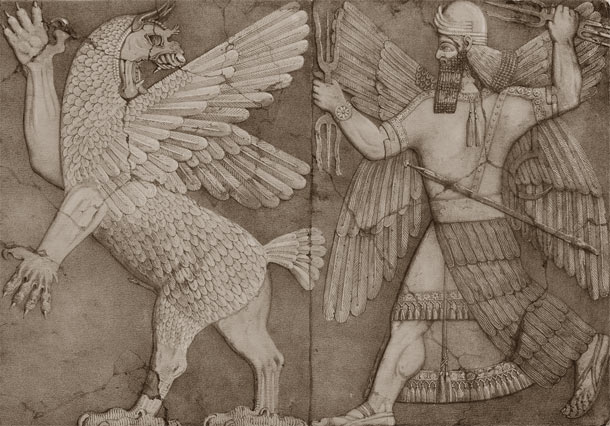
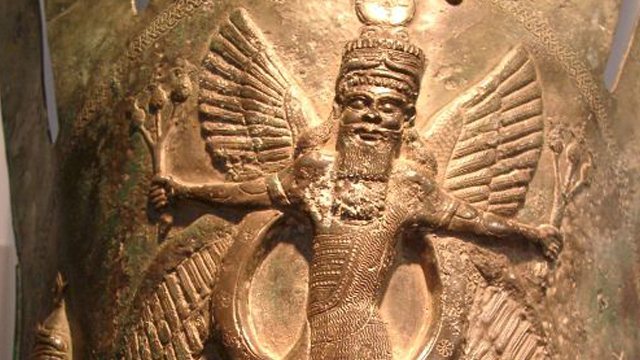
Sumerian chaos monster and sun god. (Wikipedia)

Sumerian chaos monster and sun god. (Wikipedia)

Ancient Origins  |  Sumer, or the ‘land of civilized kings’, flourished in Mesopotamia, now modern-day Iraq, around 4500 BC. Sumerians created an advanced civilization with its own system of elaborate language and writing, architecture and arts, astronomy and mathematics. Their religious system was a complex one comprised of hundreds of gods. According to the ancient texts, each Sumerian city was guarded by its own god; and while humans and gods used to live together, the humans were servants to the gods.

The Sumerian creation myth can be found on a tablet in Nippur, an ancient Mesopotamian city founded in approximately 5000 BC.

The creation of Earth (Enuma Elish) according to the Sumerian tablets begins like this:

When in the height heaven was not named,
And the earth beneath did not yet bear a name,
And the primeval Apsu, who begat them,
And chaos, Tiamut, the mother of them both
Their waters were mingled together,
And no field was formed, no marsh was to be seen;
When of the gods none had been called into being,
And none bore a name, and no destinies were ordained;
Then were created the gods in the midst of heaven,
Lahmu and Lahamu were called into being…

Sumerian mythology claims that, in the beginning, human-like gods ruled over Earth. When they came to the Earth, there was much work to be done and these gods toiled the soil, digging to make it habitable and mining its minerals.

The texts mention that at some point the gods mutinied against their labour.

When the gods like men
Bore the work and suffered the toll
The toil of the gods was great,
The work was heavy, the distress was much.

Anu, the god of gods, agreed that their labour was too great. His son Enki, or Ea, proposed to create man to bear the labour, and so, with the help of his half-sister Ninki, he did. A god was put to death, and his body and blood was mixed with clay. From that material the first human being was created, in likeness to the gods.

You have slaughtered a god together
With his personality
I have removed your heavy work
I have imposed your toil on man.

In the clay, god and man
Shall be bound,
To a unity brought together;
So that to the end of days
The Flesh and the Soul
Which in a god have ripened –
That soul in a blood-kinship be bound.

This first man was created in Eden, a Sumerian word which means ‘flat terrain’. In the Epic of Gilgamesh, Eden is mentioned as the garden of the gods and is located somewhere in Mesopotamia between the Tigris and Euphrates rivers.

Sumerian tablet depicting Enki in the creation myth. (world-myth.com)

Initially human beings were unable to reproduce on their own, but were later modified with the help of Enki and Ninki. Thus, Adapa was created as a fully functional and independent human being. This ‘modification’ was done without the approval of Enki’s brother, Enlil, and a conflict between the gods began. Enlil became the adversary of man, and the Sumerian tablet mentions that men served gods and went through much hardship and suffering.

Adapa, with the help of Enki, ascended to Anu where he failed to answer a question about ‘the bread and water of life’. Opinions vary on the similarities between this creation story and the biblical story of Adam and Eve in Eden.

Meditation Moments: The Gratitude Walk

boat_gratitude

“Walk as if you are kissing the Earth with your feet.” — Thich Nhat Hanh

How often do you really allow yourself to truly feel and express gratitude? Try this — go for a Gratitude Walk. Sometime soon drop what you are doing for 15 minutes and, if you can, go outside and start walking. The rule is that during your walk, you are not allowed to think about work or replay scenarios (real or imagined) in your head.

First, focus only on the sensation of your feet hitting the ground, your legs stretching and your hips opening up, your breathing getting deeper and more relaxed. Then turn your attention to all of the things in your life that you are happy about- whether it’s a loving relationship, a nice home, or a satisfying career. Now let those more obvious things give way to the more subtle things that you might never have thought about, but that also contribute joy to your life, that infuse you with pure gratitude.

At the end of these 15 minutes (or longer), return to what you were doing and notice your energy. Has it changed? How do you feel now?

Daily Chabad

Temple of Poseidon...Greece

Choose life!—Deuteronomy 30:19

We created beings can know only that which is. That which is not, we can only imagine—or exert effort to make it happen.

But imagine a great mind from which thoughts emerge and then crystallize as the events of the physical world—spontaneously, without effort.

All events and all things, except for those matters for which this world was originally brought into being. Those are hidden thoughts—they neither emerge nor crystallize, but only unfold through our choice to do good.

When we choose life, we redeem G‑d’s subconscious, His most hidden desire.

Theosophy ~ The Ape Appeared Later Than Man – from The Secret Doctrine (HP Blavatsky)

TSS

If the Bible combines with archæology and geology to show that human civilization has passed through three more or less distinct stages, in Europe at least; and if man, both in America and Europe, as much as in Asia, dates from geological epochs — why should not the statements of the Secret Doctrine be taken into consideration? Is it more philosophical or logical and scientific too, to disbelieve, with Mr. Albert Gaudry, in Miocene man, while believing that the famous Thenay flints 1“were carved by the Dryopithecus monkey“;or, with the Occultist, that the anthropomorphous monkey came ages after man? For if it is once conceded, and even scientifically demonstrated, that “there was not in the middle of the Miocene epoch a single species of mammal identical with species now extant” (Albert Gaudry “Les Enchainements du monde animal dans les temps géologiques” p. 240), and that man was then just as he is now, only taller, and more athletic than we are 2 — then where is the difficulty? That they could hardly be the descendants of monkeys, which are themselves not traced before the Miocene epoch, 3 is, on the other hand, testified to by several eminent naturalists.

“Thus, in the savage of quaternary ages who had to fight against the mammoth with stone weapons, we find all those craniological characters generally considered as the sign of great intellectual development” (de Quatrefages, “The Human Species, p. 312.)

Unless man emerged spontaneously, endowed with all his intellect and wisdom, from his brainless catarrhine ancestor, he could not have acquired such brain within the limits of the Miocene period, if we are to believe the learned Abbé Bourgeois (Vide infra, footnote 3).

As to the matter of giants, though the tallest man hitherto found in Europe among fossils is the “Mentone man” (6 ft. 8 in.), others may yet be excavated. Nilsson, quoted by Lubbock, states that “in a tomb of the neolithic age . . . . a skeleton of extraordinary size was found in 1807,” and that it was attributed to a king of Scotland, Albus McGaldus.

And if in our own day we occasionally find men and women from 7 ft. to even 9 ft. and 11 ft. high, this only proves — on the law of atavism, or the reappearance of ancestral features of character — that there was a time when 9 ft. and 10 ft. was the average height of humanity, even in our latest Indo-European race.

But as the subject was sufficiently treated elsewhere, we may pass on to the Lemurians and the Atlanteans, and see what the old Greeks knew of these early races and what the moderns know now.

The great nation mentioned by the Egyptian priests, from which descended the forefathers of the Greeks of the age of Troy, and which, as averred, had been destroyed by the Atlantic race, was then, as we see, assuredly no race of Palæolithic savages. Nevertheless, already in the days of Plato, with the exception of priests and Initiates, no one seems to have preserved any distinct recollection of the preceding races. The earliest Egyptians had been separated from the latest Atlanteans for ages upon ages; they were themselves descended from an alien race, and had settled in Egypt some 400,000 years before, 4 but their Initiates had preserved all the records. Even so late as the time of Herodotus, they had still in their possession the statues of 341 kings who had reigned over their little Atlanto-Aryan Sub-race (Vide about the latter “Esoteric Buddhism,” p. 66, Fifth Edition.) If one allows only twenty years as an average figure for the reign of each King, the duration of the Egyptian Empire has to be pushed back, from the day of Herodotus, about 17,000 years.

Bunsen allowed the great Pyramid an antiquity of 20,000 years. More modern archæologists will not give it more than 5,000, or at the utmost 6,000 years, and generously concede to Thebes with its hundred gates, 7,000 years from the date of its foundation. And yet there are records which show Egyptian priests — Initiates — journeying in a North-Westerly direction, by land, via what became later the Straits of Gibraltar; turning North and travelling through the future Phœnician settlements of Southern Gaul; then still further North, until reaching Carnac (Morbihan) they turned to the West again and arrived, still travelling by land, on the North-Western promontory of the New Continent. 5

What was the object of their long journey? And how far back must we place the date of such visits? The archaic records show the Initiates of the Second Sub-race of the Aryan family moving from one land to the other for the purpose of supervising the building of menhirs and dolmens, of colossal Zodiacs in stone, and places of sepulchre to serve as receptacles for the ashes of generations to come. When was it? The fact of their crossing from France to Great Britain by land may give an idea of the date when such a journey could have been performed on terra firma.

It was —

“When the level of the Baltic and of the North Sea was 400 feet higher than it is now; when the valley of the Somme was not hollowed to the depth it has now attained; when Sicily was joined to Africa, Barbary to Spain,” when “Carthage, the Pyramids of Egypt, the palaces of Uxmal and Palenque were not in existence, and the bold navigators of Tyre and Sidon, who at a later date were to undertake their perilous voyages along the coasts of Africa, were yet unborn. What we know withcertainty is that European man was contemporaneous with the extinct species of the quaternary epoch . . . . that he witnessed the upheaval of the Alps 6 and the extension of the glaciers, in a word that he lived for thousands of years before the dawn of the remotest historical traditions . . . . It is even possible that man was the contemporary of extinct mammalia of species yet more ancient . . . . of the Elephas meridionalis of the sands of St. Prest . . . and the Elephas antiquus, assumed to be prior to the elephas primigenius, since their bones are found in company with carved flints in several English caves, associated with those of the Rhinoceros hemitæchus and even of the Machairodus latidens, which is of still earlier date . . . . M. E. Lartet is of opinion that there is nothing really impossible in the existence of man as early as the Tertiary period.” 7

If “there is nothing impossible” scientifically in the idea, and it may be admitted that man lived already as early as the Tertiary period, then it is just as well to remind the reader that Mr. Croll places the beginning of that period 2,500,000 years back (See Croll’s “Climate and Time“); but there was a time when he assigned to it 15,000,000 years.

And if all this may be said of European man, how great is the antiquity of the Lemuro-Atlantean and of the Atlanto-Aryan man? Every educated person who follows the progress of Science, knows how all vestiges of man during the Tertiary period are received. The calumnies that were poured on Desnoyers in 1863, when he made known to the Institute of France that he had made a discovery “in the undisturbed pliocene sands of St. Prest near Chartres, proving the co-existence of man and the Elephas meridionaliswere equal to the occasion. The later discovery (in 1867) by the Abbé Bourgeois, that man lived in the Miocene epoch, and the reception it was given at the Pre-historic Congress held at Brussels in 1872, proves that the average man of Science will never see but that which he wants to see. 8

1 “The flints of Thenay bear unmistakable trace of the work of human hands.” (G. de Mortillet, “Promenades au Musee de St. Germain,” p. 76.)
2 Speaking of the reindeer hunters of Perigord, Joly says of them that “they were of great height, athletic, with a strongly built skeleton . . .” etc. (“Man before Metals,” p.353).
3 “On the shores of the lake of Beauce,” says the Abbé Bourgeois, “man lived in the midst of a fauna which completely disappeared (Aceratherium, Tapir, Mastodon). With the fluviatile sands of Orleanais came the anthropomorphous monkey (pliopithecus antiquus); therefore, later than man.” (See Comptes Rendus of the “Prehistoric Congress” of 1867 at Paris.)
4 “In making soundings in the stony soil of the Nile Valley two baked bricks were discovered, one at the depth of 20, the other at 25 yards. If we estimate the thickness of the annual deposit formed by the river at 8 inches per century (more careful calculations have shown no more than from three to five per century), we must assign to the first of these bricks 12,000 years, and to the second 14,000 years. By means of analogous calculations, Burmeister supposes 72,000 years to have elapsed since the first appearance of man on the soil of Egypt, and Draper attributes to the European man, who witnessed the last glacial epoch, an antiquity of more than 250,000 years.” (“Man before Metals,“p. 183.) Egyptian Zodiacs show more than 75,000 years of observation! (See further.) Note well also that Burmeister speaks only of the Delta population.
5 Or on what are now the British Islands, which were not yet detached from the main continent in those days. “The ancient inhabitant of Picardy could pass into Great Britain without crossing the Channel. The British Isles were united to Gaul by an isthmus which has since been submerged.” (“Man before Metals,“p. 184.)
6 He witnessed and remembered it too, as “the final disappearance of the largest continent of Atlantis was an event coincident with the elevation of the Alps,” a master writes (See Esoteric Buddhism p. 70). Pari passu, as one portion of the dry land of our hemisphere disappeared, some land of the new continent emerged from the seas. It is on this colossal cataclysm, which lasted during a period of 150,000 years, that traditions of all the “Deluges” are built, the Jews building their version on an event which took place later in “Poseidonis.”
7 The Antiquity of the Human Race in “Men before Metals,” by M. Joly, Professor at the Science Faculty of Toulouse, p. 184.
8 The scientific “jury” disagreed, as usual; while de Quatrefages, de Mortillet, Worsaæ, Engelhardt, Waldemar, Schmidt, Capellini, Hamy, and Cartailhac, saw upon the flints the traces of human handiwork, Steenstrup, Virchow and Desor refused to do so. Still the majority, if we except some English Scientists, are for Bourgeois.

The Secret Doctrine, ii 748–752
H. P. Blavatsky

Friday September 18th and Saturday September 19th

Grandtrines's avatarMystic Rectangles

The Moon is v/c in Scorpio for much of Friday, so it is a day best spent in contemplation, reflection and quiet meditation.  It could be useful for research and writing, just expect a need to re-do that when revelations come later.  (Later?  Yes, as early as the Moon in Sagittarius and as late as after Mercury’s direct station on October 9th.)

We now face Sun trine Ceres on Friday September 18th (feast or famine, depending on your past actions) and Saturday September 19thHygeia enters Virgo and immediate squares Saturn.  Once again, health and healthcare issues will rise in important and may result in conflict in the courts, possibly with religious organizations.  None of this, though, can come close to the intensity we will feel by Sunday as Mars is sesquiquadrate Pluto on Monday September 21st.

Friday: rest and reflection; possibly research; and feast or famine depending on…

View original post 41 more words

Mercury Retrograde — in Libra

mercury-retrograde-calendar-2015-sepoctnovdec-astrologyhoroscoperedings-copyright2014-romanolehyaworsky

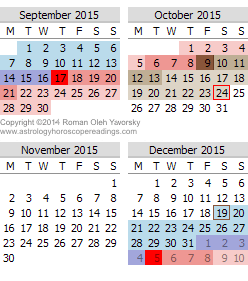
The third Mercury Retrograde Cycle of 2015 occurs in Libra (15o 55″) on September 17 at 6:09 pm Universal time,1:09 pm Eastern time and 10:09 am Pacific Time

Mercury goes direct in Libra (0o 54″) on October 9 at 2:57 pm Greenwich or Universal time, and 9:57 am Eastern time, 6:57 am Pacific Time.

Mercury enters the Pre-Shadow August 28 and is last in the Post-Shadow on October 24

———–

The calendar highlights the significant phases of Mercury Retrograde using different colors:

The Mercury Retrograde Pre-Shadow phase is shown in blue, with violet indicating where the effect tends to be felt more strongly.

The Mercury Retrograde phase is shown in light red, with the time that Mercury is in Retrograde Station indicated in dark red. During the retrograde phase, a darker color is used to highlight the time when Mercury is moving more slowly and when its effect tends to be felt more strongly.

The Mercury Retrograde Post-Shadow phase is shown in brown. The Mercury Direct Station, as Mercury stops its retrograde motions and is about to move forwards again, is indicated in dark brown. While Mercury is still moving slowly and has not speeded up, the effect of this phase tens to be felt more strongly and is indicated with a darker color.

Beyond Wisdom

OWL_eveningDo not be misled by those who claim there is no purpose.

They may know life, but not its womb.

They may know darkness, but not its meaning.

They may have wisdom, but they cannot reach higher, to a place beyond wisdom
a place from which all wisdom began.

They may reach so high until the very source from which all rivers flow. To the place where all known things converge, where all knowledge is one.

But they have not touched the the very core of being, the place before being begins, where it is chosen that being will begin, where there is nothing—no light, no darkness, no knowledge, no convergence, no wisdom—

Nothing but the burning purpose of this moment now.

Because it is for that purpose that being began.

Happy Birthday … JAI GANESHA!

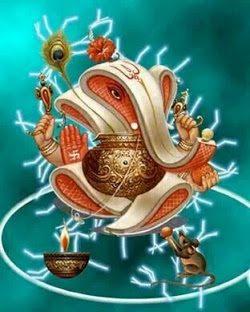
ganesh with mouse

Dissolve Your Obstacles and Karma on Ganesha’s Birthday!

The most important day of the year to clear obstacles in your life is Ganesha’s birthday. This is a very special time that happens once a year, when Ganesha will take on your karma, and dissolve all obstacles that lie in your future. All rituals and prayers to Ganesha become tremendously magnified during this time.

Obstacles are the karmic road blocks we experience in life, interwoven into the very fabric of our destiny. They are responsible for the hardships we face, especially delays, and setbacks, as well as frustration and failure. Ultimately, they block success, both materially and spiritually, and if they are not removed, they make it nearly impossible to reap the fruits of your efforts no matter how hard you try, or how well-intentioned you may be. The Archetype Ganesha, however, has the solution.

The Archetype Ganesha is a universal one that can be found in many cultures all over the world. He is sought by regular people, Mystics, and even by the Gods for his unique ability to both foresee and remove all known and unknown obstacles that lie in the future. Ganesha has the power to take your karma and transform it to ensure an utterly successful and prosperous future. He can give you the ability to enjoy effortless success and unimpeded growth in all areas of your life.

The Language and Writing System of Ancient Sumeria

Read article here

                             Read the entire article here.

The Sumerian language is considered to be a language isolated in linguistics, that does not seem to belong to any known linguistic form. Researchers have studied the ancient Sumerian language and tried making connections to other groups of languages but without success. The Sumerians invented the pictorial hieroglyphics that later transformed into cuneiform writing. Together with the ancient Egyptian writing system, the ancient Sumerian can compete in a race for the oldest known written language.

Known Sumerian texts include personal texts, business letters, transactions, receipts, lexical lists, laws, hymns and prayers, magic spells and scientific texts including mathematics, astronomy and medicine. Much of this material survived in time through copies and transcripts. Although the Semitic race became ruler of the region, the language, religion and law in Mesopotamia remained Sumerian.

Daily Chabad

NYC_Obelisk

Heaven desires Earth …

There are those who chase all things of heaven—and find they cannot live.

There are those who chase all things of earth. Their life is not worth living.

Heaven desires the earth, and the earth is lost without heaven. Make your life a marriage of the two, as lovers that never part, and you will find peace.

===

FORGOTTEN MASONIC STRUCTURE IN NEW YORK:  Obelisk in central park New York is directly related with great Pyramid of Giza and Inscriptions at Hamath in Northern Syria, old city of Joppa and tomb of David. This great structure the only giant Egyptian obelisk in the Western Hemisphere, Cleopatra’s Needle was a gift and brought to U.S. and establish by Masons in New York Central Park –Whole Park was designed by landscape architect and writer Frederick Law Olmsted and the English architect Calvert Vaux in 1858 both were Masons.