
50 years have passed, Since the invasion of the crescent moon and star, The Grey Wolves and the red flags of death Still reign in the North Cypriot sky. […]
Source: Our Beloved Cyprus

50 years have passed, Since the invasion of the crescent moon and star, The Grey Wolves and the red flags of death Still reign in the North Cypriot sky. […]
Source: Our Beloved Cyprus

This is, no doubt, a difficult practice and must be repeated again and again. Whichever purificatory chants one selects — whether it be from The Voice of the Silence, the Bhagavad Gita or The Jewel in the Lotus — these must all be taken as means that are helpful in confronting what is called the papapurusha, the assemblage of sins. It is this hideous aggregate of negative tendencies that forms the basis, at the moment of death, of the kamarupa. On average, it will take some one hundred and fifty years for this form to disintegrate. But if it is more tenacious, owing to a life of self-deception, dishonesty and spiritual pretension, it can last much longer, emitting a foul odour and precipitating crimes and even murders, recognized and unrecognized, on this earth. After-death consequences involving the kamarupa pertain to a plane of effects, but what one does in life pertains to the causal plane of human consciousness. If one is not vigilant, one may be gestating the energies that become powerfully coagulated into a tenacious kamarupa. All such entities are based, in Buddhist theory, upon the force of self-grasping, bound up with the false imputation of inherent existence to the personal ego. Naturally, the presence of such entities putrefying and disintegrating over many centuries throws an oppressive pall over humanity that puts a tremendous brake upon the aspirations of every single human being. Yet this should not be allowed to become a subject of fascination or speculation. Rather, one should recognize one’s own liability to contribute to astral pollution and so one should resolve to purify oneself and one’s emanations.
Instead of becoming preoccupied with the melodramatic history of this aggregate of tendencies, one should merely note them as they arise and mark them for elimination. They will inevitably appear when one starts to engage in meditation, and one should note them only with a view to removing them through the setting up of counter-tendencies drawn from positive efforts to visualize spiritual strengths. Hence the connection, in the Tibetan practice, between the visualization of vajrasattva and the elimination of negative tendencies. Each individual must learn to select the appropriate counter-forces necessary to negate the particular strong negative tendencies that arise. In drawing upon these counter-forces from within, one will discover that one can bring to one’s aid many an element in one’s own being that can serve to one’s spiritual advantage. Every human being has a number of elements which represent a certain ease, naturalness, decency and honesty as a human being. Sometimes there is a debilitating tendency to overlook these or take them for granted.
If this practice is going to prosper, one must bring to it a moral insight rooted in an understanding of metaphysics. The mind must be focused upon general ideas. One must reflect upon the relationship of insight and compassion. Insight is not merely intellectual, but rather arises through the recognition of what skill in action means in specific contexts. Insight involves a perception of how wisdom is reflected within action, and which can come about only through a deep reflection upon the process of how such insight is released. On the other side, before one can truly generate a conscious current of compassion, one must create a state of calm abiding. One must find out one’s resources and potentials for calmness and for generating the maximum field of patience, peacefulness, gentleness and steadfastness. Then one must combine in practice one’s capacity for calmness with one’s capacity for discerning what is essential. Inevitably, this will involve a protracted study lasting over lifetimes, and include enquiry into the fundamental propositions of Gupta Vidya, the study of karma and the study of what Buddhist thought refers to as the chain of dependent origination.
Raghavan Iyer
The Gupta Vidya II

If thou dost not — then art thou lost.
For know, that the ETERNAL knows no change.
True meditation upon emptiness depends upon a fullness of preparation through a series of stages of moral practice. Without proper preparation, authentic insight into the nature of voidness (shunyata) is impossible. It matters not how long this preparation takes; it must be honest and genuine, devised by each human being according to his or her own individual karmic agenda. Otherwise it is impossible to launch seriously into meditation, to enter into it with an inward assurance that one will never abandon it. Even after one has entered the Path leading to dhyana one will, inevitably, experience difficulties. Yet one’s very presence upon that Path must be based upon an immutable resolve. One’s preparation for deep meditation upon emptiness must be rooted in a commitment that is irreversible, inalienable and irrevocable.
According to a contemporary commentary upon this teaching delivered by Geshe Rabten, a religious counsellor to the present Dalai Lama, a mahamudra may be understood as a great seal symbolizing an immutable realization of voidness. When one enters into a formal agreement, as in signing a contract, one puts down one’s name or seals a document. Everyone knows what this means in statutory law. It is sacred and irrevocable. It is firm and binding. So, too, in a deeper and spiritual sense, one may seal one’s entire consciousness irreversibly upon the Path of dhyana — meditation. Ultimately, this is a direct subjective experience of voidness. Yet as Geshe Rabten’s commentary points out, this fundamental transformation of consciousness cannot come about except as the sequel to a long and difficult period of preparation through moral practice, mental development and preliminary exercises in meditation. Even these, as set forth in the Sutra Yana teachings of Tibetan Buddhism, require resolves, vows and the development of an unshakeable determination that once one has begun upon this Path, no matter what the difficulties, one will seek to become increasingly honest with oneself and strive ever harder to overcome them.
The primary means of preparation for the mahamudra meditation is taking refuge in the Buddha, the Dhamma and the Sangha. As soon as one directs one’s mind towards the supreme compassion and enormous sacrifice of Gautama Buddha and the entire Host of Bodhisattvas, one is filled with a tremendous purifying strength. By thinking of these beings, who have attained to the state of supreme enlightenment solely for the sake of humanity, one can gain the energy and strength to form an irreversible resolve. Thus all efforts at meditation should begin with an adoration of predecessors, a rejoicing in their very existence and in the reality of their deeds and their living presence. To this joyous practice each individual may bring devotion and an undivided seriousness entirely of his or her own choice. Thinking of the meaning of one’s own life in relationship to the meaning of the lives of all, and in relation to the world’s pain and need, one may contemplate the great work of the Bodhisattvas, inserting one’s own resolve into the broader mission of building a rainbow bridge between the Host of Dhyanis and the world of Myalba. Taking refuge in the triple gem, one can find the courage in oneself to try to aid the earth with all its plight and pain, caused ultimately by a fundamental alienation from the true Self, an ignorance of the true destiny of humanity.
The Tibetan texts lay down for monks a series of mantrams to be chanted. As Geshe Rabten explains, the set of recitations and visualizations revolving around vajrasattva is intended to assist in the elimination of negative tendencies. This aspect of the mahamudra preparation is of particular significance to individuals who have yet to master the discipline and momentum of a mendicant. Vajrasattva represents the embodiment of the power of purification of all the Buddhas. Whilst Tibetan tradition lays down for monks specific modes for visualizing vajrasattva and specific mantrams to be chanted, these details are inappropriate and unnecessary for lay individuals outside the tradition. What is of crucial importance is to bring to bear from within oneself the purifying power of the Buddha-nature upon the whole assemblage of one’s unholy modes of thought, feeling and will. There are, in every human being, a myriad such elements in a state of interconnection. These negative tendencies no doubt arose in former lives, and if they are not extinguished in this life, they will have their fruition in future lives of pain and suffering. The entire assemblage should be acknowledged so as to create a mental posture of total honesty.
Raghavan Iyer
The Gupta Vidya II

The Ptolemaic Queen Berenike II as Isis-Aphrodite Starting in the late-Ptolemaic period, we begin to hear of a Goddess called Neotera or Thea Neotera, the “Younger One” or the “Yo […]

Source: Who is the Goddess Neotera?

This week got away from me. I’ve been working on some new material for the new edition of Isis Magic (yay!). But that means I didn’t get to the post I was planning for today—some juicy […]

Source: The Night Isis Accepted Me

From now until the end of July 2025, we will be experiencing the square between Jupiter and Saturn. This is the first, or rather a waxing square, of this new cycle of conjunctions between Jupiter a […]


Look down from Orion’s belt; the bright star near the horizon is Sopdet. I’ve written a lot on this blog about the heliacal (“before the sun”) rising of the Star of Isis—Sir […]


(This article was written in 2020 when Saturn was moving into Aquarius) Every three years, sometimes two and a half, Saturn changes signs. At 3:58 GMT on March 22, the “Lord of the Rings,R […]

Source: The GREAT JUPITER-SATURN CONJUNCTION of December 2020

Lately, I am thinking about the stars. Nuet, mother of Isis holding the sun With our hot weather, the night skies are clear now, so when I look up, I can see the body of beautiful, star-filled Nuet […]


What if we could see spacetime? Embark on a visual journey through the invisible gravitational currents that shape our universe […]
Source: Imagining spacetime as a visible grid is an extraordinary journey into the unseen | Aeon Videos

The voice of the Goddess speaks in your mind and says, “Gaze at the beautiful belly of My Mother, Nuet. Squint your eyes slightly and scan the sky, to the right, to the left, above and behind […]
Source: Touching Your Isis Star
Wisdom — Your Infinite Source Of Lifechanging Wisdom.
We are a small group of individuals passionate about sharing the knowledge of people who have contributed to society. We produce content that breathes fresh life into well-known quotes that have been said throughout history because of our love of learning and creativity.
A genuine authorial voice and meticulous attention to every detail of the text enable us to produce truly excellent content that benefits so many people globally.
Let our channel serve as a never-ending well of knowledge to which you may always turn.

A perfect example I am not a fan of comicbooky-videogamey over-sexualized depictions of the Deities. I am especially not a fan of images of Goddesses with huge, spherical boobs that would hurt like […]

Source: Video Game Isis to Become Eset

June 24-30 Weekly Horoscopes and Moon Calendar. Saturn turns Retrograde … After last week’s very emotional Cancer ingress, Solstice and Lunar Standstill, you may feel like you are still reeling from that impactful energy. […]

Hello friends. After needing some support in my position at work, I decided to make a Talisman to keep in my office. My job is quite Mercurial in nature, and I wanted to put some spiritual momentum […]

Source: Mercurial Talisman

The Valley of the Golden Mummies is the largest cemetery in Egypt dating back to Greco-Roman times. It revealed around 250 mummies and most of them are aristocracies who lived in the Bahariya Oasis ( in the Western Desert of Egypt), during Greco-Roman times. The Valley of the Golden Mummies was discovered in 1996 by […]

Source: The Valley of the Golden Mummies

The eternal and transcendental geography of Mount Meru is partially mirrored in divisions of the earth connected with the polar regions. Hence, northern Asia is termed the eternal or perpetual land and the Antarctic is called the ever-living and the concealed. The freedom of the polar regions from the vicissitudes of racial evolution and geological change is a reflection of the permanence of the axis mundi of Mount Meru. The association of the North Pole with Sveta Dwipa, however, should not be thought of merely in terms of a terrestrial region. It would be more helpful to think of a Fohatic magnetic field associated with ice and snow. It is to be found both in snow-capped mountains and in desert oases, such as the Gobi Desert of Central Asia. The poles of the earth are likened in Gupta Vidya to valves regulating the ingress and egress of the solar-selenic radiance affecting the earth. They are intimately connected, through Fohatic arteries girdling the globe, with the circulations of daimons in the atmosphere. By correspondence, within the human form they are analogous to the circulation of the blood and other fluids with their invisible elemental constituents.
To connect this meta-geography with the inward life of the soul, one must connect the idea of pilgrimage to the idea of the restoration of the obscured flows of spiritual energies within the human temple. As Shankara and others taught, the sacred places of pilgrimage in the world mirror centres within the human body. Thus, there is a deep meaning behind the saying of the Puranas that even the incarnated gods themselves rejoiced to be born in the condition of men in Bharata Varsha in the Third Root Race. In one sense, Bharata Varsha is India, the original chosen land and the best division of Jambhu Dwipa. More essentially, Bharata Varsha is the land of active spiritual works par excellence, the land of initiation and divine knowledge. Hence H.P. Blavatsky’s remark that one who visits India in a proper state of mind can find more blessings and more lessons than anywhere else on this earth.
Evidently, this must not be understood in an external mechanistic or physical sense, since there are millions upon millions of souls on the Indian subcontinent who have nothing to do with this eternal current. Just as thousands of people might never show Buddhic perception, even though they saw Sir Richard Attenborough’s powerful film on Gandhi, so too, numerous individuals could either visit or be born in India without developing Buddhic insight. Rather, H.P. Blavatsky’s comment must be understood in the light of Christ’s statement that whenever two or three are gathered in his name, he was present amongst them. Again, one could think of the meaning of Dharmakshetra in Kurukshetra, the invisible and omnipresent field of dharma wherein all human beings ceaselessly live and move. Hence the teaching of the eighteenth chapter of the Gita: “Wherever Krishna, the supreme Master of devotion, and wherever the son of Pritha, the mighty archer, may be, there with certainty are fortune, victory, wealth, and wise action.”
The awakening of Buddhi depends upon soul refinement and soul sensitivity, which can only emerge from a noetic understanding of the noumenal language of the soul. That language is experienced by every human being during deep sleep, but it can only be developed when significant connections are made between what transpires in deep sleep and in waking life. One must learn to understand arcane symbols at many levels. One must, for example, become receptive to the idea that the Sveta Dwipa of the Puranas is one with the Shamballa of Buddhist tradition, and that both are identical with the abode of the Builders, the luminous Sons of Manvantaric Dawn. All such mystical names pertain to a plane of consciousness accessible to human beings within. Mount Meru and the mystical descent of the Ganges can be correlated with critical points within the spiritual spinal cord and the invisible brain. Yogic meditation transports one to inner centres, wherein dwell the gods of light. In this Sveta Dwipa, the luminous Sons of Manvantaric Dawn are eternally present during the mahamanvantara. Though they came out of the Unknown Darkness, according to mythic chronology, they are still ever present on that plane as the root of the world, as timeless spectators in the bliss of non-being. Man links heaven and earth so fully that no mode of incarnation can entirely erase the alchemical signature of one’s origin.
The lessons of mythic chronology and mystical geography must be applied by each individual to his or her own incarnation. All human beings are always involved with the cycles of the gods and daimons, the devas, devata and elementals. Every child is basically an Atma-Buddhic spark with a ray of lower Manas which becomes active in the seventh month in the mother’s womb. Typically, the ray of Manas does not become active until the age of seven, around which time it brings with it the power to choose and to take responsibility. In some it may be retarded, in others it may come too soon, before there is adequate moral preparation. But the parent who would follow the wise practices of the oldest cultures will only do the minimum that is needed for the baby. That parent will leave the baby alone to bathe in its own state of consciousness. At the same time, adults should listen to a baby’s sounds and address it as an immortal soul, as a human being capable of controlling and commanding the elementals. In so doing, an adult can arouse in the elementals that gather round a child those which are benevolent as well as those which are strong but not possessive. That everything essential to human life is capable of universalization and capable of becoming an object of responsibility may be imparted to a child before it learns to walk, or certainly when it learns to talk. Then it is crucial to draw out a baby’s innate intuition in Atma-Buddhi by explaining and guiding it through the incarnation of Manas.
By the age of seven, the child should have learnt to sit still and to receive wisdom, and be prepared to inhabit Bharata Varsha. This is nothing but a recapitulation of human evolution up until the midpoint of the Third Root Race, when the Manasa Dhyanis descended into the waiting human forms. Between the ages of seven and fourteen, a child must be very still, calm and deliberate. It can be taught deliberation by deliberate parents; anxious parents find, to their shock, their own neuroses reflected in their children. A child who is given enough basis for self-respect and self-consciousness without verbalization, before the age of seven, can, after Manas awakens it, engage in proper dialogue with a respect for alternatives and a freedom of thought. This combination of discernment and discipline is crucial if the child is to resist the chaos of companions in junior high and high school. Here both parents and children alike should closely observe and follow the best examples they can find. They should withdraw attention from negative examples, abstaining from needless analysis. In this way, the parent may help a child overcome the tendency, prevalent since Atlantis, of fascination with evil.
All this preparation encourages a balance between the centrifugal and centripetal forces which engage the incarnated ray more fully by the age of fourteen. The centrifugal power of spirit or Buddhi is capable of diffusing from a single point in every direction within a sphere. This omnidirectional diffusion mirrors the ceaseless motion of the Atman. In Manas, the capacity to hold, to focus and to concentrate these energies is associated with the centripetal energies. A helpful example in the balancing of these energies may be gleaned from those older cultures which never allowed people to speak when they were confused or excited until they had sat down. Adolescents must learn to collect themselves, to draw their energies together in calmness, if they are to avoid the rush, the tension and the anxiety endemic to the cycle between fourteen and twenty-one. Once they have developed some mature calmness, depth and strength, they can release the potential of the higher energies of Atma-Buddhi-Manas. In a sense, all humanity is presently engaged in this adolescent phase.
In the Aquarian Age a dynamic principle of balance is needed. Whilst this has its analogues on the physical plane, and even in the astral vesture, it must not be approached on this level, lest there be a degradation of the idea into Hatha Yoga. Instead, one must begin with the Buddhi-Manasic, with the emotional and mental nature, and find on the physical plane appropriate means of expressing that creative balance. Thus one can produce a rhythmic flow and a light ease in one’s sphere of influence which reflects a life of deep meditation. The ultimate aim is a fusion of love and wisdom, which then becomes Wisdom-Compassion, the fusion of Buddhi and Manas. The fusion of Buddhi and Manas at the highest level is inseparable from the path of adeptship.
Because of the inherent pacing and cycle of soul-evolution, and because of the karmic encrustations human beings have produced in themselves through associations with secondary and tertiary hosts of daimons, no one can be expected to accomplish all of this in a single lifetime, or indeed in any immediate future series of lives. But each being can make a beginning, and, at some level, fuse Buddhi and Manas. Although overactive in kama manas, most human beings are mediumistic, yet in the antaskarana there are authentic longings for the higher. Such longings must first be purified and made manasic through universalization. This requires sifting finer thoughts and higher impulses from the dross of kama manas, then releasing them for the welfare of humanity as a whole. This means ignoring statistical portraits of humanity given by mass media and developing an inward sense of one’s intimate relationship on the plane of ideation and aspiration with millions upon millions of immortal souls.
The more one can change the ratios of one’s thought about oneself, one’s thought about Bodhisattvas, and one’s thought about humanity, the better. As these ratios change, the patterns of one’s associations of daimons and elementals will shift, progressively transmuting one’s vestures and refining one’s capacity for benevolence. Gradually, as one thinks more and more in the direction of Bodhisattvas and of humanity, one will come to see oneself as someone who has the confidence and capacity to control elementals at home, at work and in the world. Thus, one can help oneself and so help others to recover the lost link with the Manasa Dhyanis. One may learn to become a being of true meditation and compassion, capable of serving as a self-conscious living link between heaven and earth.
Raghavan Iyer
The Gupta Vidya II

This Full Moon is special in many ways. It is the “first” Full Moon in Capricorn, with the second one on July 21st. This first one, which coincides with the Summer/Winter Solstice, form […]

Source: FULL MOON in Capricorn coinciding with Summer/Winter SOLSTICE – June 21st, 2024
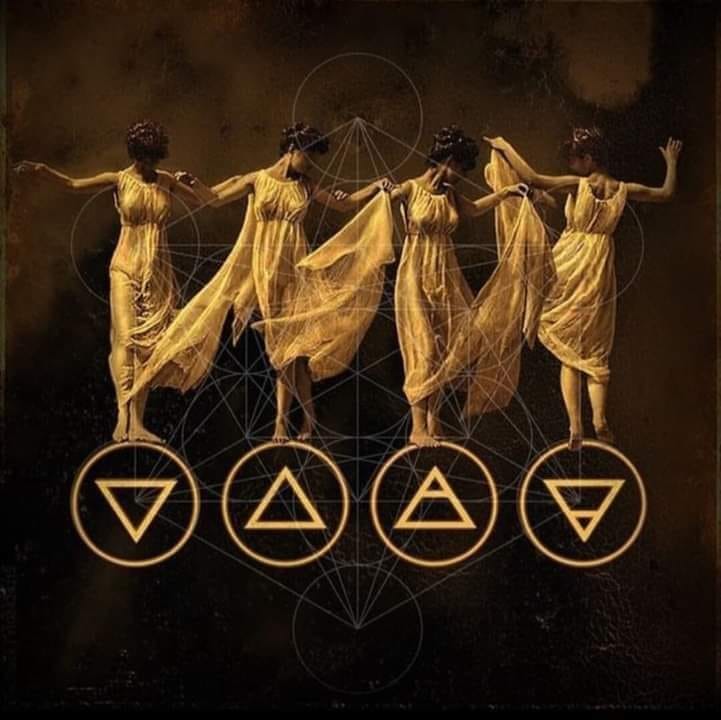
THEURGY AND TRANSMUTATION – II
Unless, however, one draws a basic distinction between the spirit and the soul of man, any effort to practice theurgy will be inverted and turn into psychism or even sorcery. Despite the Pauline classification of spirit, soul and body, Christian theology obscured the distinction between spirit and soul. Even the philosophic doctrines of the medieval Kabbalists, though they paralleled the teachings of the neo-Platonists, were not fully in accord with ancient wisdom. The neo-Platonists were, however, well aware of the dangers and seductions of all theurgy; they knew that would-be neophytes could be caught in the clutches of treacherous daimons. Those who cannot clearly distinguish between spirit and soul, cannot firmly distinguish between higher and lower daimons and theurgy will drift into thaumaturgy. As a result, they are likely to form alliances with lower hosts, worship secondary or even tertiary emanations.
The most substantial difference consisted in the location of the immortal or divine spirit of man. While the ancient Neoplatonists held that the Augoeides never descends hypostatically into the living man, but only more or less sheds its radiance on the inner man — the astral soul — the Kabalists of the middle ages maintained that the spirit, detaching itself from the ocean of light and spirit, entered into man’s soul, where it remained through life imprisoned in the astral capsule. This difference was the result of the belief of Christian Kabalists, more or less, in the dead letter of the allegory of the fall of man.
H.P. Blavatsky
The sad consequence of this concretized view of the Fall of man was twofold. First, by ontologically drawing spirit down to the level of soul, it made possible a dependence of spirit upon a third-degree anthropomorphic deity, Jehovah. Secondly, by repudiating the body as representing the Fall through intrinsic sinfulness, one was left with a passive conception of the soul, concerned only with salvation and damnation. The neo-Platonists, however, who viewed the soul as quite distinct from the transcendental spirit, saw no grounds for such an ontological or devotional subordination to lower daimons. They took an active view of the process whereby the soul seeks to link itself to the transcendent spirit. With regard to the spirit,
they allowed its presence in the astral capsule only so far as the spiritual emanations or rays of the ‘shining one’ were concerned. Man and his spiritual soul or the monad — i.e., spirit and its vehicle — had to conquer their immortality by ascending toward the unity with which, if successful, they were finally linked, and into which they were absorbed, so to say. The individualization of man after death depended on the spirit, not on his astral or human soul — Manas and its vehicle Kama Rupa — and body.
H.P. Blavatsky
From this one may see the central importance of the connection between Atma-Buddhi and Manas. One may also grasp the fundamental importance of devotion to the Brotherhood of Bodhisattvas, for without devotion it is impossible to tap the energies of Atma-Buddhi. Manas is only as luminous as its capacity to focus consciously and radiate the Atma-Buddhic light. If it can do that, then Manas can displace and control kama manas, disengaging the lower Manas from kama, which means freeing the mind from excesses, excuses and evasions. All such errors arise out of the lower manas through its fearful attachment to the body and identification with class, status and property. All of these taints erode the confidence of the soul through the inherent capriciousness of the daimons and elementals within the lower vestures. They are based upon a misguided belief in some entity which holds together all these elementals; in truth, there is only a derived or borrowed sense of entitativeness which is appropriated by the quaternary. This temporary coherence is due to its link with Manas. The lower quaternary is like an image or reflection of the light occurring through an appropriate medium. If the reflective principle of the mind confuses its own image with the authentic source of its illumination, then the polarity of self-consciousness is inverted and the powers of the soul subverted. Fragmentation precludes integration.
All efforts towards spiritual self-regeneration depend upon strengthening awareness of the shining thread which connects Atma-Buddhi to Manas, and by reflection, Atma-Buddhi-Manas to the quaternary. If this thread is not nurtured in meditation, one will not be able to alter the quality of sleep and so gain continuity of consciousness between day and night and through different states of consciousness. If one cannot do that, one will not be able to generate a strong sense of individuality and ‘I-am-I’ consciousness. One will not realize one’s Self-Being as a reflected ray of the overbrooding Dhyani, linked to the Spiritual Sun. If one cannot do this, one will always identify with one’s name and form, and spiraling downwards, fall into the midst of hosts of secondary and tertiary daimons. When the vision of the soul is deflected downward, it will look only upon that which is dark relative to the invisible radiance of spirit. Fixed by the immortal soul’s energy, this false identification with namarupa will be accompanied by a continuous exaggeration and intensification. As this misuse of divine energy is indefinitely prolonged, the immortal soul will, in time, be estranged from its ray. By assigning an exaggerated sense of reality to that which belongs to physical life, to eating, drinking, working at a job — one is generating a false sense of life, limiting both time and consciousness. This remains essentially true even if one generates a strong attachment to the concept of moral probity in connection with this incarnation. Owing to the diversion of divine energies, all identification with name and form ultimately produces dark emanations which accumulate in kamaloka, where they must be confronted soon after death.
It is possible, however, to cooperate with the processes of individualization after death. It is possible to live in a manner that dispenses altogether with kamaloka and dispels the karmic accumulations of past attachments. But such a life requires a recognition of total responsibility. It means learning to live with no attachment to name or form. One must ask oneself who is responsible for one’s personality and body, who is responsible for one’s every thought and feeling? Who is responsible for the condition of every life-atom that enters into and emanates from one’s visible and invisible vestures? In asking these questions, one begins to withdraw identification from the instruments, to see oneself as a Monad, and to approach the state of total responsibility from above below. This responsibility extends to the entire field of one’s manifest and unmanifest interactions with all life-atoms. It extends far beyond face and form, to one’s ultimate status as a true Pythagorean spectator. Only by generating a profound sense of critical distance from all names and forms may one learn to exemplify the entirety of one’s dharma in this world.
Forswearing all anxiety and attachment, all immodesty and false pride, one must learn to put to work in the best possible manner all the instruments and all the energies affecting all the hosts of daimons and devas involved in the human sphere. This can only be done if one develops, retains and strengthens a sense of being changeless and immortal, as Krishna taught Arjuna in the second chapter of the Bhagavad Gita. One must withdraw from all false ideas of vicarious atonement and salvation which are, as Plato taught in Laws, extremely harmful to the vigilant life of the spirit. Every temptation to cut corners through selfish propitiations and degrading rituals is indeed expensive karmically. The very attempt blinds the eye of wisdom, cuts the soul off from its source of light and leaves the wandering pilgrim a wretched and ridiculed victim of its false gods.
This, in epitome, is the odyssey of the fall of the human soul since its pristine golden age in the Third Root Race. Just as the divine spiritual instruction of that period retains its impress upon the imperishable centres of the soul to this day, so too does this long karmic history lie like a series of encrustations around humanity and the earth. Because man is linked with hosts of elementals within his vestures and with hosts of daimons without, this karmic inheritance is inscribed in the spatial arena of collective human evolution. It may be discerned in the mystical and sacred geography of the globe itself. Gupta Vidya suggests that when the sevenfold host of divine preceptors descended upon earth to initiate and instruct infant humanity, they descended from Sveta Dwipa, a division of Mount Meru. They established seven divine dynasties reigning over seven divisions of the earth or globe. During the Lemurian and Atlantean ages, some of these divisions changed; others have not.
Raghavan Iyer
The Gupta Vidya II