Listen to the MP3 audio
The Fool embodies whirling wind blowing between worlds. The Fool is pure existence, without substance or form. This spirit falls into the abyss of mortality. This spirit becomes all that is, seems locked into form. Yet this one being rises freely back to the silence of formlessness. The wandering Fool is like a spinning dust-devil that comes from no visible place, assumes a cloud of matter and then vanishes back into the unknown. All other Tarot cards are images frozen in time of the whirling Fool that is beyond time. When the Fool rules the world, he is the Emperor. When the Fool sits alone in thought, she is the High Priestess. When the Fool is terror and explosion, — that is the Tower. All are bound in the oneness of the Fool. The Fool is bound by no-thing.
In your preferred meditation posture, allow your eyes to close gently. Place your hands in your lap in line with your abdomen. Hold your hands together, with the back of the right hand resting against the palm of the left hand, with your thumb tips gently touching. Have the hint of a smile on your face. Just by sitting in a meditation posture, you have already set an intention. There is dignity and grace in your posture, and you may be aware of your back straightening. You may be aware of your shoulders sloping gently downwards, releasing and letting go any tension in your neck. Your feet, flat on the floor if you are sitting on the floor, or your knees touching the floor, if you’re sitting on a cushion.
Now, take a slow deep breath, bringing the breath all the way down into your belly. And as you slowly breathe out, breathe out until your lungs are empty of air. And, when you have done this, continue to breathe naturally … being aware of the breath: the inflowing breath and the outflowing breath. Breathing freely and easily. Just allowing the breath to come and go as it will.
And remaining with your eyes gently closed, visualize yourself following a path. Look down as you imagine yourself walking along it … what sort of path is it? Feel the texture of what is under your feet on this path. It could be a smooth or a rough path, or the sort of path that you have always loved that is leading you to your special place of beauty, harmony and peace. Continue walking along this path and see before you now your peaceful sanctuary. Enter into this place, for it could be a warm cozy room … it could be some special place in nature that you love, like the beach, the forest, a lake or some other place. This is the place that you can always come to where you can relax where you can experience peace and calm, a place where you are always safe and protected.
As you wander about in your own special haven, look about you and acquaint yourself with your surroundings. Touch the things that await you here and that you love. Smell the scents and aromas in this special place. And, listen to the sounds that are unique to your wonderous place.
See before you a special seat that you can sink into and feel cozy and relaxed. This can be any kind of seat in which you can sit in comfort and safety. Go now to your special seat and make yourself comfortable there.
Counting backwards into an even deeper state of relaxation … knowing that you are in control at all times … hearing these words and letting them drift by …
TEN … going deeper … NINE, EIGHT … deeper and deeper … SEVEN, SIX … relaxing and deepening … FIVE, FOUR … very very deep … THREE, TWO … relaxing, deepening … relaxing, deepening … and ONE … feeling so relaxed, so very very relaxed in your peaceful sanctuary.
And just being aware of the breath … the inward breath and the outward breath … hearing these words and allowing them to fade away.
Now, visualize yourself just like The Fool in the tarot. The Fool is not a derogatory name in this sense, but a term used to describe someone beginning the journey of deeper understanding (Chokmah) and self-knowledge (Binah) on the path of the flaming sword. Even though we are adults and may have already journeyed far, parts of us still remain naïve, unworldly or undeveloped. Immerse yourself now in the imagery of The Fool, entering into this archtype, whether you are female or male.
Visualize yourself as The Fool beginning a journey. It could be a physical journey or spiritual journey. It could be a journey, as in going to another country, or even changing your residence. It could be a journey into a new career. It could be a personal journey into changing habits so that you can experience greater health and abundance. It could be the journey of a new relationship, or a change in a relationship you already have. It could be a journey of that you may have wanted to do for some time, but something may be holding you back. Reflect now for a few moments on the journey you want to make, or would like to make, and hold that image in your mind.
Now, allow that image to fade. And, being in the archetype of The Fool, imagine this as a time in your life when you may be contemplating taking a risk … stepping off the cliff, so to speak, and plunging into something new. You may be at a crossroads in your life. If this is happening to you, reflect on that now. Stay very focused on what is happening to you right now.
And, letting those images fade again … and like the archetype of The Fool, you may be going on a personal quest. There is an element of impossibly setting off into the unknown. Again, like The Fool, your Inner Child may be innocent and eager, uninformed and uncorrupted, blind to any perils that lie ahead. Or, the inner critical adult may be remonstrating with you for such an absurd notion of wanting change in your life.
Allow yourself to sink into any feelings that may be arising for you now, and be aware of where those feelings are in your body. They could be feelings of fear and anxiety with impending change, or feelings of enthusiasm, excitement and joy as you visualize yourself setting off on this new journey. Whatever the feelings, just allow them to be there … be aware of them, observe them … without judgment.
Be aware of the breath again … the inward breath and the outward breath. Be aware of the breath as it enters and leaves your body … stabilizing your body, centering your body.
And now keep on feeling deeply into The Fool, for he or she is quite unconcerned.
Recall a time in your life when you felt very confident, as though you didn’t have a care in the world … that you carried very little with you, unburdened by worldly possessions. Go there now. If you cannot recall such a time, imagine how it would be like to have great confidence in yourself and not a care in the world.
Bring this memory from the past alive again with sounds you could hear then … what you could touch then … feel, smell, taste then … use all your senses to experience that time. Make it as vivid as you can. Make it as alive as you can. Be fully engaged in that moment in time and hold the good feelings that you had then in your body now.
And deepening more and more into the archetype of The Fool, anchoring those good feelings in your body, imagine that you are about to step off of the cliff, to plunge into the unknown, feeling unperturbed … the eternal optimist … ready to leap into anything because you are spontaneous and carefree … but most of all because you can trust and affirm for yourself your trust in yourself.
You may want to repeat to yourself, “I trust in myself. I trust in life. I trust and I let go.”
And, relaxing more and more into the archetype of The Fool, awakening in you a sense of adventure … when was the last time you stepped out of the status quo and had an adventure? Was it back in your youth, or more recently? What sort of adventure could enliven you now and give you greater vitality and heightened sensitivity?
It doesn’t have to be extreme, like climbing a mountain … it could be something such as starting a hobby or doing something you’ve always wanted to do. An adventure is about taking you in a new direction that is exciting and has an unknown element in it.
Visualize an adventure you would love now and bring it alive using all your senses. Seeing this new adventure … touching, tasting, smelling and hearing so many aspects of this adventure. Bringing it alive and fully participating in it now.
Go now to that place within, using the breath to take you there … the inward breath and the outward breath … the breath that deepens your intuition and insight to guide you through change no matter what your adventure may be.
Now, take in a deep breath … breathing in trust and belief in yourself … knowing that if you are called to make changes in your life, you can do so. And, as you breathe out, breathe out and relaxing … and letting go … letting go … letting go.
And take in another deep breath … breathing in faith in yourself … and as you breathe out, let go of all worries and self-doubts you may have. Breathe freely and easily now … allowing each breath to deepen your intuitive knowing and trust in yourself.
It is time now for you to leave your peaceful sanctuary … and so you exit from your safe place … and now, you are back on the path once more. You know you can come here any time you wish to be alone, to be in a place of inner calm.
And, counting from ONE to FIVE … ONE … becoming aware of yourself sitting on a chair or on a cushion on the floor … TWO … gently wiggling your fingers … THREE … slowly moving your head from side to side … FOUR … being aware of your feet and toes, and wiggling them … and FIVE … very very slowly, opening your eyes. Take a deep and clearing breath and stretch your whole body, if this feels good to you.
=====
“Spirit of Ether”
0 ~ Aleph ~ Fool
Man like the Greek Mercury – bounding up from the earth – the animal from behind him dragging him down. Caduceus [of Mercury] over his shoulder – represents spiritual power restrained by material conditions.
(Animal has him by the Heel)


 From the mid-nineteenth century onward the 22 cards of the major arcana had become increasingly associated with the concept of pathways and the 22 letters of the Hebrew alphabet within the Kabbalist ‘tree of life’ and ‘by 1890 Kabbalistic teaching was integral to Tarot design’ [12]. As a body of knowledge the Kabbalah has its origins in Hebrew oral tradition, scriptures and Jewish rabbinical writing. Its early history is unclear, but it developed further between the 7th and 18th centuries. Its formative texts include the Zohar and Sefer Yetzirah. A key point in its development was the writing of Etz Ha-Chaim, “The Tree of Life” by Chaim Vital in the 1590s, based on the teachings of Rabbi Isaac Luria. The concept of the tree of life entered a variety of Western esoteric traditions, being taken up by the Golden Dawn and their Hermetic Qabalah.
 The ten sefirot of the tree of life may have had their origins as representations of the metaphysical but they can be used as templates for personality traits, states of mind, or the developmental ages of man and are in some ways similar to Jungian archetypes. These templates are subtler than cartoon stereotypes or the motions of type-cast character actors, coming from a deep tradition influencing literary culture as well folk and pop psychology.

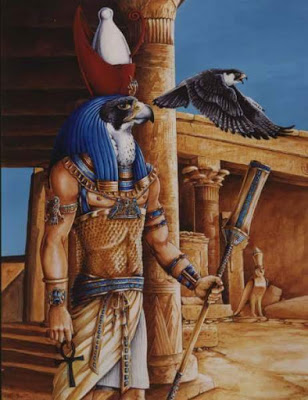
 Grand Temple of Horus Behdety