Fratres and Sorores of the Grade of Theoricus:
Tonight we turn our attention to an art that may at first seem deceptively simple.
Sixteen figures.
Rows of single and double points.
Marks traditionally made in earth, sand, dust, wax, paper, or upon a tablet.
From these apparently elementary combinations emerges one of the oldest and most elegant systems of Western divination:
Geomancy.
Yet the Theoricus should understand from the beginning that within the Golden Dawn, the study of Geomancy is not merely the learning of another method for predicting events.
It is training.
It is symbolic training.
It is mental training.
It is astral training.
And, perhaps most importantly, it is training in the disciplined interpretation of forces.
The question before us, therefore, is not simply:
“What is Geomancy?”
The deeper question is:
Why should the Theoricus learn it?
And to understand the answer, we must first understand something about the Grade through which you are presently passing.
THE THEORICUS AND THE AWAKENING OF THE SYMBOLIC MIND
The Grade of Theoricus is attributed to Yesod, the Ninth Sephirah upon the Tree of Life.
Yesod means Foundation.
It is the great formative sphere through which subtle forces are gathered, patterned, reflected, and transmitted toward manifestation.
It is traditionally associated with the Moon.
And just as the Moon receives the light of the Sun and reflects it toward the Earth, so does Yesod receive impressions from higher levels of consciousness and translate them into images, symbols, dreams, emotions, instincts, and astral forms.
This is why the Theoricus must begin learning to distinguish between a symbol and the force represented by that symbol.
A symbol is not merely a picture.
A symbol is a vessel.
It is a structure through which consciousness encounters an invisible principle.
The sixteen figures of Geomancy therefore provide the Theoricus with an ideal symbolic alphabet.
You must learn to look at a figure such as Fortuna Major and perceive more than a pattern of dots.
You must eventually recognize solar strength, enduring success, stability, elevation, protection, and the strengthening of circumstances.
You must look upon Rubeus and perceive more than an arrangement of marks.
You must begin to recognize passion, volatility, force, danger, excess, and the uncontrolled eruption of energy.
You must see Carcer and recognize restriction, limitation, boundary, enclosure, discipline, and Saturnian containment.
You must see Via and recognize movement, transition, fluidity, travel, change, and the passage from one condition into another.
Thus the figures cease to be arbitrary designs.
They become living signatures of force.
And this is one of the central tasks of the Theoricus:
to learn to perceive the invisible through the visible.
GEOMANCY AS AN ART OF EARTH AND AIR
There is a beautiful apparent contradiction within Geomancy.
Its name derives from words meaning, essentially,
divination by the Earth.
Historically, geomantic figures were often created by making spontaneous marks in sand or soil and reducing those marks into numerical patterns.
Geomancy is therefore profoundly terrestrial.
And yet the Theoricus is particularly concerned with the development of the intellectual and analytical faculties traditionally associated with Air.
Here we encounter one of the first important lessons.
The Earth produces the marks.
But the mind must interpret them.
Earth receives.
Air discriminates.
Earth records.
Air analyzes.
Earth presents the form.
Air asks:
What does this form mean?
Thus Geomancy becomes an extraordinary exercise in balancing two faculties that the magician must eventually unite:
receptivity and discrimination.
You must first allow a pattern to arise.
Then you must interpret that pattern without distorting it according to your personal desires.
This distinction is crucial.
For the immature diviner asks:
“What do I want the oracle to say?”
The trained diviner asks:
“What does the oracle actually say?”
That difference is enormous.
Indeed, it is one of the foundations of magical integrity.
THE ANCIENT CURRENT OF GEOMANCY
Geomancy possesses a long and complex history.
Forms of earth divination appear in a number of cultures, but the system that entered medieval and Renaissance Western occultism was greatly developed through the Arabic tradition of ‘ilm al-raml, the “science of the sand.”
Through transmission into medieval Europe, Geomancy became one of the respected divinatory sciences.
It was studied alongside astrology.
Medieval and Renaissance geomancers developed systems connecting the figures with planets, zodiacal signs, elements, directions, houses, qualities of motion, colors, and conditions of fortune.
By the Renaissance, Geomancy had entered the larger corpus of ceremonial and occult philosophy.
It appears within the intellectual environment associated with figures such as Cornelius Agrippa, and later became incorporated into the magical synthesis inherited and reorganized by the Hermetic Order of the Golden Dawn.
The Golden Dawn therefore did not encounter Geomancy as an isolated curiosity.
It inherited a symbolic technology.
And this technology fit remarkably well with the Order’s method.
For the Golden Dawn teaches by correspondence.
Color corresponds to planet.
Planet corresponds to Sephirah.
Sephirah corresponds to Divine Name.
Planet corresponds to metal.
Zodiacal sign corresponds to Hebrew letter.
Tarot corresponds to Path.
Element corresponds to direction.
Direction corresponds to weapon.
And so forth.
Geomancy belongs naturally within this universe because its sixteen figures are themselves embedded in an elaborate network of correspondences.
Learning Geomancy therefore helps train the student to think in precisely the way the Golden Dawn system requires.
THE SIXTEEN FIGURES AS AN OCCULT ALPHABET
The sixteen traditional geomantic figures are:
Via — the Way.
Populus — the People.
Fortuna Major — the Greater Fortune.
Fortuna Minor — the Lesser Fortune.
Acquisitio — Gain.
Amissio — Loss.
Laetitia — Joy.
Tristitia — Sorrow.
Puella — the Girl.
Puer — the Boy.
Conjunctio — Conjunction.
Carcer — Prison.
Caput Draconis — Head of the Dragon.
Cauda Draconis — Tail of the Dragon.
Albus — White.
And Rubeus — Red.
At first the student will naturally attempt to memorize definitions.
That is necessary.
But it is not sufficient.
Eventually each figure should become a kind of occult personality.
When you encounter Puella, you should feel something Venusian within it.
Receptivity.
Beauty.
Harmony.
Social connection.
Reconciliation.
When you encounter Puer, you should recognize the Martial quality.
Initiative.
Impulsiveness.
Conflict.
Courage.
Heat.
When you encounter Acquisitio, you should perceive expansion and accumulation.
When you encounter Amissio, you should perceive release, expenditure, reduction, or separation.
The Theoricus therefore begins developing an internal vocabulary of forces.
This becomes invaluable later.
Because ceremonial magic demands precisely this ability.
When a planetary force is invoked, you must eventually recognize whether the atmosphere feels Jupiterian, Saturnian, Martial, Venusian, Mercurial, Solar, or Lunar.
Geomancy begins sharpening that faculty in a controlled symbolic environment.
FOUR LINES — FOUR ELEMENTAL CONDITIONS
Every geomantic figure consists of four horizontal levels.
Each level contains either:
one point
or
two points.
Traditionally these lines may be associated with the four Elements:
Fire,
Air,
Water,
and Earth.
Thus every figure contains within itself a complete elemental formula.
Consider what this means.
A figure is not merely a name.
It is an arrangement of elemental states.
The magician therefore learns to ask:
Where is the activity?
Where is the stability?
Which portion of the figure is open?
Which portion is closed?
Where does motion occur?
Where does accumulation occur?
The sixteen figures are consequently combinations arising from a very simple binary structure.
One point.
Two points.
Active.
Passive.
Odd.
Even.
Expansion.
Contraction.
From an extraordinarily simple numerical principle arises an entire language of divination.
This should remind the Theoricus of a principle encountered again and again throughout occult science:
Complexity emerges from simplicity.
The four Elements produce innumerable worlds.
The ten Sephiroth produce countless combinations.
The Hebrew alphabet generates innumerable words.
The few basic components of astrology generate millions of possible horoscopes.
Likewise, sixteen geomantic figures may describe an astonishing variety of human circumstances.
GEOMANCY AND THE SCIENCE OF COMBINATION
There is another reason Geomancy is particularly valuable to the Theoricus.
Geomancy teaches you how occult forces combine.
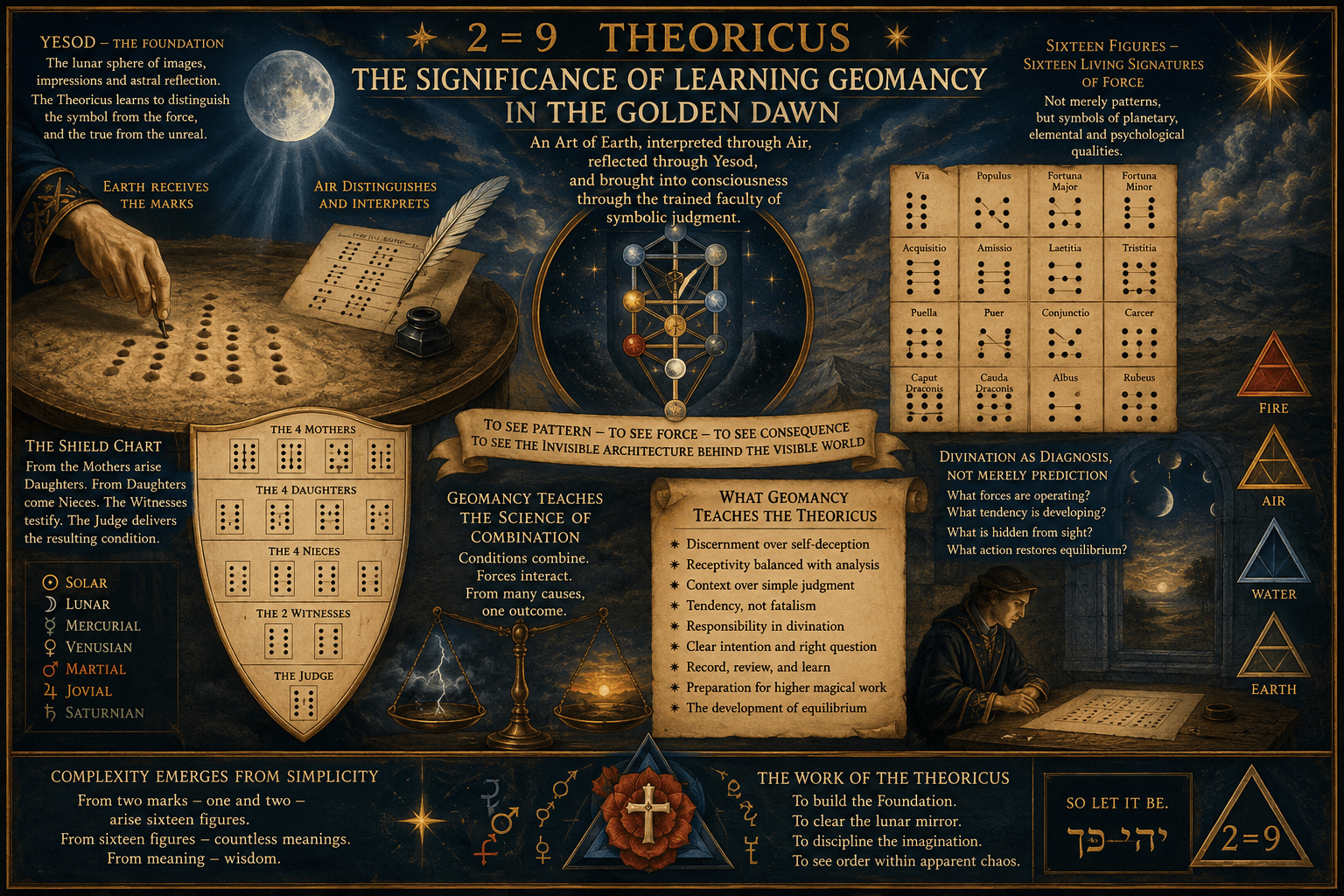
A complete geomantic chart traditionally develops through a sequence of figures beginning with the four Mothers.
From the Mothers arise the four Daughters.
From these arise the Nieces.
Then appear the two Witnesses.
And finally the Judge.
In some methods additional figures may be derived for further interpretation.
Notice the philosophical principle.
One figure generates another.
Forces combine.
Consequences emerge.
Conditions produce outcomes.
The oracle is therefore not merely presenting disconnected symbols.
It presents a chain of causation.
The Mothers may be understood as the original conditions.
The Daughters reveal another dimension of those conditions.
The Nieces demonstrate combinations and developments.
The Witnesses summarize opposing or complementary currents.
And the Judge represents the resulting condition.
The student is therefore learning something much deeper than fortune-telling.
You are learning to trace the evolution of force.
That skill will later become indispensable in ceremonial magic.
For whenever you perform a magical operation, you must eventually learn to ask:
What forces have I introduced?
How will they combine with forces already present?
What secondary effects may arise?
What is the likely final equilibrium?
Geomancy trains precisely this form of occult reasoning.
THE JUDGE AND THE DISCIPLINE OF JUDGMENT
The final figure of the traditional Shield Chart is called the Judge.
That name deserves contemplation.
The Judge does not merely “predict the future.”
The Judge represents the resolution of preceding conditions.
The Judge is therefore the product of everything that came before it.
This teaches the Theoricus a profound principle:
Outcomes arise from combinations of causes.
This principle is equally magical, psychological, and ethical.
The magician who repeatedly cultivates anger eventually produces an atmosphere shaped by anger.
The magician who repeatedly cultivates clarity produces conditions favorable to clarity.
The magician who repeatedly acts without discipline eventually produces disorder.
And the magician who repeatedly brings forces into equilibrium gradually creates a more ordered inner world.
The geomantic Judge therefore teaches not fatalism—
but consequence.
GEOMANCY AND YESOD
Now let us return to Yesod.
Why is divination particularly significant at this stage?
Because Yesod is the sphere of images.
Dreams arise through Yesod.
Memory is colored through Yesod.
Imagination operates through Yesod.
Psychic impressions often enter consciousness through Yesod.
The astral body is traditionally related to Yesodic processes.
And therefore the Theoricus must learn an extremely important lesson:
Not every image is revelation.
Not every intuition is prophecy.
Not every dream is divine communication.
Not every emotional reaction is spiritual guidance.
Not every psychic impression is accurate.
The sphere of Yesod is reflective.
And reflections may be clear or distorted.
Just as the Moon may be reflected perfectly upon still water but shattered upon turbulent water, so may subtle impressions be distorted by emotional agitation, expectation, fear, desire, or fantasy.
Geomancy gives the Theoricus a discipline through which intuition is constrained by structure.
You may have an intuitive impression—
but the chart still has rules.
You may dislike a figure—
but its established correspondence still remains.
You may desperately desire a particular outcome—
but the Judge may disagree.
Thus the system disciplines the astral imagination.
This is one of its greatest values.
DIVINATION AND SELF-DECEPTION
Every magician must confront the danger of self-deception.
The more imaginative the practitioner becomes, the greater this danger may become.
One may begin seeing omens everywhere.
Every coincidence becomes cosmic confirmation.
Every dream becomes prophecy.
Every emotional surge becomes the voice of a spiritual intelligence.
Geomancy provides a corrective.
It says:
Generate the figures.
Construct the chart.
Observe the houses.
Examine the witnesses.
Consider the Judge.
Compare testimonies.
Determine whether the figures agree.
Interpret according to established principles.
In this manner intuition is not abolished.
It is disciplined.
And disciplined intuition is one of the foundations of genuine occult practice.
GEOMANCY AS A BRIDGE TO ASTROLOGY
The Theoricus should also notice the strong relationship between Geomancy and Astrology.
Traditional geomantic practice developed extensive planetary and zodiacal correspondences.
Figures were associated with planetary forces.
Geomantic charts came to be interpreted through twelve houses analogous to the houses of astrology.
The First House concerns the querent.
The Second concerns resources.
The Third concerns communication and local affairs.
The Fourth concerns home and foundations.
The Fifth concerns creativity and pleasure.
The Sixth concerns work, service, and difficulties of daily life.
The Seventh concerns relationships and opponents.
The Eighth concerns shared resources, transformation, inheritance, and mortality.
The Ninth concerns religion, philosophy, journeys, and higher study.
The Tenth concerns profession, authority, reputation, and public standing.
The Eleventh concerns friends, allies, hopes, and associations.
The Twelfth concerns hidden conditions, confinement, enemies, and concealed matters.
Thus by learning Geomancy, the student begins becoming familiar with the concept of houses as fields of manifestation.
A symbol never exists only in abstraction.
Its meaning changes according to where it operates.
Mars in one environment is not identical to Mars in another.
Venus in one house does not behave exactly like Venus in another.
Likewise a geomantic figure must be interpreted according to the house in which it appears.
The student therefore begins learning one of the foundational principles of all advanced occult interpretation:
A force must always be understood in context.
THERE ARE NO SIMPLY “GOOD” OR “BAD” FIGURES
This is another major lesson.
Beginners often want to divide every oracle into two categories.
Good.
Bad.
Fortunate.
Unfortunate.
But the occultist must become subtler.
Consider Carcer, the Prison.
Restriction sounds unpleasant.
But suppose the question concerns:
“Will this boundary remain secure?”
Carcer may be highly favorable.
Suppose the question concerns:
“Can this unstable situation be contained?”
Again, Carcer may indicate precisely what is required.
Or consider Amissio, Loss.
If the question is:
“Will I retain this possession?”
Amissio may be unfavorable.
But if the question is:
“Can I rid myself of this harmful attachment?”
Amissio may describe liberation.
Likewise Puer, the fiery Martial figure, might signify conflict in a question of reconciliation—
but courage and decisive action in a question requiring bold intervention.
This teaches the Theoricus to move beyond simplistic moral categories.
Occult forces are contextual.
Fire may warm a home.
Fire may destroy a home.
Water may preserve life.
Water may drown.
Saturn may imprison.
Saturn may stabilize.
Mars may injure.
Mars may defend.
Venus may harmonize.
Venus may seduce.
The mature magician learns not merely to label forces but to understand their function.
Geomancy begins teaching exactly that.
GEOMANCY AND THE DEVELOPMENT OF MAGICAL MEMORY
There is also the practical matter of memory.
Golden Dawn study demands an enormous network of correspondences.
Planets.
Elements.
Signs.
Hebrew letters.
Sephiroth.
Divine Names.
Archangels.
Angelic Orders.
Tarot Keys.
Colors.
Magical weapons.
Incenses.
Metals.
Geomantic figures.
At first these may seem like isolated lists.
Eventually they must become interconnected.
Suppose you encounter a figure associated with Mars.
Immediately your mind should begin forming associations.
Mars.
Geburah.
Red.
Iron.
Force.
Severity.
Conflict.
Courage.
The Sword.
Heat.
Action.
When these correspondences begin arising naturally, something important has changed.
You are no longer memorizing occultism.
You are beginning to think occultly.
Geomancy helps develop this associative consciousness.
GEOMANCY AS TRAINING FOR SKRYING
There is another connection of particular importance to the Theoricus.
Geomancy trains symbolic contemplation.
A student may begin by looking at a geomantic figure intellectually.
Eventually, however, the figure may become a doorway for meditation.
One may contemplate its elemental composition.
Its planetary correspondence.
Its color.
Its emotional quality.
Its motion.
Its landscape.
Its symbolic inhabitants.
In advanced practice, such contemplation may contribute toward the development of skrying and astral perception.
But the order of training is important.
First:
learn the correspondence.
Then:
understand the correspondence.
Then:
meditate upon the correspondence.
Only afterward should one place great confidence in subjective impressions arising from it.
Knowledge precedes interpretation.
Structure precedes vision.
Discipline precedes freedom.
This principle protects the student.
GEOMANCY AND THE FOUR ELEMENTS
Geomancy also reinforces elemental understanding.
Every occult situation may be considered through elemental balance.
Is there too much Fire?
Too little Water?
Is Air dominating Earth?
Is Earth preventing necessary motion?
Is emotional Water overwhelming rational Air?
Geomantic figures provide another symbolic means through which these relationships may be observed.
The Theoricus begins seeing that events themselves possess elemental qualities.
A heated argument may be Martial and Fiery.
A prolonged legal restriction may be Saturnian and Earthy.
A romantic reconciliation may be Venusian and Watery.
A sudden exchange of information may be Mercurial and Airy.
Thus ordinary human situations become readable as combinations of force.
This is preparation for ceremonial magic because ritual itself works through carefully selected combinations of force.
THE DIFFERENCE BETWEEN DIVINATION AND FORTUNE-TELLING
The Golden Dawn student should be careful with language.
Divination, at its highest level, is not merely the attempt to discover:
“What will happen to me?”
That question may be legitimate.
But it is incomplete.
A more mature divinatory question asks:
What forces are operating?
What tendency is developing?
What am I failing to perceive?
What will likely result if present conditions continue?
Where is resistance?
Where is opportunity?
What action restores equilibrium?
Now divination becomes useful to the magician.
It becomes diagnostic.
Geomancy becomes not merely a device for predicting events, but a method of examining the architecture of circumstances.
FATE, TENDENCY, AND WILL
Here we encounter an important philosophical issue.
If Geomancy reveals the future, is the future fixed?
The Golden Dawn magician should resist simplistic fatalism.
The oracle often reveals tendency.
It describes forces presently operating.
Strong currents produce probable outcomes.
But human choices may alter circumstances.
New information may enter.
Different decisions may be made.
A magical operation may change conditions.
Another person’s will may intervene.
Therefore the wise diviner does not say carelessly:
“This must happen.”
Rather:
“Under the present arrangement of forces, this is the direction toward which events appear to be moving.”
Such language is both more responsible and more philosophically accurate.
THE ETHICS OF DIVINATION
The Theoricus must also begin learning responsibility.
Divination creates influence.
When someone asks you a serious question, your words may affect decisions.
Relationships may change because of what you say.
Financial choices may change.
Emotional states may change.
Therefore the magician must never use an oracle to create unnecessary fear.
Nor should one present interpretation as infallible.
Nor should one manipulate another person by claiming occult authority.
The diviner must distinguish between:
the figure,
the interpretation,
and personal opinion.
These are not always identical.
Humility is essential.
Even an experienced geomancer may misunderstand a chart.
Thus the deeper magical virtue cultivated through Geomancy is not certainty.
It is discernment.
ASKING THE RIGHT QUESTION
Geomancy also teaches the importance of formulation.
A poorly formed question often produces a poorly understood answer.
Suppose someone asks:
“Will everything turn out well?”
What does “everything” mean?
What does “well” mean?
For whom?
During what period?
Compare that with:
“What is the likely outcome of accepting this position during the next six months?”
Now the oracle has focus.
This teaches another law of magic:
Intention must be clearly formulated.
An unclear intention produces scattered results.
A clear intention gives direction to force.
Thus even the act of constructing a geomantic question becomes magical training.
THE THEORICUS AS OBSERVER
The word Theoricus itself suggests contemplation and observation.
At this stage the student must learn to observe before attempting mastery.
Geomancy is an ideal teacher because the chart exists independently of your emotional reaction.
You may examine it.
Return to it.
Record it.
Compare your interpretation with later events.
Discover where you were correct.
Discover where you projected.
Discover which correspondences you misunderstood.
Discover which intuitions proved accurate.
Thus Geomancy can become a laboratory of consciousness.
Keep records.
Date your readings.
Write the exact question.
Record the figures.
Record the interpretation before the outcome is known.
Then return later.
This practice is invaluable.
Without records, memory conveniently rewrites the past.
You remember successful predictions and forget the unsuccessful ones.
The magician must resist this tendency.
The magical diary therefore becomes the companion of Geomancy.
Together they create accountability.
THE SHIELD CHART AS A MAP OF CONSCIOUSNESS
Consider the traditional Shield Chart itself.
At first it appears to be merely a diagram.
But contemplate its structure.
Four Mothers.
Four Daughters.
Four Nieces.
Two Witnesses.
One Judge.
Many conditions gradually reduce toward synthesis.
Multiplicity moves toward unity.
This is itself profoundly Hermetic.
From many manifestations—
one judgment.
From many causes—
one result.
From complexity—
a pattern.
The magician is constantly performing this operation.
You receive impressions from the senses.
Memories.
Feelings.
Thoughts.
Intuitions.
Symbolic correspondences.
Then consciousness attempts to synthesize them.
Geomancy externalizes this process.
It gives you a visible diagram of occult reasoning.
THE TWO WITNESSES
Before the Judge appear the two Witnesses.
These may be contemplated as two great testimonies.
Two currents.
Two perspectives upon the question.
They stand before the Judge.
This structure contains an important lesson for the Theoricus:
Do not judge from one testimony alone.
Examine multiple indications.
Compare figures.
Look for repetition.
Look for contradiction.
Look for reinforcement.
Look for imbalance.
The experienced occultist rarely bases a major conclusion upon one isolated symbol.
Instead, patterns are examined.
This is equally true in Tarot, astrology, ritual observation, dream work, and skrying.
Geomancy teaches synthesis.
GEOMANCY AND MAGICAL EQUILIBRIUM
Perhaps one of the greatest contributions Geomancy can make to your training is the cultivation of equilibrium.
The diviner must remain receptive without becoming passive.
Analytical without becoming rigid.
Intuitive without becoming fanciful.
Confident without becoming arrogant.
Skeptical without becoming closed.
This is difficult.
But it is precisely the balance demanded of the magician.
To practice Geomancy properly is therefore to practice a miniature form of magical equilibrium.
PREPARATION FOR THE HIGHER GRADES
The Theoricus should understand that nothing learned at this stage exists in isolation.
Geomancy prepares you for increasingly sophisticated symbolic systems.
As you advance, the ability to combine correspondences becomes more important.
The ability to distinguish objective symbolism from subjective fantasy becomes more important.
The ability to understand planetary forces becomes more important.
The ability to interpret complex symbolic patterns becomes more important.
The ability to record magical experiments becomes more important.
The ability to recognize cause and consequence becomes more important.
Thus Geomancy is not a detour from ceremonial magic.
It is training for ceremonial magic.
The student who learns Geomancy carefully is learning how to read forces.
And the magician who cannot read forces will eventually have difficulty directing them.
FROM DIVINER TO MAGICIAN
There is a progression hidden within this study.
At first you ask:
“What does this figure mean?”
Later you ask:
“What force does this figure represent?”
Later still:
“How is this force operating within the chart?”
Then:
“How does this force interact with the other forces present?”
And eventually:
“How might equilibrium be restored?”
Notice what has happened.
You have moved from prediction toward diagnosis.
From diagnosis toward understanding.
From understanding toward intelligent action.
This is the transition from the passive fortune-teller to the active magician.
The purpose of magical knowledge is not merely to observe destiny.
It is to participate consciously in the formation of one’s life.
A FINAL CONTEMPLATION
Fratres and Sorores, imagine the ancient geomancer seated before a field of sand.
The hand moves.
Marks appear.
At first there is disorder.
Then the marks are counted.
Odd.
Even.
Single.
Double.
Four lines emerge.
A figure appears.
More figures follow.
Mothers.
Daughters.
Nieces.
Witnesses.
Judge.
What began as apparent randomness slowly reveals structure.
What appeared chaotic begins to speak.
This image contains a profound teaching.
Human life often appears exactly the same way.
Events seem disconnected.
Emotions seem contradictory.
Relationships change.
Opportunities appear.
Doors close.
Patterns arise and vanish.
To ordinary awareness it may seem chaotic.
But the occultist learns to ask:
What pattern lies beneath appearance?
That question stands near the heart of all esoteric study.
The Tree of Life asks it.
Astrology asks it.
Tarot asks it.
Alchemy asks it.
Qabalah asks it.
Geomancy asks it.
And eventually the magician asks it of the Self.
What forces move within me?
What patterns have I inherited?
What conditions am I creating?
Which forces strengthen me?
Which imprison me?
What must be gained?
What must be lost?
Where must I remain still?
Where must I travel?
Where is Fortuna?
Where is Carcer?
Where is Acquisitio?
Where is Amissio?
Where does the Dragon begin—
and where must the Dragon’s Tail release that which is finished?
Now the sixteen figures become something more than instruments of divination.
They become mirrors of consciousness.
CLOSING CHARGE TO THE THEORICUS
Therefore, Theoricus, do not learn the sixteen figures merely to pass an examination.
Learn them until they become familiar companions.
Do not memorize only their names.
Learn their movements.
Learn their planets.
Learn their elemental qualities.
Learn their strengths.
Learn their dangers.
Learn how they behave within houses.
Learn how they combine.
Learn how they testify.
Learn how they judge.
Most importantly—
learn what occurs within your own consciousness while you interpret them.
Observe when desire interferes.
Observe when fear interferes.
Observe when intuition clarifies.
Observe when imagination exaggerates.
Observe when the symbolism speaks clearly.
For this is part of the true work of the 2=9 Grade.
The Foundation must become stable.
The lunar mirror must become clear.
The imagination must become disciplined.
The intellect must become discerning.
And the student must gradually learn to recognize order within apparent chaos.
So when you next cast the points of Geomancy, do not think that you are merely making marks upon paper.
Imagine instead that you are standing upon the boundary between the visible and invisible worlds.
The Earth receives the points.
The Air distinguishes them.
The Moon reflects their images.
The mind interprets their pattern.
And consciousness seeks the hidden law beneath manifestation.
This is why the Theoricus learns Geomancy.
Not merely to predict.
Not merely to divine.
But to see.
To see pattern.
To see correspondence.
To see consequence.
To see force.
And ultimately—
to begin seeing the invisible architecture that stands behind the visible world.
Thus is Geomancy properly approached as a discipline of the Theoricus: an Art of Earth, interpreted through Air, reflected through Yesod, and brought into consciousness through the trained faculty of symbolic judgment.
May your vision become clear.
May your judgment become balanced.
And may the Foundation upon which you build become firm.
So let it be.