Fratres and Sorores of the Order, Officers newly entrusted with the governance of this Temple, Initiates assembled beneath the banners of the Mysteries: At this sacred turning of the year, we stand once again upon the threshold of equilibrium. The Sun has come unto the place of balance. Day and night face one another as equals. Neither Light nor Darkness possesses dominion, and for one brief and solemn moment the scales of Nature are held in perfect poise. This is the mystery of the Autumnal Equinox. It is not merely an astronomical event. Nor is it merely a seasonal marker in the procession of the year. To those who walk the Hermetic Path, it is a living symbol of the Great Work itself. For the Initiate must learn to stand where the Sun now stands: between opposing forces, neither fleeing one nor clinging blindly to the other. Between Mercy and Severity. Between expansion and restraint. Between speech and silence. Between action and contemplation. Between the visible and the invisible. Between that which we desire to become and that which, in truth, we presently are. At the Equinox, Nature herself teaches the lesson of the Balance. And therefore it is fitting that at this season the Officers of the Temple should be renewed, the duties of the Mysteries reassigned, and those who have accepted office reminded that no Officer stands here merely to wear a sash, bear an implement, recite a title, or occupy a station. To accept an office within the Temple is to accept a spiritual burden. It is to become, for a season, the living representative of a principle. It is to say before the visible and invisible assembly: Let this principle work through me. Therefore, Officers of the Temple, remember that the authority entrusted to you is not personal authority. The office belongs to the Temple. The power belongs to the Current. The Wisdom belongs to the Divine. You are its stewards. The robes you wear are not ornaments of distinction. They are reminders of obligation. The implements you bear are not possessions. They are symbols of responsibility. The stations at which you stand are not privileges. They are places of service. And when, in due season, another stands where you now stand, the Mysteries will continue. For none among us is greater than the Work we have sworn to serve. Let the Hiereus remember that strength without Wisdom becomes tyranny, but strength disciplined by Wisdom becomes guardianship. Let the Hegemon remember that reconciliation is not weakness, for the Middle Way requires greater mastery than either extreme. Let the Kerux remember that every proclamation should carry truth, every movement should possess purpose, and every opening of a way should be undertaken with vigilance. Let the Stolistes remember that purification begins not with Water alone, but with the cleansing of motive, intention, memory, and heart. Let the Dadouchos remember that consecration requires more than flame. One must first kindle the interior Fire before attempting to awaken it in another. Let the Sentinel remember that every sacred enclosure possesses a boundary and that discernment is itself a form of protection. And let every Officer remember that harmony among the Officers is itself part of the ritual. For a Temple divided against itself cannot become a true vessel of the Light. We may pronounce every sacred name perfectly. We may trace every symbol correctly. We may know the correspondences of the Elements, Planets, Sephiroth, Paths, Hebrew letters, Tarot Keys, and celestial spheres. Yet if we bring pride, resentment, rivalry, vanity, carelessness, or selfish ambition into the sacred precinct, then we introduce disorder into that which was erected to reveal harmony. The true Temple must first be constructed within its Officers. Govern yourselves before attempting to govern another. Correct yourselves before correcting another. Examine your own motives before judging those of your Frater or Soror. Remember that authority exercised without humility obscures the Light it claims to defend. But humility joined with courage allows authority to become sacred service. And to the Initiates I likewise speak. Do not imagine that because you hold no office, you bear no responsibility for the Temple. Every Initiate is a living stone within its walls. Every word contributes either to harmony or discord. Every act of kindness strengthens it. Every act of dishonor weakens it. Every disciplined meditation strengthens it. Every neglected obligation weakens it. Every sincere aspiration brightens its subtle form. Every indulgence in malice, gossip, contempt, or unnecessary conflict introduces shadow into its atmosphere. The Temple is not merely this physical chamber. It is a living body created through shared purpose. It is built through ritual. It is nourished by aspiration. It is strengthened through study. It is defended through ethical conduct. It is illuminated by the sincere spiritual labor of those who enter beneath its portals. Therefore never ask only: What can the Order give me? Ask also: What am I giving to the Order? Never ask merely: How rapidly may I advance? Ask: How deeply have I integrated what has already been entrusted to me? For the Mysteries are not a race toward titles. They are a process of transformation. The grade is not the attainment. The sash is not the attainment. The certificate is not the attainment. Knowledge itself, unless transformed into character, is not the attainment. The true grade is the degree to which consciousness has become capable of embodying the principle represented by that grade. What profit is there in knowing the mystery of Earth if we possess no stability? What profit is there in learning the mysteries of Air if our thoughts remain disordered? What profit is there in studying Water if our emotions govern us without restraint? What profit is there in invoking Fire if our Will is scattered among a thousand desires? And what profit is there in speaking endlessly of Spirit if we cannot recognize the Divine dignity within another human being? The Great Work is not performed upon parchment alone. It is performed upon the personality. The laboratory is the human constitution. The prima materia is the unrefined self. The furnace is life. The Fire is aspiration. The solvent is discipline. And the gold toward which we labor is awakened consciousness capable of reflecting the Light of the Higher Genius. Thus the Autumnal Equinox speaks to us of harvest. Spring carried the promise. Summer brought growth. Autumn asks: What has actually borne fruit? This is a question every Initiate should ask. What has your study produced? What has your ritual practice changed? What habit has been overcome? What virtue has been strengthened? What fear has been confronted? What illusion has been recognized? What responsibility have you finally accepted? Where have you become more truthful? Where have you become more compassionate? Where have you become stronger? Where have you become freer? And where, despite all our learning and aspiration, do we remain unchanged? These questions are not instruments of condemnation. They are instruments of measurement. The Autumnal Equinox belongs to the Scales. And the Scales neither flatter nor accuse. They reveal. To weigh a thing rightly is to see it rightly. And to see ourselves rightly is among the most difficult arts of initiation. Neither self-glorification nor self-contempt. But self-knowledge. Neither inflation nor humiliation. But truth. Know your strength. Know your weakness. Know what you understand. Know what you do not understand. Know where you have conquered. Know where you remain vulnerable. And then— work. This is equilibrium in seed. For balance does not mean immobility. Consider the Scales. Equilibrium is achieved not because nothing acts upon them, but because the forces acting upon them have been rightly adjusted. So too the balanced magician is not one who has escaped passion, sorrow, desire, conflict, responsibility, or change. The balanced magician is one who has increasingly learned to place these forces into right relationship. The Light does not require us to cease being human. It requires us to become fully human: conscious, responsible, integrated, compassionate, strong, discerning, and capable of acting from a center deeper than impulse. This is why the Equinox is both beautiful and severe. From this moment the nights lengthen. The outer Sun declines. The green world prepares to withdraw. Leaves fall. Seeds descend beneath the soil. Life moves inward. And Nature teaches again that darkness is not always destruction. Sometimes darkness is gestation. Sometimes withdrawal is preparation. Sometimes silence is instruction. Sometimes loss is purification. Sometimes the falling away of what once clothed us is necessary before the essential may be revealed. Therefore, fear not every descent into darkness. But neither worship it. The Initiate does not worship darkness. The Initiate enters it carrying a Lamp. There is a profound difference. Our task is not to become enamored of obscurity. Our task is to discover within obscurity the hidden seed of Light. When circumstances become uncertain— carry the Lamp. When the mind becomes confused— carry the Lamp. When grief enters your life— carry the Lamp. When pride has been wounded— carry the Lamp. When the Path becomes difficult— carry the Lamp. When those around you lose sight of their highest nature— carry the Lamp. And when you yourself forget who you are, seek again that interior flame which no external night can wholly extinguish. At the Vernal Equinox we celebrate emergence. At the Autumnal Equinox we contemplate surrender. The magician must know how to begin. The magician must also know how to release. There are ideas whose seasons have passed. Habits whose usefulness has ended. Ambitions belonging to an earlier self. Injuries preserved long after they ceased to protect us. Identities to which we cling because they once gave us security. Autumn therefore asks: What must fall? Look upon the trees. They do not cease to be trees when their leaves descend. Their life withdraws toward the center. So too may the Initiate learn to release without losing the Self. You are not every opinion you have ever held. You are not every role you have ever occupied. You are not every mistake you have ever made. You are not every praise you have ever received. You are not every wound you have ever carried. Behind the changing garments of personality stands something deeper. The Divine Spark. The Hidden Light. That sacred center toward which all true initiation directs us. Our ceremonies point toward it. Our studies train the mind to perceive it. Our meditations train the imagination to receive its symbols. Our ethical obligations prepare the character to bear its force. Our fraternity reminds us that the Work is never accomplished through selfishness alone. Cherish therefore the fraternity of this Temple. There will be disagreements. There will be misunderstandings. Personalities will sometimes clash. A Mystery School does not gather perfected beings. It gathers human beings attempting transformation. Our fraternity therefore cannot depend upon the absence of conflict. It must depend upon our ability to address conflict honorably. Speak truthfully. Listen carefully. Correct gently when gentleness is sufficient. Stand firmly when firmness is required. Forgive where forgiveness is possible. Protect boundaries where boundaries are necessary. Never use occult knowledge as a weapon against another. Never use spiritual rank to silence legitimate concern. Never mistake secrecy for permission to conceal wrongdoing. Never confuse obedience to the Work with unquestioning obedience to personality. Our loyalty must remain first to Truth, to the Divine, to the integrity of the Mysteries, and to those ethical principles without which no genuine spiritual community can endure. The greater the authority, the greater the responsibility. The higher the office, the deeper the accountability. The more knowledge entrusted to us, the more carefully it must be used. And now the solar gate turns toward the darker half of the year. Use the season well. Study more deeply. Meditate more faithfully. Keep your records. Examine your dreams. Observe the movements of your mind. Refine your ritual practice. Strengthen your physical foundation. Order your affairs. Repair what may be repaired. Complete what should be completed. Release what should be released. Cultivate silence. For there comes a point upon the Path when we discover that the loudest voice is rarely the voice of the Higher Genius. The deeper instruction often comes quietly. A symbol. A dream. A sudden insight. A movement of conscience. A recognition during ritual. A truth long resisted but no longer deniable. A simple realization: Something within me must change. Listen. For the season before us favors the interior Work. The outer Sun diminishes that another Sun may be discovered. There is a Solar Light that does not rise in the East nor set in the West. There is a Dawn which no clock measures. There is a Temple not built by human hands. There is a Flame before which every earthly flame is but reflection. And every authentic Mystery ultimately points toward that Light. Therefore we enter Autumn not in sorrow but in solemnity. We enter carrying the fruits of what has been accomplished. We enter acknowledging what remains unfinished. We enter ready to release what has fulfilled its season. We enter prepared to labor in hidden places. And we enter together. May those who have struggled find renewed strength. May those who have succeeded remain humble. May those who have erred learn. May those who have been wounded heal. May those who have wandered remember the Path. May those who possess knowledge gain understanding. May those who possess understanding attain wisdom. And may wisdom ripen into compassion. Let the Balance be established within us. Let the Pillars be made steadfast. Let Mercy temper Severity. Let Severity give strength to Mercy. Let the Elements be harmonized. Let the lower nature become responsive to the Higher. Let knowledge become practice. Let practice become transformation. Let transformation become service. Let service become Light. As the Sun enters the Gate of Equilibrium, may we likewise enter equilibrium within ourselves. As the leaves descend toward Earth, may all that is false within us fall away. As the seed enters darkness, may the hidden seed of the Divine be nourished within the secret ground of the soul. As the nights lengthen, may the Interior Lamp burn brighter. And when the outer world becomes dark, may we remember that those who have truly discovered the Light carry dawn within themselves. Officers of the Temple: Stand faithfully at your stations. Initiates of the Mysteries: Stand faithfully upon your Path. And all of us together, remembering that we are servants rather than possessors of the Mysteries, let us go forward into the descending half of the year with vigilance, courage, humility, discipline, and fraternity. For the Great Work continues. The Temple remains open within us. The Lamp remains kindled. The Path remains before us. Beyond every darkness— Light. Beyond every veil— Light. Within the heart of every sincere seeker— Light. So may the Balance be established. So may the Temple be strengthened. So may the Divine Light descend upon, dwell within, and radiate through all who faithfully undertake the Great Work. So let it be.
In Peace Profound,
VH Soror TF Hierophantria and Imperatrix Grand Temple of Horus Behdety
Primary Objective : To transform astrological knowledge into direct spiritual experience through disciplined contemplative practice.
Before we begin tonight’s work, I would like each of you to set aside, for just a little while, the charts, the tables of correspondences, and the lists of planetary rulerships that have occupied so much of your studies. They have served you well, and they remain indispensable. But they are only the beginning.
Throughout the earlier grades, you have learned to identify the symbols of astrology. You have memorized the qualities of the planets, the elements, the signs, the decans, and the many correspondences that bind astrology to the Tree of Life. That knowledge forms a necessary foundation. Yet no amount of intellectual study can replace direct spiritual experience.
The work of the Magician is to transform knowledge into wisdom.
Tonight, we will explore one of the most beautiful and transformative practices of the Western Mystery Tradition: astrological pathworking.
The heavens are more than a collection of distant celestial bodies. To the ancient philosophers, the Hermetic sages, the Rosicrucians, and the initiates of the Golden Dawn, the cosmos was alive. Every planet expressed a divine principle. Every zodiacal sign revealed a unique mode through which the One Life manifested itself. The stars were not merely objects to be observed—they were symbols of living realities, mirrors reflecting eternal truths within the soul of humanity.
When we practice astrological pathworking, we are not attempting to travel physically into the heavens. Rather, we enter the symbolic landscape of consciousness. We seek to encounter the archetypal intelligence represented by a planet or sign. We allow the imagination—not as fantasy, but as the sacred faculty of vision—to become a bridge between the conscious mind and the deeper levels of the psyche and spirit.
This distinction is important.
Fantasy is something we invent.
Pathworking is something we receive.
The initiate approaches these inner experiences with humility rather than expectation. We do not force visions to appear. We do not attempt to manufacture profound experiences. Instead, we create the proper conditions and allow the symbols to reveal themselves naturally. We become attentive observers of the inner world.
By the time one reaches the Grade of Philosophus, this manner of work becomes especially appropriate.
Philosophus is the Grade of Fire.
Fire is the element of transformation. It consumes what is crude and reveals what is essential. Fire gives warmth, illumination, and life, but only when governed wisely. So too must our knowledge be refined through experience. The facts we have accumulated must become living realities within consciousness.
There are, generally speaking, three stages through which astrological understanding develops.
The first is intellectual.
This is where every student begins. We memorize that Aries is cardinal fire, ruled by Mars. We learn that Taurus belongs to Venus, that Saturn governs Capricorn, that Mercury rules Gemini and Virgo. We study aspects, dignities, exaltations, and correspondences.
This level is necessary.
But it is not enough.
The second level is psychological.
Here the symbols begin to awaken within our own lives.
We notice Mars whenever we are called upon to defend someone or confront a difficult situation. We recognize Saturn whenever discipline, patience, or responsibility become necessary. Venus appears not merely as romance, but as our capacity for beauty, harmony, and appreciation.
The symbols cease being external descriptions.
They become mirrors.
Eventually, the initiate enters the third level.
This is the mystical level.
Here, the symbols are experienced as living archetypes. The initiate no longer contemplates merely the idea of courage but encounters the essence represented by Mars. No longer simply studies beauty but experiences the living current symbolized by Venus. Jupiter ceases to be only expansion or fortune and becomes the felt presence of generosity, wisdom, and noble authority.
Whether we understand these encounters psychologically, spiritually, or both is less important than the transformation they produce.
This is the purpose of pathworking.
Naturally, preparation is essential.
One should never rush into this practice.
The Temple—or whatever sacred space you have prepared—should be quiet, orderly, and free from distraction. A simple altar is sufficient. A white candle may be lit to symbolize the Divine Light. If desired, a planetary candle corresponding to the work may also be used, together with appropriate incense.
Begin, as always, by centering yourself.
Perform the Lesser Banishing Ritual of the Pentagram to establish equilibrium within the sphere of sensation. Offer an Adoration to the Lord of the Universe. Sit quietly until the ordinary chatter of the mind begins to settle.
Only then should the pathworking begin.
Most astrological pathworkings follow a remarkably similar structure.
First comes relaxation.
Allow the breath to become slow and steady. Let tension dissolve from the body. Withdraw awareness from external concerns and gather it inward.
Then comes visualization.
Imagine yourself standing before a doorway.
Upon that doorway appears the glyph of the sign or planet with which you intend to work. Do not rush forward. Pause. Recognize that you stand at the threshold of a sacred mystery. Inwardly ask permission to enter.
This simple act cultivates humility. We do not storm the Temple of Wisdom; we are invited into it.
When the time feels right, step through the doorway.
Now the true work begins.
Do not force the scenery. Do not struggle to invent details. Allow the environment to unfold gradually. Perhaps you find yourself upon a mountain. Perhaps within a forest, a temple, a desert, or beside a river. Whatever appears, observe it with quiet curiosity.
Sooner or later, most sincere pathworkings introduce some form of guide.
It may be a wise elder.
An angelic presence.
A symbolic animal.
A priest or priestess.
A king.
A child.
Occasionally no guide appears at all, and the landscape itself becomes the teacher.
Receive whatever comes without judgment.
If an opportunity arises, respectfully ask a question.
“What quality must I cultivate?”
“What obstacle hinders my growth?”
“What lesson belongs to this sign?”
Ask only one question at a time.
Then wait.
Silence often teaches more than words.
Eventually, the experience reaches its natural conclusion.
Offer gratitude to whatever intelligence or symbol has appeared. Retrace your steps through the doorway. Return your awareness gently to the room. Open your eyes without haste.
Then write.
Write immediately.
Memory fades far more quickly than we imagine.
Record the date, the planetary hour if known, the Moon’s phase, the symbols encountered, the dialogue, the emotions, the unexpected details, and any practical insights that emerged. Over months and years these journals become invaluable records of spiritual development.
Let us consider an example.
Imagine we are entering the current of Aries.
You find yourself standing before dawn. The eastern horizon glows with deep crimson light. A narrow mountain path rises before you toward a solitary temple perched upon the summit. As you climb, the landscape grows increasingly austere. There is nothing unnecessary here. Every stone, every gust of wind, every step demands purpose.
At the summit waits a great ram.
Its presence is calm rather than aggressive. Its eyes shine with unwavering certainty.
It asks a single question.
“What have you delayed because of fear?”
There is no accusation in its voice.
Only invitation.
Nearby burns a clear, unwavering flame. Within the fire stands a sword. It is not offered for violence. It is offered to cut away hesitation.
You receive it.
When you descend the mountain, the dawn has become full daylight.
Nothing in your external life has changed.
Yet inwardly something has shifted.
That is the work.
Now consider Taurus.
Instead of a mountain, you enter a broad green valley. The air is rich with the fragrance of spring. At the center stands an ancient oak whose roots disappear into immeasurable depths. Beneath its branches rests a magnificent white bull.
The bull does not challenge you.
It simply asks,
“What truly nourishes your soul?”
Notice that this question is not about possessions.
Nor comfort.
Nor pleasure.
It asks about nourishment.
Remain there as long as necessary.
Listen.
The lesson of Taurus often arrives in silence.
Or imagine entering the temple of Libra.
You walk into a vast marble hall filled with perfect stillness. At its center stands a golden balance. No one attends it. One scale bears your strengths; the other, your limitations. Neither outweighs the other. Both belong to the whole person.
A veiled figure appears—not to judge you, but to invite you into greater balance. She silently gestures for you to place one attachment upon the scales.
Observe what changes.
Such experiences often reveal truths that no textbook can adequately convey.
Planetary pathworkings proceed in much the same manner.
In a Venus meditation, you may find yourself walking through an exquisite rose garden where beauty surrounds you from every direction. Yet among hundreds of blossoms, one rose remains unopened. A luminous feminine presence asks gently,
“What beauty within yourself remains unopened?”
A Saturn pathworking may lead you instead to a mountain monastery where an elderly teacher offers no speeches, no praise, and no criticism. There is only unfinished work waiting patiently upon a stone bench. The lesson is discovered not through conversation but through disciplined labor.
A Jupiter meditation may open into a magnificent library whose shelves stretch beyond sight. Upon a throne sits a benevolent king who asks,
“What blessing have you overlooked?”
Notice that the questions are always simple.
The answers, however, may occupy a lifetime.
Now, a word of caution.
Not every image carries profound meaning.
Sometimes the imagination simply wanders.
Sometimes the subconscious rearranges memories into symbolic form.
This is perfectly natural.
The Magician therefore cultivates discernment.
Ask yourself after every experience three simple questions.
Did this meditation make me more humble?
Did it encourage greater virtue?
Did it awaken a deeper desire to serve?
If the answer is yes, then the work has likely borne good fruit.
If the experience merely inflates pride, feeds spiritual vanity, or encourages a sense of superiority, then it should be regarded with great caution.
The purpose of pathworking is transformation, not entertainment.
Its fruits should appear not only in meditation but in ordinary life.
After a Mars pathworking, practice courage.
After Venus, cultivate kindness.
After Saturn, complete a neglected responsibility.
After Mercury, communicate with greater honesty and precision.
After Jupiter, share wisdom generously.
After Moon work, spend time in reflection.
After Sun work, strive to embody integrity and noble leadership.
Without action, vision gradually fades.
Experience becomes memory rather than transformation.
For your work during the coming weeks, each of you will undertake a complete cycle through the zodiac. Dedicate one week to each sign. Enter its symbolic landscape, receive whatever instruction it offers, and faithfully record your experiences in your magical journal. At our Temple meetings, we shall compare observations—not to determine who is “correct,” but to discover how universal archetypes reveal themselves uniquely to each individual soul. You will likely find recurring themes alongside strikingly personal symbolism, and both are worthy of careful contemplation.
As you complete the cycle, you will notice a remarkable change. The zodiac will no longer appear as twelve abstract divisions upon an astrological chart. Aries will become a remembered ascent toward courage. Taurus will become a valley of quiet strength. Gemini a place of living dialogue. Cancer a sanctuary of memory. Leo a throne of radiant purpose. Virgo a sacred workshop of refinement. Libra a hall of equilibrium. Scorpio a chamber of transformation. Sagittarius a road toward distant horizons. Capricorn a mountain of disciplined ascent. Aquarius a temple of inspired vision. Pisces an ocean of compassionate surrender.
The signs will cease to be merely studied.
They will become inhabited.
This is the true aim of astrological pathworking. It is not the pursuit of extraordinary visions or psychic experiences, but the gradual refinement of consciousness. Through repeated encounters with these celestial archetypes, we begin to recognize that the zodiac is not only written across the heavens—it is inscribed within the soul itself.
The ancient Hermetic axiom reminds us, “As above, so below; as within, so without.” Through this sacred work, the macrocosm and the microcosm gradually come into harmony. We discover that the celestial temple we have sought among the stars has always existed within the sanctuary of our own being.
May your journeys through the living Zodiac deepen your wisdom, strengthen your character, and kindle ever more brightly the sacred Fire entrusted to the Magician, until every step upon the path reflects the Light of the One Divine Source.
For this lecture, I distinguish between sources that directly document Golden Dawn astral/astrological practice and sources that provide the older Hermetic, Qabalistic, astrological, and modern interpretive foundations behind the lecture.
Annotated Bibliography: Astrological Pathworking
Primary Golden Dawn and Hermetic Sources
Regardie, Israel.The Golden Dawn: The Original Account of the Teachings, Rites, and Ceremonies of the Hermetic Order. 6th ed. St. Paul, MN: Llewellyn Publications, 1989.
This is the principal modern compendium for Golden Dawn ritual, symbolism, grade material, elemental work, Tarot, Qabalah, astrology, and astral techniques. It is particularly important for understanding why astrological pathworking cannot be isolated from the Order’s larger system of correspondences. For the Magician, Regardie provides the ritual and symbolic architecture through which zodiacal and planetary forces can be approached as components of an integrated magical universe.
King, Francis, ed.Astral Projection, Ritual Magic, and Alchemy: Golden Dawn Material by S. L. MacGregor Mathers and Others. Rochester, VT: Destiny Books, 1987.
Especially relevant to the practical dimension of the lecture. The collection preserves Golden Dawn-related material concerning astral consciousness, magical imagination, visionary work, and related occult techniques. It helps place “pathworking” within the broader historical practice of skrying and astral vision rather than treating it merely as guided visualization.
Mathers, S. L. MacGregor.The Kabbalah Unveiled. London: George Redway, 1887.
Mathers’s translation of portions of Knorr von Rosenroth’s Latin Kabbala Denudata was profoundly influential upon the Golden Dawn’s understanding of Qabalah. Although it is not a pathworking manual, it provides important historical background for the cosmological structure through which Golden Dawn practitioners understood spiritual worlds, emanation, divine names, and the relationship between higher and lower realities.
Westcott, William Wynn.An Introduction to the Study of the Kabalah. London: J. M. Watkins, 1910.
Westcott, one of the Golden Dawn’s founders, offers a compact introduction to the Qabalistic worldview underlying much of the Order’s magical system. It is useful for Magician students because astrological pathworking within the Golden Dawn is not simply “astrology plus visualization”: planets, signs, Hebrew letters, Sephiroth, Tarot, and divine hierarchies exist within a deliberately interconnected symbolic structure.
Golden Dawn Correspondences and Practical Magic
Crowley, Aleister.777 and Other Qabalistic Writings of Aleister Crowley. York Beach, ME: Samuel Weiser, 1973.
Despite Crowley’s later development of a distinctly Thelemic system, the correspondence tables of 777 preserve and expand material substantially indebted to the Golden Dawn tradition. The tables are extremely useful when constructing pathworkings because they correlate planets and zodiacal signs with colors, divine names, Tarot, Hebrew letters, perfumes, magical images, and other symbolic categories. For students, however, it is important to distinguish Golden Dawn-derived material from Crowley’s subsequent Thelemic interpretations.
Cicero, Chic, and Sandra Tabatha Cicero.Self-Initiation into the Golden Dawn Tradition. St. Paul, MN: Llewellyn Publications, 1995.
A modern systematic presentation of Golden Dawn practice particularly useful for understanding how ritual, visualization, meditation, symbolism, and grade work can function as an integrated curriculum. It provides practical context for preparing sacred space and cultivating the disciplined imaginative faculties required for pathworking.
Cicero, Chic, and Sandra Tabatha Cicero.The Essential Golden Dawn: An Introduction to High Magic. St. Paul, MN: Llewellyn Publications, 2003.
A useful secondary introduction to Golden Dawn magical philosophy and practice. For the present lecture, its value lies in explaining how ritual, Qabalah, astrology, Tarot, and magical symbolism operate as interconnected components rather than independent subjects. It is particularly accessible for students transitioning from theoretical correspondence work toward practical magical application.
Astrology and the Western Esoteric Tradition
Agrippa, Heinrich Cornelius.Three Books of Occult Philosophy. Translated by James Freake. Edited and annotated by Donald Tyson. St. Paul, MN: Llewellyn Publications, 1993.
Agrippa is indispensable for understanding the Renaissance magical worldview inherited by later ceremonial traditions. His treatment of planetary qualities, celestial correspondences, number, elemental philosophy, images, spirits, and the relationship between terrestrial and celestial realities provides an important historical foundation for the concept that planetary forces may be approached through carefully constructed networks of symbolism.
Ficino, Marsilio.Three Books on Life. Edited and translated by Carol V. Kaske and John R. Clark. Binghamton, NY: Medieval & Renaissance Texts & Studies, 1989.
Ficino provides one of the most sophisticated Renaissance treatments of humanity’s relationship with celestial influences. Particularly valuable is De vita coelitus comparanda (“On Obtaining Life from the Heavens”), in which Ficino discusses music, imagery, plants, perfumes, colors, and contemplative practices in relation to planetary qualities. His work offers a major intellectual ancestor to later planetary magical practices.
Cornford, Francis Macdonald, trans.Plato’s Cosmology: The Timaeus of Plato. Indianapolis: Hackett Publishing, 1997.
Plato’s Timaeus provides an important philosophical background for the Western conception of the cosmos as an ordered, ensouled whole rather than a collection of unrelated material objects. It supports the lecture’s broader metaphysical premise that human consciousness and celestial order can be contemplated as corresponding expressions within a unified cosmos.
Hermetic Foundations
Copenhaver, Brian P., trans.Hermetica: The Greek Corpus Hermeticum and the Latin Asclepius in a New English Translation, with Notes and Introduction. Cambridge: Cambridge University Press, 1992.
One of the strongest scholarly translations of the philosophical Hermetica. The texts explore divine Mind, cosmic order, humanity as microcosm, spiritual rebirth, and the relationship between the human and celestial realms. This is an important corrective to overly simplified modern uses of “as above, so below”: the actual Hermetic worldview is considerably richer than the popular maxim suggests.
Fowden, Garth.The Egyptian Hermes: A Historical Approach to the Late Pagan Mind. Princeton, NJ: Princeton University Press, 1986.
Fowden provides the historical context necessary for understanding Hermeticism as a late-antique religious-philosophical phenomenon. This scholarly source helps distinguish historical Hermetic thought from nineteenth- and twentieth-century occult interpretations of it, making it particularly valuable for an advanced Temple curriculum.
Tarot, Astrology, and the Paths
Case, Paul Foster.The Tarot: A Key to the Wisdom of the Ages. Richmond, VA: Macoy Publishing, 1947.
Case, who was strongly influenced by Golden Dawn teachings before developing Builders of the Adytum, presents Tarot as a system of spiritual and psychological transformation. His discussions of Hebrew letters, astrological correspondences, meditation, and Tarot imagery are particularly relevant to zodiacal pathworking because the Golden Dawn’s zodiacal signs can also be approached through their corresponding Major Arcana Keys.
Wang, Robert.The Qabalistic Tarot: A Textbook of Mystical Philosophy. York Beach, ME: Samuel Weiser, 1983.
An especially useful bridge between Golden Dawn Tarot, astrology, Qabalah, and the Tree of Life. Wang demonstrates how Tarot symbolism functions within the Golden Dawn’s Qabalistic framework. For pathworking students, it assists in understanding why a zodiacal journey may simultaneously involve a Hebrew letter, Tarot trump, elemental quality, planetary influence, and Tree-of-Life path.
Although centered upon Crowley’s Thoth Tarot rather than strictly Golden Dawn Tarot, DuQuette clearly explains many of the astrological, Qabalistic, elemental, and zodiacal correspondences inherited from the Golden Dawn system. It is useful as a comparative secondary source, especially when students begin exploring how Golden Dawn correspondences evolved within later Western magical traditions.
Active Imagination and the Psychology of Pathworking
Jung, C. G.The Archetypes and the Collective Unconscious. 2nd ed. Translated by R. F. C. Hull. Princeton, NJ: Princeton University Press, 1969.
Jung supplies an important psychological framework for understanding why symbolic encounters can possess tremendous subjective power without requiring the practitioner to decide immediately whether an encountered figure is an objectively independent spiritual intelligence. His concept of archetypes is particularly helpful when interpreting recurring kings, queens, animals, temples, mountains, oceans, guides, and celestial figures within pathworking.
Jung, C. G.The Red Book: Liber Novus. Edited by Sonu Shamdasani. Translated by Mark Kyburz, John Peck, and Sonu Shamdasani. New York: W. W. Norton, 2009.
Jung’s extraordinary record of visionary encounters demonstrates sustained engagement with deliberately entered imaginal experience. It should not be treated as a Golden Dawn manual, but it provides a valuable comparative example of disciplined dialogue with interior figures and symbolic environments. It is particularly relevant to the lecture’s distinction between consciously manufacturing imagery and allowing an imaginal encounter to develop with a degree of autonomy.
Modern Studies of Western Esotericism
Hanegraaff, Wouter J.Western Esotericism: A Guide for the Perplexed. London: Bloomsbury Academic, 2013.
A valuable scholarly orientation to the field of Western esotericism. Hanegraaff helps situate Hermeticism, Renaissance magic, occultism, and related currents within their proper historical contexts. For a Magician curriculum, this provides useful academic balance alongside practitioner literature.
Goodrick-Clarke, Nicholas.The Western Esoteric Traditions: A Historical Introduction. Oxford: Oxford University Press, 2008.
A concise historical overview of Hermeticism, Renaissance magic, Rosicrucianism, occultism, and modern esoteric movements. This work helps students understand that Golden Dawn astrological practice emerged from centuries of intellectual and magical development rather than appearing as an isolated nineteenth-century system.
Asprem, Egil.Arguing with Angels: Enochian Magic and Modern Occulture. Albany: State University of New York Press, 2012.
Although primarily concerned with Enochian magic, Asprem’s scholarly treatment of visionary magical practice and modern ceremonial occultism is useful for placing Golden Dawn approaches to spiritual perception within a larger historical framework. It also encourages critical reflection on how practitioners understand and interpret visionary experiences.
Recommended Core Reading for the 4=7 Student
For this particular Temple lecture, I would make Regardie, King, Cicero & Cicero, Agrippa, Ficino, Copenhaver, Wang, and Jung the principal reading cluster.
Together they establish four layers necessary for mature Magician work: the Golden Dawn ritual framework, the astrological and Hermetic cosmology, the Qabalistic/Tarot correspondence system, and a psychological framework for evaluating visionary experience.
One important refinement should also be made to the spoken lecture. The familiar formulation “As above, so below; as within, so without” should not be presented as a verbatim ancient Hermetic quotation. The first concept derives ultimately from the Emerald Tablet, while the expanded modern formulation is considerably later. For a formal 4=7 curriculum, I would present it as a Hermetic principle rather than quote it as though those exact words appeared in the ancient Corpus Hermeticum. That distinction makes the lecture historically stronger without diminishing its esoteric meaning.
Few subjects within the Western Mystery Tradition have been as misunderstood as Alchemy.
To the modern mind, alchemy is often reduced to the image of a medieval experimenter attempting to turn lead into gold. In popular culture, the alchemist appears surrounded by furnaces, strange vessels, mysterious powders, astrological diagrams, and cryptic manuscripts, forever searching for the legendary Philosopher’s Stone.
Yet within the Western esoteric tradition, alchemy came to mean something much greater.
The laboratory was real. The metals were real. The furnaces, crucibles, salts, acids, pigments, medicines, distillation apparatus, and metallurgical experiments were real.
But alongside this material Art developed another dimension: Alchemy became a language of spiritual transformation.
The lead was also the unrefined human being.
The furnace was also the ordeal of initiation.
The vessel was also consciousness.
The purification of matter reflected the purification of the soul.
And the Gold sought by the philosopher represented not merely material wealth, but the realization of a perfected state of being.
Thus, within the Western Mystery Tradition, alchemy occupies a unique place between natural philosophy, sacred symbolism, laboratory experimentation, mysticism, Hermeticism, medicine, astrology, Qabalah, Rosicrucianism, and ceremonial magic.
It is simultaneously an Art of Nature and an Art of the Soul.
What Is Alchemy?
The word alchemy ultimately entered European languages through the Arabic al-kīmiyāʾ, although the historical roots of the tradition extend through Hellenistic Egypt, Greek philosophy, Egyptian religious symbolism, Arabic science and medicine, and later medieval and Renaissance Europe.
At its most practical level, alchemy concerned the transformation and purification of substances.
The alchemist studied processes such as:
calcination,
dissolution,
separation,
conjunction,
fermentation,
distillation,
sublimation,
coagulation,
extraction,
metallurgy,
and the preparation of medicines and tinctures.
The laboratory therefore became a place where the hidden properties of Nature might be uncovered through disciplined experimentation.
But the alchemical worldview rested upon an important philosophical assumption:
Nature is alive, purposeful, and capable of transformation.
Metals were not regarded merely as inert substances. They were understood as participating within a living cosmos.
Just as a seed might become a tree, the alchemist imagined that metals themselves possessed developmental possibilities.
Gold represented the perfection of the metallic kingdom.
The alchemist therefore sought to understand — and perhaps accelerate — the processes by which Nature brought matter toward greater refinement.
This concept eventually became inseparable from a second idea:
If Nature can be perfected, perhaps human nature can also be perfected.
Here laboratory alchemy begins to become spiritual alchemy.
Alchemy and the Hermetic Worldview
Alchemy became deeply associated with the philosophical current we now call Hermeticism.
Hermetic writings describe a universe in which the visible and invisible worlds correspond with one another.
The Divine, the cosmos, Nature, and humanity are interconnected.
The human being is therefore frequently understood as a microcosm — a small universe reflecting the greater macrocosm.
This principle is commonly summarized in later esoteric tradition by the familiar expression:
“As above, so below.”
Within an alchemical framework, this means that transformations occurring within matter can symbolically mirror transformations occurring within consciousness.
When a substance is heated, dissolved, purified, separated, recombined, and fixed into a new form, the alchemist may contemplate the corresponding operations occurring within the psyche and soul.
Alchemy therefore becomes a kind of sacred mirror.
The laboratory operation reveals the spiritual operation.
Matter teaches consciousness.
Nature becomes scripture.
The Great Work
The central undertaking of alchemy is traditionally called the Magnum Opus — the Great Work.
Externally, the Great Work concerns the production of the Philosopher’s Stone or some perfected alchemical substance.
Internally, the Great Work concerns the transformation of the human being.
The ordinary personality is fragmented.
Desires conflict with reason.
Instinct conflicts with aspiration.
Fear conflicts with courage.
Ignorance obscures wisdom.
The alchemical path seeks not simply to suppress these contradictions but to transform and reconcile them.
The practitioner becomes the alchemical vessel.
Within that vessel, the divided elements of the personality undergo purification, confrontation, dissolution, recombination, and eventual integration.
The ultimate goal is not merely to become “better.”
It is to become whole.
Solve et Coagula
One of the most important alchemical principles is expressed in the Latin phrase:
Solve et Coagula.
Dissolve and coagulate.
Break apart and re-form.
Every profound transformation involves both movements.
Something must first be loosened, questioned, dismantled, or dissolved.
Only then can a stronger and more harmonious form emerge.
This principle operates at many levels.
A false belief may need to dissolve before understanding can arise.
An unhealthy identity may need to collapse before a more authentic self can emerge.
An emotional pattern may need to be examined before its energy can be redirected.
A magical practitioner may need to surrender an illusion of power before learning genuine discipline.
Thus the Great Work repeatedly moves through cycles of:
form → dissolution → purification → integration → new form.
The process rarely occurs only once.
It repeats at progressively deeper levels.
The Three Alchemical Principles
Among the most influential symbolic systems of later alchemy is the triad of:
Sulfur, Mercury, and Salt.
These should not always be interpreted merely as ordinary chemical substances. Within philosophical alchemy they became archetypal principles.
Sulfur
Sulfur represents the active, fiery, individualizing principle.
It may correspond symbolically with will, passion, identity, energy, combustion, and the dynamic force within a thing.
Spiritually considered, Sulfur is that which burns, desires, strives, and expresses.
Mercury
Mercury represents the fluid, mediating, transformative principle.
It is mobile, elusive, volatile, and capable of joining opposites.
Mercury may therefore symbolize consciousness, imagination, communication, subtle energy, or the mediating intelligence between spirit and matter.
Salt
Salt represents fixity, structure, embodiment, and manifestation.
It gives stability.
It crystallizes.
It preserves.
In spiritual alchemy, Salt may represent the body, the established personality, or the concrete vehicle through which higher forces must ultimately operate.
The Great Work seeks not the destruction of these principles but their harmonious reconciliation.
Will, consciousness, and embodiment must learn to function together.
The Four Elements and Alchemy
Alchemy is also intimately connected with the classical elements:
Fire, Water, Air, and Earth.
These elements were not merely material substances. They were philosophical principles describing modes of existence.
Fire transforms.
Water dissolves.
Air circulates.
Earth stabilizes.
The alchemist works with these forces both literally and symbolically.
Fire may represent purification and will.
Water may represent emotion and subconscious transformation.
Air may represent thought and differentiation.
Earth may represent embodiment and manifestation.
Within later ceremonial traditions such as the Hermetic Order of the Golden Dawn, these elemental correspondences become central to initiatory training.
The candidate moves symbolically through the elements, gradually learning to recognize, purify, and equilibrate their corresponding forces within consciousness.
In this sense, the initiatory grades themselves can be interpreted alchemically.
The magician becomes the subject of the experiment.
The Blackening, Whitening, Yellowing, and Reddening
Alchemical texts sometimes describe the Great Work through a sequence of color stages.
The terminology varies between authors and periods, but four stages became particularly influential:
Nigredo — Albedo — Citrinitas — Rubedo.
These should not be treated as a single rigid universal formula, but they provide one of the clearest symbolic maps of spiritual alchemy.
Nigredo — The Blackening
Nigredo represents decomposition, darkness, dissolution, and confrontation.
The old form begins to break apart.
Psychologically, this may correspond to confrontation with one’s shadow, limitations, contradictions, fears, attachments, and illusions.
Spiritually, Nigredo is frequently experienced as a kind of descent.
It is the darkness before illumination.
Alchemy insists that this darkness is not meaningless.
Decay prepares the ground for transformation.
The seed must disappear beneath the soil before new life emerges.
Albedo — The Whitening
After decomposition comes purification.
Albedo is associated with washing, clarification, cleansing, and renewed perception.
What was confused begins to become distinguishable.
The aspirant develops greater discernment.
Emotional and intellectual impurities become easier to recognize.
Symbolically, this is the emergence of reflected light after darkness.
Albedo has often been associated with lunar symbolism, receptivity, purification, and the awakening of the interior spiritual nature.
Citrinitas — The Yellowing
Citrinitas is sometimes associated with the dawning of spiritual consciousness.
The reflected light of the Moon gives way to the rising light of the Sun.
The aspirant no longer merely receives illumination but begins to embody it.
Wisdom becomes increasingly interiorized.
The practitioner begins to understand that the spiritual principle being sought was never entirely external.
Rubedo — The Reddening
Rubedo represents culmination, integration, embodiment, and completion.
Spirit and matter are reconciled.
The divided elements are united.
What was volatile becomes fixed.
The spiritual realization must now become incarnate within life.
This is essential.
The purpose of spiritual alchemy is not permanent escape from the world.
The goal is to bring transformed consciousness back into embodied existence.
The Gold must become visible.
The Philosopher’s Stone
No symbol is more closely associated with alchemy than the Philosopher’s Stone.
Historically, alchemists described the Stone in different ways. It might transform base metals, perfect substances, restore health, or participate in the preparation of the Elixir of Life.
Within spiritual interpretation, however, the Stone becomes a profound symbol of perfected consciousness.
It is the stable center that emerges after the reconciliation of opposing forces.
The Stone is therefore paradoxical.
It represents something eternal produced through transformation.
Something hidden yet omnipresent.
Something simple yet reached only through tremendous complexity.
For the spiritual alchemist, the Stone may signify the discovery of the Divine center within the human being.
In Qabalistic terms, one might compare this awakening with the realization of the central solar consciousness associated with Tiphareth, although alchemical symbolism cannot simply be reduced to Qabalistic symbolism.
The traditions overlap, but they remain distinct languages.
Within the Western Mystery Tradition, however, these symbolic languages were frequently placed into correspondence with one another.
The Philosopher’s Stone, the solar Self, the awakened heart, the redeemed human being, and the consciousness of the Adept may therefore illuminate one another.
Alchemical Gold
Gold possesses unique symbolic importance.
Unlike iron, which rusts, or copper, which tarnishes, gold appears incorruptible.
It resists ordinary decay.
For this reason, it became an obvious symbol of permanence, perfection, solar consciousness, nobility, and spiritual incorruptibility.
The transformation of lead into gold therefore carries a powerful metaphysical message.
Lead is heavy.
Gold is radiant.
Lead belongs symbolically to Saturn.
Gold belongs symbolically to the Sun.
The transformation from lead to gold may therefore be interpreted as the movement from restriction, unconsciousness, heaviness, and mortality toward illumination, integration, and spiritual sovereignty.
Yet the alchemist does not simply discard the lead.
The lead becomes the substance through which Gold is revealed.
This expresses an important principle of the Mystery Tradition:
The lower nature is not merely rejected. It is transformed.
The body is not the enemy.
Emotion is not the enemy.
Desire is not the enemy.
Personality is not the enemy.
They are the raw materials of the Work.
Alchemy and Astrology
Alchemy historically developed in close relationship with astrology.
The seven classical planets were associated with seven metals:
Sun — Gold Moon — Silver Mercury — Mercury Venus — Copper Mars — Iron Jupiter — Tin Saturn — Lead
These correspondences allowed alchemical texts to speak simultaneously in chemical, mythological, astrological, and spiritual language.
Saturn could therefore signify both the planet Saturn and lead.
Mars could indicate iron.
Venus could indicate copper.
The Sun could signify gold, solar vitality, consciousness, or spiritual illumination.
This symbolic layering contributed to the famously cryptic character of alchemical literature.
A text describing the marriage of the Sun and Moon might refer simultaneously to substances in a laboratory, cosmic forces, psychological polarities, and spiritual principles.
Understanding alchemy therefore requires learning to read symbolically rather than merely literally.
The Chemical Wedding
One of the central mysteries of spiritual alchemy is the reconciliation of opposites.
Sun and Moon.
King and Queen.
Sulfur and Mercury.
Fire and Water.
Spirit and Matter.
Masculine and Feminine.
Conscious and Unconscious.
Above and Below.
Rather than allowing these forces to remain divided, alchemy seeks their coniunctio — sacred conjunction.
This is sometimes portrayed as a royal marriage.
The King and Queen enter the alchemical vessel.
They are dissolved.
They die symbolically.
They are purified.
And from their union emerges something greater than either possessed independently.
The mystery expresses an important esoteric principle:
Wholeness emerges not through the victory of one opposite over another, but through their reconciliation at a higher level.
The true Adept does not become all Fire or all Water.
The Adept learns equilibrium.
Alchemy and Rosicrucianism
Alchemy became particularly important within the symbolic world of Rosicrucianism.
The early seventeenth-century Rosicrucian manifestos appeared within a European intellectual environment already saturated with Hermeticism, Paracelsian medicine, alchemical philosophy, Christian mysticism, astrology, and reformist religious thought.
The mysterious Rosicrucian brotherhood described in these writings presented the image of an invisible fraternity dedicated to wisdom, healing, spiritual regeneration, and the reformation of human knowledge.
This environment naturally overlapped with alchemical ideas.
Perhaps nowhere is this connection more vividly expressed than in the enigmatic Chymical Wedding of Christian Rosenkreutz, published in 1616.
The narrative presents a sequence of symbolic ordeals, royal imagery, death and resurrection, purification, testing, and transformation.
It may be read on several levels: religious allegory, initiatory drama, alchemical symbolism, and spiritual transformation.
Within later esoteric Rosicrucianism, the Rose and Cross themselves can be understood alchemically.
The Cross represents manifested existence, embodiment, trial, and the intersection of forces.
The Rose blooms from the Cross.
Beauty emerges from suffering.
Consciousness emerges through incarnation.
Spirit flowers through matter.
Alchemy and Qabalah
Alchemy and Qabalah arose from different historical traditions, yet Renaissance and later occult philosophers increasingly brought them into dialogue.
The Tree of Life offered Western esotericists a map of divine emanation and human consciousness.
Alchemy offered a language of transformation.
When placed together, the Tree could describe where consciousness stands, while alchemy could describe how consciousness changes.
Malkuth may represent the dense material field in which the Work begins.
Yesod corresponds with the formative and imaginal foundation.
Hod and Netzach express intellectual and emotional polarities.
Tiphareth represents solar harmony and a profound reorientation toward the Higher Self.
The Supernal Sephiroth point toward increasingly transcendent states of unity.
Alchemy can therefore be used as a symbolic vocabulary for movement through these states.
Yet one principle remains essential:
The Tree of Life should not be forcibly reduced to a laboratory diagram.
Rather, the two systems function as complementary symbolic languages.
The Qabalist says:
Ascend the Tree.
The alchemist says:
Transform the substance.
The magician eventually realizes that the Tree, the substance, the laboratory, and the operator all meet within consciousness.
Alchemy and the Golden Dawn
Within the Hermetic Order of the Golden Dawn and related magical traditions, alchemical symbolism occupies an important background role.
The Golden Dawn inherited and synthesized numerous esoteric currents:
Hermeticism.
Qabalah.
Astrology.
Tarot.
Geomancy.
Enochian material.
Elemental philosophy.
Christian and Rosicrucian symbolism.
Ceremonial magic.
And alchemical thought.
The system’s emphasis upon equilibration of the elements, purification of the personality, the awakening of higher consciousness, and the progressive initiation of the candidate is deeply compatible with an alchemical interpretation.
The First Order may be understood as preparing the raw material.
The elements are identified.
Separated.
Studied.
Purified.
Balanced.
The Portal becomes a threshold of synthesis.
The Adeptus Minor mysteries shift the emphasis toward the solar center of Tiphareth and the deeper reconciliation of the human personality with the higher spiritual nature.
From an alchemical perspective, this is not merely advancement through grades.
It is the progressive refinement of the Materia Prima — the First Matter — which is the practitioner oneself.
The candidate entering the Temple is the raw substance.
The initiated Adept is the substance undergoing conscious transformation.
The Athanor: The Furnace of the Soul
An important alchemical image is the athanor, a furnace designed to maintain a steady heat over extended periods.
Spiritually, the athanor represents sustained discipline.
Transformation requires heat.
But not every transformation requires violent fire.
Often the most profound changes emerge through steady, controlled, persistent application.
Meditation.
Ritual.
Prayer.
Study.
Self-observation.
Ethical discipline.
Contemplation.
Service.
Silence.
These practices generate the slow interior heat of the Work.
Too little heat and nothing transforms.
Too much heat and the vessel may crack.
Thus the alchemist learns another essential principle:
Transformation requires both intensity and regulation.
Spiritual enthusiasm without discipline can become instability.
Discipline without inspiration can become lifeless routine.
The proper fire must be maintained.
The Alchemical Vessel
The alchemical vessel is equally important.
Processes must occur within a protected container.
In spiritual work, this vessel may be understood as the disciplined consciousness of the practitioner.
It may also be the ritual Temple.
The magical circle.
The initiatory Order.
The meditation chamber.
The relationship between teacher and student.
The body itself.
All true transformation requires containment.
This is one reason traditional Mystery schools emphasize structure, obligation, preparation, ritual boundaries, ethical expectations, and graduated initiation.
The purpose of the container is not merely restriction.
It allows transformation to occur without dispersing its energy.
The vessel holds the Work.
Laboratory and Oratory
A famous theme within later alchemical spirituality is the relationship between laboratory and oratory.
The laboratory is the place of experiment.
The oratory is the place of prayer and contemplation.
One without the other is incomplete.
Experiment without reverence may produce cleverness without wisdom.
Prayer without engagement with reality may produce spirituality without grounding.
The Western Mystery Tradition repeatedly attempts to unite these two orientations.
Study and meditation.
Reason and intuition.
Science and symbolism.
Experiment and revelation.
Alchemy therefore represents one of the clearest historical attempts within Western esotericism to refuse the division between matter and spirit.
The Divine is not discovered only by fleeing Nature.
The Divine may also be encountered through Nature.
The Alchemist as Co-Worker with Nature
One of the deepest alchemical ideas is that the practitioner does not create transformation from nothing.
Instead, the alchemist assists a process already latent within Nature.
The oak already exists potentially within the acorn.
The flower exists potentially within the seed.
Gold, within the alchemical imagination, exists potentially within less perfected metals.
Likewise, higher consciousness exists potentially within the human being.
The Great Work does not manufacture a completely alien identity.
It reveals and develops what was hidden.
This gives spiritual alchemy a remarkably hopeful anthropology.
Human beings are unfinished.
But unfinished does not mean meaningless.
The raw material contains the possibility of the Stone.
Alchemy as Initiation
Initiation itself is fundamentally alchemical.
The candidate enters as one thing and emerges as another.
The initiation chamber becomes the vessel.
The officers provide the forces.
The ritual generates the heat.
The symbols act as catalysts.
The candidate undergoes symbolic death, purification, instruction, testing, and reintegration.
A genuine initiation therefore does more than communicate information.
It rearranges consciousness.
Something is separated from something else.
Something is awakened.
Something is surrendered.
Something is remembered.
Something is reborn.
This is why alchemical symbolism remains so useful for understanding the initiatory process.
Initiation is not simply learning secrets.
It is becoming capable of embodying them.
The Prima Materia
Perhaps the most important question in alchemy concerns the mysterious Prima Materia — the First Matter.
Alchemical writers gave it countless descriptions.
It was said to be everywhere yet overlooked.
Cheap yet priceless.
Despised yet indispensable.
Known to children yet misunderstood by scholars.
These paradoxes encouraged generations of speculation.
Spiritually interpreted, however, the answer becomes remarkably intimate.
The Prima Materia is your present condition.
Not the perfected self you imagine becoming.
Not some distant mystical identity.
The Work begins with what is actually here.
Your strengths.
Your weaknesses.
Your desires.
Your fears.
Your memories.
Your habits.
Your body.
Your intellect.
Your relationships.
Your wounds.
Your talents.
Your contradictions.
Nothing is excluded from the laboratory.
The very material we might prefer to discard often becomes the material from which transformation begins.
Why Alchemy Still Matters
Alchemy remains relevant within the Western Mystery Tradition because it provides something extraordinarily valuable:
a language for understanding transformation.
It reminds the practitioner that spiritual development is a process rather than a single revelation.
There will be dissolution.
There will be purification.
There will be confusion.
There will be illumination.
There will be repeated cycles of death and renewal.
Alchemy also teaches that authentic spiritual realization must eventually become embodied.
Insight must become conduct.
Vision must become character.
Knowledge must become wisdom.
Power must become responsibility.
The Stone must become fixed.
Otherwise the Work remains volatile.
The Great Work Is the Transformation of the Operator
Eventually the student encounters one of the central paradoxes of Western esotericism.
At first, the practitioner believes that the mysteries exist somewhere outside.
In a hidden manuscript.
In a secret ritual.
In an ancient Temple.
In an undiscovered symbol.
In a magical tool.
In a teacher.
In an Order.
In some remote spiritual world.
All of these may assist the Work.
But gradually the center of gravity shifts.
The practitioner realizes that the ultimate laboratory is consciousness itself.
The metals are within.
The furnace is within.
The King and Queen are within.
The Sun and Moon are within.
The dragon is within.
The Mercury is within.
The Stone is hidden within the same mysterious substance.
And so the final question of alchemy is not simply:
Can lead become gold?
It is:
Can the human being become a conscious vessel of the Divine?
Within the Western Mystery Tradition, the answer is the very reason the Great Work exists.
Alchemy teaches that transformation is possible.
But it also teaches that transformation demands participation.
The Stone is not given cheaply.
The vessel must be prepared.
The fire must be maintained.
The opposites must be reconciled.
The impurities must be confronted.
The work must continue until knowledge becomes being.
This is Alchemy’s enduring place within the Western Mystery Tradition.
It is not merely an obsolete predecessor of chemistry.
Nor is it merely a collection of mysterious symbols.
It is one of the West’s great metaphysical languages for describing the mystery by which the unrefined becomes refined, the divided becomes reconciled, the hidden becomes revealed, and the human becomes increasingly capable of expressing the Divine Light concealed within matter itself.
And so the ancient injunction of the alchemist remains relevant to every serious student of the Mysteries:
Enter the vessel.
Tend the fire.
Separate the subtle from the gross.
Unite what has been divided.
And continue the Great Work until the Gold hidden within the First Matter begins to shine.
Annotated Bibliography
Alchemy’s Place Within the Western Mystery Tradition
A Note on Historical and Esoteric Interpretation
Because the accompanying blog approaches alchemy specifically from the perspective of the Western Mystery Tradition, it intentionally emphasizes the spiritual, initiatory, Hermetic, Rosicrucian, Qabalistic, and psychological dimensions that later esotericists discovered or developed within alchemical symbolism.
A scholarly bibliography should nevertheless distinguish this from a purely historical claim that all historical alchemists were secretly describing inner spiritual transformation. Modern historians such as Lawrence M. Principe have strongly cautioned against that interpretation. Historical alchemy included genuine experimental work with metals, minerals, medicines, distillation, furnaces, and chemical transformations, although religious, cosmological, astrological, and spiritual ideas could exist alongside those practices.
The sources below are therefore arranged in three complementary groups:
Historical and Academic Foundations
Hermetic, Rosicrucian, and Early Esoteric Sources
Spiritual Alchemy and the Modern Western Mystery Tradition
Together they support both the historical framework and the explicitly esoteric interpretation developed in the blog.
I. Historical and Academic Foundations
Copenhaver, Brian P., trans. and ed. Hermetica: The Greek Corpus Hermeticum and the Latin Asclepius in a New English Translation, with Notes and Introduction. Cambridge: Cambridge University Press, 1992.
Copenhaver’s translation is one of the most important modern scholarly editions of the philosophical Corpus Hermeticum and Asclepius. These writings are essential for understanding the religious and philosophical environment associated with Hermes Trismegistus: divine Mind, regeneration, humanity as an intermediary between celestial and terrestrial realms, and the possibility of spiritual ascent.
The Hermetica should not simply be treated as an alchemical textbook. Rather, it provides the philosophical worldview that later Western Hermeticists increasingly associated with alchemy: a meaningful cosmos in which humanity, Nature, and the Divine participate in a network of correspondences. It is particularly useful for the blog’s discussions of microcosm and macrocosm, Hermetic cosmology, and humanity’s transformative relationship with Nature.
Linden, Stanton J., ed. The Alchemy Reader: From Hermes Trismegistus to Isaac Newton. Cambridge: Cambridge University Press, 2003.
Linden provides an unusually valuable collection of primary texts spanning ancient, medieval, Renaissance, and early-modern alchemy. Rather than presenting alchemy through one modern interpretive theory, the anthology allows students to encounter the diversity of alchemical voices directly.
For the present blog, this is particularly useful because it demonstrates how alchemical language moves among technical operations, cosmology, allegory, medicine, religion, and philosophical speculation. It also helps the reader understand why symbols such as kings, queens, conjunctions, death, resurrection, furnaces, and metals cannot always be reduced to only one meaning.
Recommended for: Primary sources; historical terminology; Philosopher’s Stone; transmutation; alchemical allegory; development of the tradition.
Newman, William R., and Lawrence M. Principe. Alchemy Tried in the Fire: Starkey, Boyle, and the Fate of Helmontian Chymistry. Chicago: University of Chicago Press, 2002.
Newman and Principe’s study is fundamental to the modern academic reassessment of alchemy. By examining George Starkey, Robert Boyle, and seventeenth-century chymistry, the authors demonstrate that alchemists could be serious investigators of matter whose activities contributed to the development of experimental natural philosophy.
This work is especially valuable as a corrective to the romantic notion that laboratory terminology was merely a disguise for mystical psychology. It strengthens the blog by grounding its spiritual interpretation within the historical reality of actual laboratories, substances, experimental procedures, and technical knowledge.
Principe, Lawrence M. The Secrets of Alchemy. Chicago: University of Chicago Press, 2013.
This is arguably the most important single modern introduction for anyone teaching alchemy seriously. Principe traces alchemy from Hellenistic Egypt through the Arabic and Latin traditions into early-modern Europe while reconstructing actual alchemical procedures in the laboratory.
Principe is particularly important because he challenges the assumption that premodern alchemy was primarily a disguised system of spiritual transformation. At the same time, his work demonstrates that alchemy inhabited a world in which religion, natural philosophy, medicine, cosmology, and experimentation were far less sharply separated than they are today. This makes it an indispensable historical counterbalance to the explicitly initiatory interpretation adopted in the blog.
Recommended for: Overall history of alchemy; laboratory practice; Philosopher’s Stone; transmutation; Zosimos; misconceptions concerning alchemy.
Principe, Lawrence M. “Alchemy.” In The Cambridge Handbook of Western Mysticism and Esotericism, edited by Glenn Alexander Magee, 359–371. Cambridge: Cambridge University Press, 2016.
This concise scholarly overview is particularly useful for placing alchemy within the larger academic field of Western esotericism. Principe emphasizes that alchemy existed in many forms across nearly two millennia and resists reducing it to a single definition.
The chapter is highly useful for instructors because it explicitly addresses the historiographical problem of reading eighteenth-, nineteenth-, and twentieth-century spiritual interpretations backward into medieval and early-modern texts. It therefore provides an excellent scholarly qualification to the blog’s treatment of alchemy as the transformation of the operator.
Recommended for: Academic framing; definitions of alchemy; historiography; distinguishing historical alchemy from later occult interpretations.
Faivre, Antoine. Access to Western Esotericism. Albany: State University of New York Press, 1994.
Faivre’s work was foundational in establishing Western esotericism as a modern field of scholarly study. His analysis identifies recurring characteristics within esoteric currents, including correspondences, living Nature, imagination and mediation, and the experience of transmutation.
These categories strongly illuminate the worldview expressed in the blog. Alchemy becomes especially intelligible within Faivre’s concept of a living, interconnected Nature in which transformation of matter can participate in a larger spiritual cosmology. The book also situates alchemy beside Christian Kabbalah, Hermeticism, Rosicrucianism, and theosophical currents rather than studying each in isolation.
Recommended for: Western esotericism; correspondences; living Nature; transformation; Hermetic and Rosicrucian context.
Hanegraaff, Wouter J. Esotericism and the Academy: Rejected Knowledge in Western Culture. Cambridge: Cambridge University Press, 2012.
Hanegraaff examines how currents now grouped under “Western esotericism” became marginalized within modern intellectual history. His analysis is invaluable for understanding why Hermeticism, magic, astrology, alchemy, and related traditions were frequently treated as irrational remnants rather than as historically important components of European intellectual culture.
For the blog, this provides broader context for alchemy’s migration from natural philosophy into the territory later labeled “occult” or “esoteric.” It is especially useful for explaining why modern readers often encounter a distorted choice between viewing alchemy either as primitive chemistry or purely mystical symbolism.
Recommended for: History of Western esotericism; Renaissance Hermetism; occultism; academic reception of alchemy.
II. Hermetic, Rosicrucian, and Early Esoteric Sources
Andreae, Johann Valentin, attributed. The Chymical Wedding of Christian Rosenkreutz. 1616.
The Chymical Wedding is among the foundational literary works associated with the early Rosicrucian phenomenon. It relates the strange initiatory adventures of Christian Rosenkreutz through trials, royal imagery, death and regeneration, transformation, astronomical symbolism, and laboratory operations.
For the blog, it is an essential primary source for the section concerning the Chemical Wedding, Rosicrucianism, conjunction of opposites, initiation, and regeneration. Its symbolism later became enormously important to esoteric Rosicrucian interpreters, although scholars continue to debate how literally, allegorically, satirically, or spiritually Andreae intended the narrative to be read. The work appeared in 1616 and is traditionally associated with Johann Valentin Andreae.
Recommended for: Rosicrucianism; Chemical Wedding; King and Queen; initiation; conjunction; death and rebirth.
Tilton, Hereward. The Quest for the Phoenix: Spiritual Alchemy and Rosicrucianism in the Work of Count Michael Maier (1569–1622). Berlin and New York: Walter de Gruyter, 2003.
Tilton’s work is especially significant for the present blog because it directly investigates the relationship between alchemy, spirituality, and Rosicrucianism in the writings of Michael Maier.
Rather than assuming that spiritual interpretations of alchemy were either universal or entirely modern inventions, Tilton examines an early-modern figure in whom religious and spiritual concerns genuinely intersected with alchemical thought. The study is particularly useful for discussions of solar mysticism, Christian symbolism, Rosicrucian ideology, and the relationship between material and spiritual dimensions of the Great Work.
Recommended for: Michael Maier; spiritual alchemy; Rosicrucianism; solar symbolism; early-modern esoteric Christianity.
Yates, Frances A. The Rosicrucian Enlightenment. London: Routledge & Kegan Paul, 1972.
Yates’s classic study helped establish the Rosicrucian manifestos as important documents in the intellectual and religious environment of seventeenth-century Europe. She places Rosicrucianism in conversation with Renaissance Hermeticism, reform movements, mathematics, science, magic, and Christian spirituality.
Some aspects of Yates’s broader historical thesis have subsequently been revised or challenged, so the work should not be treated as the final word on Rosicrucian origins. Nevertheless, it remains enormously influential and highly useful for understanding the intellectual environment from which later Western Mystery traditions drew their image of Rosicrucianism as a vehicle of universal spiritual and intellectual reformation.
III. Spiritual Alchemy and the Modern Western Mystery Tradition
Atwood, Mary Anne. A Suggestive Inquiry into the Hermetic Mystery. Originally published 1850.
Atwood represents an important stage in the development of spiritual or interior interpretations of alchemy. Her work presents the Hermetic Art as something much deeper than ordinary metallic transmutation and directs the reader toward an initiatory and transformative reading of alchemical literature.
Atwood is therefore particularly relevant to the blog’s treatment of the laboratory as a metaphor for consciousness and of the Great Work as transformation of the practitioner. Historically, however, she should be read as a nineteenth-century interpreter of earlier alchemy rather than as definitive evidence that all medieval alchemists understood their work in precisely this manner.
Waite, Arthur Edward. The Secret Tradition in Alchemy: Its Development and Records. London: Kegan Paul, Trench, Trubner & Co., 1926.
Waite was an important figure in both the Golden Dawn milieu and later Rosicrucian esotericism. In The Secret Tradition in Alchemy, he explores the possibility that beneath the historical literature of metallic transmutation exists another tradition concerned with mystical realization.
Waite is especially useful for tracing how alchemy entered twentieth-century Western occultism as a language of interior transformation. His work provides a bridge between older alchemical literature and later Rosicrucian, Qabalistic, and initiatory interpretations of the Great Work. As with Atwood, his conclusions should be identified as esoteric interpretation rather than neutral historical consensus.
Jung, C. G. Psychology and Alchemy. 2nd ed. Collected Works of C. G. Jung, vol. 12. Princeton: Princeton University Press, 1968.
Jung’s interpretation of alchemy profoundly shaped the modern understanding of alchemical symbolism as a map of psychological and spiritual transformation. He interpreted images of conjunction, death, rebirth, Sol and Luna, Mercurius, the vessel, and the Philosopher’s Stone through the process he called individuation.
Jung is especially relevant to the blog’s discussions of Nigredo, confrontation with the shadow, reconciliation of opposites, wholeness, and the Philosopher’s Stone as an image of integrated consciousness. Modern historians rightly caution that Jung’s psychological interpretation should not be projected indiscriminately onto historical alchemists. Nevertheless, his influence on twentieth- and twenty-first-century spiritual alchemy is immense.
Recommended for: Nigredo and psychological descent; individuation; conjunction of opposites; Self; Philosopher’s Stone; modern symbolic interpretation.
Regardie, Israel. The Complete Golden Dawn System of Magic. Falcon Press, 1984.
Regardie’s monumental compilation preserves a large body of Golden Dawn ritual, magical, Qabalistic, elemental, Rosicrucian, and initiatory teaching. It is indispensable for understanding how nineteenth- and twentieth-century ceremonial magicians synthesized multiple Western esoteric systems into a coherent initiatory structure.
Regardie specifically acknowledges alchemy as part of the Western esoteric current recognized within the Golden Dawn environment, while also noting that it was not necessarily a major practical subject of the original Order’s formal instruction. His text connects alchemical principles with spiritual development and records the broader Golden Dawn tendency to correlate alchemy with Qabalah, astrology, initiation, and the Great Work.
This source is especially important for supporting the blog’s claim that Golden Dawn initiation can be interpreted alchemically, while preserving the historical qualification that alchemy was not simply the organizing curriculum of every Golden Dawn grade.
Recommended for: Golden Dawn; Hermetic Qabalah; elemental initiation; Rosicrucianism; Great Work; alchemical correspondences.
IV. Particularly Important Sources for Specific Sections of the Blog
For students or readers who wish to follow the blog thematically, the following reading sequence is especially useful:
For “What Is Alchemy?” and the historical laboratory tradition: Principe, The Secrets of Alchemy; Newman and Principe, Alchemy Tried in the Fire; Linden, The Alchemy Reader.
For Hermeticism and the living cosmos: Copenhaver, Hermetica; Faivre, Access to Western Esotericism.
For the Great Work and spiritual transformation: Atwood, A Suggestive Inquiry into the Hermetic Mystery; Waite, The Secret Tradition in Alchemy; Jung, Psychology and Alchemy.
For Rosicrucian alchemy and the Chemical Wedding: The Chymical Wedding of Christian Rosenkreutz; Tilton, The Quest for the Phoenix; Yates, The Rosicrucian Enlightenment.
For the Golden Dawn and ceremonial-magical interpretation: Regardie, The Complete Golden Dawn System of Magic.
For modern academic safeguards against overgeneralization: Principe, “Alchemy,” in The Cambridge Handbook of Western Mysticism and Esotericism; Hanegraaff, Esotericism and the Academy.
Recommended Core Reading List
If the bibliography is to be reduced to a seven-book core curriculum, the strongest sequence would be:
Copenhaver — Hermetica
Linden — The Alchemy Reader
Principe — The Secrets of Alchemy
Faivre — Access to Western Esotericism
Tilton — The Quest for the Phoenix
Jung — Psychology and Alchemy
Regardie — The Complete Golden Dawn System of Magic
Together, these works allow the student to encounter alchemy through several necessary lenses: primary text, historical practice, Hermetic philosophy, Western esotericism, Rosicrucian spirituality, psychological symbolism, and Golden Dawn ceremonial interpretation.
The resulting picture is richer than either of the two common extremes. Alchemy need not be reduced to “failed chemistry,” nor should every furnace, metal, and laboratory operation automatically be transformed into psychological allegory. Historically, alchemy encompassed real material practices embedded within religious, philosophical, medical, astrological, and cosmological worlds. Later Western Mystery traditions then inherited those materials and developed them into one of their most powerful languages for describing initiation, purification, death and rebirth, integration, and the Great Work of human transformation.
Hermeticism is one of the central philosophical streams underlying the teachings and practices of the Hermetic Order of the Golden Dawn.
There are certain words that appear again and again in Western esoteric tradition: Alchemy. Kabbalah. Astrology. Theurgy. Rosicrucianism. Magic.
And standing among them is Hermeticism.
For anyone beginning serious study of the Hermetic Order of the Golden Dawn, Hermeticism is not simply another subject to memorize. It is one of the philosophical frameworks that helps explain why the Golden Dawn teaches what it teaches.
The Golden Dawn did not emerge from a single religious or philosophical tradition. Rather, it brought together several streams of Western esotericism into an integrated initiatory system. Hermeticism provided one of the great intellectual and spiritual foundations upon which that synthesis could be constructed.
To understand the Golden Dawn, therefore, it is helpful to understand Hermes.
Who—or What—is Hermes?
Hermeticism takes its name from Hermes Trismegistus, the legendary figure known as “Hermes Thrice-Great.”
Hermes Trismegistus is traditionally associated with the Egyptian god Thoth and the Greek god Hermes. Historically, however, Hermetic literature emerged from the religious and philosophical environment of the Greco-Egyptian world, particularly in the first several centuries of the Common Era.
Hermes Trismegistus became the traditional author or revealer of a body of writings concerned with profound questions:
What is God?
What is the nature of the Cosmos?
What is the human being?
How are humanity and the Divine related?
What is the origin of consciousness?
How can human beings awaken to spiritual knowledge?
And perhaps most importantly:
Can humanity know the Divine directly?
This last question is fundamental to Hermetic spirituality.
Hermeticism is not merely concerned with believing certain propositions about God. It is concerned with knowing—with awakening the intellect and consciousness to perceive spiritual reality.
This is why the Hermetic tradition is closely associated with the concept of gnosis, or direct spiritual knowledge.
Hermeticism Is a Philosophy of Correspondence
One of the most recognizable principles associated with Hermeticism is the idea of correspondence.
The famous maxim traditionally associated with the Emerald Tablet is:
“As above, so below.”
Although the phrase has been interpreted in many ways over the centuries, its essential idea is that the different levels of reality are interconnected.
The macrocosm and microcosm reflect one another.
The heavens and the Earth are not regarded as completely isolated realms.
The human being is understood as a microcosm, a little universe containing within itself correspondences to the greater universe—the macrocosm.
This idea becomes enormously important in Golden Dawn training.
Why?
Because the Golden Dawn’s magical system is built upon correspondence.
Planets correspond to metals, colors, days, angels, divine names, Tarot cards, Sephiroth, geomantic figures, incense, numbers and magical weapons.
The zodiac corresponds to particular qualities of consciousness.
The elements correspond to modes of manifestation.
The Tree of Life provides a map through which these correspondences can be organized.
To the modern mind, these relationships can initially appear like an enormous collection of unrelated symbols.
Hermeticism provides the underlying principle:
The symbols are related because reality itself is interconnected.
The Microcosm and the Macrocosm
This principle becomes particularly important in Golden Dawn magical practice.
The human being is not viewed merely as a physical organism standing outside the universe and observing it.
The magician is understood as a microcosm of the greater universe.
The elements within nature correspond to elemental forces within the human being.
The planets correspond to psychological, spiritual and cosmic principles.
The seven traditional planets can therefore be contemplated not merely as objects in the sky, but as principles operating within consciousness.
The Sun may represent illumination, vitality and the center of individual identity.
The Moon may represent reflection, memory, imagination and the subconscious.
Mercury may represent intellect, communication and mediation.
Venus may represent attraction, harmony and relationship.
Mars may represent force, courage and assertion.
Jupiter may represent expansion, generosity and sovereignty.
Saturn may represent limitation, discipline, time and structure.
The Golden Dawn takes these traditional correspondences and places them into a systematic initiatory framework.
The magician learns to recognize these forces within the cosmos and within oneself.
That is quintessentially Hermetic.
Hermeticism and the Great Work
Another major reason Hermeticism became important to the Golden Dawn is its relationship with Alchemy.
Alchemy is often misunderstood as merely an ancient attempt to manufacture gold from base metals.
Historically, alchemy certainly included experimentation with physical substances, laboratory processes and the transformation of matter.
But within the Western esoteric tradition, alchemy acquired a profound spiritual interpretation.
The transformation of lead into gold became a powerful image for the transformation of the human being.
The prima materia could be understood as the unrefined condition of existence.
The alchemical work becomes a process of purification, dissolution, separation, conjunction and regeneration.
The goal is transformation.
The Golden Dawn inherited this symbolism and connected it to initiation.
The candidate enters the temple as one condition of being and proceeds through a series of symbolic transformations.
The language changes, but the fundamental question remains:
How does the imperfect become perfected?
This is the language of the Great Work.
And the Great Work is central to both Hermetic and Golden Dawn thought.
Hermeticism and Magic
Hermeticism also provides a philosophical foundation for the Golden Dawn’s understanding of magic.
Magic, in this context, is not simply the attempt to obtain material desires through supernatural means.
It is a disciplined method for bringing the human will and consciousness into alignment with higher spiritual principles.
The magician studies the universe so that the magician may understand the forces operating within it.
Then the magician studies the self so that those same forces can be recognized internally.
Eventually, the distinction between “outer universe” and “inner universe” begins to dissolve.
This is why Golden Dawn magical training involves so much symbolism.
The ritual implements are not merely props.
The colors are not merely decorative.
The divine names are not merely foreign words.
The Tarot images are not merely fortune-telling cards.
The planetary symbols are not merely astronomical glyphs.
Each becomes a vehicle of contemplation and consciousness.
The magician learns to move from symbol to principle, and from principle toward direct realization.
The Hermetic Principle of Transformation
Hermeticism is fundamentally transformative.
It asks the student not simply:
“What do you know?”
but:
“What are you becoming?”
This distinction is extremely important in Golden Dawn training.
A person can memorize the Hebrew letters, the Tarot attributions, the planetary correspondences, the Sephiroth, the zodiacal signs and the elemental weapons without necessarily undergoing any meaningful transformation.
Knowledge is necessary.
But knowledge alone is not the destination.
The Golden Dawn’s initiatory structure is designed to transform intellectual knowledge into lived consciousness.
The student learns the symbols.
The student performs the rituals.
The student meditates upon the correspondences.
The student performs elemental and planetary workings.
The student confronts the limitations of the personality.
And gradually, ideally, the student becomes capable of perceiving the symbolic language of the universe from within.
This is why Hermeticism is better understood as a way of seeing than merely a collection of doctrines.
Hermeticism and the Tree of Life
The Golden Dawn’s use of the Qabalistic Tree of Life demonstrates the Hermetic tendency toward synthesis particularly well.
Strictly speaking, Jewish Kabbalah and Hermeticism are historically distinct traditions.
The Golden Dawn did not simply reproduce traditional Jewish Kabbalah.
Instead, it developed a distinctly Western esoteric or Hermetic Qabalah, integrating Qabalistic symbolism with Tarot, astrology, alchemy, ceremonial magic and other traditions.
The Tree of Life became a universal symbolic map.
The ten Sephiroth could be contemplated as divine emanations, levels of consciousness, stages of manifestation and dimensions of the cosmic order.
The twenty-two paths could be associated with the Hebrew alphabet and Tarot Major Arcana.
The planets, elements and zodiac could be incorporated into the structure.
This creates an enormous symbolic network.
And again, Hermeticism supplies the underlying logic:
Everything participates in a greater pattern of correspondence.
Hermeticism and the Tarot
This is also why Tarot became so important within the Golden Dawn system.
The Tarot was transformed from a card game and divinatory instrument into an initiatory symbolic language.
The Major Arcana were associated with the paths of the Tree of Life.
The cards were connected with Hebrew letters, zodiacal signs and planets.
The four suits were associated with the four elements.
The court cards were organized through elemental and zodiacal correspondences.
The Tarot therefore became something much more than a method for predicting events.
It became a map of consciousness.
The Fool can be understood as the beginning of the spiritual journey.
The Magician represents directed consciousness and the capacity to bring potential into manifestation.
The High Priestess evokes hidden knowledge and the mystery of the unconscious and Divine Feminine.
The Hermit represents interior illumination and the search for wisdom.
Death represents transformation.
The Tower represents the destruction of false structures.
The Sun represents illumination and integration.
The World represents completion and the realization of the cosmic pattern.
In a Hermetic framework, these are not merely pictures.
They are archetypal stations of consciousness.
Hermeticism and Initiation
The Golden Dawn’s grade system also reflects Hermetic ideas of transformation.
The initiate does not merely receive information.
The initiate symbolically enters a new relationship with the universe.
The elemental grades—Zelator, Theoricus, Practicus and Philosophus—can be understood as stages in the development and integration of elemental consciousness.
The higher grades then introduce increasingly sophisticated planetary, solar and spiritual symbolism.
The Adeptus Minor work, especially, centers upon the transformation of the personality through the symbolism of Tiphareth and the Solar consciousness.
Here we encounter another fundamental Hermetic idea:
The human being can become consciously aligned with the Divine order.
The purpose of initiation is therefore not merely to make someone “more knowledgeable about magic.”
It is to awaken the individual to a different mode of being.
Hermeticism and “Know Thyself”
One of the oldest philosophical imperatives associated with Western esotericism is:
Know thyself.
Within Hermetic thought, self-knowledge becomes inseparable from knowledge of the cosmos.
If humanity is a microcosm, then understanding oneself provides a doorway into understanding the greater universe.
The Hermetic magician therefore studies both:
the universe without
and
the universe within.
This is one reason Golden Dawn training involves such extensive symbolic correspondences.
When the student studies Mars, for example, the question is not merely:
“What does Mars mean?”
The deeper question becomes:
Where does Mars operate within me?
Where do I experience courage?
Where do I experience anger?
Where do I assert myself?
Where do I fight unnecessarily?
Where must I develop strength?
Where must force become disciplined?
The symbol becomes a mirror.
And this is where Hermeticism becomes profoundly psychological without ceasing to be spiritual.
Hermeticism Is Not the Same Thing as “Occultism”
It is worth making an important distinction.
Hermeticism and occultism are not interchangeable terms.
“Occultism” is a much broader category describing traditions and practices concerned with hidden or esoteric dimensions of reality.
Hermeticism is one particular philosophical and religious stream within the larger Western esoteric landscape.
The Golden Dawn itself is therefore better understood as a synthetic esoteric tradition.
It draws upon:
Hermeticism.
Qabalah.
Christian mysticism.
Rosicrucianism.
Alchemy.
Astrology.
Ceremonial magic.
Tarot.
Theurgy.
Neoplatonic ideas.
Egyptian symbolism.
And other streams of Western esotericism.
Hermeticism provides one of the great philosophical threads that allows these diverse traditions to be woven together.
Why Did the Golden Dawn Need Hermeticism?
Because the Golden Dawn was attempting something extraordinarily ambitious.
It was not simply creating a system for divination.
It was attempting to construct a complete curriculum of Western magical and mystical development.
A student needed to understand the elements.
Then astrology.
Then the planets.
Then the zodiac.
Then the Tree of Life.
Then Tarot.
Then alchemy.
Then ceremonial magic.
Then the deeper structures of consciousness.
The system required a principle that could explain why all of these subjects belonged together.
Hermeticism supplied that principle through correspondence, analogy, polarity, transformation and the relationship between microcosm and macrocosm.
The many became one system.
The symbols became interconnected.
And the student was encouraged to see the universe as an intelligible spiritual organism rather than a collection of unrelated phenomena.
The Hermetic Golden Dawn
Perhaps the simplest way to understand the relationship is this:
Hermeticism provides the worldview.
The Golden Dawn provides an initiatory curriculum through which that worldview can be studied, experienced and practiced.
Hermeticism says that the universe is interconnected.
The Golden Dawn teaches the student how to map those connections.
Hermeticism says that humanity is a microcosm.
The Golden Dawn teaches the student how to explore the corresponding forces within consciousness.
Hermeticism teaches transformation.
The Golden Dawn gives the student ritual, meditation, symbolism and graded instruction through which transformation may be pursued.
Hermeticism points toward spiritual knowledge.
The Golden Dawn constructs practices intended to cultivate that knowledge.
The Deeper Purpose
Ultimately, Hermeticism is not about collecting correspondences.
It is not about knowing that one planet corresponds to a particular metal, one Tarot card to a particular Hebrew letter, or one Sephirah to a particular divine quality.
Those correspondences are the vocabulary.
They are not the conversation itself.
The deeper purpose is to learn how to think symbolically, perceive relationships, discipline consciousness and recognize the sacred pattern underlying existence.
The Golden Dawn student gradually learns to look at a symbol and ask:
What does this represent?
Where does this principle operate in nature?
Where does it operate in humanity?
Where does it operate within me?
How can I consciously harmonize myself with it?
And ultimately:
What does this reveal about the Divine?
That progression—from symbol, to correspondence, to contemplation, to experience, to realization—is deeply Hermetic.
The Hermetic Path
The Golden Dawn therefore stands within a long Western current of spiritual aspiration.
Its central question is not merely:
“How can I perform magic?”
The deeper question is:
“How can I transform myself so that I become a conscious participant in the Divine order?”
That is the Hermetic question.
The magician studies the heavens and discovers patterns.
The magician studies the Earth and discovers correspondences.
The magician studies the human being and discovers the microcosm.
The magician studies the symbols and discovers a language.
The magician enters ritual and discovers participation.
And eventually, the magician discovers that the greatest mystery being studied is not somewhere outside.
It is within.
This is why Hermeticism belongs so naturally within the Golden Dawn teachings.
It gives the student more than a collection of occult techniques.
It gives the student a philosophy of interconnectedness, a discipline of self-knowledge, and a vision of spiritual transformation.
The ultimate Hermetic lesson might therefore be expressed simply:
Know the Cosmos. Know Yourself. Recognize the correspondence. Transform the self. And through that transformation, awaken to the Divine.
That is the heart of the Hermetic current running through the Golden Dawn.
And that is why, for the serious student of the Golden Dawn, Hermeticism is not merely another subject in the curriculum.
It is one of the ideas that makes the entire curriculum intelligible.
BeDuhn, Jason David.The Manichaean Body: In Discipline and Ritual. Baltimore: Johns Hopkins University Press, 2000.
A major study of Manichaean religious practice, particularly the relationship between cosmology, bodily discipline, food, sexuality, ritual, and the liberation of Light. BeDuhn demonstrates that Manichaeism was not merely a speculative dualistic philosophy but a highly structured religious discipline. This source is especially valuable for the blog’s discussion of the Elect, Hearers, asceticism, and the body as a site within the cosmic drama.
Gardner, Iain.The Founder of Manichaeism: Rethinking the Life of Mani. Cambridge: Cambridge University Press, 2020.
An important modern reconstruction of Mani’s life and religious career. Gardner examines the historical Mani rather than relying exclusively upon later polemical accounts. Particularly useful for understanding Mani’s Persian background, missionary ambitions, encounters with other religions, and his conception of himself as a universal prophet.
Gardner, Iain, and Samuel N. C. Lieu, eds.Manichaean Texts from the Roman Empire. Cambridge: Cambridge University Press, 2004.
A valuable collection of Manichaean and related textual materials from the Roman world. It provides primary-source evidence for Manichaean beliefs, practices, and communities. Particularly useful for moving beyond descriptions of Manichaeism written by its Christian opponents.
Lieu, Samuel N. C.Manichaeism in the Later Roman Empire and Medieval China. 2nd ed. Tübingen: Mohr Siebeck, 1992.
One of the foundational historical studies of Manichaeism’s geographical expansion. Lieu traces the religion from its origins in the Persian world through its development in the Roman Empire and its eventual expansion into Central Asia and China. This is especially useful for supporting the blog’s claim that Manichaeism functioned as a genuine international religion rather than a small Mediterranean sect.
Mani and the Manichaean Cosmology
Lieu, Samuel N. C., ed.Manichaeism in the Chinese Turkestan and China: A Bibliographical Survey.
Useful for studying the eastern transmission of Manichaeism and the surviving evidence from Central Asia and China. It helps establish the extraordinary geographical reach of Mani’s religion along the Silk Road.
Sundermann, Werner.Studies in Manichaean Literature and History. Piscataway, NJ: Gorgias Press, 2009.
A collection of scholarship by one of the major modern authorities on Iranian and Central Asian Manichaeism. Sundermann’s work is particularly valuable for reconstructing Manichaean terminology, mythology, textual traditions, and historical development.
Asmussen, Jes Peter.Manichaean Literature: Representative Texts Chiefly from Middle Persian and Parthian Writings. Delmar, NY: Scholars’ Facsimiles & Reprints, 1975.
A useful collection of translations and studies of Manichaean literary remains. It provides access to the Persian and Parthian dimensions of Mani’s religion and is particularly helpful for investigating the Iranian roots of Manichaean cosmology.
Manichaeism, Gnosticism, and Late Antiquity
Jonas, Hans.The Gnostic Religion: The Message of the Alien God and the Beginnings of Christianity. Boston: Beacon Press, 1958.
A classic study of Gnostic religion and mythology. Although some of Jonas’s interpretations have been revised by subsequent scholarship, his work remains extremely influential in understanding the larger religious environment in which Manichaeism emerged. Particularly useful for the blog’s comparison of divine Light, spiritual alienation, hidden knowledge, and salvation.
King, Karen L.What Is Gnosticism?Cambridge, MA: Harvard University Press, 2003.
An important corrective to overly broad definitions of “Gnosticism.” King demonstrates that the term can obscure substantial differences among ancient religious movements. This source is especially valuable for the blog’s caution that Manichaeism should not simply be classified as another branch of Gnosticism.
Williams, Michael Allen.Rethinking “Gnosticism”: An Argument for Dismantling a Dubious Category. Princeton: Princeton University Press, 1996.
A foundational critique of the category “Gnosticism.” Williams is particularly useful for maintaining historical precision when comparing Manichaeism with Gnostic Christianity. His work supports the blog’s approach of identifying similarities without collapsing distinct traditions into a single system.
Manichaeism and Augustine
Brown, Peter.Augustine of Hippo: A Biography. Berkeley: University of California Press, 2000.
A classic biography of Augustine that provides important context for his association with Manichaeism and his eventual departure from it. Particularly useful for understanding how Manichaean ideas influenced Augustine’s intellectual development and his later reflections on evil, free will, creation, and human nature.
Augustine.Confessions.
Augustine’s autobiographical account is an essential primary source for understanding his own experience of Manichaeism. His description must, however, be read critically because it was written after his conversion to Christianity and therefore reflects his later theological perspective. It is nevertheless indispensable for understanding Manichaeism’s influence in the Roman world.
Zoroastrianism and Persian Religious Context
Boyce, Mary.Zoroastrians: Their Religious Beliefs and Practices. London: Routledge, 1979.
A highly respected introduction to Zoroastrianism. This work provides the background necessary for understanding the Persian religious environment from which Manichaeism emerged. It is particularly useful for comparing concepts of cosmic opposition, Light, Darkness, good, evil, and cosmic restoration without incorrectly equating Zoroastrianism with Manichaeism.
Boyce, Mary.A History of Zoroastrianism. 3 vols. Leiden: Brill, 1975–1991.
A major scholarly history of Zoroastrianism. This is a more advanced resource for readers who want to investigate the Persian religious context of Mani in greater depth.
Manichaeism and Buddhism
Lieu, Samuel N. C.Manichaeism in the Later Roman Empire and Medieval China.
This work is particularly useful for examining the eastward movement of Manichaeism and its encounter with Buddhist cultures. It helps place Mani’s missionary religion within the larger cultural exchange occurring across the Silk Road.
Clark, Anthony E.Manichaean and Buddhist Interactions in Central Asia.
Useful for comparative study of the relationship between Manichaean communities and Buddhist environments in Central Asia. This area is especially important because Mani’s religion was not simply a Persian phenomenon; it became increasingly adapted to the intellectual and religious environments through which it traveled.
Manichaeism and Western Esotericism
Hanegraaff, Wouter J.Western Esotericism: A Guide for the Perplexed. London: Bloomsbury, 2013.
An excellent introduction to the academic study of Western esotericism. Hanegraaff provides a useful framework for discussing Hermeticism, Gnosticism, alchemy, Christian esotericism, and later occult traditions without making simplistic claims of direct historical descent. This is especially appropriate for the blog’s section on Manichaeism’s relevance to Western esoteric thought.
Faivre, Antoine.Access to Western Esotericism. Albany: State University of New York Press, 1994.
A foundational study of the characteristics scholars have traditionally associated with Western esotericism. Particularly useful for identifying recurring themes such as correspondences, living nature, imagination, transmutation, and spiritual experience.
Hanegraaff, Wouter J., ed.Dictionary of Gnosis & Western Esotericism. Leiden: Brill, 2005.
One of the most useful reference works for advanced comparative study. The entries on Manichaeism, Gnosticism, Hermeticism, alchemy, Christian esotericism, and related movements provide a scholarly foundation for placing Manichaeism within the broader history of esoteric ideas.
Hermeticism and the Light–Darkness Problem
Copenhaver, Brian P., ed. and trans.Hermetica: The Greek Corpus Hermeticum and the Latin Asclepius in a New English Translation. Cambridge: Cambridge University Press, 1992.
The standard scholarly English edition of the principal Hermetic texts. This is particularly valuable for comparing Manichaean ideas concerning divine intellect, spiritual awakening, cosmology, and humanity’s relationship to the material world with Hermetic perspectives.
Importantly, the Hermetic texts should not be treated as evidence that Hermeticism derived directly from Manichaeism. Rather, they provide an important comparative framework for examining different late-antique responses to the relationship between spirit and matter.
Alchemy and Transformation
Eliade, Mircea.The Forge and the Crucible: The Origins and Structures of Alchemy. Chicago: University of Chicago Press, 1978.
A classic comparative interpretation of alchemy. Although some of Eliade’s broader historical conclusions require qualification, the work is useful for understanding the symbolic relationship between purification, transformation, matter, and spiritual regeneration.
For the blog, it provides a useful comparative counterpoint to Manichaean dualism: whereas Manichaeism emphasizes the liberation of Light from material entanglement, alchemical traditions frequently envision transformation occurring through engagement with material processes.
Principe, Lawrence M.The Secrets of Alchemy. Chicago: University of Chicago Press, 2013.
A particularly valuable corrective to romanticized accounts of alchemy. Principe demonstrates the importance of understanding historical alchemy as both practical laboratory work and a complex intellectual tradition. This can help prevent the blog’s Manichaean/alchemical comparison from becoming historically anachronistic.
Recommended Core Reading List
If this blog is intended for students of your Golden Dawn/Rosicrucian curriculum, I would reduce the bibliography to a manageable “core shelf”:
Jason David BeDuhn — The Manichaean Body
Iain Gardner — The Founder of Manichaeism
Samuel N. C. Lieu — Manichaeism in the Later Roman Empire and Medieval China
Karen L. King — What Is Gnosticism?
Michael Allen Williams — Rethinking “Gnosticism”
Brian P. Copenhaver — Hermetica
Wouter J. Hanegraaff — Western Esotericism
Antoine Faivre — Access to Western Esotericism
Mary Boyce — Zoroastrians
Augustine — Confessions
Together these give the student three distinct levels of investigation: what the Manichaeans actually taught, how historians reconstruct Manichaeism, and how its themes can be responsibly compared with the Western Mystery Tradition.
A Note on Historical Method
One point I would strongly recommend preserving in the blog is the distinction between historical influence and esoteric correspondence.
It is tempting to construct a chain such as:
Zoroastrianism → Manichaeism → Gnosticism → Hermeticism → Alchemy → Rosicrucianism → Golden Dawn
But that would be historically too simplistic.
A stronger esoteric approach is to say that these traditions repeatedly encounter related Mystery questions—Light and Darkness, Spirit and Matter, the nature of evil, divine immanence, human transformation, revelation, purification, and cosmic regeneration—while answering those questions in substantially different ways.
That distinction actually makes the Manichaean material much more interesting. It allows Manichaeism to stand on its own rather than turning it into a presumed ancestor of every later Western occult tradition.
We realize from our study of and, more importantly, our encounter with the figure of Hermes Trismegistus that the most difficult task we have as moderns who wish to pursue a spiritual path is that we cannot simply learn new information and fit it into our pre-existing World View, but we must learn a new World View, a new framework in which to fit the Hermetic knowledge. We are handicapped at every turn by the preconceptions we share of Reality, which are part of the Modern World View. The emphasis on the historical truth of Hermeticism, rather than its spiritual truth is but one trap. The attraction to endlessly “study” the area without actually engaging with the material or practicing the Hermetic arts is another. We do not follow this path because we wish to write a thesis or out of idle or abstract interest. Hermeticism is a means to an end and that end is union with the Divine.
So what is the method? Our first step is to learn and actually practice one or more of the Hermetic arts of astrology, magic and alchemy. At the same time we should study and meditate on the Hermetic philosophy that underlies these arts. We must constantly oscillate between theory and practice.
Practice without theory leaves us blindly following our sources and our limited experience. Practice alone also tempts us to focus on the results of our work, often material, leading us astray with the prospect of wealth, influence and power from our ultimate goal.
Theory without practice is essentially an endless series of mental games. By actually working with the Hermetic arts and obtaining results we can assure ourselves of the efficacy and correspondence to Reality of these arts and the philosophy that underlies them.
In choosing to follow the traditional methods of practicing astrology, magic and alchemy, that is those methods used before 1700, we can do our best to avoid the simplifications typical of “New Age” spirituality and the distortions induced by the Modern World View. We do not accept the traditional Hermetic teachings merely because they are ancient, but because they are true.
As interesting and useful as it is to predict the future with astrology, to summon spirits with magic and to create the philosopher’s stone with alchemy, we find the true value in these arts is the transmutation that their successful mastery causes in our World View. This is not to say that these are purely psychological changes. No, astrology, magic and alchemy most assuredly do work and do causes changes of both a material and spiritual nature. Rather, by observing these changes and recognizing our ability to cause these results, we can know, by experience and for ourselves, that materialism and atheism are false and that the title of agnostic, literally one without knowledge, i.e. the ignorant, is properly bestowed on most moderns.
After having learned this knowledge intellectually, a slow process of assimilation takes place and we begin to internalize and to embody this knowledge. If astrology, magic and alchemy work, it can only be because the Cosmos is indeed one great unified Being bound together by myriad chains of spiritual sympathy and interconnection. Once we truly know this, once we have actually experienced the reality of this, then we have truly begun the process of Hermetic gnosis.
Born on July 13, 1527, in London, England, John Dee was an “English alchemist, astrologer, and mathematician who contributed greatly to the revival of interest in mathematics in England.” – Encyclopaedia Britannica
“Dee was an exceptional student who entered Cambridge University when he was fifteen…Dee excelled at Cambridge and was named Underreader (junior faculty member) before taking his degree. After graduating he traveled to the Continent to continue his studies, achieving overnight fame in Paris at the age of twenty-three, when he delivered a series of lectures on the recently exhumed works of the Greek mathematician Euclid.” – Visions and Prophesies
“After lecturing and studying on the European continent between 1547 and 1550, Dee returned to England in 1551 and was granted a pension by the government. Dee became astrologer to the queen, Mary Tudor, and shortly thereafter was imprisoned for being a magician but was released in 1555.” – Encyclopaedia Britannica
“Dee met the future Queen Elizabeth while she was being held under house arrest by Queen Mary. The two developed a freindship that lasted for the rest of their lives. As queen, Elizabeth gave Dee money…More importantly, she protected him from those who accused him of withcraft.” – Visions and Prophesies
“Besides practicing astrology and horoscopy in the court of Elizabeth I, whose favour he enjoyed, he also gave instruction and advice to pilots and navigators who were exploring the New World. He was asked to name a propitious day for Elizabeth’s coronation, and he gave her lessons in the mystical interpretation of his writings.” – Encyclopaedia Britannica
“Dee’s house in Mortlake, near London, was for many years a major center of science in England. Dee salvaged many ancient scientific tomes that had been scattered when Roman Catholic churches and monasteries were ransacked during the Reformation, and his own library of more than 4,000 books may have been the largest of its kind in Europe at the time.” – Visions and Prophesies
“Before we raise our eyes to heaven, kabbalistically illuminated by the contemplation of these mysteries, we could perceive very exactly the constitution of our Monad as it is shown to us not only in the LIGHT but also in life and nature, for it discloses explicitly, by its inner movement, the most secret mysteries of this physical analysis.” John Dee, Theorem XVIII
“…In Dee’s most Hermetic work, the Monas Hieroglyphica, (One Hieroglyph), published in Antwerp in 1564, Dee believed he had found a ‘hieroglyph’, a hitherto hidden ‘symbol’ which contained in its form the very unifying principle of reality. It is a kind of micro-chip which contains within it all the most elementary principles of the universe. It is to be contemplated upon and fixed in memory as an archetype applicable to all studies. But what is it? If one can imagine a great ocean of prima materia which we may call in this context ‘spirit’, a pure unformed, undirected, unmoving, unmoved homogenous world, then we see the beginning of the universe. If a hand were to, as it were, drop the Monas Hieroglyphica into that ocean of potentials, the materia prima would immediately start forming itself into the universe we imagine we know.” – Tobias Churton, The Gnostics
“In 1570 the first English translation of Euclid’s work appeared, and, although it is credited to Sir Henry Billingsley, who became sheriff and later lord mayor of London, Dee probably wrote part or all of it. In addition, he wrote the preface, which encouraged the growing interest in the mathematical arts.” – Encyclopaedia Britannica
“…Dee stayed in his library, where, bent over his books, he explored the Talmudic mysteries, the Rosicrucian theories, and a host of other obscure and occult subjects.” – Daniel Cohen, Masters of the Occult
Dee died in 1608 was two years before the first Rosicrucian manifesto, the Fama Fraternitas, began to circulate in 1610.
Let’s take a simple and brief philosophical approach to the following terms, ideas and concepts …
“Substance” means: “that which underlies all outward manifestations; the essence; the essential reality; the thing in itself,”
“Reality” means: “the state of being real; true, enduring; valid; fixed; permanent; actual,”
“Substantial” means: “actually existing; being the essential element; being real,”
“Under, and back of, the Universe of Time, Space and Change, is ever to be found The Substantial Reality — the Fundamental Truth.” — The Kybalion.
“While All is in THE ALL, it is equally true that THE ALL is in All. To him who truly understands this truth hath come great knowledge.” — The Kybalion
“Under and behind all outward appearances or manifestations, there must always be a Substantial Reality. This is the Law. Man considering the Universe, of which he is a unit, sees nothing but change in matter, forces, and mental states. He sees that nothing really IS, but that everything is BECOMING and CHANGING. Nothing stands still-everything is being born, growing, dying-the very instant a thing reaches its height, it begins to decline-the law of rhythm is in constant operation-there is no reality, enduring quality, fixity, or substantiality in anything – nothing is permanent but Change. He sees all things evolving from other things, and resolving into other things-a constant action and reaction; inflow and outflow; building up and tearing down; creation and destruction; birth, growth and death. Nothing endures but Change. And if he be a thinking man, he realizes that all of these changing things must be but outward appearances or manifestations of some Underlying Power-some Substantial Reality.” — The Kybalion

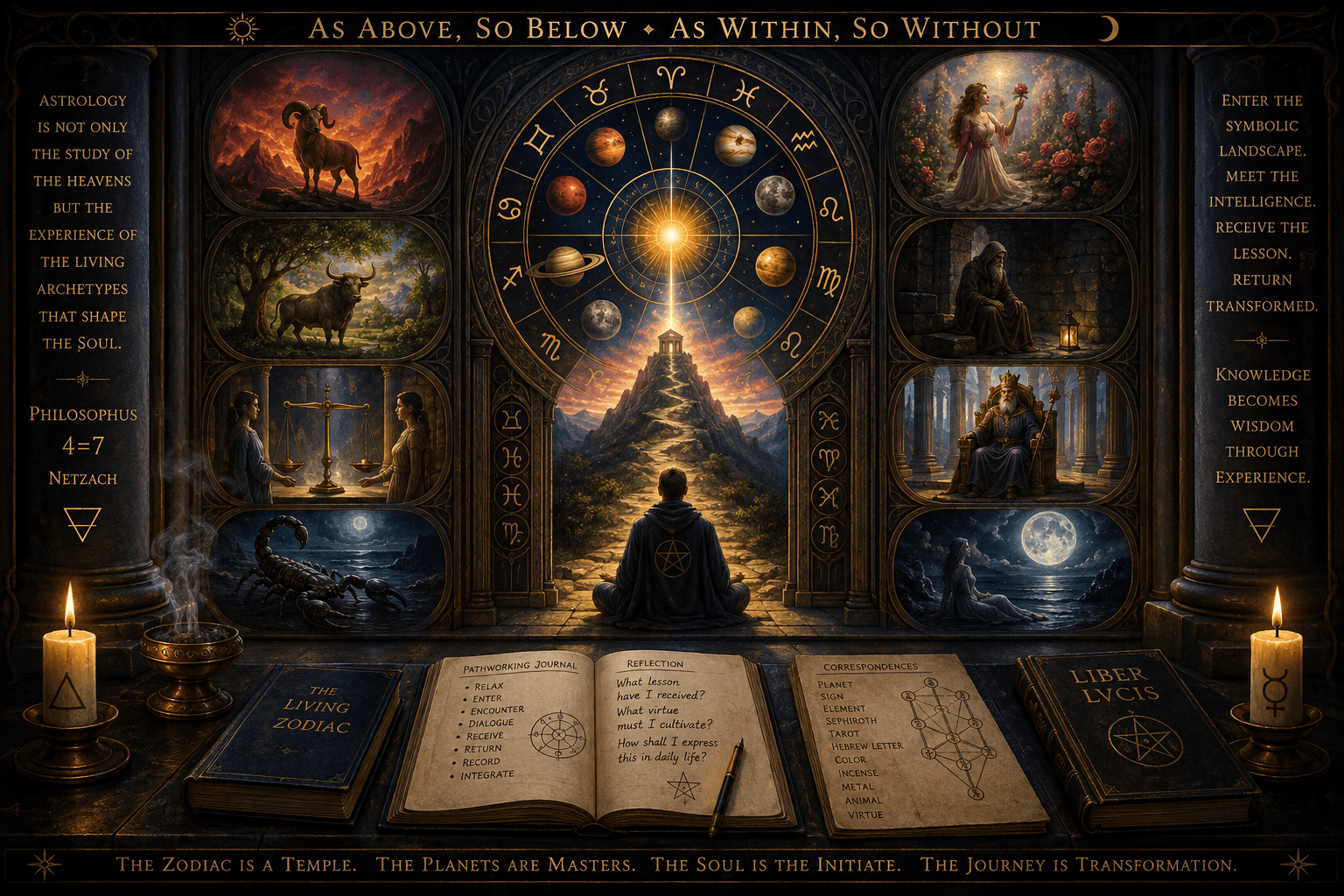


 “Dee was an exceptional student who entered Cambridge University when he was fifteen…Dee excelled at Cambridge and was named Underreader (junior faculty member) before taking his degree. After graduating he traveled to the Continent to continue his studies, achieving overnight fame in Paris at the age of twenty-three, when he delivered a series of lectures on the recently exhumed works of the Greek mathematician Euclid.”
