Clearing Up the Confusion: What Differentiates Qabalah, Kabbalah, and Cabala? | Victoria Generao, PhD

Here is the completed scholarly blog, with the spelling issue clarified at the outset and the bibliography divided between Jewish Kabbalah, Renaissance Christian Cabala, and modern Hermetic Qabalah.

Few subjects in Western esotericism produce as much terminological confusion as Kabbalah, Cabala, and Qabalah. A student may open one book and encounter the Kabbalah, another and find the Cabala, and then enter a Hermetic or Golden Dawn curriculum where the same Tree of Life is called the Qabalah. To make matters more confusing, other spellings appear everywhere: Kabala, Qabbalah, Cabbala, Kabalah, and even Kaballah.

Are these simply different English spellings of the same Hebrew word?

Linguistically, yes.

Historically and religiously, however, the answer is considerably more complicated.

In modern scholarly and esoteric usage, three spellings have gradually become useful for distinguishing three related but historically different streams of thought:

Kabbalah usually denotes the Jewish mystical tradition.

Cabala often denotes the Renaissance and early-modern Christian adaptation of Jewish Kabbalah.

Qabalah commonly denotes the later Hermetic and Western occult synthesis, particularly the system that eventually became central to Rosicrucianism, ceremonial magic, and the Hermetic Order of the Golden Dawn.

But this distinction must immediately be qualified: these spellings are conventions, not historical laws. Renaissance authors, nineteenth-century occultists, Jewish scholars, translators, and modern publishers have never used them with complete consistency. Even dictionaries list numerous acceptable transliterations. (American Heritage Dictionary)

Understanding the difference therefore requires us to look not merely at how the word is spelled, but at what happened to the tradition as it moved from one religious and intellectual environment into another.

First, a Note About “Kaballah”

Before separating the three traditions, one common misunderstanding should be cleared away.

“Kaballah” is not a fourth school of mystical thought.

It is simply one of the many English attempts to transliterate the Hebrew word קבלה — Qabbalah/Kabbalah. The standard contemporary academic spelling is generally Kabbalah. The spelling Kaballah, although frequently encountered, does not by itself indicate a separate lineage or doctrine.

The Hebrew word derives from the root Q-B-L, meaning “to receive.” Qabbalah therefore carries the sense of something received, handed down, or transmitted as tradition. The concept of reception is essential: the Kabbalist understands mystical wisdom not merely as private speculation but as participation in an inherited sacred tradition. (Sefaria)

The multiple English spellings arose because Hebrew does not map neatly onto the Latin alphabet. The Hebrew letter ק, Qof, may appear as q, k, or historically even c in European languages. Doubling consonants and retaining the final h likewise vary according to transliteration systems.

Thus, from a purely linguistic standpoint, Kabbalah, Cabala, and Qabalah can all represent the same Hebrew word.

The historical traditions that eventually gathered around those spellings, however, are not identical.


Kabbalah: The Jewish Mystical Tradition

The proper historical starting point is Jewish Kabbalah.

Kabbalah is not an independent religion and was not originally conceived as an occult philosophy detached from Judaism. It developed within the religious world of Judaism and cannot be fully understood apart from Torah, Hebrew language, rabbinic interpretation, prayer, mitzvot, divine names, and Jewish theological speculation.

Scholars debate precisely where “Kabbalah” begins. Earlier Jewish mystical currents include Merkavah and Hekhalot mysticism, speculations concerning the divine throne, angelic worlds, heavenly palaces, sacred names, and visionary ascent. The enigmatic Sefer Yetzirah, or Book of Formation, likewise provided an enormously influential cosmology based upon the Hebrew letters and numbers.

The form generally recognized as medieval Kabbalah emerged more clearly during the twelfth and thirteenth centuries, particularly in southern France and Spain. The Sefer ha-Bahir became important during this period, followed by the tremendous flowering of Spanish Kabbalah and eventually the collection of texts known as the Zohar, which appeared in late thirteenth-century Castile and became the most influential literary corpus of classical Kabbalah. Modern scholarship regards the Zohar as a collection produced within medieval Castilian Kabbalistic circles rather than simply as a verbatim composition of the second-century sage Rabbi Shimon bar Yochai to whom traditional attribution assigns it. (Cambridge University Press)

At the center of much Kabbalistic thought stands the mystery of Ein Sof, the Infinite and ultimately incomprehensible Divine, and the manifestation of divine activity through the ten sefirot.

These sefirot are not simply “ten planets,” nor are they gods. They constitute an extraordinarily complex symbolic theology describing aspects, powers, qualities, relationships, and processes within divine manifestation.

Names such as:

Keter — Crown

Chokhmah — Wisdom

Binah — Understanding

Chesed — Lovingkindness

Gevurah — Strength or Judgment

Tiferet — Beauty

Netzach — Eternity or Victory

Hod — Splendor

Yesod — Foundation

Malkhut — Kingdom

eventually became familiar far beyond Judaism.

Yet within Jewish Kabbalah they exist inside a distinctly Jewish symbolic universe involving Torah, creation, divine names, masculine and feminine dimensions of divinity, the Shekhinah, commandments, exile, restoration, and the relationship between human religious action and the divine world.

Indeed, one important scholarly interpretation describes Kabbalah as a particularly powerful example of theurgic mysticism: human prayer and sacred action can affect or harmonize the relationships among divine powers. (Stanford Encyclopedia of Philosophy)

This point already distinguishes classical Jewish Kabbalah from much later Western occult Qabalah.

The Jewish Kabbalist is not originally asking:

“Which Tarot card belongs on this path?”

The concern is more likely:

How does Torah reveal the hidden structure of divinity?

How do divine names disclose creation?

How do the sefirot interact?

How does human religious action participate in cosmic restoration?

How can the soul cleave to God?

And how does the visible world reflect mysteries concealed within revelation?

There were nevertheless many schools of Jewish Kabbalah. Abraham Abulafia developed an ecstatic and prophetic tradition involving Hebrew letters, divine names, breathing, and meditation. Moses de León and other Castilian Kabbalists developed theosophical systems. Moses Cordovero constructed an extensive synthesis. Isaac Luria and his disciples transformed Kabbalistic cosmology in sixteenth-century Safed through doctrines such as tzimtzum, shevirat ha-kelim, and tikkun—divine contraction, the breaking of the vessels, and cosmic restoration.

Thus even the phrase Jewish Kabbalah encompasses a family of traditions rather than one monolithic doctrine. Moshe Idel’s scholarship in particular helped move modern studies beyond overly simple attempts to reduce the whole history of Kabbalah to one system. (OUP Academic)


Cabala: When Renaissance Christianity Encountered Kabbalah

A dramatic transformation occurred during the Renaissance.

Christian humanists became increasingly fascinated with Hebrew. They studied Jewish scriptures, rabbinic literature, philosophy, and eventually Kabbalistic writings.

Among the most important figures was Giovanni Pico della Mirandola, whose 900 Conclusions of 1486 included numerous propositions drawn from Kabbalistic material.

Pico did not simply convert to Judaism or become a Jewish Kabbalist.

He interpreted Kabbalah through Christianity.

He believed that ancient Hebrew mysteries could reveal or confirm Christian truths. Kabbalistic doctrines were consequently interpreted in relation to Christ, the Trinity, Christian salvation, and a broader Renaissance project that sought a primordial wisdom underlying Plato, Pythagoras, Hermeticism, Christianity, and ancient theology.

Pico’s work marks a watershed in the emergence of what scholars call Christian Kabbalah or Christian Cabala. (Cambridge University Press)

The tradition was developed further by the German Christian Hebraist Johann Reuchlin, particularly in De Verbo Mirifico and his enormously influential De Arte Cabalistica, published in 1517.

Reuchlin interpreted Hebrew divine names and Kabbalistic teachings christologically. For Christian Cabalists, mysteries discovered within Hebrew could therefore become testimonies to Christianity.

This was no minor shift.

Jewish Kabbalah understood itself within Jewish revelation.

Christian Cabala took elements of that revelation and re-read them through an explicitly Christian theological framework.

Cambridge scholarship describes Christian Kabbalah precisely in terms of the Christian interpretation and use of Kabbalistic texts and methods in support of Christian doctrines. (Cambridge University Press)

From Pico and Reuchlin, Christian Cabala spread into the writings of figures such as Francesco Giorgi, Heinrich Cornelius Agrippa, Guillaume Postel, Robert Fludd, Athanasius Kircher, and others.

During this process, Kabbalistic materials increasingly interacted with:

Neoplatonism,

Hermetic philosophy,

astrology,

alchemy,

natural magic,

angelology,

number symbolism,

and Renaissance theories of cosmic correspondence.

The boundaries between Cabala, Hermeticism, natural philosophy, and magic consequently became increasingly porous. Reuchlin’s De Arte Cabalistica was particularly influential in presenting Cabala as a means of discovering connections between God, nature, language, and sacred wisdom. (Cambridge University Press)

By the seventeenth century another major bridge appeared: Christian Knorr von Rosenroth’s Kabbala Denudata, published between 1677 and 1684.

This massive Latin compilation made portions of Jewish Kabbalistic literature, including important Lurianic materials and Zoharic writings, accessible to Christian European intellectuals who could not read the Hebrew or Aramaic originals.

It would later become particularly important to Western occultists.

Christian Cabala was therefore neither merely a misspelling of Kabbalah nor entirely independent of it.

It was a Christian reinterpretation of Jewish mystical materials.

That distinction is essential.


Qabalah: The Western Hermetic and Magical Transformation

The next major transformation occurred within the Western esoteric tradition.

What is now commonly called Hermetic Qabalah emerged through several centuries of accumulated Christian Cabala, Renaissance magic, Rosicrucianism, alchemy, occult philosophy, Freemasonry, French occultism, and nineteenth-century ceremonial magic.

By the late nineteenth century, particularly within the Hermetic Order of the Golden Dawn, the Tree of Life became the organizing structure of an enormous Western esoteric system.

The Golden Dawn was founded in Britain in 1888 and became one of the most influential organizations in the history of modern ritual magic. Modern scholarship emphasizes its combination of Rosicrucian, Masonic, Hermetic, occult, and Kabbalistic interests. (OUP Academic)

Here something remarkable happened to the Tree of Life.

It became not merely a mystical theology but a universal map of correspondences.

The ten sefirot and twenty-two connecting paths could now be correlated with systems drawn from far beyond Judaism.

Among them were:

the Hebrew alphabet,

planets,

zodiacal signs,

the classical elements,

Tarot,

alchemy,

angelic hierarchies,

divine names,

magical weapons,

colors,

incenses,

metals,

plants,

Egyptian deities,

Greek and Roman gods,

grades of initiation,

states of consciousness,

and methods of ceremonial and visionary practice.

This is recognizably Hermetic Qabalah.

The Golden Dawn’s founders and early authorities—including William Wynn Westcott and S. L. MacGregor Mathers—inherited centuries of Christian and occult interpretation of Kabbalah and incorporated it into a ceremonial initiatory structure.

Mathers himself explicitly preferred the spelling Qabalah, explaining his transliteration and using Q in representing Hebrew terminology. (The Hermetic Order of The Golden Dawn®)

Later figures such as Aleister Crowley, Dion Fortune, Paul Foster Case, Israel Regardie, and many twentieth-century ceremonial magicians further developed this system.

Crowley’s Liber 777, for example, represents the Hermetic Qabalistic impulse almost perfectly: spiritual realities are arranged into immense tables of correspondences.

Dion Fortune’s The Mystical Qabalah presents the Tree as a practical philosophical and psychological framework for Western occult training.

Israel Regardie’s publications transmitted the Golden Dawn system to a vastly larger audience.

In this environment the Tree of Life functions as something like a metaphysical master diagram.

The magician can ascend it.

Meditate upon it.

Construct rituals through it.

Place Tarot upon it.

Map astrology onto it.

Use it to analyze mythology.

Interpret consciousness through it.

And correlate apparently unrelated spiritual systems by assigning them positions within its structure.

Such a methodology is characteristic of Hermetic Qabalah.

It is not characteristic of medieval Jewish Kabbalah in precisely the same way.


The Difference Is Therefore More Than Spelling

The most useful distinction can be summarized like this:

TraditionConventional SpellingHistorical SettingPrimary Orientation
Jewish mysticismKabbalahMedieval Judaism onwardTorah, God, sefirot, divine names, mystical exegesis, theurgy
Christian adaptationCabalaRenaissance and early-modern ChristianityChristian interpretation of Hebrew/Kabbalistic mysteries
Western esoteric synthesisQabalahModern Hermeticism and ceremonial magicTree of Life as initiatory and magical system of correspondences

Yet the table should never be mistaken for an absolute linguistic rule.

A Jewish scholar writing in 1900 may use Cabala.

An occultist may write Kabbalah.

A Christian scholar may use Qabbalah.

Older reference works themselves often use Cabala for Jewish mysticism. The spelling cannot establish lineage by itself. (Jewish Encyclopedia)

The distinction becomes meaningful only when we ask:

What sources are being used?

Within what religion or philosophy?

How is the Tree of Life being interpreted?

What is the purpose of the practice?

Those questions tell us far more than whether an author chose C, K, or Q.


Three Trees—or One Tree Seen Through Three Worlds?

For the Western esoteric student, it can be tempting to imagine that Kabbalah, Cabala, and Qabalah represent three completely separate systems.

Historically that would also be misleading.

There is genuine continuity.

Christian Cabalists actually studied Jewish Kabbalistic texts. Hermetic occultists inherited considerable material from Christian Cabala. Golden Dawn Qabalah retained Hebrew divine names, the ten sefirot, twenty-two Hebrew letters, the four worlds, Adam Kadmon, angelic hierarchies, and many concepts derived ultimately from Jewish mystical sources.

The relationship is therefore genealogical.

One grows historically from contact with another.

But genealogy does not mean identity.

Christian thinkers changed Kabbalah by placing it within Christianity.

Hermetic thinkers changed it again by incorporating Tarot, astrology, alchemy, comparative mythology, ceremonial magic, and initiatory symbolism.

A useful analogy would be a language passing through several cultures.

Words survive.

Structures survive.

Symbols survive.

But meanings accumulate, shift, and sometimes change radically.

Joseph Dan observes that precisely this meeting of Jewish Kabbalah with Christian philosophy, science, theology, and magic produced the multiple meanings that continue to surround the word Kabbalah today. (OUP Academic)


Why the Distinction Matters for Golden Dawn Students

For someone working within the Golden Dawn or broader Western Mystery Tradition, this distinction is particularly important.

The Golden Dawn did not simply preserve medieval Jewish Kabbalah unchanged.

It received Kabbalistic ideas after centuries of transmission through Christian Cabala, Renaissance occult philosophy, Rosicrucianism, Éliphas Lévi and nineteenth-century occultism, and then organized those materials into a sophisticated initiatory system.

Thus when a Golden Dawn initiate places:

Saturn at Binah,

Jupiter at Chesed,

Mars at Geburah,

the Sun at Tiferet,

Venus at Netzach,

Mercury at Hod,

and the Moon at Yesod,

the practitioner is operating within a distinctly Hermetic Qabalistic system of correspondences.

When the twenty-two Tarot trumps are placed upon the twenty-two paths of the Tree of Life, we are again firmly within Western esoteric Qabalah rather than classical Jewish Kabbalah.

This does not render the Hermetic system illegitimate.

It simply tells us what it is.

Its genius lies precisely in synthesis.

Hermetic Qabalah takes the Tree of Life and makes it a map upon which enormous portions of Western esoteric symbolism can be coordinated.

But scholarly clarity requires acknowledging the Jewish tradition from which that Tree originated and recognizing that later Western systems represent reinterpretations rather than simple continuations unchanged.


Kabbalah, Cabala, and Qabalah as a Historical Continuum

The clearest way to understand the development is therefore:

Jewish Kabbalah

Renaissance Christian Cabala

Early-modern Christian Hermetic and occult Cabala

Nineteenth-century Western occultism

Golden Dawn Hermetic Qabalah

Modern ceremonial magic, Tarot, Rosicrucian and occult Qabalah

This model is simplified—history is rarely so linear—but it reveals why the three traditions resemble one another while remaining distinguishable.

What began as the language of received Jewish mystical tradition eventually entered Renaissance Christianity, where it became a theological key for interpreting Christianity and creation.

From there it entered Western occult philosophy.

Eventually, in the hands of the nineteenth-century magical revival and particularly the Golden Dawn, it became one of the most elaborate systems of symbolic correspondence ever created within Western esotericism.


Clearing Up the Confusion

We can therefore answer the original question very simply.

Kabbalah is principally the Jewish mystical tradition from which the others ultimately draw.

Cabala is a useful scholarly designation for the Christian Renaissance reception and reinterpretation of Jewish Kabbalah.

Qabalah is a useful modern designation for the Hermetic and occult system that developed from Jewish and Christian Kabbalistic materials and integrated them with ceremonial magic, astrology, Tarot, alchemy, Rosicrucianism, and other Western esoteric traditions.

And Kaballah is primarily a spelling variant—not another independent branch.

The spellings themselves did not create three traditions.

History did.

Behind all three stands the Hebrew idea of קבלה — reception.

Something is received.

But every reception also involves interpretation.

The Jewish mystic received Kabbalah within Torah.

The Renaissance Christian received it through Christian revelation.

The Hermetic magician received it through the doctrine of correspondences and the initiatory mysteries of the Western esoteric tradition.

The same ancient vocabulary thus entered three different intellectual worlds.

And perhaps that is ultimately why the distinction is worth learning: not so that one tradition can be declared “real” and the others “false,” but so that each can be understood in its own historical, theological, and initiatory context.


Annotated Bibliography

I. Jewish Kabbalah: Primary Sources and Scholarship

Dan, Joseph. Kabbalah: A Very Short Introduction. Oxford: Oxford University Press, 2007.

One of the most accessible scholarly introductions to the history of Kabbalah. Dan is particularly helpful for understanding the transformation of Jewish Kabbalah through its encounter with Christianity and the resulting ambiguity surrounding the word itself. His discussion of Christian Kabbalah is especially relevant to distinguishing Kabbalah from Cabala. (OUP Academic)

Idel, Moshe. Kabbalah: New Perspectives. New Haven: Yale University Press, 1988.

A landmark revision of modern Kabbalah scholarship. Idel challenges several assumptions inherited from Gershom Scholem and emphasizes the diversity of Kabbalistic practices, including ecstatic, theosophical, and theurgical currents. Essential for avoiding the mistake of treating Jewish Kabbalah as one uniform theological system.

Idel, Moshe. Kabbalah in Italy, 1280–1510: A Survey. New Haven: Yale University Press, 2011.

Particularly valuable for understanding the intellectual environment in which Jewish Kabbalah encountered Renaissance Christianity. Idel traces the interaction among Jewish mystical schools in Italy and the conditions that eventually made Christian Kabbalah possible. (OUP Academic)

Matt, Daniel C., Nathan Wolski, and Joel Hecker, trans. The Zohar: Pritzker Edition. Stanford: Stanford University Press, 2004–2017.

The major contemporary English scholarly translation of the Zohar. The Pritzker Edition combines translation with extensive historical, textual, linguistic, and Kabbalistic commentary. It is indispensable for students who wish to encounter Jewish Kabbalah through an actual foundational text rather than primarily through later occult interpretations.

Scholem, Gershom. Major Trends in Jewish Mysticism. New York: Schocken Books, 1995. Originally published 1941.

One of the foundational works of modern academic Kabbalah studies. Although subsequent scholarship has revised many of Scholem’s conclusions, his historical framework remains indispensable. Particularly useful for Merkavah mysticism, the Zohar, Abraham Abulafia, Lurianic Kabbalah, and Hasidism.

Scholem, Gershom. Origins of the Kabbalah. Edited by R. J. Zwi Werblowsky. Translated by Allan Arkush. Princeton: Princeton University Press, 1987.

A detailed investigation of the emergence of medieval Kabbalah, especially in Provence and Gerona. This work is useful for separating historically demonstrable medieval Kabbalah from claims that the fully developed system existed unchanged from biblical antiquity.

Hayman, A. Peter. Sefer Yeṣira: Edition, Translation and Text-Critical Commentary. Tübingen: Mohr Siebeck, 2004.

A scholarly critical edition of Sefer Yetzirah. The work is important because later Jewish, Christian, and Hermetic traditions all drew upon its cosmology of Hebrew letters, numbers, directions, and creation. It also demonstrates how much later occult interpretation has been layered upon an originally concise and enigmatic Jewish text.


II. Christian Cabala and the Renaissance Transformation

Blau, Joseph Leon. The Christian Interpretation of the Cabala in the Renaissance. New York: Columbia University Press, 1944.

A classic academic study of Christian Cabala. Although later research has expanded and corrected aspects of Blau’s interpretation, the book remains enormously useful for tracing the transformation of Jewish Kabbalistic ideas within Renaissance Christian intellectual culture. (Brill)

Farmer, Stephen A. Syncretism in the West: Pico’s 900 Theses (1486): The Evolution of Traditional Religious and Philosophical Systems. Tempe: Medieval & Renaissance Texts & Studies, 1998.

Contains the Latin text, English translation, and extensive commentary on Pico della Mirandola’s famous 900 Conclusions. Essential for seeing Christian Cabala at one of its formative moments, when Pico attempted to reconcile Kabbalah with Christianity, Platonism, Aristotelianism, magic, and ancient wisdom traditions. (Folger Catalog)

Forshaw, Peter J. “Christian Kabbalah.” In The Cambridge Handbook of Western Mysticism and Esotericism, edited by Glenn Alexander Magee. Cambridge: Cambridge University Press, 2016.

An excellent modern scholarly overview of the development of Christian Kabbalah from Pico through later Renaissance and early-modern figures. Particularly useful for understanding the Christian theological motives behind the appropriation and reinterpretation of Jewish mystical sources. (Cambridge University Press)

Reuchlin, Johann. On the Art of the Kabbalah: De Arte Cabalistica. Translated by Martin and Sarah Goodman. New York: Abaris Books, 1983. Originally published 1517.

One of the most important primary texts of Christian Cabala. Reuchlin presents Kabbalistic concepts within a Christian philosophical framework and illustrates exactly how Hebrew mystical material was reinterpreted by Christian Hebraists of the Renaissance. (Folger Catalog)

Coudert, Allison P. The Impact of the Kabbalah in the Seventeenth Century: The Life and Thought of Francis Mercury van Helmont. Leiden: Brill, 1999.

An important study of the later European reception of Kabbalah, especially Lurianic material transmitted through Christian intellectual networks. Coudert demonstrates how Kabbalah became integrated with broader early-modern religious, philosophical, and scientific speculation.

Knorr von Rosenroth, Christian. Kabbala Denudata. Sulzbach and Frankfurt, 1677–1684.

A monumental Latin collection and translation of Kabbalistic texts. Although difficult for modern readers and deeply shaped by Christian interpretation, it became one of the major channels through which Kabbalistic material entered later European occultism. S. L. MacGregor Mathers subsequently translated selections into English as The Kabbalah Unveiled.


III. Hermetic Qabalah and the Western Magical Tradition

Fortune, Dion. The Mystical Qabalah. London: Ernest Benn, 1935.

A classic practitioner text of twentieth-century Hermetic Qabalah. Fortune interprets the Tree of Life as a practical map of consciousness, cosmology, magical development, and spiritual initiation. It should not be read as an academic description of Jewish Kabbalah; rather, it is an excellent primary witness to the mature Western esoteric Qabalistic tradition.

Crowley, Aleister. 777 and Other Qabalistic Writings. Edited by Israel Regardie. York Beach, Maine: Samuel Weiser, 1973.

One of the clearest demonstrations of what distinguishes Hermetic Qabalah from classical Jewish Kabbalah. Crowley’s tables correlate the Tree of Life with planets, Tarot, gods, colors, magical weapons, perfumes, stones, plants, and numerous religious systems. It represents the Hermetic doctrine of correspondences carried to extraordinary complexity.

Regardie, Israel. The Golden Dawn. Various editions.

The most influential published presentation of Golden Dawn ritual and instructional material. Regardie’s work demonstrates how completely Qabalah functions as the structural framework of Golden Dawn ceremonial magic, grades, divine names, Tarot correspondences, planetary symbolism, and initiatory cosmology.

Owen, Alex. The Place of Enchantment: British Occultism and the Culture of the Modern. Chicago: University of Chicago Press, 2004.

A major scholarly study of modern British occultism. Owen’s treatment of Golden Dawn practitioners provides valuable historical context for understanding how Cabalistic and magical interests functioned within the late Victorian occult revival rather than treating the Golden Dawn solely through its own internal mythology. (OUP Academic)

Hanegraaff, Wouter J. Esotericism and the Academy: Rejected Knowledge in Western Culture. Cambridge: Cambridge University Press, 2012.

A foundational study of Western esotericism as an academic field. Although not exclusively about Qabalah, Hanegraaff provides the intellectual framework necessary for understanding how Hermeticism, Renaissance magic, Christian Cabala, occult philosophy, and later esotericism became interconnected—and why historians must distinguish these currents from their Jewish sources.


Recommended Reading Sequence

For a student wanting to understand the three traditions without conflating them, a productive sequence would be:

Joseph Dan → Gershom Scholem → Moshe Idel → the Zohar → Pico della Mirandola → Johann Reuchlin → Christian Knorr von Rosenroth → Golden Dawn material → Dion Fortune → Crowley’s 777.

Read in that order, something important becomes visible.

The student watches a Jewish mystical vocabulary emerge within Judaism, enter Renaissance Christianity, become embedded in European esoteric philosophy, and finally transform into the comprehensive Hermetic Qabalistic system encountered within the Golden Dawn and much of modern ceremonial magic.

That historical sequence is the key to finally clearing up the confusion between Kabbalah, Cabala, and Qabalah.

I can also reshape this into a more explicitly Golden Dawn–Rosicrucian version, focusing on exactly what the Golden Dawn inherited from Jewish Kabbalah versus Christian Cabala, and what the Order itself added to create its distinctive Hermetic Qabalah.
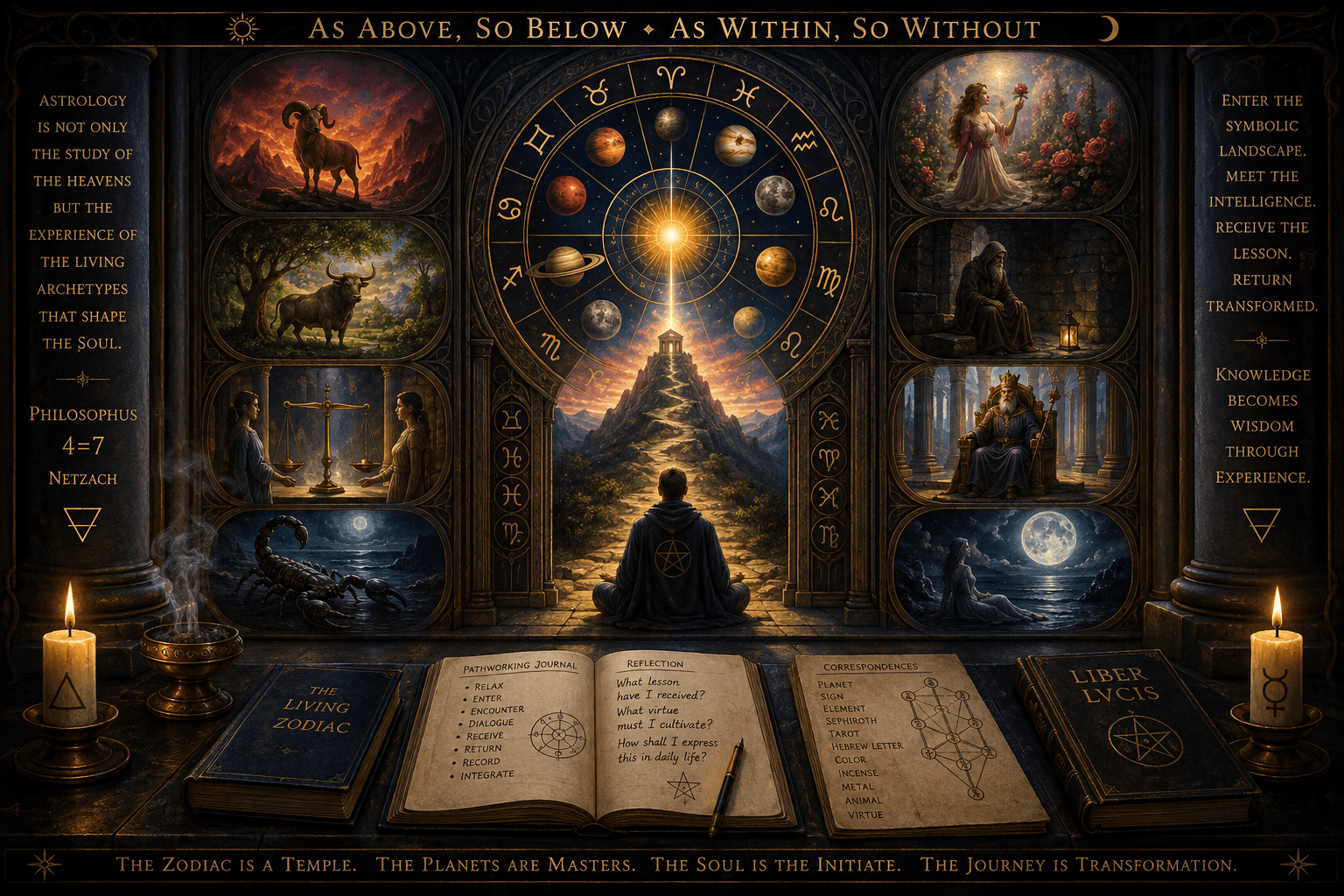
Astrological Pathworking: Walking the Living Zodiac | Victoria Generao, PhD

Primary Objective : To transform astrological knowledge into direct spiritual experience through disciplined contemplative practice.


Before we begin tonight’s work, I would like each of you to set aside, for just a little while, the charts, the tables of correspondences, and the lists of planetary rulerships that have occupied so much of your studies. They have served you well, and they remain indispensable. But they are only the beginning.

Throughout the earlier grades, you have learned to identify the symbols of astrology. You have memorized the qualities of the planets, the elements, the signs, the decans, and the many correspondences that bind astrology to the Tree of Life. That knowledge forms a necessary foundation. Yet no amount of intellectual study can replace direct spiritual experience.

The work of the Magician is to transform knowledge into wisdom.

Tonight, we will explore one of the most beautiful and transformative practices of the Western Mystery Tradition: astrological pathworking.

The heavens are more than a collection of distant celestial bodies. To the ancient philosophers, the Hermetic sages, the Rosicrucians, and the initiates of the Golden Dawn, the cosmos was alive. Every planet expressed a divine principle. Every zodiacal sign revealed a unique mode through which the One Life manifested itself. The stars were not merely objects to be observed—they were symbols of living realities, mirrors reflecting eternal truths within the soul of humanity.

When we practice astrological pathworking, we are not attempting to travel physically into the heavens. Rather, we enter the symbolic landscape of consciousness. We seek to encounter the archetypal intelligence represented by a planet or sign. We allow the imagination—not as fantasy, but as the sacred faculty of vision—to become a bridge between the conscious mind and the deeper levels of the psyche and spirit.

This distinction is important.

Fantasy is something we invent.

Pathworking is something we receive.

The initiate approaches these inner experiences with humility rather than expectation. We do not force visions to appear. We do not attempt to manufacture profound experiences. Instead, we create the proper conditions and allow the symbols to reveal themselves naturally. We become attentive observers of the inner world.

By the time one reaches the Grade of Philosophus, this manner of work becomes especially appropriate.

Philosophus is the Grade of Fire.

Fire is the element of transformation. It consumes what is crude and reveals what is essential. Fire gives warmth, illumination, and life, but only when governed wisely. So too must our knowledge be refined through experience. The facts we have accumulated must become living realities within consciousness.

There are, generally speaking, three stages through which astrological understanding develops.

The first is intellectual.

This is where every student begins. We memorize that Aries is cardinal fire, ruled by Mars. We learn that Taurus belongs to Venus, that Saturn governs Capricorn, that Mercury rules Gemini and Virgo. We study aspects, dignities, exaltations, and correspondences.

This level is necessary.

But it is not enough.

The second level is psychological.

Here the symbols begin to awaken within our own lives.

We notice Mars whenever we are called upon to defend someone or confront a difficult situation. We recognize Saturn whenever discipline, patience, or responsibility become necessary. Venus appears not merely as romance, but as our capacity for beauty, harmony, and appreciation.

The symbols cease being external descriptions.

They become mirrors.

Eventually, the initiate enters the third level.

This is the mystical level.

Here, the symbols are experienced as living archetypes. The initiate no longer contemplates merely the idea of courage but encounters the essence represented by Mars. No longer simply studies beauty but experiences the living current symbolized by Venus. Jupiter ceases to be only expansion or fortune and becomes the felt presence of generosity, wisdom, and noble authority.

Whether we understand these encounters psychologically, spiritually, or both is less important than the transformation they produce.

This is the purpose of pathworking.

Naturally, preparation is essential.

One should never rush into this practice.

The Temple—or whatever sacred space you have prepared—should be quiet, orderly, and free from distraction. A simple altar is sufficient. A white candle may be lit to symbolize the Divine Light. If desired, a planetary candle corresponding to the work may also be used, together with appropriate incense.

Begin, as always, by centering yourself.

Perform the Lesser Banishing Ritual of the Pentagram to establish equilibrium within the sphere of sensation. Offer an Adoration to the Lord of the Universe. Sit quietly until the ordinary chatter of the mind begins to settle.

Only then should the pathworking begin.

Most astrological pathworkings follow a remarkably similar structure.

First comes relaxation.

Allow the breath to become slow and steady. Let tension dissolve from the body. Withdraw awareness from external concerns and gather it inward.

Then comes visualization.

Imagine yourself standing before a doorway.

Upon that doorway appears the glyph of the sign or planet with which you intend to work. Do not rush forward. Pause. Recognize that you stand at the threshold of a sacred mystery. Inwardly ask permission to enter.

This simple act cultivates humility. We do not storm the Temple of Wisdom; we are invited into it.

When the time feels right, step through the doorway.

Now the true work begins.

Do not force the scenery. Do not struggle to invent details. Allow the environment to unfold gradually. Perhaps you find yourself upon a mountain. Perhaps within a forest, a temple, a desert, or beside a river. Whatever appears, observe it with quiet curiosity.

Sooner or later, most sincere pathworkings introduce some form of guide.

It may be a wise elder.

An angelic presence.

A symbolic animal.

A priest or priestess.

A king.

A child.

Occasionally no guide appears at all, and the landscape itself becomes the teacher.

Receive whatever comes without judgment.

If an opportunity arises, respectfully ask a question.

“What quality must I cultivate?”

“What obstacle hinders my growth?”

“What lesson belongs to this sign?”

Ask only one question at a time.

Then wait.

Silence often teaches more than words.

Eventually, the experience reaches its natural conclusion.

Offer gratitude to whatever intelligence or symbol has appeared. Retrace your steps through the doorway. Return your awareness gently to the room. Open your eyes without haste.

Then write.

Write immediately.

Memory fades far more quickly than we imagine.

Record the date, the planetary hour if known, the Moon’s phase, the symbols encountered, the dialogue, the emotions, the unexpected details, and any practical insights that emerged. Over months and years these journals become invaluable records of spiritual development.

Let us consider an example.

Imagine we are entering the current of Aries.

You find yourself standing before dawn. The eastern horizon glows with deep crimson light. A narrow mountain path rises before you toward a solitary temple perched upon the summit. As you climb, the landscape grows increasingly austere. There is nothing unnecessary here. Every stone, every gust of wind, every step demands purpose.

At the summit waits a great ram.

Its presence is calm rather than aggressive. Its eyes shine with unwavering certainty.

It asks a single question.

“What have you delayed because of fear?”

There is no accusation in its voice.

Only invitation.

Nearby burns a clear, unwavering flame. Within the fire stands a sword. It is not offered for violence. It is offered to cut away hesitation.

You receive it.

When you descend the mountain, the dawn has become full daylight.

Nothing in your external life has changed.

Yet inwardly something has shifted.

That is the work.

Now consider Taurus.

Instead of a mountain, you enter a broad green valley. The air is rich with the fragrance of spring. At the center stands an ancient oak whose roots disappear into immeasurable depths. Beneath its branches rests a magnificent white bull.

The bull does not challenge you.

It simply asks,

“What truly nourishes your soul?”

Notice that this question is not about possessions.

Nor comfort.

Nor pleasure.

It asks about nourishment.

Remain there as long as necessary.

Listen.

The lesson of Taurus often arrives in silence.

Or imagine entering the temple of Libra.

You walk into a vast marble hall filled with perfect stillness. At its center stands a golden balance. No one attends it. One scale bears your strengths; the other, your limitations. Neither outweighs the other. Both belong to the whole person.

A veiled figure appears—not to judge you, but to invite you into greater balance. She silently gestures for you to place one attachment upon the scales.

Observe what changes.

Such experiences often reveal truths that no textbook can adequately convey.

Planetary pathworkings proceed in much the same manner.

In a Venus meditation, you may find yourself walking through an exquisite rose garden where beauty surrounds you from every direction. Yet among hundreds of blossoms, one rose remains unopened. A luminous feminine presence asks gently,

“What beauty within yourself remains unopened?”

A Saturn pathworking may lead you instead to a mountain monastery where an elderly teacher offers no speeches, no praise, and no criticism. There is only unfinished work waiting patiently upon a stone bench. The lesson is discovered not through conversation but through disciplined labor.

A Jupiter meditation may open into a magnificent library whose shelves stretch beyond sight. Upon a throne sits a benevolent king who asks,

“What blessing have you overlooked?”

Notice that the questions are always simple.

The answers, however, may occupy a lifetime.

Now, a word of caution.

Not every image carries profound meaning.

Sometimes the imagination simply wanders.

Sometimes the subconscious rearranges memories into symbolic form.

This is perfectly natural.

The Magician therefore cultivates discernment.

Ask yourself after every experience three simple questions.

Did this meditation make me more humble?

Did it encourage greater virtue?

Did it awaken a deeper desire to serve?

If the answer is yes, then the work has likely borne good fruit.

If the experience merely inflates pride, feeds spiritual vanity, or encourages a sense of superiority, then it should be regarded with great caution.

The purpose of pathworking is transformation, not entertainment.

Its fruits should appear not only in meditation but in ordinary life.

After a Mars pathworking, practice courage.

After Venus, cultivate kindness.

After Saturn, complete a neglected responsibility.

After Mercury, communicate with greater honesty and precision.

After Jupiter, share wisdom generously.

After Moon work, spend time in reflection.

After Sun work, strive to embody integrity and noble leadership.

Without action, vision gradually fades.

Experience becomes memory rather than transformation.

For your work during the coming weeks, each of you will undertake a complete cycle through the zodiac. Dedicate one week to each sign. Enter its symbolic landscape, receive whatever instruction it offers, and faithfully record your experiences in your magical journal. At our Temple meetings, we shall compare observations—not to determine who is “correct,” but to discover how universal archetypes reveal themselves uniquely to each individual soul. You will likely find recurring themes alongside strikingly personal symbolism, and both are worthy of careful contemplation.

As you complete the cycle, you will notice a remarkable change. The zodiac will no longer appear as twelve abstract divisions upon an astrological chart. Aries will become a remembered ascent toward courage. Taurus will become a valley of quiet strength. Gemini a place of living dialogue. Cancer a sanctuary of memory. Leo a throne of radiant purpose. Virgo a sacred workshop of refinement. Libra a hall of equilibrium. Scorpio a chamber of transformation. Sagittarius a road toward distant horizons. Capricorn a mountain of disciplined ascent. Aquarius a temple of inspired vision. Pisces an ocean of compassionate surrender.

The signs will cease to be merely studied.

They will become inhabited.

This is the true aim of astrological pathworking. It is not the pursuit of extraordinary visions or psychic experiences, but the gradual refinement of consciousness. Through repeated encounters with these celestial archetypes, we begin to recognize that the zodiac is not only written across the heavens—it is inscribed within the soul itself.

The ancient Hermetic axiom reminds us, “As above, so below; as within, so without.” Through this sacred work, the macrocosm and the microcosm gradually come into harmony. We discover that the celestial temple we have sought among the stars has always existed within the sanctuary of our own being.

May your journeys through the living Zodiac deepen your wisdom, strengthen your character, and kindle ever more brightly the sacred Fire entrusted to the Magician, until every step upon the path reflects the Light of the One Divine Source.


For this lecture, I distinguish between sources that directly document Golden Dawn astral/astrological practice and sources that provide the older Hermetic, Qabalistic, astrological, and modern interpretive foundations behind the lecture.

Annotated Bibliography: Astrological Pathworking

Primary Golden Dawn and Hermetic Sources

  1. Regardie, Israel. The Golden Dawn: The Original Account of the Teachings, Rites, and Ceremonies of the Hermetic Order. 6th ed. St. Paul, MN: Llewellyn Publications, 1989.

This is the principal modern compendium for Golden Dawn ritual, symbolism, grade material, elemental work, Tarot, Qabalah, astrology, and astral techniques. It is particularly important for understanding why astrological pathworking cannot be isolated from the Order’s larger system of correspondences. For the Magician, Regardie provides the ritual and symbolic architecture through which zodiacal and planetary forces can be approached as components of an integrated magical universe.

  1. King, Francis, ed. Astral Projection, Ritual Magic, and Alchemy: Golden Dawn Material by S. L. MacGregor Mathers and Others. Rochester, VT: Destiny Books, 1987.

Especially relevant to the practical dimension of the lecture. The collection preserves Golden Dawn-related material concerning astral consciousness, magical imagination, visionary work, and related occult techniques. It helps place “pathworking” within the broader historical practice of skrying and astral vision rather than treating it merely as guided visualization.

  1. Mathers, S. L. MacGregor. The Kabbalah Unveiled. London: George Redway, 1887.

Mathers’s translation of portions of Knorr von Rosenroth’s Latin Kabbala Denudata was profoundly influential upon the Golden Dawn’s understanding of Qabalah. Although it is not a pathworking manual, it provides important historical background for the cosmological structure through which Golden Dawn practitioners understood spiritual worlds, emanation, divine names, and the relationship between higher and lower realities.

  1. Westcott, William Wynn. An Introduction to the Study of the Kabalah. London: J. M. Watkins, 1910.

Westcott, one of the Golden Dawn’s founders, offers a compact introduction to the Qabalistic worldview underlying much of the Order’s magical system. It is useful for Magician students because astrological pathworking within the Golden Dawn is not simply “astrology plus visualization”: planets, signs, Hebrew letters, Sephiroth, Tarot, and divine hierarchies exist within a deliberately interconnected symbolic structure.

Golden Dawn Correspondences and Practical Magic

  1. Crowley, Aleister. 777 and Other Qabalistic Writings of Aleister Crowley. York Beach, ME: Samuel Weiser, 1973.

Despite Crowley’s later development of a distinctly Thelemic system, the correspondence tables of 777 preserve and expand material substantially indebted to the Golden Dawn tradition. The tables are extremely useful when constructing pathworkings because they correlate planets and zodiacal signs with colors, divine names, Tarot, Hebrew letters, perfumes, magical images, and other symbolic categories. For students, however, it is important to distinguish Golden Dawn-derived material from Crowley’s subsequent Thelemic interpretations.

  1. Cicero, Chic, and Sandra Tabatha Cicero. Self-Initiation into the Golden Dawn Tradition. St. Paul, MN: Llewellyn Publications, 1995.

A modern systematic presentation of Golden Dawn practice particularly useful for understanding how ritual, visualization, meditation, symbolism, and grade work can function as an integrated curriculum. It provides practical context for preparing sacred space and cultivating the disciplined imaginative faculties required for pathworking.

  1. Cicero, Chic, and Sandra Tabatha Cicero. The Essential Golden Dawn: An Introduction to High Magic. St. Paul, MN: Llewellyn Publications, 2003.

A useful secondary introduction to Golden Dawn magical philosophy and practice. For the present lecture, its value lies in explaining how ritual, Qabalah, astrology, Tarot, and magical symbolism operate as interconnected components rather than independent subjects. It is particularly accessible for students transitioning from theoretical correspondence work toward practical magical application.

Astrology and the Western Esoteric Tradition

  1. Agrippa, Heinrich Cornelius. Three Books of Occult Philosophy. Translated by James Freake. Edited and annotated by Donald Tyson. St. Paul, MN: Llewellyn Publications, 1993.

Agrippa is indispensable for understanding the Renaissance magical worldview inherited by later ceremonial traditions. His treatment of planetary qualities, celestial correspondences, number, elemental philosophy, images, spirits, and the relationship between terrestrial and celestial realities provides an important historical foundation for the concept that planetary forces may be approached through carefully constructed networks of symbolism.

  1. Ficino, Marsilio. Three Books on Life. Edited and translated by Carol V. Kaske and John R. Clark. Binghamton, NY: Medieval & Renaissance Texts & Studies, 1989.

Ficino provides one of the most sophisticated Renaissance treatments of humanity’s relationship with celestial influences. Particularly valuable is De vita coelitus comparanda (“On Obtaining Life from the Heavens”), in which Ficino discusses music, imagery, plants, perfumes, colors, and contemplative practices in relation to planetary qualities. His work offers a major intellectual ancestor to later planetary magical practices.

  1. Cornford, Francis Macdonald, trans. Plato’s Cosmology: The Timaeus of Plato. Indianapolis: Hackett Publishing, 1997.

Plato’s Timaeus provides an important philosophical background for the Western conception of the cosmos as an ordered, ensouled whole rather than a collection of unrelated material objects. It supports the lecture’s broader metaphysical premise that human consciousness and celestial order can be contemplated as corresponding expressions within a unified cosmos.

Hermetic Foundations

  1. Copenhaver, Brian P., trans. Hermetica: The Greek Corpus Hermeticum and the Latin Asclepius in a New English Translation, with Notes and Introduction. Cambridge: Cambridge University Press, 1992.

One of the strongest scholarly translations of the philosophical Hermetica. The texts explore divine Mind, cosmic order, humanity as microcosm, spiritual rebirth, and the relationship between the human and celestial realms. This is an important corrective to overly simplified modern uses of “as above, so below”: the actual Hermetic worldview is considerably richer than the popular maxim suggests.

  1. Fowden, Garth. The Egyptian Hermes: A Historical Approach to the Late Pagan Mind. Princeton, NJ: Princeton University Press, 1986.

Fowden provides the historical context necessary for understanding Hermeticism as a late-antique religious-philosophical phenomenon. This scholarly source helps distinguish historical Hermetic thought from nineteenth- and twentieth-century occult interpretations of it, making it particularly valuable for an advanced Temple curriculum.

Tarot, Astrology, and the Paths

  1. Case, Paul Foster. The Tarot: A Key to the Wisdom of the Ages. Richmond, VA: Macoy Publishing, 1947.

Case, who was strongly influenced by Golden Dawn teachings before developing Builders of the Adytum, presents Tarot as a system of spiritual and psychological transformation. His discussions of Hebrew letters, astrological correspondences, meditation, and Tarot imagery are particularly relevant to zodiacal pathworking because the Golden Dawn’s zodiacal signs can also be approached through their corresponding Major Arcana Keys.

  1. Wang, Robert. The Qabalistic Tarot: A Textbook of Mystical Philosophy. York Beach, ME: Samuel Weiser, 1983.

An especially useful bridge between Golden Dawn Tarot, astrology, Qabalah, and the Tree of Life. Wang demonstrates how Tarot symbolism functions within the Golden Dawn’s Qabalistic framework. For pathworking students, it assists in understanding why a zodiacal journey may simultaneously involve a Hebrew letter, Tarot trump, elemental quality, planetary influence, and Tree-of-Life path.

  1. DuQuette, Lon Milo. Understanding Aleister Crowley’s Thoth Tarot. San Francisco: Weiser Books, 2003.

Although centered upon Crowley’s Thoth Tarot rather than strictly Golden Dawn Tarot, DuQuette clearly explains many of the astrological, Qabalistic, elemental, and zodiacal correspondences inherited from the Golden Dawn system. It is useful as a comparative secondary source, especially when students begin exploring how Golden Dawn correspondences evolved within later Western magical traditions.

Active Imagination and the Psychology of Pathworking

  1. Jung, C. G. The Archetypes and the Collective Unconscious. 2nd ed. Translated by R. F. C. Hull. Princeton, NJ: Princeton University Press, 1969.

Jung supplies an important psychological framework for understanding why symbolic encounters can possess tremendous subjective power without requiring the practitioner to decide immediately whether an encountered figure is an objectively independent spiritual intelligence. His concept of archetypes is particularly helpful when interpreting recurring kings, queens, animals, temples, mountains, oceans, guides, and celestial figures within pathworking.

  1. Jung, C. G. The Red Book: Liber Novus. Edited by Sonu Shamdasani. Translated by Mark Kyburz, John Peck, and Sonu Shamdasani. New York: W. W. Norton, 2009.

Jung’s extraordinary record of visionary encounters demonstrates sustained engagement with deliberately entered imaginal experience. It should not be treated as a Golden Dawn manual, but it provides a valuable comparative example of disciplined dialogue with interior figures and symbolic environments. It is particularly relevant to the lecture’s distinction between consciously manufacturing imagery and allowing an imaginal encounter to develop with a degree of autonomy.

Modern Studies of Western Esotericism

  1. Hanegraaff, Wouter J. Western Esotericism: A Guide for the Perplexed. London: Bloomsbury Academic, 2013.

A valuable scholarly orientation to the field of Western esotericism. Hanegraaff helps situate Hermeticism, Renaissance magic, occultism, and related currents within their proper historical contexts. For a Magician curriculum, this provides useful academic balance alongside practitioner literature.

  1. Goodrick-Clarke, Nicholas. The Western Esoteric Traditions: A Historical Introduction. Oxford: Oxford University Press, 2008.

A concise historical overview of Hermeticism, Renaissance magic, Rosicrucianism, occultism, and modern esoteric movements. This work helps students understand that Golden Dawn astrological practice emerged from centuries of intellectual and magical development rather than appearing as an isolated nineteenth-century system.

  1. Asprem, Egil. Arguing with Angels: Enochian Magic and Modern Occulture. Albany: State University of New York Press, 2012.

Although primarily concerned with Enochian magic, Asprem’s scholarly treatment of visionary magical practice and modern ceremonial occultism is useful for placing Golden Dawn approaches to spiritual perception within a larger historical framework. It also encourages critical reflection on how practitioners understand and interpret visionary experiences.

Recommended Core Reading for the 4=7 Student

For this particular Temple lecture, I would make Regardie, King, Cicero & Cicero, Agrippa, Ficino, Copenhaver, Wang, and Jung the principal reading cluster.

Together they establish four layers necessary for mature Magician work: the Golden Dawn ritual framework, the astrological and Hermetic cosmology, the Qabalistic/Tarot correspondence system, and a psychological framework for evaluating visionary experience.

One important refinement should also be made to the spoken lecture. The familiar formulation “As above, so below; as within, so without” should not be presented as a verbatim ancient Hermetic quotation. The first concept derives ultimately from the Emerald Tablet, while the expanded modern formulation is considerably later. For a formal 4=7 curriculum, I would present it as a Hermetic principle rather than quote it as though those exact words appeared in the ancient Corpus Hermeticum. That distinction makes the lecture historically stronger without diminishing its esoteric meaning.

Qabalah and Golden Dawn Magic | Victoria Generao, PhD

The Tree of Life as a Map of Initiation, Consciousness, and Magical Practice

Within the Western Mystery Tradition, few systems have exercised as profound an influence upon modern ceremonial magic as Qabalah. For the Hermetic Order of the Golden Dawn, Qabalah was not merely one subject among many. It became the great organizing framework through which astrology, Tarot, alchemy, elemental magic, planetary magic, sacred names, angelology, ritual initiation, and mystical psychology could be brought into relationship with one another.

To study Golden Dawn magic without Qabalah is therefore much like attempting to understand a cathedral by examining individual stones while ignoring the architecture that holds them together.

The Qabalistic Tree of Life provides that architecture.

Through its ten Sephiroth, twenty-two connecting Paths, multiple Worlds, Divine Names, angelic hierarchies, planetary correspondences, elemental forces, Hebrew letters, and numerical symbolism, the Tree becomes both a diagram of the cosmos and a symbolic anatomy of the human being.

For the Golden Dawn magician, it is simultaneously:

  • a map of creation,
  • a map of consciousness,
  • a map of initiation,
  • a system of magical correspondences,
  • and a contemplative model of the soul’s return toward the Divine.

Understanding this relationship reveals why Qabalah stands at the very heart of Golden Dawn magical practice.

What Is Qabalah?

The word Qabalah, from the Hebrew Qabbalah, is generally associated with the idea of “reception” or “that which has been received.” Historically, Jewish Kabbalah developed as a complex body of mystical speculation concerning God, creation, Scripture, the Divine Names, the nature of the soul, and humanity’s relationship with the Infinite.

Western ceremonial magicians inherited portions of this tradition through several historical channels and gradually developed what is now commonly called Hermetic Qabalah.

It is important to distinguish these streams.

Jewish Kabbalah possesses its own theological, textual, devotional, and historical foundations. Hermetic Qabalah emerged later within Christian, Rosicrucian, occult, and magical environments and adapted Kabbalistic concepts into a broader esoteric synthesis.

The Golden Dawn inherited this Western or Hermetic form.

Within it, the Qabalistic Tree of Life became a universal symbolic matrix upon which almost every major body of occult symbolism could be placed.

Thus the planets could be correlated to the Sephiroth.

The Hebrew alphabet could be associated with the twenty-two Paths.

The Tarot could be placed upon those same Paths.

The classical elements could be situated within the Tree.

Astrological signs, planets, Divine Names, Archangels, angelic choirs, magical weapons, colors, numbers, and states of consciousness could likewise be organized through Qabalistic correspondence.

The result was one of the most sophisticated symbolic systems ever constructed within Western esotericism.

The Tree of Life

At the center of Golden Dawn Qabalah stands the diagram known as the Tree of Life.

The Tree consists of ten primary spheres called Sephiroth, singular Sephirah, connected by twenty-two Paths.

The ten Sephiroth are:

  1. Kether — Crown
  2. Chokmah — Wisdom
  3. Binah — Understanding
  4. Chesed — Mercy
  5. Geburah — Severity or Strength
  6. Tiphareth — Beauty
  7. Netzach — Victory
  8. Hod — Splendor
  9. Yesod — Foundation
  10. Malkuth — Kingdom

These Sephiroth can be understood on many levels simultaneously.

They represent stages within the unfolding of Divine manifestation.

They represent dimensions of consciousness.

They correspond to planetary and elemental powers.

They represent psychological and spiritual conditions encountered upon the initiatory journey.

And, within Golden Dawn magic, they serve as actual ritual and contemplative territories through which the initiate progressively travels.

The Tree therefore should not be viewed merely as a chart.

It is better understood as a living symbolic universe.

From Kether to Malkuth: The Descent of Manifestation

The Tree of Life describes creation as a movement from unity into multiplicity.

At the summit is Kether, the Crown, representing the first point of manifest consciousness emerging from the incomprehensible Divine mystery beyond the Tree.

From Kether arises Chokmah, the primordial force of expansion and dynamic energy.

Across from Chokmah stands Binah, the principle of form, limitation, understanding, and containment.

From these Supernal principles arise progressively denser levels of manifestation until the process culminates in Malkuth, the Kingdom—the world of physical existence.

The magical student therefore encounters a profound principle:

Matter is not separate from Spirit.

Matter is the furthest condensation of Spirit.

Malkuth is therefore not something to be despised or escaped. It is the manifested end of a Divine process.

This idea deeply influences Golden Dawn magic.

The magician does not simply seek to flee the material world in pursuit of some distant spiritual reality. Instead, the magician seeks to recognize the spiritual forces operating through manifestation and consciously bring the lower dimensions of life into greater harmony with the higher.

The ancient Hermetic maxim expresses the principle:

“As above, so below.”

The Tree of Life gives that principle a structure.

The Tree as the Human Being

The Golden Dawn also teaches the Tree of Life as a map of human consciousness.

Malkuth corresponds to embodied life and sensory consciousness.

Yesod relates strongly to the subconscious, imagination, dream, astral perception, and the formative powers behind manifestation.

Hod corresponds to intellect, language, analysis, symbolism, and conceptual thought.

Netzach concerns desire, attraction, emotion, instinctive response, beauty, art, and relational energy.

Tiphareth represents the harmonizing spiritual center of the personality and becomes particularly important within Golden Dawn initiation.

Geburah relates to discipline, strength, judgment, destruction, and corrective force.

Chesed represents expansion, authority, mercy, order, and beneficent rulership.

Binah, Chokmah, and Kether belong increasingly to states of consciousness traditionally described as Supernal.

Thus the magician may read the Tree outwardly as a diagram of the cosmos and inwardly as a diagram of the self.

This relationship is fundamental.

The universe and the human being are understood as reflections of one another.

The magician is a microcosm of the macrocosm.

The Three Pillars

The Sephiroth are arranged upon three vertical columns traditionally called the Pillars.

The right-hand Pillar is associated with expansion, force, mercy, and activity.

The left-hand Pillar represents restriction, form, severity, and receptivity.

Between them stands the Middle Pillar, the principle of equilibrium.

This structure becomes one of the great practical teachings of Golden Dawn magic.

Magical development requires balance.

Unrestrained expansion becomes chaos.

Unrestrained restriction becomes sterility.

Emotion without intellect becomes unstable.

Intellect without imagination becomes lifeless.

Power without compassion becomes tyranny.

Compassion without discernment becomes weakness.

The Middle Pillar therefore represents the harmonization of apparent opposites.

The successful magician learns not simply to choose one polarity over another, but to stand consciously between them.

This principle appears repeatedly throughout Golden Dawn ritual.

The Four Worlds

Golden Dawn Qabalah also works extensively with the doctrine of the Four Worlds.

These are traditionally described as:

Atziluth — the Archetypal World
The level of Divine emanation and pure spiritual principle.

Briah — the Creative World
The realm of archetypal creation and great spiritual intelligences.

Yetzirah — the Formative World
The world of angels, astral formation, symbolic imagery, and subtle forces.

Assiah — the Material World
The physical universe and the domain of concrete manifestation.

These Worlds provide an important key to understanding ceremonial magic.

A magical operation may begin with intention or Divine principle, move through spiritual intelligence, acquire symbolic or astral form, and ultimately seek expression within physical circumstances.

The magician therefore attempts to align several levels of reality rather than simply “wishing” something into existence.

Golden Dawn ritual is designed to establish correspondence between these levels.

Divine Names and Magical Authority

One of the most immediately recognizable Qabalistic features of Golden Dawn ritual is the use of Divine Names.

Certain Names are associated with particular Sephiroth, elements, planets, directions, and magical forces.

These names are frequently vibrated during ritual.

Within the Golden Dawn worldview, magical authority does not properly originate in the ordinary personality of the practitioner.

The magician does not ideally proclaim:

“I personally command the universe.”

Instead, the magician seeks alignment with a higher principle.

The Divine Name establishes the highest spiritual authority associated with the force being invoked or directed.

Below the Divine Name may appear an Archangel.

Below the Archangel, an angelic choir.

Below the angelic order, planetary, elemental, or astral intelligences.

This creates a hierarchical chain of manifestation.

The magician attempts to work from the highest available spiritual level downward.

The practical implication is important.

Golden Dawn ceremonial magic is not merely the exertion of personal will.

It is ideally the alignment of personal will with a higher order of reality.

The Qabalistic Cross

One of the clearest examples of Qabalah entering Golden Dawn ritual is the Qabalistic Cross.

The practitioner touches various points upon the body while vibrating sacred words traditionally rendered:

Ateh — Thou art
Malkuth — the Kingdom
Ve-Geburah — and the Power
Ve-Gedulah — and the Glory
Le-Olam, Amen — forever, Amen

The body becomes symbolically mapped onto the Tree of Life.

Above the head is the Divine source.

The feet correspond toward Malkuth.

The shoulders establish the polarities of Geburah and Gedulah—Severity and Mercy.

The practitioner stands at the center.

The ritual therefore transforms the human body into a living Qabalistic glyph.

Before pentagrams are traced or angels invoked, the magician establishes the self as a balanced microcosm within the Divine order.

This is Qabalah translated from diagram into ritual movement.

Qabalah and the Pentagram Rituals

The Lesser Ritual of the Pentagram provides another example of Qabalistic theory expressed through ceremonial action.

The magician establishes the center through the Qabalistic Cross.

Pentagrams are traced at the quarters.

Divine Names are vibrated.

Archangels are visualized surrounding the magician.

The practitioner stands within a sacred geometric field.

What appears externally to be a simple banishing or invoking ceremony therefore contains multiple layers.

It establishes:

  • orientation within sacred space,
  • elemental equilibrium,
  • relationship between microcosm and macrocosm,
  • Divine authority,
  • angelic guardianship,
  • and centered consciousness.

The ritual is therefore both magical and psychological.

Repeated practice trains the practitioner to inhabit a symbolic universe in which body, direction, element, Divine Name, image, sound, and intention operate together.

The Middle Pillar

Perhaps no Golden Dawn-derived exercise demonstrates the practical application of the Tree of Life more clearly than the Middle Pillar Exercise.

In this practice, centers corresponding to Sephiroth upon the Middle Pillar are visualized within or around the body.

Divine Names are vibrated while the practitioner imagines light descending through the Qabalistic structure.

The Tree ceases to be an external diagram and becomes an internal experience.

The magician does not merely contemplate Kether, Tiphareth, Yesod, and Malkuth.

The magician imagines these principles awakening within the subtle body.

This reflects a larger characteristic of Golden Dawn training:

Symbols are not intended only to be memorized.

They are intended to be entered, embodied, visualized, vibrated, contemplated, and eventually experienced.

Qabalah and Golden Dawn Initiation

The grades of the Golden Dawn are closely connected with the Sephiroth of the Tree of Life.

The Outer Order curriculum progressively moves the initiate symbolically upward through the lower Sephiroth.

The traditional sequence includes:

Neophyte 0=0 — threshold or preliminary grade

Zelator 1=10 — Malkuth

Theoricus 2=9 — Yesod

Practicus 3=8 — Hod

Philosophus 4=7 — Netzach

Beyond these lies the Portal grade, followed by the Adeptus Minor grade associated with Tiphareth.

The numbering itself expresses Qabalistic symbolism.

In the grade 2=9, for example, the number nine identifies Yesod as the ninth Sephirah, while the first number signifies an additional initiatory formula within the traditional grade structure.

Initiation therefore becomes a ritualized journey through the Tree.

The student is not simply learning subjects.

The curriculum symbolically reconstructs consciousness through a progressive ascent.

Tiphareth and the Adept

Within Golden Dawn spirituality, Tiphareth occupies a particularly important position.

Located near the center of the Tree, Tiphareth signifies Beauty, harmony, solar consciousness, sacrifice, redemption, and the reconciliation of opposites.

It is associated with the Sun.

In many Western esoteric systems influenced by the Golden Dawn, Tiphareth becomes associated with the awakening of a deeper spiritual identity beyond the ordinary personality.

The Adeptus Minor grade therefore represents much more than advancement in magical technique.

Symbolically, it marks the transition from primarily personal magical development toward alignment with a more profound spiritual center.

The initiate begins to ask not merely:

“What do I desire?”

but:

“What is the purpose of my incarnation?”

“What is the deeper Will beneath my changing desires?”

“How may the lower personality become an instrument of the higher consciousness?”

Here Qabalah becomes a psychology of initiation.

Qabalah and Tarot

One of the Golden Dawn’s most influential contributions to modern occultism was its systematic integration of the Tarot with the Tree of Life.

The twenty-two Major Arcana were attributed to the twenty-two Hebrew letters and therefore to the twenty-two Paths connecting the Sephiroth.

This transformed Tarot from a collection of symbolic cards into a map of initiatory consciousness.

For example, a Tarot Key may be studied simultaneously as:

  • a pictorial symbol,
  • an astrological force,
  • a Hebrew letter,
  • a numerical principle,
  • a Path upon the Tree,
  • a psychological process,
  • and an initiatory gateway.

A pathworking involving a Major Arcana card therefore becomes much more than guided imagery.

The practitioner is symbolically entering a specific relationship between two Sephiroth.

This is why Golden Dawn Tarot symbolism can become extraordinarily layered.

Every image exists within a network of correspondences.

Qabalah and Astrology

The seven traditional planets correspond to seven major Sephiroth:

Saturn — Binah
Jupiter — Chesed
Mars — Geburah
Sun — Tiphareth
Venus — Netzach
Mercury — Hod
Moon — Yesod

Malkuth receives the elemental and terrestrial forces.

Through this correspondence, astrology becomes integrated into the Tree of Life.

Planetary magic can therefore be understood Qabalistically.

To work with Mercury is not simply to invoke an astrological planet.

The magician also encounters Hod: intellect, language, calculation, analysis, classification, communication, and magical formulation.

To work with Venus involves not merely the planet Venus but also Netzach: attraction, desire, feeling, beauty, imagination, pleasure, relationship, and artistic expression.

Thus the Sephiroth deepen the psychological and spiritual interpretation of planetary forces.


Qabalah and Alchemy

The Golden Dawn also connects Qabalistic symbolism with alchemy.

Both traditions describe transformation.

Alchemy speaks of refining the prima materia through stages of purification, dissolution, separation, conjunction, fermentation, distillation, and coagulation.

Qabalah describes the ascent and integration of consciousness through the Tree.

Both can therefore be read as descriptions of an inner work.

The unrefined personality becomes the alchemical substance.

The Tree becomes the laboratory.

Ritual becomes one of the fires.

Meditation becomes another.

Initiation applies pressure.

Study provides structure.

Life itself supplies the raw material.

The philosophical gold sought by the alchemist becomes analogous to the awakened and integrated consciousness sought by the magician.

The Paths of the Tree

The twenty-two Paths joining the Sephiroth describe relationships between different states of consciousness.

This distinction is important.

A Sephirah represents a condition or sphere.

A Path represents movement between conditions.

The spiritual journey is therefore not merely about reaching one symbolic location after another.

Transformation occurs in the passage between them.

For this reason Golden Dawn pathworking often involves movement.

The practitioner may symbolically travel from one Sephirah to another through a Tarot image, Hebrew letter, astrological correspondence, color field, magical weapon, or visionary landscape.

Such work trains consciousness to recognize transitions:

from instinct to intellect,

from intellect to imagination,

from personality to spiritual identity,

from multiplicity toward unity.

The Tree becomes a map not merely of where consciousness can be, but of how consciousness changes.

Correspondence as a Magical Science

One of the most distinctive features of Golden Dawn Qabalah is its extraordinary system of correspondences.

A single Sephirah may possess associations with:

  • number,
  • Divine Name,
  • Archangel,
  • angelic choir,
  • planet,
  • color,
  • perfume,
  • gemstone,
  • magical image,
  • spiritual virtue,
  • vice,
  • bodily correspondence,
  • mythological figure,
  • and ritual symbolism.

At first this can appear overwhelming.

Yet the purpose is not arbitrary memorization.

Correspondence trains the magician to perceive patterns.

If two symbols belong to the same underlying archetypal force, they can illuminate one another.

Gold, the Sun, Tiphareth, illumination, kingship, sacrifice, radiance, and solar deities may all become symbolic expressions of a related principle.

The magician gradually learns to think analogically rather than only literally.

This analogical consciousness is one of the foundations of ceremonial magic.

The Tree as a Magical Filing System

Golden Dawn writers sometimes treated the Tree as a kind of universal filing system.

This description is useful, but incomplete.

The Tree certainly allows the magician to organize enormous amounts of symbolic information.

Yet something more profound happens with long study.

The practitioner begins to see connections that were previously invisible.

Tarot illuminates astrology.

Astrology illuminates mythology.

Mythology illuminates ritual.

Ritual illuminates psychology.

Psychology illuminates mystical experience.

Qabalah provides the symbolic grammar through which these systems communicate.

The student gradually stops seeing separate occult subjects and begins seeing a network of relationships.

This is one of the deeper educational purposes of Golden Dawn training.

The Danger of Mere Correspondence

There is, however, a danger.

A magician may become so fascinated with correspondences that the living spiritual purpose of the system is forgotten.

It is possible to memorize every color scale, angelic name, planetary attribution, Tarot correspondence, and Hebrew letter yet remain inwardly unchanged.

Qabalah then becomes an intellectual cabinet of curiosities.

Golden Dawn magic ultimately demands something more.

Knowledge must become practice.

Practice must become experience.

Experience must become transformation.

Transformation must produce greater clarity, equilibrium, self-knowledge, ethical responsibility, and spiritual awareness.

Otherwise the Tree remains a diagram upon paper.

The true work is to discover the Tree within oneself.

Balance Before Power

One of the wisest principles implicit within Golden Dawn Qabalah is that magical power should emerge from equilibrium.

The Tree repeatedly teaches balance.

Mercy balances Severity.

Force balances Form.

Intellect balances Emotion.

Expansion balances Restriction.

The Pillars must be reconciled within the Middle.

This has direct consequences for magical practice.

Someone capable of producing extraordinary visionary experiences but unable to govern anger has not achieved equilibrium.

Someone who memorizes magical formulae but lacks discernment remains incomplete.

Someone who seeks occult power without developing ethical responsibility risks magnifying the very imbalances that initiation is meant to correct.

The Tree therefore serves as an instrument of diagnosis.

The magician asks:

Where am I excessive?

Where am I deficient?

What force requires balancing?

What Sephirah represents a quality I must cultivate?

Which apparent opposite have I rejected?

These questions transform Qabalah into a practical discipline of self-knowledge.

Ascent and Descent

Students sometimes imagine spiritual progress only as an ascent from Malkuth toward Kether.

Yet the mature magical model includes both ascent and descent.

The magician rises toward greater consciousness.

But illumination must then descend into life.

Insight must become conduct.

Vision must become service.

Spiritual realization must transform relationships, speech, work, ethics, creativity, and ordinary choices.

The lightning flash descends the Tree.

The serpent of initiation ascends it.

These two movements belong together.

One describes manifestation.

The other describes return.

The accomplished magician learns to participate consciously in both.

Qabalah as a Language of Initiation

Ultimately, Qabalah gave the Golden Dawn something far greater than an assortment of correspondences.

It gave the Order a language of initiation.

Through that language, the initiate could understand ritual events as stages within a coherent spiritual journey.

Malkuth became more than Earth.

Yesod became more than the Moon.

Hod became more than Mercury.

Netzach became more than Venus.

Tiphareth became more than the Sun.

Each became a dimension of human and cosmic consciousness.

The Tree transformed ceremonial magic from disconnected ritual techniques into a symbolic path of spiritual development.

The Living Tree

For the beginning student, the Tree of Life may first appear to be an intimidating diagram filled with unfamiliar Hebrew names and lines.

Over time, however, something changes.

The spheres acquire personality.

The Paths acquire atmosphere.

The Divine Names become recognizable.

Tarot images begin speaking the language of the Tree.

Planetary forces reveal their relationships.

Ritual gestures acquire deeper meaning.

One eventually realizes that the Tree is not asking merely to be memorized.

It is asking to be lived.

Every conflict between mercy and severity becomes Qabalistic.

Every tension between reason and feeling becomes Qabalistic.

Every descent of an idea into manifestation echoes the Tree.

Every attempt to raise consciousness from instinct toward spiritual awareness becomes a journey upon its Paths.

The Tree thus becomes less a diagram of somewhere else and more a symbolic revelation of the world already around us—and the world within us.

Qabalah at the Heart of Golden Dawn Magic

Golden Dawn magic can be understood as an enormous synthesis of Western esoteric traditions.

It incorporates Egyptian imagery, Rosicrucian symbolism, astrology, alchemy, Tarot, Enochian material, elemental philosophy, ceremonial ritual, angelology, Hermeticism, and mystical Christianity.

Yet Qabalah provides much of the structure that allows these systems to coexist.

It is the framework upon which the correspondences are arranged.

It is the ladder upon which the initiate ascends.

It is the mirror through which the magician studies the self.

And it is the symbolic bridge connecting humanity, cosmos, and Divine Reality.

The goal, however, is not merely to know where every symbol belongs upon the Tree.

The deeper goal is transformation.

The magician begins in Malkuth, within the complexity of embodied existence, and gradually learns to recognize the forces operating within consciousness and the cosmos.

Through discipline, ritual, study, contemplation, ethical refinement, and initiation, those forces are brought increasingly into equilibrium.

The Tree that was first encountered in a book becomes internalized.

The temple becomes internalized.

The symbols become internalized.

Eventually the Great Work itself is understood not merely as something the magician performs.

The magician becomes the field upon which the Work is performed.

And therein lies one of the deepest secrets of Qabalah within Golden Dawn magic:

The Tree of Life is not simply a map of the universe.

It is a map of what the human being may become.


Annotated Bibliography

Qabalah and Golden Dawn Magic

The following bibliography is designed to accompany the blog “Qabalah and Golden Dawn Magic: The Tree of Life as a Map of Initiation, Consciousness, and Magical Practice.” It intentionally includes both academic studies of Jewish Kabbalah and primary or influential works of Hermetic Qabalah and Golden Dawn ceremonial magic.

A useful distinction should be maintained throughout: Kabbalah generally refers here to the historical Jewish mystical traditions, while Qabalah refers to the later Hermetic and Western esoteric adaptation employed by the Golden Dawn. The spelling convention is helpful but is not universally followed by every author.


I. Historical and Academic Foundations of Kabbalah

Dan, Joseph. Kabbalah: A Very Short Introduction. Oxford University Press, 2006.

Joseph Dan provides a compact yet scholarly introduction to the history and major concepts of Jewish Kabbalah. He discusses the development of Kabbalistic thought, important texts, mystical interpretations of Scripture, the nature of the Divine, and the historical transmission of Kabbalistic ideas.

This book is especially valuable for Golden Dawn students because it establishes what Kabbalah was before its incorporation into Western ceremonial magic. It therefore provides an important historical corrective to the tendency to assume that the Tree of Life, Sephiroth, and Hebrew-letter correspondences have always been understood in the form later presented by occult orders.

Best used for: historical orientation; distinguishing Jewish Kabbalah from Hermetic Qabalah.


Idel, Moshe. Kabbalah: New Perspectives. Yale University Press, 1988.

Moshe Idel’s influential study broadened modern scholarship on Kabbalah by emphasizing the diversity of Kabbalistic schools and the experiential, ecstatic, magical, and theurgical dimensions of Jewish mysticism.

For the Golden Dawn student, Idel is useful because he demonstrates that Kabbalah cannot be reduced merely to a diagram of ten Sephiroth. Historical Kabbalah included contemplative techniques, linguistic mysticism, sacred names, ritual action, and theories concerning human participation in Divine processes.

These themes provide an illuminating historical background for understanding why later ceremonial magicians found Kabbalistic ideas so adaptable to ritual practice.

Best used for: advanced study of mystical experience, theurgy, and Kabbalistic practice.


Scholem, Gershom. Major Trends in Jewish Mysticism. Schocken Books.

Gershom Scholem’s classic study remains one of the foundational works in the academic investigation of Jewish mysticism. He traces major currents including early Jewish mysticism, medieval German Hasidism, the Zohar, Isaac Luria, Sabbateanism, and Hasidic developments.

Although subsequent scholars have revised some of Scholem’s conclusions, his work remains essential for understanding the historical development of Kabbalah.

For a Golden Dawn curriculum, Scholem provides valuable context by demonstrating that the occult Tree of Life employed by nineteenth-century magicians emerged from a much longer and considerably more complicated religious history.

Best used for: historical depth and advanced contextual study.


Matt, Daniel C. The Essential Kabbalah: The Heart of Jewish Mysticism. HarperSanFrancisco, 1995.

Daniel Matt presents carefully selected passages from the Jewish mystical tradition together with accessible explanatory commentary. Major concepts such as Ein Sof, the Sephiroth, creation, Divine immanence, the soul, and the Shekhinah are introduced through actual Kabbalistic writings.

This text is particularly valuable because it allows students accustomed to Golden Dawn terminology to encounter Kabbalah in a distinctly Jewish mystical voice.

It can help reveal how concepts subsequently incorporated into Hermetic Qabalah originally functioned within a religious and theological context very different from nineteenth-century ceremonial magic.

Best used for: contemplative study and exposure to primary Kabbalistic themes.


Kaplan, Aryeh, trans. and comm. Sefer Yetzirah: The Book of Creation in Theory and Practice. Weiser Books.

Aryeh Kaplan’s translation and commentary on the Sefer Yetzirah provides an extensive treatment of one of the oldest and most influential texts associated with Jewish mystical cosmology.

The work explores the Hebrew letters, numbers, the ten sefirot, cosmology, elemental principles, astrological associations, and meditative interpretations.

Golden Dawn students will find this work particularly useful because the Sefer Yetzirah became enormously influential within Western occult speculation. Comparing Kaplan’s treatment with nineteenth-century occult translations reveals both continuities and significant differences between Jewish mystical interpretation and Hermetic Qabalah.

Best used for: Hebrew letters, creation symbolism, number mysticism, and comparative Qabalistic study.


II. Sources in the Formation of Hermetic Qabalah

Westcott, William Wynn, trans. Sepher Yetzirah: The Book of Formation. 1887.

William Wynn Westcott, one of the principal founders of the Hermetic Order of the Golden Dawn, produced an influential English translation of the Sefer Yetzirah during the same period in which the Golden Dawn system was emerging.

The work is historically important because it demonstrates one of the channels through which Jewish mystical ideas entered Victorian occultism.

Westcott’s translation should not necessarily be treated as the preferred modern scholarly edition. Its importance lies instead in understanding how Golden Dawn-era occultists themselves encountered and interpreted the text.

Best used for: historical Golden Dawn reception of Kabbalistic literature.


Mathers, S. L. MacGregor, trans. The Kabbalah Unveiled. George Redway, 1887.

S. L. MacGregor Mathers, another principal figure in the formation of the Golden Dawn, translated portions of Christian Knorr von Rosenroth’s seventeenth-century Latin Kabbala Denudata into English.

The book contains translations of portions of the Zoharic tradition, including texts concerned with the concealed Divine, the primordial human, and complex configurations within the Divine realm.

Its importance to Golden Dawn studies cannot be overstated. It illustrates how Kabbalistic material entered Western ceremonial magic through several interpretive layers: Hebrew and Aramaic sources, Christian Kabbalistic interpretation, Latin translation, and finally Victorian occultism.

Best used for: understanding the intellectual environment from which Golden Dawn Qabalah developed.


III. Primary Golden Dawn Sources

Regardie, Israel. The Golden Dawn. Llewellyn Publications.

Israel Regardie’s monumental publication of Golden Dawn rituals and teachings is the most important readily available source for studying the Order’s practical application of Qabalah.

Throughout its teachings, the Tree of Life serves as a framework connecting:

  • initiation,
  • Tarot,
  • astrology,
  • geomancy,
  • alchemy,
  • elemental magic,
  • planetary symbolism,
  • Hebrew letters,
  • Divine Names,
  • angelic hierarchies,
  • color correspondences,
  • and ritual magic.

Regardie’s collection demonstrates that Qabalah was not merely an auxiliary philosophical subject within Golden Dawn training. It functioned as a central organizing structure for the entire magical curriculum.

The relationship between grades and Sephiroth is especially important. Malkuth, Yesod, Hod, Netzach, and Tiphareth become not merely abstract spheres but stages within the initiatory journey.

Best used for: Golden Dawn ritual, grade structure, correspondences, and practical ceremonial Qabalah.


Regardie, Israel. A Garden of Pomegranates: Skrying on the Tree of Life. Various editions.

A Garden of Pomegranates is Regardie’s more focused exposition of the Hermetic Tree of Life.

The book discusses the Sephiroth and Paths and presents the Tree as both a philosophical structure and a practical framework for mystical and magical development.

For students beginning to move from memorization toward direct contemplative engagement with the Tree, Regardie’s approach provides an important bridge between theoretical Qabalah and experiential pathworking.

Best used for: introductory Hermetic Qabalah, Sephiroth, Paths, and contemplative practice.


IV. The Tree of Life in Western Esotericism

Fortune, Dion. The Mystical Qabalah. 1935.

Dion Fortune’s The Mystical Qabalah remains one of the most influential twentieth-century explanations of Hermetic Qabalah.

Fortune presents the Tree of Life as a system capable of integrating psychology, mythology, astrology, magic, philosophy, and mystical development.

Her treatment was influenced by the Golden Dawn stream, although her work belongs to a later esoteric lineage.

Of particular importance is her understanding of the Tree as a method of training consciousness rather than simply an occult classification chart. The Sephiroth become living states of awareness and archetypal forces that can be encountered psychologically and magically.

This closely supports the central premise of the blog: the Tree is both a map of the cosmos and a map of the developing human being.

Best used for: psychological and mystical interpretation of the Tree of Life.


Zalewski, Pat. Kabbalah of the Golden Dawn. Llewellyn Publications.

Pat Zalewski’s work concentrates specifically upon the Qabalistic system employed by the Golden Dawn.

It explores the Sephiroth, Paths, symbolism, magical correspondences, and the relationship between Qabalah and Golden Dawn ritual practice.

Zalewski is particularly useful once students already possess a basic understanding of the Tree and wish to investigate how it functions inside the actual magical structure of the Order.

The book emphasizes that Golden Dawn Qabalah is fundamentally practical: its symbols are meant to be invoked, visualized, contemplated, and experienced.

Best used for: intermediate and advanced Golden Dawn Qabalistic study.


Cicero, Chic, and Sandra Tabatha Cicero. The Essential Golden Dawn: An Introduction to High Magic. Llewellyn Publications.

The Ciceros provide an accessible introduction to the philosophy, history, symbolism, and magical practices associated with the Golden Dawn tradition.

Their treatment is useful for newcomers because Qabalah is presented within the larger ceremonial framework rather than as an isolated subject.

The Tree of Life, elemental work, ritual magic, initiation, Tarot, and magical symbolism are shown as interrelated components of one larger system of spiritual development.

Best used for: beginners seeking an approachable introduction to Golden Dawn ceremonial philosophy.


V. Tarot and the Qabalistic Paths

Case, Paul Foster. The Tarot: A Key to the Wisdom of the Ages.

Paul Foster Case was deeply influenced by the Golden Dawn tradition and later developed his own extensive synthesis of Tarot and Hermetic Qabalah.

The book examines the Major Arcana through symbolism, number, Hebrew letters, astrology, and spiritual psychology.

For the subject of the blog, Case is particularly helpful in understanding the idea that the twenty-two Tarot Trumps can function as symbolic gateways corresponding to the twenty-two Paths of the Tree of Life.

His work illustrates how Tarot became, within the Golden Dawn-influenced tradition, far more than a system of divination. It became a visual language of initiation.

Best used for: Tarot-Qabalah correspondences and meditative interpretation of the Major Arcana.


Crowley, Aleister. 777 and Other Qabalistic Writings.

Although Aleister Crowley later developed his own Thelemic system, his early magical training occurred within the Golden Dawn tradition.

777 presents extensive tables of correspondences linking the Sephiroth and Paths with planets, zodiacal signs, elements, Divine Names, angels, Tarot cards, colors, perfumes, plants, stones, mythological figures, and many other symbolic categories.

The work demonstrates one of the defining characteristics of Hermetic Qabalah: the use of the Tree of Life as a universal correspondence system.

It is particularly useful for advanced students who want to understand the logic underlying ceremonial correspondences and ritual construction.

Best used for: advanced correspondence study and comparative ceremonial symbolism.


VI. Historical Study of the Golden Dawn

Howe, Ellic. The Magicians of the Golden Dawn: A Documentary History of a Magical Order, 1887–1923. Routledge & Kegan Paul, 1972.

Ellic Howe provides a historical rather than devotional or practitioner-oriented account of the Hermetic Order of the Golden Dawn.

The work examines the founding figures, organizational history, internal disputes, rituals, manuscripts, and personalities of the Order.

Its importance lies in separating historical Golden Dawn development from later legend.

For the study of Qabalah, Howe helps establish the cultural environment in which Westcott, Mathers, Florence Farr, W. B. Yeats, and other members participated in the creation and transmission of the Golden Dawn’s complex occult synthesis.

Best used for: documentary history and institutional context.


VII. Recommended Reading Sequence

For a student approaching Qabalah and Golden Dawn Magic, the following progression is particularly effective:

Foundation

  1. Joseph Dan — Kabbalah: A Very Short Introduction
  2. Daniel C. Matt — The Essential Kabbalah
  3. Aryeh Kaplan — Sefer Yetzirah

These establish the Jewish mystical background.

Historical Transition

  1. William Wynn Westcott — Sepher Yetzirah
  2. S. L. MacGregor Mathers — The Kabbalah Unveiled

These demonstrate how Kabbalistic ideas entered nineteenth-century Western occultism.

Golden Dawn Practice

  1. Israel Regardie — The Golden Dawn
  2. Israel Regardie — A Garden of Pomegranates
  3. Dion Fortune — The Mystical Qabalah

These establish the practical Hermetic Tree of Life.

Advanced Integration

  1. Pat Zalewski — Kabbalah of the Golden Dawn
  2. Paul Foster Case — The Tarot: A Key to the Wisdom of the Ages
  3. Aleister Crowley — 777 and Other Qabalistic Writings

These deepen the integration of the Tree with Tarot, astrology, magical correspondences, and ceremonial practice.

Historical Context

  1. Ellic Howe — The Magicians of the Golden Dawn

This places the entire magical system within its nineteenth- and early twentieth-century historical setting.


A Note for Students of the Golden Dawn

The most fruitful approach is to resist treating these texts as though they all describe precisely the same tradition.

A useful threefold distinction is:

Jewish Kabbalah
A family of Jewish mystical and theological traditions concerned with God, Torah, creation, the Sephiroth, the soul, sacred language, and humanity’s relationship with the Divine.

Christian Cabala
Renaissance and early modern Christian adaptations of Kabbalistic concepts, often interpreted through Christian theology.

Hermetic Qabalah
The Western esoteric synthesis developed through occultism, Rosicrucianism, ceremonial magic, Tarot, astrology, alchemy, and related traditions, reaching an especially elaborate form within the Hermetic Order of the Golden Dawn.

Understanding these distinctions does not weaken the Golden Dawn system.

It strengthens its study.

The Golden Dawn’s achievement was not the invention of Kabbalah, but the construction of an extraordinary esoteric synthesis in which the Tree of Life became a framework capable of organizing nearly the entire symbolic universe of Western ceremonial magic.

For the serious practitioner, the bibliography therefore serves two purposes: to recover the historical roots of the tradition and to understand how those roots were transformed into the living magical language of the Golden Dawn.

What Is Hermeticism, and Why Is It Part of the Golden Dawn Teachings? | Victoria Fenerao, PhD

Hermeticism is one of the central philosophical streams underlying the teachings and practices of the Hermetic Order of the Golden Dawn.

There are certain words that appear again and again in Western esoteric tradition: Alchemy. Kabbalah. Astrology. Theurgy. Rosicrucianism. Magic.

And standing among them is Hermeticism.

For anyone beginning serious study of the Hermetic Order of the Golden Dawn, Hermeticism is not simply another subject to memorize. It is one of the philosophical frameworks that helps explain why the Golden Dawn teaches what it teaches.

The Golden Dawn did not emerge from a single religious or philosophical tradition. Rather, it brought together several streams of Western esotericism into an integrated initiatory system. Hermeticism provided one of the great intellectual and spiritual foundations upon which that synthesis could be constructed.

To understand the Golden Dawn, therefore, it is helpful to understand Hermes.

Who—or What—is Hermes?

Hermeticism takes its name from Hermes Trismegistus, the legendary figure known as “Hermes Thrice-Great.”

Hermes Trismegistus is traditionally associated with the Egyptian god Thoth and the Greek god Hermes. Historically, however, Hermetic literature emerged from the religious and philosophical environment of the Greco-Egyptian world, particularly in the first several centuries of the Common Era.

Hermes Trismegistus became the traditional author or revealer of a body of writings concerned with profound questions:

What is God?

What is the nature of the Cosmos?

What is the human being?

How are humanity and the Divine related?

What is the origin of consciousness?

How can human beings awaken to spiritual knowledge?

And perhaps most importantly:

Can humanity know the Divine directly?

This last question is fundamental to Hermetic spirituality.

Hermeticism is not merely concerned with believing certain propositions about God. It is concerned with knowing—with awakening the intellect and consciousness to perceive spiritual reality.

This is why the Hermetic tradition is closely associated with the concept of gnosis, or direct spiritual knowledge.

Hermeticism Is a Philosophy of Correspondence

One of the most recognizable principles associated with Hermeticism is the idea of correspondence.

The famous maxim traditionally associated with the Emerald Tablet is:

“As above, so below.”

Although the phrase has been interpreted in many ways over the centuries, its essential idea is that the different levels of reality are interconnected.

The macrocosm and microcosm reflect one another.

The heavens and the Earth are not regarded as completely isolated realms.

The human being is understood as a microcosm, a little universe containing within itself correspondences to the greater universe—the macrocosm.

This idea becomes enormously important in Golden Dawn training.

Why?

Because the Golden Dawn’s magical system is built upon correspondence.

Planets correspond to metals, colors, days, angels, divine names, Tarot cards, Sephiroth, geomantic figures, incense, numbers and magical weapons.

The zodiac corresponds to particular qualities of consciousness.

The elements correspond to modes of manifestation.

The Tree of Life provides a map through which these correspondences can be organized.

To the modern mind, these relationships can initially appear like an enormous collection of unrelated symbols.

Hermeticism provides the underlying principle:

The symbols are related because reality itself is interconnected.

The Microcosm and the Macrocosm

This principle becomes particularly important in Golden Dawn magical practice.

The human being is not viewed merely as a physical organism standing outside the universe and observing it.

The magician is understood as a microcosm of the greater universe.

The elements within nature correspond to elemental forces within the human being.

The planets correspond to psychological, spiritual and cosmic principles.

The seven traditional planets can therefore be contemplated not merely as objects in the sky, but as principles operating within consciousness.

The Sun may represent illumination, vitality and the center of individual identity.

The Moon may represent reflection, memory, imagination and the subconscious.

Mercury may represent intellect, communication and mediation.

Venus may represent attraction, harmony and relationship.

Mars may represent force, courage and assertion.

Jupiter may represent expansion, generosity and sovereignty.

Saturn may represent limitation, discipline, time and structure.

The Golden Dawn takes these traditional correspondences and places them into a systematic initiatory framework.

The magician learns to recognize these forces within the cosmos and within oneself.

That is quintessentially Hermetic.

Hermeticism and the Great Work

Another major reason Hermeticism became important to the Golden Dawn is its relationship with Alchemy.

Alchemy is often misunderstood as merely an ancient attempt to manufacture gold from base metals.

Historically, alchemy certainly included experimentation with physical substances, laboratory processes and the transformation of matter.

But within the Western esoteric tradition, alchemy acquired a profound spiritual interpretation.

The transformation of lead into gold became a powerful image for the transformation of the human being.

The prima materia could be understood as the unrefined condition of existence.

The alchemical work becomes a process of purification, dissolution, separation, conjunction and regeneration.

The goal is transformation.

The Golden Dawn inherited this symbolism and connected it to initiation.

The candidate enters the temple as one condition of being and proceeds through a series of symbolic transformations.

The language changes, but the fundamental question remains:

How does the imperfect become perfected?

This is the language of the Great Work.

And the Great Work is central to both Hermetic and Golden Dawn thought.

Hermeticism and Magic

Hermeticism also provides a philosophical foundation for the Golden Dawn’s understanding of magic.

Magic, in this context, is not simply the attempt to obtain material desires through supernatural means.

It is a disciplined method for bringing the human will and consciousness into alignment with higher spiritual principles.

The magician studies the universe so that the magician may understand the forces operating within it.

Then the magician studies the self so that those same forces can be recognized internally.

Eventually, the distinction between “outer universe” and “inner universe” begins to dissolve.

This is why Golden Dawn magical training involves so much symbolism.

The ritual implements are not merely props.

The colors are not merely decorative.

The divine names are not merely foreign words.

The Tarot images are not merely fortune-telling cards.

The planetary symbols are not merely astronomical glyphs.

Each becomes a vehicle of contemplation and consciousness.

The magician learns to move from symbol to principle, and from principle toward direct realization.

The Hermetic Principle of Transformation

Hermeticism is fundamentally transformative.

It asks the student not simply:

“What do you know?”

but:

“What are you becoming?”

This distinction is extremely important in Golden Dawn training.

A person can memorize the Hebrew letters, the Tarot attributions, the planetary correspondences, the Sephiroth, the zodiacal signs and the elemental weapons without necessarily undergoing any meaningful transformation.

Knowledge is necessary.

But knowledge alone is not the destination.

The Golden Dawn’s initiatory structure is designed to transform intellectual knowledge into lived consciousness.

The student learns the symbols.

The student performs the rituals.

The student meditates upon the correspondences.

The student performs elemental and planetary workings.

The student confronts the limitations of the personality.

And gradually, ideally, the student becomes capable of perceiving the symbolic language of the universe from within.

This is why Hermeticism is better understood as a way of seeing than merely a collection of doctrines.

Hermeticism and the Tree of Life

The Golden Dawn’s use of the Qabalistic Tree of Life demonstrates the Hermetic tendency toward synthesis particularly well.

Strictly speaking, Jewish Kabbalah and Hermeticism are historically distinct traditions.

The Golden Dawn did not simply reproduce traditional Jewish Kabbalah.

Instead, it developed a distinctly Western esoteric or Hermetic Qabalah, integrating Qabalistic symbolism with Tarot, astrology, alchemy, ceremonial magic and other traditions.

The Tree of Life became a universal symbolic map.

The ten Sephiroth could be contemplated as divine emanations, levels of consciousness, stages of manifestation and dimensions of the cosmic order.

The twenty-two paths could be associated with the Hebrew alphabet and Tarot Major Arcana.

The planets, elements and zodiac could be incorporated into the structure.

This creates an enormous symbolic network.

And again, Hermeticism supplies the underlying logic:

Everything participates in a greater pattern of correspondence.

Hermeticism and the Tarot

This is also why Tarot became so important within the Golden Dawn system.

The Tarot was transformed from a card game and divinatory instrument into an initiatory symbolic language.

The Major Arcana were associated with the paths of the Tree of Life.

The cards were connected with Hebrew letters, zodiacal signs and planets.

The four suits were associated with the four elements.

The court cards were organized through elemental and zodiacal correspondences.

The Tarot therefore became something much more than a method for predicting events.

It became a map of consciousness.

The Fool can be understood as the beginning of the spiritual journey.

The Magician represents directed consciousness and the capacity to bring potential into manifestation.

The High Priestess evokes hidden knowledge and the mystery of the unconscious and Divine Feminine.

The Hermit represents interior illumination and the search for wisdom.

Death represents transformation.

The Tower represents the destruction of false structures.

The Sun represents illumination and integration.

The World represents completion and the realization of the cosmic pattern.

In a Hermetic framework, these are not merely pictures.

They are archetypal stations of consciousness.

Hermeticism and Initiation

The Golden Dawn’s grade system also reflects Hermetic ideas of transformation.

The initiate does not merely receive information.

The initiate symbolically enters a new relationship with the universe.

The elemental grades—Zelator, Theoricus, Practicus and Philosophus—can be understood as stages in the development and integration of elemental consciousness.

The higher grades then introduce increasingly sophisticated planetary, solar and spiritual symbolism.

The Adeptus Minor work, especially, centers upon the transformation of the personality through the symbolism of Tiphareth and the Solar consciousness.

Here we encounter another fundamental Hermetic idea:

The human being can become consciously aligned with the Divine order.

The purpose of initiation is therefore not merely to make someone “more knowledgeable about magic.”

It is to awaken the individual to a different mode of being.

Hermeticism and “Know Thyself”

One of the oldest philosophical imperatives associated with Western esotericism is:

Know thyself.

Within Hermetic thought, self-knowledge becomes inseparable from knowledge of the cosmos.

If humanity is a microcosm, then understanding oneself provides a doorway into understanding the greater universe.

The Hermetic magician therefore studies both:

the universe without

and

the universe within.

This is one reason Golden Dawn training involves such extensive symbolic correspondences.

When the student studies Mars, for example, the question is not merely:

“What does Mars mean?”

The deeper question becomes:

Where does Mars operate within me?

Where do I experience courage?

Where do I experience anger?

Where do I assert myself?

Where do I fight unnecessarily?

Where must I develop strength?

Where must force become disciplined?

The symbol becomes a mirror.

And this is where Hermeticism becomes profoundly psychological without ceasing to be spiritual.

Hermeticism Is Not the Same Thing as “Occultism”

It is worth making an important distinction.

Hermeticism and occultism are not interchangeable terms.

“Occultism” is a much broader category describing traditions and practices concerned with hidden or esoteric dimensions of reality.

Hermeticism is one particular philosophical and religious stream within the larger Western esoteric landscape.

The Golden Dawn itself is therefore better understood as a synthetic esoteric tradition.

It draws upon:

Hermeticism.

Qabalah.

Christian mysticism.

Rosicrucianism.

Alchemy.

Astrology.

Ceremonial magic.

Tarot.

Theurgy.

Neoplatonic ideas.

Egyptian symbolism.

And other streams of Western esotericism.

Hermeticism provides one of the great philosophical threads that allows these diverse traditions to be woven together.

Why Did the Golden Dawn Need Hermeticism?

Because the Golden Dawn was attempting something extraordinarily ambitious.

It was not simply creating a system for divination.

It was attempting to construct a complete curriculum of Western magical and mystical development.

A student needed to understand the elements.

Then astrology.

Then the planets.

Then the zodiac.

Then the Tree of Life.

Then Tarot.

Then alchemy.

Then ceremonial magic.

Then the deeper structures of consciousness.

The system required a principle that could explain why all of these subjects belonged together.

Hermeticism supplied that principle through correspondence, analogy, polarity, transformation and the relationship between microcosm and macrocosm.

The many became one system.

The symbols became interconnected.

And the student was encouraged to see the universe as an intelligible spiritual organism rather than a collection of unrelated phenomena.

The Hermetic Golden Dawn

Perhaps the simplest way to understand the relationship is this:

Hermeticism provides the worldview.

The Golden Dawn provides an initiatory curriculum through which that worldview can be studied, experienced and practiced.

Hermeticism says that the universe is interconnected.

The Golden Dawn teaches the student how to map those connections.

Hermeticism says that humanity is a microcosm.

The Golden Dawn teaches the student how to explore the corresponding forces within consciousness.

Hermeticism teaches transformation.

The Golden Dawn gives the student ritual, meditation, symbolism and graded instruction through which transformation may be pursued.

Hermeticism points toward spiritual knowledge.

The Golden Dawn constructs practices intended to cultivate that knowledge.

The Deeper Purpose

Ultimately, Hermeticism is not about collecting correspondences.

It is not about knowing that one planet corresponds to a particular metal, one Tarot card to a particular Hebrew letter, or one Sephirah to a particular divine quality.

Those correspondences are the vocabulary.

They are not the conversation itself.

The deeper purpose is to learn how to think symbolically, perceive relationships, discipline consciousness and recognize the sacred pattern underlying existence.

The Golden Dawn student gradually learns to look at a symbol and ask:

What does this represent?

Where does this principle operate in nature?

Where does it operate in humanity?

Where does it operate within me?

How can I consciously harmonize myself with it?

And ultimately:

What does this reveal about the Divine?

That progression—from symbol, to correspondence, to contemplation, to experience, to realization—is deeply Hermetic.

The Hermetic Path

The Golden Dawn therefore stands within a long Western current of spiritual aspiration.

Its central question is not merely:

“How can I perform magic?”

The deeper question is:

“How can I transform myself so that I become a conscious participant in the Divine order?”

That is the Hermetic question.

The magician studies the heavens and discovers patterns.

The magician studies the Earth and discovers correspondences.

The magician studies the human being and discovers the microcosm.

The magician studies the symbols and discovers a language.

The magician enters ritual and discovers participation.

And eventually, the magician discovers that the greatest mystery being studied is not somewhere outside.

It is within.

This is why Hermeticism belongs so naturally within the Golden Dawn teachings.

It gives the student more than a collection of occult techniques.

It gives the student a philosophy of interconnectedness, a discipline of self-knowledge, and a vision of spiritual transformation.

The ultimate Hermetic lesson might therefore be expressed simply:

Know the Cosmos.
Know Yourself.
Recognize the correspondence.
Transform the self.
And through that transformation, awaken to the Divine.

That is the heart of the Hermetic current running through the Golden Dawn.

And that is why, for the serious student of the Golden Dawn, Hermeticism is not merely another subject in the curriculum.

It is one of the ideas that makes the entire curriculum intelligible.