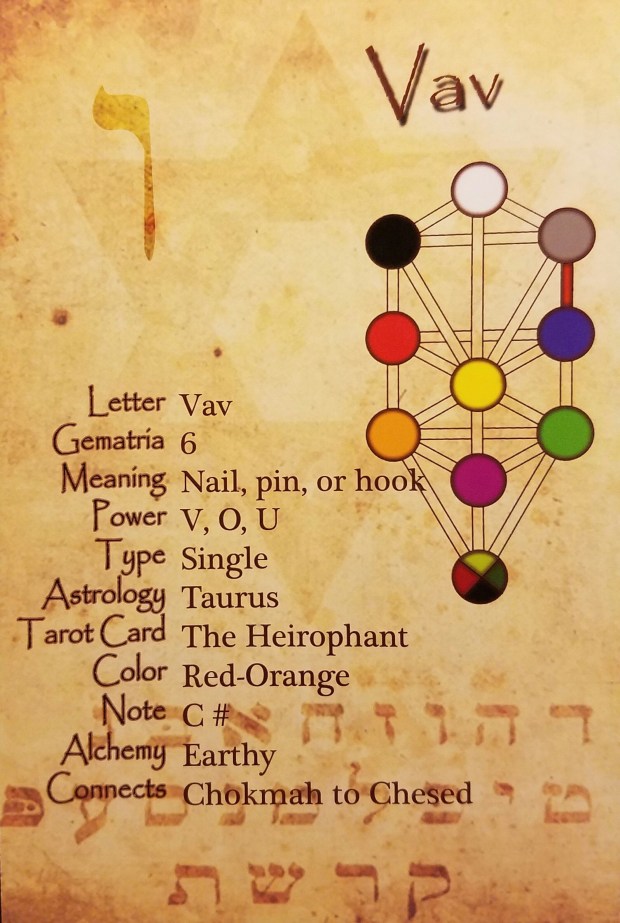
Contemplating Hebrew Letters || Vav (or Vau)

6
vav

yvdyv
Vidui
(Confession)


    When a man or woman who commits any of man’s sins, by committing treachery toward God, and that person shall become guilty—they shall confess the sin that they committed; he shall make restitution for his guilt in its principle amount and add unto it a fifth, and give it to the one to whom he is indebted.


Numbers 5:6–7


    The Jewish concept of confession and atonement for sins is based on this verse from the Bible, in which a person is dishonest regarding financial issues (theft, withholding salary, cheating a person on a loan, and so forth). Because these sins are considered not just an affront to the victim but also to God, God requires the sinner to repent, confess, and pay back the money he’s stolen with interest before he can be forgiven.


    The main prayer service of Yom Kippur, the Day of Atonement, is called the Vidui, which means “confession,” not “atonement.” It may seem odd that the main service of the heart on this holiest day of the year is filled with confessions that the penitent is meant to say aloud, sometimes together with the rest of congregation. After all, isn’t repentance an inner process, a personal discussion one has with God? The answer is yes and no. Although we repent in our hearts, without confession— that is, the act of saying “I have sinned” and admitting our guilt—we’ll never truly repent, gain atonement, or be able to move on, repairing the damage we have done.


    The letter Vav is most commonly known as the prefix used to denote the word “and,” and is seen hundreds of times thought the Bible as such, connecting words and concepts. Vidui serves a similar purpose: Because your past informs your present and future, being honest with yourself—that is, admitting your faults and expressing remorse for the things you’ve done wrong—will help to connect that past to the future in a more productive way. Expressing your guilt out loud and facing the consequences allows you to move on with your life and will help you truly reach a state of self-knowledge.


    It’s especially interesting to note that in Judaism the Vidui is said not only on Yom Kippur, but on one’s wedding day and on one’s deathbed. At traditional Jewish weddings, the bride and groom immerse in the mikveh (ritual bath), fast for the day leading up to their wedding, and recite Yom Kippur prayers just before they go to their ceremony. The bride also traditionally wears a white dress and the groom a white robe, called a kittl, which will in the future be worn to synagogue on Yom Kippur every year and eventually serve as his clothing for burial. The wedding day is known as a personal Yom Kippur for the couple, a day to reflect on their lives up until this point, realize what was lacking in those lives, and purify themselves both physically and spiritually for the future.


    The connections—the Vavs—between these three moments in life (the Day of Atonement, marriage, and death) are more than symbolic. The Vidui brings us to a place of purification and self-awareness that is crucial in every major life-changing event. Recognizing your shortcomings once a year, working toward a clean slate with which to start your married life, and making peace with God before you die are all essential elements of a truly fulfilled existence.


    The Vav card comes to you in times when it’s important to make a confession of some kind. This need not be a “sin” and isn’t a sign of any shortcomings. It’s just that from time to time we all need to admit certain truths to ourselves, to face up to our actions out loud, and accept responsibility for what we’ve done.


    The past will haunt you until it’s been properly dealt with, so don’t wait to take control of your life. Allow yourself to say what needs to be said. The rest will follow.
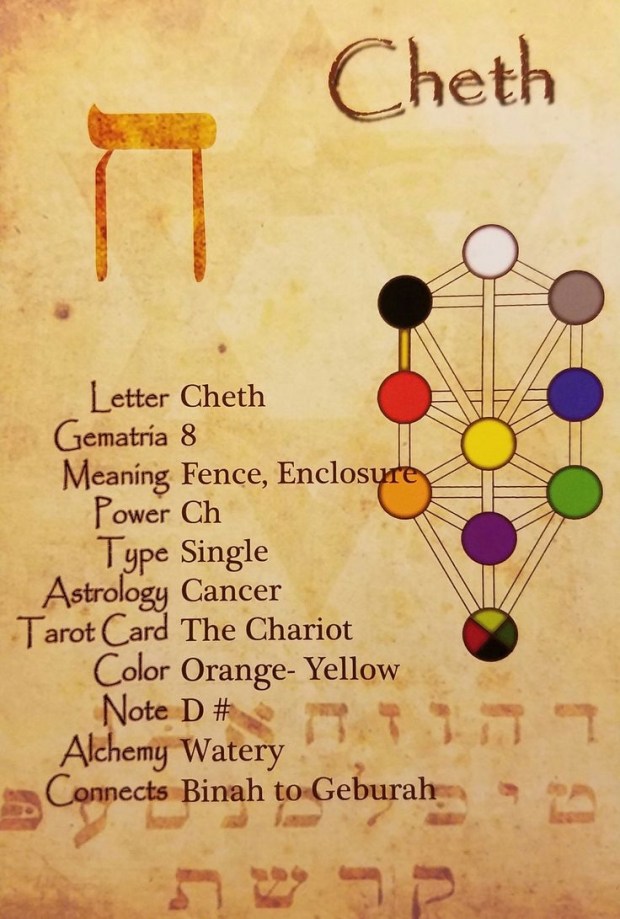
Contemplating Hebrew Letters || Chet

8
chet

hlj
Challah


    . . . when you will eat of the bread of the Land, you shall set aside a portion for God. As the first of your kneading you shall set aside a loaf [Challah] as a portion, like the portion of the threshing-floor, so shall you set it aside.


Numbers 15:19–20


    The Bible mentions the concept of “setting aside” many times: Corners of the field are to be set aside for the poor; the first fruits of every season are to be brought as offerings during harvest festivals; animals are brought as sacrifices in the Temple period; and ten percent of one’s earnings is to be set aside for charity. In this case, Jews are instructed to set aside a portion of the first loaf of every batch of bread they bake for the High Priest.


    Today, when there’s no longer a Holy Temple at the center of Jewish ritual life, and Priests don’t serve the same function, the commandment shifts: A piece of dough is taken from the first batch and thrown into the back of the oven to burn, symbolizing the destruction of the Temple and the exile that exists because of that destruction. There are many customs to reflect the loss of the Temple, such as replacing sacrifices with prayer services, using salt on bread to symbolize the bitterness of living in an imperfect world, and leaving a small part of a newly built home unfinished to commemorate the physical destruction of the Temple structure.


    But “Taking Challah,” as the custom is called, is more than merely preserving an ancient and now practically irrelevant commandment. By physically removing a small piece of dough and making it inedible, eventually discarding it altogether, we remind ourselves that everything we own is temporary. You may think that all of the dough is yours—after all, you paid for the ingredients, mixed them together, and watched them rise— but really, nothing belongs to you alone. You’re given the wheat and the eggs and the water from a higher source, and by letting some of it go, you’re acknowledging that source.


    The root of Challah actually has nothing to do with bread (which is called, in Hebrew, lechem). Instead, the root is chol, which means “ordinary.” The days of the week are separated into Shabbatand chol, Sabbath and weekday. Challah, a food made holy despite its ordinary origins, is made especially to be eaten on the Sabbath. Something as plain as wheat is elevated to a level at which it can be blessed and sanctified as an integral part of the Sabbath meal.


    The concept of Challah extends into our daily lives: We all need to learn the kabalistic lesson of sharing in order to balance the energy of the universe. What we own is never entirely ours, and we could never truly need every single object in our possession. It’s crucial to make giving a part of our consciousness, whether it is to acknowledge the higher force that guards us all, to remember the harsher realities of life, or to give thanks for what we already have.


    The Chet card comes to teach us how we can let go of what we do not need. We can survive on bread and water alone, yet we rely on incredible luxuries as if they were necessary.


    It’s time to let go. Donate clothes you no longer wear to a homeless shelter; take food supplies to a soup kitchen; make a list of your dependencies, and then set the list aflame. You will feel an increased freedom as a result.

Contemplating Hebrew Letters || Samech

15
samech

ynyo rh
Har Sinai
(Mount Sinai)


    On the third day when it was morning, there was thunder and lightning and a heavy cloud on the mountain, and the sound of the shofar [ram’s horn] was very powerful, and the entire people that were in the camp shuddered. Moses brought the people forth from the camp toward God, and they stood at the bottom of a mountain. All of Mount Sinai was smoking because God had descended upon it in the fire; its smoke ascended like the smoke of a furnace, and the entire mountain shuddered exceedingly. The sound of the shofar grew continually much stronger; Moses would speak, and God would respond to him with a voice.


Exodus 19:16–19


    Imagine being there at Sinai: Hundreds of thousands of people, slaves until just a few months before, are gathered together at the foot of a mountain in the desert—and smoke, fire, thunder, lightning, and the sound of the shofarblasting all lead up to the overwhelmingly awesome sound of the voice of God. How do you think this experience would make you feel?


    Legend has it that only the first two of the Ten Commandments were given directly by God, and the last eight had to come through Moses. The people were too overwhelmed by their first direct access to God to handle the situation—so, since they were familiar with his voice and it intimidated them less, they begged Moses to speak instead. (Although, as Bible scholars point out, every individual heard God’s voice differently, according to his or her own capacity and individual understanding, the direct experience of communication with the Divine proved to be more than they could handle.)


    There’s a tradition in Judaism that every single person in the world was at Sinai, and that those same souls have been reincarnated over and over again throughout the generations, even until today. That’s why this scene of the first mass Revelation in history is so compelling to us even now. There’s something in our souls that connects us to this event, remembers the fear that accompanied the excitement, and recognizes that in our most original state of being, we experienced it firsthand.


    The Samech is shaped like a circle, and it represents protection and safety. Although on some level they’re terrified, the people at Mt. Sinai also sense (though perhaps only subconsciously), that they’re going to be fine. When Moses hears their cries and takes over the enunciation of God’s words, the people are able to shield themselves from the frightening and foreign experience and take comfort in the familiar voice of their leader.


    Only once the sound shifts from the mighty, ethereal voice of God to the human one of Moses are the people truly able to comprehend the deeper meaning of the Revelation. Like a perfectly round wedding ring, the experience of Sinai is binding and limitless at the same time, extending to every generation through endless reincarnations. Although the people now have concrete rules and regulations, and have accepted upon themselves the responsibility to live accordingly—which might seem like a burden—they’ve also been guaranteed the ultimate protection and guidance of their God. As if they’re inside a metaphoric Samech, the people are now safely bound within the guidelines of their society, comforted by the permanence of it all.


    The Samech is your key symbol of safety and protection. Whether you’re in a place of transition or going about your daily routines without interruption, you may now and then feel like a lost lamb, unsure of your place in the world.


    Even when good things happen, we tend to question them and their place in the “bigger picture” of our lives. But the Samech reminds us that we’re always enclosed within the protective embrace of a higher force.


    Conjure up the experience of Sinai: Hear the foreign voice from above changing your reality day by day. You can conquer your fears and anxieties and quell your pride by focusing on the energy of the Samech.


    Remember that everything is part of the universal circle of life. The experience you have today leads to the one you’ll have tomorrow and so forth throughout lifetimes, and everything is just as it should be.

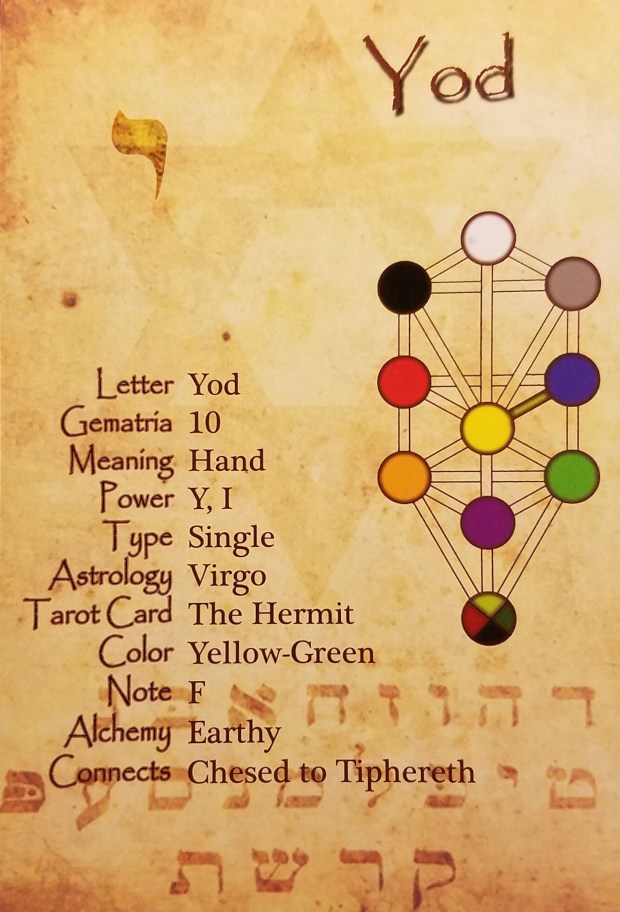
Contemplating Hebrew Letters || Yod

10
yod

PMvy
Yosef
(Joseph)


    Then Joseph said to his brothers, “Come close to me, if you please,” and they came close. And he said, “I am Joseph your brother—it is me, whom you sold into Egypt. And now, be not distressed, nor reproach yourselves for having sold me here, for it was to be a provider that God sent me ahead of you. For this has been two of the hunger years in the midst of the land, and there are yet five years in which there shall be neither plowing nor harvest. Thus God has sent me ahead of you to ensure your survival in the land and to sustain you for a momentous deliverance.”


Genesis 45: 4–8


    The story of Joseph is one of the most dramatic in all of history. Born to Jacob as the first child of his beloved wife, Rachel, Joseph is one of the 12 sons who will comprise the 12 tribes of Israel. But Joseph is unlike his brothers who are the sons of Leah and two maidservants— he’s clearly the favorite and the spiritual inheritor of the family. He and his younger brother, Benjamin, who was born to Rachel just before her death, have always been treated differently than the other ten boys.


    When, as a teenager, Joseph begins to have dreams of superiority—dreams in which he foresees that his brothers will one day bow down to him—his siblings decide that they’ve had enough of this “dreamer.” They throw him into a dark pit and sell him into slavery. Afterward, they take his special multicolored tunic and soak it in blood as “proof” that he’s been killed. They then return to Jacob and report their brother’s “death.”


    However, rather than fading into obscurity and a life of slavery, once in Egypt Joseph is able to use his talents to rise to the top, interpreting dreams and gaining a reputation that will lead him to the Pharoah’s palace to interpret the ruler’s inexplicable visions. When Joseph is able to see the hidden message in the Pharaoh’s dreams of seven skinny cows eating seven fat ones as the sign of seven years of plenty followed by seven years of famine, he’s promoted to be the Pharaoh’s second in command and makes his way into the Egyptian leadership at a crucial time in history.


    When the famine begins, Jacob sends his remaining sons to Egypt to gather provisions—and they come into contact with the brother they’d betrayed so many years ago. Not recognizing Joseph as an adult, his brothers bow down to the man they see as an Egyptian leader.


    After many months of testing the men and sending them back and forth from Egypt to Canaan, Joseph finally reveals himself as their long-lost brother and sends for his father. After all this time, his original dream has finally come true: He’s established himself in such a position of power that his brothers bow down to him, and they fear his revenge. But rather than express his anger and pain, Joseph tells them that he’s come to realize that everything leading up to this point— their jealousy and their plot against him, his time served as a slave, and so forth—was all meant to be, because as a result, he was able to provide food for the family in a time of overwhelming famine.


    Most of us cannot imagine being as “big” as Joseph was under the circumstances. Our anger over past wrongs becomes the dominant force in our actions. But Joseph, perhaps because of the amount of time that had passed, or because of his innate sense of the predestined nature of the world, looks at his reunion differently: He does want to make sure his brothers are sorry for their actions, but once he senses their remorse he seems to let go of his own anger and need for revenge. In this way, Joseph is able to focus on the present instead of the past, willing to move forward with his now reunited family.


    Joseph’s whole life has been one of dreams and their fulfillment. Having been born a dreamer, he’s known all along that the images he saw in his mind weren’t just figments of his imagination but signs of things that would actually come about in real life. As a young man, this awareness was looked at as snobbery, but as a mature adult, sobered by his difficult experiences, his gift was appreciated and led to the ultimate reunion of his family.


    The Yud, as the smallest letter in the alphabet, is often thought about as a “point.” This tiny point lies at the center of our hearts—it’s the driving force that takes us from one stage of life to another, the motivation that follows us through every action we perform. Joseph suffered for his essential point (his talent), but with time it became clear to everyone that he was not just a dreamer but a prophet, and that all of his dreams would one day become reality.


    The Yud appears in moments of spiritual or physical darkness. Like Joseph, you’ve been cast into a metaphorical pit and must redefine your life. You may feel misunderstood, underappreciated, or simply confused—the only way out of this darkness is by recognizing the small point in your soul that leads you forward in life.


    Joseph teaches the power of believing in yourself. You must always know that your life is full of purpose, and that everything that happens to you occurs for a reason. The key to personal fulfillment lies in recognizing your uniqueness and then learning how to apply your special talents in order to change your world and come to an enlightened understanding of your past, present, and future.


    Meditate on the power of forgiveness. Strive to be more like Joseph, who, as a result of forgiving his brothers for their actions, pulls his family together again.

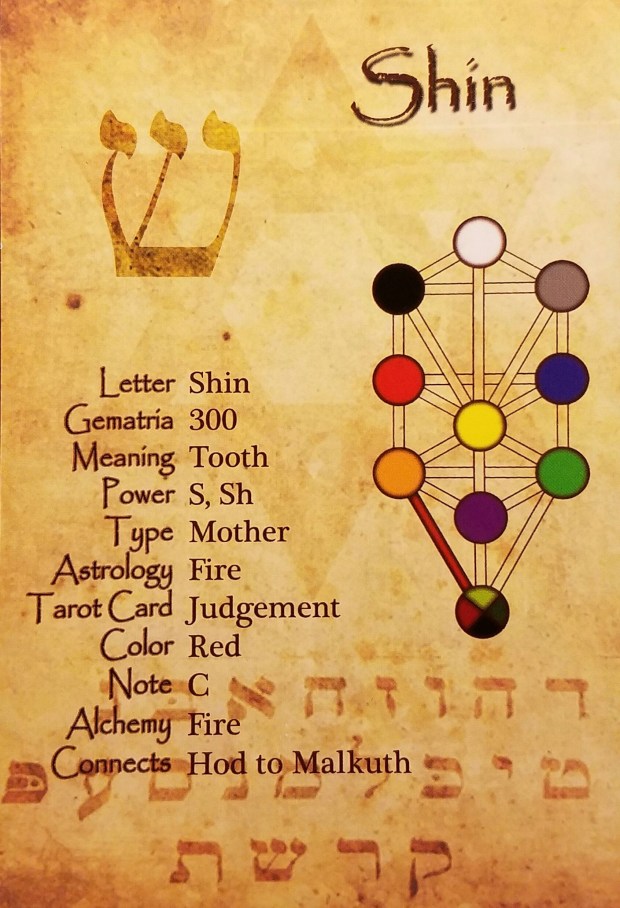
Contemplating Hebrew Letters || Shin

21
shin

Shema Yisrael
(Hear, O Israel)

    Hear, O Israel: The Lord is our God, The Lord is One.

Deuteronomy 6:4

    This single line, Shema Yisrael, Adonai Eloheinu, Adonai Echad, is considered the cornerstone of Jewish faith. The first prayer taught to young children and the last prayer recited on one’s deathbed, in its simplicity and brevity this line captures the ultimate lessons of life: God is One, we are One, everything is Oneness. Described throughout the ages as the ultimate meditation tool and declaration of faith, the Shema, as it is known, is one of the most important sentences in the world.


    Before the Jews finally enter the Land of Israel after 40 years of wandering in the desert, Moses recaps their experiences since the Exodus. He recounts the revelation at Mount Sinai and the giving of the Ten Commandments, and then proceeds to explain those commandments in preparation for living in a world where they will be relevant. In the midst of this he utters the Shema, followed by the instructions: “You shall love the Lord, your God, with all your heart, with all your soul, and with all your resources” (Deut. 6:5).


    What we learn from this is that faith is not just a matter of belief but of totality. To believe is to feel it on every level—emotional, spiritual, practical, and even physical (the Shema is inscribed in the scrolls kept inside mezuzahs, traditional ornaments affixed to the doorposts of homes).


    In order to really say the Shema, you have to be convinced of it on every level. In fact, if you look at the Hebrew text as it is written on a Torah scroll, you’ll see that the last letters of both the first word and the last word of the sentence—Ayin and Dalet—are written twice as big as the other letters in the line. When you put the Ayin of Shema and the Dalet of Echad together, you get the word Ayd, which means “Witness.” Only if you are truly a witness to something can you fully comprehend it. And to truly hear what this prayer is about, you must witness its power for yourself.


    The Shin is the first letter of the words Shalom(“peace”) and Shalem (“complete” or “whole”), so to feel like a complete person is to be at peace with oneself. To feel the wholeness of the universe—the single life force that propels all of us and the world around us—is to also find peace, to hear the lessons of the universe explained.


    Traditionally, this prayer is said sitting down, with one’s eyes closed and the right hand covering them. Each word should be said slowly and focused on, one at a time. Doing this blind meditation teaches us to slow down, to minimize, to block out all outside interference, and to recognize that everything comes down to the single, original source of energy and light. In other words, despite our diverse backgrounds, we all come from the same place. When we truly recognize that unity is the goal of all life, that reconnecting with our origins is essential, we will have achieved wholeness.


    The Shin is the beacon of peace and wholeness. By focusing on the Shemameditation, you can truly connect with the Oneness that is central to Kabala. Hear the lesson and make the statement true for yourself.


    Realize that in the end, we all come from the same source. Close your eyes and focus on the light of creation . . . know that you are part of that light—we all are. You can find peace when you truly accept this principle and witness it for yourself.

Towards an Informationist Post-Metaphysic

Frater S.C.F.V's avatarLight in Extension: A Magical Journal

By Adam J. Pearson

uni3

I recently came to the conclusion that the universe is not fundamentally composed of ‘matter,’ at its explanatory bottom, but rather of information, indeed a field of infinite potential and informational possibilities that manifest as finite actualities within universes constrained by discrete sets of physical constants and universal principles (“laws of Nature”). “Matter” and “energy” to me are both modes of information more fundamentally.

Indeed, I see matter as a kind of epiphenomenon arising out of an informational substrate.  I call this theory informationism to distinguish it from materialism.  One pleasant thing about informationsim as a theory is that it can equally and elegantly hold true whether our universe turns out to be in a sense objectively existing as posited by materialism, intersubjectively existing as posited by idealism, or even simply a simulation within a larger overarching reality as Nobel Prize-winning physicists George Smoot and…

View original post 740 more words

Horoscope December 24-30

Tara Greene www.taratarot.com's avatarTara Greene,Tarot,Astrology,Psychic

Christmas Eve under a firey LEO MOON will be heartfelt, loud, with a sense of innocence and childhood wonder, celebratory and upbeat, with big lavish dinners and presents.

Mercury in Sagittarius squares Neptune in Pisces, don’t talk politics and your judgment will be off about alcohol. Enjoy

ARIES

Your energy is still low with Mars in Pisces, use it to get in touch with your creative, sensitive, spiritual and compassionate side. On the 28/29 Mars conjunct Chiron in Pisces-you fight to defend your wounds or others this week. Spend time listening to your intuition and dreams. Addictions may be heavy right now. Come clean its a great time to admit your wounds and go to rehab.

TAURUS

You are in La La land for real. Many have found new loves after all the Retrogrades and are on a romantic high. It’s very creative and spiritual time. Venus in your solar…

View original post 696 more words

Carrying Our Ancestors: Brief Words of Consolation for a Grieving Magician

Frater S.C.F.V's avatarLight in Extension: A Magical Journal

By Frater S.C.F.V.

ancestor altr

A fellow Magician named Michael recently shared that he had experienced his mother dying in his arms only a few days earlier. He had two Pentacles of Jupiter from the Key of Solomon that he had consecrated for her. He wanted to know if he had to deconsecrate the Pentacles now that she had passed on or if he could leave them on her Altar as he preferred to do.

Here was my response to him, based on my own experience, which I share here in case it might be able to offer some consolation and encouragement to others who may have also lost people for whom they cared very deeply:

I’m so sorry to hear about your mother, Michael. I cannot imagine what you must be feeling right now.

I can, however, encourage you with the news that there is no need to deconsecrate the Pentacles. …

View original post 282 more words

Spirit Offerings: Introductory Reflections on Types and Principles of Ritual Offerings in Magical Practice

Frater S.C.F.V's avatarLight in Extension: A Magical Journal

By Frater S.C.F.V.

Bali_2011_014.jpg Balinese spirit offering photographed by Teri Genovese.

Introduction

One of the most common questions new Magicians who wish to work with spirits in traditional ways often ask is what kinds of offerings to make. This is a fantastic and very respectful and attentive question.  My esteemed colleagues have written a great deal on this important subject — see for example the amazing Ritual Offerings book from 12 practicing occultists including Aaron Leitch, Zadkiel, Frater Ashen Chassan, Brother Moloch, Joshua Gadbois, Denise Alvarado, Jason Miller, Nick Farrell, Sam Webster, Chic and Sandra Tabatha Cicero, and Gilberto Strapazon.

I cannot recommend this amazing book highly enough and what I have to share below are only a few humble footnotes from my own experience to add on to what they have already eloquently said there. Dr. Stephen Skinner, Joseph H. Peterson, Jake Stratton-Kent and others have offered many helpful pointers on the subject as well.

michael-offering-close.jpg Offerings to…

View original post 2,621 more words

Consecrating Second Pentacles of Jupiter: Cyprianic and Solomonic Magic

Frater S.C.F.V's avatarLight in Extension: A Magical Journal

By Frater SC.F.V.

jup3

Phase I – First Hour of Jupiter

Date: Thursday, December 20, 2018
Sun Phase: Dawn
Moon Phase: Waxing Gibbous (151 degrees) in 0 degrees Gemini/cusp of Taurus
Mansion of the Moon: #5, al-Haqah
Planetary Day: Day of Jupiter
Planetary Hour: First Hour of Jupiter
Activities: Solomonic Ritual Bathing with Hyssop; Offerings to the Most High and to Saint Cyprian of Antioch; Crafting Jupiterian sympathetic bags; Solomonic Bell Sounding to the Spirits of the Quarters; Prayers of Intent; Inscribing the Vigil of Sachiel with his Sigil from the Heptameron; Tracing out the First Pentacle of Jupiter on the Tablet of Lights; Prayers, Psalms and Temple Closing. 

Today is a day of magic that has been nearly a year in the making.  Over the past months, I have been preparing for this ritual, updating and crafting new implements, learning from Saint Cyprian of Antioch and from my own…

View original post 4,995 more words

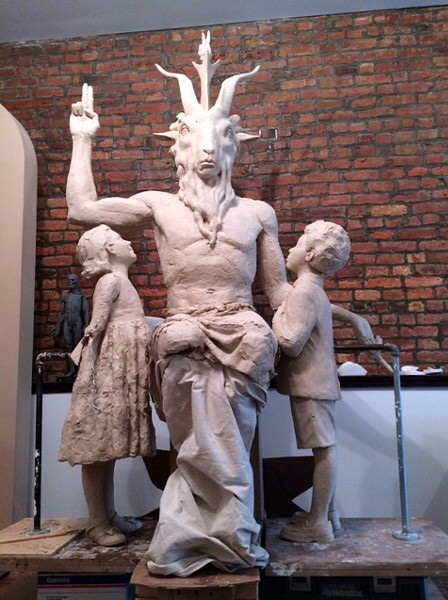
Satanic Temple cleared to enter the 10 Commandments lawsuit

A WIN IN COURT: For The Satanic Temple. It has been allowed to intervene in a court challenge of the 10 Commandments monument at the Capitol. It wants it removed, or in the alternative, for its Baphomet statue to be installed.

The Satanic Temple has been allowed to enter the lawsuit challenging the 10 Commandments monument at the state Capitol on the ground that refusal of its request to install a Baphomet monument was a violation of their constitutional equal protection right.  […]

Read article here: https://m.arktimes.com/ArkansasBlog/archives/2018/12/18/satanic-temple-cleared-to-enter-the-10-commandments-lawsuit

Venus Retrograde is officially over

Tara Greene www.taratarot.com's avatarTara Greene,Tarot,Astrology,Psychic

Venus turned Retrograde on October 5th @ 10 degrees 50 minutes of Scorpio.

She just crossed that degree today December 18 indicating that yes love can breathe fresh air again. 

look back at all the heartbreak, losses, lovers who split, those who returned, and where you are now compared to then.

Values around love, sex, money, beauty, self-worth, death and control have shifted like earthquakes. You are not now who you were then. Venus went from Scorpio where it is deeply ensouled, can be deeply enshadowed, deeply troubled, obsessed, unconscious, driven by power and to be in control into Libra where Venus rules and it’s all about pleasing others, thinking of them, worrying about your social status obsessively, buying beautiful things, being a counselor, the hostess with the mostest, saying what people want to hear, and finding it fricking difficult to ever make up your mind.

There has been huge…

View original post 265 more words

Esoteric Art || The Most Comprehensive Exhibition of Leonardo da Vinci’s Work is Coming to Denver

Leonardo de Vinci’s work has lived through generations. He was many things — inventor, artist, scientist, anatomist and architect, to name a few — and his extraordinary legacy has been  […]

Source: The Most Comprehensive Exhibition of Leonardo da Vinci’s Work is Coming to Denver

2019 – An Astrological Preview

Peter Stockinger's avatarPeter Stockinger's Traditional Astrology Weblog

This is a general overview of astrological events occurring during the year 2019. Some of the events mentioned below may affect us globally or nationwide, whilst others may only affect us on an individual basis. For details about the nature, strength, or duration of any effect that may take place, inception charts as well as natal charts of people in charge of the countries in question will also have to be taken into consideration. For events affecting the native on a personal level, natal-, solar return and other charts will have to be consulted. This should achieve an accurate judgment of the level of influence. In this astrological preview, the following information can be found:

  • Retrograde motion of the planets

  • Noteworthy sign ingresses and transits

  • Other noteworthy phenomena (Solstices, Equinoxes, Super Moons)

  • Solar and lunar eclipses

  • Solar ingress charts

For more detailed information, you may watch this space for in-depth…

View original post 1,355 more words

Frater S.C.F.V on the Glitch Bottle Podcast

Frater S.C.F.V's avatarLight in Extension: A Magical Journal

Glitch Bottle#033 – Solomonic Bells, Wands & Consecrations (Oh My!) with Frater S.C.F.V.

By Frater S.C.F.V

I recently had the great pleasure and honour of appearing on Alexander Eth’s fantastic Glitch Bottlepodcast. We discussed my own multitraditional spiritual background, Solomonic grimoires, Dr. Stephen Skinner’s interesting typology of magic, Mystery, and religion, Wand traditions, Bells and Trumpets of Art, Circles, binding, Consecration by Mass, scrying, cryptoconsecratio, Angelic invocation, and a host of other fascinating topics of magical theory and practice. Please feel free to share any comments or questions you may have. Thank you!

In LVX,
Frater S.C.F.V.

View original post

Rune and Tarot Readings for N.J. with Saint Cyprian

Frater S.C.F.V's avatarLight in Extension: A Magical Journal

Date: October 23, 2018
Sun Phase:Set, Showers Nearby
Moon Phase:Full Moon in 11 degrees Aries
Mansion of the Moon: Sharatain
Planetary Day:Day of the Moon
Planetary Hour:Hour of the Moon
Activities:Casting of a Natal Chart; Solomonic Ritual Bathing with Hyssop; Preliminary Prayers; Offering to God; Solomonic Bell Sounding to the Spirits of the Quarters; Offerings to Saint Cyprian and Gabriel; Second Phase of Prayers; Invocation of the Divine; Invocation of the Trinity; Exorcism of the Runes and Purification by Holy Water; Solomonic Consecration of the Runes with Frankincense Suffumigations, Holy Water Asperging, and Saint Cyprian Oil Anointing; Invocation of Raphael, Gabriel, Michael, and Uriel to empower the Runes; Invocation of the Trinity; Canticle of Saint Cyprian; Rite of the Crook of Saint Cyprian; Psalms Recitation; Recitation of al-Fatiha and al-Adiyat; Gifts of Rune Divination and Tarot Divination for a friend; Temple Closing

After consecrating…

View original post 3,145 more words