
Uncover the sacred role of cats in ancient Egypt. Explore their symbolism, history, and significance. […]

Uncover the sacred role of cats in ancient Egypt. Explore their symbolism, history, and significance. […]

If so, how did that happen? Did you do a specific ritual? Did it slowly gain its living quality over time? Following the inspirations of ancient Egyptian cult, for me, the ones that are alive are s […]
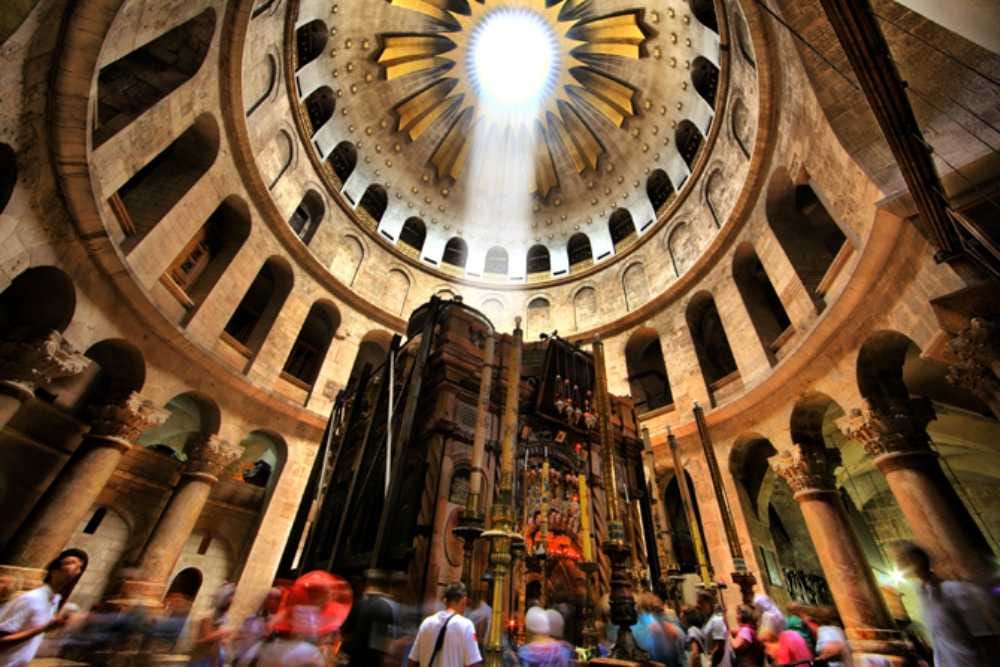
“According to Eusebius, Hadrian built a temple dedicated to the Roman goddess Venus to bury the cave in which Jesus had been buried. The Orthodox Church celebrates the Dedication of the Church of the Holy Sepulchre on September 26 (Gregorian), the same date as the ancient Roman festival of Venus.”
We call the planet Venus the morning star when it appears in the east at sunrise, and the evening star when it appears in the west at sunset, although the ancients called it Hesperus in the evening and Phosphorus, or Lucifer, in the morning. Because of the distances of the respective orbits of Venus and the Earth from the Sun, Venus is never visible more than three hours before sunrise nor three hours after sunset, and it may also surprise you that Venus can be seen in broad daylight, provided you know where, and when, to look after reference to an almanac.-Masonic Library. . . . .After Jesus was born in Bethlehem in Judea, during the time of King Herod, Magi from the east arrived in Jerusalem, asking, “Where is the One who has been born King of the Jews? We saw His star in the east and have come to worship Him.”-Matthew 2:2
Moses created Princes of the Tabernacle and the initiations took place when the Pentagram, or blazing star was to be seen in the east. A blazing star that is referred to as a Pentagram can only be a reference to Venus which had long been associated with the pentagram because of the planet’s apparent movement around the sun when observed from Earth. It is suggested that when the Romans destroyed Jerusalem and the Temple in year 70 of the Christian Era, a number of the Princes of the Tabernacle managed to escape to locations across Europe. It was from these families that the men came, who went on to found the Knights Templar.-Masonic Library

Offering bread to the Goddess.
Here in the famously cloudy Pacific Northwest, I find myself thinking of a hot bowl of soup and a slice, well buttered, of bread. So today, I write today in honor […]
Source: The Divine Bread of Isis

“Truth is many sided and eternal; the quest for truth must also be all embracing and never ending. We may liken truth to a mountain, and the various interpretations of that truth to different paths leading up to the summit.
Many people are traveling along all of these paths and every one thinks his path is the only one while he is at the bottom; he sees only a small part of the mountain and may therefore be justified in crying to his brothers, “You are wrong; come over in my path; this is the only one that leads to the top.”
But as all these people progress upward, they shall see that the paths converge at the top and that they are all one in the ultimate.”
— The Rosicrucian Philosophy In Questions and Answers, Volume I, by Max Heindel

Freemasonry, the teachings and practices of the secret fraternal order of Free and Accepted Masons, the largest worldwide secret society. Spread by the advance of the British Empire, Freemasonry remains most popular in the British Isles and in other countries originally within the empire. Freemasonry evolved from the guilds of stonemasons and cathedral builders of the Middle Ages.
Freemasonry and the Knights Templar are both fraternal organizations, but they have different origins and beliefs.
Freemasonry is a fraternity that traces its origins to the local fraternities of stonemasons, which from the end of the fourteenth century regulated the qualifications of stonemasons and their interaction with authorities and clients. These fraternities were composed of stonemasons who were working on the construction of the great cathedrals and castles of Europe. They developed a system of moral teachings and a code of conduct that was passed on to new members through a series of rituals and ceremonies. Over time, these fraternities evolved into a more speculative organization, which came to be known as Freemasonry. Today, Freemasonry is a fraternity that is open to men of good character who believe in a Supreme Being. It is a fraternity that emphasizes personal development and self-improvement through a system of moral teachings and symbols.
On the other hand, The Knights Templar were a medieval Christian military order founded in the 12th century. The order was created to protect Christian pilgrims traveling to the Holy Land. The Templars quickly grew in power and wealth, and they became one of the most powerful organizations in Europe. They were also known for their secrecy and their distinctive white mantles adorned with a red cross. The order was dissolved by Pope Clement V in the early 14th century, and many of the Templars were arrested, tortured and executed.
While Freemasonry uses the imagery and symbology of stonemasonry as a metaphor for personal development, the Knights Templar were a religious order. Some people believe that Freemasonry has its roots in the Knights Templar, but there is no evidence to support this claim. Some conspiracy theories suggest that the Templars went underground after the suppression of their order and that they became the basis of the Freemasons. But there is no historical evidence to support this claim. Furthermore, the principles and beliefs of the two organizations are vastly different. The Knights Templars were a religious order and the Freemasonry is a fraternity, with no religious connotation, but it requires its members to have a belief in a Supreme Being.
#knightstemplar #freemasonry #conspiracy #documentary
—-
Interesting links and sources:
https://en.wikipedia.org/wiki/History…
https://www.britannica.com/topic/Free… https://www.history.com/news/freemaso…
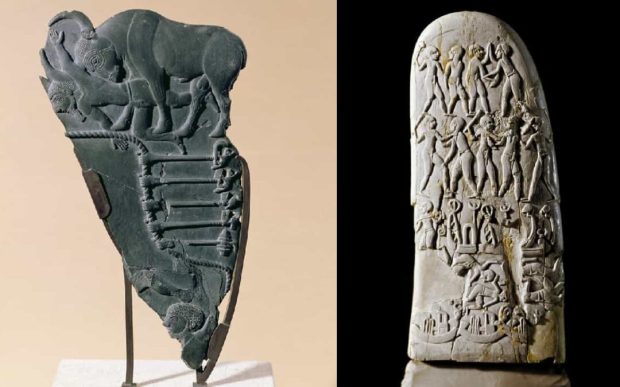
Five thousand years ago, the rulers of Upper Egypt cast their gaze upon the kingdoms of the Nile Delta and embarked on a conquest that, according to all indications, was accomplished by Narmer, the ruler of Nekhen, who is considered the first pharaoh of a unified Egypt.
In the 3rd century BC, the Egyptian priest Manetho composed a history of Egypt in Greek for King Ptolemy II Philadelphus. Unfortunately, from this work, known as Aegyptiaca, only a few passages have been preserved, reduced to the enumeration of thirty-one dynasties along with the names of the sovereigns who constituted them and references to some significant events during their reigns.
According to Manetho, the history of dynasties commenced with Menes, acknowledged as the inaugural pharaoh of Egypt and the founder of the First Dynasty. Prior to Menes, also known as Narmer, the land of the Nile was ruled by gods and demigods.
However, modern archaeology has revealed that long before Narmer’s reign, a lengthy process of unification of the entire Egyptian territory was underway. This process was led by monarchs hailing from Upper Egypt, the southern region of the country, who are associated with what we now call “Dynasty 0.”
These monarchs ruled during the Late Predynastic or Protodynastic period, spanning from 3300 to 3100 BC. This period corresponds to the concluding phase of the culture recognized by Egyptologists as Nagada III.
Today, Nagada (known as Nubt in ancient Egyptian and Ombos in Greek) is merely a village. However, it remains a crucial archaeological site for establishing the origins of these rulers of the 0th dynasty who embarked on their campaign to conquer the northern regions of the country.
Prior to the Late Predynastic period, the various “urban” communities in Upper Egypt had clustered along the Nile, where arable land was abundant.
Peasants made use of the river’s annual flooding, combined with early artificial irrigation techniques, to enhance agricultural productivity. This allowed for the cultivation of a wider range of crops, including cereals, fruits, and vegetables, leading to a substantial population increase.
As these communities grew, they began to be governed by leaders who were universally accepted and respected. Undoubtedly, these leaders must have possessed qualities of both military prowess and effective mediation.
Between 3500 and 3300 BC, corresponding to the Nagada II or Gerzense culture, Upper Egypt featured three prominent population centers that outshone the rest: the proto-kingdoms of Hierakonpolis (known as Nekhen in Egyptian), Nagada, and Tinis-Abydos. Their expansion led to fierce competition for dominance over the entire region and control of exotic trade goods.
The rivalries among these three centers eventually culminated in the triumph of Hierakonpolis. It unified Upper Egypt under its rule and established a highly centralized government. The victorious leaders of Hierakonpolis settled in the nearby town of Tinis-Abydos, possibly with plans for future expansion northward.
It’s worth noting that the necropolises of Upper Egypt’s most influential regional centers contained burials of varying social classes during this period. The quantity and quality of funerary objects discovered in certain graves point to the emergence of a powerful elite within an increasingly hierarchical society.
While Upper Egypt achieved military unity (possibly through alliances as well as conflicts), the settlements in Lower Egypt, specifically in the Delta region, did not form a cohesive kingdom. Some prominent elites may have existed in cities like Buto (known as Pe in Egyptian) or Sais. However, in general terms, the various communities remained autonomous from one another.
Furthermore, these Lower Egyptian communities had experienced limited social changes since the Neolithic era. They were societies with minimal social disparities, as evidenced by the simplicity of the tombs unearthed in the region. These tombs typically consisted of small, ground-dug oval graves with basic funerary belongings.
Gradually, the cultures in the northern regions abandoned their traditional practices and material culture in favor of those from Upper Egypt. They adopted features like wheel-turned pottery with a red glaze and the crafting of stone vessels, which were characteristic of Nagada II.
By the onset of the Late Predynastic period, around 3300 BC, the indigenous culture of Lower Egypt had vanished, supplanted by elements from Upper Egypt. Now, the entire country was culturally united, though not politically. The political unification that would ultimately lead to the formation of the pharaonic state commenced in the south during the final phase of the Predynastic era. The expansion of Upper Egypt toward the north must have been gradual and intricate, occurring under the rule of various kings from Dynasty 0.
It is intriguing to note that in later dynastic times, starting in the 3rd millennium BC, the falcon god Horus, symbolizing order, was regarded as the protective deity of Lower Egypt, while the warrior god Set, symbolizing chaos, served as the patron deity of Upper Egypt. According to mythology, Horus and Set clashed when the latter slew Osiris, the father of Horus. Until recently, scholars interpreted this mythical conflict between Horus and Set as a reflection of the struggles between two predynastic kingdoms: one from Upper Egypt and the other from Lower Egypt.
However, contemporary understanding suggests that the unification process did not result from a confrontation between an Upper Egyptian ruler and a unified Delta. In reality, Egypt’s transformation into a territorial state resulted from the successive conquests carried out by the kings of Upper Egypt over several generations.
In this context, the concept of Egypt as a land of the Two Lands (comprising two kingdoms) lacks historical grounding. Instead, it aligns with the Egyptian notion that a whole is constituted by two opposing yet complementary parts. These two halves, Upper and Lower Egypt, had their own patron gods and emblematic symbols. Consequently, Set and the city of Hierakonpolis became the protective deity and symbolic capital of Upper Egypt, while the falcon god Horus and the city of Buto assumed the role of the protective deity and symbolic capital of Lower Egypt.
Archaeological excavations conducted in Tinis-Abydos have unveiled the history of Egypt’s unifiers—the rulers of the 0th dynasty.
Starting from the Nagada III period, Abydos, serving as the necropolis of the city of Tinis (whose precise location remains unknown), became the final resting place for these rulers.
Their tombs have been identified in what we now recognize as Cemetery U and Cemetery B. Among the tombs, the most extensive and intricate one is the Uj tomb, associated with a leader or sovereign who lived around 3250 BC.
The discovery and excavation of this tomb took place in 1988, led by archaeologists from the German Institute in Cairo under the guidance of Egyptologist Günter Dreyer. Covering an area of 66.4 square meters, the tomb comprises twelve interconnected chambers linked by narrow vertical slots.
Despite being plundered in ancient times, archaeologists uncovered bone and ivory artifacts, including intricately carved knife handles, stone containers, a significant cache of ceramics (including plates, bread molds, and jugs containing scented oil, fats, and beer), as well as up to 400 vessels believed to have been imported from Canaan, possibly used to store wine.
Within the burial chamber, remnants of a wooden chapel and a complete ivory heqa scepter were discovered. The heqa scepter, shaped like a staff, symbolized royal authority during dynastic periods. Its presence in the tomb strongly suggests the royal status of its occupant.
Among the diverse array of funerary objects found in the Uj tomb of Abydos, the most significant for researchers may be the 150 small bone or ivory tablets engraved with the earliest hieroglyphic signs recorded in Egyptian history. These signs also appeared inscribed in black ink on ceramic vessels and represent the oldest known evidence of writing in the Nile region, possibly even the oldest writing in the world. These inscriptions confirm the indigenous origin of Egyptian writing and suggest its connection to the realm of royal funerals.
While the identity of the tomb’s occupant remains a mystery, the frequent appearance of the scorpion symbol on the ceramic vessels found there has led to the suggestion that the sovereign interred here might have been referred to as King Scorpion I. However, this is likely a symbolic name, and the prominently depicted scorpion sign may represent one of the many symbols of his power and strength rather than a literal name.
As previously explained, the political unification of Egypt was the outcome of an extended series of military conquests in the Delta region carried out by the kings of Upper Egypt, predating the First Dynasty.
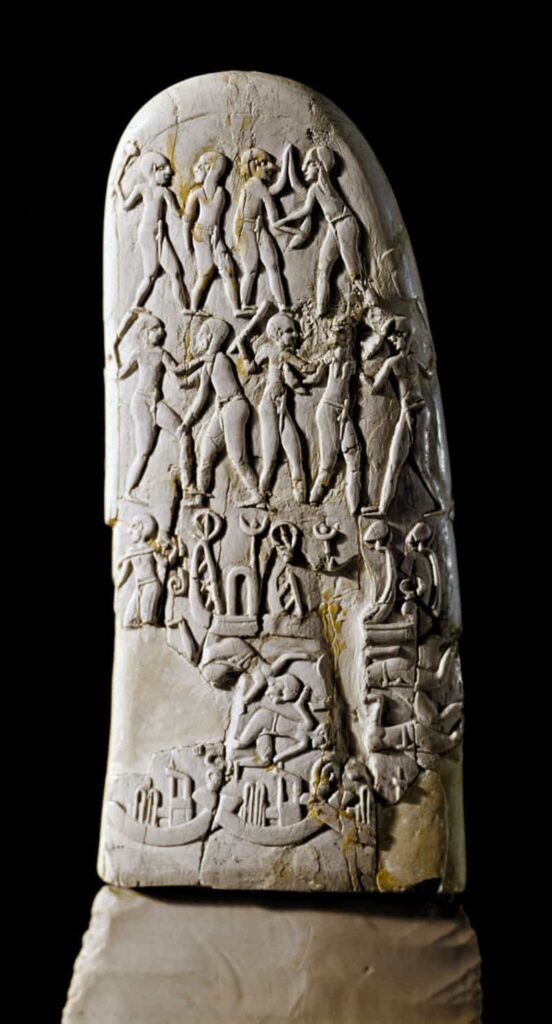
Our sole evidence of these conquests stems from the relief scenes found in the “unification documents,” which date back to the conclusion of the Predynastic era. These documents include knife handles, votive mace heads, and sizable ceremonial palettes, originally utilized as platforms for cosmetics preparation.
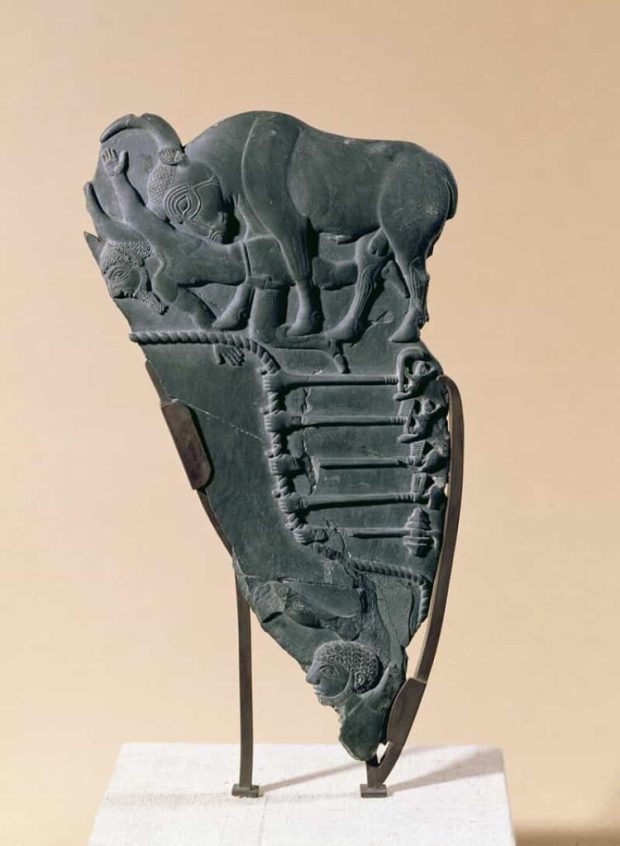
The Palettes of the Lion and the Bull depict the king in the guise of a lion or a bull, engaged in combat against enemies or fortified cities. These themes frequently recur in the iconography of the period and likely offer a representation of actual events.
The rulers credited with accomplishing the unification of the Two Lands are Narmer and Scorpion, though many experts propose that they might be one and the same individual.
In their respective city of origin, Hierakonpolis, a significant cult center linked to the falcon god Horus, numerous votive objects bearing these names have been unearthed. These include the renowned Palette of Narmer and the mace heads featuring Scorpion and Narmer.
It is highly probable that the scenes etched on the Narmer votive palette portray the culmination of this unification process. Narmer, recognized as the first ruler of the First Dynasty and the founder of the city of Memphis, is credited with finalizing the unification of Upper and Lower Egypt around 3100 BC.
Source: Irene Cordón i Solà-Sagalés, National Geographic

Throughout most of ancient Egyptian history, the god Ra was the supreme deity who governed the passage of hours, days, months, years, and seasons.
He brought order to the universe and made life possible. Ra could manifest in two other forms: Khepri, symbolizing birth or rebirth as the dung beetle, and Atum, representing the complete being.
The ancient Egyptian clergy explained that the sun star could assume different forms during its journey across the sky: Khepri represented the rising sun, Ra symbolized the sun at its zenith, and Atum represented the setting sun.
Ra’s daily emergence from the depths of the Duat (underworld) symbolized the cyclical nature of creation, and he was particularly venerated at Heliopolis.
During the Old Kingdom, the cult of Ra had a significant influence, combining with the two primary deities of creation, Atum and Amun, to give rise to hybrid entities like Atum-Ra and later Amun-Ra.
This is how the sun god became worshipped as a creator god. Ra was also considered the ancestor of the pharaohs, and his role grew even more complex as he merged with other gods.
There are various versions of Ra’s birth. In a classic rendition, as recounted notably by Neil Philip in his work “Myths and Legends,” Ra created himself by naming himself, just as he would create the elements of life by drawing them from the Nun, the primordial ocean.
In a variant, Ra is said to have been brought into the world by the goddess Neith during the darkness that presided over the emergence of life on Earth.
When confronted by this darkness, he began to cry, and humanity was born from his tears. Neith also gave birth to the serpent Apophis (Apep). Apophis and Ra were in constant conflict, clashing night after night.
Ra, whether as Atum-Ra or Amun-Ra, was not only the god of the sun but also the ruler of both gods and humans. Ra, and later his sons, reigned on Earth. The eye of Ra watched and observed everything, sparing nothing from its gaze.

The true teaching of Brahma Vach is enshrined in the secret code language of Nature. A new mode of initiation has already begun. Invisible beings in their mayavi rupas cherish the teaching, but no visible beings are entirely excluded. The quintessential teaching is conveyed in so many different ways that prepare for the sacred instructions in deep sleep, even for those struggling souls who seize their last chance in this life. The more any person can maintain during waking hours the self-conscious awareness of what is known deep within — even though one cannot formulate it — the more one can hold it and see it as blasphemous to speak thoughtlessly about it. Though such persons participate in all the fickle changes of the butterfly mind, the more attentively they can preserve and retain the seminal energy of thought with a conscious continuity, the more easily will every anxiety about themselves fade into a cool state of contentment. Like a shadow following the lost and stumbling seeker of the light, a true disciple will unexpectedly encounter the forgotten wisdom, the spiritual knowledge, springing up suddenly, spontaneously, within the very depths of his being. Then he may receive the crystalline waters of life-giving wisdom through the central conduit of light-energy, symbolized in the physical body by the spinal cord. One may walk in the world with deep gratitude for the sacred privilege of being a self-conscious Manasaputra within the divine temple of the universe for the sake of shedding light upon all that lives and breathes. In seeing, one can send out beneficent rays. In hearing, one can listen beyond the cacophony of the world. Whilst one is listening constantly to the music of the spheres echoing within one’s head and heart, one is able to send forth thoughts and feelings that are benevolent and unconditional, extended towards all other human minds. These thoughts could become living talismans for the men and women of tomorrow in the fields of cognition wherein the war between light and darkness, the living and the dead, is now being waged.
The Philosophy of Perfection of Krishna, the Religion of Responsibility of the Buddha and the Science of Spirituality of Shankara, constitute the Pythagorean teaching of the Aquarian Age of Universal Enlightenment. There are general and interstitial relationships between the idea of perfectibility, the idea of gaining control over the mind, and the exalted conception of knowledge set forth in the eighteenth chapter of the Gita. To begin to apprehend these connections, one must first heed the mantramic injunction from The Voice of the Silence: “Strive with thy thoughts unclean before they overpower thee.” Astonishingly, there was a moment in the sixties when millions became obsessed with instant enlightenment; fortunately, this is not true at present. Few people now seriously believe that they are going to die as perfected beings in this lifetime. This does not mean that the secret doctrines of the 1975 cycle are irrelevant to the ordinary man who, without false expectations, merely wants to finish his life with a modicum of fulfilment. All such seekers can benefit immensely from calmly meditating upon the Sthitaprajna, the Self-Governed Sage, the Buddhas of Perfection. This is the crux of Krishna’s medicinal method in the Gita. He presents Arjuna with the highest ideal, simultaneously shows his difficulties and offers intensive therapy and compassionate counsel. This therapeutic mode continues until the ninth chapter, where Krishna says, “Unto thee who findeth no fault I will now make known this most mysterious knowledge, coupled with a realization of it, which having known thou shalt be delivered from evil.” In the eighteenth chapter he conveys the great incommunicable secret — so-called because even when communicated it resides within the code language of Buddhic consciousness. The authors of all the great spiritual teachings like the Gita, The Voice of the Silence and The Crest Jewel of Wisdom knew that there is a deep mythic sense in which the golden verses can furnish only as much as a person’s state of consciousness is ready to receive.
H.P. Blavatsky dedicated The Voice of the Silence to the few, to those who seek to become lanoos, true neophytes on the Path. Like Krishna, she gave a shining portrait of the man of meditation, the Teacher of Mankind. In chosen fragments from the Book of the Golden Precepts, the merciful warning is sounded at the very beginning: “These instructions are for those ignorant of the dangers of the lower IDDHI.” In this age the consequences of misuse of psychic powers over many lives by millions of individuals have produced a holocaust — the harvest of terrible effects. Rigid justice rules the universe. Many human beings have gaping astral wounds and fear that there is only a tenuous connecting thread between their personal consciousness and the light of the higher nature. Human beings have long misused Kriyashakti, the power of visualization, and Itchashakti, the power of desire. Above all, they have misused the antipodal powers of knowledge, Jnanashakti, so that there is an awful abyss between men of so-called knowledge and men of so-called power. What is common to both is that their pretensions have already gone for naught, and therefore many have begun to some extent to sense the sacred orbit of the Brotherhood of Bodhisattvas. On the global plane we also witness today the tragic phenomenon of which The Voice of the Silence speaks. Many human beings did not strive with their unclean hobgoblin images of a cold war. The more they feared the hobgoblin, the more they became frozen in their conception of hope. Human beings can collectively engender a gigantic, oppressive elemental, like the idea of a personal God, or the Leviathan of the State, which is kept in motion by reinforcement through fear, becoming a kind of reality and producing a paralysis of the will on the global plane.
Today, for the first time in recent decades, we live at that fortunate moment when psychopathology and sociopathology have alike become boring, throwing the individual back upon his intuitions, dreams and secret intimations. Individuals cannot suddenly create refined vestures for the highest spiritual thought-energy, but they can at least desist from self-degradation. No protection a human being can devise is more potent or powerful than the arc of light around every human form. Any individual with unwavering faith in the divine is firmly linked with the ray descending into the hollow of the heart. One can totally reduce the shadowy self to a zero. The cipher may become a circle of sweetness and a sphere of light. It is imperative to keep faith with oneself in silence and secrecy, as every telling weakens the force that is generated. Krishna says, “In whatever way men approach me, in that way do I assist them.” This is offered unconditionally to all. Near the end of his instruction he says, “Act as seemeth best unto thee.”
Basic honesty will go far to clean out the cobwebs of delusion and confusion so that the seeds of spiritual regeneration may be salvaged. Patience is needed together with enduring trust in the healing and nurturing processes of Nature that protect the seeds silently germinating in the soil. They cannot be pulled up and scrutinized again and again, but must be allowed to sprout in the soft light of the dawn, enriched by the radiant magnetism of universal love which maintains the whole cosmos in motion. Even a little soul-memory shows that there is no need to blame history or Nature, much less the universe, for the universe is on the side of every sincere impulse. Even the most wicked and depraved man may have some hope. Even a little daily practice delivereth a man from great risk. Even a minute grain of soul-wisdom, when patiently assimilated with a proper mental posture in relation to the sacred teachings and the sacrificial Teachers, will act as a beneficent influence and an unfailing guide to the true servant of the Masters of the Verbum. This incommunicable secret of Krishna is the sweetest and most potent gift of the divine Logos of the cosmos to the awakened humanity of today and the global civilization of tomorrow.
Raghavan Iyer
The Gupta Vidya II

Hello, Isiacs! No new post this Sunday as I am off in the wilds of Ffynnon celebrating the Rites, Devotions, and Mysteries of Hekate for Fall Equinox. Many blessings of the Equinox to all of you an…
Source: Opening of the Ways

The Gita presents a magnificent portrait of the man of meditation who has all his senses and organs under complete control. Whatever he does, he remains seated like one unaffected and aloof (kutastha). He does not identify with any of the instruments musically necessary for the creative transformation of the cosmic process. The Religion of Responsibility is rooted in Ṛta, sattvic motion in unmanifested Nature, and it makes sattvic consciousness (dharma) accessible to imperfect individuals. A human being who valiantly journeys in consciousness behind and beyond the visible process of Nature — like a ballerina in Stravinsky’s “Rite of Spring” becoming Spring itself while remaining a single character in the concordant ballet — maintains a joyous and silent awareness of the whole process while coolly functioning at various levels with deft dexterity. All human beings, insofar as they can smoothly function at diverse levels of precise control and painless transcendence, can attain to firm fixity of mind and serene steadfastness of spirit — the sacred marks of initiation through sattvic ideation in the secret heart. Sattvic knowledge is the invisible common thread transcending all apparent differences. It gives support to rhythmic activity which is simultaneously precise, liberating and intrinsically self-validating, without the creeping shadow of inconstancy.
The self of the individual who is sattvic is integrated with the Self which surveys the whole world with its congeries of forms and objects, whilst seeing all of these appearances in local time and visible space as evanescent parts of a continuous process of interconnected if conceptually discrete causes and consequences. This is like a mighty river that flows from a hidden stream issuing from a sacred source in the depths of the highest mountain ranges. Dnyaneshvari offers an apt analogy which applies both to anamnesis and to Turiya-Sattva. Just as when a stream becoming a river empties itself into the great ocean, so too will individual consciousness when it withdraws itself from its reflected sense of ‘I-ness’ within the world of insupportable illusions. When the principle of self-consciousness initiates this inner withdrawal, it quietly empties itself into the great ocean of primordial light, Daiviprakriti, universal and self-luminous consciousness. Yet at the same time it remains active within Hiranyagarbha, the pristine golden egg of immortal individuality, cosmic and trans-human.
From the standpoint of the man of meditation, light and darkness are archetypal categories applicable at many levels. Philosophically and mystically, darkness at the level of inversion is chaos, and light as we understand it in nature is associated with the illumination of a field of consciousness. Psychologically, for many sad souls darkness is the deepening shadow of loneliness, and light shines as the resplendent vision of human brotherhood and the spiritual solidarity of all that lives. This can become a glorious vision of enduring hope, invulnerable faith and unwavering affirmation. Rodin’s well-known simile in stone suggests that the pilgrim-soul and weary toiler is plunged in deep thought. All such persons are asking the oldest question — “Who am I?” Significant trends are emerging across the globe, and the crisis is aggravated by the breakdown of alternatives everywhere and especially in the North American continent. Light and darkness refer to every revivified conception of what is real, what is abstract and what concrete in the vast field of unilluminated objects and hazy memories, the negations and affirmations of consciousness resulting from the repeated negation of a false sense of ‘I’ in a fast-changing world.
The Secret Doctrine offers the ancient analogy of the Sun to the individual emerging out of the cave of avidya in search of Universal Good (SAT). Though difficult to exemplify, a talismanic exercise in practical instruction is conveyed. Close your eyes, and from the depths of inmost consciousness travel outward to the extremest limits in every direction. You will find equal lines or rays of perception extending evenly in all directions, so that the utmost effort of ideation will terminate in the vault of a sphere. Think of yourself as within a numinous golden egg, a divine sphere. Close your eyes, draw within, behind and beyond your own shadowy conception of yourself, behind the superficial and self-limiting images of the mind’s surface, cast there by the lunar activity of the world, and eclipse your own restless lunar self.
As you withdraw behind your five senses, focus upon the point between your eyes and see that point as only a representation in the physical face of a field of consciousness where there are innumerable points, each of which is at the centre of a radiant sphere formed by a reflection of the fiery substance of the dark ocean of space.
From the standpoint of your own self-conscious ray of light, try to think outward to the extreme limits of boundless space in every direction. You will find that equal lines or rays of perception will terminate in all directions in the invisible vault of a macrocosmic sphere. The limit of the sphere will be a great circle, and the direct rays of thought in any direction must be right-line radii from a common centre in an immaterial, homogeneous medium. This is the all-embracing human conception of the manifesting aspect of the ever-hidden Ain-Soph, which formulates itself in the geometrical figure of a circle with elements of continuous curvature, circumference and rectilinear radii. This geometrical shape is the first recognizable link between the Ain-Soph and the highest intelligence of man. The rule proclaimed at the portals of the Pythagorean School and the Platonic Academy limited entry to those who had deeply reflected upon divine geometry.
According to Eastern esotericism, this great circle, which reduces to the point within the invisible boundless sphere, is Avalokiteshwara, the Logos. It is the manifested God, the Verbum of the Gospel According to St. John, unknown to man except through its manifested universe and the entirety of mankind. The One is intuitively known by the many, although the One is unthinkable by any mode of mere intellection. Reaching within consciousness means going behind and beyond every possible perception and conception, every possible colour and form. Form corresponds to knowledge on the lower reflected lunar plane; colour corresponds to the knower at the level of the reflected ray. The objects of knowledge are merely modifications of a single substance. These do not yield any simple triadic diagram, but involve a gradual ascent within consciousness, in a tranquil state of contemplation, towards the greatest parametric conception of the One. The Logos sleeps in the bosom of Parabrahm — in the Abstract Absolute — during pralaya or non-manifestation, just as our individual Ego is in latency during deep, dreamless sleep. We cannot cognize Parabrahm except as Mulaprakriti, the mighty expanse of undifferentiated cosmic matter. This is not merely a vesture in cosmic creation through which radiate the energy and wisdom of Parabrahm. It is the Divine Ground.
The Logos in its highest aspect takes no notice of history. The Logos is behind and beyond what appears important to human beings, but the Logos knows itself. That transcendent self-knowledge is the fons et origo of all the myriad rays of self-conscious, luminous intelligence focused at a certain level of complexity in what we call the human being, rays which, at the same time, light up the infinitude of points in space-time. As the Logos is unknown to differentiated species, and as Parabrahm is unknown to Prakriti, Eastern esotericism and the Kabbalah alike have resolved the abstract synthesis in relatively concrete images in order to bring the Logos within the range of human conception. We have images, therefore, such as that of the sun and the light, but there is freedom through concentration, abstraction and expansion, while there is bondage through consolidation, concretization and desecration. The Logos is like the sun through which light and heat radiate, but whose energy and light exist in some unknown condition in space and are diffused throughout space as visible light. If one meditates at noon on the invisible midnight sun, which sages reflect upon in a calm state of ceaseless contemplation, and if one remains still and serene, one could exercise the privilege of using the divine gift of sound. The sun itself is only the agent of the Light in The Voice of the Silence. This is the first triadic hypostasis. The Tetraktys is emanated by concentrating the energizing light shed by the Logos, but it subsists by itself in the Divine Darkness. A tremendous light-energy flows from the deepest thought, wherein one continuously voids every conception of the reflected ray of egoity or the individual self, all objects and universes, everything in what we call space and time. Thus the individuating mind enters subtler dimensions, through which it can approach universal cognition in a resplendent realm of noumenal reality, opening onto a shared field of total awareness in Mahat, wherein the self-consciousness of divine wisdom (Vach) is eternally enacted by self-luminous Mahatmas, the Brotherhood of Light.
Raghavan Iyer
The Gupta Vidya II

Since, then, the soul is immortal and has been born many times, since it has seen all things both in this world and in the other, there is nothing it has not learnt. No wonder, then, that it is able to recall to mind goodness and other things, for it knew them beforehand. For, as all reality is akin and the soul has learnt all things, there is nothing to prevent a man who has recalled — or, as people say, ‘learnt’ — only one thing from discovering all the rest for himself, if he will pursue the search with unwearying resolution. For on this showing all inquiry or learning is nothing but recollection.
Plato
Anamnesis is true soul-memory, intermittent access to the divine wisdom within every human being as an immortal Triad. All self-conscious monads have known over countless lifetimes a vast host of subjects and objects, modes and forms, in an ever-changing universe. Assuming a complex series of roles as an essential part of the endless process of learning, the soul becomes captive recurrently to myriad forms of maya and moha, illusion and delusion. At the same time, the soul has the innate and inward capacity to cognize that it is more than any and all of these masks. As every incarnated being manifests a poor, pale caricature of himself — a small, self-limiting and inverted reflection of one’s inner and divine nature — the ancient doctrine of anamnesis is vital to comprehend human nature and its hidden possibilities. Given the fundamental truth that all human beings have lived many times, initiating diverse actions in intertwined chains of causation, it necessarily follows that everyone has the moral and material environment from birth to death which is needed for self-correction and self-education. But who is it that has this need? Not the shadowy self or false egoity which merely reacts to external stimuli. Rather, there is that eye of wisdom in every person which in deep sleep is fully awake and which has a translucent awareness of self-consciousness as pure primordial light.
We witness intimations of immortality in the pristine light in the innocent eye of every baby, as well as in the wistful eye of every person near the moment of death. It seems that the individual senses that life on earth is largely an empty masquerade, full of sound and fury, signifying nothing. Nevertheless, there is a quiet joy in the recognition that one is fully capable of gaining some apprehension not only of the storied past but also of the shrouded future by a flashing perception of his unmodified, immutable divine essence. If one has earned this through a lifetime of meditation, one may attain at the moment of withdrawal from the body a healing awareness of the reality behind the dense proscenium of the earth’s drama.
Soul-memory is essentially different from what is ordinarily called memory. Most of the time the mind is clouded by a chaotic association of images and ideas that impinge upon it from outside. Very few human beings, however, are in a position to make full use of the capacity for creative thinking. They simply cannot fathom what it is like to be a thinking being, to be able to deliberate calmly and to think intently on their own. Automatic cerebration is often mistaken for primary thinking. To understand this distinction, one must look at the fundamental relation between oneself as a knower and the universe as a field of knowledge. Many souls gain fleeting glimpses of the process of self-enquiry when they are stilled by the panoramic vistas of Nature, silenced by the rhythmic ocean, or alone amidst towering mountains. Through the sudden impact of intense pain and profound suffering they may be thrown back upon themselves and be compelled to ask, “What is the meaning of all of this?” “Who am I?” “Why was I born?” “When will I die?” “Can I do that which will now lend a simple credence to my life, a minimal dignity to my death?”
Pythagoras and Plato taught the Eastern doctrine of the spontaneous unfolding from within of the wisdom of the soul. Soul-wisdom transcends all formal properties and definable qualities, as suggested in the epistemology, ethics and science of action of the Bhagavad Gita. It is difficult for a person readily to generate and release an effortless balancing of the three dynamic qualities of Nature — sattva, rajas and tamas — or to see the entire cosmos as a radiant garment of the divine Self. He needs to ponder calmly upon the subtle properties of the gunas, their permutations and combinations. Sattvic knowledge helps the mind to meditate upon the primordial ocean of pure light, the bountiful sea of milk in the old Hindu myths. The entire universe is immersed in a single sweeping cosmic process. Even though we seem to see a moving panorama of configurations, colours and forms, sequentiality is illusory. Behind all passing forms there are innumerable constellations of minute, invisible and ultimately indivisible particles, whirling and revolving in harmonic modes of eternal circular motion. A person can learn to release anamnesis to make conscious and creative use of modes of motion governing the life-atoms that compose the variegated universe of his immortal and mortal vestures.
The timeless doctrine of spiritual self-knowledge in the fourth chapter of the Bhagavad Gita suggests that human beings are not in the false position of having to choose between perfect omniscience and total nescience. Human beings participate in an immense hinterland of differentiation of the absolute light reflected within modes of motion of matter. To grow up is to grasp that one cannot merely oscillate between extremes. Human thought too often involves the violence of false negation — leaping from one kind of situation to the exact opposite rather than seeing life as a fertile field for indefinite growth. This philosophical perspective requires us to think fundamentally in terms of the necessary relation between the knower and the known. Differences in the modalities of the knowable are no more and no less important than divergences in the perceptions and standpoints of knowers. The universe may be seen for what it is — a constellation of self-conscious beings and also a vast array of elemental centres of energy — devas and devatas all of which participate in a ceaseless cosmic dance that makes possible the sacrificial process of life for each and every single human being. If one learns that there are degrees within degrees of reflected light, then one sees the compelling need to gain the faculty of divine discrimination (viveka). That is the secret heart of the teaching of the Bhagavad Gita.
The Gita is a jewelled essay in Buddhi Yoga. Yoga derives from the root yog, ‘to unite’, and centres upon the conscious union of the individual self and the universal Self. The trinity of Nature is the lock of magic, and the trinity of Man is the sole key, and hence the grace of the Guru. This divine union may be understood at early stages in different ways. It could be approached by a true concern for anasakti, selfless action and joyous service, the precise performance of duties and a sacrificial involvement in the work of the world. It may also be attempted through the highest form of bhakti or devotion, in concentrating and purifying one’s whole being so as to radiate an unconditional, constant and consistent truth, a pure, intense and selfless feeling of love. And it must also summon forth true knowledge through altruistic meditation. Jnana and dhyana do not refer to the feeble reflections of the finite and fickle mind upon the finite and shadowy objects of an ever-evolving world, but rather point to that enigmatic process of inward knowing wherein the knower and the known become one, fused in transcendent moments of compassionate revelation. The pungent but purifying commentary by Dnyaneshvari states in myriad simple metaphors the profoundest teaching of the Gita. In offering numerous examples from daily life, Dnyaneshvari wants to dissolve the idea that anything or any being can be known through a priori categories that cut up the universe into watertight compartments and thereby limit and confine consciousness. The process of true learning merges disparate elements separated only because of the looking-glass view of the inverted self which mediates between the world and ourselves in a muddled manner. The clearest perception of sattva involves pure ideation.
Raghavan Iyer
The Gupta Vidya II
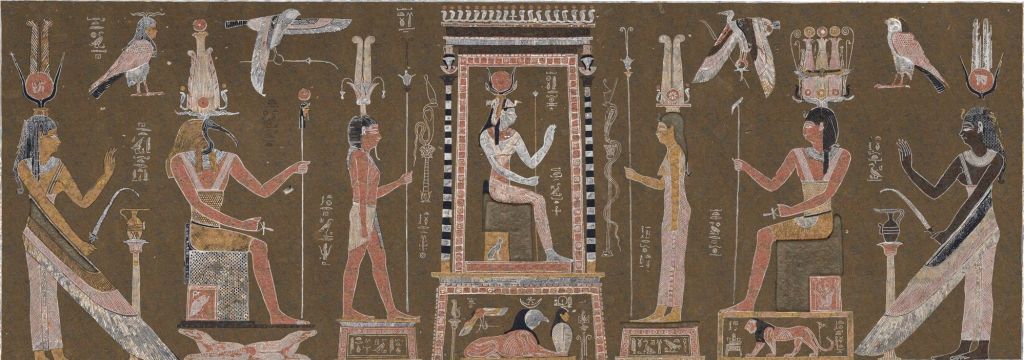
Frontpiece of the oldest known treatise on the Mensa Isiaca; first edition 1605; Lorenzo put himself in the picture as the artist/scholar Part 2 A Mysterious Artifact At about the time we first hea […]
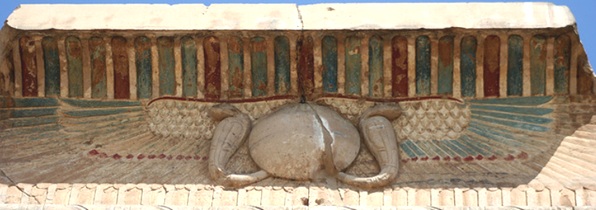
Wherever you see an image of the winged disk you are looking at Horus Behdety, a totally separate entity to the Sun. Horus sky god “He above. […]
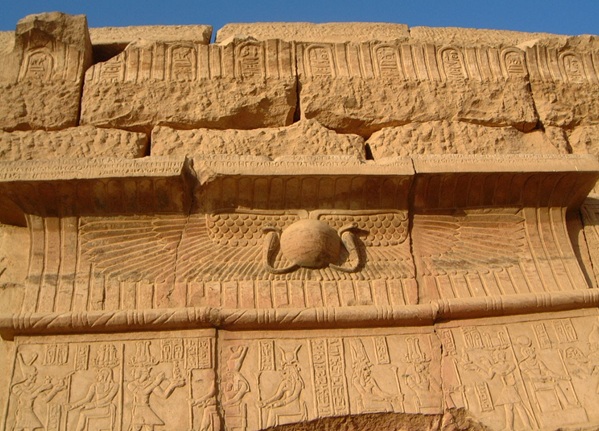
Source: Horus Behdety – The Winged Disk (Horus Gods – Part 3 of 3) – The God King Scenario
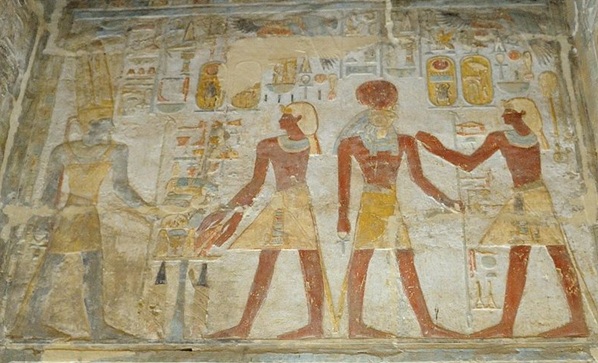
Re Horus of the horizons, Re-Horakhty, or even “Horus (who is) Re of the Horizons.” Re-Horakhty was a ‘living image of Re.’ […]
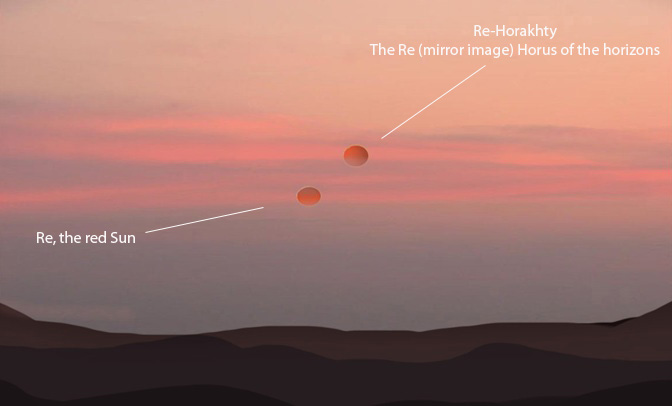
Source: Re-Horakhty (Horus Gods – Part 2 of 3) – The God King Scenario
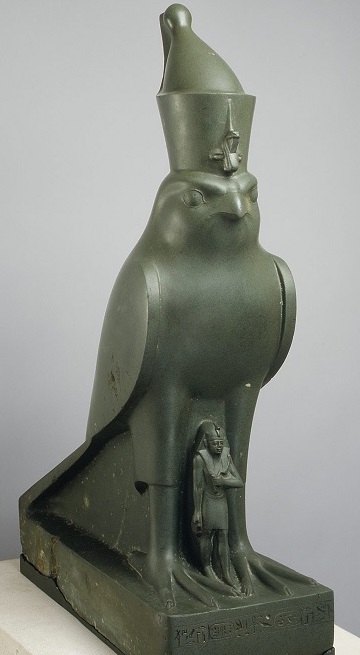
It will be shown how Horus was essentially an omnipresent sky deity whose physical form was above all manifest in the god king planets. […]
Source: The Egyptian Sky God Horus. Part 1 of 3. – The God King Scenario
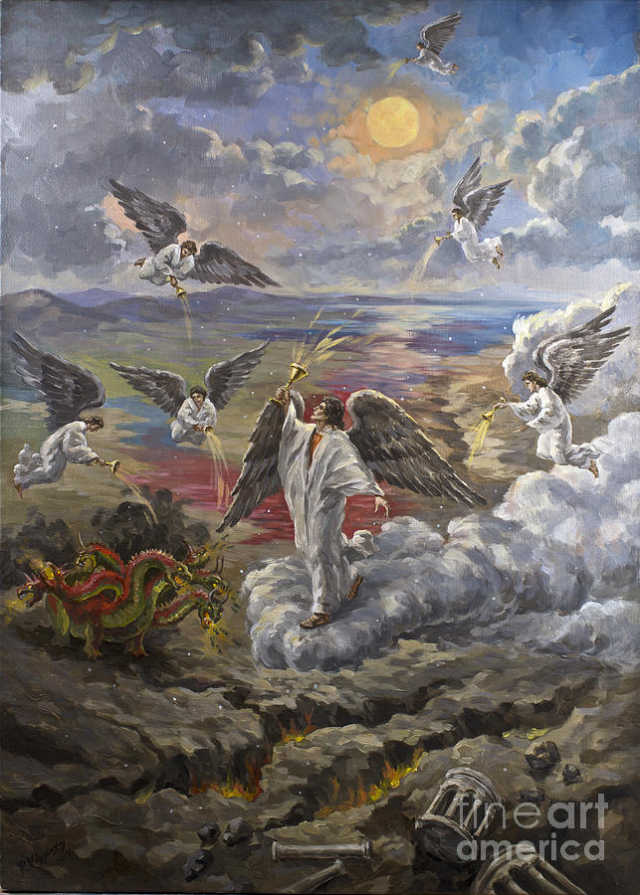
“These are the names of the seven overseers who sit upon (the) seven thrones: the name of the first is ‘WRPNY’L, and the name of the second is TYGRH, and the name of the third is […]
Many an unlettered man, in the words of the poet, is a mute, inglorious Milton, unknown, unnoticed by other men, and, like Markham’s man with a hoe, conveys through his eyes the sad awareness that this is an old story that includes all beings and will persist far into the future. For the pseudo-sophisticated intellectual classes to see as much would be extremely difficult. People for whom there is very little else can sustain the awareness of some fundamental truth. To be able to do this self-consciously within a process of growth is extraordinarily elusive for a man burdened with the mental complexities of contemporary civilization, because he cannot ascend to universal brotherhood except very partially, intermittently and, alas, defensively.
To make reincarnation a vital truth in one’s personal life is to treat each day as an incarnation, to greet every person as an immortal soul, inwardly and in silence, and to empathize with every human failure as a limitation — an effect with causes — comparable to all other limitations. It is the ability to see, even in the longing of the person who is almost totally lost, that spark of the Divine which could eventually be fanned into the flame of the cosmic and compassionate fire of wisdom of the Buddhas and Bodhisattvas. It is an old tradition in the East that those who truly know of the immortality of the soul can only say, “Thus have I heard.”
Why is there no immortality for what we call the ‘personality,’ the particular mask that we wear, through which we appear to other people to be someone with a name and a form, a recognizable identity? However glorious the aggrandizement of personal selfhood may seem in a Nietzschean sense, it is still something that limits and is limited, and hence must participate in finitude and mortality. To wish immortality for that which is visibly mortal, for a mind which is like a cobweb of confusing conceptions, is at best a compensatory illusion. Ultimately, it is a sign of weakness. But the Great Teachers did not come to tell man what he already knows — that there are limitations. They came to tell him that beyond these limitations he could be free. Buddha declared: “Know ye who suffer, ye suffer from yourselves. None else compels that ye are caught in this Wheel of Life.” When Jesus spoke of the weakness of the flesh, he also intimated that the spirit is free, that it is the source of will, and that when it is truly willing, it is immortally free.
It is only by reinforcing a weaker side of our own nature that we could project from a limited view of ourselves a confused picture of personal immortality. Despite all the self-advertisements of the age, hardly any man can do full justice to himself. A man who is loudly making the case for himself is all too often belittling himself. Even the finest self-images have some illusion built into them, and to extrapolate them into the future and into the past is to limit oneself unduly. The notion of personal immortality becomes extremely degrading in a universe of law, where everything experienced by consciousness is connected, in the course of time, with everything that follows it. If a person, early or late in life, uses the doctrine of rebirth, or some notion of personal immortality, as a crutch to cling to, physical death may well be succeeded by a dreamy state of illusory happiness after a period of purgatorial separation from all the excrescences of the life just lived. Then he will have to come back, and alas, in so doing, as Plato suggests in the Myth of Er, he may choose the very opposite of what he seeks. A person who mistakes the external tokens of the good, the true and the beautiful for the transcendental Agathon may well find himself drawn, even propelled, into an environment where he is punished by getting what he wants.
What we need is metanoia, a fundamental breakthrough in consciousness. Otherwise the notion of immortality avails us naught. Many Theosophists of every sort hold to reincarnation as a dogma rather than as a basis for meditation. It cannot help unless a man can really come to see that it is a fact in Nature — a law of life in a universe of cyclic processes — and can live by that law increasingly. He can recognize mistakes, and through repeated self-correction, open new vistas. He may make existential affirmations of perfectibility — which must be on behalf of all if they are to be authentic — and give everyone he meets something of the taste of true optimism in regard to the future. Unless a person can do these things, even if he speaks the language of impersonal immortality, still it would be nothing but a projection of a personal conception of immortality.
The teaching of the Mahatmas is utterly uncompromising on such matters. For the personal consciousness there can be no immortality, while for the indwelling soul, for the individual ray of the overbrooding Atman, immortality is a fact. For the mediating mind of the middle, immortality has to be won, to be earned, and is neither a gift nor a fact. The mind must progressively detach itself from its external vestures, like a musician who goes beyond worship of his instrument or of his fingers moving on the instrument or of his own self-image, and is merged into something beyond all recorded music, into a reverence for the inaudible music of the spheres. Until a man can do this self-consciously as a soul (and he cannot do it without pain and thoroughness if he is to be honest with himself), immortality for him will be merely a compensatory myth. It will not carry that conviction with which alone he could lighten the loads of others and, through eyes of love, make many lives more meaningful.
Raghavan Iyer
The Gupta Vidya II

Every man’s soul has by the law of his birth been a spectator of eternal truth, or it would never have passed into this our mortal frame, yet still it is no easy matter for all to be reminded of their past by their present existence.
PLATO
While we may know about the long and complex history of the doctrine of reincarnation, the crisis of our time is such that the response of thinking men and women is and should be, “How does it help me? What difference could it make to my life?” In the Bhagavad Gita Lord Krishna, speaking as the Logos in the cosmos, but also as the hidden god in every man, makes a supreme, unqualified affirmation. Like similar utterances in the great scriptures of the world, the words of Krishna have a ring of self-certification. He simply affirms for all men that there is an inexhaustible, inconsumable, incorruptible, indestructible, beginningless and endless spirit that is the sovereign ruler within the temple of the human body. Yet the same Krishna, having made this affirmation, ends his speech by asking Arjuna to recognize the honest position of the finite mind of the ordinary man by saying, “The antenatal state of beings is unknown; the middle state is evident; and their state after death is not to be discovered.”
Any human being must recognize that, in so far as his mind is a bundle of borrowed conceptions — because he has grown up conditioned and circumscribed by the limiting factors of heredity, family, education and the social environment — he cannot do any more at first than come with pain to the point of declaring with profound honesty, “I really do not know. I do not know about evil. I have no idea of many things that happened to me earlier in this life. I have no idea of what will happen to me tomorrow, next year, let alone after the moment of death.” This could give integrity to the quest. At the same time, when a human being begins at the level of categories and concepts, he also knows that there is something unspoken about his particular life — his tears, his thoughts, his deepest feelings, his loves and longings, his failures and frustrations, his invisible, hidden determination to hold fast in times of trial, to triumph over obstacles that seem forbidding. Beyond all of these there is that secret of his own soul which he cannot share with anyone else or even bring to the level of human speech. He knows that there is a depth and dimension to his own experience as a conscious sentient being which can participate in the transcendental wonder of the world, which can be aroused to depths and to heights and to a tremendous breadth of cosmic vision when looking at awesome vistas in nature or when surveying the great epochs of human history. But at the same time this secret cannot be conveyed. It cannot be demonstrated or fitted into the workaday categories and concepts needed to survive in a world of psychological limitation and scarcity.
The problem is one of translation. Seen philosophically, if we assume that there is something prior to be translated into something else that is shareable, it is a problem of self-discovery. It involves integrating the potential, intermittently intimated in our consciousness, with the actual which is a story that could be streamlined and which any Hollywood scriptwriter could convert into a celluloid version, a banal sequence of scenes. There must be something between our inchoate intuition of the inexhaustible and our painful recognition of the factuality of the temporally finite sequence that seems to string these events together. Memories clutter the mind. We look back with regrets or look forward with hopes, with longings that may be vain and ineffectual or may be impossible to share with anyone else.
What is self-validating for a Krishna or for the immortal spirit of man can only become a supreme and total fact for a human being when he has begun to strip away the layers and vestures of consciousness through which he is bound. In a Wordsworthian sense, every child is crowned by the aura of the divine, and has in his eyes some recognition of having lived before, some glint of an ancient wisdom distilled into the very essence of his response to the furniture of the world. Yet every human being, growing out of the child-state, loses those intimations. How are we to recover them compatibly with the integrity and self-consciousness that we must bring to every level and aspect of our human experience? This necessitates further work upon the whole of one’s nature. Where we do not know, we may discard the dogmas that claim to know. There are those which insist that man is merely a fortuitous concurrence of atoms — in the name of a science which would be disowned by the greatest, most agnostic and creative scientific thinkers. There is the dogma derived from religion that man is a soul created by an anthropomorphic being at a certain point of time and consigned to eternal hell or heaven, and there are other corruptions of thought such as transmigration into animal form.
When a person discards dogmas and starts with the standpoint of genuine unknowingness, combined with a willingness to learn, he has taken a stand that is truly individual, yet within the context of all mankind. Then, as he works upon himself, he must find out what is unique and gives continuity to himself. At the same time, further growth in this quest will only be possible when he can truly dissolve the sense of separateness between himself and other beings. When the barriers fall away, his love can become almost limitless in scope. He can feel the pain in every human heart and enjoy the world through the eyes of every human being. Clearly, this cannot be done by a person except at some specific level and cannot be done totally within any short-term curve of growth. We would need a number of births to attain that degree of universalization wherein we could merge the universal and the individual and also maintain stasis throughout the different levels on which we have to communicate with widening or narrowing circles of human beings. In that sense, what is self-validating at one level could only become wholly valid and be a fully embodied truth when one’s whole life revolves around it.
Raghavan Iyer
The Gupta Vidya II

This work is by Ludovic Pinelli; you can purchase a print here. To Isis, a VeilEn Iset, Behen This is a gift I bring before Isis the Hidden One, Who, Revealing Herself, Shakes Destiny: an invocatio[…] …
Source: The Veil of Isis
 Grand Temple of Horus Behdety