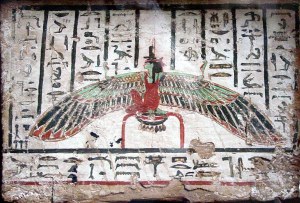
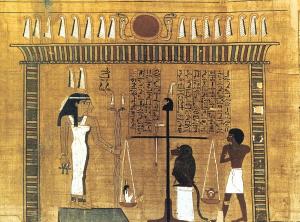
Isis, too, is associated with these ideals and sometimes Ma’at is assimilated with Isis. The Osirian Hall of Judgment is also known as the Hall of the Two Truths. Twin Goddesses, the Ma’ati (…)
Source: Isis-Ma’at, Lady of Truth

Isis, too, is associated with these ideals and sometimes Ma’at is assimilated with Isis. The Osirian Hall of Judgment is also known as the Hall of the Two Truths. Twin Goddesses, the Ma’ati (…)
Source: Isis-Ma’at, Lady of Truth

“The native rulers fled abroad in the episode known as the Flight of the Earls but, as with all the major Irish kingships, the line of descent continues into the present day.” […]
Source: https://gnosticwarrior.com/irish-tyre.html

Writing is generally agreed to be among the greatest inventions in human history, perhaps the greatest invention, since it made history possible.
You can read more about Irving’s quest to explore the Noah’s Ark myth in “The Ark Before Noah: Decoding the Story of the Flood”: https://geni.us/zU95bVO or learn more about cuneiform writing in “Cuneiform”: https://geni.us/eMPb
Writing seems to have been invented in the late fourth millennium BC in Mesopotamia in the form of wedge-shaped marks pressed into soft clay with a reed stylus: the script known as cuneiform. Through his work on this ancient language, Irving Finkel, has uncovered amazing secrets from over five thousand years ago, including the story behind Noah’s ark.
Irving Finkel is the curator in charge of cuneiform inscriptions on tablets of clay from ancient Mesopotamia at the British Museum, of which the Middle East Department has the largest collection of any modern museum. This work involves reading and translating all sorts of inscriptions, sometimes working on ancient archives to identify manuscripts that belong together, or even join to one another. He is the author of The Ark Before Noah: Decoding the Story of the Flood.
This talk was filmed in The Royal Institution on 18 January 2019.
GUIDED SEVEN SACRED FLAMES MEDITATION.
The Flame of Illumination and Wisdom. Embark on a journey and allow your consciousness to take you to The IlluminationTemple in Telos, Lemurian City of Light, http://www.lemurianconnection.com/ beneath Mount Shasta, CA, guided by Lord Lanto and Adama, High Priest of Telos.
Immerse yourself in the Second Ray energies and the guides that greet you there. Healing, connecting to the mind of God. Peaceful. A Rejuvenating meditation assisting you on your spiritual journey back to yourself.

The 1975 cycle will continue to precipitate momentous choices for individuals and societies. What are the vital elements in this decisive choosing, and what will be the chief consequences? There is in the life of every human being a series of minor choices which add up to a crucial choice, but often it is made with incomplete knowledge of its critical nature. To grow and to age is to recognize with increasing clarity that all events in the past have had their irreversible consequences. Therefore, within any shallow philosophy centered essentially on the physical body and premised upon a single incarnation, a personal sense of futility and fatalism looms large as one comes closer to the moment of death. As with individuals, so with civilizations. Civilizations are apt to conduct the deepest reflection upon their storied past in times of depression, either out of self-indulgent nostalgia or sheer bewilderment at their bygone glory. This has shadowed every great civilization in its hour of decline, and today we are witnessing this in Western Europe and in the nostalgic mood which is intermittent in the United States. Civilizations seek to cling to something of the past, and perceptive chroniclers like Toynbee in England or Jaspers in Switzerland sense that something went wrong as early as before 1914, that the seeds of today’s malaise lay far back in the past. When we look back to that past we surmise that a lot could have been avoided, that there were viable alternatives and missed opportunities. This is the sad state of societies as well as individuals who, because of narrowness of perspective and myopia in relation to the future, impose upon their lives a delusive dependence upon their own edited versions of a truncated past. But whenever human beings are willing to rethink their basic assumptions about themselves, about their shrouded past and about their cloudy future, then they do not need to edit. They do not have to limit unduly the horizon of their gaze.
This is difficult to understand initially. One might think in terms of the extreme example of a person with Promethean foresight who can discern in the cycles of this century long-term factors that go back a thousand years into the past and will go forward a thousand years into the future. In the Victorian Age, T.H. Huxley observed that in the myriad worlds around us there is no reason why there cannot be beings with an intelligence as far beyond our present level as ours is beyond that of the black beetle, and with a control over nature as far beyond our own as ours is beyond that of the snail. He also suggested that even ordinary human beings can look back and forward over a millennium and make broad projections. It is, in principle, possible for there to be beings in the universe who can see all pasts and all futures. The power of choice is partly a function of the scope of perspective. With wider perspectives our choices become more intelligent, but as they become more informed, we readily recognize that there are many factors that are constant. One cannot wish away causes generated over a long cycle. The more clearly a person sees what he cannot alter right now in this incarnation, the more effectively he can use his energies to alter what he can. All this requires a measure of balance, but most human beings are unable to choose wisely by clearly facing the alternatives before them. All too often they vainly hope that by proceeding in one direction, everything else will automatically come to them. Energy cannot move in all directions at once, and though there are many planes of matter, it is always the case that everything adds up in a mathematical universe. One’s capacity to choose is a function of one’s knowledge, not merely of particular causal chains but also of what is at the very core of the phenomenal process of becoming: breathing in and breathing out. Ideally, if one could comprehend the meaning of a single day, one would by analogy be able to understand what is enacted over a lifetime.
It has been taught that for the truly wise, each day is like a new incarnation. In small space they see the subtle motions of unbounded space. In a single moment they can grasp quintessentially the infinite possibilities that are spread out in eternal duration. They can retain in consciousness the freedom that belongs to those who are not rushing to manifest, while displaying a shrewd awareness of what it is possible to manifest with a due respect for the feelings of others, for collective strengths and weaknesses, for the limits and possibilities of the current cycle. Theosophical teaching offers the vast perspective of eighteen million years of human history and also of the sixth sub-race which will emerge far in the future but which must clearly have some relationship to the fifth sub-race – now visibly on the decline – that flowered forth in Europe and partly in America. At this point of time there is, by analogy and correspondence, a critical moment of choice bearing upon the alternatives that confront our intelligence. The ratiocinative mind has become adept, because of modern upbringing and so-called education, because of so much dichotomous thinking since Aristotle, at rationalizing its wants, desires and limitations. Now we find at a global level the logical limit of this rationalizing mind, which insists there is not enough room or food on earth for all human beings on our globe. This no-exit barrier in thinking arises because of assumptions that were too limited from the start. It hinges upon a view of the universe which is incompatible with the vast resources of the creative imagination, with the inventiveness displayed in the last three centuries in building up the structures of applied science and sophisticated civilization. Even this is merely a recent example of the immense resourcefulness of the human race over many millennia. The type of thinking which is inductive, inferential and dichotomous, functioning within the perspective of a closed universe or of a one-life system, has become sterile and has no real answers to the awesome problems of our time.
Hermes, August 1978
Raghavan Iyer

Against this, however, we have the tremendous affirmation through the supreme negation of Sri Shankaracharya.
The individual who knows that at the root is the persisting illusion of separateness, is vaster than the universe, and can dissolve it instantly by breaking down at will the baseless, insubstantial fabric of his imagination. Anyone who can do that has begun to wake up. There are people who will not wake up voluntarily because they repeatedly fell asleep during eighteen million years and are now frightened to settle accounts. They are themselves negated by suffering which comes as healing compassion, and are negated by others in the course of intolerable inhuman encounter. Self-negation is shown by the timeless religion of responsibility and the hidden science of divine wisdom. The invisible sun in every man as the Atman, the spectator, ever radiates endless energy for the sake of all. According to this teaching, darkness is prior to what we call light; glamour or unwisdom is beginningless. It is what the ancients called Chaos, Gaia, or Mahamaya. There is a chaos prior to any cosmos. There are many myriads of systems, galaxies and galactic clusters in the vast spaces of the heavens, but if there were no primordial chaos one would be forever trapped within the same universe. Before Adam was Chaos, the primordial matter, in which is hidden the light that is the soundless sound. In the beginning was the Word. Primordial chaos is necessary for the universe, but whether we think it necessary or not, we have no choice. We are caught. We can get out, because we have in us the light that was hidden in the darkness, which lighteth up every man who comes into the world.
The Crest Jewel of Wisdom speaks only to those who are prepared to negate the world of appearances:
Gaining at length human life, hard to win, and manhood, and an understanding of the revealed teachings, he who strives not for liberation in the Divine Self, deluded in heart, self-destroying, slays himself through grasping at the unreal. who, then, is the very self of folly but he who, deluded, follows selfish purposes, after he had gained a human body and manhood hard to win? Even though they recite the scriptures, and sacrifice to the gods, and fulfill all works, and worship the divinities – without awakening to the unity of the Divine Self, liberation is not attained even in a hundred aeons.
From the standpoint of the sage, the innumerable ways in which human beings are enmeshed in the Mahamaya are not very interesting. The sage can recognize anyone who is fully awake behind a semi-sleepy projection. Those who really want to emerge from behind the false personal mask will receive what they deserve in mathematically exact proportion. This is a truth about consciousness on all planes. One must deserve to go beyond all the external forms and modes and, through the eternal soul-memory now awakened of the soundless sound behind the great vibrations of the universe, to light up in the lower mind a self-conscious reflection of the invisible sun that overbroods the egg.
Albert Einstein said there are no hitching posts in the universe. There are no boundaries except arbitrary and conventional ones assigned by human beings who happen to think that they occupy a fixed point of space and time, when in fact space is curved and time is relative. They do not understand the inner meaning of spatial coordinates and of clocktime. Although there are no hitching posts, there are innumerable hooking points. When people really begin to enjoy the thought that at any point of space-time they could break out of the boundedness of the universe, they can experience through self-knowledge what they have forgotten. The ancients taught that God is a circle with its centre everywhere and circumference nowhere. Human beings can find in the inmost depths of abstract meditation an active centre of intense, motionless, joyous consciousness. Abiding in universal welfare and doing nothing, as beings of light they enjoy pure unmoving spiritual will in, through and independently of, all material vestures. Even if we somewhat understand all of this, it is still very difficult to light the lamp of discernment. The moment we think, “Let me do this,” “May I be that,” we only create karma and imprison ourselves. But the moment we say, “Let me begin,” and also recognize that there is a chaos we cannot explain and that there are no hitching posts, then we begin like true pilgrims to walk along the Path. It leads to invisible summits lost in glorious Nirvanic light which may be glimpsed from foothills and mountains arduously climbed in cheerful enjoyment, although one is aware of the many pitfalls on the way. The only hooking points are found within. They form the seven-knotted bamboo staff of the ascetic. If you were a montagnard you would cherish the serene strength of the individual and know what the communards forget, that communities are doomed to fail from the start when men are afraid to be alone. At the same time, if a human being in distress came for help, the montagnard will take care of him and then return to solitude.
The soul is ensnared through the power of misidentification in the chaos of primordial matter. If we enjoy narcissistically the illusions of the ever-changing reflective soul, then we forget the light of divine discernment, the Sleeping Beauty in the castle. She can only be awakened by Prince Charming, the androgynous manas, the power of noetic thought, ideation and imagination. Real thinking has a self-sustaining quality determined by the grasp, the vision, the scope and the strength of the universal ideas that provide mental nourishment. When one truly begins to walk the inner Path, one does not need any reference point in external space and time, and can see the moment of birth as if it were this morning’s dawn and can see the moment of death as if it were this evening’s twilight. Thousands of previous lives seem like twinkling stars in the sky.
The real Gurus who truly know teach just by being themselves. They are self-existing, self-manifesting embodiments of the wisdom of compassion, crowned with the Crest Jewel of pure insight. Their very existence is testimony. Shankara spoke to disciples who were already free from the delusion of the personal “I” but who were stuck in the illusion of the individual “I.” His teaching is not about the hereafter, not about the now and then, not about the always and everywhere, but about That. The supreme affirmation is TAT TVAM ASI – That Thou Art. That is the oldest teaching which Shankara explained by reference to reason, to experience, to states of consciousness, to vestures of matter in the five-fold classification, and also by references to madmen, yogis and free men. Universal self-awareness is the potential privilege and birthright of every human being, but no one can attain to it except by fulfilling the qualifications, embodying the conditions that approximate the posture and the position of a true learner.
The Crest Jewel could be in your hands. Use it, Shankara says, because by use you make it sufficiently your own to recognize that the greatest lies are “I” and “thou.” All amounts to an “it” and “it” equals That. That equals zero. Your sphere becomes luminous when you wholly adopt the standpoint of the Logos in the cosmos, the God in man, and then enjoy the universe through every pair of eyes. Heal yourself, and others through yourself, by luminous thoughts and adamantine compassion.
Hermes, August 1977
Raghavan Iyer
To affirm is to deny. It is obvious that we do this always, but we periodically forget because of narrowing our focus to what we affirm in the language of perceived objects and in terms of the illusive independent existence of a particular set of subjects who see those objects. We fashion a pseudo-system. The universe is boundless, birthless and partless. Both within and beyond visible space and in eternal motion within endless duration, going through apparent vicissitudes like the waxing and waning of the moon or the rise and fall of the tides, through cyclical and cosmically precise changes, human beings have the privilege of exercising the deific power of creative imagination. At the highest level conceivable to a finite mind caught up within the prison of the personality, imagination is ceaselessly enjoying the universe, for example, the play of light and shade upon the green leaves of summer. If we say that there is also continuous negation, we are correct because chlorophyll is gradually negated, and thereby the leaves turn yellow. Thus we know that spring and summer must be followed by autumn. Human beings, however, sometimes forsake these primal facts because they prefer convenient fictions which involve false affirmations.
There is the false affirmation that a whole lot of bodies are in existence today. Do the bodies say so, and if so, how do they know? Apparently they are supposed to have minds, but what is a mind and what is the evidence that bodies have minds? We entertain opinions about these matters, but are opinions the same as ideas and are ideas the efflux of fluctuating moods? Is that the same as thinking, the activity of a Thoreau in the woods and an Emerson in his study? Questions of this kind are deeply troublesome and difficult. Therefore, Sri Shankaracharya states that before you can begin to deserve the Crest Jewel, which is in the crest above the forehead of the human body, the regal gem of pure discernment and spiritual wakefulness, and before you can benefit by it in the three states of consciousness – waking, dreaming and dreamlessness – you must recognize that at the root you have made a false identification. Without knowing it, you have engaged in falsehoods to which you were invulnerable before you learned to walk, before you learned to identify with the body that stumbles and before you learned to talk, to repeat sounds associated by other people with sense-objects. You started to slip into a stupor, and began to live an increasingly unreal existence, mostly reinforcing your sense of unreality but insisting it was the only reality – thereby showing that it was not real to you – against other people’s conceptions of reality. Therefore, that compassionate teacher Sri Shankaracharya states that we must get to the root and core of illusion.
What is the root? We are told that the Crest Jewel is that which causes all our problems but which also is their cure. The Crest Jewel represents the fundamental affirmation that two habitual negatives make a higher-order affirmation. On the one hand, there is a false negation in the notion of reality attached to the apparent freedom of all seemingly separate subjects, and the resulting glamour of the false shadow-play created by supposedly separate selves. On the other hand, there is also the notion of a plurality of separate objects, constituting a false negation of the one homogeneous substance or root-matter which is of the quality of pure primordial light and remains undivided and untransformed. All the various collocations of atoms, in seemingly fortuitous movement, whirl and revolve around invisible centres which are seemingly separate points in one homogeneous universal region, giving rise to the falsehood that there are separate objects. These two false negations have been marked out in the great teaching of the Guru.
Sri Shankara begins the text by saying there are three things extremely difficult to have. One is manhood. The second is the longing for liberation. The third is access to Masters. Without the second the third is impossible and the first is useless. If one wants access to Masters, one has to long sufficiently for liberation. One has to want sufficiently, with the whole of one’s being, to become free from the massive burden of inane repetitions that we call life and the impossibility of making it meaningful with the help of borrowed, lifeless and bloodless categories that wear masks and don caps and engage in a perpetual pantomime play called living. Shankara says that there is nothing new under the sun, that it is all the same old story. One might say it began with thinking man, but it really began when man stopped thinking. As a result, a huge rigamarole emerged which men then packaged and called recorded history.
History represents in recent centuries a harsh but also a necessary negation of the absurdities, errors and illusions of the past. When that happens with so many minds, when so many wills are blunted, hearts hurt and human beings lamed and crippled, suddenly we know that springtime is near. The Golden Age is next door. Suddenly we realize what we always might have known – that there are children in this world, that other people exist, that while ten men are gloomy there are another hundred who are happy. Those who are engrossed in being happy do not go around certifying their happiness to the gloomy. The gloomy want certainty, but there is no certitude to be attained anywhere in the realm of differentiation. This is a philosophical truth which everyone knew as a little child. The intuitive negation of childhood, a beautiful sharing with no “mine” and “thine,” was followed by cruel adolescent affirmations which are intensely ugly especially to others and sometimes to oneself. Then came the prolonged adolescence of those who are petrified that they might actually have to assume minimal responsibilities. But when men will not negate, Nature negates. Nature’s power of negation is vaster than the collective power of negation of history, and both seem more awesome and decisive than the capacity of an individual to negate.
Hermes, August 1977
Raghavan Iyer
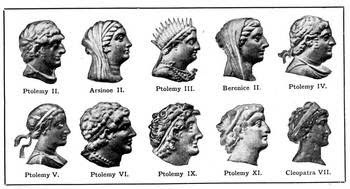
The succession of the Ptolemaic Dynasty, from Ptolemy to Cleopatra.
The Ptolemaic Dynasty of Egypt is a unique reference point in classical history. Most notably, our very notion of classical wisdom itself largely depends on this period, insofar as it played a role in the documentation, preservation, and accumulation of the wisdom of the Greek world. It was a singular cultural epoch that sprang up into its own golden age, flourishing for a time, followed by rapid decline and acquiescence to Rome. Egypt was ruled for roughly three hundred years under Ptolemies (from 323 BC to 30 BC), ending with the death of Cleopatra.
As a civilization it was a relatively rare example of a largely tranquil symbiosis; where the philosophical ideas of a Greek ruling class took fertile root in an Egyptian culture—a culture already at that time considered impossibly ancient. The particular Ptolemaic world view which rooted and ripened in that immortal Nile valley soil gave classical history three hundred years of highly innovative, self-actuated, archaic-romantic civilization. The Greek rulers were as much influenced and altered by that eldritch land of ancient gods as the land was by them.
Most notably, this vibrant community led to the creation of the most important place of learning and wisdom in the ancient world. Perhaps ever. The much celebrated and lamented Library of Alexandria.
Its history began with the god-like Macedonian conqueror Alexander The Great, who overtook Egypt in 332 BC. He was regarded there as a liberator from the Persian oppression of the Achaemenid Empire (Artaxerxes III). Alexander was afterward crowned Pharaoh. To the Egyptians, pharaohs were the divine link between gods and men, who ascended to godhood in death. The Great Alexander, in turn, secured his own Egyptian godhood by consulting the Oracle of Siwa Oasis, who declared him a son of the god Ammon. From that point on, Alexander considered and referred to himself the son of Zeus-Ammon.
It is reported that Alexander, while dreaming, asked Ammon what he was to do. The god responded to him saying that his destiny in Egypt was to found an illustrious city at the site of the island of Pharos. This the great conqueror set forth to do, and this was henceforth to be named after him: the city of Alexandria.
But Alexander left Egypt before the city was built and never had a chance to return, dying soon after in 323 BC.
After his death, one of Alexander’s somatophylakes, the historian Ptolemy, was appointed satrap of Egypt. Soon after he declared himself pharaoh Ptolemy Soter I (soter meaning saviour). Ptolemy and his descendants adopted Egyptian customs, including religion, and had themselves portrayed sculpturally in Egyptian style. They built magnificent new temples in honor of ancient Egyptian deities and adopted the monarchic system of dynastic pharaohs. This was not unusual, as the Greeks from the onset had revered Egypt and it’s magnificent longevity, and within a hundred years they had developed a new Greco-Egyptian educated middle class.
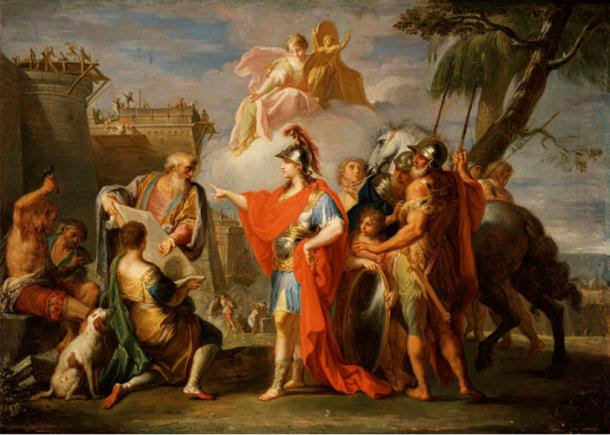
Alexander the Great founding Alexandria, Placido Costanzi (Italy, 1702-1759)
Ptolemy I Soter also went so far as to create new gods in order to unite his plural populace. Serapis was one such God, a combination of two Egyptian gods: Apis and Osiris. Additionally, Serapis combined elements of the main Greek gods: Zeus, Hades, Asklepios, Dionysos, and Helios, as well as influence from many other cults. Serapis had powers over fertility, the sun, funerary rites, and medicine, and included the worship of the new Ptolemaic line of pharaohs. To him they built the enormous Serapeum of Alexandria. Ptolemy I also promoted the cult of the deified Alexander, who became the state god of the Ptolemaic kingdom. This was a time when mortal men of sufficient influence really could become gods. Also in homage to the aims of Alexander, Ptolemy soon proclaimed the port city of Alexandria as the new capital of Egypt.
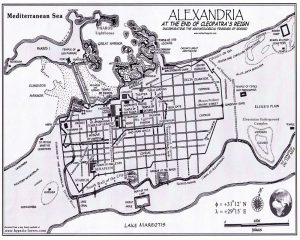
A map of Alexandria at the end of Cleopatra’s reign.
Fortunately, Ptolemy’s desire was to continue the work of his former master, which was to spread Hellenistic culture and Greek wisdom concepts throughout the known world. Where the Greeks had conquered, gymnasiums and libraries were erected. And libraries in particular enhanced a city’s reputation, attracted scholars, and augmented the available intellectual assets of a kingdom.
Any kingdom or nation faces threats to its existence. For Ptolemy the primary hazard came from his former comrades, the somatophylakes of Alexander who themselves had been granted rulers of surrounding satrapies. Each new kingdom which sprung up in the wake of one of the world’s greatest conquerors were thus set in competition against one other.
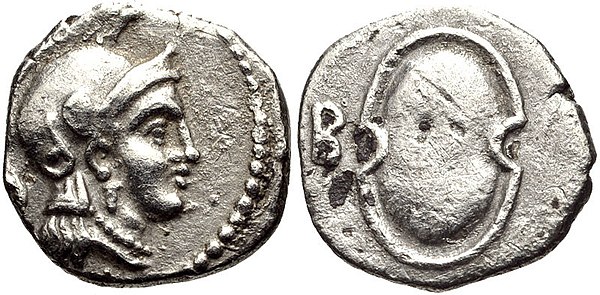
Coin of Balacrus, somatophylakes of Alexander, as Satrap of Cilicia, with letter “B” next to the shield, standing for B[AΛAKPOI],
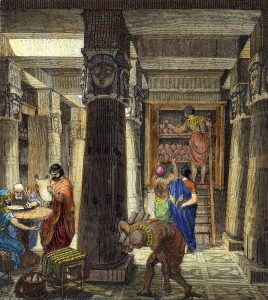
Artistic Rendering of the Library of Alexandria, based on some archaeological evidence.

An illustration of Ptolemy holding a cross-staff, published in Les vrais portraits et vies des hommes illustres (1584). Image by © Bettmann/CORBIS.
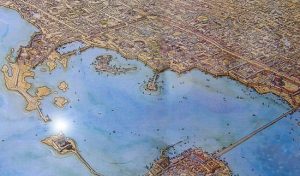
Artist’s Impression of Ancient Alexandria.
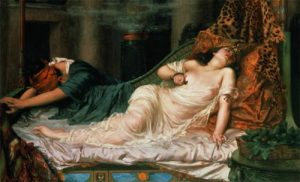
The Death of Cleopatra by Reginald Arthur, 1892. (Public Domain).
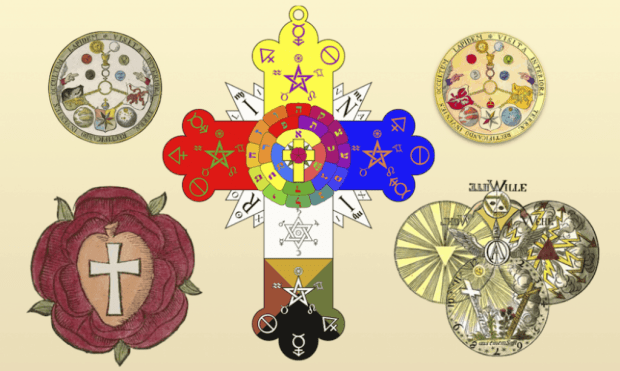
Centuries ago, Rosicrucians formed secret societies to avoid persecution for their diverging views as they carried on traditions of ancient esoteric wisdom.
Source: Rosicrucians: The Ancient and Secret Orders of Mystical Truths

In medieval Irish legends they were called Banduri or Bandorai. Their existence was confirmed by ancient Greek and Roman writers. But who were the legendary female Druids?
Source: Female Druids, the Forgotten Priestesses of the Celts
An open lecture given on the basics of alchemical philosophy and applications. Details on the 3 principles, 4 elements, there internal and external correspondences, the energetic (chakra) centers of man, and the creation of medicines for the body and the mind using alchemical philosophies and operations.
Website: https://www.kymiaarts.com
Facebook: https://www.facebook.com/kymiaarts/
Instagram: https://www.instagram.com/kymiaarts/
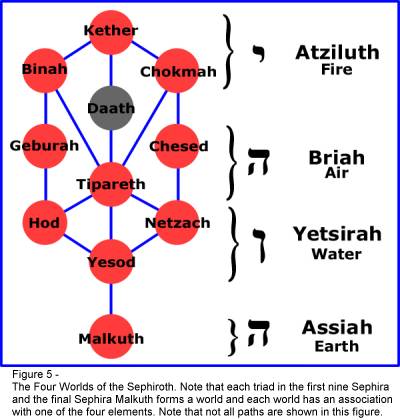
The Tetractys and the Sephiroth represent similar concepts; however the link between these two concepts would not be readily apparent were it not for their common use of the Tetragrammaton. The Tetagrammaton serves as a bridge between these concepts which span time, culture (Greek and Hebrew), and multiple Masonic rites and rituals. This paper discusses the Tetragrammaton, the Tetractys, and the Sephiroth and shows how the three are related. […]
Source: http://rosacruzes.blogspot.com/2009/02/tetragrammaton.html
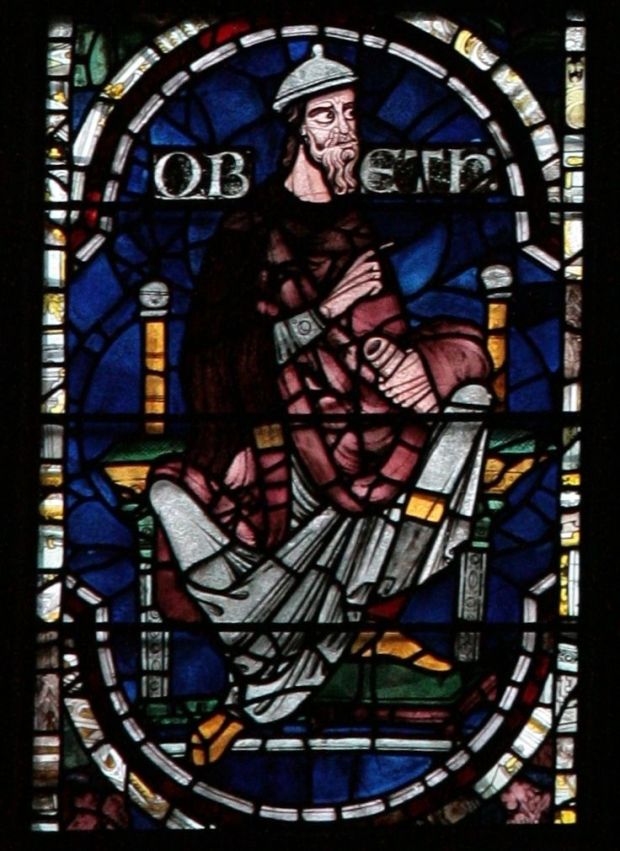
In the Ancient Craft of Masonry, Hiram is called the architect of the Temple and the Widow’s Son from the tribe of Naphtali who was the son of a Tyrian bronze worker, contracted by Solomon to…
Source: The Widow’s Son

Tat tvam asi
Despite its contempt for metaphysics and for ontology, materialistic science is honeycombed with metaphysical and contradictory implications, and even its “atoms” are “entified abstractions”. “To make of Science an integral whole necessitates, indeed, the study of spiritual and psychic, as well as physical Nature.” But although real science is inadmissible without metaphysics, and those scientists who trespass on the forbidden grounds of metaphysics, who lift the veil of matter and strain their eyes to see beyond, are “wise in their generation”, H.P. Blavatsky declared towards the end of The Secret Doctrine that the man of exact science must realize that
he has no right to trespass on the grounds of metaphysics and psychology. His duty is to verify and to rectify all the facts that fall under his direct observation; to profit by the experiences and mistakes of the Past in endeavouring to trace the working of a certain concatenation of cause and effects, which, but only by its constant and unvarying repetition, may be called A LAW. . . . Any sideway path from this royal road becomes speculation.
The Secret Doctrine, ii 664
It is a sign of advance that scientists today are less given than their predecessors in the latter half of the nineteenth century to “metaphysical flights of fancy”. Bad metaphysics is clearly worse than none. On the other hand, as modern psychology becomes less materialistic and as race evolution proceeds, a greater appreciation of the higher intuitive and cognitive capacities will emerge and may enable the most intuitive scientists to venture more effectively into metaphysics.
It is, therefore, necessary for students of Theosophy to see the fundamental difference between what goes by the name of metaphysics and has rightly become suspect today, and the “metaphysics, pure and simple”, with which The Secret Doctrine is concerned. We cannot, however, grasp the metaphysics given in Theosophical teachings unless we perceive its close and inseparable connection with Theosophical ethics. We are told in The Secret Doctrine that the “highly philosophical and metaphysical Aryans” were the authors of “the most perfect philosophical systems of transcendental psychology” and of “a moral code (Buddhism), proclaimed by Max Müller the most perfect on earth”. Without a proper understanding of Theosophical psychology and the teachings regarding the nature and constitution of man and the working of karmic law, we cannot appreciate the metaphysical basis of Theosophical ethics or the ethical significance of Theosophical metaphysics. Hence the importance of a careful study and application, from the first, of the Ten Items from Isis Unveiled or the Propositions of Oriental Psychology, and of the Aphorisms on Karma by W.Q. Judge. Until this is done, we cannot begin to see the ethical import of the statements in The Secret Doctrine or the metaphysical basis of the statements in The Voice of the Silence and Light on the Path.
We are told explicitly in The Secret Doctrine that “to make the workings of Karma, in the periodical renovations of the Universe, more evident and intelligible to the student when he arrives at the origin and evolution of man, he has now to examine with us the esoteric bearing of the Karmic Cycles upon Universal Ethics”. Our ethical progress depends on an increasing awareness of the “cycles of matter” and the “cycles of spiritual evolution”, and of racial, national and individual cycles. The kernel of Theosophical ethics is contained in the statement that “there are external and internal conditions which affect the determination of our will upon our actions, and it is in our power to follow either of the two”. This contains a great metaphysical and psychological truth, which is illuminated by the seminal article on “Psychic and Noetic Action”, written, late in life, by H.P. Blavatsky, the Magus-Teacher of the 1875 cycle.
Theosophical ethics is in the end no easier to understand properly than Theosophical metaphysics. It can no more be grasped by the mentally lazy than Theosophical metaphysics can be comprehended by the morally obtuse. There is nothing namby-pamby about Theosophical ethics and it is as fundamentally different from conventional ethics as Theosophical metaphysics is from conventional metaphysics. Just as modern metaphysics is a shadowy distortion of archaic metaphysics, modern ethics is a sad vulgarization of the archaic ethics taught by the early religious Teachers of humanity. It is to be welcomed that more and more questioning people today are less and less prepared to accept blindly conventional ethical codes merely because they are traced back to so-called scriptural revelations, just as they have little use for the metaphysical speculations of even the formidable minds of the past. If the ethical nihilism of today is even more repugnant to the Theosophist than sterile positivism, he would do well to regard both as the karmic price we have to pay for the moral and metaphysical dogmatism of the past.
Although we may talk of Theosophical metaphysics and Theosophical ethics, and classify texts broadly under these heads, we must get beyond the conventional distinction between metaphysical and ethical statements and grasp central concepts, such as Dharma and Karma, which are protean in scope and profound in content, and incapable of being regarded as purely metaphysical or exclusively ethical. It is significant that the supposedly anti-metaphysical and superbly moral teaching of the Buddha was centred in the complex concept of Dharma rather than in Brahman or moksha, in the stern law of moral compensation and universal causality, rather than in a conception of infinite Deity constructed by the finite mind of man or in any notion of salvation or redemption which caters to the spiritual selfishness of the individual.
In the European tradition, a natural reaction to theocentric systems of thought was the Cartesian affirmation of the autonomy of the individual in relation to knowledge and the later Kantian proclamation of the autonomy of the individual in relation to morality. The Theosophist, however, holds to the Pythagorean and ancient Eastern maxim that man is the mirror and microcosm of the macrocosm. It is in this context that he must evolve from egoism to egoity, from personal self-love to individual self-consciousness, which is impossible without a heart-understanding of the Law of Universal Unity and Moral Retribution. The close connection between metaphysics and ethics in Theosophy is ultimately based on the workings of Universal Law, which affects the exact and occult correspondences between the constituents of man and of the cosmos. This ancient doctrine of correspondences has been ignored by modern metaphysicians and moralists, but it was known to modern mystics and poets from Boehme to Swedenborg, Blake to Baudelaire.
Hermes, May 1975
Raghavan Iyer

The Mayan civilization is one of the most mysterious and fascinating in history. There is much we still don’t know, but they are much-admired for their fully developed writing system
Source: El Mirador, ‘The Look Out’ Of Guatemala Boasts Probably the Largest

Tat tvam asi
It is natural for us to make a firm distinction between our study and our application of Theosophy, between theory and practice. As a result, we contrast the capacities of the head and the heart, and assume that we seek and secure different kinds of nourishment from The Secret Doctrine and The Voice of the Silence. At the same time, we also know that Theosophy is essentially the Heart Doctrine, distinct from the head-learning with which our world abounds. What is more, the whole purpose of Theosophical discipline is to blend the head and the heart, to broaden our mental sympathies and to awaken and direct the intelligence of the heart. Does this simply mean that we need for conceptual clarity the dualistic view of the spiritual life as long as we remain as inwardly divided as we are, and that this dichotomy is made only so that it may be destroyed as we become rooted in the holiness that reflects an inner wholeness? It is certainly convenient to regard all conceptual distinctions and classifications as mere scaffoldings and to choose the best available at any particular stage of our growth. But in order to appreciate the distinctive significance of Theosophical classifications, we cannot merely regard them like the maps of early mariners, whose explorations needed as well as corrected their initial cartographical knowledge. We need, in fact, to acquire an entirely new and original view of the relation between true metaphysics and enduring ethics and to appreciate the profound epistemological nature and the peculiar therapeutic value of Theosophical statements as indicated in the First Item of The Secret Doctrine.
Metaphysics, as normally understood, is speculative rather than gnostic and is often the product of the propensity to subsume existing knowledge under a complete system, an imposing pattern that is then ascribed to reality with a dogmatism that pretends to a certainty that it cannot possibly possess. It is in accord with cyclic law that this kind of metaphysical system- building is suspect today and has even led to an extremist and naively positivistic reaction among die-hard empiricists. Similarly, ethics, in the everyday sense, consists of injunctions and imperatives that are rarely susceptible of rational enquiry and are either endowed with spurious absoluteness or are regarded as relativist and subjectivist preferences, from which we choose as from a menu. Given the pretentious nature of ordinary metaphysics and conventional ethics, we can understand the insistence of Hume, the sceptical Scot of the eighteenth century, that metaphysical statements are a priori assertions that are incapable of verification, that we cannot logically derive any ethical imperatives either from them or from statements of fact, and that our ethical preferences cannot possess certainty or universality or freedom from arbitrariness. The metaphysical assertion that “X is true or must be true” cannot help us to answer the question “Why ought I to do Y?” It is indeed not surprising that the speculations of most metaphysicians do not give us a basis for moral conduct and moral growth, and that the injunctions of many conventional ethical codes do not have their basis in the moral and spiritual order of our law-governed cosmos.
In Theosophical literature, however, every metaphysical statement has an ethical corollary and connotation, and every ethical injunction has a distinct metaphysical basis. It is impossible to grasp the force of any of the seven paramitas of The Voice of the Silence without a comprehension of the Three Fundamental Propositions regarding God, Nature and Man that underlie the order of reality intimated by the Stanzas of the Book of Dzyan, on which The Secret Doctrine is closely based. Theosophical literature assumes, as shown especially by Light on the Path, the truth and validity of the Socratic axiom “Knowledge is virtue.” For example, to know, with the heart as well as the head, and to be fully aware that the sin and the shame of the world are verily our own must totally transform our actions as well as our attitudes in relation to all our fellow men and also to our own sins and lower self. We cannot rely on that which is not real, in an ultimate and philosophical sense. Theosophical ethics teaches the only possible reliance — on the Divine Ground of all Being and beyond — that is available to those who become aware of the degrees of reality in an ever-evolving universe that is itself only a relatively real emanation from the Eternal Reality. Our conduct consists of emanations that cannot but harm us and others if they are not emanated in the creative and impersonal manner and with the conscious control that marks the ceaseless process of cosmic emanations from a single source — Life of our life, Force of our force. Until we are free from the dire heresy of separateness (attavada), we cannot claim to have grasped the doctrine of samvriti or of the nidanas that teaches us about the origins of delusions and chains of causation. To know is to become, and to become is truly to know.
In an illuminating passage in The Secret Doctrine on the Causes of Existence” and on the Buddhist concept of nidana and the Hindu concept of maya, H.P. Blavatsky said that …
science and religion, in trying to trace back the chain of causes and effects, jump to a condition of mental blankness much more quickly than is necessary, for they ignore the metaphysical abstractions which are the only conceivable cause of physical concretions. These abstractions become more and more concrete as they approach our plane of existence, until finally they phenomenalise in the form of the material Universe, by a process of conversion of metaphysics into physics.
The Secret Doctrine, i 45
If we consider this even as a logical possibility, then clearly the knowledge of these metaphysical abstractions gained and given by trained Initiates is epistemologically prior to the external order of reality in the material universe. Such metaphysics, the product of intuitive apprehension and capable of patient verification by the extrasensory experiences of independently acting individuals, is different in kind from the speculative metaphysics of the ordinary variety and is more analogous to the methods of investigation of the greatest natural scientists. This is why we are told that it is difficult to find a single speculation in Western metaphysics which has not been anticipated by Archaic Eastern philosophy. From Kant to Herbert Spencer, it is all a more or less distorted echo of the Dwaita, Adwaita, and Vedantic doctrines generally.
The Secret Doctrine, i 79
The very nature of Theosophical metaphysics is such that we cannot approach it merely with the head, independently of the heart. The purely ratiocinative and intellectualist approach to ordinary metaphysics is itself the result of “the inadequate distinctions made by the Jews, and now by our Western metaphysicians”, so that “the philosophy of psychic, spiritual, and mental relations with man’s physical functions is in almost. inextricable confusion”. Our metaphysical conceptions are clearly conditioned by our own mental development and cannot have the absolute validity that we claim for them. This is especially true of the evolution of the GOD-IDEA. Hence, says Theosophy, for every thinker there will be a “Thus far shalt thou go and no farther”, mapped out by his intellectual capacity. Outside of initiation, the ideals of contemporary religious thought must always have their wings clipped and remain unable to soar higher; for idealistic as well as realistic thinkers, and even free-thinkers, are but the outcome and the natural product of their respective environments and periods.
The Secret Doctrine, i 326
Not merely does modern metaphysics fall far short of the truth, but even its basic concepts and usages of terms like “Absolute”, “Nature” and “matter” are shallower and cruder than their corresponding concepts propounded by the Theosophical Adepts. Initiation into Theosophical metaphysics is more than an intellectual or moral enterprise; it is a continuous spiritual exercise in the development of intuitive and cognitive capacities that are the highest available to men, a process that includes from the first a blending of the head and the heart through the interaction of viveka and vairagya, discrimination and detachment. Even our initial apprehension of a statement of Theosophical metaphysics involves an ethical as well as mental effort, just as even the smallest application of a Theosophical injunction to our moral life requires some degree of mental control and the deeper awareness, universal and impersonal in nature, that comes from our higher cognitive capacities. Moral growth, for a Theosophist, presupposes the silent worship of abstract or noumenal Nature, the only divine manifestation”, that is “the one ennobling religion of Humanity.”
Hermes, May 1975
Raghavan Iyer
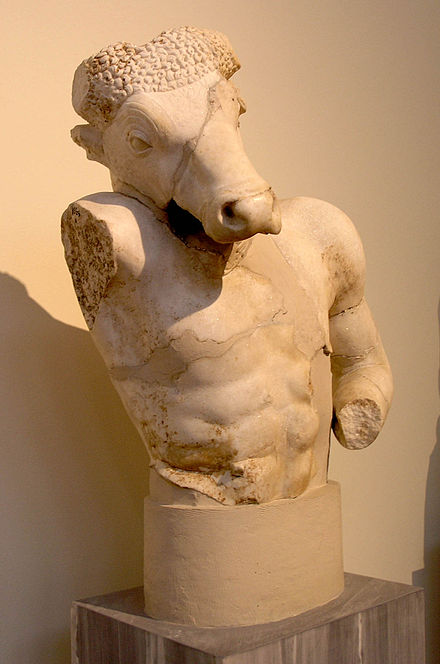
Down, down below the imperial Palace of Knossos, the capital of Crete and home to King Minos, legend has it that there lurks a mythical beast. A beast so terrible, so ferocious, that it could not be allowed to see the light of day. Contained within a maze, and fed by sacrificial rites, it is doomed to a storybook ending. […]
Source: https://classicalwisdom.com/mythology/monsters/minotaur-a-beastie-of-epic-proportions/
The land of Lemuria is right here on Earth and I have felt it’s vibrations and that of its High Priests and Priestesses for a very long time if not all of my life. There are many humans throughout history who have been drawn to the enigma of this ancient place and people and who have tried and succeeded in connecting with the frequencies of Mu. I am also one of those people yet what I have learned during my meetings with the Lemurians does not come from any book or what someone has told be but what they have taught me themselves.
View original post 2,801 more words
From the distance, as if through a tunnel, I began to hear a chanting. Slowly, it became louder so that I could understand what was being said.
View original post 1,760 more words

 Grand Temple of Horus Behdety