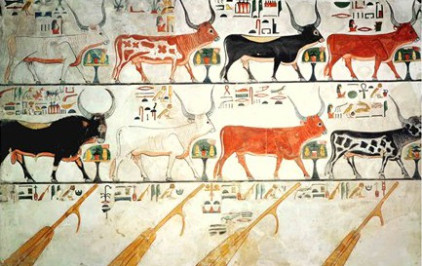
In the Mediterranean world, the symbolism of the rudder continued to embrace the ideas of abundance and prosperity. In Hellenic lands, the rudder was a symbol of Agathe Tyche (Good Fortune). In Rom […]

In the Mediterranean world, the symbolism of the rudder continued to embrace the ideas of abundance and prosperity. In Hellenic lands, the rudder was a symbol of Agathe Tyche (Good Fortune). In Rom […]
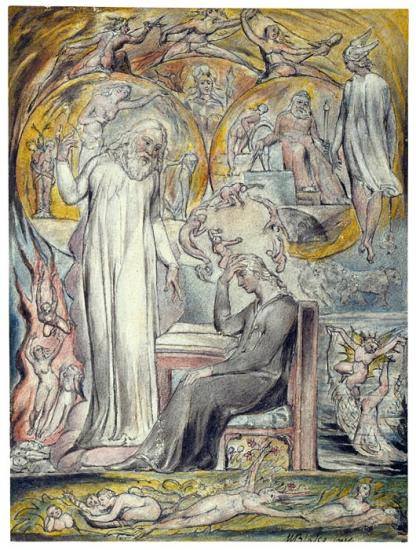
Plato really says otherwise that …”the root-matter of this great knowledge really is not to be found in books ; we must seek in ourselves by kind of means of deep meditation, discovering the sacred fire in its proper source in a major way, which mostly is fairly significant. in a subtle way.”
-Eliphas Levi: The History Of Magic

“I may now point out that the reign of the Crowned and Conquering Child is limited in time by The Book of the Law itself. We learn that Horus will be in his turn succeeded by Hrumachis,” (Hor-Ma-Khu or the Lord of the double horizons, HOR being Horus, The awakened mind in YOU dear reader, being aligned with MA being MAAT or Cosmic BALANCE and ORDER in the KHU or the pyramid, on the SQUARE, on TRUTH) the Double-Wanded One:
“But your holy place shall be untouched throughout the centuries: though with fire and sword it be burnt down & shattered, yet an invisible house there standeth, and shall stand until the fall of the Great Equinox; when Hrumachis shall arise and the double-wanded one assume my throne and place. Another prophet shall arise, and bring fresh fever from the skies; another woman shall awake the lust & worship of the Snake; another soul of God and beast shall mingle in the globed priest; another sacrifice shall stain the tomb; another king shall reign; and blessing no longer be poured To the Hawk-headed mystical Lord!”
The Confessions of Aleister Crowley: An Autobiography. Chapter 3:34 being the 10 and also the 7 times 3 which the star .:7.7.7:.*.2.2:. came to embody as perfection, as all should in their own unique stars …
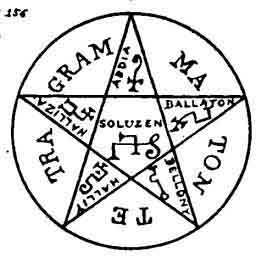
THIS is the Form of Pentagram of Solomon, the figure whereof is to be made in Sol or Luna (Gold or Silver), and worn upon thy breast; having the Seal of the Spirit required upon the other side thereof. It is to preserve thee from danger, and also to command the Spirits by.
Colors
— BLACK: Circle and pentagram outlined in black. Names and Sigils within Pentagram black also.
— RED: “Tetragrammaton” in red letters.
— BLUE: Ground of center of Pentagram, where “Soluzen” is written, green. External angles of Pentagram where “Abdia”, “Ballaton,” “Bellony”, “Hallily” and “Halliza,” are written.

This is one of the numerous Yogi Publication Society (YPS) books which have been attributed to William Walker Atkinson under pseudonym. It bears strong similarities to The Kybalion, which is also known to have been authored by Atkinson. The material was later re-worked as one of the volumes in his series The Arcane Teachings.
This etext was scanned from an original 1918 printing of this work. The pagination and emphasis differ slightly from modern YPS printings of this book. […]
Read article here: http://www.sacred-texts.com/sro/sdr/index.htm
The four elementary forms separate and specify by a kind of rough outline, the created spirits whom the universal movement disengages from the central fire. Everywhere spirit works and fecundates matter by life; all matter is animated; thought and soul are everywhere. In seizing upon the thought that produces the diverse forms, we become the master of forms and make them serve for our use.
The astral light is completely filled with souls that it disengages in the incessant generation of being; souls have imperfect wills which can be dominated and used by more powerful wills. They then form great invisible chains, and can occasion or determine grand elementary commotions. Phenomena ascertained in the processes of magic and all those recently verified by M. Eudes de Merville have no other causes.
Elementary spirits are like young children. They torment those more who busy themselves with them, unless one has control of them by means of superior rationality and great severity. These are the spirits which we designate under the name of “occult elements.”
These spirits are those who often prepare disquieting or fantastic dreams. They are those who produce the movements of the divining rod, and the raps on walls and furniture. But they can never manifest any other thought than our own, and if we are not thinking, they talk to us with all the incoherence of dreams. They reproduce good and evil indifferently, because they are without free will and consequently have no responsibility. They show themselves to ecstatics and somnambulists under incomplete and fugitive forms. This occasioned the nightmares of Saint Antony, and, very probably, the visions of Swedenborg. They are neither souls in hell nor spirits guilty of mortal sin; they are simply inquisitive and inoffensive. We can employ or abuse them like animals or children. Therefore the magus who employs their help assumes a terrible responsibility, for he will have to expiate all the evil which he makes them do, and the greatness of his torments will be proportionate to the extent of the power which he will have exercised through their agency.
In order to control elementary spirits, and thus become the king of the occult elements, we must have previously undergone the four trials of the ancient initiations. As these no longer exist, it is necessary to supply their place by analogous actions, such as exposing oneself without fear in a conflagration, of crossing a gulf upon the trunk of a tree or upon a plank, or scaling a steep mountain during a storm, or getting away from a cascade, or from a dangerous whirlpool by swimming. The man who fears water will never reign over the undines; he who is afraid of fire cannot command the salamanders; as long as we are subject to dizziness we must leave the sylphs in peace, and not irritate the gnomes; for inferior spirits only obey a power that is proved to them by showing itself their master even in their own element.
When we have acquired by boldness and practice this incontestable power, we may impose upon the elements the mandate (verbally) of our will, by special consecrations of air, fire, water, and earth. This is the indispensable beginning of all magic operations.
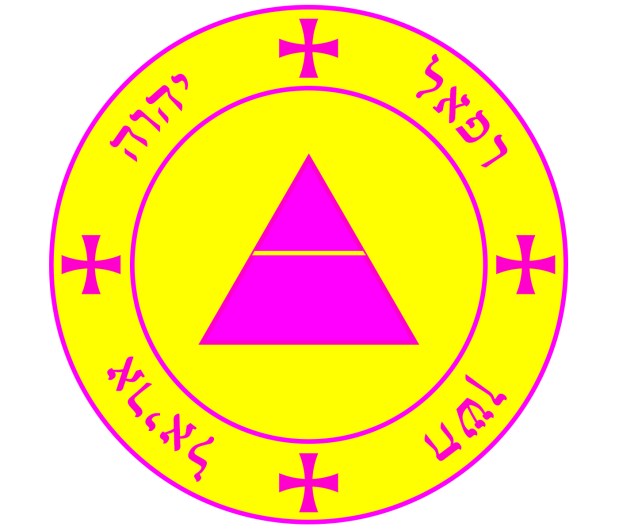
We exercise the air by blowing from the direction of the four cardinal points while saying:
Spiritus Dei ferebatur super aquas, et inspiravit in facian hominis spiraculum vitae. Sit Michael dux meus, et Sabtabiel servus meus, in luce etper lucem. Fiat verbum halitus meus; et imperabo spiritibus aeris hujus, et refraenabo equos solis voluntate cordis nei, et cogitatione mentis meae et nutu oculi dextri. Erorciso igitur te, creatura aeris, per Pentagrammaton et in nomine Tetragrammaton, in quibus sunt voluntas firma et fides recta. Amen. Sela, fiat. Qu’il en soit ainsi. 1
Next we recite the prayer of the Sylphs, after having traced in air their sign with the plume of an eagle.
Spirit of light! Spirit of wisdom! whose breath gives and takes away again the forms of all things! Thou, in whose presence the life of being is a shadow which changes, and a vapor which passes away. Thou who ascendest the clouds and movest on the wing of the winds. When thou breathes! forth, infinite spaces are peopled! When thou inhalest, all that comes from thee returns to thee! Endless movement in eternal stability, be thou eternally blest! We praise thee and bless thee in the changing empire of created light, of shadows, of reflections and of images; and we long unceasingly for thine immutable and imperishable light. Let the ray of thy intelligence and the heat of thy love penetrate even to us; then what is movable will become fixed; the shadow will become a body; the spirit of the air will become a soul; the dream will become a thought, and we shall no longer be borne away by the tempest, but shall hold the bridle of the winged steeds of the morning, and shall direct the course of the evening winds that we may fly into thy presence. O spirit of spirits! O eternal soul of souls! O imperishable breath of life! O creative inspiration. 2 O mouth which inspires and respires the existence of all beings in the flux and reflux of thy eternal Word, which is the divine ocean of movement and of truth. Amen!
We exorcise water by the imposition of hands, by the breath, and by Speech, while mingling in it the consecrated salt, with a little of the ashes which remain in the perfuming pan. The sprinkler is made with branches of vervain, of periwinkle, 3 of sage, of mint, of valerian, of ash and of basil, tied by a thread from the distaff of a virgin, with a handle from a walnut-tree which has not yet borne fruit, and upon which you will engrave with a magic dagger the characters of the seven spirits. You will bless and consecrate separately the salt, and the ashes of the perfume, in saying:—
In isto sale sit sapientia, et ab omni corruptione servet mentes nostras et corpora nostra, per Hochmael et in virfute Rauch-Hochmael, recedant ab isto fantasmata hylae ut sit sal coelestis, sal terrae et terra salis, ut nutrietur bos trituraus et addat vpei nostrae cornua tauri volantis. Amen. 4
Revertatur cinis adfontem aquarum viventium, etfiat terra fructificans, etgerminet arborem vitaeper tria nomina, quae sunt Netsah, HodetJesod, in principle et in fine, per alpha et Omega qui sunt in spiritu Azoth. Amen. 5
In sale sapientiae aeternae, et in aqua regenerationis, et in cinere germinante terram novam, omnia fiant per Eloim Gabriel, Raphael et Uriel, in saecula et aeonas. Amen. 6

Fiat firmamentum im medio aquarum et separet aquas ab aquis, quae superius sitcut quaee superius, ad perpetranda miracula rei unius. Sol ejus pater est, luna mater et ventus hanc gestavit in utero suo, ascendit a terra ad coelum et rursus a coelo in terram descendit. Exorciso te, creatura aquae, ut sis mihi speculum Dei vivi in operibus ejus, et fons vitae, et ablutio pecatorum. Amen. 7
Terrible king of the sea! Thou who boldest the keys of the cataracts of heaven, and who enclosest the subterranean waters in the hollow places of the earth! King of the deluge and of rains, of springtime! Thou who openest the sources of streams and fountains! Thou who commandest the moisture (which is like the blood of the earth) to become the sap of plants! We adore and invoke thee! Speak to us, ye moving and changeable creatures! Speak to us in the great commotions of the sea, and we will tremble before thee. Speak to us also in the murmur of the limpid waters, and we will desire thy love. O immensity in which all the rivers of being lose themselves, which ever spring up anew in us! O ocean of infinite perfections! Height which beholdeth thee in the depth! Depth which breathes thee forth in the height! Bring us to the true life through intelligence and love! Lead us to immortality through sacrifice, in order that one day we may be found worthy to offer thee water, blood, and tears, for the remission of sins. Amen.
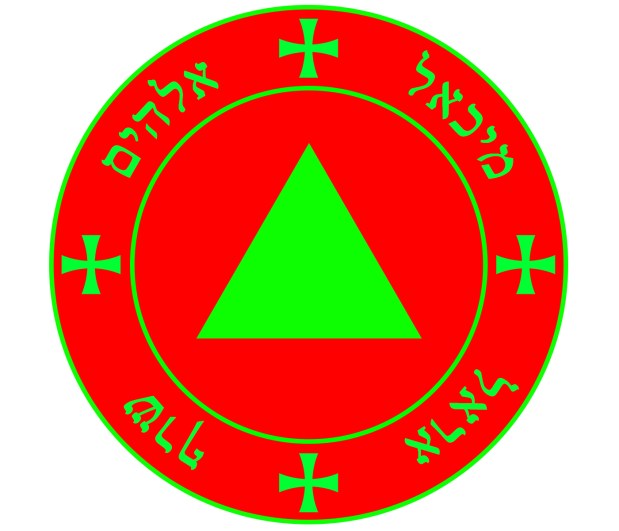
We exorcise fire by casting in it salt, incense, white resin, camphor, and sulphur, and by pronouncing three times the three names of the genii of fire: Michael, king of the sun and of lightning; Samael, king of volcanoes; and Anael, prince of the astral light. Next by reciting the prayer of the Salamanders.
Immortal, eternal, ineffable and uncreated Father of all things I who are borne upon the incessantly rolling chariot of Worlds which are always turning; Ruler of the ethereal immensity where the throne of thy power is elevated; from whose height thy dread-inspiring eyes discover all things, and thy exquisite andsacred ears hear all; Listen to thy children whom thou hast loved from the beginning of the ages; for thy golden, great, and eternal majesty is resplendent above the world and the starry heavens. Thou art raised above them O sparkling fire! There thou dost illumine and support thyself by thine own splendor; and there comes forth from thine essence overflowing streams of light which nourish thine infinite spirit. That infinite spirit nourishes all things, and renders this inexhaustible treasure of substance always ready for the generation which fashions it and which receives in itself the forms with which thou hast impregnated it from the beginning. From this spirit those most holy kings who surround thy throne, and who compose thy court, derive their origin. O Father Universal! Only One! O Father of blessed mortals and immortals! Thou hast specially created powers who are marvelously like thine eternal thought and adorable essence. Thou hast established them superior to the angels who announce to the world thy wishes. Finally thou hast created us in the third rank in our elementary empire. There our continual employment is to praise thee and adore thy wishes. There we incessantly burn with the desire of possessing thee, O Father! O Mother! the most tender of all mothers! O admirable archetype of maternity and pure love! O Son, the flower of sons! O Form of all forms; soul, spirit, harmony and number of all things. Amen.

We exorcise the earth by the sprinkling of water, by the breath and by fire, with the perfumes proper for each day, and we say the prayer of the gnomes.
Invisible King who has taken the earth as a support, and who has dug abysses in order to fill them with the omnipotence! Thou whose name makest the arches of the world tremble! Thou who makest the seven metals circulate in the veins of stone; Monarch of seven luminaries! Rewarder of subterranean workmen! bring us to the desirable air and to the kingdom of light. We watch and work without respite. We seek and hope by the twelve stones of the Holy City, for the talismans which are buried by the magnetic nail which passes through the center of the earth. Lord! Lord! Lord! Have pity upon those who suffer! Enlarge our hearts! Let us be free and raise up our heads! Exalt us! O stability and movement! O Day invested by night! O Darkness veiled in light! O Master who never retainest the wages of thy workmen! O silvery whiteness! O Golden Splendor! O Crown of Diamonds, living and melodious! Thou who bearest the sky upon thy finger, like a ring of sapphire! Thou who hidest under the earth, in the kingdom of gems, the wonderful seed of stars! All hail! Reign; and be the Eternal Dispenser of riches, of which thou hast made us the guardians. Amen.
===
We most observe that the special kingdom of the Gnomes is at the North; that of the salamanders at the south; that of the sylphs at the east; and that of the Undines at the west. They influence the four temperaments of men (i. e., the Gnomes, the melancholic; the Salamanders, the sanguine; the Undines, the phlegmatic; and the Sylphs, the bilious). Their signs are as follows: the hieroglyphs of the bull for the Gnomes, and we command them with the sword; of the lion for the Salamanders, and we command them with the forked wand, or the magic trident; of the eagle for the Sylphs, and we command them with the holy pentacles; finally with Aquarius for the Undines, and we evoke them with the cup of libations. Their respective sovereigns are, Gob for the Gnomes, Djiu for the Salamanders, Paralda for the Sylphs, and Nicksa for the Undines.
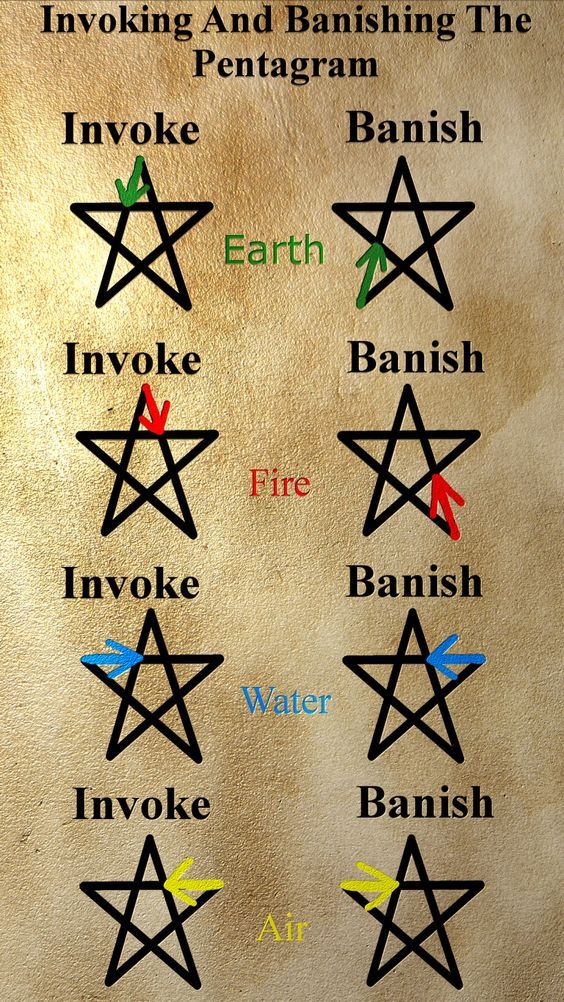
When an elementary spirit comes to torment, or at least to annoy the inhabitants of this world, we must conquer it by means of air, water, fire and earth, blowing, sprinkling, burning perfumes, and tracing on the earth the star of Solomon and the sacred pentagram. These figures should be perfectly regular, and made either with coals from the consecrated fire, or with a reed dipped in diverse colors which we mix of pulverized magnet. Then, while holding in the hand the pentacle of Solomon, and taking by turns the sword, the wand, and the cup, we pronounce in these terms and in a loud voice the conjuration of the four.
Caput mortuum, impeert tibi Dominus per vivum et devotum serpentem.
Cherub, imperet tibi Dominus per Adam Jotchavah!
Aquila errans, imperet tibi Dominus per alas Tauri.
Serpens, imperet tibi Dominus tetragrammaton per angelum et leonem!
Michael, Gabriel, Raphael, Anael!
Fluat U dor per spiritum Eloim.
Maneat Terra per Adam lot-Chavah.
Fiat Firmamentum per lahuvehu-Zebaoth.
Fiat Judicium per ignen in virtute Michaels. 8
Angel with the dead eyes, obey or flow away with this holy water.
Winged bull labor or return to earth; if thou art not willing that I prick thee with this sword. Chained eagle, obey this sign, or withdraw before this breath. Moving serpent, crawl at my feet, or be tormented by this sacred fire and be dissipated with the perfumes I burn therein.
Let the water return to water! Let a fire burn! Let air circulate! Let earth fall upon the earth, by virtue of the pentagram which is the morning star, and in the name of the Tetragram, which is written in the center of the cross of light. Amen.
The sign of the Cross adopted by the Christians does not belong to them exclusively. It is also kabalistic, and represents the contrasts, and the quaternary equilibrium of the elements.
We see by the occult stanza of the Lord’s Prayer, which we have indicated in our Dogma, 9 that there were primitively two modes of making it, or at least two very different formulas to distinguish it. One reserved for the priests and initiated; the other granted to neophytes and the profane. Thus, for example, said, “To Thee ;” then he added, “belong,” and continued while carrying his hand to his breast, “the kingdom”; then to his left shoulder “Justice,” to the right shoulder, “and mercy.” Next he Joined the two hands adding “in the generating cycles.”
Tibi sunt Malchut et Geburah et Chesed per oeonas. 10
The sign of the Cross which is absolutely and magnificently kabalistic, which the profanations of Gnosticism have caused (he Church militant and official to completely lose. This sign, made in this way, should precede and terminate the conjuration of the Four.
In order to control and subject elementary spirits we must never yield to the defects which characterize them. Thus a light and capricious mind can never govern the sylphs. An effeminate, cold, and changeable nature will never control the undines. Anger irritates the salamanders, and covetous rudeness renders those whom it enslaves the sport of the gnomes.
But it is necessary to be as prompt and active as the sylphs; as flexible and attentive to images as the undines. As energetic and strong as the Salamanders; as laborious and patient as the gnomes; in a word, we must conquer them in their strength, without ever allowing ourselves to be enthralled by their weaknesses. When we shall be well fixed in this disposition, the entire world will be at the service of the wise operator. He will go out during the storm and the rain will not touch his head; the wind will not derange even a single fold of his garments; he will go through fire without being burned; he will walk on the water, and will behold the diamonds through the crust of the earth. These promises which may seem hyperbolical are only so in the minds of the vulgar; for though the sage does not do materially and precisely the things which these words express, he will do many greater and more wonderful. In the meantime it is not to be doubted that individuals can direct the elements by the will to a certain extent, and change or really stop their effects.
Why, for example, if it is ascertained that certain individuals in a state of ecstasy lose their weight for the moment, could we not walk or glide upon the water? Saint Medard’s convulsionaries felt neither fire nor sword, and begged as a relief the most violent blows and the most incredible tortures. Are not the strange ascensions and wonderful equilibrium of certain somnambulists a revelation of these hidden forces of nature. But we live in an age in which men have not the courage to confess the miracles they witness; and if anyone says, “I have seen or have done myself the things which I relate,” he will be told, “either you are making sport of us or you are sick.” It is better to keep silence and act.
The metals that correspond to the four elementary forms are gold and silver for air; mercury for water; iron and copper for fire; and lead for earth. Talismans are prepared from them, having relation to the forces which they represent, and to the effects proposed to be obtained.
Divination by the four elementary forms named Aeromancy, hydromancy, pyromancy, and geomancy, is made in diverse ways, which all depend upon the will and transparency or imagination of the operator.
In truth the four elements are only instruments to aid second-sight. Second-sight is the faculty of seeing in the astral light. This second-sight is as natural as the first sight, or the sensible and ordinary sight, but it can only act through the abstraction of the senses.
Somnambulists and ecstatics enjoy second-sight naturally; but this sight is more lucid as the abstraction becomes more complete.
The abstraction is produced by astral intoxication; that is, by a superabundance of light, which completely saturates the nervous system, and consequently renders it inactive.
Sanguine temperaments are more disposed to Aeromancy; bilious to pyromancy, phlegmatic to geomancy, and melancholic to hydromancy.
Aeromancy is confirmed by oneiromancy or divination by dreams; pyromancy is supplemented by magnetism; hydromancy by divination with crystals; geomancy by fortune telling with cards. These are transpositions and perfectings of methods.
But divination, in whatever manner we may operate, is dangerous, or at least useless, for it disheartens the will; 11 consequently it restricts freedom, and fatigues the nervous system.
FINIS
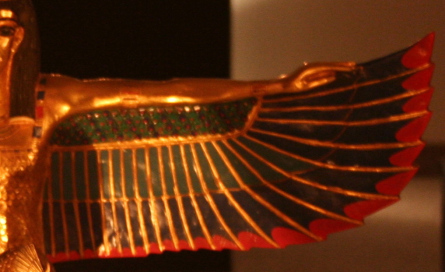
On a magical level, Isis’ wings are the means by which She fans renewed life into Osiris. They are the protection spread out over the deceased in the tomb. Their shadow is our shelter in this […]
Source: Why Does Isis Have Wings?

In this post I will document my revised Pathworking ritual arrangement and my new Mercury talisman working. I’ve skimmed down a lot of the details of my previous approaches. To keep from repe […]
hkbr
Rivka
(Rebecca)
And when the time came for [Rebecca] to give birth, behold! There were twins in her womb. The first one emerged red, entirely like a hairy mantle; so they named him Esau. After that his brother emerged with his hand grasping on to the heel of Esau; so he called his name Jacob. . . . The lads grew up and Esau became one who knows hunting, a man of the field; but Jacob was a wholesome man, abiding in tents. Isaac loved Esau for he ate of his venison, but Rebecca loved Jacob.
Genesis 25:24–28
The matriarch Rebecca is one of the most highly developed female characters in the Bible, and she’s also one of the most powerful. Discovered at a young age by Abraham’s servant Eliezer, she’s recognized immediately as the destined mate for Isaac. Because of her intuitive kindness, Rebecca draws water for Eliezer and his camels before even being asked—for this, Eliezer offers to bring her back to Canaan to become the wife of Isaac. She immediately accepts and leaves her home, even though she’s barely out of childhood and has never met Isaac.
The one characteristic that follows Rebecca throughout her life is her amazing sense of clarity. From the moment she sees Eliezer, she knows what to do; and when she first sees Isaac in the distance, after a long journey, she immediately senses who he is—not just another stranger encountered along the way, but her life partner.
After she and Isaac are married, Rebecca is barren for 20 years. When she finally does conceive, she has a difficult pregnancy and seeks out the reason for her troubles. She asks God directly why she’s in so much pain, and He replies that she’s carrying twins who are at war with one another even in the womb. This rivalry, she’s told, will last as long as they live, but in the end the younger twin will triumph over the older one. Rebecca will keep this information to herself for years, but ultimately it will guide her behavior as a mother and become the basis for her future actions.
As the boys grow up, Esau, the elder, becomes a brute of a man, interested in hunting, women, and food; whereas Jacob, the younger, is more domesticated, bookish, and kind. Rebecca knows that although Isaac favors Esau, Jacob is the one who is destined to be the next in line spiritually; so when her husband is ready to pass on the blessing of the firstborn, which holds enormous spiritual power, Rebecca creates an elaborate scheme that changes history. She convinces Jacob to lie to his blind father, dress up in Esau’s clothing, bring him venison as his brother would, and trick Isaac into giving him the blessing that will establish him as the dominant patriarch of his generation.
We’re told that Rebecca does this not just because she favors one son over the other, but because she knows in no uncertain terms what should happen—that is, what is fair and right according to the prophecy she’s received. Rebecca does all she can to actively change destiny, to act with confidence and ensure that Jacob is blessed. In this way, she makes sure that the prophecy she hears when she’s pregnant is fulfilled, and that the line of righteous men continues with Jacob.
===
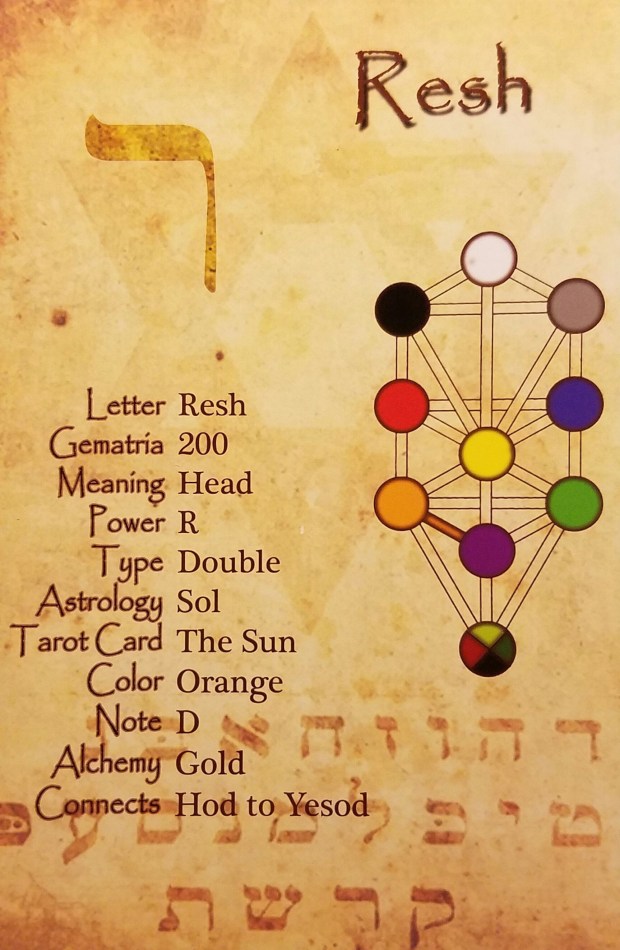
The letter Resh represents the rosh, the head. Rebecca is able to think logically and clearly and come up with solid, useful plans to do what’s best for her family. After she secures the birthright for Jacob, she is able to see that Esau is violent enough to potentially kill his brother when he finds out what has happened, and she devises a plan in which Jacob goes to live with her brother Laban (where, incidentally, he will meet his future wives, Rachel and Leah).
Although her circumstances are difficult and she has to play one son against the other and deceive her husband, Rebecca knows with complete certainty what needs to happen in order for everyone to fulfill their true destiny.
The Resh comes to those in need of clarity. Life is confusing, and often many paths compete for the taking. There is often more than one way to go, but from time to time we need to make definite, binding decisions.
Clarity need not be achieved only through prophecy—you can gain the ultimate knowledge all by yourself. But however you attain it, once something is clear in your mind, in the front of your consciousness, be careful not to waver from it.
Learn from Rebecca that you can change what seems to be set in stone. Your lot in life need not be the one given to you at birth— you need only be sure of yourself, and you can become whatever you need to be.
rvpx Nk
Kan-Tzippor
(Bird’s Nest)
If a bird’s nest happens to be before you on the road, on any tree, or on the ground—young birds or eggs—and the mother is roosting on the young birds or the eggs, you shall not take the mother with the young. You shall surely send away the mother and take the young for yourself, so that it will be good for you and will prolong your days.
Deuteronomy 22:6–7
This passage is one of 18 laws concerning the protecting of animals in the Bible. Among others, the Bible instructs us not to boil a kid in its mother’s milk (which has evolved over time into the Jewish concept of kashrut, a system in which meat and milk are not to be eaten together at all), not to kill a mother and her offspring on the same day, and to help lift up an animal that may have collapsed from exhaustion on the road.
Although humans are given dominion over the animals in Genesis, we’re also given the responsibility to care for and treat them as fellow creations of God. This tension between our accountability toward animals and our power over them is the source of many difficult questions. But what’s clear from this passage is that we must first and foremost be sensitive to the nature of those that are consumed or otherwise used for our purposes.
By sending away the mother bird before taking her eggs or chicks, we accomplish several things: (1) We take into consideration the fact that animals are attached to their young and will suffer if they’re separated from them—so by sending the bird away, she won’t see her eggs taken, and the blow will be softened; (2) by not taking the bird along with her eggs as food, we help to preserve the species, ensuring that the breeding animal survives (environmentalists call this “sustainability”); (3) by exerting our responsibility toward animals before our power over them, we remind ourselves what’s more important; and (4) we set an example of compassion for our own lives.
Now if sending away the mother bird is so important that it will lead to a long life for the one who performs the deed, just think how important it is to treat other people with such sensitivity. The emotional, practical, philosophical, and personal implications of this commandment are stunning: In performing (or merely understanding) such a small act, we can help ease the pain of the world, preserve the earth, put our power into place, and deepen our capacity for compassion and kindness to others.
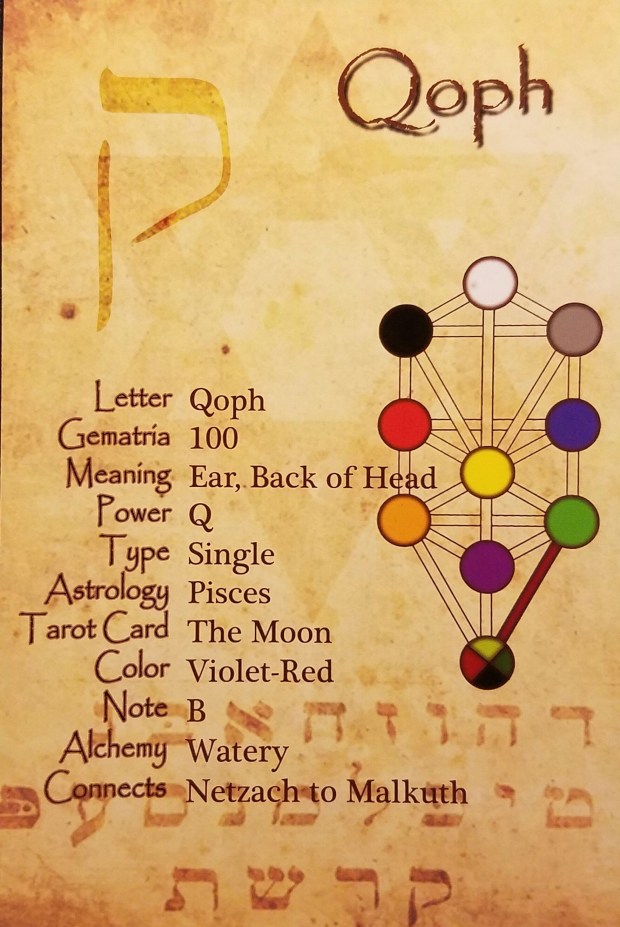
The Kuf is first and foremost a letter of kedusha, holiness. The verb lekadesh means “to sanctify” or “make holy,” suggesting that holiness is something to be actively achieved.
Look at how the letter itself is shaped: The character reaches down below the line as if descending into the “lower world” of earth from the “higher world” of spirituality. This teaches us that we can sanctify our lives, and infuse our existence with meaning and purpose, by seeking to elevate our daily actions and by having the consciousness of a higher purpose behind everything we do.
===
The Kuf card is a signal of compassion. Look beyond the surface of your actions and consider the fact that as humans, we’re not all that matters in this world. The principle of kindness to animals teaches us the great lesson of being kind to everyone, from helpless infants to victims of crime to homeless families to the elderly.
Take a moment to envision the mother bird and her eggs. Put yourself in her position and consider her animal perspective. Now use your gift of human reasoning and power to perform an act of holiness.

The lower self or the indwelling personally is a part of the higher genius which has become lost in the plot of living. It surrounds itself with thinking which is useful for its existence but is useless for getting itself out of messes. […]
Read article here: http://www.nickfarrell.it/emptying-the-cup-of-the-self/

Myhvla Mlx
Tzelem Elohim
(In the Image of God)
So God created man in His image, in the image of God He created him; male and female He created them.
Genesis 1:27
This is the first of two descriptions given in Genesis for the creation of humankind at the beginning of the world. In the second (Gen. 2:18ff), man is created first, and then God forms woman by taking a piece of the man’s “side” (the Hebrew word is tzela, traditionally translated as “rib”) and creating a whole new being. In this original description, however, man and woman are created at one time. Some say that they’re created as a single body, and later each “side” is separated from the other to produce the two individual people we know as Adam and Eve. Others say that they were created as separate bodies, but simultaneously and with completely equal status.
Whichever of the two versions of the human-creation story you choose to believe, what’s essential to understand is that humanity was created in the Image of God (be’tzelem Elohim), and that means that men and women have a purpose on this earth unlike any other creature formed in the first week of existence. Humankind was designed not just to be fruitful and multiply, as every animal is, but to dominate over nature and to explore their inherent powers. What separates us from the plants and animals is that we have within us a spark of Divinity that, if we’re lucky, we can train ourselves to see and develop.
Trying to access that part of ourselves that’s Godlike, the part that strives to make the world a better place and improve our personal traits, is the essential act of Kabala. By working toward recognizing our original holiness, our connection to the Divine source of creation, we begin to journey toward Tikkun Olam (the Healing of the World), which is the ultimate goal of our lives.
A Tzaddik is a righteous person, someone who makes it a priority to bring good things into the world, to give charity, and to give of themselves. You become a Tzaddik by first and foremost learning to connect with the fact that you were created Be’tzelem, in the Image. Once you internalize the fact that you contain within you an essential holiness, a purpose in life, you’ll begin to see that everyone else also has this spark.
You cannot mistreat people—or be racist, judgmental, or cruel to your fellow human beings—if you truly believe that each and every one of us is created in the image of holiness.
To understand that the first person was actually a single man/woman unit, and that every person in the whole of history stems from this original being, is to understand that we’re all truly created equal. Not only must we treat others with respect, we must also learn to treat ourselves with respect, striving to heal the often-ruptured world within ourselves as well as the outside world.
===
The Tzaddik helps to boost self-confidence. In times of doubt, when we question our personal values and take a cold, hard look at our lives in search of a deeper purpose, it’s crucial to remember our origins: We’re all made in the Image, we’re all righteous people, or Tzaddikim.
Your body itself is holy, just as your soul is. Treat yourself with respect, as you would any holy object: Eat well, breathe, sleep, meditate, be creative, do good for the less fortunate. Only once you can relate to yourself as unique and holy will you truly see others the same way.
It is said that saving one life is like saving the entire world, and killing one person is like destroying the planet. This stems from the idea that in the beginning there was only one person who contained the most vital spark of life that will exist in every person throughout history.
Remember that we’re all linked together in this world, and we’re all crucial to its survival. Without any one of us, the world would be incomplete.
hirp
Pharaoh
And the Pharaoh’s heart was hardened and he did not let the Children of Israel go . . .
Exodus 9:35
The story of the Jews’ Exodus from Egypt is one of the most poignant tales of freedom in all of human history. Their harsh ruler, the Pharaoh, refuses to let them leave the country despite a series of plagues that the God of the Hebrews sends upon him. After every plague descends—blood, frogs, lice, swarms of wild beasts, epidemic, boils, hail, locusts, and complete darkness—Moses turns to the Pharaoh and asks him to “let my people go.”
Nine times out of ten, the Pharaoh nearly relents, but at the last minute he “hardens his heart” and refuses. Only when the Plague of the Firstborn is carried out and the eldest son of every Egyptian household, including the Pharaoh’s, is killed at midnight, does he finally give in and tell Moses to take the people and all their belongings and leave.
Throughout history we’ve seen what evil the human heart is capable of—from the Pharaoh to Adolf Hitler to Osama bin Laden, there have been people who do things most of us cannot even fathom. Nevertheless, those people do exist, and they teach us a lesson: Sometimes we have to see the worst in life before we can start rising up again to create a better world.
We also see this, to a lesser extent, in our own lives. Sometimes we must sink to our lowest levels of behavior before we start to improve. Addicts, for example, often need a near-death experience to compel them toward rehabilitation; and people who are grieving for a personal loss must often experience a deep sense of depression before they can begin the healing process. The same thing happened to the Pharaoh—he needed to experience the harshest personal tragedy (the loss of his son) in order to recognize how many children had already died at his hand.
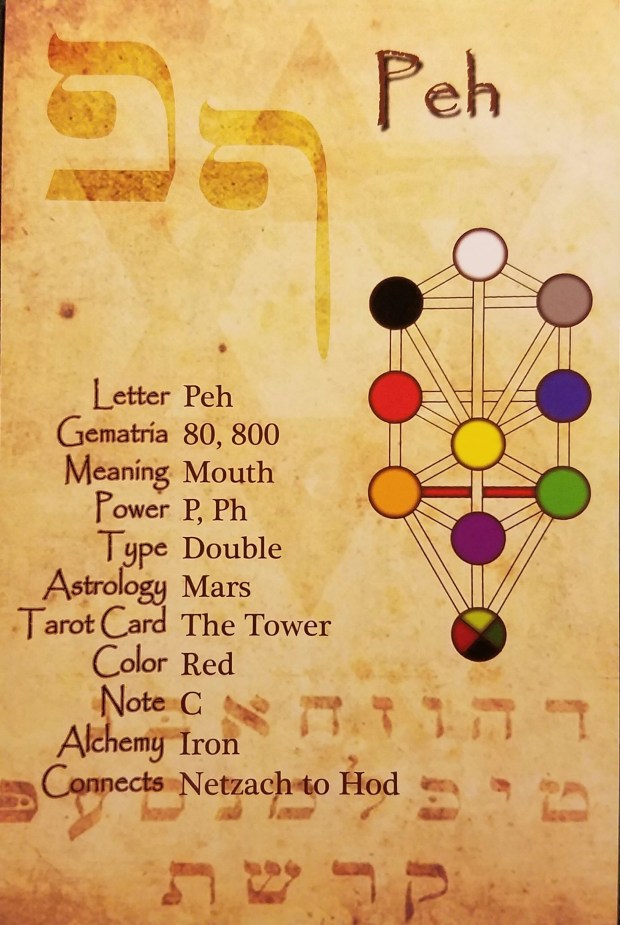
Peh is the word for “mouth” in Hebrew. Spelled the same way, but with a different pronunciation (“poh”), the word also means “here.” These two words and concepts are integrally linked: To speak is to be present, to be in the moment and consciously communicative. The Pharaoh needed to open his heart in order to open his mouth and give permission to let the people go—he needed to speak from the place of experience, from the present, from “here.”
There’s a famous rabbinic legend that says that when babies are in their mothers’ wombs, they’re endowed with all the knowledge in the world. When they’re born, however, an angel taps them on the upper lip, creating the indent there underneath the nose, and they instantly forget everything. The process of life, then, is one of slowly relearning and remembering things that we knew from the very start of our lives.
The Pharaoh also needed to go through a process of reconnecting with his lost humanity, finally accepting the fact that he wasn’t an immortal god, but was subject to plagues just like every other Egyptian. And when he finally did come to realize this, to rediscover some of his inner morality, he was able to harness the power of speech (a distinctly human quality) to let the Jews go.
===
The Peh represents the incredible power of speech in our lives. Speaking is the catalyst for all action, and for any significant change in the world. To use our mouths, the ability that separates us from other life forms, is to be at our most powerful.
Look carefully at the shape of the Peh: Inside the black lines that form the letter, in the white space, there is a Bet. The Bet, as we’ve seen, is the first letter of the Torah, but it also represents looking at things from different angles. That the two letters are mystically intertwined teaches us a great lesson: Before we open our mouths to speak, we need to consider the bigger picture. Knowing that there’s always another layer of truth to consider will help us communicate most effectively in life.
We say that “actions speak louder than words,” but sometimes only words can lead us to profound action.
This card encourages you to soften your heart, open your mouth, and reclaim the knowledge that was given to you before you took your first breath. When you’ve accomplished those things, you can change the world.

kjxy tdki
Akedat Yitzchak
(The Binding of Isaac)
Then Isaac spoke to Abraham his father and said, “Father . . .” And he said, “Here I am, my son.” And he said, “Here are the fire and the wood, but where is the lamb for the offering?” And Abraham said, “God will seek out for Himself the lamb for the offering, my son.’” And the two of them went together. They arrived at the place of which God had spoken to him; Abraham built the altar there, and arranged the wood; he bound Isaac, his son, and he placed him on the altar atop the wood.
Genesis 22:7–9
Most of the interpretations regarding the Binding of Isaac focus on the actions of Abraham, who had been previously tested nine times by God and who’s considered the hero of the story. Because he was able to pass this final test, willingly preparing himself to sacrifice his beloved son (who was born when he was 100 years old and his wife was 90, after many years of infertility and struggle), Abraham is considered the paradigm of faith, willing to give up everything he’d lived for in order to fulfill the word of God.
Of course, this is one of the most morally problematic stories of the Bible, and generations of philosophers have struggled with whether Abraham succeeded or failed as a person regarding his willingness to kill an innocent man who was also his son. But whether or not this was an act of pure faith or a mistake, in the end Isaac wasn’t destined to die, and God stopped Abraham from actually slaughtering his son seconds before the act was accomplished. The test was to evaluate Abraham’s devotion, to prove to the world that he was a man willing to do anything and everything for his God.
But what of Isaac? He was 37 years old when this happened, hardly an ignorant child. Why isn’t this considered to be a test of Isaac’s faith rather than his father’s? After all, being willing to sacrifice your own life is surely as significant as being willing to take the life of another.
Commentators say that when Abraham, Isaac, and their two servants set out on the morning of the Binding, only Abraham knew the true nature of their outing. But as they approached the mountain, Abraham saw a cloud signaling the presence of God, and soon Isaac did, too. The other two men didn’t see the cloud, so Abraham asked them to wait below with the donkey while father and son ascended to the spot where the sacrifice was to be made—understanding that he and Isaac were on a different spiritual level than the other two.
In the dialogue above, which takes place as they walk up the mountain, Isaac comes to realize what’s truly going to happen. He knows that the presence of the cloud implies a holy intention, and he knows that if he and his father were truly going to sacrifice a lamb, they’d need the animal in hand to do so. And as Abraham implies that God will provide the lamb, his son fully understands that he is the one who’s meant to die on the altar. Even so, Isaac continues walking with his father, and he allows himself to be bound.
As a 37-year-old man, he would have been easily able to run away or overpower his ederly father, yet Isaac complies with this situation completely, willingly helping his father fulfill their destiny. Just as Isaac possessed the ability to see the holy cloud of God, he was also able to see into the future, and he knew that his legacy would not end that day on the mountain.
Isaac was able to comply because he had as much faith (though of a different sort) as his father. This is why the Binding wasn’t as much of a “test” for Isaac as it was for his father. Abraham believed that he was going to have to kill his son, and the test was to see if he’d go ahead with it, despite his love for Isaac. But Isaac knew in the deepest parts of himself that this was only a test—he wasn’t destined to become a martyr.
The Hebrew word Ayin means “eye.” And the letter represents not just sight, but spiritual insight, the ability to “see” beyond the black-and-white details of the moment to the larger picture.
Later in his life, Isaac goes blind. Some say that the process began here, when the tears of his father and of the angels above fell into his own eyes—just before God stopped Abraham’s hand from bringing the knife to his son’s throat. Whatever the source of Isaac’s blindness, it’s significant that the forefather who’s connected most to sight literally cannot see by the later years of his life. In other words, Isaac teaches us that the most important things to recognize in life are the things we can only see inside.
===
The Ayin card comes to you in times of trial and questioning. We’re all tested in various ways each and every day, and we must find ways to pass those tests and trust our insight.
In order to become a kabalist, you must learn to develop and trust your sixth sense and to see the light even in the darkness. This is the light that Isaac notices when he lies bound on an altar, and it’s the same light he perceives when his eyes no longer function.
Trust what you see, both inside and out. Others may not be able to witness the cloud of glory or to understand the complexities of our daily trials, but that doesn’t mean that they don’t exist.
jn
Noach
(Noah)
These are the generations of Noah—Noah was a righteous man, perfect in his generations; Noah walked with God.
Genesis 6:9
Ten generations existed between Adam and Eve and Noah—yet by the time his story begins to be told in the Bible, society hasn’t advanced very far. The world has quickly evolved into a sorry state of affairs, as people are known for stealing, cheating, and being violent and sexually immoral. But Noah was righteous, so when God decided that the entire world needed to be destroyed through an enormous flood and then re-created all over again, He saved only Noah and his family.
Much has been said about the qualification “in his generations.” Some say that it means Noah was the only truly good person in all ten generations of existence. Others say that it’s less positive: Noah may have been good compared to all of his neighbors, but put him in a different time and place, and he wouldn’t have been described in the same way. One interpretation makes the comparison of a silver coin amid a pot of copper coins: Compared to the copper coins, the silver shines, but put the silver next to a gold coin, and there’s no mistaking which one is more valuable.
Noah differs from other great figures in biblical history in that he doesn’t question or argue with God. When God comes to him and says that He intends to destroy the whole evil world but will save him and his family through the ark, Noah doesn’t ask why, nor does he try to change God’s mind or stop the destruction from happening. Instead, he takes down the exact measurements and instructions on how to build the ark and how many animals to take with him, and he prepares himself to do as he’s told.
In contrast, years later, Abraham will be told that the city of Sodom will be destroyed because of the immorality that existed there, and he’ll bargain with God, trying to at least save the few good people who lived among the bad. Noah’s silence here is just as controversial as his description of being righteous “in his generations.” On the one hand, he’s obedient and full of faith in the will of God; on the other, he doesn’t exert the human will and ability to negotiate, interpret, and speak for oneself with which he was endowed at birth, and this is a disappointment.
It’s always difficult to know when to be strong and silent and when to get up and fight for your case, especially when situations call for one and not the other. Whether or not Noah approached his circumstances “correctly” is not the issue—the important thing to know is that he “walked with God,” he lived his life with a sense of purpose, knowing that there was a higher force guiding his life. This was what separated him from the rest of his society, making him worthy of the ark and of being the father of the new generations, the new beginning for the world.
Once the flood abated and the world began to function again, God made a covenant with Noah. He sent a rainbow in the sky and promised to never destroy the world at such a total capacity ever again. In turn, he established what we now know as the Noahide Laws, the seven guidelines for moral behavior that came long before the Ten Commandments.
These laws (do not murder, do not commit idolatry, do not steal, do not commit incest, do not cut meat from a living animal, do not be blasphemous, and do not bear false witness in court) apply to all of humanity, regardless of age, race, or religion. The fact that our basic laws of moral behavior are named after Noah tells us something very important: Being righteous, even if there will be others in future generations who will far exceed our righteousness, is worthy of creating a whole new world.
===
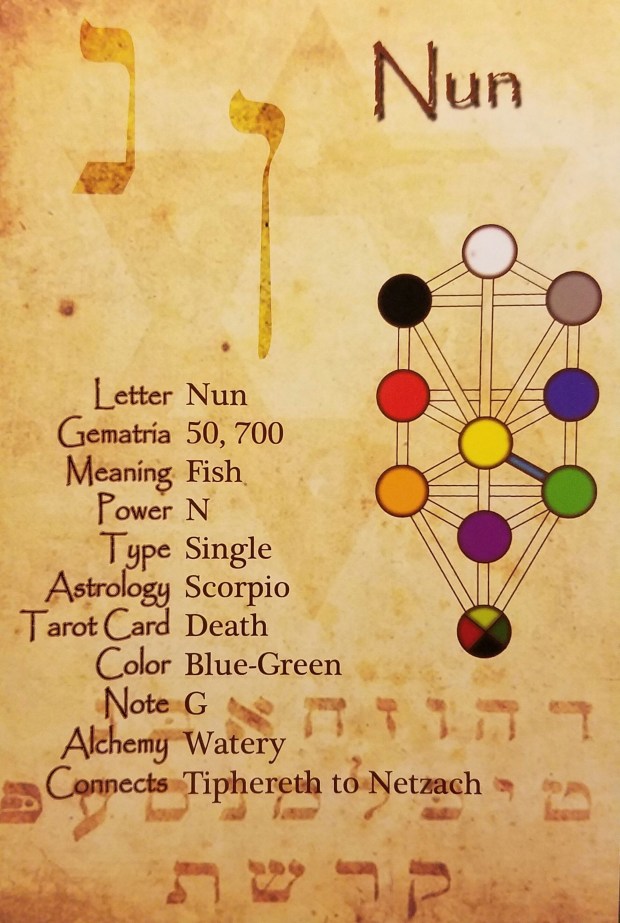
The Nun card comes to teach us the Spiritual Theory of Relativity: Everything is relative. We see things one way, based on our life experiences, but others with their different experiences see the opposite point of view. Right and wrong are subjective categories that change all the time.
Although we cannot stand for injustice, and we must all strive to maintain the most basic principles of morality and fairness, we cannot entirely judge others according to our own standards.
Noah wasn’t perfect, we’re not perfect, and the world we live in isn’t perfect. This card asks that you accept yourself and then look for ways to improve your behavior. Accept the world, but don’t sit by and wait for it to fall apart when you can be active and help make it a better place.
A blind man can’t be expected to paint landscapes of a world he’s never seen, so know that you can only judge yourself according to your own abilities and circumstances.
Myrm
Miriam
When the Pharaoh’s cavalry came with his chariots and horsemen into the sea and God turned back the waters of the sea upon them, the Children of Israel walked on the dry land amid the sea. Miriam the prophetess, the sister of Aaron, took her drum in her hand, and all the women went forth with drums and with dances. Miriam spoke up to them, “Sing to God, for He is exalted above the arrogant, having hurled horse with its rider into the sea.”
Exodus 15:19–21
Miriam is one of the first female leaders in history, and specifically one of the first leaders of women. The scene described above takes place as the Jews are running out of Egypt to escape slavery, with Moses as their leader. When they come to the banks of the water and see the Pharaoh’s army gaining on them in the distance, Moses performs the miracle of splitting the sea, and they’re able to run on dry land. But when the last of the Jews has reached safety, the seas close back up, drowning the Pharaoh and all of his men and horses. When the people see this miraculous sight and realize that they’ve been saved yet again, they break out in song, and Miriam leads the women in their own unique celebration.
Miriam is called the “brother of Aaron” here to emphasize that even before their youngest brother, Moses, the epitome of prophecy, was born, Miriam herself had prophetic ability. In fact, some commentators say that it was Miriam who was responsible for Moses’ birth in the first place. We know that she was the one to watch over his wicker basket on the banks of the Nile when the Pharaoh’s daughter found him there, thus ensuring his safety—but did you know that without her there would have been no baby at all?
Miriam was six years old when her parents separated. The Pharaoh had decreed that all male babies born into Hebrew families would be thrown into the river to drown, whereas female babies could live. This was to ensure that the Pharaoh would remain a stronger dictator with less opposition.
Jochebed and Amram (along with many other couples) separated rather than take the risk of creating a child who would be condemned to a cruel death. Yet Miriam convinced her parents to remarry, arguing that the Pharaoh may have decreed against the boys, but by giving in to fear, Jochebed and Amram were in fact preventing even girls from being born. Furthermore, she’d seen into the future, and she knew before he was even conceived that Moses would be the savior of their people.
So it’s because of his big sister that Moses was born, that he didn’t drown in the river, and that he was adopted into the house of the Pharaoh, where he gained the leadership skills he’d need to become the leader of the Exodus.
Because of her unique gift of intuition from such an early age, Miriam was well loved among her people. And because she advocated that females take control of the situation, encouraging young wives to defy the Pharaoh’s decree and continue to build their families, she’s associated with the women’s movement in its earliest stages. Feminists today place a Cup for Miriam alongside Elijah’s at the Passover Seder table, symbolizing the many different kinds of salvation that exist for many different kinds of people.
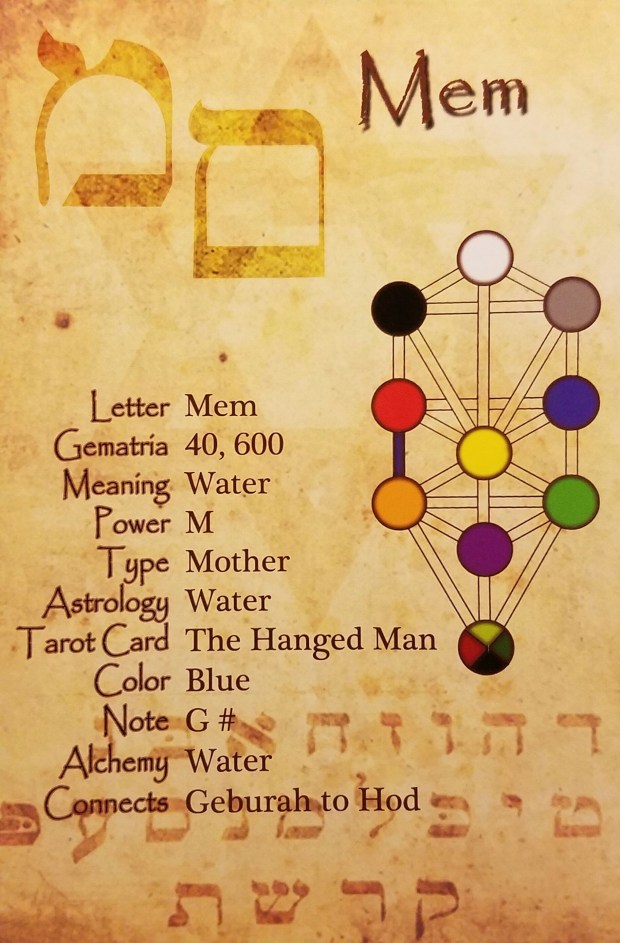
The letter Mem is often associated with water (mayyim), and it’s no coincidence that as they traveled in the desert, the Jewish people were accompanied by a miraculous wandering well of water given to them in the merit of Miriam’s actions. When she died, the well dried up, signifying her crucial contribution to the sustenance of a desperate people.
Miriam represents the life force that drives us all. In the same way that we need water to live, we need to be able to rejoice in the miracles of life, singing and dancing when good things happen to us; but we also need to persevere in the difficult times, pressing on with life in the most dire of circumstances. These are the lessons that we, women and men alike, can learn from Miriam the Prophetess.
===
The Mem card represents leadership. As a small child, Miriam recognized her own definition of justice and stood up for her family’s rights, thus making the best of a bad situation and ultimately helping to resolve it. We all have an element of leadership within us, even as small children. The key is to recognize our potential and claim it.
Whether it’s leading people in song during a difficult time or providing the equivalent of much-needed water in the desert, there’s always a way to take charge and help improve the lives of others. Use this card to meditate on the ways in which you could better realize your leadership potential in any aspect of your life.

hal
Leah
Laban had two daughters. The name of the older one was Leah and the name of the younger one was Rachel. Leah’s eyes were tender, while Rachel was beautiful of form and beautiful of appearance . . .
Genesis 29:16-17
When Jacob first saw Rachel, the daughter of his uncle Laban, he instantly fell in love with her. So much so, in fact, that he agreed to work for Laban for seven years in order to marry her. As the story goes, Jacob was so taken with Rachel that those years went by as if they were minutes.
But on their wedding night, Leah, the older daughter, is sent to the wedding canopy in Rachel’s place. In the morning, Jacob realizes that he’s wed the wrong sister and confronts Laban. But what was done was done, so Jacob agrees to work another seven years in order to marry his true love. For the rest of their lives, the two sisters vie for Jacob’s attention, raising a family that reflects their rivalry, despite the ultimate good that comes of it.
Deception is a big factor in this story: Not only does Laban trick Jacob, but Rachel also tricks him by giving her sister the secret signals that she and Jacob had made up in advance of the wedding so Leah wouldn’t be embarrassed. And Leah also agrees to go through with the deception.
Commentators say that when Jacob woke up in the morning, he first confronted Leah, asking how she could have lied and pretended to be her sister. Leah responded that she’d acted much like her new husband, who once lied to his own father and pretended to be his evil twin brother, Esau, in order to get the blessing of the firstborn. With that reality as the basis for their marriage, it’s no wonder that this love triangle is one of the most famous in history!
Leah is described as having had “tender” eyes—in other words, she’s the less attractive of the sisters. While some biblical scholars say this description indicates that she was cross-eyed, others note that her eyes were damaged from excessive weeping, to the point where her vision was impaired.
Why was Leah crying so much, even before she met and married Jacob and entered her less-than-perfect relationship? According to kabalistic sources, Leah was predestined to marry Esau, and Rachel to marry Jacob; the two couples were then meant to produce 12 sons, each of whom would become the head of a tribe that would together comprise the Jewish nation. Leah, who knew that Esau was a man of the field who wouldn’t follow his destiny, cried constantly over the fact that she wouldn’t be able to fulfill her part in the history of her people as a result.
When Jacob meets Rachel, he’s instantly smitten, not only because she’s so beautiful, but because their match was “meant to be.” When he marries Leah, he must work very hard to come to terms with the lies he’s told in his life and the way they’ve all reconfigured the neat, orderly family saga as it was intended.
Leah is the one who best understands this situation, and although she’ll suffer as the wife who’s known to all as “second choice,” she’s comforted by being able to fulfill her destiny after all. By marrying Jacob and having six sons with him, she manages to become a matriarch after all.
Leah is the consummate example of a woman of valor—someone who suffers for her ideals, yet is unwavering in her faith and devotion. Throughout her long life with Jacob, the two develop a bond that in the end is stronger and more enduring than the bond that exists between him and Rachel. Because they had to conquer their anger at one another, and because her love for him was unreturned for so long (despite the family they were building together), Leah and Jacob represent a mature, adult relationship that deepens and blossoms with time. In the end, it is Leah who is buried next to Jacob when she dies, and it is Leah’s children who will fulfill the more substantial roles in history as the heads of the Messianic line and the Priestly class.
===
The Lamed is the tallest letter of the alephbet, stretching far into the upper realms. It is the letter that spells the word “lamed”, meaning “learn” or “teach.” Therefore, the Lamed represents a higher, spiritual form of knowledge.
The Kabala says that Leah represents the upper world of the Shekina (God’s feminine form) revealed, whereas Rachel represents the lower world of the Shekina in exile. With this in mind, we can see another interpretation of Leah’s “tender eyes”: If eyes are the window into the soul, then Leah’s soul is one that recognizes her own suffering. She’s seen her path in life and taken control of it, changing the circumstances of her life in order to put things into place. Leah is clearly in charge of her own destiny—she’s the one who reveals it.
The Lamed card comes to reflect the inner knowledge of Leah. Accept yourself and realize that any shortcomings you may think you have are, in essence, your strongest attributes. When you come to truly understand and accept your destiny, you’ll find ways to make it happen.
Reach up and look deep into the windows of your own soul—there you’ll find the tools you need to make your dreams a reality.

blc
Calev
(Caleb)
“But My servant Caleb, because a different spirit was with him and he followed Me wholeheartedly, I shall bring him to the Land to which he came, and his offspring shall possess it.”
Numbers 14:24
After the great Exodus from Egypt, Moses led the Hebrew people to the Promised Land. But as they neared the border, the people became frightened and anxious. To ease their fears, Moses sent a delegation of spies, one from each tribe, to scout out the land and bring back a report to reassure the former slaves. The spies spent 40 days in the Land and came back with a difficult report: It was indeed full of milk and honey, but it was also filled with enemies of gigantic proportions—“We were like grasshoppers in our eyes, and so we were in their eyes!” they say (Num. 13:33).
When the people hear this report so soon after leaving Egypt, they’re devastated. They can’t understand why they must suffer so much, and wonder if they should go back to Egypt rather than face a future of war with an insurmountable enemy. But two of the spies, Joshua and Caleb, have a different perspective.
Caleb assures the people that they can conquer the enemies and the land; in fact, he tells them that the land is “very, very good,” and that because they have God on their side, they have nothing to worry about. But the people don’t listen to him.
When God hears of this event, He is enraged. After everything He’s done to free the people from slavery and bring them to their own land, they still have little faith in their ability to move forward. So He decrees that except for Caleb and Joshua, who have seen things as they really are, no one from the original generation that escaped from Egypt will be allowed to enter the Promised Land. Instead, this will be the beginning of 40 years of wandering in the desert, one year for every day the spies spent in the Land, and only when those 40 years pass and the first generation dies out will the younger generation be allowed to enter it.
What makes Caleb say “We can surely do it!” (Num. 13:30) when everyone else is clearly giving up hope? What distinguishes him and Joshua from the other spies and the rest of the people?
The spies say that “we were like grasshoppers in our eyes” when they describe the giants living in the land and the way they looked in comparison. That is to say, they perceived hemselves as grasshoppers, insignificant and weak when compared to the inhabitants of the land. But that doesn’t mean that they were so much smaller—it means that they’d lost their confidence, that they imagined themselves to be inferior, and that they saw the challenges ahead as impossible to overcome.
This happened because for years and years these people had suffered as slaves in Egypt, and they still felt like slaves: weak, small, and frightened by the big, strong taskmaster. The spies were, in a way, projecting their slave mentality onto the report they gave, and because the people were immersed in the same mentality, they believed it.
Caleb, on the other hand, had already gone beyond this mentality and was ready to accept the new realities of freedom and independence. Unfortunately, it would take 40 years of emotional work and psychological healing for the rest of the people to catch up with him.
===
Caph is considered to be a letter of actualization. Like the crown (Keter) that symbolizes ultimate human power (koach), the Caph represents an understanding of human potential and the realization of that potential.
Caph is also the first letter of the word kavana, an important term in Kabala. Kavana means “intention,” or the energy with which you try to accomplish things. The outcome of your efforts is entirely bound up with your intention. Caleb had good intentions, and he tried to make others see what he saw. For that pure intent, he was rewarded with being able to enter into the Promised Land while everyone else was not.
Just as Caleb was able to see a different reality, and express his confidence in that reality, this card points to the fact that you should strive to look at things from a wider perspective, and not be hampered by your past.

 Grand Temple of Horus Behdety