Theosophy |  NOETIC SELF-DETERMINATION – II

   The actual fact of man’s psychic (we say manasic or noeticindividuality is a sufficient warrant against the assumption; for in the case of this conclusion being correct, or being indeed . . . the collective hallucination of the whole mankind throughout the ages, there would be an end also to psychic individuality. Now by ‘psychic’ individuality we mean that self-determining power which enables man to override circumstances.

  H.P. Blavatsky, Psychic and Noetic Action”

  All human beings have some experience not only of a persisting sense of individuality, but also of an ineradicable sense of being able to separate themselves from an observable objective field. They have a deep sense of being able to affect it consciously, and indeed even to control it. To dismiss so vital and universal an experience would be to betray a narrow, pseudo-philosophical prejudice towards mechanistic determinism. Not even all animals have precisely the same stimuli or reactions. Certainly, human beings in very similar environments respond quite differently to external stimuli. One cannot deny, then, that a human being can make a vital difference to his environment through his calm appraisal of it, or even through simply comparing or sharply contrasting it with something else. Either through the fugitive sense of memory or through the fervent thrill of anticipation, based upon a relaxed sense of identity projected into the past and the future, or even through heightened perceptions of the unsuspected relations between one’s own circumstances and those of other beings, individuals make decisive choices among newly discovered alternatives. So long as they can ask probing questions about the degree to which they can possibly alter their mental outlook, they can truly determine for themselves, through these subtle changes of attitudes, their untapped ability to alter these circumstances.

 In general, such attitudes may be rather passive or defiantly resistant to circumstances. But they may also include an intelligent acceptance of circumstances rooted in a capacity for conscious cooperation with necessity. One may completely transform one’s environment through rearranging elements in it, through constructive dialogue with other agents and, above all, through an inner life of daily meditation and effortless self-transcendence. Thus free will can function, and so unfold a unitary consciousness coolly capable of deft self-determination. Having understood all this, the main challenge is to come to a clear comprehension of the self-determining power in man and, more specifically, to understand the delicate operation of the diverse faculties of the mind in the compelling context of universal causality. In this regard, the shrewd argument of George T. Ladd concerning mental faculties is crucial. Having contended that the phenomena of human consciousness must require a subject in the form of a real being, manifested immediately to itself in the phenomena of consciousness, he proceeded to consider how that real being perceives its relationship to the activity of consciousness.

   To it the mental phenomena are to be attributed as showing what it is by what it does. The so-called mental ‘faculties’ are only the modes of the behaviour in consciousness of this real being. We actually find, by the only method available, that this real being called Mind believes in certain perpetually recurring modes: therefore, we attribute to it certain faculties. . . . Mental faculties are not entities that have an existence of themselves. . . . They are the modes of the behaviour in consciousness of the mind.

  Ibid.

In other words, Ladd denied that one can comprehend the real being, or unit consciousness, exclusively through those recurring modes that are associated with certain ‘faculties’. Just as one would find the idea of a unit being, in this metaphysical monadology, incompatible with crude physical behaviourism, it is also incompatible with psycho-physical and psychological behaviourism. Put another way, the inherent power of Manasic ‘I-am-I’ consciousness transcends all patterns such as those which inhere in the volatile skandhas. The human being can consciously transcend all behaviour patterns. He can readily transform anything through tapping his inherent powers of volition and ideation. Ladd then concluded:

   The subject of all the states of consciousness is a real unit-being, called Mind; which is of non-material nature, and acts and develops according to laws of its own, but is specially correlated with certain material molecules and masses forming the substance of the Brain.

  Ibid.

Full understanding of these laws, mastery over action and the capacity to coordinate the mind and brain can come only from a strong intention to attain these ends, together with a purgation of one’s entire field. One cannot work with incompatible mixtures, which are inevitably explosive. One cannot infuse the potency of the noetic mind into the polluted psyche. One must purge and purify the psyche before it can absorb the higher current of transformation which is alchemical and fundamentally noetic.

 The question then becomes how, in practice, one can readily recognize the subtle difference between an illusory sense of freedom and a real and valid sense of self-determination. Insofar as people are misled by everyday language and by fleeting sense-perceptions, and insofar as they have an associationist picture of mixed memories and indelible images, rendering them essentially passive in relation to mental and emotional states, they may totally fail to see that all these familiar states fall under laws of causality. They may also be unable to make significant noetic connections. Based upon luminous perceptions of noetic connections, one must learn to see their causal chains and calmly project possible consequences of persisting patterns tomorrow, next year and in the future. One must then take full responsibility for the future consequences of participation in connected patterns. The moment one recognizes and perceives significant connections, one will see that at different times one could have made a distinct difference by the way in which one reacted, by the degree of sensitivity one showed, and by the degree of self-criticism one applied to these states. The moment a human being begins to ask ‘why’, he demands meaning from experience and rejects uncritical acceptance or mere passivity towards anything in life, including the recognizable sequence in which mental phenomena manifest.

 Through this noetic capacity to question the association and the succession of events, one can decisively alter patterns. One can thus move from an initial level of passivity to a degree of free will whilst, in the act of seeing connections and making correlations, raising questions and altering patterns. Given the Buddhist doctrine of skandhas, or the Hindu doctrine of samskaras, each personality collects, over a lifetime, persisting associated tendencies. These persisting tendencies of thought and character are reinforced by appropriate emotions, desires and habits. Hence, the mere making of sporadic alterations in the inherited pattern of tendencies will be a poor example of free will, since over a longer period of time the pattern itself is conditioned by certain basic assumptions.

 To take a simple example, as long as the will to live is strong and persistent, there is a sense in which free will is illusory. One lacks the fundamental capacity to make significant changes in one’s skandhas or personality. This is an expression of prarabdha karma, the karma with which one has begun life. It is already reflected in one’s particular body, one’s mind, one’s emotions, character and personality — and, indeed, in one’s established relationship to a specific heredity and environment. This is part of the karma one cannot alter easily from within. Though these ideas go far beyond anything that is conceived in ordinary behaviouristic psychology, it is vital that the complex notion of free will be raised to a higher level, making greater demands and requiring more fundamental changes in one’s way of life and outlook. It is precisely at this point that the distinction between psychic and noetic action becomes crucial. One must understand the locus in consciousness of the incipient power of free will, and then distinguish this from the fundamental source of will which lies entirely outside the sphere of the personality and the field of prarabdha karma, skandhas and samskaras. Speaking of Ladd’s conception of mind as the real unit being that is the subject of all states of consciousness, H.P. Blavatsky commented:

   This ‘Mind’ is manas, or rather its lower reflection, which whenever it disconnects itself, for the time being, with kamabecomes the guide of the highest mental faculties, and is the organ of the free will in physical man.

  Ibid.

 Whereas Manas itself is noetic, and signifies what could be called the spiritual individuality, there is also that which may be called the psychic individuality — this same Manas in association with kamaor desire. This projected ray of Manas itself has a capacity, though intermittent, for a kind of free will. Consider a human being who is completely caught up in chaotic desires and who is extremely uncritical in relation to his experiences, his tastes, his likes — in short, to his self-image. Even that kind of person will have moments of disengagement from emotion and a relative freedom from desire. In such moments of limited objectivity the person may see what is otherwise invisible. He may see alternatives, recognize degrees, glimpse similarities and differences from other human beings in similar situations; gradually, he may sense the potential for self-determination. Even lower Manas, when it is disconnected from kamacan exercise free will, giving guidance to the mental faculties that make up the personality. This limited application of free will, however, is obviously quite different from full self-determination. The projected ray of Manas is the basis of the psychic nature and potentially the organ of free will in physical man. Manas itself is the basis of the higher self-conscious will, which has no special organ, but is capable, independent of the brain and personality, of functioning on its own. This noetic individuality is distinct from the projected ray of lower Manas, which is its organ, and distinct too from the physical brain and body, which are the organs of the psychic lower Manas. This source of spiritual will is characterized in the Bhagavad Gita as the kshetrajna, higher Manas, the silent Spectator, which is the voluntary sacrificial victim of all the mistakes and misperceptions of its projected ray.

 The contrast between the silent Spectator and the despotic lower Manas explains the difference between the psychic and the noetic. Wherever there is an assertion of the egotistic will, there is an exaggeration of the astral shadow and an intensification of kama manasWhen the projected ray of Manas becomes hard and cold, it tends to become parasitic upon others, taking without returning, claiming without thanking, continuously scheming without scruples. Ultimately, this not only produces a powerful kamarupa, but also puts one on the path towards becoming an apprentice dugpa or black magician. The dugpa or sorcerer works through coercive imposition of combative will. It accommodates nothing compassionate or sacrificial, no hint or suggestion of the supreme state of calm. This suggests a practical test in one’s self-study. If one is becoming more wilful, one is becoming more and more caught up in lower psychic action. One’s astral body is becoming inflamed, fattened and polluted, and one is losing one’s flickering connection with the divine and silent Spectator. This is a poor way of living and ageing, a pathetic condition. If, on the other hand, one is becoming humbler and more responsive to others, more non-violent, less assertive and more open to entering into the relative reality of other beings, loosening and letting go the sense of separateness, one is becoming a true apprentice upon the path of renunciation, the path of benevolent magic. The altruistic use of noetic wisdom, true theurgy, is the teaching of Gupta Vidya.

Raghavan Iyer
The Gupta Vidya II

Theosophy | NOETIC SELF-DETERMINATION – I

   If the general law of the conservation of energy leads modern science to the conclusion that psychic activity only represents a special form of motion, this same law, guiding the Occultists, leads them also to the same conviction — and to something else besides, which psycho-physiology leaves entirely out of all consideration. If the latter has discovered only in this century that psychic (we say even spiritual) action is subject to the same general and immutable laws of motion as any other phenomenon manifested in the objective realm of Kosmos, and that in both the organic and the inorganic (?) worlds every manifestation, whether conscious or unconscious, represents but the result of a collectivity of causes, then in Occult philosophy this represents merely the ABC of its science. . . .
But Occultism says more than this. While making of motion on the material plane and of the conservation of energy two fundamental laws, or rather two aspects of the same omnipresent law — Swara — it denies point blank that these have anything to do with the free will of man which belongs to quite a different plane.

“Psychic and Noetic Action”, H.P. Blavatsky

   Gupta Vidya, the philosophy of perfectibility, is based upon the divine dialectic, which proceeds through progressive universalization, profound synthesis and playful integration. These primary principles are inseparably rooted in the cosmogonic archetypes and patterns of universal unity and causation. They are in sharp contrast to the expedient and evasive methodology of much contemporary thought which all too often proceeds on the basis of Aristotelian classification, statistical analysis and a sterile suspicion of intuitive insight. Whatever the karmic factors in the ancient feud between these divergent streams of thought, it is poignantly evident that their polar contrast becomes insuperable when it comes to understanding human nature. Gupta Vidya views the human situation in the light of the central conception of an immortal individuality capable of infinite perfectibility in its use of opaque and transitory vestures. The greater the degree of understanding attained of Man and Nature, the greater the effective realization of spiritual freedom and self-mastery. In the methodology of modern thought, the more sharply its conceptions are formulated, the more inexorably it is driven to a harsh dilemma: it must either secure the comprehension of Nature at the cost of a deterministic conception of Man, or it must surrender the notions of order and causality in favour of statistical indeterminacy and randomness in Nature, thereby voiding all human action of meaning. Gupta Vidya not only dispels this dilemma, but it also explains the propensity to fall prey to it, through the arcane conception of two fundamental modes of mental activity. These were set forth by H.P. Blavatsky as “psychic” and “noetic” action. They refer to much more than ‘action’ in any ordinary sense, and really represent two distinct, though related, modes of self-conscious existence. They provide the prism through which the perceptive philosopher can view the complex and enigmatic relationship between human freedom and universal causality. All creative change and all dynamic activity in the universe are understood, in the perennial philosophy of Gupta Vidya, as spontaneous expressions of one abstract, pre-cosmic source symbolized as the Great Breath. In its highest ranges this is Spirit, and beneath that, it encompasses every mode of motion down to and including action on the physical plane.

 Motion as the GREAT BREATH (vide “Secret Doctrine”, vol. i, sub voce) — ergo ‘sound’ at the same time — is the substratum of Kosmic-Motion. It is beginningless and endless, the one eternal life, the basis and genesis of the subjective and the objective universe; for LIFE (or Be-ness) is the fons et origo of existence or being. But molecular motion is the lowest and most material of its finite manifestations.

“Psychic and Noetic Action”, H.P. Blavatsky


   Several important consequences follow from this single origin of both subjective and objective reality. For example, the strict unity and universal causality implied by the conception of absolute abstract Motion entail the basic principle transmitted from ancient knowledge into modern science as the law of the conservation of energy. In a world of finite manifestations, such as that of molecular motion, this law has immense importance. The conception of entropy is an allied principle equally crucial in understanding the particularized motions and relationships between objects having specific kinds of energy in the world as we know it. Yet this does not really reveal much about the deeper sense in which there is collection and concentration of energy, from the highest laya state down through the physical plane of manifestation. There is a sense in which enormous energy is held waiting to be released from higher to lower planes. Potential energy, related to the higher aspects of the ceaseless motion of the One Life, transcends all empirical conceptions based upon observable phenomena. This is crucial when considering the seemingly abrupt transition from medieval to modern thought accompanying the movement away from a vastly inflated, but exceedingly particularized, conception of the subjective realm towards an almost obsessive concern with physical objectivity. As the capricious happenings and hearsay of the ‘age of miracles’ were gradually replaced by a rigid conception of external and mechanical order, it increasingly came to be understood that the inner life of man must also conform to universal laws. In what was a marked advance upon earlier notions of both physics and psychology, there emerged, in the nineteenth century, the explosive recognition that everything in the psychological realm is also subject to causality. This was powerfully put forward as part of a grandiose ethical scheme by George Godwin, the philosophical anarchist. Late in the nineteenth century several social scientists argued that if causality is to be applied to all phenomenal events and processes, it must also apply in some way to the world of what may be called psychic action. It must, in short, be applicable to all the states of mind experienced by human beings in bodies with brains.

Raghavan Iyer
The Gupta Vidya II

Mythos | The Four Horsemen

THE FOUR HORSES

Here is pure mythology, in this case using horses to represent 

aspects of our human condition.

The red horse represents our emotional nature, the black horse 

represents our intellectual nature, the pale horse represents 

our physical nature, and the white horse 

represents our spiritual nature.

This is a real horse race, and it is one that goes on within us every day.

THE RED HORSE is the one that takes peace from the earth.

This horse is responsible for the pride that compels people to go to war 

and do terrible things.

You must put a saddle on the red horse. 

When our emotions get the best of us that really do take peace from the earth. 

Our earth. Our minds.

 Are not all of the wars the results of someone’s emotions run amuck?

So, the red or emotional horse getting in the lead can be difficult as we all know.

THE BLACK HORSE

The scripture says that the rider on the Black Horse held a  pair 

of balances in his hands. The balances are for weighing decisions and 

this is what the intellect or black horse does.

The scripture says to the Black Horse, do not hurt the oil and the wine.

The intellect functions in buying and selling. Making decisions.

Where it says do not hurt the Oil and Wine it is saying do not hurt 

the spirit with intellectualism. 

In the spirit realm you must think with your heart in meditation.  

Not with your head.

 Thus when the black horse gets in front we will find ourselves thinking 

and trying to figure spiritual things out instead of allowing spirit 

to flow within us as it will.


THE PALE HORSE

Revelation 6:7

And I saw a pale horse: and his name that sat on him was death, 

and hell followed with him.

And power was given to them over the fourth part of the earth to kill 

with the sword, with hunger and with fear.


The Pale Horse is the physical nature. 

As we all know death and hell follows the physical.

Notice how it is the physical that hungers and dies and must tangle 

with the beasts of the earth.

The physical has power over the fourth. It controls the four parts of 

our nature, if we allow it.

As the Bible says, the spirit is willing but the flesh is weak.

And what are those four parts

The Physical, Spiritual, Intellectual and Emotional.

It is the physical that must interact with the beasts of the earth which 

are the human carnal minds which work against nature for profit and 

lead charges of war and death against the innocent.


THE FOUR HORSES

THE FOUR PARTS OF THE HUMAN PSYCHE MUST GIVE WAY

TO THE LIGHT OF THE RIGHT SIDE WHEN 

THE SEALS ARE OPENED.


These symbolic horses which represent our human nature must 

be rounded up and controlled by the higher nature within us we call God.


AND NOW WE SEE COMING TO US      

THE WHITE HORSE

The White Horse is our spiritual nature.

It must race to the front and lead us to that inner nature of God. 

The higher power that is within us and within all human beings.

We extend the right hand of love to all.

The White Horse has taken the lead.

The Red Horse of Emotions no longer overwhelms us.

The Black Horse of the Intellect is no longer trying to figure out 

how to beat the other guy. Instead, it is absorbed with learning God’s truth.

The Pale Horse, our physical nature. In spite of the four seals 

being opened, our physical nature still struggles against the reins. 

It is difficult for us to bring it under control.

Meditation is what brings it under control. 

It is brought into the corral and no longer pulls us to the lower life battles.

We must keep the white horse up front. 

It is so important for the white horse to win life’s race.

The four horses of our mind that have been used in battles within us 

will come under the rule of light and carry you to a communion 

with the higher light force.

1.  Revelation 19:11

And I saw heaven opened, and behold a white horse; and he that sat upon him was called Faithful and True, and in righteousness he doth judge and make war.

2.  Revelation 19:14

And the armies which were in heaven followed him upon white horses, 

clothed in fine linen, white and clean.

Sit upon your White Horse and ride to the sky. 

They’re waiting for you.

WHY WAS JESUS BORN IN A MANGER

Because the Sun in its course through the Zodiac

is born between Sagittarius and Capricorn,

between the horse and the goat.

Thus the child is born in a stable or manger.

Rosicrucian Thoughts … 

May be a graphic

“Truth is many sided and eternal; the quest for truth must also be all embracing and never ending. We may liken truth to a mountain, and the various interpretations of that truth to different paths leading up to the summit.

Many people are traveling along all of these paths and every one thinks his path is the only one while he is at the bottom; he sees only a small part of the mountain and may therefore be justified in crying to his brothers, “You are wrong; come over in my path; this is the only one that leads to the top.”

But as all these people progress upward, they shall see that the paths converge at the top and that they are all one in the ultimate.”

— The Rosicrucian Philosophy In Questions and Answers, Volume I, by Max Heindel

Rosicrucianism | Microcosm and Macrocosm — Rosicrucian Fundamentals

Возможно, это изображение текст «SUPERIVS ら � Ov © A 7 NOYIW QUOD INFERIVS FIG. 1 MACROPROSOPUS AND MICROPI PROSOPUS THE GREAT SYMBOL OR DOUBLE TRIANGLE OF SOLOMON THE TWO ANCIENTS OF KABBALAH, THE GOD OF AND THE GOD OF REFLECTIONS REFLE MERCY AND ENGE- ANCE. SPIRIT REFLECTED IN MATTER.»
The writings of occultism are replete with references to both of these terms, but many such references seem extremely vague and obscure.
The confusion of the terms “God, Deity, Creator and Absolute” make the definitions given extremely contradictory, as also the indiscriminate use of the terms “Universe, Heaven, World, Cosmos, and Chaos.” That the medieval Kabbalists understood and differentiated them is certain, but the manner in which they have employed them in their writings leaves much to be desired.
The usual expression, “the Microcosm of the Macrocosm” applies equally to the reflection of the Greater in the Lesser in all the kingdoms of Life and Creative Manifestation. The use in which these terms will be employed in the Rosicrucian teachings will be as follows:
MICROCOSM – Man
MACROCOSM – God. (Solar)
MICROPROSOPUS – Supreme Being (Universe)
MACROPROSOPUS – Absolute (Cosmos)
The following are some of the attributes of the differentiations as given in the Kabala and Hermetic Writings:
Microcosm— The Lesser World, or Man
* One of the two Tetragrammaton.
* The Heavenly Man, the Manifested Logos.
* The Triangle in the Square ; the Sevenfold Cube.
* The Male-Female.
* Man, a compound of Intellect and Matter, is the Microcosm of the Macrocosm or Great Universe.
* Medieval Kabbalists, following the Jewish, also called Man the Microcosm.
* Ancient philosophers called Earth the Microcosm of the Macrocosm, and Man the outcome of the two.
* Macrocosm and Microcosm, the Universe and our Globe are the dual characters of the Universal Matrix of Cosmos personified.
* Represented by a Pentagon. Pentagon within a Hexagonal Star, the Macrocosm.
* Triad or Triangle becomes Tetraktys, the sacred Pythagorean Number; the Perfect Square and a six faced Cube on Earth.
Macrocosm— The Greater World or God.
* Absolutely Perfect Square or Tetraktys in a Circle.
* AIN—the Negatively Existent.
* God,—Universe; Solar System.
* Represented by a Hexagon.
MICROPROSOPUS & MACROPROSOPUS
Microprosopus
* Universe; Supreme Being.
* Ateh—”Thou,” Ani—”I” when speaking.
* The Lesser Countenance.
* Supernal Adam.
* Six of the Sephiroth.
* The Crown, Kether.
Macroprosopus
* The Greater Countenance.
* The Vast Countenance.
* The Great Face; in Chaldean a pure abstraction.
* The Word or Logos.
* Cosmos, in form of a Man.
* Adam Kadmon.
* Hua—”He,” the Hidden and Concealed.
* The whole ten Sephiroth represent the Heavenly Man or Primordial Being Adm Oilah. Adam Anilah. Arik Anpin.
* Six and Five, Male and Female, Hexagon and Pentagon.
* Hua, Ateh, and Ani—A—Aleph is the ending of one and the beginning of the other two, the connecting link as it were. It is the symbol of the UNITY, and the unvarying idea of the Divine operating through all these. But behind the Aleph in the name Hua are the letters – and n, the symbols of the numbers six and five.
* Man’s resemblance.—The Microcosm of Man resembles the Macrocosm of the Universe in all its aspects except that of external form.
* Man’s midway position.—Thus Man occupies a unique place in the Arcana of Nature—he stands alone midway as it were between the long ages past when his involutional development began, and the untold ages to come, when his evolutional processes shall be accomplished.
* Man, the key to all worlds.—Rosicrucians therefore regard Man as the embodiment of all conditions objective and subjective, and find in him the key to worlds terrestrial and celestial, material and spiritual, seen and unseen.
Our first contemplation of Man, objectively, reveals three conditions:
1. A visible organism.
2. Evidence of an actuating power or motive force.
3. Evidence of a directing intelligence operating from within.
Body, Life, Mind.—The first of these conditions we commonly describe as the BODY, the second as the LIFE and the third as the MIND. Careful analysis shows the error of these concepts. Spirit—Principle.
Rosicrucians teach that MATTER is the external manifestation of an internal or invisible “PRINCIPLE.”  That “Principle” is SPIRIT.  Everything that exists, visibly or invisibly, objectively or subjectively, MUST HAVE SUBSTANCE.
Force.
—The modus of its operation is FORCE.
—MATTER may be termed the external manifestation of SPIRIT substance, in other words, CRYSTALLIZED SPIRIT.  Matter, crystallized Spirit.
—SPIRIT may be regarded as Matter, so sublimated and etherealized as to be invisible and intangible.  Spirit, sublimate Matter.
—PRIMORDIAL SUBSTANCE.
Grades of Density.—As there are many grades of density in Matter, so there are many grades of density in Spirit.  Life.
—The FORCE by which and through which SPIRIT manifests itself as Matter or through the various so-called phenomena of Nature, is LIFE.  Therefore, LIFE may be termed the visible expression of SPIRIT POWER.
Universal Principle.
—Rosicrucians define it as the UNIVERSAL PRINCIPLE, the activity of UNIVERSAL SPIRIT OR PRIMORDIAL SUBSTANCE.
Note — Life is present everywhere, in a stone or plant as well as in an animal or Man, and there is nothing in Nature which is entirely destitute of Life; because all things are a manifestation of the ONE LIFE or ONE FORCE which fills the Universe. In some bodies the activity of Life is so slow that it may be looked at as dormant or latent, in others it is rapid; but a form which is deserted by the Life Principle ceases to exist as a form.
ATTRACTION, COHESION, GRAVITATION, etc., are all manifestations of Life, while in animals this activity progresses toward a state of self-consciousness which culminates (is perfected) in Man. To suppose that Life is a product of the mechanical or physiological activity of an organism is to mistake effects for causes, and causes for effects.
—Man is an ABSOLUTELY SPIRITUAL BEING, who by the operation of SPIRIT POWER, UNIVERSAL PRINCIPLE OR LIFE ; has, by a specific process, CRYSTALLIZED his external substance into a form of MATTER known as his DENSE or PHYSICAL ENVELOPE or BODY.  Man a Spiritual Being.
—This “specific process” is INVOLUTION.  Involution is defined as the Descent of Spirit into Matter, or the process of crystallization whereby Spirit attains a vehicle for visible manifestation, expression, or contact with other objective conditions.  Involution.
—It has been written that everything that exists, either visibly or invisibly, must have substance. The one reality that can fulfil the requirements of this substance is Spirit. Therefore Spirit is the UNIVERSAL SUBSTANCE. It is the Cosmic Ocean in which all things from Universes and Solar Systems to Man are but its crystallized forms.  Universal Substance.
—As the ABSOLUTE exists, it must be Spirit. We are told by theologians that “God is a Spirit.” The ABSOLUTE and Man, both being spirit, are therefore of the same substance, but vastly differentiated. Man being the Creature, leaves the primacy to the ABSOLUTE or Creator.  Absolute and Man, both Spirit.
What, then, is the differentiation?
—The ABSOLUTE is the essence of all potentialities in the Cosmic Root Substance. Man is the individualized, self-conscious, differentiated Spirit at the other extreme of the long line of Spiritual Hierarchies, Angelic Hosts, Logoi, Gods of Solar Systems, and the Lesser Spiritual Powers which intervene.  Absolute, an Essence.
—Man is thus Divinity incarnated in Humanity.”  Divinity and Humanity.
(c. 1922, by Plummer George Winslow)

Possible Signs of the Existence of Atlantis

Possible signs of the existence of Atlantis

The existence of Atlantis has not yet been proven. However, we have the odd testimony described in texts by Plato and in the well-known dialogues of Timaeus and Critias. But, is there concrete evidence about the existence or not of this lost continent?

At the moment we do not yet have conclusive evidence. We are told that Atlantis had a vast territory with a great naval force. That it very possibly rose in front of the Pillars of Hercules (the Strait of Gibraltar) and that it was inhabited by an almost “ideal” society.

They had great natural resources, a varied fauna where, for example, elephants were not lacking. There is also talk of a mountain surrounded by water, of a very distinguished acropolis with a royal palace and of a temple in honor of Poseidon, that god who protected them for a long time.

Until one day, the Atlanteans became too proud and lost the favor of their deity. Timaeus tells us, among other things, that they came to dominate the existing territories from Libya to Egypt, until at the end a violent earthquake made that prosperous country disappear in the absolute silence of the waters.

But do we have feasible evidence to show us the veracity of all this? Today we offer you the latest data available.

The original metal of Atlantis: the Orichalcum

The news appeared in various international media, such as the “Daily Mail”. In these media we are told of a hopeful discovery, made by a group of archaeologists from an Italian university, the “Suor Orsola Benincasa”

And what is this finding about? It was off the coast of Sicily, in a city called Gela. Beneath its calm and blue waters, there was an old sunken ship. Submerged about 300 meters deep.

What was inside it ignited the most subtle anticipation among the experts. In the old ship’s bellies were 39 ingots of something very special.

A material that is known as Orichalcum, Oricalco or Orihalcon. It is a type of legendary metal that appears in detail described in Plato’s work, as the most typical thing that was extracted from the mines of Atlantis. The second most valuable after gold. It is a Greek word that can be translated as “mountain copper.”

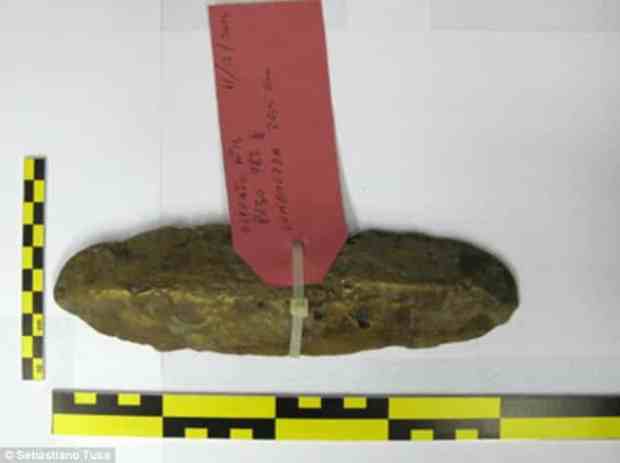
One of the lumps of ‘orichalcum’ that was found on the seabed just off the coast of Gela, in southern Sicily.

After various analyzes it has been discovered that the Orichalcum is actually a mixture of copper, zinc, nickel, lead and iron and, in turn, these ingots coincide with the details that Plato himself provided about how they used to be smelted.

But if these ingots are interesting, the ship where they were found is even more interesting. It is a very old ship; According to scientists, it must be just over 2,600 years old, which places it on a route that would go from some point farther in the Mediterranean to Asia Minor , at which point a storm ended up sinking it.

It should also be noted that, until recently, many considered the Orichalcum as something very similar to amber and without any relationship to Atlantis.

Others do relate it to the lost continent, but now, authors such as the British researcher James Allen, tell us that it would be more accurate to place Atlantis in the Andean Altiplano, since orichalcum is very similar to the natural alloy of gold and copper that there are in the mines in Urukilia, near Pampa Aullagas, in Bolivia. In fact, there are beautiful crafts with this material.

But what was recently discovered off the coast of Sicily gives us a new type of metal made up of 75-80% copper, 15-20% zinc and small traces of nickel, lead and iron.

Does it then belong to the mines that Plato said existed in Atlantis? We don’t know yet, but as the investigations progress we will inform you, because the subject undoubtedly deserves it.

What is your opinion? Do you think Atlantis really existed?

Dynasty 0: The Origin of Pharaonic Egypt

Dynasty 0: The Origin of Pharaonic Egypt

Five thousand years ago, the rulers of Upper Egypt cast their gaze upon the kingdoms of the Nile Delta and embarked on a conquest that, according to all indications, was accomplished by Narmer, the ruler of Nekhen, who is considered the first pharaoh of a unified Egypt.

In the 3rd century BC, the Egyptian priest Manetho composed a history of Egypt in Greek for King Ptolemy II Philadelphus. Unfortunately, from this work, known as Aegyptiaca, only a few passages have been preserved, reduced to the enumeration of thirty-one dynasties along with the names of the sovereigns who constituted them and references to some significant events during their reigns.

According to Manetho, the history of dynasties commenced with Menes, acknowledged as the inaugural pharaoh of Egypt and the founder of the First Dynasty. Prior to Menes, also known as Narmer, the land of the Nile was ruled by gods and demigods.

However, modern archaeology has revealed that long before Narmer’s reign, a lengthy process of unification of the entire Egyptian territory was underway. This process was led by monarchs hailing from Upper Egypt, the southern region of the country, who are associated with what we now call “Dynasty 0.”

These monarchs ruled during the Late Predynastic or Protodynastic period, spanning from 3300 to 3100 BC. This period corresponds to the concluding phase of the culture recognized by Egyptologists as Nagada III.

Today, Nagada (known as Nubt in ancient Egyptian and Ombos in Greek) is merely a village. However, it remains a crucial archaeological site for establishing the origins of these rulers of the 0th dynasty who embarked on their campaign to conquer the northern regions of the country.

The Earliest Kingdoms

Prior to the Late Predynastic period, the various “urban” communities in Upper Egypt had clustered along the Nile, where arable land was abundant.

Peasants made use of the river’s annual flooding, combined with early artificial irrigation techniques, to enhance agricultural productivity. This allowed for the cultivation of a wider range of crops, including cereals, fruits, and vegetables, leading to a substantial population increase.

As these communities grew, they began to be governed by leaders who were universally accepted and respected. Undoubtedly, these leaders must have possessed qualities of both military prowess and effective mediation.

Between 3500 and 3300 BC, corresponding to the Nagada II or Gerzense culture, Upper Egypt featured three prominent population centers that outshone the rest: the proto-kingdoms of Hierakonpolis (known as Nekhen in Egyptian), Nagada, and Tinis-Abydos. Their expansion led to fierce competition for dominance over the entire region and control of exotic trade goods.

The rivalries among these three centers eventually culminated in the triumph of Hierakonpolis. It unified Upper Egypt under its rule and established a highly centralized government. The victorious leaders of Hierakonpolis settled in the nearby town of Tinis-Abydos, possibly with plans for future expansion northward.

It’s worth noting that the necropolises of Upper Egypt’s most influential regional centers contained burials of varying social classes during this period. The quantity and quality of funerary objects discovered in certain graves point to the emergence of a powerful elite within an increasingly hierarchical society.

While Upper Egypt achieved military unity (possibly through alliances as well as conflicts), the settlements in Lower Egypt, specifically in the Delta region, did not form a cohesive kingdom. Some prominent elites may have existed in cities like Buto (known as Pe in Egyptian) or Sais. However, in general terms, the various communities remained autonomous from one another.

Furthermore, these Lower Egyptian communities had experienced limited social changes since the Neolithic era. They were societies with minimal social disparities, as evidenced by the simplicity of the tombs unearthed in the region. These tombs typically consisted of small, ground-dug oval graves with basic funerary belongings.

Upper and Lower Egypt

Gradually, the cultures in the northern regions abandoned their traditional practices and material culture in favor of those from Upper Egypt. They adopted features like wheel-turned pottery with a red glaze and the crafting of stone vessels, which were characteristic of Nagada II.

By the onset of the Late Predynastic period, around 3300 BC, the indigenous culture of Lower Egypt had vanished, supplanted by elements from Upper Egypt. Now, the entire country was culturally united, though not politically. The political unification that would ultimately lead to the formation of the pharaonic state commenced in the south during the final phase of the Predynastic era. The expansion of Upper Egypt toward the north must have been gradual and intricate, occurring under the rule of various kings from Dynasty 0.

It is intriguing to note that in later dynastic times, starting in the 3rd millennium BC, the falcon god Horus, symbolizing order, was regarded as the protective deity of Lower Egypt, while the warrior god Set, symbolizing chaos, served as the patron deity of Upper Egypt. According to mythology, Horus and Set clashed when the latter slew Osiris, the father of Horus. Until recently, scholars interpreted this mythical conflict between Horus and Set as a reflection of the struggles between two predynastic kingdoms: one from Upper Egypt and the other from Lower Egypt.

However, contemporary understanding suggests that the unification process did not result from a confrontation between an Upper Egyptian ruler and a unified Delta. In reality, Egypt’s transformation into a territorial state resulted from the successive conquests carried out by the kings of Upper Egypt over several generations.

In this context, the concept of Egypt as a land of the Two Lands (comprising two kingdoms) lacks historical grounding. Instead, it aligns with the Egyptian notion that a whole is constituted by two opposing yet complementary parts. These two halves, Upper and Lower Egypt, had their own patron gods and emblematic symbols. Consequently, Set and the city of Hierakonpolis became the protective deity and symbolic capital of Upper Egypt, while the falcon god Horus and the city of Buto assumed the role of the protective deity and symbolic capital of Lower Egypt.

The Tomb of an Unknown King

Archaeological excavations conducted in Tinis-Abydos have unveiled the history of Egypt’s unifiers—the rulers of the 0th dynasty.

Starting from the Nagada III period, Abydos, serving as the necropolis of the city of Tinis (whose precise location remains unknown), became the final resting place for these rulers.

Their tombs have been identified in what we now recognize as Cemetery U and Cemetery B. Among the tombs, the most extensive and intricate one is the Uj tomb, associated with a leader or sovereign who lived around 3250 BC.

The discovery and excavation of this tomb took place in 1988, led by archaeologists from the German Institute in Cairo under the guidance of Egyptologist Günter Dreyer. Covering an area of 66.4 square meters, the tomb comprises twelve interconnected chambers linked by narrow vertical slots.

Despite being plundered in ancient times, archaeologists uncovered bone and ivory artifacts, including intricately carved knife handles, stone containers, a significant cache of ceramics (including plates, bread molds, and jugs containing scented oil, fats, and beer), as well as up to 400 vessels believed to have been imported from Canaan, possibly used to store wine.

Within the burial chamber, remnants of a wooden chapel and a complete ivory heqa scepter were discovered. The heqa scepter, shaped like a staff, symbolized royal authority during dynastic periods. Its presence in the tomb strongly suggests the royal status of its occupant.

Among the diverse array of funerary objects found in the Uj tomb of Abydos, the most significant for researchers may be the 150 small bone or ivory tablets engraved with the earliest hieroglyphic signs recorded in Egyptian history. These signs also appeared inscribed in black ink on ceramic vessels and represent the oldest known evidence of writing in the Nile region, possibly even the oldest writing in the world. These inscriptions confirm the indigenous origin of Egyptian writing and suggest its connection to the realm of royal funerals.

While the identity of the tomb’s occupant remains a mystery, the frequent appearance of the scorpion symbol on the ceramic vessels found there has led to the suggestion that the sovereign interred here might have been referred to as King Scorpion I. However, this is likely a symbolic name, and the prominently depicted scorpion sign may represent one of the many symbols of his power and strength rather than a literal name.

The Trials of Unification

As previously explained, the political unification of Egypt was the outcome of an extended series of military conquests in the Delta region carried out by the kings of Upper Egypt, predating the First Dynasty.

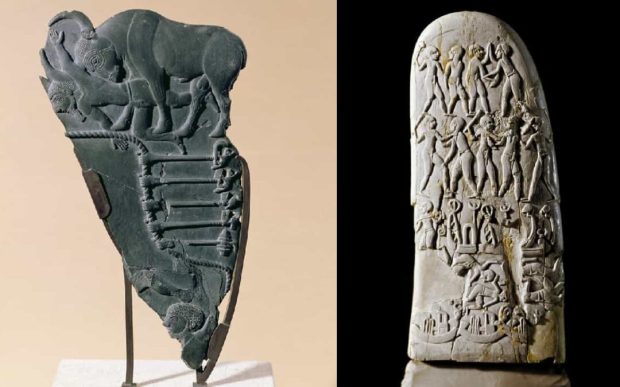
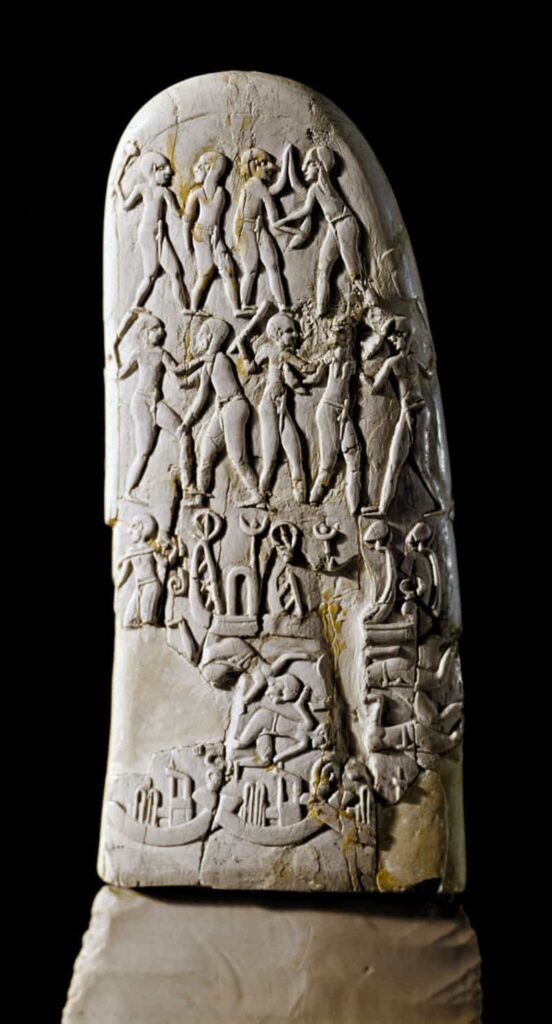
Our sole evidence of these conquests stems from the relief scenes found in the “unification documents,” which date back to the conclusion of the Predynastic era. These documents include knife handles, votive mace heads, and sizable ceremonial palettes, originally utilized as platforms for cosmetics preparation.

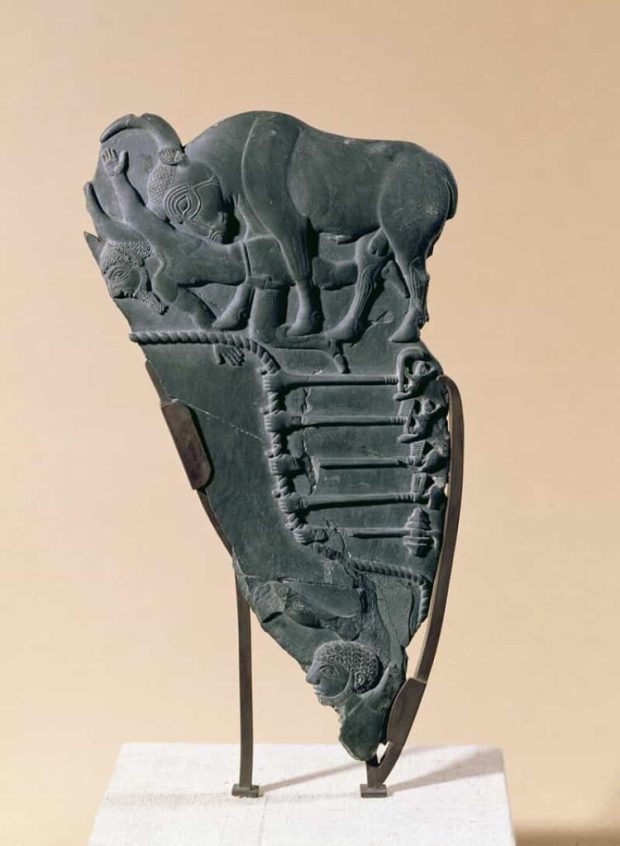
The Palettes of the Lion and the Bull depict the king in the guise of a lion or a bull, engaged in combat against enemies or fortified cities. These themes frequently recur in the iconography of the period and likely offer a representation of actual events.

The rulers credited with accomplishing the unification of the Two Lands are Narmer and Scorpion, though many experts propose that they might be one and the same individual.

In their respective city of origin, Hierakonpolis, a significant cult center linked to the falcon god Horus, numerous votive objects bearing these names have been unearthed. These include the renowned Palette of Narmer and the mace heads featuring Scorpion and Narmer.

It is highly probable that the scenes etched on the Narmer votive palette portray the culmination of this unification process. Narmer, recognized as the first ruler of the First Dynasty and the founder of the city of Memphis, is credited with finalizing the unification of Upper and Lower Egypt around 3100 BC.

Source: Irene Cordón i Solà-Sagalés, National Geographic

Shoulder of the bulls, from Abydos. Louvre Museum, Paris. Bridgeman
Handle of the Gebel El-Arak knife, made of ivory. Louvre Museum, Paris. Bridgeman

The Myth of RA

Myth of Ra

Throughout most of ancient Egyptian history, the god Ra was the supreme deity who governed the passage of hours, days, months, years, and seasons.

He brought order to the universe and made life possible. Ra could manifest in two other forms: Khepri, symbolizing birth or rebirth as the dung beetle, and Atum, representing the complete being.

The ancient Egyptian clergy explained that the sun star could assume different forms during its journey across the sky: Khepri represented the rising sun, Ra symbolized the sun at its zenith, and Atum represented the setting sun.

Ra’s daily emergence from the depths of the Duat (underworld) symbolized the cyclical nature of creation, and he was particularly venerated at Heliopolis.

During the Old Kingdom, the cult of Ra had a significant influence, combining with the two primary deities of creation, Atum and Amun, to give rise to hybrid entities like Atum-Ra and later Amun-Ra.

This is how the sun god became worshipped as a creator god. Ra was also considered the ancestor of the pharaohs, and his role grew even more complex as he merged with other gods.

The Birth of Ra

There are various versions of Ra’s birth. In a classic rendition, as recounted notably by Neil Philip in his work “Myths and Legends,” Ra created himself by naming himself, just as he would create the elements of life by drawing them from the Nun, the primordial ocean.

In a variant, Ra is said to have been brought into the world by the goddess Neith during the darkness that presided over the emergence of life on Earth.

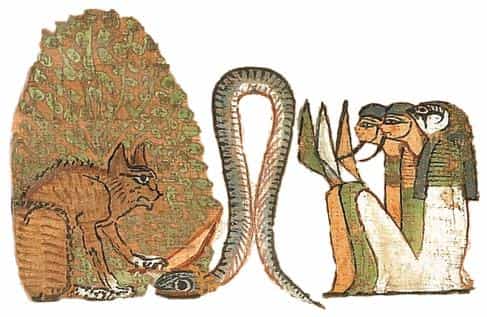
When confronted by this darkness, he began to cry, and humanity was born from his tears. Neith also gave birth to the serpent Apophis (Apep). Apophis and Ra were in constant conflict, clashing night after night.

Ra, whether as Atum-Ra or Amun-Ra, was not only the god of the sun but also the ruler of both gods and humans. Ra, and later his sons, reigned on Earth. The eye of Ra watched and observed everything, sparing nothing from its gaze.

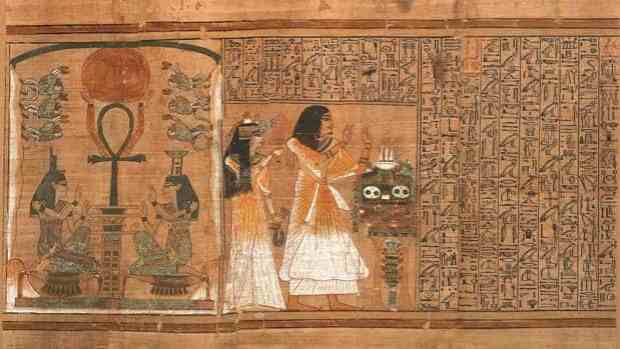
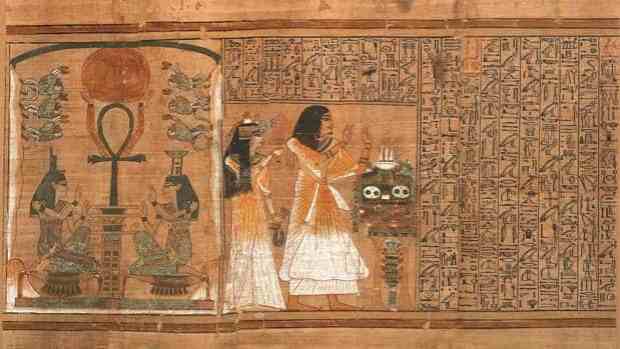
The fascinating story of the Papyrus of Ani, one of the most spectacular scrolls of the Book of the Dead

The fascinating story of the Papyrus of Ani, one of the most spectacular scrolls of the Book of the Dead

The Papyrus of Ani is one of the best-known versions of the Book of the Dead. It is believed that it was written about the nineteenth dynasty.

Among other things, its importance is because it contemplates the largest number of chapters among all the texts that have been found, explaining in detail the judgment of Osiris, a moment in which the soul of the deceased faces a judgment on the conduct of his past life.

The ancient Egyptians had a lot of respect for death. They cared more about the afterlife than the present one. For this reason, those who could afford it, as it was very expensive, did not hesitate to purchase their own Book of the Dead.

They could be made to order, thus bearing the name of the deceased and having previously chosen the spells for his papyrus. On the other hand, series of the Books of the Dead were also frequent, in which space was left to place the name of the deceased (they would obviously be cheaper).

Taking this into account, we can affirm that Ani was someone of great relevance. In the text, it is already said that he was a scribe, and the truth is that the scribes enjoyed an excellent social position at that time.

The text thus reveals that Ani was a “true royal scribe and administrator of the divine offerings of all the gods”, “Governor of the granary of the lords of Abydos and scribe of the divine offerings of the Lords of Thebes,” and “Beloved of the lord of the north and south”.

All this makes us see that he was of a high rank and that his position allowed him to pay for such a complex and elaborate book.

Egyptologists believe that the book was written by three different scribes. This is because three very different spellings can be identified, although it is true that they are from the same school and that one of them stands out above the other two.

On this occasion, the text was adapted to the images, as can be seen in the changes of signs, repetition of chapters, and omission of others. This was unusual for this type of book.

The book itself is nothing more than a perfect manual of the steps that the ka of the deceased must follow in the Duat. A Guide to the Perils of the Path to Judgment with Osiris. Thus, this book would have been called the book of eternal awakening.

Although approximately twenty-five thousand different copies of the Book of the Dead have been found, this papyrus of Ani is, without a doubt, one of the best-preserved copies. Therefore, the book itself has been a great source of knowledge about the religiosity of the ancient Egyptians.

The “strange” find of the papyrus

Discovered in the tomb of Ani at Thebes (nineteenth dynasty ca. 1250 BC), it recounts the journey to the afterlife of this high official and royal scribe together with his wife, the priestess Tutu.

It was purchased by the controversial Ernest Wallis Budge (1857-1934). Given the “strange” circumstances by which the piece was taken, the authorities of the Antiquities Service surrounded the Egyptologist’s house to seize the pieces. But Budge did not flinch, and he evaded the pieces.

In order to more easily take out the papyrus from the country, he cut its more than twenty-three meters into thirty-seven fragments, which are the ones that can be seen today in the British Museum in London.

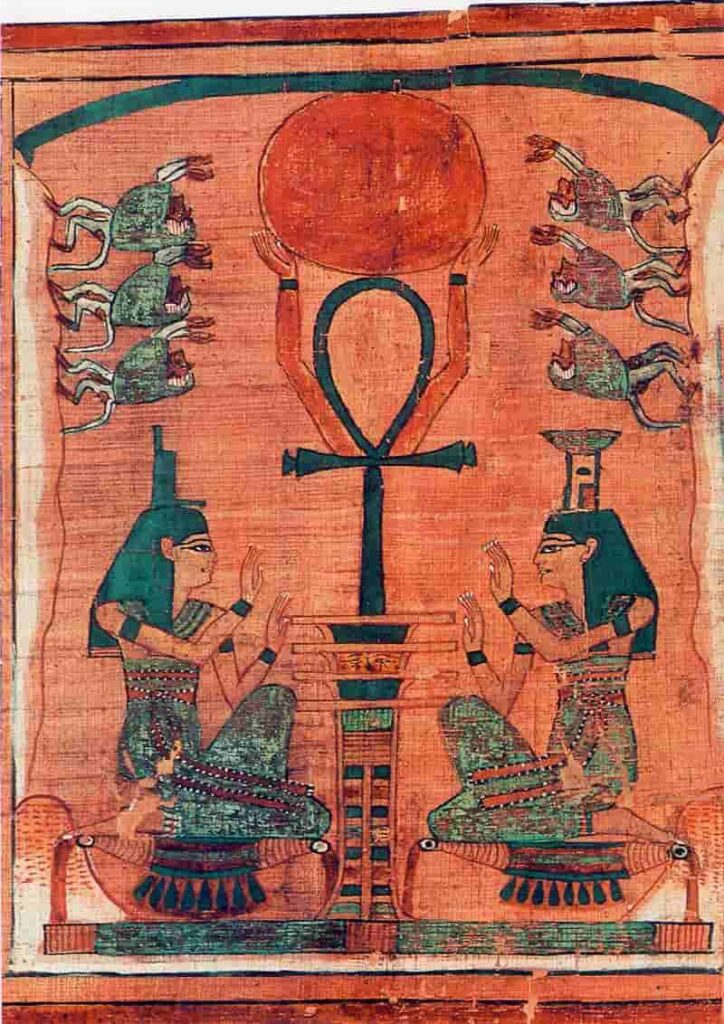
Isis and Nephthys before Osiris, in the form of a Djed pillar. Papyrus of Ani.


Theosophy | ANAMNESIS – II

 The Gita presents a magnificent portrait of the man of meditation who has all his senses and organs under complete control. Whatever he does, he remains seated like one unaffected and aloof (kutastha). He does not identify with any of the instruments musically necessary for the creative transformation of the cosmic process. The Religion of Responsibility is rooted in Ṛta, sattvic motion in unmanifested Nature, and it makes sattvic consciousness (dharma) accessible to imperfect individuals. A human being who valiantly journeys in consciousness behind and beyond the visible process of Nature — like a ballerina in Stravinsky’s “Rite of Spring” becoming Spring itself while remaining a single character in the concordant ballet — maintains a joyous and silent awareness of the whole process while coolly functioning at various levels with deft dexterity. All human beings, insofar as they can smoothly function at diverse levels of precise control and painless transcendence, can attain to firm fixity of mind and serene steadfastness of spirit — the sacred marks of initiation through sattvic ideation in the secret heart. Sattvic knowledge is the invisible common thread transcending all apparent differences. It gives support to rhythmic activity which is simultaneously precise, liberating and intrinsically self-validating, without the creeping shadow of inconstancy.

 The self of the individual who is sattvic is integrated with the Self which surveys the whole world with its congeries of forms and objects, whilst seeing all of these appearances in local time and visible space as evanescent parts of a continuous process of interconnected if conceptually discrete causes and consequences. This is like a mighty river that flows from a hidden stream issuing from a sacred source in the depths of the highest mountain ranges. Dnyaneshvari offers an apt analogy which applies both to anamnesis and to Turiya-Sattva. Just as when a stream becoming a river empties itself into the great ocean, so too will individual consciousness when it withdraws itself from its reflected sense of ‘I-ness’ within the world of insupportable illusions. When the principle of self-consciousness initiates this inner withdrawal, it quietly empties itself into the great ocean of primordial light, Daiviprakriti, universal and self-luminous consciousness. Yet at the same time it remains active within Hiranyagarbha, the pristine golden egg of immortal individuality, cosmic and trans-human.

 From the standpoint of the man of meditation, light and darkness are archetypal categories applicable at many levels. Philosophically and mystically, darkness at the level of inversion is chaos, and light as we understand it in nature is associated with the illumination of a field of consciousness. Psychologically, for many sad souls darkness is the deepening shadow of loneliness, and light shines as the resplendent vision of human brotherhood and the spiritual solidarity of all that lives. This can become a glorious vision of enduring hope, invulnerable faith and unwavering affirmation. Rodin’s well-known simile in stone suggests that the pilgrim-soul and weary toiler is plunged in deep thought. All such persons are asking the oldest question — “Who am I?” Significant trends are emerging across the globe, and the crisis is aggravated by the breakdown of alternatives everywhere and especially in the North American continent. Light and darkness refer to every revivified conception of what is real, what is abstract and what concrete in the vast field of unilluminated objects and hazy memories, the negations and affirmations of consciousness resulting from the repeated negation of a false sense of ‘I’ in a fast-changing world.

The Secret Doctrine offers the ancient analogy of the Sun to the individual emerging out of the cave of avidya in search of Universal Good (SAT). Though difficult to exemplify, a talismanic exercise in practical instruction is conveyed. Close your eyes, and from the depths of inmost consciousness travel outward to the extremest limits in every direction. You will find equal lines or rays of perception extending evenly in all directions, so that the utmost effort of ideation will terminate in the vault of a sphere. Think of yourself as within a numinous golden egg, a divine sphere. Close your eyes, draw within, behind and beyond your own shadowy conception of yourself, behind the superficial and self-limiting images of the mind’s surface, cast there by the lunar activity of the world, and eclipse your own restless lunar self.

 As you withdraw behind your five senses, focus upon the point between your eyes and see that point as only a representation in the physical face of a field of consciousness where there are innumerable points, each of which is at the centre of a radiant sphere formed by a reflection of the fiery substance of the dark ocean of space.

 From the standpoint of your own self-conscious ray of light, try to think outward to the extreme limits of boundless space in every direction. You will find that equal lines or rays of perception will terminate in all directions in the invisible vault of a macrocosmic sphere. The limit of the sphere will be a great circle, and the direct rays of thought in any direction must be right-line radii from a common centre in an immaterial, homogeneous medium. This is the all-embracing human conception of the manifesting aspect of the ever-hidden Ain-Sophwhich formulates itself in the geometrical figure of a circle with elements of continuous curvature, circumference and rectilinear radii. This geometrical shape is the first recognizable link between the Ain-Soph and the highest intelligence of man. The rule proclaimed at the portals of the Pythagorean School and the Platonic Academy limited entry to those who had deeply reflected upon divine geometry.

 According to Eastern esotericism, this great circle, which reduces to the point within the invisible boundless sphere, is Avalokiteshwara, the Logos. It is the manifested God, the Verbum of the Gospel According to St. John, unknown to man except through its manifested universe and the entirety of mankind. The One is intuitively known by the many, although the One is unthinkable by any mode of mere intellection. Reaching within consciousness means going behind and beyond every possible perception and conception, every possible colour and form. Form corresponds to knowledge on the lower reflected lunar plane; colour corresponds to the knower at the level of the reflected ray. The objects of knowledge are merely modifications of a single substance. These do not yield any simple triadic diagram, but involve a gradual ascent within consciousness, in a tranquil state of contemplation, towards the greatest parametric conception of the One. The Logos sleeps in the bosom of Parabrahm — in the Abstract Absolute — during pralaya or non-manifestation, just as our individual Ego is in latency during deep, dreamless sleep. We cannot cognize Parabrahm except as Mulaprakriti, the mighty expanse of undifferentiated cosmic matter. This is not merely a vesture in cosmic creation through which radiate the energy and wisdom of Parabrahm. It is the Divine Ground.

 The Logos in its highest aspect takes no notice of history. The Logos is behind and beyond what appears important to human beings, but the Logos knows itself. That transcendent self-knowledge is the fons et origo of all the myriad rays of self-conscious, luminous intelligence focused at a certain level of complexity in what we call the human being, rays which, at the same time, light up the infinitude of points in space-time. As the Logos is unknown to differentiated species, and as Parabrahm is unknown to Prakriti, Eastern esotericism and the Kabbalah alike have resolved the abstract synthesis in relatively concrete images in order to bring the Logos within the range of human conception. We have images, therefore, such as that of the sun and the light, but there is freedom through concentration, abstraction and expansion, while there is bondage through consolidation, concretization and desecration. The Logos is like the sun through which light and heat radiate, but whose energy and light exist in some unknown condition in space and are diffused throughout space as visible light. If one meditates at noon on the invisible midnight sun, which sages reflect upon in a calm state of ceaseless contemplation, and if one remains still and serene, one could exercise the privilege of using the divine gift of sound. The sun itself is only the agent of the Light in The Voice of the Silence. This is the first triadic hypostasis. The Tetraktys is emanated by concentrating the energizing light shed by the Logos, but it subsists by itself in the Divine Darkness. A tremendous light-energy flows from the deepest thought, wherein one continuously voids every conception of the reflected ray of egoity or the individual self, all objects and universes, everything in what we call space and time. Thus the individuating mind enters subtler dimensions, through which it can approach universal cognition in a resplendent realm of noumenal reality, opening onto a shared field of total awareness in Mahat, wherein the self-consciousness of divine wisdom (Vach) is eternally enacted by self-luminous Mahatmas, the Brotherhood of Light.

Raghavan Iyer
The Gupta Vidya II

Theosophy | ANAMNESIS – I

Since, then, the soul is immortal and has been born many times, since it has seen all things both in this world and in the other, there is nothing it has not learnt. No wonder, then, that it is able to recall to mind goodness and other things, for it knew them beforehand. For, as all reality is akin and the soul has learnt all things, there is nothing to prevent a man who has recalled — or, as people say, ‘learnt’ — only one thing from discovering all the rest for himself, if he will pursue the search with unwearying resolution. For on this showing all inquiry or learning is nothing but recollection.

Plato

 Anamnesis is true soul-memory, intermittent access to the divine wisdom within every human being as an immortal Triad. All self-conscious monads have known over countless lifetimes a vast host of subjects and objects, modes and forms, in an ever-changing universe. Assuming a complex series of roles as an essential part of the endless process of learning, the soul becomes captive recurrently to myriad forms of maya and moha, illusion and delusion. At the same time, the soul has the innate and inward capacity to cognize that it is more than any and all of these masks. As every incarnated being manifests a poor, pale caricature of himself — a small, self-limiting and inverted reflection of one’s inner and divine nature — the ancient doctrine of anamnesis is vital to comprehend human nature and its hidden possibilities. Given the fundamental truth that all human beings have lived many times, initiating diverse actions in intertwined chains of causation, it necessarily follows that everyone has the moral and material environment from birth to death which is needed for self-correction and self-education. But who is it that has this need? Not the shadowy self or false egoity which merely reacts to external stimuli. Rather, there is that eye of wisdom in every person which in deep sleep is fully awake and which has a translucent awareness of self-consciousness as pure primordial light.

 We witness intimations of immortality in the pristine light in the innocent eye of every baby, as well as in the wistful eye of every person near the moment of death. It seems that the individual senses that life on earth is largely an empty masquerade, full of sound and fury, signifying nothing. Nevertheless, there is a quiet joy in the recognition that one is fully capable of gaining some apprehension not only of the storied past but also of the shrouded future by a flashing perception of his unmodified, immutable divine essence. If one has earned this through a lifetime of meditation, one may attain at the moment of withdrawal from the body a healing awareness of the reality behind the dense proscenium of the earth’s drama.

 Soul-memory is essentially different from what is ordinarily called memory. Most of the time the mind is clouded by a chaotic association of images and ideas that impinge upon it from outside. Very few human beings, however, are in a position to make full use of the capacity for creative thinking. They simply cannot fathom what it is like to be a thinking being, to be able to deliberate calmly and to think intently on their own. Automatic cerebration is often mistaken for primary thinking. To understand this distinction, one must look at the fundamental relation between oneself as a knower and the universe as a field of knowledge. Many souls gain fleeting glimpses of the process of self-enquiry when they are stilled by the panoramic vistas of Nature, silenced by the rhythmic ocean, or alone amidst towering mountains. Through the sudden impact of intense pain and profound suffering they may be thrown back upon themselves and be compelled to ask, “What is the meaning of all of this?” “Who am I?” “Why was I born?” “When will I die?” “Can I do that which will now lend a simple credence to my life, a minimal dignity to my death?”

 Pythagoras and Plato taught the Eastern doctrine of the spontaneous unfolding from within of the wisdom of the soul. Soul-wisdom transcends all formal properties and definable qualities, as suggested in the epistemology, ethics and science of action of the Bhagavad Gita. It is difficult for a person readily to generate and release an effortless balancing of the three dynamic qualities of Nature — sattva, rajas and tamas — or to see the entire cosmos as a radiant garment of the divine Self. He needs to ponder calmly upon the subtle properties of the gunas, their permutations and combinations. Sattvic knowledge helps the mind to meditate upon the primordial ocean of pure light, the bountiful sea of milk in the old Hindu myths. The entire universe is immersed in a single sweeping cosmic process. Even though we seem to see a moving panorama of configurations, colours and forms, sequentiality is illusory. Behind all passing forms there are innumerable constellations of minute, invisible and ultimately indivisible particles, whirling and revolving in harmonic modes of eternal circular motion. A person can learn to release anamnesis to make conscious and creative use of modes of motion governing the life-atoms that compose the variegated universe of his immortal and mortal vestures.

 The timeless doctrine of spiritual self-knowledge in the fourth chapter of the Bhagavad Gita suggests that human beings are not in the false position of having to choose between perfect omniscience and total nescience. Human beings participate in an immense hinterland of differentiation of the absolute light reflected within modes of motion of matter. To grow up is to grasp that one cannot merely oscillate between extremes. Human thought too often involves the violence of false negation — leaping from one kind of situation to the exact opposite rather than seeing life as a fertile field for indefinite growth. This philosophical perspective requires us to think fundamentally in terms of the necessary relation between the knower and the known. Differences in the modalities of the knowable are no more and no less important than divergences in the perceptions and standpoints of knowers. The universe may be seen for what it is — a constellation of self-conscious beings and also a vast array of elemental centres of energy — devas and devatas all of which participate in a ceaseless cosmic dance that makes possible the sacrificial process of life for each and every single human being. If one learns that there are degrees within degrees of reflected light, then one sees the compelling need to gain the faculty of divine discrimination (viveka). That is the secret heart of the teaching of the Bhagavad Gita.

 The Gita is a jewelled essay in Buddhi Yoga. Yoga derives from the root yog, ‘to unite’, and centres upon the conscious union of the individual self and the universal Self. The trinity of Nature is the lock of magic, and the trinity of Man is the sole key, and hence the grace of the Guru. This divine union may be understood at early stages in different ways. It could be approached by a true concern for anasakti, selfless action and joyous service, the precise performance of duties and a sacrificial involvement in the work of the world. It may also be attempted through the highest form of bhakti or devotion, in concentrating and purifying one’s whole being so as to radiate an unconditional, constant and consistent truth, a pure, intense and selfless feeling of love. And it must also summon forth true knowledge through altruistic meditation. Jnana and dhyana do not refer to the feeble reflections of the finite and fickle mind upon the finite and shadowy objects of an ever-evolving world, but rather point to that enigmatic process of inward knowing wherein the knower and the known become one, fused in transcendent moments of compassionate revelation. The pungent but purifying commentary by Dnyaneshvari states in myriad simple metaphors the profoundest teaching of the Gita. In offering numerous examples from daily life, Dnyaneshvari wants to dissolve the idea that anything or any being can be known through a priori categories that cut up the universe into watertight compartments and thereby limit and confine consciousness. The process of true learning merges disparate elements separated only because of the looking-glass view of the inverted self which mediates between the world and ourselves in a muddled manner. The clearest perception of sattva involves pure ideation.

Raghavan Iyer
The Gupta Vidya II