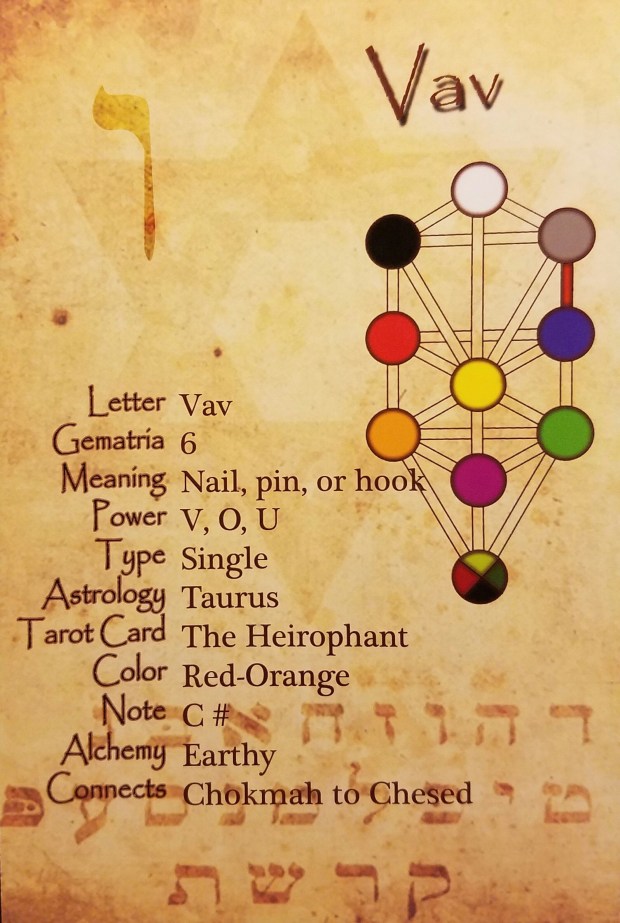
Contemplating Hebrew Letters || Vav (or Vau)

6
vav

yvdyv
Vidui
(Confession)


    When a man or woman who commits any of man’s sins, by committing treachery toward God, and that person shall become guilty—they shall confess the sin that they committed; he shall make restitution for his guilt in its principle amount and add unto it a fifth, and give it to the one to whom he is indebted.


Numbers 5:6–7


    The Jewish concept of confession and atonement for sins is based on this verse from the Bible, in which a person is dishonest regarding financial issues (theft, withholding salary, cheating a person on a loan, and so forth). Because these sins are considered not just an affront to the victim but also to God, God requires the sinner to repent, confess, and pay back the money he’s stolen with interest before he can be forgiven.


    The main prayer service of Yom Kippur, the Day of Atonement, is called the Vidui, which means “confession,” not “atonement.” It may seem odd that the main service of the heart on this holiest day of the year is filled with confessions that the penitent is meant to say aloud, sometimes together with the rest of congregation. After all, isn’t repentance an inner process, a personal discussion one has with God? The answer is yes and no. Although we repent in our hearts, without confession— that is, the act of saying “I have sinned” and admitting our guilt—we’ll never truly repent, gain atonement, or be able to move on, repairing the damage we have done.


    The letter Vav is most commonly known as the prefix used to denote the word “and,” and is seen hundreds of times thought the Bible as such, connecting words and concepts. Vidui serves a similar purpose: Because your past informs your present and future, being honest with yourself—that is, admitting your faults and expressing remorse for the things you’ve done wrong—will help to connect that past to the future in a more productive way. Expressing your guilt out loud and facing the consequences allows you to move on with your life and will help you truly reach a state of self-knowledge.


    It’s especially interesting to note that in Judaism the Vidui is said not only on Yom Kippur, but on one’s wedding day and on one’s deathbed. At traditional Jewish weddings, the bride and groom immerse in the mikveh (ritual bath), fast for the day leading up to their wedding, and recite Yom Kippur prayers just before they go to their ceremony. The bride also traditionally wears a white dress and the groom a white robe, called a kittl, which will in the future be worn to synagogue on Yom Kippur every year and eventually serve as his clothing for burial. The wedding day is known as a personal Yom Kippur for the couple, a day to reflect on their lives up until this point, realize what was lacking in those lives, and purify themselves both physically and spiritually for the future.


    The connections—the Vavs—between these three moments in life (the Day of Atonement, marriage, and death) are more than symbolic. The Vidui brings us to a place of purification and self-awareness that is crucial in every major life-changing event. Recognizing your shortcomings once a year, working toward a clean slate with which to start your married life, and making peace with God before you die are all essential elements of a truly fulfilled existence.


    The Vav card comes to you in times when it’s important to make a confession of some kind. This need not be a “sin” and isn’t a sign of any shortcomings. It’s just that from time to time we all need to admit certain truths to ourselves, to face up to our actions out loud, and accept responsibility for what we’ve done.


    The past will haunt you until it’s been properly dealt with, so don’t wait to take control of your life. Allow yourself to say what needs to be said. The rest will follow.
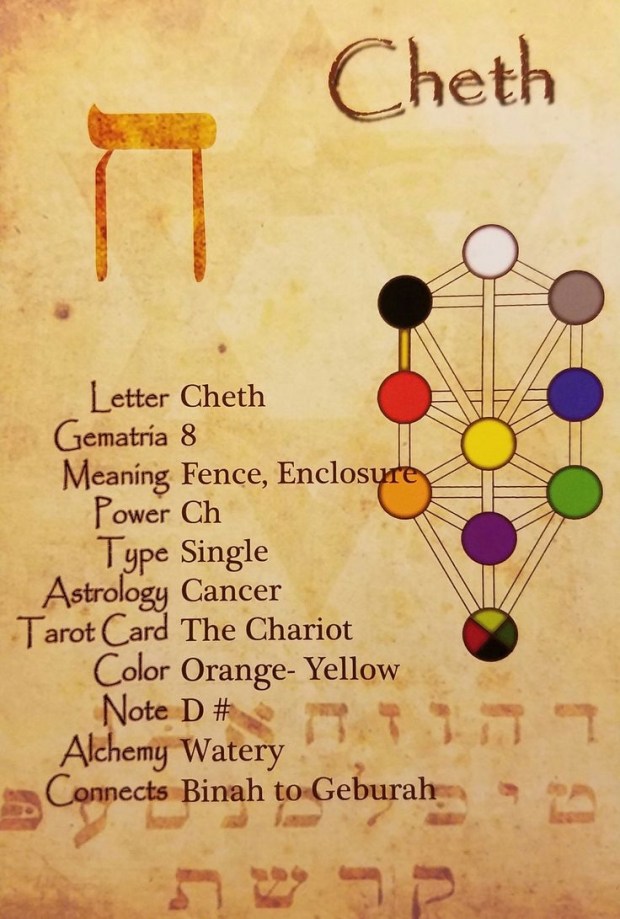
Contemplating Hebrew Letters || Chet

8
chet

hlj
Challah


    . . . when you will eat of the bread of the Land, you shall set aside a portion for God. As the first of your kneading you shall set aside a loaf [Challah] as a portion, like the portion of the threshing-floor, so shall you set it aside.


Numbers 15:19–20


    The Bible mentions the concept of “setting aside” many times: Corners of the field are to be set aside for the poor; the first fruits of every season are to be brought as offerings during harvest festivals; animals are brought as sacrifices in the Temple period; and ten percent of one’s earnings is to be set aside for charity. In this case, Jews are instructed to set aside a portion of the first loaf of every batch of bread they bake for the High Priest.


    Today, when there’s no longer a Holy Temple at the center of Jewish ritual life, and Priests don’t serve the same function, the commandment shifts: A piece of dough is taken from the first batch and thrown into the back of the oven to burn, symbolizing the destruction of the Temple and the exile that exists because of that destruction. There are many customs to reflect the loss of the Temple, such as replacing sacrifices with prayer services, using salt on bread to symbolize the bitterness of living in an imperfect world, and leaving a small part of a newly built home unfinished to commemorate the physical destruction of the Temple structure.


    But “Taking Challah,” as the custom is called, is more than merely preserving an ancient and now practically irrelevant commandment. By physically removing a small piece of dough and making it inedible, eventually discarding it altogether, we remind ourselves that everything we own is temporary. You may think that all of the dough is yours—after all, you paid for the ingredients, mixed them together, and watched them rise— but really, nothing belongs to you alone. You’re given the wheat and the eggs and the water from a higher source, and by letting some of it go, you’re acknowledging that source.


    The root of Challah actually has nothing to do with bread (which is called, in Hebrew, lechem). Instead, the root is chol, which means “ordinary.” The days of the week are separated into Shabbatand chol, Sabbath and weekday. Challah, a food made holy despite its ordinary origins, is made especially to be eaten on the Sabbath. Something as plain as wheat is elevated to a level at which it can be blessed and sanctified as an integral part of the Sabbath meal.


    The concept of Challah extends into our daily lives: We all need to learn the kabalistic lesson of sharing in order to balance the energy of the universe. What we own is never entirely ours, and we could never truly need every single object in our possession. It’s crucial to make giving a part of our consciousness, whether it is to acknowledge the higher force that guards us all, to remember the harsher realities of life, or to give thanks for what we already have.


    The Chet card comes to teach us how we can let go of what we do not need. We can survive on bread and water alone, yet we rely on incredible luxuries as if they were necessary.


    It’s time to let go. Donate clothes you no longer wear to a homeless shelter; take food supplies to a soup kitchen; make a list of your dependencies, and then set the list aflame. You will feel an increased freedom as a result.

Contemplating Hebrew Letters || Samech

15
samech

ynyo rh
Har Sinai
(Mount Sinai)


    On the third day when it was morning, there was thunder and lightning and a heavy cloud on the mountain, and the sound of the shofar [ram’s horn] was very powerful, and the entire people that were in the camp shuddered. Moses brought the people forth from the camp toward God, and they stood at the bottom of a mountain. All of Mount Sinai was smoking because God had descended upon it in the fire; its smoke ascended like the smoke of a furnace, and the entire mountain shuddered exceedingly. The sound of the shofar grew continually much stronger; Moses would speak, and God would respond to him with a voice.


Exodus 19:16–19


    Imagine being there at Sinai: Hundreds of thousands of people, slaves until just a few months before, are gathered together at the foot of a mountain in the desert—and smoke, fire, thunder, lightning, and the sound of the shofarblasting all lead up to the overwhelmingly awesome sound of the voice of God. How do you think this experience would make you feel?


    Legend has it that only the first two of the Ten Commandments were given directly by God, and the last eight had to come through Moses. The people were too overwhelmed by their first direct access to God to handle the situation—so, since they were familiar with his voice and it intimidated them less, they begged Moses to speak instead. (Although, as Bible scholars point out, every individual heard God’s voice differently, according to his or her own capacity and individual understanding, the direct experience of communication with the Divine proved to be more than they could handle.)


    There’s a tradition in Judaism that every single person in the world was at Sinai, and that those same souls have been reincarnated over and over again throughout the generations, even until today. That’s why this scene of the first mass Revelation in history is so compelling to us even now. There’s something in our souls that connects us to this event, remembers the fear that accompanied the excitement, and recognizes that in our most original state of being, we experienced it firsthand.


    The Samech is shaped like a circle, and it represents protection and safety. Although on some level they’re terrified, the people at Mt. Sinai also sense (though perhaps only subconsciously), that they’re going to be fine. When Moses hears their cries and takes over the enunciation of God’s words, the people are able to shield themselves from the frightening and foreign experience and take comfort in the familiar voice of their leader.


    Only once the sound shifts from the mighty, ethereal voice of God to the human one of Moses are the people truly able to comprehend the deeper meaning of the Revelation. Like a perfectly round wedding ring, the experience of Sinai is binding and limitless at the same time, extending to every generation through endless reincarnations. Although the people now have concrete rules and regulations, and have accepted upon themselves the responsibility to live accordingly—which might seem like a burden—they’ve also been guaranteed the ultimate protection and guidance of their God. As if they’re inside a metaphoric Samech, the people are now safely bound within the guidelines of their society, comforted by the permanence of it all.


    The Samech is your key symbol of safety and protection. Whether you’re in a place of transition or going about your daily routines without interruption, you may now and then feel like a lost lamb, unsure of your place in the world.


    Even when good things happen, we tend to question them and their place in the “bigger picture” of our lives. But the Samech reminds us that we’re always enclosed within the protective embrace of a higher force.


    Conjure up the experience of Sinai: Hear the foreign voice from above changing your reality day by day. You can conquer your fears and anxieties and quell your pride by focusing on the energy of the Samech.


    Remember that everything is part of the universal circle of life. The experience you have today leads to the one you’ll have tomorrow and so forth throughout lifetimes, and everything is just as it should be.

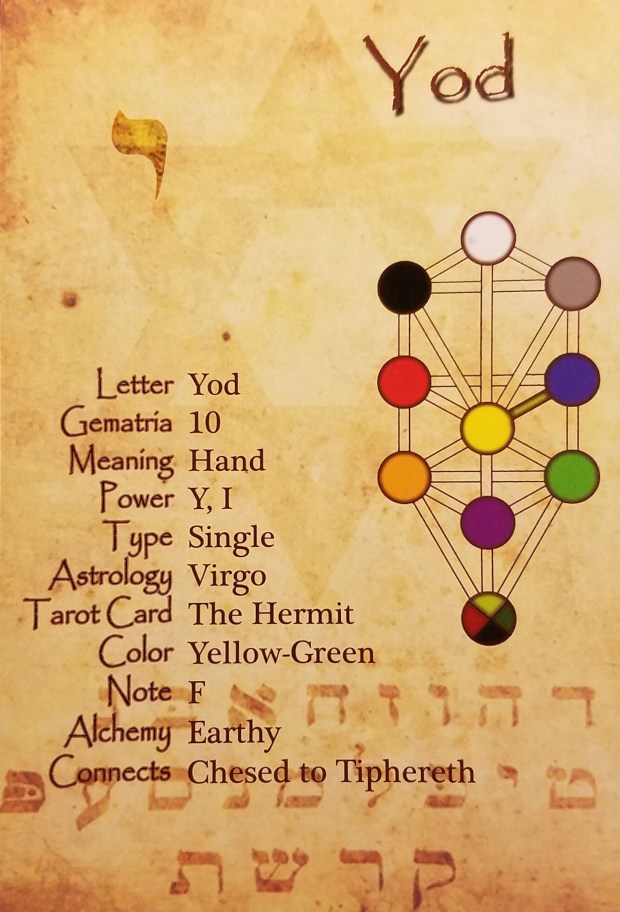
Contemplating Hebrew Letters || Yod

10
yod

PMvy
Yosef
(Joseph)


    Then Joseph said to his brothers, “Come close to me, if you please,” and they came close. And he said, “I am Joseph your brother—it is me, whom you sold into Egypt. And now, be not distressed, nor reproach yourselves for having sold me here, for it was to be a provider that God sent me ahead of you. For this has been two of the hunger years in the midst of the land, and there are yet five years in which there shall be neither plowing nor harvest. Thus God has sent me ahead of you to ensure your survival in the land and to sustain you for a momentous deliverance.”


Genesis 45: 4–8


    The story of Joseph is one of the most dramatic in all of history. Born to Jacob as the first child of his beloved wife, Rachel, Joseph is one of the 12 sons who will comprise the 12 tribes of Israel. But Joseph is unlike his brothers who are the sons of Leah and two maidservants— he’s clearly the favorite and the spiritual inheritor of the family. He and his younger brother, Benjamin, who was born to Rachel just before her death, have always been treated differently than the other ten boys.


    When, as a teenager, Joseph begins to have dreams of superiority—dreams in which he foresees that his brothers will one day bow down to him—his siblings decide that they’ve had enough of this “dreamer.” They throw him into a dark pit and sell him into slavery. Afterward, they take his special multicolored tunic and soak it in blood as “proof” that he’s been killed. They then return to Jacob and report their brother’s “death.”


    However, rather than fading into obscurity and a life of slavery, once in Egypt Joseph is able to use his talents to rise to the top, interpreting dreams and gaining a reputation that will lead him to the Pharoah’s palace to interpret the ruler’s inexplicable visions. When Joseph is able to see the hidden message in the Pharaoh’s dreams of seven skinny cows eating seven fat ones as the sign of seven years of plenty followed by seven years of famine, he’s promoted to be the Pharaoh’s second in command and makes his way into the Egyptian leadership at a crucial time in history.


    When the famine begins, Jacob sends his remaining sons to Egypt to gather provisions—and they come into contact with the brother they’d betrayed so many years ago. Not recognizing Joseph as an adult, his brothers bow down to the man they see as an Egyptian leader.


    After many months of testing the men and sending them back and forth from Egypt to Canaan, Joseph finally reveals himself as their long-lost brother and sends for his father. After all this time, his original dream has finally come true: He’s established himself in such a position of power that his brothers bow down to him, and they fear his revenge. But rather than express his anger and pain, Joseph tells them that he’s come to realize that everything leading up to this point— their jealousy and their plot against him, his time served as a slave, and so forth—was all meant to be, because as a result, he was able to provide food for the family in a time of overwhelming famine.


    Most of us cannot imagine being as “big” as Joseph was under the circumstances. Our anger over past wrongs becomes the dominant force in our actions. But Joseph, perhaps because of the amount of time that had passed, or because of his innate sense of the predestined nature of the world, looks at his reunion differently: He does want to make sure his brothers are sorry for their actions, but once he senses their remorse he seems to let go of his own anger and need for revenge. In this way, Joseph is able to focus on the present instead of the past, willing to move forward with his now reunited family.


    Joseph’s whole life has been one of dreams and their fulfillment. Having been born a dreamer, he’s known all along that the images he saw in his mind weren’t just figments of his imagination but signs of things that would actually come about in real life. As a young man, this awareness was looked at as snobbery, but as a mature adult, sobered by his difficult experiences, his gift was appreciated and led to the ultimate reunion of his family.


    The Yud, as the smallest letter in the alphabet, is often thought about as a “point.” This tiny point lies at the center of our hearts—it’s the driving force that takes us from one stage of life to another, the motivation that follows us through every action we perform. Joseph suffered for his essential point (his talent), but with time it became clear to everyone that he was not just a dreamer but a prophet, and that all of his dreams would one day become reality.


    The Yud appears in moments of spiritual or physical darkness. Like Joseph, you’ve been cast into a metaphorical pit and must redefine your life. You may feel misunderstood, underappreciated, or simply confused—the only way out of this darkness is by recognizing the small point in your soul that leads you forward in life.


    Joseph teaches the power of believing in yourself. You must always know that your life is full of purpose, and that everything that happens to you occurs for a reason. The key to personal fulfillment lies in recognizing your uniqueness and then learning how to apply your special talents in order to change your world and come to an enlightened understanding of your past, present, and future.


    Meditate on the power of forgiveness. Strive to be more like Joseph, who, as a result of forgiving his brothers for their actions, pulls his family together again.

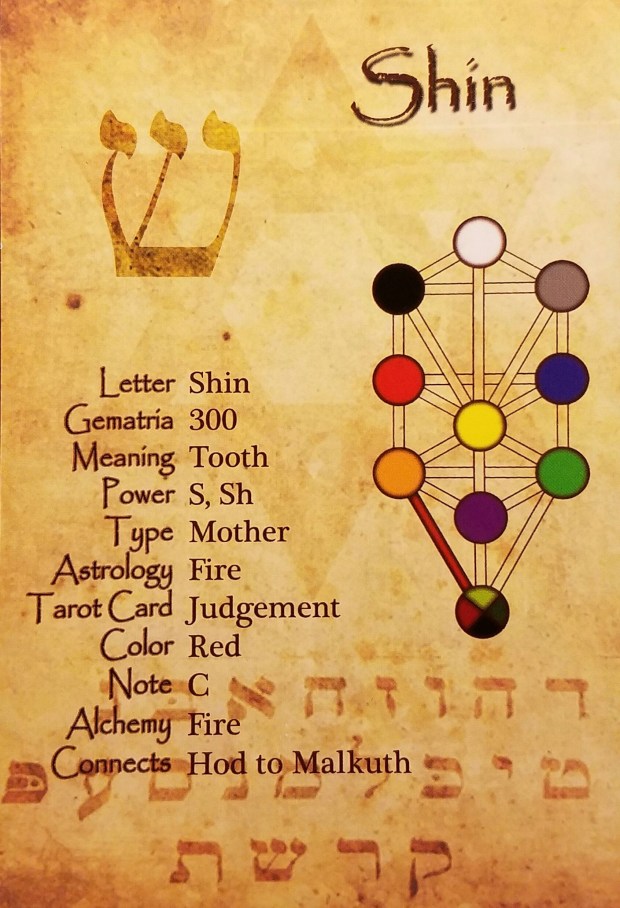
Contemplating Hebrew Letters || Shin

21
shin

Shema Yisrael
(Hear, O Israel)

    Hear, O Israel: The Lord is our God, The Lord is One.

Deuteronomy 6:4

    This single line, Shema Yisrael, Adonai Eloheinu, Adonai Echad, is considered the cornerstone of Jewish faith. The first prayer taught to young children and the last prayer recited on one’s deathbed, in its simplicity and brevity this line captures the ultimate lessons of life: God is One, we are One, everything is Oneness. Described throughout the ages as the ultimate meditation tool and declaration of faith, the Shema, as it is known, is one of the most important sentences in the world.


    Before the Jews finally enter the Land of Israel after 40 years of wandering in the desert, Moses recaps their experiences since the Exodus. He recounts the revelation at Mount Sinai and the giving of the Ten Commandments, and then proceeds to explain those commandments in preparation for living in a world where they will be relevant. In the midst of this he utters the Shema, followed by the instructions: “You shall love the Lord, your God, with all your heart, with all your soul, and with all your resources” (Deut. 6:5).


    What we learn from this is that faith is not just a matter of belief but of totality. To believe is to feel it on every level—emotional, spiritual, practical, and even physical (the Shema is inscribed in the scrolls kept inside mezuzahs, traditional ornaments affixed to the doorposts of homes).


    In order to really say the Shema, you have to be convinced of it on every level. In fact, if you look at the Hebrew text as it is written on a Torah scroll, you’ll see that the last letters of both the first word and the last word of the sentence—Ayin and Dalet—are written twice as big as the other letters in the line. When you put the Ayin of Shema and the Dalet of Echad together, you get the word Ayd, which means “Witness.” Only if you are truly a witness to something can you fully comprehend it. And to truly hear what this prayer is about, you must witness its power for yourself.


    The Shin is the first letter of the words Shalom(“peace”) and Shalem (“complete” or “whole”), so to feel like a complete person is to be at peace with oneself. To feel the wholeness of the universe—the single life force that propels all of us and the world around us—is to also find peace, to hear the lessons of the universe explained.


    Traditionally, this prayer is said sitting down, with one’s eyes closed and the right hand covering them. Each word should be said slowly and focused on, one at a time. Doing this blind meditation teaches us to slow down, to minimize, to block out all outside interference, and to recognize that everything comes down to the single, original source of energy and light. In other words, despite our diverse backgrounds, we all come from the same place. When we truly recognize that unity is the goal of all life, that reconnecting with our origins is essential, we will have achieved wholeness.


    The Shin is the beacon of peace and wholeness. By focusing on the Shemameditation, you can truly connect with the Oneness that is central to Kabala. Hear the lesson and make the statement true for yourself.


    Realize that in the end, we all come from the same source. Close your eyes and focus on the light of creation . . . know that you are part of that light—we all are. You can find peace when you truly accept this principle and witness it for yourself.

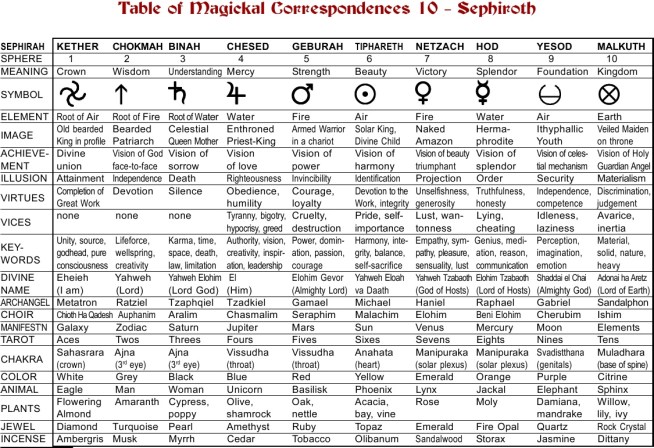
Why is Yesod in Air and Hod in Water?

A common query among those working the Golden Dawn system is why the Sephirah Yesod (and Theoricus) is attributed to Air instead of Water (after all, it is linked with the Moon, which affects the tides), and why the Sephirah Hod (and Practicus) is attributed to Water (when it is also assigned to the more intellectual, or airy, planet of Mercury). It almost seems like it’s reversed, an apparent elemental inconsistency.  […]

Source:  Yesod In Air, Hod In Water

The Tribe of Dan – ROBERT SEPEHR

To the Germans he was known as Votan. To the Anglo-Saxons Woden. To the Norse and other Scandinavians, he was known as Odin. A Reuters News Agency report from Nov. 30, 2001: “The Viking god Odin may have been a real king who lived in what is now southern Russia 2,000 years ago, Norwegian explorer Thor Heyerdahl said in a controversial new book … […]

Source:  The Tribe Of Dan

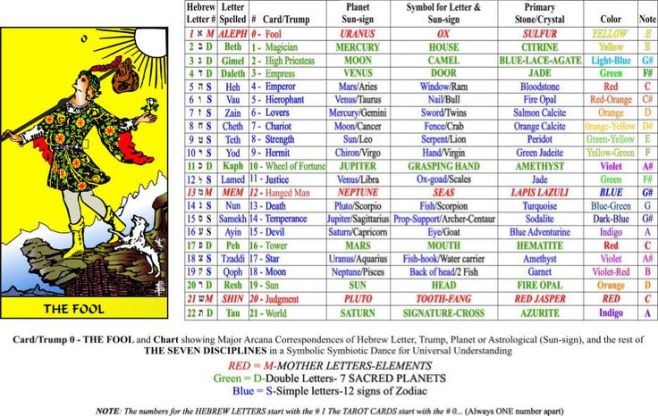
Concerning the Literal Qabalah and the Methods of Gematria, Notaricon and Temurah

The Hebrew Alphabet, as previously explained, has a numerical basis, so that, in truth, every Word as well as every Letter is really expressive of a number. Again, any two Words having a similar Numerical Value may be said to have a natural affinity through their vibration. This is the basic idea of what is called GEMATRIA and upon it a system of interesting Correspondences has been built up, especially in regard to the Hebrew Scriptures and other Qabalistic writings, wherein a Word or even a Sentence may be made to disclose some hidden meaning (often concealed in that way by the writer) by finding the numerical correspondence between it and other words or sentences of like value.  […]

Source:  Cabala and Gematria


Cracking the Code to Discover Ancient Tarot Symbolism and Forgotten Universal Knowledge

How old is the Tarot? This is a question that seems easy to answer today. As playing cards, we can confidently map the Tarot to the early 15th century. Mystery solved? Well, it’s not quite that simple.  […]

Source: Cracking the Code to Discover Ancient Tarot Symbolism and Forgotten Universal Knowledge

Doreen Dotan’s Archive on BlogSpot

B”H

This blog is a compendium of my thoughts on various topics. These are my private writings. *No portion of any of the material here may be recopied or used in any way without my express written permission.

* CONTACT: DoreenDotan@gmail.com

For Sunday, August 19, 2018

ב”ה

אפרים

אפרים = 891 = אף פי = פי ארם = פרי אם
= לבית המקדש = לראש השנה
= חזון לפני = חזון לעיני
= כאן לפני = כאן לעיני = הרועים = הצופים על
= אפקים על = הביט עמוק אל תוך העולם
= 1890 = 891 = כל חזון ישעיהו בן אמוץ הנביא
= 2889 = 891 = היות קרקע = לבית המקדש

בית המקדש = 861 = לחוזרים = אסף
= אלף יהודה = ברחם אמי
= חזון הקהל = הקהל כאן = חזון עיני
= ראש השנה = המחשבה אשר

Hebrew Torah and Gemetria | Our Father, by Doreen Bell-Dotan

B”H

This is far more of the Truth about what the Hebrew word אבינו , pronounced Avinu, contains than what the Christians have been told. I cannot demonstrate the whole Truth of it, because that is infinite. I will prove the most important points – the inclusivity of the term that speaks of the entire Holy Family.

This demonstration, and the Hebrew *proofs* of what is said herein, should be shared with experts in Hebrew who can verify that what I say is what the Hebrew language says about this term. Try me. Consult with those who know Hebrew. See for yourselves if this is the Truth or not.

One more thing: The Hebrew word מלכנו, pronounced Malkeinu, which is translated as Our King, is equal to 146, which the value of the expression המלכה אמה, The Queen is Her Mother and קולי, which means my voice.