Body (Nephesch), Mind (Ruach) and Spirit (Neschamah)
The Tree teaches us that what we perceive, whether it is the world around us, or our mental processes, is only an image in Yetzirah of the Tree of Life and the Reality it creates. In this it conforms to the Buddhist concept of Maya. The world is not an illusion, but it is illusory. Compare it to watching a TV show about Paris; in all respects, what it conveys is a good image of what is really there, but it is a limited view and fails to convey a huge proportion of the real experience. So (even moreso!) with our perceptions; our experience of Reality is at one (very large!) remove. If we had cyclotrons instead of eyes and ears, we would see a dance of subatomic particles – this image would be just as ‘real’ as what we see now, but stars and humans and music would have disappeared into a cloud of quantum froth. And it would still be only an image of the Real. For Qabalists, the primary reality of the Universe is the Tree of Life. What can possess people (like me!) to regard something that can’t be seen as ‘more real’ than anything that can be? The answer is that the Tree models so much of what we know about the world. When a single hypothesis has the ability to describe so much of what we see, how can it be ignored? 
This essay looks at what the Tree has to say about our perception of ourselves – particularly, what is meant by the ‘soul’.
According to the traditional teachings of Qabalah, we have three (or five) souls.
The Nephesch is the soul of our physical makeup;
the Ruach of our mental faculties;
and, above (beyond) these is the Neschamah, which could be called the Spirit.
This is sometimes subdivided into 3 parts; Neschamah, Chiah and Yechidah.
The Nephesch
The most obvious characteristic of our identity is our body. This is, effectively, how we see the Nephesch, the first of the Qabalistic ‘souls’. If you are familiar with the writings of Rupert Sheldrake, regard it as a Morphic Field. It is not immutable or immortal – it comes into being at conception and is said to slowly fade away in a matter of days after death. It may be that this is what people see as the ‘aura’. Most who can say that they reflect, or image life processes; Qabalists say the Nephesch guides and develops them. They might be two aspects of the same thing. If there’s a difference, the person seeing the aura might say that a particular feature shows a problem with the body, a Qabalist might say that a feature of the body shows a problem in the Nephesch. As the response would be the same (treat it!), the difference is academic. The Nephesch decides the growth of the foetus – whether a cell becomes part of the eye, or part of the leg and (usually, subject to the vicissitudes of Fate) produces a baby at the end of gestation, and guides its form as it matures. Ageing is primarily a characteristic of the Nephesch, as it gradually loses the ability (or strength) to maintain its form. It is apparent (to me, at least) that what people are doing at wakes, and other similar events, is respecting this separation of the other souls from the Nephesch, and its fading away.
The Neschamah
At the other end of our personal Tree of Life is the Neschamah. Descriptions of its nature and role get decidedly technical and metaphysical, and I’ve never found it greatly productive to dwell upon it (or them, if viewed as three entities). The important things are that the Neschamah is unique to each individual, but closely united to the Divine, is formless, and does not, itself, incarnate – but it is the source of Life. It is beyond (before) such fleeting notions as thought, feeling, memory, habit, intelligence, or any other human characteristic. It’s probably best to think of it as Consciousness, but not the sort of consciousness most of us have; if you think of the consciousness of Neschamah as the sun, our daily consciousness is a 25-watt bulb. This ‘Cosmic Consciousness’ (as some have called it) filters down through the Tree to the level of our everyday awareness. Mystics who have experienced (temporarily or permanently) this state of consciousness have been trying to describe it for millennia and, speaking as I do from the foothills of this mountain range, I do not intend to add to the confusion! I recommend the works of Bernadette Roberts2 in this regard. At one point she describes her world as consisting of only three ‘ingredients’; a smile, the One who smiles, and the one who perceives the smile. Glad we’ve got that cleared up.
So far we have a soul that is definitely incarnate and mortal, which can be attributed to Malkuth (it’s more complex than this, but that’s good enough for current purposes). We have another that is transcendent and immortal, that (with its companions or aspects) can be attributed to the Supernal Sephiroth. Both are aspects of ‘identity’, but the Nephesch is comparatively fleeting.
The Ruach (pl. ‘Ruachoth’)
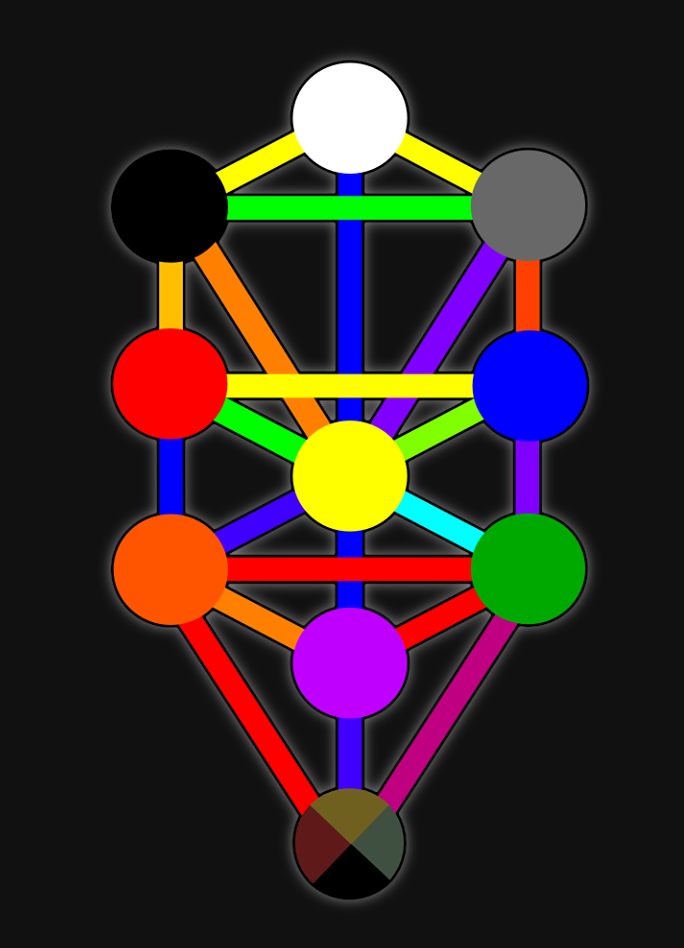
The Ruach links the two other souls via the six Sephiroth, Chesed to Yesod. It can be regarded as the matrix for our mental abilities and faculties, personality, etc., in the same way that the Nephesch does for our bodies. At (or not long before) the quickening of a foetus, the Neschamah unites with the Nephesch; and, at this boundary, the Ruach either forms (as a new individual, probably acquiring some characteristics of previously living beings – usually close relations) or enters (as the incarnation of a pre-existing one).
What do we mean by ‘I’? Disregarding the drastic changes that happen to our bodies during our lives, where is the constant in our minds? We change our beliefs as our understanding grows, our feelings shift from moment to moment. Our thoughts are evanescent and mostly irrelevant. Our memories are unreliable, so we ‘remember’ events that didn’t happen and forget ones that did, and even our consciousness waxes and wanes like the moon. This sense of personal identity, insofar as it is anything more than awareness of existence, comes down to a process, rather than a thing. This is exactly what is taught by the Tree of Life. For the Qabalist, there is a creative process in the Universe that begins with the Divine and, in a fractal process of subdivision, produces what Taoists call the ‘Ten Thousand Things’ – everything that exists. But nothing is created-fullstop; everything is subject to the continuing process of creation, and that means growth, and eventual decay. But a human is Neschamah-Ruach-Nephesch. Mental and spiritual change and growth occur in the Ruach, through its interaction with the other two souls. In the Ruach, growth is produced in the upper Triad of Sephiroth, and its decay is monitored and controlled through the Lower Triad. It’s a good idea to look at these individually.
Chesed:
It’s difficult to find a one-word translation for Chesed; it could be empathy, love, loving-kindness, caritas, or any one of a dozen others. At its most general, it is the impetus to engage and interact positively. When it is not working properly (is disabled in some way, through genetic predisposition, birth defect or abuse by others), it can produce the psychopath and the sociopath, as well as other unusual (and not necessarily desirable) characteristics. Engagement with the world becomes (in one or more respects) limited to introverted ends that take little or no account of human relationships. In the wrong context, this can be extremely dangerous; in other areas, it can provide a focused, talented approach that can be valuable to society. A healthy individual recognises that ‘no man is an island’ and, at least within a small community, will empathise with and support the goals of others. The individual also has the innate desire to engage with virtually all aspects of the world – as parents who have had to grab their child’s fingers out of the fire will know!
Geburah:
When a baby first perceives a desirable object (food, a rattle, etc.) it is just as likely to reach out with its foot as with its hand. Soon it learns that the hand does a better job, and no longer reaches with its foot. This is one of the early manifestations of the growth of Geburah (Discernment) in the Ruach. As the child grows toward adulthood, this faculty (usually) becomes much more acute and sophisticated; we learn about ‘delayed gratification’ – that it is better to get the work done before enjoying ourselves, for example – as well as making assessments about our involvement with others, undertaking dangerous activities, etc. These will depend on what makes for equilibrium for the individual – or, at least, their view of what makes for equilibrium.
Tiphareth:
Tiphareth is, at best, a healthy Self in a state of self-awareness and equilibrium, guided by Geburah and Chesed (Discernment and Empathy). This can be a stable state, but we have all experienced this identity at times – perhaps standing on a hill and watching a sunset, or examining the petals on a flower, or even lying back in the bath in a state of perfect relaxation. It is identifiable by a bright sense of self-awareness – ‘I am here, doing this, now!’ Your ‘light-bulb’ goes up from 25 to 200watts.
These three Sephiroth constitute the Triad of Equilibrium – but equilibrium is not a statue caught in a dramatic pose; it is a surfer racing on the crest of a wave. At every moment, the universe is inventing new things that demand a response.
Netzach:
This Sephirah performs synthesising, strategic work. It plays a huge role in emotion and its most obvious physical counterpart is the right hemisphere, but it has to be remembered that the hemisphere has activities attributable to all the Sephiroth, and Netzach-like activities occur throughout the brain. Its critical role is to recognise the state of Equilibrium we saw in Tiphareth. In response it produces a positive emotion, saying in a wordless way, ‘This is good, keep doing it’. If equilibrium has been, or is being, lost, it produces one of a range of negative emotions, from utter panic at one end, to a mild sense of dissatisfaction at the other.
Hod:
This Sephirah does the decisive, analytical, tactical work of our minds; not just thought, although this is very important, but in every part of the mind where such processes occur. It plays a huge role in intellectual activity. Its most obvious physical counterpart is the left hemisphere, but with similar caveats to those above. If the pressure from Netzach is strong enough, it will allow a new form of behaviour to emerge in an attempt to restore equilibrium. This could be as minor as going to the kitchen to get a drink in response to thirst, or as major as a complete change in one’s way of life. The important thing is that it has a distinct tendency to overrate its importance. As this structure shows, it is almost the last step in a process of change, but it thinks it’s the only one! Its role is not to decide what to do; this has been developing in the other Sephiroth of the Ruach; its role is as a backstop; the last chance to do resist an action.
Yesod:
This Sephirah is responsible for displaying our sensory and internal experience, visualisation, imagination, etc to awareness; Qabalists call it ‘The Treasure-house of Images’. It is also the realm of the persona, the ‘little me’ that involves itself in the interaction with the other forms of the world. Everything we perceive, from a passing thought or feeling, to the light from a distant galaxy, appears here in a form appropriate to its nature. A significant part of the brain for this activity is the prefrontal cortex, but many other areas are almost certainly involved. When a decision is being made, Yesod temporarily holds two images; one of the current state of the world (‘I am in the living room and thirsty’) and another of the future (‘I need to be in the kitchen getting a drink’). These states are transitory; the process of visualisation is part of the way we get to our goal. In some cases, perhaps because there is a highly desirable state that is (temporarily or permanently) unavailable, these two images can create great conflict (see the image of the ‘Qlippothic Tree’ on the ‘Star’ Key of the Tarot) and can lead to mental health difficulties. In some, an imaginary world can take over from the perceived world, with disastrous results. In most cases, our transition from one state to the next is so smooth we hardly notice it taking place.
This Elemental Triad deals with the loss of the Equilibrium in Tiphareth and the actions undertaken to restore it. It is achieved by developing a new Tree, with its Kether overlying the old Tiphareth and its Tiphareth over the old Malkuth. See the essay on ‘Jacob’s Ladder’ for detail. This process is happening all the time, mostly in things so minor we hardly notice. From here, the Lightning Flash of the Tree goes to Malkuth, the Sephirah of Action; the old state of Equilibrium is no more, and a new one emerges.
The Growth of the Ruach
During our lives, the Ruach (the word means ‘wind’, or ‘spirit’) accumulates ‘useful stuff’. It does this through methods that all experience through the senses, but in other ways as well. There are techniques, such as hypnosis, guided meditation, and a thousand others that can find links to otherwise inaccessible knowledge. Like the Nephesch, it is useful to think of the Ruach as a Morphic Field. Imagine a slowly swirling tornado, drawing things into itself. This process can be just ‘tuning in’ while thinking about (or otherwise encountering) some aspect of ‘normal’ experience. This is why ‘daydreaming’ is so often a source of creativity; while we focus consciously on something, we can close our minds to these faint influences from ‘outside’; but allowing our thoughts to ‘float’, they become more accessible.
This ‘access’ is not predicated on geographical proximity, but on similarity, in fact or intent. For example, a Japanese professor of linguistics devised some nonsense strings of syllables that sounded (to a non-speaker of the language) like real Japanese nursery rhymes. These, and real rhymes, were then taught to randomly selected UK primary schoolchildren by their teachers; but neither teachers nor children knew that some were nonsense. The teachers were asked to time how long it took the children to memorise their ‘nursery rhyme’; and the children with real rhymes learned them faster than the others. It would appear that the UK children accessed generations of Japanese children’s experience as an aid. The important thing here is that they did not just ‘tune in’ to the current generation of Japanese children, but to every child that ever learned the rhymes. In the invisible realms of Yetzirah the collective knowledge of all humanity is potentially available for our use – and we are probably accessing it regularly. This knowledge could go right back (if the experience, feeling, attitude, mannerism or whatever has been useful) to Ug, the caveman.
An example of how some very specific things can be passed from the ‘dead’, comes from a real experience.
My nephew, when still a very young child, started showing personal ‘tics’ – ways of holding his arms, expressions, etc. – that were just like my grandfather’s; but my grandfather was gone long before he was born, so he couldn’t have copied Grandfather. Does anyone really believe there is a DNA code for inheriting your grandfather’s mannerisms? If so, the geneticists are even more imaginative than we mystics! It’s much easier for me to believe that the two fields resonated with each other, and the younger ‘picked up’ the older’s ways.
Experiments show that such things happen even in laboratory rats. Individual rats, in separate (but identical) mazes in laboratories scattered around the world, learned to run the maze safely – but the more rats that knew the maze, the sooner later generations learned it. This means that the links are not one-off, like a telegraph message saying, ‘Do it like this’, but an intimate and possibly permanent contact between fields that are, in turn, similarly connected to others.
Again, cuckoos find their migration route between Europe and Africa, flying thousands of miles, even though they hatched in the nest of a different species. What are they tuning in to? How, after flying without hesitation across the English Channel, do they know to stop and feed up in southern Europe before crossing the Mediterranean and the Sahara? We call it ‘instinct’ – to make it sound like we know what it is; but a word is not an explanation.
The Ruach is not inherently immortal – but is as long-lived as it is useful, and the process is not one-way; Just as my nephew’s Ruach has picked up stuff from Grandfather, so Grandfather’s Ruach (potentially) picks up stuff from him, possibly passing it on. Some (perhaps most) individuals are reincarnations of small aspects of others – out of the accumulated ‘humanity’, they access a mannerism, a personality trait, a way of dealing with the world, or a whole collection of things with which they resonate. If many people behave in a particular way (it might be just the use of a word or phrase), suddenly everybody starts doing it. Experience (both in laboratory experiments with rats, and everyday experience with people) suggests that close relations are easier to ‘tap into’, but no knowledge is inherently inaccessible. Out there in the invisible world, information is being transferred around, fields are developing, discarding irrelevancies and accumulating useful strategies and knowledge. These are known by some as the ‘Akashic Records’5. As soon as one person starts working on the idea of Evolution, others, without knowledge of each other, start doing the same. As soon as one started working on steam engines, or radio, so did others. Someone else, somewhere, is probably writing this essay!
The Ruach and its Relation to Physical Death
For any individual, the Nephesch is (effectively) the body, the Ruach is (effectively) the Mind, and the Neschamah is (for want of a better word) the Spirit. The Ruach is what most people refer to when they speak of ‘departed soul’ – the personality, memories and character of the individual. But it is essential to remember that there are two ways to view the Ruach; it is not only the mental aspects of the individual, it is also (always, and sometimes only) part of an information storage system. The characteristics of a person that are productive and useful in the visible world remain in this invisible world and will, if anything, grow even stronger. The understanding you gain in this life will be forever accessible to others (they may recognise it as a ‘flash of inspiration’). Patterns of behaviour that no-one finds useful will fade away.
The more one studies the Tree of Life, the more complex the story of ‘survival after death’ becomes. Amongst traditional Qabalists, the most common view of what happens after mortal death was Metempsychosis; a doctrine (or perhaps a set of varied hypotheses) centred on the transmigration of the soul into other animal or plant forms. It is fundamentally similar to the Hindu idea of Reincarnation, but without the influence of Karma, or the idea that to be human is the highest aspiration or achievement. In Metempsychosis, the generally held view is that the person chooses to become a rabbit, cactus, human, or other life-form. I think that even the genius loci, a ‘spirit’ inhabiting a particular location (similar to many of the Kami of Shinto), might be human souls who have chosen to rest in a particular place – in the same way that so many dedicate a bench at a favoured location.
‘Life’ is inherent in the Neschamah, and whatever it attaches itself to is, in some sense, alive. Although many people dismiss any stories of survival after physical death as fiction or delusion, there is so much evidence that something is going on that it needs examination. The problem is that there are well-evidenced stories of reincarnation, ghostly apparitions, astral voices, table-rappers and other phenomena that, on the surface at least, contradict any simple explanation of survival. I even read one story, apparently well-founded, of a woman who had convincing evidence of having been reincarnated, but saw the ghost of the previous identity walking across her lawn. Yikes! Scary, and hardly the sort of story someone would invent if they wanted to scam everyone.
At the death of the Nephesch, the disembodied Ruach seems to be faced with several, possibly many, options. Qabalists say the usual one is Metempsychosis; it will find a new Nephesch, which might be any living being. In most cases, the emotions, beliefs and thoughts, etc. (the work of the Elemental Sephiroth) are lost, because they will not be appropriate to a new life. The characteristics of the Equilibrium Sephiroth, however, are useful forever. We recognise this in children when we say, ‘She has wisdom beyond her years’, or ‘He is an old soul’. Sometimes (probably a lot more often than is recognised) some of characteristics of the Elemental Sephiroth do survive, and children realise, at some level, that they have lived before. We should talk more with children, treat them more like adults, and respect what they say.
Another possibility for continuity after death is survival in some sort of ‘Heaven’. Most cultures have stories, myths, evidence and/or knowledge of such after-death ‘locations’. People not only survive in these heavens, but can communicate with us. The departed seem to have the ability to appear as they wish – or, perhaps, as we need to see them.
Several years ago, my Uncle Gil was at death’s door and I went to see him at the ICU. He awoke in the night to find an angel standing at the foot of his bed, who asked him to follow. I also saw my grandparents standing at the foot of his bed, as if they were waiting to take him if that was to be his fate. Later, Uncle told me that after a brief tour of ‘heaven’, the angel asked if he wanted to stay. Uncle Gil said that he wanted to hang around until he was able to nurse his wife, my Auntie Nene, back to health as she had been struggling with health problems for over a year and he wanted to see her through the worst of it. But most of all, he did not want to leave her behind as it was both of their wish that he and my Auntie “go together”. He also wanted to see all of his grown children come home to visit before they both passed on, and at that time one lived several states away while the eldest was left in the Philippines. When he awoke the next morning, the fever had broken and he recovered (and they both lived for a year afterward and were able to reunite with the children to celebrate one last Christmas together).
Perhaps something similar happens with our departed loved ones; they keep the connection going until ‘family business’ has been concluded to their satisfaction. In the case of departed scientists, musicians, doctors and so on, who have a tendency to ‘turn up’ at opportune moments, perhaps the love of their vocation keeps them around to observe and support later developments. If there’s nothing to keep them, they reincarnate, or reside (temporarily or permanently) in a ‘heaven’ or even (as the Buddhists believe is the ultimate destiny for us all) dissolve back into the Divine whence they came. What decides is the Awareness, Wisdom and Understanding of the Neschamah, filtering down through the Tree of Life to the levels where human nature can make whatever sense they can of its directives.
The Spooky Issue of ‘Ghosts’
What we call ‘ghosts’ seems to be a much more complex issue. Some Qabalists, who posit the existence of ‘elementals’, have said that they can exploit remnants left behind that are emotionally attached to some place of significance. Elementals could be using these remnants to impersonate humans; on the other hand, they could be some sort of ‘trapped’ part of a Ruach that can’t let go of a place or event. I don’t know enough to deny either possibility (or any other).
The things I have described above – ghosts, reincarnation, heaven, communication – seem to be experienced in cultures all over the world, and as far back as we have records. I don’t know enough to answer even all of my questions about the Ruach; but something along these lines is both the strong inference from the Tree of Life, and the simplest explanation of the ‘after death’ events that have such a variety of manifestations.
Telepathy, Clairvoyance, Fortune-telling and Prophecy
The connections between Ruachoth also provides a useful model for telepathy and other forms of ‘distant perception’. Because your Ruach resonates with that of Aunt Betty, you know it’s her when the phone rings. You feel something has happened to a friend, before you are notified of an accident, or you tune in to a distant scene through connection to a Ruach that knows the scene well.
Additionally, we have the ability, at times, to foresee future events. This is because the whole world is forming by exactly the same processes (mutatis mutandis) that bring about change within your mind. But the future is not predestined, and various possible futures are working their way down through the Tree towards manifestation. Some people can tune in to these and make fairly accurate forecasts of future events. The most unpleasant experience I have had in this respect was on the 10th September 2001. All day I had an overwhelming sense that something dreadful was about to happen, and I listened to every news bulletin I could; the following day I knew what it was I had been anticipating.
About three months before I first visited the town where I now live, I dreamed I walked its streets. As a result, when I arrived, I recognized where different buildings were, how to get to the harbour, etc.
Events like this are so common that most of us will have experienced something like this at least once. I’ve had it happen to me repeatedly. At the same time, some prophecies are slightly off, and a lot never happen at all. We are forced to disregard the last category – it just means it wasn’t a prophecy! The ones that come true exactly might make one believe in predestination; but it’s the ones in between that interest me most. In many cases, perhaps people pick up on one or two features and misinterpret them, or only see things vaguely, but there is another explanation for some. As a Qabalist, what I think sometimes happens is as follows. Several (perhaps many) possible futures are ‘trying’ to come into existence at particular times, and all of them can be accessed by someone sensitive. These ‘futures’ are not seen as potential events, but asevents actually happening. Eventually the time and place are arrived at, and the prophecy is shown to be True, False, or somewhere in between. Someone foresees an assassin with a gun – but he turns out to have a knife, or some other variant. A good example of what might be happening comes from Meteorology. Sometimes weather patterns are quite stable; at those times, we get quite accurate forecasts. At other times, the features are unstable and any one of three or four outcomes are equally likely, and the forecasters start hedging their bets. Most of the time, the future, if not predictable, at least is not very surprising when it arrives. Most people, most of the time, will keep doing more-or-less exactly what they were doing before. But, every now and then, something very unusual happens and it allows other potential futures, which might not have had much chance of eventuating, to take a great leap forward in the probability stakes. 9-11 is a case in point. A small group of terrorists (15 Saudi Arabian and a few others from nearby nations) suddenly made possible the invasion of Iraq. IRAQ? No obvious connection, but all of a sudden it seemed (to some, anyway) to be a natural consequence. The invasion didn’t spring from nowhere; those who wanted it had been working towards it for a long time – but the ‘unlikely’ suddenly became ‘inevitable’.
Most people, most of the time, will keep doing more-or-less exactly what they were doing before. If they didn’t, fortune-telling would be impossible – but, in general, when people ask the Tarot or the I Ching or the tea leaves what is going to happen, it has an unspoken clause – ‘…all other things being equal’. Prophecy (and other forms of prognostication) has always worked like this. What would be the point, otherwise? If Jonah had prophesied that Ninevah would be destroyed, and it didn’t matter how much the citizens repented, the future was fixed, what would be the point of the prophecy? The whole point is so that bad futures can be avoided, and good things helped to eventuate. When Lincoln’s secretary warned him not to go to the theatre, the point was to stop him going to the theatre, not to show everyone his prognosticative powers.
A final point here is to examine the Near-Death Experience. While there is some variation in what people report, a fairly common description would look like this, as the Ruach separates itself from the Nephesch –
Yesod – the interest in (and even the perception of) the world diminishes, and the awareness turns inward.
Hod – thought slows down; analysis and decision-making no longer have any significance.
Netzach – emotional reactions diminish and disappear, as the acceptance of this process sweeps through the mind.
Tiphareth – the mind is now in a state of equilibrium, as awareness turns away from the ‘outside world’.
Geburah – awareness is focused into a restricted ‘tunnel’ as the Ruach begins to break away from the Nephesch. At this point many experience a brilliant light. There is a Qabalistic explanation for this, as well, but it would require another essay!
Chesed – a feeling of love and empathy encompasses the Ruach. If death follows, this will be the last ‘signal’ to get through to the Nephesch; if the Ruach reattaches to the Nephesch, it will be recorded as a memory, usually with some explanation of why the return was necessary or desirable.











 Grand Temple of Horus Behdety