Rosicrucian Ideas …

“The mystic does everything they can to cultivate and maintain four primary virtues, and thus warrant being called a mystic: understanding, service, compassion, and love. These virtues all flow into one another, and end up merging into a perfect unity and forming one entity, thus moving us closer to the “Rose-Croix” state. But the road is long, and the ascent an arduous one, with its tests like so many stones on the path. Willpower, perseverance, and trust are three further virtues that need to be manifested, if we wish to achieve our spiritual elevation. We can do this together under the aegis of the sacred symbol of the Rose-Cross, and thanks to all the experiences – pleasant and unpleasant – that we have already lived through, and will continue to live through. This choice is ours, for we have our free will.” — Christian Bernard

www.rosicrucian.org

Weekly Tarot Guidance for the week of January 14 through 20, 2019

tarotbycecelia's avatarTarot by Cecelia

The Sun will enter the sign of Aquarius this week, and we will also see the final Leo eclipse for quite some time as we experience a Full Moon Supermoon Total Lunar Eclipse at 0° Leo. Change and transformation are in the air and the ride may be anything but smooth! Be sure to check out my Weekly Tarot Guidance for the coming week as we continue to navigate a very powerful eclipse season! My Weekly reading is now available through the Patreon app, or on Facebook in my Special Tarot Guidance Members Only Area.

Artwork Credit: Tiffany Toland-Scott

To reconnect with my Weekly and Love and Finance Tarot Guidance, you can go to:

https://patreon.com/tarotbycecelia/ ~ listen for FREE, or subscribe to hear all of my Special Guidances as well, or

Click on “Use App” at the top of my Facebook page to join my Special Tarot Guidance Members Only…

View original post 112 more words

Russian Orthodox Head: Antichrist is the person who will be at the head of the world wide web that controls the entire human race

As the Apocalypse evolves to its end stages, the head of the Russian Orthodox Church and all Rus’, Patriarch Kirill had issued an ominous warning to Russians on state TV. as if it was taken o […]

Source: Russian Orthodox Head: Antichrist is the person who will be at the head of the world wide web that controls the entire human race

Gemstone crystals found in teeth of 11th-century nun shed light on women’s role in creating medieval religious texts

The woman, who was about 45 to 60 years old when she died, was likely a painter of some skill and authority, to be entrusted with such valuable materials […]

Source: Gemstone crystals found in teeth of 11th-century nun shed light on women’s role in creating medieval religious texts

Three Kings Magic: Magi Lore and Christian Folk Rites on the Feast of Epiphany

Frater S.C.F.V's avatarLight in Extension: A Magical Journal

By Adam J. Pearson (Frater S.C.F.V.)

gifts_of_magi_ebay.jpg1. Celebrating the Coming of the Three Kings: Introduction to Epiphany Magic on the Feast of the Adoration of the Magi

On January 6th, the Catholic and Eastern Orthodox Churches celebrate the Feast of Epiphany or the Feast of the Adoration of the Magi, a day richly layered in lore, folk magical resonances, apocryphal tradition, and esoteric and exoteric practices  alike.  About this most sacred and magical of Catholic and Eastern Orthodox Feast Days, the traditional text of the Catholic Roman Rite reveals that

“In the East, the Church has long emphasized in her celebration of Epiphany the mystery of our Lord’s baptism, and by analogy our baptism.  This aspect is not neglected in Western Christendom, although in practice we have concentrated on the visit of the Magi.  Many years before the Latin Rite officially adopted the blessing of Epiphany water, diocesan rituals, notably in…

View original post 9,613 more words

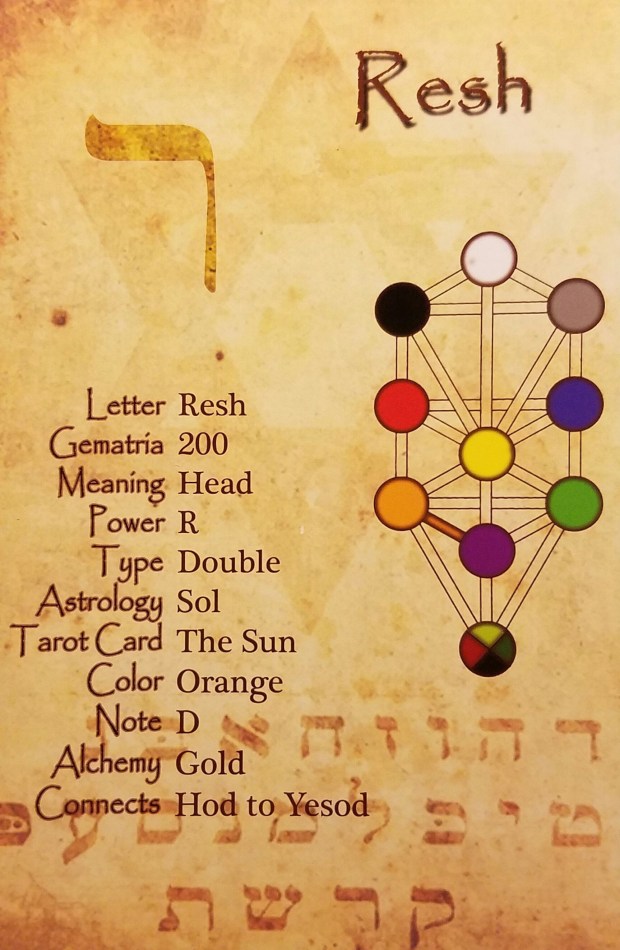
Contemplating Hebrew Letters | Resh

20
resh

hkbr
Rivka
(Rebecca)


    And when the time came for [Rebecca] to give birth, behold! There were twins in her womb. The first one emerged red, entirely like a hairy mantle; so they named him Esau. After that his brother emerged with his hand grasping on to the heel of Esau; so he called his name Jacob. . . . The lads grew up and Esau became one who knows hunting, a man of the field; but Jacob was a wholesome man, abiding in tents. Isaac loved Esau for he ate of his venison, but Rebecca loved Jacob.

Genesis 25:24–28

The matriarch Rebecca is one of the most highly developed female characters in the Bible, and she’s also one of the most powerful. Discovered at a young age by Abraham’s servant Eliezer, she’s recognized immediately as the destined mate for Isaac. Because of her intuitive kindness, Rebecca draws water for Eliezer and his camels before even being asked—for this, Eliezer offers to bring her back to Canaan to become the wife of Isaac. She immediately accepts and leaves her home, even though she’s barely out of childhood and has never met Isaac.

The one characteristic that follows Rebecca throughout her life is her amazing sense of clarity. From the moment she sees Eliezer, she knows what to do; and when she first sees Isaac in the distance, after a long journey, she immediately senses who he is—not just another stranger encountered along the way, but her life partner.

After she and Isaac are married, Rebecca is barren for 20 years. When she finally does conceive, she has a difficult pregnancy and seeks out the reason for her troubles. She asks God directly why she’s in so much pain, and He replies that she’s carrying twins who are at war with one another even in the womb. This rivalry, she’s told, will last as long as they live, but in the end the younger twin will triumph over the older one. Rebecca will keep this information to herself for years, but ultimately it will guide her behavior as a mother and become the basis for her future actions.

As the boys grow up, Esau, the elder, becomes a brute of a man, interested in hunting, women, and food; whereas Jacob, the younger, is more domesticated, bookish, and kind. Rebecca knows that although Isaac favors Esau, Jacob is the one who is destined to be the next in line spiritually; so when her husband is ready to pass on the blessing of the firstborn, which holds enormous spiritual power, Rebecca creates an elaborate scheme that changes history. She convinces Jacob to lie to his blind father, dress up in Esau’s clothing, bring him venison as his brother would, and trick Isaac into giving him the blessing that will establish him as the dominant patriarch of his generation.

We’re told that Rebecca does this not just because she favors one son over the other, but because she knows in no uncertain terms what should happen—that is, what is fair and right according to the prophecy she’s received. Rebecca does all she can to actively change destiny, to act with confidence and ensure that Jacob is blessed. In this way, she makes sure that the prophecy she hears when she’s pregnant is fulfilled, and that the line of righteous men continues with Jacob.

===

The letter Resh represents the rosh, the head. Rebecca is able to think logically and clearly and come up with solid, useful plans to do what’s best for her family. After she secures the birthright for Jacob, she is able to see that Esau is violent enough to potentially kill his brother when he finds out what has happened, and she devises a plan in which Jacob goes to live with her brother Laban (where, incidentally, he will meet his future wives, Rachel and Leah).

Although her circumstances are difficult and she has to play one son against the other and deceive her husband, Rebecca knows with complete certainty what needs to happen in order for everyone to fulfill their true destiny.

The Resh comes to those in need of clarity. Life is confusing, and often many paths compete for the taking. There is often more than one way to go, but from time to time we need to make definite, binding decisions.

Clarity need not be achieved only through prophecy—you can gain the ultimate knowledge all by yourself. But however you attain it, once something is clear in your mind, in the front of your consciousness, be careful not to waver from it.

Learn from Rebecca that you can change what seems to be set in stone. Your lot in life need not be the one given to you at birth— you need only be sure of yourself, and you can become whatever you need to be.

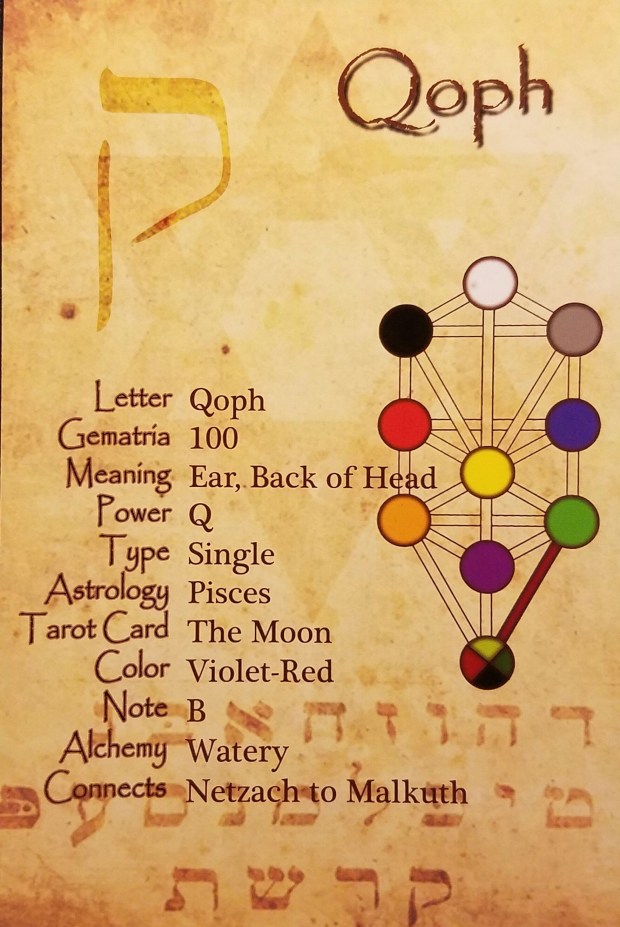
Contemplating Hebrew Letters | Qoph

19
kuf

rvpx Nk
Kan-Tzippor
(Bird’s Nest)


If a bird’s nest happens to be before you on the road, on any tree, or on the ground—young birds or eggs—and the mother is roosting on the young birds or the eggs, you shall not take the mother with the young. You shall surely send away the mother and take the young for yourself, so that it will be good for you and will prolong your days.


Deuteronomy 22:6–7

This passage is one of 18 laws concerning the protecting of animals in the Bible. Among others, the Bible instructs us not to boil a kid in its mother’s milk (which has evolved over time into the Jewish concept of kashrut, a system in which meat and milk are not to be eaten together at all), not to kill a mother and her offspring on the same day, and to help lift up an animal that may have collapsed from exhaustion on the road.

Although humans are given dominion over the animals in Genesis, we’re also given the responsibility to care for and treat them as fellow creations of God. This tension between our accountability toward animals and our power over them is the source of many difficult questions. But what’s clear from this passage is that we must first and foremost be sensitive to the nature of those that are consumed or otherwise used for our purposes.

By sending away the mother bird before taking her eggs or chicks, we accomplish several things: (1) We take into consideration the fact that animals are attached to their young and will suffer if they’re separated from them—so by sending the bird away, she won’t see her eggs taken, and the blow will be softened; (2) by not taking the bird along with her eggs as food, we help to preserve the species, ensuring that the breeding animal survives (environmentalists call this “sustainability”); (3) by exerting our responsibility toward animals before our power over them, we remind ourselves what’s more important; and (4) we set an example of compassion for our own lives.

Now if sending away the mother bird is so important that it will lead to a long life for the one who performs the deed, just think how important it is to treat other people with such sensitivity. The emotional, practical, philosophical, and personal implications of this commandment are stunning: In performing (or merely understanding) such a small act, we can help ease the pain of the world, preserve the earth, put our power into place, and deepen our capacity for compassion and kindness to others.

The Kuf is first and foremost a letter of kedusha, holiness. The verb lekadesh means “to sanctify” or “make holy,” suggesting that holiness is something to be actively achieved.

Look at how the letter itself is shaped: The character reaches down below the line as if descending into the “lower world” of earth from the “higher world” of spirituality. This teaches us that we can sanctify our lives, and infuse our existence with meaning and purpose, by seeking to elevate our daily actions and by having the consciousness of a higher purpose behind everything we do.

===

The Kuf card is a signal of compassion. Look beyond the surface of your actions and consider the fact that as humans, we’re not all that matters in this world. The principle of kindness to animals teaches us the great lesson of being kind to everyone, from helpless infants to victims of crime to homeless families to the elderly.

Take a moment to envision the mother bird and her eggs. Put yourself in her position and consider her animal perspective. Now use your gift of human reasoning and power to perform an act of holiness.

Contemplating Hebrew Letters || Tzaddi (Tzaddik)

18
tzaddik

Myhvla Mlx
Tzelem Elohim
(In the Image of God)


    So God created man in His image, in the image of God He created him; male and female He created them.


Genesis 1:27

This is the first of two descriptions given in Genesis for the creation of humankind at the beginning of the world. In the second (Gen. 2:18ff), man is created first, and then God forms woman by taking a piece of the man’s “side” (the Hebrew word is tzela, traditionally translated as “rib”) and creating a whole new being. In this original description, however, man and woman are created at one time. Some say that they’re created as a single body, and later each “side” is separated from the other to produce the two individual people we know as Adam and Eve. Others say that they were created as separate bodies, but simultaneously and with completely equal status.

Whichever of the two versions of the human-creation story you choose to believe, what’s essential to understand is that humanity was created in the Image of God (be’tzelem Elohim), and that means that men and women have a purpose on this earth unlike any other creature formed in the first week of existence. Humankind was designed not just to be fruitful and multiply, as every animal is, but to dominate over nature and to explore their inherent powers. What separates us from the plants and animals is that we have within us a spark of Divinity that, if we’re lucky, we can train ourselves to see and develop.

Trying to access that part of ourselves that’s Godlike, the part that strives to make the world a better place and improve our personal traits, is the essential act of Kabala. By working toward recognizing our original holiness, our connection to the Divine source of creation, we begin to journey toward Tikkun Olam (the Healing of the World), which is the ultimate goal of our lives.

A Tzaddik is a righteous person, someone who makes it a priority to bring good things into the world, to give charity, and to give of themselves. You become a Tzaddik by first and foremost learning to connect with the fact that you were created Be’tzelem, in the Image. Once you internalize the fact that you contain within you an essential holiness, a purpose in life, you’ll begin to see that everyone else also has this spark.

You cannot mistreat people—or be racist, judgmental, or cruel to your fellow human beings—if you truly believe that each and every one of us is created in the image of holiness.

To understand that the first person was actually a single man/woman unit, and that every person in the whole of history stems from this original being, is to understand that we’re all truly created equal. Not only must we treat others with respect, we must also learn to treat ourselves with respect, striving to heal the often-ruptured world within ourselves as well as the outside world.

===

The Tzaddik helps to boost self-confidence. In times of doubt, when we question our personal values and take a cold, hard look at our lives in search of a deeper purpose, it’s crucial to remember our origins: We’re all made in the Image, we’re all righteous people, or Tzaddikim.

Your body itself is holy, just as your soul is. Treat yourself with respect, as you would any holy object: Eat well, breathe, sleep, meditate, be creative, do good for the less fortunate. Only once you can relate to yourself as unique and holy will you truly see others the same way.

It is said that saving one life is like saving the entire world, and killing one person is like destroying the planet. This stems from the idea that in the beginning there was only one person who contained the most vital spark of life that will exist in every person throughout history.

Remember that we’re all linked together in this world, and we’re all crucial to its survival. Without any one of us, the world would be incomplete.

2018: A Magical Year in Review

Frater S.C.F.V's avatarLight in Extension: A Magical Journal

By Frater S.C.F.V.

20181223_232701 View inside a Vigil offered to Archangel Sachiel dressed with Solomonic Holy Oil and Basil.

As we move into 2019, I’d like to take a few moments to reflect on all that has happened in my life in the whirlwind of a year that was 2018.  It has been a tumultuous year in world events to be sure, but in my own little human life, it has been a massively important year.  I share these life and magical achievements and strange tale of bizarre events and poltergeist phenomena not out of arrogance, but in the hopes of inspiring others to work harder to achieve their own goals and to humble myself with the recollection of the giants on whose shoulders I was able to stand this year.

We are all the Divine dancing in the lila (Divine play) of manifested human lives; as this human action figure…

View original post 3,310 more words

The Alchemy of 2019, January Astrology

Tara Greene www.taratarot.com's avatarTara Greene,Tarot,Astrology,Psychic

January 2019 Major Astrology Aspects

January 1st

MARS is in ARIES at Zero degrees, the very beginning of the Zodiac. According to Julija Simas of the Cosmic Intelligence Agency says this aspect hasn’t happened in over 200 years. This begins the year with brand new red-hot rocket fuel. We’re off to a big bang. It’s GOOD FOR ALL FIRE SIGNS.

This is the year of the Empress reducing to #3 in the Tarot. This is a feminine Venus ruled year. 

Jan 1st/ 2nd The astrology chart of the year is a birth chart of 2019

2019 Birth Chart Astrology tara Greene The birth chart of 2019. January 1 2019 12:00 am

The YEAR starts out with the magical SUN/ SATURN CAZIMI  which means Saturn is in the Heart of the SUN.

CAZIMI is the magic mantra word for the year.

Saturn is Lead and the SUN is gold and that is the purpose…

View original post 369 more words

2019 MERCURY RETROGRADES

Susan Levitt's avatarSusan Levitt

new 2019HAPPY NEW YEAR

Wishing you a wonderful and happy New Year full of magic and creativity!
On New Years Eve and New Years Day, the Moon is in passionate Water sign Scorpio. The Scorpio Moon conjuncts Venus for love, passion, and pleasure. Contact me for your 2019 astrology forecast.

MERCURY RETROGRADES

Mercury Retrograde dates for your 2019 travel plans:

March 5 – 28 in Water sign Pisces.
Mercury retrograde in Pisces is a time when communication is nuanced and subtle. People communicate through emotions, not rational thought. If feelings are hurt, wait out the Mercury retrograde cycle to discuss it. 

July 7 – 31 in Fire sign Leo and Water sign Cancer.
Mercury retrograde in Leo is when communication is direct, and you can cover much ground. But slow down out if people become bossy or demanding. 
Mercury retrograde in Cancer is when emotions come to the surface. Emphasis is…

View original post 83 more words

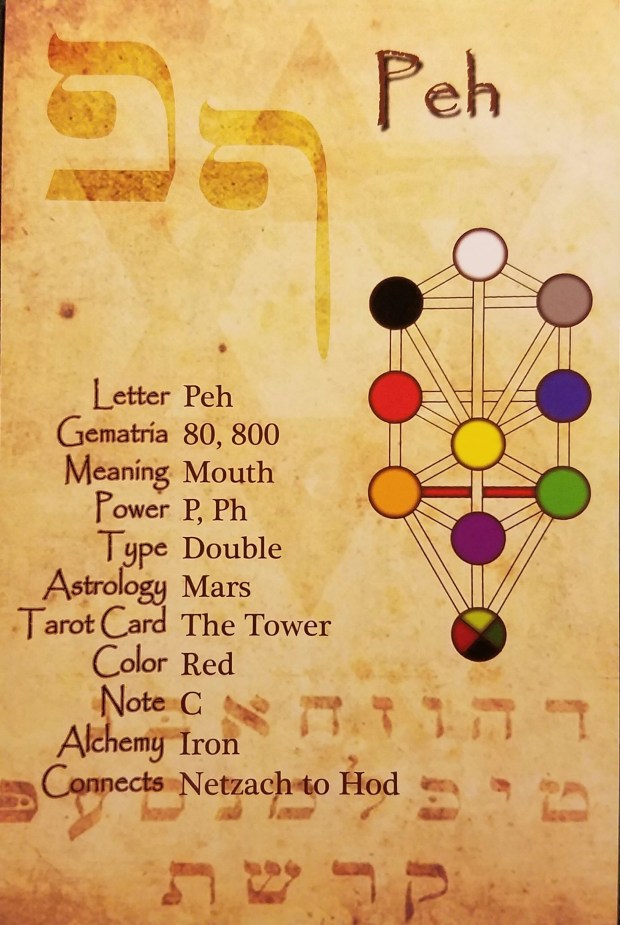
Contemplating Hebrew Letters || Peh

17
peh

hirp
Pharaoh


     And the Pharaoh’s heart was hardened and he did not let the Children of Israel go . . .


Exodus 9:35

The story of the Jews’ Exodus from Egypt is one of the most poignant tales of freedom in all of human history. Their harsh ruler, the Pharaoh, refuses to let them leave the country despite a series of plagues that the God of the Hebrews sends upon him. After every plague descends—blood, frogs, lice, swarms of wild beasts, epidemic, boils, hail, locusts, and complete darkness—Moses turns to the Pharaoh and asks him to “let my people go.”

Nine times out of ten, the Pharaoh nearly relents, but at the last minute he “hardens his heart” and refuses. Only when the Plague of the Firstborn is carried out and the eldest son of every Egyptian household, including the Pharaoh’s, is killed at midnight, does he finally give in and tell Moses to take the people and all their belongings and leave.

Throughout history we’ve seen what evil the human heart is capable of—from the Pharaoh to Adolf Hitler to Osama bin Laden, there have been people who do things most of us cannot even fathom. Nevertheless, those people do exist, and they teach us a lesson: Sometimes we have to see the worst in life before we can start rising up again to create a better world.

We also see this, to a lesser extent, in our own lives. Sometimes we must sink to our lowest levels of behavior before we start to improve. Addicts, for example, often need a near-death experience to compel them toward rehabilitation; and people who are grieving for a personal loss must often experience a deep sense of depression before they can begin the healing process. The same thing happened to the Pharaoh—he needed to experience the harshest personal tragedy (the loss of his son) in order to recognize how many children had already died at his hand.

Peh is the word for “mouth” in Hebrew. Spelled the same way, but with a different pronunciation (“poh”), the word also means “here.” These two words and concepts are integrally linked: To speak is to be present, to be in the moment and consciously communicative. The Pharaoh needed to open his heart in order to open his mouth and give permission to let the people go—he needed to speak from the place of experience, from the present, from “here.”

There’s a famous rabbinic legend that says that when babies are in their mothers’ wombs, they’re endowed with all the knowledge in the world. When they’re born, however, an angel taps them on the upper lip, creating the indent there underneath the nose, and they instantly forget everything. The process of life, then, is one of slowly relearning and remembering things that we knew from the very start of our lives.

The Pharaoh also needed to go through a process of reconnecting with his lost humanity, finally accepting the fact that he wasn’t an immortal god, but was subject to plagues just like every other Egyptian. And when he finally did come to realize this, to rediscover some of his inner morality, he was able to harness the power of speech (a distinctly human quality) to let the Jews go.

===

The Peh represents the incredible power of speech in our lives. Speaking is the catalyst for all action, and for any significant change in the world. To use our mouths, the ability that separates us from other life forms, is to be at our most powerful.

Look carefully at the shape of the Peh: Inside the black lines that form the letter, in the white space, there is a Bet. The Bet, as we’ve seen, is the first letter of the Torah, but it also represents looking at things from different angles. That the two letters are mystically intertwined teaches us a great lesson: Before we open our mouths to speak, we need to consider the bigger picture. Knowing that there’s always another layer of truth to consider will help us communicate most effectively in life.

We say that “actions speak louder than words,” but sometimes only words can lead us to profound action.

This card encourages you to soften your heart, open your mouth, and reclaim the knowledge that was given to you before you took your first breath. When you’ve accomplished those things, you can change the world.

Contemplating Hebrew Letters || Ayin

16
ayin

kjxy tdki
Akedat Yitzchak
(The Binding of Isaac)


     Then Isaac spoke to Abraham his father and said, “Father . . .” And he said, “Here I am, my son.” And he said, “Here are the fire and the wood, but where is the lamb for the offering?” And Abraham said, “God will seek out for Himself the lamb for the offering, my son.’” And the two of them went together. They arrived at the place of which God had spoken to him; Abraham built the altar there, and arranged the wood; he bound Isaac, his son, and he placed him on the altar atop the wood.


Genesis 22:7–9

Most of the interpretations regarding the Binding of Isaac focus on the actions of Abraham, who had been previously tested nine times by God and who’s considered the hero of the story. Because he was able to pass this final test, willingly preparing himself to sacrifice his beloved son (who was born when he was 100 years old and his wife was 90, after many years of infertility and struggle), Abraham is considered the paradigm of faith, willing to give up everything he’d lived for in order to fulfill the word of God.

Of course, this is one of the most morally problematic stories of the Bible, and generations of philosophers have struggled with whether Abraham succeeded or failed as a person regarding his willingness to kill an innocent man who was also his son. But whether or not this was an act of pure faith or a mistake, in the end Isaac wasn’t destined to die, and God stopped Abraham from actually slaughtering his son seconds before the act was accomplished. The test was to evaluate Abraham’s devotion, to prove to the world that he was a man willing to do anything and everything for his God.

But what of Isaac? He was 37 years old when this happened, hardly an ignorant child. Why isn’t this considered to be a test of Isaac’s faith rather than his father’s? After all, being willing to sacrifice your own life is surely as significant as being willing to take the life of another.

Commentators say that when Abraham, Isaac, and their two servants set out on the morning of the Binding, only Abraham knew the true nature of their outing. But as they approached the mountain, Abraham saw a cloud signaling the presence of God, and soon Isaac did, too. The other two men didn’t see the cloud, so Abraham asked them to wait below with the donkey while father and son ascended to the spot where the sacrifice was to be made—understanding that he and Isaac were on a different spiritual level than the other two.

In the dialogue above, which takes place as they walk up the mountain, Isaac comes to realize what’s truly going to happen. He knows that the presence of the cloud implies a holy intention, and he knows that if he and his father were truly going to sacrifice a lamb, they’d need the animal in hand to do so. And as Abraham implies that God will provide the lamb, his son fully understands that he is the one who’s meant to die on the altar. Even so, Isaac continues walking with his father, and he allows himself to be bound.

As a 37-year-old man, he would have been easily able to run away or overpower his ederly father, yet Isaac complies with this situation completely, willingly helping his father fulfill their destiny. Just as Isaac possessed the ability to see the holy cloud of God, he was also able to see into the future, and he knew that his legacy would not end that day on the mountain.

Isaac was able to comply because he had as much faith (though of a different sort) as his father. This is why the Binding wasn’t as much of a “test” for Isaac as it was for his father. Abraham believed that he was going to have to kill his son, and the test was to see if he’d go ahead with it, despite his love for Isaac. But Isaac knew in the deepest parts of himself that this was only a test—he wasn’t destined to become a martyr.

The Hebrew word Ayin means “eye.” And the letter represents not just sight, but spiritual insight, the ability to “see” beyond the black-and-white details of the moment to the larger picture.

Later in his life, Isaac goes blind. Some say that the process began here, when the tears of his father and of the angels above fell into his own eyes—just before God stopped Abraham’s hand from bringing the knife to his son’s throat. Whatever the source of Isaac’s blindness, it’s significant that the forefather who’s connected most to sight literally cannot see by the later years of his life. In other words, Isaac teaches us that the most important things to recognize in life are the things we can only see inside.

===

The Ayin card comes to you in times of trial and questioning. We’re all tested in various ways each and every day, and we must find ways to pass those tests and trust our insight.

In order to become a kabalist, you must learn to develop and trust your sixth sense and to see the light even in the darkness. This is the light that Isaac notices when he lies bound on an altar, and it’s the same light he perceives when his eyes no longer function.

Trust what you see, both inside and out. Others may not be able to witness the cloud of glory or to understand the complexities of our daily trials, but that doesn’t mean that they don’t exist.

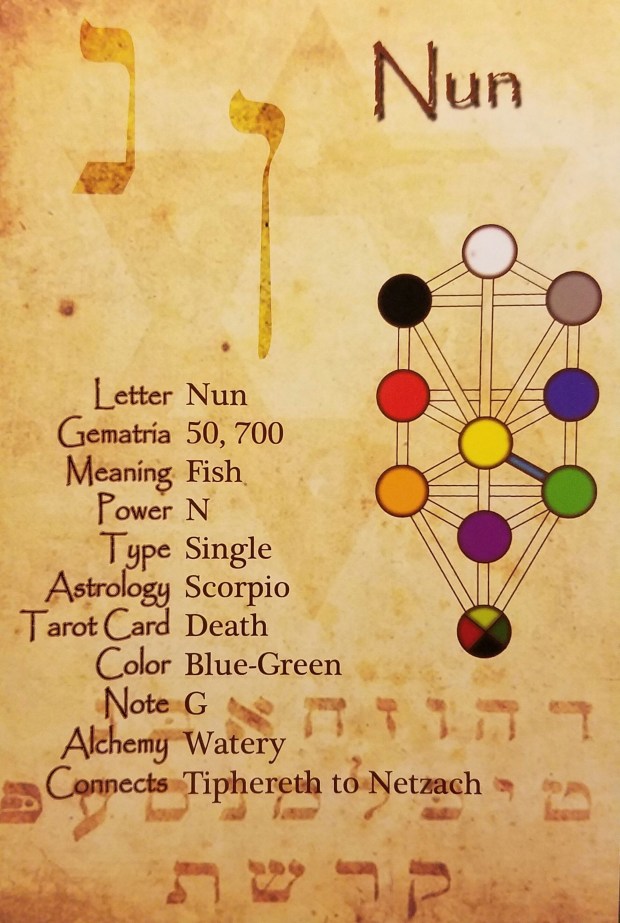
Contemplating Hebrew Letters || Nun

14
nun

jn
Noach
(Noah)


     These are the generations of Noah—Noah was a righteous man, perfect in his generations; Noah walked with God.


Genesis 6:9

Ten generations existed between Adam and Eve and Noah—yet by the time his story begins to be told in the Bible, society hasn’t advanced very far. The world has quickly evolved into a sorry state of affairs, as people are known for stealing, cheating, and being violent and sexually immoral. But Noah was righteous, so when God decided that the entire world needed to be destroyed through an enormous flood and then re-created all over again, He saved only Noah and his family.

Much has been said about the qualification “in his generations.” Some say that it means Noah was the only truly good person in all ten generations of existence. Others say that it’s less positive: Noah may have been good compared to all of his neighbors, but put him in a different time and place, and he wouldn’t have been described in the same way. One interpretation makes the comparison of a silver coin amid a pot of copper coins: Compared to the copper coins, the silver shines, but put the silver next to a gold coin, and there’s no mistaking which one is more valuable.

Noah differs from other great figures in biblical history in that he doesn’t question or argue with God. When God comes to him and says that He intends to destroy the whole evil world but will save him and his family through the ark, Noah doesn’t ask why, nor does he try to change God’s mind or stop the destruction from happening. Instead, he takes down the exact measurements and instructions on how to build the ark and how many animals to take with him, and he prepares himself to do as he’s told.

In contrast, years later, Abraham will be told that the city of Sodom will be destroyed because of the immorality that existed there, and he’ll bargain with God, trying to at least save the few good people who lived among the bad. Noah’s silence here is just as controversial as his description of being righteous “in his generations.” On the one hand, he’s obedient and full of faith in the will of God; on the other, he doesn’t exert the human will and ability to negotiate, interpret, and speak for oneself with which he was endowed at birth, and this is a disappointment.

It’s always difficult to know when to be strong and silent and when to get up and fight for your case, especially when situations call for one and not the other. Whether or not Noah approached his circumstances “correctly” is not the issue—the important thing to know is that he “walked with God,” he lived his life with a sense of purpose, knowing that there was a higher force guiding his life. This was what separated him from the rest of his society, making him worthy of the ark and of being the father of the new generations, the new beginning for the world.

Once the flood abated and the world began to function again, God made a covenant with Noah. He sent a rainbow in the sky and promised to never destroy the world at such a total capacity ever again. In turn, he established what we now know as the Noahide Laws, the seven guidelines for moral behavior that came long before the Ten Commandments.

These laws (do not murder, do not commit idolatry, do not steal, do not commit incest, do not cut meat from a living animal, do not be blasphemous, and do not bear false witness in court) apply to all of humanity, regardless of age, race, or religion. The fact that our basic laws of moral behavior are named after Noah tells us something very important: Being righteous, even if there will be others in future generations who will far exceed our righteousness, is worthy of creating a whole new world.

===

The Nun card comes to teach us the Spiritual Theory of Relativity: Everything is relative. We see things one way, based on our life experiences, but others with their different experiences see the opposite point of view. Right and wrong are subjective categories that change all the time.

Although we cannot stand for injustice, and we must all strive to maintain the most basic principles of morality and fairness, we cannot entirely judge others according to our own standards.

Noah wasn’t perfect, we’re not perfect, and the world we live in isn’t perfect. This card asks that you accept yourself and then look for ways to improve your behavior. Accept the world, but don’t sit by and wait for it to fall apart when you can be active and help make it a better place.

A blind man can’t be expected to paint landscapes of a world he’s never seen, so know that you can only judge yourself according to your own abilities and circumstances.

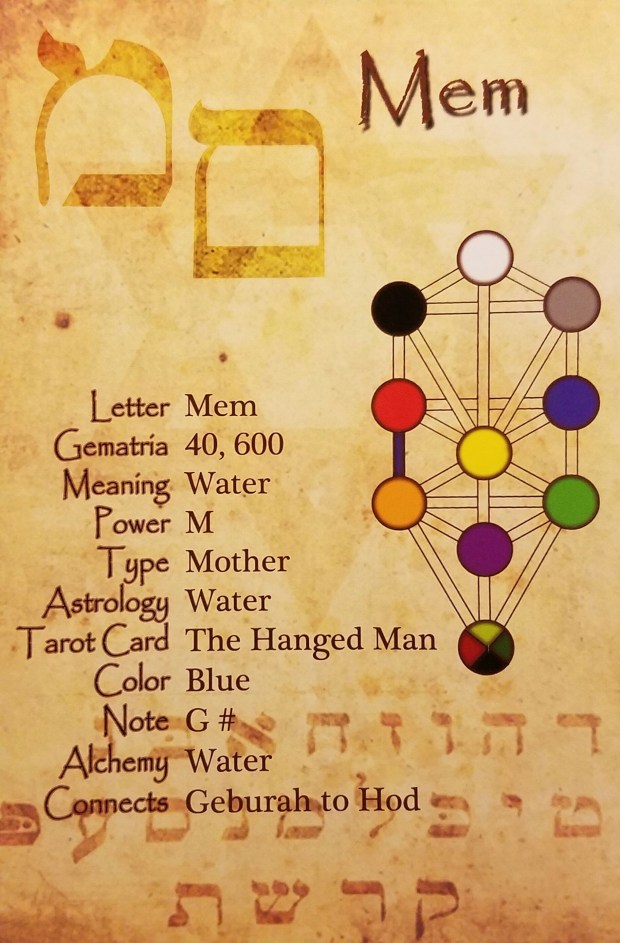
Contemplating Hebrew Letters || Mem

13
mem

Myrm
Miriam


     When the Pharaoh’s cavalry came with his chariots and horsemen into the sea and God turned back the waters of the sea upon them, the Children of Israel walked on the dry land amid the sea. Miriam the prophetess, the sister of Aaron, took her drum in her hand, and all the women went forth with drums and with dances. Miriam spoke up to them, “Sing to God, for He is exalted above the arrogant, having hurled horse with its rider into the sea.”


Exodus 15:19–21

Miriam is one of the first female leaders in history, and specifically one of the first leaders of women. The scene described above takes place as the Jews are running out of Egypt to escape slavery, with Moses as their leader. When they come to the banks of the water and see the Pharaoh’s army gaining on them in the distance, Moses performs the miracle of splitting the sea, and they’re able to run on dry land. But when the last of the Jews has reached safety, the seas close back up, drowning the Pharaoh and all of his men and horses. When the people see this miraculous sight and realize that they’ve been saved yet again, they break out in song, and Miriam leads the women in their own unique celebration.

Miriam is called the “brother of Aaron” here to emphasize that even before their youngest brother, Moses, the epitome of prophecy, was born, Miriam herself had prophetic ability. In fact, some commentators say that it was Miriam who was responsible for Moses’ birth in the first place. We know that she was the one to watch over his wicker basket on the banks of the Nile when the Pharaoh’s daughter found him there, thus ensuring his safety—but did you know that without her there would have been no baby at all?

Miriam was six years old when her parents separated. The Pharaoh had decreed that all male babies born into Hebrew families would be thrown into the river to drown, whereas female babies could live. This was to ensure that the Pharaoh would remain a stronger dictator with less opposition.

Jochebed and Amram (along with many other couples) separated rather than take the risk of creating a child who would be condemned to a cruel death. Yet Miriam convinced her parents to remarry, arguing that the Pharaoh may have decreed against the boys, but by giving in to fear, Jochebed and Amram were in fact preventing even girls from being born. Furthermore, she’d seen into the future, and she knew before he was even conceived that Moses would be the savior of their people.

So it’s because of his big sister that Moses was born, that he didn’t drown in the river, and that he was adopted into the house of the Pharaoh, where he gained the leadership skills he’d need to become the leader of the Exodus.

Because of her unique gift of intuition from such an early age, Miriam was well loved among her people. And because she advocated that females take control of the situation, encouraging young wives to defy the Pharaoh’s decree and continue to build their families, she’s associated with the women’s movement in its earliest stages. Feminists today place a Cup for Miriam alongside Elijah’s at the Passover Seder table, symbolizing the many different kinds of salvation that exist for many different kinds of people.

The letter Mem is often associated with water (mayyim), and it’s no coincidence that as they traveled in the desert, the Jewish people were accompanied by a miraculous wandering well of water given to them in the merit of Miriam’s actions. When she died, the well dried up, signifying her crucial contribution to the sustenance of a desperate people.

Miriam represents the life force that drives us all. In the same way that we need water to live, we need to be able to rejoice in the miracles of life, singing and dancing when good things happen to us; but we also need to persevere in the difficult times, pressing on with life in the most dire of circumstances. These are the lessons that we, women and men alike, can learn from Miriam the Prophetess.

===

The Mem card represents leadership. As a small child, Miriam recognized her own definition of justice and stood up for her family’s rights, thus making the best of a bad situation and ultimately helping to resolve it. We all have an element of leadership within us, even as small children. The key is to recognize our potential and claim it.

Whether it’s leading people in song during a difficult time or providing the equivalent of much-needed water in the desert, there’s always a way to take charge and help improve the lives of others. Use this card to meditate on the ways in which you could better realize your leadership potential in any aspect of your life.

Contemplating Hebrew Letters || Lamed

12
lamed

hal
Leah


    Laban had two daughters. The name of the older one was Leah and the name of the younger one was Rachel. Leah’s eyes were tender, while Rachel was beautiful of form and beautiful of appearance . . .


Genesis 29:16-17

When Jacob first saw Rachel, the daughter of his uncle Laban, he instantly fell in love with her. So much so, in fact, that he agreed to work for Laban for seven years in order to marry her. As the story goes, Jacob was so taken with Rachel that those years went by as if they were minutes.

But on their wedding night, Leah, the older daughter, is sent to the wedding canopy in Rachel’s place. In the morning, Jacob realizes that he’s wed the wrong sister and confronts Laban. But what was done was done, so Jacob agrees to work another seven years in order to marry his true love. For the rest of their lives, the two sisters vie for Jacob’s attention, raising a family that reflects their rivalry, despite the ultimate good that comes of it.

Deception is a big factor in this story: Not only does Laban trick Jacob, but Rachel also tricks him by giving her sister the secret signals that she and Jacob had made up in advance of the wedding so Leah wouldn’t be embarrassed. And Leah also agrees to go through with the deception.

Commentators say that when Jacob woke up in the morning, he first confronted Leah, asking how she could have lied and pretended to be her sister. Leah responded that she’d acted much like her new husband, who once lied to his own father and pretended to be his evil twin brother, Esau, in order to get the blessing of the firstborn. With that reality as the basis for their marriage, it’s no wonder that this love triangle is one of the most famous in history!

Leah is described as having had “tender” eyes—in other words, she’s the less attractive of the sisters. While some biblical scholars say this description indicates that she was cross-eyed, others note that her eyes were damaged from excessive weeping, to the point where her vision was impaired.

Why was Leah crying so much, even before she met and married Jacob and entered her less-than-perfect relationship? According to kabalistic sources, Leah was predestined to marry Esau, and Rachel to marry Jacob; the two couples were then meant to produce 12 sons, each of whom would become the head of a tribe that would together comprise the Jewish nation. Leah, who knew that Esau was a man of the field who wouldn’t follow his destiny, cried constantly over the fact that she wouldn’t be able to fulfill her part in the history of her people as a result.

When Jacob meets Rachel, he’s instantly smitten, not only because she’s so beautiful, but because their match was “meant to be.” When he marries Leah, he must work very hard to come to terms with the lies he’s told in his life and the way they’ve all reconfigured the neat, orderly family saga as it was intended.

Leah is the one who best understands this situation, and although she’ll suffer as the wife who’s known to all as “second choice,” she’s comforted by being able to fulfill her destiny after all. By marrying Jacob and having six sons with him, she manages to become a matriarch after all.

Leah is the consummate example of a woman of valor—someone who suffers for her ideals, yet is unwavering in her faith and devotion. Throughout her long life with Jacob, the two develop a bond that in the end is stronger and more enduring than the bond that exists between him and Rachel. Because they had to conquer their anger at one another, and because her love for him was unreturned for so long (despite the family they were building together), Leah and Jacob represent a mature, adult relationship that deepens and blossoms with time. In the end, it is Leah who is buried next to Jacob when she dies, and it is Leah’s children who will fulfill the more substantial roles in history as the heads of the Messianic line and the Priestly class.

===

The Lamed is the tallest letter of the alephbet, stretching far into the upper realms. It is the letter that spells the word “lamed”, meaning “learn” or “teach.” Therefore, the Lamed represents a higher, spiritual form of knowledge.

The Kabala says that Leah represents the upper world of the Shekina (God’s feminine form) revealed, whereas Rachel represents the lower world of the Shekina in exile. With this in mind, we can see another interpretation of Leah’s “tender eyes”: If eyes are the window into the soul, then Leah’s soul is one that recognizes her own suffering. She’s seen her path in life and taken control of it, changing the circumstances of her life in order to put things into place. Leah is clearly in charge of her own destiny—she’s the one who reveals it.

The Lamed card comes to reflect the inner knowledge of Leah. Accept yourself and realize that any shortcomings you may think you have are, in essence, your strongest attributes. When you come to truly understand and accept your destiny, you’ll find ways to make it happen.

Reach up and look deep into the windows of your own soul—there you’ll find the tools you need to make your dreams a reality.

Contemplating Hebrew Letters || Kaph

11
caph

blc
Calev
(Caleb)

    “But My servant Caleb, because a different spirit was with him and he followed Me wholeheartedly, I shall bring him to the Land to which he came, and his offspring shall possess it.”

Numbers 14:24

After the great Exodus from Egypt, Moses led the Hebrew people to the Promised Land. But as they neared the border, the people became frightened and anxious. To ease their fears, Moses sent a delegation of spies, one from each tribe, to scout out the land and bring back a report to reassure the former slaves. The spies spent 40 days in the Land and came back with a difficult report: It was indeed full of milk and honey, but it was also filled with enemies of gigantic proportions—“We were like grasshoppers in our eyes, and so we were in their eyes!” they say (Num. 13:33).

When the people hear this report so soon after leaving Egypt, they’re devastated. They can’t understand why they must suffer so much, and wonder if they should go back to Egypt rather than face a future of war with an insurmountable enemy. But two of the spies, Joshua and Caleb, have a different perspective.

Caleb assures the people that they can conquer the enemies and the land; in fact, he tells them that the land is “very, very good,” and that because they have God on their side, they have nothing to worry about. But the people don’t listen to him.

When God hears of this event, He is enraged. After everything He’s done to free the people from slavery and bring them to their own land, they still have little faith in their ability to move forward. So He decrees that except for Caleb and Joshua, who have seen things as they really are, no one from the original generation that escaped from Egypt will be allowed to enter the Promised Land. Instead, this will be the beginning of 40 years of wandering in the desert, one year for every day the spies spent in the Land, and only when those 40 years pass and the first generation dies out will the younger generation be allowed to enter it.

What makes Caleb say “We can surely do it!” (Num. 13:30) when everyone else is clearly giving up hope? What distinguishes him and Joshua from the other spies and the rest of the people?

The spies say that “we were like grasshoppers in our eyes” when they describe the giants living in the land and the way they looked in comparison. That is to say, they perceived hemselves as grasshoppers, insignificant and weak when compared to the inhabitants of the land. But that doesn’t mean that they were so much smaller—it means that they’d lost their confidence, that they imagined themselves to be inferior, and that they saw the challenges ahead as impossible to overcome.

This happened because for years and years these people had suffered as slaves in Egypt, and they still felt like slaves: weak, small, and frightened by the big, strong taskmaster. The spies were, in a way, projecting their slave mentality onto the report they gave, and because the people were immersed in the same mentality, they believed it.

Caleb, on the other hand, had already gone beyond this mentality and was ready to accept the new realities of freedom and independence. Unfortunately, it would take 40 years of emotional work and psychological healing for the rest of the people to catch up with him.

===

Caph is considered to be a letter of actualization. Like the crown (Keter) that symbolizes ultimate human power (koach), the Caph represents an understanding of human potential and the realization of that potential.

Caph is also the first letter of the word kavana, an important term in Kabala. Kavana means “intention,” or the energy with which you try to accomplish things. The outcome of your efforts is entirely bound up with your intention. Caleb had good intentions, and he tried to make others see what he saw. For that pure intent, he was rewarded with being able to enter into the Promised Land while everyone else was not.

Just as Caleb was able to see a different reality, and express his confidence in that reality, this card points to the fact that you should strive to look at things from a wider perspective, and not be hampered by your past.