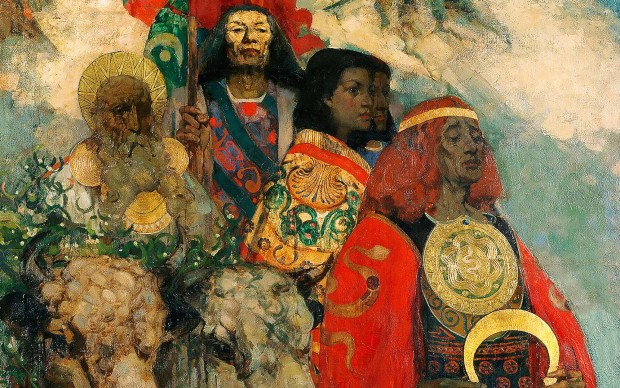
The Greeks and Romans portrayed these elusive priests as bogeymen who bathed in their victims’ blood. Who were they really? […]
Source: What can archaeology tell us about the Druids’ dark arts? | Aeon Essays
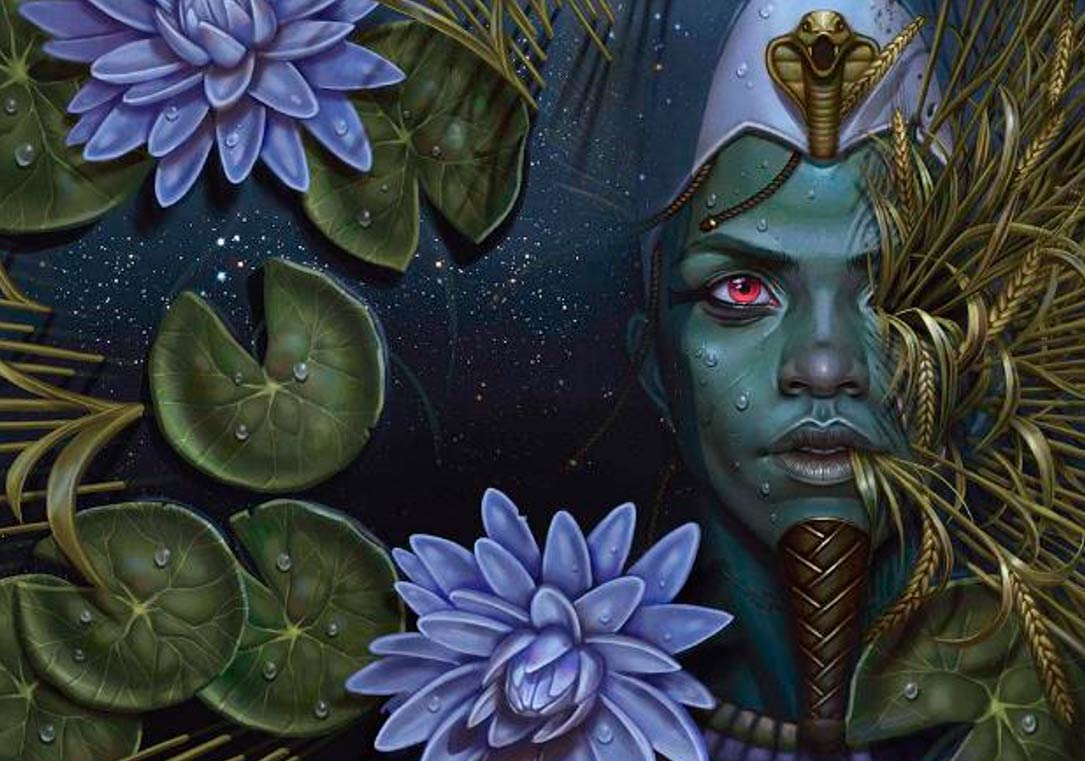
The Greeks and Romans portrayed these elusive priests as bogeymen who bathed in their victims’ blood. Who were they really? […]
Source: What can archaeology tell us about the Druids’ dark arts? | Aeon Essays
 September astrology and Tarot card Guidance and video for you.
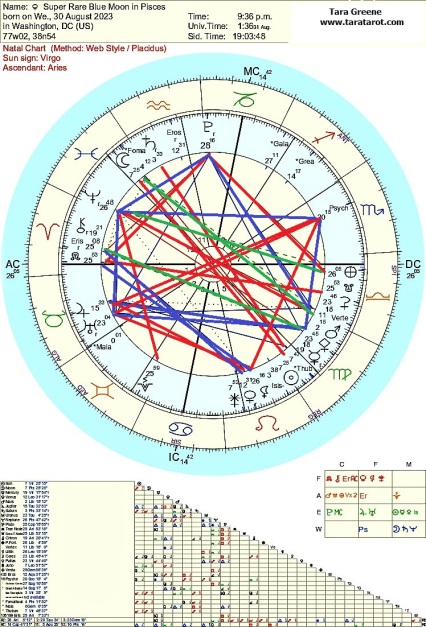
A very rare Super Blue Moon at 7+ degrees Pisces for so many reasons, occurs at 6:36 pm PDT/ 9:36 pm EDT/1:36 GMT energy with 7 Retrograde plamets including Chiro and with Jupiter stationing to tur […]

Frontpiece of the oldest known treatise on the Mensa Isiaca; first edition 1605; Lorenzo put himself in the picture as the artist/scholar Part 2 A Mysterious Artifact At about the time we first hea […]

For me, there are two things that make August wonderful, here in Portland, Oregon. One of them is all the produce that I can go pick on Sauvie’s Island, fresh from the farmers’ fields. […]
Source: She is Rising 2023
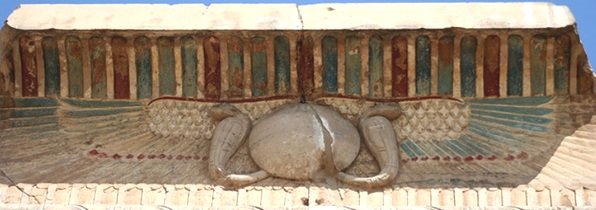
Wherever you see an image of the winged disk you are looking at Horus Behdety, a totally separate entity to the Sun. Horus sky god “He above. […]
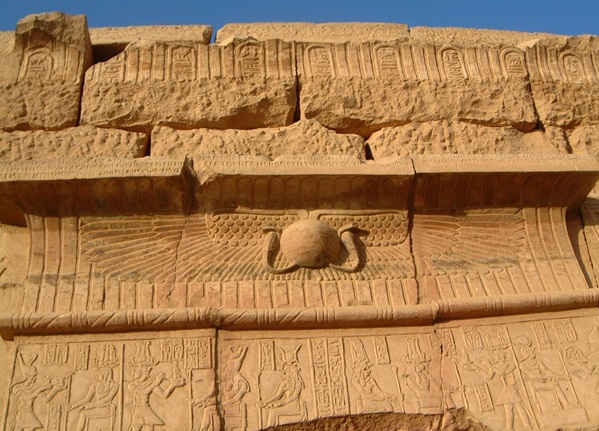
Source: Horus Behdety – The Winged Disk (Horus Gods – Part 3 of 3) – The God King Scenario

Re Horus of the horizons, Re-Horakhty, or even “Horus (who is) Re of the Horizons.” Re-Horakhty was a ‘living image of Re.’ […]
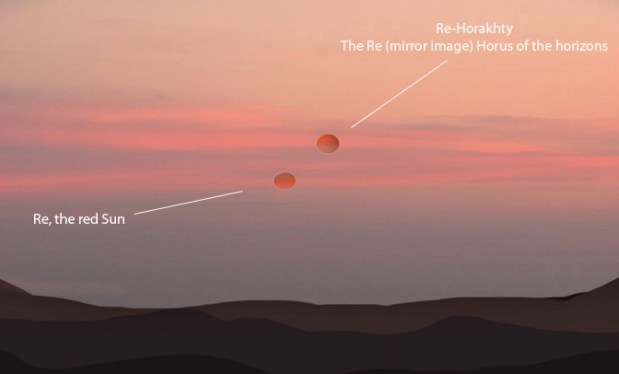
Source: Re-Horakhty (Horus Gods – Part 2 of 3) – The God King Scenario

It will be shown how Horus was essentially an omnipresent sky deity whose physical form was above all manifest in the god king planets. […]
Source: The Egyptian Sky God Horus. Part 1 of 3. – The God King Scenario

“These are the names of the seven overseers who sit upon (the) seven thrones: the name of the first is ‘WRPNY’L, and the name of the second is TYGRH, and the name of the third is […]

In 1150, a pair of green-skinned children are said to have shown up in an English village, and the strange tale continues to baffle historians to this day. […]
Source: The Head-Scratching Mystery Behind The Green Children Of Woolpit

What is your concept of the soul? It’s one of those things that we often talk about, but we don’t have a firm definition of what, exactly, it is. Is it the divine part of ourselves? Is […]
Source: Isis & the Soul

Many an unlettered man, in the words of the poet, is a mute, inglorious Milton, unknown, unnoticed by other men, and, like Markham’s man with a hoe, conveys through his eyes the sad awareness that this is an old story that includes all beings and will persist far into the future. For the pseudo-sophisticated intellectual classes to see as much would be extremely difficult. People for whom there is very little else can sustain the awareness of some fundamental truth. To be able to do this self-consciously within a process of growth is extraordinarily elusive for a man burdened with the mental complexities of contemporary civilization, because he cannot ascend to universal brotherhood except very partially, intermittently and, alas, defensively.
To make reincarnation a vital truth in one’s personal life is to treat each day as an incarnation, to greet every person as an immortal soul, inwardly and in silence, and to empathize with every human failure as a limitation — an effect with causes — comparable to all other limitations. It is the ability to see, even in the longing of the person who is almost totally lost, that spark of the Divine which could eventually be fanned into the flame of the cosmic and compassionate fire of wisdom of the Buddhas and Bodhisattvas. It is an old tradition in the East that those who truly know of the immortality of the soul can only say, “Thus have I heard.”
Why is there no immortality for what we call the ‘personality,’ the particular mask that we wear, through which we appear to other people to be someone with a name and a form, a recognizable identity? However glorious the aggrandizement of personal selfhood may seem in a Nietzschean sense, it is still something that limits and is limited, and hence must participate in finitude and mortality. To wish immortality for that which is visibly mortal, for a mind which is like a cobweb of confusing conceptions, is at best a compensatory illusion. Ultimately, it is a sign of weakness. But the Great Teachers did not come to tell man what he already knows — that there are limitations. They came to tell him that beyond these limitations he could be free. Buddha declared: “Know ye who suffer, ye suffer from yourselves. None else compels that ye are caught in this Wheel of Life.” When Jesus spoke of the weakness of the flesh, he also intimated that the spirit is free, that it is the source of will, and that when it is truly willing, it is immortally free.
It is only by reinforcing a weaker side of our own nature that we could project from a limited view of ourselves a confused picture of personal immortality. Despite all the self-advertisements of the age, hardly any man can do full justice to himself. A man who is loudly making the case for himself is all too often belittling himself. Even the finest self-images have some illusion built into them, and to extrapolate them into the future and into the past is to limit oneself unduly. The notion of personal immortality becomes extremely degrading in a universe of law, where everything experienced by consciousness is connected, in the course of time, with everything that follows it. If a person, early or late in life, uses the doctrine of rebirth, or some notion of personal immortality, as a crutch to cling to, physical death may well be succeeded by a dreamy state of illusory happiness after a period of purgatorial separation from all the excrescences of the life just lived. Then he will have to come back, and alas, in so doing, as Plato suggests in the Myth of Er, he may choose the very opposite of what he seeks. A person who mistakes the external tokens of the good, the true and the beautiful for the transcendental Agathon may well find himself drawn, even propelled, into an environment where he is punished by getting what he wants.
What we need is metanoia, a fundamental breakthrough in consciousness. Otherwise the notion of immortality avails us naught. Many Theosophists of every sort hold to reincarnation as a dogma rather than as a basis for meditation. It cannot help unless a man can really come to see that it is a fact in Nature — a law of life in a universe of cyclic processes — and can live by that law increasingly. He can recognize mistakes, and through repeated self-correction, open new vistas. He may make existential affirmations of perfectibility — which must be on behalf of all if they are to be authentic — and give everyone he meets something of the taste of true optimism in regard to the future. Unless a person can do these things, even if he speaks the language of impersonal immortality, still it would be nothing but a projection of a personal conception of immortality.
The teaching of the Mahatmas is utterly uncompromising on such matters. For the personal consciousness there can be no immortality, while for the indwelling soul, for the individual ray of the overbrooding Atman, immortality is a fact. For the mediating mind of the middle, immortality has to be won, to be earned, and is neither a gift nor a fact. The mind must progressively detach itself from its external vestures, like a musician who goes beyond worship of his instrument or of his fingers moving on the instrument or of his own self-image, and is merged into something beyond all recorded music, into a reverence for the inaudible music of the spheres. Until a man can do this self-consciously as a soul (and he cannot do it without pain and thoroughness if he is to be honest with himself), immortality for him will be merely a compensatory myth. It will not carry that conviction with which alone he could lighten the loads of others and, through eyes of love, make many lives more meaningful.
Raghavan Iyer
The Gupta Vidya II

July 17/18 the Nodes of Fate, our collective evolutionary goals, shift into fiery active independent Aries North Node and Libra South Node-what we are releasing. This means the emphasis and purpose is for new beginnings, war, aggression, competition, good for entrepreneurs, independent, hot-headed, angry, macho, initiative and initiations, fast things, NO PATIENCE and it’s all about me-selfish Numero UNO, 1st sign in the zodiac until Jan 11, 2025.
Fortune favors the bold. The downside of ARIES is impulsive,reckless, loves danger, doesn’t finish anything, chip on shoulder, accident prone, headaches, baldness, fires, heat, explosions, guns, violence no one else’s needs exist and WAR. The South Node, what we are leaving behind, moves into Libra.
The cycles repeat every approx. 18 years. These Nodes or Dragons create all eclipses.
This last occurred Dec 27, 2004 – Jun 22, 2006-what was going on in your life then?
aND FURTHER BACK April 7…
View original post 457 more words

I was talking, not with Isis, but with a couple priestess friends of mine, last evening at a lovely party we were having. We were talking about our upcoming, local Fall Equinox festival, this year dedicated to Hekate. While I’m not among the main folks in charge, I do have one significant role that includes “talking with Hekate.” I wanted their take on how Hekate “feels” and/or “sounds” when my fellow priestesses connect with Her.
It’s always enlightening and interesting to hear the experiences of others with our Divine Ones. For myself, I will just briefly say that, so far, Hekate feels a bit “heavier” than Isis and has a deeper voice. During one of my first meditations with Her, Isis was there with me, handing me off for a brief time, for this Magical Work with Hekate.
All that said…
View original post 899 more words

Every man’s soul has by the law of his birth been a spectator of eternal truth, or it would never have passed into this our mortal frame, yet still it is no easy matter for all to be reminded of their past by their present existence.
PLATO
While we may know about the long and complex history of the doctrine of reincarnation, the crisis of our time is such that the response of thinking men and women is and should be, “How does it help me? What difference could it make to my life?” In the Bhagavad Gita Lord Krishna, speaking as the Logos in the cosmos, but also as the hidden god in every man, makes a supreme, unqualified affirmation. Like similar utterances in the great scriptures of the world, the words of Krishna have a ring of self-certification. He simply affirms for all men that there is an inexhaustible, inconsumable, incorruptible, indestructible, beginningless and endless spirit that is the sovereign ruler within the temple of the human body. Yet the same Krishna, having made this affirmation, ends his speech by asking Arjuna to recognize the honest position of the finite mind of the ordinary man by saying, “The antenatal state of beings is unknown; the middle state is evident; and their state after death is not to be discovered.”
Any human being must recognize that, in so far as his mind is a bundle of borrowed conceptions — because he has grown up conditioned and circumscribed by the limiting factors of heredity, family, education and the social environment — he cannot do any more at first than come with pain to the point of declaring with profound honesty, “I really do not know. I do not know about evil. I have no idea of many things that happened to me earlier in this life. I have no idea of what will happen to me tomorrow, next year, let alone after the moment of death.” This could give integrity to the quest. At the same time, when a human being begins at the level of categories and concepts, he also knows that there is something unspoken about his particular life — his tears, his thoughts, his deepest feelings, his loves and longings, his failures and frustrations, his invisible, hidden determination to hold fast in times of trial, to triumph over obstacles that seem forbidding. Beyond all of these there is that secret of his own soul which he cannot share with anyone else or even bring to the level of human speech. He knows that there is a depth and dimension to his own experience as a conscious sentient being which can participate in the transcendental wonder of the world, which can be aroused to depths and to heights and to a tremendous breadth of cosmic vision when looking at awesome vistas in nature or when surveying the great epochs of human history. But at the same time this secret cannot be conveyed. It cannot be demonstrated or fitted into the workaday categories and concepts needed to survive in a world of psychological limitation and scarcity.
The problem is one of translation. Seen philosophically, if we assume that there is something prior to be translated into something else that is shareable, it is a problem of self-discovery. It involves integrating the potential, intermittently intimated in our consciousness, with the actual which is a story that could be streamlined and which any Hollywood scriptwriter could convert into a celluloid version, a banal sequence of scenes. There must be something between our inchoate intuition of the inexhaustible and our painful recognition of the factuality of the temporally finite sequence that seems to string these events together. Memories clutter the mind. We look back with regrets or look forward with hopes, with longings that may be vain and ineffectual or may be impossible to share with anyone else.
What is self-validating for a Krishna or for the immortal spirit of man can only become a supreme and total fact for a human being when he has begun to strip away the layers and vestures of consciousness through which he is bound. In a Wordsworthian sense, every child is crowned by the aura of the divine, and has in his eyes some recognition of having lived before, some glint of an ancient wisdom distilled into the very essence of his response to the furniture of the world. Yet every human being, growing out of the child-state, loses those intimations. How are we to recover them compatibly with the integrity and self-consciousness that we must bring to every level and aspect of our human experience? This necessitates further work upon the whole of one’s nature. Where we do not know, we may discard the dogmas that claim to know. There are those which insist that man is merely a fortuitous concurrence of atoms — in the name of a science which would be disowned by the greatest, most agnostic and creative scientific thinkers. There is the dogma derived from religion that man is a soul created by an anthropomorphic being at a certain point of time and consigned to eternal hell or heaven, and there are other corruptions of thought such as transmigration into animal form.
When a person discards dogmas and starts with the standpoint of genuine unknowingness, combined with a willingness to learn, he has taken a stand that is truly individual, yet within the context of all mankind. Then, as he works upon himself, he must find out what is unique and gives continuity to himself. At the same time, further growth in this quest will only be possible when he can truly dissolve the sense of separateness between himself and other beings. When the barriers fall away, his love can become almost limitless in scope. He can feel the pain in every human heart and enjoy the world through the eyes of every human being. Clearly, this cannot be done by a person except at some specific level and cannot be done totally within any short-term curve of growth. We would need a number of births to attain that degree of universalization wherein we could merge the universal and the individual and also maintain stasis throughout the different levels on which we have to communicate with widening or narrowing circles of human beings. In that sense, what is self-validating at one level could only become wholly valid and be a fully embodied truth when one’s whole life revolves around it.
Raghavan Iyer
The Gupta Vidya II

I am slightly obsessed with knots in Egyptian magic. The basic idea is fairly simple: tied knots bind and untied knots release. Beyond that, knots can unite opposites and—since a knot secures things—protect.
Working magic, heka, is sometimes described as weaving or knitting, which is just another form of knotting. The deceased person is said to be “knit together in the egg” prior to rebirth. Some texts say that the head of the deceased is “knit on.” The concept of weaving or knitting magic—bringing the strands of magic together to create or preserve—makes complete and utter sense to me. There is a delicacy and precision that weaving and knitting requires.
Knot magic was well known in Egypt from an early period; an inscription in one of the pyramids states that…
View original post 1,283 more words

When the North and South Nodes change signs, it shifts the backdrop both in our world and in our personal lives for 18 months. The North Node is the point based on the moon’s ecliptic that indicate
Source: True Node in Aries
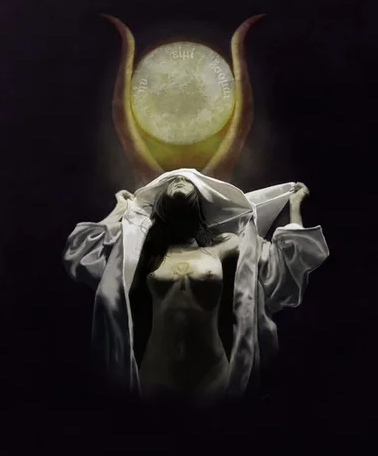
This work is by Ludovic Pinelli; you can purchase a print here. To Isis, a VeilEn Iset, Behen This is a gift I bring before Isis the Hidden One, Who, Revealing Herself, Shakes Destiny: an invocatio[…] …
Source: The Veil of Isis
If you have unhealthy sexual appetites that are leading towards degeneration and pain, you need to strengthen your thymus gland, and saturate it with uplifting forces. There is a powerful mantra exactly for this purpose.
We recommend using this mantra daily, especially when you are struggling with your sexual power. This mantra is especially powerful from June 20 to July, during the influence of the sign of Cancer, but can be used anytime of year.
If you have unhealthy sexual appetites that are leading towards degeneration and pain, you need to strengthen your thymus gland, and saturate it with uplifting forces. There is a powerful mantra exactly for this purpose. The mantra Abracadabra is Hebrew אברה קדברה Ebrah K’Dabri, which means “I create what I speak.” Its primary component is the vowel A, which stimulates the thymus gland. When used consciously, the vowel A nourishes the thymus gland, giving us control over our sexual appetite.
This video provides more than one hour of mantra recitation that you can follow. Use it to accompany your meditation practice.
To perform this mantra:
1. Relax. Become perfectly still, like you are going to sleep.
2. Empty your mind.
3. Concentrate inwardly.
4. Consciously concentrate the mantra in your thymus gland.
The purpose of these videos is as an accompaniment as you close your eyes and dive within, leaving the body, the room, and of course the video far behind. If someone is watching the video with their eyes for one full hour, or even focused on listening to it with their ears, they will not learn how to meditate.
“When this gland is active, the organism does not age. The sage-doctors of antiquity said that the vowel “A,” when it is pronounced wisely, has the power to make the thymus gland vibrate. The ancient sages utilize the wise mantra so vulgarized by people today: Abracadabra. This mantra is said to keep the thymus gland active during life. They pronounced this word forty-nine times in the following way:
Abracadabra
Abracadabr
Abracadab
Abracada
Abracad
Abraca
Abrac
Abra
Abr
Ab
A
“The word was pronounced so that the sound of the vowel “A” was prolonged. Even some doctors are beginning to cure by means of musical sound. It is interesting to acknowledge that in the voice of the doctor, in each of his words, there is a source of life or death to his patients.
“The endocrinological science should study the intimate relationships that exist between music and the endocrine glands. It is better to investigate, analyze, and comprehend than to laugh at that which we do not know.”
—Sexology, the Basis of Endocrinology and Criminology, by Samael Aun Weor
Do you like the Egyptian culture and its wonderful music? Well, this is the right place to move to this extraordinary civilization.

 Grand Temple of Horus Behdety