
We often use such phrases as “the spiritual path” or “the path of spiritual progress.” Sometimes we say that we are “treading” or “following” the path. But did you know that there are actually TWO […]
Source: The Two Paths

We often use such phrases as “the spiritual path” or “the path of spiritual progress.” Sometimes we say that we are “treading” or “following” the path. But did you know that there are actually TWO […]
Source: The Two Paths

I’d like to share with you some beautiful art of Our Lady that was shared with me recently. I absolutely adore the fact that She inspires so much art. It seems that sometimes art is the only […]
Source: Art of Isis

There is in every single human being the embryo of this ideal man of meditation, and we can at least imagine what it would be like for such a being to be present somewhere in our midst, if not in ourselves. We also can recognize that we have our own share in the desperate demand for psychological survival. In this way we restore an integrity to our own quest and are somewhat deserving of that illumination which will take hold in our consciousness in relation to the great and priceless teaching. We might begin to wonder whether perhaps there is a golden chord that connects the golden sphere of a man of meditation and the complex intermediary realms in which he must, by pain and anguish and awakening, by knitting together minute golden moments rescued from a great deal of froth and self-deception, come to know himself. If there were not a fundamental connection between meditation and self-study, something of the uniquely precious wisdom in this great text would be lost to us. When we begin to realize this in our lives, we come to appreciate that, while we may not be in a position to make judgments about teachers and schools in a vast and largely unrecorded history or in our own time, nonetheless we do know that there is something profoundly important in stressing both meditation and self-study, in bringing the two together. We must reconcile what looked like a pair of opposites and get beyond despair to something else which allows an existential and dynamic balance between meditation and self-study. This is the quality of compassion. It is in the heart of every human being in his response to human pain, and brings him truly into the fellowship of those Beings of Boundless Compassion.
A man is a Buddha before he seeks to become a Buddha. He is a Buddha potentially. The Buddha at one time must have had a desire to become a Buddha, to understand human pain. The Buddha vow is holy because it is a vow taken on behalf of all. There is in everyone the capacity to want something for the sake of all, and also honestly to want it for oneself. In this there is an authentic mirroring, in every human heart, of the highest, the holiest and the most pregnant of beginnings of the quest. There are many beginnings, many failures, and many seeming endings. The quest itself, since it applies to all beings and not only to any one man, is beginningless and endless. It is universal, since any individual quest in this direction becomes at some point merged into the collective quest. Put in poetical form, or recognized in the simplest feelings, there is something metaphysically important and philosophically fundamental to the connection between meditation or self-transcendence, and the kind of self-study which makes true self-actualization possible. There is a way in which a man can both be out of this world and in this world, can forget himself and yet be more truly himself. These paradoxes of language are difficult to explain at one level and yet we all know them to be the paradoxes of our very lives. In our moments of greatest loneliness we suddenly find a surprising capacity to come closer to beings far removed from us, men of different races and alienated groups in pain. Then we come to feel a brotherhood that is so profound that it could never be secured in any other way. These are part of the everyday experience of mankind.
Here we touch on a crucial emphasis, maintained sedulously by the Gelukpa tradition of Tibet, which affirms that unless you spend sufficient time in refining, studying and purifying your motive, in using compassion as fuel to generate the energy needed to take off and land, you should not begin to rush into meditation. It is a slow school, but it greets the aspirant in the name of all. It scorns powers and the notion of one man becoming a superman in isolation from the quest of other men. Making no promises or claims, it does not insult our intelligence by promising us something to be attained without effort.
Are we not old enough in history to be somewhat apprehensive of schools that promise too much and too soon, when we know that this does not work in any sphere of life? Would we go to some local, loud-talking musician who tells us that he could make us as good as Casals in a week? Would we even take him seriously? We might go to him out of fun or sympathy or curiosity. Why in the most sacred of all realms should we be misled? Is it because of our impatience, our feeling of unworthiness, an advance fear of failure? These questions throw us back upon ourselves. In raising them, in probing our own standpoint at the original moment of the beginning of the quest, we make discoveries about ourselves. They are very profound and important, as they may sum up for us a great deal of the past. They would also be crucial in the future where we may come to sense the supreme relevance all along the way, when it is hard and rough, of what Merlin said to Arthur: “Go back to the original moment.” If one could understand the fullness of what is anticipated in that original moment of our quest, one could trace the whole curve of our growth that is likely to emerge, with its ups and downs. Yet it cannot tell all as long as there are unknown depths of potentiality and free will in a human being.
A statement in The Morning of the Magicians suggests that so long as men want something for nothing, money without work, knowledge without study, power without knowledge, virtue without some form of asceticism, so long will a thousand pseudo-initiatory societies flourish, imitating the truly secret language of the ‘technicians of the sacred.’ There must be some reason why the integrity of the quest requires that no false flattery be made to the weaker side in every man. The Voice of the Silence tells us early on: “Give up thy life, if thou would’st live.” That side of you which is afraid, which wants to be cajoled and flattered and promised, which would like an insurance policy, must go, must die. It is only in that dying that you will discover yourself. We all limit ourselves. We engage in a collective act of daily self-denigration of mankind. We impose, in addition to our tangible problems, imaginary and insurmountable difficulties owing to our dogmatic insistence on the finality of our limitations.
The Wisdom-Religion is transmitted so as to restore in the human being, and collectively in the world, the reality of the perfectibility of man, the assurance that men are gods, that any man is capable of reaching the apex, and that the difference between a Buddha or a Christ and any one of us is a difference of degree and not of kind. At the same time it shows that the slaying of the dragon, the putting of the demon under the foot, the command of the sovereign will of the Adept, “Get thee behind me, Satan,” are heroic deeds every one of us could accomplish. Potential gods could also become kings. Every man could be a king in his own republic, but he can only become a king and eventually a god if he first experiences the thrill of affirming what it is to be a man — man qua man, one who partakes of the glory, the potentiality, the promise and the excellence of human nature, one who shares points of contact with the mightiest man of meditation. He must understand what the power of his thought can do, and discern a connection between the imagination of children and the disciplined imagination of perfected teachers.
With this exalted view of the individual embodiment of the collective potentialities of man, a person can say, “I’m proud to be a man and man enough to give myself a minimum of dignity. I’m willing to be tried, to be tough, to go through a discipline. I’m willing to become a disciple, and dissipate that portion of myself which is pretentious, but which is also my problem and my burden — like the donkey the man carries on his back in the Japanese fable — instead of making it an ever-lengthening shadow by walking away from the sun. I can make that shadow shrink by walking towards the sun, the Logos reflected in the great teachers, which is real and in me and every single living being.” This is a great affirmation. To make it is profoundly important. It is to affirm in this day and age that it is meaningful for a man to give up lesser pretensions and engage in what may look like presumption, but is really an assertion in his life that he can appreciate the prerogative of what it is to be a manushya, a man, a self-conscious being. That is a great step on the path of progressive steps in meditation and self-study.
So far all that has been said is about beginnings, but this really is an arena where the first step seems to be the most difficult. Also, it is a matter of how you define the first step. An analogy may be made here with our experience in the engineering of flying machines. The designs were there; the diagrams were there; the equations were there; the knowledge of what is involved in maintaining a jet engine at high altitudes was there. The tough part was the take-off and landing problem. We now know more widely, in an age when people turn in desperation to a variety of drugs, that it is very difficult to have control over entry into the higher states of consciousness in a manner that will assure a smooth re-entry into ordinary life. It is because of the take-off and landing problem that we need both to be very clear about our beginnings and also to see the whole quest as a re-sharpening of the integrity of the beginning, in relation to meditation and self-study.
In the Gelukpa schools one would be told to spend a lot of time expanding compassion but also meditating on meditation. What is one going to meditate on? Meditate on meditation itself. Meditate on men of meditation. In other words, the more you try to meditate, the more you realize that meditation is elusive. But this is an insight that protects you from self-deception. Ultimately, the entire universe is an embodiment of collective mind. Meditation in its fullness is that creative power of the Platonic Demiurge, of the Hindu Visvakarman, of the Logos of the Gnostics, which could initiate a whole world. That initiation or inauguration of a world is a representation of the mighty power of meditation. You can become, says The Voice of the Silence, one with the power of All-Thought, but you cannot do so until you have expelled every particular thought from your mind-soul. Here is the philosophical and cosmic basis of meditation in its fullness. All meditations can only be stepping stones towards a larger meditation. What will give us a gauge of the quality, strength and meaningfulness of our power to meditate, and of our particular meditations, is our ability to harvest in the realm of self-knowledge that which can be tested in our knowledge and understanding of all other selves. To put this in another way, if to love one person unconditionally is so difficult for us, how extraordinarily remote from us seems to be the conception of those beings who can unconditionally love all living beings. We cannot do it even with one. Now someone might say, “No, but I can do it with one or a few sufficiently to understand in principle what it would be like to do it for all.” Someone else might say, “Oh, when I look at my life I find that I don’t know what it is fully to love any one, but I do know that somewhere in my loneliness and pain I feel the closeness of anonymous faces, a silent bond of brotherhood between myself and many others.”
There are different ways by which we could see in ourselves the embryo of that boundless love and compassion which is the fruit of self-knowledge at its height, where a man becomes self-consciously a universal embodiment of the Logos, having no sense of identity except in the very act of mirroring universal light.
There must be a tremendous integrity to a teaching and discipline which says that every step counts, that every failure can be used, and that the ashes of your failures will be useful in regrafting and rejuvenating what is like a frail tree that has to be replanted again and again. But the tree one is planting is the tree of immortality. One is trying to bring down into the lesser vehicles of the more differentiated planes of matter the glorious vesture of immortality, which showed more clearly when one was a baby, which one saluted in the first cry of birth, and of which one becomes somewhat aware at the moment of death.
There is a hint at the moments of birth and death, something like an intimation of the hidden glory of man, but during life one is not so awake. This becomes a problem of memory and forgetfulness. The chain of decline is started. It was classically stated in the second chapter of the Gita: “He who attendeth to the inclinations of the senses, in them hath a concern; from this concern is created passion, from passion anger, from anger is produced delusion, from delusion a loss of the memory, from the loss of memory loss of discrimination, and from loss of discrimination loss of all!” Every man is fragmenting himself, spending himself, limiting himself, finitizing himself, localizing himself, to such a degree, with such an intensity and irregularity, and such a frenetic, feverish restlessness, that he is consuming himself. Physiologically, we know that we cannot beat the clocktime processes of the changes in the physical body. Therefore we cannot expect to find the elixir of immortality on the physical plane. But we all know that by attending to the very process of growth and change, and by awareness of what happens to us in sickness, that we do have some control and can make a difference by our very attitude and acceptance of the process. If you are very ill, by worrying about it you are going to make yourself worse, but there are people who are really quite ill, who by acceptance have gained something of the aroma of well-being.
These are everyday facts having analogues and roots in a causal realm of ideation and creative imagination which gives shape and form to the subtle vehicle, through which a transmission could take place of the immortal, indestructible and inexhaustible light of the Logos which is in every man and came into the world with every child. It is the radiance of Shekinah, the nur of Allah, the light of St. John. It is a light that looks like darkness and is not to be mistaken for those things that have a glamour on the sensory plane. To bring it down or make it transmit through the causal realm and become a living tejas or light-energy issuing forth from the fingers and all the windows and apertures of the human body is, of course, asking for a great deal. But what one is asking is meaningful, and we have got to try to understand.
Raghavan Iyer
The Gupta Vidya II

When the Christian Empire forcibly forbade the worship of the Pagan Deities, the Goddesses and Gods did not die, but They did go underground. […]
Source: Goddess Isis Goes Underground

The only comparison between Rudolf Steiner’s Anthroposophy and the Kabbalah you’ll ever need by Giogio Tarditi Spagnoli […]
Source: Kabbalah and Anthroposophy – Rosicrucian Tradition Website
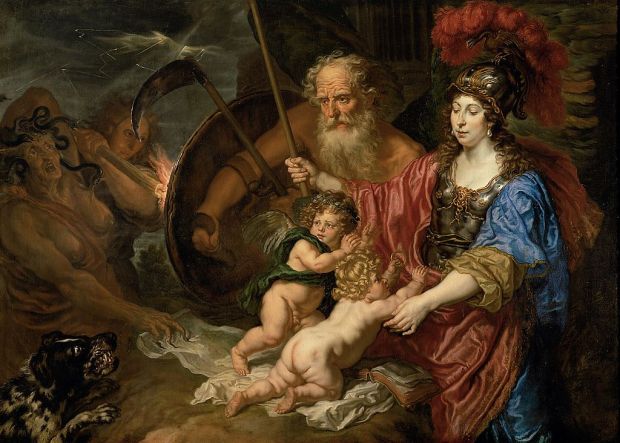
Happy Saturnalia! The ancient Roman festival of Sol Invictus the conquering light at Solstice was celebrated December 17-24 with freedom from slavery and role reversals.
Source: Saturnalia Celebration, December 17-24, freedom from slavery
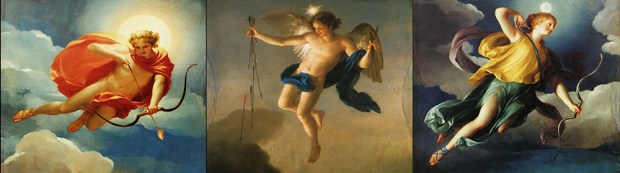
Venus in sexy Scorpio Dec. 4-29. A short but intense time obsessively dark in Scorpio. Venus is considered to be in detriment in a Mars-ruled sign but she will add depth and sexy spice to our love […]

Hello, Isiacs. I’m reposting this because, well, it’s that time of year and this question must be answered. Again. Every year, at about this time, one post on this blog starts to get a […]
Source: Was Horus born on December 25th?
The actual fact of man’s psychic (we say manasic or noetic) individuality is a sufficient warrant against the assumption; for in the case of this conclusion being correct, or being indeed . . . the collective hallucination of the whole mankind throughout the ages, there would be an end also to psychic individuality. Now by ‘psychic’ individuality we mean that self-determining power which enables man to override circumstances.
H.P. Blavatsky, “Psychic and Noetic Action”
All human beings have some experience not only of a persisting sense of individuality, but also of an ineradicable sense of being able to separate themselves from an observable objective field. They have a deep sense of being able to affect it consciously, and indeed even to control it. To dismiss so vital and universal an experience would be to betray a narrow, pseudo-philosophical prejudice towards mechanistic determinism. Not even all animals have precisely the same stimuli or reactions. Certainly, human beings in very similar environments respond quite differently to external stimuli. One cannot deny, then, that a human being can make a vital difference to his environment through his calm appraisal of it, or even through simply comparing or sharply contrasting it with something else. Either through the fugitive sense of memory or through the fervent thrill of anticipation, based upon a relaxed sense of identity projected into the past and the future, or even through heightened perceptions of the unsuspected relations between one’s own circumstances and those of other beings, individuals make decisive choices among newly discovered alternatives. So long as they can ask probing questions about the degree to which they can possibly alter their mental outlook, they can truly determine for themselves, through these subtle changes of attitudes, their untapped ability to alter these circumstances.
In general, such attitudes may be rather passive or defiantly resistant to circumstances. But they may also include an intelligent acceptance of circumstances rooted in a capacity for conscious cooperation with necessity. One may completely transform one’s environment through rearranging elements in it, through constructive dialogue with other agents and, above all, through an inner life of daily meditation and effortless self-transcendence. Thus free will can function, and so unfold a unitary consciousness coolly capable of deft self-determination. Having understood all this, the main challenge is to come to a clear comprehension of the self-determining power in man and, more specifically, to understand the delicate operation of the diverse faculties of the mind in the compelling context of universal causality. In this regard, the shrewd argument of George T. Ladd concerning mental faculties is crucial. Having contended that the phenomena of human consciousness must require a subject in the form of a real being, manifested immediately to itself in the phenomena of consciousness, he proceeded to consider how that real being perceives its relationship to the activity of consciousness.
To it the mental phenomena are to be attributed as showing what it is by what it does. The so-called mental ‘faculties’ are only the modes of the behaviour in consciousness of this real being. We actually find, by the only method available, that this real being called Mind believes in certain perpetually recurring modes: therefore, we attribute to it certain faculties. . . . Mental faculties are not entities that have an existence of themselves. . . . They are the modes of the behaviour in consciousness of the mind.
Ibid.
In other words, Ladd denied that one can comprehend the real being, or unit consciousness, exclusively through those recurring modes that are associated with certain ‘faculties’. Just as one would find the idea of a unit being, in this metaphysical monadology, incompatible with crude physical behaviourism, it is also incompatible with psycho-physical and psychological behaviourism. Put another way, the inherent power of Manasic ‘I-am-I’ consciousness transcends all patterns such as those which inhere in the volatile skandhas. The human being can consciously transcend all behaviour patterns. He can readily transform anything through tapping his inherent powers of volition and ideation. Ladd then concluded:
The subject of all the states of consciousness is a real unit-being, called Mind; which is of non-material nature, and acts and develops according to laws of its own, but is specially correlated with certain material molecules and masses forming the substance of the Brain.
Ibid.
Full understanding of these laws, mastery over action and the capacity to coordinate the mind and brain can come only from a strong intention to attain these ends, together with a purgation of one’s entire field. One cannot work with incompatible mixtures, which are inevitably explosive. One cannot infuse the potency of the noetic mind into the polluted psyche. One must purge and purify the psyche before it can absorb the higher current of transformation which is alchemical and fundamentally noetic.
The question then becomes how, in practice, one can readily recognize the subtle difference between an illusory sense of freedom and a real and valid sense of self-determination. Insofar as people are misled by everyday language and by fleeting sense-perceptions, and insofar as they have an associationist picture of mixed memories and indelible images, rendering them essentially passive in relation to mental and emotional states, they may totally fail to see that all these familiar states fall under laws of causality. They may also be unable to make significant noetic connections. Based upon luminous perceptions of noetic connections, one must learn to see their causal chains and calmly project possible consequences of persisting patterns tomorrow, next year and in the future. One must then take full responsibility for the future consequences of participation in connected patterns. The moment one recognizes and perceives significant connections, one will see that at different times one could have made a distinct difference by the way in which one reacted, by the degree of sensitivity one showed, and by the degree of self-criticism one applied to these states. The moment a human being begins to ask ‘why’, he demands meaning from experience and rejects uncritical acceptance or mere passivity towards anything in life, including the recognizable sequence in which mental phenomena manifest.
Through this noetic capacity to question the association and the succession of events, one can decisively alter patterns. One can thus move from an initial level of passivity to a degree of free will whilst, in the act of seeing connections and making correlations, raising questions and altering patterns. Given the Buddhist doctrine of skandhas, or the Hindu doctrine of samskaras, each personality collects, over a lifetime, persisting associated tendencies. These persisting tendencies of thought and character are reinforced by appropriate emotions, desires and habits. Hence, the mere making of sporadic alterations in the inherited pattern of tendencies will be a poor example of free will, since over a longer period of time the pattern itself is conditioned by certain basic assumptions.
To take a simple example, as long as the will to live is strong and persistent, there is a sense in which free will is illusory. One lacks the fundamental capacity to make significant changes in one’s skandhas or personality. This is an expression of prarabdha karma, the karma with which one has begun life. It is already reflected in one’s particular body, one’s mind, one’s emotions, character and personality — and, indeed, in one’s established relationship to a specific heredity and environment. This is part of the karma one cannot alter easily from within. Though these ideas go far beyond anything that is conceived in ordinary behaviouristic psychology, it is vital that the complex notion of free will be raised to a higher level, making greater demands and requiring more fundamental changes in one’s way of life and outlook. It is precisely at this point that the distinction between psychic and noetic action becomes crucial. One must understand the locus in consciousness of the incipient power of free will, and then distinguish this from the fundamental source of will which lies entirely outside the sphere of the personality and the field of prarabdha karma, skandhas and samskaras. Speaking of Ladd’s conception of mind as the real unit being that is the subject of all states of consciousness, H.P. Blavatsky commented:
This ‘Mind’ is manas, or rather its lower reflection, which whenever it disconnects itself, for the time being, with kama, becomes the guide of the highest mental faculties, and is the organ of the free will in physical man.
Ibid.
Whereas Manas itself is noetic, and signifies what could be called the spiritual individuality, there is also that which may be called the psychic individuality — this same Manas in association with kama, or desire. This projected ray of Manas itself has a capacity, though intermittent, for a kind of free will. Consider a human being who is completely caught up in chaotic desires and who is extremely uncritical in relation to his experiences, his tastes, his likes — in short, to his self-image. Even that kind of person will have moments of disengagement from emotion and a relative freedom from desire. In such moments of limited objectivity the person may see what is otherwise invisible. He may see alternatives, recognize degrees, glimpse similarities and differences from other human beings in similar situations; gradually, he may sense the potential for self-determination. Even lower Manas, when it is disconnected from kama, can exercise free will, giving guidance to the mental faculties that make up the personality. This limited application of free will, however, is obviously quite different from full self-determination. The projected ray of Manas is the basis of the psychic nature and potentially the organ of free will in physical man. Manas itself is the basis of the higher self-conscious will, which has no special organ, but is capable, independent of the brain and personality, of functioning on its own. This noetic individuality is distinct from the projected ray of lower Manas, which is its organ, and distinct too from the physical brain and body, which are the organs of the psychic lower Manas. This source of spiritual will is characterized in the Bhagavad Gita as the kshetrajna, higher Manas, the silent Spectator, which is the voluntary sacrificial victim of all the mistakes and misperceptions of its projected ray.
The contrast between the silent Spectator and the despotic lower Manas explains the difference between the psychic and the noetic. Wherever there is an assertion of the egotistic will, there is an exaggeration of the astral shadow and an intensification of kama manas. When the projected ray of Manas becomes hard and cold, it tends to become parasitic upon others, taking without returning, claiming without thanking, continuously scheming without scruples. Ultimately, this not only produces a powerful kamarupa, but also puts one on the path towards becoming an apprentice dugpa or black magician. The dugpa or sorcerer works through coercive imposition of combative will. It accommodates nothing compassionate or sacrificial, no hint or suggestion of the supreme state of calm. This suggests a practical test in one’s self-study. If one is becoming more wilful, one is becoming more and more caught up in lower psychic action. One’s astral body is becoming inflamed, fattened and polluted, and one is losing one’s flickering connection with the divine and silent Spectator. This is a poor way of living and ageing, a pathetic condition. If, on the other hand, one is becoming humbler and more responsive to others, more non-violent, less assertive and more open to entering into the relative reality of other beings, loosening and letting go the sense of separateness, one is becoming a true apprentice upon the path of renunciation, the path of benevolent magic. The altruistic use of noetic wisdom, true theurgy, is the teaching of Gupta Vidya.
Raghavan Iyer
The Gupta Vidya II

If the general law of the conservation of energy leads modern science to the conclusion that psychic activity only represents a special form of motion, this same law, guiding the Occultists, leads them also to the same conviction — and to something else besides, which psycho-physiology leaves entirely out of all consideration. If the latter has discovered only in this century that psychic (we say even spiritual) action is subject to the same general and immutable laws of motion as any other phenomenon manifested in the objective realm of Kosmos, and that in both the organic and the inorganic (?) worlds every manifestation, whether conscious or unconscious, represents but the result of a collectivity of causes, then in Occult philosophy this represents merely the ABC of its science. . . .
But Occultism says more than this. While making of motion on the material plane and of the conservation of energy two fundamental laws, or rather two aspects of the same omnipresent law — Swara — it denies point blank that these have anything to do with the free will of man which belongs to quite a different plane.
“Psychic and Noetic Action”, H.P. Blavatsky
Gupta Vidya, the philosophy of perfectibility, is based upon the divine dialectic, which proceeds through progressive universalization, profound synthesis and playful integration. These primary principles are inseparably rooted in the cosmogonic archetypes and patterns of universal unity and causation. They are in sharp contrast to the expedient and evasive methodology of much contemporary thought which all too often proceeds on the basis of Aristotelian classification, statistical analysis and a sterile suspicion of intuitive insight. Whatever the karmic factors in the ancient feud between these divergent streams of thought, it is poignantly evident that their polar contrast becomes insuperable when it comes to understanding human nature. Gupta Vidya views the human situation in the light of the central conception of an immortal individuality capable of infinite perfectibility in its use of opaque and transitory vestures. The greater the degree of understanding attained of Man and Nature, the greater the effective realization of spiritual freedom and self-mastery. In the methodology of modern thought, the more sharply its conceptions are formulated, the more inexorably it is driven to a harsh dilemma: it must either secure the comprehension of Nature at the cost of a deterministic conception of Man, or it must surrender the notions of order and causality in favour of statistical indeterminacy and randomness in Nature, thereby voiding all human action of meaning. Gupta Vidya not only dispels this dilemma, but it also explains the propensity to fall prey to it, through the arcane conception of two fundamental modes of mental activity. These were set forth by H.P. Blavatsky as “psychic” and “noetic” action. They refer to much more than ‘action’ in any ordinary sense, and really represent two distinct, though related, modes of self-conscious existence. They provide the prism through which the perceptive philosopher can view the complex and enigmatic relationship between human freedom and universal causality. All creative change and all dynamic activity in the universe are understood, in the perennial philosophy of Gupta Vidya, as spontaneous expressions of one abstract, pre-cosmic source symbolized as the Great Breath. In its highest ranges this is Spirit, and beneath that, it encompasses every mode of motion down to and including action on the physical plane.
Motion as the GREAT BREATH (vide “Secret Doctrine”, vol. i, sub voce) — ergo ‘sound’ at the same time — is the substratum of Kosmic-Motion. It is beginningless and endless, the one eternal life, the basis and genesis of the subjective and the objective universe; for LIFE (or Be-ness) is the fons et origo of existence or being. But molecular motion is the lowest and most material of its finite manifestations.
“Psychic and Noetic Action”, H.P. Blavatsky
Several important consequences follow from this single origin of both subjective and objective reality. For example, the strict unity and universal causality implied by the conception of absolute abstract Motion entail the basic principle transmitted from ancient knowledge into modern science as the law of the conservation of energy. In a world of finite manifestations, such as that of molecular motion, this law has immense importance. The conception of entropy is an allied principle equally crucial in understanding the particularized motions and relationships between objects having specific kinds of energy in the world as we know it. Yet this does not really reveal much about the deeper sense in which there is collection and concentration of energy, from the highest laya state down through the physical plane of manifestation. There is a sense in which enormous energy is held waiting to be released from higher to lower planes. Potential energy, related to the higher aspects of the ceaseless motion of the One Life, transcends all empirical conceptions based upon observable phenomena. This is crucial when considering the seemingly abrupt transition from medieval to modern thought accompanying the movement away from a vastly inflated, but exceedingly particularized, conception of the subjective realm towards an almost obsessive concern with physical objectivity. As the capricious happenings and hearsay of the ‘age of miracles’ were gradually replaced by a rigid conception of external and mechanical order, it increasingly came to be understood that the inner life of man must also conform to universal laws. In what was a marked advance upon earlier notions of both physics and psychology, there emerged, in the nineteenth century, the explosive recognition that everything in the psychological realm is also subject to causality. This was powerfully put forward as part of a grandiose ethical scheme by George Godwin, the philosophical anarchist. Late in the nineteenth century several social scientists argued that if causality is to be applied to all phenomenal events and processes, it must also apply in some way to the world of what may be called psychic action. It must, in short, be applicable to all the states of mind experienced by human beings in bodies with brains.
Raghavan Iyer
The Gupta Vidya II

THE FOUR HORSES
Here is pure mythology, in this case using horses to represent
aspects of our human condition.
The red horse represents our emotional nature, the black horse
represents our intellectual nature, the pale horse represents
our physical nature, and the white horse
represents our spiritual nature.
This is a real horse race, and it is one that goes on within us every day.
THE RED HORSE is the one that takes peace from the earth.
This horse is responsible for the pride that compels people to go to war
and do terrible things.
You must put a saddle on the red horse.
When our emotions get the best of us that really do take peace from the earth.
Our earth. Our minds.
Are not all of the wars the results of someone’s emotions run amuck?
So, the red or emotional horse getting in the lead can be difficult as we all know.
THE BLACK HORSE
The scripture says that the rider on the Black Horse held a pair
of balances in his hands. The balances are for weighing decisions and
this is what the intellect or black horse does.
The scripture says to the Black Horse, do not hurt the oil and the wine.
The intellect functions in buying and selling. Making decisions.
Where it says do not hurt the Oil and Wine it is saying do not hurt
the spirit with intellectualism.
In the spirit realm you must think with your heart in meditation.
Not with your head.
Thus when the black horse gets in front we will find ourselves thinking
and trying to figure spiritual things out instead of allowing spirit
to flow within us as it will.
THE PALE HORSE
Revelation 6:7
And I saw a pale horse: and his name that sat on him was death,
and hell followed with him.
And power was given to them over the fourth part of the earth to kill
with the sword, with hunger and with fear.
The Pale Horse is the physical nature.
As we all know death and hell follows the physical.
Notice how it is the physical that hungers and dies and must tangle
with the beasts of the earth.
The physical has power over the fourth. It controls the four parts of
our nature, if we allow it.
As the Bible says, the spirit is willing but the flesh is weak.
And what are those four parts
The Physical, Spiritual, Intellectual and Emotional.
It is the physical that must interact with the beasts of the earth which
are the human carnal minds which work against nature for profit and
lead charges of war and death against the innocent.
THE FOUR HORSES
THE FOUR PARTS OF THE HUMAN PSYCHE MUST GIVE WAY
TO THE LIGHT OF THE RIGHT SIDE WHEN
THE SEALS ARE OPENED.
These symbolic horses which represent our human nature must
be rounded up and controlled by the higher nature within us we call God.
AND NOW WE SEE COMING TO US
THE WHITE HORSE
The White Horse is our spiritual nature.
It must race to the front and lead us to that inner nature of God.
The higher power that is within us and within all human beings.
We extend the right hand of love to all.
The White Horse has taken the lead.
The Red Horse of Emotions no longer overwhelms us.
The Black Horse of the Intellect is no longer trying to figure out
how to beat the other guy. Instead, it is absorbed with learning God’s truth.
The Pale Horse, our physical nature. In spite of the four seals
being opened, our physical nature still struggles against the reins.
It is difficult for us to bring it under control.
Meditation is what brings it under control.
It is brought into the corral and no longer pulls us to the lower life battles.
We must keep the white horse up front.
It is so important for the white horse to win life’s race.
The four horses of our mind that have been used in battles within us
will come under the rule of light and carry you to a communion
with the higher light force.
And I saw heaven opened, and behold a white horse; and he that sat upon him was called Faithful and True, and in righteousness he doth judge and make war.
And the armies which were in heaven followed him upon white horses,
clothed in fine linen, white and clean.
Sit upon your White Horse and ride to the sky.
They’re waiting for you.
WHY WAS JESUS BORN IN A MANGER
Because the Sun in its course through the Zodiac
is born between Sagittarius and Capricorn,
between the horse and the goat.
Thus the child is born in a stable or manger.

If so, how did that happen? Did you do a specific ritual? Did it slowly gain its living quality over time? Following the inspirations of ancient Egyptian cult, for me, the ones that are alive are s […]

Offering bread to the Goddess.
Here in the famously cloudy Pacific Northwest, I find myself thinking of a hot bowl of soup and a slice, well buttered, of bread. So today, I write today in honor […]
Source: The Divine Bread of Isis

“Blessed be thy feet, that have brought thee in these wayBlessed be thy knees, that shall kneel at the sacred altar.Blessed be thy womb, without which we would not be.Blessed be thy breasts, formed in beauty.Blessed be thy lips, that shall utter the Sacred Name”
“Blessed be thy feet, that have brought thee in these ways.Blessed be thy knees, that shall kneel at the sacred altar.Blessed be thy phallus, without which we would not be.Blessed be thy breasts, formed in strengthBlessed be thy lips, that shall utter the Sacred Names.”


“Truth is many sided and eternal; the quest for truth must also be all embracing and never ending. We may liken truth to a mountain, and the various interpretations of that truth to different paths leading up to the summit.
Many people are traveling along all of these paths and every one thinks his path is the only one while he is at the bottom; he sees only a small part of the mountain and may therefore be justified in crying to his brothers, “You are wrong; come over in my path; this is the only one that leads to the top.”
But as all these people progress upward, they shall see that the paths converge at the top and that they are all one in the ultimate.”
— The Rosicrucian Philosophy In Questions and Answers, Volume I, by Max Heindel

Freemasonry, the teachings and practices of the secret fraternal order of Free and Accepted Masons, the largest worldwide secret society. Spread by the advance of the British Empire, Freemasonry remains most popular in the British Isles and in other countries originally within the empire. Freemasonry evolved from the guilds of stonemasons and cathedral builders of the Middle Ages.
Freemasonry and the Knights Templar are both fraternal organizations, but they have different origins and beliefs.
Freemasonry is a fraternity that traces its origins to the local fraternities of stonemasons, which from the end of the fourteenth century regulated the qualifications of stonemasons and their interaction with authorities and clients. These fraternities were composed of stonemasons who were working on the construction of the great cathedrals and castles of Europe. They developed a system of moral teachings and a code of conduct that was passed on to new members through a series of rituals and ceremonies. Over time, these fraternities evolved into a more speculative organization, which came to be known as Freemasonry. Today, Freemasonry is a fraternity that is open to men of good character who believe in a Supreme Being. It is a fraternity that emphasizes personal development and self-improvement through a system of moral teachings and symbols.
On the other hand, The Knights Templar were a medieval Christian military order founded in the 12th century. The order was created to protect Christian pilgrims traveling to the Holy Land. The Templars quickly grew in power and wealth, and they became one of the most powerful organizations in Europe. They were also known for their secrecy and their distinctive white mantles adorned with a red cross. The order was dissolved by Pope Clement V in the early 14th century, and many of the Templars were arrested, tortured and executed.
While Freemasonry uses the imagery and symbology of stonemasonry as a metaphor for personal development, the Knights Templar were a religious order. Some people believe that Freemasonry has its roots in the Knights Templar, but there is no evidence to support this claim. Some conspiracy theories suggest that the Templars went underground after the suppression of their order and that they became the basis of the Freemasons. But there is no historical evidence to support this claim. Furthermore, the principles and beliefs of the two organizations are vastly different. The Knights Templars were a religious order and the Freemasonry is a fraternity, with no religious connotation, but it requires its members to have a belief in a Supreme Being.
#knightstemplar #freemasonry #conspiracy #documentary
—-
Interesting links and sources:
https://en.wikipedia.org/wiki/History…
https://www.britannica.com/topic/Free… https://www.history.com/news/freemaso…

The existence of Atlantis has not yet been proven. However, we have the odd testimony described in texts by Plato and in the well-known dialogues of Timaeus and Critias. But, is there concrete evidence about the existence or not of this lost continent?
At the moment we do not yet have conclusive evidence. We are told that Atlantis had a vast territory with a great naval force. That it very possibly rose in front of the Pillars of Hercules (the Strait of Gibraltar) and that it was inhabited by an almost “ideal” society.
They had great natural resources, a varied fauna where, for example, elephants were not lacking. There is also talk of a mountain surrounded by water, of a very distinguished acropolis with a royal palace and of a temple in honor of Poseidon, that god who protected them for a long time.
Until one day, the Atlanteans became too proud and lost the favor of their deity. Timaeus tells us, among other things, that they came to dominate the existing territories from Libya to Egypt, until at the end a violent earthquake made that prosperous country disappear in the absolute silence of the waters.
But do we have feasible evidence to show us the veracity of all this? Today we offer you the latest data available.
The news appeared in various international media, such as the “Daily Mail”. In these media we are told of a hopeful discovery, made by a group of archaeologists from an Italian university, the “Suor Orsola Benincasa”
And what is this finding about? It was off the coast of Sicily, in a city called Gela. Beneath its calm and blue waters, there was an old sunken ship. Submerged about 300 meters deep.
What was inside it ignited the most subtle anticipation among the experts. In the old ship’s bellies were 39 ingots of something very special.
A material that is known as Orichalcum, Oricalco or Orihalcon. It is a type of legendary metal that appears in detail described in Plato’s work, as the most typical thing that was extracted from the mines of Atlantis. The second most valuable after gold. It is a Greek word that can be translated as “mountain copper.”
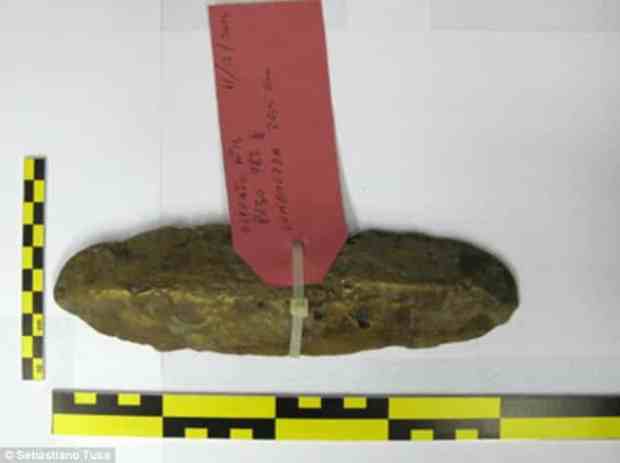
After various analyzes it has been discovered that the Orichalcum is actually a mixture of copper, zinc, nickel, lead and iron and, in turn, these ingots coincide with the details that Plato himself provided about how they used to be smelted.
But if these ingots are interesting, the ship where they were found is even more interesting. It is a very old ship; According to scientists, it must be just over 2,600 years old, which places it on a route that would go from some point farther in the Mediterranean to Asia Minor , at which point a storm ended up sinking it.
It should also be noted that, until recently, many considered the Orichalcum as something very similar to amber and without any relationship to Atlantis.
Others do relate it to the lost continent, but now, authors such as the British researcher James Allen, tell us that it would be more accurate to place Atlantis in the Andean Altiplano, since orichalcum is very similar to the natural alloy of gold and copper that there are in the mines in Urukilia, near Pampa Aullagas, in Bolivia. In fact, there are beautiful crafts with this material.
But what was recently discovered off the coast of Sicily gives us a new type of metal made up of 75-80% copper, 15-20% zinc and small traces of nickel, lead and iron.
Does it then belong to the mines that Plato said existed in Atlantis? We don’t know yet, but as the investigations progress we will inform you, because the subject undoubtedly deserves it.
What is your opinion? Do you think Atlantis really existed?

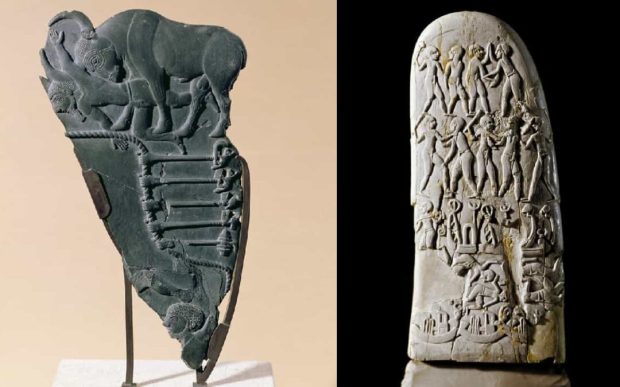
Five thousand years ago, the rulers of Upper Egypt cast their gaze upon the kingdoms of the Nile Delta and embarked on a conquest that, according to all indications, was accomplished by Narmer, the ruler of Nekhen, who is considered the first pharaoh of a unified Egypt.
In the 3rd century BC, the Egyptian priest Manetho composed a history of Egypt in Greek for King Ptolemy II Philadelphus. Unfortunately, from this work, known as Aegyptiaca, only a few passages have been preserved, reduced to the enumeration of thirty-one dynasties along with the names of the sovereigns who constituted them and references to some significant events during their reigns.
According to Manetho, the history of dynasties commenced with Menes, acknowledged as the inaugural pharaoh of Egypt and the founder of the First Dynasty. Prior to Menes, also known as Narmer, the land of the Nile was ruled by gods and demigods.
However, modern archaeology has revealed that long before Narmer’s reign, a lengthy process of unification of the entire Egyptian territory was underway. This process was led by monarchs hailing from Upper Egypt, the southern region of the country, who are associated with what we now call “Dynasty 0.”
These monarchs ruled during the Late Predynastic or Protodynastic period, spanning from 3300 to 3100 BC. This period corresponds to the concluding phase of the culture recognized by Egyptologists as Nagada III.
Today, Nagada (known as Nubt in ancient Egyptian and Ombos in Greek) is merely a village. However, it remains a crucial archaeological site for establishing the origins of these rulers of the 0th dynasty who embarked on their campaign to conquer the northern regions of the country.
Prior to the Late Predynastic period, the various “urban” communities in Upper Egypt had clustered along the Nile, where arable land was abundant.
Peasants made use of the river’s annual flooding, combined with early artificial irrigation techniques, to enhance agricultural productivity. This allowed for the cultivation of a wider range of crops, including cereals, fruits, and vegetables, leading to a substantial population increase.
As these communities grew, they began to be governed by leaders who were universally accepted and respected. Undoubtedly, these leaders must have possessed qualities of both military prowess and effective mediation.
Between 3500 and 3300 BC, corresponding to the Nagada II or Gerzense culture, Upper Egypt featured three prominent population centers that outshone the rest: the proto-kingdoms of Hierakonpolis (known as Nekhen in Egyptian), Nagada, and Tinis-Abydos. Their expansion led to fierce competition for dominance over the entire region and control of exotic trade goods.
The rivalries among these three centers eventually culminated in the triumph of Hierakonpolis. It unified Upper Egypt under its rule and established a highly centralized government. The victorious leaders of Hierakonpolis settled in the nearby town of Tinis-Abydos, possibly with plans for future expansion northward.
It’s worth noting that the necropolises of Upper Egypt’s most influential regional centers contained burials of varying social classes during this period. The quantity and quality of funerary objects discovered in certain graves point to the emergence of a powerful elite within an increasingly hierarchical society.
While Upper Egypt achieved military unity (possibly through alliances as well as conflicts), the settlements in Lower Egypt, specifically in the Delta region, did not form a cohesive kingdom. Some prominent elites may have existed in cities like Buto (known as Pe in Egyptian) or Sais. However, in general terms, the various communities remained autonomous from one another.
Furthermore, these Lower Egyptian communities had experienced limited social changes since the Neolithic era. They were societies with minimal social disparities, as evidenced by the simplicity of the tombs unearthed in the region. These tombs typically consisted of small, ground-dug oval graves with basic funerary belongings.
Gradually, the cultures in the northern regions abandoned their traditional practices and material culture in favor of those from Upper Egypt. They adopted features like wheel-turned pottery with a red glaze and the crafting of stone vessels, which were characteristic of Nagada II.
By the onset of the Late Predynastic period, around 3300 BC, the indigenous culture of Lower Egypt had vanished, supplanted by elements from Upper Egypt. Now, the entire country was culturally united, though not politically. The political unification that would ultimately lead to the formation of the pharaonic state commenced in the south during the final phase of the Predynastic era. The expansion of Upper Egypt toward the north must have been gradual and intricate, occurring under the rule of various kings from Dynasty 0.
It is intriguing to note that in later dynastic times, starting in the 3rd millennium BC, the falcon god Horus, symbolizing order, was regarded as the protective deity of Lower Egypt, while the warrior god Set, symbolizing chaos, served as the patron deity of Upper Egypt. According to mythology, Horus and Set clashed when the latter slew Osiris, the father of Horus. Until recently, scholars interpreted this mythical conflict between Horus and Set as a reflection of the struggles between two predynastic kingdoms: one from Upper Egypt and the other from Lower Egypt.
However, contemporary understanding suggests that the unification process did not result from a confrontation between an Upper Egyptian ruler and a unified Delta. In reality, Egypt’s transformation into a territorial state resulted from the successive conquests carried out by the kings of Upper Egypt over several generations.
In this context, the concept of Egypt as a land of the Two Lands (comprising two kingdoms) lacks historical grounding. Instead, it aligns with the Egyptian notion that a whole is constituted by two opposing yet complementary parts. These two halves, Upper and Lower Egypt, had their own patron gods and emblematic symbols. Consequently, Set and the city of Hierakonpolis became the protective deity and symbolic capital of Upper Egypt, while the falcon god Horus and the city of Buto assumed the role of the protective deity and symbolic capital of Lower Egypt.
Archaeological excavations conducted in Tinis-Abydos have unveiled the history of Egypt’s unifiers—the rulers of the 0th dynasty.
Starting from the Nagada III period, Abydos, serving as the necropolis of the city of Tinis (whose precise location remains unknown), became the final resting place for these rulers.
Their tombs have been identified in what we now recognize as Cemetery U and Cemetery B. Among the tombs, the most extensive and intricate one is the Uj tomb, associated with a leader or sovereign who lived around 3250 BC.
The discovery and excavation of this tomb took place in 1988, led by archaeologists from the German Institute in Cairo under the guidance of Egyptologist Günter Dreyer. Covering an area of 66.4 square meters, the tomb comprises twelve interconnected chambers linked by narrow vertical slots.
Despite being plundered in ancient times, archaeologists uncovered bone and ivory artifacts, including intricately carved knife handles, stone containers, a significant cache of ceramics (including plates, bread molds, and jugs containing scented oil, fats, and beer), as well as up to 400 vessels believed to have been imported from Canaan, possibly used to store wine.
Within the burial chamber, remnants of a wooden chapel and a complete ivory heqa scepter were discovered. The heqa scepter, shaped like a staff, symbolized royal authority during dynastic periods. Its presence in the tomb strongly suggests the royal status of its occupant.
Among the diverse array of funerary objects found in the Uj tomb of Abydos, the most significant for researchers may be the 150 small bone or ivory tablets engraved with the earliest hieroglyphic signs recorded in Egyptian history. These signs also appeared inscribed in black ink on ceramic vessels and represent the oldest known evidence of writing in the Nile region, possibly even the oldest writing in the world. These inscriptions confirm the indigenous origin of Egyptian writing and suggest its connection to the realm of royal funerals.
While the identity of the tomb’s occupant remains a mystery, the frequent appearance of the scorpion symbol on the ceramic vessels found there has led to the suggestion that the sovereign interred here might have been referred to as King Scorpion I. However, this is likely a symbolic name, and the prominently depicted scorpion sign may represent one of the many symbols of his power and strength rather than a literal name.
As previously explained, the political unification of Egypt was the outcome of an extended series of military conquests in the Delta region carried out by the kings of Upper Egypt, predating the First Dynasty.
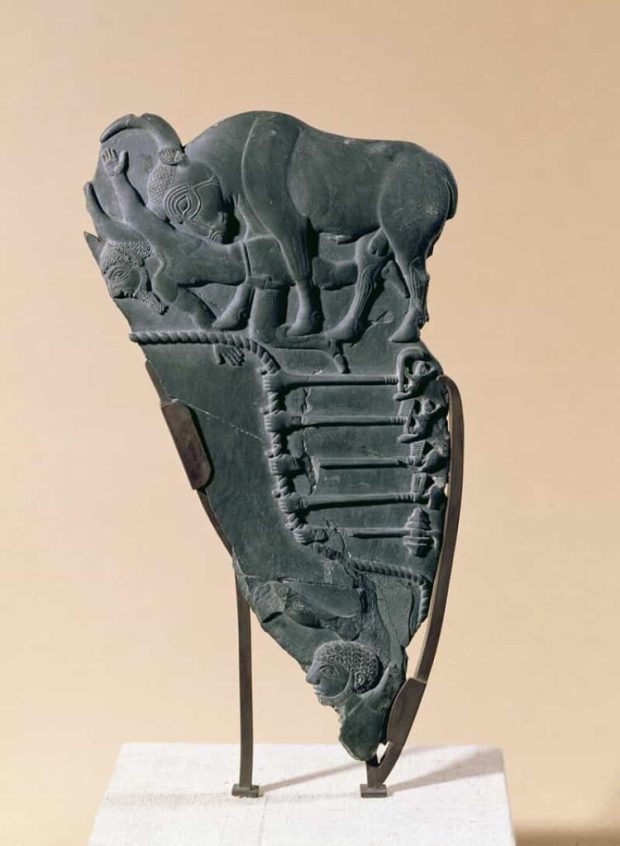
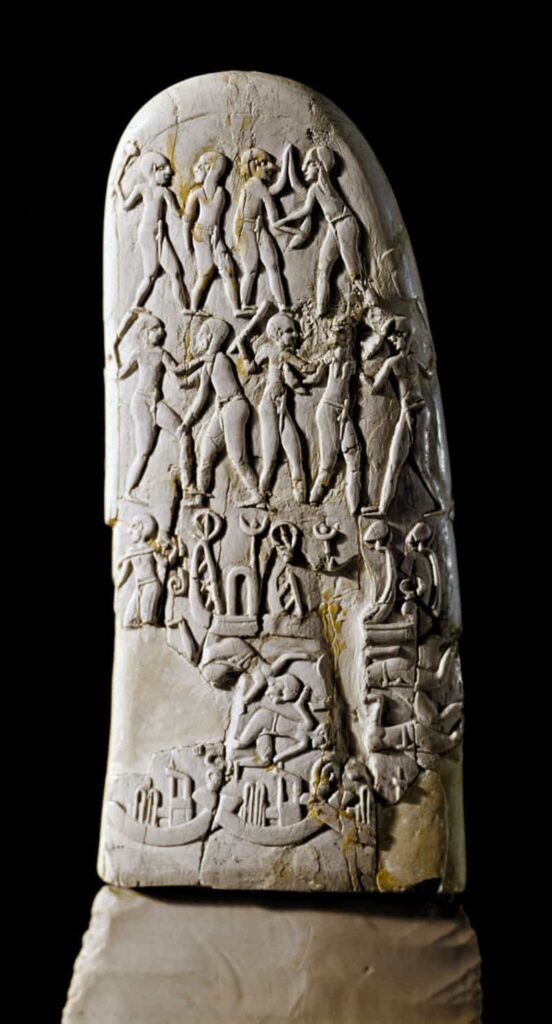
Our sole evidence of these conquests stems from the relief scenes found in the “unification documents,” which date back to the conclusion of the Predynastic era. These documents include knife handles, votive mace heads, and sizable ceremonial palettes, originally utilized as platforms for cosmetics preparation.
The Palettes of the Lion and the Bull depict the king in the guise of a lion or a bull, engaged in combat against enemies or fortified cities. These themes frequently recur in the iconography of the period and likely offer a representation of actual events.
The rulers credited with accomplishing the unification of the Two Lands are Narmer and Scorpion, though many experts propose that they might be one and the same individual.
In their respective city of origin, Hierakonpolis, a significant cult center linked to the falcon god Horus, numerous votive objects bearing these names have been unearthed. These include the renowned Palette of Narmer and the mace heads featuring Scorpion and Narmer.
It is highly probable that the scenes etched on the Narmer votive palette portray the culmination of this unification process. Narmer, recognized as the first ruler of the First Dynasty and the founder of the city of Memphis, is credited with finalizing the unification of Upper and Lower Egypt around 3100 BC.
Source: Irene Cordón i Solà-Sagalés, National Geographic

Throughout most of ancient Egyptian history, the god Ra was the supreme deity who governed the passage of hours, days, months, years, and seasons.
He brought order to the universe and made life possible. Ra could manifest in two other forms: Khepri, symbolizing birth or rebirth as the dung beetle, and Atum, representing the complete being.
The ancient Egyptian clergy explained that the sun star could assume different forms during its journey across the sky: Khepri represented the rising sun, Ra symbolized the sun at its zenith, and Atum represented the setting sun.
Ra’s daily emergence from the depths of the Duat (underworld) symbolized the cyclical nature of creation, and he was particularly venerated at Heliopolis.
During the Old Kingdom, the cult of Ra had a significant influence, combining with the two primary deities of creation, Atum and Amun, to give rise to hybrid entities like Atum-Ra and later Amun-Ra.
This is how the sun god became worshipped as a creator god. Ra was also considered the ancestor of the pharaohs, and his role grew even more complex as he merged with other gods.
There are various versions of Ra’s birth. In a classic rendition, as recounted notably by Neil Philip in his work “Myths and Legends,” Ra created himself by naming himself, just as he would create the elements of life by drawing them from the Nun, the primordial ocean.
In a variant, Ra is said to have been brought into the world by the goddess Neith during the darkness that presided over the emergence of life on Earth.
When confronted by this darkness, he began to cry, and humanity was born from his tears. Neith also gave birth to the serpent Apophis (Apep). Apophis and Ra were in constant conflict, clashing night after night.
Ra, whether as Atum-Ra or Amun-Ra, was not only the god of the sun but also the ruler of both gods and humans. Ra, and later his sons, reigned on Earth. The eye of Ra watched and observed everything, sparing nothing from its gaze.
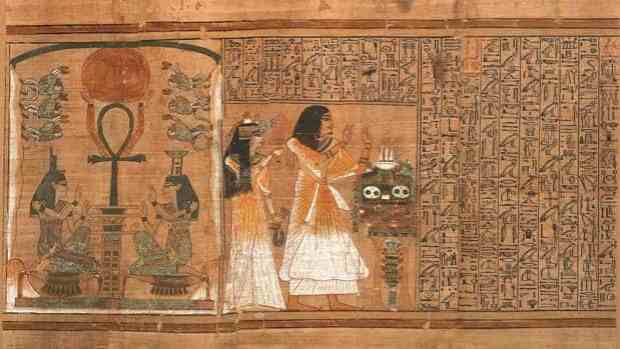
The Papyrus of Ani is one of the best-known versions of the Book of the Dead. It is believed that it was written about the nineteenth dynasty.
Among other things, its importance is because it contemplates the largest number of chapters among all the texts that have been found, explaining in detail the judgment of Osiris, a moment in which the soul of the deceased faces a judgment on the conduct of his past life.
The ancient Egyptians had a lot of respect for death. They cared more about the afterlife than the present one. For this reason, those who could afford it, as it was very expensive, did not hesitate to purchase their own Book of the Dead.
They could be made to order, thus bearing the name of the deceased and having previously chosen the spells for his papyrus. On the other hand, series of the Books of the Dead were also frequent, in which space was left to place the name of the deceased (they would obviously be cheaper).
Taking this into account, we can affirm that Ani was someone of great relevance. In the text, it is already said that he was a scribe, and the truth is that the scribes enjoyed an excellent social position at that time.
The text thus reveals that Ani was a “true royal scribe and administrator of the divine offerings of all the gods”, “Governor of the granary of the lords of Abydos and scribe of the divine offerings of the Lords of Thebes,” and “Beloved of the lord of the north and south”.
All this makes us see that he was of a high rank and that his position allowed him to pay for such a complex and elaborate book.
Egyptologists believe that the book was written by three different scribes. This is because three very different spellings can be identified, although it is true that they are from the same school and that one of them stands out above the other two.
On this occasion, the text was adapted to the images, as can be seen in the changes of signs, repetition of chapters, and omission of others. This was unusual for this type of book.
The book itself is nothing more than a perfect manual of the steps that the ka of the deceased must follow in the Duat. A Guide to the Perils of the Path to Judgment with Osiris. Thus, this book would have been called the book of eternal awakening.
Although approximately twenty-five thousand different copies of the Book of the Dead have been found, this papyrus of Ani is, without a doubt, one of the best-preserved copies. Therefore, the book itself has been a great source of knowledge about the religiosity of the ancient Egyptians.
Discovered in the tomb of Ani at Thebes (nineteenth dynasty ca. 1250 BC), it recounts the journey to the afterlife of this high official and royal scribe together with his wife, the priestess Tutu.
It was purchased by the controversial Ernest Wallis Budge (1857-1934). Given the “strange” circumstances by which the piece was taken, the authorities of the Antiquities Service surrounded the Egyptologist’s house to seize the pieces. But Budge did not flinch, and he evaded the pieces.
In order to more easily take out the papyrus from the country, he cut its more than twenty-three meters into thirty-seven fragments, which are the ones that can be seen today in the British Museum in London.
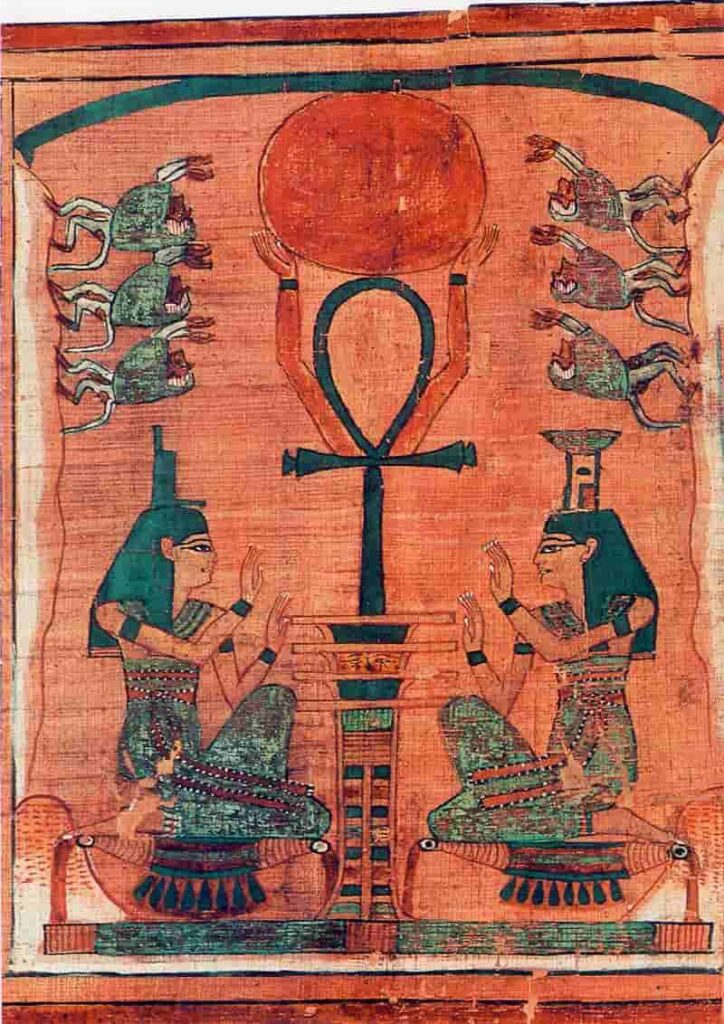
Isis and Nephthys before Osiris, in the form of a Djed pillar. Papyrus of Ani.
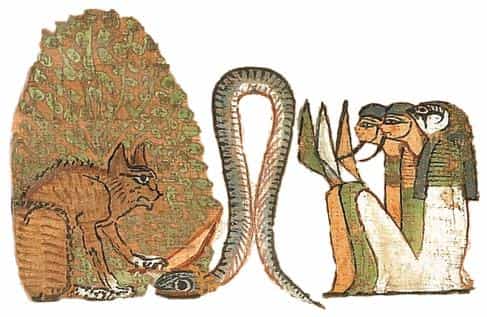
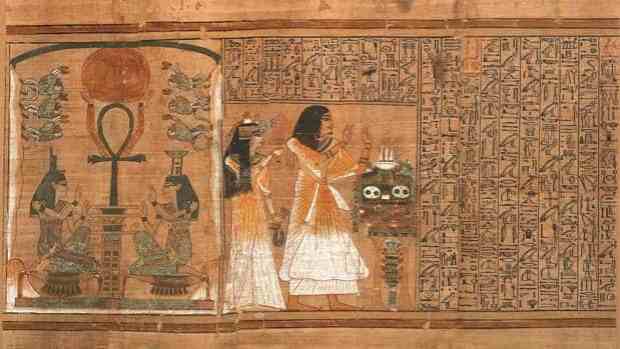

 Grand Temple of Horus Behdety