Daily Chabad

RIGHT-TRACK

Continuously Everywhere …

There are no things. The experience of a world of static objects is an illusion. There are only words—a constant flow of meaning generating an entire universe anew at every moment.

There is no world. Abandon the notion that there is a G‑d who created a world outside of Himself as an artisan fashions an artifact.

There is only the energy of being, flowing continuously outward from the Source of Being, investing within countless strata of being, until ultimately crystallizing as our material reality.

Which means that if for a moment that current would cease, all of existence would cease with it. There would be no matter, no laws of physics, no fields of energy or dimensions of space. Not only would all these be gone, they would never have been, for time itself would be erased.

And if the current would begin again, in some different way than it was before, then the world would be a new world and the past would be a new past.

Which means that there is no room for worry or despair, and neither is there anything that can defeat your purpose. For you are intimately entwined in a bond of love with that Source of Being, and from there, at any moment, all of past, present and future can be annulled and created anew.

Shaar Hayichud Veha-emunah, chapter 1. Tzavaat Harivash 137

Tarot Attributes on the Tree of Life, by Rev. Marek Bazgrzacki

TOL-TAROT1

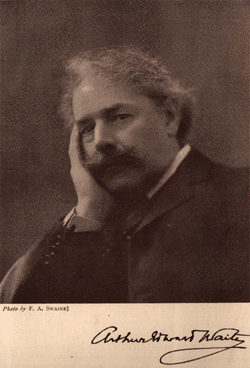
The use of the Tarot fitted in nicely with the poem’s themes of the Fisher King and the Grail myths. A.E. Waite, a Grail obsessive, had worked numerous Arthurian figures and symbols into the highly popular 1910 Waite Smith Tarot deck. Along with the grail iconography Waite added aspects of the Christian Cabala and Hebrew Kabbalah, Gnosticism, Rosicrucianism and ancient Egyptian symbology into the deck [11]. This was done as part of a ambitious synthesis of the various occult traditions, a task undertaken by the grandly self-titled Hermetic Order of the Golden Dawn, a group in which A.E. Waite was a key member. The Waite Smith Tarot was the first deck to have the 22 cards of the major arcana and the 4 suits, each of 14 of the minor arcana cards fully illustrated, a companion guidebook The pictorial key to the Tarot was published alongside the deck with full explanations of the cards.

AE-WaiteFrom the mid-nineteenth century onward the 22 cards of the major arcana had become increasingly associated with the concept of pathways and the 22 letters of the Hebrew alphabet within the Kabbalist ‘tree of life’ and ‘by 1890 Kabbalistic teaching was integral to Tarot design’ [12]. As a body of knowledge the Kabbalah has its origins in Hebrew oral tradition, scriptures and Jewish rabbinical writing. Its early history is unclear, but it developed further between the 7th and 18th centuries. Its formative texts include the Zohar and Sefer Yetzirah.  A key point in its development was the writing of Etz Ha-Chaim, “The Tree of Life” by Chaim Vital in the 1590s, based on the teachings of Rabbi Isaac Luria. The concept of the tree of life entered a variety of Western esoteric traditions, being taken up by the Golden Dawn and their Hermetic Qabalah.

Allusions to the components and structures of the tree of life with its alphabetised pathways and the use of kabbalistic allegory has a long tradition in Jewish and European literature.

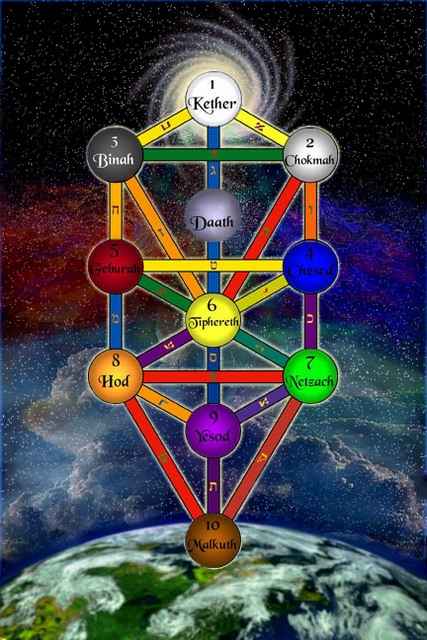
Consisting of ten interconnected sefira (plural sefirot), the tree of life is arranged vertically into three columns or pillars: the left hand pillar, the pillar of mercy, representing the principles of benevolence; the right hand pillar, the pillar of severity, power and strict justice; while the central pillar, representing harmony and the ideal balance of mercy and justice, uniting and balancing the two sides. Each of the sefirot has an associated vice and virtue and like a snakes and ladders board, the vices and virtues form gateways and trapdoors between the sefirot.

Though each sefira is as important as the rest, the tree is arranged hierarchically into the four overlapping worlds of the Kabbalah, a ladder from the physical to the metaphysical, a ladder that one may both ascend and descend, a ladder made up of the 22 pathways.

hebrew tarotThe ten sefirot of the tree of life may have had their origins as representations of the metaphysical but they can be used as templates for personality traits, states of mind, or the developmental ages of man and are in some ways similar to Jungian archetypes. These templates are subtler than cartoon stereotypes or the motions of type-cast character actors, coming from a deep tradition influencing literary culture as well folk and pop psychology.

Each of the 22 pathways is associated with a letter of the Hebrew alphabet. The names of the letters have literal meanings e.g. the word aleph, the name of the Hebrew character ? also has the literal meaning of ‘ox’. Each of the 22 pathways is also associated with one of the 22 Tarot cards of the Major Arcana. In the tarot tradition these have a recognized set of attributes and symbolic and mythic associations and cards will often have links and relationships to other cards in the deck. Though the cards often represent characters they should not be seen solely in those terms, rather they present situations or dilemmas within a plot, situations that the protagonists must overcome, being integral rather than part of a parallel narrative structure. The cards, like panels from a graphic novel are dealt, interpreted and stitched into a storyboard.

—-

For a detailed reference on each of the Major and Minor Arcana, access our Resources link here.

The Kabbalistic Tree of Life, by Z’ev ben Shimon Halevi

TOL-Psyche-in-detail2

Existence is governed by a simple set of basic laws. The first is that there is a unity between ten essential principles, with twenty-two minor laws that allow them to interact. Like other esoteric systems, the Tree has active and passive pillars with a central column of equilibrium. Within this scheme are various activities, levels and flows that lie behind every entity in the universe. The book sets out to show how this is so.

Next comes a brief history of Kabbalah starting from Biblical times to show how the Tree has its origin in the seven-branched candlestick in the Tabernacle and the Temple. It then goes on to explain how Hellenic ideas influenced this mythological version of the tradition. In the Middle Ages Kabbalah appeared as a solution in the debate between religion and philosophy then going on and had much influence upon European mysticism.

The origin and purpose of Existence is then presented in the emanation of the ten sefirot or numbers and the unfolding of the Lightning Flash of the Octave that brings the Tree into being. Then comes the notion that a human being is a microcosm of Existence. Each individual person is an image of the Absolute in miniature. The composition and dynamics of the psyche are seen in modern terms. This is followed by a study of the planetary archetypes and the relationship between Kabbalah and Astrology, the ancient form of psychology, and the influence of celestial conditions on the mind. The image of the Zodiacal Man resembles at a lower level that of Adam Kadmon, the Divine Man seen sitting on the Throne of Heaven, set in a great chariot of Ezekiel’s vision. Both these traditions root back to Abraham’s home city of Ur in ancient Mesopotamia. Included in this section is an example of how a birth chart can be put on the Tree diagram to get a deeper insight.

The idea of the four Worlds within one Tree is then explored to show the various levels within a human being, as symbolised by the garments worn by the Israelite High Priest. These correspond to the physical, psychological, spiritual and Divine dimensions within ourselves. The triads within the Tree and the Octave are explored to reveal ascending and descending processes and the purpose of the various functions as regards the body, soul and spirit. This is followed by an exposition of the paths between the sefirot and how the flows from one to another can bring about balance or imbalance between different parts of the psyche and indeed the body, which may also be seen as a Tree. The Hebrew letters associated with the paths and the Tarot are then set out on the Tree to show how each symbol represents a specific function.

The next section is about practice and application of the Tree. First comes an exercise in a form of a simple ritual in which one ‘goes up the Tree’. This, if done with the right frame of mind in a quiet place, will give one a sense of the Tree within oneself and be a reference point in any mystical experience, as well as in understanding any particular situation in terms of the Tree diagram. This exercise should be practised from time to time to accustom oneself to the Tree’s configuration.

The first application of the Tree is to that of Parliament, which is seen in terms of its structure and dynamics. Also included in this section is the horoscope of England, which was born at Noon 25th December 1066 when William the Conqueror was crowned King, giving an insight into the national character. God and Mammon are then examined in terms of the Tree. In this chapter every religion and its several levels is seen to follow a classical pattern as does any economic system. From this it is shown how any imbalance or excessive focus on one area can upset the balance and cause the entity either to degenerate into a revolt against a corrupt priesthood or board of directors.

To make the Tree less remote and more experiential I have used a love affair to illustrate how even a lovers’ quarrel is part of a cosmic process. Everyone believes their relationship is unique, but upon putting it on the Tree one can see how Mother Nature brings a man and woman together to produce the next generation. However, it must be said that a marriage between soul-mates is of another order as a higher Tree, that of the psyche, can generate a single spirit out of such a union.

Birth, Life and Death are then examined. Here the process of conception and gestation are seen underlying the building of the body, followed by the ascending Octave of passing through the stages of life towards death and the hereafter, as Kabbalah subscribes to the notion of Hell, Paradise, Heaven and reincarnation. These themes are developed in my later books. This leads onto Time and its various orders. In this Tree the several grades between the ‘Passing Moment’ and the ‘Eternal Now’ are placed between the scales of a human lifetime and that of the planets, galaxy and Eternity. This illuminates why mystics speak of different levels of perception. Such a view opens onto the Biblical version of Creation which is seen in terms of Darwin’s theory of Evolution. Each order of creature fits exactly into the Tree.

Schools of the soul are next to be scrutinised in Tree terms, which reveals how every spiritual tradition must concur with the laws of Existence, if its working method is genuine. This is seen in the progression of consciousness and the exploitation of what opportunities life offers. Then comes an exposition of Jacob’s Ladder and how it is the flexible framework of the Divine Name I AM THAT I AM. The word THAT represents Existence between the first I AM and the second I AM. As such, the universe is the Mirror by which the Absolute beholds ITSELF with the aid of humanity, which is the organ of perception for God. Finally, the last diagram shows the present state of the Divine drama, in which we all play either a conscious or unconscious role with every new life we live.

TOL-KAB-overview

Alchemical Transformation in the Golden Dawn ~ by Lyam Thomas Christopher

GD-TOL-OUTER-ORDER


The Great Work is not an easy task for the human animal. It is the alchemical change from human to more-than-human, and it brings the student of the occult into a direct relationship with the predicament of mortality and with the compromises that he has made in order to survive in the material world. Plunging into these issues when most people would turn back, the student finds himself on a journey through disillusionment, self-doubt, and a dreadful loss of purpose—and possibly a journey that arrives at a new vista of life going far beyond what ordinary consciousness can fathom. In the process of this magical work, life usually gets worse before it gets better. The immortal Self awakened by the Golden Dawn’s Kabbalistic techniques, by its very definition, brings with it a permanent joy and realization, yes, but these rewards are obtained by a journey through darkness. For the true thrust of the Golden Dawn comes as an assault from within. The Great Work brings forth an inner truth that destroys what we hold most dear. It dissolves from the inside the stranglehold that our biology has upon our spirit, subduing the animal and calling forth the god.

This is not good news to the ego, the “assumed identity” that you and I have adopted in order to survive in the world. We have spent at least eighteen years creating a fully functional personality capable of finding food and shelter, forming profitable relationships, and rearing offspring. To discover other possibilities beyond this baseline of existence poses a threat. The human animal fears the power of magic because, in its essence, magic seeks to supplant the animal motives with deeper ones. It seeks to penetrate beyond the boundaries of our daily survival drama. The fact that the body, which you and I work so hard to care for, is mortal—and obviously expendable in the hands of some deeper purpose—is the last reality we want to face!

For those of us morbid enough to value this kind of self-discovery there are available the hidden traditions that still maintain magical practices of self-transformation. The grade system of the Golden Dawn spells out one such program of practice for us. Granted, there are many modern-day offshoots of the Golden Dawn that have become too “respectable” and mainstream to explore the darkness of the human soul. They teach the rudiments of Kabbalah and Egyptology, revealing to us secret handshakes and granting us prestigious certificates, all while oozing an aura of empty mystery with every email. But for those of us who are looking for more than diplomas and historical trivia, there are the less impressive curricula that still teach the distasteful, hands-on work of killing and resurrecting the human animal.

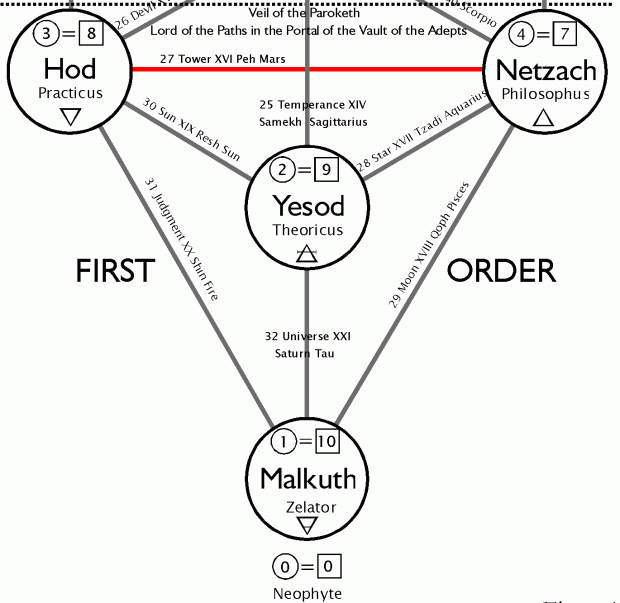
To begin this not-so-glamorous process of transformation, the Golden Dawn student enters the first grade of the Outer Order: Neophyte. In most temples, the student’s primary responsibility in this grade is to perform two exercises every day: the Lesser Banishing Ritual of the Pentagram (LBRP)and the Middle Pillar. He must also complete a small amount of reading, study, and group ritual, but these formalities, as important as they can be, are secondary to the actual daily practice of self-initiation.

The LBRP and Middle Pillar exercises restructure the psyche of the student and set the stage for the transformation process to begin. To do this, the LBRP creates a cleared “space” within the student’s imagination. He draws a magic circle of protection, he intones Hebrew names of God, and he draws sigils with the intention of warding off the influences of the material world from his inner landscape. Following this, the Middle Pillar exercise invokes the highest, purest spiritual light from the student’s divine aspect, drawing it downward into the cleared space and into his body, all the way to the feet. The student thereby identifies himself with a continuum of pure, unconditioned consciousness. He becomes the Middle Pillar of the Tree of Life. This is not so much pictured as an actual tree, but as a framework of interconnected spheres, which symbolizes the creation of the universe from spirit into matter.

Neophyte is a probationary grade. By creating this cleared space, the student introduces himself to future possibilities. If he isn’t yet ripe for spiritual change, his ego has a chance to wage its war of resistance and win. And it often does win. The student who isn’t ready for transformation either stops the process honestly and quits the Golden Dawn (usually for very “rational” reasons) or he joins the social club of New Age charlatans, accumulating grades, certificates, and a storehouse of impressive and useless information. Invisible to him are the students who proceed onward into the inner roller-coaster ride of the grades that follow. No one can fully understand the changes that come next, except those who have gone before.

The next step then is to jump-start the process of dissolving the personality. The student proceeds into the realm of the four Elemental grades:

  1. Zelator = Earth
  2. Theoricus = Air
  3. Practicus = Water
  4. Philosophus = Fire

In each of these grades, he uses Kabbalistic ritual to call forth one of the Four Elements, experiencing intimately its inner psychic correspondences. His personality becomes temporarily unbalanced, preoccupied with anything that corresponds to that Element. In Zelator (the Earth grade), for example, he feels the heaviness and the grit of life in the world. The physicality of everything around him comes into sharp focus. Even the supposedly exalted phenomenon of light can appear as darkness, as just one kind of brick in the tomb of matter. In Theoricus (the Air grade), thoughts and daydreams become overly pronounced. Elation, wonder, and the temptation to chase after glamorous images become commonplace. This gives the student a chance to reach a better understanding of his powers of imagination and his habits of thought, and to organize them and eliminate obsessions. In Practicus (the Water grade), the student gains gradual perspective over emotion and intuition, seeing these as a playing field that reveals the influence of higher forces, similar to the way that the surface of water that displays the influence of wind. And lastly, in the Fire grade, his ritual invocations fan the flames of his animal powers. Passions and instincts rise from below, and the old personality begins to burn away and disappear.

These four grades call forth, purify, and consolidate the each of the Elements, showing how these four come together to produce the illusion of the personality. The student discovers that his ego isn’t inherently real or composed of any singular essence, but rather that it is an arbitrary patchwork, woven together from separate Elemental threads. The false image of the ego shows itself for what it is, and the question of whether anything lies beyond its ingredients becomes serious.

A new perspective begins to dawn, and the student realizes that the real work hasn’t even begun yet. The Elemental grades actually comprise the preliminary work, and a new landscape awaits him as he readies himself to embark on the Great Work itself.

The next task then is to balance the Elements—the facets of the personality—until their unity-in-diversity yields forth something more than the sum of its parts. The Portal Grade is therefore the last grade of the Outer Order, and it reverses the process of disintegration brought on via the Elemental-Grade exercises. All four Elements, which now stand in the four quarters (North, South, East, and West) symbolically untangled from one another, are brought back together meaningfully. This reintegration creates a healthy, sturdy base on which (or within which) to ignite the “oven” of the Great Work.

In Portal and the grades that follow, the language of alchemy, which has remained unreliable and even impenetrable till now, begins to make sense. The sturdy foundation (or vessel) that the student has built via the Elemental grades becomes tangible to the inner senses as a sort of inner, ethereal body, neither energy nor matter. In the midst of the four Elements the newborn adeptcan discern, for the first time perhaps, a sort of stasis field within which he can manipulate the three hidden alchemical principles: Mercury, Sulfur, and Salt. As he proceeds into adeptship, he graduates from working with the four visible Elements (the outer facets of the quintessence) to the threeinvisible principles of the Trinity (the inner aspects of the quintessence). These three supernal principles, expressed in their raw form, are the Salt, Sulfur, and Mercury of alchemy, and they comprise the intangible “guts” of the Four Elements, beneath the “skin” of tangible sensation. They must not be confused with the salt, sulfur, and mercury of common experience.

Into the stasis field—alchemical Salt—the magician begins to concentrate Mercury, the volatile, meandering aspect of mind, and Sulfur, discipline and concentration. His visualization ability now acts from a higher dimension, and it becomes nearly impossible to relay these deeper activities in words. But this kind of magical work has many symbols that attempt to explain it. The alchemists have sometimes represented the process as a crucified serpent, such as the serpent that Moses affixed to a cross in the desert. The cross represents the framework established by the preliminary work (Salt), the Serpent represents the volatile mind (Mercury), and the nails represent the fixation, the restraint and focus (Sulfur) applied to the volatile mind. The adept, in other words, is now capable of working with the quintessence. He can use visualization, breath, and ritual actions to contain his mind’s volatile tendency (Mercury) within a localized area (Salt) and concentrate it to crystallize into manifestation (via the principle of Sulfur). The end product of this effort is the legendary philosopher’s stone, none other than manifested spirit. His body begins to transform and take on the quality of invisible radiance.

Another image that represents this idea is that of the squared circle, common to Renaissance magicians. Renaissance humanists symbolized the unexpressed, divine self of an individual as a circle (Mercury). It’s expression in matter, in the outer world, they visualized as a square (Salt). So, for the magician of antiquity, the squared circle—or circle with a square drawn around it—represented manifested spirit. Sulfur he represented as a point in the center of the circle. The point is the constant, balanced pressure (or meditation) that gradually pushes spiritual potential into matter, forcing it to crystallize and come forth.

To summarize then, the Work in the Golden Dawn’s Outer Order is to dissolve the false personality and make it disappear. The Work in the Inner Order is to call forth the true “personality,” to make it appear or express itself tangibly in the physical world. Though at first glance, the mysticism of the Golden Dawn seems to focus on dissolving the self into spirit, become more subtle and airy, it may come as a surprise to many that the further work of the inner order actually reverses this process such that the adept actively comes out into the world as a direct expression of his Higher Self. In the open air of awakening, his outer world of appearances is consumed by the Worlds within and by the very process of transformation itself. His very presence, without effort, begins to act as a catalyst for magical change wherever he goes.

Lyam Thomas Christopher
Lyam Thomas Christopher (Florida) has been a student of Hermeticism and the Golden Dawn for over fifteen years. After receiving his BA in Liberal Studies he went on to receive his Adeptus Minor from Ra Horkhty Temple. A former bookseller, the author is currently a learning specialist at a regional community college.

Understanding Kabballah Concepts

Zohar2

For one to understand what has been written by a Kabbalist, much study, preparation and development through previous experience must take place. Kabbalah allows a soul to see the puzzle of creation in a perspective that is all inclusive. Physicality and spirituality are but one as the branch portrays what the root necessitates. When we wish to develop and have enough desire to engage in spirituality, the language of Kabbalah will open to us and our ability to perceive it as a composition for development will begin to blossom.

Ritual Meditation ~ Tree of Life

TreeOfLife4WorldsByDelilah

Tree of Life Ritual

Temple is arranged in the shape of the Tree of Life.


Kether:

In the beginning there was nothingness … this is the Ain, Ain Soph and Ain Soph Aur …  and nothingness was composed of all the energies and forces of the Divine Universe at a time before our existence …. for this is the primal point that we came from and to which we shall return.  Thus, the Divine Spirit began to manifest through stages … energies each denser than the last … each stage came from that which was before it.


And Lo!  There came ten energies unique and individual unto themselves with the physical universe, the tenth among them … and these ten energies formed a tree that had twenty-two branches … and this tree is the tree of life of which the bible refers, for it is the blueprint of the universe and only the Divine knows of it completely.  We shall now invoke the tree for it is said, “That which is above is as that which is below.”


For I am Kether, the crown represented by the name of god Eheieh … the name that was given to Moses at the burning bush … and which name means, “I am that I am.”  My angel is Metatron, the greatest of angelic beings.  I rule the universe and represent on this plane completion of the Great Work . With this sword, I pass on to my place on the tree.

(Hands sword to Chokmah and goes to his/her place.)


Chokmah:

I am Chokmah … Wisdom … I am represented by the name of god YAH which means “Divine Ideal Wisdom.”  My angel is Ratziel, the prince of knowledge and hidden and concealed things.  I rule the solar system and represent on this plane devotion. With this sword I pass on to my place on the tree.

(Hands sword to Binah and goes to his/her place.)


Binah:

I am Binah understanding I am represented by the name of god YHVH Elohim which means “Lord God” … my angel is Tzaphkiel the prince of spiritual strife against evil. I rule Saturn and on this plane I represent silence but can represent avarice. With this sword I pass on to my place on the tree.

(Hands sword to Chesed and goes to his/her place.)


Chesed:

I am Chesed mercy and justice, I am represented by the name of god El which means God the Mighty One, my angel is Tzadkiel the prince of mercy and beneficence. I rule Jupiter and represent elemental salt. On this plane I represent obedience to a higher will but can represent pride and hypocrisy. With this sword I pass on to my place on the tree.

(Hands sword to Geburah and goes to his/her place.)


Geburah:

I am Geburah severity and strength, I am represented by the name of god Elohim Gebor which means “God Almighty” … my angel is Kamael the prince of strength and courage. I rule Mars and represent elemental sulfer, on this plane I represent energy and courage but can represent cruelty. With this sword I pass on to my place on the tree.

(Hands sword to Tiphareth and goes to his/her place.)


Tiphareth:

I am Tiphareth beauty, I am represented by the name of god YHVH Eloah Veh Da’ath which means “God of Knowledge and Wisdom”… my angel is Raphael archangel of brightness, beauty, healing and life.  I rule the Sun and represent elemental mercury, on this plane I represent devotion to the great work but I can also represent false pride. With this sword I pass on to my place on the tree.”

(Hands sword to Netzach and goes to his/her place.)


Netzach:

I am Netzach victory, I am represented by the name of god YHVH Tzabaoth which means “God of hosts” …  my angel is Haniel archangel of love and harmony. I rule Venus and represent initiation into the element of fire, on this plane I represent unselfishness but I can also represent lust and impurity. With this sword I pass on to my place on the tree.

(Hands sword to Hod and goes to his/her place.)


Hod:

I am Hod glory, I am represented by the name of god Elohim Tzabaoth which means “God of hosts ruling the universe in wisdom and harmony” … my angel is Michael the Archangel Prince of splendor and wisdom and the great protector. I rule Mercury and represent initiation into the element of water, on this plane I represent truth but I can also represent dishonesty. With this sword I pass on to my place on the tree.

(Hands sword to Yesod and goes to his/her place.)


Yesod:

I am Yesod foundation, I am represented by the name of god Shaddai El Chai which means “Almighty Living God” …  my angel is Gabriel archangel of truth. I rule the Moon and represent initiation into the element of air, on this plane I represent independence but can also represent idleness. With this sword I pass on to my place on the tree.

(Hands sword to Malkuth and goes to his/her place.)


Malkuth:

I am Malkuth kingdom, I am represented by the name of god Adonai Ha Aretz which means “Lord of the Earth and Visible Universe” … my angel is the archangel Sandalphon the approacher and prince of prayer. I rule the Earth and represent initiation into the element of earth, on this plane I represent discrimination but can also represent avarice. With this sword I pass on to my place on the tree.

(Takes sword and lays it on altar)


Kether:

As above


Malkuth:

So below


Kether:

As it is in the heavens


Malkuth:

So it is on earth


Kether:

Where in Malkuth is in Kether


Malkuth:

So Kether is in Malkuth


Kether:

We will now purify, consecrate and empower this space and those within with elemental salt, sulfur, and mercury and the elements fire, water, air and earth.”


Chesed:

I purify, consecrate and empower with salt this space and those within.

(Returns to his/her place.)


Geburah:

I purify, consecrate and empower with sulfur this space and those within.

(Returns to his/her place.)


Tiphareth:

I purify, consecrate and empower with mercury this space and those within.

(Returns to his/her place.)


Netzach:

I purify, consecrate and empower with fire this space and those within.

(Returns to his/her place.)


Hod:

I purify, consecrate and empower with water this space and those within.

(Returns to his/her place.)


Yesod:

I purify, consecrate and empower with air this space and those within.

(Returns to his/her place.)


Malkuth:

I purify, consecrate and empower with earth this space and those within.

(Returns to his/her place.)


All do Lesser Banishing Ritual of the Pentagram to finish.

Sign of Silence.

“Being Begins With Physical Birth and Terminates With Death,”by GraalBaum

Right away this signifies a refusal to recognize any kind of living away from this world, or indeed taking the least interest in supramundane affairs.

All forms of religion, mysticism, magic, or the slightest hints of spiritual states must be resolutely rejected. Being begins with physical birth and terminates with death. Provided we stay within whatever bounds have been laid out by our “people-planners” our brief lives here may not be too bad. After all, we are only animals to be eaten up by earth when we are surplus on her surface. And so forth and so forth. The principle of all this is to divert us away from inherent divinity at all costs, whether by distracting attention, screening and obscuring viewpoints, or any other likely tactic.

People who are prepared to accept materialism as a way of living offer no opposition to intended evil or very much opportunity for intended good. So long as they willingly remain with their noses firmly glued to the ground their eyes are unlikely to discover any stars. They are no threat to evil doers at all. True, they may, and often do, draw distinct lines at physical or observable ills that might be traced to chemical and allied causes, but they will cheerfully allow all kinds of much more subtle and spiritually dangerous contaminants of consciousness first because they do not believe these have any reality, and then because they suppose that whatever will not respond to physical treatment can scarcely be much of a menace in a totally material world. The more humans who can be held as relatively happy captives of entirely greater opportunities earth bound environments, they occur for dedicated evil doers to operate on levels rather above the heads of those who refuse to up lift themselves beyond bodily bounds. In addition, if evil is intelligently presented as socially or economically expedient, it is incredible what materialists will not only accept, but actively insist upon. Perhaps the worst evil possible among materialists is to become convinced there is no such principle as evil at all. It has been said that the devil being the “father of lies”, his greatest deception has been to disguise himself from humanity altogether.

At all events, materialism might positively be marked up as a high major score for the “baddies” of life, whether incarnate or not. At a stroke, it reduces any serious opposition to their intentions right down to minimum. It may not provide over whelming possibilities of profit, but it does at least afford a definite work able basis in this world for whatever worst might be coming to it. By clever use of the powerful coercion compulsion persuaders to discourage man from seeing his divine spiritual heritage, humanity may remain condemned to the eventual extinction of all who refuse to rise above their material marks.

–W G Gray ( Exorcizing the Tree of Evil )

Daily Chabad ~ The Ark

The 150 metre-long Noah's ark created by Dutch Johan Huibers is pictured at an old abandoned quay on the Merwede River in Dordrecht on June 21, 2011. For the last three years the quaint old Dutch city of Dordrecht have been watching in amazement as construction businessman Johan Huibers' dream of building a 150 metre-long Noah's ark, stocked with thousands of plastic animals, slowly grew into a reality. At an old abandoned quay on the Merwede River, about 65 kilometres (40 miles) south of Amsterdam, Huibers, 52, and a team of 50 dedicated employees are slowly putting the final touches to what they believe is the only life-size wooden ark in existence. AFP PHOTO / ANOEK DE GROOT (Photo credit should read ANOEK DE GROOT/AFP/Getty Images)

The 150 metre-long Noah’s ark created by Dutch Johan Huibers is pictured at an old abandoned quay on the Merwede River in Dordrecht on June 21, 2011. For the last three years the quaint old Dutch city of Dordrecht have been watching in amazement as construction businessman Johan Huibers’ dream of building a 150 metre-long Noah’s ark, stocked with thousands of plastic animals, slowly grew into a reality. At an old abandoned quay on the Merwede River, about 65 kilometres (40 miles) south of Amsterdam, Huibers, 52, and a team of 50 dedicated employees are slowly putting the final touches to what they believe is the only life-size wooden ark in existence. AFP PHOTO / ANOEK DE GROOT.  (Photo credit should read ANOEK DE GROOT/AFP/Getty Images.)


There is a raging storm at sea. There are hellish waves that crash and pound at the shore, carrying all away, leaving desolation behind.

The sea is the world of making a living. The waves are the stress and anxiety of indecision, not knowing which way to turn, on what to rely. Up and down, hot and cold—constantly churning back and forth.

Do as Noah did, and build an ark. “An ark” in Hebrew is teivah—which means also “a word.” Your ark shall be the words of meditation and of prayer. Enter into your ark, and let the waters lift you up, rather than drown you with everything else.