The following article by Mathers was written by him on October 7th 1884 and published in the S.R.I.A. journal. I do not believe this has since been republished but am open to correction. A lengthy and rather pompous letter disagreeing with Mathers was published by one Bro. L. Hespiradoux which is too long to give here but Mathers’ rejoinder letter is included. Although Mathers’ article is somewhat basic it contains a few interesting points and is offered here for historical interest. Mathers’ first use of ‘respective’ below is obviously incorrect – he means the reverse, and his reference to the author of the Zohar, following his quotation from Eliphas Levi is confusing. The two diagrams of the Pentagram and Hexagram are omitted.
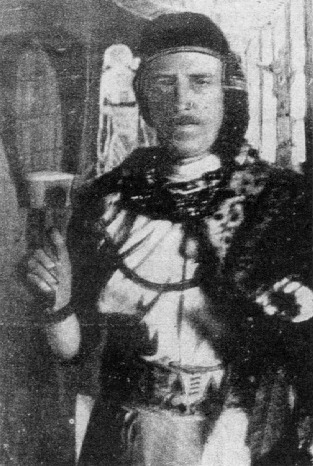
Samuel Liddell MacGregor Mathers
“On Some Esoteric Significations of the Six-Pointed and the Five-Pointed Star”
A Paper by S. Liddell Mathers, Honorary VIII [degree], read before the Rosicrucian Society of England.
I propose to lay before you this evening a brief paper on the Esoteric Significations of those two well-known symbols which are to be found in every Masonic lodge, and which yet are even more replete with Occult suggestions than others which have been more jealously shrouded from the gaze of the Uninitiated – I refer to the Six-pointed and the Five-pointed Stars, better known to Students of Occult Science under the respective appellations of “The Sign of the Macrocosm-“ and “The Sign of the Microcosm”.
Let us first examine the Six-pointed Star, the Sign of the Macrocosm, or Greater World, sometimes also called the “Shield of David” and “The Seal of Solomon”. It consists of two interlaced Triangles, one with the apex upwards, the other inverted; or, the symbols of the uniting of Fire and Water, of Astral Light and Spermatic Chaos. In some ancient works it is represented with the inverted triangle black, and the other triangle red; the respective colours of Fire and Matter; or, in the Alchemical nomenclature, of Sulphur and Mercury. Further, it is the Symbol of Equation of Force, of the balance of Light and Darkness, of God, and of NATURE. Its Six points symbolize the Six limitations of Matter, the Six faces of the Cube of the Universe, the Six Days of Creation. To the Initiate it conveys the whole first Chapter of Genesis and the Qabalistic Cosmogony of the Zohar. The following extract, given by Eliphaz Levi, affords an illustration of this:-
“The Knowledge of the Occult is the Science of Equilibrium. Forces which produce themselves without being counterbalanced perish in the Void. Thus have perished the Kings of the Ancient World, the Princes of the Giants; they have fallen like trees without roots, and their place is found no more. It was owing to the conflict of unbalanced Forces that the devastated Earth was bare and without form, when the Breath of God made a firmament in the Heavens and separated the mass from the Lower Waters. All the aspirations of Nature were then towards Unity of Form, towards the Living Synthesis of Counterbalanced Powers, and the Brow of God, crowned with Light, raised Itself above the vast Ocean, and reflected Itself in the Lower Waters. His two Eyes appeared, radiating with Brilliancy, darting arrows of Flame, which crossed with the Rays of the Reflection.
“The Forehead of God and His two Eyes formed the TRIANGLE OF THE HEAVENS, and the Reflection formed the TRIANGLE OF THE WATERS.” Thus was the NUMBER SIX revealed, which was that of the Universal Creation”.
The author of the Zohar continues his sublime dream, and goes on to describe the formation of the World. In the Book of Jasher we read “In the Beginning God created the AEther and the Chaos.” In the Book of Genesis we read that “Darkness was upon the FACE of the Deep, and the Ruach Elohim moved upon the Face of the Waters”. And thus, as Synthesis of that Mighty Work, the Sign of the Macrocosm stands forth – the Star of the Universe, the Star of the Creation, the Symbol of the Life of Nature; while above and through the Chaos of Existence vibrates the Mind Divine. With such sublime meanings hidden in the six-rayed form, can we then wonder that it was considered so significant as emblem; that it was called the Talisman of Talismans, and the Pentacle of Pentacles?
Let us now consider the Five-pointed Star, the Symbol of the Microcosm or Lesser World, of our own Human Life as contrasted with that of the Universe. It may be described as a figure formed by a line starting from a given-point, and reflected four times so as at length to terminate at the point where it commenced. It was in use among the Pythagoreans, and it was called by them Pentalpha, as it resembles 5 A’s grouped around a centre. This Symbol has two distinct classes of Signification according to whether it is represented with the single angle upwards or downwards. In the former instance it is symbolic of Good, in the latter of Evil.
With the point upwards it represents Man the Image of God, Adam the Image of the Adam Qadmon. In it are contained the Symbols of the Sephiroth the Pillars of Heaven and Earth. It is Life particularized as opposed to Life generalized. In this sense also it may be taken as the emblem of Anthropomorphic Theology, the mixed and united God-Man, darkly referred to by the Qabalists as the “Seir-Anpin.” It is especially the symbol of the more Exoteric forms of the various Creeds; – of that beautiful Poem of Nature, the Greek’s Artistic Religion; of the Mithras of Persia, the Krishna of India, the Osiris of Egypt; for it is the Symbol of that Greatest Equilibrium Who is the Second Person, the I.H. and the V.H. combined with the S.
But with the point downwards it is the representative of Evil, it is the Head of the Goat, the cold and dark Capricorn of the Zodiac, the Black He-Goat of the Sorcerers of the Middle Ages, the Baphomet, and the Hyle, and the Averted Force. It is the Destruction of the Equilibrium, the Separation of the Universe, the wild whirling Motion of unbalanced Powers, the Averse of the Qabalistic Sephiroth.
Time and space alike forbid my entering more fully into this subject, and I must, therefore, close this paper, hoping that it has at least interested my hearers.

S.L. MacGregor Mathers
October 7th, 1884.”
THE SIX-POINTED AND THE FIVE-POINTED STARS
To the Editor of the “Freemason”
Dear Sir and Brother,
Will you kindly permit me through the medium of your columns to answer Bro. Hespiradoux’s objection to my calling the Six-pointed Star the “Seal of Solomon”?
I must first of all premise that in a paper, read as mine was, before so august a body as the Rosicrucian Society of England, which numbers amongst its members many deeply read and thinking men, I should not have ventured to advance an unguarded statement; neither, after having studied occult subjects for upwards of ten years, should I have been likely to select a capricious meaning, and attach it to a wrong symbol. Furthermore, my paper was one which did not profess to give a mere exoteric translation of those glyphs, and one which would be known to the merest neophyte in occult lore. Far be it for me to undervalue Masonic learning, bur even that is exoteric in its teachings when compared with those of the Rosicrucianism.
Now, it appears to me that Bro. Hespiradoux contradicts himself in his article, for at the commencement he says “that the Seal or Signet of Solomon was …. a Pentalpha, or endless Triangle, but not a Six-pointed Star”, and yet at the end he quotes Richardson’s Dictionary “that the muchra Salimani, or Seal of Solomon was two triangles interlaced, and this is what the archaeologists generally think.” Also he says previously that “The Pentalpha is sometimes called the Pentangle of Solomon, and is said to have constituted the Signet or Seal of our ancient Grand Master.” Perhaps the self-contradiction can be accounted for by the fact that the whole of Bro. Hespiradoux’s article, with the exception of the part taken from the “Boston Freemason”, is transcribed verbatim from “Mackey’s Lexicon of Freemasonry,” pages 318, 358, 359, 348, 349, 242, 310, 311, 277, and 324. I would suggest to Bro. Hespiradoux that he would do well in future to consult more authorities than one before impugning the correctness of my occult knowledge, especially as I have had occasion in my researches to consult some hundreds of ancient and mediaeval authors, besides having read nearly all the modern works on the subject.
Among others I may mention the following authors who uphold the fact of the two interlaced triangles being the “Seal of Solomon’: Hargrave Jennings, in his work “The Rosicrucians” page 166; Eliphaz Levi, in various places in his “L’Historie de la Magie”, “Dogme et Rituel de la Haute Magie”. And “Clef des Mysteres;” and Madam Blavatsky in “Isis Unveiled”, page 135 of volume I. In the “Clavicula Salomonis Regis vel Lemegeton” both the Hexalpha and Pentalpha are attributed to the Hebrew monarch, and are there called respectively the Hexagram and Pentagram of Solomon; the figures are given at the end of the first part, called, “Goetia”.
The Six-pointed Star is not necessarily to be inscribed in a circle; when it is, the circle signifies the “Bebedicta Linea” of the Qabalists. The Name of God in any form is not necessarily inscribed thereon, seeing the figure itself is a Glyph of the Almighty, and to each of its angles is attributed one of the Six-fold Forms of the Ternary of the Awful Schema of the Tetragrammaton. For it is the Name which rusheth through the Universe and returneth to the Abyss of the Unity, when “before the Throne of the Countenance of His Synthesis are prostrate the Ten Sephiroth Belimah,” “and before the face of the Unity what Numeration wilt thou enumerate?”
The word Seal does not necessarily mean a Signet; it is applied, like the terms Pentacle, or Pantacle, to any synthetical hieroglyph. I may be wrong; but I believe I have seen ancient bronze, as well as stone signets.
– I am, dear Sir and Brother, yours in fraternity,
S. L MATHERS, Hon. VIII [degree]
Societas Rosicrucianae in Anglia
London.

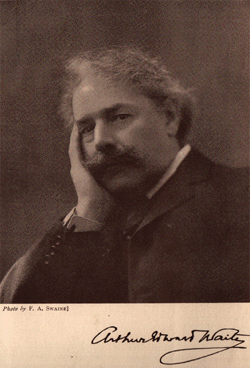 From the mid-nineteenth century onward the 22 cards of the major arcana had become increasingly associated with the concept of pathways and the 22 letters of the Hebrew alphabet within the Kabbalist ‘tree of life’ and ‘by 1890 Kabbalistic teaching was integral to Tarot design’ [12]. As a body of knowledge the Kabbalah has its origins in Hebrew oral tradition, scriptures and Jewish rabbinical writing. Its early history is unclear, but it developed further between the 7th and 18th centuries. Its formative texts include the Zohar and Sefer Yetzirah. A key point in its development was the writing of Etz Ha-Chaim, “The Tree of Life” by Chaim Vital in the 1590s, based on the teachings of Rabbi Isaac Luria. The concept of the tree of life entered a variety of Western esoteric traditions, being taken up by the Golden Dawn and their Hermetic Qabalah.
 The ten sefirot of the tree of life may have had their origins as representations of the metaphysical but they can be used as templates for personality traits, states of mind, or the developmental ages of man and are in some ways similar to Jungian archetypes. These templates are subtler than cartoon stereotypes or the motions of type-cast character actors, coming from a deep tradition influencing literary culture as well folk and pop psychology.

 Grand Temple of Horus Behdety