
Author Archives: Hālau ʻĀha Hūi Lanakila
Eckartshausen’s Prayers | Prayers for Alchemists

Two prayers for alchemists from Über die Zauberkräfte der Natur, Munich, 1819, translated by Joscelyn Godwin]
Two Prayers for Alchemists
by Karl von Eckartshausen (1752-1803)
I.
1. Light Supreme, who art the Divine in Nature and dwellest in its innermost parts as in Heaven, hallowed be thy qualities and laws!
2. Wherever thou art, all is brought to perfection; may the realm of thy Knowledge become subject unto thee.
3. May our will in all our work be only thee, self-moving Power of Light! And as in the whole of Nature thou accomplishest all things, so accomplish all things in our work also.
4. Give us of the Dew of Heaven, and the Fat of the Earth, the Fruits of Sun and Moon from the Tree of Life.
5. And forgive us all errors which we have committed in our work without knowledge of thee, as we seek to turn from their errors those who have offended our precepts. And leave us not to our own darkness and our own science, but deliver us from all evil through the perfection of thy Work, Amen.
II
Hail, pure self-moving Source, O Form, pure for receiving the Light! The Light of all things unites itself with thee alone.
Most blessed art thou among all receptive forms, and blessed is the Fruit that thou conceivest, the Essence of Light united with warm substance.
Pure Form, Mother of the most perfect Being, lift thyself up to the Light for us, now as we toil and in the hour when we complete the Work!
Alchemical Reflections | The Hermet’s Tale
In Pilgrimage one onely thing I found
Of worth in Lemnes nere to Vulcan’s shopp,
A Christall founteine runnig under ground,
Between a Vally and a Mounteins topp.
Pleas’d with this sight, I bid a Hermite tell
The story of the place, who there did dwell.Within this Vale a hallowe dusky Cave
There is (quoth he) of greate Antiquity,
Where plumes of Mars blew greene and red you have:
Torne from his crest for his Iniquity.
The Troope of Smiths, as he for Venus lay,
Supris’d and tooke him, yett he gett away.For as the Cyclops him in tryumph brought,
To halting Vulcan to receive his doome,
They lifted up his beaver, and found nought
But vacant place and Armour in the roome.
Of th’armour then they thought they had good prize,
But working it they found itt scyndarize.The Smiths amaz’d finding themselves deluded,
Satt all in Counsaile in their Masters Denne,
Deliberating well, at length concluded,
There is no equall War twixt Godds and men,
Lett’s finde the Angry God and pardon crave,
Lett’s give him Venus our poore selves to save.They sought in Heaven Mars knew his fact so bad,
He came out there, then one began to tell,
Saturne turn’d from his Throne, a Place had
Not far from thence, hard by this Christall Well.
Thither they wen, and found two Gods alone,
Sitting within a darke, but glittering throne.Down fell old Vulcan on his crooked knee,
And said forgive, O mighty God of Warr,
My servants and my selfe (once God as yee)
Then use thy will with Venus my faire starr.
Saturne (quoth Mars) and I must not yet part,
Though shee for whom th’art pard’ned hath my heart.With this the Cuckold with his sweaty Troope
Went to Forge and seem’d to make a legg,
Att every steppe, where halting made him stoope,
In thankes to Mars, granting what he did begg;
In whose remembrance you shall ever have
Syndars, and fetters in that hollow Cave.But lett me tell you all that then befell,
Iove seeing this, meaning the Smith to right,
Sent downe a winged God, he trusted well,
Disguis’d in habitt of a shineing light,
Which to the Vally from the Hill’s high topp,
Affrighted all the Smiths in Vulcans shopp.A voyce was heard from Ioves Embassadour,
To summon Mars t’appeare before the Gods:
With Saturne forth came Venus Paramour:
Thinkeing with might to gett of right the odds:
Downward came he 9 myles, they upward fower,
All mett in mist, he fledd, they nere went lower.Vulcan came hobling up to se what’s done,
He findes nor light, nor Gods, but other shape;
To witnesse of this fact he calles the Sonne,
Who streght cryes Murther, and made hast to scape:
Sme dyeing Soule groan’d forth, Apollo stay,
Helpe wise Apollo ere thou goest away.With this Apollo lookeing round about,
Espies this fountaine knowes the voice was here,
And boweing downe to finde the party out,
Himselfe unto himselfe doth streyght appeare.
There gaz’d he till a sturdy showre of rayne
Tooke wise Apollo from himselfe againe.Farewell Apollo then Apollo sayd,
To morrow when this storme is fully past,
Ile turne and bring some comfortable ayd,
By which Ile free thee ere the latter cast.
Then did itt cry as if the voice were spent,
Come sweete Apollo, soe itt downwards went.Vulcan went to his Forge, the Sonne to bed,
But both were up betimes to meete againe;
Next morne after the storme a pale foule dead
Was found att bottome of this faire Fountaine.
Smith (said Apollo) helpe to lade this spring,
That I may raise to life yonder dead thing.Then Vulcan held Apollo by the heele,
While he lades out the Waters of the Well;
Boweing and straining made Apollo feele
Blood from his nose, that in the fountaine fell.
Vulcan (quoth he) this Accident of blood
Is that or nought must does this Creature good.He spake the word, and Vulcan sawe itt done,
Looke Sol (said he) I see itt changeth hue,
Fewe Gods have vertue like to thee o Sonne,
From pale itt is become a ruddy blue;
Vulcan (quoth Phoebus) take itt to thy forge,
Warme it, rubb it, lett itt caste the Gorge.Thus Vulcan did, itt spued the Waters out,
And then itt spake and cry’de itt was a cold;
Then Vulcan stuft and cloath’d it round about,
And made the Stone as hott as ere itt would.
Thus fourteene dayes itt sickly did indure,
The Sonne came every day to se the cure.As itt grewe well the Colours went and came,
Blew, Blacke, White, Redd, as by the warmth & heate,
The humours moved were within the same,
Then Phoebus bid him put it in a sweate;
Which Vulcan plyed soe well, it grue all Red,
Then was itt found, and cald for drinke and bread.Stay (quoth Apollo) though itt call for meate,
Digestion yett is weake, 奏will breede relapse,
By surfett, therefore eye you lett itt eate,
Some little exercise were good perhapps,
Yett had itt broath alowde the strength to keep,
But when 奏was on his leggs it would scarce creepe.Sol sawe some reliques left of th’ould disease,
A solutine (quoth he) were good to clense,
With which the sickness he did so appease,
Health made the Patyent seeke to make amense;
Who went away three weekes, then brought a Stone,
That in projection yeelded ten for one.This did he lay down att Apollo’s feete,
And said by cureing one th’hast saved three:
Which three in this one present joyntly meete,
Offring themselves which are thine owne to thee.
Be our Physitian, and as we growe old,
Wee’le bring enough to make new worlds of Gold.With that this Hermite tooke me by the hand
And ledd me to his Cell; Loe here (quoth he)
Could’st thou but stay, and truly understand
What thou now seest, thou knowst this Mystery.
I stayd, I saw, I tryd, and understood,
A Heav’n on Earth, and everlasting good.
Isis Rising


Yes, yes, yes. It is getting to be that time. That time when She rises early, early in the dawning light. It’s the best thing that happens in August as far as I’m concerned. While everything else starts to crisp in the late summer heat, I am refreshed in Her rising power.
Here in Portland, Oregon in 2019, Sirius rises at 4:31 in the morning of August 23rd. Further south, She rises earlier. It all depends on your latitude. You can calculate Her rising in your area here with this online calculator. If you’d like to celebrate Isis’ birthday, then it would be two days before the rising of Sirius, in this case, August 21. So Isis is a Leo (at least at this latitude.) And well, She is Isis-Sakhmet, after…
View original post 934 more words
Contemplate THE WALKING ALCHEMIST

“Earth symbolizes the natural crystalline densities created out of Spirit’s energies and sustained by the beings of the elemental kingdom. These tiny creators, in their mimicry of human discord, have transferred to nature mankind’s inharmonious patterns. Thus the convergence of human error upon the planetary body came forth as thorn, thistle, insect, and beast of prey [as well as tornado, hurricane and earthquake]. It is this discord imposed upon the very atoms of substance which the alchemist must remove from his/her embodied laboratory before he/she can create. It is this dross which the walking alchemist will purify with fire. All inner impurities will be burned from you by the Baptism of fire when you choose this path–only then will your outer world be cleansed and harmonious–when your inner world is.”
— book excerpt from Saint Germain on Alchemy
Contemplate The CHRISTOS — THE FIRST FLOW OF THE WOMB
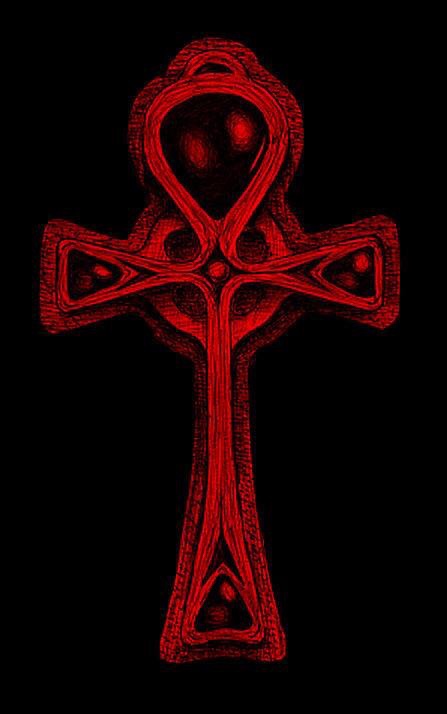
The Chi Rho is developed from the Ankh itself which in turn forms the basis for the fleur de lys. In Melusine’s time, the field of lilies, the arms of Anjou, represented the Pictish virgin princesses coveted by other dynasties, which are the lilies featured in the earlier Song of Solomon.
These lilies, or Anjous/Ankhous/Ankh maidens, are the Bruidhinas, the Morrigan/Valkiries and Swan Princesses of the Dragon Dynasty which the Swan Knights were sworn to protect. Their symbol is the Chi Rho Ankh which, instead of just representing the XP (the first letters of the name of Christ the Man), latterly conceals the true nature and gender of the Christos itself, which is of the Rtu, first flow of the womb, of the Ankh, the Goddess.
Consequently, the Chi Rho itself is a female Dragon symbol related to both Morgana and Melusine, as well as all the other Ladies of the Lake: Mermaids, Naiads, Nixes, Virgin Priestesses and so forth. The earlier history of the Chi Rho, the Ankh and the Haegl rune which forms the fleur de lys can be found in the development of Mesopotamian cuneiform from earlier Sumerian pictograms.
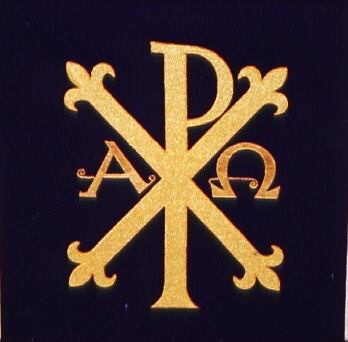
In Sumerian the symbol represents “An”: the Star. At this stage the symbol came to represent the “Heavens” and its final cuneiform representation was an equal-armed cross with a wedge at the end of the top ray and two wedges on the left arm which represented the gods.
— The Dragon Legacy, by Nicholas de Vere, p168
[“The Apple Trees – either Lilith or her descendant scarlet priestesses – bore the fruit which symbolized the sephirah and the glands of the female body. These, the apples of red-gold, produce the enriched virginal womb blood that was consumed by both the male and female druids – the Boars in the Orchard and the Serpents or Dragons in the Trees. Red-Gold is also the Tantric Kaula term for womb blood: the Rtu or first flow of the womb.”
2=9 | Sylphs | Contemplate this about THE FAIRIES
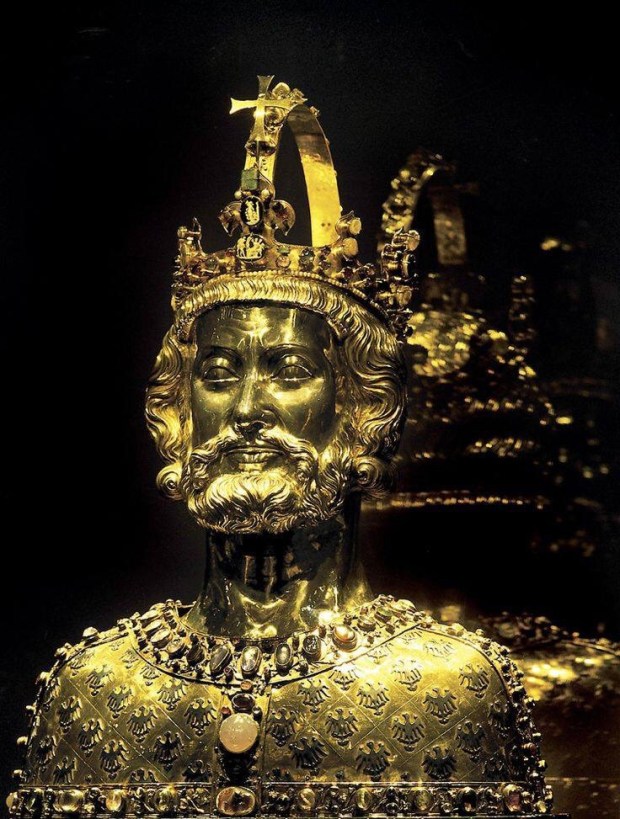
The Fairies, though now thought of as obscure nature spirits, were at the forefront of Eurasian civilisation and included the PenDragons and their cousins the Merovingians. The decline and obscurity of the Fairy race was caused by the Roman Catholic Church who, unlike the now defunct Celtic Church, were the sworn enemies of the Grail or Fairy blood. The Celtic or Druidic Church was a priestly variant of the Middle Eastern branch of the Grail race, the Dragon Kings. The word “Church” actually derives from “circa” and the old highland euphemism for going to the Kirk was “going to the stones”, meaning stone circle.
The Messiaship, the rulership of the Christian Church was invested in Jesus as the appointed son and rabbi and was intended, like Dragon Kingship, to descend in his bloodline. This it did through the Merovingian Kings and the Celtic Church. In Britain, Jesus’ granddaughter married the Archdruid Bran the Blessed, cementing a blood alliance between the Dragon and the Grail branches of the one greater royal family, guided and protected by the Druidic Priests of the Celtic Church and the indigenous Druids of Britain.
For reasons outlined in other works, Jesus’ other brother James attracted a following consisting of Paul of Tarsus and Peter the Fisherman. This faction settled in Rome with Paul and established itself eventually as the Roman Catholic Church. However, as Vatican records show, Prince Linus of Britain was descended from Jesus, and therefore was the First Bishop of the Christian Church following [by descent] Christ himself.
Nevertheless, since then, the Roman heresy, the Catholic Church of the Dogma and not the Blood, vied for ascendance. After its final victory in 644 AD at the Council of Whitby, it did everything in its power to steal authority and leadership from the rightful bloodline descendants who held it. As part of this process in Europe, agreements were made with the Mayors of the Palaces, and the Merovingians were either murdered or incarcerated as the Roman Church established these Mayors, the Carolingians, under them as puppet kings.
After the Dark Ages the Roman Church became a ubiquitous and brutal power which attempted the utter destruction of the true Kings. Because of this relentless campaign, as the centuries have progressed we have been left to think of the Fairies as the Roman Church would wish us to think of them, as being anything other than what they really were.
— The Dragon Legacy, by Nicholas de Vere, pp. 106-107
geneology:
73.Lugh II “Lamfhota, The Shining One”, King of Britain married Gwendolyn
72.Llyr Llediaith, King Lear, “the Sea God” married Penarddun
71.Bran the Blessed, ArchDruid, King of Britain married Anna of Arimathea, granddaughter of Jesus and Mary Magdalene
70.Julia Penardin de Brittany married Meurig, King of Britain
69.Coel “Old King Cole”, King of Britain married to Ystradwal
68.Athildis, Princess of Britain married Marcomir IV, King of Franks
67.Clodomir IV, King of Franks married Hasilda
66.Farabert, King of Franks married to Farabet
65.Sunno “Huano”, King of Franks married Hunno
64.Hilderic, King of Franks married to Hastila
63.Bartherus, King of Franks married to Hermintude
62.Clodius III, King of Franks married unknown
61.Walter, King of Franks married Eurgen Ferch Llieffer
60.Dagobert I “The Great”, King of Franks married unknown
59.Genebald I, Duke of East Franks married to Athildis
58.Dagobert II, King of Franks married unknown
57.Clodius I, King of Franks married to Frotmund Desposynl de Frimutel
56.Marcomir, King of Franks married Ildegonde
55.Pharamond, King of Westphalia (West Franks) married Argotta
54.Clodio “The Long Haired”, King of Westphalia married Basina
53.Merovee, King of France married Verica
52.Childeric I, King of France married Basina of Thuringia
51.Clovis “The Great”, King of France married St. Clothilde
50.Clothaire I, King of France married Ingonde
49.Blithildes married Ausbert of Moselle
48.Arnoul, Bishop of Metz married Oda de Savoy
47.St. Arnolph, Bishop of Metz married Lady Dodo of Saxony
46.Anchises married Begga of Brabant
45.Pepin d’Heristal, Mayor of the Palace married Alpais
44.Charles Martel, King of France married Rotrude
43.Pepin “The Short”, King of France married Bertha of Laon
42.Charlamagne, Emperor of the West married Hildegarde
41.Pepin, King of Italy married Bertha of Toulouse
40.Bernhard, King of Lombardy married Cunegonde
39.Pepin II of Vermandois, Lay Abbot married Crothais Rothaïde de Bobbio
38.Herbert I, Count of Vermandois married Bertha Beatrice de Morvois
37.Herbert II, Count of Vermandois married Hildebrand
36.Robert, Count of Vermandois married Adelaide de Chalons
35.Adelaide, Countess of Chalons married Geoffrey, Count d’Anjou
34.Fulk III “The Black”, Count d’Anjou married Hildegarde
33.Ermengarde d’Anjou married Geoffrey II d’Gastinois
32.Fulk IV, Count d’Anjou married Bertrade de Montfort
31.Fulk V, King of Jerusalem married Ermengarde du Maine
30.Geoffrey Plantagenet married Matilda, g.daughter of William the Conqueror
29.Henry II, King of England married Eleanor of Aquitane
28.Eleanor, Princess of England married Alphonso IX, King of Castille
27.Berengaria of Castille married Alphonso X, King of Leon
26.Ferdinand III, King of Castille married Joan de Dammartin
25.Eleanor of Castille married Edward I, King of England
24.Edward II, King of England married Isabel of France
23.Edward III, King of England married Philippa of Hainault
22.Lionel, Duke of Clarence married Elizabeth Burgh
21.Philippa Plantagenet married Edmund de Mortimer, Earl of March
20.Elizabeth Mortimer married Henry de Percy “Hotspur”
19.Henry de Percy, 1st Earl of Northumberland married Eleanor Neville
18.Henry de Percy, 2nd Earl of Northumberland married Eleanor Poynings
17.Margaret de Percy married William Gascoigne
16.Elizabeth Gascoigne married George de Talbois
15.Anne Talbois married Edward Dymoke
14.Frances Dymoke married Sir Thomas Windebank, Knight
13.Mildred Windebank married Robert Reade
12.Col. George Reade, Governor of Virginia married Elizabeth Martian
11.Mildred Reade, g.g.mother of George Washington married Col. Augustine Warner
10.Elizabeth Warner married Col. John Lewis
9.David Lewis, Sr. married Mary McGrath Hart
8.Capt. James Lewis, 2nd in command of the Revolutionary War and cousin of Meriwether Lewis and George Washington, married Lucy Thomas
7.Mary Elizabeth Brenham Lewis married Capt. Dyer Moore
6.William Dyer Moore married Susannah Harriet Dance
5.Mary Annetta Moore married Lafayette Mantooth
4.Helen Irene Mantooth married Crockett Campbell
3.Mary Campbell married Virgil Jefferson Fugler
2.Saxon Fox Fugler married Edward Joseph Maurer
1.Scott Maurer
DNA is a map. We are living genetic libraries of the entire journey of our ancestors, from the center to the outer edge. Our oldest common ancestor is Adam Kadmon, the perfected Human at the center of creation.
4=7 | Salamanders | Comtemplate – THE DRUIDS -PRIEST KINGS OF THE DRAGON
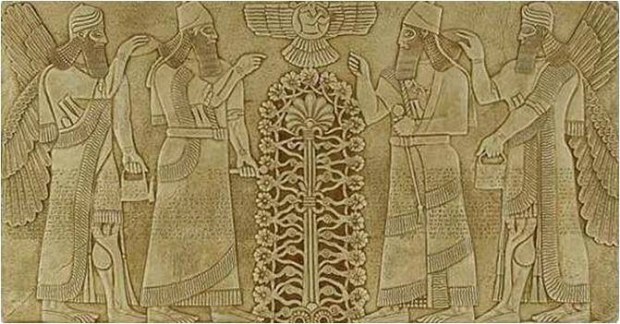
The Druids are associated with groves and, as some will insist, oak trees. However, it is feasible to suggest that in light of their Sumerian and Ubaid origins, the Druids as priest kings of the Dragon, were connected specifically with the Tree of Life and the Tree of Knowledge, rather than with any mundane or temporal shrubbery.
Accepting this we may further suggest that, as priests of these pre-eminent Trees of Life and Knowledge, they may be further identified with those magicians and scholars whose Transylvanian descendents were the Scythian Aryans or Sumerian Anunnaki–the Dragon God-Kings. They were instrumnental in establishing the Chakric system of Hindu and Buddhist Tantra and Hebrew, Arabic and Greek Qabalah whose magical systems, as we all know, contain a glyph called the Tree of Life.
Generally speaking this Tree is a system of pathways both macrocosmic and microcosmic in nature. It links the various subtle energy centres which are said to exist both in the universe, as levels of density and emanation relating to the manifestation of cosmic power and being, and in the human body–on the microscopic level–as energy centres corresponding to the glands in the endocrinal system. In Qabalah the spheres which do not relate to the glands may be seen as points in the meridian system adopted by the Chinese. On another level, the Qabalistic Tree of Life is a genealogical chart of the Gods.
The magical Tree is a universal symbol. As in the early Sumerian depiction of the Tree of Life, the abode of Lilith, many of the subsequent Arabic, Indian and European Holy Trees share common attributes. All have residing in their topmost branches some form of bird.
In Tantra it is the Swan, whose head rests within the Ajna Chakra which corresponds to the pineal and pituitary glands and the corpus callosum. In Welsh Druidic lore the bird is represented as the Eagle, a typically shamanic totem bird which symbolises the ascendant spirit. Here the Eagle is the god Lleu (in Ireland he is the Danaan king Lugh), the father of the Elven Llewwlyn Kings of Gwynnedd. In Arabic Sufism the bird is a Peacock, whilst in Viking lore the Sacred Tree Yggdrasil has at its base a coiled serpent by a pool and in its highest boughs the bird of the released spirit accompanied by a white heart. Yggdrasil is called the Axis Mundi and is seen as the tree which contains within its branches and roots the nine worlds of the Viking philosophical sytem, including their version of the Hebrew Qlipphoth or underworld. Immediately the similarity between it and the Qabalistic and Tantric Trees becomes apparent. This is no fluke.
— The Dragon Legacy, by Nicholas de Vere, pp. 74-75
Meditation | On Ancient Egypt (2 hrs.)
Golden Dawn | Invocation of Thoth
Heat wave, Mars trine Jupiter
Isis, Mistress of the Pyramids
THE GOSPEL ACCORDING TO ST. JOHN

Let us beware of creating a darkness at noonday for ourselves by gazing, so to say, direct at the sun . . . , as though we could hope to attain adequate vision and perception of Wisdom with mortal eyes. It will be the safer course to turn our gaze on an image of the object of our quest.
The Athenian Stranger
Plato
Every year more than three hundred and fifty Catholic and Protestant sects observe Easter Sunday, celebrating the Resurrection of Jesus, the Son of God who called himself the Son of Man. So too do the Russian and Greek Orthodox churches, but on a separate calendar. Such is the schism between East and West within Christendom regarding this day, which always falls on the ancient Sabbath, once consecrated to the Invisible Sun, the sole source of all life, light and energy. If we wish to understand the permanent possibility of spiritual resurrection taught by the Man of Sorrows, we must come to see both the man and his teaching from the pristine perspective of Brahma Vach, the timeless oral utterance behind and beyond all religions, philosophies and sciences throughout the long history of mankind.
The Gospel According to St. John is the only canonical gospel with a metaphysical instead of an historical preamble. We are referred to that which was in the beginning. In the New English Bible, the recent revision of the authorized version produced for the court of King James, we are told: Before all things were made was the Word. In the immemorial, majestic and poetic English of the King James version, In the beginning was the Word and the Word was with God, and the Word was God. This is a bija sutra, a seminal maxim, marking the inception of the first of twenty-one chapters of the gospel, and conveying the sum and substance of the message of Jesus. John, according to Josephus, was at one time an Essene and his account accords closely with the Qumran Manual of Discipline. The gospel attributed to John derives from the same oral tradition as the Synoptics, but it shows strong connections with the Pauline epistles as well as with the Jewish apocalyptic tradition. It is much more a mystical treatise than a biographical narrative.
Theosophically, there is no point or possibility for any man to anthropomorphize the Godhead, even though this may be very touching in terms of filial devotion to one’s own physical father. The Godhead is unthinkable and unspeakable, extending boundlessly beyond the range and reach of thought. There is no supreme father figure in the universe. In the beginning was the Word, the Verbum, the Shabdabrahman, the eternal radiance that is like a veil upon the attributeless Absolute. If all things derive, as St. John explains, from that One Source, then all beings and all the sons of men are forever included. Metaphysically, every human being has more than one father, but on the physical plane each has only one. Over a thousand years or thirty generations, everyone has more ancestors than there are souls presently incarnated on earth. Each one participates in the ancestry of all mankind. While always true, this is more evident in a nation with mixed ancestries. Therefore it is appropriate here that we think of him who preached before Jesus, the Buddha, who taught that we ask not of a man’s descent but of his conduct. By their fruits they shall he known,say the gospels.
There is another meaning of the ‘Father’ which is relevant to the opportunity open to every human being to take a decision to devote his or her entire life to the service of the entire human family. The ancient Jews held that from the illimitable Ain-Soph there came a reflection, which could never be more than a partial participation in that illimitable light which transcends manifestation. This reflection exists in the world as archetypal humanity – Adam Kadmon. Every human being belongs to one single humanity, and that collectivity stands in relation to the Ain-Soph as any one human being to his or her own father. It is no wonder that Pythagoras – Pitar Guru, ‘father and teacher,’ as he was known among the ancient Hindus – came to Krotona to sound the keynote of a long cycle now being reaffirmed for an equally long period in the future. He taught his disciples to honour their father and their mother, and to take a sacred oath to the Holy Fathers of the human race, the ‘Ancestors of the Arhats.’
We are told in the fourth Stanza of Dzyan that the Fathers are the Sons of Fire, descended from a primordial host of Logoi. They are self-existing rays streaming forth from a single, central, universal Mahatic fire which is within the cosmic egg, just as differentiated matter is outside and around it. There are seven sub-divisions within Mahat – the cosmic mind, as it was called by the Greeks – as well as seven dimensions of matter outside the egg, giving a total of fourteen planes, fourteen worlds. Where we are told by John that Jesus said, In my Father’s house are many mansions, H.P. Blavatsky states that this refers to the seven mansions of the central Logos, supremely revered in all religions as the Solar Creative Fire. Any human being who has a true wakefulness and thereby a sincere spirit of obeisance to the divine demiurgic intelligence in the universe, of which he is a trustee even while encased within the lethargic carcass of matter, can show that he is a man to the extent to which he exhibits divine manliness through profound gratitude, a constant recognition and continual awareness of the One Source. All the great Teachers of humanity point to a single source beyond themselves. Many are called but few are chosen by self-election. Spiritual Teachers always point upwards for each and every man and woman alive, not for just a few. They work not only in the visible realm for those immediately before them, but, as John reminds us, they come from above and work for all. They continually think of and love every being that lives and breathes, mirroring “the One that breathes breathless” in ceaseless contemplation, overbrooding the Golden Egg of the universe, the Hiranyagarbha.
Such beautiful ideas enshrined in magnificent myths are provocative to the ratiocinative mind and suggestive to the latent divine discernment of Buddhic intuition. The only way anyone can come closer to the Father in Heaven – let alone come closer to Him on earth Who is as He is in Heaven – is by that light to which John refers in the first chapter of the Gospel. It is the light that lighteth every man who cometh into the world, which the darkness comprehendeth not. Human beings are involved in the darkness of illusion, of self-forgetfulness, and forgetfulness of their divine ancestry. The whole of humanity may be regarded as a garden of gods but all men and women are fallen angels or gods tarnished by forgetfulness of their true eternal and universal mission. Every man or woman is born for a purpose. Every person has a divine destiny. Every individual has a unique contribution to make, to enrich the lives of others, but no one can say what this is for anyone else. Each one has to find it, first by arousing and kindling and then by sustaining and nourishing the little lamp within the heart. There alone may be lit the true Akashic fire upon the altar in the hidden temple of the God which lives and breathes within. This is the sacred fire of true awareness which enables a man to come closer to the one universal divine consciousness which, in its very brooding upon manifestation, is the father-spirit. In the realm of matter it may be compared to the wind that bloweth where it listeth. Any human being could become a self-conscious and living instrument of that universal divine consciousness of which he, as much as every other man or woman, is an effulgent ray.
This view of man is totally different from that which has, alas, been preached in the name of Jesus. Origen spoke of the constant crucifixion of Jesus, declaring that there is not a day on earth when he is not reviled. But equally there is not a time when others do not speak of him with awe. He came with a divine protection provided by a secret bond which he never revealed except by indirect intonation. Whenever the Logos becomes flesh, there is sacred testimony to the Great Sacrifice and the Great Renunciation – of all Avatars, all Divine Incarnations. This Brotherhood of Blessed Teachers is ever behind every attempt to enlighten human minds, to summon the latent love in human hearts for all humanity, to fan the sparks of true compassion in human beings into the fires of Initiation. The mark of the Avatar is that in him the Paraclete, the Spirit of Eternal Truth, manifests so that even the blind may see, the deaf may hear, the lame may walk, the unregenerate may gain confidence in the possibility and the promise of Self-redemption.
In one of the most beautiful passages penned on this subject, the profound essay entitled “The Roots of Ritualism in Church and Masonry,” published in 1889, H.P. Blavatsky declared:
Most of us believe in the survival of the Spiritual Ego, in Planetary Spirits and Nirmanakayas, those great Adepts of the past ages, who, renouncing their right to Nirvana, remain in our spheres of being, not as ‘spirits’ but as complete spiritual human Beings. Save their corporeal, visible envelope, which they leave behind, they remain as they were, in order to help poor humanity, as far as can he done without sinning against Karmic Law. This is the ‘Great Renunciation,’ indeed; an incessant, conscious self-sacrifice throughout aeons and ages till that day when the eyes of blind mankind will open and, instead of the few, all will see the universal truth. These Beings may well be regarded as God and Gods – if they would but allow the fire in our hearts, at the thought of that purest of all sacrifices, to be fanned into the flame of adoration, or the smallest altar in their honour. But they will not. Verily, ‘the secret heart is fair Devotion’s (only) temple,’ and any other, in this case, would be no better than profane ostentation.
Let a man be without external show such as the Pharisees favoured, without inscriptions such as the Scribes specialized in, and without arrogant and ignorant self-destructive denial such as that of the Sadducees. Such a man, whether he be of any religion or none, of whatever race or nation or creed, once he recognizes the existence of a Fraternity of Divine Beings, a Brotherhood of Buddhas, Bodhisattvas and Christs, an Invisible Church (in St. Augustine’s phrase) of living human beings ever ready to help any honest and sincere seeker, he will thereafter cherish the discovery within himself. He will guard it with great reticence and grateful reverence, scarcely speaking of his feeling to strangers or even to friends. When he can do this and maintain it, and above all, as John says in the Gospel, be true to it and live by it, then he may make it for himself, as Jesus taught, the way, the truth and the light. While he may not be self-manifested as the Logos came to be through Jesus – the Son of God become the Son of Man – he could still sustain and protect himself in times of trial. No man dare ask for more. No man could do with less.
Jesus knew that his own time of trial had come – the time for the consummation of his vision – on the Day of Passover. Philo Judaeus, who was an Aquarian in the Age of Pisces, gave an intellectual interpretation to what other men saw literally, pointing out that the spiritual passover had to do with passing over earthly passions. Jesus, when he knew the hour had come for the completion of his work and the glorification of his father to whom he ever clung, withdrew with the few into the Garden of Gethsemane. He did not choose them, he said. They chose him. He withdrew with them and there they all used the time for true prayer to the God within. Jesus had taught, Go into thy closet and pray to thy father who is in secret, and that, The Kingdom of God is within you. This was the mode of prayer which he revealed and exemplified to those who were ready for initiation into the Mysteries. Many tried but only few stayed with it. Even among those few there was a Peter, who would thrice deny Jesus. There was the traitor, Judas, who had already left the last supper that evening, having been told, That thou doest, do quickly. Some among the faithful spent their time in purification. Were they, at that point, engaged in self-purification for their own benefit? What had Jesus taught them? Could one man separate himself from any other? He had told those who wanted to stone the adulteress,Let him who is without sin cast the first stone. He had told them not to judge anyone else, but to wait for true judgment. Because they had received a sublime privilege, about which other men subsequently argued for centuries and produced myriad heresies and sects, in their case the judgment involved their compassionate concern to do the sacred Work of the Father for the sake of all. The Garden of Gethsemane is always here. It is a place very different from the Wailing Wall where people gnash their teeth and weep for themselves or their tribal ancestors. The Garden of Gethsemane is wherever on earth men and women want to cleanse themselves for the sake of being more humane in their relations with others.
Nor was the crucifixion only true of Jesus and those two thieves, one of whom wanted to have a miracle on his behalf while the other accepted the justice of the law of the day, receiving punishment for offences that he acknowledged openly. Every man participates in that crucifixion. This much may be learnt from the great mystics and inspired poets across two thousand years. Christos is being daily, hourly, every moment crucified within the cross of every human being. There are too few on earth who are living up to the highest possibility of human god-like wisdom, love and compassion, let alone who can say that in them the spirit of Truth, the Paraclete, manifests. Who has the courage to chase the money-changers of petty thoughts and paltry desires from the Temple of the universal Spirit, not through hatred of the money-changers, but through a love in his heart for the Restoration of the Temple? Who has the courage to say openly what all men recognize inwardly when convenient, or when drunk, or when among friends whom they think they trust? Who is truly a man? How many men are there heroically suffering? Not only do we know that God is not mocked and that as we sow, so shall we reap, but we also realize that the Garden of Gethsemane is difficult to reach. Nonetheless, it may be sought by any and every person who wants to avoid the dire tragedy of self-annihilation. Indeed, there are many such people all around who barely survive from day to day because of their own self-hatred, self-contempt and despair, and who tremble on the brink of moral death. We live in terribly tragic times, and therefore there is no one who cannot afford to take a little pause for the sake of making the burden of one’s presence easier for one’s wife or husband, for one’s children, or for one’s neighbours. Each needs a time of re-examination, a time for true repentance, a time for Christ-like resolve. The Garden of Gethsemane is present wherever there is genuineness, determination and honesty. Above all, it is where there is the joyous recognition that, quite apart from yesterday and tomorrow, right now a person can create so strong a current of thought that it radically affects the future. He could begin now, and acquire in time a self-sustaining momentum. But this cannot be done without overcoming the karmic gravity of all the self-destructive murders of human beings that he has participated in on the plane of thought, on the plane of feeling, especially on the plane of words, and also, indirectly, on the plane of outward action.
If the Garden of Gethsemane did not exist, no persecuting Saul could ever become a Paul. Such is the great hope and the glad tiding. As Origen said, Saul had to be killed before Paul could be born. The Francis who was a simple crusader had to die before the Saint of Assisi could be born. Because all men have free will, no man can transform himself without honest and sincere effort. Hence, after setting out the nature of the Gods, the Fathers of the human race, H.P. Blavatsky, in the same article quoted, spoke of the conditions of probation of incarnated souls seeking resurrection:
. . . every true Theosophist holds that the divine HIGHER SELF of every mortal man is of the same essence as the essence of these Gods. Being, moreover, endowed with free-will, hence having, more than they, responsibility, we regard the incarnated EGO as far superior to, if not more divine than, any spiritual INTELLIGENCE still awaiting incarnation. Philosophically, the reason for this is obvious, and every metaphysician of the Eastern school will understand it. The incarnated EGO has odds against it which do not exist in the case of a pure divine Essence unconnected with matter; the latter has no personal merit, whereas the former is on his way to final perfection through the trials of existence, of pain and suffering.
It is up to each one to decide whether to make this suffering constructive, these trials meaningful, these tribulations a golden opportunity for self-transformation and spiritual resurrection.
If this decision is not made voluntarily during life, it is thrust upon each ego at death. Every human being has to pass at the moment of death, according to the wisdom of the ancients, to a purgatorial condition in which there is a separation of the immortal individuality. It is like a light which is imprisoned during waking life, a life which is a form of sleep within the serpent coils of matter. This god within is clouded over by the fog of fear, superstition and confusion, and all but the pure in heart obscure the inner light by their demonic deceits and their ignorant denial of the true heart. Every human being needs to cast out this shadow, just as he would throw away an old garment, says Krishna, or just as he would dump into a junkyard an utterly unredeemable vehicle. Any and every human being has to do the same on the psychological plane. Each is in the same position. He has to discard the remnants, but the period for this varies according to each person. This involves what is called ‘the mathematics of the soul.’ Figures are given to those with ears to hear, and there is a great deal of detailed application to be made.
Was Jesus exempt from this? He wanted no exception. He had taken the cross. He had become one with other men, constantly taking on their limitations, exchanging his finer life-atoms for their gross life-atoms – the concealed thoughts, the unconscious hostilities, the chaotic feelings, the ambivalences, the ambiguities, the limitations of all. He once said, My virtue has gone out of me,when the hem of his garment was touched by a woman seeking help, but does this mean that he was exposed only when he physically encountered other human beings? The Gospel according to John makes it crisply clear, since it is the most mystical and today the most meaningful of the four gospels, that this was taking place all the time. It not only applies to Jesus. It takes place all the time for every person, often unknown to oneself. But when it is fully self-conscious, the pain is greater, such as when a magnanimous Adept makes a direct descent from his true divine estate, leaving behind his finest elements, like Surya the sun in the myth who cuts off his lustre for the sake of entering into a marriage with Sanjna, coming into the world, and taking on the limitations of all. The Initiator needs the three days in the tomb, but these three days are metaphorical. They refer to what is known in the East as a necessary gestation state when the transformation could be made more smoothly from the discarded vehicle which had been crucified.
People tend to fasten upon the wounds and the blood, even though, as Titian’s painting portrays clearly, the tragedy of Jesus was not in the bleeding wounds but in the ignorance and self-limitation of the disciples. He had promised redemption to anyone and everyone who was true to him, which meant, he said, to love each other. He had washed the feet of the disciples, drawn them together, given them every opportunity so that they would do the same for each other. He told them that they need only follow this one commandment. We know how difficult it is for most people today to love one another, to work together, to pull together, to cooperate and not compete, to add and not subtract, to multiply and serve, not divide and rule. This seems very difficult especially in a hypocritical society filled with deceit and lies. What are children to say when their parents ask them to tell the truth and they find themselves surrounded by so many lies? In the current cycle the challenge is most pointed and poignant. More honesty is needed, more courage, more toughness – this time for the sake of all mankind. One cannot leave it to a future moment for some pundits in theological apologetics and theosophical hermeneutics to say this cycle was only for some chosen people. Every single part of the world has to be included and involved.
The teaching of Jesus was a hallowed communication of insights, a series of sacred glimpses, rather than a codification of doctrine. He presented not asumma theologica or ethica, but the seminal basis from which an endless series of summae could be conceived. He initiated a spiritual current of sacred dialogue, individual exploration and communal experiment in the quest for divine wisdom. He taught the beauty of acquiescence and the dignity of acceptance of suffering – a mode appropriate to the Piscean Age. He showed salvation – through love, sacrifice and faith – of the regenerated psyche that cleaves to the light of no us. He excelled in being all things to all men while remaining utterly true to himself and to his ‘Father in Heaven.’ He showed a higher respect for the Temple than its own custodians. At the same time he came to found a new kind of kingdom and to bring a message of joy and hope. He came to bear witness to the Kingdom of Heaven during life’s probationary ordeal on earth. He vivified by his own luminous sacrifice the universal human possibility of divine self-consecration, the beauty of beatific devotion to the Transcendental Source of Divine Wisdom – the Word Made Flesh celebrating the Verbum In the Beginning.
Above all, there was the central paradox that his mission had to be vindicated by its failure, causing bewilderment among many of his disciples, while intuitively understood only by the very few who were pure in heart and strong in devotion, blessed by the vision of the Ascension. After three days in the tomb, Jesus, in the guise of a gardener, said to a poor, disconsolate Mary Magdalene,Mary! At once she looked back because she recognized the voice, and she said,Rabboni – “My Master” – and fell at his feet. Then he said, Touch me not. Here is a clue to his three days in the tomb. The work of permanent transmutation of life-atoms, of transfiguration of vehicles, was virtually complete. He then said,Go to my brethren, and say unto them, I ascend unto my Father and your Father; and to my God and your God. Subsequently he appeared three times to his disciples.
Jesus gave the greatest possible confidence to all his disciples by ever paying them the most sacred compliment, telling them that they were children of God. But, still, if a person thinks that he is nothing, or thinks that he is the greatest sinner on earth, how can the compassion and praise of Jesus have meaning for him? Each person has to begin to see himself undramatically as one of many sinners and say, “My sins are no different from those of anyone else.” The flesh is weak but pneuma, the spirit, is willing. And pneuma has to do with breath. The whole of the Gospel according to John is saturated with the elixir of the breathing-in and breathing-out by Jesus of the life-infusing current that gives every man a credible faith in his promise and possibility, and, above all, a living awareness of his immortality, which he can self-consciously realize when freed from mis-identification with his mortal frame.
The possibility of resurrection has to do with identification and mis-identification. This is the issue not for just a few but for all human beings who, in forgetfulness, tend to think that they are what their enemies think, or that they are what their friends want them to be. At one time men talked of the imago Christi. We now live in a society that constantly deals in diabolical images and the cynical corruption of image-making, a nefarious practice unfamiliar in simpler societies which still enjoy innocent psychic health. Even more, people now engage in image-crippling – the most heinous of crimes. At one time men did it openly, with misguided courage. They pulled down statues and defaced idols. They paid for it and are still paying. Perhaps those people were reborn in this society. That is sad because they are condemning themselves to something worse than hell – not only the hell of loneliness and despair – but much worse. The light is going out for many a human being. The Mahatmas have always been with us. They have always abundantly sent forth benedictory vibrations. They are here on earth where they have always had their asylums and their ashrams. Under cyclic law they are able to use precisely prepared forums and opportunities to re-erect or resurrect the mystery temples of the future. Thus, at this time, everybody is stirred up by the crucial issue of identity – which involves the choice between the living and the dead, between entelechy and self-destruction.
The central problem in the Gospel according to John, which Paul had to confront in giving his sermon on the resurrection, has to do with life and with death. What is life for one man is not life to another. Every man or woman today has to raise the question, “What does it mean for me to be alive, to breathe, to live for the sake of others, to live within the law which protects all but no one in particular?” Whoever truly identifies with the limitless and unconditional love of Jesus and with the secret work of Jesus which he veiled in wordless silence, is lit up. Being lit up, one is able to see the divine Buddha-nature, the light vesture of the Buddha. The disciples in the days of the Buddha, and so again in the days of Jesus, were able to see the divine raiment made of the most homogeneous pure essence of universal Buddhi. Immaculately conceived and unbegotten, it isdaiviprakriti, the light of the Logos. Every man at all times has such a garment, but it is covered over. Therefore, each must sift and select the gold from the dross. The more a person does this truly and honestly, the more the events of what we call life can add up before the moment of death. They can have a beneficent impact upon the mood and the state of mind in which one departs. A person who is wise in this generation will so prepare his meditation that at the moment of death he may read or have read out those passages in the Bhagavad Gita, The Voice of the Silence, or The Gospel According to St. John, that are exactly relevant to what is needed. Then he will be able to intone the Word, which involves the whole of one’s being and breathing, at the moment when he may joyously discard his mortal garment. It has been done, and it is being done. It can be done, and it will be done. Anyone can do it, but in these matters there is no room for chance or deception, for we live in a universe of law. Religion can be supported now by science, and to bring the two together in the psychology of self-transformation one needs true philosophy, the unconditional love of wisdom.
The crucifixion of Jesus and his subsequent resurrection had little reference to himself, any more than any breath he took during his life. Thus, in the Gospel, we read that Jesus promises that when he will be gone from the world, he will send the Paraclete. This archaic concept has exercised the pens of many scholars. What is the Paraclete? What does it mean? ‘Comforter’? ‘The Spirit of Truth’? Scholars still do not claim to know. The progress made in this century is in the honest recognition that they do not know, whereas in the nineteenth century they quarrelled, hurled epithets at each other out of arrogance, with a false confidence that did not impress anyone for long. The times have changed, and this is no moment for going back to the pseudo-complacency of scholasticism, because today it would be false, though at one time it might have had some understandable basis. Once it might have seemed a sign of health and could have been a pardonable and protective illusion. Today it would be a sign of sickness because it would involve insulting the intelligence of many young people, men and women, Christian, Jewish, Protestant, Catholic, but also Buddhist, Hindu, Moslem, Sikh, and every other kind of denomination. No one wants to settle for the absurdities of the past, but all nonetheless want a hope by which they may live and inherit the future, not only for themselves or their descendants, but for all living beings.
This, then, is a moment when people must ask what would comfort the whole of mankind. What did Jesus think would be a way of comforting all? Archetypally, the Gospel according to John is speaking in this connection of the mystery temple, where later all the sad failures of Christianity took place. This is the light and the fire that must be kept alive for the sake of all. Who, we may ask, will joyously and silently maintain it intact? Who will be able to say, as the dying Latimer said in Oxford in 1555, “We shall this day light such a candle . . . as I trust shall never be put out.” Jesus was confident that among his disciples there were those who had been set afire by the flames that streamed through him. He was the Hotri, ‘the indispensable agent’ for the universal alkahest, the elixir of life and immortality. He was the fig tree that would bear fruit, but he predicted that there would be fig trees that would bear no fruit. He was referring to the churches that have nothing to say, nothing real to offer, and above all, do not care that much for the lost Word or the world’s proletariat, or the predicament and destiny of the majority of mankind.
His confidence was that which came to him, like everything in his life, from the Father, the Paraguru, the Lord of Libations, who, with boundless love for all, sustains in secret the eternal contemplation, together with the twoBodhisattvas – one whose eye sweeps over slumbering earth, and the other whose hand is extended in protecting love over the heads of his ascetics. Jesus spoke in the name of the Great Sacrifice. He spoke of the joy in the knowledge that there were a few who had become potentially like the leaven that could lift the whole lump, who had become true Guardians of the Eternal Fires. These are the vestal fires of the mystery temple which had disappeared in Egypt, from which the exodus took place. They had disappeared from Greece, though periodically there were attempts to revive them, such as those by Pythagoras at Delphi. They were then being poured into a new city called Jerusalem. In a sense, the new Comforter was the New Jerusalem, but it was not just a single city nor was it merely for people of one tribe or race.
Exoterically, the temple of Jerusalem was destroyed in 63 B.C. by Pompey and was rebuilt. Later it was razed to the ground again in 70 A.D. Since the thirteenth century no temple has been in existence there at all because that city has been for these past seven hundred years entirely in the hands of those who razed the old buildings and erected minarets and mosques. Now, people wonder if there really ever was a true Jerusalem, for everywhere is found the Babylon of confusion. Today it is not Origen who speaks to us, but Celsus, on behalf of all Epicureans. Everyone is tempted, like Lot’s wife, to be turned into salt by fixing their attention upon the relics and memories of the past long after they have vanished into the limbo of dissolution and decay.
Anyone, however, who has an authentic soul-vision is El Mirador. Jesus knew that the vision, entrusted to the safekeeping of a few, would inspire them to lay the basis of what would continue, because of what they did, despite all the corruption and the ceaseless crucifixion. Even today, two thousand years later, when we hear of the miracle of the limitless love of Jesus, when we hear the words he spoke, when we read about and find comfort in what he did, we are deeply stirred. We are abundantly grateful because in us is lit the chela-light of true reverential devotion to the Christos within. This helps us to see all the Christs of history, unknown as well as renowned, as embodiments of the One and Only – the One without a Second, in the cryptic language of the Upanishads. When this revelation takes place and is enjoyed inwardly, there are glad tidings, because it is on the invisible plane that the real work is done. Most people are fixated on the visible and want to wait for fruits from trees planted by other men. There are a few, however, who have realized the comfort to be derived in the true fellowship of those who seek the kingdom of God within themselves, who wish to become the better able to help and teach others, and who will be true in their faith from now until the twenty-first century. Some already have been using a forty-year calendar.
There have been such persons before us. Pythagoras called them Heroes. The Buddha called them Shravakas, true listeners, and Shramanas, true learners. Then there were some who became Srotapattis, ‘those who enter the stream,’ and among them were a few Anagamin, ‘those who need never return on earth again involuntarily.’ There were also those who were Arhans of boundless vision, Perfected Men, Bodhisattvas, endlessly willing to re-enter the cave, having taken the pledge of Kwan-Yin to redeem every human being and all sentient life. Nothing less than such a vow can resurrect the world today. These times are very different from the world at the time of John because in this age outward forms are going to give no clues in relation to the work of the formless. Mankind has to grow up. We find Origen saying this in the early part of the third century and Philo saying the same even in the first century. Philo, who was a Jewish scholar and a student of Plato, was an intuitive intellectual, while Origen, who had studied the Gnostics and considered various philosophical standpoints, was perhaps more of a mystic or even an ecstatic. Both knew that the Christoscould only be seen by the eye of the mind. If therefore thine eye be single, Jesus said, thy whole body shall be full of Light. Those responding with the eyes of the body could never believe anything because, as Heraclitus said, “Eyes are bad witnesses to the soul.” The eyes of the body must be tutored by the eye of the mind. Gupta Vidya also speaks of the eye of the heart and the eye in the forehead – the eye of Wisdom-Compassion. Through it, by one’s own love, one will know the greater love. By one’s own compassion one will know the greater compassion. By one’s own ignorance one will recognize the ignorance around and seek the privilege of recognition of the Paraclete. Then, when the eye becomes single in its concentration upon the welfare of all, the body will become full of the light of the Christos. Once unveiled at the fundamental level of causality, it makes a man or woman an eternal witness to the true resurrection of the Son of Man into the highest mansions of the Father.
Hermes, April 1977
Raghavan Iyer
Virtual Mercury Molasses times

July 28 Your Daily Astro guide
GEMINI MOON time is very media-driven, constant flirting, conversations, mentally flying every which way, hard to commit and constant mind games and changes. It’s light.
SUN in LEO TRINE CHIRON Retro in Aries in PDT EDT July 29 in GMT
This is a time to be open to be vulnerable and open your heart wider. Open up to what you really feel behind your ego. Be brave in your wounding.
MERCURY IS virtually at Standstill @ 24 degrees getting ready to turn DIRECT July 31/Aug 1st @ 23 degrees 57 minutes.
This is virtually Mercury Molasses time.
Gemini and Virgo are feeling the Mercury Retrograde more than most of course.
Don’t expect anything to be moving too quickly for the next few days. This can be a good thing if you need to play catch up.
Please share widely all writing is copyright of…
View original post 8 more words
Isis, Mistress of the Pyramids

There is a most interesting inscription on an artifact known as the Inventory Stela from the Giza Plateau.
It has caused a lot of excitement, especially among those who believe that the Sphinx and Pyramids areolder than the fourth dynasty period to whichEgyptologists usually attribute their construction.
You’ll immediately see why I was interested. Here’s what itsays according to the great Egyptologist Gaston Maspero’s translation of the stele:
Live Horus the Mezer, the King of Upper and Lower Egypt, Khufu, given life. He made for his mother Isis, the Divine Mother, Mistress of the Western Mountain [that is, the necropolis], a decree made on a stela, he gave to Her a divine offering, and he built Her a temple of stone, renewing what he had found, namely the Gods in Her place.
Live Horus, the Mezer, the King of Upper and Lower Egypt, Khufu, given life…
View original post 1,099 more words
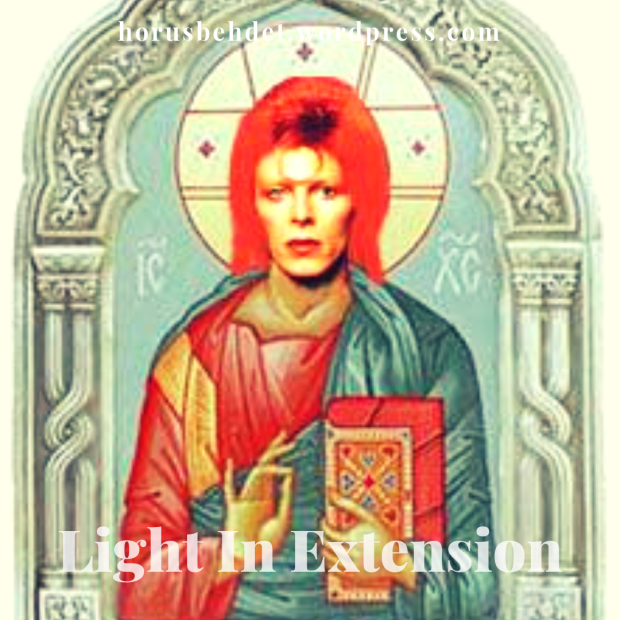
St. David Bowie – Khabs Am Pekht!
Heat wave, Mars trine Jupiter
July 24/25 Mars in Leo trines Jupiter Retro in Sagittarius at 14/15 degrees the most powerful.
It’s hot! Very literally, in Europe the heat wave continues with the Royals enduring 33-over 40 degrees Celsius temperatures. They’re not used to those high heats in Europe. So please stay cool.
Tempers May flare up easily.
Taurus moon also squares mars today.
The energy is very up optimistic, can be a tad too risky taking, Mars in Leo is a big show-off. I’m so busy I don’t have time to write.
Enjoy the fun, party heart,
Bask in the regal spotlight and the sunshine.
Back yourself up,
Blessings
Tara
Please share widely all writing is copyright Tara Greene meet a reading with me http://www.taratarot.comTara Greene Tarot Astrology psychic consultant
Steve Kalec | From the Chaldean Oracles of Zoroaster
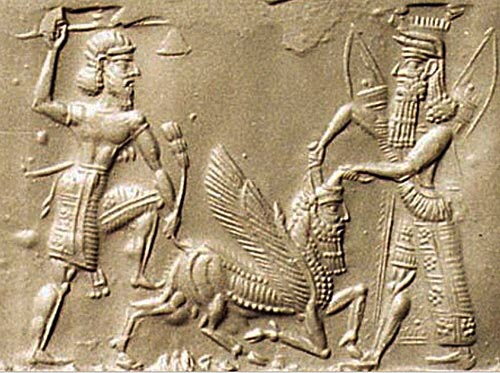
“There is above the celestial fire an incorruptible flame, always sparkling; the spring of life, the fountain of all being, the original of all things!
This Flame produceth all things, and nothing perisheth but what It consumeth. It maketh Itself known by Itself. This Fire cannot be contained in any place; It is without body and without matter, It encompasseth the heavens.
And there goeth forth from it a little spark, which maketh all the fire of the sun, of the moon and of the stars. Strive not to know more of Him, for that is beyond thy capacity, how wise soever thou art.
“There is in God an immense profundity of flame ! Nevertheless the heart should not fear to touch this adorable Fire, or to be touched by it; it will never be consumed by this so sweet Fire; whose mild and tranquil heat maketh the binding and harmony and the duration of the world.
Nothing subsisteth but by this Fire, which is God Himself. No person begat Him. He is without mother. He knoweth all things and can be taught nothing. He is infallible in His designs and His Name is unspeakable.”
An Egyptian “Solar Boat”
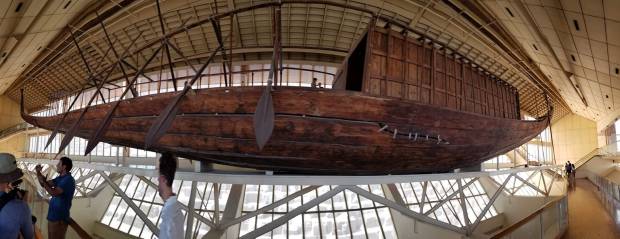
Image: Lionel Chan
This boat was found in the southern side of the great Pyramid and it was made of Cedar wood. It is the biggest Ancient boat ever found. I do believe the Ancient Egyptians were “easily” sailing overseas, and I believe they traveled to Australia, North America and South America.
From the Temple at Dandara …

(This attempts to explain the famous view of the ancient Egyptian Iligan at Dendera Temple). ❤❤❤
This Inscription is located at the Temple of Dendera, located about 2,5 kilometers southeast of the village of Dendera, west of Qena, and about 55 kilometers north of Luxor, on the west shore of the Nile.
This temple was built to worship Hathor, the Goddess of love, music and beauty worshipped by the ancient Egyptians.
As for the names of the Royal Crowns, depicted here according to the inscription carved at the Temple of Dendera, each of the names could be interpreted, as follows:
(1) Crown their
(2) Crown of the covenant (linked to the idol God)
(3) the crown of fear (linked to the idol of fear.. Lord of the moon at the ancient Egyptians and the son of idol amun ra)
(4) the crown of their their ornamented with Cobra (their their or rouse)
(5) Red Crown ornamented with Cobra (dsẖrt or rouse)
(6) Crown of the four feathers
(7) Crown of the maat (affectionate-about)
(8) the crown of Amun (the) and is called saraswati swty
(9) Marchesa (a mixture of blue naj and maat)
(10) Crown of n (Crown of the eagle)
(11) their their armando
(12) they are committed to suicide (insisted)
(13) Crown of the agreement with Cobra (archived)
(14) Crown of wreath.. Da (scarf)
(15) Crown of burch = Blue Crown
(16) Head Cover.. Mongoose
(17) Crown Cap
(18) another cap crown
(19) Head Cover.. Ring’s ring
(20) another head cover.. another ring (Avneet)
(21) Red Crown (Dsẖrt)
(22) White Crown (argument)
(23) Double Crown (my sarcasm) = strong
— Scientific Research Department at Karnak
New Discoveries Indicate Hebrew was World’s Oldest Alphabet – Part 1 – Patterns of Evidence: The Moses Controversy
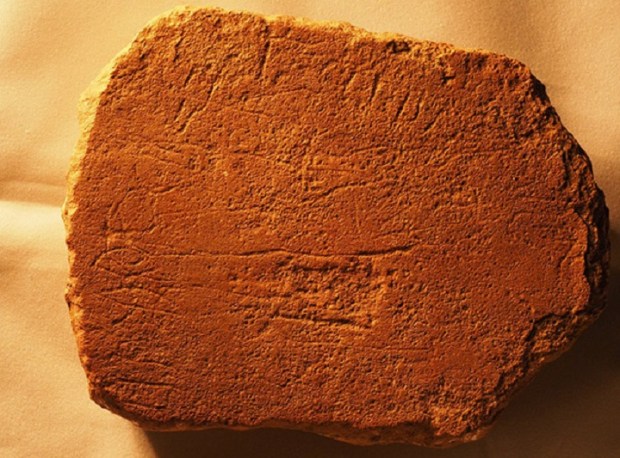
“Remarkable new evidence discovered by Dr. Douglas Petrovich may change how the world understands the origins of the alphabet and who first wrote the Bible. As to be expected, his controversial proposals have ignited contentious debate. In this first of a two-part series, the background and importance of this issue will be explored before some of the specifics of the new finds and the pushback from other scholars is covered in part two.”
 Grand Temple of Horus Behdety