Tarot Attributes on the Tree of Life, by Rev. Marek Bazgrzacki

TOL-TAROT1

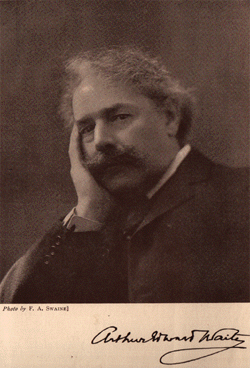
The use of the Tarot fitted in nicely with the poem’s themes of the Fisher King and the Grail myths. A.E. Waite, a Grail obsessive, had worked numerous Arthurian figures and symbols into the highly popular 1910 Waite Smith Tarot deck. Along with the grail iconography Waite added aspects of the Christian Cabala and Hebrew Kabbalah, Gnosticism, Rosicrucianism and ancient Egyptian symbology into the deck [11]. This was done as part of a ambitious synthesis of the various occult traditions, a task undertaken by the grandly self-titled Hermetic Order of the Golden Dawn, a group in which A.E. Waite was a key member. The Waite Smith Tarot was the first deck to have the 22 cards of the major arcana and the 4 suits, each of 14 of the minor arcana cards fully illustrated, a companion guidebook The pictorial key to the Tarot was published alongside the deck with full explanations of the cards.

AE-WaiteFrom the mid-nineteenth century onward the 22 cards of the major arcana had become increasingly associated with the concept of pathways and the 22 letters of the Hebrew alphabet within the Kabbalist ‘tree of life’ and ‘by 1890 Kabbalistic teaching was integral to Tarot design’ [12]. As a body of knowledge the Kabbalah has its origins in Hebrew oral tradition, scriptures and Jewish rabbinical writing. Its early history is unclear, but it developed further between the 7th and 18th centuries. Its formative texts include the Zohar and Sefer Yetzirah.  A key point in its development was the writing of Etz Ha-Chaim, “The Tree of Life” by Chaim Vital in the 1590s, based on the teachings of Rabbi Isaac Luria. The concept of the tree of life entered a variety of Western esoteric traditions, being taken up by the Golden Dawn and their Hermetic Qabalah.

Allusions to the components and structures of the tree of life with its alphabetised pathways and the use of kabbalistic allegory has a long tradition in Jewish and European literature.

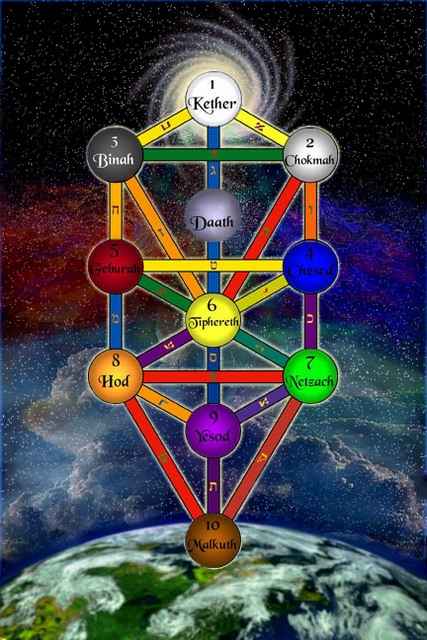
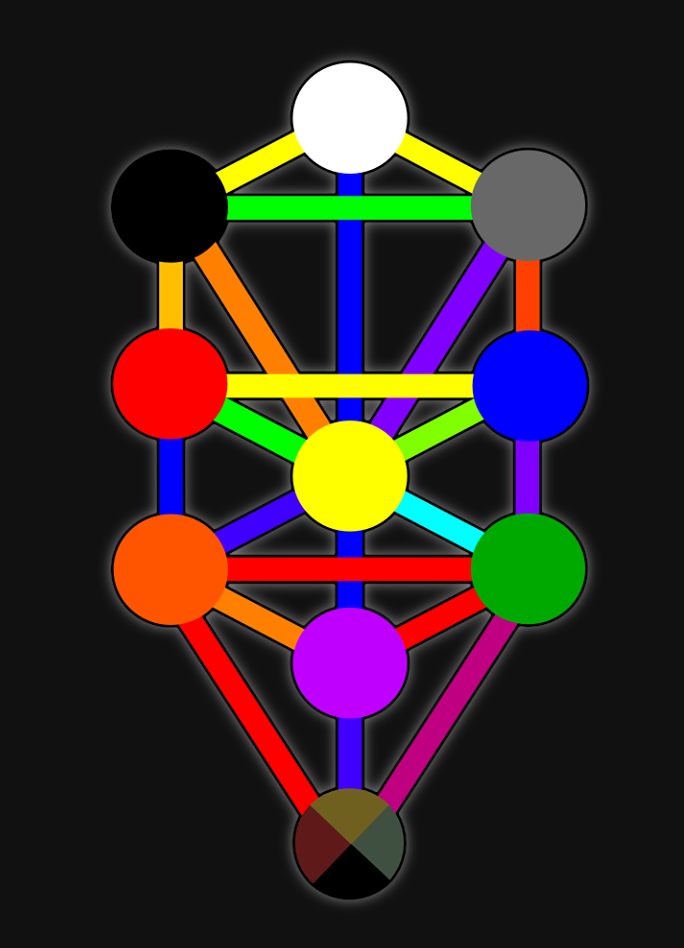
Consisting of ten interconnected sefira (plural sefirot), the tree of life is arranged vertically into three columns or pillars: the left hand pillar, the pillar of mercy, representing the principles of benevolence; the right hand pillar, the pillar of severity, power and strict justice; while the central pillar, representing harmony and the ideal balance of mercy and justice, uniting and balancing the two sides. Each of the sefirot has an associated vice and virtue and like a snakes and ladders board, the vices and virtues form gateways and trapdoors between the sefirot.

Though each sefira is as important as the rest, the tree is arranged hierarchically into the four overlapping worlds of the Kabbalah, a ladder from the physical to the metaphysical, a ladder that one may both ascend and descend, a ladder made up of the 22 pathways.

hebrew tarotThe ten sefirot of the tree of life may have had their origins as representations of the metaphysical but they can be used as templates for personality traits, states of mind, or the developmental ages of man and are in some ways similar to Jungian archetypes. These templates are subtler than cartoon stereotypes or the motions of type-cast character actors, coming from a deep tradition influencing literary culture as well folk and pop psychology.

Each of the 22 pathways is associated with a letter of the Hebrew alphabet. The names of the letters have literal meanings e.g. the word aleph, the name of the Hebrew character ? also has the literal meaning of ‘ox’. Each of the 22 pathways is also associated with one of the 22 Tarot cards of the Major Arcana. In the tarot tradition these have a recognized set of attributes and symbolic and mythic associations and cards will often have links and relationships to other cards in the deck. Though the cards often represent characters they should not be seen solely in those terms, rather they present situations or dilemmas within a plot, situations that the protagonists must overcome, being integral rather than part of a parallel narrative structure. The cards, like panels from a graphic novel are dealt, interpreted and stitched into a storyboard.

—-

For a detailed reference on each of the Major and Minor Arcana, access our Resources link here.

The Kabbalistic Tree of Life, by Z’ev ben Shimon Halevi

TOL-Psyche-in-detail2

Existence is governed by a simple set of basic laws. The first is that there is a unity between ten essential principles, with twenty-two minor laws that allow them to interact. Like other esoteric systems, the Tree has active and passive pillars with a central column of equilibrium. Within this scheme are various activities, levels and flows that lie behind every entity in the universe. The book sets out to show how this is so.

Next comes a brief history of Kabbalah starting from Biblical times to show how the Tree has its origin in the seven-branched candlestick in the Tabernacle and the Temple. It then goes on to explain how Hellenic ideas influenced this mythological version of the tradition. In the Middle Ages Kabbalah appeared as a solution in the debate between religion and philosophy then going on and had much influence upon European mysticism.

The origin and purpose of Existence is then presented in the emanation of the ten sefirot or numbers and the unfolding of the Lightning Flash of the Octave that brings the Tree into being. Then comes the notion that a human being is a microcosm of Existence. Each individual person is an image of the Absolute in miniature. The composition and dynamics of the psyche are seen in modern terms. This is followed by a study of the planetary archetypes and the relationship between Kabbalah and Astrology, the ancient form of psychology, and the influence of celestial conditions on the mind. The image of the Zodiacal Man resembles at a lower level that of Adam Kadmon, the Divine Man seen sitting on the Throne of Heaven, set in a great chariot of Ezekiel’s vision. Both these traditions root back to Abraham’s home city of Ur in ancient Mesopotamia. Included in this section is an example of how a birth chart can be put on the Tree diagram to get a deeper insight.

The idea of the four Worlds within one Tree is then explored to show the various levels within a human being, as symbolised by the garments worn by the Israelite High Priest. These correspond to the physical, psychological, spiritual and Divine dimensions within ourselves. The triads within the Tree and the Octave are explored to reveal ascending and descending processes and the purpose of the various functions as regards the body, soul and spirit. This is followed by an exposition of the paths between the sefirot and how the flows from one to another can bring about balance or imbalance between different parts of the psyche and indeed the body, which may also be seen as a Tree. The Hebrew letters associated with the paths and the Tarot are then set out on the Tree to show how each symbol represents a specific function.

The next section is about practice and application of the Tree. First comes an exercise in a form of a simple ritual in which one ‘goes up the Tree’. This, if done with the right frame of mind in a quiet place, will give one a sense of the Tree within oneself and be a reference point in any mystical experience, as well as in understanding any particular situation in terms of the Tree diagram. This exercise should be practised from time to time to accustom oneself to the Tree’s configuration.

The first application of the Tree is to that of Parliament, which is seen in terms of its structure and dynamics. Also included in this section is the horoscope of England, which was born at Noon 25th December 1066 when William the Conqueror was crowned King, giving an insight into the national character. God and Mammon are then examined in terms of the Tree. In this chapter every religion and its several levels is seen to follow a classical pattern as does any economic system. From this it is shown how any imbalance or excessive focus on one area can upset the balance and cause the entity either to degenerate into a revolt against a corrupt priesthood or board of directors.

To make the Tree less remote and more experiential I have used a love affair to illustrate how even a lovers’ quarrel is part of a cosmic process. Everyone believes their relationship is unique, but upon putting it on the Tree one can see how Mother Nature brings a man and woman together to produce the next generation. However, it must be said that a marriage between soul-mates is of another order as a higher Tree, that of the psyche, can generate a single spirit out of such a union.

Birth, Life and Death are then examined. Here the process of conception and gestation are seen underlying the building of the body, followed by the ascending Octave of passing through the stages of life towards death and the hereafter, as Kabbalah subscribes to the notion of Hell, Paradise, Heaven and reincarnation. These themes are developed in my later books. This leads onto Time and its various orders. In this Tree the several grades between the ‘Passing Moment’ and the ‘Eternal Now’ are placed between the scales of a human lifetime and that of the planets, galaxy and Eternity. This illuminates why mystics speak of different levels of perception. Such a view opens onto the Biblical version of Creation which is seen in terms of Darwin’s theory of Evolution. Each order of creature fits exactly into the Tree.

Schools of the soul are next to be scrutinised in Tree terms, which reveals how every spiritual tradition must concur with the laws of Existence, if its working method is genuine. This is seen in the progression of consciousness and the exploitation of what opportunities life offers. Then comes an exposition of Jacob’s Ladder and how it is the flexible framework of the Divine Name I AM THAT I AM. The word THAT represents Existence between the first I AM and the second I AM. As such, the universe is the Mirror by which the Absolute beholds ITSELF with the aid of humanity, which is the organ of perception for God. Finally, the last diagram shows the present state of the Divine drama, in which we all play either a conscious or unconscious role with every new life we live.

TOL-KAB-overview

Ritual Meditation ~ Tree of Life

TreeOfLife4WorldsByDelilah

Tree of Life Ritual

Temple is arranged in the shape of the Tree of Life.


Kether:

In the beginning there was nothingness … this is the Ain, Ain Soph and Ain Soph Aur …  and nothingness was composed of all the energies and forces of the Divine Universe at a time before our existence …. for this is the primal point that we came from and to which we shall return.  Thus, the Divine Spirit began to manifest through stages … energies each denser than the last … each stage came from that which was before it.


And Lo!  There came ten energies unique and individual unto themselves with the physical universe, the tenth among them … and these ten energies formed a tree that had twenty-two branches … and this tree is the tree of life of which the bible refers, for it is the blueprint of the universe and only the Divine knows of it completely.  We shall now invoke the tree for it is said, “That which is above is as that which is below.”


For I am Kether, the crown represented by the name of god Eheieh … the name that was given to Moses at the burning bush … and which name means, “I am that I am.”  My angel is Metatron, the greatest of angelic beings.  I rule the universe and represent on this plane completion of the Great Work . With this sword, I pass on to my place on the tree.

(Hands sword to Chokmah and goes to his/her place.)


Chokmah:

I am Chokmah … Wisdom … I am represented by the name of god YAH which means “Divine Ideal Wisdom.”  My angel is Ratziel, the prince of knowledge and hidden and concealed things.  I rule the solar system and represent on this plane devotion. With this sword I pass on to my place on the tree.

(Hands sword to Binah and goes to his/her place.)


Binah:

I am Binah understanding I am represented by the name of god YHVH Elohim which means “Lord God” … my angel is Tzaphkiel the prince of spiritual strife against evil. I rule Saturn and on this plane I represent silence but can represent avarice. With this sword I pass on to my place on the tree.

(Hands sword to Chesed and goes to his/her place.)


Chesed:

I am Chesed mercy and justice, I am represented by the name of god El which means God the Mighty One, my angel is Tzadkiel the prince of mercy and beneficence. I rule Jupiter and represent elemental salt. On this plane I represent obedience to a higher will but can represent pride and hypocrisy. With this sword I pass on to my place on the tree.

(Hands sword to Geburah and goes to his/her place.)


Geburah:

I am Geburah severity and strength, I am represented by the name of god Elohim Gebor which means “God Almighty” … my angel is Kamael the prince of strength and courage. I rule Mars and represent elemental sulfer, on this plane I represent energy and courage but can represent cruelty. With this sword I pass on to my place on the tree.

(Hands sword to Tiphareth and goes to his/her place.)


Tiphareth:

I am Tiphareth beauty, I am represented by the name of god YHVH Eloah Veh Da’ath which means “God of Knowledge and Wisdom”… my angel is Raphael archangel of brightness, beauty, healing and life.  I rule the Sun and represent elemental mercury, on this plane I represent devotion to the great work but I can also represent false pride. With this sword I pass on to my place on the tree.”

(Hands sword to Netzach and goes to his/her place.)


Netzach:

I am Netzach victory, I am represented by the name of god YHVH Tzabaoth which means “God of hosts” …  my angel is Haniel archangel of love and harmony. I rule Venus and represent initiation into the element of fire, on this plane I represent unselfishness but I can also represent lust and impurity. With this sword I pass on to my place on the tree.

(Hands sword to Hod and goes to his/her place.)


Hod:

I am Hod glory, I am represented by the name of god Elohim Tzabaoth which means “God of hosts ruling the universe in wisdom and harmony” … my angel is Michael the Archangel Prince of splendor and wisdom and the great protector. I rule Mercury and represent initiation into the element of water, on this plane I represent truth but I can also represent dishonesty. With this sword I pass on to my place on the tree.

(Hands sword to Yesod and goes to his/her place.)


Yesod:

I am Yesod foundation, I am represented by the name of god Shaddai El Chai which means “Almighty Living God” …  my angel is Gabriel archangel of truth. I rule the Moon and represent initiation into the element of air, on this plane I represent independence but can also represent idleness. With this sword I pass on to my place on the tree.

(Hands sword to Malkuth and goes to his/her place.)


Malkuth:

I am Malkuth kingdom, I am represented by the name of god Adonai Ha Aretz which means “Lord of the Earth and Visible Universe” … my angel is the archangel Sandalphon the approacher and prince of prayer. I rule the Earth and represent initiation into the element of earth, on this plane I represent discrimination but can also represent avarice. With this sword I pass on to my place on the tree.

(Takes sword and lays it on altar)


Kether:

As above


Malkuth:

So below


Kether:

As it is in the heavens


Malkuth:

So it is on earth


Kether:

Where in Malkuth is in Kether


Malkuth:

So Kether is in Malkuth


Kether:

We will now purify, consecrate and empower this space and those within with elemental salt, sulfur, and mercury and the elements fire, water, air and earth.”


Chesed:

I purify, consecrate and empower with salt this space and those within.

(Returns to his/her place.)


Geburah:

I purify, consecrate and empower with sulfur this space and those within.

(Returns to his/her place.)


Tiphareth:

I purify, consecrate and empower with mercury this space and those within.

(Returns to his/her place.)


Netzach:

I purify, consecrate and empower with fire this space and those within.

(Returns to his/her place.)


Hod:

I purify, consecrate and empower with water this space and those within.

(Returns to his/her place.)


Yesod:

I purify, consecrate and empower with air this space and those within.

(Returns to his/her place.)


Malkuth:

I purify, consecrate and empower with earth this space and those within.

(Returns to his/her place.)


All do Lesser Banishing Ritual of the Pentagram to finish.

Sign of Silence.

Tree Of Life Series: Body, Mind and Spirit

Body (Nephesch), Mind (Ruach) and Spirit (Neschamah)

The Tree teaches us that what we perceive, whether it is the world around us, or our mental processes, is only an image in Yetzirah of the Tree of Life and the Reality it creates. In this it conforms to the Buddhist concept of Maya. The world is not an illusion, but it is illusory. Compare it to watching a TV show about Paris; in all respects, what it conveys is a good image of what is really there, but it is a limited view and fails to convey a huge proportion of the real experience. So (even moreso!) with our perceptions; our experience of Reality is at one (very large!) remove. If we had cyclotrons instead of eyes and ears, we would see a dance of subatomic particles – this image would be just as ‘real’ as what we see now, but stars and humans and music would have disappeared into a cloud of quantum froth. And it would still be only an image of the Real. For Qabalists, the primary reality of the Universe is the Tree of Life. What can possess people (like me!) to regard something that can’t be seen as ‘more real’ than anything that can be? The answer is that the Tree models so much of what we know about the world. When a single hypothesis has the ability to describe so much of what we see, how can it be ignored? Souls.JPG


This essay looks at what the Tree has to say about our perception of ourselves – particularly, what is meant by the ‘soul’.

According to the traditional teachings of Qabalah, we have three (or five) souls.

The Nephesch is the soul of our physical makeup;
the Ruach of our mental faculties;

and, above (beyond) these is the Neschamah, which could be called the Spirit.
This is sometimes subdivided into 3 parts; Neschamah, Chiah and Yechidah.

The Nephesch

The most obvious characteristic of our identity is our body. This is, effectively, how we see the Nephesch, the first of the Qabalistic ‘souls’. If you are familiar with the writings of Rupert Sheldrake, regard it as a Morphic Field. It is not immutable or immortal – it comes into being at conception and is said to slowly fade away in a matter of days after death. It may be that this is what people see as the ‘aura’. Most who can say that they reflect, or image life processes; Qabalists say the Nephesch guides and develops them. They might be two aspects of the same thing. If there’s a difference, the person seeing the aura might say that a particular feature shows a problem with the body, a Qabalist might say that a feature of the body shows a problem in the Nephesch. As the response would be the same (treat it!), the difference is academic. The Nephesch decides the growth of the foetus – whether a cell becomes part of the eye, or part of the leg and (usually, subject to the vicissitudes of Fate) produces a baby at the end of gestation, and guides its form as it matures. Ageing is primarily a characteristic of the Nephesch, as it gradually loses the ability (or strength) to maintain its form. It is apparent (to me, at least) that what people are doing at wakes, and other similar events, is respecting this separation of the other souls from the Nephesch, and its fading away.


The Neschamah

At the other end of our personal Tree of Life is the Neschamah. Descriptions of its nature and role get decidedly technical and metaphysical, and I’ve never found it greatly productive to dwell upon it (or them, if viewed as three entities). The important things are that the Neschamah is unique to each individual, but closely united to the Divine, is formless, and does not, itself, incarnate – but it is the source of Life. It is beyond (before) such fleeting notions as thought, feeling, memory, habit, intelligence, or any other human characteristic. It’s probably best to think of it as Consciousness, but not the sort of consciousness most of us have; if you think of the consciousness of Neschamah as the sun, our daily consciousness is a 25-watt bulb. This ‘Cosmic Consciousness’ (as some have called it) filters down through the Tree to the level of our everyday awareness. Mystics who have experienced (temporarily or permanently) this state of consciousness have been trying to describe it for millennia and, speaking as I do from the foothills of this mountain range, I do not intend to add to the confusion! I recommend the works of Bernadette Roberts2 in this regard. At one point she describes her world as consisting of only three ‘ingredients’; a smile, the One who smiles, and the one who perceives the smile. Glad we’ve got that cleared up.

So far we have a soul that is definitely incarnate and mortal, which can be attributed to Malkuth (it’s more complex than this, but that’s good enough for current purposes). We have another that is transcendent and immortal, that (with its companions or aspects) can be attributed to the Supernal Sephiroth. Both are aspects of ‘identity’, but the Nephesch is comparatively fleeting.


The Ruach (pl. ‘Ruachoth’)

The Ruach links the two other souls via the six Sephiroth, Chesed to Yesod. It can be regarded as the matrix for our mental abilities and faculties, personality, etc., in the same way that the Nephesch does for our bodies. At (or not long before) the quickening of a foetus, the Neschamah unites with the Nephesch; and, at this boundary, the Ruach either forms (as a new individual, probably acquiring some characteristics of previously living beings – usually close relations) or enters (as the incarnation of a pre-existing one).

What do we mean by ‘I’? Disregarding the drastic changes that happen to our bodies during our lives, where is the constant in our minds? We change our beliefs as our understanding grows, our feelings shift from moment to moment. Our thoughts are evanescent and mostly irrelevant. Our memories are unreliable, so we ‘remember’ events that didn’t happen and forget ones that did, and even our consciousness waxes and wanes like the moon. This sense of personal identity, insofar as it is anything more than awareness of existence, comes down to a process, rather than a thing. This is exactly what is taught by the Tree of Life. For the Qabalist, there is a creative process in the Universe that begins with the Divine and, in a fractal process of subdivision, produces what Taoists call the ‘Ten Thousand Things’ – everything that exists. But nothing is created-fullstop; everything is subject to the continuing process of creation, and that means growth, and eventual decay. But a human is Neschamah-Ruach-Nephesch. Mental and spiritual change and growth occur in the Ruach, through its interaction with the other two souls. In the Ruach, growth is produced in the upper Triad of Sephiroth, and its decay is monitored and controlled through the Lower Triad. It’s a good idea to look at these individually.

Chesed:

It’s difficult to find a one-word translation for Chesed; it could be empathy, love, loving-kindness, caritas, or any one of a dozen others. At its most general, it is the impetus to engage and interact positively. When it is not working properly (is disabled in some way, through genetic predisposition, birth defect or abuse by others), it can produce the psychopath and the sociopath, as well as other unusual (and not necessarily desirable) characteristics. Engagement with the world becomes (in one or more respects) limited to introverted ends that take little or no account of human relationships. In the wrong context, this can be extremely dangerous; in other areas, it can provide a focused, talented approach that can be valuable to society. A healthy individual recognises that ‘no man is an island’ and, at least within a small community, will empathise with and support the goals of others. The individual also has the innate desire to engage with virtually all aspects of the world – as parents who have had to grab their child’s fingers out of the fire will know!

Geburah:

When a baby first perceives a desirable object (food, a rattle, etc.) it is just as likely to reach out with its foot as with its hand. Soon it learns that the hand does a better job, and no longer reaches with its foot. This is one of the early manifestations of the growth of Geburah (Discernment) in the Ruach. As the child grows toward adulthood, this faculty (usually) becomes much more acute and sophisticated; we learn about ‘delayed gratification’ – that it is better to get the work done before enjoying ourselves, for example – as well as making assessments about our involvement with others, undertaking dangerous activities, etc. These will depend on what makes for equilibrium for the individual – or, at least, their view of what makes for equilibrium.

Tiphareth:

Tiphareth is, at best, a healthy Self in a state of self-awareness and equilibrium, guided by Geburah and Chesed (Discernment and Empathy). This can be a stable state, but we have all experienced this identity at times – perhaps standing on a hill and watching a sunset, or examining the petals on a flower, or even lying back in the bath in a state of perfect relaxation. It is identifiable by a bright sense of self-awareness – ‘I am here, doing this, now!’ Your ‘light-bulb’ goes up from 25 to 200watts.

These three Sephiroth constitute the Triad of Equilibrium – but equilibrium is not a statue caught in a dramatic pose; it is a surfer racing on the crest of a wave. At every moment, the universe is inventing new things that demand a response.

Netzach:

This Sephirah performs synthesising, strategic work. It plays a huge role in emotion and its most obvious physical counterpart is the right hemisphere, but it has to be remembered that the hemisphere has activities attributable to all the Sephiroth, and Netzach-like activities occur throughout the brain. Its critical role is to recognise the state of Equilibrium we saw in Tiphareth. In response it produces a positive emotion, saying in a wordless way, ‘This is good, keep doing it’. If equilibrium has been, or is being, lost, it produces one of a range of negative emotions, from utter panic at one end, to a mild sense of dissatisfaction at the other.

Hod:

This Sephirah does the decisive, analytical, tactical work of our minds; not just thought, although this is very important, but in every part of the mind where such processes occur. It plays a huge role in intellectual activity. Its most obvious physical counterpart is the left hemisphere, but with similar caveats to those above. If the pressure from Netzach is strong enough, it will allow a new form of behaviour to emerge in an attempt to restore equilibrium. This could be as minor as going to the kitchen to get a drink in response to thirst, or as major as a complete change in one’s way of life. The important thing is that it has a distinct tendency to overrate its importance. As this structure shows, it is almost the last step in a process of change, but it thinks it’s the only one! Its role is not to decide what to do; this has been developing in the other Sephiroth of the Ruach; its role is as a backstop; the last chance to do resist an action.

Yesod:

This Sephirah is responsible for displaying our sensory and internal experience, visualisation, imagination, etc to awareness; Qabalists call it ‘The Treasure-house of Images’. It is also the realm of the persona, the ‘little me’ that involves itself in the interaction with the other forms of the world. Everything we perceive, from a passing thought or feeling, to the light from a distant galaxy, appears here in a form appropriate to its nature. A significant part of the brain for this activity is the prefrontal cortex, but many other areas are almost certainly involved. When a decision is being made, Yesod temporarily holds two images; one of the current state of the world (‘I am in the living room and thirsty’) and another of the future (‘I need to be in the kitchen getting a drink’). These states are transitory; the process of visualisation is part of the way we get to our goal. In some cases, perhaps because there is a highly desirable state that is (temporarily or permanently) unavailable, these two images can create great conflict (see the image of the ‘Qlippothic Tree’ on the ‘Star’ Key of the Tarot) and can lead to mental health difficulties. In some, an imaginary world can take over from the perceived world, with disastrous results. In most cases, our transition from one state to the next is so smooth we hardly notice it taking place.

This Elemental Triad deals with the loss of the Equilibrium in Tiphareth and the actions undertaken to restore it. It is achieved by developing a new Tree, with its Kether overlying the old Tiphareth and its Tiphareth over the old Malkuth. See the essay on ‘Jacob’s Ladder’ for detail. This process is happening all the time, mostly in things so minor we hardly notice. From here, the Lightning Flash of the Tree goes to Malkuth, the Sephirah of Action; the old state of Equilibrium is no more, and a new one emerges.


The Growth of the Ruach

During our lives, the Ruach (the word means ‘wind’, or ‘spirit’) accumulates ‘useful stuff’. It does this through methods that all experience through the senses, but in other ways as well. There are techniques, such as hypnosis, guided meditation, and a thousand others that can find links to otherwise inaccessible knowledge. Like the Nephesch, it is useful to think of the Ruach as a Morphic Field. Imagine a slowly swirling tornado, drawing things into itself. This process can be just ‘tuning in’ while thinking about (or otherwise encountering) some aspect of ‘normal’ experience. This is why ‘daydreaming’ is so often a source of creativity; while we focus consciously on something, we can close our minds to these faint influences from ‘outside’; but allowing our thoughts to ‘float’, they become more accessible.

This ‘access’ is not predicated on geographical proximity, but on similarity, in fact or intent. For example, a Japanese professor of linguistics devised some nonsense strings of syllables that sounded (to a non-speaker of the language) like real Japanese nursery rhymes. These, and real rhymes, were then taught to randomly selected UK primary schoolchildren by their teachers; but neither teachers nor children knew that some were nonsense. The teachers were asked to time how long it took the children to memorise their ‘nursery rhyme’; and the children with real rhymes learned them faster than the others. It would appear that the UK children accessed generations of Japanese children’s experience as an aid. The important thing here is that they did not just ‘tune in’ to the current generation of Japanese children, but to every child that ever learned the rhymes. In the invisible realms of Yetzirah the collective knowledge of all humanity is potentially available for our use – and we are probably accessing it regularly. This knowledge could go right back (if the experience, feeling, attitude, mannerism or whatever has been useful) to Ug, the caveman.

An example of how some very specific things can be passed from the ‘dead’, comes from a real experience.

My nephew, when still a very young child, started showing personal ‘tics’ – ways of holding his arms, expressions, etc. – that were just like my grandfather’s; but my grandfather was gone long before he was born, so he couldn’t have copied Grandfather. Does anyone really believe there is a DNA code for inheriting your grandfather’s mannerisms? If so, the geneticists are even more imaginative than we mystics! It’s much easier for me to believe that the two fields resonated with each other, and the younger ‘picked up’ the older’s ways.

Experiments show that such things happen even in laboratory rats. Individual rats, in separate (but identical) mazes in laboratories scattered around the world, learned to run the maze safely – but the more rats that knew the maze, the sooner later generations learned it. This means that the links are not one-off, like a telegraph message saying, ‘Do it like this’, but an intimate and possibly permanent contact between fields that are, in turn, similarly connected to others.

Again, cuckoos find their migration route between Europe and Africa, flying thousands of miles, even though they hatched in the nest of a different species. What are they tuning in to? How, after flying without hesitation across the English Channel, do they know to stop and feed up in southern Europe before crossing the Mediterranean and the Sahara? We call it ‘instinct’ – to make it sound like we know what it is; but a word is not an explanation.

The Ruach is not inherently immortal – but is as long-lived as it is useful, and the process is not one-way; Just as my nephew’s Ruach has picked up stuff from Grandfather, so Grandfather’s Ruach (potentially) picks up stuff from him, possibly passing it on. Some (perhaps most) individuals are reincarnations of small aspects of others – out of the accumulated ‘humanity’, they access a mannerism, a personality trait, a way of dealing with the world, or a whole collection of things with which they resonate. If many people behave in a particular way (it might be just the use of a word or phrase), suddenly everybody starts doing it. Experience (both in laboratory experiments with rats, and everyday experience with people) suggests that close relations are easier to ‘tap into’, but no knowledge is inherently inaccessible. Out there in the invisible world, information is being transferred around, fields are developing, discarding irrelevancies and accumulating useful strategies and knowledge. These are known by some as the ‘Akashic Records’5. As soon as one person starts working on the idea of Evolution, others, without knowledge of each other, start doing the same. As soon as one started working on steam engines, or radio, so did others. Someone else, somewhere, is probably writing this essay!


The Ruach and its Relation to Physical Death

For any individual, the Nephesch is (effectively) the body, the Ruach is (effectively) the Mind, and the Neschamah is (for want of a better word) the Spirit. The Ruach is what most people refer to when they speak of ‘departed soul’ – the personality, memories and character of the individual. But it is essential to remember that there are two ways to view the Ruach; it is not only the mental aspects of the individual, it is also (always, and sometimes only) part of an information storage system. The characteristics of a person that are productive and useful in the visible world remain in this invisible world and will, if anything, grow even stronger. The understanding you gain in this life will be forever accessible to others (they may recognise it as a ‘flash of inspiration’). Patterns of behaviour that no-one finds useful will fade away.

The more one studies the Tree of Life, the more complex the story of ‘survival after death’ becomes. Amongst traditional Qabalists, the most common view of what happens after mortal death was Metempsychosis; a doctrine (or perhaps a set of varied hypotheses) centred on the transmigration of the soul into other animal or plant forms. It is fundamentally similar to the Hindu idea of Reincarnation, but without the influence of Karma, or the idea that to be human is the highest aspiration or achievement. In Metempsychosis, the generally held view is that the person chooses to become a rabbit, cactus, human, or other life-form. I think that even the genius loci, a ‘spirit’ inhabiting a particular location (similar to many of the Kami of Shinto), might be human souls who have chosen to rest in a particular place – in the same way that so many dedicate a bench at a favoured location.

‘Life’ is inherent in the Neschamah, and whatever it attaches itself to is, in some sense, alive. Although many people dismiss any stories of survival after physical death as fiction or delusion, there is so much evidence that something is going on that it needs examination. The problem is that there are well-evidenced stories of reincarnation, ghostly apparitions, astral voices, table-rappers and other phenomena that, on the surface at least, contradict any simple explanation of survival. I even read one story, apparently well-founded, of a woman who had convincing evidence of having been reincarnated, but saw the ghost of the previous identity walking across her lawn. Yikes! Scary, and hardly the sort of story someone would invent if they wanted to scam everyone.

At the death of the Nephesch, the disembodied Ruach seems to be faced with several, possibly many, options. Qabalists say the usual one is Metempsychosis; it will find a new Nephesch, which might be any living being. In most cases, the emotions, beliefs and thoughts, etc. (the work of the Elemental Sephiroth) are lost, because they will not be appropriate to a new life. The characteristics of the Equilibrium Sephiroth, however, are useful forever. We recognise this in children when we say, ‘She has wisdom beyond her years’, or ‘He is an old soul’. Sometimes (probably a lot more often than is recognised) some of characteristics of the Elemental Sephiroth do survive, and children realise, at some level, that they have lived before. We should talk more with children, treat them more like adults, and respect what they say.

Another possibility for continuity after death is survival in some sort of ‘Heaven’. Most cultures have stories, myths, evidence and/or knowledge of such after-death ‘locations’. People not only survive in these heavens, but can communicate with us. The departed seem to have the ability to appear as they wish – or, perhaps, as we need to see them.

Several years ago, my Uncle Gil was at death’s door and I went to see him at the ICU. He awoke in the night to find an angel standing at the foot of his bed, who asked him to follow. I also saw my grandparents standing at the foot of his bed, as if they were waiting to take him if that was to be his fate. Later, Uncle told me that after a brief tour of ‘heaven’, the angel asked if he wanted to stay. Uncle Gil said that he wanted to hang around until he was able to nurse his wife, my Auntie Nene, back to health as she had been struggling with health problems for over a year and he wanted to see her through the worst of it.  But most of all, he did not want to leave her behind as it was both of their wish that he and my Auntie “go together”. He also wanted to see all of his grown children come home to visit before they both passed on, and at that time one lived several states away while the eldest was left in the Philippines. When he awoke the next morning, the fever had broken and he recovered (and they both lived for a year afterward and were able to reunite with the children to celebrate one last Christmas together).  

Perhaps something similar happens with our departed loved ones; they keep the connection going until ‘family business’ has been concluded to their satisfaction. In the case of departed scientists, musicians, doctors and so on, who have a tendency to ‘turn up’ at opportune moments, perhaps the love of their vocation keeps them around to observe and support later developments. If there’s nothing to keep them, they reincarnate, or reside (temporarily or permanently) in a ‘heaven’ or even (as the Buddhists believe is the ultimate destiny for us all) dissolve back into the Divine whence they came. What decides is the Awareness, Wisdom and Understanding of the Neschamah, filtering down through the Tree of Life to the levels where human nature can make whatever sense they can of its directives.

The Spooky Issue of ‘Ghosts’

What we call ‘ghosts’ seems to be a much more complex issue. Some Qabalists, who posit the existence of ‘elementals’, have said that they can exploit remnants left behind that are emotionally attached to some place of significance. Elementals could be using these remnants to impersonate humans; on the other hand, they could be some sort of ‘trapped’ part of a Ruach that can’t let go of a place or event. I don’t know enough to deny either possibility (or any other).

The things I have described above – ghosts, reincarnation, heaven, communication – seem to be experienced in cultures all over the world, and as far back as we have records. I don’t know enough to answer even all of my questions about the Ruach; but something along these lines is both the strong inference from the Tree of Life, and the simplest explanation of the ‘after death’ events that have such a variety of manifestations.


Telepathy, Clairvoyance, Fortune-telling and Prophecy

The connections between Ruachoth also provides a useful model for telepathy and other forms of ‘distant perception’. Because your Ruach resonates with that of Aunt Betty, you know it’s her when the phone rings. You feel something has happened to a friend, before you are notified of an accident, or you tune in to a distant scene through connection to a Ruach that knows the scene well.

Additionally, we have the ability, at times, to foresee future events. This is because the whole world is forming by exactly the same processes (mutatis mutandis) that bring about change within your mind. But the future is not predestined, and various possible futures are working their way down through the Tree towards manifestation. Some people can tune in to these and make fairly accurate forecasts of future events. The most unpleasant experience I have had in this respect was on the 10th September 2001. All day I had an overwhelming sense that something dreadful was about to happen, and I listened to every news bulletin I could; the following day I knew what it was I had been anticipating.

About three months before I first visited the town where I now live, I dreamed I walked its streets. As a result, when I arrived, I recognized where different buildings were, how to get to the harbour, etc.

Events like this are so common that most of us will have experienced something like this at least once. I’ve had it happen to me repeatedly. At the same time, some prophecies are slightly off, and a lot never happen at all. We are forced to disregard the last category – it just means it wasn’t a prophecy! The ones that come true exactly might make one believe in predestination; but it’s the ones in between that interest me most. In many cases, perhaps people pick up on one or two features and misinterpret them, or only see things vaguely, but there is another explanation for some. As a Qabalist, what I think sometimes happens is as follows. Several (perhaps many) possible futures are ‘trying’ to come into existence at particular times, and all of them can be accessed by someone sensitive. These ‘futures’ are not seen as potential events, but asevents actually happening. Eventually the time and place are arrived at, and the prophecy is shown to be True, False, or somewhere in between. Someone foresees an assassin with a gun – but he turns out to have a knife, or some other variant. A good example of what might be happening comes from Meteorology. Sometimes weather patterns are quite stable; at those times, we get quite accurate forecasts. At other times, the features are unstable and any one of three or four outcomes are equally likely, and the forecasters start hedging their bets. Most of the time, the future, if not predictable, at least is not very surprising when it arrives. Most people, most of the time, will keep doing more-or-less exactly what they were doing before. But, every now and then, something very unusual happens and it allows other potential futures, which might not have had much chance of eventuating, to take a great leap forward in the probability stakes. 9-11 is a case in point. A small group of terrorists (15 Saudi Arabian and a few others from nearby nations) suddenly made possible the invasion of Iraq. IRAQ? No obvious connection, but all of a sudden it seemed (to some, anyway) to be a natural consequence. The invasion didn’t spring from nowhere; those who wanted it had been working towards it for a long time – but the ‘unlikely’ suddenly became ‘inevitable’.

Most people, most of the time, will keep doing more-or-less exactly what they were doing before. If they didn’t, fortune-telling would be impossible – but, in general, when people ask the Tarot or the I Ching or the tea leaves what is going to happen, it has an unspoken clause – ‘…all other things being equal’. Prophecy (and other forms of prognostication) has always worked like this. What would be the point, otherwise? If Jonah had prophesied that Ninevah would be destroyed, and it didn’t matter how much the citizens repented, the future was fixed, what would be the point of the prophecy? The whole point is so that bad futures can be avoided, and good things helped to eventuate. When Lincoln’s secretary warned him not to go to the theatre, the point was to stop him going to the theatre, not to show everyone his prognosticative powers.

A final point here is to examine the Near-Death Experience. While there is some variation in what people report, a fairly common description would look like this, as the Ruach separates itself from the Nephesch –

Yesod – the interest in (and even the perception of) the world diminishes, and the awareness turns inward.

Hod – thought slows down; analysis and decision-making no longer have any significance.

Netzach – emotional reactions diminish and disappear, as the acceptance of this process sweeps through the mind.

Tiphareth – the mind is now in a state of equilibrium, as awareness turns away from the ‘outside world’.

Geburah – awareness is focused into a restricted ‘tunnel’ as the Ruach begins to break away from the Nephesch. At this point many experience a brilliant light. There is a Qabalistic explanation for this, as well, but it would require another essay!

Chesed – a feeling of love and empathy encompasses the Ruach. If death follows, this will be the last ‘signal’ to get through to the Nephesch; if the Ruach reattaches to the Nephesch, it will be recorded as a memory, usually with some explanation of why the return was necessary or desirable.

The Paths on the Tree Of Life

TOL_queenscale

★ The Thirty-two Paths of Wisdom ★

כֶּתֶר ★

The First Path is called the Admirable or the Hidden Intelligence (the Highest Crown): for it is the Light giving the power of comprehension of that First Principle which has no beginning; and it is the Primal Glory, for no created being can attain to its essence.

חָכמָה ★

The Second Path is that of the Illuminating Intelligence: it is the Crown of Creation, the Splendour of the Unity, equalling it, and it is exalted above every head, and named by the Kabalists the Second Glory.

בִּינָה ★

The Third Path is the Sanctifying Intelligence, and is the foundation of Primordial wisdom, which is called the Creator of Faith, and its roots are AMN; and it is the parent of Faith, from which doth Faith emanate.

חֶסֶד ★

The Fourth Path is named the Cohesive or Receptacular Intelligence; and is so called because it contains all the holy powers, and from it emanate all the spiritual virtues with the most exalted essences: they emanate one from the other by the power of the Primordial Emanation. The Highest Crown.)

גְבוּרָה ★

The Fifth Path is called the Radical Intelligence, because it resembles the Unity, uniting itself to the Binah, (2) or Intelligence which emanates from the Primordial depths of Wisdom or Chokmah.

תִפאֶרֶת ★

The Sixth Path is called the Mediating Intelligence, because in it are multiplied the influxes of the emanations, for it causes that influence to flow into all the reservoirs of the Blessings, with which these themselves are united.

נֵצַח ★

The Seventh Path is the Occult Intelligence, because it is the Refulgent Splendour of all the Intellectual virtues which are perceived by the eyes of intellect, and by the contemplation of faith.

הוֹד ★

The Eighth Path is called the Absolute or Perfect Intelligence, because it is the means of the primordial, which has no root by which it can cleave, nor rest, except in the hidden places of Gedulah, Magnificence, from which emanates its own proper essence.

יְסוֹד ★

The Ninth Path is the Pure Intelligence, so called because it purifies the Numerations, it proves and corrects the designing of their representation, and disposes their unity with which they are combined without diminution or division.

מַלְכוּת ★

The Tenth Path is the Resplendent Intelligence, because it is exalted above every head, and sits on the throne of Binah (the Intelligence spoken of in the Third Path). It illuminates the splendour of all the lights, and causes an influence to emanate from the Prince of countenances.

אָלֶף ★

The Eleventh Path is the Scintillating Intelligence, because it is the essence of that curtain which is placed close to the order of the disposition, and this is a special dignity given to it that it may be able to stand before the Face of the Cause of Causes.

בֵּית ★

The Twelfth Path is the Intelligence of Transparency, because it is that species of Magnificence called Chazchazit, the place whence issues the vision of those seeing in apparitions. (That is the prophecies by seers in a vision.)

גִּמֶל ★

The Thirteenth Path is named the Uniting Intelligence, and is so called because it is itself the Essence of Glory. It is the Consummation of the Truth of individual spiritual things.

דָּלֶת ★

The Fourteenth Path is the Illuminating Intelligence and is so called because it is that Chashmal, which is the founder of the concealed and fundamental ideas of holiness and of their stages of preparation.

הֵא ★

The Fifteenth Path is the Constituting Intelligence, so called because it constitutes the substance of creation in pure darkness, and men have spoken of these contemplations; it is that darkness spoken of in Scripture, Job xxxviii. 9, “and thick darkness a swaddling band for it.”

וָו ★

The Sixteenth Path is the Triumphal or Eternal Intelligence, so called because it is the pleasure of the Glory, beyond which is no other Glory like to it, and it is called also the Paradise prepared for the Righteous.

זַיִן ★

The Seventeenth Path is the Disposing Intelligence, which provides Faith to the Righteous, and they are clothed with the Holy Spirit by it, and it is called the Foundation of Excellence in the state of higher things.

חֵית ★

The Eighteenth Path is called the Intelligence or House of Influence (by the greatness of whose abundance the influx of good things upon created beings is increased), and from its midst the arcana and hidden senses are drawn forth, which dwell in its shade and which cling to it, from the Cause of all causes.

טֵית ★

The Nineteenth Path is the Intelligence of the Secret of all the activities of the spiritual beings, and is so called because of the influence diffused by it from the most high and exalted sublime glory.

יוֹד ★

The Twentieth Path is the Intelligence of Will, and is so called because it is the means of preparation of all and each created being, and by this intelligence the existence of the Primordial Wisdom becomes known.

כָּף ★

The Twenty-first Path is the Intelligence of Conciliation and Reward, and is so called because it receives the divine influence which flows into it from its benediction upon all and each existence.

לָמֶד ★

The Twenty-second Path is the Faithful Intelligence, and is so called because by it spiritual virtues are increased, and all dwellers on earth are nearly under its shadow.

מֵם ★

The Twenty-third Path is the Stable Intelligence, and it is so called because it has the virtue of consistency among all numerations.

נוּן ★

The Twenty-fourth Path is the Imaginative Intelligence, and it is so called because it gives a likeness to all the similitudes which are created in like manner similar to its harmonious elegancies.

סָמֶךְ ★

The Twenty-fifth Path is the Intelligence of Probation, or Temptation, and is so called because it is the primary temptation, by which the Creator trieth all righteous persons.

עַיִן ★

The Twenty-sixth Path is called the Renewing Intelligence, because the Holy God renews by it all the changing things which are renewed by the creation of the world.

פֵּא ★

The Twenty-seventh Path is the Active or Exciting Intelligence, and it is so called because through it every existent being receives its spirit and motion.

צָדִי ★

The Twenty-eighth Path is called the Natural Intelligence; by it is completed and perfected the nature of all that exists beneath the Sun. (This Path is omitted by Rittangelius: I presume by inadvertence.)

קוֹף ★

The Twenty-ninth Path is the Corporeal Intelligence, so called because it forms every body which is formed in all the worlds, and the reproduction of them.

רֵישׁ ★

The Thirtieth Path is the Collective Intelligence, and Astrologers deduce from it the judgment of the Stars and celestial signs, and perfect their science, according to the rules of the motions of the stars.

שִׁין ★

The Thirty-first Path is the Perpetual Intelligence; but why is it so called? Because it regulates the motions of the Sun and Moon in their proper order, each in an orbit convenient for it.

תָו ★

The Thirty-second Path is the Administrative Intelligence, and it is so called because it directs and associates the motions of the seven planets, directing all of them in their own proper courses.

~ Westcott

The Tree – A Guided Meditation

matrix tree

Listen to the audio!

This guided meditation will help to align your energies with the earth’s energies so that you feel calm, refreshed and at peace. It begins with awareness on the out breath, which helps to keep you focused in the present moment. The guided meditation itself is done as a visualization exercise, but you could do it outdoors sitting with your back against a tree. Trees and plants have their own energy fields and you can absorb this energy in a positive and revitalizing way for your whole being. The Tree guided meditation could be particularly grounding for you if you live in a city and do not have easy access to nature.


Preparation

Find a room in your home where you will be undisturbed. If this is not possible, a corner in a room could become your place of regular meditation. Prepare the room if you can with a lighted candle, some fresh flowers, and some lighted incense, or aromatherapy oils to purify the space. Make sure the room is warm, and that the lighting is soft. When you first begin to meditate choose a place that is not too noisy. A blanket over your legs can be comforting. Placing a shawl, or blanket around your shoulders can also be a part of your attire for your meditations. Wear loose, comfortable clothing making sure there is no tightness at your waist, hips, or chest. Switch off your mobile, and take the phone off the hook. Turn off any other appliances that may interfere with your meditation. This is time out for you, your time away from all other responsibilities. Affirm that you deserve this time out.


Posture

You can sit in a chair with your feet flat on the floor, and your hands resting in your lap, or on your thighs. It is preferable to sit for meditation without leaning onto the back of the chair.

You may choose to sit on a cushion on the floor. You can do this by sitting cross-legged. Choose a cushion that elevates your buttocks. Rest your hands in your lap. Traditionally the palms of the hands can be upturned on your thighs with the thumbs and index fingers lightly touching.

However you decide to sit, keep your back straight throughout the practice.

To help center yourself, gently sway from side to side, and then gently move from your hips, forwards and then backwards. You will sense where the center of gravity is in your body to keep you aligned.


So, let’s begin …

Gently close your eyes. Take in a deep breath … and as you breathe out, just notice how your body is feeling right now. Become aware of yourself sitting on the chair … your back straight … your buttocks on the seat … your hands resting in your lap … your feet flat on the floor … or, if you are seated on the floor, also be aware that you are sitting comfortably, with your back straight and your hands resting in your lap or your preferred position.

Now, bring your attention to your breath … but only the outward breath. Just be aware of each outward breath … stay focused on the breath as you breathe out, just the outward breath only. Become aware of the breath going out … stay focused on the outward breath … focusing on the outward breath brings your attention back to being in the present. Become aware of the breath going out … let the noticing of the breath trail away as you breathe out so that there is a gap in your concentration when you breathe in. Continue to focus on the out-breath only and be aware of the gap between the outgoing breath and the incoming breathe. Continue by yourself now for another thirty seconds.

Resting now in timeless awareness, allow the breath to be just as it is … allowing the breath to come and go as it will, being in a state of mental awareness and deeper and deeper relaxation.

Create in your mind now an image or a picture of a large tree. Imagine that you are sitting with your back against the tree. Feeling the roughness or smoothness of the bark of the tree against your back.

Now, slowly merge yourself with the bark of the tree and become it. As you meld with the tree, becoming one with it, visualize its or your roots penetrating deeply into the earth. Visualize the roots sinking down into the earth and spreading up to find nourishment from the soil … spreading out in a wide arc to absorb water and minerals from the earth … feel yourself being held by the gravitational pull to the earth … feel the earth nourishing and feeding you so that you remain grounded … and sink deeper and deeper into a calm and still space.

Keep on allowing the breath to come and go as it will. Feel the earth beneath you and feel yourself merged with the tree.

Now, watch the branches in your mind fanning outward and upward into the sky. See, feel, or hear the branches reaching out towards the Sun’s warmth and vitality … reaching up to the Sun for nourishment and life.

Feel the solidness of the trunk of the tree as the center of your body keeping you straight and upright. The trunk as the carrier for nutrients to flow through your body …

Now, still with your eyes closed, very slowly reach down and touch the floor beside you with the palms of your hands … and as you do this, visualize that you are feeling the warmth of the earth and your connectedness with the earth.

Now, very very slowly, turn your hands over with your eyes closed so that your palms are facing upwards … and slowly raise your hands and your arms upwards until they are extending over your head. As you do this, imagine that you are feeling the warmth of the sun and your connectedness to it … feeling your chest opening with your arms raised … feeling the energy flowing through your body … the subtle vibrations of the life force being drawn into your body.

Slowly now, bring your hands and arms down and place your left hand … about one inch or two centimeters below your navel … and your right hand just below your rib cage. Feel the warmth and flow of energy through your hands and into your body … the warmth of the earth and the warmth of the sun … as above, so below … holding you in quiescence and harmony and equanimity … in groundedness and awareness and consciousness.

And in the still, silent space … come back to your breath once more … letting the image of the tree fade … but knowing that you are imbued with these qualities … knowing that you are imbued with the qualities of harmony … quiescence … equanimity … groundedness … awareness …

Be again being just aware of the outward breath … and the space between the outward breath and the inward breath … just be aware of each outward breath … the breath trailing out as you breathe out … and the pause as you breathe in … the outward breath, just be aware of the outward breath … breathing in your own rhythm … breathing with stillness … each outward breath centering you in this present moment. Breathe with awareness each outward breath …

And, once again, just breathe freely and easily … remain breathing in your own rhythm … and taking a deep and clearing breath … And when you are ready, slowly open your eyes.

Ain Soph: The Endless One

The term Ain Sof, Ayn Sof, or Ayn Sof (/n sɒf/, Hebrew: אין סוף) is used to describe the cycle of time that is circular in AIN SOPH 2motion. It is understood as God prior to his self-manifestation in the production of any spiritual Realm. Ain or атп, signifies a great circle, the vacuum of pure spirit, moved and created AIN SOPH, or Infinity. The meaning of Ain is nothingness, motionlessspace, and abstract space. Ain Sof may be translated as “no end”, “unending”, “there is no end”, or Infinity.

The Zohar explains the term “Ain Sof” as follows: “Before He gave any shape to the world, before He produced any form, He was alone, without form and without resemblance to anything else. Who then can comprehend how He was before the Creation?

Hence it is forbidden to lend Him any form or similitude, or even to call Him by His sacred name, or to indicate Him by a single letter or a single point… But after He created the form of the Heavenly Man, He used him as a chariot wherein to descend, and He wishes to be called after His form, which is the sacred name “YHWH“.

Many P. Hall had said, “THE Qabbalists conceive of the Supreme Deity as an Incomprehensible Principle to be discovered only through the process of eliminating, in order, all its cognizable attributes. That which remains–when every knowable thing has been removed–is AIN SOPH, the eternal state of Being. Although indefinable, the Absolute permeates all space. Abstract to the degree of inconceivability, AIN SOPH is the unconditioned state of all things. Substances, essences, and intelligences are manifested out of the inscrutability of AIN SOPH, but the Absolute itself is without substance, essence, or intelligence.

AIN SOPH may be likened to a great field of rich earth out of which rises a myriad of plants, each different in color, formation, and fragrance, yet each with its roots in the same dark loam–which, however, is unlike any of the forms nurtured by it. The “plants” are universes, gods, and man, all nourished by AIN SOPH and all with their source in one definitionless essence; all with their spirits, souls, and bodies fashioned from this essence, and doomed, like the plant, to return to the black ground–AIN SOPH, the only Immortal–whence they came.

AIN SOPH was referred to by the Qabbalists as The Most Ancient of all the Ancients. It was always considered as sexless. Its symbol was a closed eye. While it may be truly said of AIN SOPH that to define It is to defile It, the Rabbis postulated certain theories regarding the manner in which AIN SOPH projected creations out of Itself, and they also assigned to this Absolute Not-Being certain symbols as being descriptive, in part at least, of Its powers. The nature of AIN SOPH they symbolize by a circle, itself emblematic of eternity. This hypothetical circle encloses a dimensionless area of incomprehensible life, and the circular boundary of this life is abstract and measureless infinity.

According to this concept, God is not only a Center but also Area.

circumpunct


Centralization is the first step towards limitation. Therefore, centers which form in the substances of AIN SOPH are finite because they are predestined to dissolution back into the Cause of themselves, while AIN SOPH Itself is infinite because It is the ultimate condition of all things. The circular shape given to AIN SOPH signifies that space is hypothetically enclosed within a great crystal-like globe, outside of which there is nothing, not even a vacuum. Within this globe–symbolic of AIN SOPH–creation and dissolution take place. Every element and principle that will ever be used in the eternities of Kosmic birth, growth, and decay is within the transparent substances of this intangible sphere. It is the Kosmic Egg which is not broken till the great day “Be With Us,” which is the end of the Cycle of Necessity, when all things return to their ultimate cause.”

HP Blavatsky had written: “Ain Soph is also written En Soph and Ain Supk, no one, not even Rabbis, being sure of their vowels. In the religious metaphysics of the old Hebrew philosophers, the One Principle was an abstraction, like Parabrahmam, though modernKabbalists have succeeded now, by dint of mere sophistry and paradoxes, in making a ” Supreme God” of it and nothing higher. But with the early Chaldean Kabbalists Ain Soph is “without form or being”, having “no likeness with anything else” (Franck, Die Kabbala, p. 126).

That Ain Soph has never been considered as the “Creator” is proved by even such an orthodox Jew as Philo calling the ” Creator ” the Logos, who stands next the ” Limitless One “, and the ” Second God “. “The Second God is its (Ain Soph’s) wisdom “, says Philo (Quaest. et Solut.). Deity is No-thing; it is nameless, and therefore called Ain Soph; the word Ain meaning Nothing. (See Franck’s Kabbala, p. 153 ff.)”

We find the number nine associated with the continued motion of  the three words AIN /SOPH/AUR. These three words contain three letters each, making nine letters total producing the Sephiroth.

In ancient Celtic Ireland where they spoke Gaelic or Old Irish, the people had called this the Bel-ain (атп), or Ba’al ain/Béal-ain, ie, the circle of Baal /Belus, or the solar circle or annual course of  the Father and Sovereign Lord of the Heavens, Jupiter. The meaning of the name Baal is the same precise meaning in Gaelic as in Phoenician which is now called Hebrew as “the lord of heaven.” Ba’al ain to the modern Kabbalists is called “AIN SOPH” and was referred to as The Most Ancient of all the Ancients. They also symbolize AIN SOPH by a circle.